




Abstract
This study investigates the prevalence of experiences of sex-based and sexual orientation-based violence—including physical, verbal, psychological (i.e., negative rumors and lies), and online violence—among vocational education and training (VET) students in Switzerland (N = 1,261). Data were collected over 3 years (from 2020 to 2023) from both female and male students, and nonheterosexual and heterosexual students, across various VET fields of study (categorized as male-dominated, female-dominated, and sex-balanced). Furthermore, we gathered information on the contexts and perpetrators of experiences of violence. Analyses were conducted using Chi-square tests and odd ratios with 95% confidence intervals. Results revealed that female and nonheterosexual students were significantly more likely to experience all forms of violence compared to their male and heterosexual counterparts. By the end of their training, 24.8% of female students and 22.7% of nonheterosexual students reported having experienced verbal violence related to their sex or sexual orientation in the previous year, compared to 9% of male students and 3.1% of heterosexual students. Notably, sex-based violence against female students was most prevalent in male-dominated fields. In contrast, nonheterosexual students faced heightened risks of sexual orientation-based violence in both male-dominated and sex-balanced fields. These findings provide a precise view of the prevalence of sex-based and sexual orientation-based violence experienced by VET students within the Swiss context. They underscore the urgent need for targeted interventions to mitigate violence.
Keywords
Introduction
Sex-based and sexual orientation-based violence (defined as any experience of violence perceived as being directed at individuals based on their sex or sexual orientation) remains pervasive within educational settings. Female students frequently report experiencing various forms of violence because of their sex (Brown & Stone, 2016; Leaper & Brown, 2008, 2018). For example, Leaper and Brown’s (2008) study of 600 girls aged 12 to 18 from U.S. middle, junior, and high schools revealed that 90% of the participants reported experiencing sexual harassment (e.g., “unwanted or inappropriate romantic attention from a male,” “being teased about appearance”), and 52% reported experiencing sexism, particularly discouraging remarks coming from male peers about their abilities in traditionally male-dominated subjects such as math, science, and computing.
Similarly, sexual minority students, particularly those identifying as lesbian, gay, or bisexual (LGB), face disproportionately higher levels of violence linked to their sexual orientation than their heterosexual counterparts (Kosciw et al., 2010; Rodríguez-Hidalgo & Hurtado-Mellada, 2019; Toomey & Russell, 2016). Kosciw et al.’s (2010) large-scale study reported that over 80% of LGB students experienced verbal harassment, 40% endured physical harassment, and more than 50% faced online harassment.
The forms of violence experienced by female and LGB students are not isolated incidents but occur within a broader social context, where deeply entrenched ideologies both enable and perpetuate them. A substantial body of research has demonstrated that sexist attitudes, particularly those explicitly hostile toward women, not only legitimize status hierarchies and power imbalances between men and women but also provide a powerful ideological foundation for supporting violence against women (Agadullina et al., 2022). This dynamic has been well-documented in school settings, where aggressiveness toward female students has been directly linked to increased levels of sexist beliefs (Ayala et al., 2021). Similarly, adherence to traditional masculine ideology, which emphasizes rigid norms of masculinity defined in opposition to femininity (e.g., “a real man is not a woman”) and homosexuality (e.g., “a real man is not gay”), has been largely associated with violence issues (see Messerschmidt, 1993), notably targeting female (Krivoshchekov et al., 2023) and LGB students (Poteat et al., 2011).
Experiences of violence have profound consequences for both physical and mental health (Hertz et al., 2015; van Geel et al., 2014). Numerous studies have documented elevated rates of anxiety, depression, and suicidal ideation among young girls and LGB students who experience victimization based on sex or sexual orientation (Heiden-Rootes et al., 2020; Paceley et al., 2017). Additionally, such victimization significantly undermines educational outcomes, contributing to poorer performance and increased dropout rates (Birkett et al., 2014; Okumu et al., 2020). These adverse consequences underscore the importance of obtaining precise estimates of the levels of violence experienced by affected students.
Although substantial evidence documents the prevalence of sex-based and sexual orientation-based violence in schools, important gaps remain in existing research. First, most studies have focused narrowly on specific forms, such as bullying or harassment, yet violence manifests in multiple ways. As Kelly (1988) argued, acts of violence, particularly those perpetrated by men against women, fall along a continuum of coercive practices, ranging from overt acts such as physical assault to more subtle and socially normalized behaviors such as insults, derogatory remarks, or rumors. Each form of violence may entail distinct psychological, social, and academic consequences. Verbal and psychological violence, though often perceived as less severe and less visible than physical assault, can be especially damaging (Mendoza-Perez & Ortiz-Hernandez, 2021). Moreover, the increasing digitalization of youth interactions has fostered new forms of online violence, which disproportionately affect women (Donato et al., 2022) and LGB populations (DeSmet et al., 2018), and can be as harmful as offline aggression (Lam et al., 2019). To capture this diversity, our study adopted a comprehensive approach, focusing on four distinct types of violence: physical (e.g., assault), verbal (e.g., insults), psychological (e.g., rumors), and online.
Second, relatively few studies have examined how fields of study shape experiences of sex-based and sexual orientation-based violence. Male-dominated fields, such as Science, Technology, Engineering, and Mathematics (STEM), tend to exhibit greater tolerance toward violence against women and sexual minorities, both of whom remain underrepresented (Cheryan et al., 2017; Xavier Hall et al., 2022). Research indicates higher prevalence of violence and discrimination in STEM targeting female students (Dresden et al., 2018; Settles et al., 2006) and LGB students (Cech & Waidzunas, 2011; Hugues, 2017). For example, Robnett (2016) found that 61% of women in STEM experienced sex-based bias, including negative remarks about their abilities, exclusion from activities, and other forms of marginalization, with math-intensive majors reporting the highest rates (70%), primarily from male peers, followed by female peers and instructors. Similarly, Blondé et al. (2024) conducted a cross-sectional study with Swiss vocational education and training (VET) students, revealing that female and LGB students, compared to their heterosexual male peers, reported higher levels of discrimination in male-dominated fields than in female-dominated ones. These fields are also characterized by stronger adherence to sexist attitudes and traditional masculinity norms. Such masculinized environments, which promote hostility toward identities that deviate from heteronormative standards, may legitimize violence and undermine affected students’ sense of belonging, self-esteem, well-being, and academic performance (Casad et al., 2019; Settles et al., 2006, 2007).
Third, most research on sex- and sexual orientation-based violence in educational settings has concentrated on general education, with relatively limited attention paid to VET. Yet, VET constitutes a critical context for examining gendered dynamics, due to its marked sex segregation across fields of study. This pronounced imbalance increases the salience of traditional gender norms and stereotypes, which may in turn exacerbate the risk of violence against women and LGB students. Moreover, many STEM disciplines are embedded within the VET system, where sex segregation tends to be even more entrenched. As such, patterns of violence documented in general education may be further intensified in VET STEM-related fields, given their occupational focus and the reproduction of rigid sex roles in these environments. Several investigations have examined the experiences of women enrolled in STEM-related VET fields (e.g., mechanics, computers, construction), showing that they often encountered hostile behavior and acts of discrimination perpetrated by male peers to signal their incompatibility with navigating male-dominated fields (Blondé et al., 2024; Gianettoni et al., 2021; Makarova et al., 2016; Meri et al., 2023). However, there remains a significant gap in literature regarding the prevalence of sexual orientation-based violence in VET.
This study aimed to address these gaps by examining the prevalence of multiple forms of sex-based and sexual orientation-based violence experienced by students enrolled in VET programs. We investigated whether disparities in reported violence emerged based on students’ sex (male vs. female) and sexual orientation (heterosexual vs. non-heterosexual), and whether these disparities varied across fields of study (which were categorized by their sex composition: male-dominated, female-dominated, and sex-balanced fields). Additionally, for each reported incident of violence, information was collected regarding the context in which it occurred and the identity of the perpetrators.
This study sought to provide essential contributions to both educational research and practice. From a research perspective, it addressed a clear gap in the literature by delivering robust, up-to-date data on the prevalence of sex-based and sexual orientation-based violence as reported by students in the VET context. These data are currently lacking, particularly on violence experienced by LGB students in VET, whereas they are critical for advancing our understanding of how such experiences affect students’ well-being and educational trajectories. By quantifying these forms of violence with precision, this study aspired to create an empirical foundation for future work in this area. From a practical perspective, our findings are best suited to highlight a dimension that is often underestimated or neglected within educational institutions, namely the persistence of sex- and sexual orientation-based violence in school settings. While our data are situated in the Swiss VET system, the issues identified likely resonate beyond national borders and arguably reflect broader trends. We hope our results will contribute to raising institutional awareness and will support the development of targeted policies and preventive measures, particularly in the most affected sectors and training pathways.
The Current Study
This study addressed the following questions: (a) What are the overall prevalence rates of sex-based and sexual orientation-based violence among students enrolled in VET programs?, (b) In what contexts do these forms of violence occur, and who are the perpetrators?, (c) To what extent do they differ between female and male students, and between nonheterosexual and heterosexual students?, and (d) Do these disparities vary across fields of study?. To answer these questions, we used data from a longitudinal survey with students enrolled in VET (see Gianettoni et al., 2023). Data were collected at 3 points between 2020 and 2023, with surveys administered annually at the beginning of each academic year. 1 A core component of the survey focused on students’ experiences of violence and discrimination, with a specific emphasis on violence based on sex and sexual orientation. Although other measures were included in the survey, we restricted our analysis to those directly related to our research focus. In total, our sample included students from six upper-secondary schools, each representing distinct vocational sectors and incorporating a diverse range of study fields. We ensured a balanced representation of students from male-dominated, female-dominated, and sex-balanced fields of study.
Our study was conducted in the specific context of VET in Switzerland. The Swiss VET system stands out in Europe for its strong dual-track model, integrating formal classroom instruction with practical, workplace-based training. Most students spend approximately 3 days per week in a company and 2 days in a vocational school. The rest of the students follow a full-time school-based program. Most apprenticeships (i.e., the training pathways within VET system) have a duration of 3 to 4 years, culminating in the attainment of a Federal VET Diploma. The VET system encompasses more than 200 distinct occupations across diverse sectors, including technical fields, healthcare, business, and skilled crafts. The age range of students varies between cantons. In the canton where this study was conducted, the typical age of VET students generally spans from 19 to 25 years (Office pour l’orientation, la Formation Professionnelle et Continue, 2022).
Method
Participants
The survey was distributed to an estimated pool of approximately 1,600 first-year apprentices during the 2020 to 2021 academic year (data were collected from 2020 to 2023), across various vocational education schools in a French-speaking Swiss Canton. However, not all students participated, and response rates varied across the three survey waves. In the first wave, the average response rate was 82%, resulting in a sample of 1,261 participants. This sample included 824 male and 435 female students (with 2 missing sex data points), and 195 nonheterosexual and 949 heterosexual students (117 missing data on sexual orientation). The mean age was 18.91 years (SD = 3.99; Md = 18.00). The majority of participants were between 14 and 26 years old. Most students (79.8%) were enrolled in dual apprenticeship programs (i.e., they alternate between academic instruction and practical training within the company), while 20.2% were in full-time school-based apprenticeships. Most participants held Swiss nationality (72.9%), and French was the first spoken language for 31.1%.
In the second wave, the response rate decreased to 70%, yielding a sample of 1,174 participants. This wave included 794 male and 360 female students (with 20 missing sex data points), and 153 nonheterosexual and 714 heterosexual students (307 missing data on sexual orientation). The mean age was 20.27 years (SD = 4.78). Again, the majority (79.2%) were enrolled in dual apprenticeships, with 67.5% holding Swiss nationality, and French being the first spoken language for 41.2%. By the third wave, the response rate had dropped to 61%, resulting in a sample of 909 participants. This sample comprised 580 male and 319 female students (10 missing data), with 109 nonheterosexual and 608 heterosexual students (192 missing data on sexual orientation). The mean age was 21.16 years (SD = 4.39). As in previous waves, most students (77.2%) were engaged in dual apprenticeships, with 66% holding Swiss nationality and 36.4% listing French as their first language.
Procedure
The study was administered during regular school hours in students’ classrooms across multiple waves, under the supervision of their regular teachers. Prior to data collection, teachers were trained to assist students with any questions and to ensure that the instructions were clearly understood. At the beginning of each session, students were provided with a link to the online Qualtrics questionnaire, which they completed individually on computers supplied by the school. Due to occasional technical issues, some students completed the questionnaire on their mobile phones. Each session took approximately 30 min to complete. Before participation, the objectives of the study were outlined, and students were reminded that their participation was confidential. Those who did not consent to participate were instructed to request an alternative task from their teacher. For students under the age of 18, parental consent was obtained in advance. The survey language was French. As this article is part of a broader longitudinal investigation designed to explore sex-based and sexual orientation-based experiences within the VET context in Switzerland, other measures were included in the survey (e.g., discrimination, gender identity, school engagement, sexism, homophobia), which are not described here (see Gianettoni et al., 2023). The study received ethical approval from the research committee of the Geneva Canton Education Service and was subsequently validated by the Department of Education of Geneva Canton.
Measures
Demographics
Participants were asked to report their sex as indicated on their ID (male or female), along with their age, nationality, and first language. To assess sexual orientation, respondents indicated by whom they felt primarily attracted, using the following categories: “exclusively men,” “exclusively women,” “mostly men,” “mostly women,” “equally by men and women,” or “neither men nor women.” Responses were then categorized to create a binary variable distinguishing those who reported exclusively heterosexual attraction from those who reported nonexclusively heterosexual attraction (i.e., individuals selecting any category other than “exclusively men” or “exclusively women”).
Fields of Study
VET system Switzerland is characterized by sex imbalances across fields of study. For instance, men are disproportionately represented in technical and construction fields, while women dominate health and social care disciplines (Office pour l’orientation, la Formation Professionnelle et Continue, 2019). Business-related fields exhibit a more balanced sex distribution. To capture these differences, students were asked to report their current field of study. Based on sex distribution data at the time of the survey, we categorized fields of study into three groups: (a) male-dominated fields (≥70% male), (b) female-dominated fields (≥70% female), and (c) sex-balanced fields. This categorization reflects the sex segregation that persists in Switzerland’s VET system. For example, in 2017, less than 8% of students in construction fields were women, while only 14% of students in social care fields were men (Office Fédéral de la Statistique, 2019).
Experiences of Violence
Four forms of violence were measured using items developed specifically for this study: (a) physical violence (“Have you ever been physically assaulted, e.g., shoved, beaten, or injured?”), (b) verbal violence (“Have you ever been verbally attacked, e.g., insulted, bullied, or mocked?”), (c) psychological violence (“Have you ever been the victim of negative rumors or lies?”), and (d) online violence (“Have you ever been the victim of negative rumors or lies via social media or electronic communication?”). Participants were asked whether they had experienced each type of violence since beginning their apprenticeship (or since the previous survey wave, for those who participated in earlier waves). Responses were given using the following categories: “never,” “at least once,” “at least once every month,” “several times every month,” and “several times every week.” For clarity, we dichotomized those who had experienced violence at least once and those who reported no experiences of violence. 2 Each question was duplicated to capture both sex-based violence (“. . . due to your sex”) and sexual orientation-based violence (“. . . due to your sexual orientation”). Accordingly, there was a total of eight items, each type of violence being assessed with one item referring to sex-based violence and one item referring to sexual orientation-based violence. When participants reported violence, follow-up questions were asked to gather additional information about the context and perpetrators. The options for assessing the context were “in my school,” “in my training firm,” “in a context related to my apprenticeship,” and “in a context unrelated to my apprenticeship.” For perpetrators, the response categories were “close relatives,” “peers or colleagues,” “teachers or supervisors,” and “others.”
Analytical Strategy
Our analytical approach was structured into four phases. First, we presented univariate descriptive statistics for each form of violence across years of data collection, without disaggregating by sex or sexual orientation. Second, we detailed the contexts and perpetrators of violence (across all waves of the study). Third, we conducted a series of bivariate analyses to examine differences in experiences of sex-based violence between female and male students, and in sexual orientation-based violence between nonheterosexual and heterosexual students, for each year of the study. Fourth, we examined whether the prevalence of violence varied by field of study. All comparative analyses were performed using Chi-square tests. Odds ratios and their 95% confidence intervals were computed from 2 × 2 contingency tables to quantify the strength of associations. Statistical analyses were performed with SPSS 30.0, following standard procedures (Field, 2018). Data are publicly available at https://osf.io/wr2jg/.
Results
What Are the Prevalence Rates of Sex-Based and Sexual Orientation-Based Violence?
Across all survey waves, descriptive analyses (see Table 1) indicated that sex-based violence was more prevalent than violence based on sexual orientation, with the exception of online violence. Verbal violence emerged as the most frequently reported form of violence. In Wave 3 for example, 14.4% of students reported experiencing verbal violence related to their sex, and 6.9% related to their sexual orientation. Physical violence was the second most reported type of violence, with 9.4% of students reported having experienced sex-based physical violence in Wave 3, and 5.7% reported having experienced physical violence related to sexual orientation. Online violence was more frequently reported for sexual orientation-based violence than for sex-based violence. In contrast, offline psychological violence was more commonly reported in relation to sex-based violence.
Sex-Based and Sexual Orientation-Based Violence Experiences as a Function of Students’ Sex, Sexual Orientation, and Study Waves.
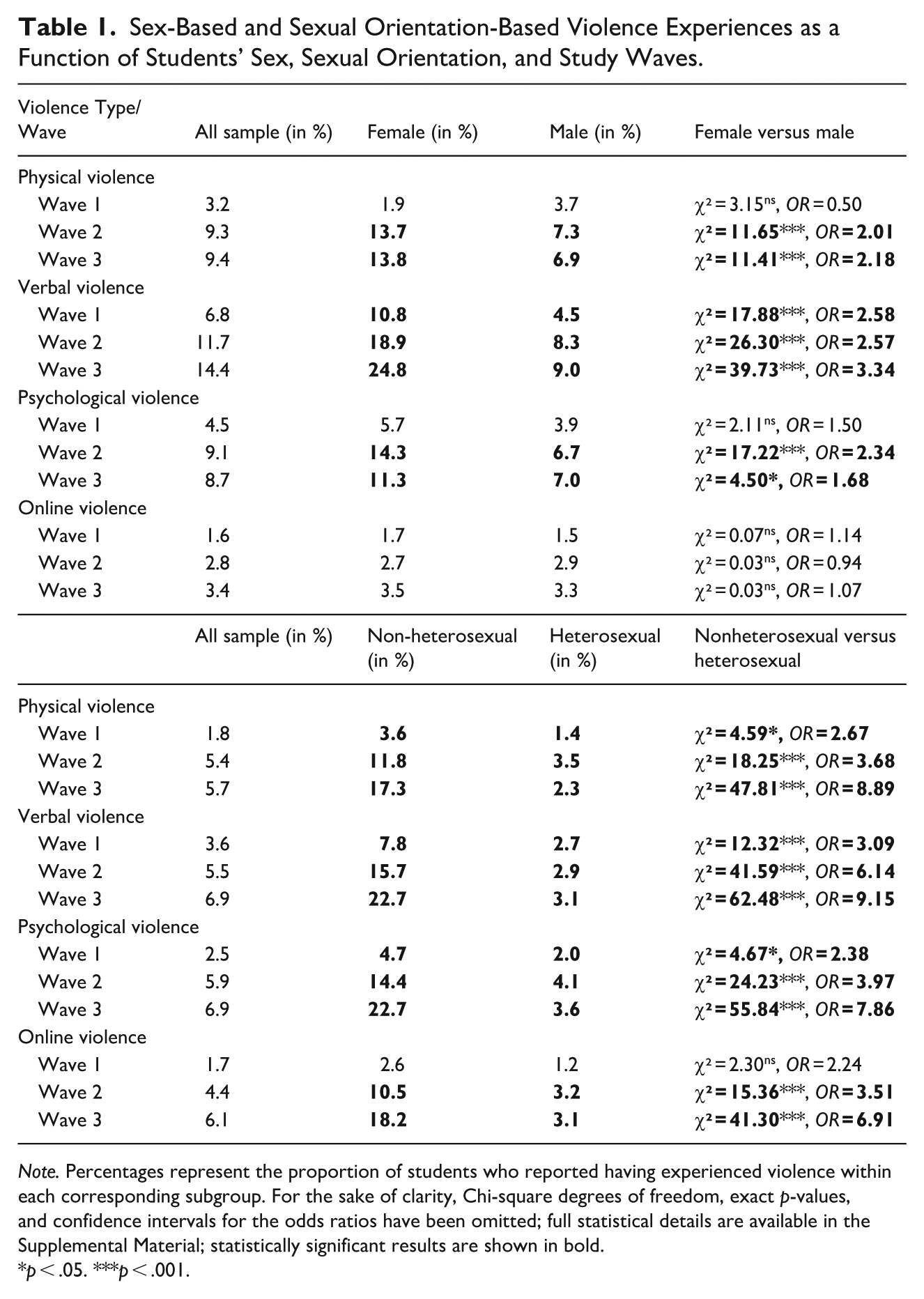
Note. Percentages represent the proportion of students who reported having experienced violence within each corresponding subgroup. For the sake of clarity, Chi-square degrees of freedom, exact p-values, and confidence intervals for the odds ratios have been omitted; full statistical details are available in the Supplemental Material; statistically significant results are shown in bold.
p < .05. ***p < .001.
In What Context Does Violence Occur, and Who Are the Perpetrators?
A significant proportion of physical, verbal, and psychological sex-based violence occurred in contexts unrelated to students’ training environments (all statistics on the contexts and perpetrators are available in the Supplemental Material). Nevertheless, approximately 20% of reported physical violence took place at school, and around 25% occurred within the training firm. Verbal violence followed a similar pattern, with about 25% of incidents reported at school and 30% in the firm, on average across the three waves of data collection. Peers or colleagues were the most frequently cited perpetrators of sex-based violence, being involved in roughly 30% of physical and verbal violence cases and in 35% of psychological violence cases, on average across the study waves. Teachers or supervisors and close relatives were less frequently identified as perpetrators, although teachers or supervisors were reported to be responsible for 15% of physical violence incidents and 10% of verbal violence cases.
Patterns of sexual orientation-based violence were evenly distributed across all contexts. Incidents occurred in relatively equal proportions at school, in the training firm, and in contexts both related and unrelated to students’ vocational training. Peers or colleagues were the most frequently reported perpetrators. On average across the study waves, 35% of those who experienced verbal violence based on their sexual orientation identified peers or colleagues as the aggressors. Interestingly, teachers or supervisors were implicated more often than close relatives, accounting for 20% of both physical and verbal violence incidents related to sexual orientation, on average across the study waves.
To What Extent Do Experiences of Violence Differ by Sex and Sexual Orientation?
Table 1 presents the prevalence of sex-based violence among female and male students, and of sexual orientation-based violence among heterosexual and nonheterosexual students, across the three survey waves, along with Chi-square tests and odds ratios. Across all waves, female students consistently reported significantly higher rates of verbal, physical, and psychological sex-based violence than their male peers, except for physical and psychological violence in Wave 1. For example, in the final wave, 24.8% of female students reported experiencing verbal violence (compared to 9% of male students), and 13.8% reported physical violence (compared to 6.9% of male students). The odds ratios for the significant comparisons ranged from 1.68 to 3.34, with a mean of 2.40, indicating that female students were, on average, 2.4 times more likely to report experiencing sex-based violence than male students. No significant sex differences were found for online sex-based violence.
Regarding sexual orientation-based violence, nonheterosexual students consistently reported significantly higher rates of all forms of violence compared to their heterosexual peers across all waves, except for online violence in Wave 1. For instance, by the final year, 17.3% of nonheterosexual students reported experiencing physical violence due to their sexual orientation (compared to 2.3% of heterosexual students), and 22.7% reported verbal violence (compared to 3.6% among heterosexuals). The odds ratios for the significant comparisons ranged from 2.38 to 9.15, with a mean of 5.30, indicating that nonheterosexual students were, on average, 5.3 times more likely to report experiencing sexual orientation-based violence than their heterosexual peers.
To What Extent Do Experiences of Violence Vary Across Fields of Study?
First, we examined the prevalence of violence across fields of study, without distinguishing by sex or sexual orientation (details are in Table 2). Descriptive statistics indicated relatively few differences in reported violence rates across fields. However, students in male-dominated fields consistently reported the lowest overall prevalence of sex-based and sexual orientation-based violence. For example, in the last wave, only 6.7% of students in male-dominated fields reported physical violence due to their sex, compared with 11.2% in sex-balanced fields and 14.2% in female-dominated fields. Similarly, 5.4% of students in male-dominated fields reported verbal violence due to their sexual orientation, compared with 7.7% in sex-balanced fields and 10.0% in female-dominated fields.
Sex-Based and Sexual Orientation-Based Violence Experiences by Fields of Study and Survey Waves.
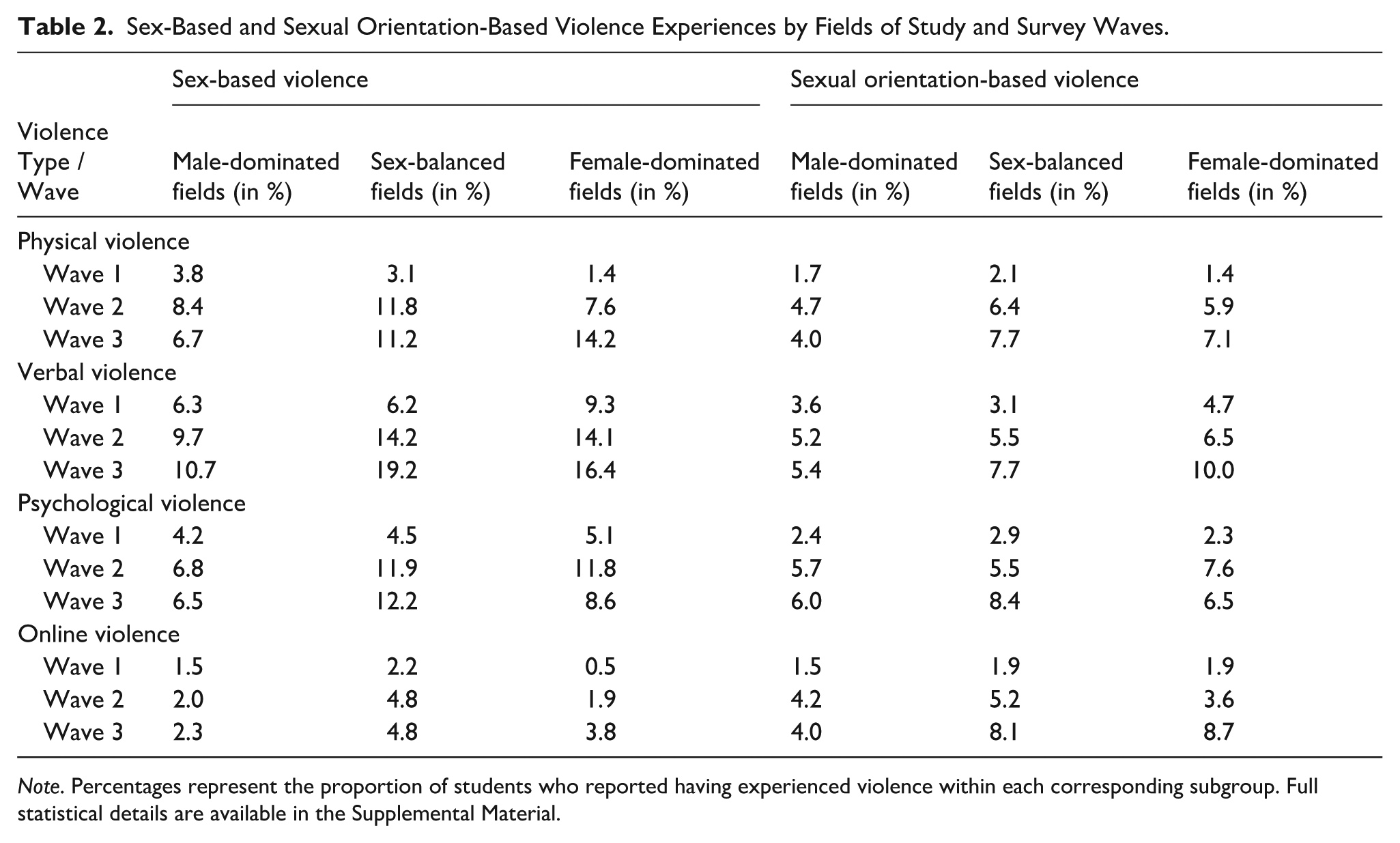
Note. Percentages represent the proportion of students who reported having experienced violence within each corresponding subgroup. Full statistical details are available in the Supplemental Material.
Second, we examined experiences of violence by sex and sexual orientation across fields of study (results related to sex-based violence are in Table 3, and those related to sexual orientation-based violence in Table 4). Across all survey waves, findings consistently showed that female students in male-dominated fields reported the highest levels of physical, verbal, and psychological violence compared to their male peers. Specifically, in male-dominated fields, female students reported significantly more physical violence (24.5% in Wave 2 and 15.9% in Wave 3), verbal violence (37.5% in Wave 2 and 43.2% in Wave 3), and psychological violence (18.8% in Wave 2 and 13.6% in Wave 3) due to their sex. The odds ratios for the significant comparisons ranged from 2.62 to 12.34, with a mean of 6.26, indicating that female students in male-dominated fields were, on average, 6.26 times more likely than male students to report experiencing sex-based violence. In sex-balanced fields, female students were more likely than male students to report verbal violence (but only at Waves 1 and 3), while no significant differences were observed for physical or psychological violence (except at Wave 2). In female-dominated fields, no significant differences in violence experiences were found between male and female students (except in online violence at Wave 3). Moreover, almost no differences between male and female students were observed in experiences of online violence across any field of study.
Sex-Based Violence Experiences as a Function of Sex, Fields of Study, and Survey Waves.
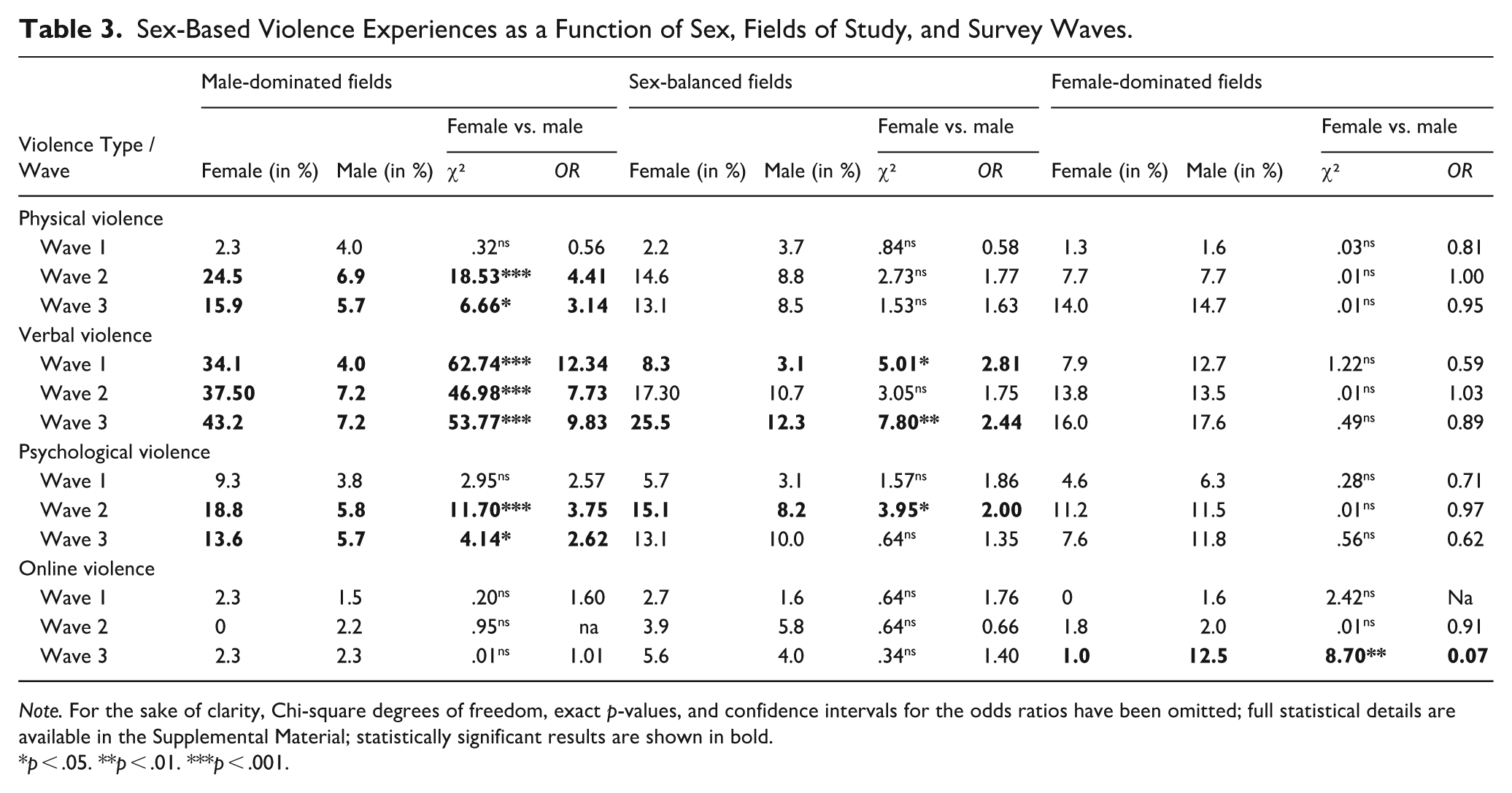
Note. For the sake of clarity, Chi-square degrees of freedom, exact p-values, and confidence intervals for the odds ratios have been omitted; full statistical details are available in the Supplemental Material; statistically significant results are shown in bold.
p < .05. **p < .01. ***p < .001.
Sexual Orientation-Based Violence Experiences as a Function of Sexual Orientation, Fields of Study, and Survey Waves.
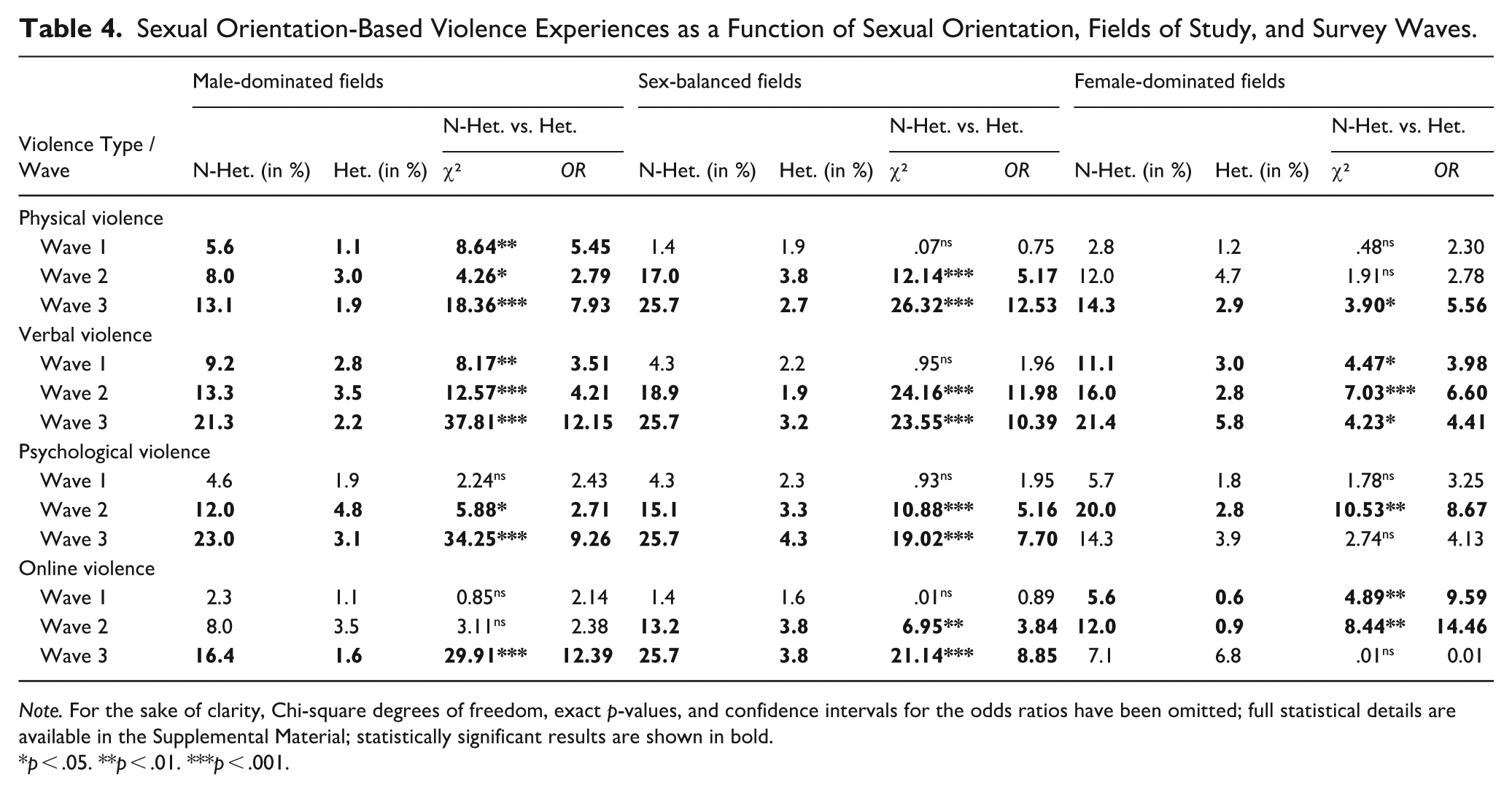
Note. For the sake of clarity, Chi-square degrees of freedom, exact p-values, and confidence intervals for the odds ratios have been omitted; full statistical details are available in the Supplemental Material; statistically significant results are shown in bold.
p < .05. **p < .01. ***p < .001.
Regarding sexual orientation-based violence, non-heterosexual students reported significantly higher levels of physical, verbal, and psychological violence compared to their heterosexual peers in male-dominated fields across all waves. They also reported more online violence, though this was only significant at Wave 3. In sex-balanced fields, nonheterosexual students reported higher levels of all forms of violence compared to heterosexual students, but only consistently at Waves 2 and 3. In female-dominated fields, nonheterosexual students reported significantly more verbal violence than heterosexual students across all waves, as well as more physical violence (only at Wave 3), psychological violence (at Wave 2), and online violence (at Waves 1 and 2). The odds ratios for the significant comparisons ranged from 2.71 to 12.39 (M = 6.71) in male-dominated fields, from 3.84 to 12.53 (M = 8.20) in sex-balanced fields, and from 3.98 to 14.46 (M = 7.61) in female-dominated fields.
Discussion
This study aimed to provide robust statistics on the prevalence of sex-based and sexual orientation-based violence experienced by VET students in Switzerland. Our findings revealed high levels of both sex-based and sexual orientation-based violence, with verbal and physical violence emerging as the most prevalent forms. Nearly 15% of the total sample reported experiencing verbal violence at least once due to their sex, and almost 10% reported incidents of physical violence at least once due to their sex. While sex-based violence was less frequent in educational contexts compared to contexts unrelated to VET, a significant proportion (45% of physical violence cases) occurred within school or training firm environments. In contrast, sexual orientation-based violence occurred uniformly across all contexts. Peers or colleagues were most frequently identified as the perpetrators of both sex-based and sexual orientation-based violence, with teachers (or supervisors) and close relatives also accounting for a notable portion of violent acts.
Importantly, we found that female students reported significantly more experiences of sex-based violence than male students, thereby aligning with prior research (Brown & Stone, 2016; Leaper & Brown, 2008, 2018). Similarly, the comparative analyses of violence based on sexual orientation corroborated trends widely documented in previous studies (Bontempo & D’Augelli, 2002; Kosciw et al., 2010; Toomey & Russell, 2016). Nonheterosexual students reported substantially higher rates of sexual orientation-based violence than their heterosexual peers, across all forms of violence. On average, the likelihood of experiencing sex-based violence is nearly twice as high for female compared to male students, while nonheterosexual students are over 5 times more likely to experience sexual orientation-based violence than heterosexual students. These findings provide clear evidence of the heightened prevalence of violence experienced by female and nonheterosexual students.
Fields of study play a key role in shaping the prevalence of violence. Sex-based violence reported by female students occurred almost exclusively in male-dominated fields, with minimal incidence in female-dominated or sex-balanced fields. In contrast, sexual orientation-based violence reported by nonheterosexual students was equally prevalent in male-dominated and sex-balanced fields. These findings align with prior research documenting higher levels of sex-based and sexual orientation-based violence in traditionally male-dominated environments (Blondé et al., 2024; Cech & Waidzunas, 2011; Dresden et al., 2018; Robnett, 2016). This suggests that such violence is not merely a reflection of individual attitudes but is shaped by a normative climate that legitimizes hostility toward women and nonheterosexual populations. The concentration of sexist violence in male-dominated fields reflects widely shared norms of masculinity, including strength, virility, and rejection of femininity (Cheryan et al., 2009; Messerschmidt, 1993). In these environments, women are seen as transgressing gender boundaries, and violence may function to affirm male dominance and signal that women are “out of place” (Lisco et al., 2015; Stanaland & Gaither, 2021).
Conversely, homophobic violence emerged in both male-dominated and sex-balanced fields. While male-dominated fields may foster such violence as a means of defending a strong masculine identity, defined in opposition to both femininity and homosexuality, sex-balanced fields (though potentially more flexible regarding gender norms) may nonetheless harbor deeply rooted heteronormative expectations. In these fields, heterosexuality may remain an unspoken norm, contributing to the marginalization of nonheterosexual students through both overt and subtle forms of violence.
Although no statistical analyses were conducted to test differences across study waves, several descriptive trends in experiences of violence are noteworthy. While previous research has documented a general decline in violence over time (Goodenow et al., 2016; Kessel Schneider et al., 2015), our data suggest a relative increase in both sex-based and sexual orientation-based violence over the course of students’ training. Specifically, experiences of sex-based violence among female students (compared to male students) appeared to rise between the first and second years before stabilizing in the final year, particularly in male-dominated and sex-balanced fields. This pattern may reflect an initial phase of social integration, during which students gradually encounter and internalize heterosexist norms within their school and field environments (Cerbara et al., 2022; Poteat, 2007). As peer dynamics increasingly revolve around exclusionary ideologies, hostile behaviors may intensify. By the final year, these patterns may stabilize (see also Cerbara et al., 2022), potentially due to the normalization of gendered roles, internalization of violence as part of the social climate, or attrition of more vulnerable students.
In contrast, sexual orientation-based violence reported by nonheterosexual students showed a steady increase across all waves, particularly in male-dominated and sex-balanced fields. This upward trend may reflect progressive socialization into homophobic norms, which are often reinforced rather than challenged in certain environments. Consequently, pressure on sexual minority students may intensify over time, contributing to persistent marginalization. Additionally, as students grow older, sexual orientation may become more visible or openly disclosed, further increasing exposure to targeted acts of violence.
Practical Implications
These findings underscore the persistent and pervasive nature of violence against female and LGB students in educational settings, representing a critical societal issue. The substantial disparities observed underscore the urgent need for more proactive public policies and large-scale interventions. The prevalence levels revealed in our study indicate that violence problems are not isolated actions of a few individuals. Rather, sex-based and sexual orientation-based violence constitute systemic issues that require comprehensive, multilevel responses (Osler, 2006).
First, it is essential to create an environment in which victims feel empowered to report any acts of violence they experience, ensuring they receive proper care once they do. Second, all stakeholders in the educational system must commit to a zero-tolerance stance on any form of violence, whether perpetrated by students, educators, or staff. Third, prevention efforts must be prioritized, with widespread, impactful information campaigns aimed at raising awareness among all parties involved. These prevention initiatives should clarify the full scope of sex-based and sexual orientation-based violence, emphasizing that even seemingly minor behaviors, such as sexist jokes, are harmful and constitute real forms of violence (Kelly, 1988; Swim et al., 2001). Additionally, educational programs must focus on highlighting the psychological and academic consequences of violence on victims. Efforts should also be directed at dismantling the underlying attitudes and beliefs, such as sexist and homophobic ideologies, and rigid traditional notions of masculinity, that perpetuate and justify violent behaviors. For example, Moss-Racusin et al. (2018) demonstrated that exposure to videos presenting the results of scientific studies on gender bias and its psychological underpinnings increases awareness of gender bias and promote positive attitudes toward women in STEM.
Limitations
This research has several limitations. First, although our findings provide valuable insights into the specific context of VET, they may not generalize to general education settings. Moreover, as the study was conducted within the Swiss educational system, observed patterns may reflect national or local specificities. Replication in other national and educational contexts is needed to assess the generalizability of our results. Second, we did not examine the intersection of students’ social identities—specifically, the interaction between sex and sexual orientation. Prior research (Goodenow et al., 2016) shows that experiences of victimization can differ markedly depending on whether women identify as heterosexual or nonheterosexual, as sexist and homophobic violence may co-occur in additive or interactive ways. However, due to small sample sizes, particularly when disaggregated by field of study, such intersectional analyses were not statistically feasible; they would not yield reliable or interpretable results. Future studies should aim to recruit larger and more diverse samples to better capture these intersecting experiences.
Third, our measures of violence relied on participants’ subjective interpretation of specific incidents as actual forms of violence and their attribution to sex or sexual orientation, which may have led to underreporting. Moreover, experiences of sexual orientation-based violence presuppose some level of disclosure, which many students may avoid in unsupportive environments. This may have obscured indirect violence experiences (e.g., exposure to homophobic language not directly aimed at the respondent). Additionally, all forms of violence were assessed using single-item measures. While common in large-scale surveys, this approach limits the ability to evaluate internal reliability and may fail to capture the full complexity of violence.
While our study examined various forms of violence, the categories themselves would also benefit from greater specificity: verbal and physical violence were not broken down into subtypes (e.g., insults, degrading jokes), and the online violence measure was limited to rumors and lies. Moreover, the study did not assess sexual harassment, despite its known prevalence and impact on female and LGB students. That said, as noted by Polanin et al. (2021), there is still no consensus on the scope of “school violence,” which is often assessed across heterogeneous forms of hostile behavior. Future research should strive for more refined measures to capture the complexity of violence experiences in educational settings.
Conclusion
Our study offers up-to-date data on the prevalence of various forms of sex-based and sexual orientation-based violence experienced by students in VET programs. Our findings provided concrete evidence that sex-based and sexual orientation-based violence remains a persistent issue in schools. Female and LGB students, particularly in fields where they are underrepresented, continue to face significant risks. These findings highlight the urgent need for comprehensive programs aimed at supporting victims of violence and addressing the causes of violent behaviors.
Supplemental Material
sj-docx-1-jiv-10.1177_08862605251384951 – Supplemental material for Prevalence of Sex-Based and Sexual Orientation-Based Violence Experiences in Vocational Education and Training
Supplemental material, sj-docx-1-jiv-10.1177_08862605251384951 for Prevalence of Sex-Based and Sexual Orientation-Based Violence Experiences in Vocational Education and Training by Jérôme Blondé, Lavinia Gianettoni, Edith Guilley, Dinah Gross and Taïs Foretay in Journal of Interpersonal Violence
Footnotes
Acknowledgements
The authors want to thank Morgane Dejussel for her help in this research.

Ethical Considerations
The study received ethical approval from the Research Ethics Committee of the Geneva Canton Education Service and was subsequently validated by the Department of Education in Geneva Canton.
Consent to Participate
Students’ consent to participate could be given verbally to their teacher before starting the study. Those who did not consent to participate were instructed to request an alternative task from their teacher. For students under the age of 18, parental consent was obtained in advance.
Funding
The authors disclosed receipt of the following financial support for the research and/or authorship of this article: The authors acknowledge support from the Swiss National Science Foundation (Grant number: 185460).
Declaration of Conflicting Interests
The authors declared no potential conflicts of interests with respect to the authorship and/or publication of this article.
Supplemental Material
Supplemental material for this article is available online.
Notes
Author Biographies
References
Supplementary Material
Please find the following supplemental material available below.
For Open Access articles published under a Creative Commons License, all supplemental material carries the same license as the article it is associated with.
For non-Open Access articles published, all supplemental material carries a non-exclusive license, and permission requests for re-use of supplemental material or any part of supplemental material shall be sent directly to the copyright owner as specified in the copyright notice associated with the article.
