




Abstract
A lot of sexual harassment research has focused on the most common male-on-female manifestation. Little research has considered women as perpetrators, men as victims, and same-sex incidents of harassment. It is necessary to consider both men and women as victims and perpetrators to foster targeted approaches for all manifestations. The current study examines same and opposite sex harassment, with men and women as both victims and perpetrators. Sexual harassment is further broken down and examined as undesired solicitation and derogation as opposite sex mate-seeking and competitor degradation tactics, respectively. The role of sociosexuality, which indicates an individual’s openness to short-term mating, was also examined. In a UK-based sample (n = 421, 58% women, age 18–30, recruited via social media and via the Prolific website) with opposite-sex interests, we found sociosexual behaviour to be a consistent predictor of opposite but not same sex harassment for both sexes. For women only, hostile sexism strongly predicted all manifestations of harassment engagement and experience. For undesired solicitation, opposite sex manifestations were most common. Same sex undesired solicitation was mediated by opposite sex solicitation for both sexes’ engagement and experience, suggesting a spillover effect. For derogation, opposite sex manifestations were again most common, with no mediation effect. This implies that sexual harassment as undesired solicitation is primarily a mate-seeking tactic reflecting underlying evolved desires, but derogation may be influenced by other factors. These findings have implications for future intervention development, indicating a need to consider mate-seeking psychology and to create sex-specific methods of targeting solicitation and derogation separately.
Introduction
Sexual harassment is a prevailing societal issue worldwide (Pina et al., 2009) that has received considerable attention in recent years, partly due to social movements (e.g., #MeToo) and strategic focus at both an international and national level. For example, the strategies of the Violence Against Women, Domestic Abuse, and Sexual Violence (Wales) Act 2015 include early intervention via age-appropriate primary and secondary education, raising societal awareness and challenging public attitudes, tackling gender-based harassment in public spaces, and workplace harassment. However, due to limited understanding, proactive interventions have demonstrated little and/or inconsistent efficacy and provide no longitudinal evidence (Adams et al., 2020; Bondestam & Lundqvist, 2020). Deeper investigation into personality, attitudinal factors, sex differences, and underlying evolved desires that influence sexual harassment is necessary to aid future intervention success (Leigh et al., 2021; Pina et al., 2009). This study seeks to address these shortcomings, to enhance extant knowledge of sexual harassment in a way that can guide future intervention development, by asking how specific factors relate to sexual harassment behaviour, and is this the same or different across the sexes?
‘Sexual harassment’ includes sex-based harassment and unwanted sexual attention (Bendixen & Kennair, 2017a; Burn, 2018). Sex-based harassment is any form of ‘derogation’ (e.g., insults) aimed at another because of their actual or perceived sex, gender expression, or sexuality. Unwanted sexual attention is any form of sexual ‘solicitation’ (e.g., touching, suggestive comments) that is unwanted by the targeted party. There is research that examines derogation and undesired solicitation separately, for example, in terms of prevalence, victimisation, and outcomes (Petersen & Hyde, 2009). However, the study of predictors for these distinct types of sexual harassment (e.g., Bendixen & Kennair, 2017a; Dekker & Barling, 1998; Diehl et al., 2012) is rare, more so when also examining same versus opposite sex manifestations. More research is needed to consider the possibility of differential routes to engagement, which may reveal unique intervention necessities.
Although harassment may be conducted with the intent of causing distress (e.g., bullying, derogation), there are various reasons mate-acquisition attempts may inadvertently devolve into harassment; e.g., immaturity (Schnoll et al., 2015), gender stereotyping (Brown et al., 2020; Galdi & Guizzo, 2021), and miscommunication (Haselton, 2003). A comparatively unexplored route to sexual harassment, however, is how a behavioural spillover effect may contribute to less common manifestations. Sex-role spillover theory considers how stereotypical sex-role expectations carry over into and have effects on workplace expectations and outcomes, regardless of relevance to the job (Gutek & Morasch, 1982; Triana, 2011). Research has demonstrated that sex-role expectations frequently spillover into the workplace, particularly regarding women (Gutek & Cohen, 1987). Individuals who deviate from expectations (e.g., homosexual men, women in a typically male work environment) are more likely to be victims of sexual harassment (Burgess & Borgida, 1997; Kaltiala-Heino et al., 2019; Stockdale et al., 1999).
There are well-grounded theories of sexual harassment as a behaviour driven by misogyny (Gray, 2021; Tinkler & Zhao, 2020) and a desire for power (Cleveland & Kerst, 1993; Kunstman & Maner, 2011). Many instances of harassment may indeed be explained as dominance behaviours intended to maintain social hierarchies (Manne, 2017). Yet there are other instances of harassment that are not well explained by these theories, particularly those involving ambiguous behaviours that occur without the intent of causing distress (e.g., during typical mate acquisition attempts). While some instances of sexual harassment are an attempt to gain sexual access and others as means of asserting dominance or reaffirming gender roles, these goals are not necessarily mutually exclusive. From an evolutionary psychological standpoint, degrading sexual competitors may be a tactic to elevate one’s status to desirable mates, and studies demonstrate the cross-cultural use of such tactics (Bendixen & Kennair, 2015; Buss & Schmitt, 1993; Fisher & Cox, 2009; Schmitt & Buss, 1996). Evolutionary psychological theories such as parental investment (Trivers, 1972) and sexual strategies (Buss & Schmitt, 1993) provide explanations for sex differences in mating styles and mate-acquisition tactics, including both undesired solicitation (giving unwanted sexual attention to potential sexual/romantic partners) and derogation (comments and/or actions that degrade potential sexual competitors) behaviours. Drawing from these theories, opposite sex mate-seeking behaviour would be expected to (a) signal sexual interest to members of the opposite sex and (b) derogate potential sexual competitors of the same sex. However, there may also be a positive (i.e., increasing as opposed to decreasing) behavioural spillover effect in sexual harassment perpetrators. Thus, higher rates of engagement in opposite sex solicitation and same sex derogation may lead to somewhat higher rates of same sex solicitation and opposite sex derogation.
There is value in determining which behaviours are goal-orientated and which are the product of spillover: Goal-oriented behaviours provide a clear target for intervention development (Ellis et al., 2016; Mastos et al., 2007) and reduction of these will likely decrease spillover behaviours (Dolan & Galizzi, 2015).
Sociosexuality and Harassment
Complementing theories of sexual harassment is a plethora of research discerning the traits and attitudes of those most likely to harass. Factors commonly associated with sexual harassment proclivity include rape myth acceptance (Begany & Milburn, 2002), sexism (Begany & Milburn, 2002; Diehl et al., 2012), sociosexuality (Bendixen & Kennair, 2017a; Kennair & Bendixen, 2012), and pornography use (Galdi & Guizzo, 2021; Kennair & Bendixen, 2012). Of particular interest from an evolutionary perspective, and thus of interest within this research, is the trait of sociosexuality, which reflects an individual’s preference for short-term mating. Studies have found an association between men’s short-term mate preferences and sexual harassment engagement (Abbey et al., 2011; Bendixen & Kennair, 2017a; Diehl et al., 2012; Tharp et al., 2013), highlighting a link between sociosexuality and sexual harassment. In fact, while still an under-researched topic, an issue to be addressed as part of this study, there is evidence that sociosexuality has strong associations with sexual harassment engagement and experience in both sexes (Bendixen & Kennair, 2017a; Kennair & Bendixen, 2012).
Bendixen and Kennair’s (2017a) study (n = 1,326) examined Norwegian student’s same and opposite sex experiences of and engagement in sexually harassing behaviours. To date, this is the only study to analyse sexual harassment by derogation and undesired solicitation separately, thus, replicability shall be assessed in the current study. Men were especially subject to same-sex derogation, and women to opposite-sex solicitation. Sociosexuality predicted both same-sex derogation and opposite-sex solicitation with greater power than all other variables. The authors argue that this format of same-sex derogation and opposite-sex solicitation is indicative of evolved sexual strategies, where the intent is sexual (mate acquisition) and not inherently hostile.
Male-on-female solicitation harassment dominates legal reports and public awareness (Adams et al., 2020); whether men are truly less harassed than women or whether the high tolerance of male sexual harassment (Russell & Oswald, 2016) and society’s traditional expectations of masculinity (Smith et al., 2023) result in significant underreporting is unclear. However, studies often find that sex differences are exaggerated rather than decreased in egalitarian societies, suggesting that social expectations are not a primary influence of gendered behaviour (Halsey & Geary, 2025; Herlitz et al., 2025). Similarly, as derogation compared to mate-seeking behaviour is overtly antisocial (Bendixen & Kennair, 2017a), perpetration of this type of behaviour may also be highly subject to underreporting. However, as a clear public issue coupled with evidence of sex differences in typical mating behaviour patterns and aggressive tendencies, most research focuses on the male-on-female manifestation. The current study will build on this by incorporating various possible manifestations of sexual harassment and delving deeper into the associations discussed, examining sexual harassment as derogation and as solicitation separately, and by sex.
Based on the research and logic discussed above, we predict that:
Sociosexuality will be the strongest predictor of same and opposite sex sexual harassment (Hypothesis 1).
Reporting victimisation of derogation would be more prevalent than reporting perpetration of derogation (Hypothesis 2).
Women will report more solicitation victimisation than men (Hypothesis 3).
Men will report more perpetration than victimisation of solicitation (Hypothesis 4).
There will be a higher prevalence of same sex compared to opposite sex derogation (Hypothesis 5).
There will be a higher prevalence of opposite-sex compared to same sex solicitation (Hypothesis 6).
While evolutionary psychologists share the belief that humans have the same set of psychological adaptations, they also acknowledge that those adaptations can be sensitive to context, allowing variation between behaviours across cultures (Gangestad et al., 2006). Not all adaptations are as susceptible to environmental input as others—mate preferences, for example, seem highly canalised and show remarkable stability between culture groups (Thomas et al., 2019). As discussed, sociosexuality has been linked to same and opposite sex harassment in both sexes. However, as this research used an exclusively Norwegian student sample (age 16–25), how generalisable this is to other age groups and less sexually egalitarian cultures is unclear. Additionally, this sampling would largely exclude incidents of workplace harassment. To expand on this and test generalisability, the current study will recruit a slightly older (age 18–30), mixed (i.e., students, in full-time employment, not working etc.), UK-based population. Should the relationship between sexual strategies and harassment hold true across context, then this speaks to the generalisability of evolutionary-informed sexual harassment interventions. Based on evolutionary logic, we predict that sociosexuality will remain primarily associated with sexual harassment tactics that solicit opposite sex mates and derogate same sex competitors. Thus, stemming from this, our hypotheses are:
Positive associations between sociosexuality and opposite sex derogation will be mediated by same sex derogation (Hypothesis 7).
Positive associations between sociosexuality and same sex solicitation will be mediated by opposite sex solicitation (Hypothesis 8).
Method
Participants
A total of 627 participants completed an online survey advertised as ‘A Survey on Sexual Attitudes and Experiences’. The study was distributed online using convenience sampling, with the paid recruitment site ‘Prolific’ being used to recruit 104 of the total participants. After excluding participants who were not in the key 18 to 30 age range, not from the United Kingdom, did not consider themselves male or female, or provided extensive missing data, there were 421 participants: 177 men (Mage = 23.35, SD = 3.23) and 244 women (Mage = 22.02, SD = 3.20). Most of the sample were white (85.3%), heterosexual (65.5%), educated to A-level or degree level (68.8% collectively), in full-time education (63.8%), and considered themselves lower-middle to middle class (69.3%). There was a fairly even split between being in a monogamous relationship and being single (48.2% and 40.4%, respectively). The largest observable sex difference was that more women than men were bisexual (28.7% vs. 9.1%, respectively).
Materials and Procedure
Participants gave informed consent and completed a form that captured their demographic details, including their age, sex, country of residence. Following this, they completed the following measures presented in the order presented below.
Data Availability
The data associated with this research are available at https://data.mendeley.com/datasets/vbx69szjng/1
Sociosexual Orientation Inventory—Revised
A nine-item self-report measure of one’s desire to have sex in the absence of commitment (Penke & Asendorpf, 2008). It comprises three subscales: behaviour (α = .84), attitude (α = .78), and desire (α = .88). Mean scores were used in analysis for each subscale. Aggregate sociosexuality scores represent the mean of the combined total of the subscales for each participant. Throughout this paper, reliability figures reflect those from the current study.
Porn Exposure Index
A self-report measure of (a) exposure during the past year (yes/no; α = .63) and (b) frequency of use (never [0], rarely [1], monthly [2], weekly [3], daily [4]; α = .73) to different types of pornography (erotica, soft-core, hard-core, and violent). Exposure was coded as 0 = no exposure or erotica only, 1 = soft core, 2 = hard core, and 3 = violent pornography. Each participant’s exposure score was multiplied by their frequency score to generate their pornography exposure index (Kennair & Bendixen, 2012).
Adapted Illinois Rape Myth Acceptance
An eight-item measure of belief in common rape myths (adapted from Payne et al., 1999; Bendixen & Kennair, 2017b). This short form maintains reliability (α = .83) and captures four categories of rape myths; (a) ‘she asked for it’, (b) ‘he didn’t mean to’, (c) ‘it wasn’t really rape’, and (d) ‘she lied’). Although Bendixen and Kennair (2017a) used a 22-item version of this scale, the authors recommend the use of this shorter, more participant-friendly version to avoid attrition. Mean scores are used for analysis.
Hostile Sexism Inventories
Adapted by Bendixen and Kennair (2017a) from the Ambivalent Sexism Inventory (Glick & Fiske, 1996) and the Ambivalence Toward Men Inventory (Glick & Fiske, 1999), this is a short eight-item measure of hostile sexism (Bendixen & Kennair, 2017a). Items were sampled from each inventory to measure sexism directed at (a) women—justification of objectification, power over women, and acceptance of traditional roles, and (b) men—resentment of male power and acceptance of negative stereotypes of men as hostile, arrogant, and domineering. Although Bendixen and Kennair (2017a) used five items from each, four items each were used in the current study for brevity’s sake, as recommended by Bendixen and Kennair (2017b); reliability was maintained (hostile sexism toward women α = .84, toward men α = .83). These items were presented in a randomised order. Two mean scores were used for analyses: (a) hostile sexism toward men and (b) hostile sexism toward women.
Sexual Harassment and Coercion Index
As in Bendixen and Kennair’s (2017a) study, the nine nonphysical (verbal, non-verbal, and digital) sexual harassment items from the original 13-item scale were used. Engagement in and experience of sexual harassment behaviours from/toward same sex and opposite sex peers were measured (Kennair & Bendixen, 2012). Thus, four aggregate scores were used in analyses to represent total same sex sexual harassment engagement, total same sex sexual harassment experience, total opposite sex sexual harassment engagement, and total opposite sex sexual harassment experience.
Following completion of the questionnaires above, participants were given a full written debrief. The study took approximately 30 min to complete, and IRB approval was granted by the first author’s institution.
Results
The first section of the results examines predictions of same and opposite sex sexual harassment. The second section examines sexual harassment in the forms of unwanted sexual solicitation versus derogation. Means were multiplied by 100 for ease of comparison with existing research.
Sex Differences
Compared to women, men tended to have a less restricted sociosexual orientation. Looking at separate subcomponents, this difference was mainly driven by desire—sociosexual behaviours were similar. Men had been exposed to much more porn than women and had a stronger acceptance of common rape myths. Both sexes were more hostile toward opposite sex than same sex peers, though this difference was marginal for men’s hostile sexism. Men held significantly higher hostile views of women than other women did, and women held significantly higher hostile views of men than other men did, with women’s hostility toward men being the strongest manifestation (see Table 1).
Descriptives and Sex Differences for Measures of Sociosexuality, Pornography Exposure, Rape Stereotypes, Hostile Sexism, and Harassment.
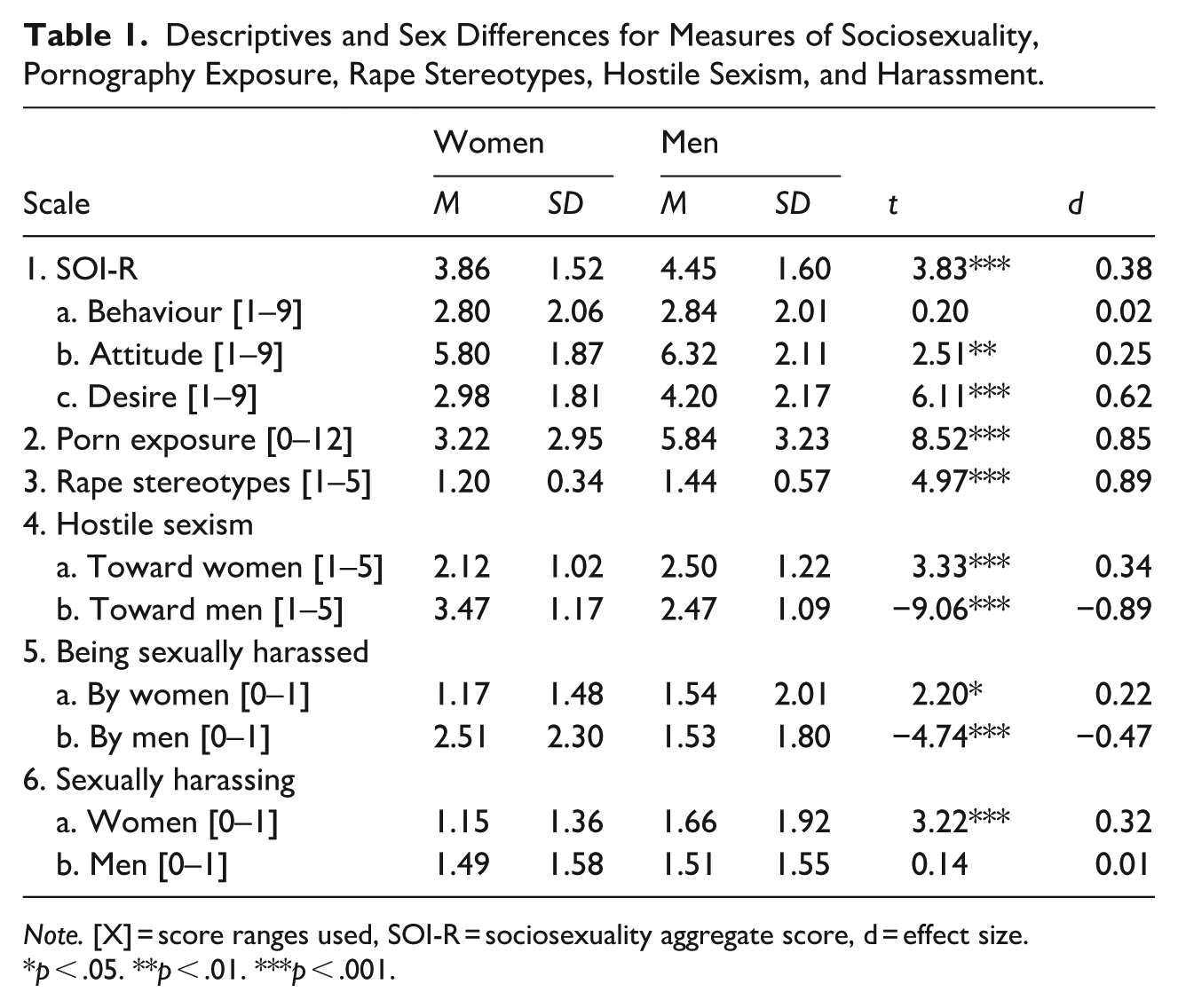
Note. [X] = score ranges used, SOI-R = sociosexuality aggregate score, d = effect size.
p < .05. **p < .01. ***p < .001.
Men reported experiencing similar levels of same and opposite sex harassment, whereas women reported experiencing greater levels of opposite sex harassment (harassment from men). Comparatively, men experienced slightly (but significantly) more harassment from women than did other women, while women experienced much greater levels of harassment from men than did other men. When reporting engagement in harassment, men reported engaging in slightly more opposite sex than same sex harassment (harassing more women than they did men). Women reported a similar pattern engaging in more opposite sex than same sex harassment (harassing more men than they did women). Comparatively, men reported harassing women significantly more often than women harass other women, while both sexes report harassing men at similar levels.
Reflecting known relationships between sexual harassment experience and engagement, both sexes report engagement and experience of harassment at similar levels in all cases except women’s opposite sex incidents (having experienced more harassment from men than they had engaged in).
Predictors of Being Sexually Harassed by Same and Opposite Sex Peers
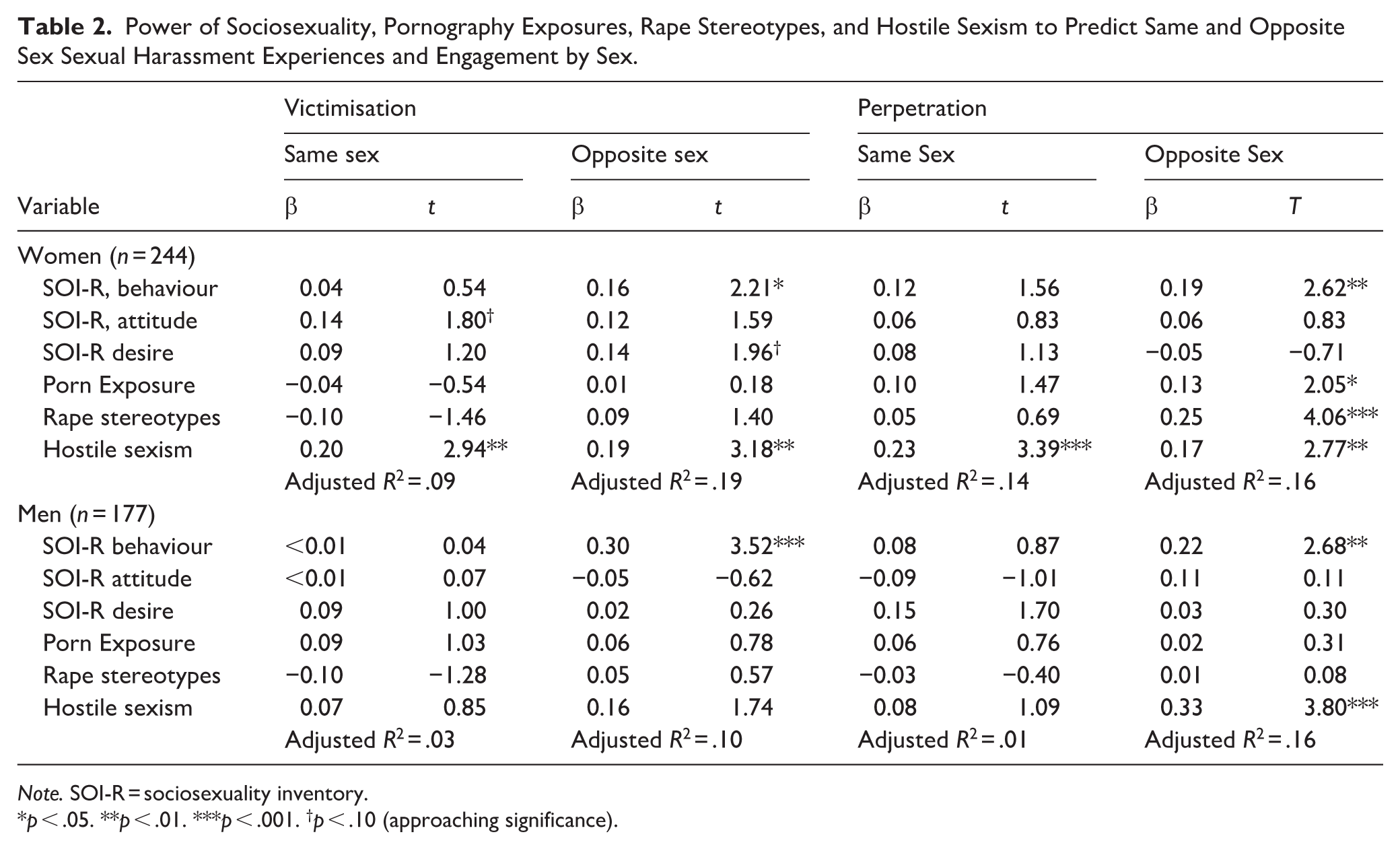
To test the prediction that sociosexuality would be the strongest predictor of same and opposite sex sexual harassment (Hypothesis 1), multiple regression analyses were conducted. Each sex was examined separately to allow for sex specific relationships to be revealed (see Thomas et al., 2021). All six predictors were entered into the same model (Table 2). In all models, hostile sexism reflected the appropriate sex (e.g., ‘toward women’ was entered for women being harassed by/harassing the same sex). These analyses were performed separately for being sexually harassed (victimisation) and for sexually harassing others (perpetration).
Power of Sociosexuality, Pornography Exposures, Rape Stereotypes, and Hostile Sexism to Predict Same and Opposite Sex Sexual Harassment Experiences and Engagement by Sex.
Note. SOI-R = sociosexuality inventory.
p < .05. **p < .01. ***p < .001. †p < .10 (approaching significance).
Victimisation
The behaviour component of sociosexuality was a consistent predictor of being harassed by opposite sex peers (though the effect size was twice as strong for men compared to women). Sociosexual desire was marginally significant for predicting women being harassed by men. Hostile sexism (toward women) predicted women’s victimisation from both men and other women. There were no significant predictors for men’s victimisation from other men. Porn exposure, rape stereotypes, and sociosexuality attitudes did not contribute to any predictive models. Predictive models of women’s victimisation were comparatively stronger than men’s. These findings contradict the hypothesis (H1) that sociosexuality would be the overall strongest predictor of sexual harassment victimisation. Instead, sociosexuality was a good predictor of opposite sex harassment victimisation but was secondary to hostile sexism for women.
Perpetration
Sociosexuality behaviour was again consistent for opposite, but not same sex harassment. Other sociosexuality components (desire and attitude) did not predict the perpetration of any sexual harassment. Hostile sexism predicted women’s harassment of men and women, and it was the strongest predictor of men’s harassment of women. For women’s harassment of men only, porn exposure and rape stereotypes were also predictive, with the latter being strongest. There were no predictive variables of men’s harassment of other men. Once again, findings were not supportive of the hypothesis (H1) that sociosexuality would be the strongest predictor of sexual harassment engagement, though, as with victimisation, sociosexuality was a good predictor of opposite sex harassment.
Derogation and Solicitation as Distinct Types of Harassment
To test predictions regarding the reporting of derogation and solicitation behaviour (Hypotheses 2–4), SHCI items were grouped to form a derogation component (items 1, 2, 3, and 6) and a solicitation component (items 4, 5, 8, and 9). Having nude images distributed online (item 7) was omitted form the study due to its low prevalence. These distinct styles of harassment capture the evolutionary theoretical vision of sexual harassment; solicitation directed at the opposite sex combined with derogation of same sex sexual competitors. Mean scores are displayed in Figure 1.
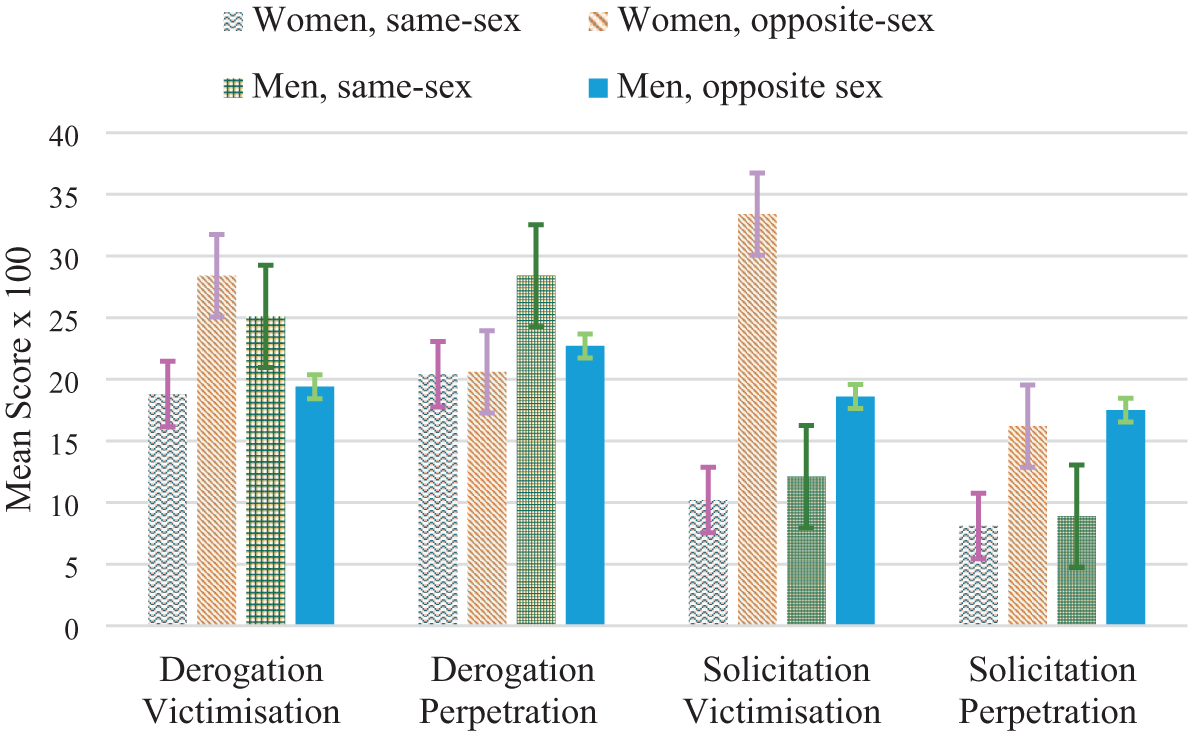
Mean score (×100) with standard error bars for victimisation and perpetration of same and opposite sex derogation and solicitation by sex.
Overall, findings are only partially supportive of predictions. The prediction that reporting derogation victimisation would be more prevalent than reporting derogation perpetration (Hypothesis 2) was largely unsupported: Only women’s experiences of derogation from men were more common than their derogation perpetration. The prediction that women would report more solicitation victimisation than men (Hypothesis 3) was supported by opposite sex harassment, but the reverse was true for same sex harassment. The prediction that men would report more perpetration than victimisation of solicitation (Hypothesis 4) was not supported.
Figure 1 clearly shows that reporting derogation is more common than solicitation for both sexes, with women’s high rates of being solicited by men being the only exception. Solicitation perpetration is the least reported manifestation for both sexes, with men and women reporting similar levels of engagement. Regarding victimisation, male-on-female harassment was most commonly reported by women for both derogation and solicitation. The pattern of men’s derogation and solicitation victimisation and perpetration appears to reflect evolved mate seeking and sexual competitor degradation behaviours: same sex derogation is more common than opposite sex, and opposite sex solicitation is more common than same sex.
Victimisation Versus Perpetration
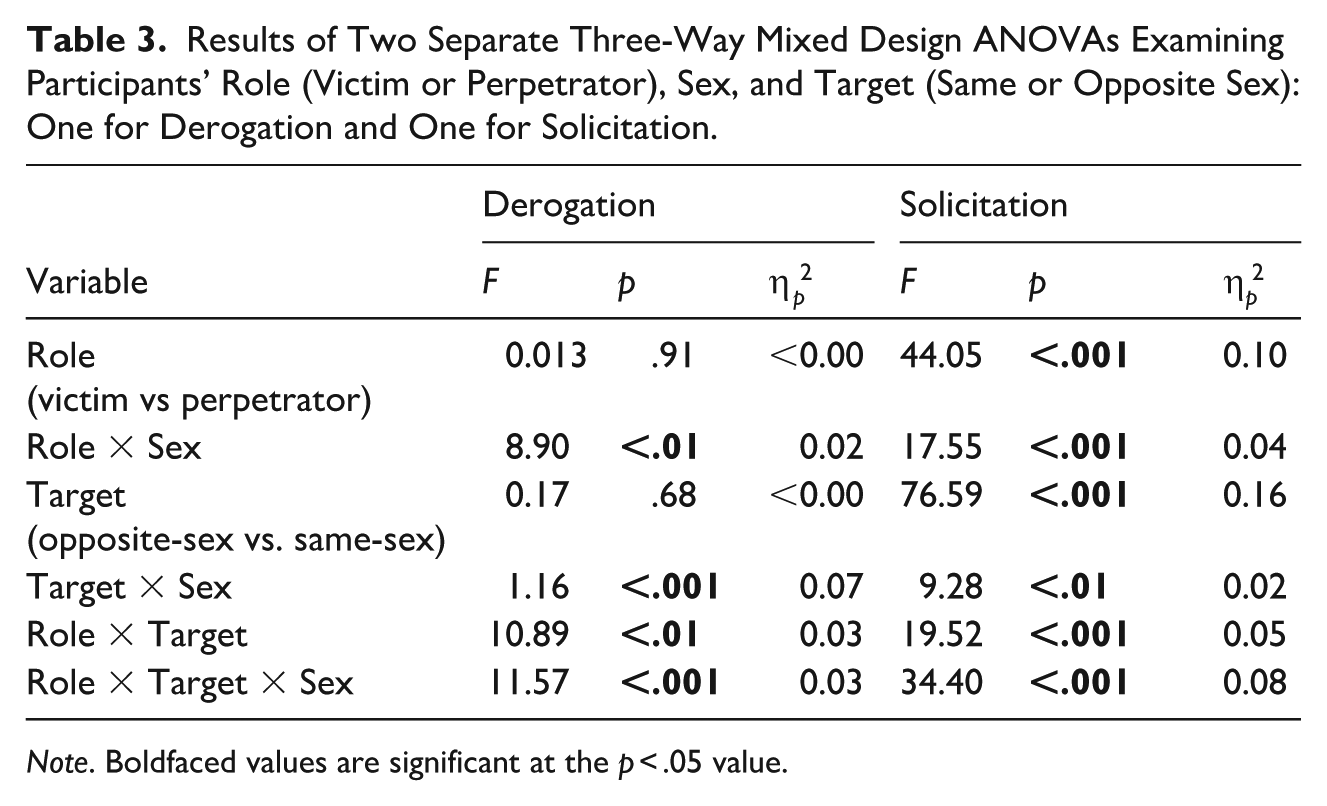
To test the predictions regarding same sex versus opposite sex derogation and solicitation prevalence (Hypotheses 5 and 6), two three-way (2 × 2 × 2) mixed design ANOVAs were run for derogation and solicitation separately. Targeted party (same sex vs. opposite sex) and role (victim vs. perpetrator) were within-subject factors and participant sex (men vs. women) was a between-subjects factor. Results are displayed in Table 3.
Results of Two Separate Three-Way Mixed Design ANOVAs Examining Participants’ Role (Victim or Perpetrator), Sex, and Target (Same or Opposite Sex): One for Derogation and One for Solicitation.
Note. Boldfaced values are significant at the p < .05 value.
The ANOVA results in Table 3 show that there is a three-way interaction for both derogation and solicitation. Significant comparisons revealed in post hoc analyses, using Bonferroni correction, are included in the Appendix.
Derogation
There was a significant three-way interaction between targeted party, role, and participant sex, F(1, 419) = 11.57, p < .001, η p 2 = .03, suggesting that derogation patterns of same sex versus opposite sex victimisation versus perpetration differ between men and women. Overall, the most reported manifestations of derogation were women being derogated by men and same sex perpetration for men.
For derogation, whereas men report harassing women more than being harassed by women, women report harassing men markedly less than being harassed by men. Women report similar levels of harassment towards men and women, whereas men report being harassed by and harassing other men more than being harassed by or harassing women. The pattern for men’s and women’s same sex derogation is similar (more perpetration than victimisation), though men’s is higher. The prediction that reporting victimisation would be more prevalent than reporting perpetration (Hypothesis 5) was not supported regarding derogation.
Solicitation
There was a significant three-way interaction between targeted party, role, and participant sex, F(1, 419) = 34.40, p < .001, η p 2 = .08, suggesting that solicitation patterns of same sex versus opposite sex victimisation versus perpetration differ between men and women. Overall, the most reported manifestation of solicitation was opposite sex victimisation for both women and men.
For solicitation, women report much higher levels of male-on-female than female-on-male harassment compared to men; men report these at similar levels. Both men and women report higher opposite sex than same sex victimisation and perpetration. The pattern for men’s and women’s same sex solicitation is similar (more victimisation than perpetration). The pattern of findings for solicitation was supportive of the prediction that there would be a higher prevalence of opposite sex compared to same sex undesired solicitation (Hypothesis 6).
Spillover Effects
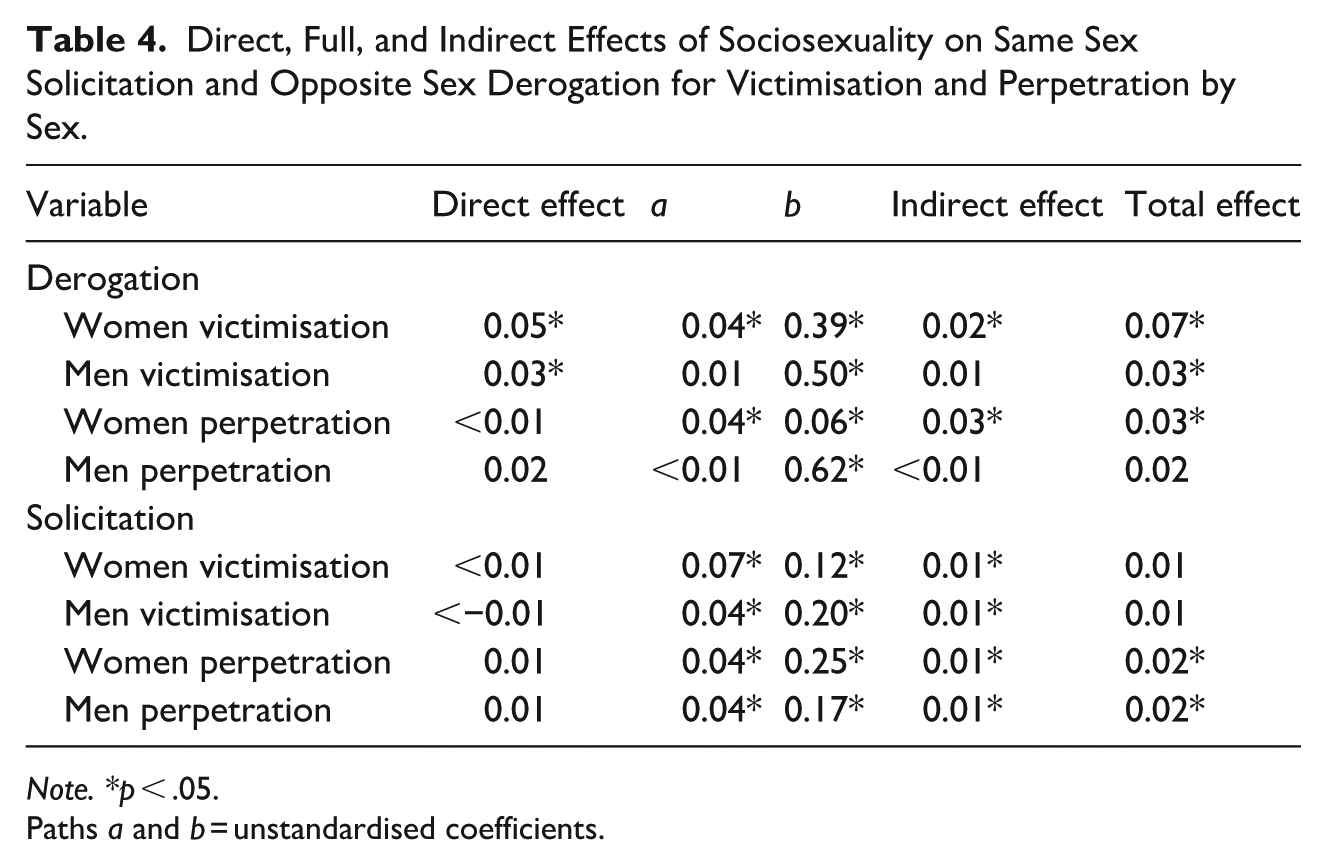
To test the predictions regarding sociosexuality and associations with sexual harassment tactics (Hypotheses 7 and 8), four mediation analyses were conducted for each sex. Associations between aggregate sociosexuality and opposite sex derogation (1—victimisation and 2—perpetration) were assessed with same sex derogation as a mediator. Associations between sociosexuality and same sex solicitation (1—victimisation and 2—perpetration) were assessed with opposite sex solicitation as a mediator. If indirect pathways are significant, it can be inferred that a spillover effect is present. Results, including unstandardised coefficients (paths a and b), direct effects, indirect effects, and total effects are displayed in Table 4.
Direct, Full, and Indirect Effects of Sociosexuality on Same Sex Solicitation and Opposite Sex Derogation for Victimisation and Perpetration by Sex.
Note. *p < .05.
Paths a and b = unstandardised coefficients.
The prediction that the association between sociosexuality and opposite sex derogation would be mediated by same sex derogation (Hypothesis 7) was partially supported in women only. Women being derogated by other women partially mediated the relationship between sociosexuality and women being derogated by men. Women derogating other women fully mediated the relationship between sociosexuality and women’s derogating men. Men’s derogation of/from other men did not mediate the relationships between men’s derogation of/from women.
The prediction that the association between sociosexuality and same sex solicitation would be mediated by opposite sex solicitation (Hypothesis 8) was supported in both sexes. Soliciting (perpetration) or being solicited (victimisation) by members of the opposite sex fully mediated the relationship between sociosexuality and soliciting/being solicitated by same sex peers.
Discussion
This study examined relationships between sociosexuality and sexual harassment. Sexual harassment was divided into the categories of engagement and experience, same and opposite sex, and into derogation and solicitation manifestations. Sociosexuality was not the strongest predictor of global harassment (Hypothesis 1) but was a good predictor of opposite sex harassment, specifically. Instead, hostile sexism was a consistent predictor of women’s sexual harassment. Unexpectedly, reporting perpetration of derogation was slightly more common than reporting victimisation (Hypothesis 2), with the exception of women’s opposite sex incidents. In partial support of Hypothesis 3, women reported being the victim of solicitation more than men, but only from the opposite sex. Men did not report more perpetration than victimisation of solicitation (Hypothesis 4). There was a higher prevalence of opposite sex compared to same sex derogation, contradicting Hypothesis 5. As predicted, there was a higher prevalence of opposite sex compared to same sex solicitation (Hypothesis 6). It was expected that sociosexuality would primarily be associated with sexual harassment tactics that reflected same sex derogation and opposite sex solicitation. This was not supported regarding derogation (Hypothesis 7); the relationship between sociosexuality and opposite sex derogation was partially mediated by same sex derogation in women only. However, this premise was supported regarding solicitation (Hypothesis 8); the relationship between sociosexuality and same sex solicitation was fully mediated by opposite sex solicitation in both sexes.
Interpretations and Implications
Sociosexuality is indicative of evolved predispositions towards a short- or long-term mating preference (Marcinkowska et al., 2021; Penke & Asendorpf, 2008). Having unrestricted sociosexuality (a preference for short-term mating) is more prevalent in men (Buss, 2016; Kennair & Bendixen, 2012), reflecting the perpetration rates of sexual harassment. There is evidence that sociosexuality has significant associations with sexual harassment engagement and experience in both sexes (Bendixen & Kennair, 2017a), thus, the same was expected to be found herein. The current study re-examined known associations between sociosexuality and sexual harassment and investigated this further by examining sexual harassment in the forms of derogation and undesired solicitation separately, and by sex. While sociosexuality was not the overall strongest predictor of sexual harassment, sociosexual behaviour was a good and consistent predictor of opposite sex sexual harassment for both sexes. This suggests that opposite sex harassment has a more direct relationship with mating strategy than does same sex harassment. This type of behaviour is likely, at least in part, to be motivated by sociosexual desire.
Same sex harassment, while likely still part of mating strategy, may take a less direct route; for example, derogation may be a method of seeking power/dominance as part of enhancing oneself over sexual competitors, with the subsequent goal of successful mate acquisition. Derogation, as an overtly undesirable behaviour, may also require greater levels of malevolent tendencies, for example, more hostility towards the same sex (as seen in women) and/or higher levels of traits commonly associated with sexual harassment but not measured herein (e.g., dark triad traits; Zeigler-Hill et al., 2016). As suggested in a study by Casey et al. (2017), sociosexuality alone is not always be enough to predict sexual aggression, despite having clear links. This may explain why none of the variables were predictive of men’s same-sex harassment within this study.
An unexpected, but interesting finding was the role of sexism in predicting sexual harassment. For women, hostile sexism strongly predicted all manifestations of harassment engagement/experience. In men, hostile sexism was only predictive of their harassment of women. Within the confluence model of men’s sexual aggression (Malamuth et al., 1996, 2021), hostile masculinity (which reflects men’s sexist views) and impersonal sex (sociosexuality) are both core risk predictors. In the current study, the strength of relationship with sociosexuality varies by harassment type, which may explain why sexism appears dominant. However, sex differences in predictors of and associations with sexual harassment may reflect asymmetries in ancestral pressures leading to differential cognitive processes preceding similar behaviours. Such information is vital for those wishing to develop sexual harassment interventions.
Hostile sexism may have a bidirectional link with sexual harassment: For example, and in relation to sexual harassment experience, ‘I am harassed, so I dislike you’ (and perhaps are more likely to perceive behaviour as sexual harassment), but also ‘I openly dislike you’ inviting retaliatory harassment behaviours. This could also apply to engagement, whereby having sexist views leads to sexual harassment engagement (e.g., a belief in sexual entitlement leading to solicitation or hostility leading to derogation), and sexual harassment behaviour evokes and/or strengthens sexist beliefs. How this harassment manifests may differ between the sexes; while men may objectify women they do not like, women may be more likely to engage in derogatory harassment (e.g., homophobic slurs, spreading sexual rumours). Furthermore, this could simultaneously reinforce the bidirectional link between sexual harassment engagement and experience in the same way as sociosexuality does: Those who engage in opposite sex sexual harassment because of their sexist beliefs (e.g., a man’s view of male entitlement or a woman’s view that all men are readily available) may inadvertently invite similar behaviour towards themselves.
Findings regarding sexual harassment as solicitation correspond with expected heterosexual mate acquisition tactics, further supporting the application of an evolutionary lens. Specifically, opposite sex solicitation was more frequent than same sex, the most common manifestation was women being solicited by men, and the relationship between sociosexuality and same sex solicitation was fully mediated by opposite sex solicitation in both sexes. The latter suggests that same sex solicitation is a form of behavioural spillover rather than a result of those with high sociosexuality indiscriminately soliciting and/or intentionally acting undesirably.
For reasons that are unclear, opposite sex derogation was more prevalent than same sex derogation herein. In other studies, the opposite prevalence is true (Bendixen & Kennair, 2015; Buss, 2016; Fisher & Cox, 2009; Schmitt & Buss, 1996), specifically with more slut-shaming among women (Buss & Dedden, 1990; Kennair et al., 2023) and more physical prowess derogation and homonegative slurs among men (Buss & Dedden, 1990; Slaatten et al., 2014). It is possible that an element of social desirability and/or a UK tendency to view same sex derogation as ‘harmless banter’ (common within UK ‘lad culture’; Owen, 2020) had an influence on participants’ responses. This anomaly warrants further investigation.
There was also a tendency towards reporting more derogation perpetration than victimisation (except for women derogating men) despite derogation being an overtly undesirable behaviour. As discussed, this may reflect the use of denigrating slang as ‘banter’, with these types of behaviours being seen as more acceptable to admit to compared to solicitation (which may be specific to UK culture), particularly in lieu of the #MeToo movement. Additionally, derogation was, overall, reported more commonly than solicitation. Again, this may be due to the higher perceived acceptability of derogation compared to solicitation, and even greater reluctance to admit to solicitation. The exception to this is women experiencing solicitation at the hands of men, a common and well-publicised occurrence about which women are actively encouraged to speak of.
Of interest, the aforementioned study using a Norwegian sample (Bendixen & Kennair, 2017a) found derogation victimisation was more commonly reported than perpetration, and there were less pronounced differences between reports of derogation and solicitation. The Norway study also found a significant mediation effect for sexual harassment associations with sociosexuality for both derogation and solicitation. Norway has consistently scored as a highly egalitarian society; In the Global Gender Gap report (World Economic Forum, 2024), which is weighted on educational attainment, health, political empowerment, and economic opportunity, Norway ranked third place while the United Kingdom did not make the top 10 at 14th. Previous research has found that sex differences in partner age preferences are consistent despite culture (even when highly egalitarian), suggesting evolved tendencies in mate choice (Grøntvedt & Kennair, 2013). While similar cross-cultural findings regarding solicitation support the premise of evolved predispositions and mating tactics at play, notable discrepancies herein suggest that derogation as a mating strategy is more susceptible to cultural influences. As with sex differences, cultural differences will be important to consider during intervention implementation.
Limitations and Future Directions
While logical assumptions can be made, due to the cross-sectional nature of the study, direction and causality cannot be definitively inferred. Given the novelty of examining sexual harassment as derogation and solicitation separately, this line of research needs replication to further support findings; in particular, to confirm the cultural versus the evolved influences of derogation and solicitation, respectively. The higher influence of sexism seen in women compared to men suggests that future sexual harassment interventions may need to adopt targeted, sex-specific approaches: Aiming to reduce hostile perceptions of men in women and focusing on promoting prosocial behaviour in mate-seeking men. However, it is important that future research continues to examine other possible underpinnings not included within this study, such as fear, as drivers of sexual harassment behaviour.
Various expectations were contradicted in the study results. Predictions were made based on previous research findings and using evolutionary logic. These unexpected outcomes emphasise the nuanced nature of sexual harassment behaviour, especially across differing samples (e.g., cross-culturally). However, key elements remain consistent, specifically regarding solicitation and male-on-female sexual harassment, supporting the application of an evolutionary lens in these areas.
An effect of sexism on women’s sexual harassment was found within the Norway study (Bendixen & Kennair, 2017a), though this was not as strong as within the UK sample, which may reflect cultural differences in attitudes. This sex-specific finding across cultures highlights the necessity of targeted approaches. It should be noted that there was a slight age difference between the United Kingdom and Norway samples (UK = 18–30, Norway = 16–24), with the Norway sample being comprised entirely of students. Thus, noted differences may in fact be age-related rather than cultural and/or may reflect incidents of workplace harassment that were unobservable in an exclusively student sample.
The sample within this study was collected with the aim to reflect the UK population. Compared to recent UK census results, this aim was successfully achieved for this age group in terms of sexuality, SES, ethnicity, sex, and education level. As such, other minorities are not well represented, and results cannot be generalised to them, to other age groups, or to other cultures. Furthermore, there was a disproportionately high number of participants still in full-time education and, due to the nature of hypotheses, those who did not consider themselves male or female were omitted. These factors should be taken into consideration when assessing findings. While the aims of the current study were accomplished, future research should continue to examine the sexual harassment engagement and experiences of all minorities, both within and between cultures and subcultures that vary in relevant social dimensions.
Conclusion
Interventions may need to be harassment type-specific, as well as sex-specific, with derogation requiring a culturally relevant approach, while solicitation may facilitate a more universal method. It would be sensible to investigate the latter suggestion further, especially concerning more conservative cultures. Larger-scale studies that can examine possible effects of age and/or employment status are desirable. However, there was a large age-range overlap and most of the UK sample were full-time students, so some comparability remains. If findings for sociosexuality and solicitation remain consistent cross-culturally, future approaches should take evolved drives and cognitive processes into consideration.
Supplemental Material
sj-docx-1-jiv-10.1177_08862605251381845 – Supplemental material for Same and Opposite Sex Sexual Harassment: The Roles of Sex and Sociosexuality
Supplemental material, sj-docx-1-jiv-10.1177_08862605251381845 for Same and Opposite Sex Sexual Harassment: The Roles of Sex and Sociosexuality by Shonagh Leigh, Faith Jones, Tom Scourfield, Leif E. O. Kennair, Mons Bendixen and Andrew G. Thomas in Journal of Interpersonal Violence
Footnotes
Acknowledgements
We thank Marius Stavang, Melis Demiralp, Rachel George, and Izabela Houston for their feedback on an earlier version of this manuscript.

Ethical Considerations
Ethical approval was received from the Swansea University psychology department ethics committee (5386).
Consent to Participate
All participants gave informed consent before taking part in this research. Consent was given via a checkbox on the Qualtrics survey.
Consent for Publication
Informed consent for the publication of individuals’ data was provided by participants.
Funding
The authors disclosed receipt of the following financial support for the research and/or authorship of this article: This work was supported by the Economic and Social Research Council (Wales Doctoral Training Partnership PhD+3, awarded to Shonagh Leigh). The funders had no role in study design, data collection and analysis, decision to publish, or preparation of the manuscript.
Declaration of Conflicting Interests
The authors declared no potential conflicts of interest with respect to the authorship and/or publication of this article.
Supplemental Material
Supplemental material for this article is available online.
Author Biographies
References
Supplementary Material
Please find the following supplemental material available below.
For Open Access articles published under a Creative Commons License, all supplemental material carries the same license as the article it is associated with.
For non-Open Access articles published, all supplemental material carries a non-exclusive license, and permission requests for re-use of supplemental material or any part of supplemental material shall be sent directly to the copyright owner as specified in the copyright notice associated with the article.
