




Abstract
Aggression in relational contexts, such as intimate partner violence (IPV) and stalking, is a worldwide problem with severe consequences for all involved, including bystanders and society. Although previous research has identified risk factors for victims and perpetrators, the connections among these risk factors remain unclear. Therefore, we aimed to investigate how individual characteristics (i.e., childhood trauma, adult attachment style, maladaptive personality traits, and moral disengagement) and negative experiences during or after romantic relationships (i.e., IPV and stalking) as both victim and perpetrator are interrelated. A sample of 648 participants from the general population completed online self-report questionnaires (71% female, Mage = 34.93 years old, SDage = 16.40). A partial correlation network was estimated on the scale level to investigate these interrelations. In addition, networks were estimated and compared for men and women separately. While IPV victimization and perpetration were strongly interrelated, there was no significant relationship to other nodes in the network. Contrarily, stalking victimization was part of the network and positively connected to abusive childhood trauma and gender. The most central nodes in the network were Callous-Unemotional personality traits and gender. No significant differences were found between the networks for men and women separately. Against expectations, these individual characteristics are not as impactful in IPV involvement as previously thought. Further research is needed to understand the contextual factors predicting aggression in romantic relationships.
Keywords
Introduction
Stalking is defined as the “willful, malicious, and repeated following or harassing of another person that threatens his or her safety” (Meloy & Gothard, 1995, p. 258) and can manifest in various forms, from offline to online behaviors. Between 2014 and 2018, 50,885 victims of stalking were reported in the Netherlands, with ex-partners accounting for the majority (60.1%) of perpetrators (Centraal Bureau voor de Statistiek, 2020). Stalking often follows romantic relationships and can co-occur with intimate partner violence (IPV). IPV encompasses physical, psychological, or sexual harm within/after an intimate relationship, including physical and psychological aggression, sexual coercion, and controlling behaviors (World Health Organization, 2022). In 2017, 417,000 individuals in the Netherlands1 were victims of IPV (van Eijkern et al., 2018), a number that may include stalking due to reporting overlaps. Many victims do not report these incidents to law enforcement often due to shame (van der Veen & Bogaerts, 2010). Consequently, more research and alternative methods are needed to investigate the overlap between stalking and IPV and to identify distinct risk factors.
Although several studies have investigated the interrelations between various risk factors and involvement in IPV and stalking separately (e.g., Carter & Egan, 2022; Widom et al., 2008), no research has simultaneously examined all these factors together for both victimization and perpetration, as aimed in the current study. According to the intergenerational transmission of violence, risk factors and involvement in IPV and stalking may be interconnected and mutually reinforcing. Childhood maltreatment can lead to trauma, influencing cognitive, affective, and behavioral internal working models (IWM), which may result in insecure attachment styles (Bowlby, 1988). Attachment styles, formed through early interactions with primary caregivers, become internalized as working models of the self and others. These models form the foundation for personality traits, including maladaptive traits. Personality traits tend to be relatively stable over time, affecting future (romantic) relationships (Fraley & Shaver, 2000). As a result, early experiences might predict negative parenting styles in adulthood, potentially leading to adverse outcomes and violence in the next generation (Sijtsema et al., 2020). However, there is a lack of detailed information on the reciprocal associations and the strength of associations between factors like childhood trauma, attachment, maladaptive personality traits, and adverse outcomes when controlling for the other factors.
Overall, evidence has suggested an association between IPV and stalking from both victim and offender perspectives (Senkans et al., 2021). Both stalking and IPV involve attempts to control, dominate, and exert power over the victim. This is often rooted in underlying beliefs, such as a desire for closeness combined with hypersensitivity to rejection, obsessive thinking, possessiveness, or aggression driven by a conflicted sense of identity and self-worth, as well as feelings of entitlement (Flowers et al., 2022). These beliefs are frequently linked to maladaptive or psychopathic personality traits, including narcissism, dominance, sensation-seeking, and impulsivity, which are common in perpetrators of both stalking (March et al., 2020) and IPV (Plouffe et al., 2022). These traits align with the three-factor hierarchical model of psychopathic traits: grandiose-manipulative (GM), callous-unemotional (CU), and impulsive-irresponsible (II) traits (Andershed et al., 2002). Clinical studies emphasized the role of coercive control and its association with (cluster B) personality disorders in perpetrators, although motivations may vary among perpetrator types (Flowers et al., 2020, 2022). Consequently, different maladaptive personality traits may contribute to IPV and stalking perpetration in distinct ways.
Maladaptive personality traits can help explain why some victims struggle to leave abusive relationships. Traits like borderline personality and emotional deprivation schemas, which involve beliefs that others cannot provide adequate emotional support, are particularly relevant (Pereira et al., 2020). Stalking victimization has been associated with borderline and narcissistic personality traits, including impulsivity and self-centeredness (Ménard & Pincus, 2014). In addition, individuals with an (unconscious) preference for a dominant partner may be more susceptible to stalking victimization (Sciarrotta et al., 2022), a vulnerability linked to childhood trauma and lack of family support (Ménard & Pincus, 2014). Childhood trauma is known to increase the likelihood of victimization of stalking and IPV in adulthood (Li et al., 2019; Widom et al., 2008). Specifically, childhood sexual abuse is a risk factor for both the perpetration and victimization of stalking, regardless of gender (Ménard & Pincus, 2012, 2014). Moreover, any form of childhood trauma predicts IPV victimization (McMahon et al., 2015) and IPV perpetration, with childhood abusive trauma showing a stronger association for men compared to women (Li et al., 2020; Smith-Marek et al., 2015).
These associations between childhood trauma and maladaptive personality traits can be understood through the theoretical framework of intergenerational transmission of violence, as explained by the social learning theory (Bandura et al., 1961) and attachment theory (Bowlby, 1988). Attachment can be divided into two dimensions: anxiety (IWM of the self: fear of rejection and abandonment) and avoidance (IWM of the other: fear of intimacy and closeness) (Hazan & Shaver, 1987). Both dimensions were found to be risk factors for IPV victimization and perpetration (Velotti et al., 2018), but the impact of these attachment styles varied by gender and type of victimization or perpetration. Anxious attachment—related to a negative self-image—may explain why some victims remain in abusive relationships, as they often feel responsibility and guilt, attributing the abuse to their own perceived shortcomings. Avoidantly attached victims may be perceived as reluctant to seek help and often lack adequate social support, which can explain their hesitation to leave violent partners (Zapor et al., 2018). Perpetrators with anxious attachment tendencies might be hypersensitive to rejection and more demanding of their partner, using violence as a strategy of regulation (Velotti et al., 2018). Although not consistently found, some studies suggested that avoidantly attached perpetrators may display a more antisocial subtype, characterized by using physical and sexual violence (Velotti et al., 2018).
Thus far, childhood trauma is a well-established risk factor for developing maladaptive personality traits and experiencing negative or violent behaviors during and after romantic relationships. But what drives someone to harm a loved one or an (ex-)partner, or stay in a relationship with an abusive partner? One explanation lies in the concept of moral agency, part of the social cognitive theory, which encompasses self-regulatory mechanisms aimed at promoting humane behavior (Bandura et al., 1996). However, when these mechanisms are inhibited or disengaged, immoral and inhumane acts can occur, even if they conflict with core beliefs. This process, known as moral disengagement, can occur in both perpetrators (Bandura et al., 1996) and victims (Cuadrado-Gordillo et al., 2020). Men may use moral disengagement more frequently than women, particularly in contexts like sexual harassment (Rollero & De Piccoli, 2020). Moral disengagement mechanisms such as displacement of responsibility or dehumanization have been found to mediate the relationship between maladaptive personality traits—especially psychopathic traits—and psychological IPV perpetration by men against women (Carter & Egan, 2022). Therefore, moral disengagement may be an important cognitive mechanism explaining why individuals engage in IPV or stalking.
The Present Study
Most research on IPV and stalking uses variable-centered approaches, which assume independent risk factors. However, this approach may obscure dynamic and reciprocal relations among multiple co-occurring factors within the complexity of interpersonal contexts. There remains a gap in understanding how multiple risk factors overlap and interact within romantic relationships. Detailed analysis of the reciprocal associations among these factors, while controlling for the other variables, is essential to identify key elements influencing IPV and stalking behaviors in both perpetrators and victims. To address this gap, a network approach is proposed, which uniquely allows for an examination of reciprocal associations and core features within the network (Hevey, 2018). In network analysis, nodes represent constructs or variables, and edges denote the relationships between them. By mapping these interrelations, this study aims to uncover patterns that may reveal the underlying mechanisms driving negative romantic experiences. Identification of constructs that are relatively central, meaning they have strong connections with other constructs, while accounting for the influence of all other variables, can aid in developing prevention and treatment strategies for both victims and perpetrators of IPV and stalking. By providing a detailed examination, network analysis can help develop targeted prevention and treatment programs by revealing nuanced psychosocial patterns. It moves beyond variable-by-variable explanations and offers a systems-level perspective on IPV and stalking.
The central research question investigates how individual characteristics, such as childhood trauma (abuse and neglect), attachment (anxiety and avoidance), maladaptive personality traits (GM, CU, and II), and moral disengagement, are related to negative partner relationship events, including IPV and stalking (both as victim and perpetrator). Although the study is mostly exploratory, positive associations (edges) were expected between the individual characteristics and IPV and stalking. Age was added as a control variable, expected to correlate positively with both IPV and stalking, as older participants had more opportunities to experience these behaviors. It was expected that childhood trauma and attachment were the most central in the network. Childhood victimization is one of the most important predictors of IPV and stalking in adulthood (Li et al., 2019, 2020; McMahon et al., 2015; Widom et al., 2008). Childhood trauma can lead to insecure attachment styles (Bowlby, 1988), shaping one’s IWM of the self and others within the context of romantic relationships in adulthood (Hazan & Shaver, 1987).
Method
Participants and Procedure
Dutch-speaking community members completed an online Qualtrics questionnaire, consisting of self-report measures, which took 30 to 60 min. Participants were required to be 16 years or older. The final sample comprised 648 participants (71% women). Participants were recruited through convenience sampling by psychology students at Tilburg University, who distributed the survey link within their social networks. Participants ranged from 16 to 86 years old (M = 34.9, SD = 16.4). On average, they reported having three past romantic relationships (lasting for ≥ 1 month; M = 2.9, SD = 4.7). The distribution of current relationship statuses was single (22.6%), in a relationship without cohabiting (29.8%), cohabiting (15.4%), married or in a registered partnership (30.5%), and widowed (1.7%). Regarding sexual preference, 89.9% identified as heterosexual, 2.5% as homosexual, 6.5% as bisexual, 0.2% as asexual, 0.5% as pansexual, 0.2% as queer, 0.2% were unsure, and 0.3% preferred not to disclose.
Before participation, informed consent was obtained, ensuring that participants were informed about the voluntary and anonymous nature of the study and the possibility of data publication. They were notified that they could withdraw from the study at any time without consequences or providing a reason. Given the potentially sensitive topics, such as traumatic experiences and violence, participants were given links to websites for psychological help (e.g., https://www.veiligthuis.nl). The study received approval from the Ethics Review Board of Tilburg School of Social and Behavioral Sciences (RP128). All data were stored anonymously in compliance with the European Union General Data Protection Regulation (GDPR) guidelines.
Measures
Adult Attachment
Adult attachment style was measured by the Dutch translation of the Revised Adult Attachment Scale (Collins, 1996; van Aken et al., 2017), an 18-item self-report scale assessing two attachment dimensions: avoidance (12 items, e.g., “I am somewhat uncomfortable being close to others”) and anxiety (six items, e.g., “I often worry that other people won’t want to stay with me”). Participants responded based on how they generally feel in close relationships, using a 5-point Likert scale ranging from 1 (not at all characteristic of me) to 5 (very characteristic of me). Mean total scores were calculated for both dimensions. Higher scores indicate more insecure attachment styles, whereas lower scores represent more secure attachment styles. The subscales had good internal consistencies (avoidance: α = .83; anxiety: α = .85).
Childhood Trauma
To evaluate traumatic childhood experiences, the Dutch version of the Childhood Trauma Questionnaire—Short Form was used (Bernstein et al., 2003; Thombs et al., 2009). This is a 25-item self-report measure encompassing five subscales, each with five items: emotional abuse, physical abuse, sexual abuse, emotional neglect, and physical neglect. Items (e.g., for physical abuse “When I was growing up I had not enough to eat”) were rated on a 5-point Likert scale ranging from 1 (never true) to 5 (very often true). Mean total scores were calculated for abuse (i.e., emotional, physical, and sexual abuse), and neglect (i.e., emotional and physical neglect) separately, with higher scores indicating more experienced childhood trauma. The subscales had good internal consistency (abuse: α = .88; neglect: α = .85).
Maladaptive Personality Traits
Maladaptive personality traits were assessed using the Dutch version of the Youth Psychopathic Traits Inventory (YPI; Andershed et al., 2002; Das & de Ruiter, 2003), a 50-item self-report measure focusing on the psychopathic personality constellation. Although initially designed for youth, the YPI has been validated in samples of (emerging) adults (Colins & Andershed, 2016 [ages 20–24]; Neumann & Pardini, 2014 [Mage = 25.76, SD = 0.96]). The YPI comprises three factors: Grandiose-Manipulative (GM), Callous-Unemotional (CU), and Impulsive-Irresponsible (II). These can be scored based on the following 10 subscales with five items each: dishonest charm, grandiosity, lying, and manipulation (GM), callousness, unemotionality, and remorselessness (CU), and impulsivity, thrill-seeking, and irresponsibility (II). Participants responded to statements (e.g., for subscale manipulation “I can get almost anyone to believe anything”) on a 4-point Likert scale from 0 (does not apply at all) to 3 (applies very well). Mean total scores were calculated for the three factors, with higher scores indicating more maladaptive personality traits. The factors showed acceptable–good internal consistencies (GM: α = .90; CU: α = .76; II: α = .82).
Moral Disengagement
Moral disengagement mechanisms were identified using the Dutch translation of the shortened version of the Moral Disengagement Scale (MDS; Bandura et al., 1996; Detert et al., 2008). This 24-item self-report scale assesses eight cognitive mechanisms to self-regulate moral emotions, with three items each: moral justification, euphemistic labeling, advantageous comparison, displacement of responsibility, diffusion of responsibility, distortion of consequences, attribution of blame, and dehumanization. Participants rated statements such as “Talking about people behind their backs is just part of the game” (euphemistic labeling) on a 4-point Likert scale ranging from 1 (totally disagree) to 4 (totally agree). A mean total score was calculated for moral disengagement based on the eight mechanisms, with higher scores reflecting more moral disengagement, and showing good internal consistency (α = .84).
Intimate Partner Violence
The Dutch version of the Revised Conflict Tactics Scale Short Form (CTS2S; Straus & Douglas, 2004) was used to assess IPV for both victimization and perpetration separately. The CTS2S is a 20-item self-report measure about potential conflicts during a relationship. The first question asks whether they have ever been in a relationship lasting at least one month. Consequently, participants responded to 10 items about behaviors their partners inflicted on them and 10 items about the same behaviors they inflicted on their partners over the past year. Responses were coded following Sezgin and Punamäki (2020) into 0 (never happened), 1 (not in the last year, but it did happen before), 2 (once in the past year), 3 (two times in the past year), 4 (3–5 times in the past year), 5 (6–10 times in the past year), 6 (11–20 times in the past year), and 7 (more than 20 times in the past year). The 20 items are subdivided into five subscales, each with two items, assessing negotiation, physical assault, injury, sexual coercion, and psychological aggression for both victimization and perpetration. Since the subscales consist of only two items, it was not appropriate to calculate internal consistency, and the instrument is not intended to obtain a total score. However, the CTS2S is highly correlated with the full CTS2 and is considered sufficiently reliable (Straus & Douglas, 2004). The physical assault and psychological aggression subscales were combined into mean total scores for both perpetration and victimization. Since these variables were based on only four items each, mean inter-criterion correlations (MICs; rule of thumb: MIC between 0.15 and 0.50; Clark & Watson, 1995) were calculated to assess internal consistency, which was acceptable (IPV victimization: MIC = 0.22; IPV perpetration: MIC = 0.23).
Stalking
Stalking was assessed using the Stalking Assessment Indices (SAI; McEwan et al., 2021), which was translated to Dutch using the back-translation method for this study. The SAI is a self-report measure subdivided into two indices: victimization (SAI-V) and perpetration (SAI-P). Given the high questionnaire burden in the study, participants were only shown the SAI-V items if they answered “yes” to the question “Have you ever had someone continue to contact or pursue you against your wishes?” For the SAI-P, they were asked, “Have you ever continued to contact or pursue someone against their wishes?” If they responded with yes, they were asked to indicate how often 16 behaviors had occurred during the time they were contacted/pursued (SAI-V; e.g., “They watched me from a distance or followed me”) or contacted/pursued somebody (SAI-P; e.g., “I watched them from a distance or followed them”; 0 = never, 1 = once, 2 = twice, 4 = 3–5 times, 8 = 6–10 times, 15 = 11–20 times, 20 = more than 20 times). Participants were deliberately not presented with the term “stalking” during the assessment. Scores on these items were summed to a total score, with ≥ 6 indicating stalking behavior. Although the SAI is a relatively new instrument, it is considered sufficiently valid and reliable to assess stalking victimization and perpetration (McEwan et al., 2021).
The distributions of stalking victimization and stalking perpetration were highly skewed; 75.5% (n = 489) of the participants scored 0 on victimization, and 98.9% (n = 793) scored 0 on perpetration. Hence, due to the small number of participants scoring > 0 for stalking perpetration (i.e., less than 30 stalking perpetrators), this variable was excluded from analysis. For stalking victimization, scores were dichotomized according to the manual: 0 = never victimized by stalking and 1 = victimized by stalking once or more (score ≥ 6; McEwan et al., 2021).
Statistical Analyses
Data Preparation
All analyses were executed in SPSS version 28 and R version 4.3.2 using RStudio. Preregistration of the analyses was uploaded on OSF (https://osf.io/qguwt/; OSF | Negative Experiences in Romantic Relationships). The original sample encompassed 844 participants, though four participants were excluded due to >25% missing data. The remaining missing values were inspected using the relative chi-square value (
Network Estimation Method
The final sample comprised 648 participants, and 13 variables were inserted as nodes into the network analysis. Although all variables (after winsorizing to limit extreme values to reduce the impact of outliers) met the assumptions of normality based on skewness and kurtosis, the Multivariate Normality Test (MVN package; Korkmaz et al., 2014) in R indicated a lack of multivariate normality. Transforming the items using Henze Zirkler’s test (Henze & Zirkler, 1990) did not improve this, so the nonparanormal correlation method was applied to adjust for non-normality. Given the ordinal and dichotomous nature of the nodes, the mixed graphical model (MGM; Haslbeck & Waldorp, 2020) was used from the “MGM” package, implemented in the “estimateNetwork” function of the bootnet package (Epskamp et al., 2018). The MGM estimation makes use of the least absolute shrinkage and selection operator (LASSO; Tibshirani, 1996) and the Extended Bayesian Information Criterion (Chen & Chen, 2008) to avert false-positive edges from multiple testing, with the gamma hyperparameter set to 0.5. LASSO reduces small edge values to zero, culminating in a sparse network. Within the network, edge weights represent partial correlation coefficients. Blue edges represent positive associations, red edges negative associations, and thicker edges signify stronger relationships between nodes. Within the network, edge weights represent partial correlation coefficients, showing the strength of associations while controlling for all other variables. To balance clarity and transparency, detailed methodological information is provided in Supplemental Appendix B, following current reporting standards (Burger et al., 2023).
Results
Network Estimation for Full Sample
Table 1 presents the means, standard deviations, strength centrality, and predictability for all nodes in the network for the full sample (N = 648), and in Table 2, correlations between all nodes are reported. Figure 1 displays the estimated network (MGM), while supplementary materials, including edge weights and bootstrapped difference tests, are shown in Supplemental Appendix C. The network, consisting of 13 nodes, had a mean edge weight of 0.032 and a relatively low density of 0.29 (with 23 out of 78 possible connections having an absolute weight above zero). The centrality stability test revealed a CSC of 0.284, indicating low yet sufficient stability; hence, results should be carefully interpreted regarding generalization to the population. The most central nodes in the network were callous-unemotional traits and gender. IPV victimization and IPV perpetration were exclusively correlated with each other (r = .70) and remained separate from the rest of the network. Although moral disengagement seems to have a central position in the network, the strength centrality is significantly lower than that of grandiose-manipulative traits. Notable strong positive partial correlations were found between childhood trauma abuse and neglect (r = .56), attachment avoidance and anxiety (r = .55), grandiose-manipulative and impulsive-irresponsible traits (r = .41), and gender and stalking victimization with women more frequently victimized (r = .39). A strong negative partial correlation was observed between gender and callous-unemotional traits with men scoring higher than women (r = −.46).
Sample Description with Parameters of Network Inference.
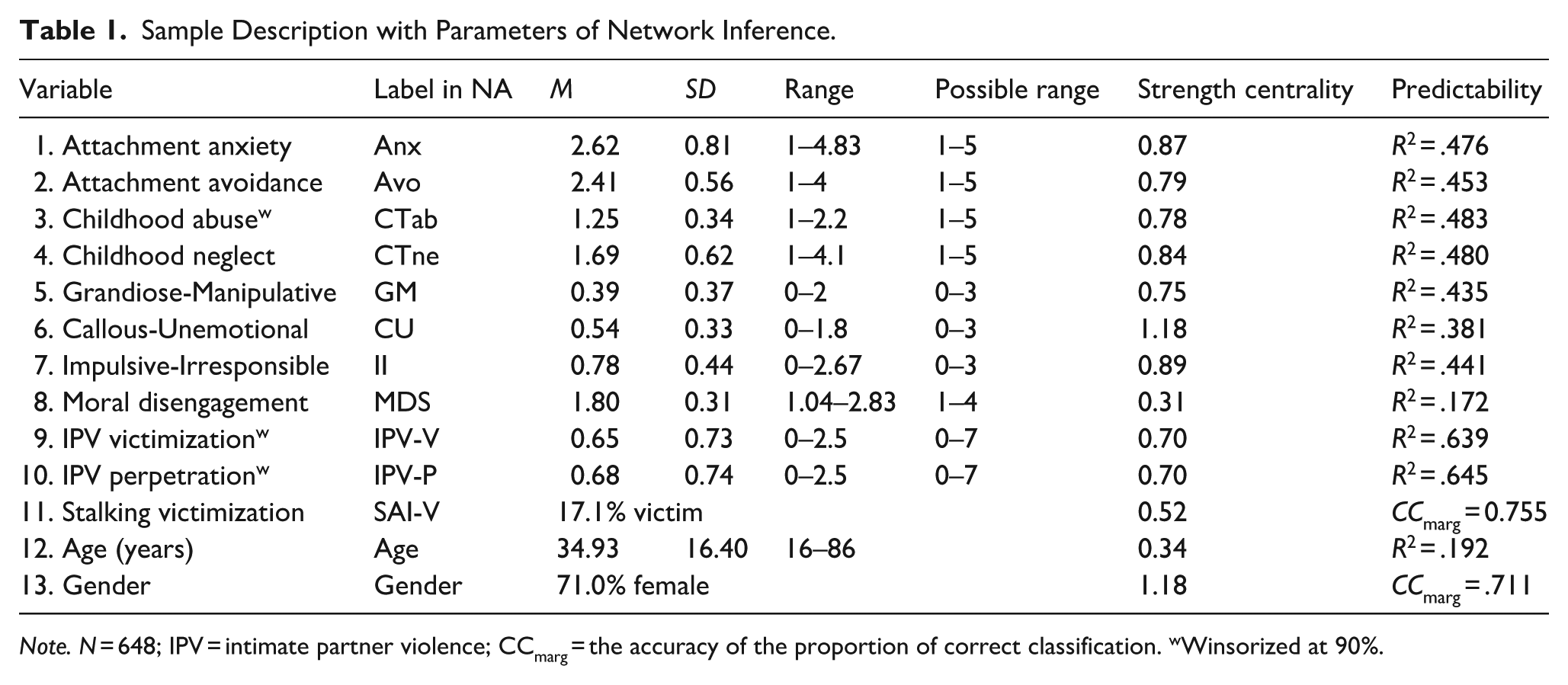
Note. N = 648; IPV = intimate partner violence; CCmarg = the accuracy of the proportion of correct classification. wWinsorized at 90%.
Correlations for Full Sample.
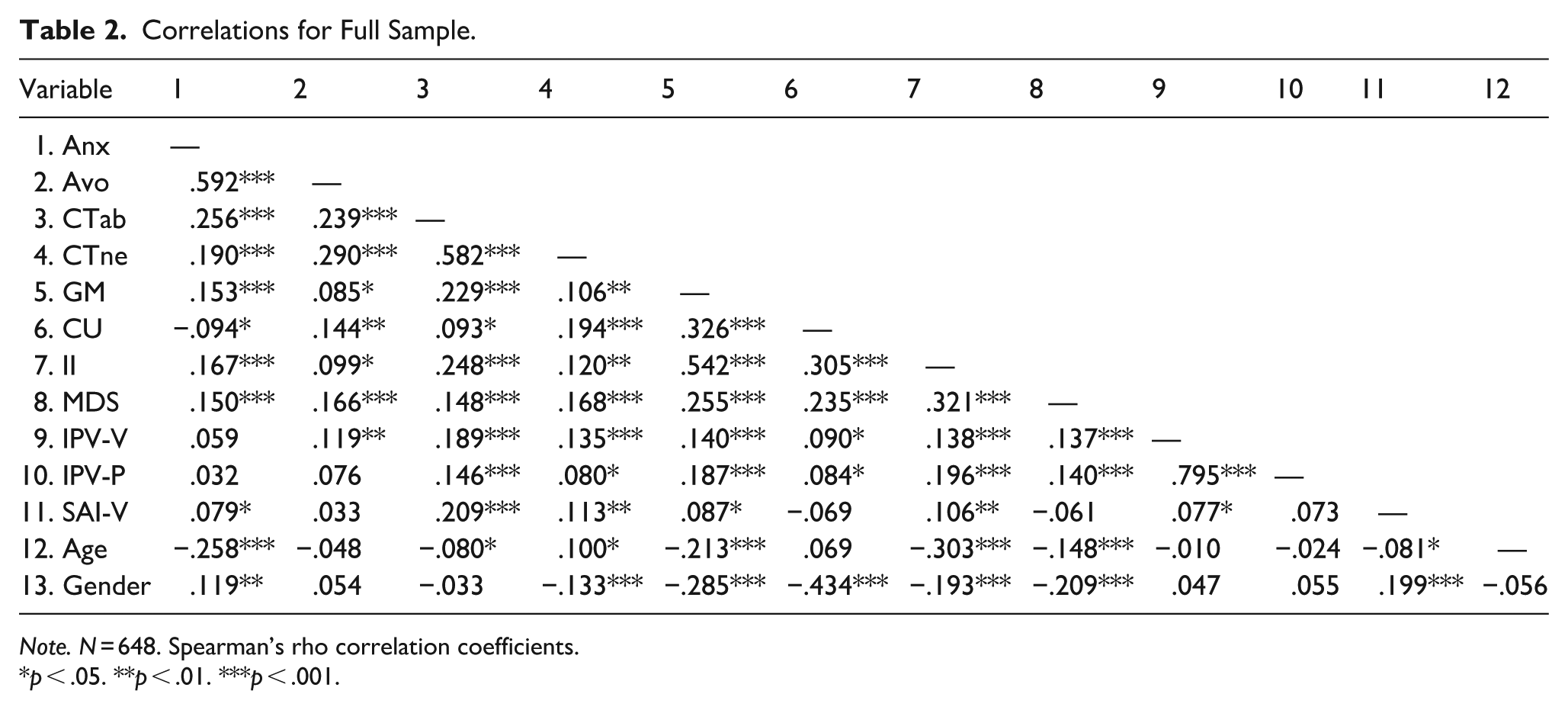
Note. N = 648. Spearman’s rho correlation coefficients.
p < .05. **p < .01. ***p < .001.
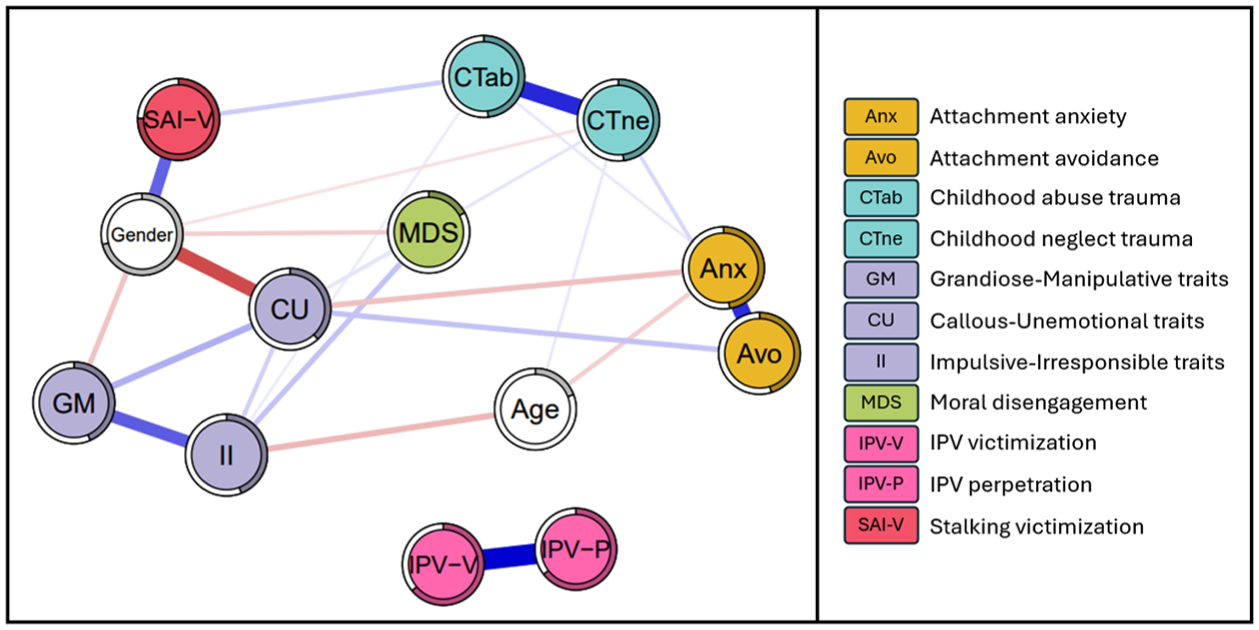
Network estimation for full sample.
Network Comparisons for Gender (see Supplemental Appendix D)
Significant gender differences were found (see Table 3). Women scored significantly higher than men on attachment anxiety (ΔM = −0.22, t(646) = −3.16, p = .002). Men scored significantly higher than women on childhood trauma—neglect (ΔM = 0.15, t(646) = 2.87, p = .004), grandiose-manipulative traits (ΔM = 0.25, t(263,68) = 7.12, p < .001), callous-unemotional traits (ΔM = 0.31, t(300.95) = 10.81, p < .001), impulsive-irresponsible traits (ΔM = 20, t(299.03) = 4.90, p < .001), and moral disengagement (ΔM = 0.15, t(646) = 5.55, p < .001). No significant differences were found for IPV victimization or perpetration. Yet, women were more often victims of stalking (n = 159; 24.5%) compared to men (n = 21; 11.2%), with X2(1) = 25.56, p < .001. In Table 4, the correlations between all nodes are presented for men and women separately.
Group Differences for Gender.
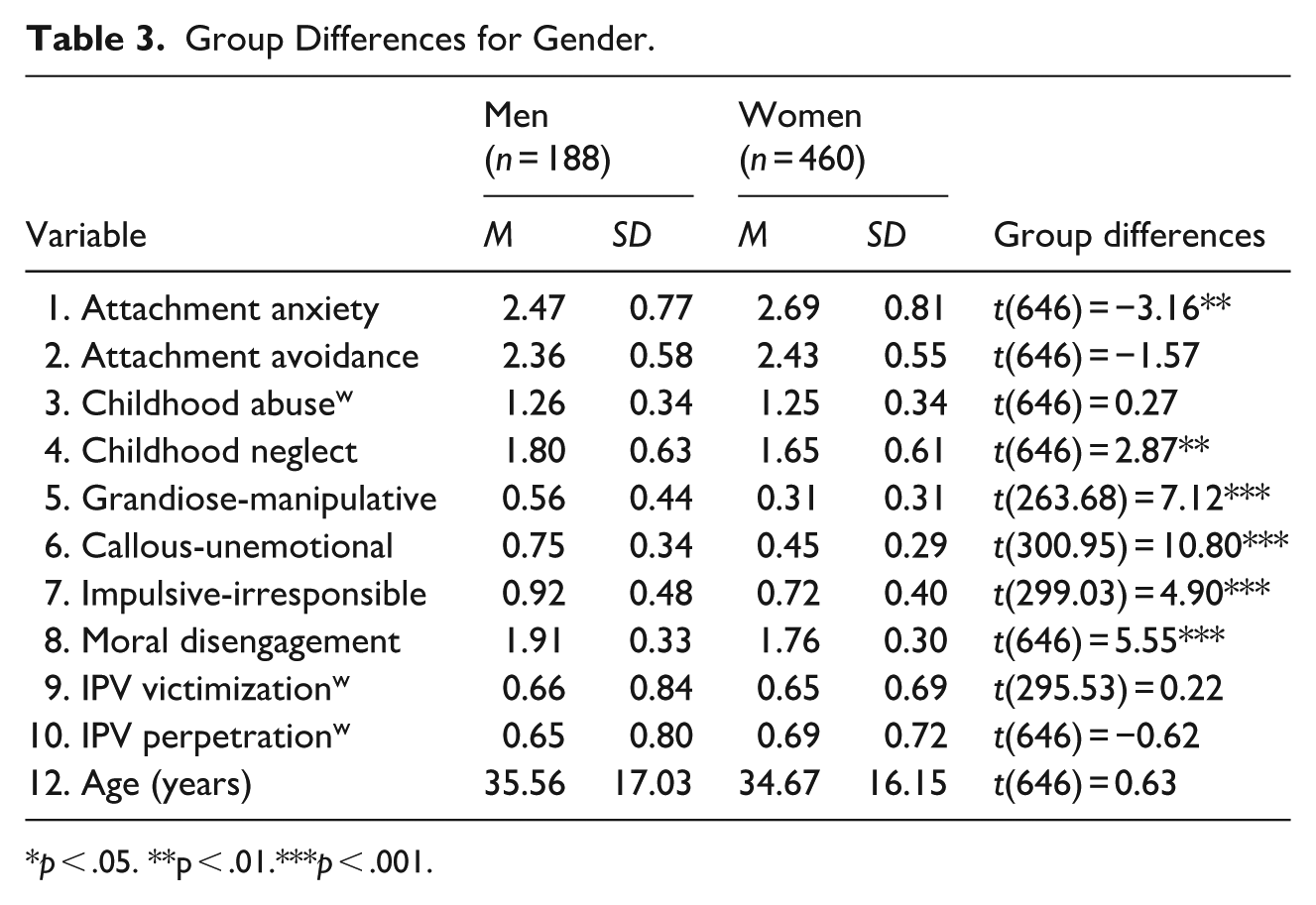
p < .05. **p < .01.***p < .001.
Correlations Separated for Gender.
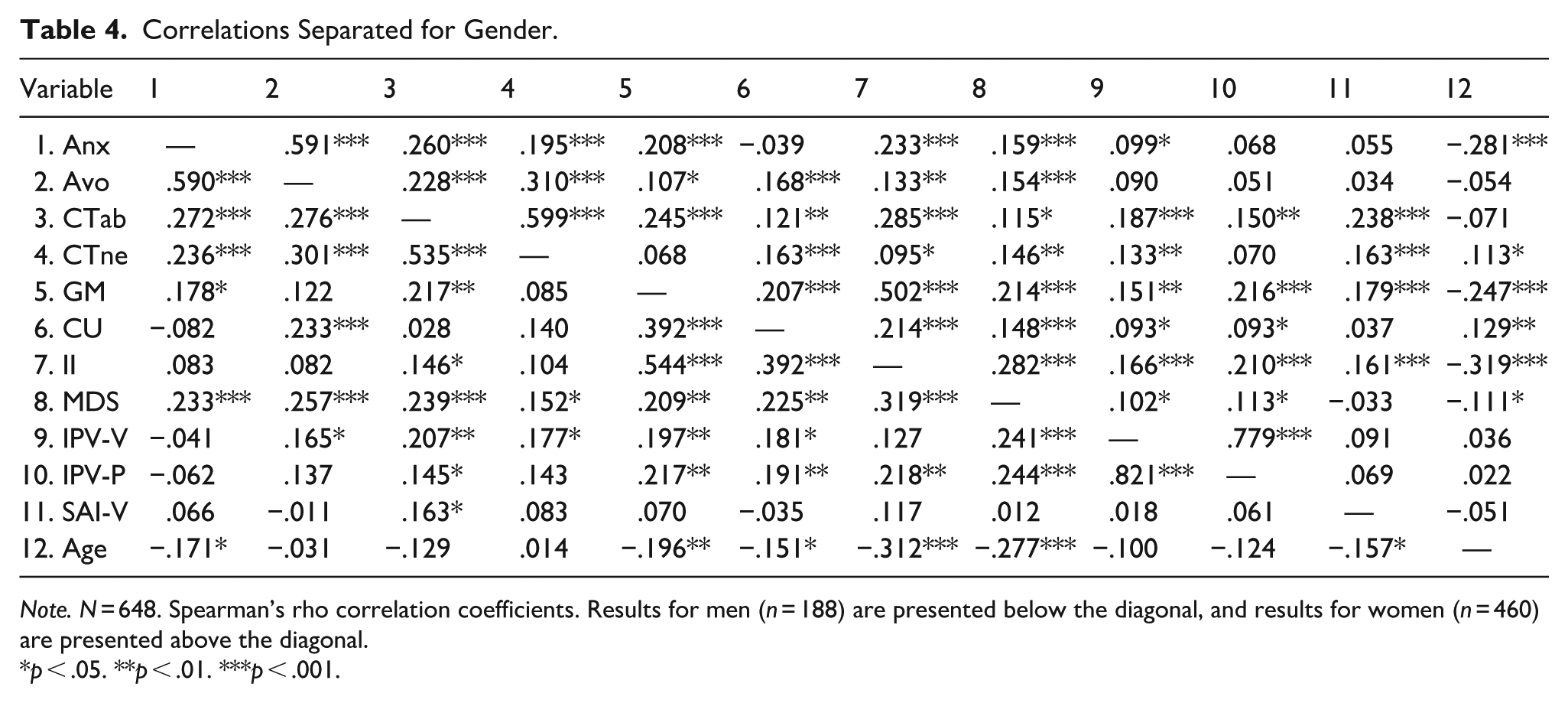
Note. N = 648. Spearman’s rho correlation coefficients. Results for men (n = 188) are presented below the diagonal, and results for women (n = 460) are presented above the diagonal.
p < .05. **p < .01. ***p < .001.
Figure 2a displays the estimated network for men (n = 188; MGM). The network, consisting of 12 nodes, had a mean edge weight of 0.041 and a density of 0.20, with 13 out of 66 possible connections having an absolute weight above zero. The centrality stability test revealed a CSC of 0.362 for strength centrality, indicating low but adequate stability; thus, results should be interpreted with caution. The most central nodes were impulsive-irresponsible traits, IPV victimization, and IPV perpetration. In Figure 2b, the estimated network for women is presented (n = 460; MGM). The network also had 12 nodes, with a mean edge weight of 0.044 and a density of 0.29, with 19 out of 66 possible connections with an absolute weight above zero. The centrality stability test revealed a CSC of 0.207, indicating insufficient stability, suggesting that centrality measures may not be reliable. The most central nodes were attachment anxiety and impulsive-irresponsible traits. The network comparison test revealed no significant differences between the networks for men and women in terms of edges overall (network invariance test: M = 0.15, p = .780) and global strength (S = 0.04, p = .99). After applying the Bonferroni–Holm correction for multiple testing (van Borkulo et al., 2023), post hoc exploratory edge difference tests found no significant edge differences.
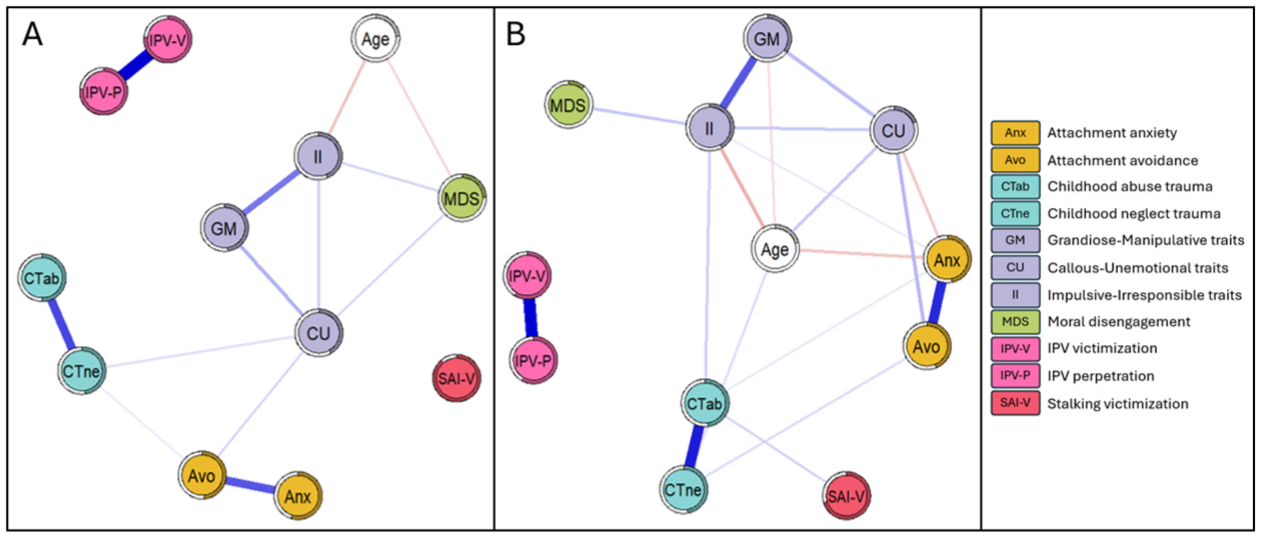
Network estimation for men (A) and women (B).
Discussion
This study aimed to investigate how individual characteristics are related to negative partner relationship events using a network approach. Contrary to expectations, the main findings were as follows: (a) IPV victimization and perpetration were strongly associated with each other but largely isolated from the rest of the network, suggesting that IPV dynamics may operate independently of other factors studied; (b) Stalking perpetration was excluded due to low frequency, while stalking victimization had a relatively distal position in the network and was associated with gender and childhood abuse; (c) Callous-unemotional traits and gender emerged as the most central nodes, highlighting their significance in the network; and (d) No overall differences were found between the networks for men and women, but there were mean-level differences in attachment anxiety, childhood neglect, and maladaptive personality traits.
Although individual characteristics have been identified as risk factors for IPV involvement (e.g., Velotti et al., 2018), our network analysis suggests that these traits may play a more distal role. The strong association between IPV victimization and perpetration indicates that relational context may be more predictive than individual characteristics. This pattern would likely have remained less visible in traditional analytic frameworks, which are less suited to capture reciprocal and multivariate interdependencies. Network analysis models these interdependencies, providing a systems-level view essential for understanding complex links like the strong association between IPV victimization and perpetration. It offers a clearer picture of interpersonal violence mechanisms. This finding aligns with broader conceptual models of IPV that emphasize the interplay between individual, relational, and contextual factors (Sijtsema et al., 2020; Woicik et al., 2019). Our study focused on individual and relational factors. However, qualitative research shows that proximal factors like stress and financial problems may be more predictive of IPV in the moment (Woicik et al., 2019). This distinction is also reflected in the contextual framework of IPV by Bell and Naugle (2008), differentiating between distal factors (e.g., individual/relational characteristics) and proximal factors (e.g., current stressors/interpersonal conflicts). This suggests that interventions should focus on modifiable proximal risk factors rather than distal individual characteristics (Bell & Naugle, 2008).
Mean scores for IPV victimization and perpetration were low (given the right-skewed distributions), indicating low self-reported prevalence and severity. This could partly explain the absence of associations with other factors. Although social desirability may influence self-reports, especially for sensitive topics like violence and personality traits (Paulhus, 2002), its specific impact on IPV reporting appears minimal (Visschers et al., 2017). Moreover, physical IPV was rare in our sample, while psychological IPV occurred more often. Yet, different risk factors may predict different IPV manifestations. Richards et al. (2017) found that different types of childhood trauma, such as emotional and sexual abuse, have distinct effects on IPV involvement. However, these effects can be obscured when combining all forms of childhood trauma (Richards et al., 2017). Particularly, sexual abuse has been found to play a prominent role in IPV victimization (McMahon et al., 2015), with potential gender differences, as sexual abuse was associated with IPV perpetration only in men (Richards et al., 2017).
The low frequency of stalking perpetration inhibited its inclusion in the analyses. This could be due to actual low prevalence in the community sample, or a reporting bias influenced by social desirability (as for reporting of stalking, there is limited research on the effects of social desirability). The true prevalence rates of stalking perpetration remain unclear, as most studies focus on stalking victimization (e.g., Senkans et al., 2021; Smith et al., 2022). Although stalking was not specifically mentioned in the SAI, admitting to behaviors like unwanted contact and following others could raise discomfort in participants. This discomfort aligns with existing myths and stereotypes that often normalize and minimize stalking or blame the victim (McKeon et al., 2015). These stereotypes of stalking are held by both perpetrators and victims, making the absence of an observed association between moral disengagement and stalking victimization in the current sample surprising. Furthermore, the study did find a positive association between childhood trauma and stalking victimization, supporting the revictimization hypothesis (Widom et al., 2008). However, this association was specific to abuse (vs. neglect), which is partly in concordance with previous findings, showing an association between stalking victimization and sexual abuse, but not with physical abuse or neglect (Ménard & Pincus, 2014).
Contrary to expectations, callous-unemotional traits and gender were the most central in the estimated network. Callous-unemotional traits, characterized by a lack of guilt and empathy, are typically associated with aggression (e.g., Plouffe et al., 2022), but this connection was not observed in the network. The centrality of callous-unemotional traits can be explained by their central role in romantic relationship quality, independent of antisocial behaviors (Golmaryami et al., 2021). Callous-unemotional traits influence relationship quality and relate to physical IPV and dominance (Golmaryami et al., 2021). However, these traits do not always lead to antisocial behavior, suggesting they operate through distinct mechanisms, such as reduced empathic and emotional processes. These processes, crucial for relationship satisfaction (Golmaryami et al., 2021), were not included in the study, possibly explaining the isolated role of IPV in the network.
Callous-unemotional traits were associated with more attachment avoidance and less anxiety, even though emotional processes were not directly measured. According to evolution-based resource-control theory (Hawley et al., 2009), social dominance, a key factor in stalking and IPV perpetration, can be obtained through coercive or prosocial strategies. Attachment dynamics, particularly attachment avoidance, influence an individual’s preferred strategy, often leading to coercive behaviors like instrumental aggression. Such dominance can be rationalized through moral emotions and instrumental moral functioning (Hawley & Geldhof, 2012), a form of moral disengagement. However, if individuals do not perceive their behaviors as wrong, moral disengagement processes are redundant (Aignesberger & Greitemeyer, 2024), which may explain the weak yet central position of these traits in the network.
Despite the central role of gender in the network, no differences were found between the estimated networks for men and women, likely due to the small sample size for men (van Borkulo et al., 2023). Nevertheless, the gender distinction remains critical; biological factors (e.g., hormonal differences) and socialization processes (e.g., gender norms) can contribute to IPV patterns (Hyde, 2014). Consistent with previous research, women reported stalking victimization more frequently (Senkans et al., 2021) and had higher scores on attachment anxiety (Del Giudice, 2011). The literature is more mixed on the finding that men scored higher on childhood neglect, since this generally seems evenly distributed (Stoltenborgh et al., 2013). Men also scored higher on maladaptive personality traits (grandiose-manipulative, callous-unemotional, and impulsive-irresponsible) and moral disengagement in accordance with the existing literature (Colins & Andershed, 2016; Rubio-Garay et al., 2019). Gender differences may reflect both biological predispositions and socialization processes. Men show more maladaptive traits, linked to testosterone and emotion regulation differences and moral reasoning compared to women (Archer, 2006; Fumagalli et al., 2010). Social norms also encourage empathy in women and dominance in men (Carter, 2014). These stereotypes may lead to underreporting of victimization in men, potentially explaining the gender differences in stalking. No gender differences were observed for IPV victimization and perpetration, consistent with evidence supporting a gender symmetry model (Ahmadabadi et al., 2021).
Strengths and Limitations
A key strength of the present study is the use of network analyses, which enabled investigating IPV and stalking simultaneously while also addressing the overlap and reciprocal nature of IPV victimization and perpetration (Richards et al., 2017). This approach allowed us to move beyond traditional variable-centered methods and uncover interrelations that may otherwise remain obscured. Limitations were the small sample size and relatively low networks’ stability, which suggests caution in generalizing the findings. Especially the skewed gender and relationship status distribution of the current sample should be acknowledged, where only information on socialized gender (not biological sex) was provided. The sample lacked diversity information (e.g., employment, socioeconomic status, or cultural context), making it difficult to investigate its representativeness, particularly concerning gender identity and sexual orientation. Although sexual orientation was collected and a minority of participants identified as non-heterosexual, the sample was predominantly heterosexual, and the number of non-heterosexual participants was too small to allow meaningful subgroup analyses. Moreover, we did not collect data on the specific relationships they reported (e.g., same-sex vs. different-sex couples). As a result, no meaningful inferences regarding sexual preference or relationship type could be drawn. This distinction is important, as unique risk factors for IPV have been identified in LGB relationships, and IPV may occur at higher rates compared to heterosexual couples (Rollè et al., 2018). Therefore, future research is warranted to address this on a larger and more diverse scale.
Overall, the current sample reported low rates of IPV and stalking, which could be due to the use of a community sample, while such behaviors may be more prevalent in forensic samples (Senkans et al., 2021). However, the low rates observed may also result from social desirability processes, though it remains unclear whether social desirability bias equally affects all measured constructs (e.g., stalking and IPV; Visschers et al., 2017). Especially since no behavioral data was collected, the underreporting of IPV or stalking behaviors cannot be estimated, and its potential influence cannot be ruled out. Combining physical, emotional, and sexual childhood abuse into one variable may have conflated the findings, given the potential unique contribution of childhood sexual abuse on adult victimization (Ménard & Pincus, 2014). In addition, the YPI was designed for youth and is not fully validated for adults, which may limit generalizability across age groups. Nevertheless, psychopathic personality traits show moderate to high stability across development (Frick & Viding, 2009), supporting that the theoretical basis of the YPI remains valid for adults. Moreover, the non-clinical framing of the psychopathic constructs in the YPI makes it more suitable for community samples (Andershed et al., 2002).
Future studies should focus on disentangling the unique pathways from childhood maltreatment to adult victimization and perpetration in romantic relationships. Multilevel analyses, such as experience sampling methods and longitudinal studies, are recommended to investigate within-person processes leading to IPV and stalking, incorporating individual, relational, and contextual and proximal factors. Research is particularly needed at the relational and contextual levels (e.g., work, finances, and interpersonal conflicts) for effective prevention and treatment (Bell & Naugle, 2008; Woicik et al., 2019). Longitudinal research in perpetrator–victim dyads is crucial to investigate the interplay of distal and proximal risk factors.
Conclusion
Our findings underscore the complexity of the relationships between the studied traits and behaviors. The low density and stability of the networks highlight the need for cautious interpretation and further research with larger and more diverse samples. However, identifying central nodes like callous-unemotional traits and gender, along with the strong correlations between IPV victimization and perpetration, provide valuable insights for targeted interventions. Specifically, the isolated position of IPV victimization and perpetration may indicate that individual characteristics are less predictive of relational aggression than other more contextual factors.
Supplemental Material
sj-docx-1-jiv-10.1177_08862605251375396 – Supplemental material for Unraveling the Web of Individual Characteristics and Negative Partner Relationship Events Through Network Analyses
Supplemental material, sj-docx-1-jiv-10.1177_08862605251375396 for Unraveling the Web of Individual Characteristics and Negative Partner Relationship Events Through Network Analyses by Iris Frowijn, Elien De Caluwé and Stefan Bogaerts in Journal of Interpersonal Violence
Footnotes
Acknowledgements
Not applicable.
Authors’ Note
It is important to note that the present article discusses risk factors associated with IPV and stalking victimization; however, the presence or absence of such factors should not be interpreted as implying responsibility or blame on the part of the victim. No claims of causality are made. Victimization results from the harmful actions by perpetrators, often occurring within systemic or situational contexts that exacerbate vulnerability. The findings should be interpreted with this framework in mind.
Elien De Caluwé is now affiliated Fivoor Science and Treatment Innovation (FARID), Rotterdam, the Netherlands.

Ethical Considerations
The study was performed in accordance with the ethical standards as laid down in the 1964 Declaration of Helsinki and its later amendments or comparable ethical standards. Ethical approval was obtained by the Ethics Review Board of Tilburg School of Social and Behavioral Sciences (RP128). All data were stored anonymously in compliance with the European Union GDPR guidelines.
Consent to Participate
All participants gave informed consent.
Author Contributions
All authors contributed to the study conception and design. Material preparation, data collection, and statistical analyses were performed by Iris Frowijn under the supervision of Stefan Bogaerts. The first draft of the manuscript was written by Iris Frowijn. Elien De Caluwé and Stefan Bogaerts reviewed and edited previous versions of the manuscript. All authors read and approved the final manuscript.
Funding
The authors received no financial support for the research and/or authorship of this article.
Declaration of Conflicting Interests
The authors declared no potential conflicts of interests with respect to the authorship and/or publication of this article.
Data Availability Statement
Supplemental Material
1.
Between 2014–2018, there were roughly 17 million inhabitants in the Netherlands, of which 75% adults.
Author Biographies
References
Supplementary Material
Please find the following supplemental material available below.
For Open Access articles published under a Creative Commons License, all supplemental material carries the same license as the article it is associated with.
For non-Open Access articles published, all supplemental material carries a non-exclusive license, and permission requests for re-use of supplemental material or any part of supplemental material shall be sent directly to the copyright owner as specified in the copyright notice associated with the article.
