




Abstract
Bullying victimization is linked to interpersonal difficulties and elevated depression risk, yet it is unclear whether these difficulties persist after victims leave the bullying environment. Using a longitudinal design with event-contingent recording (ECR), we examined the interpersonal styles of bullying victims during their final year of high school (T1) and 1 year later (T2). At T1, we hypothesized that victims would exhibit more maladaptive interpersonal styles compared to adolescents without any bullying experiences (non-involved). At T2, we examined whether the observed differences between the two groups at T1 persisted after participants transitioned out of the bullying environment, which could potentially explain victims’ long-term risk for depression. At T1, participants included 27 self-reported bullying victims and 56 non-involved adolescents; 9 victims and 26 non-involved remained at T2. At each time point, participants completed 14 days of ECR, rating their behaviors and perceptions of their interaction partners (referred to as “others”) on dominance–submissiveness and agreeableness–quarrelsomeness, and pre- and post-ECR measures of depression symptoms. At T1, victims generally perceived others as less agreeable and reported more negative affect than non-involved adolescents. By T2, these general differences in perceived agreeableness and negative affect between victims and non-involved adolescents were no longer observed. However, victims continued to perceive others as less agreeable than non-involved adolescents when perceiving their partners as highly dominant. At both time points, victims consistently reported higher depression symptoms. Additionally, depression symptoms were negatively associated with perceptions of agreeableness at T1 and with behaviors displaying agreeableness at T2. During high school, victims exhibited distinct perceptions of others and affect across social situations compared to non-involved adolescents. Interpersonal differences between victims and non-involved adolescents became less pervasive after leaving high school, but some context-specific differences persisted alongside higher depression symptoms. These findings may help explain victims’ long-term vulnerability to depression, though conclusions are limited by attrition across waves.
Introduction
Bullying is a complex interpersonal phenomenon. It is often conceptualized as an interplay between involved individuals and their social environment (Hong & Espelage, 2012). This conceptualization is derived from Bronfenbrenner’s ecological theory of development (Bronfenbrenner, 1977, 1979). It describes bullying as a reciprocal interplay between the individual, the family, peer group, school, community, and culture, and that a general consistency in a person’s life course can serve as a buffer against bullying experiences. Accordingly, bullying should be studied within as well as across those levels, from the cultural context and school climate in which bullying takes place to group processes and social interactions with peers, and across different time periods, both short-term and long-term (Espelage, 2014). Complementary to this social-ecological view, and specifically relevant for the level of direct interactions with peers and family, is Contemporary Integrative Interpersonal Theory (CIIT; Pincus, 2005; Pincus & Ansell, 2013). It proposes that, to understand interpersonal processes, it is necessary to examine between-person differences in interpersonal style (i.e., expressed interpersonal behaviors and perceptions) and the interplay with an individual’s social environment. CIIT uses the interpersonal circumplex (Kiesler, 1983; Wiggins, 1991) to describe interpersonal style along the orthogonal dimensions of affiliation (also referred to as communion) and status (agency). Affiliation represents seeking connection with others and the exchange of agreeable (or warm) and quarrelsome (or cold) behaviors. Status or agency reflects striving towards power and leadership and the interplay of dominant (or assertive) and submissive (or unassertive) behaviors. Quarrelsome behavior is usually responded to with quarrelsomeness and agreeableness with agreeableness, while dominant behavior generally invites a submissive response and vice versa (Orford, 1986). In the present study, we studied the interpersonal style of victims of high-school bullying across time, both during high school and afterwards. We also explored how their interpersonal style might be linked to their increased risk for depression: bullying victimization has repeatedly been shown to be a unique risk factor for depression (Moore et al., 2017; Reijntjes et al., 2010), even 36 years after the victimization took place (Ttofi et al., 2011).
Past Research on Interpersonal Behaviors and Perceptions of Victims of Bullying
Concerning interpersonal style, earlier research has shown that victims are less agentic than bullies (i.e., bullying perpetrators) and individuals not involved in bullying (i.e., persons without reported bullying experiences, neither as victims nor as bullies). For example, victims tend to lack dominance and status orientation and be more submissive than bullies and non-involved individuals (Fox & Boulton, 2006; Perren & Alsaker, 2006; Sijtsema et al., 2009). In addition, victims more often engage in reactive aggression than non-involved individuals, which points towards low communion in behavior (Manring et al., 2018; Runions et al., 2018; Salmivalli & Helteenvuori, 2007). Besides, victims seem to perceive social situations more negatively than non-involved individuals. For example, studies report that victims misinterpret facial expressions and misjudge neutral facial expressions as negative (Franzen et al., 2021; Woods et al., 2009) and are more inclined to expect that others mainly have bad intentions (Ziv et al., 2013). On an emotional level, victims experience more negative affect and less positive affect in a social context (Dill et al., 2004; Hanish et al., 2004; Rauschenberg et al., 2021).
Low levels of agentic and communal interpersonal characteristics can work as a social repellent, interfering with building and maintaining good-quality relationships (O’Connor, 2011). In turn, missing a supportive social network can lower the threshold for developing depression (Erzen & Çikrikci, 2018; Hansen et al., 2012; Ttofi et al., 2014). There is evidence that this interpersonal mechanism may also explain the link between victims’ interpersonal style and their increased depression risk (see Hunter et al., 2010; Noret et al., 2021), as victims report lower quality friendships and romantic relationships and struggling more in maintaining these relationships, both in school (Ellis & Zarbatany, 2007) and afterwards (Jantzer et al., 2006). Moreover, studies have reported interpersonal factors such as rejection sensitivity, offensive tone in communication, dysregulated expression of anger and sadness, and threat and challenge appraisals as mediators between bullying victimization and internalizing outcomes such as depression symptoms (Kretschmer, 2016; Noret et al., 2021).
Aims of the Present Study
In the present study, we set out to gain a dynamic understanding of the interpersonal style of individuals who have been victims of bullying, particularly in their daily lives. Our approach is distinct from prior studies on victims’ interpersonal behaviors and perceptions, which predominantly assessed interpersonal style as a stable trait (e.g., Jenkins et al., 2016; Salmivalli & Helteenvuori, 2007), at a single time point (e.g., Perren & Alsaker, 2006; Sijtsema et al., 2009), or in a laboratory setting (Franzen et al., 2021; Woods et al., 2009). Interpersonal style is considered context-sensitive (Reis, 2014), meaning that it varies not only between persons but also within persons, depending on the (social) situation they are in.
Therefore, in the present study, we assessed the everyday, real-life interpersonal behaviors and perceptions of victims of bullying using event-contingent recording (ECR; Moskowitz, 1994; Moskowitz & Sadikaj, 2014; see methods for details) of social interactions. ECR allows for assessing (variation in) interpersonal style across various social contexts and in an ecologically valid and reliable manner. Studying interpersonal style in daily life can help to better understand why, and when, victims might struggle with building a supportive social network. Such an understanding could in turn be used to guide interventions targeting to improve victims’ interpersonal relationships, thereby reducing their risk for developing depressive symptoms (Ttofi et al., 2014).
The primary aim of this two-part longitudinal study was to investigate high-school bullying victims’ interpersonal behaviors, perceptions, and affect during their everyday social interactions. We compared these with those of a group of non-involved adolescents. The first part of this study focused on the interpersonal style of both groups during the last year of high school, while they were still in their likely bullying environment (i.e., school, T1). Part 2 focused on their interpersonal style 1 year later, after participants had generally left high school and transitioned into a new social environment (T2). Social ecological theory suggests that such a shift in role and setting provides a framework for dealing with developmental changes (Bronfenbrenner, 1979; also see Viner et al., 2012). Compared to non-bullied individuals, victims possibly struggle more with such changes and consequently have more difficulties adjusting to new environments (e.g., Kretschmer et al., 2018). Lacking abilities to repair and recover from stressful emotional events can decrease the quality of social interactions and relationships, both short- and long-term (Hessel et al., 2016).
A secondary aim of this study was to investigate the links between victims’ interpersonal styles and possible depression symptoms, both within each time point (T1, T2) and across time points (T1 → T2). Of note, our study is the first to concurrently examine victims’ interpersonal style and depression symptoms both in the final year of high school as well as afterwards. Studies that have previously examined victims’ mental health after a transition usually focused on younger age groups, such as the transition from elementary to middle school (Drazdowski et al., 2021; Forbes et al., 2019) or from middle to high school (Drazdowski et al., 2021; Krygsman & Vaillancourt, 2019). Although both transitions require forming new relationships and adjusting to a new group or class, graduating high school likely represents a more stressful transition period as it comes with several changes. Apart from forming new relationships (i.e., communal motives), such changes also include adjusting existing relationships with parents and family (e.g., when moving out of the parental home; Parker et al., 2004), as well as increased independence and autonomy (i.e., agentic motives) when making choices regarding work or post-secondary education. Some previous studies also focused on victims’ transition out of high school. However, these studies generally assessed pre-transition bullying information retrospectively and collected interpersonal and mental health data post-transition but not pre-transition (Goodboy et al., 2016; Holt et al., 2014; Valentiner et al., 2017).
In short, the study had two aims:
(1) To examine how bullying victims’ interpersonal behaviors, perceptions, and affect during their everyday social interactions differ from those of non-involved adolescents, both in their last year of high school (T1) and 1 year later after transitioning into new environments (T2).
(2) To examine the relation between victims’ interpersonal behaviors, perceptions, and affect and possible depression symptoms, both within each time point (T1, T2) and across time points (T1 → T2).
Part 1 (T1)
In the first part of our longitudinal study, we tested if, similar to previous studies mentioned in the Introduction, victims would indeed report more submissive behaviors, less dominant behaviors, and more quarrelsome behaviors than non-involved individuals (H1). We also tested if victims perceived their interaction partners as more dominant and more quarrelsome than non-involved participants (H2), and experienced social interactions as more negatively and less positively (i.e., experiencing more negative affect and less positive affect) than non-involved participants (H3).
Moreover, given that interpersonal style is context-sensitive, we were interested in whether perceiving their interaction partner as increasingly dominant would moderate the differences in interpersonal style between victims and non-involved individuals. Based on previous research suggesting (a) that perceptions of others are related to interpersonal alterations (Ladd et al., 2014) and less beneficial coping strategies (Lodge & Feldman, 2007; Undheim et al., 2016), and (b) that bullies often display dominant, pro-aggressive behaviors (Salmivalli, 2010), we hypothesized that particularly in situations when interaction partners are perceived as more dominant, victims would behave more submissively and more quarrelsomely than non-involved individuals (H4).
Methods T1
The Ethics Committee of the Department of Psychology at the University of Groningen approved the study. All participants provided active informed consent before starting the pre-screen (see below) and before participating in Parts 1 and 2, if applicable.
Participants
Initial participant recruitment entailed contacting high schools in the north of the Netherlands, placing online advertisements on social media platforms, and distributing flyers in the city of Groningen. Interested persons could either participate directly at their school (n = 1,463) or sign-up on a website created for the study (n = 197). The study was advertised as investigating how teenagers experience positive social interactions (e.g., receiving a compliment) and negative social interactions (e.g., being bullied). Participants were not explicitly categorized as victims, bullies, bully-victims, or non-involved individuals to avoid potential stigmatization associated with bullying and participation in our study. Participants needed to be at least 16 years of age and own a smartphone. At school, researchers first explained the purpose of the study and then provided a link to an online questionnaire (Qualtrics, Provo, UT). Persons who signed up online were contacted via email and sent the same link. After being provided with detailed written study information and giving consent for the pre-screen and to be contacted for the ECR, participants filled in the Olweus Bully/Victim Questionnaire (BVQ; Olweus, 1996, 2002) and other questionnaires. 1 Confidentiality was emphasized and participants were invited to ask questions at any time throughout the study. Remuneration was a gym bag from the University of Groningen.
Based on their answers on the pre-screen BVQ, first, pure victims and bully-victims were invited for part 1 of the study. Subsequently, for each interested (bully-) victim, matched non-involved peers (based on gender 2 and age) were invited (see Figure 1 for details regarding study invitation and participation). A total of 157 participants started, and 125 (80%) completed part 1. For hypothesis testing, we focused on participants who had the same (i.e., stable) victimization category at both pre-screen (T0) and T1 (see below). Specifically, we included stable pure victims (n = 27), who, based on their BVQ scores, were participants categorized as a pure victim at both time points. Also included in the final analyses were 56 stable non-involved individuals. We excluded three stable bully-victims (due to small n) and participants who changed victimization categories from T0 to T1 (n = 57) from further analyses. Participants predominantly self-identified as female (71%), had a mean age of 17 years (SD = 0.90), and were of Dutch nationality (98%; seeTable 1 for further details).
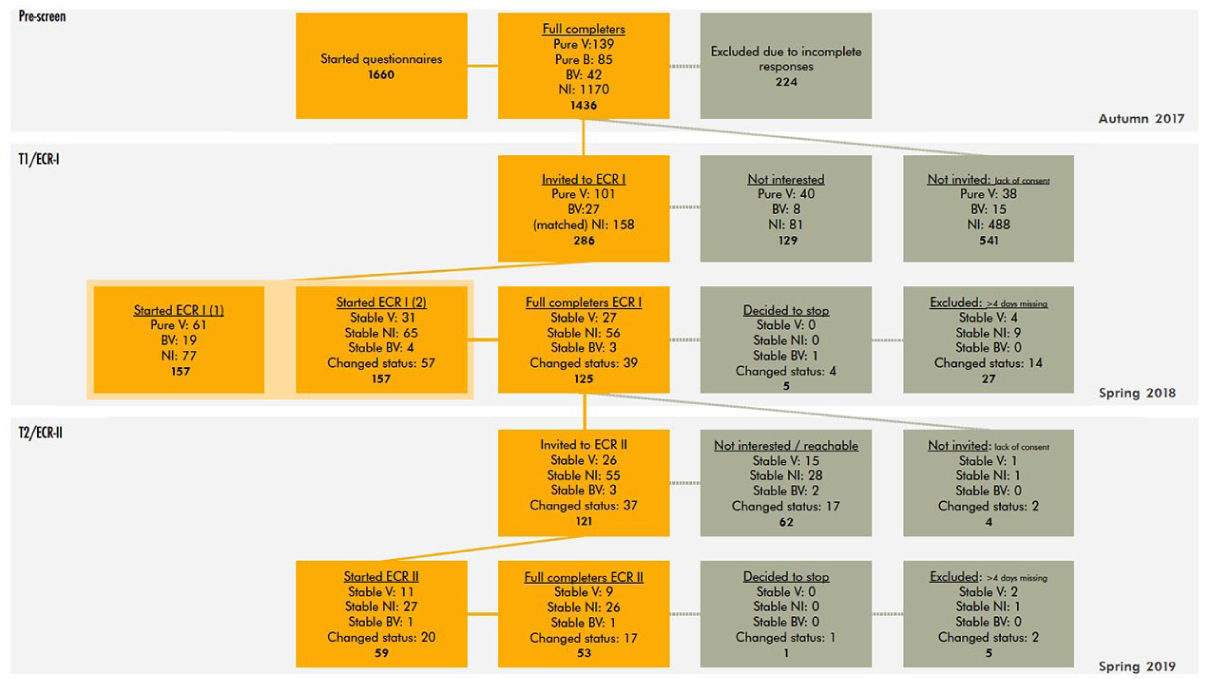
Flowchart of participation and victimization status throughout the entire study.
Descriptive Statistics for Participant Characteristics and for Reported SI for ECR-I and ECR-II.
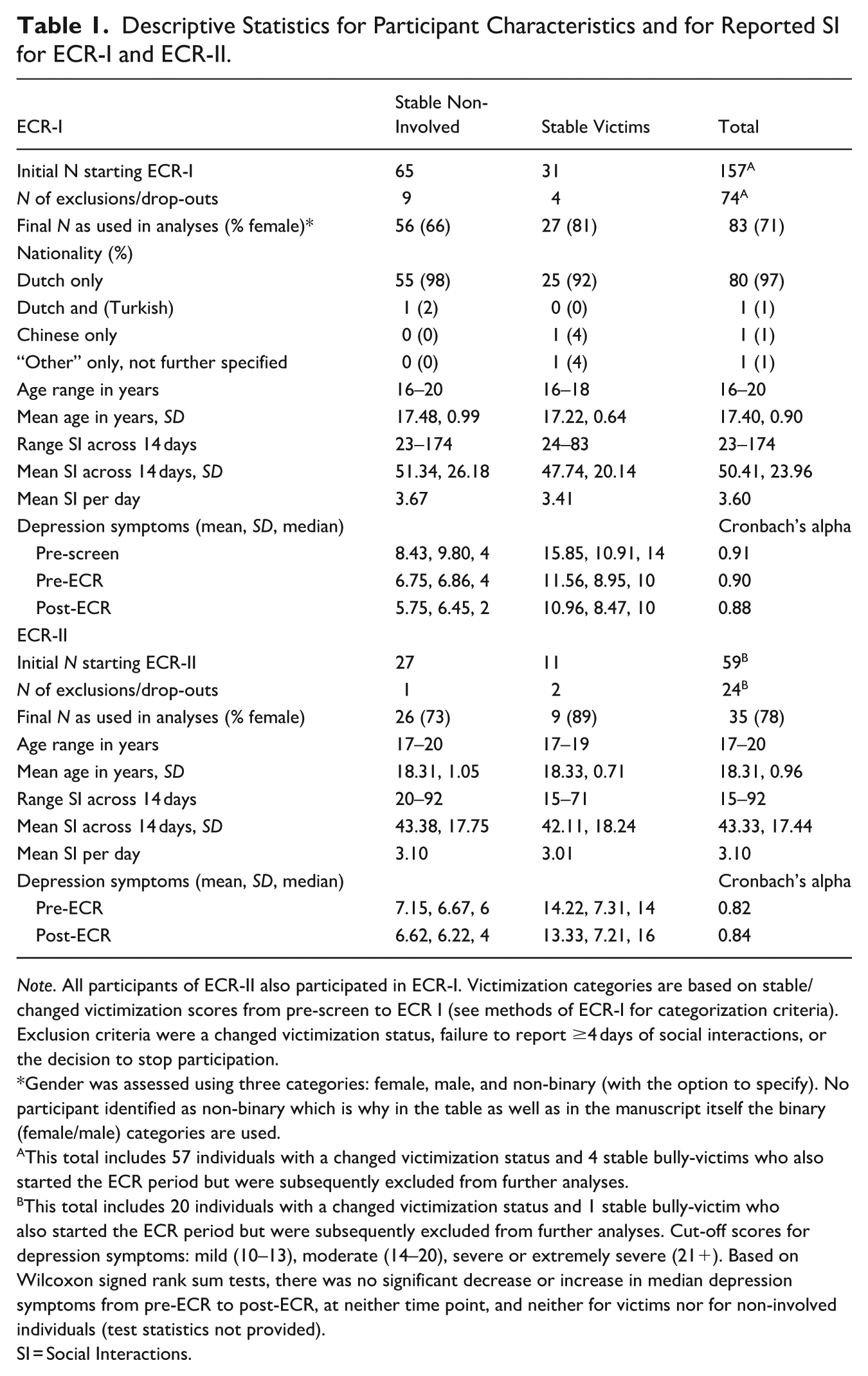
Note. All participants of ECR-II also participated in ECR-I. Victimization categories are based on stable/changed victimization scores from pre-screen to ECR I (see methods of ECR-I for categorization criteria). Exclusion criteria were a changed victimization status, failure to report ≥4 days of social interactions, or the decision to stop participation.
Gender was assessed using three categories: female, male, and non-binary (with the option to specify). No participant identified as non-binary which is why in the table as well as in the manuscript itself the binary (female/male) categories are used.
This total includes 57 individuals with a changed victimization status and 4 stable bully-victims who also started the ECR period but were subsequently excluded from further analyses.
This total includes 20 individuals with a changed victimization status and 1 stable bully-victim who also started the ECR period but were subsequently excluded from further analyses. Cut-off scores for depression symptoms: mild (10–13), moderate (14–20), severe or extremely severe (21+). Based on Wilcoxon signed rank sum tests, there was no significant decrease or increase in median depression symptoms from pre-ECR to post-ECR, at neither time point, and neither for victims nor for non-involved individuals (test statistics not provided).
SI = Social Interactions.
Materials
Recent Bullying Victimization
Using the Dutch version of the BVQ (Olweus, 1996, 2002), we assessed bullying victimization in the previous 4 weeks, both at pre-screen and part 1. As in the original BVQ, bullying was defined as repeated, intentional aggression in a relationship where there is an imbalance of power. Participants indicated to what extent they (A) were bullied by or (B) bullied others on a five-point Likert scale ranging from 0 = “never,” 2 = “two or three times,” to 4 = Several times per week.” Eight sub-questions assessed the frequency of (A) and (B) regarding specific types of bullying (i.e., physical, verbal, social, sexual, and electronic bullying, or because of body weight, race or religion, and disability).
We categorized participants as pure victims if they scored 2 or higher on any of the (A) questions and below 2 on all of the (B) questions. Participants were categorized as pure bullies if they scored 2 or higher on any of the (B) but below 2 on all of the (A) questions. A bully-victim scored 2 or higher on any of the (A) questions as well as on any of the (B) questions. Participants who scored 0 or 1 on both (A) and (B) questions were categorized as non-involved individuals.
Life-Time Bullying Victimization
For descriptive purposes, lifetime bullying victimization was assessed by asking participants to indicate if they were bullied by peers, (step) siblings, (step) parents, and/or others during childhood or adolescence. For each endorsed answer option, participants received two follow-up questions: (a) How often were you bullied by X during your childhood and adolescence? Answer options were: one or two times, three or four times, more than four times. And (b) For how long were you bullied by X? Answer options were: 1 to 4 weeks, more than 4 weeks but less than 1 year, 1 year, more than 1 year.
ECR of Social Interactions
We applied the ECR method according to Moskowitz and Sadikaj (2014). A social interaction event was defined as a spoken conversation, either in person, on the phone, or video call, lasting at least several minutes. 3 For 14 consecutive days, participants were instructed to complete a short form about the interaction close in time after an interaction had occurred. Participants were asked to report as many interactions as possible. If they had consumed alcohol or drugs in the 3 hr before an interaction, participants were not to report these interactions.
To gain access to the online ECR forms, participants installed a link to the software TEMPEST (Batalas & Markopoulos, 2012) on their smartphones and filled in a trial ECR form. The ECR form included questions about participants’ interpersonal behaviors, perceptions, and affect (see below). The link was accessible both online and offline. Throughout the 14-day ECR period, participants were regularly contacted via WhatsApp or text messages and reminded about their daily participation to keep response rates high. Participants were contacted every 3 days with a general reminder. Participants who did not report any interactions on any given day were additionally contacted in between.
Interpersonal Behaviors
Using items from the Dutch version of the Social Behavior Inventory (SBI; aan het Rot et al., 2013; Moskowitz, 1994), we assessed interpersonal behavior in terms of the four dimensions of the interpersonal circumplex; namely dominance (e.g., “I expressed an opinion”), submissiveness (e.g., “I let others make plans or decisions”), quarrelsomeness (e.g., “I ignored the other[s] comments”), and agreeableness (e.g., “I smiled and laughed with the other[s]”). The SBI consists of 46 items equally assessing all four subscales (1 item represents both dominance and quarrelsomeness, and 1 item represents both submissiveness and agreeableness).
Participants recorded behaviors they engaged in during the interaction by ticking the relevant items. To decrease the time necessary for responding and to prevent participants from adopting a response set, each ECR form randomly included one of four subsets of questions of the SBI. Each subset included three items representing each of the four dimensions/respective behaviors of the circumplex.
Scores for each of the four dimensions were calculated for each record form by computing their individual mean frequency and then subtracting the mean frequency for all respective behavior items. These ipsatized scores reflect the frequency with which each kind of behavior was checked, adjusted for the participant’s general rate of behavior checking.
Perceptions
By means of an 11 by 11 interpersonal grid (Moskowitz & Zuroff, 2005), participants indicated how the interaction partner behaved towards them during the specific interaction. The horizontal axis was labelled “Cold/Quarrelsome” on the left side and “Warm/Agreeable” on the right side. The vertical axis was labelled “Assured/Dominant” on the top of the grid and “Unassured/Submissive” on the bottom of the grid. A higher score on the horizontal axis (i.e., the further right) meant the interaction partner was perceived as more warm and agreeable. A higher score on the vertical axis meant the interaction partner was perceived as more dominant and assured. On both axes, potential scores ranged from 1 to 11.
Affect
Using a list of positive and negative affect items (Diener & Emmons, 1984), participants indicated how they felt during the interaction on a scale from 0 (“not at all”) to 6 (“extremely”). For a negative affect score, we calculated the mean of the worried/anxious, frustrated, angry/hostile, unhappy, and depressed/blue items. To obtain a positive affect score, the mean score on happy, pleased, joyful, and enjoyment/fun was calculated.
Depression Symptoms
We assessed depression symptoms in the previous 7 days at pre-screen, pre-ECR, and post-ECR applying the Dutch version of the shortened Depression Anxiety and Stress Scale (DASS-21; de Beurs et al., 2001; Lovibond & Lovibond, 1995). Answer options ranged from 0 = “not at all/never” to 3 = “very much/most of the time.” Answers to the 7-item depression subscale were summed up and doubled to compare scores to the original 42-item DASS and its cut-offs (see Table 1 for descriptive statistics and Cronbach’s alphas). We had a protocol in place for participants with high scores on the DASS depression scale. This included suggestions to talk with a trusted person, reach out to the national children’s helpline, or contact the first author, who is a clinically trained psychologist.
Procedures
ECR instructions were mostly provided in small groups at school with a maximum of five people per group (n = 68) or else individually via a video call (n = 18). Participants started with an online Qualtrics questionnaire that assessed their victimization status and depression symptoms. Subsequently, participants were given detailed verbal instructions about how to report their everyday-life social interactions using the ECR questionnaires. After the ECR period, participants were contacted online and filled in a final set of questionnaires via Qualtrics including a feedback questionnaire about their experience with the ECR forms. Participants received a monetary reward of 30 € for completion of T1.
Data Analyses
Main analyses were completed on 83 individuals (i.e., 27 victims and 56 non-involved) and repeated with 86 individuals (i.e., this time the victim group included the three individuals with a bully-victim status). Not included in the main analyses were participants with an unstable victimization status (those who had a different status at pre-screen compared to T1; n = 57). Additionally, participants who failed to report 4 or more days of social interactions (n = 13), thus providing data on less than 70% of the 14-day study period (i.e., following previous research, e.g., Franzen et al., 2018), or who decided to stop (n = 1) were excluded from further analyses. See Table 1 for an overview of sample characteristics.
The data were analyzed using a longitudinal mixed-effects modelling approach (multilevel modelling) with maximum likelihood estimation using PROC MIXED in SAS version 9.4 (SAS Institute: Cary, NC). Social behaviors, perceptions of others, and affect were (event-level) dependent variables. For primary analyses, a dichotomous person-level victimization variable (stable pure victim or stable non-involved comparison) represented the predictor. The analyses were repeated adding stable bully-victims (n = 3) to the stable victim group and yielded similar results regarding the significance and direction of effects (not reported in this manuscript).
We first examined the main effects of stable pure victimization (predictor) on behaviors (H1), perceptions of others (H2), and affect (H3) (macro level analyses; model 1). We then investigated cross-level interactions by analyzing the moderation effects of perception of dominance (H4) on the association between stable pure victimization and behaviors, perceptions of others, and affect (micro level analyses; model 2). The moderator variable was person-mean centered, meaning that for each score of perception of dominance, we subtracted the person-mean of it. Therefore, the scores for the moderator perception of dominance should be understood relative to the person’s mean. It describes a situation when a person perceives the interaction partner as more (or less) dominant than usual. Based on non-significant empty models with only gender or age as predictors, we did not add gender or age as covariates in the final models. For the sake of readability, we continue to refer to the “stable pure victim” group as “victims” from this point onwards.
Significance was set at an alpha of .05. Effect sizes were computed with Cohen’s d. As recommended by Aiken et al. (1991), significant interactions were probed by estimating simple intercepts and slopes for between-person predictor scores that were ±1 SD of the sample mean in each predictor, respectively.
Results T1
Descriptive Statistics
Participants reported a total of 4249 social interactions in the 14-day period, with a mean average of 3.60 interactions per day. For a description of reported social interactions, see Table 1.
Most of the victims in the present study reported to have been bullied 2 to 3 times in the 4 weeks prior to data collection (n = 17; 63%), 5 reported victimization about once a week, and another 5 several times per week. The main types of experienced victimization were social (48%) and verbal victimization (33%).
All victims but one (96%) also reported bullying victimization during childhood and adolescence. Within the non-involved group, 46% experienced bullying victimization during childhood and adolescence (but not in the last year of high school). Therefore, our victim and non-involved groups differed in both current and past victimization.
Of the victims who also reported past victimization, 73% indicated having been victimized by peers only and that it mostly happened more than 4 times (58%) and lasted for 1 year or more (48%). Of the non-involved individuals who reported past victimization, perpetrators were also primarily peers (77%), half of the time it happened more than 4 times (50%), and lasted 1 year or longer (55%). This indicates that the nature of past victimization was similar in both groups.
Table 2 represents Pearson product–moment correlations for interpersonal behaviors, affect, and depression symptoms.
Between-Person Pearson Correlations Between Interpersonal Variables and Pre- and Post-ECR Depression Symptoms for the Entire Sample and Separated by Victimization Group.
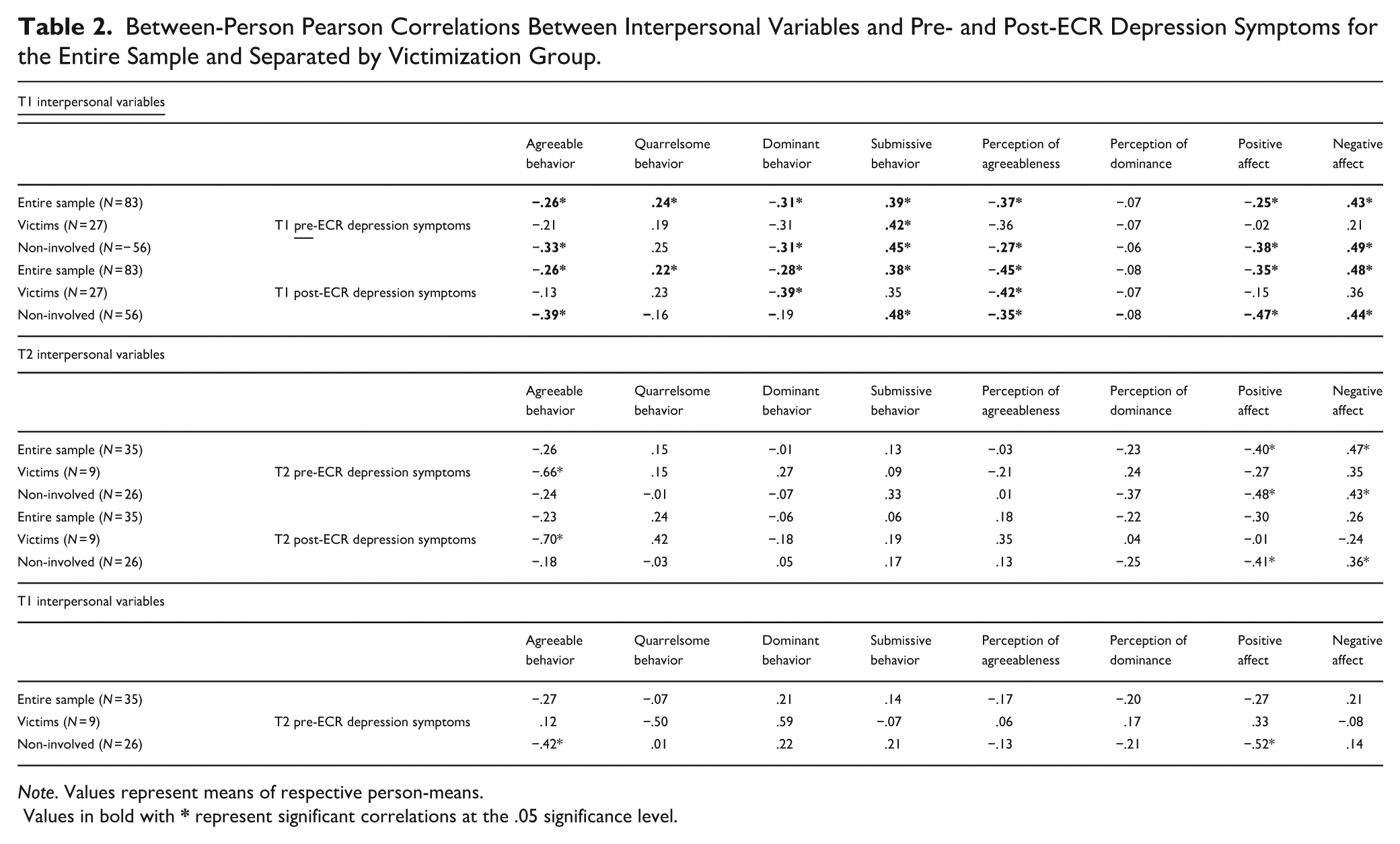
Note. Values represent means of respective person-means.
Values in bold with
Overall Group Differences Regarding Interpersonal Behaviors, Perceptions, and Affect (Model 1)
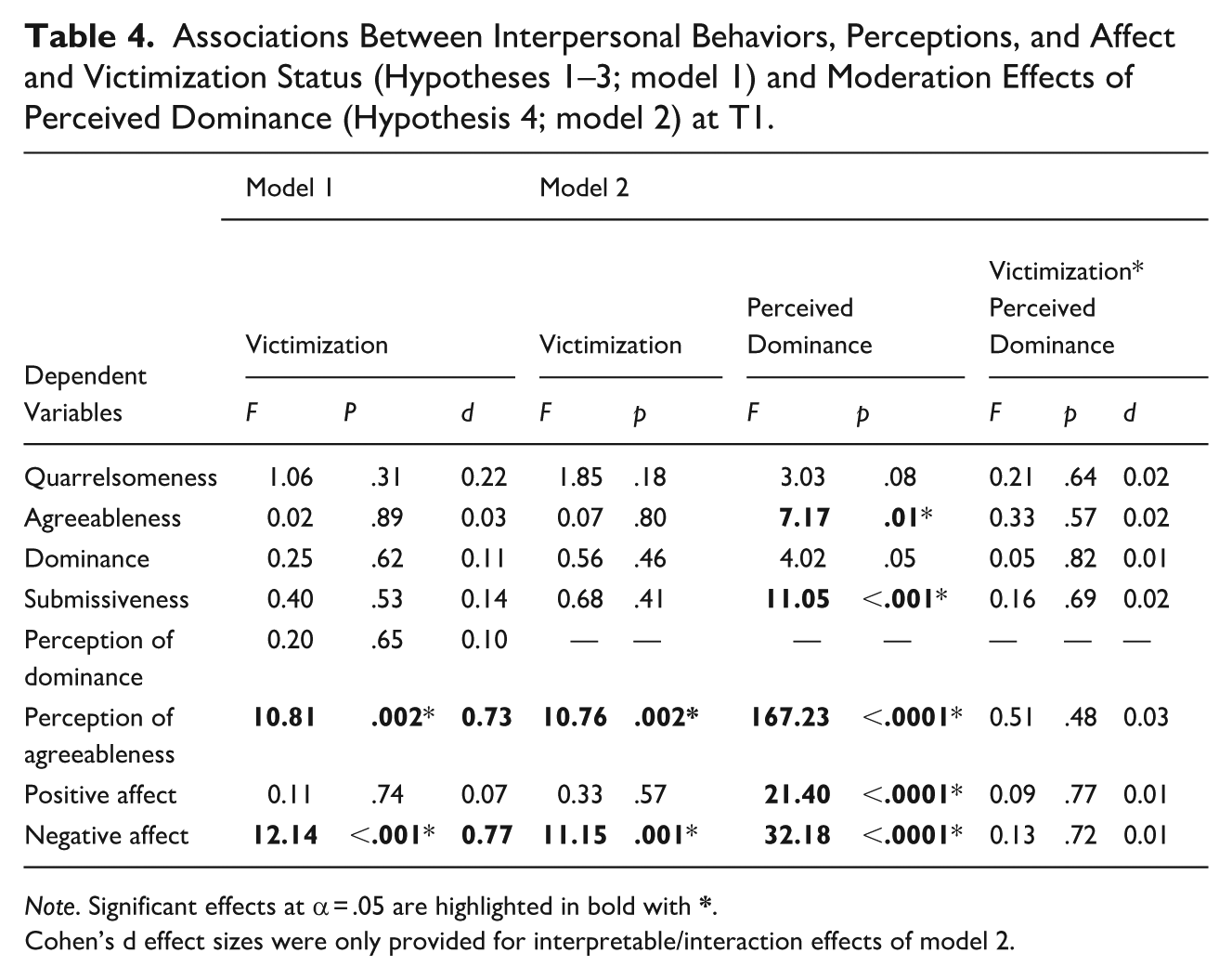
Means for interpersonal behaviors, perceptions, and affect by victimization status are shown in Table 3. All statistics can be found in Table 4.
Descriptive Statistics of Reported Interpersonal Behaviors, Perceptions of Others, and Affect Across the 14 Days of the Study.
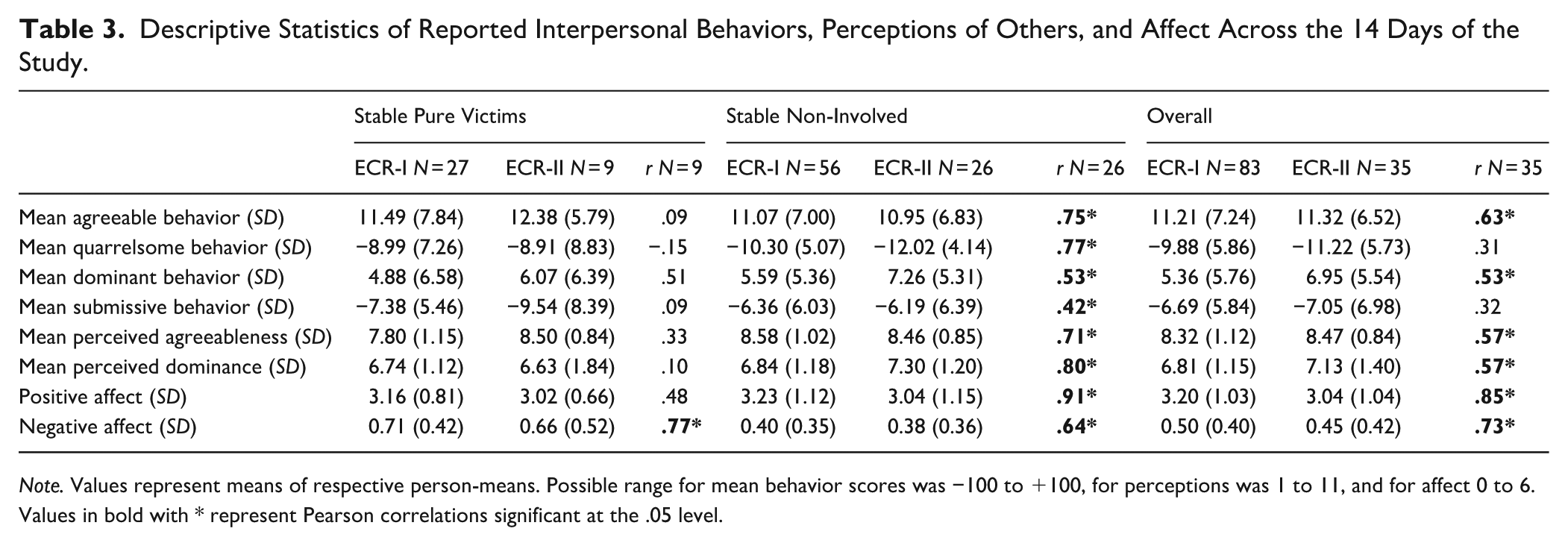
Note. Values represent means of respective person-means. Possible range for mean behavior scores was −100 to +100, for perceptions was 1 to 11, and for affect 0 to 6.
Values in bold with * represent Pearson correlations significant at the .05 level.
Associations Between Interpersonal Behaviors, Perceptions, and Affect and Victimization Status (Hypotheses 1–3; model 1) and Moderation Effects of Perceived Dominance (Hypothesis 4; model 2) at T1.
Note. Significant effects at α = .05 are highlighted in bold with
Cohen’s d effect sizes were only provided for interpretable/interaction effects of model 2.
Interpersonal Behaviors (H1)
There were no significant differences regarding submissive, dominant, quarrelsome, or agreeable behaviors between victims and non-involved individuals.
Interpersonal Perceptions (H2)
Victims perceived their interaction partners as less agreeable (M = 7.79, SE = 0.20) than non-involved participants (M = 8.60, SE = 0.14; t(81) = 3.29, p = .002, d = .73). There was no significant difference in perceived dominance.
Interpersonal Affect (H3)
Victims reported significantly more negative affect (M = 0.71, SE = 0.07) than non-involved participants (M = 0.40, SE = 0.05; t(81) = −3.48, p < .001, d = .77). Victims did not significantly differ in positive affect.
Situation-Specific Group Differences Regarding Interpersonal Behaviors, Perceptions, and Affect (Model 2)
Moderation of Perception of Dominance (H4)
We hypothesized that, particularly in situations when interaction partners are perceived as more dominant, victims would behave more submissively and more quarrelsomely than non-involved individuals. This hypothesis was not supported. Additional analyses. 4 Besides the original aim of testing if the moderation effect would be specific to submissive or quarrelsome behaviors, we also conducted additional analyses regarding the moderation of perceived dominance on other interpersonal aspects. There was no significant moderation effect on victimization and agreeable behavior, dominant behavior, perception of agreeableness, or positive or negative affect.
Depression Symptoms
Due to non-normality of the depression symptoms variable, medians for victims and non-involved individuals were compared using a Wilcoxon–Mann–Whitney test (see Table 1 for descriptive statistics). Victims reported more depression symptoms than their non-involved peers both at pre-ECR (z = 2.52; p = .012), and post-ECR (z = 2.83; p = .005), and also at pre-screen (z = 3.44; p < .001; all analyses based on N = 83).
Overall, more pre- and post-ECR depression symptoms were associated with decreased perceptions of agreeableness and increased negative affect during social interactions. These correlations were also found per group, with a stronger effect of perceptions of agreeableness for victims and a stronger effect of negative affect for the group of non-involved participants (for Pearson correlations, see Table 2).
Summary of T1
Victims reported similar interpersonal behaviors as non-involved individuals, yet experienced social interactions more negatively. They perceived their interaction partners as being less agreeable and recorded more negative affect than their non-involved peers. These interpersonal differences were found across situations and were not especially pronounced in interactions in which interaction partners were perceived as highly dominant. Thus, victims’ social interactions might generally be more negative, rather than only those interactions resembling situations involving bullies.
In line with the idea that between-group differences in interpersonal functioning may contribute to between-group differences in depression symptomology, victims in their final high school year also reported more depression symptoms than non-involved individuals. Moreover, depression symptoms were associated with more negative perceptions and affect during social interactions.
Part 2 (T2)
Graduating high school is often related to many changes and represents a stressful transition period for many adolescents. Possibly, bullying victims struggle more with these changes and with adjusting to new social environments than non-involved individuals (e.g., Kretschmer et al., 2018; Reid et al., 2016). This could also explain their increased depression risk even years after the bullying experience (Moore et al., 2017; Ttofi et al., 2011).
We set up T2 to investigate the interpersonal style of high-school bullying victims and non-involved individuals after their transition out of high school into a new life phase (i.e., starting university or working). One might expect that victims of high-school bullying would report similar interpersonal styles as when still in high school (i.e., during T1 in our sample). We therefore examined whether T1 victims, compared to non-involved peers, would also report perceiving others as less agreeable (H1) and experiencing more negative affect (H2) during T2, and continue to have more depression symptoms (H3).
Methods T2
Participants
All participants who completed part 1 and who gave consent to be contacted for the follow-up were invited to participate in part 2. Of those, 59 started and 53 (90%) fully completed part 2 (see figure 1 for details). Most participants graduated from high school (87%). 5 Of these individuals, 70% started post-secondary education, 18% started working, and 12% took a gap year. As in part 1, the main analyses were based on stable victims (n = 9) and stable non-involved individuals (n = 26) based on T0 and T1 scores (n = 35). We deliberately chose to concentrate on individuals with a stable victimization status to be conservative in labeling adolescents as “victims,” and to align more closely with the definition of bullying, which emphasizes repetitive exposure to bullying perpetration (Olweus, 1996). We recognize that this decision affected our sample size and acknowledge that the small number of participants, specifically in the victim group, likely resulted in insufficient power to reliably detect meaningful effects.
At T2, three of the nine victims (33%) continued to be victimized, whereas the other six did not report any recent bullying or victimization experiences. The majority of non-involved participants continued to be non-involved (92%), one person reported to have been victimized (i.e., victim), and another person reported to have been victimized as well as to have bullied others (i.e., bully-victim). See Table 1 for an overview of other sample characteristics.
Regarding the comparability between our T1 and T2 samples, we found that individuals who did versus who did not take part in T2 did not significantly differ regarding gender, age, interpersonal behaviors, perceptions, or affect (see appendix A for details).
Materials
Materials were the same as in part 1 (see previous section “Materials” for more details).
Procedure
The procedure was very similar to part 1. We gave detailed study information either during a personal appointment with each participant (n = 28) or during a video call (n = 7).
Data Analyses
Regarding the main analyses, to keep comparability between both study parts high, we performed the same multilevel analyses as for T1 applying maximum likelihood estimation using PROC MIXED in SAS version 9.4 (SAS Institute: Cary, NC). Specifically, we examined the main effects of stable pure victimization (predictor) on behaviors, perceptions of others, and affect, as well as the moderating effects of perceived dominance on the association between stable pure victimization and these outcomes.
This approach allowed us to test our hypotheses that, same as at T1, victims, compared to non-involved peers, would report perceiving others as less agreeable (H1) and experiencing more negative affect (H2).
As at T1, medians for victims and non-involved individuals were compared using a Wilcoxon-Mann-Whitney test, allowing us to examine whether victims continued to experience more depressive symptoms than non-involved adolescents (H3) at T2. As additional analyses, we calculated Pearson correlations per group to examine the stability of T1 to T2 interpersonal characteristics. The interpersonal variables were aggregated to a person-mean level, therefore representing a person’s average level of the specific interpersonal variable across the respective ECR period (at T1 or T2).
We also examined how interpersonal style at T1 and at T2 was related to T1 depression symptoms and predictive of T2 depression symptoms (see Table 2 and to Appendix B for more details and the description of results).
Results T2
Descriptive Statistics
Participants reported a total of 1506 social interactions in the 14-day period, with a mean average of 3.10 interactions per day. For a complete description of reported social interactions, see Table 1.
Overall Group Differences Regarding Interpersonal Behaviors, Perceptions, and Affect (Model 1)
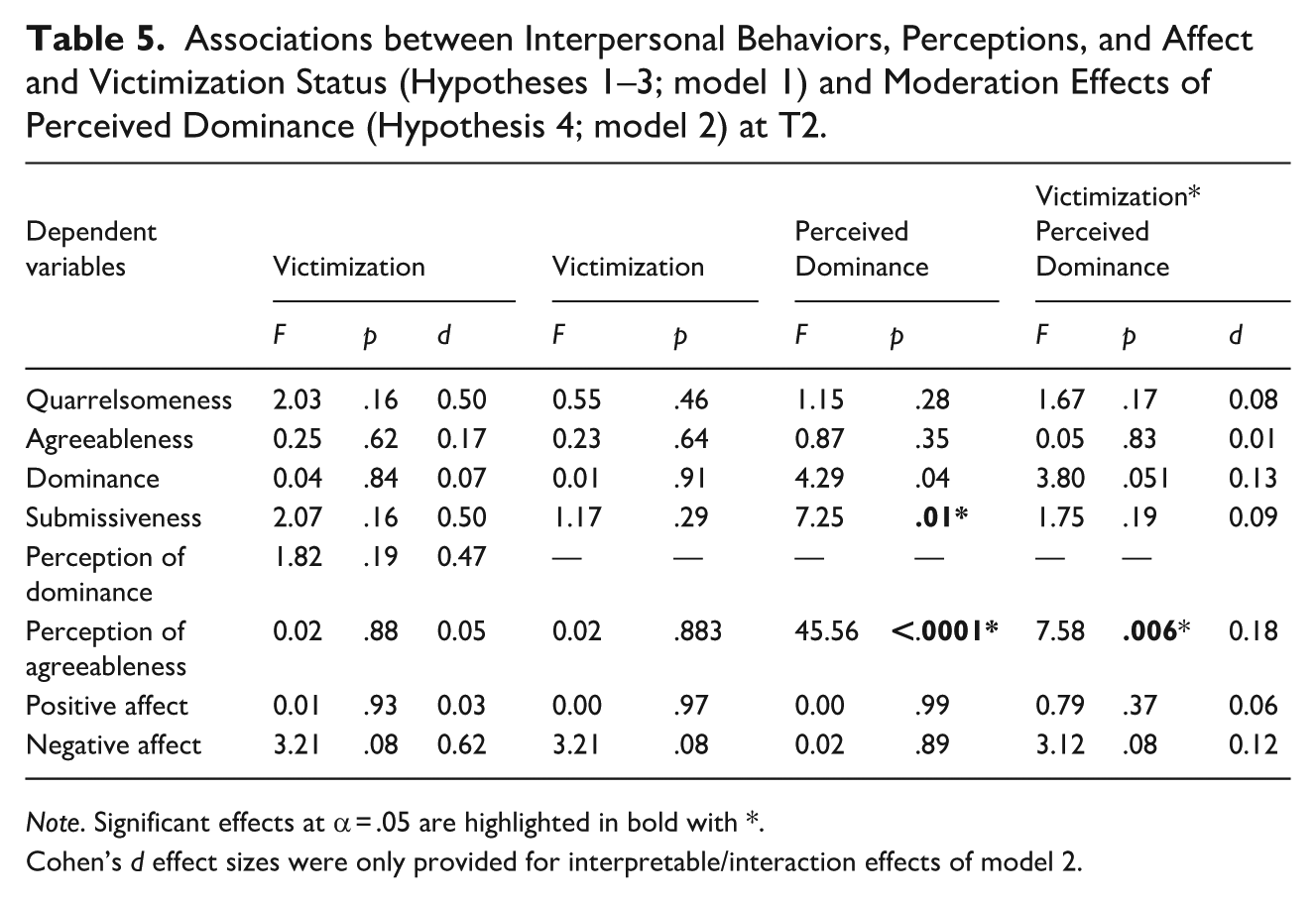
For mean interpersonal behaviors, perceptions, and affect by victimization status, please see Table 3. All statistics can be found in Table 5.
Associations between Interpersonal Behaviors, Perceptions, and Affect and Victimization Status (Hypotheses 1–3; model 1) and Moderation Effects of Perceived Dominance (Hypothesis 4; model 2) at T2.
Note. Significant effects at α = .05 are highlighted in bold with *.
Cohen’s d effect sizes were only provided for interpretable/interaction effects of model 2.
Interpersonal Behaviors
Victims and non-involved participants did not significantly differ in submissive, dominant, quarrelsome, or agreeable behaviors.
Interpersonal Perceptions
There were no significant differences in perceived dominance or perceived agreeableness (H1) between victims and non-involved individuals.
Interpersonal Affect
Victims did not significantly differ in positive or negative affect (H2) from non-involved participants.
Although all main effects were non-significant, effect sizes for quarrelsome and submissive behavior, perceived dominance, and negative affect were of medium strength, suggesting a potential lack of power to find group differences (see Table 5 for details). The direction of those effects suggested victim status to be positively associated with submissive behavior and negative affect, and negatively associated with quarrelsome behavior and perceptions of dominance.
Situation-Specific Group Differences Regarding Interpersonal Behaviors, Perceptions, and Affect (Model 2)
Moderation of Perception of Dominance
Perception of dominance of the interaction partner did not significantly moderate the relationship between victimization and submissive, quarrelsome, or agreeable behavior. It, however, approached significance for the moderation of the association between victimization and dominant behavior (d = 0.13). There was a significant negative slope for victims (β = −3.24, t(929) = −2.41, p = .016, d = 0.16). The slope for non-involved individuals was non-significant (β =−.099, t(929) = −0.11, p = .91, d = 0.007). This suggests that the more victims perceived their interaction partner as dominant, the less they themselves behaved in a dominant way; this was not the case for non-involved individuals (see Figure 2).
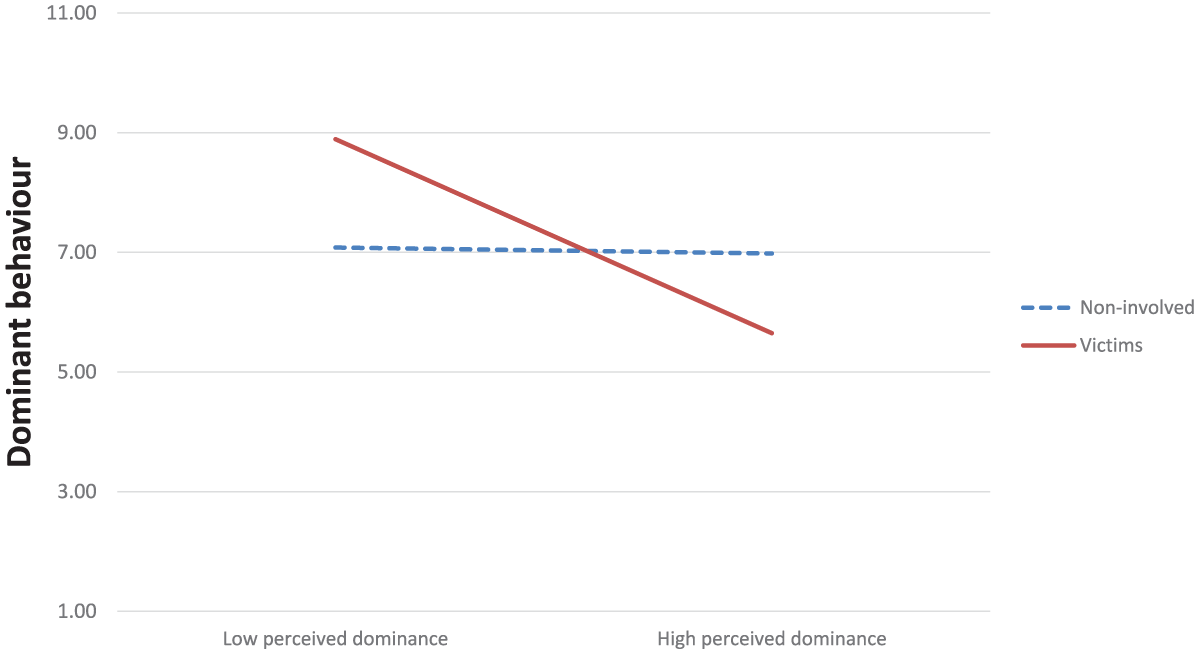
Dominant behavior of victims and non-involved participants in response to perceiving the interaction partner as less dominant (−1 SD) or more dominant (+1 SD).
Additional moderation analyses yielded significant results for the association between victimization and perception of agreeableness (d = 0.18). There were significant negative slopes for victims (β = −.69, t(935) = −5.68, p < .0001, d = 0.37) and for non-involved individuals (β = −.29, t(930) = −3.64, p < .001, d = 0.24). For both groups, perception of agreeableness decreased the more dominantly they perceived their interaction partner (see Figure 3). This association was stronger for victims (β = −.69; d = 0.37) than for non-involved individuals (β = −.29; d = 0.24). No significant moderation effect of perception of dominance on the association between victimization and positive and negative affect was found.
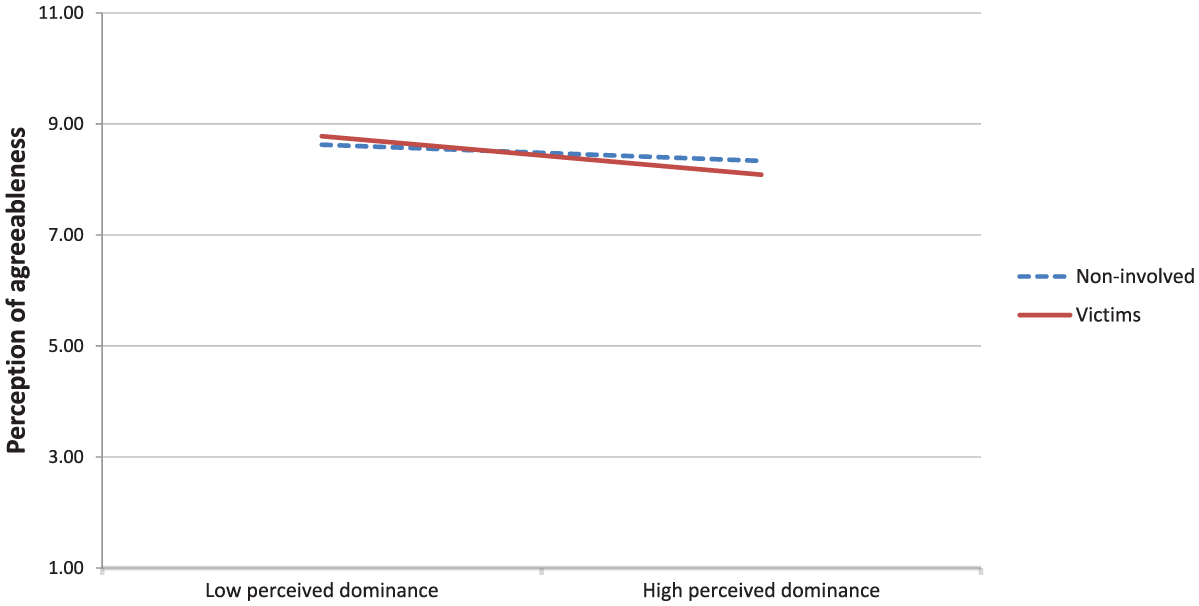
Perception of agreeableness of victims and non-involved participants in response to perceiving the interaction partner as less dominant (−1 SD) or more dominant (+ 1SD).
Within-Group Stability of Interpersonal Variables From T1 to T2
Using Pearson correlations, per group, we inspected the relationship between the interpersonal characteristics from T1 to T2 as an index of stability. For non-involved individuals, their T1 interpersonal characteristics were moderately to very strongly predictive of their respective interpersonal style at T2 (see Table 3). For victims, however, the size of most of the correlations was substantially smaller. More specifically, apart from dominant behavior and affect, T1 interpersonal characteristics of victims only weakly or very weakly predicted their respective T2 characteristics.
This difference between the two groups also became apparent when visually examining the respective mean levels. Means of agreeable behaviors and perceptions of victims appeared to have increased from T1 to T2 (see Table 3), whereas they remained relatively similar for non-involved individuals. Thus, it seemed that victims behaved and perceived their interaction partners as more friendly after they transitioned from high school into new environments.
Depression Symptoms
Based on a Wilcoxon–Mann–Whitney test, the median of depression symptoms of victims was significantly higher than that of non-involved participants both pre-ECR (z = 2.54; p = .011) and post-ECR (z = 2.56; p = .011) (H3), respectively (see Table 1 for descriptive statistics). Overall, more pre- and post-ECR depression symptoms were associated with decreased positive affect and increased negative affect (see Table 2). When examining per group, these significant moderate correlations were also found for non-involved individuals but not for victims. For the victim group, there was one significant association: less agreeable behavior was strongly correlated with more depression symptoms both pre- and post-ECR. Similar to associations with the interpersonal variables, the small group size of the victim group might have prevented us from finding more significant effects.
Summary of T2
In the second part of our study, we examined the interpersonal style of victims of bullying and non-involved individuals approximately 1 year after they completed high school (T2). Across situations, the two groups had comparable interpersonal styles at this point. Nonetheless, when considering the interpersonal context, we found a small yet significant moderation effect of perception of dominance. In situations with dominant interaction partners, victims showed subtle differences in behaviors and perceptions compared to non-involved individuals. In other words, when in situations with individuals potentially behaving similar to bullies (i.e., very dominantly), victims behaved less dominantly and perceived the interaction partner as less agreeable compared to non-involved individuals. In addition, similar to T1, victims had more depression symptoms at T2.
General Discussion
The present longitudinal study was the first to apply ECR of everyday social interactions to examine real-life interpersonal style of victims of bullying and non-involved peers. More specifically, we assessed their interpersonal behaviors, perceptions, and affect for 2 weeks in their final year of high school and again 1 year later. This way we were able to test for general and context-specific interpersonal differences between the two groups and to examine the stability of their interpersonal style after a transition out of the likely bullying environment. Stable maladaptive interpersonal characteristics might help explain victims’ increased risk for developing symptoms of depression.
Overview of Main Findings
While still in high school (T1), we found that, across situations, victims had more interpersonal problems than non-involved peers. They perceived their interaction partners as less agreeable and experienced more negative affect during social interactions compared to non-involved peers (partially supporting H2 and H3). These interpersonal differences were evident in perceptions and affect but not in behavioral aspects, as victims showed similar interpersonal behaviors to non-involved individuals (not supporting H1). One year later (T2), these general group differences were not replicated (i.e., our hypotheses were not supported). Instead, interpersonal differences were more nuanced and context-specific; victims and non-involved individuals specifically differed in interactions with dominant others: When the interaction partner was perceived as highly dominant, victims perceived them as less agreeable. Regarding depression symptoms, victims consistently experienced more depression symptoms than their non-involved peers (as hypothesized).
Interpersonal Style During the Last Year of High School
Our findings indicate that victims have more negative perceptions and affect compared to non-involved adolescents, which aligns with our expectations and is consistent with previous research showing that victims generally report more negative affect and tend to perceive others’ intentions as more hostile compared to their non-involved peers (Ziv et al., 2013). However, our results were not in line with past research suggesting that victims display more submissive or aggressive behavior than non-involved individuals (e.g., Manring et al., 2018; Runions et al., 2018). Specifically, we found that victims did not behave more submissively, less dominantly, or more quarrelsomely than their non-involved peers.
One explanation for why we did not find similar group differences as reported by previous research could lie in differences in methodology. Previous research that reported more hostile or more submissive behaviors in victims relied on one-point-in-time retrospective assessments asking about indications of general interpersonal behaviors (e.g., in the past 2 weeks). These retrospective assessments can be influenced by a memory bias for more extreme events, thereby coloring the overall indication of behaviors (Schwarz, 2014). Therefore, a few incidents with relatively high aggression can lead to an overall higher average report of aggression even though the vast majority of the time the person is not hostile. The novelty and major strength of our study is that using ECR, we assessed daily interpersonal behaviors immediately after they occurred and during single interpersonal events. By then creating averages of those behaviors across the 2-week study period, potential hostile events were more directly compared to non-aggressive events and were less influential to the overall behavioral average. Our results may thus provide a more realistic representation of victims’ general interpersonal behaviors and suggest that, on a daily basis, victims might be less aggressive than previously reported, and that aggressive behavior may be more context-specific.
In addition to a more methodological explanation, there are also theoretical reasons for why we might not have found behavioral differences between victims and non-involved peers. Given the principle of interpersonal complementarity, the perception of more quarrelsomeness would generally be expected to lead to more quarrelsome responses. However, such a behavioral response was not seen in victims in our sample, even though they had more negative perceptions of their interaction partners than non-involved peers. Possibly, victims tried to avoid triggering a confrontation with their interaction partner and felt they could regulate the situation by choosing not to react negatively (i.e., behavioral self-blame; Graham & Juvonen, 1998; McDougall & Vaillancourt, 2015). Nevertheless, victims in our study reported decreased perception of agreeableness and increased negative affect during social interactions, which were also associated with more depression symptoms. This suggests that they have a more negative internal interpretation of social interactions (i.e., perceptual and affective) but show less of an external reaction (i.e., behavioral). Such internal processes are in line with the general conceptualization of depression being an internalizing disorder. Considering the aspect of time, potentially, behavioral differences might only develop later, after continued negative interpersonal encounters.
An alternative interpretation of our findings regarding increased negative affect and depression symptoms but not more maladaptive behaviors in victims could be based on the notion of thwarted interpersonal motives (Horowitz et al., 2006; Shechtman & Horowitz, 2006; a component of CIIT; Pincus, 2005; Pincus & Ansell, 2013). It suggests that for some, a thwarted interpersonal motive can lead to frustration expressed in maladaptive behaviors, whereas for others it might take a different form, such as increased negative affect in the form of loneliness and sadness. It is suggested that the type of negative response depends on the content and context of the frustrated motive and can be a means to distinguish individuals and their risk for developing internalizing and externalizing disorders (Shechtman & Horowitz, 2006). For victims in our study, this could mean that their negative affect and depression symptoms might be related to their highly valued communal motive being thwarted, as they perceived social interactions generally as more negative and might have felt their goal to connect with others was threatened.
Interpersonal Style After Transitioning Out of High School
At T2, we examined the interpersonal style of victims approximately 1 year after they completed high school. This allowed us to test for a potential persistence of victims’ interpersonal characteristics after major environmental changes. Long-term, stable maladaptive interpersonal behaviors and perceptions can impact building a supporting social network and may contribute to the development of mental health problems (Kretschmer et al., 2018). Of note, we would like to highlight that, due to our small sample size at T2, our findings need to be interpreted considering how low power might have led to either not finding underlying meaningful effect or false positives. At first glance, our results suggest that victims in our sample adapted to their new environment as they had similar interpersonal functioning as their non-involved peers. Additionally, victims’ interpersonal style at T1 only weakly predicted their interpersonal style at T2. These findings support the notion that victims might use a transition to re-invent themselves in order to control and prevent negative interpersonal encounters such as re-victimization (Graham & Juvonen, 1998), and that, overall, their interpersonal communal motives regarding connecting with others were met and not thwarted (see Horowitz et al., 2006).
Although generally having similar interpersonal styles as non-involved peers, victims seemed to feel less comfortable in situations with dominant others and potentially experienced these interactions as stressful. More specifically, our results suggest that when in situations with individuals who were perceived as behaving similar to bullies (i.e., very dominantly), victims potentially behaved less dominantly and perceived the interaction partner as less agreeable compared to non-involved individuals. Negative perceptions of interpersonal interactions can increase feelings of insecurity and loneliness and can negatively impact victims’ building new relationships (Jantzer et al., 2006; Newman et al., 2005). In addition, low agentic (e.g., very submissive) behavior can be perceived as unpleasant and less socially desirable by interaction partners (Moskowitz, 2009, 2010) and could potentially invite (highly dominant) others (e.g., bullies) to (re-)victimize those individuals. Stress sensitivity and stressful interpersonal encounters can also contribute to symptoms of depression (Baker & Bugay, 2011). Indeed, similar to T1, also at T2 victims in our sample had more depression symptoms than non-involved individuals.
Strengths and Limitations
Our study was the first to repeatedly examine real-life interpersonal behaviors, perceptions, and affect in adolescents with and without victimization experiences during their final high school year, using ECR. As an additional strength, we examined them longitudinally, following them through a major life event, namely the transition out of high school. Also, we assessed both positive and negative daily conversations right after they occurred. In this, our study is different to previous studies in bullied populations that applied intensive repeated measures in naturalistic settings, as those only assessed negative social interactions for one time-period rather than multiple time-periods, and often only assessed them once at the end of the day rather than multiple times a day (e.g., Morrow et al., 2019; Pouwels et al., 2016). Using ECR of social interactions enabled us to gain insight into victims’ general interpersonal functioning across social interactions. In addition, we were able to test the context sensitivity, and thus the within-person variability of victims’ interpersonal functioning.
Another strength of our study was that our victim group consisted of individuals with stable victimization experiences at both pre-screen and T1 as opposed to studies that assessed victimization only at one time-point. This choice to focus on stable victimization experiences was made based on previous research suggesting that frequent and stable victimization is more strongly associated with internalizing symptoms than infrequent or unstable victimization (Menesini et al., 2009; Moore et al., 2017). Therefore, victims in our sample were potentially also more likely to have more maladaptive interpersonal functioning, due to a longer-term exposure to bullying. And indeed, even though our stable non-involved group also had childhood bullying experiences, we found differences in interpersonal style between the two groups. This suggests that stable victimization experiences throughout the final high school year constituted a factor that differentiated interpersonal experiences between the two groups both concurrently and 1 year later.
Nevertheless, our study is not without shortcomings. Our sample is a convenience sample comprising approximately 70% self-identified girls. This introduces a risk of self-selection bias and may result in an underrepresentation of boys and other-gendered adolescents. In addition, our participants mostly had Dutch nationality, which also limits the generalizability of our findings. Another limitation is the relatively small sample or group sizes, especially at T2, despite the great effort of the research team—which contacted 50 schools during the initial recruitment phase and pre-screened more than 1600 adolescents (see Figure 1). We acknowledge that the substantial loss to follow-up resulted in low power to detect meaningful effects and made the study sensitive to chance findings. Thus, it is important to examine the robustness of the present findings.
Another potential limitation is that written, online social interactions were not recorded by participants. This is because, unlike spoken, offline interactions, they rarely have a discrete end; online chats can be repeatedly continued, even with hours or days in between the initial start of a conversation and the subsequent responses. This impacts the comparability with spoken conversations, including (video) calls. Nonetheless, adolescents often have written, online interactions, and hence we potentially missed to include relevant social exchanges. Yet, with an average of three to four reported spoken interactions per day, our sample reported numbers that are comparable with previous studies in (young) adults (e.g., Clegg et al., 2021; Rappaport et al., 2017).
In a similar vein, although we instructed our participants to report all social interactions, both positive and negative ones, participants may have failed to report on certain interactions, such as when they experienced them as highly stressful. In addition, participants may have avoided negative social interactions. Given that many people tend to shy away from such situations, this behavior might have applied to our entire sample. Nonetheless, victims may have been even more likely to avoid negative interactions due to their greater struggles with social anxiety and avoidance (Coelho & Romão, 2018). Although we do believe this should be considered when interpreting our findings and in future research, the feedback forms completed by participants at the end of both ECR periods would provide useful insights. At both time points, participants from both groups indicated that they reported >70% of their social interactions, indicating that the majority of our sample was actively involved in social activities despite potential avoidance tendencies.
Implications
While they were still in high school, victims in our sample reported more negative perceptions of others and more negative affect during interaction with others. Therefore, they did experience more interpersonal struggles compared to their non-involved peers. Of note, these negative interpersonal experiences were less directly observable (i.e., behavioral) and represent more internal processes (i.e., cognitions and affect). Less observable interpersonal struggles represent a challenge for teachers and parents as they might not realize that an adolescent is struggling in social situations, and might therefore less often offer social support. Lacking such support increases the risk for victims to develop mental health problems (Ttofi et al., 2014). Therefore, we suggest teachers and parents frequently approach and check in with bullied adolescents, in order to provide support early on and to prevent further interpersonal and mental health problems.
Internalizing processes such as negative interpersonal perceptions and affect are thought to play a critical role in the development of depression (Beck & Haigh, 2014; Everaert et al., 2017). This is why, changing maladaptive cognitions and interpretations, such as hostile attribution biases, represent an essential part of cognitive behavioral interventions for depression (Bockting et al., 2017; Meyer & Scott, 2008). Victims in our sample reported similar maladaptive cognitions, both when still in high school, and once they are in new environments. Interventions addressing maladaptive internal interpersonal processes, including assertiveness exercises, could help prevent future interpersonal struggles, thereby aiding victims to build good-quality relationships. This is certainly useful when transitioning to new environments and when interacting with more dominant persons.
Conclusions
In this present short-term longitudinal study, we were the first to apply ECR of social interactions to assess interpersonal functioning of adolescents with and without bullying experiences. We did so for two 14-day intervals, namely in their final high school year and in the year after finishing high school. While still in high school, victims reported more interpersonal struggles characterized by less communal perceptions of their interaction partners and more negative affect compared to their non-involved peers. One year later, after they transitioned into new environments, victims’ interpersonal styles were more similar to that of their non-involved peers and more context-specific. Only in interactions with dominant interaction partners did victims perceive these interaction partners as less agreeable than non-involved participants. Throughout the entire study period, victims reported more depression symptoms. Potentially, victims’ interpersonal style during high school may be predictive of their depression symptoms after transitioning out of high school. Unfortunately, due to our limited sample size at follow-up, it was not possible to reliably test this link. Thus, larger prospective studies are needed to test if subtle, yet enduring, alterations in the interpersonal style of victims of bullying might, over time, contribute to their elevated risk for mental-health problems.
Supplemental Material
sj-docx-1-jiv-10.1177_08862605251375381 – Supplemental material for Interpersonal Style and Depression Symptoms in Victims of Bullying: A Longitudinal Study Across the Transition Out of Dutch High School
Supplemental material, sj-docx-1-jiv-10.1177_08862605251375381 for Interpersonal Style and Depression Symptoms in Victims of Bullying: A Longitudinal Study Across the Transition Out of Dutch High School by Minita Franzen, Peter J. de Jong, René Veenstra and Marije aan het Rot in Journal of Interpersonal Violence
Footnotes
Acknowledgements
The authors would like to thank Jenneke Nijkamp, Jasmijn Tabor, Caroline Miethe, Britt Bolland, Jennifer March, Tess M. C. J. de Leeuw, Bart M. Kranenborg, Miriam G. Leijzer, Hannah Spijker, and Caren van de Vooren for their help with participant recruitment and/or data collection.

Funding
The authors received no financial support for the research and/or authorship of this article.
Declaration of Conflicting Interests
The authors declared no potential conflicts of interest with respect to the authorship and/or publication of this article.
Supplemental Material
Supplemental material for this article is available online.
Notes
Author Biographies
References
Supplementary Material
Please find the following supplemental material available below.
For Open Access articles published under a Creative Commons License, all supplemental material carries the same license as the article it is associated with.
For non-Open Access articles published, all supplemental material carries a non-exclusive license, and permission requests for re-use of supplemental material or any part of supplemental material shall be sent directly to the copyright owner as specified in the copyright notice associated with the article.
