




Abstract
Homicide victimization is prevalent among American Indian and Asian American populations, yet it has received minimal scholarly attention. To address this gap in the literature, we conduct a comprehensive, large-scale study of homicide victimization among the five largest racial and ethnic groups in the United States. The study sample consists of 75,474 homicide victims from 2003 to 2021 in the National Violent Death Reporting System. To test key notions of the racial invariance thesis and the immigrant paradox, we use descriptive and multilevel regression techniques to compare the correlates for homicide victimization across American Indian, Asian American, White, African American, and Hispanic homicide victims. Results demonstrated differences in the correlates for American Indian and Asian American homicide compared to other racial and ethnic groups, providing mixed support for the theoretical frameworks. American Indian and Asian American victims were less likely to be male compared to other victims of color. They were also less likely to be killed by an offender of the same race. American Indians were less likely to be married, whereas Asian Americans were more likely to be married. Asian Americans were more likely to reside in areas with higher levels of concentrated disadvantage, residential instability, racial and ethnic heterogeneity, and population density. The findings suggest that violence reduction strategies should take into consideration, and be tailored to, the unique cultural values and experiences among different racial and ethnic groups.
In 2021, homicides were responsible for approximately 26,000 deaths in the United States (Centers for Disease Control and Prevention, 2024). Although there has been a slight decline in homicide rates in recent years, the homicide rate of 12.7 per 100,000 persons in 2023 was 19% higher than the pre-pandemic homicide rate of 10.8 per 100,000 persons in 2019 (Lopez & Boxerman, 2024). Homicide thus continues to be a leading cause of death in the United States (Curtin & Garnett, 2023), where the homicide rate is seven times higher than the homicide rate in other high-income countries (Grinshteyn & Hemenway, 2016).
The extant literature on homicide in the United States has predominantly focused on White, Black, and Hispanic Americans, with less scholarly attention devoted to the other two largest racial and ethnic groups in the United States—American Indians and Asian Americans. 1 The scarcity of research on these populations is concerning, considering their high incidence of homicide victimization. In 2020, American Indians had the second-highest homicide rate (1.4 per 100,000 persons) among the five largest racial and ethnic groups in the United States, and Asian Americans had a higher homicide rate (0.3 per 100,000) than White Americans (0.2 per 100,000) (Curtin & Garnett, 2023). Homicide was also a leading cause of death for American Indians and Asian Americans aged 1 to 44 years (Curtin & Garnett, 2023). Further, research has indicated that some of the correlates of homicide victimization among Asian Americans and American Indians may differ from those documented for other racial and ethnic groups (Bachman et al., 2008; Harrell, 2009; Wu, 2008).
Of the limited research on American Indian and Asian American homicide victimization, studies typically compare American Indian or Asian American homicide victims to White homicide victims or to the general population, therefore neglecting potentially important differences among American Indian, Asian American, African American, and Hispanic populations (Alberton et al., 2023). In addition, previous research has relied predominantly on small samples, state-specific samples, or samples comprised solely of specific demographic groups such as women (Bachman et al., 2008; Wu, 2008). Moreover, existing studies have focused on a limited number of variables, thereby excluding some documented correlates of homicide victimization and increasing the likelihood of omitted variable bias.
This study contributes to the literature by conducting a comprehensive, large-scale examination of homicide victimization among the five largest racial and ethnic groups in the United States Using data from the National Violent Death Reporting System (NVDRS), the analysis compares the correlates of homicide across American Indian, Asian American, White, African American, and Hispanic homicide victims from 2003 to 2021. The results can facilitate the development of culturally appropriate race- and ethnicity-specific prevention strategies. Below, we ground our discussion of differences in the correlates of American Indian and Asian American homicide in the racial invariance thesis and the immigrant paradox.
Conceptual Background
Racial Invariance and the Immigrant Paradox
Grounded in the Chicago School’s observation that crime rates were higher in structurally disadvantaged areas of early 20th-century Chicago, regardless of the racial and ethnic composition of these areas (Shaw & McKay, 1942), the racial invariance thesis (Sampson & Wilson, 1995) is a foundational assumption of general theories of crime. It assumes that all persons, regardless of their racial and ethnic background, engage in problematic behaviors for the same reasons. In particular, structural factors such as concentrated poverty, family disruption, and residential instability impact crime similarly across race and ethnicity. But racial and ethnic groups are differentially exposed to these factors, thereby explaining observed racial and ethnic disparities in crime. This thesis supports the generality of criminological theories.
Research on the racial invariance thesis has documented a consistent relationship between structural factors (e.g., disadvantage, segregation, relative inequality) and crime across racial and ethnic groups (Hernandez et al., 2016; Painter-Davis, 2012; Painter-Davis & Harris, 2021; Sun & Feldmeyer, 2022; Torres, 2019). Yet, research has documented variation in the magnitude and direction of contextual effects on crime across race and ethnicity (Steffensmeier et al., 2010; Sun & Feldmeyer, 2022; Unnever et al., 2015; Wright et al., 2014). Literature, albeit limited in scope, has also examined whether the key tenets of the racial invariance thesis extend to homicide victimization. This scholarship has identified structural disadvantage and segregation as predictors of homicide victimization, regardless of one’s race and ethnicity (Allen & Feldmeyer, 2022; Berthelot et al., 2016; Painter-Davis & Harris, 2021; Xie, 2010). However, variation in factors such as family income (Berthelot et al., 2016), urban/rural locality (Sun & Feldmeyer, 2022), and type of victimization (Painter-Davis & Harris, 2021) can impact the magnitude of a predictor’s effect on homicide victimization.
A related body of research has examined the immigrant paradox, a framework for understanding how racial and ethnic groups differentially experience the correlates of crime. Grounded in theories linking community inequality, disadvantage, and disorder to crime, and research showing that immigrants tend to be more socioeconomically disadvantaged than native-born individuals (Borjas, 2011; Durand et al., 2016; Patler, 2018), popular belief has associated immigration with criminal behavior. However, studies indicate that foreign-born persons are less likely to engage in criminal behavior than their native-born counterparts (Bersani, 2014a; Martinez & Stowell, 2012; Vaughn et al., 2014), a phenomenon commonly known as the immigrant paradox. One explanation for this phenomenon is that selective migration policies lead to the arrival of healthier, less criminogenic immigrants, although the evidence supporting this hypothesis is mixed (Bostean, 2013; Kennedy et al., 2014; Markides & Rote, 2015). Alternatively, the cultural armamentarium hypothesis suggests that immigrants from collectivist societies benefit from strong family involvement and prosocial norms, which protect them from criminality (Vaughn et al., 2014; Salas-Wright et al., 2016). Accordingly, evidence indicates that cultural norms from one’s country of origin act as a deterrent against criminal involvement (Salas-Wright et al., 2016; Sampson, 2008; Wright & Benson, 2010; Zhang et al., 2021).
Research has broadly supported the immigrant paradox, illustrating that foreign-born individuals exhibit lower rates of antisocial conduct, criminal behavior, substance use problems, and mental health issues, relative to U.S.-born individuals (Salas-Wright et al., 2014, 2016; Vaughn & Salas-Wright, 2018; Vaughn et al., 2014; Zhang et al., 2021). But, studies indicate that the relationship between immigration and crime depends on factors such as generation level (Bersani, 2014a, 2014b; Vaughn et al., 2014) and race and ethnicity (John et al., 2012). Albeit limited, studies have also examined whether the immigrant paradox extends to interpersonal victimization. Some research indicates that immigrants are less likely to experience victimization than their native-born counterparts (Peguero, 2008; Peguero & Jiang, 2014; Xie & Baumer, 2021), although immigrants are disproportionately targeted in hate crime incidents (McCann & Boateng, 2022).
Applying Racial Invariance and the Immigrant Paradox to Racial and Ethnic Differences in Homicide Victimization
We ground our expectations for differences in the correlates of homicide victimization in the racial invariance thesis and the immigrant paradox. As discussed above, part of the explanation for the immigrant paradox is that cultural norms from one’s country of origin deter criminal behavior (Salas-Wright et al., 2016; Sampson, 2008; Wright & Benson, 2010; Zhang et al., 2021). In some cases, these cultural norms can explain racial and ethnic differences in the characteristics of homicide victims. For example, strict gender norms in Asian American communities require women to maintain family harmony despite conflict. This can contribute to unnoticed and unreported acts of violence against Asian American women, which often escalate (Kim & Emery, 2003; Ozaki & Otis, 2017). Similarly, a significant number of homicides involving American Indian women involve a history of under-prosecuted sexual assault, leading to lack of trust in law enforcement (LE); under-reporting of sexual assault and violence; and emboldening of perpetrators (Branton et al., 2021). Accordingly, we may expect a higher proportion of Asian American and American Indian homicide victims to be female, relative to victims from other racial and ethnic groups (Bachman et al., 2008; Wu, 2008).
We may also expect racial and ethnic differences in the academic, professional, and financial correlates of homicide victimization. The racial invariance thesis identifies structural disadvantage as a key influence in the lives of all persons, regardless of race and ethnicity. In particular, there are lasting economic and social hardships faced by American Indian communities, traced back to historical initiatives aimed at economically disabling these populations (Empey et al., 2021; Warne & Frizzell, 2014). These structural disadvantages contribute to higher dropout rates, limited economic opportunities, and increased vulnerability to violence. For example, American Indian students are 237% more likely than White students to drop out of school (National Conference of State Legislatures, 2022), and socioeconomic predictors of homicide are particularly pronounced in American Indian communities (Herne et al., 2016). Indeed, more than one in four American Indians live in poverty (Crepelle, 2023). We therefore expect American Indian homicide victims to have relatively lower levels of educational attainment, employment status, and financial success.
On the other hand, the immigrant paradox suggests that foreign-born individuals often achieve better outcomes than their U.S.-born counterparts. Among Asian Americans, cultural values emphasizing education, family, and community support contribute to higher levels of academic and financial success (Budiman & Ruiz, 2021). Over time, these patterns have reinforced the model minority stereotype, which pressures Asian Americans to attain educational and financial success. Given these trends, we may expect Asian American homicide victims to have relatively higher levels of educational attainment, employment status, and financial success.
With respect to situational factors, we may expect to observe differences in homicide method across race and ethnicity. In particular, firearms accounted for 78% of all homicides in 2021, and this percentage hovered around 70% between 2010 and 2019 (Council on Criminal Justice, 2023). Firearm use in homicide is thus prevalent among all racial and ethnic groups, consistent with the racial invariance thesis. However, research indicates that the firearm homicide rate among American Indians was 2.2 times higher than for White homicide victims between 2016 and 2020 (Nguyen & Drane, 2022). Conversely, studies have shown that Asian American homicide victims are less likely to die by firearm (Tran et al., 2024), although between 2018 and 2022, the number of firearm homicides among Asian Americans rose by 11.8% (Nguyen & Yap, 2024). As such, we expect the use of firearms in homicide to be relatively higher among American Indian homicide victims and lower among Asian American victims.
We may also expect substance use problems to be particularly prevalent among American Indian homicide victims, but relatively uncommon among Asian American victims. Elevated alcohol and substance use rates among American Indians (Young & Joe, 2009) may be best understood as consequences of structural disadvantage, as per the racial invariance thesis. Upward of 80% of American Indian homicides are alcohol-related (May, 1994), and substance use dependency worsens when substance abuse services are limited due to transportation issues, lack of health insurance, poverty, and a shortage of appropriate treatment options, issues prevalent in American Indian communities (Kaliszewski, 2024). On the other hand, the immigrant paradox suggests that despite facing socioeconomic challenges, many foreign-born groups have cultural values that limit substance use problems, relative to their U.S.-born counterparts (Salas-Wright et al., 2014). Among Asian Americans, cultural values such as filial piety and “saving face” are pivotal in influencing how Asian Americans present themselves to others (Kramer, 2002; Liu et al., 2000). The prioritization of family harmony and adherence to family roles often means Asian Americans are concerned about disrupting family dynamics, which may reduce alcohol and substance use and dependency (Fang et al., 2011).
Additionally, we may anticipate a high proportion of American Indian and Asian American homicides to be linked to intimate partner violence. American Indian communities experience disproportionately high rates of intimate partner homicide, exacerbated by systemic barriers to support and justice. Research indicates that 38% of female and 17% of male American Indian victims are unable to access the services they need (Rosay, 2016), due in part to underfunded tribal LE and inadequate victim support resources (Bachman et al., 2008). These patterns underscore how structural inequalities shape victimization, reinforcing tenets of the racial invariance thesis. Similarly, while the immigrant paradox suggests that cultural protective factors may reduce certain correlates of homicide victimization, deeply ingrained expectations of family harmony and the stigma of divorce in Asian American communities often discourage individuals from leaving abusive relationships (Chang et al., 2009). This can lead to a heightened risk of intimate partner homicide, as victims may remain in dangerous situations due to social and cultural pressures.
Regarding contextual factors, we may expect American Indian homicide victims to disproportionately reside in rural communities with less population density (Henry-Nickie & Seo, 2022). An appreciable percentage of American Indians reside in sovereign-governed areas or live near tribal lands (Dewees & Marks, 2017). Reservations are known to experience poverty, unemployment, and housing instability (Crepelle, 2023), and to foster mental health challenges, suicide, and domestic violence (Beals et al., 2005; Olson & Wahab, 2006). Of American Indians residing in metropolitan areas, there are high rates of overcrowding, unemployment, and residential instability (National Council on Aging, 2023).
In contrast, we may expect a disproportionate number of Asian American victims to reside in urban communities characterized by high levels of poverty and transiency. According to Reeves and Bennett (2003), almost 95% of Asian Americans and Pacific Islander Americans live in metropolitan areas. The immigrant paradox may help to explain this, as Wu (2013) attributes the strong presence of Asian American in urban communities to cultural values regarding the convenience and dynamic lifestyle of urban residency.
The Current Study
Our study extends extant research in several ways. First, while studies testing the racial invariance thesis and the immigrant paradox have typically focused on White, Black, and Hispanic populations, our study expands this scope by examining the five largest racial and ethnic groups in the United States: White, Black, Hispanic Asian American, and American Indian. By utilizing aggregate data spanning an 18-year period, we assembled substantial sample sizes of over 1,000 homicide victims from each group. This approach is particularly valuable for Asian American and American Indian populations, which represent relatively small annual percentages of homicides but, when aggregated over time, provide large samples that yield meaningful insights for targeted homicide prevention strategies. Second, racial invariance and the immigrant paradox have been studied in the contexts of offending and health, but their application to homicide victimization, the focus of our study, has been limited. Third, previous research has focused primarily on areal structural characteristics, while we examine a comprehensive array of individual and situational predictors of homicide victimization across race and ethnicity, in addition to broader contextual characteristics.
With respect to individual characteristics, we hypothesize that a higher proportion of Asian American and American Indian homicide victims will be female, relative to victims from other racial and ethnic groups (Hypothesis 1). We also expect American Indian homicide victims to have relatively lower levels of educational attainment, employment status, and financial success, and Asian American homicide victims to have relatively higher levels of educational attainment, employment status, and financial success (Hypothesis 2).
Regarding situational factors, we expect the use of a firearm in homicide to be relatively higher among American Indian homicide victims and lower among Asian American victims (Hypothesis 3). We also posit that substance use problems will be particularly prevalent among American Indian homicide victims, but relatively uncommon among Asian American victims (Hypothesis 4). Further, we anticipate a higher proportion of American Indian and Asian American homicides to be linked to intimate partner violence, relative to victims from other racial and ethnic groups (Hypothesis 5).
With respect to contextual characteristics, we expect American Indian homicide victims to disproportionately reside in rural communities with less population density. In contrast, we expect a disproportionate number of Asian American victims to reside in urban communities characterized by high levels of poverty and transiency (Hypothesis 6). As discussed below, we test these hypotheses using data from the NVDRS.
Research Methods
Data
The NVDRS is a state-based active web surveillance system of all persons who die by homicide, suicide, unintentional firearm fatality, undetermined intent, and legal intervention in the United States. Established by the Centers for Disease Control (CDC) and Prevention, the NVDRS included data from six states in 2003 before becoming nationally representative in 2020. The study sample includes information from all U.S. states between 2003 and 2021 (see Appendix A). The NVDRS integrates information from death certificates (DCs), coroner/medical examiner records, LE reports, Supplementary Homicide Reports, National Incident-Based Reporting System records, Bureau of Alcohol, Tobacco, Firearms and Explosives firearms trace data, crime lab and toxicology reports, hospital discharge data, court records, and Child Fatality Review reports.
The NVDRS defines homicide as death resulting from the intentional use of force or power—threatened or actual—against another person, group, or community (ICD-10 codes X85-X99, U01-U03, Y00-Y09, and Y87.1). Homicide includes: incidents with intent to injure but not kill; deaths induced by the threat of force (e.g., heart attack); self-defense or “justifiable homicides” (not by a LE officer); and intentional abuse or neglect.
Contextual information derived from the U.S. Census Bureau’s American Community Survey (ACS) was appended to NVDRS homicides using census place and state geographic identifiers. The ACS is a continuous, nationwide survey of households and group living quarters in the United States. With a response rate of 95%, the ACS is the premier source of demographic, housing, and socioeconomic information in the United States. ACS data are from the study midpoint (2010–2014).
The study sample includes 24,810 White (32.87%), 38,888 non-Hispanic African American (50.87%), 9,717 Hispanic (12.87%), 1,146 non-Hispanic Asian American (1.52%), and 1,413 non-Hispanic American Indian (1.87%) homicide victims from 2003 to 2021. 2 Appendix B displays the total number of homicide victims in our study sample by year. Homicide victims are nested within 7,660 places and 50 U.S. states.
Measures
Victim Characteristics
Victim characteristics include biological sex (0 = male; 1 = female), age, employment status, educational attainment, marital status (0 = not married; 1 = married), and mental health problems. Employment status was coded based on the type and skill level of work. Low status jobs require a high school degree or less, minimal prior experience, and under 1 year of training (e.g., food preparation workers). Medium status jobs require vocational school or an associate’s degree, and multiple years of training (e.g., electricians). High status jobs require at least a 4-year bachelor’s degree and extensive training (e.g., medical doctors). Victims who were retired, homemakers, or not working were coded as unemployed. Educational attainment includes: less than high school; high school; and some college or more. A binary variable indicates whether the victim had been diagnosed with or treated for a mental health problem according to the DSM-V.
Homicide Offender Characteristics
A binary variable indicates whether or not (0 = no; 1 = yes) the homicide offender was the same race and ethnicity as the homicide victim. Additional offender characteristics include: biological sex (0 = male; 1 = female); age; the offender’s relation to the victim (i.e., intimate partner, family member, friend or acquaintance, other known person, or stranger); whether or not there was a history of the offender abusing the victim; whether or not the offender was the victim’s caregiver; and the number of offenders involved in the homicide. 3
Situational Characteristics
The analysis includes dummy variables indicating whether the homicide was completed by firearm; bludgeoning or beating; stabbing; or other (or multiple) methods. Homicide location includes home or apartment; street or parking lot; car or vehicle; business; and other. Analyses also assess whether or not: there were alcohol or drugs in the victim’s system at time of death; the homicide ended with the offender’s suicide; the homicide was related to intimate partner violence; the homicide was gang-involved; the homicide was part of another crime; the homicide was related to drugs or trafficking; the victim used a weapon; and others were non-fatally shot.
Place and State Characteristics
Concentrated disadvantage represents the weighted factor regression score of median household income (reverse-coded) and the proportion of the population aged 18 to 64 living below poverty, unemployed, single female-headed households with children, married (reverse-coded), and adults with a high school degree (reverse-coded). Residential stability is the average of the proportion of the population living in owner-occupied housing and living in the same house for the past year. Racial and ethnic heterogeneity was measured using Blau’s (1997) index: 1 – ∑pi2, where pi is the proportion of the population in each racial and ethnic group. The analysis also controls for the natural log of the population.
Analytic Strategy
The analysis proceeds in two stages. First, one-way analysis of variance (ANOVA), Kruskal Wallis, and Chi-square tests examine differences in the correlates of homicide across racial and ethnic groups. We test for differences across each racial and ethnic pair. Second, three-level multinomial logistic regression models nesting victims in their place and state of death examine differences in the correlates of homicide across race and ethnicity while controlling for the full array of study covariates, thereby providing a robust and conservative examination of the study hypotheses. In one model, the reference category represents Asian American homicide victims, allowing for a comparison of Asian Americans to victims of all other races and ethnicities. In the second model, the reference category represents American Indians. Models account for year of death via dummy variables. All analyses were performed in HLM 8.2.
Results
Differences across Racial and Ethnic Groups
Table 1 provides a descriptive comparison of differences in the correlates of homicide victimization across race and ethnicity. Subscripts on variables within Table 1 indicate significant bivariate differences across a racial and ethnic pair.
Descriptive Statistics for Homicide Victims, by Race and Ethnicity, NVDRS, 2003–2021, N = 75,474 Homicide Victims, 7,660 U.S. Places, 51 U.S. States and the District of Columbia.
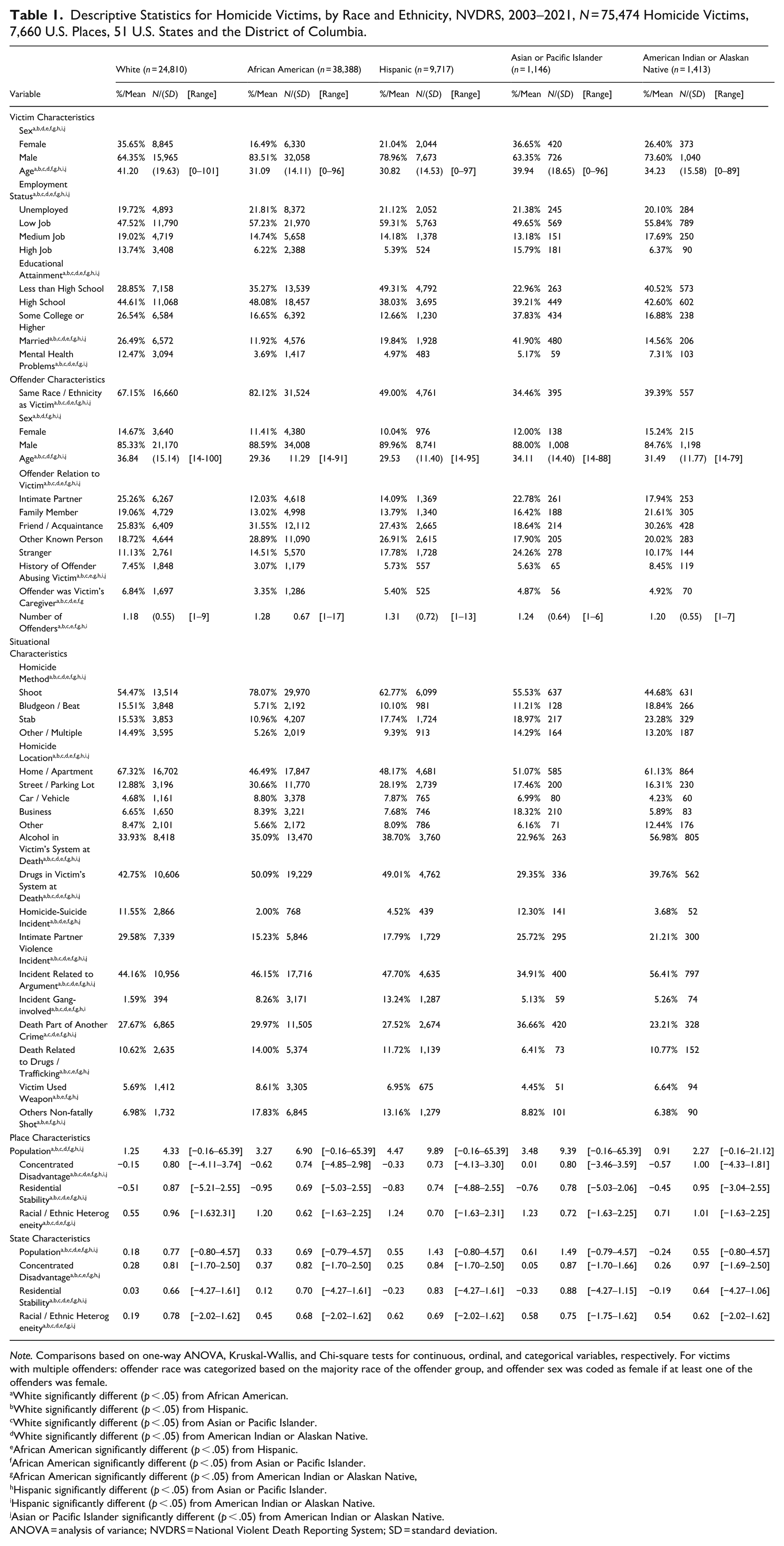
Note. Comparisons based on one-way ANOVA, Kruskal-Wallis, and Chi-square tests for continuous, ordinal, and categorical variables, respectively. For victims with multiple offenders: offender race was categorized based on the majority race of the offender group, and offender sex was coded as female if at least one of the offenders was female.
White significantly different (p < .05) from African American.
White significantly different (p < .05) from Hispanic.
White significantly different (p < .05) from Asian or Pacific Islander.
White significantly different (p < .05) from American Indian or Alaskan Native.
African American significantly different (p < .05) from Hispanic.
African American significantly different (p < .05) from Asian or Pacific Islander.
African American significantly different (p < .05) from American Indian or Alaskan Native,
Hispanic significantly different (p < .05) from Asian or Pacific Islander.
Hispanic significantly different (p < .05) from American Indian or Alaskan Native.
Asian or Pacific Islander significantly different (p < .05) from American Indian or Alaskan Native.
ANOVA = analysis of variance; NVDRS = National Violent Death Reporting System; SD = standard deviation.
Regarding victim characteristics, Asian Americans had the highest percentage of female homicide victims, followed by Whites, American Indians, Hispanics, and African Americans. White homicide victims were the oldest, followed by Asian American, American Indian, African American, and Hispanic victims. Asian American victims were most likely to have high-status jobs and be college-educated, followed by White, American Indian, African American, and Hispanic victims. Asian American victims were also most likely to be married, followed by White, Hispanic, American Indian, and African American victims. White victims were most likely to have mental health problems, followed by American Indian, Asian American, Hispanic, and African American victims.
Regarding homicide offender characteristics, more than four of five African American victims were killed by an African American offender. Similarly, roughly two-thirds of White victims were killed by a White offender, and roughly half of Hispanic victims were killed by a Hispanic offender. Conversely, just over one-third of American Indian and Asian American victims were killed by offenders of the same race and ethnicity. The majority of offenders were male, regardless of the victim’s race and ethnicity. White homicide victims had the oldest offenders, followed by Asian American, American Indian, Hispanic, and African American victims. Across all groups, the majority of offenders were known to their victims, although almost one-quarter of Asian American victims’ offenders were strangers. A history of offender abuse of the victim was most prevalent among American Indian victims. Offenders were most likely to be caregivers for White victims, followed by Hispanic, American Indian, Asian American, and African American victims.
Of the situational characteristics, homicide by firearm was most likely among African American victims, followed by Hispanic, Asian American, White, and American Indian victims. Among all races and ethnicities, homicide occurred predominantly in the home. By far, American Indian victims were most likely, and Asian Americans were least likely to have alcohol in their system at the time of death. Asian American victims were also least likely to have drugs in their system. Victims were unlikely to be killed during a homicide-suicide incident, although this was most common among Asian American and White victims. Homicide incidents involving intimate partner violence were most common among White victims, followed by Asian American, American Indian, Hispanic, and African American victims. American Indian victims were most likely, and Asian Americans were least likely, to be killed in an argument-related incident. Gang-related homicides were most prevalent among Hispanic victims, followed by African American, American Indian, Asian American, and White victims. Asian American victims were most likely to die in an incident that involved another crime. African American homicide victims were most likely, and Asian American victims were least likely, to die in an incident related to drugs or trafficking. Similarly, African American victims were most likely, and Asian American victims were least likely, to use a weapon. Further, African Americans and Hispanics were most likely to be killed in an incident in which others were non-fatally shot.
Of the contextual correlates of suicide, Asian American victims tended to reside in more populous, more disadvantaged, less residentially stable, and more heterogeneous places. Conversely, American Indian victims resided in less populous, less disadvantaged, more residentially stable, and less racially and ethnically heterogeneous places.
Multivariate Analysis of Factors that Distinguish Asian American Homicide Victims
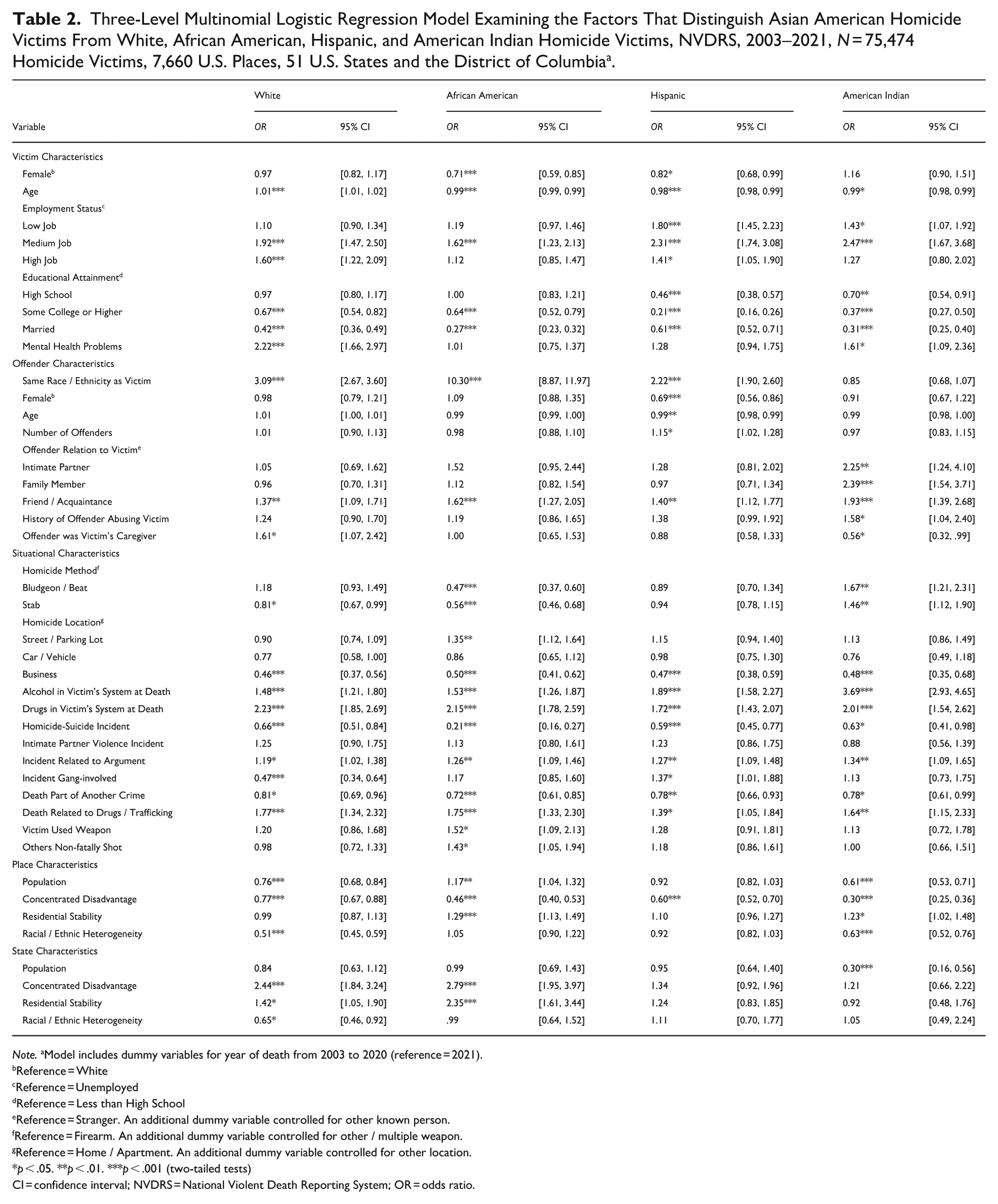
Table 2 presents the results from a multinomial logistic regression model examining the correlates that distinguish Asian American homicide victims from victims in the other racial and ethnic groups, controlling for the full array of study covariates. Regarding the victim characteristics, the odds of being female were more than 20% higher among Asian American homicide victims than among African American (OR = 0.71, 95% CI [0.59, 0.85]) and Hispanic (OR = 0.82,[0.68, 0.99]) victims, consistent with Hypothesis 1. Asian American victims were significantly younger than White victims (OR = 1.01, [1.01, 1.02]) but older than African American (OR=0.99,[0.99, 0.99]), Hispanic (OR = 0.98,[0.98, 0.99]), and American Indian (OR = 0.99, [0.98, 0.99]) victims. Consistent with Hypothesis 2, Asian American victims were more likely to be high school and college-educated than their counterparts. Furthermore, Asian American victims were more likely to be married than all other victims. And, Asian Americans had fewer mental health problems than Whites (OR = 2.22, [1.66, 2.97]) and American Indians (OR = 1.61, [1.09, 2.36]).
Three-Level Multinomial Logistic Regression Model Examining the Factors That Distinguish Asian American Homicide Victims From White, African American, Hispanic, and American Indian Homicide Victims, NVDRS, 2003–2021, N = 75,474 Homicide Victims, 7,660 U.S. Places, 51 U.S. States and the District of Columbia a .
Note. aModel includes dummy variables for year of death from 2003 to 2020 (reference = 2021).
Reference = White
Reference = Unemployed
Reference = Less than High School
Reference = Stranger. An additional dummy variable controlled for other known person.
Reference = Firearm. An additional dummy variable controlled for other / multiple weapon.
Reference = Home / Apartment. An additional dummy variable controlled for other location.
p < .05. **p < .01. ***p < .001 (two-tailed tests)
CI = confidence interval; NVDRS = National Violent Death Reporting System; OR = odds ratio.
With respect to offender characteristics, the odds of having an offender of the same race and ethnicity were 209%, 930%, and 122% lower among Asian American victims than among White (OR = 3.09, 95% CI [2.67, 3.60]), African American (OR = 10.30, [8.87, 11.97]), and Hispanic (OR = 2.22, [1.90, 2.60]) victims, respectively. Relative to offenders of Hispanic victims, offenders of Asian American victims were more likely to be female (OR = 0.69, [0.56, 0.86]) and older (OR = 0.99, [0.98, 0.99]), and less likely to have co-offenders (OR = 1.15, [1.02, 1.28]). Asian American victims were less likely than all other victims to be killed by friends (relative to strangers). Further, Asian Americans were less likely than American Indians to have history of abuse by their offender (OR = 1.58, [1.04, 2.40]), but more likely than American Indians to have been cared for by the offender (OR = 0.56, [0.32, 0.99]).
Of the situational characteristics, Asian American victims were more likely than African American victims to die by methods other than firearms, consistent with Hypothesis 3. On the other hand, Asian American victims were less likely than American Indian victims to die by methods other than firearms. Asian American victims were more likely than victims of all other racial and ethnic groups to be killed at work, compared to at home. Asian American homicide victims were less likely than victims from all other racial and ethnic groups to have alcohol or drugs in their system at the time of death, consistent with Hypothesis 4. Additionally, Asian American victims were less likely to be killed in an incident triggered by an argument or to be killed in a drug-related incident. Conversely, Asian Americans were more likely than all other victims to be killed in an incident that ended with the offender’s suicide or in an incident that was crime-related. Contrary to Hypothesis 5, Asian American victims were not more likely than victims from other racial and ethnic groups to be killed in an intimate partner violence-related incident.
Finally, consistent with Hypothesis 6, Asian American victims were more likely than all other victims to die in places with higher levels of concentrated disadvantage. Asian American homicide victims were also generally more likely to reside in populous, heterogeneous places, and less likely to reside in residentially stable places. Similar trends were observed for the state-level characteristics.
Multivariate Analysis of Factors that Distinguish American Indian Homicide Victims
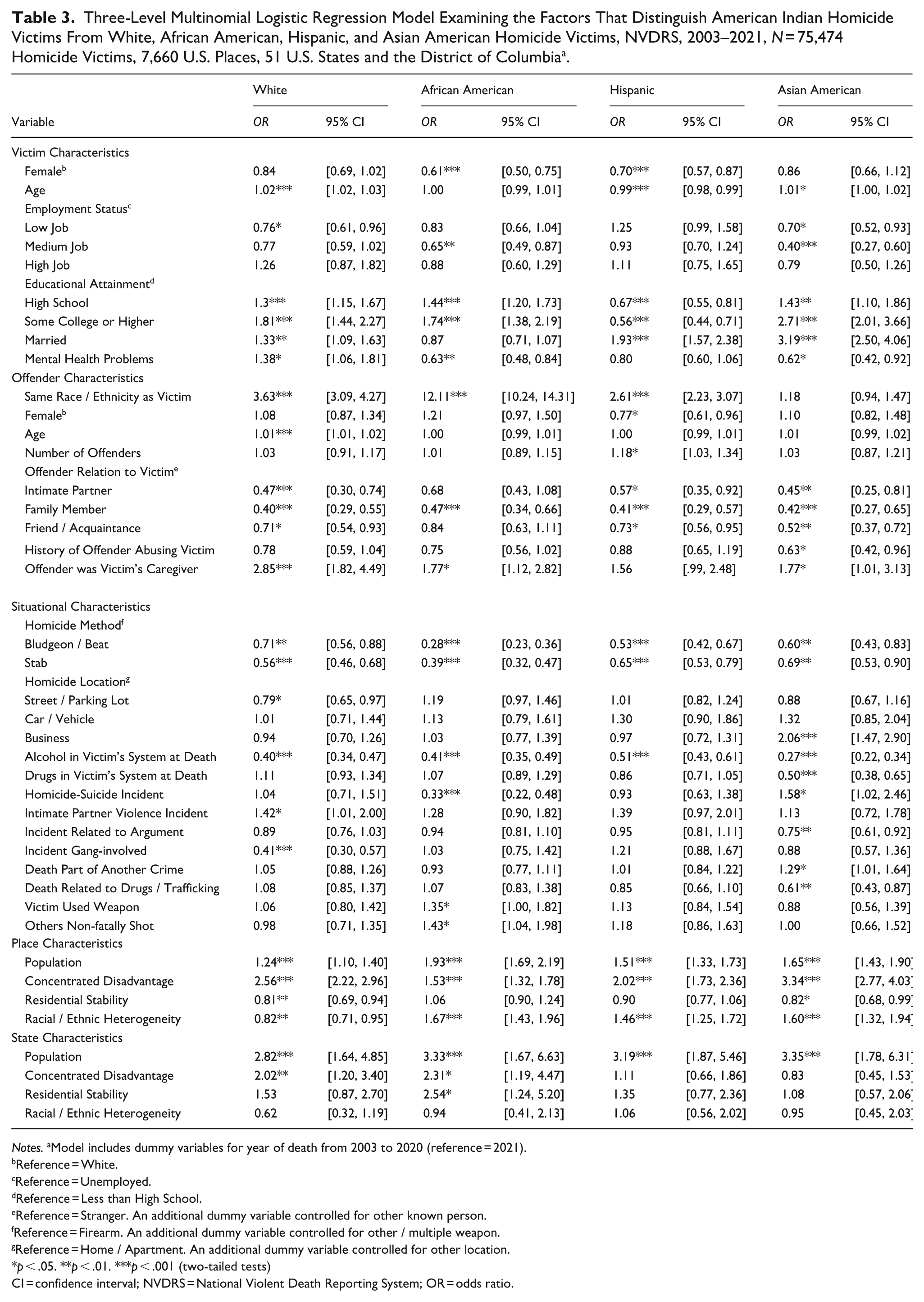
Table 3 presents the results from a multinomial logistic regression model with American Indian homicide victims as the reference category. Regarding the victim characteristics, the odds of being female were more than 30% higher among American Indian homicide victims than among African American (OR= .61, 95% CI [0.50, 0.75]) and Hispanic (OR = 0.70,[0.57, 0.87]) victims, consistent with Hypothesis 1. American Indian victims were significantly younger than White victims (OR = 1.02, [1.02, 1.03]) and Asian American victims (OR = 1.01, [1.00, 1.02]) but older than Hispanic (OR = 0.99, [0.98, 0.99]) victims. Consistent with Hypothesis 2, American Indian victims were less likely to be high school and college-educated than White, African American, and Asian American victims. American Indian victims were less likely to be married than other victims. American Indian victims had fewer mental health problems than White victims (OR = 1.38, [1.06, 1.81]) but more mental health problems than African American (OR = 0.63,[0.48, 0.84]) and Asian American (OR = 0.62,[0.42, 0.92]) victims.
Three-Level Multinomial Logistic Regression Model Examining the Factors That Distinguish American Indian Homicide Victims From White, African American, Hispanic, and Asian American Homicide Victims, NVDRS, 2003–2021, N = 75,474 Homicide Victims, 7,660 U.S. Places, 51 U.S. States and the District of Columbia a .
Notes. aModel includes dummy variables for year of death from 2003 to 2020 (reference = 2021).
Reference = White.
Reference = Unemployed.
Reference = Less than High School.
Reference = Stranger. An additional dummy variable controlled for other known person.
Reference = Firearm. An additional dummy variable controlled for other / multiple weapon.
Reference = Home / Apartment. An additional dummy variable controlled for other location.
p < .05. **p < .01. ***p < .001 (two-tailed tests)
CI = confidence interval; NVDRS = National Violent Death Reporting System; OR = odds ratio.
With respect to offender characteristics, the odds of having an offender of the same race and ethnicity were 263%, 1,111%, and 161% lower among American Indian victims than among White (OR = 3.63, 95% CI [3.09, 4.27]), African American (OR = 12.11, [10.24, 14.31]), and Hispanic (OR = 2.61, [2.23, 3.07]) victims, respectively. American Indian victims were generally more likely to be killed by intimate partners, family members, and friends and acquaintances, relative to strangers, than victims from all other groups. American Indians were less likely to be killed by their caregivers than White (OR = 2.85, [1.82, 4.49]), African American (OR = 1.77, [1.12, 2.82]), and Hispanic (OR = 1.77, [1.01, 3.13]) victims.
There were very few differences in the situational correlates of homicide between American Indian victims and other victims, with two exceptions. First, American Indian victims were more likely than all other victims to die by methods other than firearms, contrary to Hypothesis 3. Second, American Indian victims were more likely than all other victims to have alcohol in their system at the time of death, consistent with Hypothesis 4. Also note that American Indian victims were not more likely than victims from other racial and ethnic groups to be killed in an IPV-related incident, contrary to Hypothesis 5.
Finally, consistent with Hypothesis 6, American Indian victims tended to reside in less populous, less disadvantaged, and less racially and ethnically heterogeneous places than victims from all other racial and ethnic groups. American Indian victims also resided in less populous states than all other victims.
Discussion
This study tested the racial invariance thesis and the immigrant paradox by examining the variables associated with homicide victimization across American Indian, Asian American, White, African American, and Hispanic victims in the United States. Results from descriptive statistics and multilevel regression techniques offered mixed support for both theoretical frameworks while highlighting notable differences across the observed racial and ethnic groups.
As expected, and consistent with Hypotheses 1 and 5, American Indian and Asian American homicide victims were less likely to be male, but more likely to be victims of intimate partner violence than their counterparts. For Asian Americans, these findings are consistent with key notions in the immigrant paradox, which suggests that cultural protective factors may paradoxically contribute to distinct vulnerability patterns. While cultural norms typically promote prosocial behaviors and deter criminal involvement according to the immigrant paradox (Salas-Wright et al., 2014; Vaughn et al., 2014), these same cultural values may inadvertently increase the risk for certain types of victimization. Specifically, cultural emphases on maintaining familial harmony and a positive community image can deter Asian American women from separation and divorce, even in the face of domestic disputes and intimate partner violence (Kim & Emery, 2003; Ozaki & Otis, 2017). These cultural factors may lead Asian American women to remain in dangerous domestic situations longer, potentially increasing their risk of lethal intimate partner violence.
For American Indian women, the heightened risk of female victimization reflects structural inequalities that support key tenets of the racial invariance thesis. In particular, differential victimization patterns across racial groups stem from varying exposure to criminogenic social conditions rather than cultural differences (Sampson & Wilson, 1995). Structural constraints unique to tribal communities create particularly dangerous environments for American Indian women. For example, while intimate partner violence precipitates 45% of homicide incidents, jurisdictional limitations prohibit tribal courts from prosecuting non-American Indian perpetrators (Bureau of Justice Statistics, n.d.). This legal framework, combined with federal attorneys declining to prosecute 46% of assault and 67% of sexual abuse cases (Government Accountability Office, 2010), creates a context of impunity that increases risk for escalation to homicide victimization.
Consistent with Hypothesis 2, Asian American victims were more likely to be educated, whereas American Indian victims were less likely to be educated than victims from other racial and ethnic groups. This contrast supports the racial invariance thesis and immigrant paradox, demonstrating how differential structural and cultural mechanisms produce divergent outcomes across racial and ethnic groups. Regarding the racial invariance thesis, lower educational attainment among American Indian homicide victims reflects broader patterns of structural inequality, including chronic underfunding of tribal schools and limited access to higher education opportunities (Empey et al., 2021; Warne & Frizzell, 2014). On the other hand, the immigrant paradox suggests that cultural protective factors can simultaneously create unique vulnerability patterns. The immigrant paradox typically predicts better outcomes for foreign-born individuals, often attributed to strong family bonds, educational emphasis, and selective migration patterns. However, these same cultural strengths may contribute to distinct victimization risks. Notably, for Asian Americans, the cultural focus on educational achievement, along with the pressures of “model minority” stereotypes, may intensify the need for academic success (Kramer, 2002). Concomitantly, high stress levels among more educated Asian Americans may contribute to higher levels of victimization, contrary to typical patterns observed in other racial and ethnic groups.
The findings also support Hypothesis 3, with Asian American and American Indian victims being less likely to die by firearm compared to other racial and ethnic groups. For Asian Americans, this aligns with previous research demonstrating lower firearm use in homicide within this population (Tran et al., 2024), despite recent increases (Nguyen & Yap, 2024). Similarly, the findings are consistent with studies documenting lower firearm deaths among the American Indian population (Petrosky et al., 2021), with some notable exceptions (Nguyen & Drane, 2022).
These weapon patterns provide nuanced insights into how structural and cultural factors shape homicide characteristics. The racial invariance thesis suggests that firearm use in homicide reflects varying exposure to structural inequalities across groups (Houghton et al., 2021; Wong et al., 2020). For Asian American victims, lower firearm involvement supports this framework, as their generally advantaged structural position corresponds with reduced exposure to conditions that facilitate firearm violence (Sun & Feldmeyer, 2022). Cultural factors consistent with the immigrant paradox may also contribute, including a historical lack of gun ownership among immigrants (Sabri et al., 2018).
For American Indian victims, lower firearm use in homicide appears inconsistent with the racial invariance thesis, given the high prevalence of structural disadvantage among this population. This suggests that additional mechanisms may be operating, including the geographic concentration of many American Indian communities in rural areas where firearm access patterns differ from urban contexts (Corry et al., 2024). Furthermore, the prevalence of intimate partner violence with distinct weapon dynamics (Carmichael et al., 2018) shapes these contexts.
Consistent with Hypothesis 4, American Indian victims were more likely to have alcohol and illicit substances in their system at the time of death, while Asian Americans were less likely to have alcohol and other substances in their system. These contrasting patterns align with both the racial invariance thesis and immigrant paradox. For American Indians, higher substance involvement reflects structural inequalities documented in this population, including the high risk of alcohol use and insufficient infrastructure to support those struggling with substance use (Kaliszewski, 2024; Young & Joe, 2009). For Asian Americans, lower alcohol and substance use are consistent with the immigrant paradox, as cultural norms within many Asian American communities discourage substance use (Cook et al., 2015). However, this protective factor may be weakening across generations, as there is increasing concern about excessive alcohol use among U.S.-born Asian Americans (Zhang et al., 2024).
Consistent with Hypothesis 6, Asian American victims were more likely to live in densely populated, disadvantaged, racially and ethnically diverse, and residentially unstable areas. This may be a product of circumstance, as nearly 95% of all Asian Americans live in metropolitan areas (Reeves & Bennett, 2003) due to a cultural preference for urban living (Wu, 2013). The immigrant paradox helps explain this concentration, as cultural values may drive residential choices toward urban areas despite potential exposure to structural disadvantages typically associated with higher crime rates.
Conversely, American Indians were more likely to reside in less densely populated, less disadvantaged, and less heterogeneous areas. In general, American Indians are more likely to reside in rural areas (Henry-Nickie & Seo, 2022) with the highest rates (40%) of residential stability (Henning-Smith et al., 2023), the lowest rates (17%) of poverty (Parker et al., 2018), and the lowest rates of racial and ethnic diversity (Castillo & Cromartie, 2020). However, tribal lands, where an appreciable percentage of American Indians live, have high poverty rates, low income, inadequate housing, and overcrowding (National Low Income Housing Coalition, n.d.). This contradiction illustrates important limitations of the racial invariance thesis when applied to American Indians, as traditional measures of structural disadvantage may not capture the unique geographic, jurisdictional, and historical factors that shape victimization risk in tribal communities. The disconnect between general rural advantages and specific tribal disadvantages underscores the need for more nuanced investigation into the contextual correlations of homicide victimization among this population.
The findings related to the study hypotheses revealed important differences in the individual (gender, educational attainment), situational (intimate partner violence, alcohol use, substance use, weapon choice), and contextual (population density, concentrated disadvantage, racial and ethnic heterogeneity, residential instability) correlates of homicide victimization across racial and ethnic groups. It is thus critical to consider the multiple spheres of domain relevant to homicide victimization, from the individual to their family, peers, school, community contexts, and beyond.
Additional findings worthy of discussion emerged. Regarding victim and offender characteristics, Asian American victims were less likely to be victims of intraracial homicide, consistent with research by Tran et al. (2024), also using data from the NVDRS. This pattern supports the racial invariance thesis, which emphasizes how structural conditions shape victimization patterns. For example, research demonstrates that population density, racial heterogeneity, and residential instability—characteristics of the communities in which many Asian Americans reside—increase interracial contact and conflict (Messner & South, 1992; Stacey, 2018). Similarly, American Indian victims were less likely to be victims of intraracial homicide. In this case, different structural mechanisms might be operating to produce similar outcomes. Their small population size, representing 2.9% of the total population (National Council on Aging, 2023), high interracial marriage rates (58%; Wang, 2015), and high rates of intimate partner violence may explain the disproportionately high levels of interracial homicide among the American Indian population.
With respect to situational characteristics, Asian Americans were more likely to be killed by strangers, more likely to be killed at business locations, and more likely to be killed during a crime. These findings support the theory that many Asian American homicides result from workplace robberies carried out by unknown offenders (Tran et al., 2024). Moreover, this pattern reveals important nuances in the immigrant paradox framework. While the immigrant paradox typically predicts better outcomes for immigrants despite socioeconomic challenges, these victimization patterns suggest that structural vulnerabilities can override cultural protective factors in specific contexts. Although Asian Americans are often portrayed as concentrated in highly skilled positions, they are also disproportionately represented in personal care and service roles that generally earn below the median weekly wage (USAFacts, 2023). These positions may create unique vulnerability to stranger violence and workplace crimes that transcend the typical protective mechanisms associated with the immigrant paradox.
With the key findings in mind, we highlight several avenues for future research. First, the current study focuses on racial and ethnic differences in the correlates of individual homicide victimization, but it is also important to examine the overall risk of homicide victimization within specific racial and ethnic groups. Analyzing homicide rates allows researchers and policymakers to identify temporal and spatial trends, providing an overall understanding of homicide across demographic groups. While the NVDRS data used in this study consisted solely of victims of violent death, with no comparison group of living persons, future studies could employ novel methodological approaches to assess homicide victimization risk by incorporating appropriate comparison groups of living individuals. Pescosolido et al. (2020) demonstrated the feasibility of such an approach in their study of suicide by using geocoded information to match suicide victims with demographically similar living individuals at both individual and county levels. This data harmonization strategy enabled them to calculate suicide rates and examine risk factors in a case-control framework. While beyond the scope of this study, similar methodologies could be applied to homicide research, allowing for an analysis that examines the risk of homicide victimization across different populations. Such research is critical for allocating resources, shaping violence prevention strategies, and developing targeted interventions to address the specific needs of vulnerable populations (Council on Criminal Justice, 2023; Kegler, 2022).
Second, our findings underscore the importance of intersectionality in homicide research. Female Asian American homicide victims were particularly impacted by intimate partner violence and cultural barriers to help-seeking. For female American Indian homicide victims, structural vulnerabilities such as violence by non-Native perpetrators and jurisdictional gaps in prosecution were especially relevant. Intersectionality, therefore, can enhance our interpretation of the racial invariance thesis and immigrant paradox by revealing how these frameworks operate differently across identity intersections. The racial invariance thesis may mask how identical structural conditions affect different intersecting identities uniquely, while cultural protective factors of the immigrant paradox appear to vary across gender lines within ethnic groups.
Prior research has demonstrated the importance of understanding homicide victimization across race, ethnicity, gender, and class. Lauritsen and White (2001) and Lauritsen and Carbone-Lopez (2011) examine how correlates of offending and victimization vary across race, ethnicity, gender, and class, while Semenza et al. (2022) demonstrate how victimization trajectories differ across racial, ethnic, and gender identities. These studies illustrate how overlapping social positions create distinct experiences with violence that require a more nuanced theoretical understanding. Future research should examine how race, gender, class, and immigration status interact to create unique homicide victimization profiles, potentially requiring modifications to existing theoretical frameworks to better account for these intersectional complexities.
These research implications are tempered by several data limitations. First, the majority of homicides in the study sample occurred in 17 states (see Appendix A), which are unequally distributed across the country. Second, we were unable to measure acculturation and nativity, variables linked to homicide victimization in previous research (Wu, 2008). Third, issues have been documented with the racial misclassification of American Indian death records, with indications that 40% of such DCs are misclassified (Arias et al., 2016). Finally, NVDRS data are not disaggregated by Asian American origin group or American Indian regional group or tribe. The data also do not distinguish between United States and foreign-born Asian Americans. Thus, we were unable to examine differences across American Indian and Asian American subgroups.
With these limitations in mind, we highlight violence prevention efforts grounded in the key findings. Broadly speaking, the correlates for Asian American homicide victimization tended to resemble the correlates for White victimization, whereas the correlates for American Indian homicide victimization tended to resemble the correlates for African American and Hispanic victimization. This suggests that existing violence prevention efforts for White, African American, and Hispanic groups can serve as a template for Asian American and American Indian interventions, with adjustments to meet the unique needs among these populations. This may include addressing cultural values and traditional belief systems.
For example, violence prevention efforts in the Asian American community should address the cultural emphasis on familial harmony, the stigma associated with divorce, and barriers to reporting violence. Organizations such as the Center for the Pacific Asian Family and the Asian/Pacific Islander Domestic Violence Resource Project offer essential services in this regard, including multilingual hotlines, emergency shelters for immigrant women, and training for service providers on cultural barriers among Asian American populations (Hu, 2018).
Similarly, violence prevention in the American Indian community should take into account socioeconomic challenges that are deeply rooted in historical and societal contexts. Rural American Indians endure inadequate and overcrowded housing conditions grounded in historical policies designed to subjugate American Indians and exacerbated by the current lack of funding and restrictions on tribal sovereignty (Crepelle, 2023). A lack of access to vital resources is coupled with the underreporting and lack of prosecution of violence against American Indians via barriers to jurisdictional authority and communication between state and tribal lands (Native Hope, n.d.). Initiatives that seek to address these unique challenges include the Missing and Murdered Indigenous Women initiative, which advocates for increased prosecution of crimes and culturally appropriate services to victims. Relatedly, the National Congress of American Indians (n.d.) strengthens tribal LE and improves communication between state, federal, and tribal authorities. Evidence also suggests that incorporating cultural values and spiritual beliefs into prevention and treatment programs can be successful for American Indian communities (Moghaddam & Momper, 2011). For instance, some alcohol addiction treatment facilities offer programs that emphasize harmony, interconnectedness, and balance, addressing the spiritual needs of some American Indians (Bourne, 2024).
We conclude with the observation that differences in the correlates of homicide victimization across the five largest racial and ethnic groups in the United States necessitate culturally relevant violence prevention that addresses the specific challenges faced by each of these groups. Effective violence prevention efforts in the Asian American community should address barriers to violence reporting and help-seeking, such as filial piety and saving face, and strategies in the American Indian community should address historical socioeconomic and resource suppression.
Footnotes
Appendix
State Participation in the National Violent Death Reporting System (NVDRS) by Year, 2003–2021.
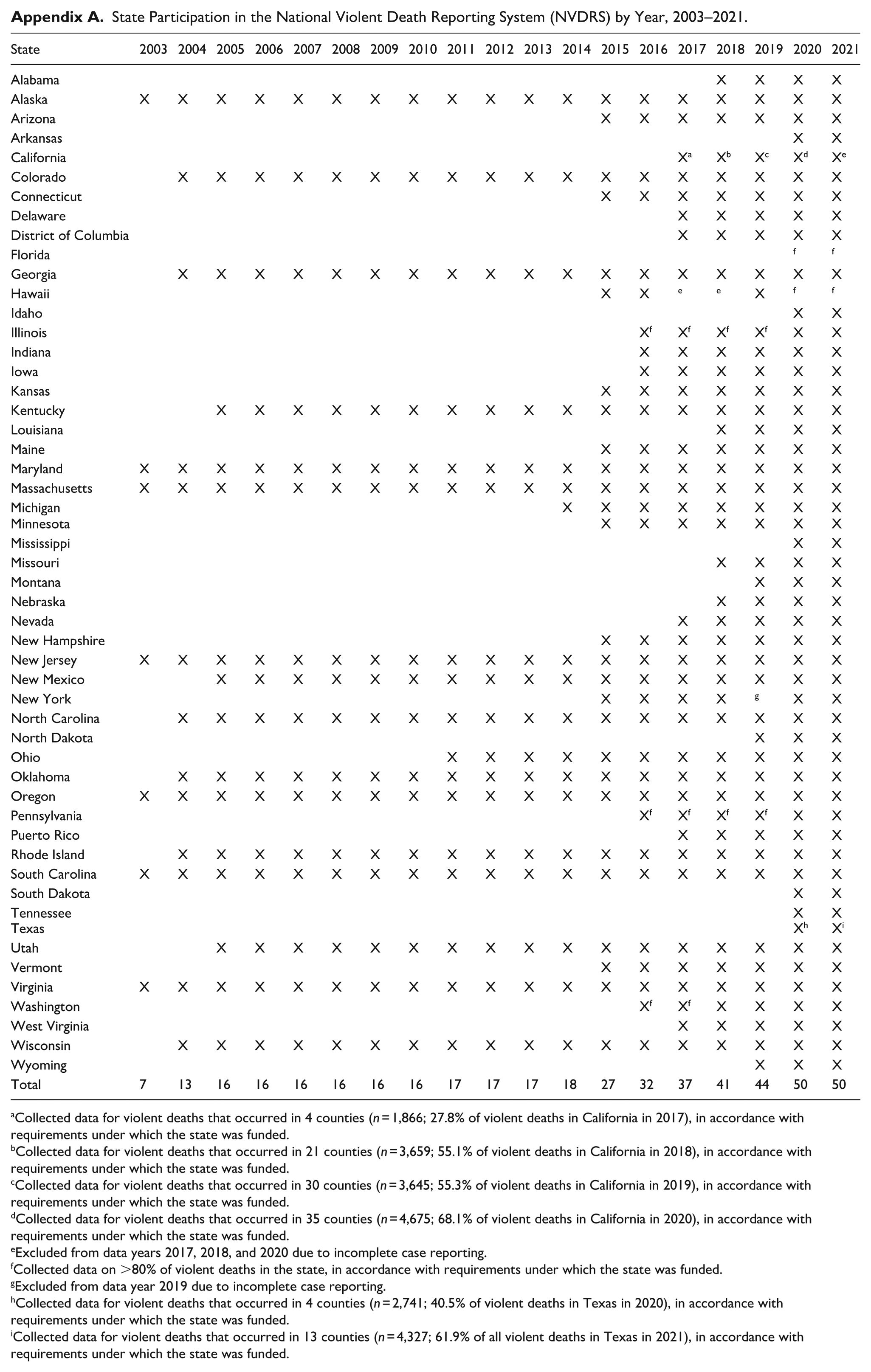
| State | 2003 | 2004 | 2005 | 2006 | 2007 | 2008 | 2009 | 2010 | 2011 | 2012 | 2013 | 2014 | 2015 | 2016 | 2017 | 2018 | 2019 | 2020 | 2021 |
|---|---|---|---|---|---|---|---|---|---|---|---|---|---|---|---|---|---|---|---|
| Alabama | X | X | X | X | |||||||||||||||
| Alaska | X | X | X | X | X | X | X | X | X | X | X | X | X | X | X | X | X | X | X |
| Arizona | X | X | X | X | X | X | X | ||||||||||||
| Arkansas | X | X | |||||||||||||||||
| California | X a | X b | X c | X d | X e | ||||||||||||||
| Colorado | X | X | X | X | X | X | X | X | X | X | X | X | X | X | X | X | X | X | |
| Connecticut | X | X | X | X | X | X | X | ||||||||||||
| Delaware | X | X | X | X | X | ||||||||||||||
| District of Columbia | X | X | X | X | X | ||||||||||||||
| Florida | f | f | |||||||||||||||||
| Georgia | X | X | X | X | X | X | X | X | X | X | X | X | X | X | X | X | X | X | |
| Hawaii | X | X | e | e | X | f | f | ||||||||||||
| Idaho | X | X | |||||||||||||||||
| Illinois | X f | X f | X f | X f | X | X | |||||||||||||
| Indiana | X | X | X | X | X | X | |||||||||||||
| Iowa | X | X | X | X | X | X | |||||||||||||
| Kansas | X | X | X | X | X | X | X | ||||||||||||
| Kentucky | X | X | X | X | X | X | X | X | X | X | X | X | X | X | X | X | X | ||
| Louisiana | X | X | X | X | |||||||||||||||
| Maine | X | X | X | X | X | X | X | ||||||||||||
| Maryland | X | X | X | X | X | X | X | X | X | X | X | X | X | X | X | X | X | X | X |
| Massachusetts | X | X | X | X | X | X | X | X | X | X | X | X | X | X | X | X | X | X | X |
| Michigan | X | X | X | X | X | X | X | X | |||||||||||
| Minnesota | X | X | X | X | X | X | X | ||||||||||||
| Mississippi | X | X | |||||||||||||||||
| Missouri | X | X | X | X | |||||||||||||||
| Montana | X | X | X | ||||||||||||||||
| Nebraska | X | X | X | X | |||||||||||||||
| Nevada | X | X | X | X | X | ||||||||||||||
| New Hampshire | X | X | X | X | X | X | X | ||||||||||||
| New Jersey | X | X | X | X | X | X | X | X | X | X | X | X | X | X | X | X | X | X | X |
| New Mexico | X | X | X | X | X | X | X | X | X | X | X | X | X | X | X | X | X | ||
| New York | X | X | X | X | g | X | X | ||||||||||||
| North Carolina | X | X | X | X | X | X | X | X | X | X | X | X | X | X | X | X | X | X | |
| North Dakota | X | X | X | ||||||||||||||||
| Ohio | X | X | X | X | X | X | X | X | X | X | X | ||||||||
| Oklahoma | X | X | X | X | X | X | X | X | X | X | X | X | X | X | X | X | X | X | |
| Oregon | X | X | X | X | X | X | X | X | X | X | X | X | X | X | X | X | X | X | X |
| Pennsylvania | X f | X f | X f | X f | X | X | |||||||||||||
| Puerto Rico | X | X | X | X | X | ||||||||||||||
| Rhode Island | X | X | X | X | X | X | X | X | X | X | X | X | X | X | X | X | X | X | |
| South Carolina | X | X | X | X | X | X | X | X | X | X | X | X | X | X | X | X | X | X | X |
| South Dakota | X | X | |||||||||||||||||
| Tennessee | X | X | |||||||||||||||||
| Texas | X h | X i | |||||||||||||||||
| Utah | X | X | X | X | X | X | X | X | X | X | X | X | X | X | X | X | X | ||
| Vermont | X | X | X | X | X | X | X | ||||||||||||
| Virginia | X | X | X | X | X | X | X | X | X | X | X | X | X | X | X | X | X | X | X |
| Washington | X f | X f | X | X | X | X | |||||||||||||
| West Virginia | X | X | X | X | X | ||||||||||||||
| Wisconsin | X | X | X | X | X | X | X | X | X | X | X | X | X | X | X | X | X | X | |
| Wyoming | X | X | X | ||||||||||||||||
| Total | 7 | 13 | 16 | 16 | 16 | 16 | 16 | 16 | 17 | 17 | 17 | 18 | 27 | 32 | 37 | 41 | 44 | 50 | 50 |
Collected data for violent deaths that occurred in 4 counties (n = 1,866; 27.8% of violent deaths in California in 2017), in accordance with requirements under which the state was funded.
Collected data for violent deaths that occurred in 21 counties (n = 3,659; 55.1% of violent deaths in California in 2018), in accordance with requirements under which the state was funded.
Collected data for violent deaths that occurred in 30 counties (n = 3,645; 55.3% of violent deaths in California in 2019), in accordance with requirements under which the state was funded.
Collected data for violent deaths that occurred in 35 counties (n = 4,675; 68.1% of violent deaths in California in 2020), in accordance with requirements under which the state was funded.
Excluded from data years 2017, 2018, and 2020 due to incomplete case reporting.
Collected data on >80% of violent deaths in the state, in accordance with requirements under which the state was funded.
Excluded from data year 2019 due to incomplete case reporting.
Collected data for violent deaths that occurred in 4 counties (n = 2,741; 40.5% of violent deaths in Texas in 2020), in accordance with requirements under which the state was funded.
Collected data for violent deaths that occurred in 13 counties (n = 4,327; 61.9% of all violent deaths in Texas in 2021), in accordance with requirements under which the state was funded.
Ethical Considerations
Our institution does not require ethical approval for reporting individual cases or case series.
Consent to Participate
Not applicable.
Consent for Publication
Not applicable.
Funding
The authors received no financial support for the research and/or authorship of this article.
Declaration of Conflicting Interests
The authors declared no potential conflicts of interests with respect to the authorship and/or publication of this article.
Data Availability Statement
The NVDRS data underlying the results presented in the study are available by request from the United States CDC and Prevention as part of their restricted-access data process. Our use of these restricted-access data—the National Violent Death Reporting System Restricted Access Database (NVDRS RAD file)—is governed by a Data Use Agreement (DUA) with the CDC. This DUA legally prohibits us from sharing these data with outside investigators. Anyone who wishes to gain access to these restricted access NVDRS data should contact nvdrs-rad@cdc.gov and follow the procedures outlined here: https://www.cdc.gov/violenceprevention/datasources/nvdrs/dataaccess.html Other NVDRS data are publicly available and can be accessed here:  .
.