




Abstract
This study investigated how cultural factors relate to romantic relationship attitudes and behaviors among Latinx adolescent parents. Guided by a culturally informed prosocial perspective, the study examined the associations between cultural orientation (acculturation and enculturation), familism values, traditional gender role attitudes, and Latinx adolescent parents’ reports of healthy relationship attitudes, healthy conflict management, and intimate partner violence (IPV). Path analyses revealed that higher acculturation and familism values were positively associated with healthier relationship attitudes and engagement in healthy conflict management behaviors. In contrast, less traditional gender role attitudes were linked to healthier relationship attitudes. Notably, the links between acculturation, familism, and relationship attitudes were stronger for U.S.-born youth than immigrant youth. In addition, familism was negatively associated with IPV engagement only among immigrant adolescents. These findings highlight the importance of considering cultural factors, particularly traditional gender role attitudes and familism, in understanding and promoting healthy romantic relationship development among Latinx adolescent parents. The study emphasizes the need for tailored, culturally responsive prevention efforts to address the Latinx community’s diversity. By supporting Latinx adolescent parents in cultivating fulfilling romantic relationships, these efforts can help break cycles of IPV and promote healthy family dynamics.
Introduction
Intimate partner violence (IPV) is a serious public health issue that affects people of all genders, ages, races, and socioeconomic backgrounds (Zhu et al., 2024). IPV includes physical violence, sexual violence, psychological aggression, and stalking among romantic partners, and is a common concern in adolescence (Leemis et al., 2022). Research shows that 26% of adolescent girls and 15% of adolescent boys in the United States report experiencing IPV before age 18 (Center for Disease Control and Prevention, 2021), and approximately half of IPV is bidirectional (Manriquez & Mankowski, 2025). IPV is negatively linked to adolescents’ overall socioemotional development (Sabina et al., 2022), academic performance (Klencakova et al., 2023), and future risk for victimization (Courtain & Glowacz, 2019). Given the prevalence of IPV and its long-term implications for development and adjustment, it is important to understand the correlates associated with IPV, including early precursors to IPV, such as adolescent engagement in healthy (healthy relationship conflict) and unhealthy relationship behaviors (IPV) and relationship attitudes (acceptance of IPV).
Within this study, we will focus on Latinx adolescent parents, as Latinx youth make up a large proportion of the U.S. youth population (25.7%; U.S. Census Bureau, 2020), and pregnant adolescent youth are at higher risk for experiencing IPV (Hoss et al., 2019). Within the U.S. adolescent population, approximately 11% are adolescent parents, and research shows these young parents face twice the risk of experiencing IPV compared to their non-parenting peers (Buzi et al., 2020). Adolescents who become parents face higher rates of IPV due to several risk factors: economic challenges, social stigma, isolation from support networks, and complex power dynamics related to parenting responsibilities (Maddox, 2024), and Latinx adolescent parents can face additional marginalization due to their ethnic-racial heritage (Umaña-Taylor & Updegraff, 2013), placing them at higher risk of IPV. Further, by solely focusing on Latinx adolescent parents, we are also able to provide a nuanced exploration of what important cultural factors may inform adjustment in parenting youth.
We focus on cultural factors that might inform adolescent engagement in healthy and unhealthy relationship behaviors and attitudes because culturally informed prosocial perspectives (Carlo & de Guzman, 2009) suggest adaptive cultural factors, such as cultural orientations and values, might promote youth to engage in healthy, prosocial relationship behaviors and endorse healthy relationship attitudes, which will protect youth from engaging in or being victims of IPV. Among Latinx families, several cultural factors have been identified as potential protective factors to consider, such as youths’ orientation toward U.S. White culture (acculturation) and toward Latinx culture (enculturation), familism values, and gender role attitudes (Alvarez et al., 2020; Mancera et al., 2017; McNaughton Reyes et al., 2016a). However, much of the research assessing the interrelation between culture and relationship outcomes, including IPV, has focused on adults. Less is known about these associations among adolescents, and even less among parenting adolescents. As such, our goal is to examine how cultural factors, such as cultural orientation, familism values, and gender role attitudes, are associated with relationship attitudes and behaviors among Latinx adolescent parents. Further, understanding that several developmental and family dynamics differ for U.S.-born and immigrant Latinx youth (Umaña-Taylor & Updegraff, 2013), we will also assess how these cultural factors differentially inform these relationship outcomes. Previous literature on Latinx communities and IPV has overemphasized cultural risk factors by reinforcing stereotypes or treating cultural differences as barriers while neglecting protective cultural elements that could enhance programming relevance and responsiveness (Silverman et al., 2023). We focus on identifying cultural strengths to help shift the narrative surrounding IPV from a deficit-focused lens toward a strength-based approach that acknowledges the resilience inherent in Latinx culture.
Romantic Relationship Factors and IPV
Dating and romantic relationships are normative experiences in adolescence (Connolly et al., 2023). These early experiences can provide a foundation for future relationships (Siegel, 2020), as youth who report having higher quality romantic relationships in early and mid-adolescence are more likely to have high-quality romantic relationships in late adolescence and early adulthood (Gonzalez Avilés et al., 2021). As such, early engagement in healthy (e.g., healthy conflict management) or unhealthy (e.g., IPV) relationship behaviors or unhealthy relationship attitudes might have long-term implications for future romantic partner relationships.
Healthy relationship attitudes involve recognizing behaviors such as hitting, threatening, and pushing as unacceptable behaviors in a relationship (Hunt et al., 2022). On the other hand, unhealthy relationship attitudes might include normalizing IPV, minimizing the severity of IPV, justifying or excusing harmful behaviors, victim-blaming, or perpetuating harmful gender stereotypes. Research examining the relationship between dating violence (DV) and unhealthy relationship attitudes found that men have more accepting attitudes than women, both genders show greater acceptance of female-perpetrated DV, and there are patterns of multiple forms of violence occurring together (Courtain & Glowacz, 2021), highlighting how attitudes might be an important precursor to future IPV behaviors.
In addition to healthy relationship attitudes, early engagement in healthy or unhealthy relationship behaviors is also important to consider. Healthy conflict management is the ability to navigate disagreements, conflicts, or differences of opinion constructively and respectfully (Paradis et al., 2024). Healthy conflict management typically includes effective communication, active listening, empathy, compromise, and a willingness to find mutually satisfactory solutions (Bleckmann et al., 2024). Unhealthy relationship behaviors can include engagement in IPV, such as physical aggression, sexual coercion, emotional abuse, and controlling behaviors. Engaging in or experiencing these healthy and unhealthy behaviors has important implications for one’s adjustment (Bonache et al., 2019) and can set a foundation for developing patterns of IPV engagement across the life course (Herrenkohl et al., 2022). Understanding the impact of romantic relationship factors, including attitudes and behaviors, is crucial in addressing IPV and promoting healthy relationships among young parents and adolescents, as these early experiences can shape future relationship patterns and well-being.
Cultural Correlates of Healthy and Unhealthy Relationship Factors
A culturally informed prosocial perspective provides a comprehensive framework for understanding the influences of cultural factors on individuals’ behaviors and attitudes within interpersonal relationships (Carlo & Padilla-Walker, 2020). This perspective emphasizes the significance of cultural context and socialization processes in molding individuals’ prosocial behaviors, encompassing attitudes and actions that foster positive interactions and contribute to the welfare of others. Coupled with interpersonal factors (e.g., cognition, personality, and moral reasoning), cultural values, orientations, and ethnic-racial identity factors can shape individuals’ moral compass, motivations, interpersonal attributions promoting empathy, and general interpersonal interaction style, consequently influencing their inclination toward engaging in prosocial actions (Carlo & Padilla-Walker, 2020). Further, context can inform youths’ tendencies and abilities to behave in a prosocial manner, as supportive environments may foster more opportunities to model prosocial behaviors, whereas negative environments, including those that impose cultural stressors (e.g., discrimination, acculturative stress), may reduce youths’ psychological and motivational resources to engage in prosocial ways. Latinx adolescents who are parents may undergo a unique process where they balance the values and traditions of their heritage culture with the demands and expectations of their new parental roles. Within the context of Latinx adolescent parents’ relationship behaviors and attitudes, prosocial perspectives offer a lens to explore how cultural factors inform romantic relationship attitudes and behaviors.
Among U.S. Latinx youth, cultural orientations encompass individuals’ engagement with the U.S. White culture (acculturation; Padilla-Medina et al., 2022) and with Latinx culture (enculturation; Cuéllar et al., 1995). Existing research with Latinx adults highlights how acculturation and enculturation can differentially inform relationship dynamics, such that enculturation is linked to lower IPV rates (Cala & Soriano-Ayala, 2021; McNaughton Reyes et al., 2016a), while acculturation has been associated with increased IPV (Alvarez et al., 2020). Research focused on adolescents shows slightly mixed results, such that greater acculturation in Latinx adolescents correlates with a heightened risk of involvement in violent acts (Smokowski et al., 2009), less healthy relationship attitudes, and more negative attitudes toward seeking help if one experienced IPV (Rueda et al., 2015), but it is also linked to less IPV victimization (Sabina et al., 2022). Only one study has explored the role of enculturation on IPV behaviors and found that enculturation is linked to less victimization (Terrazas-Carrillo et al., 2024).
Familism values include an emphasis on prioritizing family needs over one’s own, family harmony, and interdependence (Knight et al., 2010) and have been conceptualized as important promotive factors that inform prosocial behaviors and adjustment (Carlo & Padilla-Walker, 2020). Research on Latinx adults and adult opposite-gender couples has shown that higher endorsement of familism values is linked to more positive romantic relationship dynamics (e.g., more support; Campos et al., 2016), lower engagement in IPV (Cavanaugh et al., 2010; Curry et al., 2018), and lower tolerance for IPV (McNaughton Reyes et al., 2016b; Ulloa et al., 2004). Though some qualitative work suggests that familism could also be linked to less help-seeking behaviors (Gonzalez-Guarda et al., 2011), much of this work has focused on adults. Only one study has explored the role of familism on IPV behaviors in adolescence, noting that higher familism values were linked to adolescents’ higher likelihood of engaging in help-seeking behaviors if they experienced IPV—suggesting less acceptability of IPV (Cuevas et al., 2021). There is a lack of research on this topic in adolescence, yet the generally consistent evidence that familism might be positively linked to healthy relationships in adulthood informs our interest in assessing how familism relates to adolescent parents’ romantic relationship dynamics.
Traditional gender role attitudes can be defined as the adherence to long-standing behavioral norms that privilege men and support the notion that men should be providers and women should be accommodating and obedient (Terrazas-Carrillo & Sabina, 2019). Less traditional gender role attitudes challenge these rigid classifications and advocate for more flexible, egalitarian relationships between genders. Latinx adults who endorsed more traditional gender role stereotypes were more likely to experience or engage in IPV (Cummings et al., 2013; Gonzalez-Guarda et al., 2010, 2011) and had more tolerant attitudes toward IPV (Terrazas-Carrillo & Sabina, 2019). Among young adults, Latinx college men and women who endorsed more machismo ideals (related to traditional gender role attitudes) reported more positive attitudes toward IPV (Terrazas-Carrillo et al., 2024). We are aware of only one study exploring this relationship with adolescents, which found Latinx adolescent boys who endorsed more traditional gender role attitudes were more likely to perpetrate IPV (McNaughton Reyes et al., 2015); thus, highlighting the need for this research.
Differences Between U.S.-Born and Immigrant Youth
Researchers focused on IPV and relationship outcomes among Latinx youth have long suggested that nativity (if someone is an immigrant or U.S.-born) might be an important factor to consider (McNaughton Reyes et al., 2016a). Such expectations are informed by past research on adults that has found, for example, that adult U.S.-born Latina women report a higher prevalence of IPV compared to immigrant Latina women (Espinoza et al., 2022). However, scholars have highlighted the need to assess differential processes for U.S.-born and immigrant Latinx populations to better represent the diversity that exists within Latinx families (Cabrera et al., 2024), especially as nativity might significantly influence the cultural values and interpersonal behaviors of Latinx individuals and their subsequent approach to conflict resolution and acceptance of IPV (Carlo & Padilla-Walker, 2020). As an example, in a study of Latina adult women, nativity moderated the link between education and IPV, such that education was negatively linked to IPV for U.S.-born Latina women but not immigrant Latina women (Henke & Hsu, 2018). Though this study did not explore how cultural factors differentially inform relationship outcomes, it does provide evidence that some sociocultural factors might differ between these groups. As such, our final goal is to assess the moderating role of nativity.
Current Study
The current study aims to assess how cultural factors are related to Latinx adolescent parents’ reports of healthy and unhealthy relationship behaviors and attitudes. Specifically, we focus on youths’ cultural orientations, familism values, and gender role attitudes, as researchers have conceptualized these factors to be salient to IPV (McNaughton Reyes et al., 2016a). Given that most research has assessed these links among Latinx adults (Alvarez et al., 2020; Espinoza et al., 2022; Mancera et al., 2017), more research on how these factors inform relationship behaviors among Latinx adolescents is greatly needed. Guided by prosocial perspectives on youth development (Carlo & Padilla-Walker, 2020), our first goal was to understand how cultural factors related to Latinx adolescent parents’ reports of healthy and unhealthy relationship behaviors and attitudes (Figure 1). Based on previous research and theory, we hypothesized that less acculturated and more enculturated adolescent parents would report healthier relationship attitudes (characterized by lower support of IPV) and healthier relationship behaviors (characterized by more engagement in healthy conflict management and less engagement in IPV). We also hypothesized that higher endorsement of familism values and lower endorsement of traditional gender role attitudes would be linked to more healthy relationship attitudes and behaviors. The second goal in our study was to assess if these cultural factors related to the above-mentioned relationship outcomes differed for immigrant and nonimmigrant youth (Figure 1). This second research question was exploratory. Within our analyses, we included adolescents’ age, gender, and pregnancy status as covariates to account for developmental (Johnson et al., 2015), and family transition (Newman & Campbell, 2011) differences.
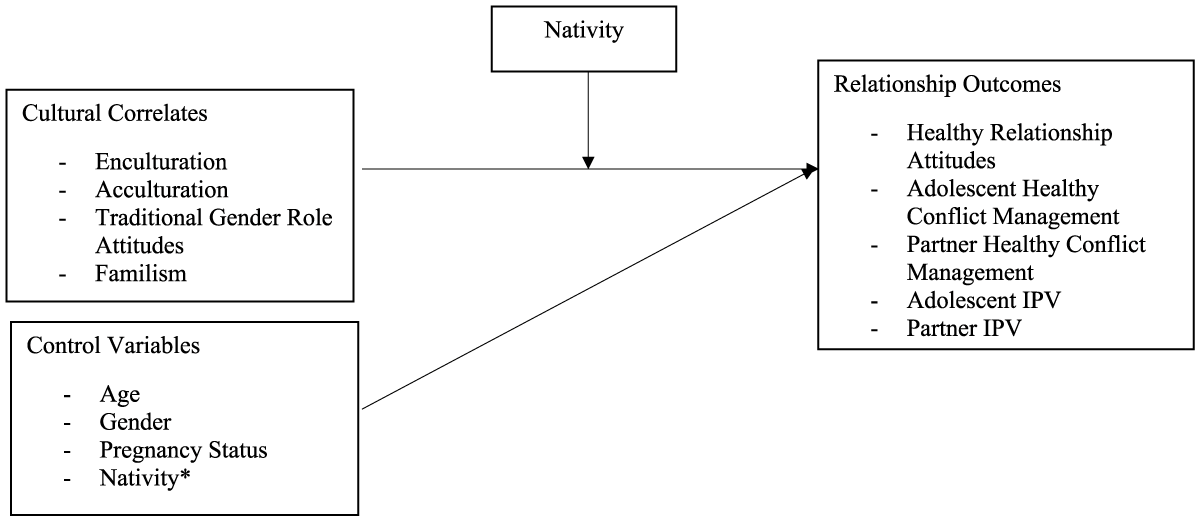
Theorized model assessing cultural factors’ association with relationship outcomes (goal 1) and the moderating role of nativity (goal 2).
Methods
Procedure
Data were collected between 2015 and 2020 from a more extensive study focused on learning about adolescent parents’ relationships and social support systems. Schools were selected to represent a range of socioeconomic situations, with the proportion of students receiving free/reduced lunch varying from 31.1% to 90.3% across schools. Adolescents were recruited from eight public high schools in Central Texas through each school’s Pregnancy, Education, and Parenting Programs representatives. To be eligible to participate in the study, adolescents had to be pregnant, have a pregnant romantic partner, or be the biological parent to a child. Adolescents could participate alone or as a couple. Each qualified participant received a packet with information regarding the study, including consent and assent forms. A snowball sampling method was used to recruit additional participants, and mothers were asked to identify the fathers. Partners whose information was shared were then contacted to participate in the study. Snowball sampling techniques are especially helpful to identify populations that are not easy to identify or access (Atkinson & Flint, 2001).
Data were collected in the schools via electronic tablets using a Qualtrics electronic survey. To accommodate the linguistic diversity of the population, surveys were provided in English and Spanish. Participants received a $5 gift card for participation. If adolescents were not in school during data collection, the research team followed up via phone calls and text messages. The University’s institutional review board approved all procedures.
Participants
A total of 536 adolescents agreed to participate in the study, with 74.8% identifying as female (n = 401) and 24.2% identifying as male (n = 135). Participants’ ages ranged from 14 to 19 years old (Mage = 16.81, SD = 1.20). All adolescents identified as Hispanic/Latinx, and 77.1% were born in the U.S. Most participants did not identify their ethnicity beyond noting they were Hispanic/Latinx (51.5%), with a smaller group identifying as Mexican (41.4%), Central American (5.7%; i.e., Guatemala, Honduras, and El Salvador), or other Latin American/Caribbean countries (1.4%; i.e., Colombia, Cuba, and Peru). Regarding parenting status, 49.8% reported they or their partner was pregnant, and 50.2% were already parenting. Next, 72.8% of adolescents were in a relationship with the child’s other biological parent, 3.6% reported they were in a relationship with someone else, and 23.6% were not in a relationship.
Measures
All measures were forward translated into Spanish and reviewed by a team of bilingual (English and Spanish) speakers. The translated measures were compared with the original items for meaningful equivalence, and changes were recommended to the original and translated materials (Prieto, 1992). By recommending changes to the original and translated material, researchers ensure better cross-language equivalence compared with simple forward-and back-translation techniques (Knight et al., 2009). Skew and kurtosis values for all measures fell within the accepted ranges, suggesting they were normally distributed (±2; Tabachnick & Fidell, 2007). Across all measures, higher scores indicated higher endorsement of a construct.
Cultural Correlates
Enculturation and Acculturation
We used the shortened version of the Acculturation Rating Scale for Mexican Americans-II (Cuéllar et al., 1995) to assess participant orientation toward Mexican culture and Anglo (U.S. White, non-Latinx) culture. This measurement is comprised of six items assessing enculturation, cultural orientation toward Latinx culture (e.g., “I enjoy speaking Spanish”), and six items assessing acculturation, cultural orientation toward U.S. White culture (e.g., “I think in English”). All items use a 4-point scale, ranging from 1 (not at all) to 4 (extremely often or almost always). This measure has been validated among diverse Latinx samples (Gutierrez et al., 2009). Cronbach’s alphas were high for enculturation (α = .96) and acculturation (α = .72).
Familism Values
We used the Mexican American Cultural Values Scale to assess agreement with statements of familism values (Knight et al., 2010). This 17-item scale assessed the extent to which participants endorsed the importance of family obligations (e.g., “Children should be taught that it is their duty to care for their parents when their parents get old”), support and emotional closeness (e.g., “Family provides a sense of security because they will always be there for you”), and guidance by family response (e.g., “Children should always do things to make their parents happy”). All items were scored on a 5-point scale, ranging from 1 (strongly disagree) to 5 (strongly agree). Because this scale has not been validated with a broader range of Latinx, we ran confirmatory factor analyses (CFA) to assess how the scale performed in the expected manner within our diverse Latinx sample. Results showed good model fit (Comparative Fit Index (CFI) = 0.905, Root Mean Square Error of Approximation (RMSEA) = 0.072, Standardized Root Mean Square Residual (SRMR) = 0.045) and Cronbach’s alpha was high, α = .93, suggesting the scale was appropriate to use within our diverse Latinx sample.
Traditional Gender Role Attitudes
We used a shortened eight-item version of the What is a Father? scale to assess gender role attitudes among participants regarding parental roles and expectations (Palkovitz, 1984). This measure uses a 5-point scale to assess how strongly participants agree (1 = strongly agree to 5 = strongly disagree) with a series of statements such as “Fathers should spend more time with their children and less time at work.” The original nine-item scale was pilot tested with our sample of Latinx adolescents. Based on student feedback and CFAs, one item was removed. Cronbach’s alpha for this scale was α = .65.
Romantic Relationship Attitudes and Behaviors
Healthy Relationship Attitudes
We assessed adolescents’ attitudes toward healthy and unhealthy relationship behaviors using the Healthy Relationship Attitudes scale (Scott et al., 2015), which was created using a diverse sample that included Latinx couples. This 8-item scale asks adolescents how important (1 = not at all important to 4 = very important) it is for people in healthy relationships to embody certain behaviors (e.g., “Do not cheat on each other,” “Do not threaten each other,” “Encourage each other when life is hard”). Items were averaged, with higher scores reflecting healthier relationship attitudes (α = .86).
Healthy Conflict Management and IPV
We used the Conflict in Adolescent Dating Relationship Inventory (CADRI; Wolfe et al., 2001) to assess adolescent engagement in healthy (healthy conflict management) and unhealthy relationship behaviors (IPV engagement). Adolescents reported on their own and their partners’ relationship behaviors using a 4-point scale (1 = never to 4 = often). This study used two subscales of the CADRI: the healthy conflict resolution subscale, which consists of 8 items that assess engagement in healthy relationship behaviors (e.g., “My partner gave reasons for his/her side of the argument”), and 21 items to assess overall abuse (e.g., “My partner kicked, hit, or punched me”). This measure has been validated with Latinx youth (Hokoda et al., 2006) and showed good internal consistency in our sample across adolescents’ (α = .73) and partners’ healthy behaviors (α = .82), and adolescents’ (α = .87) and partners’ (α = .91) IPV behaviors.
In addition to the standardized measures, we included the following covariates and controls in this study. Participants were asked their age (continuous), gender (0 = female, 1 = male), nativity (0 = U.S.-born, 1 = immigrant), and if they were pregnant or parenting (0 = parenting, 1 = pregnant).
Analytical Strategy
We ran univariate analysis using IBM SPSS (version 27.0) to examine the sample’s characteristics (Table 1). We also estimated a path analysis in Mplus 8.8 (Muthén & Muthén, 2017) to predict adolescents’ reports of their endorsement of healthy conflict resolution and abusive behaviors, their partner’s healthy conflict resolution and abusive behaviors, and their own relationship attitudes. Exogenous variables were adolescents’ gender, pregnant status, and nativity, along with adolescents’ self-reported gender role attitudes, enculturation, acculturation, and familism values. The model included correlations between the exogenous variables and correlations between endogenous variables. We used an estimator of Type = Complex with Cluster = Family ID to correct the standard errors within these data to account for the nested nature of including data from the two members of the dyad. To account for missing data, we used the full information maximum likelihood estimator. The model fit was considered acceptable if a ꭓ2-test was nonsignificant (p ≥ .05), CFI was greater than or equal to 0.95, RMSEA was less than or equal to 0.10, and SRMR was less than 0.08 (Kline, 2023). We also used the R2 statistic to assess whether we modeled a significant amount of variance in the outcomes (Cohen, 2013).
Descriptive Statistics for all Study Variables.
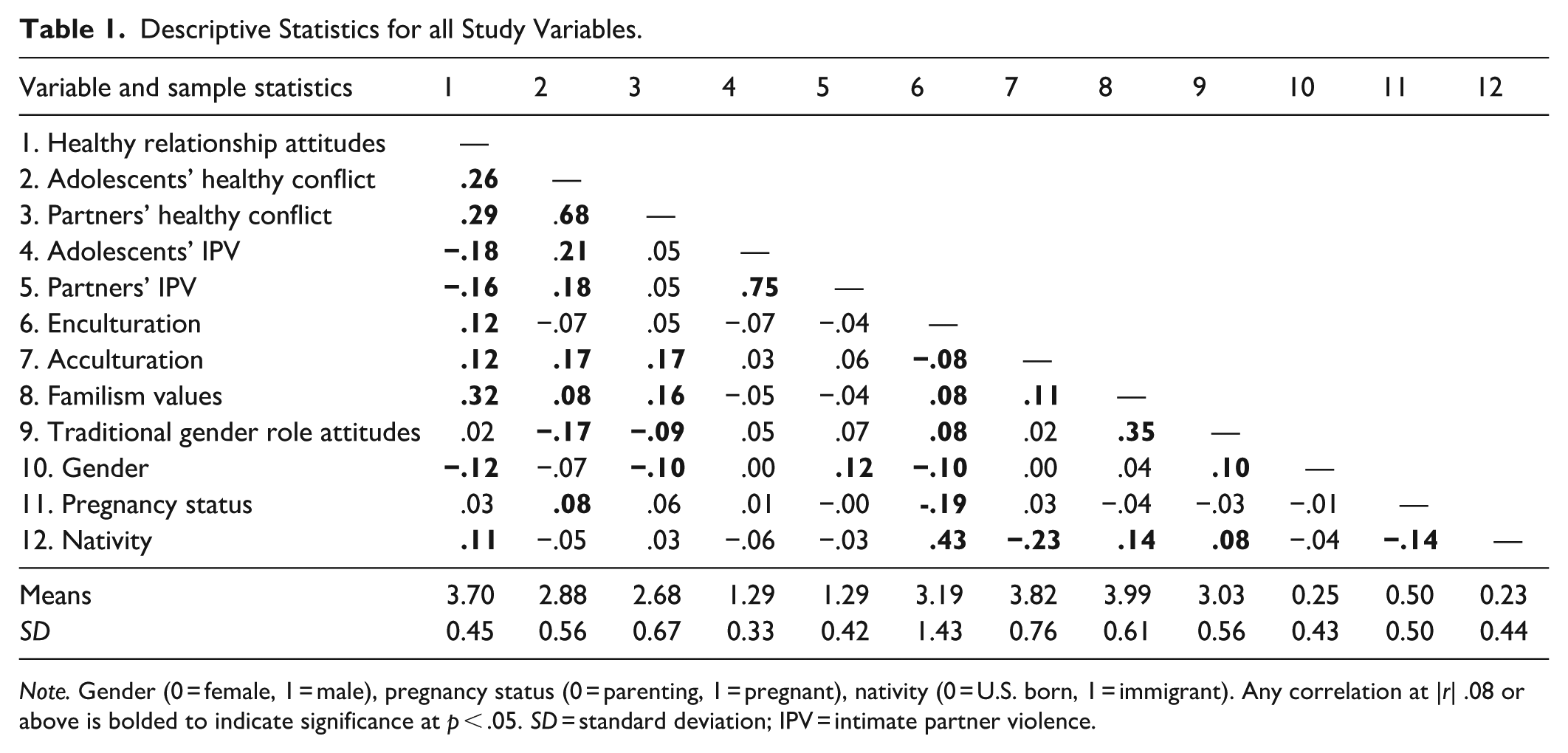
Note. Gender (0 = female, 1 = male), pregnancy status (0 = parenting, 1 = pregnant), nativity (0 = U.S. born, 1 = immigrant). Any correlation at |r| .08 or above is bolded to indicate significance at p < .05. SD = standard deviation; IPV = intimate partner violence.
To test the moderating effect of nativity status, we estimated a series of multigroup autoregressive models by assessing differences between constrained and unconstrained pathways. We tested moderation by releasing paths one at a time and comparing the log-likelihood and CFI estimates between constrained and unconstrained paths. Chi-square difference tests (for the log-likelihoods) and a change ≥.01 in the CFI indicated improved model fit, suggesting moderation (Cheung & Rensvold, 2002). We ran a final model where all moderated paths were included in one model. The above-mentioned model fit thresholds were used to assess the fit of this moderated model.
Results
Descriptive Statistics
Correlations, means, and standard deviations for all study variables can be found in Table 1. Healthy relationship attitudes were positively correlated with adolescents’ and partners’ healthy conflict behaviors. Healthy relationship attitudes were positively correlated with enculturation, acculturation, familism values, and nativity status. Healthy relationship attitudes were negatively correlated with adolescents’ and partners’ IPV behaviors and gender. Adolescents’ healthy conflict behaviors were positively correlated with partners’ healthy conflict, adolescents’ IPV, partners’ IPV, acculturation, familism values, and pregnancy status. Adolescents’ healthy conflict was negatively correlated with traditional gender role attitudes. Partners’ healthy conflict was positively correlated with acculturation and familism values and negatively correlated with traditional gender role attitudes and gender. Adolescents’ IPV was also correlated with partners’ IPV. Lastly, partners’ IPV was positively correlated with gender.
Path Analyses
To address our study goals, we estimated a path model with age, gender, parenting status, and nativity control variables and youth enculturation, acculturation, familism, and gender role attitudes as independent variables. Our original model did not show good fit and model fit statistics suggested age be removed. A model without age as a control variable showed good model fit (ꭓ2(1, N = 536) = 2.74, p = .10, CFI = 0.99; RMSEA = 0.06; 90% confidence interval [0.00, 0.14], SRMR = 0.01). The standardized coefficients, β, and standard errors are reported below, and unstandardized coefficients, b, and further statistics can be found in Table 2.
Estimates Predicting Adolescents’ and Partners’ Romantic Relationship Behaviors and Adolescents’ Relationship Attitudes.
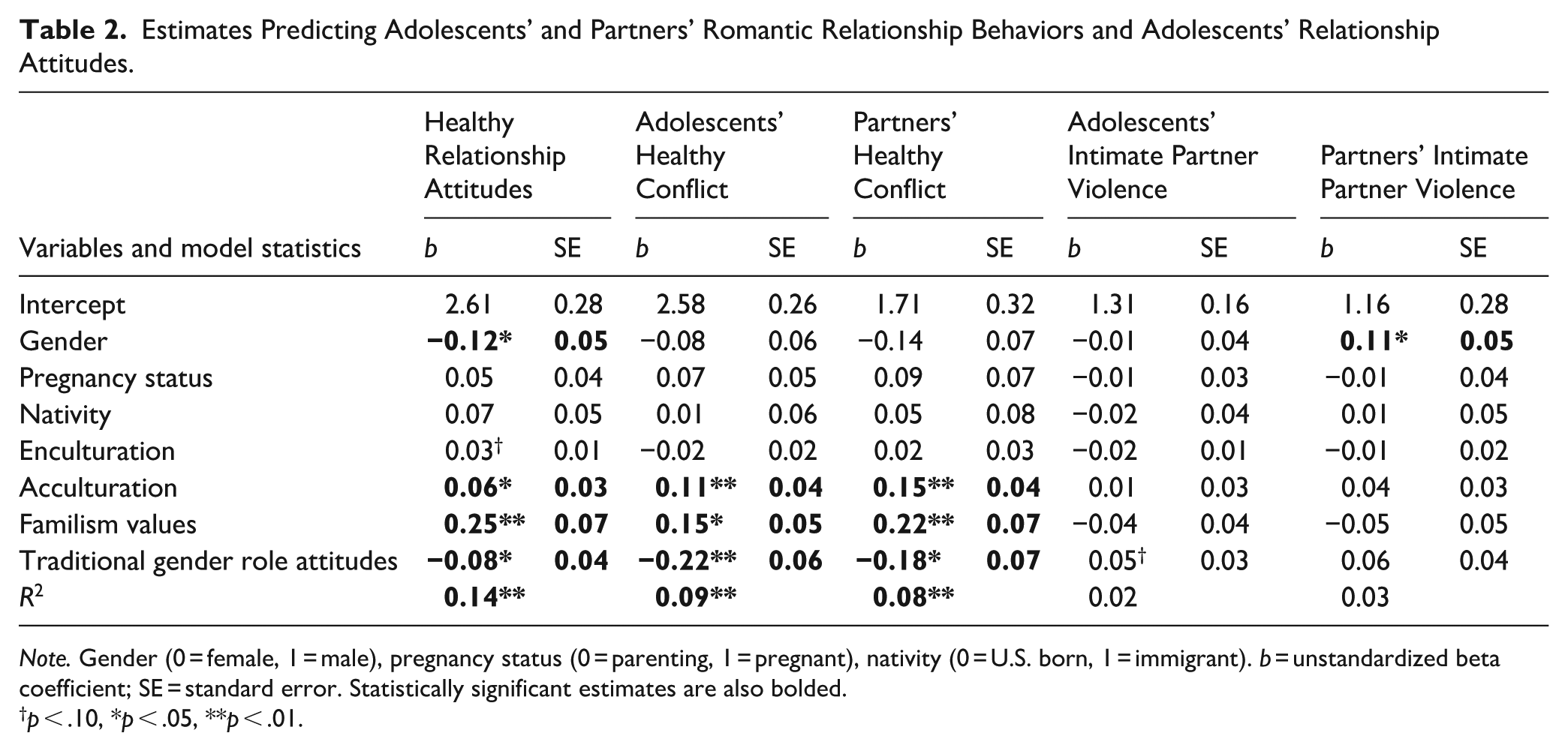
Note. Gender (0 = female, 1 = male), pregnancy status (0 = parenting, 1 = pregnant), nativity (0 = U.S. born, 1 = immigrant). b = unstandardized beta coefficient; SE = standard error. Statistically significant estimates are also bolded.
p < .10, *p < .05, **p < .01.
Healthy Relationship Attitudes
Acculturation (β = .11, SE = 0.05) and familism values (β = .34, SE = 0.09) were positively associated with more healthy relationship attitudes. Adolescents who endorsed less traditional gender role attitudes (β = −.10, SE = 0.05) reported more healthy relationship attitudes. Also, adolescents’ gender (β = −.11, SE = 0.05) was negatively associated with relationship attitudes, with girls reporting healthier relationship attitudes. No other cultural factors or demographic factors informed adolescents’ attitudes.
Relationship Behaviors
Regarding adolescents’ healthy relationship behaviors, acculturation (β = .15, SE = 0.05) and familism values (β = .16, SE = 0.06) were positively associated with healthy conflict management behaviors. Adolescents who endorsed more traditional gender role attitudes engaged in less healthy conflict management (β = −.22, SE = 0.06). Turning to adolescents’ report of their partners’ behaviors, acculturation (β = .17, SE = 0.05) and familism values (β = .20, SE = 0.07) were positively associated with partners’ healthy conflict management, and traditional gender role attitudes were negatively linked to partners’ healthy conflict management behaviors (β = −.15, SE = 0.06). No other variables emerged as significant.
Regarding adolescents’ unhealthy relationship behaviors, no individual or cultural factors were related to adolescents’ self-reports of IPV. For adolescents’ reports of their partners’ behaviors, adolescents’ gender was positively associated with partners’ IPV (β = .12, SE = 0.05), suggesting that males reported their partners engaged in more IPV behaviors than females. No other variables were associated with adolescents’ or partners’ IPV engagement.
Assessing Nativity Status Moderation
Three significant paths were moderated by nativity status. These three released paths were left unconstrained for the final model, which showed a significant improvement in fit compared to a fully constrained model, ΔLog-likelihood = 23.28, p < .001, ΔCFI = 0.04, and resulted in adequate overall model fit (χ2(90, N = 518) = 711.41, p = .0312, CFI = 0.97; RMSEA = 0.04; 90% confidence interval [0.01, 0.07], SRMR = 0.04).
Regarding healthy relationship attitudes, the negative association for gender role attitudes was consistent across groups. However, nativity moderated how acculturation, ΔLog-likelihood = 10.258, p < .001, ΔCFI = 0.02, and familism, ΔLog-likelihood = 7.336, p < .01, ΔCFI = 0.01, were linked to healthy relationship attitudes. The positive association between acculturation and healthy relationship attitudes was significant for U.S.-born adolescents (b = 0.12, β = .17, SE = 0.05, p < .01), but not for immigrant adolescents (b = −0.01, β = −.03, SE = 0.03, p = .661). Further, U.S.-born adolescents who endorsed more familism values reported healthier relationship attitudes (b = 0.26, β = .34, SE = 0.07, p < .001), but this association only approached significance for immigrant adolescents (b = 0.14, β = .20, SE = 0.08, p < .10).
One final moderated association emerged, suggesting familism was differentially linked to adolescents’ reports of their own IPV behaviors, ΔLog-likelihood = 11.036, p < .001, ΔCFI = 0.02. Immigrant adolescents who endorsed more familism values engaged in less IPV behaviors (b = −0.17, β = −.24, SE = 0.08, p < .05), but this association was not significant for U.S.-born adolescents (b = −0.02, β = −.05, SE = 0.04, p = .521). All other significant and non-significant pathways remained the same as our overall model (see Table 2).
Discussion
Engaging in romantic relationships is a normative experience in adolescence (Guzman et al., 2009) that can provide a foundation for future relationships (Siegel, 2020). The role of cultural factors in shaping healthy relationship behaviors and attitudes among adolescents, particularly adolescent parents, warrants careful examination given the concerning prevalence of IPV (Newman & Campbell, 2011; Toews & Yazedjian, 2014). Guided by a culturally informed prosocial perspective (Carlo & Padilla-Walker, 2020) and building on previous research (Henke & Hsu, 2018; McNaughton Reyes et al., 2015; Rueda et al., 2015; Ulloa et al., 2004), we investigated the associations between cultural factors and Latinx adolescent parents’ prosocial relationship attitudes and behaviors, while examining potential differences between immigrant and non-immigrant youth.
Our findings reveal that cultural elements such as familism and acculturation have context-dependent effects on relationship outcomes. This variability underscores the need to move beyond viewing cultural factors as uniformly protective or risk-enhancing. By analyzing data from both adolescent mothers and fathers across diverse relationship outcomes, our study illuminates the nuanced interplay between cultural factors and romantic relationship dynamics among Latinx adolescent parents. These findings contribute to a growing body of literature that recognizes the complex and sometimes contradictory ways in which cultural values influence relationship behaviors and IPV risk.
Cultural Correlates of Relationship Outcomes
Past research has shown several cultural factors, such as familism, gender role attitudes, acculturation, enculturation, and nativity, are important to Latinx adults’ relationship outcomes, and researchers have conceptualized these same factors to be important to adolescents (Cala & Soriano-Ayala, 2021; McNaughton et al., 2016a, 2016b). However, few have empirically tested these associations among Latinx adolescents and adolescent parents. In support of the prosocial perspective (Carlo & Padilla-Walker, 2020), we found that values and attitudes that aligned with prosocial behaviors, such as valuing harmony (e.g., familism) and equality (i.e., less traditional gender role attitudes), were linked to more prosocial relationship attitudes and behaviors (e.g., self and partner healthy conflict management), but we found minimal links to antisocial behaviors, such as one’s own or partners’ IPV behaviors.
Turning our attention to familism, research has documented the many positive associations between familism values and youth outcomes (Cahill et al., 2021) and suggest that familism’s emphasis on mutual support, harmony, and obligation fosters prosocial attitudes and behaviors (Carlo & Padilla-Walker, 2020). In support of this notion, and in alignment with past research on adults (Campos et al., 2016), familism values were linked to healthier relationship attitudes and engagement in more healthy conflict management among the Latinx adolescent parents in our study. However, it is important to note the link between familism and healthy relationship attitudes was significant for U.S.-born youth and only approached significance for immigrant youth. The lack of significance for immigrant youth might be because immigrant youth’s familism values were higher and showed less variability, suggesting a possible ceiling effect. That is, as endorsement of familism values was already high among immigrant youth, the added benefits of additional endorsements of familism were not as large. Though familism was not linked to immigrant adolescents’ attitudes, it was linked to their self-reports of IPV behaviors. Higher endorsement of familism was linked to less self-reported engagement in IPV among immigrant youth, but not U.S.-born youth. Given that familism values include endorsement of prioritizing harmony (Cahill et al., 2021), endorsing more familism might lead to more prosocial behaviors, regardless of one’s attitudes. Familism’s influence on IPV behaviors may also vary between immigrant and U.S.-born adolescents due to differences in family dynamics and access to resources. Past research has shown immigrant families demonstrate stronger familism attitudes, and their experiences of marginalization might lead them to rely more heavily on family and community support, thus increasing the salience of familism in their lives.
By analyzing data from both adolescent mothers and fathers across diverse relationship outcomes, our study illuminates the nuanced interplay between cultural factors and romantic relationship dynamics among Latinx adolescents. More research is needed to explore these ideas. However, our results support the idea that familism values are generally promotive of prosocial relationship outcomes, though sometimes the benefits differ for immigrant and U.S.-born youth. Our work somewhat contrasts past research assessing the link between familism and IPV among adults, which has found that familism values might be linked to a higher likelihood of staying in an abusive relationship (Gonzalez-Guarda et al., 2011). It is possible that our findings differ because our sample generally reported low levels of IPV, focused on adolescents instead of adults, and our outcomes of interest mostly focused on positive relationship attitudes and behaviors.
We also expected endorsing less traditional gender role attitudes, which value gender equality and respect, to lead to more prosocial relationship attitudes that devalue a need for control, subsequently leading to more collaborative and respectful conflict management (McNaughton Reyes et al., 2015). As expected, holding less traditional gender role attitudes was the cultural factor that was most consistently linked to positive outcomes, as having less traditional gender role attitudes was linked to healthier relationship attitudes and more engagement in healthy conflict among adolescent parents and their partners. Further, these results were consistent across immigrant and U.S.-born youth. Our results align with past research linking gender role attitudes with relationship attitudes among adults (Terrazas-Carrillo et al., 2024) and adolescents (Ulloa et al., 2004). However, we extend this work to show how gender role attitudes also inform positive behavioral outcomes such as healthy conflict management. Contrary to expectations, we did not find a link between gender role attitudes and IPV behaviors, even though past work has shown a link for adolescent males (McNaughton Reyes et al., 2015). It is possible the link between gender role attitudes and IPV behaviors is salient for males, not females, and our use of a mixed-gender sample reduced the strength of this association.
We also expected cultural orientations to inform relationship outcomes, as these orientations might provide a larger cultural framework from which adolescents operate. Though past research has documented enculturation as being a protective factor (Cala & Soriano-Ayala, 2021; Sabina et al., 2022) and acculturation as having mixed effects (Alvarez et al., 2020; Sabina et al., 2022), we found acculturation was positively linked to several positive relationship outcomes in our study, while enculturation was not. Specifically, adolescent parents who endorsed high levels of acculturation reported they and their partners engaged in more healthy conflict management. In addition, acculturation was linked to healthier relationship attitudes among U.S.-born youth, not immigrant youth. Though past research on adults and adolescents has noted that acculturation can be a risk factor, this research has primarily focused on IPV-specific outcomes (i.e., violent behaviors and IPV victimization). How these cultural orientations relate to general relationship attitudes and behaviors, such as healthy conflict management, might differ. Relatedly, acculturation can expose individuals to new norms and behaviors (Schwartz et al., 2010), and this added perspective might promote healthier conflict, including perspective taking and direct communication.
Regarding enculturation, research with adults has documented enculturation to be negatively linked to unhealthy relationship outcomes, such as IPV (Cala & Soriano-Ayala, 2021; McNaughton Reyes et al., 2016a). Our study is among the first to assess this link among adolescents. Although we did not find a significant association between enculturation and any of our relationship outcomes, this information is still important to guide future research and intervention.
Limitations and Future Direction
Our study includes many strengths, such as data from Latinx adolescent mothers and fathers. Our study also used a nuanced assessment of multiple aspects of cultural values, relationship attitudes, and endorsement of healthy conflict management and IPV behaviors. Despite these strengths, this study also includes limitations. First, our study utilizes an uneven number of mothers and fathers. Having a larger representation of fathers will allow future research to assess differences between mothers and fathers. Second, the sample population was comprised of Latinx youth residing in Central Texas and might not be generalizable to other Latinx populations of different geographical locations. Future research should replicate this study across diverse geographic locations. Third, our recruitment strategy was solely focused on school-based youth; this might have reduced our ability to recruit more recently immigrated youth, given that 9% of recently immigrated youth do not enroll in school, compared to 3% of U.S.-born (Sugarman, 2023). Thus, our findings are not as generalizable to recently immigrated adolescent parents. Fourth, the lack of significant findings might be due to a lack of measurement sensitivity or the omission of additional variables such as parenting stress. Expanding this research to include diverse assessment tools, additional demographic factors, and family coping patterns will help strengthen future findings. Finally, our data were cross-sectional; thus, more research is needed to assess how these cultural correlates are linked to long-term relationship outcomes.
Conclusion
The findings of this study have vital implications for culturally informed IPV prevention efforts targeting Latinx youth. Programming that fosters more egalitarian gender attitudes and strong familism values, while creating space to discuss and validate variations within Latinx individuals, could aid healthy relationship development within this group. For example, programs should create structured opportunities for adolescents to critically examine traditional gender roles while affirming positive cultural values. These could include guided conversations about gender norms or examining how gender norms shape relationship dynamics through exercises such as analyzing media representations and engaging in self-reflection. Prevention efforts should leverage familism as a protective factor by actively involving family members and demonstrating how healthy relationships align with familial values. Further, programming tailored to diverse Latinx adolescents, in particular immigrant and U.S.-born youth, will help ensure discussion and intervention targets are more specifically tailored to the youth’s unique socioecological context. Through these multifaceted approaches, prevention programs can help Latinx adolescents develop relationship skills that integrate positive aspects of their cultural heritage while fostering equitable gender dynamics.
Recent systematic reviews on IPV interventions have often shown the integration of cultural resilience factors is minimal and call for more intentional integrations of such culturally relevant elements (Cardenas et al., 2024). As such, this study highlights promising directions for relationship education and support tailored to this population’s cultural strengths and risks. It demonstrates the need for a nuanced understanding of how cultural values intersect with adolescent relationship dynamics to inform prevention efforts. Thus, our findings provide insights to help guide a culturally responsive approach to interventions. In maintaining these research efforts, we can empower Latinx adolescent parents to cultivate fulfilling romantic relationships while navigating the complexities of adolescence and parenthood.
Footnotes
Acknowledgements
We are grateful to the families and youth who participated in this project and to the following schools and districts that collaborated: Austin Integrated School District, Comal Integrated School District, Hays Incorporated School District, and San Marcos Integrated School District. We thank Kristin Anders, Elia Bueno, Allison Caplovitz, Sarah Colburn, Alicia Collins, Carolina de Jongh, Gabriel Dhesse, Mark Feinberg, Eric Goodcase, Lara Hoss, Andrea Hutson, Kimberlyn Jaggers, Heather Kristoff, Julie Moore, Elizabeth Norton, Paloma Ocampo, Veronica Panduro, Renee Perez, Eddie Reyes, Lindsay Rudy, and Haleigh Williams for their assistance in conducting this investigation.

Funding
The author(s) disclosed receipt of the following financial support for the research and/or authorship of this article: This research was funded by the DHHSACF Healthy Marriage and Responsible Fatherhood grant 90FM0067-02-00 (principal investigator: Norma Perez-Brena, co-principal investigator: Michelle Toews) with approval by the Texas State University Institutional Review Board (2014 T2817).
Declaration of Conflicting Interests
The author(s) declared no potential conflicts of interests with respect to the authorship and/or publication of this article.