




Abstract
Families living in heavily policed and incarcerated communities bear a disproportionate burden of intimate partner violence (IPV), with serious consequences for children. Incidents of IPV may bring parents into contact with the criminal legal system, but parents’ criminal legal system contact (whether for IPV or other charges) may also precipitate IPV. This study examines the bidirectional relationship between inter-parental IPV and fathers’ contact with the criminal legal system, using data collected from young parents in the Future of Families and Child Well-being Study (N = 4,898) when their children were ages 1, 3, 5, and 9. Autoregressive cross-lagged model results indicate that paternal incarceration (for any charge) predicts later maternal IPV victimization and that maternal IPV victimization predicts later paternal incarceration. Observed effects diminish over the child’s early years and are statistically insignificant by age 9. Beta values indicate that incarceration is a stronger predictor of later IPV than IPV is of later jailing or imprisonment. Extending prior empirical work on IPV and the legal system—traditionally focused more on outcomes of domestic violence calls for service, protective orders, and domestic violence criminal adjudication than on IPV-impacted families’ broader encounters with the legal system—this study suggests that in a time of mass incarceration, fathers’ broader criminal legal system contact may exacerbate early childhood IPV exposure.
Introduction
The specter of stranger violence and street crime has long dominated U.S. public safety discourse (Flamm, 2005; Garland, 2001). But no other form of violence or criminalized activity compares in its prevalence and consequences to intimate partner violence (IPV; Miller & Brigid, 2019; Sumner et al., 2015)—consequences that can linger for decades among children who witness it (Wood & Sommers, 2011). As such, to be deemed effective at promoting safety, systems of law enforcement and justice must effectively promote it in intimate relationships and families.
Yet relations between the criminal legal system and the public are complex, particularly in communities impacted by racism and poverty. An ongoing historical period of mass surveillance, criminalization, and imprisonment (Hinton & Cook, 2021) complicates the regard in which members of low-income communities of color hold police, the criminal legal system, and the state (Prowse et al., 2019; Soss & Weaver, 2017). Structural racism and other forms of structural adversity put such families at elevated risk of IPV while also heightening the risks they face in encounters with law enforcements and the courts (Charbonneau et al., 2017; Kurlychek & Johnson, 2019) and depriving many of access to alternate resources when facing danger and strife (Cheliotis & McKay, 2021; Schaible & Hughes, 2012).
In a time of ongoing mass incarceration and persistent violence in families, we lack the evidence base to decisively adjudicate (or reconcile) divergent theoretical perspectives on IPV and incarceration. Potential pathways leading from IPV to incarceration and potential pathways from incarceration to IPV are each a matter of concern and controversy, but are rarely examined jointly. The current study leverages four waves of couples-based survey data from a representative sample of young, urban parents (N = 4,898) to better illuminate this complex interplay. Autoregressive cross-lagged modeling of the relationships between mothers’ IPV victimization and fathers’ experiences of jailing and imprisonment (each net of the other) indicates a bidirectional relationship; however, fathers’ incarceration exposure is a stronger predictor of mothers’ later IPV victimization than mothers’ IPV victimization is of fathers’ later incarceration. Further, these predictive effects are attenuated over time, losing statistical significance by the time focal children are 9. Results suggest that carceral responses to IPV itself may be of comparatively limited significance in the lives of young, urban families—but that broader exposures to jail and prison among urban fathers (for a wide variety of charges) may have unintended consequences for the safety and well-being of mothers and young children.
Background
IPV Prevalence and Impact on Survivors and Children
IPV is the most widespread form of violence in the United States (Sumner et al., 2015) and profoundly damaging for survivors and their children. IPV negatively impacts survivors’ mental health, participation in work and school, and predisposes them to a range of negative health impacts, including asthma, irritable bowel syndrome, diabetes, high blood pressure, frequent headaches, chronic pain, sleep disturbance, and functional disability (Gilbert et al., 2023; Peterson, Liu, et al., 2018). Economic consequences of IPV over the life course average $138,011 for women survivors, with a total population economic burden of $4.8 trillion among known survivors (Peterson, Kearns, et al., 2018).
Inter-parental IPV is especially devastating because of its long-range, developmental impacts on children. More than 1 in 4 children witness inter-parental violence (Finkelhor et al., 2015), with structural disadvantage placing children of color and low-income children at particular risk (Benson et al., 2004; Yakubovich et al., 2018). Childhood IPV exposure interferes with cognitive, emotional, linguistic, and attentional development (Carpenter & Stacks, 2009; Conway et al., 2021) and has long-lasting impacts on physical and mental health (Chan et al., 2021). It predisposes children to internalizing and externalizing problems and depresses their educational achievement (Wood & Sommers, 2011). Finally, childhood IPV exposure puts children at risk for early sexual initiation and for using and being subjected to violence later in their lives (Abajobir et al., 2017; Ehrensaft et al., 2003; Jonson-Reid et al., 2017; Vasilenko et al., 2023).
Striking overlap exists between the U.S. communities most impacted by IPV and those most impacted by criminal legal system contact. Young parents are at heightened risk for both IPV and criminal legal system contact (Wildeman & Muller, 2012; Yakubovich et al., 2018). Individuals living with poverty, structural racism, and other forms of adversity experience a disproportionate IPV burden (Gilbert et al., 2023; Yakubovich et al., 2018), and are also disproportionately likely to navigate arrest and incarceration, whether their own or that of an immediate family member (Enns et al., 2019; Weaver et al., 2019). Collectively, too, residents of disadvantaged neighborhoods are simultaneously more likely to experience IPV (Benson et al., 2003; Beyer et al., 2015; Copp et al., 2015) and more likely to be exposed to the criminal legal system, including police contact and incarceration in jail or prison (Clear, 2009; Pearlman et al., 2003; Sampson & Loeffler, 2010; Schaible & Hughes, 2012), and various large studies (most with non-probability samples) document extraordinarily high rates of IPV victimization among the women partners of formerly incarcerated men (McKay et al., 2018; Stansfield et al., 2020; Western, 2004; Wildeman, 2012).
The overlapping prevalence of IPV and criminal legal system contact may simply reflect the respective, independent relationships that each of these phenomena have to poverty and structural racism exposure (Pettit & Western, 2004; Yakubovich et al., 2018). The overlap may also, in part, reflect the consequences of “generally violent” tendencies among some IPV perpetrators (Holtzworth-Munroe, 2000). However, there is abundant reason to expect that the two are directly related as well: that is, IPV leads to criminal legal system contact (including incarceration in jail or prison) and, conversely, incarceration leads to IPV. The next two sections explore each of these two pathways in turn.
From IPV to Paternal Incarceration
From battered women’s movement advocates to feminist criminologists, many have argued that public safety systems must respond to IPV as the serious public safety threat it is (Stanko, 1995, 2006). Second-wave feminists, aiming to confront the sidelining of public violence against women, argued successfully for confronting IPV using police intervention and criminal adjudication (Goodmark, 2016; Gruber, 2020; Houston, 2014). From this perspective, IPV can and should lead to contact with the criminal legal system because IPV-impacted families are entitled to a vigorous, protective response from that system. Such a perspective gained tremendous traction in the 1980s, and police departments nationwide came under fire (and into civil litigation) for their perceived inadequate responses to domestic violence (Houston, 2014). Adherents of this view advocated and secured policies such as mandatory arrest and the increasing criminalization of domestic violence.
When Sherman and Berk published the results of an early Minneapolis domestic violence arrest experiment—which showed reductions in future IPV-related calls for service in households where suspected IPV perpetrators had been arrested (rather than counseled) by responding police (Sherman & Berk, 1984)—mandatory arrest policies spread like wildfire, quickly becoming the norm in jurisdictions across the United States (Sherman & Cohn, 1989). Today, convicted IPV arrestees can face immediate jailing, sentencing to jail or prison, and/or the imposition or violation of probation and parole terms, which can in turn result in jail or prison incarceration (Durose et al., 2005; Romain Dagenhardt et al., 2023). As such, fathers who use IPV may be immediately jailed at the time of the incident, and they may also become incarcerated later—either because they are convicted of domestic violence and sentenced to a term of incarceration or because they are placed on probation or parole for domestic violence and later incarcerated for violating probation or parole conditions.
Nevertheless, IPV can only lead to criminal legal system contact if it comes to the attention of authorities—and much IPV goes unreported (Felson & Lantz, 2016; Felson & Paré, 2005). Indeed, as interpreters of Sherman and Berk’s original arrest experiment often failed to acknowledge, police responses to IPV may themselves deter future IPV reporting. Formal reporting of IPV and other criminalized activity appears to be on the decline in the contemporary United States, particularly in marginalized communities (Baidoo et al., 2021; Xie & Baumer, 2019; Xie, Solis, et al., 2024). Even so, IPV reports represent the single largest source of 911 calls in most jurisdictions (Klein, 2009) and domestic violence arrests represent the majority (54%) of interpersonal violence arrests logged by the National Incident-Based Reporting System (Public Interest Analysis, n.d.).
As such, although not all IPV incidents are expected to lead to police or court involvement, it is expected that a mother’s experience of IPV victimization will increase the likelihood of a father’s later incarceration, including jailing and imprisonment.
From Paternal Incarceration to IPV
Conversely, criminal legal system contact may also influence IPV—whether that contact is IPV-related or associated with non-IPV charges. Prior scholarship presents conflicting views on the direction of this influence, particularly as it pertains to jail and prison incarceration. Since the late 20th century, a normative view of the relationship between IPV and incarceration has suggested that incarceration could decrease the likelihood of future IPV through deterrence and incapacitation (Hanna, 1997). Even among those who hold the legal system in critical regard, law enforcement and legal intervention are widely understood as central to ending IPV and mitigating impacts on the health and well-being of survivors and their children (Bishop, 2016). Yet most of the studies that followed Sherman and Berk’s early Minneapolis domestic violence experiment have failed to show the expected impact of criminal legal system contact on later IPV. What was interpreted in the original study as the deterrent effect of arrest on future IPV events may have been primarily a deterrent effect of arrest on future IPV reporting (e.g., Gezinski, 2022). Deterrent effects of arrest on future IPV events, when they have been observed, appear concentrated among employed individuals (Berk et al., 1992; Pate & Hamilton, 1992). Effects of incarceration on future IPV events are less well studied.
An opposing view of IPV and criminal legal system contact counters traditional feminist and battered women’s movement perspectives by suggesting that mass incarceration, in particular, might actually exacerbate IPV. Critical race feminist legal scholars (Gruber, 2020; Richie, 2000; Richie & Eife, 2020) and advocates for battered immigrant women (Bhattacharjee, 2006; Messing et al., 2015) have each argued that the collateral consequences of incarceration are more likely to promote than to restrain future IPV. From this perspective, heavy (and racially targeted) incarceration produces both neighborhood- and household-level conditions that could conceivably promote IPV; for example, reduced neighborhood social cohesion and increased household economic strain (Hampton et al., 2003; Richie & Eife, 2020). At the neighborhood level, theorists propose that “the weakening of social supports and community cohesion creates the very conditions that the social disorganization research finds to be strongly correlated with increased rates of domestic violence” (Coker & Macquoid, 2015, p. 612). At the individual level, the consequences of incarceration exposure (including post-traumatic stress and destructive forms of masculine prison socialization) could increase individual-level risk for IPV perpetration (Coker & Macquoid, 2015). The policy implications of this theoretical view diverge sharply from the traditional view; proponents have advocated variously for eliminating mandatory arrest, decriminalizing domestic violence, and abolishing the criminal legal system as we know it (Goodmark, 2018; Gruber, 2020; Houston, 2014; Richie & Eife, 2020).
Although the possibility that criminal legal system contact promotes IPV has been primarily elaborated in legal theory, some empirical work offers tentative support. Qualitative research suggests that incarceration (for any charge) can promote a set of psychological and interpersonal changes—including post-traumatic stress, a sense of hopelessness and helplessness, and a need for control in close interpersonal relationships—that increase the individual- and community-level risk of IPV (Hairston & Oliver, 2011; Holliday et al., 2019; Oliver et al., 2004). Similarly, exploratory analyses using data from the Multi-site Family Study on Incarceration, Parenting and Partnering find that higher levels of individual lifetime criminal legal system contact (for any charge; McKay, 2023) and concentrated neighborhood incarceration (not specific to IPV; McKay, 2024) put men at increased risk for IPV perpetration.
Findings on the impacts of legal system interventions specifically related to domestic violence charges are more complex. An early Bayesian analysis of data from IPV arrest experiments in four U.S. cities found that individuals who were arrested for domestic violence charges were 45% more likely than non-arrested IPV perpetrators to use IPV again. But the dizzyingly inconsistent treatment effects the study documented—including substantial differences in effect size and direction across the four sites as well as complex and countervailing moderation effects by employment and marital status—prompted its authors to caution against any theoretical or practical conclusions (Berk et al., 1992, pp. 706–707). Similarly complex and countervailing effects emerge in more recent studies of the impacts of jailing on IPV recidivism among those charged with domestic violence. Cissner and colleagues’ (2015) analysis of case outcomes data from 24 domestic violence courts in New York found that courts that were quicker and more consistent in their imposition of jail sanctions had lower rates of IPV recidivism. Yet Romain Dagenhardt et al. (2023), applying logistic regression and survival analysis with case outcomes data from a large Midwestern domestic violence court (N = 347), find that the imposition of jail sanctions for domestic violence charges speeds, rather than lengthens, the time to IPV recidivism.
Together, this body of work raises, but falls far short of confirming, the possibility that paternal incarceration (for any charge) could increase the likelihood of later maternal IPV victimization.
Moderating Influence of Race
Prior scholarship on race, IPV help-seeking, and mass incarceration highlights the possibility that the reciprocal influences between incarceration and IPV exposure in a household may each be moderated by race. First, because the pathway from IPV to incarceration is contingent on reporting to authorities, racial differences in willingness to report IPV could attenuate the predictive influence of mothers’ IPV victimization on fathers’ later jailing or imprisonment. Globally, police notification is on the decline, with urban victims’ trust in police responses appearing as a significant driver of that drop (Xie, Ortiz Solis, e t al., 2024). Some evidence suggests that violence victims who reside in disadvantaged urban communities (Baumer, 2002) and victims of color living in neighborhoods of color (Xie, Solis, et al., 2024) may be less likely to involve formal authorities. Black survivors, in particular, may grapple with heightened risk of being criminalized themselves and internalized race-gender stereotypes of Black women’s strength that suggest they can endure without outside help (Decker et al., 2019; Dichter et al., 2011; Durfee & Goodmark, 2021; Monterrosa, 2021).
Further, the desire to protect partners or co-parents who use IPV is a long-recognized barrier to reporting to authorities among all IPV survivors (Felson et al., 2002) and among Black survivors specifically (Anyikwa, 2015; Monterrosa, 2021). Given widely recognized racial disparities in criminal legal system violence and punitiveness (Charbonneau et al., 2017; Gaston, 2019; Pettit & Western, 2004; Prowse et al., 2019) and the specific “threat of a racially motivated and disproportionately harsh response” when IPV is reported to police, the desire to protect partners or co-parents who use IPV is likely more influential for Black than non-Black survivors (Decker et al., 2019, p. 780; Monterrosa, 2023).
Yet countervailing effects of race are also possible. Analyses of National Crime Victimization Survey data find that Black women are twice as likely as White women to report IPV to police (Holliday et al., 2020), and racial disparities at every point in criminal law enforcement and case processing make Black defendants more likely to be convicted and sentenced (Kurlychek & Johnson, 2019). Although the impact of race on each stage of domestic violence enforcement and processing has not yet been thoroughly investigated, domestic violence cases involving Black defendants are more likely to result in a prison sentence (Freiburger & Romain, 2018). At the same time, IPV incidents involving Black victims are less likely to result in arrest (Durfee & Goodmark, 2020; Pattavina et al., 2007). Given that 90% of U.S. marriages and 82% of cohabiting partnerships are intra-racial, these two influences may partially offset one another (Bialik, 2017; Livingston, 2017).
With regard to the pathway from incarceration to IPV, prior evidence suggests a more straightforward pattern of moderation by race. The imposition of incarceration and other forms of criminal legal system contact as a form of political violence, as in the contemporary United States, may precipitate a sense of helplessness and hopelessness among the exposed that is more likely to promote IPV than would be the imposition of incarceration purely as a response to harmful behavior (Clark et al., 2010; Holliday et al., 2019; McKay, 2023). Further, the racial targeting of incarceration and other criminal legal system contact—and its corresponding decoupling from criminalized behavior (Weaver et al., 2019)—means that Black families may be more likely than non-Black families to lose a prosocial, nonviolent family member to incarceration (Haskins & Lee, 2016). Thus, Black families may be less likely to reap any countervailing beneficial effects of incarceration on IPV (e.g., through deterrence or incapacitation of a violent partner/co-parent), which in the aggregate would strengthen the magnitude of incarceration’s hypothesized detrimental influence on IPV.
Together, prior work points to a role for race, as proxy for exposure to structural racism, in moderating the relationship between incarceration and IPV. Although existing evidence is inconclusive, and some countervailing effects are highly likely, prior work suggests that the influence of IPV on incarceration may be attenuated for Black men (net of countervailing effects) and the influence of incarceration on IPV may be strengthened.
Current Study Purpose
The current study aims to bring new empirical information to bear on our understanding of the relationship between IPV and criminal legal system contact in a time of mass incarceration. It uses longitudinal data from the Future of Families and Child Well-being Study (N = 4,898) to examine the bidirectional relationship between mothers’ IPV victimization and fathers’ experiences with jailing and imprisonment in a representative sample of urban parents. It tests three hypotheses suggested by prior research:
Mothers’ IPV victimization positively predicts fathers’ later jail or prison incarceration (for any charge);
Fathers’ jail or prison incarceration (for any charge) positively predicts mothers’ later IPV victimization; and
Race moderates both influences, such that the positive influence of IPV on incarceration is attenuated among Black individuals and the positive influence of incarceration on later IPV is strengthened.
By using autoregressive cross-lagged modeling with four waves of longitudinal data (collected when the children of participating parents were 1, 3, 5, and 9 years old), the study estimates the strength of each predicted pathway, net of the other, and then re-estimates the model among Black families to examine whether observed influences differ as hypothesized.
Methods
Data Source
The current study uses survey data from mothers and fathers enrolled in the Future of Families and Child Well-being Study (“Future of Families”). Future of Families oversampled unmarried new parents with babies born at hospitals in 20 U.S. urban centers (population >200,000) at the turn of the 21st century (Reichman et al., 2001). Mothers, and subsequently fathers, were recruited and enrolled in the study shortly after the child’s birth. The resulting sample (N = 4,898) was predominantly comprised of unmarried parents (76%). Families were racially diverse, with approximately half (48% of mothers, 49% of fathers, 49% of children) identified as Black, one quarter (27% of mothers, 28% of fathers, 25% of children) as Hispanic/Latinx, one fifth (21% of mothers, 18% of fathers, 18% of children) as non-Hispanic White, and the remainder (4% of mothers, 4% of fathers, 8% of children) as another race/ethnicity or multiracial.
Follow-up surveys were conducted in person when children were 1, 3, 5, 9, 15, and 22, with participating members of the same family interviewed separately. The current analysis uses longitudinal survey data collected from mothers and fathers during early and middle childhood (child ages 1, 3, 5, and 9). Although attrition in the Future of Families sample was relatively low considering the duration of follow-up and the economic vulnerability of the sample, it did occur. At Year 1, interviews were completed with 4,457 mothers (91% of the baseline sample), and follow-up surveys at Years 3, 5, and 9 were completed by 4,365 (89%), 4,295 (88%), and 3,813 (78%) mothers, respectively. Differential attrition and differential wave non-response were very minimal, with respondents and nonrespondents (for each wave included in the current study) having nearly identical baseline demographic, social, behavioral, financial, and health characteristics (Princeton Center for Child and Family Well-being, 2024).
Measures
The two focal constructs, mothers’ IPV victimization and fathers’ incarceration (for any charge), were operationalized using four waves of survey responses. Mothers’ IPV victimization was captured in a composite analytic variable that reflected the sum of mothers’ survey responses at child ages 1, 3, 5, and 9 to Revised Conflict Tactics Scale (CTS2) items that captured abusive behavior by the focal child’s father. A subset of CTS2 items was selected that focused on physical violence and control victimization, including slapping or kicking, hitting, sexual assault, injury, isolation, interference with work or school, and financial control. Fathers’ incarceration was captured in a composite variable that incorporated mothers’ and fathers’ survey reports at child ages 1, 3, 5, and 9 regarding whether the father had spent time in jail or prison at any point since the prior study interview.
Analytic Method
An autoregressive cross-lagged (ARCL) panel model was fitted to the data in Stata 18 (StataCorp, 2023). Well-suited to understanding phenomena that may be in a reciprocal relationship with one another, ARCL models estimate the cross-lagged influence of each construct on the other. Cross-lagged effects (representing the two pathways described in hypothesis 1 and hypothesis 2) are estimated net of autoregressive effects (controlling for the influence of each construct on values of the same construct at subsequent time points), effectively adjusting for time-invariant confounders (Bauer & Curran, 2022). The full available sample was used for all included follow-up waves; missing values were handled using a maximum likelihood approach. Models estimated how mothers’ IPV victimization at each wave influenced the likelihood of fathers’ jail or prison incarceration at the next wave and how fathers’ incarceration at each wave influenced the likelihood of mothers’ IPV victimization at the next wave. Each of these two pathways was estimated net of the other, controlling for the autoregressive effects of the earlier-wave values of each construct on the later-wave values of that same construct.
First- and second-order ARCLs were fitted and a final model was selected empirically, based on model fit statistics. In the first-order model, autoregressive effects were only estimated for consecutive time points: for example, the influence of IPV at child age 1 on IPV at child age 3, the influence of IPV at child age 3 on IPV at child age 5, and so forth. Next, a second-order ARCL was fitted, incorporating autoregressive effects for non-consecutive time points: for example, the influence of IPV at child age 1 on IPV at child age 5, and so forth. The second-order model was selected as the final model based on superior fit.
Results
Measurement Model Results
Measurement model results for the second-order ARCL are shown in Table 1.
Model Fit Statistics.
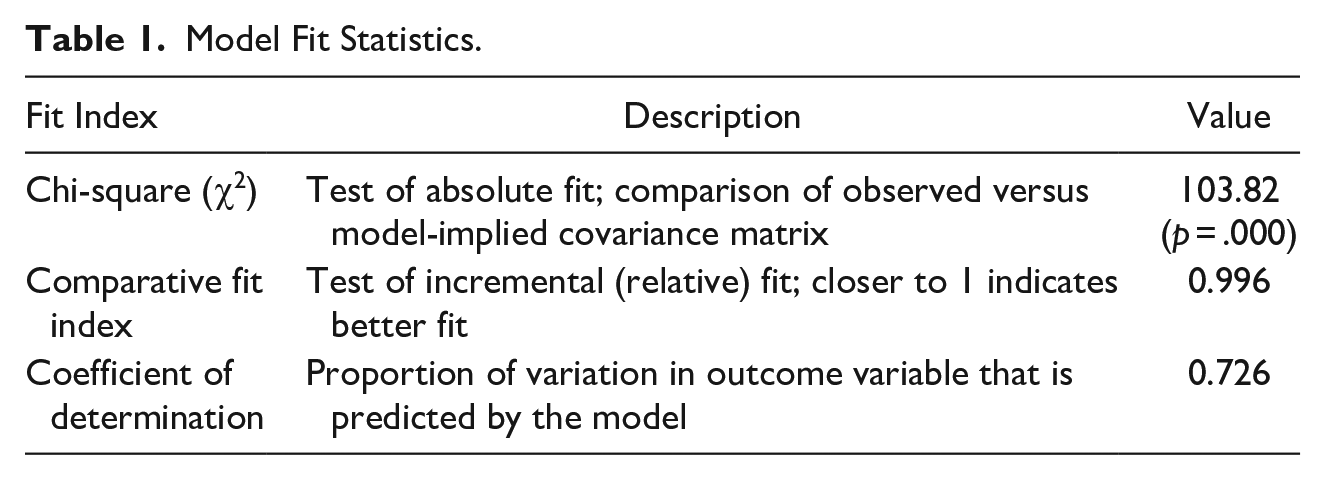
The chi-squared test of absolute model fit, which compares the observed covariance matrix to the model-implied covariance matrix, rejected the null hypothesis (χ2 = 103.82, p = .000). This result is consistent with the large sample size. The comparative fit index (CFI), used to test incremental (relative) model fit, closely approached 1 (CFI = 0.996). This result is consistent with a well-fitting model. The coefficient of determination (CD), which estimates the proportion of variation in the outcome variable that is predicted by the model, also conformed to accepted thresholds (CD = 0.726). These results indicate a reasonably well-fitting model. Figure 1 depicts the final model, estimates from which are presented in the next two sub-sections.
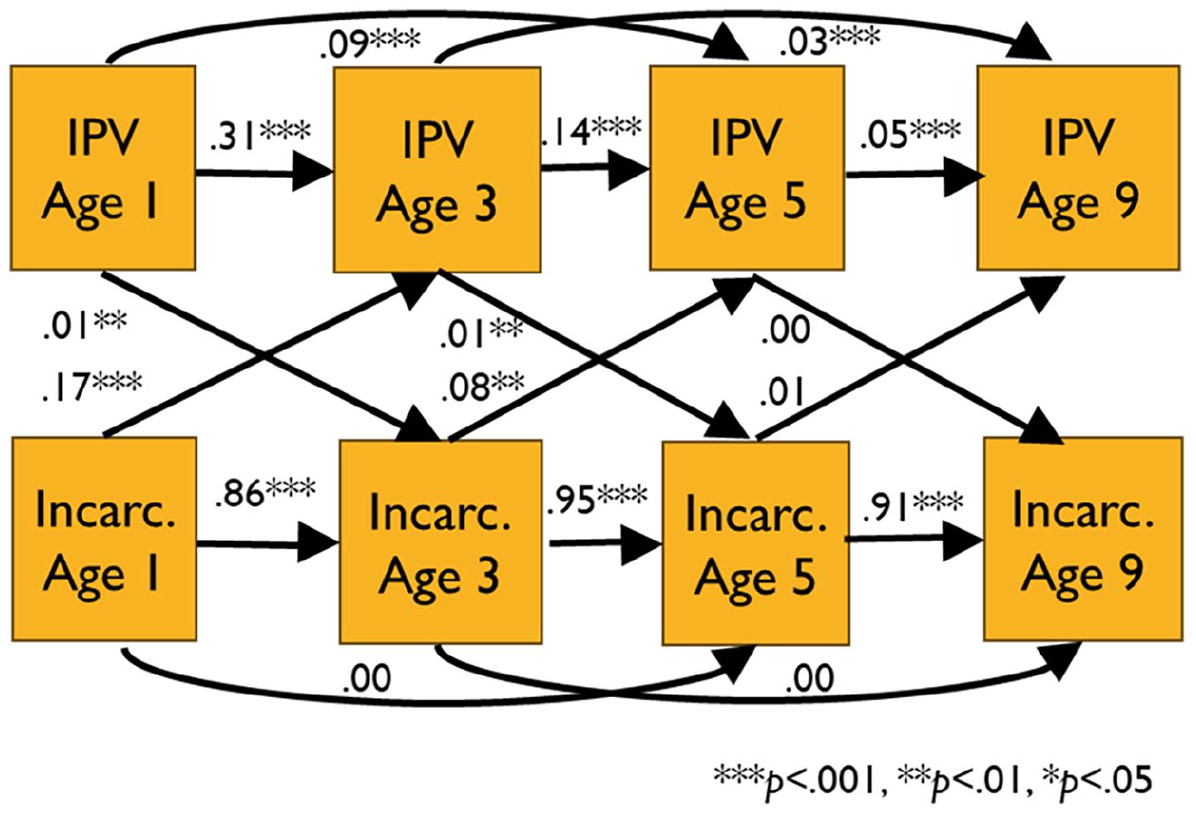
Autoregressive cross-lagged model for bidirectional pathways between IPV and incarceration.
Hypothesis 1: From IPV to Paternal Incarceration
The first hypothesis is that mothers’ IPV victimization at any wave positively predicts fathers’ jail or prison incarceration at the next wave. The fitted ARCL model estimated the influence of mothers’ prior-wave IPV victimization on fathers’ jail or prison incarceration at the next wave. Structural model results indicated a statistically significant influence of maternal IPV victimization on paternal jail or prison incarceration at ages 3 (p = .001) and 5 (p = .007) but not age 9 (p = .603). Beta coefficients and z scores indicated weak influences across ages 3 (B = .012, z = 3.46), 5 (B = .006, z = 2.68), and 9 (B = .002, z = 0.51). These results provide the modest support for hypothesis 1.
Hypothesis 2: From Paternal Incarceration to IPV
The second hypothesis is that fathers’ jail or prison incarceration at one study wave positively predicts mothers’ IPV victimization at the next wave. The fitted ARCL model estimated the influence of fathers’ prior-wave incarceration on mothers’ IPV victimization at the next wave. Structural model results indicated a statistically significant influence of prior-wave incarceration on maternal IPV victimization at ages 3 (p < .000) and 5 (p = .001) but not age 9 (p = .467). Beta coefficients and z scores indicated the modest influences across ages 3 (B = .172, z = 5.17), 5 (B = .078, z = 4.29), and 9 (B = .014, z = 1.36). These results support hypothesis 2.
Hypothesis 3: Moderating Role of Race
The third hypothesis is that race moderates relationships between IPV and incarceration, such that the positive influence of IPV on incarceration will be attenuated among Black families and the positive influence of incarceration on later IPV will be strengthened. These propositions were examined in a sub-group analysis, which fitted an identical second-order ARCL model (with specifications matching those of the final model used to test hypotheses 1 and 2) to survey data from families in which the father identified as Black.
In sub-group models for the families of Black fathers, beta coefficients for the influence of maternal IPV victimization on fathers’ later jailing or imprisonment were markedly smaller than in the full-sample model (indicating a weaker influence than that observed in the full sample) and were not statistically significant at any wave. Beta coefficients for the influence of paternal jailing or imprisonment on later IPV were of a similar magnitude to those estimated in the full-sample model at child ages 1 and 3 (indicating a similar influence than that observed in the full sample). However, unlike in the full-sample model, the influence of incarceration on later IPV persisted in strength (B = .052) and statistical significance (p = .037) to child age 9.
Discussion
Summary of Findings and Contributions
The current study advances a more precise understanding of IPV in a time of mass incarceration in three ways. First, unlike most empirical research on criminal legal system outcomes and IPV, it addresses the influences of broader (non-IPV-related) legal system contact, which has been shown to have a range of negative consequences for individuals and families (Kirk & Wakefield, 2018).
Second, the study focuses on IPV and incarceration exposures that occur in households with young children, which have especially serious implications for child well-being. Improving on the use of cross-sectional or short-term follow-up data from non-probability-based samples in prior work, the current study uses a probability-based sample that supports inference to the broader population of unmarried new parents in U.S. urban areas—an especially important population for understanding the mutual influences of IPV and incarceration and mitigating childhood exposure to IPV.
Third, heeding prior theory and evidence that suggest bidirectional effects between IPV and incarceration exposure, the current study applied autoregressive cross-lagged panel modeling to estimate these reciprocal influences simultaneously (each net of the other). Further, by estimating these focal (“cross-lagged”) effects net of the (“autoregressive”) effects of prior-wave values of each construct, the ARCL helps to rule out the possibility that post-incarceration IPV simply reflects resumption of pre-incarceration IPV, rather than a substantive influence of incarceration on IPV.
Fitted to four waves of survey data from mothers and fathers in the Future of Families and Child Well-being Study, ARCL model results supported three hypotheses: (1) maternal IPV victimization predicts later paternal jail or prison incarceration, (2) paternal jail or prison incarceration predicts later IPV, and (3) race (as proxy for exposure to structural racism) moderates each observed influence. Model results indicated a significant bidirectional relationship between IPV and incarceration, supporting the first two hypotheses. Sub-group models also provided preliminary support for the moderating role of race in each relationship.
Results run counter to the early hopes of second-wave feminists and battered women’s movement advocates, who envisioned the criminal legal system as a powerful source of protective intervention for IPV-impacted families. Instead, consistent with an abolitionist feminist view, beta coefficients and z scores for the influence of paternal jailing or imprisonment on maternal IPV victimization were greater than those for the reverse relationship, suggesting that the net impact of incarceration-heavy (and heavily racialized) contemporary criminal legal system policies (Hinton & Cook, 2021) may be putting mothers and children at risk.
Sub-group models with Black families found an especially weak relationship between mothers’ IPV victimization and fathers’ later jailing or imprisonment, even though Black women are more likely than other groups to report IPV to the police (Holliday et al., 2020), suggesting that structural racism may influence criminal legal system responses to IPV (Decker et al., 2019; Nnawulezi & West, 2018).
Finally, results indicate that fathers’ incarceration exerted the strongest influence on mothers’ IPV victimization during their children’s early years (up to age 5). This result may be explained, in large part, by prior research with the Future of Families sample that documents the lessening of mother-father contact over the course of a child’s early life (Meadows et al., 2008). Unfortunately, the attenuation of the incarceration-to-IPV influence over these years is little consolation from a child development perspective. Exposure to IPV in the developmentally sensitive period implicated in the current study can precipitate especially hard-to-reverse outcomes with lifelong consequences, including structural brain changes, attachment problems, poor emotion regulation, language acquisition difficulty, and other developmental consequences for the nervous and endocrine systems (e.g., Carpenter & Stacks, 2009; Conway et al., 2021).
Limitations and Directions for Future Research
Results should be interpreted with several limitations in mind. First, this study focused exclusively on jailing and imprisonment and did not examine other forms of criminal legal system contact. Understanding how other forms of contact such as police stops, arrest, and court contact may influence (and be influenced by) IPV represents a potentially fruitful direction for future work. Second, the current study focused on exploring whether incarceration globally contributes to IPV (and IPV to incarceration) in a historical period of mass incarceration. Limitations in the coding of domestic violence charges and convictions in the Future of Families data made it impossible to look specifically at the contribution (and functioning) of IPV-related incarceration within this broader landscape. Future research would ideally seek to disentangle the respective contributions of IPV-related and non-IPV-related criminal legal system contact within the broader context of mass incarceration-era policing and punishment.
Third, the current study focused exclusively on individual-level influences. In light of prior evidence that economic, social, and policy contexts beyond the immediate household shape IPV (Beyer et al., 2015; McKay, 2024), future research would do well to operationalize neighborhood, state, and national contexts. Fourth, the use of longitudinal data collected over an extended follow-up period necessarily introduces risks of attrition bias. However, differential non-response—the aspect of attrition and wave non-response that would pose a threat to validity for the current study—is remarkably low in the Future of Families cohort, substantially mitigating this issue (Princeton Center for Child and Family Well-being, 2024).
Fifth, prior research on IPV and IPV-related criminal legal system contact highlights complex and countervailing effects of employment status as a plausible moderator, mediator, and/or potential confounder of these pathways (Berk et al., 1992; Sherman & Harris, 2013, 2015). The ARCL approach, useful for the current study because of its ability to simultaneously estimate cross-lagged effects and autoregressive effects simultaneously, carries the limitation of not being able to accommodate or adjudicate the complexity. Future research unpacking the role of employment in the reciprocal relationship between IPV and incarceration is of utmost importance and would ideally be accomplished within a mixed-methods framework where quantitative analyses could be informed and interpreted with insights from directly affected individuals. Finally, as in much contemporary social scientific research, the study examined the potential moderating influence of race, a social construct that in this instance was intended to capture differences in racialized life experiences, such as exposure to structural racism, as opposed to any biological influence of “race” as such. Future research would do well to measure and incorporate such experiences directly and avoid exclusive reliance on self-reported racial identity as a proxy.
Conclusions and Policy Implications
In a time of mass-scale jailing and imprisonment, it is more critical than ever to understand the complicated relationships between IPV and contemporary criminal legal system operations. Yet these relationships rarely receive joint empirical attention, and theoretical perspectives on them remain divergent. The current study modeled these proposed bidirectional relationships simultaneously, using representative data from unmarried new parents in major urban centers. Findings suggest that incarceration of fathers, particularly in children’s early lives, may have hidden consequences for IPV exposure in vulnerable families. Abolitionist feminist approaches to IPV—implemented and refined for decades by grassroots organizations such as INCITE!, Critical Resistance, and Spirit House—hold promise. Investing in and investigating potentially transformative approaches like these could help begin to rein in the hidden consequences of mass-scale incarceration for family and child safety and well-being.
Footnotes
Declaration of Conflicting Interests
The author declared no potential conflicts of interests with respect to the authorship and/or publication of this article.
Funding
The author disclosed receipt of the following financial support for the research and/or authorship of this article: I am grateful to the Eunice Kennedy Shriver National Institute of Child Health and Human Development (4R00HD109361-03) for the support to do this work; to the Center for Research on Child and Family Well-being at Princeton University for use of the Future of Families and Child Well-being Study data; to Gianna Campa for excellent research assistance; to Kat Theall, Christopher Wildeman, Kristin Turney, Antonio Morgan-Lopez, and Emily Putnam Hornstein for their exceptionally high quality guidance and mentorship on the larger study; and to the anonymous reviewers for their thoughtful feedback.
Ethical Considerations
This research, which used deidentified data only, was determined to be exempt from review by the Institutional Review Board of the University of North Carolina at Chapel Hill (FWA # 4801).
Consent to Participate
Not applicable. This study used deidentified secondary data from the Future of Families and Child Well-being Study.
Consent for Publication
Not applicable. This study used deidentified secondary data from the Future of Families and Child Well-being Study.

Data Availability Statement
Data can be obtained via application to the Princeton University Center for Child and Family Well-being; see Data and Documentation | Future of Families and Child Well-being Study.