




Abstract
Intimate partner violence (IPV) remains a critical public health issue, disproportionately affecting women. This study investigates the psychological mechanisms that may help explain how cognitive mechanisms are associated with revictimization in abusive relationships, with a focus on the role of adverse childhood experiences (ACEs) and cognitive dissonance reduction strategies. Drawing upon Cognitive Dissonance Theory and the Foot-in-the-Door effect, this cross-sectional study examines how ACEs predict revictimization in adulthood and whether this relationship is moderated by specific cognitive dissonance reduction strategies. A sample of 99 adult women with a history of intimate relationships completed measures assessing ACEs, IPV victimization, and cognitive dissonance reduction strategies, including trivialization, denial of responsibility, adding consonant cognitions, self-concept change, distraction, and forgetting. Findings indicate that ACEs significantly predict IPV victimization, aligning with prior research on the intergenerational transmission of violence. Notably, among cognitive dissonance reduction strategies, self-concept change emerged as a significant moderator of this relationship. Women who engaged in self-concept change—reframing their experiences to perceive themselves as “better” individuals due to the relationship—exhibited a stronger link between childhood adversity and IPV victimization. This psychological adaptation may serve to justify remaining in abusive relationships, further entrenching the cycle of violence. Other cognitive dissonance strategies did not yield significant moderation effects, potentially due to retrospective bias or measurement constraints. These findings underscore the complex interplay between past trauma, psychological coping mechanisms, and sustained victimization in intimate relationships. The study highlights the need for IPV interventions to address cognitive dissonance processes, particularly self-concept change, to empower survivors and facilitate their ability to leave abusive situations.
The present study addresses the pressing issue of intimate partner violence (IPV) against women, aiming to deepen the understanding of this phenomenon, foster empathy for victims, and provide more effective support. IPV is a pervasive global problem, with research showing that over one in four women (27%) have experienced physical or sexual abuse from their partner at some point in their lives (Sardinha et al., 2022). In Romania, the prevalence is even higher, with 56.3% of women reporting at least one form of abuse, and half of these enduring multiple forms (Rada, 2014). The consequences of IPV are severe, encompassing physical, mental, and neurological disorders, diminished overall health and daily functioning, unplanned or terminated pregnancies, attachment difficulties, and even mortality (Davies et al., 2009; World Health Organization, 2022).
Women often remain in abusive relationships due to multifaceted factors. Fear of angering the abuser or of escalating violence, including the risk of death, plays a critical role. Childhood exposure to violence (Heyman & Slep, 2002; Manchikanti Gómez, 2011), which fosters greater tolerance for abuse (Patzel, 2006), and other individual factors such as lack of resources, self-blame, low self-esteem, isolation, and difficulty recognizing abuse contribute significantly (Estrellado & Loh, 2014; Loke et al., 2012; Sichimba et al., 2020). Social and cultural dynamics further complicate this situation, with patriarchal beliefs that normalize abuse, inadequate support from the criminal justice system, fear of stigmatization, and social blame acting as formidable barriers to leaving (Barnett, 2000; Eckstein, 2011; Loke et al., 2012). Importantly, it should be noted that leaving an abusive relationship is not always the safest option. Evidence shows that attempts to leave can escalate the risk of severe violence or even lethality (Stark, 2007), making safety planning and support crucial components of intervention efforts. Commitment and consistency biases, wherein women strive to remain aligned with their initial decisions and judgments, and cognitive dissonance arising from the conflict between the desire to leave and perceived inability to do so, can also perpetuate these relationships (Dare et al., 2013).
This study examines the relationship between prior adverse experiences and IPV victimization, focusing on cognitive dissonance mechanisms that may sustain these dynamics, regardless of whether women stayed or left these relationships, particularly within the patriarchal societal framework in Eastern Europe. It aims to address a gap in the literature by exploring the strategies women use to reduce cognitive dissonance—strategies that may inadvertently complicate their decision-making processes and prolong their exposure to abusive relationships.
Adverse Childhood Experiences
The concept of adverse childhood experiences (ACEs) was established in 1998 with the ACE Study (Felitti et al., 1998), which posited that a child’s development and health are impacted by both abuse and neglect, as well as by household dysfunction. Since then, the scope of ACEs has broadened to encompass various experiences within and outside the family. These include direct experiences such as physical, sexual, and emotional abuse; neglect; physical punishment; and exposure to domestic violence, parental separation, incarceration of a household member, substance abuse, or severe illness. In addition, ACEs now cover experiences outside the immediate home environment, such as poverty, school violence, racial segregation, political conflict, community violence, natural disasters, and even abuse by authority figures such as teachers (Kalmakis & Chandler, 2014).
The Cycle of Violence and Abusive Relationships
A significant phenomenon associated with ACEs is the cycle of violence, or intergenerational transmission of violence. This concept suggests that children exposed to abuse or neglect are more likely to experience or perpetrate violence in adulthood (Heyman & Slep, 2002). Research confirms that individuals exposed to family violence, either through direct abuse or witnessing interparental conflict, have an increased risk of violence in later relationships. Women are particularly vulnerable, with abused girls facing a 210% higher risk of revictimization compared to their peers (Manchikanti Gómez, 2011). Furthermore, experiencing both interparental violence and childhood abuse is linked to higher rates of revictimization in adulthood (Heyman & Slep, 2002). This cycle may stem from social learning theory (Bandura, 1977), which posits that children adopt behaviors observed in formative years. Thus, those exposed to abuse may come to perceive aggression as a normative response to conflict and replicate or accept it in adult relationships. Studies indicate that victims often view abuse as familiar, which diminishes their ability to recognize its harmful nature (Patzel, 2006).
Intimate Partner Violence
According to the World Health Organization (2022), IPV involves behaviors within intimate relationships that cause physical, sexual, or psychological harm. For women, the pervasive effects of IPV have led to the recognition of Battered Woman Syndrome (Walker, 1984), a form of post-traumatic stress disorder characterized by symptoms such as hypervigilance, avoidance, disrupted intimacy, altered body image, and interpersonal relationship issues (Walker, 2006). Many women find it challenging to leave abusive relationships due to commitment and consistency biases, further complicated by cultural norms that stress dedication to family and relationships (Dare et al., 2013). Psychological theories, such as the Foot-in-the-Door effect and Cognitive Dissonance Theory, offer insights into this pattern, suggesting that gradual acceptance of abuse aligns with a deep-seated desire for consistency and cognitive stability.
Foot-in-the-Door Effect and Cognitive Dissonance Theory
The desire for commitment and consistency means that individuals often sustain relationships despite adversity, as changing course would suggest instability or poor judgment (Dare et al., 2013). Prior abuse may normalize violence and lower one’s threshold for tolerating such behaviors in adulthood. The Foot-in-the-Door effect posits that acceptance of minor abusive acts can escalate tolerance for more severe forms of abuse, as initial compliance sets a precedent for further concessions (Freedman & Fraser, 1966; Nicholson & Lutz, 2017). As abuse intensifies, cognitive dissonance—the psychological discomfort from conflicting behaviors and attitudes—grows. To reconcile this discomfort, individuals may rationalize their situation by reinterpreting the relationship positively, attributing fault to themselves, or minimizing the harm endured (Festinger & Carlsmith, 1959).
Patriarchy and Cognitive Dissonance
Romanian society, still heavily influenced by patriarchal norms, further complicates the cognitive dissonance experienced by women in abusive relationships. In patriarchal structures, men hold authority, while women are often relegated to subordinate roles (Ortner, 2022). Cultural expectations reinforce women’s devotion to family, casting male control and dominance as normative. Evidence of this influence is seen in low female representation in government and corporate leadership, the widespread objectification of women in advertising, and public victim-blaming in cases of gendered violence (European Commission, 2018; Pop, 2016). These patterns cultivate an environment where male violence may be seen as part of traditional relationships, making it more challenging for women to question or leave abusive partners. Cognitive dissonance within such cultural contexts is heightened, as women wrestle with ingrained beliefs about loyalty and societal acceptance of male dominance.
Cognitive Dissonance Reduction Strategies
To alleviate the discomfort of cognitive dissonance (Harmon-Jones & Mills, 1999), individuals in abusive relationships often employ various strategies, such as trivializing the abuse, denying responsibility, or redirecting attention to the positive aspects of the relationship (Gosling et al., 2006; Lelaurain et al., 2018; McGrath, 2017; Zanna & Aziza, 1976). For example, victims might downplay the severity of abuse, rationalize it as situational, or blame themselves to justify remaining in the relationship (Eckstein, 2011). They may also prioritize positive memories or view abusive situations as familiar and, therefore, bearable, thus managing cognitive dissonance by reducing or reframing the discomforting aspects of their experience (Harmon-Jones & Mills, 1999).
Overview of the Current Study
The current study examines how cognitive dissonance reduction strategies influence the persistence of abusive relationships in women who have experienced ACEs. Research has demonstrated a strong link between ACEs and an increased tolerance for abuse in adulthood, as formative experiences may normalize abusive behavior. However, the discomfort of remaining in an unwanted situation often leads to dissonance, especially in relationships where abuse is persistent. This study investigates whether cognitive dissonance reduction strategies help women reconcile the contradiction of remaining with abusive partners, thereby providing a more nuanced understanding of how psychological processes sustain these relationships.
While the relationship between ACEs and IPV has been well-established, this study uniquely explores how cognitive dissonance may reinforce these dynamics, an area that has received primarily theoretical attention. By focusing on women’s internal mechanisms to rationalize abusive relationships, this study aims to contribute practical insights into therapeutic approaches that could support women in breaking free from these cycles.
The objective of this study is to examine the positive relationship between ACEs and adult revictimization in intimate relationships, with a particular focus on whether this relationship is amplified by cognitive dissonance reduction strategies. The study hypothesizes that cognitive dissonance reduction strategies—such as trivialization, denial of responsibility, addition of consonant cognitions, self-concept change, distraction, and forgetting—will significantly enhance the association between ACEs and IPV.
Methodology
Procedure
Data were collected via Google Forms, with inclusion criteria requiring participants to be female, at least 18 years of age, and to have experienced at least one romantic relationship with a male partner. While there was no timeframe specified for the relationship, the instructions for the questionnaire explicitly referenced the most impactful relationship that they had, ensuring that their responses were grounded in a specific relational context rather than generalized across multiple past relationships. There were no incentives used for participation in this study. Participants completed a modified version of the Conflict Tactics Scale Revised (CTS-2) victimization subscale, the ACE scale, and a set of items measuring cognitive dissonance reduction strategies: two items on trivialization, one on denial of responsibility, two on adding consonant cognitions, the 12-item Relational Self-Change Scale, one item on forgetting, and the Self-Distraction subscale from The Brief COPE. Demographic information (age, education level, place of birth, childhood living situation, marital status, and history of abusive relationships) was also collected. Informed consent was obtained at the study’s outset and ensured that participants were fully aware of their right to withdraw from the study at any time without any repercussions. This study used a non-experimental, cross-sectional design, with data collected at a single point in time.
Participants
An a priori analysis using G*Power (Faul et al., 2009) was conducted in order to establish our sample size. The effect size of r = .200 (odds ratio = 2.097) was established, based on data from the meta-analysis of Zhu et al. (2024), which studied the relationship between ACEs and IPV. With a criterion of α = .05 and power = 0.80, the smallest sample size for this effect size, for the realization of a logistic regression, is N = 78. Our final sample included 99 women, aged 19 to 67 (M = 36.5, SD = 14.4). Among participants, 35.4% (n = 35) had completed a master’s degree, 31.3% (n = 32) a bachelor’s degree, 32.3% (n = 31) a high school education, and 1% (n = 1) 8 years of schooling. Marital status was varied, with 44.4% in a relationship, 29.3% single, and 26.3% married. A majority of 90.9% (n = 90) were from urban areas, while 9.1% (n = 9) were from rural areas. Most participants lived with both biological parents during childhood (78.8%, n = 78), while others had different living situations (e.g., single parent or stepparents). To minimize selection bias, recruitment was attempted through various avenues, both word-of-mouth (by asking acquaintances to disseminate the survey) and digital (through WhatsApp student groups and Instagram). The study was presented to participants as a study about harm in past relationships and the strategies used to deal with that harm.
Instruments
Adverse Childhood Experiences
ACEs were measured using the ACE scale (Felitti et al., 1998), a retrospective 28-item self-report questionnaire covering 10 categories of adverse experiences. Participants indicated whether they experienced specific types of abuse or neglect during the first 18 years of life (e.g., psychological, physical, or sexual abuse; household dysfunction; and neglect) on a yes/no scale. Scores ranged from 0 to 10, depending on the number of categories endorsed. To minimize the risk of recall bias, questionnaire items were clearly worded, with prompts for participants to think of specific events. The ACE scale was treated as a cumulative index of exposure to distinct categories of childhood adversity. As an index, internal consistency reliability (e.g., Cronbach’s alpha) was not computed, since the items are not expected to be strongly intercorrelated or reflect a single latent dimension (Stadler et al., 2021).
Intimate Partner Violence
IPV was assessed using a modified version of the CTS-2 victimization subscale (Straus et al., 1996), with items measuring psychological aggression, physical assault, sexual coercion, and injuries. Severe and highly specific items were excluded, yielding a 26-item scale. Participants indicated the frequency of each behavior experienced, and responses were coded numerically to compute two variables: IPV prevalence and IPV severity. Cronbach’s alpha for the total scale was .92, with subscales showing good to acceptable consistency, except for the sexual coercion subscale (α = .53). The instruction the participants received was: “In the following questionnaire you will find a series of questions about your relationship. Please refer to the relationship that you consider to have been the most toxic/abusive or if you have not had such a relationship, please refer to the most impactful relationship you have had. Respond to each statement with the frequency that best suits you.”
Cognitive Dissonance Reduction Strategies
Trivialization
Measured with two items adapted from Alexopoulos (2021), scored on a 7-point Likert scale, with higher scores indicating greater trivialization (α = .77). The participants were asked to think about the previous abusive behaviors related to IPV from the CTS-2 (Straus et al., 1996) and to relate to the most toxic/abusive or impactful relationship they have ever had, and respond to the following two items: “How much could a person infer/assume about you’re partner/former partner knowing that he engaged in these behaviors?” and “How important is the extent to which he engaged in these behaviors?”
Denial of Responsibility
Assessed by a single item, “He deserves to be blamed for engaging in these behaviors” (Alexopoulos, 2021), rated on a 7-point scale, with higher scores reflecting greater denial of responsibility.
Adding Consonant Cognitions
Measured with two items on downward comparison (Herbert et al., 1991), reverse-scored and rated on a 5-point scale, with a Cronbach’s alpha of α = .71. The two items used were “I think my relationship was less happy than most relationships,” which is reverse-coded, and “I believe that our relationship was as pleasant as that of most people I know.” The participants were instructed to relate to the most toxic/abusive or impactful relationship they have ever had.
Self-Concept Change
Assessed using the 12-item Relational Self-Change Scale (Mattingly et al., 2014), capturing self-expansion (e.g., “I have learned many great new things”), self-contraction (e.g., “Positive qualities about myself have been diminished”), self-pruning (e.g., “I have been able to lose undesirable aspects about myself”), and self-adulteration (e.g., “My bad habits have increased”). Internal consistency for subscales ranged from 0.40 to 0.92, with the overall scale at α = .69. Higher scores reflected positive self-concept change.
Distraction
Measured via the Self-Distraction subscale of The Brief COPE (Carver, 1997), which included two items: “I’ve been turning to work or other activities to take my mind off things” and “I’ve been doing something to think about it less, such as going to movies, watching TV, reading, daydreaming, sleeping, or shopping.” scored on a 4-point scale. Higher scores indicated a greater degree of distraction (α = .85).
Forgetting
Measured with a single yes/no item asking if participants had forgotten unpleasant relationship events. Responses were coded to indicate higher levels of forgetting.
Statistical Analysis
We conducted statistical analyses using logistic regression models, as the dependent variable—IPV—was treated categorically (no IPV, low, moderate, or severe). Predictor variables (adverse childhood experiences, ACEs) and moderator variables (cognitive dissonance reduction strategies) were standardized into z-scores prior to analysis to minimize multicollinearity. To test moderation effects, interaction terms between ACEs and each cognitive dissonance strategy were included in the models. Model fit was assessed using chi-square statistics, and explained variance was reported using Cox & Snell and Nagelkerke pseudo-R2 values, which are suitable for categorical outcomes. Odds ratios were computed to interpret the strength of associations between predictors, interactions, and IPV category membership. All analyses were conducted using SPSS (IBM Corp., 2021), with statistical significance set at α = .05.
Results
Descriptive Statistics
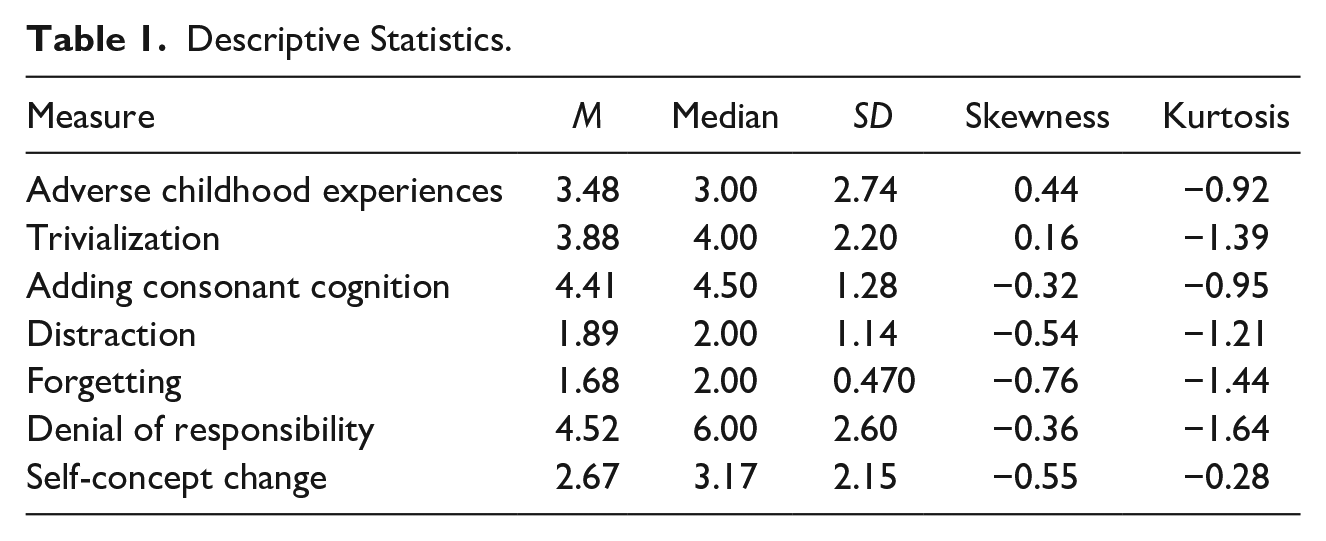
Prior to conducting the statistical analyses, we evaluated the normality of the data by examining skewness and kurtosis to determine the appropriateness of using parametric tests. The results indicated that the data met the assumption of normality, as detailed in Table 1, which also provides the mean, median, and standard deviation for all variables.
Descriptive Statistics.
To examine the distribution of abuse severity among participants, we analyzed the frequencies for different levels of abuse. Unexpectedly, the group with the highest concentration of participants (42.4%, n = 42) experienced a high level of abuse, defined as any severe instance of sexual coercion, physical assault, or injury, or 10 or more instances of minor physical assault, sexual coercion, or injury, or 50 or more instances of severe psychological aggression. The second largest group consisted of women who endured moderate levels of abuse (25.3%, n = 25), characterized by more than 10 instances of severe psychological aggression or between 1 and 10 instances of minor forms of sexual coercion, physical assault, or injury. Following this, 20.2% (n = 20) of women reported none or very few instances of abuse, defined as fewer than 50 instances of minor psychological aggression. Lastly, 12.1% (n = 12) of women fell into the low-abuse category, encompassing more than 50 instances of minor psychological aggression or fewer than 10 instances of severe psychological aggression without other forms of abuse.
Notably, only 20.2% of women experienced no abuse or only minor altercations in their relationships. However, when asked if they considered themselves to have ever been in an abusive romantic relationship, 49.5% (n = 49) responded negatively. This highlights a clear discrepancy between women’s perceptions of abuse in their relationships and the objective measures of abuse they reported. Table 2 provides a detailed breakdown of the frequencies for the various forms of abuse experienced by women in their intimate romantic relationships.
Frequencies for Different Forms of Intimate Partner Violence.
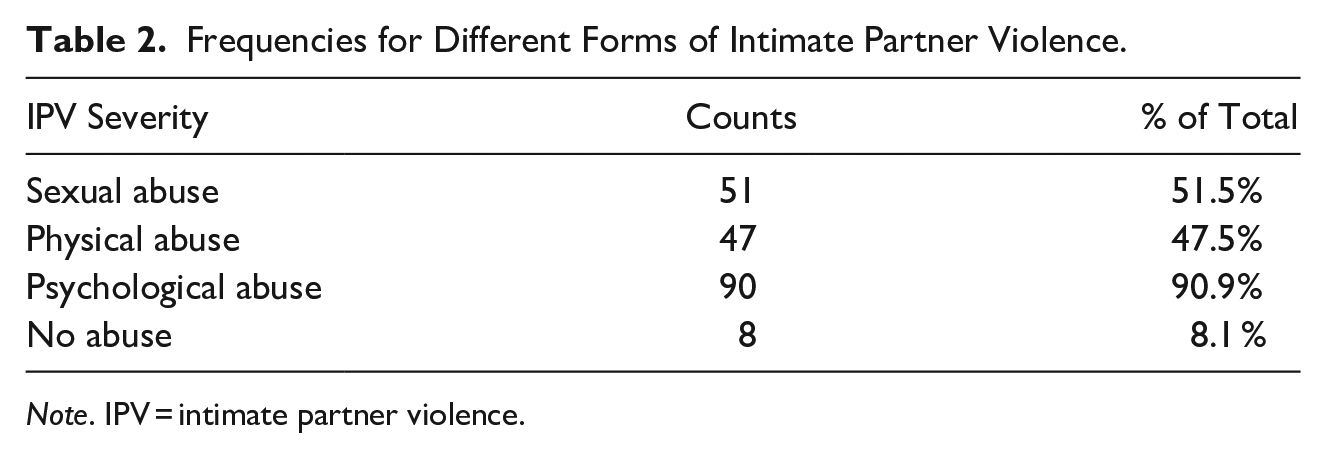
Note. IPV = intimate partner violence.
Hypothesis Testing
Given that the dependent variable is categorical, a logistic regression analysis was conducted to examine the interaction between ACEs and IPV. The logistic regression results indicate that ACEs explain 4.7% of the variance in IPV (R2CS = .047, p < .001). The chi-square statistic (χ2 = 19.2, p < .001) confirms that ACEs significantly predict IPV.
When examining each level of the dependent variable separately, the relationship was significant only for the high level of IPV. Specifically, individuals with ACEs were 1.394 times more likely (odds ratio = 1.394, p = .004) to experience a high level of IPV compared to no IPV.
To address potential collinearity between the moderators and the predictor, the variables were standardized into z-scores. Subsequently, moderation analyses were conducted for various cognitive dissonance reduction strategies. Among these, only the strategy of changing one’s self-concept showed a significant moderating effect (χ2 = 8.07, p = .045). The moderated logistic regression revealed that the interaction between ACEs and self-concept change accounted for 2% of the variance in IPV (R2 = .0202, p = .045).
When each level of IPV was analyzed separately, the moderation effect was significant only for the moderate level of IPV. Specifically, individuals with ACEs who engaged in self-concept change as a cognitive dissonance reduction strategy were 2.273 times more likely (odds ratio = 2.273, p = .016) to experience a moderate level of IPV compared to no IPV. This odds ratio greater than 1 indicates a positive relationship between the interaction of ACEs and self-concept change and the likelihood of experiencing IPV, suggesting that self-concept change amplifies the relationship between ACEs and IPV.
Further analysis was conducted to assess the moderator’s impact at varying levels of self-concept change. Participants were divided into three groups based on their scores on the self-concept change scale: high (+1 SD), low (−1 SD), and average (between −1 SD and +1 SD). The results demonstrate that the moderation effect was significant only for participants with high levels of self-concept change (χ2 = 17.2, p < .001). This finding underscores the role of self-concept change in intensifying the relationship between ACEs and IPV at higher levels of this moderating factor.
Discussion and Conclusions
This study explored the relationship between ACEs and IPV, with a focus on whether this relationship is amplified by cognitive dissonance reduction strategies. Consistent with previous research (Heyman & Slep, 2002; Manchikanti Gómez, 2011), ACEs significantly predicted revictimization in adult romantic relationships. However, unlike studies suggesting that educational level influences IPV victimization (World Health Organization, 2022), our sample, which was relatively homogeneous in terms of education, revealed that IPV prevalence remained high regardless of education level. Moderation analysis indicated that only the cognitive dissonance reduction strategy of self-concept change significantly inflated the relationship between ACEs and IPV.
The role of self-concept change can be understood through the Meaning Maintenance Model (Heine et al., 2006), which posits that individuals strive for coherence in their relationships with themselves, others, and the environment. When disruptions, such as being in an abusive relationship, occur, individuals may restore meaning and self-esteem by altering perceptions in one of these domains. In abusive relationships, women may reaffirm their self-worth by perceiving themselves as improved through the relationship, even if unsatisfactory. Baumeister and Jones (1978) support this notion, demonstrating that individuals restore self-esteem by focusing positively on other traits when faced with negative feedback. Research by McIntyre et al. (2020) further suggests that perceiving personal growth within a relationship increases satisfaction and commitment, thereby reducing the likelihood of leaving.
Interestingly, moderation effects were significant only within the moderate IPV group and not the severe IPV group. One possible explanation is that in cases of severe abuse, external factors such as physical danger, control, or lack of resources may overshadow internal cognitive processes like dissonance reduction, limiting the observable moderating effect. In contrast, in moderate IPV cases, cognitive dissonance mechanisms may play a more prominent role in shaping perceptions and responses.
The lack of significance for other cognitive dissonance reduction strategies may stem from retrospective bias. Current emotional states can reshape how individuals interpret past experiences (Blome & Augustin, 2015). Women may reinterpret past beliefs about a relationship to align with their present understanding, reducing cognitive dissonance. In addition, the limited number of items used to measure these strategies may have reduced the sensitivity of the analysis, as fewer items were included to minimize participant burden.
Descriptive statistics revealed that many women either did not recognize their relationship as abusive or refrained from acknowledging it. This reluctance could be linked to fears of being blamed for the abuse (Loke et al., 2012), highlighting another factor potentially influencing the nonsignificant moderation results.
Despite its contributions to understanding the relationship between ACEs, IPV, and cognitive dissonance reduction strategies, this study presents several limitations. First, the study utilized a cross-sectional design, which limits causal inferences regarding the relationship between ACEs and IPV. Longitudinal studies are necessary to establish the temporal order of these variables and to explore whether cognitive dissonance reduction strategies evolve over time in response to prolonged exposure to abuse.
Second, data collection relied on self-reported measures, which may introduce recall bias, social desirability bias, or subjective interpretation of past experiences (Blome & Augustin, 2015). Given the retrospective nature of assessing both ACEs and IPV, participants’ current emotional state and cognitive reappraisal processes could have influenced their responses, particularly in recalling past instances of abuse and the cognitive strategies they employed. To mitigate the risks associated with self-reported measures, several methodological strategies were implemented. First, participants were assured of the anonymity and confidentiality of their responses, reducing the likelihood of social desirability bias by allowing them to answer more honestly without fear of judgment. To minimize recall bias, participants were encouraged to reflect on specific life stages or events rather than providing generalized accounts of their past. Furthermore, the survey instructions emphasized the importance of accuracy over desirability, and multiple-item measures were employed to capture a broader and more nuanced picture of their experiences. These strategies helped to enhance the reliability of the self-reported data and reduce the impact of potential cognitive distortions or retrospective reinterpretations of past events. Although recall bias remains an inherent limitation in retrospective research, the study design aimed to minimize its effects through these methodological safeguards. Future research could further address this issue by incorporating longitudinal designs, collateral reports from close others, or mixed-method approaches that integrate qualitative insights to validate self-reported experiences.
Another limitation concerns the measurement of cognitive dissonance reduction strategies. While the study identified self-concept change as a significant moderator, other dissonance reduction strategies may not have emerged as significant due to measurement constraints. The relatively small number of items used to assess these strategies may have resulted in lower internal consistency and reduced statistical power to detect significant effects. Future research should refine and expand these measures to capture the full complexity of cognitive dissonance mechanisms in abusive relationships.
In addition, even if the participants were anchored in the most impactful past relationship specifically, an interpretive limitation arises from the fact that participants may have reported on experiences across multiple past or current relationships, raising the question of how well the measured cognitive dissonance strategies apply to any specific relationship context. However, it is important to note that cognitive dissonance reduction strategies are conceptualized not merely as situational reactions but as relatively stable coping tendencies that individuals rely on across different contexts. Prior research suggests that, although cognitive dissonance strategies are triggered situationally, individuals display consistent preferences for particular dissonance reduction strategies over time (Heine et al., 2006; Simon et al., 1995), supporting the view that the measures used here capture enduring psychological patterns rather than transient reactions to a single relationship. This perspective allows for meaningful interpretation of the role of dissonance strategies in the broader association between ACEs and IPV victimization, even without isolating responses to one specific relationship.
In addition, the sample consisted of women from a predominantly urban background with a relatively homogeneous level of education. While this allowed for better control over education as a confounding variable, it also limits the generalizability of the findings to broader populations, particularly those in rural areas or with lower levels of formal education. Furthermore, the sample size, while sufficient for detecting moderate effects, may not have been large enough to detect smaller yet meaningful moderation effects.
Finally, while the study discusses the impact of patriarchal societal norms on IPV, it does not directly measure these sociocultural influences. Future research should incorporate measures of gender role beliefs, societal attitudes toward IPV, and perceived societal support to gain a more comprehensive understanding of how patriarchal ideologies shape women’s cognitive responses to abuse.
The findings of this study provide valuable insights into the psychological mechanisms that sustain abusive relationships, particularly within the sociocultural framework of patriarchal societies. However, their generalizability is constrained by the specific characteristics of the sample. The majority of participants had a higher level of education, which may not fully represent the experiences of women with lower educational attainment who may face additional structural barriers to leaving abusive relationships. Additionally, the sample was drawn from an urban setting, limiting applicability to rural populations, where access to support services and societal attitudes toward IPV may differ significantly.
Moreover, while the study identifies self-concept change as a key cognitive dissonance reduction strategy, cultural differences in self-construal and relationship norms may influence how women rationalize and respond to IPV. These findings may be especially applicable to cultures where relational harmony and self-sacrifice are emphasized, reinforcing commitment to abusive relationships. Although the present study did not directly analyze sociocultural factors, the sample reflects the cultural context of Romania, where traditional gender norms and patriarchal dynamics shape women’s experiences. Future cross-cultural research should explicitly examine how such cultural dynamics interact with cognitive dissonance strategies in perpetuating IPV.
Overall, while the study contributes to the literature on IPV and cognitive dissonance, its findings should be interpreted with caution when applied to populations with different socioeconomic, cultural, and educational backgrounds. Further research should aim to replicate these findings across diverse groups and investigate additional sociocultural and structural factors that may influence women’s experiences and decisions regarding IPV. In addition, because the present data do not include relationship duration or chronicity of abuse, future research should explore how cognitive dissonance strategies influence not only revictimization risk but also the decision to remain or leave an abusive relationship. Furthermore, studies involving women currently in abusive relationships could yield more precise results about cognitive dissonance, though ethical concerns may necessitate alternative approaches, such as laboratory simulations. Finally, the current work only addresses women or people assigned female at birth; future studies should also examine male victimization in IPV to understand the prevalence and contributing factors to this phenomenon.
In conclusion, this study revealed a strikingly high prevalence of intimate partner abuse among participants, with 91.9% reporting at least one form of abuse and 67.7% experiencing physical or sexual abuse. ACEs emerged as a significant predictor of IPV. Furthermore, the decision to remain in abusive relationships was influenced by women’s engagement in the cognitive dissonance reduction strategy of altering their self-concept, specifically by enhancing their perception of themselves as improved due to the relationship (e.g., believing they are a kinder person because of it). These findings underscore the need to consider such psychological mechanisms when designing and implementing interventions aimed at supporting people in abusive relationships. While the sample is not representative of the general population, the insights gained offer meaningful implications for understanding the psychological processes that may perpetuate harmful relational dynamics.
Footnotes
Data Availability
Data is available upon request.
Declaration of Conflicting Interests
The author(s) declared no potential conflicts of interests with respect to the authorship and/or publication of this article.
Funding
The author(s) received no financial support for the research and/or authorship of this article.
Ethical Considerations
This study was conducted in accordance with the Declaration of Helsinki.
Consent to Participate
Respondents gave written informed consent prior to data collection.
