




Abstract
Image-based sexual abuse (IBSA), defined as the non-consensual creation, use, and/or distribution of sexually explicit photos, is an under-researched yet common form of violence against women. Victims of this form of violence are often blamed for the abuse they endure, which influences their likelihood to seek help and recover. While in-person sex work stigma is known to increase the likelihood of negative reactions to victims, it is unknown whether women who share their own sexual images online for money are viewed in similar ways. The current study used an experimental vignette design to understand the influence of the context of IBSA, specifically related to how the original image was produced, and gender, on individuals’ attributions of blame to a female victim and male perpetrator of IBSA and their empathy for the victim, while controlling for rape myth endorsement. Results showed that participants placed more blame on the victim, less blame on the perpetrator, and displayed less empathy toward the victim when she took the explicit photo herself compared to a victim whose photo was taken by someone else. Moreover, participants blamed a perpetrator of IBSA less when he had paid for access to the explicit photo on a subscription-based website and displayed lower empathy for a victim of IBSA who earned a monetary reward for their explicit photo. On average, women reported more empathy for victims of IBSA compared to men, and individuals of all genders who endorsed rape myths to a greater degree placed more blame on victims of IBSA. This study is the first step in understanding the ways in which the context of image production affects the views of victims and perpetrators of IBSA and provides important information for prevention and education efforts.
Keywords
Approximately 35% of women will experience some form of sexual violence in their lifetime (World Health Organization, 2017). This makes addressing sexual violence (SV) crucial. While SV is most commonly thought of as behaviors that occur in person, such as sexual harassment and sexual assault (Kelly, 2012), recent developments in technology have led to some sexually violent acts occurring entirely online (Henry & Powell, 2018). SV that transpires online includes image-based sexual abuse (IBSA) which occurs when someone non-consensually creates, uses, distributes, and/or pressures someone into sending sexually explicit photos or videos (Henry & Powell, 2018). IBSA is a recently recognized form of violence, only becoming criminalized in countries like Canada in 2015 and the United States in 2019 (Criminal Code, 2015; U.S. Congress, 2019). The criminalization of IBSA in many jurisdictions represents a significant step forward, but gaps persist in protecting victims and challenging societal attitudes about IBSA (Henry & Powell, 2016).
Despite the relatively early stages of IBSA research, the studies that have been conducted show that it is a common problem. For example, an international study that assessed a diverse sample of individuals aged 16 to 64 from Australia, New Zealand, and the United Kingdom found that 1 in 3 (37.7%) respondents had experienced at least one form of IBSA since 16 years of age (Powell et al., 2024). As with in-person sexual violence, the experience of IBSA is gendered. The majority of studies have shown that women are disproportionally targeted by IBSA (Wood et al. 2015), and men are more likely to perpetrate it (Barrense-Dias et al., 2020; Powell et al., 2019; Strassberg et al., 2014). However, at least one study has found that men and women exhibit relatively comparable rates of IBSA perpetration (Flynn et al., 2022b). Furthermore, although research on LGBTQS+ individuals’ experiences with IBSA is lacking, studies that have been conducted show that they report experiencing IBSA at higher rates compared to cisgender and heterosexual individuals (Lenhart et al., 2016; Meechan-Rogers et al., 2021).
Victims of IBSA often experience profound psychological ramifications, including feelings of betrayal, shame, and long-lasting mental health challenges such as anxiety and depression (Bates, 2017; McGlynn et al., 2021). These emotional and psychological consequences are compounded by societal attitudes that frequently blame survivors for the victimization, which not only exacerbates their suffering but also discourages them from seeking support (McGlynn et al., 2021). Some survivors may be more susceptible to harmful responses when disclosing. For example, one study found that victims who took their own explicit photos were blamed more for IBSA compared to victims whose photo was taken by someone else (Zvi & Shechory-Bitton, 2021). This type of judgment may be exacerbated by stigma if a monetary reward is obtained by women for initially sharing their photos, similar to stigma experienced by in-person sex workers.
The present study was designed to explore how a victim’s behavior, in relation to the context within which the explicit photo was created before it was non-consensually shared, influences young adults’ placement of blame on a victim and perpetrator of this type of IBSA and their empathy toward the victim. This exploration expands findings about attitudes toward sexual violence against sex workers to IBSA in online contexts like subscription-based websites. The study also contributes to the small body of literature on how IBSA is viewed by young adults and provides knowledge for future research and prevention efforts.
Victim and Perpetrator Blame
Despite the harm that sexual violence causes to survivors and society, sexual violence remains one of the least reported crimes in North America (Daly & Bouhours, 2010). While there are many reasons for the underreporting of sexual violence, one of the most common is a victim’s fear of being blamed or held responsible for the violence (Ahrens, 2006; Ullman et al., 2020). 1 To date, there is no research examining individuals’ reasons for and against reporting IBSA; therefore, we focused on the established findings for in-person sexual violence to guide our hypotheses about blame related to IBSA.
Overall, the literature has identified several factors that play a role in perceivers’ assignments of blame to victims of in-person sexual violence, including characteristics of the perceiver, such as their gender or degree of rape myth acceptance, the context in which the violence occurred, and the victim’s behavior (Van der Bruggen & Grubb, 2014; Zvi, 2022). Specifically, research has found that males are more likely to blame victims compared to women and gender-diverse individuals (Diamond-Welch et al., 2021). Moreover, research shows that regardless of gender, those who endorse rape myths to a higher degree are more likely to blame victims of in-person sexual violence (Cohn et al., 2009; Murray et al., 2023).
Rape myths are false beliefs about sexual violence, which blame victims and exonerate perpetrators (Burt, 1980; Edwards et al., 2011). When individuals accept these false beliefs, they are less likely to recommend punishment for offenders of sexual assault, and if they are men, are more likely to perpetrate sexual assault themselves (see Suarez & Gadalla, 2010, for a review). Research has consistently found that men are more likely to accept rape myths compared to women (Hammond et al., 2011; Schulze & Koon-Magnin, 2017; Suarez & Gadalla, 2010). Fewer studies have been conducted on rape myth acceptance of gender-diverse individuals, but one study did find that transgender women endorsed rape myths at a lower rate compared to cisgender and transgender men (Diamond-Welch et al., 2021). While some rape myths are generally applicable beyond an in-person context, new measures have been developed to assess rape myths specific to IBSA (Powell et al., 2019). These IBSA-specific myths reflect the unique dynamics of online spaces and include harmful beliefs such as the myth that women should be flattered if their partner shared explicit images of them, that men cannot be held responsible for sharing explicit images while drunk, or that individuals who take explicit photos are partly to blame if the images are leaked (Powell et al., 2019). Recent studies suggest that there are similar connections between IBSA myth acceptance and victim blaming (Flynn et al., 2022a; Henry et al., 2017).
Research on in-person sexual violence contexts suggests that the assignment of blame to a victim is influenced by the victim’s behavior, specifically, if a victim behaves differently from their prescribed gender roles (Loughnan et al., 2013). Deviations from these expectations, such as when a woman acts in ways that are perceived as contrary to traditional femininity, can lead to a higher likelihood of being blamed for sexual violence. In many Western societies, while not universal, there are prevailing (and often contradictory) feminine expectations that women should be attractive and focus on their appearance, but also minimize (unwanted) male attention sometimes expressed through conservative dress codes (Farvid et al., 2016; Loughnan et al., 2013). Any behaviors that do not correspond with these feminine expectations, such as behaving in a self-objectifying way (Loughnan et al., 2013; Zvi & Shechory-Bitton, 2021) and/or earning a monetary reward for sexual acts (Sprankle et al., 2018), results in higher victim blaming. When a woman is perceived to be engaging in sexual behaviors for personal gain, such as earning money through sex work, the resulting judgments often become more severe (Sprankle et al., 2018). These prejudicial beliefs are known as sex work stigma and are often justified by misguided ideas that sex workers have chosen a high-risk lifestyle (see Grittner & Walsh, 2020, for a review). There are types of sex work that involve the use of the internet to exchange sexual commodities and can include a variety of acts such as webcam modeling or pornographic acting (Jones, 2015) or uploading explicit photos to a subscription-based website (Litam et al., 2022). However, whether stigmatizing beliefs like increased victim blame apply to IBSA in online sex work contexts has not been examined.
While there are many studies that have examined factors that influence blame attribution to victims and perpetrators of in-person sexual violence (see Suarez & Gadalla, 2010, for a review), fewer studies have assessed the factors that influence blame for victims and perpetrators of IBSA (see Zvi & Shechory-Bitton, 2021 for an exception). The research that has been done has found that while IBSA perpetrators are typically assigned more blame than victims, variations in the amount of blame attributed to each are still critically important (Zvi & Shechory-Bitton, 2021). For instance, Zvi’s (2022) study found that while participants largely placed blame on the perpetrator, in certain contexts, they were slightly more inclined to shift blame toward the victim. These subtle shifts in blame are important to examine, as even a slight increase in victim blaming can reduce the likelihood of offering supportive responses to the victim (Johnson et al., 2002). Individuals may blame only perpetrators, only victims, or they may blame both for sexual violence. Since few studies have examined victim and perpetrator blame separately for instances involving IBSA, the current study explores the factors that influence the degree to which blame is assigned to both victims and perpetrators in such instances.
Victim Empathy
A related concept to victim blaming is victim empathy, or the ability to understand the emotions, perspectives, and reactions of a victim of sexual assault (Smith & Frieze, 2003). Blame and empathy are interconnected, as studies have shown that attributing blame to victims of sexual violence is correlated with lower empathy. This research suggests that when individuals blame survivors for the victimization, they are less likely to feel empathy and provide support to them (Bongiorno et al., 2020; Kazmi et al., 2023). Victims may be unlikely to disclose their experiences because they fear they will not receive empathetic responses (e.g., Maddox et al., 2011), and different factors may influence whether a victim receives empathetic responses from the individuals in which they confide (e.g., Edwards et al., 2022). Research on victim empathy suggests that similarly to victim blaming, men are less likely to display empathy toward victims of sexual violence compared to women and transgender individuals (Diamond-Welch et al., 2021). As well, research shows that men and women with higher rape myth acceptance tend to have less empathy for victims of in-person sexual violence than do those with lower acceptance (Leone et al., 2021). However, no research currently exists to address whether the same perceiver characteristics influence empathy for victims of IBSA, making this an important outcome for this study.
The studies mentioned previously found that the characteristics or behavior of a victim of in-person sexual assault negatively influenced victim blame, and also found that engaging in self-objectifying behaviors (Loughnan et al., 2013), and/or earning a monetary reward for a sexual act (Sprankle et al., 2018; Zvi, 2022), led perceivers to display less empathy for these victims compared to others. No studies to date have assessed whether involvement in online platforms, known as subscription-based websites, where individuals can post explicit photos of themselves and earn monetary rewards for these photos, influence perceivers’ empathy and blame toward victims, therefore, this is one of the contexts we investigated.
Particularities of Online Contexts
While research suggests that online spaces are less safe for women than for men (Wood et al., 2015), there are also different types of online contexts that may have higher perpetration rates of IBSA, one of which is through sexting (Powell et al., 2022). Sexting occurs when one person creates sexual material of themselves and shares it with another individual via technology (Henry & Powell, 2018). As sexting has increased as a social practice (Klettke et al., 2014), IBSA has also increased (Powell et al., 2022). Some authors have suggested that this may be because individuals often believe that sharing photos without consent is a normal part of sexting (Wolak & Finkelhor, 2011).
Subscription-based websites, such as “OnlyFans,” are contexts where not only has the individual produced and shared their own image or video, but they have also posted it to earn a monetary reward (Litam et al., 2022). In general, there is a lack of empirical research specifically focused on these platforms. However, it seems likely that given the higher burden of sexual violence experienced by sex workers in in-person contexts (Deering et al., 2014), these platforms may also be contexts with an elevated risk of IBSA. In both cases, the context requires a particular behavior that has been associated with negative perceptions of survivors of in-person sexual violence. For these reasons, sexting and subscription-based websites were contexts within which attributions of blame to perpetrators and victims and empathy for victims following IBSA were explored in this study.
Current Study
Our study was designed to fill a gap in the sexual violence and IBSA literature by assessing how a victim’s behavior in different contexts and perceiver characteristics influence perceivers’ assignment of blame to victims and perpetrators, and their empathy for IBSA victims. Vignettes were used to assess participants’ assignments of blame to a perpetrator and victim of IBSA and their empathy for the victim as they allow for controlled manipulation of variables in a realistic yet standardized context, minimizing external influences. In our experimental design, we manipulated two types of victim behaviors in different contexts that emerged from our review of the literature: first, whether the sexual photo was produced by the victim herself (either through a subscription-based website or sexting) or taken without her consent (control condition—through non-consensual photography). Second, we varied whether the victim received a monetary reward for the photo (through a subscription-based website) or not (through sexting, through non-consensual photography). Victim and perpetrator blame were studied with separate items since previous research suggests that a victim’s behavior may influence the attribution of blame toward victims and perpetrators in different ways; attributions of victim and perpetrator blame do not always have a simple inverse relationship (Zvi, 2022). Additionally, given that rape myth endorsement is known to shape perceptions of blame in both offline and online sexual violence cases (Cohn et al., 2009; Flynn et al., 2022a; Murray et al., 2023), IBSA rape myth attitudes were included as a covariate. We were interested in the possible effects of a female victim’s behavior in different contexts above the effects of IBSA myth acceptance. We studied young adults in university since they experience both a high risk of sexual violence (Fisher et al., 2000) and high engagement online (Zachos et al., 2018).
Our primary research question was whether a victim’s behavior in different IBSA contexts (i.e., through a subscription-based website, through sexting, or as a control, through non-consensual photography) produced differing degrees of victim/perpetrator blame and victim empathy over and above the influence of rape myth endorsement. Given the gendered nature of the phenomenon under study, participant gender was included as a quasi-independent variable to establish whether there was a main effect and/or interaction between participant gender and the context of IBSA for the dependent variables. Based on findings from previous research, three hypotheses were tested:
Hypothesis 1—Context and victim behaviors—Who took the photograph?: Participants will report lower perpetrator blame and victim empathy, and assign higher blame to the victim, when she took and shared her own explicit photo (i.e., through subscription-based websites and through sexting), compared to victims whose explicit photo was taken by someone else without their consent (i.e., through non-consensual photography).
Hypothesis 2—Context and victim behaviors—Was the victim paid for the image?: Participants will report lower perpetrator blame and victim empathy, and higher victim blame when victims received money for their images (photos were taken for subscription-based websites) compared to when those images were obtained through sexting or through non-consensual photography.
Hypothesis 3: Perceiver Characteristics: For any context of IBSA, women, transgender, and non-binary students will display higher empathy for victims, assign more blame to perpetrators, and assign lower blame to victims of IBSA than men, regardless of contextual factors.
Method
Participants
Ethical clearance was obtained from a university Research Ethics Board. A sample of 149 undergraduate students were recruited from a medium-sized university’s Department of Psychology participant pool from December 2021, until February 2022. Participants were between the ages of 17 and 49 (M = 21.84, SD = 4.96) years. In total, 73 participants identified as female, 65 as male, 3 as transgender, and 7 as non-binary. Participants were predominantly Caucasian (n = 94, 63.5%), with 16 (10.8%) Middle Eastern, 9 (6.1%) Bi/Mixed/Multi-Racial, 8 (5.4%) Black, and 19 (13%) identifying with another ethnicity. The sample was predominantly heterosexual (n = 117, 78.5%), with 10 lesbian or gay students (6.8%), 14 bisexual students (9.5%), and 7 identifying as another sexual identity (4.8%). Most participants were in the Faculty of Arts, Humanities, and Social Sciences (n = 88, 59.5%), with 40 in Science/Engineering (27%), 10 in Human Kinetics (6.8%), and 10 in another faculty (6.9%) across years of study.
Participants were also asked about their experiences with sexting, subscription-based websites, and IBSA perpetration and victimization. Approximately half of the participants reported that they had shared a nude with a current sexual partner (n = 72, 48.6%), though this was not consistent by gender (32% of male, 59.2% of female, 100% of transgender [n = 3], and 85.7% of nonbinary students [n = 7]), X2(4) = 16.51, p < .01. Only one participant (identified as female) reported that she had uploaded a nude to a subscription-based website (n = 1, 0.7%). Overall, most participants reported that they had not shared a photo of someone else without the individual’s consent (n = 138, 93.2%). Additionally, most participants reported never experiencing IBSA victimization (n = 133, 89.3%).
Measurements
Vignettes
Vignettes were designed based on Stolte’s (1994) recommendations to construct most parts of the vignettes to be the same for each participant and to keep vignettes short to minimize extraneous effects and to lower the likelihood that participants will process vignettes with minimal thought and effort. To ensure that the scenarios reflected real-life instances of IBSA, the vignettes were constructed using common elements of IBSA cases reported in the literature and media (e.g., Litam et al., 2022; Powell et al., 2019). Each vignette described a female character who had a nude image of her saved by a male acquaintance who shared it with his friends without her consent. The experimental (independent variable) manipulations were whether the sexual photo of the woman was taken and shared by her or taken without her consent and whether she received a monetary reward for sharing the photo. All vignettes described an incident that fits the definition of IBSA. The stories in the vignettes were designed such that the victim was clearly upset, and the acts of the perpetrator were clearly non-consensual in all vignettes to keep judgements of non-consent and harm consistent across the conditions. To evaluate whether participants understood that the acts were non-consensual and had consequences for the victim, participants answered several questions (manipulation check) once they had finished reading the vignette. The sexting vignette (photo taken and shared by victim, no financial gain) is provided below in bold with the wording for other conditions in square brackets (i.e., subscription-based website [photo taken and shared by victim, financial gain]/control—non-consensual photography [photo taken by perpetrator, no financial gain]): Jenny is a 24-year-old woman living in [city]. One day, Jenny took a nude selfie and texted this photo to Justin, a guy she knew from school. [Jenny signed up for a website called OnlyFans, where she could post photos and charge viewers a subscription fee to view them. One day, Jenny took a nude selfie and posted this photo on the website. Justin, a guy who knew Jenny from school, signed up to see Jenny’s photo./One day, Jenny was hanging out at her house with Justin, a guy she knew from school. While Jenny was getting ready in another room, Justin took a nude of her without her knowledge or permission.] Later that day, Justin saved Jenny’s photo on his phone and then sent it to his friends [Later that day, Justin downloaded Jenny’s photo and sent it to his friends/Justin then sent this photo of Jenny to his friends.]. When Jenny found out that her nude photo had been shared without her permission, she was very upset.
Manipulation Check
To assess if participants understood that the incident described was non-consensual, participants responded to a yes/no/unsure question which asked: “Did Justin have Jenny’s permission to save her image to his phone?” (6 participants said “yes”) and “Did Justin have Jenny’s permission to send her image to his friends?” (1 participant responded “yes”). To assess the degree to which participants understood that the incident caused the female character distress, participants responded to the following statement: “On a scale of 1 (very happy) to 5 (very upset), how do you think Jenny felt after finding out her photo was forwarded to someone else?” (none suggested she was not upset). Since it was expected that some participants may falsely believe that by sexting or uploading an explicit image, consent is implied, and since none of the participants failed all three manipulation questions, all participants were included in the analyses.
Outcome Measures and Covariate
Attributions of Blame
Two questions regarding attributions of blame to the victim and perpetrator came from Stormo et al. (1997) study. They read: “How much is Jenny to blame for the incident occurring?” and “How much is Justin to blame for the incident occurring?” As some research has suggested that measurement of blame can be improved by adding a definition, a definition of blame, taken from Stormo et al. (1997) study, followed before participants were asked to respond (“blame is a value judgment about the extent to which one should be held accountable for the outcome of an event and perhaps experience future consequences because of it”). Blame was assessed using a 5-point Likert scale ranging from 1 (not at all blameworthy) to 5 (entirely to blame). Higher mean scores indicated higher blame. Stormo et al. (1997) items were chosen for comparability to other research as they have been widely used to assess blame in similar contexts, however, the two items are always reported separately and do not have published construct validity or test-retest reliability.
Victim Empathy
One question assessing victim empathy was adapted from Anastasio and Costa (2004). This question read “Regardless of whether she could anticipate the consequences, do you feel bad for Jenny in this situation?” This adapted question is designed not to presume a particular level of victim blame. Participants answered on a 5-point scale from 1 (strongly disagree) to 5 (strongly agree). Higher mean scores indicated higher empathy for the victim. Anastasio and Costa’s (2004) question was chosen as it offers a straightforward, context-specific assessment of empathy and has been used widely. Construct validity and test-retest reliability have not been reported.
Rape Myth Acceptance
The Sexual Image-Based Abuse Myth Acceptance Scale
The Sexual Image-Based Abuse Myth Acceptance Scale (SIAMA) scale has 18 items rated on a 7-point Likert scale from 1 (strongly disagree) to 7 (strongly agree) (Powell et al., 2019). Higher mean scores indicated higher IBSA myth acceptance. Minor wording changes were made for relevance to a North American context (e.g., mates changed to friends). In the current study, the full SIAMA scale had good reliability (α = .86).
Demographic/Background Questions
In addition to demographic questions, participants were also asked to respond to 16 questions in a yes/no format regarding their experiences with sexting, subscription-based websites, and IBSA perpetration and victimization, which were based on questions from Powell et al. (2019) study. For example, sample questions were, “Have you ever sent a nude or sexual photo or video of yourself to a current sexual partner?” and “Have you ever uploaded a nude or sexual image of yourself to a subscription-based website?”
Procedure
Students signed up for the study using the participant pool website and could earn one-half bonus mark for eligible classes for participating. Gender balance was accomplished by using two ads, one visible only to male-identified and gender-diverse students and the other to female-identified students. Once 75 women had signed up for the study, we removed the women’s advertisement since it took longer to recruit an equal number of men and gender-diverse students for the study. Participants completed the study online. After reading the consent information and agreeing to participate, participants completed the demographic questionnaire. Participants then read one of the three vignettes assigned at random. In total, 48 were assigned to the sexting condition, 46 to the subscription-based website condition, and 52 to the non-consensual photography condition. Participants then completed the manipulation check, followed by questions regarding victim/perpetrator blame and victim empathy, IBSA myth acceptance, and their personal experiences with IBSA. Finally, participants were directed to a post-study information page and a list of resources.
Results
All analyses for the present study were performed with IBM SPSS Statistics Version 26. Three participants had incomplete data; they were included in analyses for measures they completed. Normality, linearity, and homogeneity of variance were assessed, and violations of all three assumptions were found as is common when dependent variables are highly correlated. Normality tests revealed only one outlier and there were no differences in findings when this outlier was removed, so it was retained. The hypotheses were tested using multiple analyses of covariance (ANCOVA) analyses and planned a priori comparisons since ANCOVAs are more robust under conditions where assumptions are violated (Grice & Iwasaki, 2007). To understand the relationships between outcome and rape myth acceptance variables, correlations were tested before running the ANCOVA and can be found in Table 1.
Intercorrelations Among Variables.
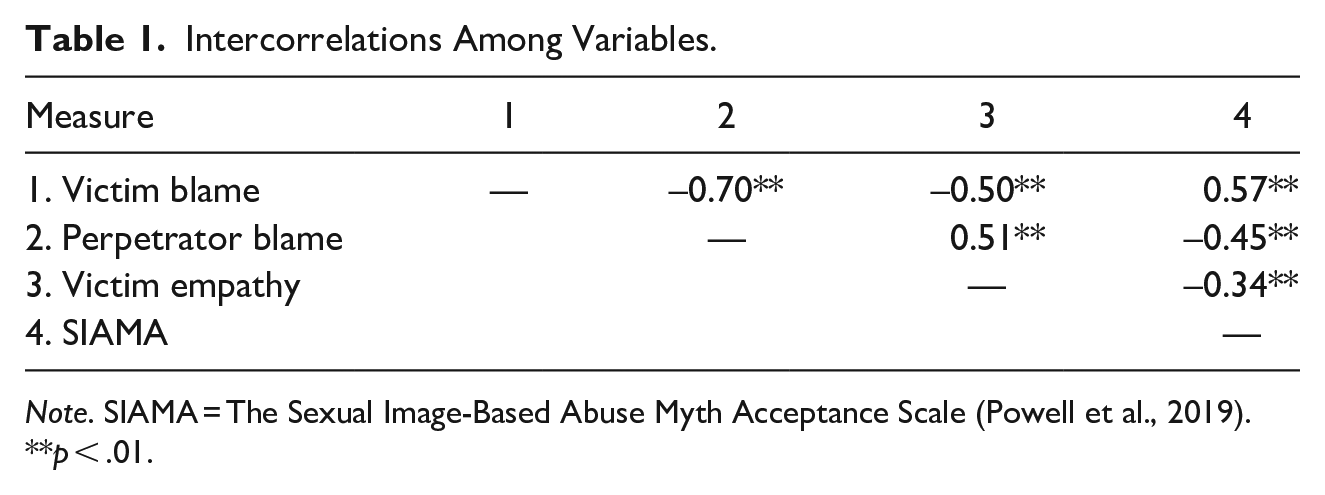
Note. SIAMA = The Sexual Image-Based Abuse Myth Acceptance Scale (Powell et al., 2019).
p < .01.
Main Analysis
To test the three hypotheses, we conducted a 2 (gender: female/transgender/non-binary, male 2 ) × 3 (context: IBSA occurring through sexting, a subscription-based website, and non-consensual photography) between-subjects univariate ANCOVA for each of the three outcome variables. Post hoc tests were then used to test the first two hypotheses related to differences in victim behaviors in online contexts for the three outcome variables.
Between-subjects ANCOVAs for each outcome variable can be found in Table 2. Findings showed a main effect of context for all outcome variables while controlling for rape myth acceptance. Main effects of context were found for victim blame, F(2, 139) = 33.24, p < .001, partial η2 = .32; perpetrator blame, F(2, 139) = 24.03, p < .001, partial η2 = .26; and victim empathy F(2, 139) = 20.76, p < .001, partial η2 = .23. A main effect of gender was also found for ratings of victim empathy F(1, 139) = 3.95, p < .05, partial η2 = .03, but not for ratings of victim blame F(1, 139) = 0.30, p = .59; or perpetrator blame F(1, 139) = 3.37, p = .07, while controlling for rape myth acceptance. Additionally, the interaction between context and gender was significant for ratings of victim empathy F(2, 139) = 3.22, p < .05, partial η2 = .04, but not for ratings of victim blame F(2, 139) = 1.80, p = .17; or perpetrator blame F(2, 139) = 1.15, p = .32.
Between-Subjects ANCOVAs.
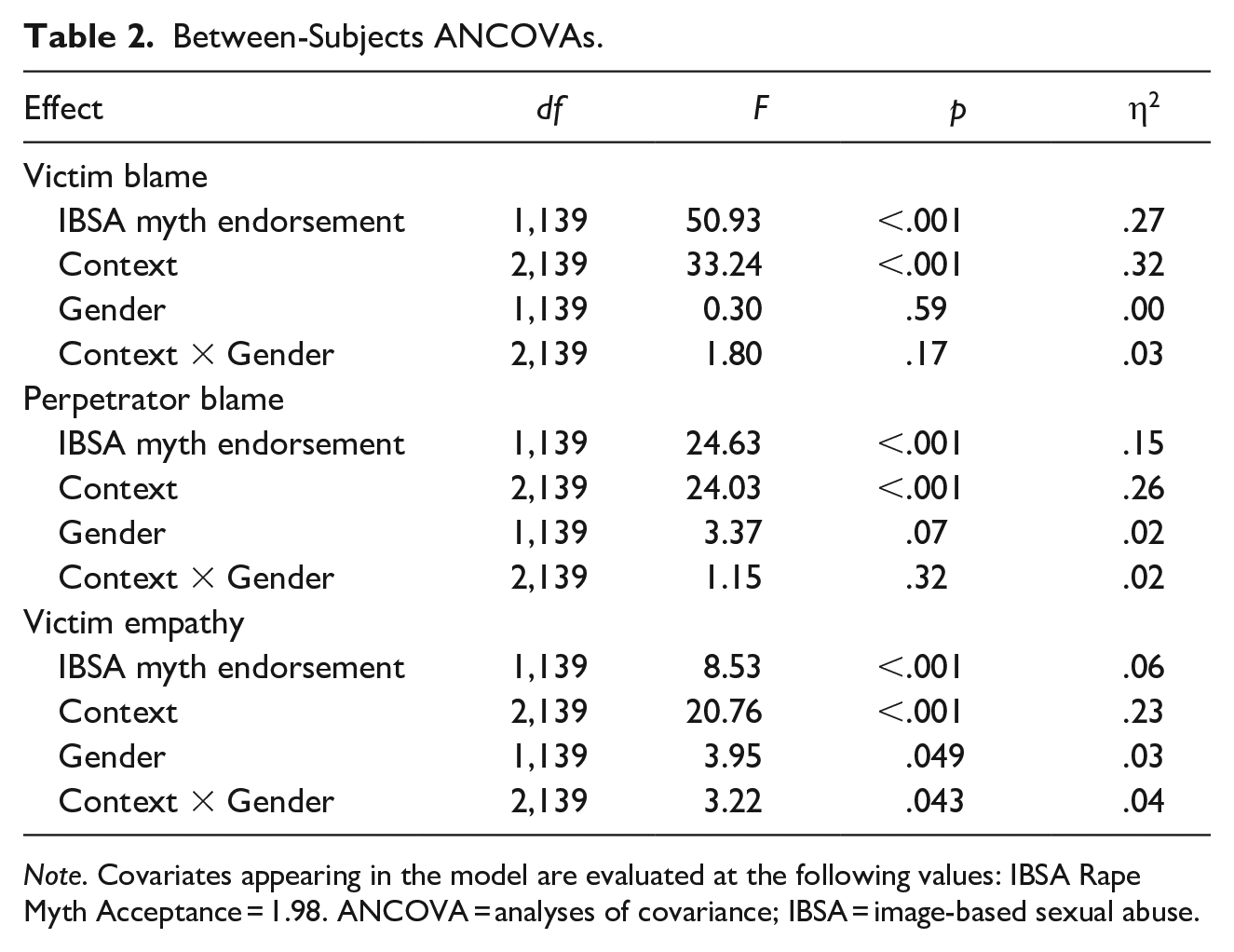
Note. Covariates appearing in the model are evaluated at the following values: IBSA Rape Myth Acceptance = 1.98. ANCOVA = analyses of covariance; IBSA = image-based sexual abuse.
To assess the first hypothesis which predicted that participants would display higher victim blame, lower perpetrator blame, and lower victim empathy for victims who took their own explicit photo compared to those whose photo was taken by someone else, pairwise Bonferroni comparisons were conducted. The first hypothesis was supported for all outcomes. Participants in the sexting condition (M = 2.59, SD = 1.14; Mdifference = 1.19, p < .001, 95% CI [0.85, 1.52]) and subscription-based website condition (M = 2.49, SD = 1.25; Mdifference = 1.22, p < .001, 95% CI [0.88, 1.55]) placed more blame on the victim than those in the control condition (M = 1.17, SD = 0.51). Participants in the sexting condition (M = 4.27, SD = 0.64; Mdifference = −0.49, p < .001, 95% CI [−0.76, −0.22]) and subscription-based website condition (M = 4.06, SD = 0.79; Mdifference = −0.76, p < .001, 95% CI [−1.04, −0.49]) placed less blame on the perpetrator than those in the control condition (M = 4.87, SD = 0.35). Participants in the sexting condition (M = 4.44, SD = 0.65; Mdifference = −0.38, p < .05, 95% CI [−0.73, −0.02]) and subscription-based website condition (M = 3.93, SD = 1.12; Mdifference = −0.93, p < .001, 95% CI [−1.28, −0.58]) reported lower victim empathy than those in the control condition (M = 4.88, SD = 0.32).
To test the second hypothesis that predicted that participants would display higher victim blame, lower perpetrator blame, and lower victim empathy for victims who earned a monetary reward for an explicit photo compared to those who did not, pairwise Bonferroni comparisons were conducted between the two experimental conditions. The hypothesis was supported by the contrasts between the subscription-based website condition and the control condition as reported in the analysis above. For comparisons between the subscription-based website condition and the sexting condition, this hypothesis was supported for two of the three outcomes. This hypothesis was not supported for victim blame, as there was no difference between the subscription-based website and sexting conditions (p = .59). The hypothesis was supported for perpetrator blame with participants in the subscription-based website condition reporting the lower perpetrator blame (M = 4.04, SD = 0.79) compared to participants in the sexting condition (M = 4.30, SD = 0.62; Mdifference = 0.31, p < .05, 95% CI [0.04, 0.58]). The hypothesis was also supported for victim empathy; participants in the subscription-based website condition displayed lower empathy toward the victim (M = 3.94, SD = 1.12) compared to participants in the sexting condition (M = 4.44, SD = 0.65; Mdifference = 0.55, p < .001, 95% CI [0.20, 0.91]).
The third hypothesis, which predicted that males would display more victim blame, less perpetrator blame, and less victim empathy compared to individuals who identified as female, transgender, and non-binary (beyond the influence of rape myth acceptance), was not supported for victim blame (p = .59), or perpetrator blame (p = .07) but was supported for victim empathy. Participants who identified as male reported lower victim empathy (n = 65, M = 4.17, SD = 0.96) compared to students who identified as female, transgender, or non-binary (n = 81, M = 4.65, SD = 0.67; Mdifference = 0.26, p < .05, η2 = .27, 95% CI [0.00, −0.51]),
To explore the interaction of context and gender on victim empathy (see Figure 1), pairwise Bonferroni comparisons were examined. Participants who identified as male appeared to be more strongly affected by the context compared to those who identified as female, non-binary, or transgender. Men’s scores were significantly different between the three conditions, with those in the subscription-based website condition reporting the lowest levels of victim empathy (M = 3.50, SD = 1.14), compared to the sexting condition (M = 4.24, SD = 0.66; Mdifference = 0.76, p < .001, 95% CI [0.26, 1.25]; SE = 0.20) or the control condition (Mdifference = −1.30, p < .001, 95% CI [−1.84, −0.76]; SE = 0.22). Men in the sexting condition also had significantly less empathy for the female character compared to males who were in the control condition (M = 4.89, SD = 0.32; Mdifference = −0.54, p < .05, 95% CI [−1.07, −0.11]; SE = 0.22).
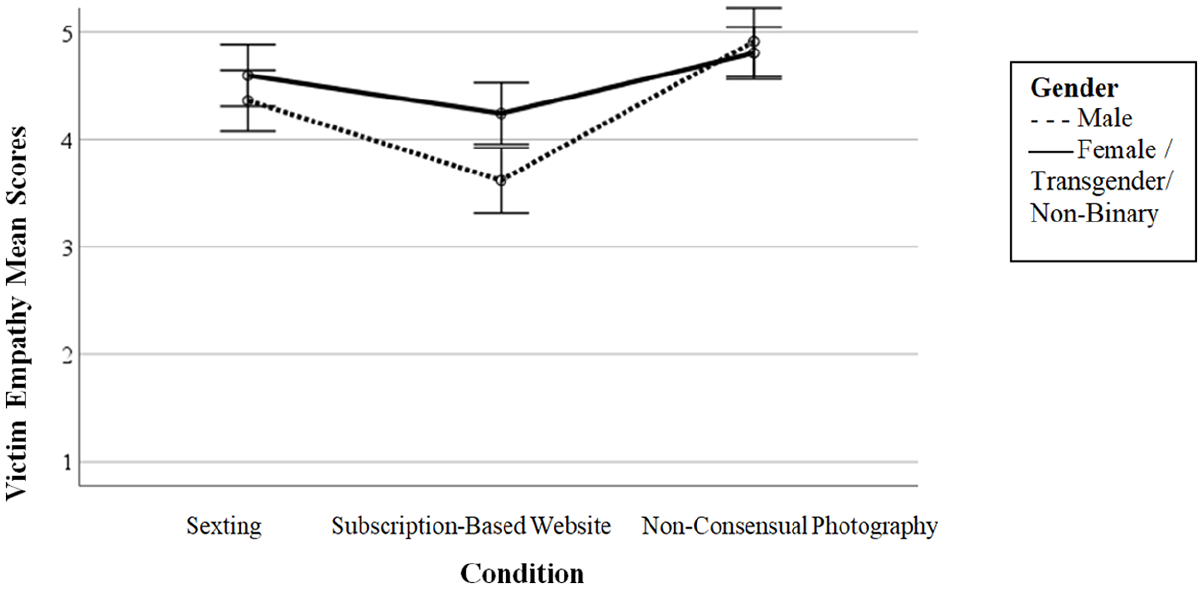
The interaction between context and gender on victim empathy.
The pattern for students who identified as female, transgender, or non-binary, was different in two important ways. First, as expected given the main effect of gender, empathy for victims was higher than for men across all conditions. Second, lower empathy was only evident in comparisons between the subscription-based website condition (M = 4.33, SD = 0.96) and the control condition (M = 4.88, SD = 0.33; Mdifference = −0.56, p < .01, 95% CI [−1.01, −0.11]; SE = 0.19). Female, transgender, and non-binary students did not distinguish between the sexting (M = 4.65, SD = 0.57) and subscription-based website condition (p = .26), or between the sexting and control condition (p = .81), in their reports of victim empathy.
Discussion
This study fills an important gap in research on attributions of victim and perpetrator blame and victim empathy in circumstances of IBSA. In this experiment, we examined whether judgments of victims of IBSA would be affected by who originally took the image (the woman herself or someone without her consent) and whether she had originally been paid for access to the image (through a subscription-based website) over and above the influence of rape myth endorsement. Given its robust influence for in-person sexual violence research, we also included perceiver gender in the analysis.
Overall, our findings showed that a victim’s behavior in different online contexts mattered. Although participants generally assigned full or near full blame to the perpetrator (rating closer to 5, meaning he was entirely to blame) and little blame to the victim (closer to 1, meaning she was not at all to blame), small differences in these ratings are important. When the survivor took her own image and made it available to someone else, either through sexting or a subscription-based website, participants placed more blame on her and less blame on the perpetrator, and expressed less empathy toward her, compared to a survivor whose photo was taken by someone else without her consent. This response occurred despite the participants’ clear understanding that sharing the image was without her consent and that she was upset by it.
These biases based on perceptions of the victim’s behavior in different contexts are consistent with research on IBSA that found that participants placed more blame on victims who had taken their own explicit photo, compared to victims whose photo was taken by someone else (Loughnan et al., 2013; Zvi & Shechory-Bitton, 2021). Interestingly, although research has shown that rape myth endorsement was related to victim judgments for in-person violence (Van der Bruggen & Grubb, 2014), the present study found that context had considerable influence even after rape myth endorsement was taken into account for situations involving IBSA. Therefore, these findings suggest that biased attitudes toward victims of in-person sexual violence also occur for victims of IBSA and that a focus on rape myths alone would miss additional drivers of the attitudes related to the context in which IBSA occurs.
One possible driver of negative views toward some sexual violence victims is stigma related to sex work, which results in sex workers being blamed for the victimization because of biases related to their life circumstances (Grittner & Walsh, 2020). In the current study, we included an experimental condition where the victim took her own image (in common with the sexting condition) but was compensated for uploading her image through a subscription-based website, an online form of sex work. Results showed that participants blamed perpetrators less and reported lower empathy toward victims of IBSA who earned a monetary reward for a sexual photo compared to other victims who had not. These findings are consistent with past research that has found that participants displayed lower empathy toward sex workers who were victims of in-person sexual violence compared to victims who were not sex workers (Sprankle et al., 2018; Zvi, 2022). Feminist theories of sexual violence suggest that there are gendered social and sexual expectations, and when women behave in ways that are contrary to what is expected of them, such as by having multiple sexual partners, they are believed to be causing trouble (Farvid et al., 2016). Sex work is clearly outside of these expected behaviors, particularly for women, and there is a pernicious false belief that sex workers are less deserving of protection from sexual violence (Sprankle et al., 2018). Results from the present study support these theories and extend these findings by showing that this phenomenon may also occur online.
However, our findings that victim blame was not higher in the subscription-based website condition than in the sexting condition (but was higher than the control condition) appears to be inconsistent with some but not all research on sex work and victim blame. Sprankle et al. (2018) conducted a similar vignette-based study, but for situations involving in-person sexual violence, and found that participants attributed more blame to victims of in-person sexual assault who were sex workers compared to non-sex worker victims. In contrast, but consistent with our own findings, Zvi’s (2022) vignette study that focused on police officers’ perceptions of in-person SV victims, showed that participants blamed perpetrators differently depending on whether the victim was involved in sex work. When the victim was engaged in sex work, participants assigned less blame to the perpetrator, but this distinction did not affect the level of blame attributed to the victim themself. In our study, attributions of blame differed between an IBSA victim whose photo was produced for online sex work compared to a non-sex worker victim whose photo was captured by a male perpetrator. Further, our study found that participants blamed the perpetrator more when the image was produced for sexting compared to when it was produced for a subscription-based website. However, the absence of a significant difference in victim blaming between the sexting (no monetary reward) and subscription-based website (monetary reward) conditions suggests that more nuance in interpretation is required. It may be that whether the woman took her own image (for which there is perhaps no obvious offline parallel) is of greater importance for victim blame and there is no additional burden of sex work stigma on victim blame in contexts that are already sexual (sexting or sex work). However, given that individuals in our study blamed perpetrators less and had less empathy for the sex-working victim, stigma remains a serious problem for some types of judgments that affect victims.
Given the gendered dynamics of sexual violence, we also examined how a perceiver’s gender influenced attributions of blame toward victims and perpetrators of IBSA, and their empathy toward victims, while controlling for rape myth attitudes. Past research has found that men tend to blame victims more than women and transgender individuals (Diamond-Welch et al., 2021; Van der Bruggen & Grubb, 2014). The present study found apparently contradictory results; men compared to women and transgender/non-binary individuals did not significantly differ in the amount of blame they placed on victims and perpetrators of IBSA. However, this is very likely explained by the influence of rape myth endorsement, which we controlled. Results from the present study showed that regardless of gender, individuals who endorsed rape myths to a greater degree reported higher victim blame and lower perpetrator blame. Our findings are therefore consistent with a study that found that rape myth endorsement was a greater predictor of victim blame than gender for instances of in-person sexual assault (Cohn et al., 2009; Murray et al., 2023).
Although we did not find differences in attributions of victim and perpetrator blame between genders once rape myth endorsement was taken into account, gender remained an important factor in empathy for victims of IBSA, with female, transgender, and non-binary students displaying more empathy for victims of IBSA compared to male students. Given that female, transgender, and non-binary individuals are more often targeted by sexual violence than men, they may tend to be more understanding of victims, which results in more empathetic responses (Diamond-Welch et al., 2021). Further, when we examined the interaction between gender and IBSA context, the findings were nuanced in ways that have not previously been reported. Participants who identified as male were more strongly affected by the context, such that men displayed less empathy when the victims took their own photo compared to the victim who had her photo taken by someone else without her consent, and males displayed less empathy toward the victim who earned a monetary reward for her explicit photo compared to victims who did not. Female, transgender, and non-binary students were affected by sex work stigma (but to a lesser degree than men), as they had less empathy for victims who earned a monetary reward for their explicit photo compared to victims whose photo was taken by someone else without their consent. Despite this, these students’ levels of empathy were the same in comparisons between the victim who was sexting prior to experiencing IBSA and the victim whose image was on the subscription-based website, and in comparisons between the victim who was sexting and the victim whose photo was taken by someone else without their consent.
One possible explanation for these outcomes is the relatively large proportion of female, transgender, and non-binary students in the sample who had prior experience with sexting (59%, 100%, 86%, respectively) but not with subscription-based websites (one person). This could mean that these students would be more likely to imagine themselves in the position of victims who experienced IBSA through sexting. Past research has shown that women who had prior experiences with sexting were less likely to place responsibility (a construct closely tied to blame) on a victim who experienced IBSA through sexting (Scott & Gaven, 2018), and although gender differences were not found in victim blame in the current study, the results suggest that sexting experiences may be related to more helpful responses to victims who experience IBSA through sexting. Similarly, past research has also found that women were less likely to blame a victim of non-consensual photography and sharing compared to a victim who took their own explicit photo and experienced non-consensual sharing because women see themselves as being equally vulnerable to this type of IBSA (Zvi & Shechory-Bitton, 2021). This may explain why the current findings showed that women, transgender, and non-binary students had less empathy for a victim who experienced IBSA through a subscription-based website compared to a victim who experienced IBSA through non-consensual photography. The women, transgender, and non-binary students in this sample may be more likely to identify with a victim who experienced non-consensual photography and/or sexting, and identification may create a route to empathy (Diamond-Welch et al., 2021).
Implications
Overall, the current findings highlight the importance for research efforts to examine online forms of sexual violence and the factors that influence individuals’ responses to victims and perpetrators of this type of violence. Past research on IBSA has examined victim blame but not empathy (Zvi & Shechory-Bitton, 2021). Given that the present study found that empathy was influenced by both the victim’s behavior in different contexts and the perceiver’s gender, empathy, an understanding of the emotions, perspectives, and reactions of a victim of sexual assault (Smith & Frieze, 2003), appears to be an important outcome that should be included in future research. Factors such as context and gender, which influence empathy toward victims of sexual violence are specifically important for researchers to understand, given that empathy plays a role in an individual’s likelihood of helping a victim of sexual violence (Leone et al., 2021).
The current findings also point to the importance of sexual violence prevention efforts to provide the public with educational programs that address biases toward victims of IBSA, especially given that this is a relatively newly recognized form of violence. Our results suggest that individuals who receive disclosures may express less empathy and concern toward online sex workers when they experience IBSA. Additionally, although sexting is becoming common (Barrense-Dias et al., 2017; Klettke et al., 2014), women who engage in sexting and who experience IBSA appear to also receive higher blame. While these findings have important implications for our understanding of sexual violence, they also highlight the importance of providing the public with education that will help undermine myths regarding online sexual violence. This type of training will help to challenge myths about online violence, challenge individuals to take a more empathetic approach toward victims regardless of the context and undermine notions that some victims are more deserving of care and support than others.
Findings from the present study also highlight the importance of education efforts to challenge gender-based sexual stigma and decrease rape myth acceptance for individuals of all genders and focus on increasing men’s empathy toward victims of IBSA. One such sexual violence prevention program, RealConsent, found that reducing rape myth acceptance among men increased empathy toward women, as well as having a range of other positive outcomes (Salazar et al., 2019). However, this intervention does not appear to target rape myths specific to IBSA. Our results suggest that educational programs should incorporate specific education about IBSA and IBSA-specific myths into their programs.
Limitations and Future Directions
Despite the contribution this experimental study makes, there are limitations. Although the sample was ethnically diverse, and despite efforts made to ensure adequate representation of men and gender-diverse students, the results cannot be generalized to members of the community who are not university students. University students may differ from the general population in terms of age, social class, and familiarity with digital platforms, which could influence their perceptions and reactions to IBSA. However, the fact that the students were diverse in ethnicity and sexual identity and from a variety of academic majors may increase the generalizability of the results to other student populations.
The present study used vignettes to carefully control extraneous content but given that the participants were not responding to real-world situations, this may limit the generalizability of the results. While we did ask participants about their experiences with IBSA perpetration and victimization, prevalence rates were low, and therefore we were unable to test whether experience with either IBSA perpetration or victimization would influence blame and empathy. Future research could assess whether experiences of IBSA influence people’s attributions of blame or empathy for IBSA victims and perpetrators.
Additionally, we used single-item, self-report measures of victim/perpetrator blame and victim empathy, and participants may have been affected by social desirability. However, real-world studies of victim blame, and empathy would be ethically challenging if not impossible. The present study is still a valuable experimental study and offers important information about how participants think and feel about victims and perpetrators of IBSA, which is useful for policy and education efforts.
Future research should replicate this study with community participants, to determine if responses to situations describing IBSA are different for those who are older and do not have post-secondary education. Additionally, replication with purposeful recruitment of gender-diverse individuals could assess whether their inclusion with other non-dominant gender (female) individuals for statistical analysis in studies of attitudes toward sexual violence is appropriate. Researchers could also extend these findings by assessing whether the same factors predict how individuals assign blame and empathy to male victims of IBSA. Research in this field would also benefit from examining how IBSA and the response to victims of IBSA differs beyond this Western cultural context.
Lastly, the results of the present study show the importance for future researchers and practitioners to develop and evaluate the effectiveness of education designed to reduce victim blame and rape myth acceptance and increase empathy for victims in lasting ways. By creating and evaluating educational programs designed to reduce biased beliefs about victims of IBSA, and improve empathetic responses to victims, practitioners will be able to increase the likelihood that victims disclose their experiences and seek help.
Conclusion
This study provides important insights into how the context of IBSA, along with perceiver characteristics, influences individuals’ empathy for victims and blame of victims and perpetrators of IBSA beyond the influence of rape myth acceptance. By examining these dynamics in an online context, we extend previous research on sexual violence and reveal how bias persists even in digital spaces. These findings highlight the need for targeted educational efforts to challenge misconceptions about IBSA and enhance empathy toward victims, ultimately improving support and reducing blame toward victims in online environments.
Footnotes
Declaration of Conflicting Interests
The author(s) declared no potential conflicts of interests with respect to the authorship and/or publication of this article.
Funding
The author(s) received no financial support for the research and/or authorship of this article.
