




Abstract
Research suggests that belonging to multiple groups and trust separately mitigate psychological distress in response to adversity. However, their combined influence, particularly over time, in the context of unwanted sexual experiences during mass gatherings has not been fully explored. To advance our understanding, we investigated whether multiple group membership prior to a youth mass gathering was associated with lower psychological distress, and if trust in friends at the mass gathering (i.e., ingroup trust) explained this relationship among young people who either reported or did not report an unwanted sexual experience. Drawing on data from a longitudinal field study of young people attending a mass gathering, Schoolies (N = 97), we assessed participants’ multiple group memberships prior to the mass gathering (T1) and measured ingroup trust and psychological distress during the mass gathering (T2). Our findings revealed that 64.9% of participants reported unwanted sexual experiences at the mass gathering. Among those who reported unwanted sexual experiences, moderated mediation analysis indicated that belonging to multiple groups at T1 was associated with greater ingroup trust at T2, which in turn was linked to lower psychological distress at T2. This study provides evidence that multiple group membership may provide important psychological resources necessary for protecting against psychological distress following unwanted sexual experiences. Further, it highlights how group memberships might be thought of as latent psychological resources in the context of adverse experiences.
Keywords
Introduction
Unwanted sexual experiences, harassment, and violence are, unfortunately, common occurrences (Benjet et al., 2016). While these experiences are reported by both men and women across age groups, the frequency and perceived threat of such incidents are typically higher among young people (Auderset et al., 2021; Rotundo et al., 2001). Studies suggest that 30% to 50% of young people have encountered unwanted sexual experiences, inappropriate comments, or physical harassment (Fileborn et al., 2020; Hill et al., 2020). In Australia, recent surveys indicate that nearly 1 in 5 women and 1 in 20 men report experiencing unwanted sexual experiences, harassment, or violence annually (Australian Bureau of Statistics, 2023). While we recognize that gender plays a significant role in the increased risk of experiencing these incidents, we use the term unwanted sexual experience to reflect the prevalence of these experiences across all genders, particularly in settings such as youth mass gatherings (Fileborn et al., 2020).
Unwanted sexual experiences have been reported at concerts (Hill et al., 2020), sporting events (Waterhouse-Watson, 2019), and various extracurricular activities associated with school life (Mora et al., 2023). Given the widespread nature of these experiences, many authorities have implemented safeguards and policies to reduce their occurrence; see, for example, Mountjoy et al. (2016). Unwanted sexual experiences may not always be overt acts of sexual violence, such as rape, but can involve subtle forms of harassment, ranging from nonconsensual advances to inappropriate comments or touches (Gartner & Sterzing, 2016). Despite their ubiquity, the potential social-psychological impacts of unwanted sexual experiences remain underexplored. This paper aims to longitudinally explore this issue further and examine the social factors that can influence psychological distress following an unwanted sexual experience.
One important factor that may protect against psychological distress during times of stress, including adverse experiences, is belonging to social groups. Over the past decade, research using the social identity approach has consistently shown that people who belong to multiple social groups tend to have better psychological well-being than those who belong to fewer social groups (Cruwys et al., 2013; Griffin et al., 2025; Jetten et al., 2015). This is partly because group memberships, such as family and friend networks, when positive and accessible, provide a platform for people to access psychological resources such as social support and a sense of trust in others (Jetten et al., 2017). This effect, known as a social cure, has been demonstrated across various contexts, including life-changing stressful experiences such as natural disasters (Craig et al., 2024; Cruwys et al., 2023; Muldoon et al., 2017), domestic violence and abuse (Naughton et al., 2020), and childhood adversity (McMahon et al., 2024). Unsurprisingly then, people who belong to multiple groups are likely to have more potential sources from which to draw these psychological resources, in turn protecting and enhancing their well-being (Cruwys et al., 2014; Haslam et al., 2021; Muldoon et al., 2024).
Other research has found a link between multiple group memberships and positive outcomes in the aftermath of intimate gender-based violence and abuse (Haslam et al., 2022). For example, survivors of violent sexual assault in South Africa reported fewer symptoms of posttraumatic stress disorder to the extent that they belonged to more social groups (e.g., friends, family, recreational activity groups, and survivor/activist-related groups; Haslam et al., 2022). Here, we build on this evidence to explore protective social factors that might operate in the face of adverse experiences among young people exposed to unwanted sexual experiences at a mass gathering.
Mass gatherings are unique social contexts often characterized by the emergence of shared identities among attendees. This shared identity can foster solidarity and mutual support, enhancing positive experiences at mass gatherings (Hopkins & Reicher, 2021). However, it can also expose people to risks, such as crowding or unwanted physical contact, where proximity may leave participants vulnerable to harassment (Hopkins & Reicher, 2021). Adverse experiences, such as unwanted sexual encounters, may undermine the shared identity of the mass gathering, leaving people feeling isolated despite being surrounded by others. In such situations, trusted groups, such as the friends people attend an event with, are likely to become critical sources of support.
Research highlights the health benefits of support from everyday groups during periods of adversity or stressful life change, emphasizing that the group memberships people rely on in such times are often not immediately recognized (Foran et al., 2021, 2024; Walsh et al., 2015, 2017). These groups, such as family and friend networks, form the backdrop of daily life and while they may not always be in our conscious awareness, they are ready to be mobilized during times of adversity (Stevenson & Muldoon, 2010). For instance, people living with acquired brain injuries who had strong affiliative identities, defined as groups to which they were assumed to belong (typically family and friend groups), had access to better social support (Walsh et al., 2015). In the context of adversity, such as an unwanted sexual experience, the experience itself may influence how people use available group memberships (Muldoon, 2024). We hypothesize that during such experiences, people particularly value the presence of an accessible trustworthy group, and, where they can rely on this group for support, it can minimize psychological distress.
While adverse experiences often lead to a reduced sense of trust in others (Cloitre et al., 2008), trust can be a vital resource for mitigating psychological distress (Charuvastra & Cloitre, 2008). At mass gatherings, trust can also operate at two levels: generalized trust in other attendees and trust in one’s immediate social group (Cruwys et al., 2021). In the context of this research, unwanted sexual experiences may erode trust in the broader mass gathering community, making reliance on friends essential for mitigating psychological distress. Muldoon et al. (2021) suggest that the negative effects of adverse experiences can be reduced through access to trust in the social groups to which people already belong, known as ingroup trust. Although both multiple group memberships and trust have separately been linked to well-being (Cruwys et al., 2014; Muldoon, 2024), their connection has not been explicitly examined. Belonging to multiple groups enhances trust by fostering positive social interactions that reinforce norms of reliability and reciprocity (Haslam et al., 2021). Multiple group memberships also provide stability and continuity, enabling individuals to draw on these networks as reliable support during times of adversity (Muldoon et al., 2019). We propose that access to ingroup trust may be a key pathway through which multiple group memberships protect against psychological distress.
Ingroup trust may also be especially important following unwanted sexual experiences, given the fear of not being believed, which often leads to underreporting (Ahrens, 2006). Even when reporting is not exercised, having access to trustworthy support from one’s ingroup could mitigate psychological distress. Given the current prevalence of such experiences, an understanding of how young people might be better supported in the event they have an unwanted sexual experience is also crucial. In the context of this research, the friends with whom people attend a youth mass gathering represent a significant ingroup that may be able to provide trustworthy support in the face of adversity. It is critical for intervention efforts to focus on both reducing their incidence and understanding how young people can be better supported if they do occur. Here we do so by focusing on ingroup trust as a novel yet highly plausible mechanism through which multiple group memberships protect against psychological distress following an unwanted sexual experience.
The Present Study
We investigate our research questions in the context of the largest youth mass gathering in Australia, “Schoolies.” Schoolies is an annual week-long youth mass gathering for secondary school graduates. Schoolies celebrations are held at several coastal locations across Australia, with the largest organized mass gathering occurring at the Gold Coast, Queensland. A significant proportion of secondary school graduates in Australia participate in Schoolies celebrations each year, exposing a large number of young people to the associated risks. This provides a substantial context in which to examine the psychological processes and factors we investigate. It is also common for young people to attend Schoolies with their established friendship groups. Previous research on young people’s experiences at Schoolies has demonstrated that the friends young people attend Schoolies with are more psychologically important than a broader group of other Schoolies attendees (Ferris et al., 2022; Stevens et al., 2021). In other words, preexisting friendships are often viewed as more meaningful and reliable sources of support compared to the shared identity of being part of the larger Schoolies community. Because of this, we focus specifically on trust placed in one’s friends at Schoolies as an indicator of ingroup trust.
The first aim of this paper was to explore the prevalence of unwanted sexual experiences reported at a youth mass gathering. The prevalence rates of these types of unwanted sexual experiences at a mass youth event and rite of passage, such as Schoolies, to date is unknown. Prior research has considered sexual behaviors at Schoolies. However, this has tended to focus on risk perceptions of consensual sexual activity (Cruwys et al., 2021; Lubman et al., 2014), and far less on unwanted sexual experiences. Other research that has focused on unwanted sexual experiences at Schoolies has predominantly engaged with the phenomenon qualitatively, in connection with risky drinking (Pettigrew et al., 2016).
We also focus on exploring broader social cure processes, particularly the link between multiple group memberships and trust, which to date has not been extensively examined. To avoid the influence of retrospective biases on psychological distress and trust, the second aim was to investigate whether multiple group membership prior to the mass gathering (T1) was associated with psychological distress during the mass gathering (day 3 of the Schoolies week; T2). We further wished to examine if trust in friends at the mass gathering (T2) explained any relationship between group memberships and psychological distress among young people who reported an unwanted sexual experience (Figure 1).

Conceptual moderated mediation model of the effect of multiple group membership (T1) on psychological distress (T2) via ingroup trust (T2), moderated by unwanted sexual experiences at the mass gathering.
We hypothesized the following:
Multiple group membership prior to the mass gathering (T1) would be associated with greater ingroup trust during the mass gathering (T2).
Among those who reported unwanted sexual experiences, multiple group membership (T1) would be associated with lower self-reported psychological distress during the mass gathering (T2), and this relationship would be mediated by ingroup trust.
Method
Design and Procedure
The current study employed a two-wave longitudinal design: before (T1) and during (T2) the youth mass gathering. Multiple group membership prior to the mass gathering was measured as our predictor variable. Ingroup trust, operationalized as the trust placed in the friends that young people attended the mass gathering with, was measured as our mediator. Unwanted sexual experiences reported during the mass gathering were included as a moderator and psychological distress was measured as our outcome variable.
Participants were initially recruited online through paid advertisements on Facebook and Instagram in the month leading up to the youth mass gathering. The advertisements targeted users aged 16 to 19 in Queensland, Australia, who were 2021 secondary school graduates and planning to participate in Schoolies celebrations. Eligible users were invited to participate in a study called “Understanding the Schoolies Experience.” In 2021, 15,719 secondary school graduates attended the organized week-long Schoolies festival at the Gold Coast.
The initial survey (T1) was administered online 1 month before the event, followed by a second survey (T2) delivered via SMS on days 1 and 3 of the Schoolies week. All surveys were conducted through Qualtrics. Participants received an AU$5 voucher for each completed survey. To be eligible for inclusion in the analysis, participants needed to be between 16 and 19 years old and successfully pass an attention check embedded in each questionnaire. Failure to pass the attention check resulted in exclusion from analyses for that timepoint. The recruitment and data validation methods used in this study have been effective in previous research (e.g., Rathbone et al., 2022).
Participants
A total of 291 young people completed the T1 survey prior to the mass gathering (222 female, 69 male, and 0 self-identified gender; Mage = 17.52, SD = 0.53, range = 16–19 years). Ninety-seven young people at T2 were included in the analysis at follow-up having completed our variables of interest at both timepoints (66 women and 31 men; Mage = 17.57, SD = 0.06, range = 17–19 years).
Measures
This study was part of a larger project on the Schoolies mass gathering. 1 The full questionnaire is available on the Open Science Framework: OSF | The Psychology of Schoolies Project.
Multiple Group Membership
Multiple group membership was assessed with four items from the Exeter Identity Transition Scale ( Haslam et al., 2008; e.g., “Right now I belong to lots of different groups,” 1 = do not agree, 7 = agree completely; α = .83).
Psychological Distress
Psychological distress was measured by the six-item Kessler Psychological Distress Scale (K6), a validated and reliable measure (Kessler et al., 2002; e.g., “During the past 2 days, about how often did you feel worthless,” 1 = none of the time, 5 = all of the time; α = .83). The K6 is typically used for a timescale of “during the past 4 weeks,” however, this timescale was adapted for the Schoolies context.
Ingroup Trust
A single-item measure of ingroup trust was used: “I feel I can trust my group of friends at Schoolies” (adapted from Helliwell & Wang, 2010; 1 = not at all, 7 = very much so).
Unwanted Sexual Experiences at Schoolies
On day 1 and 3 of Schoolies, participants were asked if they had experienced any of the following behaviors in the past day: Unwanted teasing, jokes, remarks, or questions of a sexual nature; unwanted pressure for sexual favors; and unwanted deliberate touching, leaning over, cornering, or pinching (0 = none, 1 = once, 3 = twice or more; Cochran et al., 1997). Responses to each of these items were considered together to convert these into one dichotomous variable to present unwanted sexual experiences at the mass gathering. Scores were assigned based on two values, 1 = reported unwanted sexual experiences at Schoolies, and 0 = did not report unwanted sexual experiences at Schoolies. For example, if a participant reported an experience on day 1 but not on day 3, they were assigned a score of 1 to indicate that they encountered unwanted sexual experiences at the overall mass gathering.
Approach to Analysis
SPSS version 29 (IBM) was used to analyze the data. To minimize the impact of attrition over time on statistical power, the analysis method used all available data such that participants who completed the unwanted sexual experiences measured on day 1 and/or day 3 of the mass gathering were included in the analyses (N = 97). Preliminary descriptive analyses were conducted on the variables of interest (see Table 1). The hypothesized moderated mediation model was tested using Hayes PROCESS Model 58 (Hayes, 2013), controlling for ingroup trust and psychological distress at T1.
Means, Standard Deviations, and Bivariate and Partial Correlations of all Variables of Interest.

Note. SD = standard deviation.
p < .05. **p < .01.
Results
Addressing the first aim of demonstrating the prevalence of unwanted sexual experiences reported at Schoolies, descriptive statistics revealed that of the 97 participants included at T2, n = 63 (64.9%) reported at least one form of unwanted sexual experience at the mass gathering. Of these, n = 36 reported experiencing unwanted teasing, jokes, remarks, or questions of a sexual nature; n = 25 reported experiencing unwanted pressure for sexual favors; n = 37 reported experiencing unwanted deliberate touching, leaning over, cornering, or pinching. Participants could choose more than one type of unwanted sexual experience if it applied to them.
An independent samples t-test revealed a significant difference in the of reporting unwanted sexual experiences at the mass gathering between women and men, t(62) = −2.84, p = .003. Women (M = 0.70, SD = 0.46) were significantly more likely to report unwanted sexual experiences compared to men (M = 0.43, SD = 0.50). In terms of the types of unwanted sexual experiences reported in our sample, women (M = 0.90, SD = 0.81) were significantly more likely to report unwanted teasing, jokes, remarks, or questions of a sexual nature compared to men (M = 0.38, SD = 0.65), t(62) = −2.14, p = .018. Women (M = 0.67, SD = 0.82) were also significantly more likely to report unwanted pressure for sexual favors compared to men (M = 0.23, SD = 0.60), t(62) = −1.80, p = .038. There was no significant difference between women (M = 0.78, SD = 0.76) and men (M = 0.69, SD = 0.86) in the reporting of unwanted deliberate touching, leaning over, cornering, or pinching, t(62) = −0.38, p = .352.
Moderated Mediation Analysis
As expected, multiple group membership at T1 significantly predicted ingroup trust at T2, b = 0.86, SE = 0.35, t(92) = 2.43, p = .017, 95% CI [0.158, 1.564], suggesting that belonging to multiple groups prior to the mass gathering was associated with greater perceived ingroup trust during the mass gathering. The overall moderation of the pathway from multiple group membership at T1 to ingroup trust at T2 (path a) by unwanted sexual experiences was nonsignificant, t = −1.77, p = .081. An examination of the simple slopes revealed a significant conditional effect of multiple group membership on ingroup trust among participants who reported an unwanted sexual experience during the mass gathering, b = 0.41, SE = 0.14, t = 2.88, p < .01 [0.126, 0.686] (see Figure 2). Specifically, among participants who reported at least one unwanted sexual experience, having fewer group memberships prior to Schoolies was associated with a reduction in ingroup trust during the massing gathering. The effect of multiple group membership on ingroup trust among participants who did not report an unwanted sexual experience during the mass gathering was nonsignificant, b = −0.49, SE = 0.22, t = −0.23, p = .822 [−0.480, 0.382].
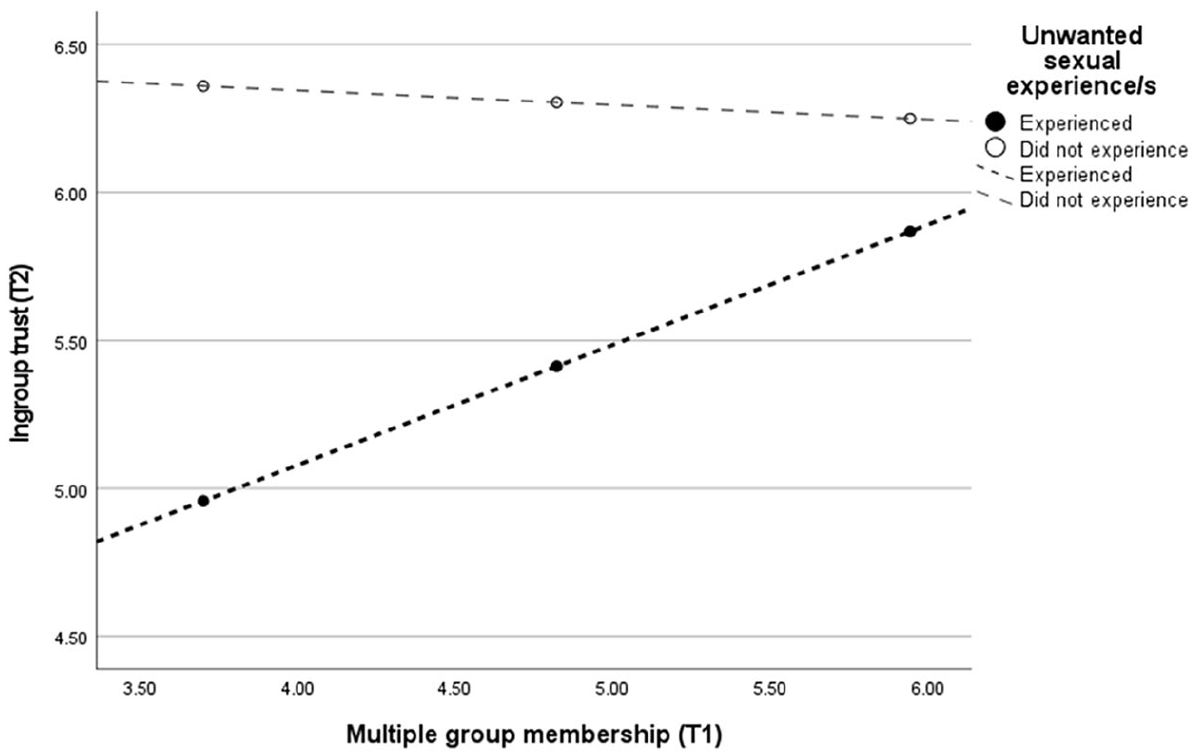
Conditional effect of multiple group membership among participants who reported unwanted sexual experiences during the mass gathering.
As predicted, ingroup trust at T2 was significantly associated with psychological distress at T2, b = −1.77, SE = 0.85, t(91) = −2.07, p = .041, 95% CI [−3.464, −0.070], suggesting that greater perceived ingroup trust during the mass gathering was associated with lower feelings of psychological distress during the mass gathering. The overall moderation of the pathway from ingroup trust at T2 to psychological distress at T2 (path b) by unwanted sexual experiences was nonsignificant, t = 1.41, p = .161.
There was no direct effect of multiple group membership at T1 on psychological distress at T2, b = −0.37, SE = 0.34, t = −1.09, p = .279, 95% CI [−1.041, 0.304]. This result suggests that belonging to multiple groups prior to the mass gathering was not associated with lower psychological distress during the mass gathering.
The overall hypothesized moderated mediation model was supported with the index of moderated mediation, b = 0.35, SE = 0.23, 95% CI [0.008, 0.912], suggesting that the impact of belonging to multiple groups (T1) on psychological distress (T2) via ingroup trust (T2) was significantly different between women and men who reported an unwanted sexual experience at the mass gathering and those who did not. Examination of the conditional indirect effects indicated that there was evidence of a statistically significant mediation model among participants who reported an unwanted sexual experience, b = −0.35, SE = 0.22 [−0.884, −0.015], but not those who did not report an unwanted sexual experience, b = −0.002, SE = 0.08 [−0.118, 0.187]. The total effect of multiple group memberships on psychological distress was b = −0.54, SE = 0.25 [−0.710, −0.379].
Discussion
The aim of this research was twofold: (a) to explore, for the first time, the prevalence of unwanted sexual experiences reported at Schoolies, and (b) to examine whether multiple group memberships and ingroup trust are protective against psychological distress at youth mass gatherings—particularly for those who report an unwanted sexual experience. We identified that 64.9% of participants in the current study reported at least one unwanted sexual experience during the 2021 Schoolies mass gathering. Although our sample is a small proportion of Schoolies attendees overall, the prevalence of these experiences among our sample is alarming. Our work extends prior qualitative research on the Schoolies context, where participants highlighted that risky drinking behavior could result in unwanted sexual advances for themselves and their peers (Pettigrew et al., 2016). Our finding suggests that further investigation into prevalence rates, prevention, mitigation, and protective strategies in relation to unwanted sexual experiences at Schoolies and other youth mass gatherings is needed.
As hypothesized, we also provide evidence of one mechanism through which young people may be protected (to some degree) against the harmful impacts of unwanted sexual experiences on their mental health during mass gatherings. Specifically, we show that the impact of multiple group membership (T1) on psychological distress at T2 was found to be mediated by ingroup trust at T2; though importantly this effect was only observed among those who reported an unwanted sexual experience at the mass gathering. This indirect effect is consistent with the arguments of Muldoon et al. (2021) which posit that group-based trust can mitigate negative responses to adverse experiences. In other words, having people you can trust in times of adversity can help reduce negative psychological health outcomes. Our findings extend this work by highlighting that ingroup trust is a key pathway through which multiple group membership influences psychological distress for young people. Given that these effects were evident among those who reported unwanted sexual experiences, our findings suggest that the benefits of belonging to multiple groups, namely the “social cure” effect, are particularly evident in the context of adverse experiences. These findings are in line with previous work demonstrating the substantial benefits of group membership for those who are vulnerable or at risk (e.g., people with depression; Cruwys et al., 2013; adolescents; Koni et al., 2019). Prior work has highlighted that social cure effects can be underscored by a myriad of influencing factors (Chang et al., 2016)—here, we demonstrate that this is evident within the context of unwanted sexual experiences.
Of interest too is the finding that under certain conditions—such as unwanted sexual experiences—multiple group membership is associated with ingroup trust. While the overall interaction effect was statistically nonsignificant, our findings revealed a conditional effect of multiple group membership on ingroup trust, specifically among participants who reported an unwanted sexual experience during the mass gathering. This suggests that belonging to multiple groups prior to an unwanted sexual encounter may be protective against reductions in how much trust they place in valued and accessible group memberships following such an experience. Indeed, this points to the benefits of multiple groups particularly for enabling access to psychological resources (Ferris et al., 2016; Haslam et al., 2016), such as ingroup trust, which are important for promoting and protecting well-being following distressing experiences.
Implications
Belonging to multiple groups prior to the mass gathering was found to be an indirect predictor of psychological distress (through ingroup trust) only in participants who reported an unwanted sexual experience. In this latter case, multiple group memberships were positively associated with ingroup trust. However, as shown in Figure 2, there was a reduction in trust among people with fewer multiple group memberships who reported at least one unwanted sexual experience. People with fewer group affiliations may find their trust diminished in the aftermath of such experiences, potentially leading to greater distress. This suggests that having multiple group memberships may play a crucial role in maintaining trust and mitigating psychological distress when facing adverse events, such as unwanted sexual experiences.
This effect can be explained by considering the Social Identity Model of Traumatic Identity Change (SIMTIC; Muldoon et al., 2019). Adverse events, such as unwanted sexual experiences, can represent a breaking point in one’s group memberships and a substantial life change (e.g., Muldoon et al., 2024). SIMTIC underscores the important role of multiple group membership in maintaining a sense of continuity with the past (i.e., social identity continuity). Previous multiple social identities can therefore be protective in at least two ways. First, having a sense of belonging to multiple groups allows people to cope with adverse experiences by choosing the more protective level of social categorization for their well-being (see Blanz et al., 1998). Second, from a social cure perspective, ingroups offer material and psychological support and resources (Craig et al., 2024; Muldoon et al., 2017).
Future research should analyze in depth this phenomenon to better understand the process and the extent to which these theoretical paths contribute to making multiple group memberships a protective factor. However, the main novelty of this work is that the protective role of multiple group memberships, in the case of unwanted sexual experiences, passes through the maintenance of functional levels of ingroup trust, which is a key variable in the psychological distress experienced after trauma (Muldoon et al., 2021).
Approximately two-thirds of participants in the current study reported an unwanted sexual experience at Schoolies. This highlights that unwanted sexual experiences are (still) occurring even in the context of structured and formal government support services (e.g., Safer Schoolies)—which are designed to keep young people safe. Presumably, the numbers would be even higher in informal celebration environments without such support. While many interventions have focused on reducing risky drinking, as noted in Beckwith et al. (2023), there remains a gap in strategies specifically aimed at preventing unwanted sexual experiences. We argue that there is a need to shift the focus from “the victim should” toward targeting perpetrator behavior and changing norms around unwanted sexual experiences. A social identity approach to mass gatherings suggests that people’s behavior can be shaped by the values/norms associated with the event (Hopkins & Reicher, 2021). Mass gatherings inherently involve the emergence of shared social identities among attendees, grounded in their collective participation in the event. These shared identities offer an opportunity for mass organizers and event stakeholders to promote pro-social norms and values that foster mutual respect and safety. By shaping the meaning and expectations associated with the shared identity of “Schoolies attendees” (or equivalent identities at other mass gatherings), organizers in their communications can help instill norms that actively discourage harmful behaviors.
The high prevalence rates also highlight the imperative for understanding ways of reducing associated harms for young people attending mass social gatherings, while retaining access to the benefits that mass gatherings can provide (Hopkins & Reicher, 2021). Current Schoolies advice encourages young people to “stay with friends and keep an eye out for one another” (Drinkwise, n.d.) and “Be Safe and Watch Your Mates” (Queensland Government, 2017). Our findings are in line with this advice and highlight in particular the protective role of multiple group memberships and ingroup trust in mitigating psychological distress for those who report unwanted sexual experiences at Schoolies. Our findings, grounded in the social identity framework, may also have broader relevance beyond the specific context of Schoolies. Mass gatherings occur globally and are often accompanied by similar risks. The protective role of multiple group memberships and ingroup trust identified in our study likely extends to other settings characterized by significant social interaction and crowding, such as music festivals, sports events, and university orientations. This is because people often attend these events with members of groups they already belong to. In line with the findings of this study and previous social identity research (Cruwys et al., 2019; Ferris et al., 2022), youth mass gathering campaigns should continue to highlight the importance of people’s preexisting friendship groups as a trustworthy source of support during these events and should be considered in the planning of future campaigns and events.
Strengths, Limitations, and Future Directions
We derive confidence in our conclusions because of the strong ecological validity of the research. This was achieved through in situ data collection. However, this research is not without limitations. While the longitudinal data collected both before and during a mass gathering event allowed us to analyze our predicted relations over time, it is important to note that path b in our model is correlational given that ingroup trust and psychological distress were both measured at T2. Although we use two waves of data, our longitudinal sample size is small (N = 97). This is perhaps unsurprising in the Schoolies context where attendees are actively involved in festival activities. Future studies aiming to replicate and expand upon our research with larger sample sizes would enhance confidence in our findings. Our findings may be specific to the Australian context, with most participants having similar ethnic and socioeconomic backgrounds. We advise researchers to generalize our findings with sensitivity to the diverse features of other national contexts where they may be applied. Future research should aim to gain a deeper understanding of the protective role of multiple group memberships and ingroup trust at mass gatherings in more diverse samples and in other countries.
It is important to acknowledge that unwanted sexual experiences are a gendered issue. While we included both men and women in our sample, the type and quantity of such experiences differed significantly by gender. Research consistently shows that women are more likely to experience unwanted sexual encounters, feel more threatened by their occurrence, and incur greater physical and psychological harm as a result (e.g., Breiding et al., 2014; Oram, 2019). Our main empirical analysis did not explicitly analyze the experiences of women and men separately and we did not have the statistical power to complete this analysis. Rather our primary focus was on the broader psychological and social impacts of unwanted sexual experiences. However, findings from our analysis of gender differences in reporting unwanted sexual experiences at a mass gathering underscores the need to consider the gendered nature of unwanted sexual experiences in future research.
Conclusion
Unwanted sexual experiences are remarkably common experiences at youth mass gatherings, and as a result, negative outcomes linked to unwanted sexual experiences are inevitable. We identified that 64.9% of participants in the current study reported at least one unwanted sexual experience during the 2021 Schoolies mass gathering. Our findings also showed that the impact of multiple group membership prior to the mass gathering (T1) on psychological distress at T2 was mediated by ingroup trust at T2 among young people who reported an unwanted sexual experience at the mass gathering. We propose that multiple group membership may provide important psychological resources necessary for protecting against psychological distress following unwanted sexual experiences. This evidence consolidates prior work on the role that people’s group memberships play in the wider domain of adverse experiences; and also points to the benefits of sustaining multiple group memberships and the support resources drawn from these groups during times of adversity.
Footnotes
Availability of Data and Materials

Declaration of Conflicting Interests
The author(s) declared no potential conflicts of interests with respect to the authorship and/or publication of this article.
Funding
The author(s) disclosed receipt of the following financial support for the research and/or authorship of this article: Data collection for the Schoolies project was supported by the Queensland Government Department of Environment and Science, Safer Schoolies Initiative Unit.
Dr. Aoife-Marie Foran has received funding from the European Union’s Horizon 2020 research and innovation program under the Marie Skłodowska-Curie grant agreement number 101034345.
Prof. Orla Muldoon’s, Dr. Grace McMahon’s, Dr. Éadaoin Whelan’s, and Dr. Efisio Manunta’s involvement in this project has been facilitated by a European Research Council Advanced Award (agreement number 884927).
Prof. Jolanda Jetten’s involvement in this project has been facilitated by an ARC Laureate Fellowship (FL180100094).
Prof. Tegan Cruwys is supported by an NHMRC Fellowship (1173270).
Dr. Laura Ferris has received funding from the UQKx&T grant scheme (#029039).
Ethical Approval
This project received ethical approval from the Australian National University Human Research Ethics Committee (protocol number 2018/558) and the University of Queensland Human Research Ethics Committee (protocol number 16-PSYCH-MCP-32-AH). In accordance with the approved ethics protocol, all participants provided informed consent prior to taking part in this study. Participants gave informed consent to participate in the study before taking part.
Consent for Publication
All authors consented to the submission of this manuscript.