




Abstract
While far-right movements are commonly associated with masculinity and women are in the minority, it is notable that they often play significant roles within these movements. To deepen our understanding of the motivations behind women’s participation, this study challenges Blee’s argument that women’s motivations for participating are shaped by their interactions with other members. By using the psychosocial method devised by Hollway and Jefferson and developed by Gadd, the present study argues that women’s pre-participation experiences can play a vital part in drawing them to the movements. Through analyzing the life stories of six far-right women in Japan and conducting an in-depth case study of three of them, the study aims to uncover a wide range of experiences that may initially appear unrelated to far-right ideology but ultimately led these subjects to become involved in far-right movements. It highlights the importance of paying attention to their complex subjectivities, which are formed by the interplay between their unique trajectories and societal transitions concerning gender norms, particularly within the era of neoliberal “emancipation.” The study finds that the duality of far-right movements, which combine conservatism with deviance, enables some women to express paradoxical desires that they experience in response to living through a transitional era.
Recent years have seen the surge of far-right movements in many corners of the world, notably in Europe and America, with some of them entering or influencing mainstream politics, fomenting hatred toward minority groups. While these movements tend to be associated with masculinity (Ralph-Morrow, 2022), far-right groups have noted the advantage of including women and attempted to expand their support (Pilkington, 2017; Wineinger & Nugent, 2020). Studies have revealed that women play roles in far-right movements, both in terms of symbolizing and disseminating their ideologies and leading and managing their activities (Bacchetta & Power, 2002; Blee, 2002; Campion, 2020; Stern, 2022).
Researchers are slowly uncovering why women are attracted to far-right movements. Some studies refer to negative experiences of far-right women that predate their involvement in the movements, along with those of their male counterparts, that tie in with the far-right agenda, such as negative perceptions of immigration and multiculturalism (Hall, 2023; Pilkington, 2016). However, these studies are not necessarily concerned with how gendered social structures can play a role in creating these dissatisfactions. Other scholars are concerned with the role of gender, particularly how and why women participate in far-right movements despite their male-oriented internal culture and masculine discourses. While women are quite often discontented with the gendered roles imposed by far-right men and endure psychological and even physical suffering within the sexist culture of the far right (Latif et al., 2020, 2023; Pilkington, 2017), studies have also found that some of them achieve “alternative emancipation” by playing important roles in the movements and enjoying equal status to their male counterparts (Félix, 2017). Studies on the gender-related discourses of the far right have argued that idealization of “traditional” roles of women as mothers and anti-feminist discourses tap into the anxiety of some women about finding husbands and having and raising children (Mattheis, 2018) and/or an “emancipation fatigue” stemming from the burden of playing traditionally gendered roles as a wife and mother while also fulfilling the expectation of neoliberalism to be economically independent (Dietze, 2020; see also Mulinari & Neergaard, 2017). These arguments resonate with the evidence that far-right women feel empowered and some even consider themselves as feminists (Dietze & Roth, 2020). Feminist perspectives have provided valuable insights into the motivation of the far-right women in Japan, the subjects of the current study. Kim-Wachutka (2019) and Suzuki (2019a), for example, suggest that far-right women might be motivated to consolidate their status within Japan’s male-oriented society by actively playing a role in trying to discredit historical accounts of Imperial Japan’s wrongdoings, particularly soldiers’ sexual exploitation of women in the occupied territories.
The current study aspires to contribute to this discussion by elucidating how gendered social structures impact women’s attraction to the far right. To this end, I psychosocially examine the life stories of six far-right women. Studies examining the life stories of far-right women to explore the causes of their participation in the movements are rare. One exception is Blee’s (1996, 2002) work on klanswomen and skinhead women. Examining their life stories, Blee argues that rather than experiencing a dramatic moment of conversion to embrace racist ideologies, being brainwashed by male members of the far-right, or suffering from mental health issues, their participation is a matter of “simple happenstance” (2002, p. 30), namely their contact with racist organizations. According to Blee (1996, 2002), after joining the movements, women start to negotiate their own agenda with that of the racist organizations, selectively dis/agreeing with the latter.
While Blee’s study made a huge contribution to the field by drawing attention to far-right women’s agency, whether participation is always preceded by contact with existing members is questionable, considering that contemporary far-right groups use the Internet to attract followers, like the far-right movements in Japan (Higuchi, 2014). Such movements do not depend on a pre-existing strong tie between their members and potential participants. For the activists in such movements, the “receptivity” that Blee (2002, p. 188) identified in some of her participants, or a pre-existing disposition to be attracted to far-right ideologies and activities, seems to play a more important role. The lack of studies on “receptivity” of far-right women is in stark contrast with studies on far-right men. Through closely examining far-right men’s life stories, Kimmel (2007), Treadwell and Garland (2011), and Yoshida (2020) uncover how class-based disadvantages, in some cases intertwined with childhood trauma, such as underachievement at school, cause a sense of shame due to the failure to achieve masculine ideals, which makes some men susceptible to the masculine discourses and behaviors of the far right. By applying such a psychosocial approach to the analysis of far-right women, this study aims to provide a more refined picture of how experiences prior to contact with these movements play a vital role in women’s investment in specific far-right discourses. It is particularly attentive to the influence of gendered neoliberal social structures, in line with the studies by Dietze (2020) and Mulinari and Neergaard (2017). When discussing the dissatisfactions experienced by far-right women that may underlie their attraction to the idealization of “traditional” labor division or to the discourses of hatred against immigrants who in their eyes steal their jobs, these studies take into account the pressures on women to manage their careers as independent subjects of neoliberalist society. At the same time, however, as Blee (2012) warned, to analyze women’s life stories only from a gender perspective would mean failing to grasp the entirety of their experiences. In fact, one of the problems with the existing studies on far-right women mentioned above is that they tend to discuss women in relation to the male-oriented culture of far-right groups and wider society, consequently presenting them as if they only exist in the shadow of men. One of the theoretical contributions of the current study is to point out the importance of grasping the meanings of gendered disadvantages for far-right women by taking into account the impact of childhood trauma on how they interpret their situation. This, in turn, leads to another contribution of the current study, which is, in line with Blee’s goal (2002), to present an alternative view of far-right women, who are not controlled or used by men, but who join in the movements because of their own life trajectories. The current research will also contribute to promoting diversity within the field of far-right studies by enhancing our understanding of non-European/American far-right women, a group that has been significantly understudied.
After providing an overview of the current situation of far-right movements, neoliberalism, and gender norms in Japan, the methodology of the study is explained. The paper then presents analyses of the lives of six far-right women. It concludes by discussing the need for a gender-sensitive approach to the study of far-right women and exploring the implications of these findings for demystifying the attraction of far-right movements.
Far-Right Movements in Japan
Far-right movements in Japan have become known as the Action Conservative Movement (Kodo suru Hoshu Undo, hereafter the ACM). The ACM rose to prominence in the mid-2000s and is characterized by its nativist discourses and orientation—unlike conservative commentators who in their eyes do not get their hands dirty enough—to “actions,” such as street rallies featuring hate speech against minorities (Yamaguchi, 2013). Some of these groups, such as Shuken Kaifuku wo Mezasu Kai (the Group That Seeks Recovery of Sovereignty) Zainichi Tokken o Yurusanai Shimin no Kai (The League of Citizens Intolerant of the Privileges of the Zainichi), or Zaitoku-kai for short, garnered public attention in the late 2000s due to their reprehensible activities against minorities (Ito, 2014). Other groups that share some members in common with them, such as Nedeshiko Akushon (Japanese Women for Justice and Peace) became known for their activities in cooperation with rightist parliament members to discount the sexual exploitation of women in Asia by Imperial Japanese soldiers (Yamaguchi, 2018).
One of the primary targets of these movements, particularly early on, was the population of Zainichi Koreans, who are “colonial-era migrants from the Korean peninsula that settled in the Japanese archipelago and their descendants” (Lie, 2008, p. x). Other agendas include diplomatic issues with neighboring Asian countries, for instance, recognition of and compensation for the wartime atrocities perpetrated by Imperial Japan and the ensuing territorial disputes (Ito, 2014). The rise of such movements was fueled in part by strained diplomatic relations between Japan and its neighboring countries, particularly South Korea (Higuchi, 2014). The leader of Zaitoku-kai, Sakurai Makoto, established the Japan First Party (Nippon Daiichi-Tou, hereafter the JFP) in 2016, making electoral campaigns for local and national assemblies significant events for the ACM. The transition from street and online activism to electoral politics may have been influenced by the responses of both state and non-state actors to the rise of these hate movements, including the introduction of the Hate Speech Elimination Act (HSEA) in 2016, which prohibits (but does not punish) hate speech against those with foreign origins, and also by the growth of counter-activism against the ACM’s street rallies (Löschke, 2021).
While the activities of these far-right movements certainly shocked Japanese society, as the introduction of the HSEA indicates, it should be noted that they have not taken root in Japanese society in the same way as some of their European counterparts, such as Pegida in Germany. The number of participants in their rallies is estimated to be somewhere between 1,500 and 2,000 at most (Ito, 2014), but when I observed their activities between 2018 and 2019, far fewer people were present, a few dozen or less. The JFP’s attempts to have members elected to local and national parliaments have proved unsuccessful, except for one case in a small city in 2020. When Sakurai and another JFP member stood for election to the House of Councilors of the national parliament in 2022, the total number of votes that the JFP, he and the other candidate secured was only 109,081 while the total number of voters was approximately 105 million. 1 However, the relatively low popularity of the far-right movements should not be taken as an indicator that nationalistic political actors have not garnered support in Japan. On the contrary, their low popularity makes sense when one considers the existence of other choices for voters who support nationalist politicians or political parties, most notably the late Prime Minister Abe Shinzo and his successors in the Liberal Democratic Party. Such actors are not as explicit in their nativist attitude as the ACM, but they have possibly undermined the ACM’s attempts to expand their support.
Although the far-right movements may not be well-known, they are not clandestine groups. Higuchi’s (2014) study revealed that more than 70% of his interviewees contacted the ACM or learned about the far-right agenda through the Internet. None of the seven women that I interviewed (of whom I analyze the stories of six) had previously supported the ACM’s political stance or been members of any political movements. Six of them discovered far-right ideology/groups online, and one discovered the JFP at the time of Sakurai’s electoral campaign in 2016. It would be also wrong to assume that discourses that are antagonistic to neighboring countries or to people who have their roots in such countries are unusual in Japan. Publications expressing such views sometimes meet with great popular success and can be found in large bookstores (Hanssen & Woo, 2023; Kurahashi, 2018). The gap between the numbers of the potential sympathizers of the ACM and the actual numbers of those who dare to join them might suggest that those who participate in the movement have particularly strong attachments to their discourses and ideologies.
The number of female activists observed during the current study’s fieldwork between July 2018 and March 2019 was smaller than that of male activists, which is in line with the findings by Matsutani (2019) that those who supported Sakurai in his electoral campaign in 2020 were predominantly male. Nevertheless, women played vital roles. Regarding the JFP, women’s roles included being one of three deputy presidents of the party; head of the secretariat; head of the disciplinary committee and director of the branches; and head of regional branches in six prefectures when I completed my fieldwork in 2019 (Nippon Dai’ichi-tou, n.d.). Reflecting the symbolically and practically important roles of their Western counterparts (Blee, 2002), women in the Japanese far-right movement have exercised a range of functions, including arranging and managing street activities; coordinating Sakurai’s activities; mediating internal conflicts; leading protests, which sometimes involved violent collisions with counter-activists and the police; and standing as candidates for election. Another important role played by women is that of “truth-tellers” (Öberg & Hagstöm, 2022) in the far right’s attempts to deny the sexual exploitation of women in Asia by Imperial Japanese soldiers (under a system known as “comfort women”), as the women’s claims are less likely to be seen as biased by their gender (Yamaguchi, 2018). Women in the ACM have been involved in a variety of harmful actions, such as using hate speech on the street against minorities and denying the atrocities caused by Imperial Japan, rubbing salt in the emotional wounds of the victims, and insulting nationals of the countries they belong to (Kim-Wachutka, 2019). However, while women are integral to the ACM, it does not necessarily mean that the ACM is a comfortable place for them. I observed the sexist culture of the movements on several occasions. Some male members were obsessed with particular female members, resulting in internal conflicts; there were persistent rumors of at least one female member having affairs with multiple male members; and when women took on administrative roles, such contributions were likened to a mother’s care-taking.
Women, Work, and Childrearing in Neoliberalist Japan
Suzuki (2019a) notes that far-right women are somewhat sympathetic to former “comfort women,” possibly because they themselves also face gender-based disadvantages. Her observation appears compelling, given the arduous circumstances faced by women in contemporary Japan. According to the Global Gender Gap Report published by the World Economic Forum (2024), Japan is positioned in 118th place among 146 countries. Although the nation has achieved a moderate ranking in certain sub-indices (72nd for educational attainment and 58th for health and survival), it is especially deficient in the other two indices, namely economic participation and opportunity (120th) and political empowerment (such as the number of women in national and local assemblies), where it was in 113rd place. Statistics published by the Cabinet Office Gender Equality Bureau (COGEB) (2023) underscores these evaluations of Japan: the Gender Pay Gap Score Japan in 2021 was 77.5, while the average score of the OECD countries was 88.4; in 2022, approximately 20% of the companies listed on the Tokyo Stock Exchange Prime Market did not have a woman among the members of their board; women make up 16.1% of the national parliament members (in October 2023) and 15.6% of local parliaments (in December 2022).
While political empowerment is undoubtedly crucial, what women in Japan experience most acutely on an everyday level is the predicament of economic participation. In 1986, the government introduced the Equal Employment Opportunity Law (EEOL) to foster women’s participation in the labor market, but under neoliberalist economic policies of liquidizing labor forces (Ueno, 2017), EEOL and subsequent policies led to the exploitation of women’s labor. In response to EEOL, companies instituted a two-tiered career system where men and certain elite women accept frequent relocation and long working hours to pursue a promotion, while the majority of women perform miscellaneous and often trivial jobs at local offices (Assman, 2020). Neoliberalist policies, coupled with the prolonged economic recession that began in the 1990s, led to a higher proportion of irregular employment (Osawa et al., 2013). Women, who frequently sacrifice their careers for marriage and childrearing due to social pressure (Teramura, 2022), have disproportionally filled these irregular jobs (Macnaughtan, 2020). The number of women who occupy part-time employment is twice as large as their male counterparts, while the number of women who engage in full-time jobs is half of that of men (COGEB, 2023). The government’s failure to revise post-war social policies, which presuppose a household with a male breadwinner and a dependent wife, has resulted in numerous women working with less social protection, lower wages, and diminished employment security (Gottfried, 2009). The façade of “equal opportunities” since the EEOL means that this unequal situation appears to be the result of the free choices of women. Consequently, feminist aspirations for the liberation of women from patriarchy were mobilized to legitimate a flexible labor market, in what Fraser (2009, p. 97) called “the cunning of history.”
Single mothers are among the most significantly disadvantaged groups, as evidenced by the fact that their average net income is less than half that of all households with children (Ministry of Health, Labor and Welfare [MHLW], 2022), with half of the single mothers depending on precarious jobs (Children and Families Agency, 2022). In addition, social norms that assume a male breadwinner contribute to challenges faced by single mothers, including rental market discrimination (Ezawa, 2016) and limited job opportunities (Dalton, 2017). Women, especially those born in and before the 1960s, even some of those who in reality are single mothers themselves, firmly embrace the image of an “ordinary” family (Ezawa, 2016).
Another indicator of gender inequality relates to gender-based violence. A victim survey conducted by the Ministry of Justice (Research and Training Institute of the Ministry of Justice, 2019) indicates that six times more women than men are victimized in sexual violence, and COGEB’s (2021) study indicates that women are more likely to be victimized in violence by their partners (25.9%) than men (18.4%).
Methodology
The current study uses the psychosocial method devised by Hollway and Jefferson (2000). Drawing ideas from psychoanalysis, the method assumes a defended subject, whose “investment” in certain narratives and behaviors is the result of the function of a defense mechanism against negative feelings (Hollway & Jefferson, 2000). Its analysis is anchored in Rustin’s (1991) and Clarke’s (1999) Kleinian explanation of racism. The Kleinian understanding of the mind sees the subject as split in the face of stress, projecting what they feel as their “bad” parts onto others. According to Rustin (1991), the emptiness of the category of race allows the projection of a wide range of negative feelings onto racial others, which is at the root of aggressiveness toward them along with the idealization of the ingroup when subjects are feeling stressed. This theoretical perspective has been mobilized to explain engagement with racist violence and/or far-right movements (Gadd & Dixon, 2011).
The current study analyzes the life stories of far-right women that I encountered during my fieldwork between 2018 and 2019. The fieldwork formed part of my doctoral research, whose primary goal was to explore the motivations that prompted far-right activists in Japan to join the movement. I conducted life-story interviews with 25 participants from a variety of far-right groups, including the JFP and Zaitoku-kai, using the Free Association Narrative Interview Method (Gadd, 2012; Hollway & Jefferson, 2000). In this method, the interviewee is encouraged to articulate freely whatever comes to mind with regard to the subject matter, even if their narratives appear to be irrelevant or inconsistent (Hollway & Jefferson, 2000). The method is advantageous for exploring the unconscious meaning-making of events by interviewees and the connections between these events in their minds (Hollway & Jefferson, 2000). After indicating that I was interested in their far-right activities, I asked the interviewees to tell their life stories so that they could mention whatever life events they felt related to the movement, following Cartwright’s (2004) strategy. Then I asked a few follow-up questions about my topics of interest, such as their experiences with the HSEA. I recruited participants by approaching them directly during their street rallies or asking other activists to introduce them to me. While some groups, such as the JFP, have formal membership, groups of the ACM do not limit who can join or leave their activities. As such, it was virtually impossible to conduct random sampling. Instead, I conducted purposive sampling, making efforts to diversify gender, age, roles in the movements, and the groups with which the participants were affiliated. I approached groups from different cities across Japan, as they are known to have different orientations and cultures (Higuchi, 2014). Seven participants were women. Here I analyze the life stories of six of them, as one did not allow me to conduct a second interview and so I do not have her complete life story. (The limitations and advantages of analyzing a limited number of cases are presented in the next section.) The women came from a variety of backgrounds. To protect anonymity, I only provide an overview here. Four are from the JFP, while two are from Zaitoku-kai. They represent a variety of geographical areas, from North East to West Japan, and a variety of age cohorts (one in her 30s, two in their 40s, and three in their 50s). While the demography of far-right groups in other contexts might be predominantly young (see, e.g., Pilkington [2016] in Japan, it is not rare for a far-right activist to be middle-aged [Higuchi, 2014]). The interviews resulted in the disclosure of episodes which by their own admission they had never shared with others, thus enriching the data. I obtained ethical approval from the University of Manchester. Participants had a chance to read the information sheet and ask questions about it before they decided to join the research. The sheet detailed the purpose and the method of the study, as well as how confidentiality would be ensured. The participants gave me recorded verbal consent. To ensure their anonymity, the current paper refers to them by pseudonyms. Participants could withdraw from the study at any time. Generally, a friendly atmosphere dominated the interviews, and the participants appeared to enjoy or find benefits in talking about their lives. As a result, although I initially planned for two interviews of 2 hr each, the average duration of the interviews with the six women turned out to be 3 hr and 40 min. Moreover, two participants gave me the opportunity to conduct a third interview with them. The interviews were conducted in Japanese and transcribed by the author.
For the analysis, the study followed steps similar to those introduced by Frosh and Saville (2017). First, I read the transcripts closely to conduct discourse analysis. By contextualizing the discourses (including far-right discourses) mentioned by the participants within the culture of Japan, I tried to identify what identities or meanings of actions the interviewees were attempting to establish or to deny through the use of such discourses (Gee, 2014). Second, I explored the meanings of such identity work further by contextualizing them in the specific trajectory of interviewees’ lives, using a psychoanalytic perspective. This perspective supposes that the discourses are metaphorical, symbolizing the relations between subjects and others as unconsciously imagined by the subjects (Cartwright, 2004). With the above-mentioned Kleinian explanation of racism in mind, I coded the experiences which seemed to cause the types of negative feelings mentioned above. Avoidance of certain topics at the initial stage of the interview or repetition of the same behaviors in different scenarios are important indicators of the sources of interviewees’ negative feelings and how they desire to assert themselves in response to these feelings (Cartwright, 2004; Gadd, 2012). These methods have proved advantageous in identifying a wide range of negative experiences behind far-right activists’ attraction to the movements, including experiences which may appear to be unrelated to far-right ideologies, and are therefore unlikely to be invoked as a “reason” for joining the movements (Treadwell & Garland, 2011; Yoshida, 2020).
Analysis
Table 1 summarizes the issues that appear to be related to the women’s investment in certain far-right discourses. The analysis revealed some issues that are gender-related and others that are not. The former include gender-based violence, divorce and separation from their children, low socio-economic status, and repressed desire for masculinity; the latter include a tense relationship with parents and an unmet need for recognition. Of course, none of the “gender-related issues” concern women exclusively. Nevertheless, they are classified as “gender-related” as their causes and repercussions can vary according to gender. As the table shows, in every case of the women studied in this paper, the investment in far-right discourses is related to gender in some way.
The Issues That Interviewees Faced in the Course of Their Lives and Their Invested Discourses.
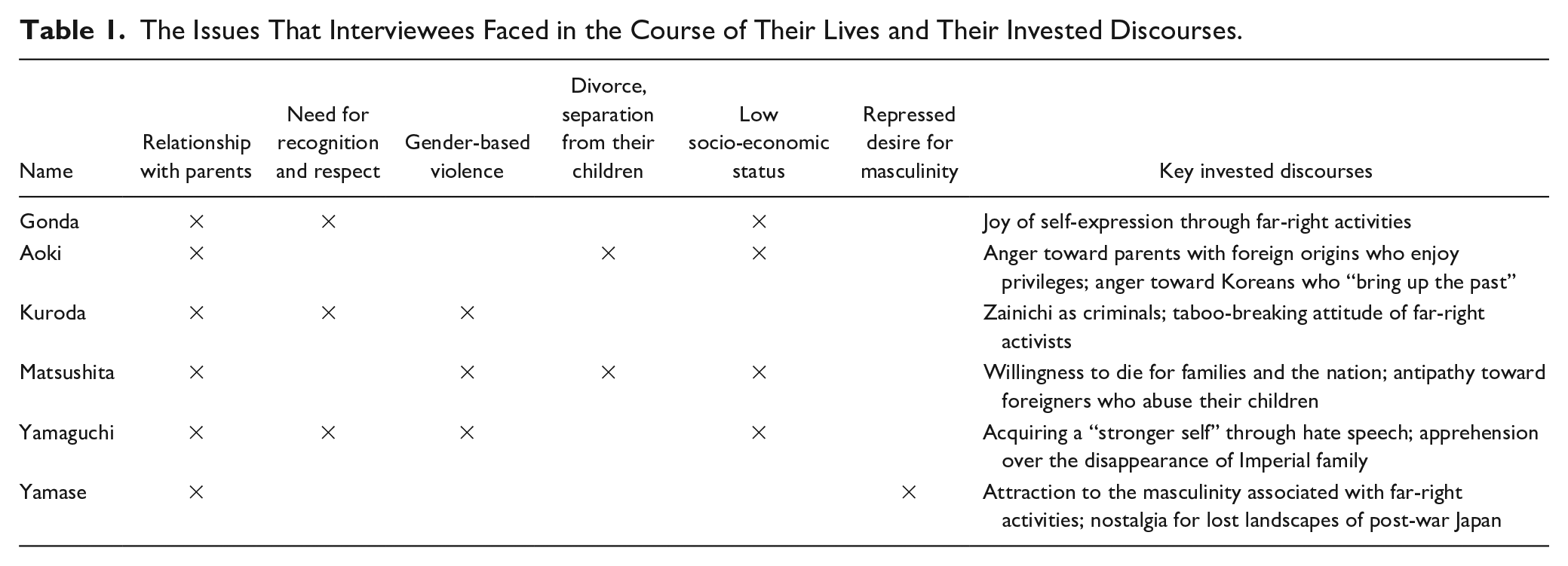
While the activists mentioned a variety of far-right discourses, the most significant ones—such as those referred to many times, those that motivated the women to join the movement, or those which they embraced throughout their activist careers according to them—are included in the category of “key invested discourses.” These can be either behavioral (such as joy of self-expression through far-right activities) or ideological (such as anger toward parents with foreign origins who enjoy privileges). The invested discourses were not necessarily related to asserting “traditional” femininity, and indeed the finding that “fighter” is one of the identities that far-right women become invested in resonates with existing research (Latif et al., 2023). In Yamase’s case, she wished that she had been born a boy and even fought with her parents about it. However, as she grew up, she “admitted” being a woman, started wearing a skirt, and gave up her dream of becoming a police officer, which she regarded as a job mainly for men, describing it as “a job related to the nation, an extraordinary job.” I met her on several occasions at ACM activities, and she was dressed like a blue-collar laborer, which symbolizes a masculine quality in Japan, with her hair cut short. This gave me the impression that the ACM was the place where she could access her masculine side, doing a “job related to the nation.” Her case shows that women themselves can perform masculinity, traversing gender boundaries, and perpetuating masculine far-right culture. This cautions us against assuming that it is only men who perpetuate the masculine culture of the movement (Ralph-Morrow, 2022).
It should be noted that it is not the intention of the current study to provide a comprehensive typology of the issues that women might have faced before their engagement with far-right movements. To produce a statistically generalizable model of far-right women, a different kind of study would be necessary. Instead, the current study aims to provide a nuanced understanding of how gendered social structures affected women’s attraction to the far right in the light of their experiences, not all of which are necessarily gender-related. To do this, the current study will move on to consider the case studies of three far-right women—Matsushita, Aoki, and Yamaguchi. While this method may have limitations in terms of drawing conclusions that are applicable to the entire population or majority, examining a limited number of cases enables deduction of theoretical implications by closely examining the interplay of factors within each case (J. Mitchell, 2000). The three women were chosen as their experiences cover the wide range of events identified in Table 1. Moreover, their stories provide useful illustrations of the roles of various emotions, namely shame, guilt, and ambivalence, enabling us to grasp some of the experiences of far-right women.
Case 1: Matsushita
The case of Matsushita is pertinent to how gendered social structures can influence a woman’s investment in certain far-right discourses. Matsushita’s story featured her dislike toward parents with foreign origins, whom she associated with child abuse. Her heightened concern with child abuse is understandable considering her experiences of gender-based violence. Having been raped by her father, abused by her Korean ex-husband, and stalked by another man, she felt a grave sense of shame, feeling that she was “different.” According to Gilligan (2000, p. 48), shame refers to the state involving “absence, or deficiency of self-love” caused by suffering from “the loss of love from others, by being rejected, or abandoned, assaulted, or insulted, slighted, or demeaned, humiliated, or ridiculed, dishonored, or disrespected.” Severe sexual violence can cause a strong sense of shame (Aakvaag et al., 2016). Shame is known to be projected onto others, manifesting as hatred toward immigrants or racial/ethnic minorities (Ray et al., 2004), and Matsushita seems to have dealt with this feeling by being angry with parents with foreign origins who, according to her, frequently appear on the news due to their abuse toward children. She said “I always think of killing them” whenever she saw such news.
Her shame about being sexually abused might also have resulted in her attraction to the imagined bond among the Japanese, a form of idealization of an in-group that is symptomatic of the projection of negative feelings onto others (Rustin, 1991). She started her pathway to the far right when she discovered YouTube videos about the letters of kamikaze fighters during World War II and was deeply moved to learn of their willingness “to die for family.” Moreover, Matsushita’s sense of alienation—according to her she wanted to be in a space where she did not have to feel she was “different”—drew her to other activists sharing the same ideology, with whom she felt she had close ties. Particularly noticeable was her relationship with a female leader. She attributed her membership of the current group to her attachment to the leader. “I love [the female leader], that’s it [. . .] I cannot leave her alone.” It has been pointed out that sisterhood can be observed among far-right women (Suzuki, 2019b). Furthermore, her attachment to this leader might also have a romantic dimension. She mentioned that she was “close to bisexual” because she “felt an attraction to both women and men” but clarified that this attraction was primarily “mental, without direct [physical] experiences.” This aspect of her sexuality is reminiscent of Pilkington’s (2017) findings, which highlight the diversity of sexual orientations among far-right activists.
For Matsushita, participation in a far-right movement is a means to secure an imagined safe place as well as to fight against foreigners who symbolize the violent men in her life. Her investment in specific discourses, especially those about child abuse by parents with foreign origins, only makes sense within the context of her experience of gender-based violence.
Case 2: Aoki
Aoki’s case, as explained below, highlights the necessity of considering the role of childhood trauma. This is not necessarily related to the issue of gender, but it nevertheless affects how far-right women experience their gender-based disadvantages. Aoki’s case also points to how internalization of gender norms can amplify uncontained negative feelings.
One of her notable discourses concerned her resentment toward immigrant/foreign parents, who in her eyes appeared to enjoy parenting in Japan, receiving financial assistance which they should not be entitled to, or illegally staying in the country. Such antipathy makes sense considering that she had struggled financially to bring up her son in a single-mother household since her divorce (Dalton, 2017; Ezawa, 2016). For Aoki, it appeared that divorce was not merely a matter of socio-economic disadvantages, but also a moral issue, which was evident from her repeated self-deprecating use of the term “selfish” with regard to her decision to be divorced and her description of the subsequent struggles that her son had to go through. It seems that she harbored a strong sense of guilt. Guilt happens due to a fear of hurting somebody (Bush, 1989), and the pain it produces comes from subjects feeling that they have failed to live up to their own moral standards (Lewis, 1971). Perhaps Aoki felt guilty because she had deeply internalized the image of an “ordinary” family, a household which is composed of a male breadwinner and a housewife (Ezawa, 2016). Aoki’s antipathy toward foreign parents and the “privileges” that they enjoy despite not being “ordinary” in Japanese society, like herself, could be seen as what Klein called “envy,” referring to an urge to deny the value of a thing and its owner when a subject badly wants the thing (Klein, 1997).
However, it was notable that even though Aoki’s struggle was partly caused by the way Japan’s social structure disadvantaged single mothers, her story was centered more around her complicated feelings toward her childhood experiences and her parents. To grasp Aoki’s “receptivity” to far-right discourses, it is crucial to delve into this part of her life, which seemed to affect her meaning-making in relation to the hardship she experienced as an adult. Another notable discourse was her stance on Koreans “bringing up the past,” specifically Japan’s wartime atrocities. This narrative seems to be related to how her parents imposed a strict music education that curtailed her freedom. She described this situation by saying: “I was oppressed by my parents, kind of, I wanted to meet their expectations.” She recognized the profound impact this had on her adulthood, to the extent of claiming that it caused her divorce. She said that she was divorced “because I grew up in such a way.” Although she acknowledged that her music education was unique and valuable, she also admitted to having a tense relationship with her mother. “Ambivalence” is a useful concept to comprehend Aoki’s experience. Ambivalence can be defined in terms of “simultaneously positive and negative orientations toward an object” where orientation is “the actor’s alignment or position with regard to the object” (Ashforth et al., 2014, p. 1454). It has been identified that repression of ambivalence can lead to the manifestation of authoritarian, racist attitudes (Adorno et al., 1950/1969). Aoki’s ambivalent feelings about her parents intensified as her financial struggle made her realize that she needed them: “[I] could not live without the support of my parents, in the end.” Aoki repeatedly revisited her childhood. “I can never go back to that time [. . .] but I really wonder what might have happened if I had done something different.” This recurrent pain seemed to be projected onto Koreans, whom she accused of constantly “bring[ing] up the past,” specifically that of Japan’s wartime atrocities. Regarding this history, she used language similar to when she spoke of her childhood, stating: “[W]e cannot go back and restart,” despite her own repressed desire to go back and start again.
The ambivalent nature of Aoki’s desire was observable in the way she sought to represent herself through her ACM activities. Her sense of guilt, which can result in an act of reparation (Cryder et al., 2012), might have led to her participation in the JFP, where she could fight and punish those foreign parents, thereby protecting the interests of “legitimate” parents and children in Japan and compensating for her own perceived inability to be a good mother to her son. At the same time, she joined the ACM despite her son’s opposition, an opposition which is understandable considering the infamy of this movement. Aoki’s decision might have resulted from her own desire to be freed from the role of a mother, which appears to have its roots in her childhood experience of oppression. The ACM, with its contradictory mix of self-representation as a “conservative” movement and some ACM groups’ willingness to resort to deviant behaviors, seems to have been useful in helping her to accommodate her conflicting desires.
Aoki’s story is enlightening, illustrating how gender-related disadvantages can retreat to the background while her ambivalence toward her mother comes to the fore. Consequently, some gendered disadvantages, such as the financial challenges facing her as a single mother, are framed in terms of her personal issues, such as her “selfishness” or the way she was brought up, rather than as a problem with social structure. This does not mean that gendered disadvantages are not important, but Aoki’s story suggests the possibility that there is a gap between how she perceives her problems and how they are perceived by third parties.
Case 3: Yamaguchi
To further illustrate the interaction between childhood trauma, ambivalence, and the gendered social structure, Yamaguchi’s story is examined here. One of Yamaguchi’s narratives was about how she acquired a stronger sense of self by becoming a far-right activist. According to her, she was a “timid” child who was inhibited in expressing herself. This was partly due to feeling she was not loved by her parents. Reflecting on the time when she hurled hate speech at zainichi she stated: “I guess I enjoyed it. Like ‘I will beat the enemy by doing this.’” She suspected that she “[was] doing street agitation to compensate for my inability to speak when I was a child,” especially speaking to her parents about her needs. For her, Sakurai was someone who could “say emphatically what I cannot say on the streets.” This compensation for the shame of being a timid child by identifying with an “outspoken” activist could also be seen in the accounts of male ACM activists (Yoshida, 2020; Yoshida & Demelius, 2024), as well as in the accounts of other female activists’ such as Kuroda and Gonda. In the case of Yamaguchi, her sense of being silenced might have been reinforced as she came into contact with gendered social structures. She resigned from the first company she worked for because it was a hotbed of sexual harassment, and after that she enrolled herself as an agency worker, a position she still held at the time of the interviews. The precariousness of her role was exposed during the economic lows of the businesses in which she worked. Yamaguchi found that, typical of the Japanese labor market (Macnaughtan, 2020), “many temporary staff are female; hence they are all the more reticent.” Her investment in acquiring an “outspoken,” hate-speaker self could be also viewed as a consequence of her dissatisfaction with the gendered societal framework.
Yamaguchi seems to be cognizant of the impact of gender-based disadvantages on her life, as is indicated by her reference to how women are silenced about their precarious status. However, when it comes to explaining her precarious employment situation, her narrative turns into self-blaming and ambivalence toward her parents, in much the same way as Aoki. Yamaguchi’s distrust in her parents was reinforced in her teenage years when they dashed her aspirations to become a musician. She would revisit this memory at later stages of her life when she encountered maltreatment due to being a woman with a precarious job. Despite the anger toward her parents, she would repeatedly describe herself as “dame” (a waste, a failure) and attribute the hardship she experienced to the “weakness of not adhering to one thing or knowing what I wanted to do” in her youth. Her fear of acknowledging the anger toward her parents might have resulted in her investment in an unusual far-right discourse. She was fearful that the Imperial family might disappear due to the actions of leftists and immigrants. In her opinion, without the Imperial family, Japan would be “nothing,” and its current system would be reduced to a mere “fiction.” This idealization of the Imperial family appears to reflect the ideology of Imperial Japan, which is supported by some contemporary far-right activists, namely that the Emperor is the head of the family state, the unbroken lineage of the Imperial family since the ancient era is the core of Japan’s identity, and all Japanese nationals are the children of the Emperor (Fujitani, 1996; Gluck, 1985). Yamaguchi might have projected the repressed anger toward her mother onto the leftists and immigrants who, according to her, conspire to abolish the Imperial family.
Yamaguchi’s story provides an insight into what happens when ambivalence becomes uncontainable due to external circumstances. Just like Aoki, Yamaguchi’s account is characterized by revisiting her ambivalence at the time of her struggle. Indeed, it should be pointed out that the culmination of her fear that the enemies would topple Japan’s system directly triggered her participation in the far-right movements at the time of economic crisis in 2008 when she lost her job and felt “at the bottom of society.” Perhaps such a struggle makes individuals reflect on their life trajectory and forces them to seek the cause of their problems, thereby making conflicts surface. As psychologists have discovered, ambivalence feels acutely uncomfortable when the person has to face up to it (van Harreveld et al., 2009).
Much like Aoki, the self-blaming narrative is salient in Yamaguchi’s account, strengthening the repression of her anger and sustaining her ambivalence. While she may have produced this narrative to ease her emotional anguish about uncontrollable tragedy, namely her persistent sense of failure (Jost, 2020), her self-blaming might also be reinforced by the characteristics of the neoliberalist mentality she has familiarized herself with as a woman working in neoliberal Japan, where women’s low socio-economic status is considered a matter of choice under the façade of “equal opportunity,” rather than labor-related conventions in Japan which have developed to privilege male breadwinners (Ueno, 2017).
Discussion
The above analysis differs from Blee’s (2002) account of how women adopt far-right discourses. According to Blee, the most significant reason why women start adopting these discourses is contact with existing members of far-right groups and spending more time with them, rather than their pre-existing motivations. By contrast, the current study suggests that far-right women’s investment in specific discourses is influenced by their pre-activist life events, which caused negative feelings such as shame, guilt, and ambivalence. This argument underscores that women’s participation is driven by their own needs, although they might not be conscious of them, particularly in the case of involvement in far-right movements that depend on the Internet for recruitment, rather than existing personal ties. This is not to deny that contact is important: none of the Japanese far-right women had a prior systematic knowledge of far-right ideologies, nor had they even been interested in politics. Contact with far-right views might therefore have given them a voice to articulate unconscious desires stemming from their life trajectories. Also, in line with Blee’s (2002) argument, this study does not contend that these women were born far right. Rather, the analysis suggests that through their investment in far-right discourses, they sought to resolve personal conflicts that in themselves are unrelated to far-right teachings. In this sense, it seems that a “personalization of social issues” (Adorno et al., 1950/1969, p. 485) was occurring. The lack of obvious connections between their life events and far-right agendas suggests that their negative feelings could potentially manifest themselves in a different form. Comprehending the function of trauma and a defense mechanism can help to avoid dehumanizing far-right activists by making sense of what would otherwise appear as an abrupt change in the behavior of these individuals.
The psychosocial analysis above emphasizes the need for a nuanced understanding of how gendered social structures exert an influence on women’s attraction to far-right discourses, as well as understanding how far-right women subjectively experience and understand their gender-related problems. Due to the minority status of women in far-right movements, existing studies, including my own, have tended to focus on men’s struggles and how their support for the far right relates to the socio-economic problems of wider society (e.g., Finnsdottir, 2022; Kimmel, 2007; Rippeyoung, 2007; Treadwell & Garland, 2011; Yoshida, 2020). Also, in the context of more violent far-right movements, Samuels and Shajkovci (2023) argue for the need to recognize the existence of far-right women and introduce gender perspectives in an effort to prevent their radicalization. Supporting their argument, the case studies above point to the significance of considering how gendered social structures can impact individual women’s attraction to far-right movements, even though gender inequality does not explain the overall demographic trend of the far right. A close analysis of the life stories discussed reveals that a variety of problems relating to women’s experiences, from gender-based violence to low socio-economic status, can produce or reinforce negative feelings, which are projected onto “others.”
However, recognizing gender-related issues should not lean toward gender essentialism. Essentializing the experiences of far-right women would run the risk of ignoring their willingness to transcend gender binaries and to use a wide range of far-right discourses to deal with their inner conflicts. Rather than conforming to “traditional” femininity, some women, such as Yamaguchi, Yamase, and Kuroda, were attracted to aggressive or masculine images of a far-right activist, reminiscent of a “fighter” role (Latif et al., 2023). Moreover, as the close study of far-right women’s narratives suggests, their negative feelings can stem from interplay between a tense relationship with their parents and gender-based problems. As such, even though gendered social structures affect their lives considerably, their narratives can center around conflicts that exist since their childhood, with tendencies toward self-blaming, indicating their sense of shame and guilt. What we can learn from studying the Japanese context, which is severely detrimental to women, is that even under such conditions, it is possible for women to scrutinize themselves and the distinctive trajectories they have taken. The far right accommodates their ambivalence, offering a variety of discourses through which they can project their negative feelings. In the narratives of Matsushita, Aoki, and Yamaguchi, the empty category of “non-Japanese,” whether they are zainichi, Koreans, or immigrants, symbolizes a wide range of negative figures whom they fear, while the “us”—kamikaze fighters or the “Imperial family”—are idealized, as Rustin (1991) contends. For those who suffer a sense of recurrent ambivalence, the simplistic narrative of the far right, which lets them express their anger toward an enemy, might seem comforting. Moreover, far-right activities seem to offer them a chance to fill their ontological sense of lack, whether that means occupying a comfortable space where they don’t have to feel different (Matsushita), being a mother figure who protects her own children while also being freed from maternal duty (Aoki) or connecting with a strong self who can openly utter words of hatred toward “others” who symbolize their parents, and a self who becomes a protector of the Imperial family signifying her parents in an ideal form (Yamaguchi). Far-right discourses can accommodate somewhat ambivalent desires, even though they do not necessarily lead to the conscious awareness that would commence the subjects’ process of starting personal growth by accepting their own multifaceted nature (S. A. Mitchell, 1993). Therefore, although participation in far-right groups might not be felt as emancipation from gender inequality (Félix, 2017), it might mean a release from the inner tension caused by the trauma. To grasp the complexity of their desires, it is necessary to approach these individuals as historical subjects who have undergone and assimilated various norms in the course of their unique life trajectories. The analysis of the life stories also adds to Mulinari and Neergaard’s (2017) and Dietze’s (2020) discussions on how gendered neoliberal social structures can potentially influence women’s attraction to the far right. Responsibilizing norms that require subjects to manage their careers and lives can enhance their self-blaming, reinforcing a sense of shame and guilt stemming from their childhood experiences. It can divert their attention away from the issues inherent in gendered social structures. While gender perspectives are certainly important, linking them with a psychosocial perspective is useful to grasp how far-right women experience gender-based disadvantages.
Conclusion
As stated in the introduction, women play significant roles within far-right movements across various contexts, and there is therefore a need to investigate further what attracts them to such movements. Building upon the discussion by Blee, Dietze, and other scholars on why women join far-right movements, the present study urges a thorough examination of their experiences before and/or outside these movements, including their interaction with gender norms and economic social structures. By utilizing a psychosocial approach to analyze these cases, I have demonstrated how gendered neoliberalist social structures amplify the psychological turmoil of some individuals. These case studies suggest that to understand the appeal of far-right movements for women, it is useful to capture their meaning-making processes in relation to life events that are related to gendered social structures, by contextualizing them in the context of their unique life trajectories.
One of the shortcomings of the current study is its small sample size. While scrutinizing a limited number of cases provides a more nuanced understanding of the interplay between individuals’ life events and broader social issues, larger samples are necessary to gain a more comprehensive view on what gender-based disadvantages far-right women may have experienced before joining the movements. Moreover, as Pilkington (2017) noted, some far-right movements have started to incorporate people from the LGBTQ+ community. A study on the motivations of these far-right members will further elucidate the relationship between gender and the far right.
Footnotes
Declaration of Conflicting Interests
The author(s) declared no potential conflicts of interest with respect to the research, authorship, and/or publication of this article.
Funding
The author(s) received no financial support for the research and/or authorship of this article.
