




Abstract
We sought to test the effects of sexual assault form and complainant/defendant gender on jurors’ perceptions of the prototypicality of a sexual assault case, complainant, and defendant. We examined whether these perceived prototypicality measures predict mock jurors’ complainant/defendant blame and credibility assessments and if these assessments predict verdict decisions in a simulated sexual assault trial. We predicted that the female complainant–male defendant condition, vaginal intercourse condition, and their combination would be perceived as more prototypical than their counterparts, which would predict blame/credibility assessments, ultimately predicting verdict. Mock jurors (N = 437) recruited via Prolific Academic read a trial transcript involving an alleged sexual assault (oral or vaginal sex forced onto the complainant) with a female complainant–male defendant or a male complainant–female defendant. They provided a verdict and assessed the perceived prototypicality of the case/complainant/defendant, provided blame/credibility assessments for the complainant/defendant, and responded to rape myth questionnaires. Sexual assault form did not significantly affect any of our outcomes. Mock jurors perceived the male complainant–female defendant condition as less prototypical of a sexual assault case/complainant/defendant than the female complainant–male defendant condition, resulting in negative evaluations of the complainant, favorable evaluations of the defendant, and lowered probability of conviction. Simultaneously, for fixed levels of prototypicality, the female complainant received more negative evaluations, and the male defendant received more favorable evaluations, which lowered the probability of conviction; mock jurors’ rape myth acceptance moderated this effect. Rape myths were predictive of decision-making in cases involving a female complainant, and male rape myths were predictive in cases involving a male complainant. Results demonstrate that prototypicality is a mechanism behind mock jurors’ decisions in sexual assault trials and elucidate the distinctive role of prototypes and rape myths on juror decision-making, with practical implications for the field of psychology and the criminal legal system.
Sexual assault is a pervasive problem in Canada—one in three women and one in eight men report having experienced at least one sexual assault since the age of 15 (Government of Canada, 2018). 1 Numerous legal reforms have been established over the last 40 years (e.g., Bill-127) to expand the definition of sexual assault to better encompass its varied forms and the diversity of individuals involved (see Criminal Code, RSC 1985, c C-46, s 271, for the current definition). These reforms aimed to increase sexual assault reporting and conviction rates (Roberts & Grossman, 1994). However, compared to other crimes, sexual assault continues to yield higher attrition rates within the criminal justice chain (Rotenberg, 2017). One of the potential factors underlying attrition between trial and conviction is decision-makers’ (mis)conceptions about sexual assault and sexual assault complainants (Schuller et al., 2010). The prevailing assumption of our legal system is that jurors are impartial and can objectively decide on the facts of the case based solely on the evidence, trial directions, and legal rules provided to them (e.g., R v. Find, 2001). However, research has challenged this notion by demonstrating that jurors’ expectations and beliefs about sexual assault can play an important role in their decisions (e.g., Schuller et al., 2010). Specifically, jurors may be less likely to believe a victim when their sexual assault scenario (case, complainant, and defendant) deviates from jurors’ image of what comprises a “typical” sexual assault (McKimmie et al., 2014). This problem may be exacerbated in sexual assault trials where the complainant is a male, the defendant is female, and the sexual assault is oral sex. Although previous research has manipulated the prototypicality of sexual assault scenarios to determine whether this yields differences in decision-making (e.g., Du Mont et al., 2003; McKimmie et al., 2014), to our knowledge, no published research has directly measured prototypicality of a sexual assault scenario. Therefore, the current study aimed to test the effects of sexual assault form (oral vs. vaginal sex) and gender of the complainant/defendant (man/woman vs. woman/man) on jurors’ perceived prototypicality of the case, complainant, and defendant. In addition to verifying actual differences in the rated prototypicality of these scenarios, these measures allow for an examination of the extent to which sexual assault prototypicality is related to important variables known to be associated with jury decision-making outcomes (i.e., blame, credibility, and rape myths) and to verdicts.
Prototype Theory, Rape Myths, and Sexual Assault Cases
Prototype Theory (Rosch, 1978) may help explain the role of jurors’ attitudes about sexual assault cases/complainants in their case-related decisions (e.g., guilt, complainant/defendant credibility and blameworthiness; McKimmie et al., 2014; Smith, 1991). Prototypes are defined as the best cognitive representations of a member within a certain category (Rosch, 1978). Smith (1991) demonstrated that participants’ prototypes may not map closely onto legal definitions of crime (murder, theft, kidnapping), and that as case descriptions deviate from these prototypes, participants are less likely to vote guilty despite these descriptions matching the legal requirements for guilt.
For sexual assault, the existing literature has examined characteristics thought to be related to a “typical” case. Framed in terms of stereotypes, Anderson (2007) found that participants perceived cases involving male defendants and female complainants and scenarios involving strangers to be more stereotypical than their counterparts.
In the limited research applying prototype theory to sexual assault cases, studies have found that jurors’ prototypes are informed by rape myths (McKimmie et al., 2014), defined as “prejudicial, stereotyped or false beliefs about rape, rape victims, and rapists” (Burt, 1980, p. 217). These myths are influenced by society’s dependence on gender norms (Burt, 1980) that dictate what it means to be masculine and feminine (Ridgeway & Correll, 2004). Rape myth endorsement is suggested to be one of the most consistent predictors for complainant and defendant blame (e.g., Klement et al., 2019), which in turn are related to verdict decisions (e.g., McKimmie et al., 2014) in sexual assault cases. The effect of rape myths on jurors’ decisions is further evidenced by psycho-legal research demonstrating that mock jurors higher in rape myth acceptance are consistently more punitive toward sexual assault complainants than are participants lower in rape myth acceptance (see Dinos et al., 2015; Leverick, 2020).
Rape myths dictate what constitutes a “real” sexual assault scenario (i.e., case, complainant, and defendant; McKimmie et al., 2014), as they are centered on what circumstances represent a “genuine” sexual assault and who is involved (Burt, 1980). The predominant focus of psycho-legal research has been on female victims of male-perpetrated sexual assault involving vaginal intercourse (e.g., Klippenstine & Schuller, 2012; Lilley et al., 2022; McKimmie et al., 2014; Schuller et al., 2010). The consensus of previous research is that complainants who deviate from what rape myths prescribe as a “genuine” sexual assault (e.g., intoxicated complainant, lack of complainant’s physical resistance, the defendant was known to the complainant, and the complainant was dressed “immodestly”) receive more blame from mock jurors, yield fewer guilty verdicts, and are seen as less credible compared to complainants who are seen as “genuine.”
Importantly, Du Mont et al. (2003) found that the same holds true in real-life cases. They examined archival cases involving female complainants of male-perpetrated sexual assault to determine if rape myths could predict guilty verdicts. The findings demonstrated that rape myths related to stranger assault, required resistance, “modesty,” and sobriety could indeed predict verdicts. The researchers concluded that rape myths are deeply ingrained in our society, creating a “real rape” prototype (Du Mont et al., 2003). In this, a “genuine” sexual assault victim is characterized by being assaulted by a stranger, actively resisting the assault, remaining sober during the incident, promptly reporting the assault, and displaying visible distress when reporting the crime (Du Mont et al., 2003).
Notably, for these researchers, what is considered prototypical is what led to a conviction. Therefore, jurors’ perceived prototypicality of the sexual assault case, complainant, and defendant were not explicitly empirically measured.
To examine deviations from Du Mont et al. (2003) “real rape” prototype on jurors’ decisions, McKimmie et al. (2014) presented participants with one of two case summaries. The scenarios were identical, except the researchers depicted the female complainant as either aligning or diverging from the “real rape prototype,” denoted as “prototypical” or “counter-prototypical.” Results revealed that mock jurors in the “prototypical” condition rendered significantly more guilty verdicts, attributed less blame, and credited higher credibility to the complainant than mock jurors in the “counter-prototypical” condition (McKimmie et al., 2014).
Importantly, although it seems that deviating from the prototype is the mechanism through which rape myths influence juror decision-making, prototypicality itself was not measured in the aforementioned studies. Previous research manipulated the “prototypical” nature of a sexual assault scenario based on adherence to specific rape myths dictating who is a “genuine” sexual assault complainant and what constitutes a “genuine” sexual assault case. Therefore, it is unclear whether prototypes of sexual assault are informed by rape myths, rape myths are informed by prototypes of sexual assault, or these constructs operate in a psychologically distinct manner. Additionally, as the aforementioned studies focused on female complainants of vaginal intercourse sexual assault, how the form of the sexual assault and complainant/defendant’s gender relates to this “real rape” prototype is unknown.
Consequently, the current study aims to disentangle prototypes from rape myths, determining the relative role of each in juror decision-making in sexual assault trials. We also seek to explore how complainant/defendant gender and the form of the sexual assault impact jurors’ prototypes and decisions in sexual assault cases.
Gender in Sexual Assault Cases
Due to societal perceptions that men possess sexual assertiveness (Buss, 1994) and are consistently willing to engage in sexual activity with women (e.g., Connell & Messershmidt, 2005), they may be perceived as improbable victims of forced sexual assault by women (e.g., Smith et al., 1988). This gender stereotype informs the rape myth that men cannot be sexually assaulted and women cannot be perpetrators of sexual assault against men (Anderson, 2007). This persists despite Canadian Sexual Assault Law being gender-neutral and inclusive of male victims (Criminal Code, RSC 1985, c C-46, s 271) and U.S. statistics indicating that over 35% of male victims of sexual assault report female perpetrators (Stemple & Meyer, 2017). The impact of these stereotypes and myths is evident in research, emphasizing that men are less likely to report their assaults, potentially resulting in an underestimation of the true prevalence of male sexual assault (Ralston, 2020, p. 129).
Of the scant research that has examined sexual assault trials involving male complainants and female defendants, studies consistently demonstrate that mock jurors blame male complainants significantly more and view them as less credible than their female complainant counterparts in identical scenarios (Pica et al., 2021; Smith et al., 1988; Starosta & Schuller, 2020). Similarly, female defendants are viewed as significantly more credible and less blameworthy than male defendants (Pica et al., 2021; Smith et al., 1988; Starosta & Schuller, 2020). Interestingly, despite these observed differences in credibility and blameworthiness, these studies found no significant differences between jurors’ verdict decisions as a function of either complainant or defendant’s gender.
Conroy et al. (2023) investigated participants’ attitudes toward male victims of female-perpetrated intimate partner violence (IPV). The results suggest that participants’ perceptions of what constitutes physical, psychological, and sexual abuse in adolescent dating relationships shape their views on female-perpetrated abuse. Despite focusing on IPV, which carries distinct myths (Rollero & De Piccoli, 2020), the study provides evidence to suggest that individuals have perceptions, arguably prototypes, of what constitutes different crimes. Therefore, it is feasible that the male complainant of female-perpetrated sexual assault would arguably not fit within jurors’ prototypes of a sexual assault case, complainant, or defendant, and this deviation from a prototype could lead to differences in verdict (Smith, 1991). The current study tests this directly by measuring perceptions of a sexual assault case, defendant, and complainant prototypicality in scenarios with different complainant/defendant gender combinations.
Determining the effects of complainant gender and sexual assault form is important. Weare (2018) interviewed male victims who were “forced to penetrate” by female perpetrators, and nearly all of the male forced-to-penetrate victims reported experiencing emotional and psychological trauma, including fear, anxiety, and distress. Therefore, it is essential to address biases within our legal system that may contribute to re-victimizing the victims and exacerbating these pre-existing emotional and psychological traumas.
Sexual Assault Form
The Canadian legal definition of sexual assault includes forced oral sex (Criminal Code of Canada, RSC 1985, c C-46. s 271). However, there is a prevailing rape myth that only vaginal intercourse equates to a sexual assault (Schafran, 2005), potentially informed by the prevalent sexual script identified by Welsh et al. (2000) state that vaginal-penile penetration is the apex of what our society constitutes as sex. For instance, Hans et al. (2010) interviewed college students’ opinions on their classification of sex. The results found that only 20% of their participants believed that oral sex counted as “having sex,” a finding that was echoed in a later study (Blake et al., 2012). Therefore, it stands to reason that mock jurors may not view oral sex as a prototypical sexual assault form.
Unfortunately, a gap exists in the jury decision-making research with regard to jurors’ decisions in oral sex sexual assault cases. We were unable to identify a single published study of jury decision-making involving an oral sex scenario. Therefore, the current study sought to examine the effects of sexual assault type (including oral sex) on jurors’ perceived prototypicality of the defendant, complainant, and case and on their verdict decisions.
Current Study
The objectives of the present study were three-fold. The first objective was to ascertain if the form of the sexual assault and the complainant and defendant’s gender combination (male defendant/female complainant vs. female defendant/male complainant) influence mock jurors’ perceptions of a sexual assault case’s, complainant’s, and defendant’s prototypicality. The second was to examine if these perceived prototypicality measures are related to mock jurors’ complainant/defendant blame and credibility assessments. Thirdly, we aimed to investigate the relationship between mock jurors’ complainant/defendant blame and credibility assessments and their verdict decisions in sexual assault cases. Furthermore, the present study considered the role of mock jurors’ rape myth acceptance on the predicted paths to be an important exploratory endeavor.
The present study was a two (form of assault: vaginal intercourse, oral sex) by two (gender combination: female complainant/male defendant, male complainant/female defendant) design. We chose a path analysis to examine possible linkages among constructs in determining jurors’ verdict decisions in sexual assault cases (see Figure 1).
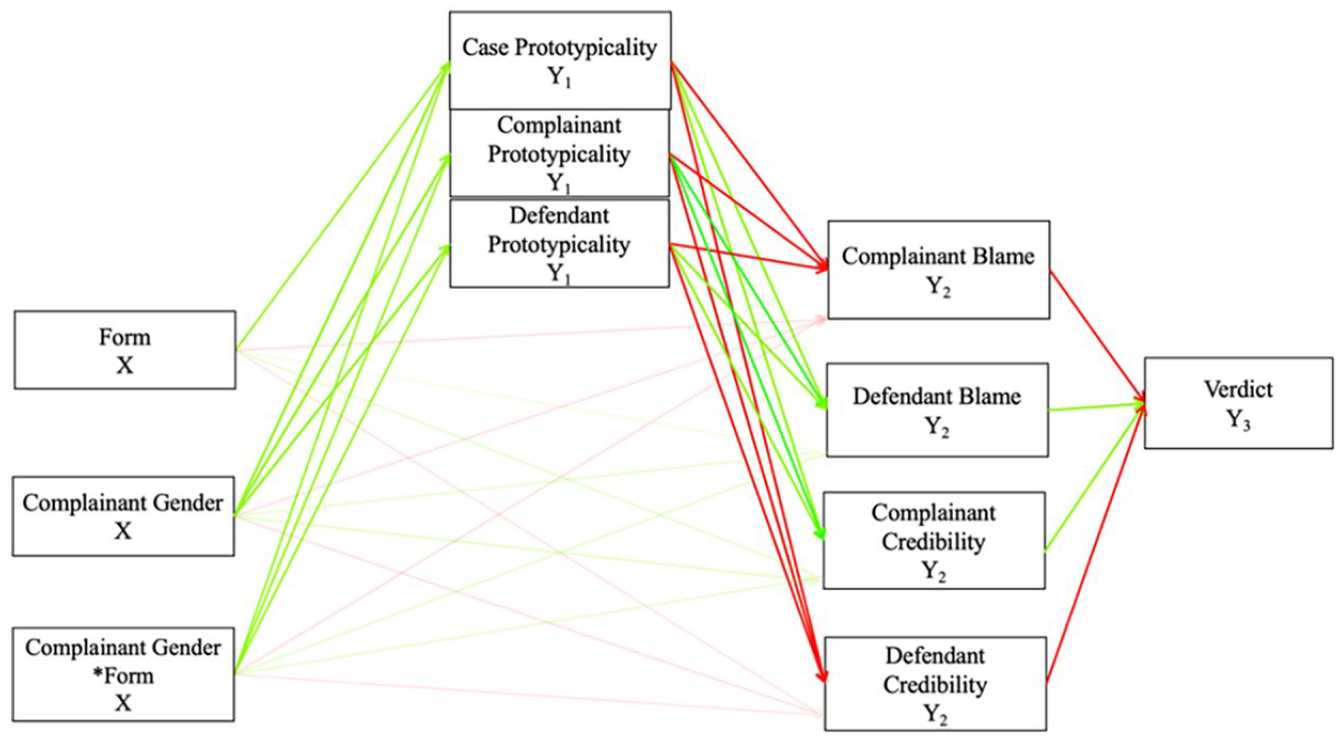
Hypothesized conceptual model results.
Based on prototype theory (Rosch, 1978); crime prototype theory (Smith, 1991); the contention that rape myths inform prototypes (McKimmie et al., 2014); and the rape myths that men cannot be sexually assaulted (Anderson, 2007), women cannot sexually assault men (Anderson, 2007), and only vaginal intercourse equates a sexual assault (Schafran, 2005), our hypotheses were as follows (see Figure 1):
We predicted that our independent variables (i.e., form of the sexual assault, complainant [tied to defendant] gender, and their interaction) would affect perceived prototypicality of the case, complainant, and defendant. Specifically, the vaginal intercourse condition, the female complainant/male defendant condition, and the female complainant/male defendant combined with vaginal intercourse condition were expected to yield higher ratings of perceived case, complainant, and defendant prototypicality than their counterpart conditions.
We hypothesized that case, complainant, and defendant prototypicality ratings would predict complainant and defendant credibility and blame assessments. We predicted that higher levels of perceived case, complainant, and defendant prototypicality would be associated with lower levels of complainant blame, higher levels of defendant blame, higher levels of complainant credibility, and lower levels of defendant credibility.
We further predicted that complainant and defendant blame and credibility assessments would predict verdict choice, such that higher levels of defendant blame and complainant credibility and lower levels of defendant credibility and complainant blame would be associated with a higher likelihood of a guilty verdict.
We also predicted direct effects from each of our independent variables (i.e., form of the sexual assault, complainant [tied to defendant] gender, and their interaction) on complainant/defendant blame and credibility assessments (see Figure 1), but that these effects would be reduced when case, complainant, and defendant perceived prototypicality assessments were included as mediators. Finally, we predicted a series of indirect effects, such that our independent variables (i.e., form of the sexual assault, complainant [tied to defendant] gender, and their interaction) would indirectly affect verdicts via their effects on perceived prototypicality and complainant/defendant blame and credibility.
Methods
Participants
Research ethics approval was obtained from Carleton University. Participants were recruited from Prolific Academic, an online crowdsourcing platform (https://www.prolific.co/) found to yield higher data quality, more diverse samples, and higher naivete/honesty than Amazon’s Mechanical Turk (Peer et al., 2017). Due to the potential stress associated with reading about a sexual assault, participants who indicated on Prolific Academic that they had experienced a sexual assault were restricted from participation.
The initial sample comprised 437 jury-eligible Canadian community members (i.e., Canadian citizens, 18 years or older, with no prior convictions of an indictable offense for which they have not received a record suspension and are fluent in English). Three participants misidentified the complainant’s gender (two for the male complainant–female defendant condition and one for the female complainant–male defendant condition), and four participants incorrectly completed the attention checks. Prolific Academic replaced these submissions. Therefore, the final sample consisted of 437 jury-eligible community members (56% women, 44% men; see Supplementary Table 1 for the breakdown of male and female participants in the four conditions and Supplementary Table 2 for full demographic breakdown). Participants took an average of 15 min to complete the survey and were compensated with $2.50 USD, following Prolific Academic guidelines.
Materials
Trial Vignette
Participants were randomly assigned to one of four trial transcripts (available from the authors on request) depicting a 1,635-word summary of the proceedings in a hypothetical sexual assault trial. The four transcripts were identical except for the manipulations of the gender combinations of the complainant and the defendant and the form of the alleged sexual assault. Gender was manipulated using names (Lauren/Ted for the complainant and for the defendant) and pronouns. Form of the alleged assault was manipulated in the complainant’s description of the events (e.g., “Lauren reports that Ted forced vaginal intercourse/oral sex with her”) and was reiterated in the defendant’s statement.
The remaining aspects of the sexual assault were represented to adhere to the specific rape myths that dictate what a “genuine” sexual assault case is (i.e., stranger assault, verbal resistance, sober, immediately reporting the assault; McKimmie et al., 2014) to allow for a focused examination on whether/how the form of the sexual assault and the gender of the complainant/defendant inform mock jurors’ perceptions of prototypicality and other case-related decisions.
Jury Instructions
At the end of the trial transcript, participants received jury instructions adapted from the National Judicial Council’s Model Jury Instructions (National Judicial Institute, 2014, s.7) and the Criminal Code of Canada (Criminal Code, RSC 1985, c C-46, s 271) outlining the Canadian legal definitions of sexual assault and consent and the burden of proof, the standard of reasonable doubt, and their duties as jurors.
Verdict
Participants were asked to render a dichotomous verdict on the charge of sexual assault (guilty, not guilty).
Prototypicality Assessments
Next, participants were asked to indicate how typically they perceived the sexual assault case (i.e., “To what extent are the events in this case like a typical sexual assault?”), complainant (i.e., “How typical is Ted/Lauren of people who have been sexually assaulted?”), and defendant (i.e., “How typical is Lauren/Ted of people who have committed a sexual assault?”) to be on a seven-point scale (from 1 = not at all typical to 7 = completely typical).
Blameworthiness
Participants were asked three questions regarding the complainant/defendant’s perceived blame, responsibility, and the appropriateness of their behavior (reverse scored) on seven-point scale (from 1 = not at all to 7 = completely). These items showed good internal consistency (complainant α = .89, defendant α = .88) and were therefore combined into respective scales of complainant and defendant blame.
Credibility
Participants were asked two questions regarding each of the complainant’s and defendant’s perceived believability/credibility on seven-point scale (from 1 = not at all to 7 = completely). These items showed good internal consistency (complainant α = .95, defendant α = .91) and were combined into respective scales of complainant and defendant credibility.
Illinois Rape Myth Acceptance (IRMA) Scale
We used the IRMA (McMahon & Farmer, 2011) scale to measure female rape myth acceptance. Participants were asked to indicate their level of agreement or disagreement with 22 statements using 1 = strongly disagree to 7 = strongly agree scales (McMahon & Farmer, 2011). Higher scores indicate greater acceptance of rape myths. In our sample, the scale demonstrated strong internal consistency (α = .91).
Male Rape Myth Acceptance (MRMA) Scale
We used the MRMA (Anderson, 2007) scale to measure MRMA. Participants were asked to indicate their level of agreement or disagreement with 22 statements using 1 = strongly disagree to 7 = strongly agree scales. Higher scores indicate greater acceptance of rape myths. In our sample, the items demonstrated strong internal consistency (α = .94).
Test of Manipulation and Attention
To ensure participants were paying attention to the case and that the manipulations were being perceived as intended, we included manipulation checks for complainant gender, defendant gender, and form of the alleged assault using multiple choice questions. Three random responding items were inserted throughout the questionnaire, instructing participants to select a number on the seven-point scale to assess attentiveness.
Demographics
Participants completed a demographic questionnaire asking about their age, gender, education, ethnicity, religion, and political affiliation.
Procedure
We recruited participants from Prolific Academic. After obtaining informed consent, participants were randomly assigned to one of four conditions and were instructed to play the role of a juror and read the trial transcript. Participants then rendered a verdict, and responded to the jury questionnaire, then were thanked, debriefed, and compensated.
Analysis Plan
To test our hypotheses, we conducted a path analysis using Mplus v. 8(Muth’en & Muth’en, 2010; code available upon request). To prepare for our analyses, we created dummy codes for gender of the complainant (1 = woman, 0 = man), and form of the alleged sexual assault (1 = vaginal intercourse, 0 = oral sex), and a two-way interaction term (form × complainant gender). All variables were regarded as being continuous except for verdict, which was analyzed as a binary categorical outcome. To initially assess the measurement quality of the four complainant/defendant blameworthiness and credibility measures, a confirmatory factor analysis (CFA) with four correlated factors was performed on the 10 blame and credibility questions. Goodness of fit measures of CFI/TLI > 0.95 and RMSEA/SRMR < 0.06 can generally be regarded as signaling an excellent fitting measurement model (Aldao et al., 2010).
Results
Several important findings emerged from these analyses (see Figure 2 and Table 1). The path model results involving complainant gender supported our hypotheses, whereas those pertaining to the form of sexual assault did not. Descriptive statistics for all study variables and the bivariate correlations between each pair of variables are provided in Supplementary Material Tables 3 and 4. Results of the CFA of the four complainant/defendant blameworthiness and credibility measures suggested that a very good fit of a four-factor model derived from the 10 blame and credibility questions was obtained. The goodness of fit values were CFI = 0.977, TLI = 0.964, RMSEA = 0.078, and SRMR = 0.033 (with an attempt to fit a one-factor model to all 10 questions yielding an inadequate model fit; CFI/TLI < 0.75, RMSEA > 0.20, and SRMR > 0.08). All standardized question loadings on their corresponding measures were ≥0.800 except for the third complainant and defendant blame questions, which had loadings of 0.603 and 0.696, respectively. The latent correlations between the four measures (ignoring the signs) ranged from .503 to .780.
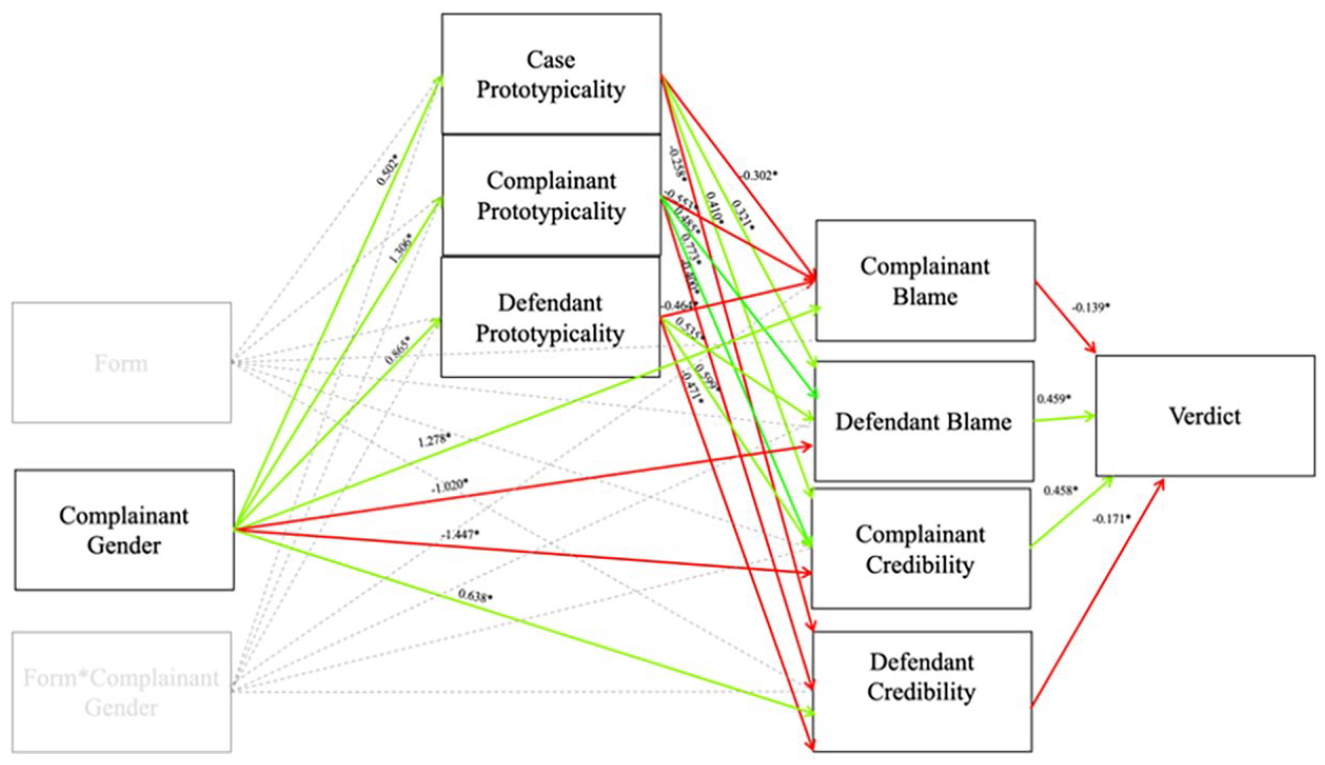
Model Results.
Model Results for Main Study Variables.
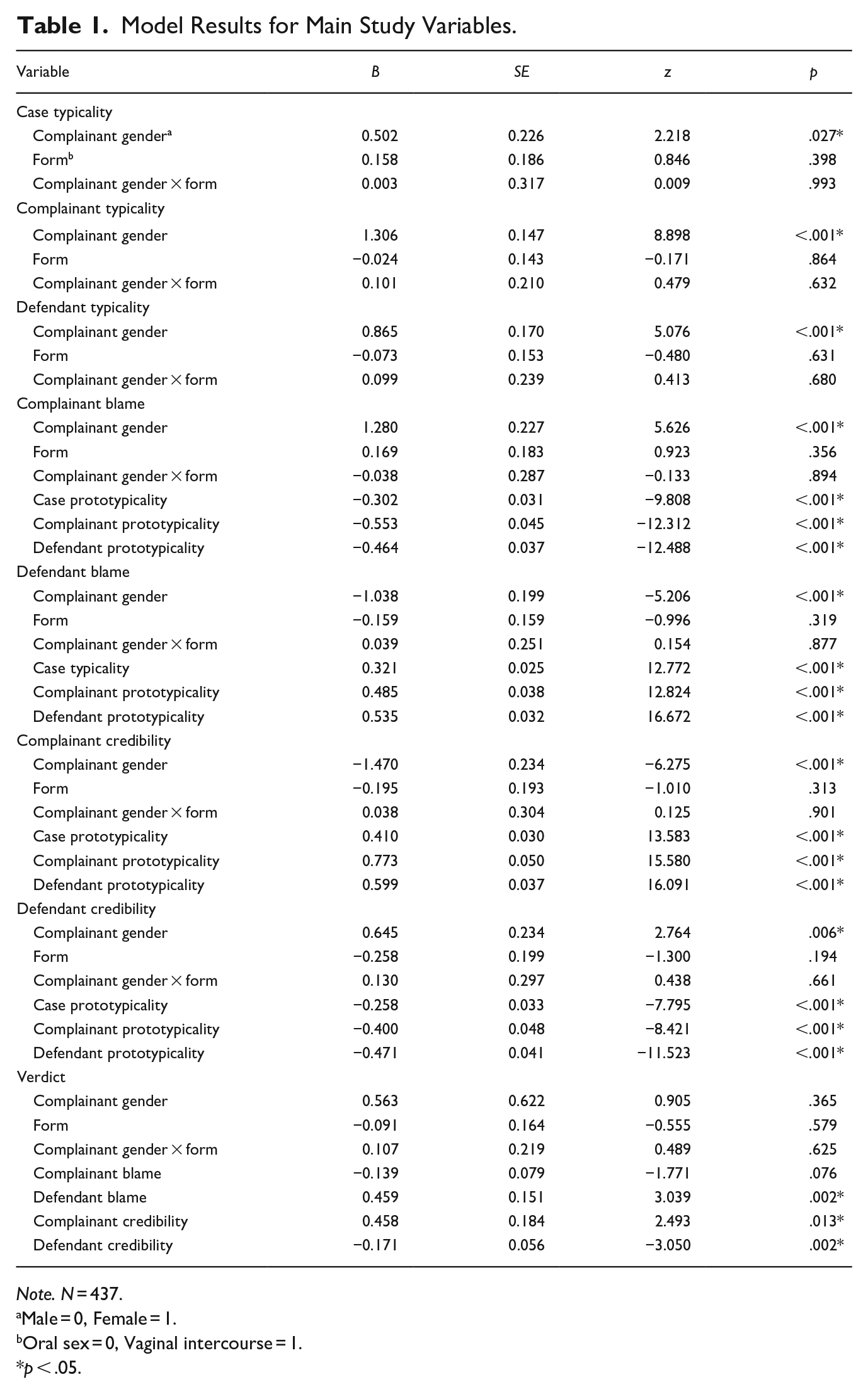
Note. N = 437.
Male = 0, Female = 1.
Oral sex = 0, Vaginal intercourse = 1.
p < .05.
Form of the Sexual Assault and Its Interaction with Complainant Gender
Contrary to our predictions, mock jurors did not view the vaginal intercourse condition as more prototypical of a sexual assault case, complainant, or defendant than the oral sex condition. Moreover, this finding did not depend on the gender of the complainant. Therefore, Baron and Kenny’s (1986) steps for concluding mediation through prototypicality of the effect of either the form of the sexual assault or its interaction with gender were not satisfied. Furthermore, there were no significant direct effects between either the form of the sexual assault or its interaction with complainant’s gender on the complainant/defendant blame or credibility assessments. Hence, no evidence for a relationship between the form of the sexual assault and either case/complainant/defendant prototypicality or complainant/defendant credibility and blameworthiness (and, hence, verdict) was present in our results.
Complainant Gender
We predicted that the female complainant–male defendant condition would be regarded as more prototypical of a sexual assault case, complainant, and defendant, leading to lower complainant blame, higher defendant blame, higher complainant credibility, and lower defendant credibility with such effects than being expected to predict verdict decisions. In this case, the path model results fully supported this prediction (see Table 1) with positive paths from complainant gender to each of the three prototypicality types, negative paths from the prototypicality types to complainant blame and defendant credibility, and positive paths from the prototypicality types to defendant blame and complainant credibility. However, we had initially anticipated a partial mediation model, such that with prototypicality included within the analysis, the direct effects of complainant gender on the complainant/defendant blame and credibility variables would be substantially reduced. Contrary to this prediction, many of these direct effects were significant (see Table 1). Moreover, their signs were invariably opposite to the composite sign of the corresponding indirect effects. Therefore, the nature of the mediation that is occurring represents a form known as inconsistent mediation (see MacKinnon et al., 2007 for an excellent example of such mediation). Inconsistent mediation can be regarded as being present when the direct and mediated effects of an independent variable on a dependent variable have opposite signs (Cliff & Earleywine, 1994).
To illustrate, note that complainant gender had a positive direct effect on complainant blame (i.e., 1.28) whereas all of the indirect effects on this same variable through case/complainant/defendant prototypicality were negative (e.g., 0.502 × −0.302 = −0.152 for case prototypicality). Hence, in line with our prediction, a sexual assault case involving a female complainant was perceived to be more prototypical, which then resulted in less blame being assigned to the complainant (and similarly for complainant and defendant prototypicality). In contrast, the direct path from complainant gender to complainant blame was positive. Hence, after controlling for the prototypicality of the case, complainant, and defendant, female complainants were associated with significant increases in complainant blame. Therefore, holding the levels of prototypicality fixed, mock jurors tended to blame the female complainant more than the male complainant. An analogous pattern of results occurred as well for the direct and indirect paths between complainant gender and defendant credibility, with opposite patterns occurring for those between complainant gender and both defendant blame and complainant credibility.
In turn, complainant blame, defendant blame, complainant credibility, and defendant credibility predicted mock jurors’ probability of rendering a guilty verdict. That is, lower levels of complainant blame and defendant credibility were associated with a significantly higher probability of a guilty verdict for the defendant (albeit at the α = .10 level for complainant blame). Similarly, higher levels of defendant blame and complainant credibility were also associated with a significantly higher probability of a guilty verdict for the defendant.
To ensure the model was accounting for all of the potential direct and indirect effects, we also ran the model with direct paths to verdict from our independent variables to examine if they would directly predict more guilty verdicts (over and above complainant/defendant credibility and blameworthiness). None of these further direct effects on the verdicts were significant (see Table 1). Interestingly, all four of the complainant/defendant credibility and blameworthiness variables were significantly related to the verdict variable (again, at the 0.10 level for complainant blame), indicating that they all had something unique to add to the prediction of the verdict.
Rape Myth Acceptance Scales
To further examine, in an exploratory fashion, the nature of the effects beyond prototypicality, we then added mock jurors’ scores on the IRMA and MRMA to the model. Given the null results regarding the Form of the Sexual Assault and its interaction with Complainant Gender, these two factors were dropped from subsequent path models. As shown in Table 2, with the inclusion of IRMA and MRMA in the model, complainant gender no longer had an effect on the prototypicality of the sexual assault case (although it was still related to complainant and defendant prototypicality). Additionally, the direct effects of complainant gender on complainant blame and defendant credibility were no longer significant. Similarly, the effect of complainant blame on the verdict was not significant.
Model Results with the Form Factor Omitted and the Rape Myth Acceptance Scales Included.
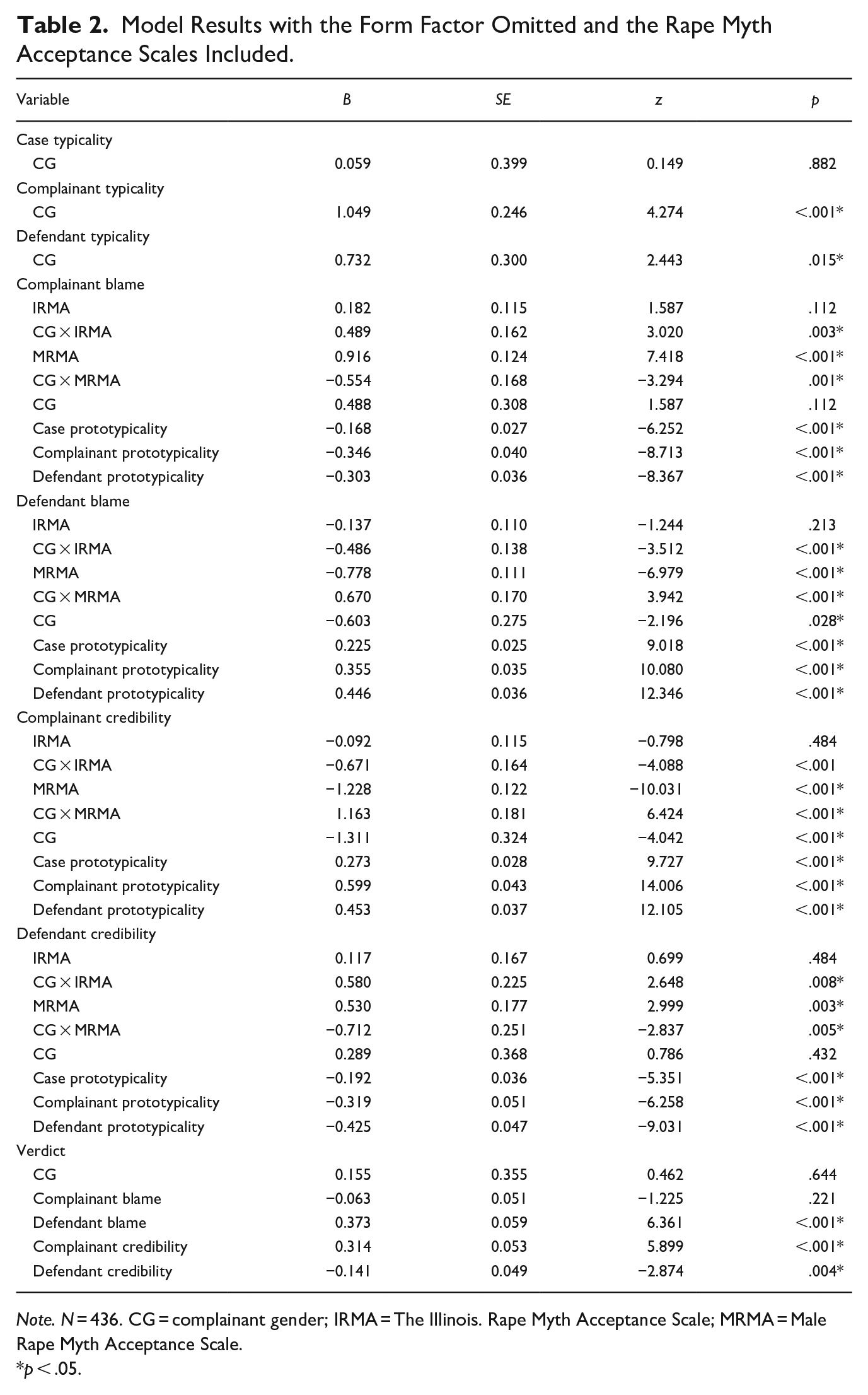
Note. N = 436. CG = complainant gender; IRMA = The Illinois. Rape Myth Acceptance Scale; MRMA = Male Rape Myth Acceptance Scale.
p < .05.
With respect to the role of these added variables as predictors in the model, although none of the direct effects of IRMA on complainant/defendant credibility and blameworthiness were significant, significant interactions involving IRMA and complainant gender were present. Given the nature of the indicator coding of complainant gender, the coefficients for IRMA in Table 2 represent the size of the unique relation between IRMA and each of the complainant/defendant credibility and blame variables for the complainant gender condition coded with 0 (i.e., male complainant–female defendant). Similarly, the coefficients for the interaction of IRMA with complainant gender in Table 2 represent the change in the size of those relations for the complainant gender condition coded with 1 (i.e., female complainant–male defendant). Hence, it is clear from Table 2 that the relation between IRMA and each of the complainant/defendant credibility and blame variables is much stronger for the female complainant–male defendant condition than it is for the male complainant–female defendant condition. For example, for male complainants, each one-unit increase in jurors’ IRMA scores increases complainant blame by 0.152 units (controlling for all other variables). On the other hand, for female complainants, each one-unit increase in jurors’ IRMA scores increases complainant blame by 0.182 + 0.484 = 0.671 units (controlling for all other variables). Hence, complainant gender could be regarded as moderating the effects of IRMA on complainant/defendant credibility and blameworthiness.
Importantly, however, it is also possible to consider how jurors’ IRMA levels moderate the direct effects of complainant gender. Namely, the coefficients for the interaction of IRMA and complainant gender in the model in Table 2 also technically represent the increase in the direct unique effect of complainant gender on complainant/defendant credibility and blameworthiness for each one-unit increase in the jurors’ IRMA scores. Hence, as IRMA increases, so does the direct effect of complainant gender (e.g., every one-unit increase in IRMA increases the direct effect of complainant gender on complainant blame by 0.489 units). As noted earlier, the direct effect of complainant gender on complainant blame is in a direction opposite to its indirect effect on complainant blame through prototypicality.
With respect to MRMA scores, coefficients for its direct effect on complainant/defendant credibility and blameworthiness are all significant, indicating that for the condition in which complainant gender is coded with 0 (i.e., male complainant–female defendant), jurors’ MRMA scores are indeed related to each of the complainant/defendant credibility and blame variables (and, hence, verdicts). On the other hand, the MRMA by complainant gender interaction terms indicates that such relations are significantly reduced for the condition in which complainant gender condition is coded with 1 (i.e., female complainant–male defendant). For example, for male complainants, complainant blame rises by 0.916 units for every one-unit increase in jurors’ MRMA scores, whereas for female complainants, this increase is only 0.916 to 0.554 = 0.362 units. 2
Discussion
This mock juror study serves as the first examination of mock jurors’ perceived prototypicality of a sexual assault case, complainant, and defendant in various conditions to ascertain if mock jurors’ sexual assault prototypes are one of the mechanisms behind their case-related decisions. To this end, the present study offers an initial examination of the impact of the form of alleged sexual assault (forced oral sex onto the complainant vs. forced vaginal intercourse) and complainant (tied to defendant) gender on mock jurors’ sexual assault perceptions of prototypicality and, in turn, their assessments and decisions. Results of the present study demonstrate that prototypicality is one of the mechanisms behind mock jurors’ decisions and provides evidence to suggest that mock jurors appear to have an image of what genders are involved in a prototypical sexual assault case, complainant, and defendant, with practical implications for sexual assault cases, the field of psychology, and the criminal legal system.
Complainant Gender
As predicted, the gender of the complainant/defendant informed mock jurors’ perceptions of prototypicality such that a female complainant–male defendant pairing was perceived as more prototypical of a sexual assault case, complainant, and defendant. In line with our predictions, mock jurors’ complainant and defendant blame and credibility assessments were informed by their sexual assault prototypes, and these assessments, in turn, predicted their verdict decisions. Namely, higher levels of sexual assault case, complainant, and defendant prototypicality each uniquely predicted lower complainant blame, higher defendant blame, higher complainant credibility, and lower defendant credibility, which, in turn, predicted an increase in mock jurors’ probability of rendering a guilty verdict. Conversely, our results also provided evidence to suggest that because male complainants/female defendants are seen as less prototypical of a sexual assault case, complainant, and defendant, this can lead to more blame and less credibility assigned to male complainants while decreasing the level of blame and increasing the level of credibility of their female defendants. Such effects can then serve to reduce the probability of mock jurors rendering a guilty verdict in the male complainant/female defendant condition. To this end, as predicted on the basis of prototypicality, the probability of rendering a guilty verdict in the female complainant–male defendant condition was higher than in the male complainant–female defendant condition. In this way, our results are broadly in line with the growing body of research examining judicial decisions involving male complainants of female-perpetrated sexual assault, which has shown that male complainants can be viewed as more blameworthy and less credible than their female complainant counterparts (e.g., Pica et al., 2021; Smith et al., 1988; Starosta & Schuller, 2020). Notably, however, our results go beyond previous reports by empirically demonstrating the potential mediating role of perceived prototypicality of the sexual assault case, complainant, and defendant in accounting for the aforementioned studies’ findings. Our results can also add to the conceptualization of the “real rape” prototype (Du Mont et al., 2003) because explicitly measuring mock jurors’ perceived prototypicality of a sexual assault case, complainant, and defendant provides evidence that mock jurors are more likely to rate a female complainant/male defendant pairing as prototypical than the reverse gender pairing.
The present study results, therefore, suggest a male complainant of female-perpetrated sexual assault may face a disadvantage if he pursues his claims at trial because his is not the prototypical sexual assault scenario. As seen in this study, although mock jurors were provided with the Canadian legal definitions of sexual assault as defined in Bill C-51 (i.e., gender-neutral terms such as “complainant” and “defendant” rather than “she” or “he”; Criminal Code [Code], R.S.C. 1985, c. C-46), they still appeared to have a prototype of what genders are involved in a sexual assault case, complainant, and defendant and used this prototype to guide their decisions. These findings have implications for victims in the criminal legal system. If the circumstances surrounding an alleged sexual assault do not adhere to jurors’ sexual assault prototypes, then prosecutors may have more difficulty convincing a jury that a sexual assault occurred.
On the other hand, above and beyond (or independent of) the prototypicality effects, there existed a direct tendency to assign more blame and less credibility to female complainants than to male complainants. Namely, for fixed levels of prototypicality (i.e., after partialling out the prototypicality paths), the female complainant–male defendant condition was directly associated with higher complainant blame, lower defendant blame, lower complainant credibility, and higher defendant credibility, which were all related to a lower probability of rendering a guilty verdict. What this means is that although the higher prototypicality of the female complainant–male defendant condition indirectly served to increase the probability of a guilty verdict for the defendant, this increase was then attenuated on average by a further tendency of the female complainant–male defendant condition to directly lower the probability of mock jurors deciding on a guilty verdict. Interestingly, in the aggregate, these separate direct and indirect effects can tend to balance out (i.e., act inconsistently), which could lead to the conclusion that complainant gender is not related to mock jurors’ verdict decisions (as would typically have been concluded from the overall correlation between complainant gender and verdict of r = .07 in Supplementary material Table 4). Indeed, such a result (no effects of gender on verdict) has previously been found in studies examining jurors’ decisions for male complainant/female defendants compared to female complainant/male defendants in sexual assault cases (e.g., Pica et al., 2021; Smith et al., 1988; Starosta & Schuller, 2020), and in domestic sex trafficking cases (Stevens et al., 2022).
Importantly, some indication of the underlying basis for the direct effects of complainant gender on complainant/defendant blame and credibility was provided by the fact that they were moderated by IRMA scores, becoming stronger as acceptance of rape myths increased. Such a result would then allow for the conclusion that the tendency increases for complainant gender to work directly in an opposite fashion to its effect through prototypicality as jurors’ IRMA (i.e., rape myth) scores increase. However, the continued presence of direct effects for complainant gender, even in the model accounting for IRMA, suggests that there are reasons beyond just endorsement of rape myths for mock jurors’ tendency to blame male complainants less in sexual assault trials, view female complainants as less credible, and convict male defendants less often when prototypicality is held constant. While we are unable to directly identify these reasons with the current data, some potential avenues for future research include investigating whether female complainants are seen as more responsible for their assaults due to societal messaging that the onus for preventing rape is on women (Bedera & Nordmeyer, 2015).
The line of inquiry opened here is warranted given that previous empirical evidence suggests that jurors’ verdict decisions are not different for male or female complainants, which arguably does not capture the whole story; therefore, researchers/policymakers may infer that preventive strategies are not necessary. Our results suggest that given the potential multidirectional effect of complainant gender, targeted interventions could focus on either raising the perceived prototypicality of scenarios involving male complainants and female defendants to offset bias against male complainants or using voir dire to select for jurors low in rape myth acceptance to offset bias against female complainants (in jurisdictions in which this is permitted). They also highlight that future research should develop additional strategies in this vein to ensure equivalent treatment for sexual assault complainants regardless of gender. Furthermore, the present study suggests that investigations of jurors’ decisions using path analysis would certainly be fruitful to try and account for the myriad indirect and direct effects present within this phenomenon.
Form of Sexual Assault
To our knowledge, this study was the first to empirically investigate mock jurors’ decisions in a sexual assault case involving forced oral sex. Contrary to our predictions, the form of sexual assault did not affect participant responses, with no significant differences found between the oral sex and the vaginal intercourse condition. It, therefore, seems that the “only vaginal intercourse equates to sexual assault” rape myth (Schafran, 2005) was not held by mock jurors in this study. Because prototypicality ratings were not significantly different as a function of form, it appears that our participants did not believe that forced oral sex is any less “typical” of a sexual assault than forced vaginal intercourse.
It is possible that this reflects changing popular discourse surrounding forced oral sex. Since the initial discussion of the “only vaginal intercourse equates to sexual assault” rape myth, many high-profile sexual assault cases involving men forcing oral sex onto a female victim (e.g., Hays & Sisak, 2020; Ellison, 2018) and women forcing oral sex onto a male victim (e.g., Beaumont-Thomas, 2018) have occurred; these cases received heavy media focus.
It is reasonable that due to the increase in media attention on forced oral sex onto victims, this form of sexual assault is now perceived as a “genuine” and “typical” form of sexual assault, despite the rape myth against it. This supposition is consistent with the findings of Kessler et al. (2020), who demonstrated that behaviors inconsistent with media stories were not perceived as sexual harassment. However, as this is the first study to test this research question, future research should attempt to replicate these findings and extend them by including other diverse forms of sexual assault to enable a more extensive understanding of the role of this variable on decision-making in sexual assault cases.
Rape Myths
IRMA and MRMA together as control variables attenuated the direct effects of complainant blame on verdict, and their inclusion resulted in the direct effects of complainant gender on prototypicality of the sexual assault case, complainant blame, and defendant credibility becoming statistically non-significant in the model. Exact understanding of why this occurred may not be possible because these findings occurred in conjunction with the statistical combination of multiple control variables in the exploratory model. As preliminary analysis yielded promising results for the role of IRMA and MRMA as covariates in the model, researchers are encouraged to investigate this further.
Traditional rape myth acceptance (IRMA) was more predictive in conditions involving female complainants than in those involving male complainants. This is unsurprising given that the scale measures myths regarding female victimization (e.g., “If a woman goes home with a man she doesn’t know, it is her own fault if she is raped”) and male perpetration (e.g., “when men rape, it is because of their strong desire for sex”). Notably, those scoring higher in this form of rape myth acceptance assigned higher blameworthiness ratings to female complainants. Therefore, it appears that traditional rape myth acceptance and perceived prototypicality operate in opposite directions, with higher endorsement of the former leading to more blame for female complainants (and therefore fewer guilty verdicts), and higher levels of the latter leading to reduced blame for female complainants (and therefore more guilty verdicts). This finding speaks directly to the need to disentangle rape myths and prototypes in studies of decision-making in sexual assault cases.
Consistent with previous research, higher MRMA scores were significantly associated with increases in male complainant blame and female defendant credibility and decreases in male complainant credibility and female defendant blame (Sleath & Bull, 2010). In our study, even though participants had low MRMA acceptance scores in general, any acceptance of male rape myths predicted negative perceptions of the male complainant. Endorsement of male rape myths appeared to inform participants’ assessments and decision-making, potentially resulting in unfair proceedings and outcomes for male complainants. This has practical implications within the Canadian context, where limited voir dire questioning hinders screening for rape myth acceptance. Additional policy research is necessary to address these constraints and inform unbiased trial proceedings.
Implications
This study marks the inaugural attempt to directly measure mock jurors’ perceived prototypicality concerning the sexual assault case, complainant, and defendant. Historically, research has gauged the prototypicality of a sexual assault scenario based on its alignment with prevalent rape myths. However, the findings of this study underscore that the interplay between complainant and defendant gender in mock jurors’ case-related decisions is more intricate than previously hypothesized. Only through the direct measurement of mock jurors’ perceived prototypicality can this complexity be unraveled. Understanding these intricate relationships is crucial for implementing effective measures to counter prototype-based bias. Moreover, given the significance of directly measuring prototypicality, this study establishes a methodological foundation for psycho-legal researchers investigating prototypes and their impact on judicial decision-making in sexual assault cases.
To further enhance our understanding of the distinctiveness of rape myths and prototypes on jurors’ decisions and ensure that reforms address additional sources of bias, it would be empirically valuable to replicate previous research examining the role of rape myths in jurors’ decisions (e.g., Du Mont et al., 2003; McKimmie et al., 2014; Schuller et al., 2010) while incorporating measurements that empirically assess jurors’ sexual assault prototypes. This line of inquiry would contribute to a more nuanced understanding of the impact of rape myths and prototypes on jurors’ decision-making processes.
Additionally, future studies should explore strategies and policy reforms to educate jurors that men can be victims of sexual assaults perpetrated by women. Such strategies could involve specific judicial instructions emphasizing the irrelevance of complainant/defendant’s gender and asserting that anyone can be victimized. Additionally, attitudinal training packages or expert witnesses speaking to these facts may be effective. This is an essential endeavor because the prototype-based bias identified in the present study can contribute to the high attrition rates sexual assault cases face once they reach court (Morgan & Truman, 2017). Therefore, Crown and defense lawyers, as well as trial judges, should take steps to mitigate this potential bias. We also strongly recommend conducting research interviews with male victims of female-perpetrated sexual assault, following the methodological and ethical considerations outlined by Weare and Hulley (2023), to gain a deeper understanding of any biases they may have experienced within the criminal justice system. This information can then inform empirical-based policy reform.
For female complainants, this study provides insight into the multifaceted role of complainant gender in mock jury decision-making for sexual assault cases. The findings suggest that female complainants may face blame for reasons beyond the endorsement of rape myths. Replicating and confirming these findings is essential, with subsequent investigations into why jurors hold negative evaluations of female sexual assault complainants and how to implement reforms (such as judicial instructions, expert witnesses, and training packages) to address this bias effectively.
Our study contributes to the ongoing debate on rape myth acceptance among real versus mock jurors. Thomas (2020) surveyed real jurors after jury service, contending that there is no issue with rape myths in English and Welsh juries. In contrast, Daly et al. (2023) criticized her work, citing research indicating that individuals may express low rape myth acceptance generally but nonetheless rely on them when making decisions. Rather than framing this as a debate between real and mock jurors, it may be more accurately characterized as a consideration of questions related to abstract versus applied rape myths and differences in deliberation between real and mock jurors. Our findings align with Daly et al. (2023), as our participants had low rape myth acceptance (abstract), but any acceptance predicted their negative perceptions of the complainant (applied). This underscores the importance of studying jurors’ attitudes and their decisions, including verdict, blameworthiness, and credibility assessments. Unfortunately, conducting such research with real jurors in Canada or the UK is currently unfeasible; hence, mock jurors and simulated trials provide a unique venue for this investigation.
This study further extends the current literature by encompassing a wider range of persons affected by sexual assault, thereby broadening current psycho-legal research to novel populations. This study provides a methodological basis for future studies to investigate other gender influences on jurors’ sexual assault prototypes and their role in decision-making in sexual assault cases. This is necessary because jurors’ tendency to underestimate assault that does not involve a female complainant–male defendant promotes the marginalization of male, female, and transgender complainants of female-perpetrated sexual assault.
Limitations
The current study was conducted in a manner that follows previous practice in jury decision-making research, specifically in Canada (Hans, 2010). Because Canadian jurors cannot legally disclose the reasons for their decisions (Criminal Code, s. 649; 1985), jury simulations provide an opportunity to examine the effect of extralegal information on juror decision-making. Several caveats of the present study must, however, be noted.
Firstly, the present study used a simulated trial. It is possible that participants knowing that their responses had no consequences for a defendant may have influenced their decision-making process and/or outcome (Bornstein & McCabe, 2005; Bornstein et al., 2017). Therefore, the present study may not fully represent what would occur in a courtroom, lowering ecological validity. Secondly, although our trial transcript met the standards of acceptability identified by expert jury researchers (Lieberman et al., 2016), the use of a written trial transcript instead of an audio recording or video/live presentation may also have lowered the ecological validity of the present study, as real jurors hear and view a case and do not read it. However, research has demonstrated few (if any) differences in results between various modes of presentation (Bornstein, 1999; Pezdek et al., 2010). Additionally, this study lacked a deliberation component. Although individual verdicts can be predictive of group decisions (Devine et al., 2012), individual verdicts may differ due to group discussion (Kaplan & Miller, 1987). Future research could replicate this study with the inclusion of a deliberation process.
Conclusion
Our study highlights the multifaceted roles of complainant and defendant gender and perceived prototypicality on prospective jurors’ decision-making. The present study also serves as a first examination of the impact of the form of sexual assault and complainant gender (tied to defendant gender) on mock jurors’ sexual assault perceptions of prototypicality of the case, complainant, and defendant, and in turn, their case-related assessments and verdict decisions. Our findings suggest that the criminal legal system and its players must be aware that juror perceptions of prototypicality may be related to their decision-making in sexual assault cases and the distinctive role of prototypes and rape myths on judicial decisions.
Supplemental Material
sj-docx-1-jiv-10.1177_08862605241253025 – Supplemental material for The Role of Complainant/Defendant Gender and Form of Sexual Assault on Jurors’ Perceptions of Prototypicality and Verdicts
Supplemental material, sj-docx-1-jiv-10.1177_08862605241253025 for The Role of Complainant/Defendant Gender and Form of Sexual Assault on Jurors’ Perceptions of Prototypicality and Verdicts by Cassandra Starosta, Evelyn Maeder and Craig Leth-Steenson in Journal of Interpersonal Violence
Supplemental Material
sj-docx-2-jiv-10.1177_08862605241253025 – Supplemental material for The Role of Complainant/Defendant Gender and Form of Sexual Assault on Jurors’ Perceptions of Prototypicality and Verdicts
Supplemental material, sj-docx-2-jiv-10.1177_08862605241253025 for The Role of Complainant/Defendant Gender and Form of Sexual Assault on Jurors’ Perceptions of Prototypicality and Verdicts by Cassandra Starosta, Evelyn Maeder and Craig Leth-Steenson in Journal of Interpersonal Violence
Footnotes
Declaration of Conflicting Interests
The author(s) declared no potential conflicts of interests with respect to the authorship and/or publication of this article.
Funding
The author(s) disclosed receipt of the following financial support for the research and/or authorship of this article: This research received funding from the American Psychology-Law Society’s BRIDGE Diversity Research Award and the American Psychology-Law Society’s Grant-in-Aid for Graduate Students.

Supplemental Material
Supplemental material for this article is available online.
Notes
Author Biographies
References
Supplementary Material
Please find the following supplemental material available below.
For Open Access articles published under a Creative Commons License, all supplemental material carries the same license as the article it is associated with.
For non-Open Access articles published, all supplemental material carries a non-exclusive license, and permission requests for re-use of supplemental material or any part of supplemental material shall be sent directly to the copyright owner as specified in the copyright notice associated with the article.
