




Abstract
This article explores the perception of violence against women (VAW) in the Middle East and North Africa in the aftermath of the COVID-19 pandemic using Arab Barometer VI parts 1 and 3 (N = 12,548). Results showed that men and social conservatism were less likely to perceive that the VAW in the community had increased. For religious people, the odds of perceiving violence in the community were higher. Individuals whose jobs were interrupted because of the COVID-19 outbreak were more likely to perceive VAW in the community has increased compared to individuals whose jobs were not interrupted. The strongest predictor of the perception of increased VAW in the community because of COVID-19 was the current economic situation of the country. Those who perceived the economic situation of the country as bad were 1.6 times more likely to believe that VAW has increased. Government handling of the crisis and overall government performance increased the odds of perceiving that VAW has increased. Investigating correlates of VAW as the consequence of the COVID-19 pandemic is crucial because it helps governments, emergency services, and community leaders develop strategies of prevention for future disasters and improve community and institutional reactions.
The association between natural disasters and increased violence against women (VAW) is not a new phenomenon (First et al., 2017; Lauve-Moon & Ferreira, 2016; Rezaeian, 2013; Weitzman & Behrman, 2016). VAW refers to any act of violence or threats of violence by a partner, family, or community that results in or might result in physical, psychological, or sexual harm to women (Cepeda et al., 2022; Pan American Health Organisation & World Health Organisation, 2021; United Nations, 1993). VAW exists in the Middle East and North Africa (MENA) region and, despite its prevalence, continues to be underreported (Kisa et al., 2021).
The outbreak of COVID-19 resulted in countries introducing lockdown policies and other measures, which contributed to increasing incidences of VAW worldwide (Bradbury-Jones & Isham, 2020; Campbell, 2020; Usher et al., 2020). The outbreak caused stress and depression rates to increase owing to, among other factors, the risk of being infected by the virus, the economic downturn, job loss, and isolation (Akel et al., 2020; Bradbury-Jones & Isham, 2020). Some authors suggest that post-disaster increases in violence are negatively related to marital satisfaction combined with other factors (Banford et al., 2011) while others argue that in disaster situations, people increasingly use violence to settle disputes (Harville et al., 2011). Disasters could potentially create more disputes and disagreements between partners, exhausting communication channels (Lowe et al., 2012). It has been argued that women are more at risk than men because of the already preexisting inequalities (Enarson, 2012).
Gender-based violence (GBV) is a major problem in the MENA where females are at risk of being subjected to different forms of violence (World Bank, 2021). The region has some of the highest percentages of prevalence for different forms of GBV (World Bank, 2021). The MENA region has been placed lowest on the Global Gender Index performing miserably on health, education, economic, and political participation indicators (World Economic Forum, 2019). The female labor market involvement in MENA is among the lowest in the world (Fakih et al., 2020). Most Arab countries have not ratified laws on eradicating VAW and have failed to pay enough attention to issues related to “prevention, protection, prosecution, punishment and providing redress and reparation” (Khafagy & Abdel Khalik, 2021, p. 5).
The COVID-19 pandemic exacerbated the risks of perpetration of VAW and shaped the accessibility of services. For example, in Lebanon and Jordan, there has been a surge in reported VAW (UN Women, 2020). During the lockdown, people of all sexes reported feeling unsafe across Lebanon. There were reports of most people witnessing some form of VAW against women and girls in their communities (Mahmood et al., 2022; UN Women, 2020).
Surveys commissioned by UN Women in 2021 found that in Jordan and Morocco, women felt less safe both inside and outside their homes because of the COVID-19 pandemic. This resulted in a substantial impact on their mental and emotional health, brought about by additional external factors such as food insecurity, family relations, and access to services (UN Women, 2022a, 2022b). The majority of women reported that they, or people known to them, have experienced some form of abuse.
VAW in MENA
Patriarchy is the primary cause of women’s subordination globally (Haj-Yahia et al., 2012; Heise, 2011), and the origins of VAW is in gender stratification (Hunnicutt, 2009). In MENA, it is lawfully recognized for a man to control his wife (Haj-Yahia & Zaatut, 2015); the husband is the authority figure to whom the wife and children must ultimately respond (Haj-Yahia, 2011). However, as El Abani and Pourmehdi (2021) and Kposowa and Aly Ezzat (2019) state, patriarchy alone is not the cause of women’s oppression in Arab societies but the misinterpretation of the Qur’an and social conservatism might be related to this. Islam is the bedrock upon which Arab societies are built; therefore, it has a massive influence on almost every aspect of these societies, including gender roles and marital relations (Niu & Laidler, 2015).
Within patriarchal societies, VAW is justified if women’s perceived behavior differs from established local norms (Alhalal et al., 2019; Schuler et al., 2011). Violence takes place within a moral order that the victim, perpetrator, and others inhabit (Fiske & Rai, 2015). Offenders rely on culturally important and normative stocks to justify abuse, blame the victims, and exercise their moral duty, and for the victim of the abuse to become “normal, acceptable, disciplinary, and corrective” (Adjei, 2015, p. 1).
In MENA, most incidents of VAW are not openly visible, as people do not always report it because it is considered a private matter rather than a social problem (Haj-Yahia et al., 2012; Kulwicki et al., 2015; Pargeter, 2010; Spencer et al., 2014). The mechanisms of dealing with violence are not effective due to religious, legal, and cultural factors, which maintain and support men’s dominance and control over women (Pargeter, 2010). Most MENA countries do not have legislation in place to protect women from VAW (Kulczycki & Windle, 2011). The typical religious interpretations and understanding of Islamic scriptures allow men to “correct” women when this is “required.” Women rarely contact authorities because of shame and the possibility of being divorced if they are already married.
Prevalence and Risk Factors of VAW in MENA
The prevalence of VAW varies across countries in MENA. Various studies report different rates of prevalence depending on the nature and the year of study (Akel et al., 2020; Alijani et al., 2018; Eldoseri & Sharps, 2020; Kavak et al., 2018; Malik et al., 2017; Safadi et al., 2018; Shaikh et al., 2017; Sousa et al., 2015). A systematic review of published studies by Kisa et al. (2021) found the prevalence and type of VAW in MENA in a number of studies: physical violence was found in 111 studies, psychological and verbal violence in 92 studies, sexual violence in 82 studies, and economic violence in 28 studies (Kisa et al., 2021).
Risk Factors and VAW
MENA studies on VAW have identified several risk factors for VAW. Several studies report a negative correlation between age and VAW (Alijani et al., 2018; Baran & Gumus, 2017; Eldoseri & Sharps, 2020), indicating that younger women have a higher risk of victimization. By contrast, some studies found the opposite that older women were more at risk of VAW (Akadli Ergocmen et al. (2013); Safadi et al., 2018; Sen & Bolsoy, 2017).
Women with low levels of education are more likely to experience VAW compared to more educated women (Akyazi et al., 2018; Safadi et al., 2018). Conversely, myriad studies report that the risk of VAW is higher among women with higher education (Korkmaz et al., 2016; Saffari et al., 2017). Another risk factor reported by MENA studies is a low level of the husband’s education. Lower levels of education of the husband is associated with a higher risk of VAW (Haj-Yahia & Clarke, 2013; Hajian et al,., 2014; Halawi et al., 2017).
Few studies reported that being a housewife increased the risk of victimization (Halawi et al., 2017; Kirvak et al., 2015). Other studies found that employed women were also subjected to violence (Jamali et al., 2017; Kirvak et al., 2015; Sen & Bolsoy, 2017). A husband’s unemployment was another common contributing factor as the prevalence of VAW was higher for those women whose husbands were unemployed (Ahmadi et al., 2017; Akar et al., 2010; Mohamadian et al., 2016). Few studies report an association between large families and VAW (Akar et al., 2010; Akyazi et al., 2018; Clark et al., 2008; Haj-Yaha & Clark, 2013; Saffari et al., 2017). Related to this, the number of children and larger family sizes and a preference for male children have been reported as increasing the prevalence of VAW (Akyazi et al., 2018; Awwad et al., 2014; Barnawi, 2017; Bilgin Sahin & Erbay Dundar, 2017).
VAW affects the children who witness the violence. The association between children’s exposure to domestic violence and VAW perpetration is well reported in the literature (Nixon et al., 2013; Temple et al., 2013). MENA studies also report that the history of childhood abuse and witnessing family violence is positively correlated with VAW (Akyazi et al., 2018; Al-Faris et al., 2013; Bilgin Sahin & Erbay Dundar, 2017; Eldoseri & Sharps, 2020; Kivrak et al., 2015; Kotan et al., 2017; Sen & Bolsoy, 2017; Sheikhbardsiri et al., 2020).
Substance abuse, drug use, and alcohol consumption by the husband are documented as risk factors in a number of MENA studies (Al-Tawil, 2012; Akyazi et al., 2018; Alzahrani et al., 2016; Awwad et al., 2014; Eldoseri & Sharps, 2020; Halawi et al., 2017; Saffari et al., 2017; Sheikhbardsiri et al., 2020). These studies focus on the perpetrators and pay no attention to women’s experience of violence and their own substance use and abuse. The association between substance abuse, drug use, and alcohol and VAW is not simple as they do not always lead to violent behavior, and there are complex interdependencies with other variables (Gadd et al., 2019).
Some studies report a positive relationship between the low socioeconomic status of women and a risk of VAW (Alzahrani et al., 2016; Arslantas et al., 2012; Bohlaiga et al., 2014; Habib et al., 2011; Halawi et al., 2017; Kavak et al., 2018; Saffari et al., 2017; Yount & Li, 2010; Yount, 2005). The vulnerability of women to VAW in lower socioeconomic positions interacts with other factors such as economic pressures (Dabaghi et al., 2023; Fageeh, 2014). These studies treat socioeconomic status as a multidimensional construct that takes education, income, and occupation into consideration.
Endogamous marriage was found to be negatively associated with VAW (Akyazi et al., 2018; Baran and Gumus, 2017; Hajikhani Golchin et al., 2014). Endogamy refers to marriage concerning people of the same social group, caste, ethnic background, or religious group (Giddens & Sutton, 2021; Macionis & Plummer, 2012). Having a co-wife was also negatively associated with VAW (Al-Tawil, 2012; Sen & Bolsoy, 2017; Clark et al., 2008; Halawi et al., 2017). However, an acceptance of violence by women resulted in further abuse (Awwad et al., 2014; Tokuc et al., 2010). Finally, a husband suffering from mental health problems was found to be positively associated with VAW (Akyazi et al., 2018; Garrusi et al., 2008; Ghahhari et al., 2008; Kirvak et al., 2015; Kotan et al., 2017; Khayat et al., 2017; Ozer et al., 2015).
Interestingly, there are not enough studies that explore the relationship between religiosity and VAW in MENA. Haj-Yahia et al. (2002) observed that the incorrect interpretation of Islamic Sharia was to blame. Kposowa and Aly Ezzat (2019) examined whether religiosity and social conservatism were related to wife beating and found that religiosity was negatively associated with wife beating but social conservatism was positively associated with wife beating.
It is important to note that VAW is multidimensional and risk factors often interact with each other. It is also worth observing that gender inequality intersects with other forms of inequality and affects women’s experience of VAW. The above-reviewed risk factors are to some extent universal; however, most studies of VAW in MENA use domestic violence, intimate partner violence, and VAW interchangeably and make no distinction between them (Ince-Yenilmez, 2022; Rishal et al., 2017; Wagman et al., 2016).
Some studies claim that Islam and the culture of the region are the main factors influencing the prevalence of VAW (Gengler et al., 2021; Gharaibeh & Oweis, 2009). This claim is highly questionable as a higher prevalence of VAW has been reported in non-Muslim countries (Ince-Yenilmez, 2022). Yet, this increase in reported cases of VAW in the West is perhaps due to the accessible support systems such as diversity and inclusion clauses introduced into social and economic institutions, and an increased dedication to women’s rights in comparison to MENA. Patriarchy is the principal reason for women’s subordination worldwide (Haj-Yahia et al., 2012; Heise, 2011), and the roots of VAW lie in gender stratification (Hunnicutt, 2009).
In most Arab societies, it is legally accepted for a man to control and discipline his wife (Haj-Yahya & Zaatut, 2015). On the other hand, as El Abani and Pourmehdi (2021) and Kposowa and Ezzat (2019) state, patriarchy alone is not the cause of women’s oppression in Arab societies but the misinterpretation of the Qur’an and social conservatism might be related to this. The control of women by force is backed by sizable sections of Arab societies, the roots of which can be traced to pre-Islamic tribal and Bedouin culture (Ahmed, 1992). One must note that the use of force is not believed to be abuse but a means of correcting women’s behavior (Joseph, 1996). In MENA, societal and cultural norms as well as religious practices consider men as powerful and authoritative, and women as inferiors and therefore less powerful.
Islam highlights the corresponding qualities of women and men and prescribes their roles appropriately (Joseph, 1996). The Qur’an acknowledges that men and women are companions who must treat each other with love and kindness within the marriage institution (Stowasser, 1993). There are passages in the Qur’an that require obedience and respect for husbands (i.e., Verse 4:34 of the Qur’an) but some men have misinterpreted these verses to justify domestic abuse (Douki et al., 2003).
This study explores the correlates of perception of VAW among a representative sample of Algerian, Jordanian, Lebanese, Libyan, Moroccan, and Tunisian nationals during the COVID-19 pandemic. This study specifically aims to inform future studies of actual experiences of VAW that could help to recover lost and oppressed voices within this complex and sensitive area of study, which is under-researched in MENA and informs future policies. VAW became a major concern during the pandemic as lockdown measures potentially trapped women in the house with their abusers, creating a fertile ground for VAW worldwide (UN Women, 2021). This study will analyze demographic and COVID-19-specific factors to explore the perception of VAW with a representative sample of the aforementioned MENA countries.
Data and Method
This is a secondary data analysis of Arab barometer Wave VI parts 1 and 3 to explore the correlates of the COVID-19 pandemic and VAW in MENA. Arab Barometer is an invaluable source of data on the views of people in the MENA region and part of the Global Barometer Survey. The following institutions fund Arab Barometer: the Middle East Partnership Initiative, Princeton University, the University of Michigan, and the United States Agency for International Development (Arab Barometer VI, 2020a). The core topics covered in part 1 were COVID-19, the state of the economy, trust and government performance, media, religion and culture, international relations, and demographics. In part 3, the following core topics were covered: COVID-19, the state of the economy, gender norms and attitudes, trust and government performance, international relations, and demographics. Wave VI was conducted in Algeria, Jordan, Lebanon, Libya, Morocco, and Tunisia between July 2020 and April 2021 and highlights the impact of the COVID-19 pandemic on the opinions of people in the MENA countries. These countries are known as middle-income countries of the region. The survey includes respondents aged 18 and above in all countries. The sampling frame is made of the population by governorate in both rural and urban areas. The sampling strategy used varies in each country to ensure each respondent has an equal chance of being selected. For most countries, proportional multistage random sampling is used. The researchers pre-allocate respondents’ gender by household to ensure an even gender representation (Arab Barometer VI, 2020b).
Randomly selected representative samples of the people in these countries were selected to accurately represent the characteristics of the population of the surveyed countries for mobile phone surveys. In each part of the survey, including parts 1 and 3, representative samples of approximately 1,000 individuals were selected in each country. The percentage of citizens with a mobile phone in each country surveyed was 90%. In Lebanon, the phone numbers were selected randomly using a directory above 350,000 numbers, stratified by governorate and sect. For the remaining countries, random digit dialing was used to generate samples (Arab Barometer VI, 2020b). Different respondents were surveyed in part 1 and part 3. Each interview lasted approximately 25 min. We combined the two data sets to achieve a larger sample size. Parts 1 and 3 surveys shared a number of variables related to the following sections of the surveys: COVID-19, state of the economy, trust and government performance, international relations, and demographics. For this study, all the chosen variables were included in both surveys. After combining the two datasets, the final sample size for this study was 12,548. After analyzing the patterns of missing data, we subsequently used the R package for multiple imputations and used IBM SPSS 27 (IBM Corp., Armonk, NY) and STATA 17 (StataCorp LLC, College Station, TX) for subsequent analysis of data.
Dependent Variable
In Parts 1 and 3 surveys, there was a question on whether the respondents perceived abuse or VAW in the community following the COVID-19 outbreak has increased, stayed the same, or decreased. This ordinal variable was used as the dependent variable in the study.
Independent Variables
The independent variables for this study were the economic situation of the country measured by a four-item scale. This was measured by asking respondents: “How would you evaluate the current economic situation in your country?” The response categories were as follows: “very good,” “good,” “bad,” and “very bad.” We dummy-coded this variable as good (0) and bad (1). Social conservatism, the belief that a man should have the final say in all decisions concerning the family, was measured on a four-item scale; response categories ranged from strongly agree,” “agree,” “disagree,” and “strongly disagree.” We dummy coded this variable to agree (1) and disagree (0). Being religious was measured on a three-item scale: response categories were “religious,” “somewhat religious,” and “not religious.” We dummy coded this variable to religious (1) and not religious (0). Governments’ response to the COVID-19 outbreak was measured on a four-item scale: “very good,” “good,” “bad,” and “very bad.” We dummy coded this variable to good (0) and bad (1). Satisfaction with the overall performance of the government was measured on a four-item scale: “completely satisfied,” “satisfied,” “dissatisfied,” and “completely dissatisfied.” We dummy-coded this variable to satisfied (0) and dissatisfied (1).
Control Variables
These include gender, with males coded as (1) and females coded as (0). The questionnaire asked respondents: If you were employed before the spread of the coronavirus, did it cause you to: “permanently lose your job,” “a temporary interruption in your job,” “you had to work at home but it caused no serious interruption,” “had no effect on your job status.” We dummy-coded this variable by merging the first two categories as job status interrupted (1) and job status not interrupted (combining categories 3 and 4) as (0). Household income was measured on a four-item scale; “our net household income covers our expenses, and we are able to save,” “our net household income covers our expenses without notable difficulties,” “our net household income does not cover our expenses; we face some difficulties,” and “our net household income does not cover our expenses; we face significant difficulties.” This variable was dummy-coded as income covers the expenses (0) and income does not cover the expenses (1). The age of respondents was measured on a ratio scale. Education was measured on a seven-item scale; “no formal education,” “elementary,” “preparatory/basic,” “secondary,” “mid-level diploma/professional or technical,” “bachelor degree,” and “masters and above.” This variable was recoded to lower levels of education that is categories 1–3 combined and coded as (1), mid-level education refereeing to categories 4 and 5, coded as (2) and a higher level of education; categories 6 and 7 coded as (3). Finally, marital status was measured on a seven-item scale; “single/bachelor,” “living with a partner,” “engaged,” “married,” “divorced,” “separated,” and “widowed.” We dummy-coded this variable to married and living with a partner as (1) and single/bachelor, engaged, divorced, separated, and widowed as single (0).
Results
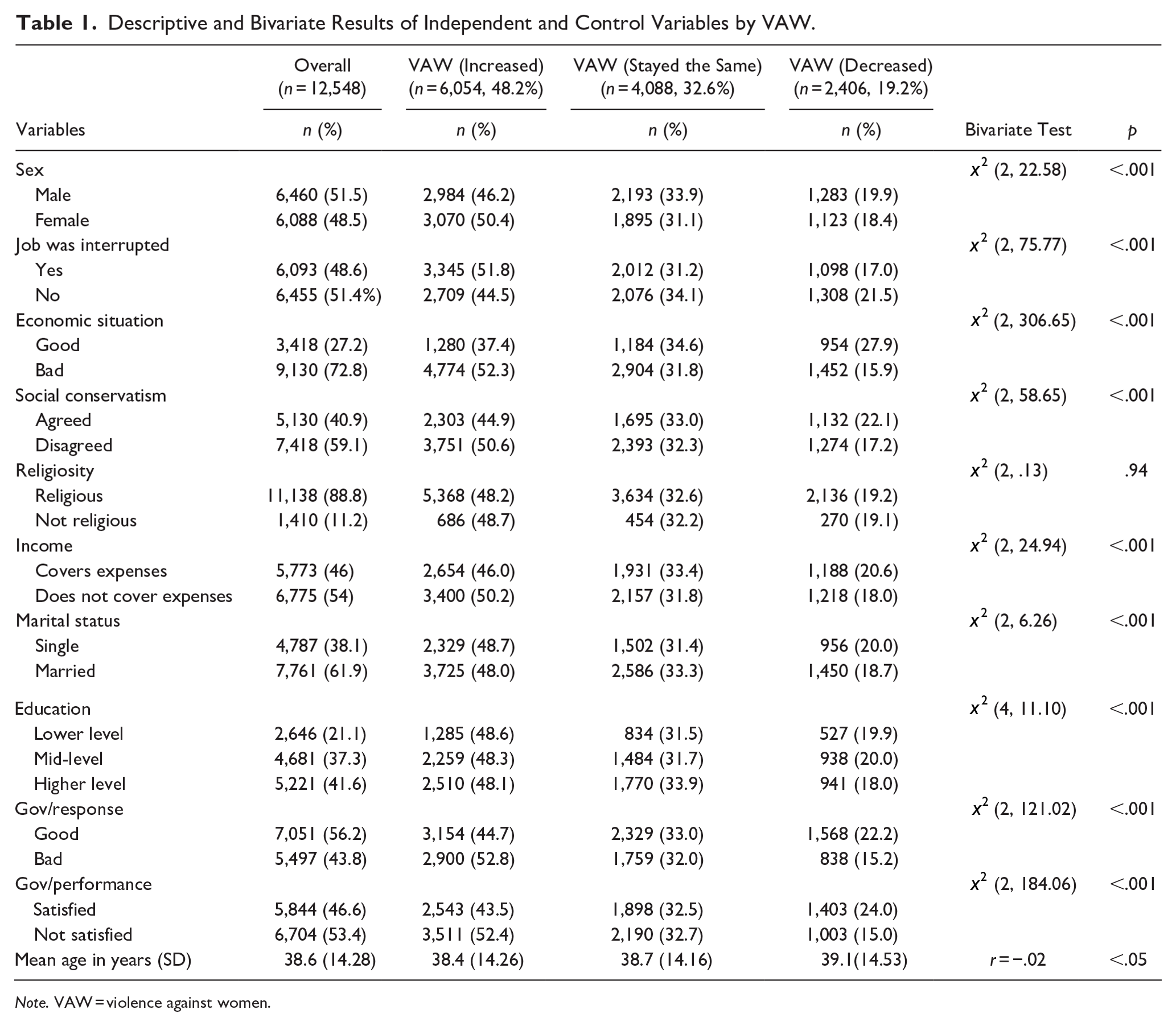
Descriptive and Bivariate Results of Independent and Control Variables by VAW are presented in Table 1.
Descriptive and Bivariate Results of Independent and Control Variables by VAW.
Note. VAW = violence against women.
The final sample (N = 12,548) consisted of 51.5% (N = 6,460) males and 48.5% (6,088) of females. At the individual country level almost, the same percentages were reported. According to the World Bank data (2021), the male and female population of Algeria, Jordan, Lebanon, Libya, Morocco, and Tunisia as a percentage of the total population in 2021 were [(51, 49), (52, 48), (49, 51), (51, 49), (50, 50), and (49, 51)] respectively. Most respondents perceived that VAW had increased (48%) compared with 33% who perceived the VAW stayed the same and 19% who perceived that it decreased. Regarding employment, 49% reported that their employment was interrupted while 73% perceived the economic situation of their countries as bad. Concerning family decisions, 41% of the people in the study felt that a man should have the final say in all decisions regarding the family, and 89% of respondents declared that they were religious. The income of over half the sample (54%) did not cover their expenses.
The majority in the study were married (62%). In terms of educational attainment, 42% had degrees and above, compared to 37% who were educated to secondary and mid-level diploma and 21% with no formal qualification or basic schooling. When asked to evaluate their government’s response to the COVID-19 outbreak, 44% stated the response was bad. Finally, 53% of respondents were dissatisfied with the overall performance of their governments. The average age of respondents was 38.60 (SD = 14.28) with a wide dispersion.
Regarding the religious composition of the sample, the non-Muslim religious groups were underrepresented. This is partly the result of the fact that only 3%–4% of the total population of the MENA region belongs to other religious groups. In Algeria, 99% of the population is Sunni Muslim and only 1% belong to other religious groups (Middle East Action Team, 2022). In Jordan, 97.1% of the population are Sunni Muslims while 2.1% are Christians, and other religious groups make up less than 1% of the population (U.S. Department of State Report, 2021a). Lebanon by far has the largest percentage of Christians in the region (32%), while an estimated 64% of the population are Muslim (32% Sunni and 31.3% Shia) (U.S. Department of State Report, 2021b). In Libya, an estimated 90%–95% belong to the Sunni sect of Islam while between 4.5% and 6% include other religious communities (U.S. Department of State Report, 2021c). In Morocco and Tunisia, an estimated 99% of the population is Sunni Muslim (U.S. Department of State Report, 2021d, 2021e).
Bivariate Findings
We explored the bivariate relationships between the independent variables and the dependent variable. All independent variables were associated with the dependent variable, except religiosity. None of the independent variables had a strong relationship with the dependent variable. The collinearity diagnostics showed no cause for concern.
Multivariate Findings
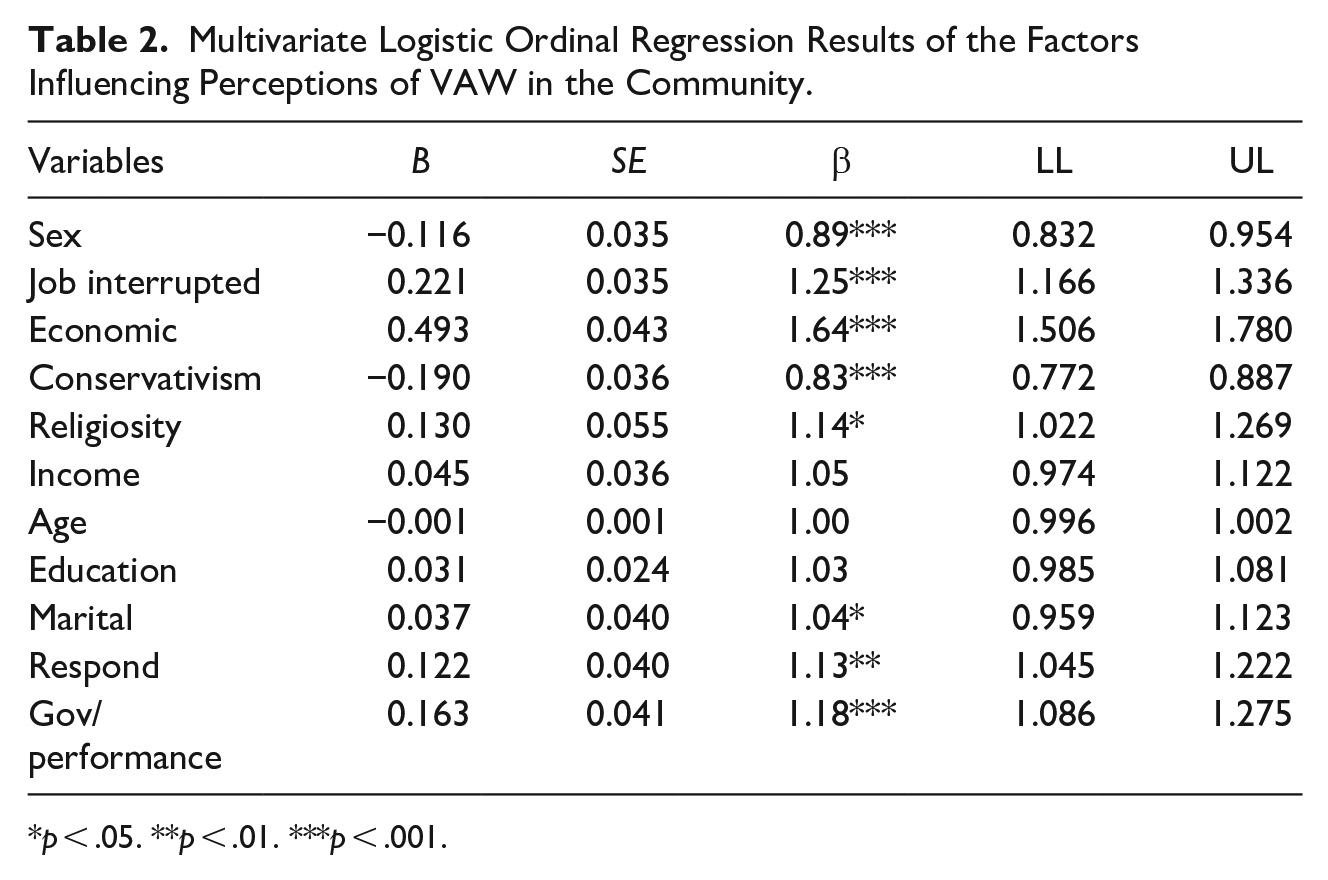
The results of the multivariate logistic ordinal regression model are presented in Table 2.
Multivariate Logistic Ordinal Regression Results of the Factors Influencing Perceptions of VAW in the Community.
p < .05. **p < .01. ***p < .001.
The overall regression model shows that men were 11% less likely to perceive the VAW in the community has increased because of the outbreak compared with women (OR = 0.89, 95% CI [0.832, 0.954]). Respondents whose jobs were interrupted due to the pandemic were 1.25 times more likely to perceive VAW in the community had increased compared to those whose jobs were not affected by the pandemic (OR = 1.25, 95% CI [1.166, 1.336]). The perception of the current economic situation of the country was the strongest predictor as those who perceived the economic situation of the country as bad were 1.6 times more likely to believe that VAW has increased compared to those who perceived the economic situation of the country as good (OR = 1.64, 95% CI [1.506, 1.780]). It was not surprising that social conservatism had a negative association with the dependent variable as social conservatives were 17% less likely to perceive that VAW has increased compared to those who disagreed that a man should have the final say in all decisions concerning the family (OR = 0.83, 95% CI [0.772, 0.887]). By contrast, religious people were 14% more likely to perceive VAW has increased in the community compared to non-religious counterparts (OR = 1.14, 95% CI [1.022, 1.269]). Being married was positively related to respondents perceiving an increase in VAW compared to single individuals (OR = 1.04, 95% CI [0.959, 1.123]). The likelihood of perceiving that VAW increased was 13% higher for the respondents who felt that the government response to the outbreak was bad, compared with the reference category who felt that the government response was good (OR = 1.13, 95% CI [1.045, 1.222]). Similarly, the odds of perceiving that VAW increased was 18% higher for respondents who stated that the overall government performance was bad (OR = 1.18, 95% CI [1.086, 1.275]). Age, education, having children, and family income had no influence.
Discussion
All variables in the model except income, age, and education had an association with the dependent variable. Regarding gender, 50% of females (n = 3,070) perceived an increase in VAW compared to 46% of males (n = 2,984). Those whose Jobs were interrupted by the pandemic were 25% more likely to perceive an increase in VAW, a husband’s unemployment has been identified as a familiar contributing factor to the prevalence of VAW in MENA (Ahmadi et al., 2017; Akar et al., 2010; Mohamadian et al., 2016). The perception of the poor economic situation of the country was the strongest predictor as the COVID-19 pandemic disrupted the economy of the countries in the study. The economy and loss of jobs are not the cause but increase the risk of VAW (Bhalotra et al., 2021a, 2021b; NIJ, 2004; Schneider et al., 2016).
Social conservatives perceived that VAW had decreased during the pandemic. This is not surprising as social conservatism is a key contributing factor to women’s oppression in the MENA region (El Abani & Pourmehdi, 2021; Kposowa & Aly Ezaat, 2019). Nevertheless, religious people were 14% more likely to perceive that VAW increased as a result of the pandemic.
Not having enough income to cover the expenses of the family can be a causal factor of VAW (Conger et al., 1994) because financial insecurity can lead to frustration and a sense of powerlessness in men, fostering violent conduct toward women (Cano & Vivian, 2001; Fox et al., 2002; Jewkes, 2002). However, income in our study was not a significant factor. This was also the case for age as our study did not find a relationship between age and the perception of VAW, although some research show VAW decreases with age (Alijani et al., 2018; Alquaiz et al., 2017; Baran and Gumus, 2017; Eldoseri & Sharps, 2020; Ibrahim et al., 2015). We would have expected younger people to report that VAW had increased.
An extensive body of research has explored the relationship between marital status and VAW (Brown & Bulanda, 2008; Brownridge, 2008; Rennison et al., 2013). The risk of victimization differs with the relationship status (Sinha, 2012; Sutton & Dawson, 2021). It was found that married people were 4% more likely to perceive an increase in VAW during the pandemic.
Respondents who felt that the government response to COVID-19 was bad were 13% more likely to perceive that VAW had increased. Similarly, those who were dissatisfied with the overall government performance were 18% more likely to perceive increased levels of VAW because of the pandemic. The connection between natural disasters and VAW is well documented in the literature (First et al., 2017; Lauve-Moon & Ferreira, 2016; Rezaeian, 2013; Weitzman & Behrman, 2016). Government and disaster management services’ response to disasters is very important in preventing abuse. Disasters increase the vulnerability of women to violence. This is extremely important that government agencies, emergency managers, and community leaders are aware of this, otherwise, they will expose women to further danger (Enarson, 1999; Fothergill, 2008; Phillips, et al., 2010; Wilson, et al., 1998).
In studying MENA countries, attention should be paid to the role of religion, which is the main sociocultural and organizational pillar of the countries in the study. Islamic societies, compared with Western countries, are conservative on matters such as sexuality and gender equality (Norris & Inglehart, 2004). MENA countries are deeply shaped by Islamic principles and tradition (Bowen et al., 2008; Pourmehdi, 2015), and family honor is of paramount importance because the family’s reputation is largely dependent on the behavior of its female members and the chastity of women. Social conservatism highly influences people’s attitudes to gender relations in the region. Religion, social norms, patriarchy, social conservatism, and culture intersect and continue to play an important role in determining the MENA’s attitude toward VAW.
MENA region should develop a stronger prevention and response strategy and integrate it into a comprehensive plan of action that could be used to monitor the prevalence, progress, and gaps in prevention and response to VAW. VAW has overwhelming consequences for the health and well-being of individuals and communities. The MENA must develop reliable measures to collect dependable data on the prevalence of VAW in the region. There is an urgent need for legal reform and the introduction of new measures in the region to protect women. Law enforcement agencies and related institutions need training and awareness of different forms of VAW and develop better procedures and protocols for dealing with the victims, recognition of abuse, and reporting. Khafagy and Abdel Khalik (2021) advocate a zero-tolerance strategy toward VAW and recommend the adaptation of international legal frameworks to national legal standards to protect women from VAW, changing dominant social cultural norms that blame and stigmatize the victims of VAW, by reaching out to “religious/community leaders, academic institutions and actors at grassroots levels” (Khafagy & Abdel Khalik, 2021, p. 7), and engage men in response and prevention projects.
The governments and policymakers in MENA need to raise awareness through campaigns involving celebrities using social media, TVs, radios, and newspapers and should provide hotlines and shelters to support the victims. The awareness campaign could be extended to schools, mosques, and other institutions to gradually change the existing social norms and attitudes of the people in the region.
Limitations
Given the sensitive nature of the question related to the dependent variable, some respondents may have answered the question in a socially desirable fashion, reducing or changing some variability in data. In addition, some respondents might have been the victims or perpetrators of VAW themselves, but there is no way of knowing this.
Religious minorities were drastically underrepresented in the sample, as the non-Muslim religious groups constitute roughly 3%–4% of the total population of MENA. Future studies could benefit from including minority groups in the sample, using disproportionate stratified sampling, and using a booster sample to increase the chance of inclusion of these groups as diversity can improve the value, accuracy, and inclusiveness of the knowledge (Miller et al., 2019).
Future surveys of the region should include more questions related to VAW and develop scale measures to quantify the actual experiences of respondents instead of their perception while being mindful of ethical issues. There is a need for more advanced methodological development to capture all forms of VAW. Depending on the aims of the research, most surveys on VAW could include only women in the study, concentrating on their current and lifetime experience of violence, and recording the number of incidences of violence that have been committed against them.
There is also an urgent need for the development of culturally sensitive research instruments for the study of VAW in patriarchal societies (Kisa et al., 2021). Culturally relevant research could enhance our understanding of issues related to VAW such as barriers to reporting, asking for help, cultural norms, perceptions, etc. (Dong, 2012; Lee et al., 2014). Finally, this research seeks to inform public policy; hence, the findings of this study can be generalized to middle-income and low-income countries in MENA that share similar cultural norms and religious values.
Implications
Exploring correlates of VAW during the pandemic is important because it helps us to develop strategies of prevention during disasters and to improve community and institutional reactions. At the individual level, this may indicate public awareness of the problem, its spread and intensity, and its threat to the community (Gracia et al., 2009; Gracia & Tomas, 2014). Consequently, it may shape both public and institutional attitudes to VAW.
Conclusion
We explored the factors influencing the perception of VAW in the MENA in the aftermath of the COVID-19 pandemic using Arab Barometer data wave VI, using an ordinal logistic regression model. Most people in the study perceived that VAW in the community had increased. Losing one’s job, the poor economic situation of the country, religiosity, marital status, government response to the pandemic, and overall government performance were positively correlated to the perception that VAW had increased because of the COVID-19 pandemic. By contrast, gender and social conservatism were negative predictors of whether VAW was perceived as increased because of the pandemic while income, age, and education were found to be insignificant predictors.
Footnotes
Declaration of Conflicting Interests
The author(s) declared no potential conflicts of interests with respect to the authorship and/or publication of this article.
Funding
The author(s) received no financial support for the research and/or authorship of this article.
