




Abstract
The purpose of this study was to explore U.S. parents’ and caregivers’ understanding about children’s bullying—what bullying is and how to address it. We analyzed 2017, 2018, and 2019 Fall ConsumerStyles online panel survey data from U.S. parents/caregivers of children ages 10 to 17 years (N = 1,516), including 20 items representing statements consistent or inconsistent with the bullying prevention evidence and best practices. Percentage of endorsement for each item and a summary measure of understanding about bullying were calculated. The association between low overall understanding about bullying and sociodemographic characteristics was explored. Most parents identified bullying as harmful (77%), repetitive (63%), and involving power imbalance (51%). At least half of parents answered 13 or more items (20 total) consistent with the bullying prevention evidence or best practices. Being male, non-Hispanic Black or Hispanic, having high school or less education, and small household size were associated with higher odds of low overall understanding about bullying. Awareness of parents’ understanding about bullying and how to appropriately address it is vital for bullying prevention. Findings can inform the strategic development of bullying prevention health messages for parents.
Introduction
Bullying, a type of youth violence and adverse childhood experience (Centers for Disease Control and Prevention (CDC), 2019), is defined as “any unwanted aggressive behavior(s) by another youth or group of youths who are not siblings or current dating partners that involves an observed or perceived power imbalance and is repeated multiple times or is highly likely to be repeated” (Gladden et al., 2013). A notable proportion of United States (U.S.) youth report experiencing bullying. Analysis of the 2019 Youth Risk Behavior Survey data estimates that 19.5% of U.S. high school students were bullied on school property, and 15.7% of them were bullied electronically during the prior 12 months (Basile et al., 2020). School staff are often unaware of bullying incidents in schools. Analyses of the 2017 School Crime Supplement to the National Crime Victimization Survey data revealed that only 46% of public-school students ages 12 to 18 who reported being bullied at school told school staff about it (U.S. Department of Justice & Bureau of Justice Statistics, 2017).
Beyond school staff, parents and caregivers (hereafter parents) can play a key role in bullying prevention and help moderate the harmful effects of bullying on children (David-Ferdon et al., 2016). In fact, parent’s discussion with children about bullying has been found to be a protective factor against bullying (Chen et al., 2021), and parenting components of bullying prevention interventions have been found to significantly reduce bullying in children (Chen et al., 2021; Huang et al., 2019; Ttofi & Farrington, 2011). Furthermore, parents’ understanding, perceptions, and beliefs about bullying and peer victimization may impact how they react to it (Waasdorp et al., 2011), and moderate children’s peer victimization and psychological adjustment (Troop-Gordon & Gerardy, 2012). As such, understanding what parents know about bullying (e.g., it has definition, types, reasons for being bullied) and how to address it, as well as differences in understanding across parent subgroups, is important for the development and selection of appropriate, parent-focused prevention strategies and approaches that can be tailored to specific parent audiences for increased reach and acceptability.
Unfortunately, despite the importance of parents in bullying prevention, data on parents’ understanding about bullying is scarce (Sawyer et al., 2011). A systematic review about the role of contextual family, relational and parental processes on bullying (1970 through November 2017) found that only 8% of studies (n = 12) focused on parents’ beliefs, knowledge, and self-efficacy factors pertaining bullying and peer victimization (Nocentini et al., 2019). Existing published research typically focuses on bullying’s definition (e.g., Smorti et al, 2003) is based on mostly qualitative or small sample studies (e.g., Claes et al., 2015; Malm et al., 2016; Polanin et al., 2012; Sawyer et al., 2011; Stives et al., 2019; Williams, 2008; Yoon & Barton, 2008), or not specific to U.S. parents (e.g., Eslea & Smith, 2000; Offrey & Rinaldi, 2014; Smorti et al, 2003). Furthermore, gaps remain in parents’ differential understanding about bullying and the effectiveness of prevention efforts across sociodemographic subgroups (Huang et al., 2019).
Study Purpose
This study aimed to depict U.S. parents’ (from here on parents) understanding of what is bullying and how to appropriately address it. Additionally, differences in understanding about bullying by parents’ sociodemographic characteristics were assessed to identify parent subgroups with increased need for bullying prevention awareness efforts. Findings can inform the strategic development of health education and communication messages for parents on how to prevent and address children’s bullying.
Methods
ConsumerStyles is a series of seasonal surveys conducted by Porter Novelli Public Services via KnowledgePanel®—the largest probability-based online panel in the U.S. (Porter Novelli, n.d.-a). It is designed to be representative of the non-institutionalized, adult U.S. population ages 18 or older in the 50 states and D.C., with respect to broad geodemographic characteristics (IPSOS, n.d.-a, n.d.-b, n.d.-c; MacInnis et al., 2018; Yeager et al., 2011) (also Deanne Weber, PhD/Porter Novelli Public Services, written communication, April 2020). KnowledgePanel® has around 60,000 members (IPSOS, n.d.-c), who are provided with internet access if needed for participation (Weber & Fridinger, 2021). Its address-based sampling patented methodology is based on a probability proportional to size procedure that helps ensure that its samples behave as if each member of the population had equal chance of being selected (i.e., equal probability selection method) (IPSOS, n.d.-a, n.d.-b). As incentive for participation, active KnowledgePanel® members are eligible for a $5 to $10 value incentive, special raffles, and/or sweepstakes (IPSOS, n.d.-a).
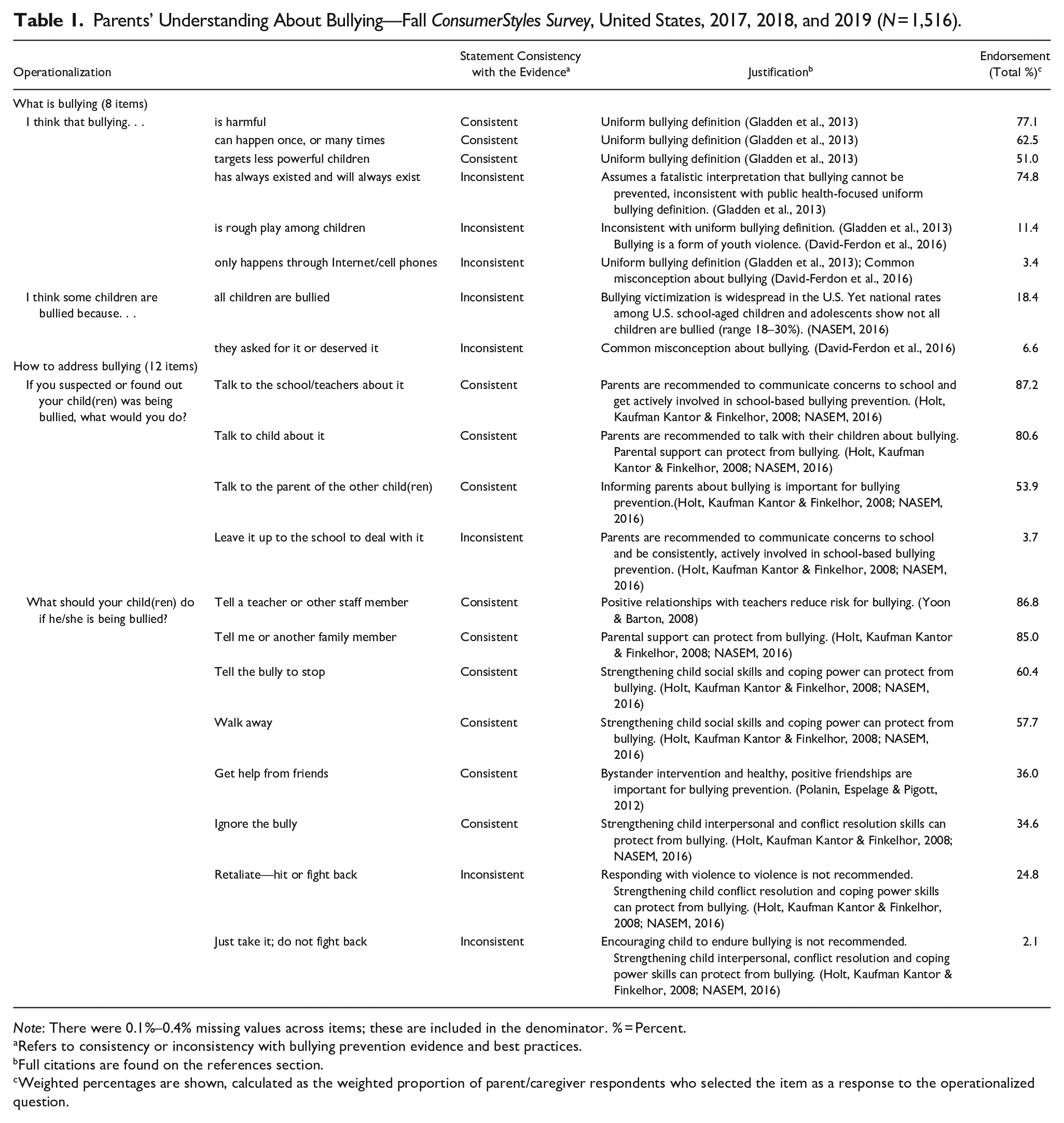
This study consists of the secondary analysis of 2017, 2018, and 2019 Fall ConsumerStyles survey data (N = 3,547, N = 3,561, and N = 3,624, respectively), employing sample weights provided by KnowledgePanel® to reflect the geodemographic composition of the population it represents. Response rates for the 2017, 2018, and 2019 Fall ConsumerStyles surveys were 77%, 79%, and 78%, respectively (Porter Novelli, n.d.-b). Specifically, this study focuses on respondents who self-identified as parents of children ages 10 to 17 years during each of the survey years (n = 611, n = 465, and n = 400, respectively; de-duplicating respondents to keep the earliest response submitted by same respondents across different survey years; total n = 1,516), who answered 20 survey items to self-report their understanding of what is bullying and how to address it. These items represent statements that are consistent (12 items) or inconsistent (8 items) with CDC’s uniform bullying definition (Gladden et al., 2013), prior research on bullying and the best available evidence for its prevention (Table 1) (David-Ferdon et al., 2016; Gladden et al., 2013; Holt et al., 2008; National Academies of Sciences, 2016; Polanin et al., 2012; Yoon & Barton, 2008).
Parents’ Understanding About Bullying—Fall ConsumerStyles Survey, United States, 2017, 2018, and 2019 (N = 1,516).
Note: There were 0.1%–0.4% missing values across items; these are included in the denominator. % = Percent.
Refers to consistency or inconsistency with bullying prevention evidence and best practices.
Full citations are found on the references section.
Weighted percentages are shown, calculated as the weighted proportion of parent/caregiver respondents who selected the item as a response to the operationalized question.
The percentage of endorsement for each item was calculated. Endorsing an item consistent with the bullying prevention evidence and/or not-endorsing an item that is inconsistent with the evidence meant the parent self-reported understanding about bullying. A summary measure (referred to as summary score) of self-reported understanding about bullying was calculated for each respondent, out of the total 20 items. Summary scores were not calculated for respondents with missing values on any item (n = 11, <1% of respondents across the three survey years). Based on the quartiles for the distribution of the summary scores, parents whose scores were below the lower quartile (<60% or <12 out of 20 items) were considered to have low self-reported understanding about bullying.
The association between low self-reported understanding about bullying and parents’ sociodemographic characteristics (i.e., age, sex, race/ethnicity, education, household income, marital status, working status, rental status, family size) was further explored using fully adjusted multivariate logistic regression models. We selected the lower quartile group as the outcome measure as this group may benefit the most from specific public health outreach to improve their understanding of bullying. Beyond describing parent respondents, the sociodemographic characteristics considered for this multivariate analysis were characteristics that could inform audience segmentation for bullying prevention and intervention efforts, given existing differences in bullying’s impact across population groups (Clayton et al., 2023; NASEM, 2016) and gaps in the differential understanding about bullying among parents.
Weights were applied to all descriptive analyses. Logistic regression analyses were based on unweighted data, given survey design variables were not available to account for sampling methods.
Results
Parents’ Sociodemographic Characteristics
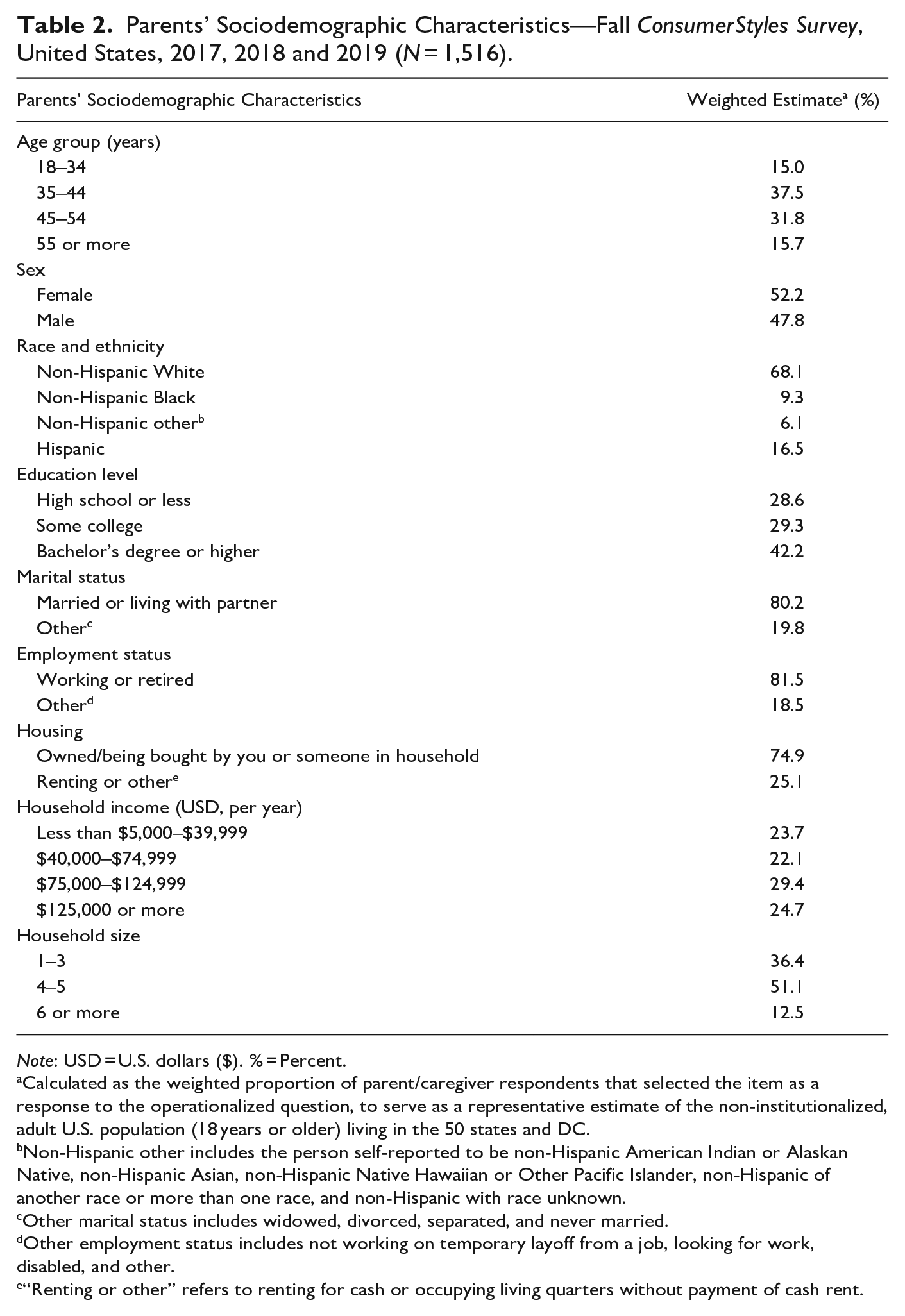
Most parents self-reported to be 35 to 44 or 45 to 54 years old (37.5% or 31.8%, respectively), female (52.2%) and non-Hispanic White (68.1%). Over one-quarter (28.6%) of parents reported having completed high school or less, and 42.2% of parents had a bachelor’s degree or higher. Most parents were married or living with a partner (80.2%). Similarly, most parents reported that they were working or retired (81.5%). Nearly half of all parents reported an estimated household income of less than $75,000 per year (45.8%), and over half lived in a 4 to 5 people household (51.1%). Most parents reported to be homeowners (74.9%) (Table 2).
Parents’ Sociodemographic Characteristics—Fall ConsumerStyles Survey, United States, 2017, 2018 and 2019 (N = 1,516).
Note: USD = U.S. dollars ($). % = Percent.
Calculated as the weighted proportion of parent/caregiver respondents that selected the item as a response to the operationalized question, to serve as a representative estimate of the non-institutionalized, adult U.S. population (18 years or older) living in the 50 states and DC.
Non-Hispanic other includes the person self-reported to be non-Hispanic American Indian or Alaskan Native, non-Hispanic Asian, non-Hispanic Native Hawaiian or Other Pacific Islander, non-Hispanic of another race or more than one race, and non-Hispanic with race unknown.
Other marital status includes widowed, divorced, separated, and never married.
Other employment status includes not working on temporary layoff from a job, looking for work, disabled, and other.
“Renting or other” refers to renting for cash or occupying living quarters without payment of cash rent.
What is Bullying
Most parents self-reported understanding what is bullying (Table 1). They understood that bullying is harmful (77.1%), a repetitive behavior (62.5%; “can happen once, or many times”), and that it involves power imbalance (51.0%; “targets less powerful children”). Most parents thought bullying cannot be eliminated (74.8%; “has always existed and will always exist”). Few parents asserted that “all children are bullied” (18.4%), or that bullying is “rough play among children” (11.4%), which is inconsistent with the bullying prevention evidence.
How to Appropriately Address Bullying
In terms of parents’ understanding on how to address their child being bullied, most parents would appropriately talk to school/teachers (87.2%) or the child (80.6%), and over half would talk to the other children’s parents (53.9%). Most parents reported consistency with the bullying prevention evidence and best practices on what to recommend their children do if they are being bullied, such as telling a teacher or staff member (86.8%) or parents/family member (85.0%). More than half would recommend their child tell the one bullying to stop (60.4%) or walk away (57.7%). Alternatively, two-thirds of parents did not acknowledge other evidence-based skills for children to respond to bullying (e.g., getting help from friends, 36.0%; and ignoring bullying, 34.6%). About one in four parents (24.8%) would tell their children to retaliate or hit back, inconsistent with bullying prevention best practices (Table 1).
Parents’ Overall Understanding About Bullying
Parents had different levels of understanding about bullying, represented in the Figure as being in the upper quartile (75.0%; at least 15 out of 20 items), median (65.0%; 13 out of 20 items), or lower quartile (60%; equal or less than 12 out of 20 items). Parents in the lower quartile were considered to have low overall self-reported understanding about bullying, given their limited endorsement of items that are consistent with the bullying prevention evidence and/or their endorsement of items that are inconsistent with the evidence (Figure 1)
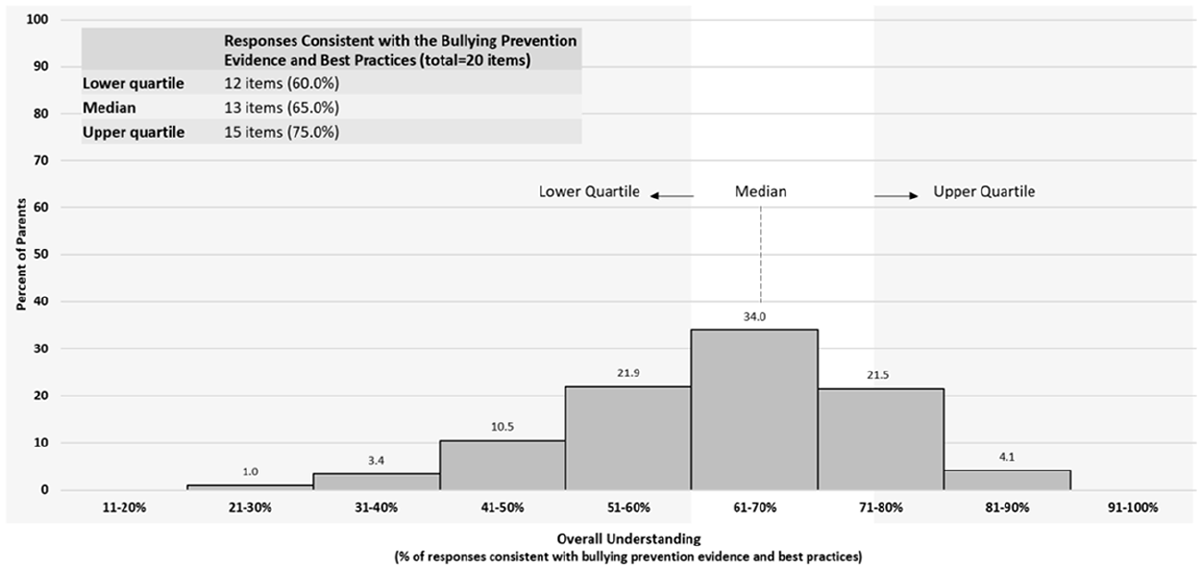
Weighted distribution of summary score of parents’ self-reported understanding about bullying—Fall ConsumerStyles Survey, United States, 2017, 2018 and 2019 (N = 1,516).
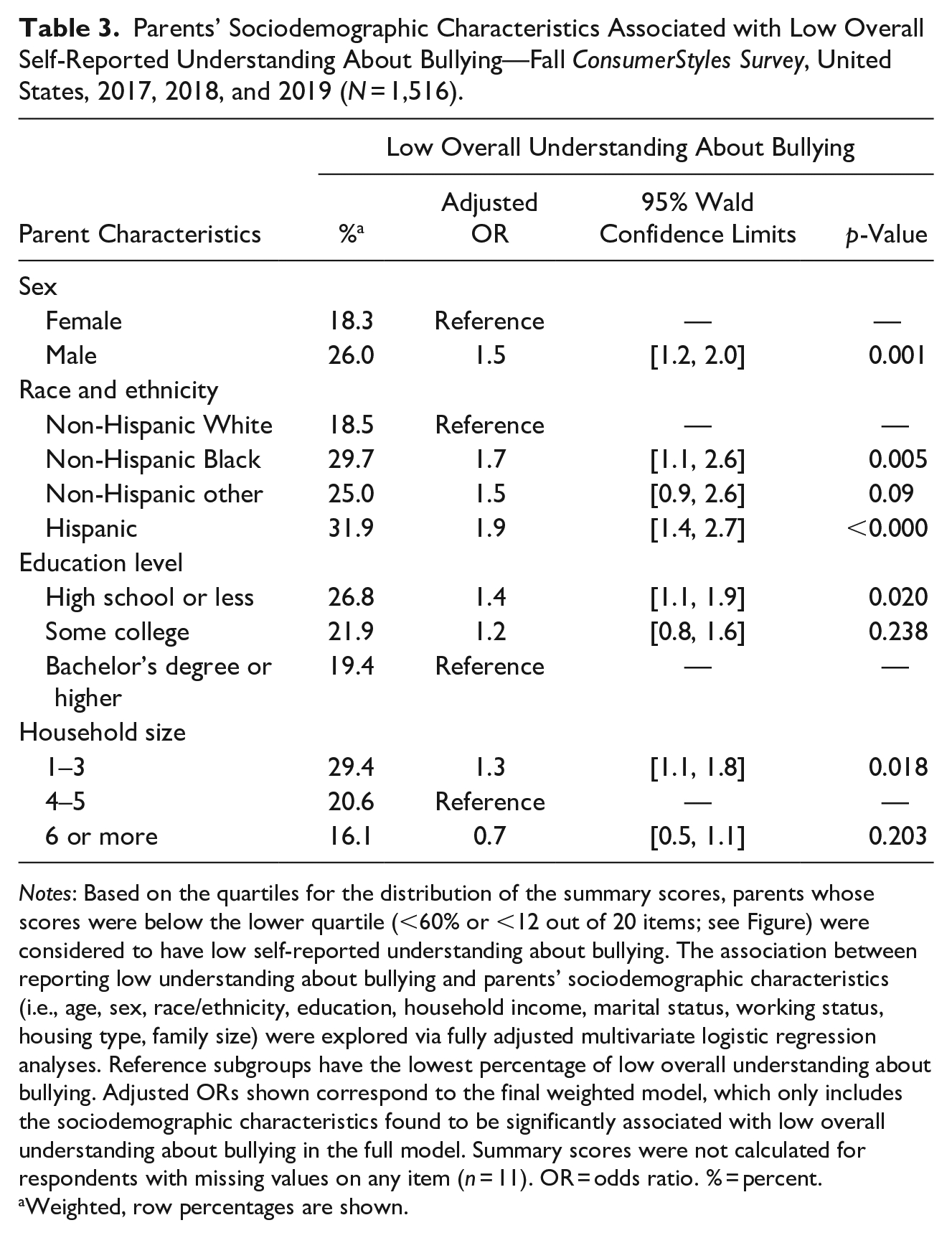
Male parents had significantly higher odds than female parents of having low overall understanding about bullying (Adjusted odds ratio [AOR] = 1.5, p < 0.001). Parents who self-identify as non-Hispanic Black (AOR = 1.7, p = 0.005) and Hispanic (AOR = 1.9, p < 0.000) had higher odds for low understanding about bullying, compared to parents who self-identify as non-Hispanic White. Higher odds for low understanding about bullying were also observed for parents with a high school education or less (AOR = 1.4, p < 0.020) and parents who live in households with 1 to 3 members (AOR = 1.3, p = 0.018) (Table 3). Parents’ household income, marital status, working status, and rental status were not significantly associated with low self-reported understanding about bullying.
Parents’ Sociodemographic Characteristics Associated with Low Overall Self-Reported Understanding About Bullying—Fall ConsumerStyles Survey, United States, 2017, 2018, and 2019 (N = 1,516).
Notes: Based on the quartiles for the distribution of the summary scores, parents whose scores were below the lower quartile (<60% or <12 out of 20 items; see Figure) were considered to have low self-reported understanding about bullying. The association between reporting low understanding about bullying and parents’ sociodemographic characteristics (i.e., age, sex, race/ethnicity, education, household income, marital status, working status, housing type, family size) were explored via fully adjusted multivariate logistic regression analyses. Reference subgroups have the lowest percentage of low overall understanding about bullying. Adjusted ORs shown correspond to the final weighted model, which only includes the sociodemographic characteristics found to be significantly associated with low overall understanding about bullying in the full model. Summary scores were not calculated for respondents with missing values on any item (n = 11). OR = odds ratio. % = percent.
Weighted, row percentages are shown.
Discussion
This study’s findings suggest that most U.S. parents can identify key definitional aspects of children’s bullying—such as it being harmful, repetitive, and involving power imbalance. However, opportunities remain to improve their understanding of what is bullying and how to appropriately address it among some parent subgroups (e.g., males, racial/ethnic minority groups, and the with lower education levels). Additional research is needed to explain the differences in understanding about bullying found among some U.S. parent demographic subgroups, and how it relates to existing differential bullying experiences across some child demographic subgroups; although research suggests some child subgroups are at increased risk for bullying victimization, gaps remain in understanding bullying’s differential impact across racial/ethnic and other sociodemographic subgroups (NASEM, 2016).
The findings of this study are subject to at least five limitations. First, online survey panel participants could be systematically different from the general population. This is a possibility, even though the address-based probability methods employed by KnowledgePanel® (IPSOS, n.d.-a, n.d.-b, n.d.-c; Novelli, n.d.-a; Weber & Fridinger, 2021) have demonstrated high accuracy in producing nationally representative estimates of the non-institutionalized U.S. population when compared to sociodemographic benchmarks from federal, high-response rate surveys like the Current Population Survey (MacInnis et al., 2018; Yeager et al., 2011). Second, self-reported responses may be subject to social desirability bias. This form of response bias may be minimal given the survey was completed online. Third, the study sample may not have statistical power to detect differences in low overall accuracy in self-reported understanding about bullying among some demographic subgroups. Fourth, an additional limitation is related to parents’ endorsement of the item that read “Bullying has always existed and will always exist,” endorsed by 74.8% of parents. Additional research may be needed to understand whether parents interpreted this survey item in absolute terms (e.g., bullying can never be eliminated) versus a prevention-possible perspective (i.e., bullying can be prevented).
Finally, parents self-reported only on their understanding about their child(ren)’s bullying victimization, not perpetration. Notwithstanding, the findings reported provide a general view of U.S. parents’ understanding about bullying, a topic which has not been fully explored and is understood mostly through qualitative or small sample studies (e.g., Claes et al., 2015; Malm et al., 2016; Polanin et al., 2012; Sawyer et al., 2011; Stives et al., 2019; Williams, 2008; Yoon & Barton, 2008). It is also important to consider that these data were collected prior to the COVID-19 pandemic and implementation of its mitigating measures (e.g., stay at home orders, physical distancing, virtual learning). Changes in parents’ concern about children’s bullying were documented during this time (Benatov, 2019). Additional research is recommended to explore whether changes in parents’ concern about bullying could have also resulted in changes in parents’ understanding about bullying. Notwithstanding, these findings have important implications for public health communication and education programs and products and suggest the need for tailored messages that directly address parents’ gaps in their understanding of bullying.
Public Health Implications
Bullying is a preventable form of youth violence and an adverse childhood experience. Beyond school staff, parents and caregivers can play a key role in bullying prevention. In fact, parents’ understanding, skills, feelings, and perceptions about bullying are critical in their ability to respond to and prevent bullying (Benatov, 2019; Claes et al., 2015; David-Ferdon et al., 2016; Midamba & Moreno, 2019; Stives et al., 2019).
This study reports U.S. parents’ understanding of what is bullying and how to appropriately address it, which has implications for public health research and practice. While parental components in bullying prevention programs have been found to have significant impacts in bullying reduction (Chen et al., 2021; Huang et al., 2019; Ttofi & Farrington, 2011), gaps remain in the understanding of the possible differential effectiveness of distinct parental program components and challenges in their implementation (Huang et al., 2019). For instance, this study found that although parents accurately report that telling a trusted adult is an action children can take when experiencing bullying, parents also report lower levels of knowledge about bystander prevention strategies and actions that children can take to intervene or help their peers. This represents an important opportunity for parents to change social norms about bullying among children; additional research is needed.
Also, this study’s findings may also help inform the types of programs that may be most needed across different parent audiences, as well as program areas which may need to be strengthened. This is supportive of health equity principle of measuring differences in health and its determinants across different population groups, to inform prevention and health promotion efforts (Penman-Aguilar et al., 2016). Additional research is needed to understand the drivers of differences in concern about bullying by parents’ sociodemographic characteristics considered in this study.
Furthermore, findings suggest that public health messaging could enhance knowledge on what bullying truly is and build skills on how parents and children can respond to bullying. Communications efforts could promote bystander (or upstander) prevention strategies that (a) change social norms about bullying among children, and (b) empower children to speak up if they see bullying happening. Public health practitioners could employ audience segmentation strategies to tailor bullying prevention messages to parents—especially for parents who are younger, male, or of lower educational attainment—to increase awareness and to encourage their reinforcement of proven prevention strategies and fostering resilience. Future research efforts could focus on testing prevention messages with parents from racial and ethnic minority groups to better understand potential differences in language used around bullying, and different perceptions of bullying. It is also important to continue efforts to sustain overall parents’ understanding on what bullying is and what it is not, via evidence-based prevention strategies and interventions (David-Ferdon et al., 2016), including health communications. Additional research is needed to better understand the most appropriate channels for distributing bullying prevention messages to parents of school-aged children.
Footnotes
Acknowledgements
We would like to thank Deanne Weber, PhD—Strategic Planning, Analytics, and Research, Porter Novelli Public Services; Linda Dahlberg, PhD (retired) and Alberto M. Santana, MS—Division of Violence Prevention, National Center for Injury Prevention and Control (NCIPC), CDC; Deborah M. Stone, ScD, and Margaret Melissa Brown, PhD (formerly)—Division of Injury Prevention, NCIPC, CDC; Fred Fridinger, DrPH—Office of the Associate Director of Communications, CDC; and Naayab Nazir Ladak—Oak Ridge Institute for Science and Education (ORISE) for their support in this work.
Disclaimer
The findings and conclusions in this report are those of the authors and do not necessarily represent the official position of the Centers for Disease Control and Prevention.
Declaration of Conflicting Interests
The authors declared no potential conflicts of interests with respect to the authorship and/or publication of this article.
Funding
The authors received no financial support for the research and/or authorship of this article.
Human Participation Protection
The analysis was based on de-identified, secondary statistical data. As such, the study was ruled exempt from Institutional Review Board review.
