



Abstract
Increased access to information online (e.g., social media) provides opportunities for exposure to rape myths (i.e., false beliefs about incidents of sexual assault). Social media, in particular, may serve a critical role in shaping rape culture. Thus, it is important to identify ways to assess online exposure to rape myths, especially given the influence online exposure may have on offline behaviors. Data were analyzed from 2,609 18–25-year-old participants (mean age = 20.9 years; 46.1% male; 71.6% White) recruited in 2017 through social media to complete an online survey on experiences and perceptions of sexual violence. We used exploratory and confirmatory factor analyses (EFA, CFA) to evaluate the relatedness of nine items adapted to reflect rape myths posted by friends on social media. We split the sample into training (50%) and testing (50%) sets for the EFA and CFA, respectively, then evaluated the correlation between experiences of sexual violence, substance use, and social media use and exposure to online rape myths. Eigenvalues (1-factor: 5.509; 2-factor: 0.803; 3-factor: 0.704; 4-factor: 0.482), factor loadings, fit statistics (RMSEA: 0.03; CFI: 0.99; TLI: 0.99; SRMR: 0.057), interpretability, and existing theory supported a 1-factor solution, which was supported by CFA fit statistics (RMSEA: 0.021; CFI: 0.99; TLI: 0.99; SRMR: 0.038
Rape myths refer to widely held false beliefs about incidents of rape and may include stereotyped beliefs about victims or perpetrators of rape (Burt, 1980). Examples of rape myths include the idea that a victim “asked for it” (e.g., if someone is raped while drunk, they are somewhat responsible) and the perpetrator “didn’t mean to” (e.g., rape usually happens because of a man’s strong desire for sex; McMahon & Farmer, 2011; Payne et al., 1999). Greater belief in rape myths can have harmful consequences, including unfavorable attitudes toward victims of rape or sexual assault (Fansher & Zedaker, 2022; Russell & Hand, 2017) and greater misperceptions of sexual intent (Wegner et al., 2015), which can lead to sexual coercion (Farris et al., 2008). Though rape myth endorsement had previously been found to not be associated with rape victimization (Carmody & Washington, 2001), in more recent work rape myth endorsement was found to be negatively associated with prior rape victimization (Vonderhaar & Carmody, 2015). Researchers postulate that the inverse association could suggest positive societal changes whereby individual victims understand that victimization is not their fault. Additionally, in a recent systematic review, rape myth acceptance positively predicted male-to-female sexual violence behaviors (Yapp & Quayle, 2018).
Rape Myths and Gender
Given the health, psychological, and social consequences of sexual violence, it is important to identify factors related to rape myth exposures (Basile et al., 2016). For example, researchers have found differential endorsement of rape myths by gender, with male-identifying persons reporting higher endorsement of rape myths as compared with female-identifying persons (Suarez & Gadalla, 2010). Though males are more likely to accept rape myths, males and females who accept rape myths are more likely to report perpetration of sexually coercive behaviors as compared to those reporting lower endorsement of rape myths (Trottier et al., 2021). While understanding differences by gender is important, much of the literature on rape myths has focused on binary gender and male-to-female dynamics and thus failed to yield information on individuals who identify beyond the binary construction of gender (e.g., trans, non-binary, agender, etc.; Longpré et al., 2022; Olszewska et al., 2023; Wilson & Newins, 2023). This is a major limitation given the disproportionate risk of sexual violence exposure for individuals who identify outside of binary gender (Flores et al., 2021). As such, new measurement development or existing measure refinement should be inclusive of non-binary gender identities.
Rape Myths and Substance Use by Age
The majority of men and women who will experience sexual violence have their initial exposure prior to the age of 25 years (Centers for Disease Control and Prevention, 2022), with preliminary data suggesting a similar trend for non-binary identifying individuals (James et al., 2016). However, risk of sexual violence exposure prior to the age of 25 years is not constant but has a curvilinear relationship with age (Boakye, 2009). In light of the curvilinear risk and that the majority of sexual violence occurs prior to the age of 25 years, understanding aspects of rape myths is particularly important between the ages of 18 to 25 years (Basile et al., 2016).
Emerging adulthood (corresponding to the age of 18–25 years) is also a developmental period with higher reports of substance use including the highest prevalence of past-month binge drinking, heavy alcohol, marijuana, cocaine, hallucinogen use, and past-year prescription stimulant misuse (Center for Behavioral Health Statistics and Quality, Substance Abuse and Mental Health Services Administration, 2021). Alcohol consumption is an important risk factor to understand in relation to rape myths, not only because it is a risk factor for sexual violence (Anderson et al., 2017), but also given prior literature which has shown a positive association between rape myths, greater consumption of alcohol, and greater frequency of high-risk drinking (Dworkin et al., 2017; Navarro & Tewksbury, 2017). A further potential consideration when examining rape myth exposure and substance use are changes in perceptions capability and event responsibility for both the victim and perpetrator when either or both are intoxicated by alcohol, marijuana, or illicit substances (Grubb & Turner, 2012; Qi et al., 2016). As substance use behaviors are more common in emerging and early adulthood and increase the risk of rape myths and sexual violence, they are important to include when studying rape myths.
Contextualizing Features of Contemporary Emerging Adults: The Importance of Online Spaces
While beliefs are formed through a multitude of exposures and interactions, the influence of peers on individual beliefs and behaviors increases throughout adolescence into emerging adulthood as individuals take on more autonomy and independence, rely less on caregivers, and become responsible for interpersonal relationships (Collins & Steinberg, 2006; Ellis & Dumas, 2018). Individuals often hold beliefs similar to their peer groups’ (Brechwald & Prinstein, 2011), resulting in clustering of beliefs and behaviors within social networks (Banyard et al., 2022). The influence of peers extends through highly distal relationships (Weigard et al., 2014), including those seen in online spaces such as social media. Though conversations around rape myths have historically occurred in private spaces (e.g., small group conversations; Stubbs-Richardson et al., 2018), far less is known about ideas and myths around rape expressed in online spaces.
Although the first iPhone debuted in 2007, recent data show that 96% of 18- to 29-year-olds in the United States own a smartphone (Perrin, 2021). Emerging adults spend, on average, more than 25 hours per week on their phones (Wagner et al., 2021), with those reporting a greater number of social media accounts spending more time on social media (Len-Ríos et al., 2016). As people easily share and receive information regardless of geographic location (Paat & Markham, 2021), research examining the positive and negative influences of online information and social interactions is nascent (Alkhamees et al., 2021; Masrom et al., 2021; Moorhead et al., 2013). Previous generations accessed information through newspapers or books (Twenge et al., 2019), but now online resources are major sources of news and information (Mitchell et al., 2021; Walker, 2022). False, sensationalized information is prevalent in online spaces and spreads much faster than online factual information (Vosoughi et al., 2018). Despite being confident in their abilities to spot false news, many U.S. adults are unable to identify nonfactual information, which makes them more likely to share unsubstantiated information (Lyons et al., 2021).
While less is known about how rape myths are communicated in the online space, there is ample evidence of online communication about violence including the perpetuation of fictitious information and spreading of discriminatory views relative to gender, sexuality, and violence (Suzor et al., 2019). For example, a study examining the content of Twitter posts found that, compared to messages with victim-supporting content, messages with victim-blaming content were more influential as measured by the number of retweets and followers (Stubbs-Richardson et al., 2018). Actively seeking highly violent material within online forums is associated with increased extremist attitudes in online and offline spaces, and with committing physical identity-based violence (e.g., neo-Nazi racially motivated violence; Hassan et al., 2018). Certain online forums have also been linked to gender-based violence (O’Malley et al., 2022; Witt, 2020). Less extreme forms of misogyny and gender-based violence are also prevalent in online spaces, increasing the likelihood of both intentional (active searching) and unintentional (passive) exposure (Barker & Jurasz, 2019; Hassan et al., 2018; Jones et al., 2020; Moloney & Love, 2018). Further research is needed in this area to understand both broad and specific forms of violence expression (Lewis et al., 2017).
Identifying a tool which can be used to evaluate exposure to online rape myths within an emerging adult population is important given the role of social media in the lives of emerging adults (Auxier & Anderson, 2021), including for socializing and obtaining information Walker & Matsa, 2021). For instance, almost a quarter of 18- to 29-year-olds report changing their mind on a social issue due to something they saw on social media (Bialik, 2018), a trend that appears to be increasing (Perrin, 2020). Thus, online portrayals may have a significant impact, particularly given the large proportion of emerging adults who use the online space, and the substantial proportion who can be influenced by information they see within these platforms.
Current Study
The present study aims to explore the existence of emerging adults’ self-reported passive exposure to online rape myths posted by friends (salient influencers of emerging adults’ behaviors), to examine the initial psychometrics of an evaluation tool of online rape myth exposure to inform future research, and to explore correlates of online rape myth exposure with other risk behaviors and characteristics (attempted rape perpetration and misperception of sexual intent resulting in assault, rape victimization, number of social media accounts, substance use, sex, gender, and age) to inform future interventions.
Methods
Study Design, Data Sources, and Study Sample
Data are drawn from an online survey about emerging adults’ sexual violence experiences administered in 2017 (procedures approved by the Institutional Review Board at the University of Michigan). We used Facebook and Instagram advertisements targeted to 18- to 25-year-olds nationally in the United States to recruit individuals to complete a 15 to 20-minute survey containing items described below. Following survey completion, participants could provide contact information and be entered to win one of four $75 Amazon.com gift cards. Specific details of recruitment are described elsewhere (see Bonar et al., 2021).
Of the 6,115 participants who initiated the survey, 4,010 completed the entire survey. Of the 4,010 participants, 2,848 (71.02%) indicated they had seen sexual content posted on social media by a friend and thus were asked questions related to online rape myths; of the 2,848, 91.6% (n = 2,609) had complete covariate data and were thus included in the present study.
Measures
Electronic Rape Myths
We modified nine items from the Illinois Rape Myth Acceptance (IRMA) scale (original and updated versions; McMahon & Farmer, 2011; Payne et al., 1999) to assess exposure to rape myths via social media. A team of experts in sexual violence research among emerging adults reviewed and selected items from each IRMA Short-Form subscale to include in the study survey. The team chose items based on several facets, including subscale factor loadings, ability to extrapolate the original item concept to the social media context, ability to modify the item to reflect gender nonspecific language (e.g., “girl” or “guy” were changed to “person”), scale brevity (i.e., concern for participant burden), and relevance to future interventions. We chose multiple items from the “she asked for it” subscale to reflect substance use, communication, and clothing, given that these may serve different points of intervention. We first asked participants to indicate how often they had seen their friends post or share content on social media about sexual assault in the past 6 months, with options of “Never,” “Once or Twice,” “Monthly,” “Weekly,” “Daily or almost daily,” and “Several times a day.” Then, participants who reported seeing sexual assault content on social media at least once in the past 6 months were asked to complete the nine items regarding online rape myth exposure. Specifically, they were asked (yes/no) to indicate whether their friends had posted anything on social media in the same time frame that supported each item (e.g., “people who were raped tend to exaggerate how much rape affects them” and “many people secretly desire to be raped”). A full list of items can be found in Table 1.
Descriptive Statistics of Rape Myth Items, Rape Myth Scale, and Regression Model Covariates (N = 2,609).

Additional Covariates
Attempted Rape Perpetration
We asked participants the following item to characterize attempted rape perpetration: “Since you turned 16, how many times have you tried to have sex with someone age 16 or older when you knew that they did not want to have sex?” (Ybarra et al., 2014). They reported the number of times on a seven-point scale: “Never,” “Once,” “Twice,” “3 to 5 times,” “6 to 10 times,” “11 to 20 times,” and “More than 20 times.” Given the skewed distribution of this variable, we used a binary variable for analyses reflecting no report of attempted rape perpetration (0) or any report (1).
Misperceptions of Intent Resulting in Sexual Assault
We asked participants to report on incidents where they may have misread a sexual situation and had sex with someone who did not want to have sex with them (i.e., “Sometimes people misread what we do or say. Since you turned 16 years old, how many times have you had vaginal or anal sex with someone age 16 or older and found out later that he/she did not want to have sex?”) (Ybarra et al., 2014). Response options were “Never,” “Once,” “Twice,” and “Three or more times.” Given the skewed distribution of this variable, we used a binary variable for analyses representing no report of misperceptions of intent resulting in assault (0) or any report (1).
Rape Victimization
We asked participants the following item to characterize rape victimization history: “Since you turned 16, how many times has someone not related to you had sex with you when you did not want to have sex?” (Ybarra et al., 2014). Answer options were: “Never,” “Once,” “Twice,” “3 to 5 times,” “6 to 10 times,” “11 to 20 times,” and “More than 20 times.” For analyses, we transformed this rape victimization variable into a binary measure of no report of rape victimization (0) or any report (1).
Social Media Accounts
The number of social media accounts was a summary count of all accounts that a participant indicated they had a current profile on. Social media sites included Facebook, Instagram, Snapchat, Twitter, Reddit, Tumblr, Vine, and three options for “other” write-ins (e.g., YouTube, Google+). Possible values ranged from 0 to 10.
Substance Use
Frequency of past-year substance use (i.e., binge drinking, cannabis use, illicit drug use, or prescription drug misuse) was evaluated using three items from the National Institute on Drug Abuse (NIDA)-Modified Alcohol Smoking and Substance Involvement Screening Test (ASSIST) and one item from the NIDA Quick Screen (Smith et al., 2010; WHO ASSIST Working Group, 2002). For each item, participants indicated use frequency on a five-point scale from “Never” (0) to “Daily/Almost Daily” (4). Binge drinking was defined as five or more drinks per day for biological males, and four or more drinks per day for biological females.
Demographic Variables
We used questions from prior research to assess demographic characteristics including sex, gender, and age (Federal Register, 1997; Grant et al., 2011).
Statistical Analysis
We used descriptive statistics to review variable distribution. Then, we randomly split the sample into two groups (a seed was set for reproducibility): a model training group and a testing group. Exploratory factor analysis was conducted with the training group. The exploratory factor analysis employed a Geomin oblique rotation, as this type of rotation provides correlations similar to those of the confirmatory factor analysis without having to specify specific loading structures and is the common rotation type for exploratory factor analyses (Asparouhov & Muthén, 2009; Schmitt & Sass, 2011). The number of factors selected was based on eigenvalues and a scree plot “elbow,” fit statistics of the model (RMSEA, CFI, TLI, SRMR), review of item-factor loading and theoretical interpretation (Furr & Bacharach, 2013). Once the factor solution was selected, a confirmatory analysis was conducted with the testing group. The fit statistics of RMSEA, CFI, TLI, and SRMR were used to evaluate confirmatory model fit (Hu & Bentler, 1999); acceptable cutoffs are values < 0.06 for RMSEA; >0.95 for CFI and TLI; and < 0.08 for SRMR. In a final set of analyses, a mean score across the nine rape myth items was calculated (ranging from 0 to 1) to represent how many types of rape myths were seen in online spaces. Finally, we produced a correlation table to evaluate bivariate association between covariates and rape myths and used a multivariable OLS regression model to evaluate the association between the mean of rape myth exposure score and covariates.
Results
Study Sample
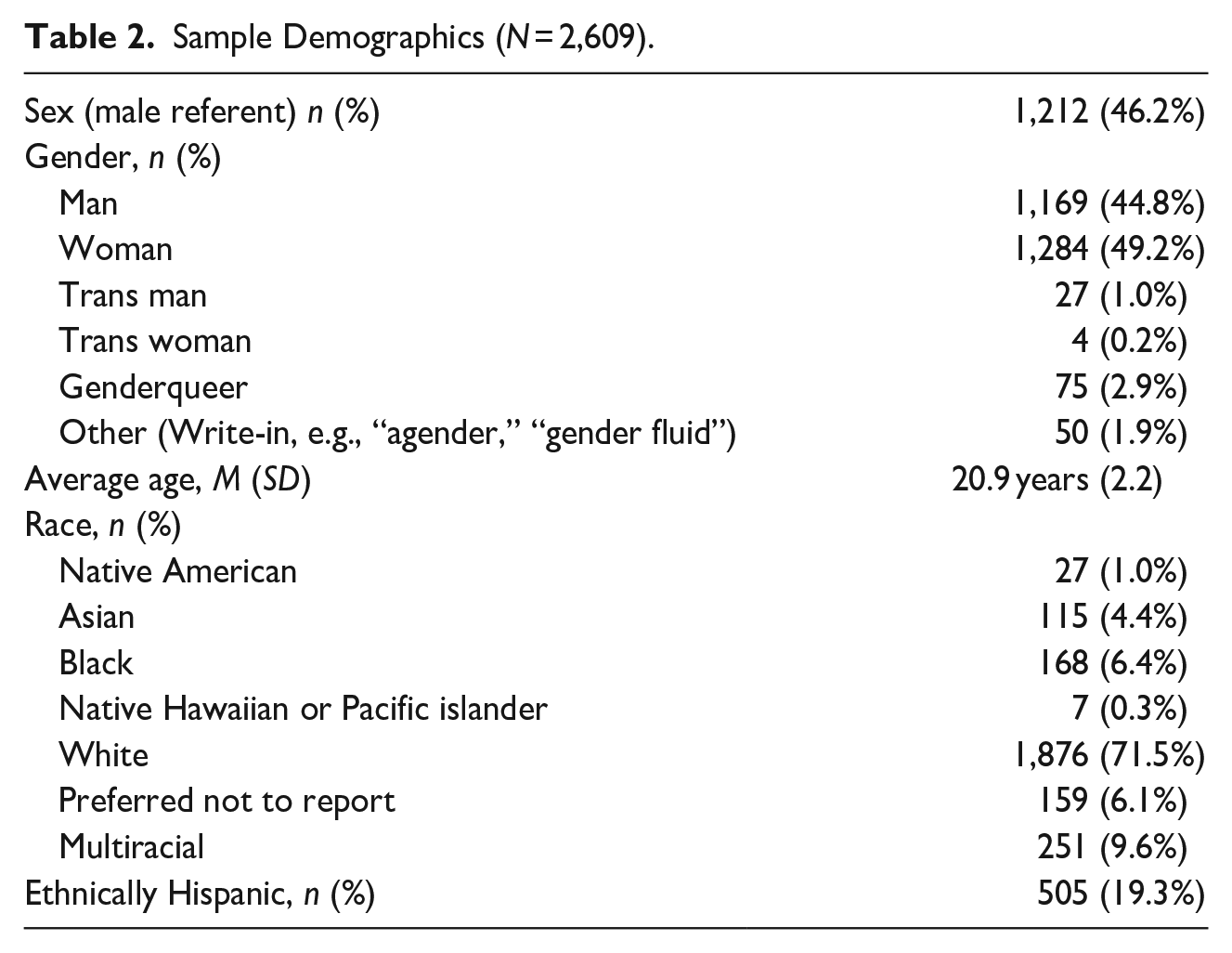
Of the 4,010 individuals who completed the item assessing frequency with which they had seen content posted by friends on social media about sexual assault, 71.02% (n = 2,848) reported having seen such content. Of those 2,848, 91.6% (n = 2,609) provided complete data for the online rape myth items and covariates; 237 did not answer any further questions about the rape myths they saw online, and 2 did not answer information about cannabis, opioids, and/or illicit drugs. Of the 2,609 participants, mean age was 20.9 years (SD = 2.2 years), just under half were biologically male (n = 1,202, 46.1%), and most were White (71.6%, n = 1,868; Table 1). Most participants identified their gender as either man (n = 1,169, 44.8%) or woman (n = 1,284, 49.2%); 27 (1.0%) of participants identified as a trans man, 4 (0.2%) identified as a trans woman, 116 (2.2%) identified as genderqueer, and 75 (1.4%) identified as a gender not listed, such as “agender,” “non-binary,” or “gender fluid.”
Descriptive Statistics
On average, participants reported having between four and five social media accounts (M = 4.16, SD = 1.25). The rape myth item with the greatest endorsement was seeing content reflecting that “rape accusations are often used as a way of getting back at someone,” which 31.9% (n = 832) of the sample endorsed. More than a quarter of participants (25.5%, n = 666) reported exposure to content reflecting that “people don’t usually tend to force sex on others, but sometimes they get too sexually carried away.” The fewest participants reported that friends posted content supporting the idea that “people from nice middle-class homes almost never rape” (n = 114, 4.4%). When evaluated as a summary score, on average, participants reported seeing one or two rape myths posted to social media by friends (M = 0.15, SD = 0.20).
More than one-third of study participants reported rape victimization (n = 902, 34.6%), though fewer reported attempted rape perpetration (n = 171, 6.6%) or perpetrating a sexual assault in a situation where the individual “misread” the situation (n = 141, 5.4%). On average, most participants reported less than monthly risky drinking (defined as five or more drinks in 1 day for males, and four or more drinks in 1 day for females; M = 1.20, SD = 1.08). On average, cannabis was used monthly or less than monthly (M = 1.38, SD = 1.52), and illicit drug use (e.g., cocaine, heroin, ecstasy, mushrooms; M = 0.28, SD = 0.61), and prescription drug misuse (M = 0.26, SD = 0.65), were less common. All descriptive statistics are located in Table 2.
Sample Demographics (N = 2,609).
Exploratory Factor Modeling
First, we examined eigenvalues for possible solutions (1-factor: 5.509; 2-factor: 0.803; 3-factor: 0.704; 4-factor: 0.482) and examined the scree plot. Though the “elbow” of the graph was around 2, the values suggested a 1-factor solution. As these were slightly conflicting, we compared the fit statistics and interpretability of a 1-factor and 2-factor model before choosing the final solution. The fit statistics for both the 1-factor (RMSEA: 0.03; CFI: 0.99; TLI: 0.99; SRMR: 0.057) and the 2-factor solution (RMSEA: 0.014; CFI: 0.99; TLI: 0.99; SRMR: 0.036) were both acceptable given the cutoff scores suggested by Hu and Bentler (1999), though the 2-factor solution was slightly better fitting. The selection of the 1-factor solution was supported by the loading scores of each item onto the 1-factor solution, the acceptability of fit, and the ease of interpretation of a parsimonious model given existing theory. Thus, we selected a 1-factor solution (Table 3).
Item Loadings by Factor Solution.

Confirmatory Factor Modeling
We next tested the 1-factor solution using a confirmatory factor analysis in the other half of participants (testing group). The fit statistics of the 1-factor solution in the testing group suggested a good fitting model (RMSEA: 0.021; CFI: 0.99; TLI: 0.99; SRMR: 0.038). Cronbach alpha of the nine items within the testing group was .77.
Correlation with Other Factors
Our final set of results is to evaluate the associations between covariates and electronic rape myth exposure. First, we used a correlation table to examine bivariate correlation between covariates and electronic myth exposure score (M = 0.15, SD = 0.20, range 0–1; Table 4). Then, we used multivariable linear regression to evaluate the association between the covariates and electronic rape myth exposure (R2 = .029; Table 5). Greater exposure to rape myths posted by friends on social media sites was associated with greater attempted rape perpetration (β = .052, SE = .016, p< .005), rape victimization (β = .045, SE = .009, p< .005), and illicit drug use (β = .021, SE = .008, p < .05). Those with greater exposure were more likely to be male (β = .017, SE = .008, p < .05) and younger in age (β = −0.008, SE = .002, p < .005).
Correlation Matrix.

p < .05.
Covariate Correlates With Electronic Rape Myth Exposure.

Discussion
Widespread Prevalence of Online Rape Myth Sharing
Sexual assault is a widespread problem in the United States which disproportionately occurs during adolescence and early adulthood (Basile et al., 2016), yet little work has been done to examine rape myths within the online space. In the present study, more than two-thirds of the broader study sample (n = 4,010) of emerging adults surveyed reported seeing discussion of content promoting rape myths/sexual assault on social media. This proportion is particularly concerning given that greater endorsement of rape myths often decreases individual perception of the responsibility of actions (e.g., one or more parties were intoxicated, someone was wearing tight clothing that shows certain body parts), which has harmful implications, including an increased risk of sexual assault perpetration (Fansher & Zedaker, 2022).
Beyond examining the prevalence of the broad topic of online rape myths, it is important to gather nuanced information on the specific forms and classifications of violence expressions to inform future interventions (Lewis et al., 2017). Our data suggest that among emerging adults who see sexual assault content posted by friends, the most common expressions of rape myths are those which suggest that sexualized violence acts are used as a method of revenge (reported by one in three); that rape is the result of being sexually carried away (reported by one in four); that rape is the consequence of wearing revealing clothes (reported by one in five); that rape often occurs because the person being violated was not sufficiently clear with their “no” (reported by one in six); and that the person who is violated has some responsibility for a rape if they were intoxicated (reported by one in six). Rape myths are prevalent, but the several specific myths that are most common could serve as focal points for future education campaigns. Addressing exposure to rape myths in the online space is important for three reasons. The first is given the propensity for victim-blaming-type posts to spread quickly on social media platforms; the second is that the vast majority of emerging adults use social media to socialize, for entertainment, and to gain important news/health-related information; and the third is that this age group appears to be particularly swayed by the information they see online (Auxier & Anderson, 2021; Bialik, 2018; Mitchell et al., 2021; Perrin, 2020; Shearer, 2021).
Advancing Measurement for Online Rape Myths
One of the major challenges in the field of online sexual violence and intimate partner violence research is a lack of coherence across measures (Caridade et al., 2019). Having multiple measures reflecting different conceptualizations or definitions of a given phenomenon creates confusion and a lack of consensus on the prevalence of a problem and can be particularly problematic when evaluating changes over time. In an effort to not replicate this challenge in the measurement of online rape myths, we examined the psychometric properties of our adapted rape myth scale specific to social media postings by friends. Using EFA, we found preliminary support that the nine items were psychometrically related and can be combined to form a scale. We then tested the structure using CFA and found additional support for a 1-factor solution. By splitting the sample in half to build independent training and testing sub samples, we were able to increase validity of our findings and potential reproducibility. We also acknowledge the potential limitations of this new measure which could benefit from refinement and/or extension. Specifically, given the constraints of our parent study with respect to participant burden, we were limited in the number of items from the IRMA we could adapt and include, and it may be that other items better or more completely measure this construct. Nonetheless, we believe this measure provides a useful starting point for future work to accurately characterize online rape myth exposure. For example, researchers could extend this area by using a content analysis of the available social media data to help articulate the various rape myths that may be missing from the current measure. Researchers could also use focus groups and/or think aloud procedures with emerging adults to better understand how they interpret the items presented.
Correlates with Online Rape Myth Exposure
In the final step of our analysis, we examined the associations between greater exposure to online rape myths posted by friends on social media platforms (using the online rape myth scale) with sexual violence experiences. Our findings that online rape myth exposure is associated with greater attempted rape perpetration and victimization builds on past research regarding rape myths and sexual behaviors which were not specific to the online space (Fansher & Zedaker, 2022). Further, results showing that exposure to friends’ posts endorsing rape myths is significantly associated with one’s own actions extends research on the clustering of beliefs within social networks (Banyard et al., 2022; Brechwald & Prinstein, 2011). While our results support and extend prior work examining rape myth beliefs outside of online spaces, we are unable to draw conclusions regarding directionality; an alternative interpretation of our findings could be that those with exposure to in-person sexual violence are more aware of rape-related material in online spaces, and thus have more precise recall of this type of content. This alternative explanation highlights the need for future prospective work to evaluate temporal directionality and causality. This would hold particularly important implications for ongoing and future social media reform to better manage exposure to certain content/misinformation and actively work toward dispelling rape myths (Hedrick, 2021).
Beyond the correlation of exposure to rape myths and experiences of sexual violence, we also considered correlations with sociodemographic variables and risk behaviors. Younger age and male sex were associated with greater online exposure to rape myths, which are consistent with prior research on rape myths that are not specific to online spaces (Beshers & DiVita, 2021). Importantly, the present study psychometrically tested items which did not use gender or sex-specific language to create a scale on rape myths within the online space. This focus is critical given that the majority of the literature on rape and sexual assault is focused on heterosexual relationships, and on male perpetrators and female victims (Boyle & Rogers, 2020). While biologically female bodies are at high risk of sexual assault (Basile et al., 2016), implying perfect correlation of sex and gender excludes individuals on the basis of biological differences (e.g., intersex individuals) and social identities (e.g., trans, non-binary gender), which do not fit into hegemonic binary sex and gender categories.
Finally, our findings regarding substance use and rape myths were somewhat surprising. Prior work has found a positive association between alcohol use and rape myths (Dworkin et al., 2017; Navarro & Tewksbury, 2017), lower perceived capability of perpetrators and greater responsibility of victims when intoxicated (Grubb & Turner, 2012), and the co-occurrence of alcohol use and sexual violence (Anderson et al., 2017). Yet, we did not find a significant association between alcohol use and online exposure to rape myths. Additionally, cannabis use was not associated with rape myths. These findings may be due in part to differences in the normativity of alcohol and cannabis use relative to rape myths. Although alcohol and cannabis use are relatively prevalent behaviors in emerging adulthood (Center for Behavioral Health Statistics and Quality, Substance Abuse and Mental Health Services Administration, 2021), in line with other researcher findings, it could be that increased societal knowledge and awareness around rape and culpability have lowered the social normativity of these beliefs (Beshers & DiVita, 2021), pushing rape myths from a social norm into a set of antisocial beliefs. This could help explain our finding of association between illicit drug use and greater rape myth exposure. Youth who use illicit drugs are at higher risk of engaging in a broader range of antisocial behaviors (Fitzsimons & Villadsen, 2021) and are more likely to be part of friendship networks with individuals who also display a broader range of antisocial behaviors (Sijtsema & Lindenberg, 2018), which could include rape myths.
Limitations
Several limitations require mentioning. Although we adapted items from a standard measure, reviewed the items for face validity, and psychometrically tested the items to understand their interrelatedness, replication, and potential expansion, other samples, is required. As noted earlier, due to the cross-sectional design, we are unable to draw conclusions about temporal associations. The study design of the current project did not purposively collect data from non-binary identifying individuals and thus does not allow the current piece to explicitly examine rape myths relative to gender identities; however, we strove to not remove individuals who do not identify within the gender binary from our analyses and thus chose to use biological sex. Future work on online rape myths which uses a purposive sampling framework to represent multiple forms of gender (beyond the binary man/woman) is an important next step. Finally, our measure of exposure relied on individual recall for the prior 6 months; although prior research shows a positive correlation between recall and observed measures of social media use (e.g., what is seen on social media; Parry et al., 2021), future research should include objective variables (e.g., scraping social media data) of exposure to rape myths and explore validity of reported recall relative to duration of time. Despite limitations, our findings using a large data set of emerging adults set the stage for future investigations and begin to quantify the ways in which exposure to rape myths occurs in the online world. These findings could inform future peer network interventions as well as social media messaging campaigns to address and disrupt these harmful belief systems.
Conclusions
The present study helps further future research by psychometrically evaluating items which are inclusive of a wider set of gender identities, thus promoting increased diversity in the measurement tools which are used and thus the data, analyses, and results which can be created in future work. Findings suggest that online portrayals of rape myth endorsement by peers via social media were viewed by the majority of emerging adults. Additionally, exposure to a wider number of online rape myths was associated with key demographics (i.e., male sex, older age), prior experiences with rape (i.e., attempted rape perpetration, rape victimization), and individual risk factors (i.e., illicit drug use). Future longitudinal studies should examine the role of social media in the formation of one’s individual attitudes about rape myth endorsement to update sexual assault prevention programs to address such online influences.
Footnotes
Acknowledgements
We thank the study staff, participants, and the collaborators who made this work possible. We also want to recognize that the University of Michigan originated from the sale of lands ceded by the Anishinaabeg (Odawa, Ojibwe, and Boodewadomi), Meskwahki-asahina (Fox), Peoria, and Wyandot; almost all property in the United States was obtained through unconscionable means including genocide and settler colonialism.
Declaration of Conflicting Interests
The author(s) declared no potential conflicts of interests with respect to the authorship and/or publication of this article.
Funding
The author(s) disclosed receipt of the following financial support for the research and/or authorship of this article: Research reported herein was supported by a grant to the University of Michigan Injury Prevention Center by the Centers for Disease Control (CDC) & Prevention Award Number R49-CE-002099. Drs. Thulin and Florimbio were also supported by a training grant from the National Institute of Alcohol Abuse and Alcoholism (T32 AA007477-29).
