




Abstract
Alcohol use correlates with psychological partner abuse (PA) perpetration among lesbian, gay, bisexual, queer, and other nonheterosexual (LGBQ+) young adults. However, less is known about the proximal association between alcohol use and psychological PA within this population, which would provide valuable information for intervention development. Informed by minority stress and alcohol-related PA theories, we evaluated whether (a) psychological PA perpetration odds increased as the number of drinks consumed prior to psychological PA on a given day increased, (b) psychological PA perpetration odds were greater following heavy episodic drinking (HED) relative to non-HED, and (c) experiencing LGBQ+-specific discrimination (i.e., heterosexist harassment, incivility, and hostility) strengthened the association between daily alcohol use (number of drinks, HED) and subsequent psychological PA perpetration. LGBQ+ college students (N = 41; 75.6% women, 22.0% men, and 2.4% transgender/non-binary) completed a baseline survey of past-year discrimination before completing daily reports of their alcohol use and psychological PA for 60 consecutive days. Multilevel modeling revealed that drinking more than one usually does on a given day is positively associated with subsequent psychological PA odds (OR = 1.31, p < .001). Psychological PA was more likely following HED relative to non-HED (OR = 3.23, p < .001). Unexpectedly, experiencing discrimination was negatively associated with psychological PA odds across models (OR = .26 p = .01). No alcohol × discrimination interactions emerged. Results support alcohol use as a proximal risk factor for psychological PA among LGBQ+ college students and underscore the need for more nuanced examination of discrimination and other contextual variables in alcohol-related PA.
Psychological partner abuse (PA; e.g., threatening a partner, humiliating a partner, name-calling, and destroying a partner’s belongings) is the most common form of PA among college students, with as many as 74.6% of college students self-reporting psychological PA perpetration annually (Brem et al., 2021). Relative to physical and sexual PA, psychological PA perpetration remains understudied despite evidence that physical and mental health outcomes for psychological PA are comparable to those of physical and sexual PA (Coker et al., 2000; Pico-Alfonso, 2005). Further, psychological PA may precede more physically injurious forms of PA, underscoring the importance of identifying and intervening with psychological PA among emerging adults (Cadely et al., 2020).
Problematically, an overwhelming majority of psychological PA investigations have drawn data from primarily heterosexual populations. The lack of lesbian, gay, bisexual, queer/questioning, and other nonheterosexual (LGBQ+) representation within this literature is concerning, given that psychological PA is as or more prevalent in LGBQ+ populations, and LGBQ+ PA survivors experience more pronounced mental health complications (e.g., depression, anxiety), relative to their non-LGBQ+ counterparts (Decker et al., 2018; Graham et al., 2019; Miller & Irvin, 2017; Porter & Williams, 2011; Reuter et al., 2017; Wang et al., 2023). In their review of studies on psychological PA among lesbian, gay, and bisexual individuals, Mason et al. (2014) noted that PA perpetration remains understudied relative to victimization, thereby hindering opportunities to identify PA prevention targets. In the past decade, some LGBQ+ studies have incorporated measures of psychological PA perpetration (e.g., Lewis et al., 2018; Miltz et al., 2019; Ronzón-Tirado et al., 2022; Sutter et al., 2019), though many LGBQ+ psychological PA investigations overwhelmingly focus solely on victimization (Callan et al., 2021; Finneran & Stephenson, 2014; Mason et al., 2014). Examining perpetration will enhance understanding of PA correlates that should be targeted in comprehensive prevention programming.
Though limited, perpetration data drawn from LGBQ+ populations revealed that as many as 96% of men and 98% of women reported perpetrating psychological PA in a current or former relationship (Mason et al., 2014). Notably, among primarily heterosexual populations, risk of PA is greatest during the college years (i.e., ages 18–21 years; Johnson et al., 2015), though few LGBQ+ psychological PA investigations have focused on this age range (Edwards & Sylaska, 2013; Taylor & Neppl, 2020; Whitfield et al., 2021). LGBQ+ students are more than twice as likely as heterosexual students to experience psychological PA, with bisexual college students demonstrating the highest odds of psychological PA perpetration relative to their gay, lesbian, and heterosexual peers (Porter & Williams, 2011; Whitfield et al., 2021). Developing inclusive interventions that target young adults during a period of heightened PA risk necessitates further examination of psychological PA perpetration risk factors among LGBQ+ college students.
Decades of research support alcohol use as a global and proximal PA risk factor (Leonard & Quigley, 2017). Although acute alcohol use is not necessary for PA perpetration to occur, decades of cross-sectional, experimental, event-level, and intervention-focused PA research led some to conclude that alcohol is a contributing cause of PA (see Leonard & Quigley, 2017, for a review). Indeed, the strength of the association between alcohol use and PA perpetration is comparable to the strength of the associations between PA and other factors (e.g., gender, violence-condoning attitudes, and anger; Abramsky et al., 2011; Foran & O’Leary, 2008; Leonard & Quigley, 2017; Stith et al., 2004). Problematically, LGBQ+ young adults have not been well-represented in some of the most methodologically robust alcohol-related PA studies. For instance, only heterosexual adults with PA histories were included in experimental investigations of alcohol-related PA that involved alcohol administration in a laboratory setting (Eckhardt et al., 2021; Watkins et al., 2015). These data revealed that acute intoxication facilitated verbal and physical PA (i.e., an aversive stimulus such as a shock or noise blast ostensibly delivered to a partner; Eckhardt et al., 2021; Watkins et al., 2015). Similarly, daily diary data from mostly non-LGBQ+ populations indicated that PA perpetration, including psychological PA, was two to three times more likely to occur after alcohol use and heavy episodic drinking (HED; defined as 4+ [for women] or 5+ [for men/non-binary populations] drinks in a single setting; Flentje et al., 2020; Substance Abuse and Mental Health Services Administration, 2014) relative to no alcohol use (Moore et al., 2011; Shorey et al., 2014a, 2014b; Testa & Derrick, 2014). Advancing the generalizability of alcohol-related PA theory and intervention recommendations requires greater LGBQ+ representativeness in this body of research.
Most extant investigations of alcohol use and PA perpetration among LGBQ+ populations were drawn from cross-sectional samples of lesbian and bisexual women. Among lesbian and bisexual community women, alcohol use (including drinking quantity and HED) was positively and prospectively associated with psychological PA perpetration (Kelly et al., 2011; Leone et al., 2022; Lewis et al., 2017). Alcohol-related psychological PA perpetration data from gay and bisexual men are scarce as research has primarily explored men’s physical PA (Kelley et al., 2014; Kelly et al., 2011; Kimmes et al., 2019; Stults et al., 2015; Wu et al., 2015). However, some data suggest that gay and bisexual men’s alcohol use positively associated with their mutual PA (i.e., both partners perpetrated and experienced psychological and physical PA; Kelly et al., 2011). We are aware of only one study that examined whether drinking increased the likelihood of same-day psychological PA perpetration among LGBQ+ adults (Wang et al., 2023). Drawing from data collected for 30 consecutive days from 58 same-sex and 191 mixed-sex community couples, Wang et al. (2023) found that individuals’ and their partners’ alcohol use was positively associated with verbal PA (a facet of psychological PA) within the next 4 hours; results were comparable for same- and mixed-sex couples. Notably, couples in Wang et al.’s (2023) study were older (M age range: 26–29 years) than traditional college students, and were required to (a) be married or cohabitating and (b) endorse a history of past-year PA to participate. As such, it is unclear whether Wang et al.’s (2023) results generalize to college students.
Notably, other data suggest that while alcohol use may contribute to PA perpetration among LGBQ+ young adults, it is not the only, or the most salient, risk factor for PA perpetration within this population. Martin-Storey and Fromme (2021) reported that the number of times gay, lesbian, and bisexual young adults were intoxicated within the past 3 months did not explain the association between LGBQ+ status and physical PA perpetration after accounting for discrimination experiences. Similarly, numerous investigations informed by Minority Stress Theory (Meyer, 2003) proposed that LGBQ+-specific stressors (e.g., discrimination, internalized heteronormativity, and degree of social support for LGBQ+ status) may account for the elevated prevalence of alcohol use and PA perpetration documented within LGBQ+ communities (Edwards & Sylaska, 2013; Edwards et al., 2015; Kelley et al., 2014; Klostermann et al., 2011; Lewis et al., 2012, 2014, 2016, 2017; Longobardi & Badenes-Ribera, 2017; Mason et al., 2016; McCabe et al., 2010).
Drawing from these findings and minority stress (Meyer, 2003) and alcohol myopia theories (Steele & Josephs, 1990), Shorey et al. (2019) proposed an integrated model of LGBQ+ alcohol-related PA that describes the potential additive effects of LGBQ+-specific stressors (e.g., discrimination) on alcohol-related PA perpetration. According to this integrative model, more frequent exposure to distal and proximal LGBQ+-specific stressors such as discrimination may evoke higher levels of negative effects that, when paired with alcohol’s myopic effect on an individual’s attentional resources, increase short-term risk for PA perpetration (Shorey et al., 2019). That is, prolonged and frequent exposure to LGBQ+-specific stress creates a salient state of negative, provocative stimuli that, when paired with the pharmacological effects of alcohol (i.e., restricted attentional focus and disinhibition), increases the likelihood of PA perpetration. To date, there are no published studies evaluating whether exposure to LGBQ+-specific stressors moderate the proximal association between LGBQ+ college students’ alcohol use and PA perpetration. Such data are necessary to (a) inform public education and policy efforts to ameliorate discrimination and (b) identify the health needs of LGBQ+ young adults who perpetrate psychological PA.
Toward this end, the present study examined the proximal association between alcohol use (daily number of drinks consumed, HED) and psychological PA perpetration among LGBQ+ college students, and the moderating effect of LGBQ+-specific discrimination (i.e., heterosexist harassment, incivility, and hostility) on this proximal association. We collected baseline data on LGBQ+-specific discrimination from LGBQ+ college students followed by 60 consecutive days of assessments of their alcohol use and psychological PA. Although daily self-report assessments cannot speak for causal associations between alcohol use, discrimination, and PA, this approach was selected because it is more ecologically valid than cross-sectional and experimental approaches and reduces error and bias associated with retrospective reporting (Shiffman et al., 2008). We hypothesized that, controlling for average alcohol, (a) greater number of drinks consumed would proximally precede and increase the odds of psychological PA perpetration, (b) odds of psychological PA perpetration would be greater following HED relative to non-HED, and (c) experiencing past-year LGBQ+-specific discrimination would strengthen the proximal association between daily alcohol use (number of drinks, HED) and subsequent psychological PA perpetration.
Method
Participants
Participant data used in the present study were collected as part of a larger daily diary study investigating college students’ alcohol use and PA at a large, public, southeastern university (Brem et al., 2022); this study was not preregistered. Participants within the parent study who identified as LGBQ+ (N = 41) were examined within the present study. To be eligible for the larger study, participants had to (a) be at least 18 years of age, (b) be in a current dating relationship that lasted for at least 1 month in duration, (c) have a dating partner who was 18 years of age or older, (d) have consumed alcohol in the past month, and (e) have a minimum of two contact days with their dating partner each week (e.g., face-to-face contact or technology-facilitated contact). Participants were not dating each other (i.e., data were collected from individuals and not couples). See (Brem et al., 2022) for details regarding participant characteristics of the larger study. Participants included in the final sample used in the present study were those who met the aforementioned criteria from the parent study and self-identified as LGBQ+.
Procedure
Participants were undergraduate students recruited using three mechanisms: (a) flyers posted across campus, (b) a university research participation website where students were made aware through their psychology courses, and (c) listservs shared by the university’s PRIDE Center. Those interested were asked to complete a brief screening measure on Qualtrics.com to determine eligibility. Eligible participants were sent an email stating that they were eligible to participate in a research study in which they would complete a baseline assessment of self-report measures on Qualtrics.com followed by daily questionnaires for 60 consecutive days. Participants would receive a partial course credit (if they were enrolled in an eligible introductory psychology course) or $20.00 monetary compensation after completing the baseline questionnaire.
Participants were asked to complete a daily questionnaire for 60 consecutive days following the baseline assessment. Each morning at 6:00 AM, each participant was emailed a link to the 5-minute daily questionnaire. Daily questionnaires asked participants to report about their previous day’s behavior, defined for participants as the time they awoke until the time they went to sleep, consistent with prior daily diary work (Brem et al., 2022; Shorey et al., 2014a, 2014b). Participants received two reminder emails each day (i.e., one at 12:00 PM and another at 5:00 PM) if their daily survey was not completed by 12:00 PM or 5:00 PM. Participants received $1.00 per daily survey completed for 60 consecutive days and were compensated an additional $5.00 per week that they completed all seven surveys. Thus, participants could earn up to $120.00 for participating in the study.
Measures
Baseline Measures
Demographics
Demographic data assessed at baseline included age, sex assigned at birth, gender, racial/ethnic identity, sexual orientation, family income, relationship status, relationship length, and current living arrangements.
LGBQ+-Specific Discrimination
The 11-item Personal/Ambient Discrimination Scale (PADS; Woodford et al., 2014) was used to assess past-year heterosexist harassment, incivility, and hostility that the participants personally experienced. Participants were asked how many times (1 = never; 5 = 5 or more times) they experienced forms of hostility (5 items; e.g., being physically threatened, bullied, or assaulted because of their sexual orientation), incivility (3 items; e.g., being stared at, sneered at, or given dirty looks because of their sexual orientation), and heterosexist harassment (3 items; e.g., being called homophobic names) in the past year. Item responses were summed such that higher scores represent more frequent personally experienced LGBQ+-specific discrimination. PADS was previously used to capture LGBQ+-specific discrimination among LGBQ+ college students and evidenced good concurrent validity (Woodford et al., 2014). The PADS evidenced good internal reliability within the present sample (α = .93).
Daily Measures
Relationship Status
Participants reported their relationship status each day. Participants were asked if they were in the same relationship that they reported at baseline. All participants were asked to consider their baseline partner as they completed all questions, regardless of relationship status, because PA often continues and increases in frequency and severity even after the relationship ends (Anderson & Saunders, 2003).
Psychological PA
Participants were asked if they perpetrated psychological PA during the previous day using three items adapted from the Psychological Maltreatment Against Women Inventory (Tolman, 1999) and the Revised Conflict Tactics Scales (Straus et al., 1996) Psychological Aggression subscale. All items used gender-neutral wording. Each of the scales from which psychological PA acts were chosen evidenced good internal consistency and criterion validity and have been used in multiple studies assessing psychological PA among LGBQ+ college students (Kim & Schmuhl, 2021; Scheer & Baams, 2021). Psychological PA acts assessed various forms of verbal and emotional abuse, harassment, humiliation, intimidation, and threatening that occur as part of psychological PA. Each of the three items used to assess daily psychological PA listed several psychological PA tactics. For example, one item asked whether a participant perpetrated any of the following: threatened to hit or throw something at partner; destroyed something belonging to partner; did something to spite partner; or accused partner of being a lousy lover. Responses were dichotomized such that if a participant perpetrated any of the psychological PA perpetration acts listed in a single item, they responded in the affirmative to the item (i.e., scored “1”). If a participant responded “yes” to any of the three psychological PA perpetration items, that participant’s overall psychological PA perpetration score for that day was coded “1”; if no psychological PA perpetration items were endorsed for the day (i.e., a participant responded “no” to all three psychological PA items), that participant’s overall psychological PA perpetration score for the day was coded “0.”
Alcohol Use
Each day, all participants were asked if they consumed alcohol during the previous day, and if so, how many standard drinks they consumed. Participants were provided with a definition of a standard drink based on guidelines proposed by the National Institute on Alcohol Abuse and Alcoholism (2010). If participants consumed alcohol on a day when psychological PA occurred, they were also asked to report whether they consumed alcohol prior to the initial psychological PA event and, if so, how many drinks they consumed prior to this first event. If drinking only occurred after the first psychological PA event, the alcohol use variable was recoded to 0 to better approximate drinking that occurred before psychological PA. If an individual reported drinking before and after psychological PA, only alcohol consumed before the first psychological PA event was included in the count index of number of drinks consumed. This alcohol coding approach was previously used in daily diary investigations of alcohol and PA (Shorey et al., 2014a, 2014b) to prevent confounding drinking that occurred after PA with drinking that occurred prior to PA. To further clarify, if a participant reported consuming four drinks on a given day but did not perpetrate psychological PA, their number of drinks was coded as “4.” If a participant reported consuming five drinks on a given day, but only three were consumed prior to the first psychological PA event, that participant’s number of drinks was coded “3.” If a participant reported consuming five drinks on a given day, but all were consumed after psychological PA perpetration, then the participant’s number of drinks was coded “0.” If a participant did not consume any alcohol on a given day their number of drinks for the day was coded “0.”
HED was calculated by examining the number of drinks consumed before the first psychological PA event. Specifically, participants were coded “1” if they consumed four or more (for women) or five or more (for men and non-binary participants; Flentje et al., 2020; James et al., 2016) drinks in one sitting prior to psychological PA; participants were coded “0” if they consumed less than four (for women) or five (for men and non-binary participants) drinks in one sitting prior to psychological PA.
Data Analytic Strategy
Descriptive analyses were completed using SPSS Version 24.0. IBM Hypotheses were tested with multilevel modeling using HLM Version 8.0. Scientific Software International Compliance rates were computed by calculating the percentage of missed surveys in relation to total surveys.
For hypothesis testing, we used multilevel modeling using fixed slopes specifying a logit link function with a Bernoulli sampling distribution and full maximum likelihood estimation; the multilevel nature of these models accounts for the correlated errors associated with individuals’ repeated reports. All participants were used in analyses despite some missing data due to attrition and noncompliance because the multilevel modeling procedure uses all available data and estimates model parameters according to Bayesian rules. All available data were used including days when psychological PA did not occur and days when alcohol use did not occur.
Separate analyses were conducted for the number of drinks consumed model and the HED model. Two-level models were employed. In each model, alcohol use (a time-varying predictor, i.e., number of drinks consumed, HED) was entered to yield Level 1 within-person effects. The number of drinks variable was centered on each individual’s overall mean (i.e., person-mean centered) and the HED variable was uncentered due to the dichotomous nature of the variable. We calculated each individual’s overall mean for daily alcohol use, centered the mean on the grand mean, and included these values in Level 2 to provide between-person effects for alcohol use. This approach allowed us to examine within-person effects controlling for between-person effects to better approximate proximal associations among alcohol use and psychological PA. Discrimination (grand-mean centered) was entered in Level 2. We tested hypotheses by estimating (a) the within-person effects of alcohol use on repeated measures of psychological PA perpetration, (b) the between-person effects of discrimination and average alcohol use on repeated measures of psychological PA perpetration, both entered in Level 2, and (c) the cross-level interaction effects of alcohol use (entered in Level 1) × discrimination (entered in Level 2) on repeated measures of psychological PA perpetration. The first author may be contacted for further inquiries pertaining to data and analytic strategy.
Results
Descriptive Statistics
Participant Demographic Characteristics
With regard to gender, most (75.6%) participants identified as women, followed by men (22.0%); one participant (2.4%) identified as transgender/non-binary. Participants identified as bisexual (75.6%), gay (7.3%), lesbian (7.3%), queer (7.3%), and asexual (2.4%). The average age of participants was 20.31 years (SD = 2.37). The racial composition was 85.36% White; 4.88% African American or Black; 4.88% Multiracial; 2.44% Hispanic or Latino(a); and 2.44% Asian. Most participants reported that they were dating their partner (87.80%), though some reported that they were engaged (7.32%) or married (4.88%). The average relationship length was 16.66 months(SD = 14.82) (Mdn = 24.00 months). Most participants (51.24%) endorsed living with friends or roommates, followed by living with their partner (29.24%), living alone (17.08%), and living with family (2.44%). Regarding annual family income, the distribution was as follows: Less than $50,000 (51.24%); $50,000 to $100,000 (17.04%); $100,000 to $150,000 (17.08%); and $150,000 to $200,000 (7.32%); 7.32% of participants did not know or chose not to report their annual family income.
Compliance Rates
Of the 41 people who completed at least three daily surveys, 2,460 surveys were sent, and 1,700 surveys were completed for an overall compliance rate of 69.11%. No participants withdrew from the study. Participants completed an average of 41.46 daily surveys (SD = 19.26). Participants’ number of daily surveys completed did not significantly associate with the average number of drinks consumed each day, age, relationship length, or frequency of psychological PA perpetration. Number of daily surveys completed positively associated with frequency of personally experienced discrimination (r = .06, p = .01).
Baseline Data Descriptive Statistics
Within the past year, 58.5% of participants personally experienced at least one instance of LGBQ+-specific discrimination. Participants who personally experienced hostility were 39%; 46.3% of participants experienced incivility; and 58.5% of participants experienced heterosexist harassment. On average, participants reported a total PADS score of 9.00 (SD = 12.46; range = 0–50) and a mean PADS score of .81 (SD = 1.13), suggesting that each form of LGBQ+-specific discrimination assessed was experienced an average of .81 times in the past year.
Daily Data Descriptive Statistics
Of all the daily surveys completed (N = 1,700), there were 36 instances of psychological PA perpetration that occurred on 27 days (1.58% days of the daily survey data included psychological PA perpetration). Eleven participants reported perpetrating psychological PA at least once during the daily survey phase of the study (26.83% of participants). There was an average of 2.45 days that included psychological PA perpetration among those who perpetrated psychological PA at least once during the study.
Most (82.93%) participants had at least one drinking day during their participation. On average, participants reported consuming alcohol on an average of 4.10 days during the study. Participants consumed alcohol on an average of 11.23% of days in which they completed surveys. Participants reported drinking an average of 2.49 (SD = 2.03) standard drinks on drinking days. With regard to HED, 48.78% of participants had at least one HED event during the study. Across participants, 3.33% of all days in which surveys were completed involved HED, and 25.65% of all drinking days involved HED.
Co-Occurrence of Alcohol Use and Psychological PA
Participants reported drinking alcohol on 168 days; 128 days of alcohol use occurred on days in which the participant had face-to-face contact with their partner (i.e., 12.4% of all partner contact days included alcohol use). Participants consumed an average of .25 drinks (SD = 1.02) before psychological PA perpetration. Of the 27 days that included psychological PA perpetration, alcohol was consumed before the first psychological PA event on 6 days (22.22% of psychological PA days) and after psychological PA perpetration on 3 days (11.11% of psychological PA days). HED occurred before psychological PA perpetration on 2 days (7.4% of psychological PA days) and after psychological PA perpetration on 2 days (7.4% of psychological PA days). Alcohol was not consumed at all on the 18 days in which psychological PA occurred (66.67% of psychological PA days). When examining only drinking days, the average number of drinks consumed before psychological PA (M = 2.89; SD = 2.89) was comparable to the number of drinks consumed on a non-perpetration drinking day (M = 2.63, SD = 2.13, t[0.159] = .69, p = .49).
Hypothesis Tests
Model results (see Table 1) revealed that drinking more than one usually does (within-person effect) and HED were positively associated with the odds of subsequent psychological PA perpetration. Mean alcohol use (between-person effect) was not significantly related to psychological PA perpetration odds. In both the number of drinks model and the HED model, discrimination negatively associated with psychological PA odds. There were no significant alcohol (number of drinks or HED) × discrimination effects.
Model Parameters Predicting Odds of Daily Psychological Partner Abuse Perpetration.
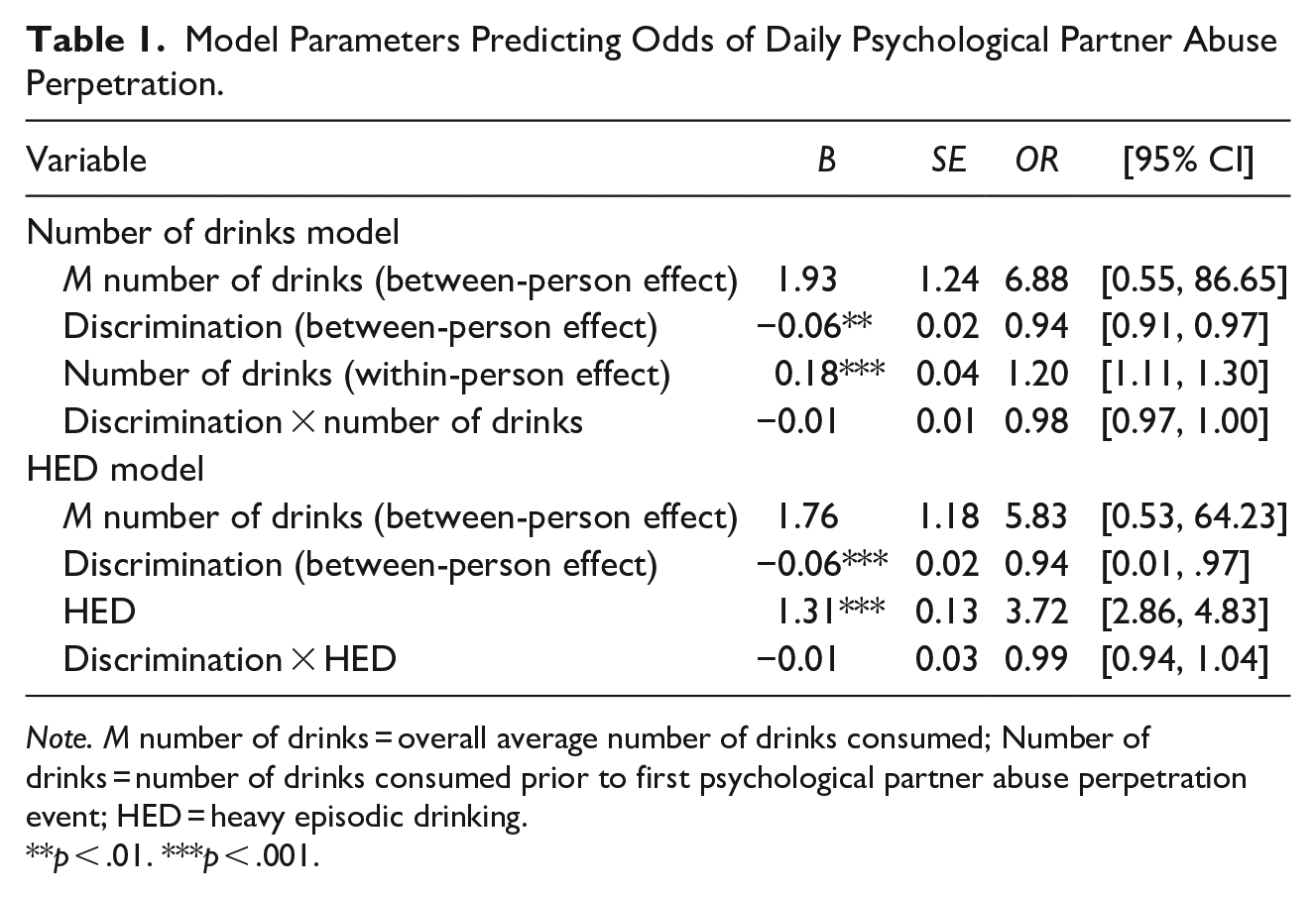
Note. M number of drinks = overall average number of drinks consumed; Number of drinks = number of drinks consumed prior to first psychological partner abuse perpetration event; HED = heavy episodic drinking.
p < .01. ***p < .001.
Discussion
We hypothesized that (a) greater number of drinks consumed would proximally precede and increase the odds of LGBQ+ college students’ psychological PA perpetration, (b) odds of psychological PA perpetration would be greater following HED relative to non-HED, and (c) experiencing past-year LGBQ+-specific discrimination would strengthen the proximal association between daily alcohol use (number of drinks, HED) and subsequent psychological PA perpetration. Our hypotheses were partially supported. Drinking more alcohol than one usually does preceded and increased the odds of perpetrating psychological PA. Further, psychological PA perpetration was more likely to occur after HED relative to non-HED. In contrast to our third hypothesis, experiencing past-year LGBQ+-specific discrimination did not strengthen the likelihood of daily psychological PA perpetration after drinking. Surprisingly, experiencing past-year LGBQ+-specific discrimination was associated with lower likelihood of psychological PA perpetration. These results underscore the importance of targeting alcohol use alongside efforts to prevent PA among LGBQ+ young adults, and the need for more nuanced assessment of discrimination within this population.
In partial support of Shorey et al.’s (2019) theoretical model of LGBQ+ alcohol-related PA, results of the present study indicate that alcohol use, including HED, is a proximal correlate that precedes and may increase the likelihood of LGBQ+ college students’ psychological PA. Although the mechanisms responsible for this association cannot be determined from the present data, it is plausible that, as with non-LGBQ+ couples, heavy drinking creates opportunities for conflict (e.g., conflict surrounding heavier-than-typical drinking) via the myopic effects of acute alcohol use (Fischer & Wiersma, 2012; Steele & Josephs, 1990; Testa et al., 2019). Acute alcohol use may also interfere with social information processing such that individuals have difficulty decoding and choosing an appropriate response to socially relevant information after drinking, thereby increasing the likelihood that maladaptive responses (e.g., yelling at, threatening, or humiliating a partner) are selected (Holtzworth-Munroe, 1992). While these mechanisms may function similarly within LGBQ+ populations as with non-LGBQ+ populations, it is plausible that some mechanisms (e.g., threat/rejection perceptions) may be enhanced within LGBQ+ populations as a result of prolonged exposure to discrimination, structural stigma, and anti-LGBQ+ violence (Dyar et al., 2018; Feinstein et al., 2012; van der Star et al., 2020); acute alcohol use may then further impact threat perceptions to enhance the likelihood of aggression. Future research is needed to identify potentially unique alcohol-related PA mechanisms within LGBQ+ populations.
In contrast to our expectations, our data do not suggest that experiencing LGBQ+-specific discrimination within the past year impacts the alcohol-psychological PA association among LGBQ+ college students. It is plausible that proximal exposure to discrimination (e.g., at the daily level) is more influential than past-year discrimination in eventuating PA following alcohol use due to increased negative affect following same-day discrimination. Consistent with Shorey et al.’s (2019) integrated model of LGBQ+ alcohol-related PA, LGBQ+ participants exposed to discrimination on a given day may experience increases in same-day negative affect, thereby increasing the likelihood that PA would follow alcohol consumption. It is also plausible that experiencing discrimination has a cumulative effect over time that eventuates alcohol use and PA perpetration; however, this supposition has yet to be investigated. Future research is needed to examine daily exposure to discrimination and subsequent changes in negative affect, alcohol use, and PA perpetration.
Collecting partner data may also clarify the unexpected finding that distal discrimination is negatively related to psychological PA perpetration. It is plausible that some couples are able to discuss and/or empathize over shared experiences with discrimination, thereby enhancing protective factors (e.g., closeness) that may mitigate PA perpetration risks. Indeed, support from same-sex partners can mitigate the impact of discrimination on mental health symptoms (e.g., depression symptoms; Donnelly et al., 2019; Randall et al., 2017). Similarly, data collected from primarily heterosexual populations suggest that drinking episodes in which both partners were drinking, and solo drinking with a partner present, increased the likelihood of intimacy within the next 3 hours (relative to no drinking or solo drinking with a partner absent; Testa et al., 2019). To date, there are no studies investigating LGBQ+ couples’ shared discrimination and alcohol use in relation to intimacy and PA. Couple-level data are needed to identify ways to prevent and intervene with discrimination, alcohol use, and PA within LGBQ+ couples.
In addition to the aforementioned considerations, several limitations should be considered when interpreting the present study’s results. First, the present sample was small and comprised mostly bisexual college women who were recruited university wide and within the psychology department, which is not representative of all LGBQ+ populations. Most (51.24%) participants had an annual income less than $50,000; the monetary incentive for the present study may have resulted in oversampling of participants within lower income brackets. A larger, more ethnically and socioeconomically diverse sample with greater gay, lesbian, queer, and gender-diverse representation would provide more robust, generalizable results. The fact that participants were recruited from PRIDE Center listservs may mean that participants in the present study varied in meaningful ways from the broader LGBQ+ college community in terms of outness, affiliation with LGBQ+ networks, and social support; these unexamined factors may have influenced study results. Additionally, only LGBQ+-specific discrimination was assessed within the present study. Participants (and the broader LGBQ+ population) have intersecting identities that are targets of discrimination (e.g., racism, sexism, classism); yet other forms of discrimination were not assessed in the present study. Further, other forms of LGBQ+-specific stressors, such as internalized stigma, may be more insidious for relationship health because it can occur in the absence of discrete instances of discrimination and may operate in the absence of others (e.g., when alone; Doyle & Molix, 2015). Future research should assess various types of discrimination to which participants are exposed, including microaggressions, internalized stigma, and ambient discrimination (i.e., witnessing, overhearing, or being aware of others being harassed; Woodford et al., 2014) to better ascertain the potential impact of discrimination on alcohol-related PA.
Data from the present study were collected via once-daily self-report surveys which, despite being less impacted by recall bias than cross-sectional approaches (Shiffman et al., 2008), are impacted by several limitations. For instance, causal conclusions cannot be drawn from these data, and participants’ recall of events may be skewed. It is plausible that participants did not accurately recall or report the number of standard drinks consumed each day, particularly on days in which HED occurred (Stevens et al., 2020). Psychological PA may occur several times throughout the day, making it challenging to recall when the first incident occurred in relation to drinking. Our daily data cannot speak to alcohol’s role in patterns of PA that evolve within a couple over time or the associations between alcohol use and more physically injurious forms of PA (e.g., physical or sexual assault). Participants may underreport PA perpetration, underscoring the need for couple-level data to collaborate PA reports and identify retaliatory PA. More intensive ecological momentary assessment designs paired with objective measures of alcohol use (e.g., portable breathalyzers) would provide more nuanced data on within-day fluctuations in alcohol use, discrimination, and psychological PA. Similarly, experimental approaches would allow investigators to investigate the impact of acute alcohol intoxication and discrimination on lab-based aggression (e.g., the Taylor Aggression Paradigm; Eckhardt et al., 2021; Taylor, 1967). Investigators have manipulated exposure to discrimination with racially and ethnically minoritized populations (e.g., Gerrard et al., 2012; Sawyer et al., 2012), but experimental discrimination paradigms have not been applied to the study of LGBQ+ alcohol-related PA.
Results of the present study provide preliminary support for the importance of targeting alcohol use in efforts to prevent or intervene with LGBQ+ college students’ PA perpetration. Pending additional research, clinical scientists may consider examining the impact of discrimination on LGBQ+ couples, the ways in which couples respond to discrimination, adaptive and maladaptive alcohol use patterns in LGBQ+ relationships characterized by PA, and the function of PA within LGBQ+ couples. At the same time, policy efforts are needed to reduce LGBQ+ discrimination while also ensuring that LGBQ+ individuals have supports in place to buffer against minority stressors.
Footnotes
Declaration of Conflicting Interests
The author(s) declared no potential conflicts of interests with respect to the authorship and/or publication of this article.
Funding
The author(s) disclosed receipt of the following financial support for the research and/or authorship of this article: This work was supported by a Visionary Grant from the American Psychological Foundation (APF) and by grant F31AA026489 from the National Institute on Alcohol Abuse and Alcoholism (NIAAA) awarded to the first author. The content is solely the responsibility of the authors and does not necessarily represent the official views of the APF, NIAAA, or the National Institutes of Health.
