




Abstract
Continued exposure to abuse or neglect is a strong predictor for immediate and long-term negative developmental outcomes including developmental delays, disabilities, poor school performance, criminal behavior, and mental health issues. The purpose of this study was to identify distinct subgroups of children with repeat victimization based on maltreatment timing, subtype, and chronicity and to examine how the unique subgroups are related to youth’s juvenile justice outcome. Using data from Longitudinal Studies of Child Abuse and Neglect, this study included 286 children (47% males, 41% blacks) with more than one report for substantiated maltreatment from birth to age 17. Latent class analysis was employed to identify heterogeneity in the patterns of maltreatment revictimization. Four latent classes emerged: (a) Prevailing Early Neglect (52.6%); (b) Co-occurring Maltreatments in Preschool Age (20.1%); (c) Incremental Neglect with Sexual Abuse in School Age (18.7%); and (d) Co-occurring Maltreatments in School Age (8.6%). Black children were overrepresented in Incremental Neglect with Sexual Abuse in School Age compared to white and other racial groups of children. Ordinal logistic regression analysis indicated that there was no significant difference in the juvenile justice outcome across four subgroups of children with revictimization. Our person-centered investigations of maltreatment subtype, timing, and chronicity highlight the need for precise assessment and prevention strategies based on a more nuanced understanding of various patterns of childhood maltreatment revictimization.
Introduction
Childhood maltreatment and revictimization have serious and long-lasting negative effects on the child development, including developmental delays, disabilities, delinquency, poor school performance, and mental health issues (Cho et al., 2019; Lauterbach & Armour, 2016; Lemmon, 2006). The effectiveness of the Child Protective Services (CPS) interventions aimed at preventing future harm to children who have experienced maltreatment has been called into question (US DHHS, 2021). Approximately 4 million children in the U.S. CPS system underwent investigation or alternative response (US DHHS, 2018). Within 6 months of the prior episode, the recurrence of substantiated maltreatment or alternative response ranged from 1.3% to 13% among these children in 52 U.S. states (US DHHS, 2018). Hindley et al. (2006) conducted a systematic review revealing that empirical studies have identified a much higher proportion of children with multiple episodes of maltreatment, up to 66.8%. This study aims to understand the child population experiencing maltreatment revictimization and identify distinct subgroups of children considering timing, subtypes, and chronicity of maltreatment to enhance their safety and well-being.
Co-occurring Subtypes of Maltreatment and Developmental Outcomes
The distinct subtypes of maltreatment have differential impacts on the developmental outcomes of children experiencing maltreatment revictimization. More recent research using advanced statistical methods, such as the latent class/profile analysis, has extended our knowledge about the associations between specific combinations of maltreatment subtypes and developmental outcomes (English et al., 2005c; Hazen et al., 2009; Jonson-Reid et al., 2010; Pears et al., 2008; Proctor et al., 2012). For example, exposures to physical and emotional abuse have been associated with externalizing (e.g., anger and aggression) and/or internalizing (e.g., anxiety, depression, and low self-esteem) behavioral problems (Debowska, 2017; Hazen et al., 2009; Pears et al., 2008; Nooner et al., 2010), whereas sexual abuse has been linked to risky sexual behaviors as well as suicidality (Devries et al., 2014; Thompson et al., 2017; Van Roode et al., 2009). Among adolescents who experienced co-occurring multiple types of maltreatment, however, Hazen et al. (2009) found no significant difference in their psychological symptoms. Using latent profile analysis, they identified three maltreatment profiles: (a) sexual + physical + emotional maltreatment, (b) physical + emotional maltreatment, and (c) low maltreatment. While adolescents in the first two maltreatment profiles exhibited significantly higher psychological symptoms scores compared to those in the low maltreatment profile, there were no significantly different in psychological symptom scores in the two co-occurring maltreatment profiles (Hazen et al., 2009).
Timing and Patterns of Maltreatment Recurrence
The timing of maltreatment recurrence, that is, the developmental age when the child experienced maltreatment, also has significant implications for children’s development. Early age at first report to CPS has consistently been identified as a risk factor for maltreatment recurrence (Bae et al., 2009; Connell et al., 2009; English et al., 2005b; Fluke et al., 2008; Jonson-Reid et al., 2010; White et al., 2015). To be specific, children under the age 5 have the highest rates of CPS reports and are at greater risk for recurrent CPS reports. It is estimated that 11%–23% of children with substantiated maltreatment reports experience a second substantiation within 18 months (Hindley et al., 2006). Furthermore, the developmental course of CPS reports over time has shown different patterns. For example, using CPS records from birth through age 8, English et al. (2005) found that approximately 43% of children experienced maltreatment recurrence during a single developmental period and 38% of children experienced maltreatment recurring either episodically (across nonadjacent periods) or continuously (across adjacent periods). Continuous maltreatment with no gaps between developmental periods emerged most predictive of negative developmental outcomes, including worse socialization adaptation, depression, anger, anxiety, and post-traumatic stress disorders, than situational and episodic occurrence of maltreatment (English et al., 2005b, 2005c).
The Current Study
Developmental psychological theory suggests that earlier adverse experiences, such as child maltreatment, can disrupt typical developmental processes and increase the risk of negative outcomes in various domains of functioning (Cicchetti & Rogosch, 1996; Masten & Cicchetti, 2010). Previous studies have collectively provided valuable insight into varying developmental outcomes in children with revictimization based on the complex nature and patterns of maltreatment recurrence. Yet incorporating multiple dimensions of childhood maltreatment such as subtype, onset, timing, developmental periods, and chronicity in a single study has posed challenges for researchers to model its relation to differential developmental outcomes. To obtain a comprehensive understanding of a child’s experience of revictimization, it is essential to incorporate specific maltreatment subtypes, timing, and chronicity across different developmental periods. This approach enables a more accurate characterization of the underlying patterns associated with maltreatment revictimization.
Extensive research has consistently demonstrated a strong association between childhood maltreatment victimization and juvenile offending behavior (Herz et al., 2010; Ryan & Testa, 2005; Ryan et al., 2007; Widom, 1989). Maltreated children tend to enter the juvenile justice system at younger ages and commit repeat offenses in adolescence (Cho et al., 2019; Ryan et al., 2008). The involvement of children who have experienced maltreatment revictimization in the juvenile justice system is particularly concerning due to the additional harm posed by system involvement to child development, such as stigmatization and disruptions to family and social interactions (Haight & Cho, 2017; Ryan et al., 2008). Therefore, the current study aims to identify subgroups of children with repeat victimization, examine their baseline characteristics, and determine differences in risk for juvenile justice involvement across the identified groups.
Methods
Data Source and Sample
A secondary data analysis was conducted using data from Longitudinal Studies of Child Abuse and Neglect (LONGSCAN), a large-scale consortium of prospective studies that investigated the antecedents and consequences of child maltreatment in children and families with varying levels of risk or exposure to maltreatment (Larrabee & Lewis, 2014). The original sample of LONGSCAN included 1,354 children born between February 1986 and June 1995 and their primary caregivers who were recruited by five study sites in the United States including the Southwestern (SW, n = 330), Northwestern (NW, n = 254), Eastern (EA, n = 282), Southern (SO, n = 243), and Midwestern (MW, n = 245). Data were collected using face-to-face interviews with children, their current caregivers, and teachers at seven time points: ages 4, 6, 8, 12, 14, 16, and 18 from July 1991 to January 2012. Further information about the LONGSCAN study design and sampling method is described elsewhere (Larrabee & Lewis, 2014). Maltreatment data were collected from multiple sources including review of official CPS records and self-reports from telephone interviews. This study relied on the official records of substantiated maltreatment. LONGSCAN utilized the modified maltreatment classification system (MMCS; English et al., 2005a) to assess child maltreatment official records in each study site. They trained coders in each site systematically reviewed and coded CPS allegations narratives by using MMCS that measures substantiation of each maltreatment subtype for the conclusion code. High inter-coder reliability was found between the coders indicating Kappas > .70 (Larrabee & Lewis, 2014). Among the original sample size of 1,354 children, we identified 687 children who had more than one substantiated maltreatment report. We limited the type of maltreatment to four subtypes including physical abuse, sexual abuse, emotional abuse, and neglect, yielding a sample of 570 children. Among them, we analyzed 268 children with more than one reports for substantiated maltreatment from birth to age 17 in this study (see Supplemental Figure 1 for a visual representation of sampling procedure).
Measures
Revictimization
The number of substantiated maltreatments from the official CPS records spanning the entire childhood was used to measure revictimization of children in this study. Children who had more than one substantiated maltreatment reports were identified as having repeat victimization. To measure developmental period of each maltreatment episode, we calculated the child’s age at each CPS report for substantiated maltreatment by subtracting the child’s birth date from the referral date. Then we grouped ages at the referral of the substantiated CPS report into four stages of development: (a) Infancy to toddlerhood (Stage 1: 0–2 years old), (b) preschool age (Stage 2: 3–5 years old), (c) school age (Stage 3: 6–11 years old), and (d) adolescence (Stage 4: 12–17 years old). The type of maltreatment was coded as a dichotomous variable for four maltreatment subtypes distinguished by MMCS: (a) neglect, (b) emotional abuse, (c) physical abuse, and (d) sexual abuse. Finally, we created 16 dichotomous indicators (0 = absence, 1 = presence) of whether the four maltreatment subtypes occurred for each of the developmental stages. These observed indicators were assumed to be independent of each other and used to determine latent class membership.
Covariates
Four covariates were included in estimating the probability of class membership: (a) gender (0 = male, 1 = female), (b) age at the first CPS referral, (c) early-out-of-home placement (OHP) (1 = if the child was separated from their primary caretaker more than a week during their first year of life and otherwise 0), and (d) a proxy measure for poverty (1 = families in receipt of food stamp and otherwise 0). All covariates other than age at the first CPS referral were measures at baseline (child’s age of 4 years).
Juvenile Justice System Involvement
The participants self-reported at age 18 whether they have ever been arrested taken into custody by the police or charged with a crime for anything other than a minor traffic violation before they turned 18. If they endorsed the question, they also self-reported their age of the first-time involvement with the juvenile justice system and the number of incidents on three response options: 1 = 1 time, 2 = 2 times, and 3 = 3 or more times. Using the last item, we created an ordinal variable indicating 0 = no criminal justice involvement, 1 = one criminal justice involvement, 2 = two criminal justice involvements, and 3 = three or more criminal justice involvements. Of the 268 children, approximately 11% (n = 29) have been arrested, taken into custody by the policy, or charged with a crime for anything other than a traffic misdemeanor, with 6% (n = 15) being reported once, 3% (n = 7) twice, and 2% (n = 6) for three or more before age 18. Most of children’s first involvement with delinquency occurred later in the developmental stage, with approximately 10% before age 12, 41% between age 12 to 15, and 49 % after age 15.
Statistical Analysis
This study employed latent classic analysis (LCA) to identify unobserved homogeneous subgroups of children with similar patterns of repeated maltreatment experience. LCA is a person-centered data analytic strategy that allows researchers to classify individuals into distinctive subgroups (i.e., latent classes) based on their responses to a set of observed variables (Lanza et al., 2007). The probability of each individual belonging to each subgroup is estimated iteratively from the available data. The latent classes are mutually exclusive, with each individual assigned to a single most plausible, homogenous group at the end. The LCA model in this study was constructed by 16 dichotomous indicators of maltreatment profile and four covariates. The age at first CPS referral was centered around the mean and scaled by the standard deviation for better interpretability. There was no missing data for indicators of latent class and covariates.
The optimal number of classes is determined by a variety of statistical fit indices. The current study used the following fit indices: Akaike Information Criterion (AIC), Bayesian Information Criterion (BIC), AIC with the penalty of 3 (AIC3), adjusted Bayesian Information Criterion (aBIC), the likelihood ratio chi-squared (G2), entropy, Lo–Mendell–Rubin adjusted likelihood ratio test (aLRT), and parametric bootstrap likelihood ratio test (BLRT). Adapting from the previous recommendations (Collins & Lanza, 2009), we selected plausible LCA models with a combination of fit indices. We then reanalyzed the identified models through BLRT to determine the optimal latent class model. The final latent class model was determined after checking whether all class sizes were greater than 5% of the sample to ensure predictability and reproducibility (Hipp & Bauer, 2006). Subsequently, we assessed the characteristics of child maltreatment events within classes and the relationship between the predicted class membership and other variables. Specifically, we used the chi-square test of association and the multinomial logistic regression to assess the relation between latent class membership and race. The Benjamini–Hochberg (BH) procedure was selected to control the false discovery rate during multiple-testing and pairwise comparison. As the post-hoc analysis to determine the predictive validity of classes for juvenile justice system involvement, we used the ordinal logistic regression. All analyses were conducted with R version 3.6.0 (R Core Team, 2019) using poLCA package for LCA (Linzer & Lewis, 2011).
Results
Sample Characteristics
The sample of children with recurrent maltreatments comprised 47% of males (n = 126). The sample was racially diverse with 31% of white (n = 83), 41% black (n = 111), and 27% other (n = 73). There were 49% of children (n = 131) who experienced early out of home placement and 56% (n = 149) were from low-income families in receipt of food stamps. The average number of recurrent substantiated maltreatments during the entire childhood was 3.1 (SD = 1.58, range: 2–11) in this study sample. Approximately 47% of the children (n = 126) experienced a single subtype of maltreatment, 44% (n = 118) experienced two subtypes, 8% (n = 21) experienced three subtypes, and 1% (n = 2) experienced four subtypes. Regarding timing of maltreatment occurrence, approximately 40% (n = 107) of children had their CPS records at one developmental stage, 50% (n = 133) had maltreatment histories occurred in two developmental stages, 9% (n = 26) had the CPS records across three developmental stages, and 1% (n = 2) experienced maltreatment across four developmental stages.
Identifying Latent Classes of Children with Recurrent Child Maltreatment
We considered one- to five-class solutions to select the best-fitting model to the data based on a combination of fit indices of pre-selected information criterion, item response interpretability, and parametric resampling. Table 1 presents fit statistics for one- to five-class LCA models of recurrent child maltreatment. The four-class solution was considered the best fitting model based on a series of fit indices. Although the lowest value of BIC occurred at the two-class model, the aBIC that performs well with a small sample size favored the four-class model. The conclusion was based on AIC coincided with that of aBIC—the value decreased as the number of classes increased until reaching the minimum value at the four-class solution. The AIC3 indicated the three-class model as the optimal solution. However, the values of AIC3 were mostly similar between the three-class and four-class, as compared to the under-fitted two-class and over-fitted five-class model. Across all models, the entropy values were acceptable (>0.80). The likelihood ratio based G2 statistic also suggested that the highest prediction accuracy emerges with the four-class model. Findings from the BLRT confirmed the conclusion from aLRT and identified the four-class model as the optimal solution for the childhood maltreatment revictimization data. The four-class solution was also interpretable, with each class comprising at least 8% of the sample.
Latent Classic Analysis Models and Fit Indices.
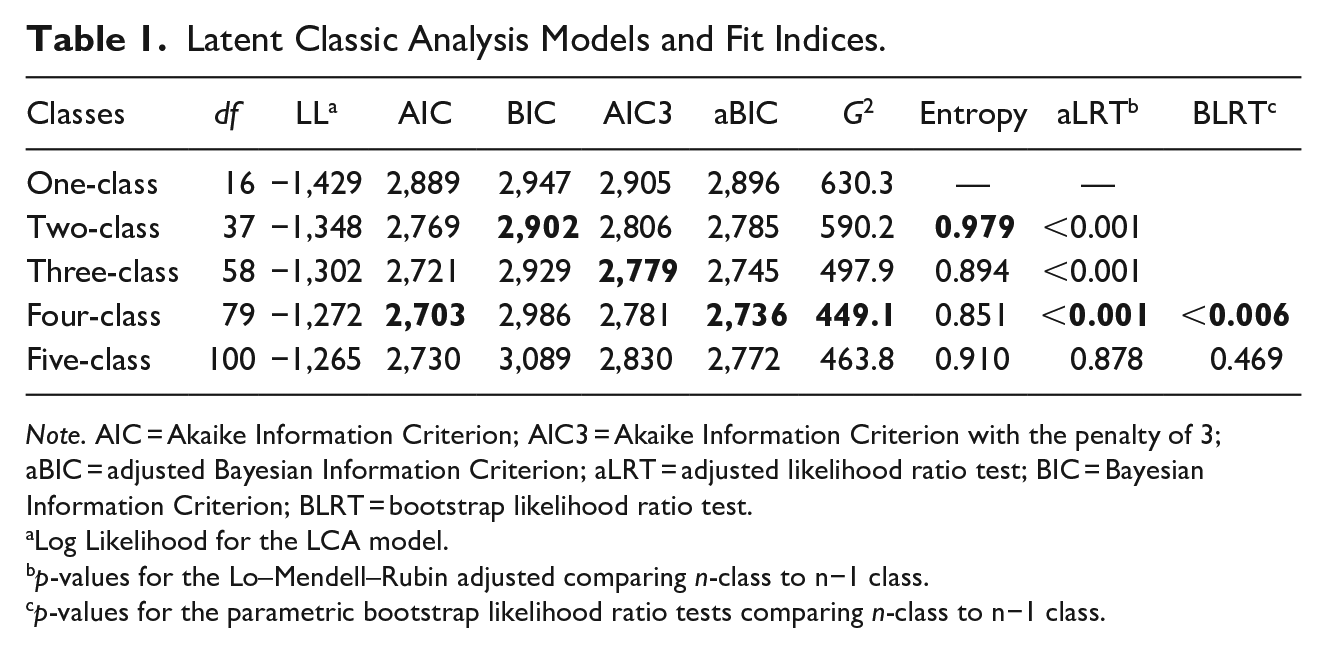
Note. AIC = Akaike Information Criterion; AIC3 = Akaike Information Criterion with the penalty of 3; aBIC = adjusted Bayesian Information Criterion; aLRT = adjusted likelihood ratio test; BIC = Bayesian Information Criterion; BLRT = bootstrap likelihood ratio test.
Log Likelihood for the LCA model.
p-values for the Lo–Mendell–Rubin adjusted comparing n-class to n−1 class.
p-values for the parametric bootstrap likelihood ratio tests comparing n-class to n−1 class.
Interpretation of the Four-class Model of Children with Revictimization
Figure 1 illustrates the four-class model of children with repeat victimization: 52.6% of the children were classified into Class 1, 20.1% were classified into Class 2, 18.7% were classified into Class 3, and 8.6% were classified into Class 4. The largest class, Class 1 consisted of children who had the highest probabilities of neglect in infancy and toddlerhood with a relatively lower probability of physical, emotional, and sexual abuse throughout childhood. This class was labeled the “Prevailing Early Neglect” class. The second largest class, Class 2 appeared to represent no predominant pattern of subtypes, despite a slight increase in the probabilities for all maltreatment subtypes in preschool. Class 2 can be termed the “Co-occurring Maltreatments in Preschool Age” class. Children in Class 3 was characterized by an increasing pattern in the probabilities of neglect until school age with an abrupt increase in the probabilities of sexual abuse at the peak. This class was named the “Incremental Neglect with Sexual Abuse in School Age” class. Class 4 was characterized by early physical abuse and a sudden increase in all types of maltreatment in middle childhood. This class also showed relatively high probabilities of emotional abuse in adolescence. This class was labeled the “Co-occurring Maltreatments in School Age.” In Supplemental Tables 1 and 2, we summarize the combinations of co-occurring maltreatment subtypes and the chronicity of recurring maltreatment by latent classes, respectively.
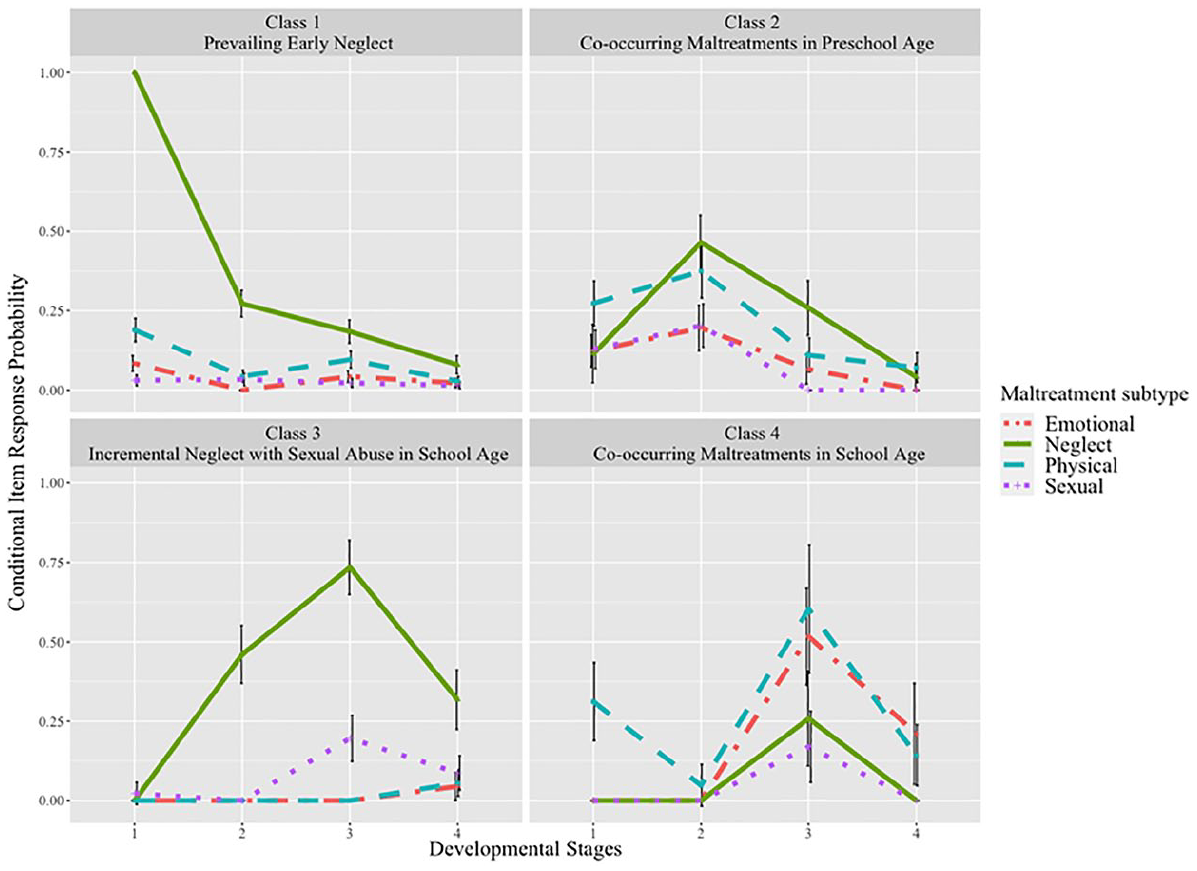
Item response probabilities for the four-class latent classic analysis model.
Assessment of Racial Invariance Across Latent Classes
The omnibus chi-square test revealed a statistically significant association between the race/ethnicity and latent groups identified by our LCA model
Multinomial Logistic Regression of the Association Between Race and Latent Class Membership.
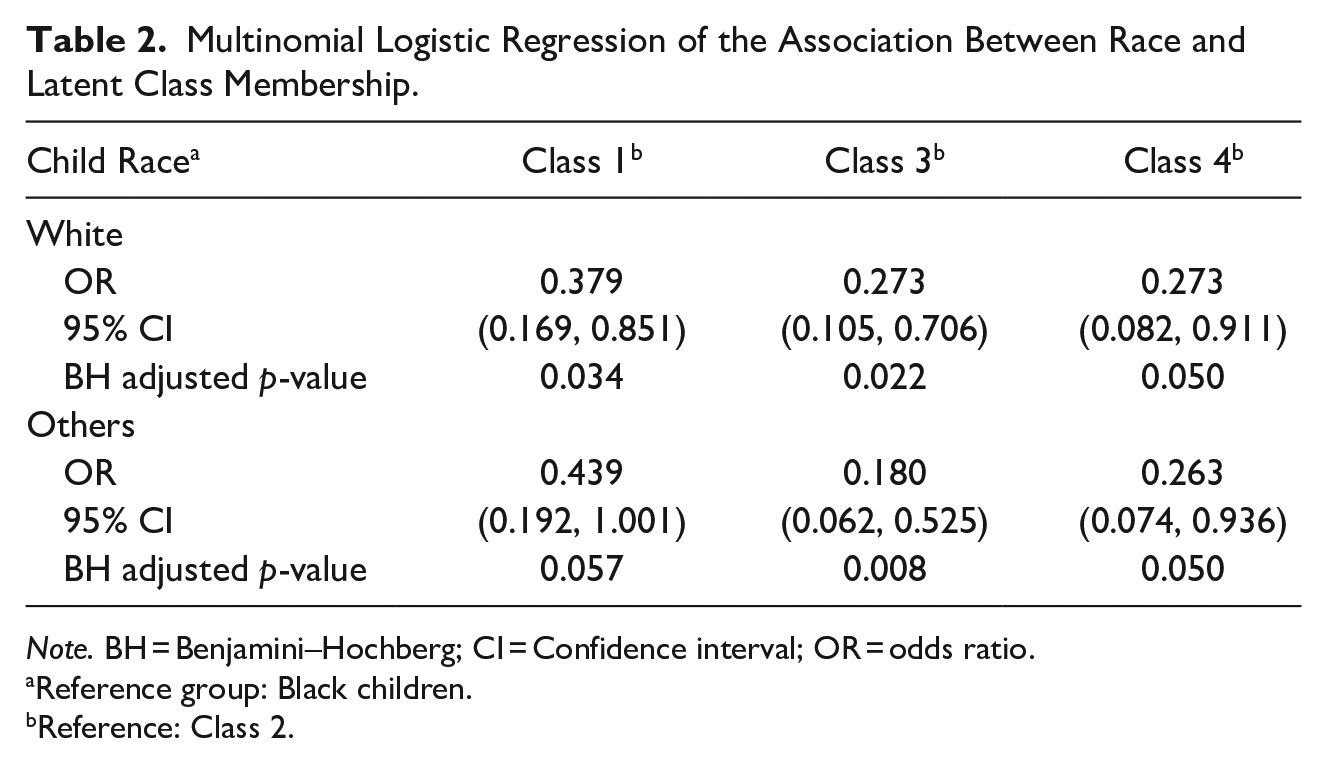
Note. BH = Benjamini–Hochberg; CI = Confidence interval; OR = odds ratio.
Reference group: Black children.
Reference: Class 2.
Juvenile Justice System Involvement Across Latent Classes
Results from ordinal logistic regression analysis indicated marginally significant differences in 5% tests across latent classes. To be specific, the odds of being more involved in the juvenile justice system was 5.3 times higher for children in the group of Co-occurring Maltreatments in School Age compared to children in the group of Co-occurring Maltreatments in Preschool Age (95% CI: 0.98–32.30, p = .052).
Discussion
This study explored the heterogeneous patterns of maltreatment revictimization using a person-centered approach. Utilizing lifetime CPS records, this study provided a more accurate and comprehensive characterization of children with multiple substantiated maltreatment, considering several important dimensions of maltreatment: subtypes, timing, and chronicity throughout childhood. The latent class analysis identified four distinct patterns of maltreated children experiencing revictimization. Consistent with prior research, the most prevalent pattern observed in this study involved children with notably high probabilities of early neglect during infancy and toddlerhood. Neglect played a significant role in differentiating the patterns among the identified classes, with each group exhibiting distinct developmental periods characterized by high probabilities of neglect. Neglect, although the most prevalent form of maltreatment, has received relatively less attention regarding its long-term effects on child development and its distinct nature in terms of recurrence risk compared to other forms of abuse. The current study identified that approximately 85% of children were neglected, and 45% of those neglected children were also reported with other types of maltreatment throughout their childhood. The results suggest that neglect from lifetime CPS reports is much higher and more prevalent than a one-year snapshot of neglect rates from the national data of child maltreatment in 2019, which indicated that approximately 61% of maltreatment victims were reported as neglected only, and 16% had two or more maltreatment types (US DHHS, 2021).
Neglect, often characterized as chronic, and neglectful parenting, is challenging to address in the short term due to its strong association with contextual factors such as poverty, unemployment, social isolation, limited education, and lack of social support (Avdibegović & Brkic, 2020; Jonson-Reid et al., 2013; Stith et al., 2009). Understandably, previous studies have found that children initially neglected are at significantly higher risk of revictimization and more likely to experience revictimization sooner than children with other maltreatment subtypes (Hélie & Bouchard, 2010; DePanfilis & Zuravin, 1999; Marshall & English, 1999). The findings from this study further contribute to the knowledge base about the nature of neglect by highlighting its occurrence and escalation across different developmental periods, which are influenced by contextual conditions such as poverty and social isolation. These conditions have temporary or persistent adverse effects on families and parenting. While some scholars have suggested excluding children aged 12 to 17 from research on child maltreatment due to increased autonomy and self-defense capabilities (Hélie & Bouchard, 2010), it is important to consider that children in that age group, particularly those who have experienced early abuse and neglect, remain at elevated risk for various vulnerabilities (e.g., developmental delay and aggression) and subsequent victimizations.
Another noteworthy finding of this study is the subgroup of children who experienced an increasing pattern of neglect until school age, accompanied by a sudden increase in cases of sexual abuse. Sexual abuse during the school age period can be partially attributed to chronic neglect. Neglect is mainly characterized by a lack of supervision and parent–child interactions and may have detrimental effects on children’s interpersonal relationships in later life. Neglected children often develop anxious attachment, dependency to others, lower self-esteem, and continuous negative interpersonal expectations, and difficulties in resolving interpersonal problems (Colman & Widom, 2004; Shields et al., 2001; Spratt et al., 2012). These difficulties leave them feeling powerlessness and lacking control of what happens, increasing their vulnerability to sexual abuse during subsequent developmental periods. This is consistent with the premise of the developmental psychopathology perspective that childhood maltreatment represents a significant early life adversity that can have long-lasting effects on children’s development (Cicchetti & Rogosch, 1996; Masten & Cicchetti, 2010). The strain and trauma associated with maltreatment can exert detrimental impacts on the developing brain and physiological systems of children, thereby influencing their emotional and behavioral regulation, cognitive functioning, and social relationships. Repeated maltreatment over time further exacerbates these effects, leading to a cumulative impact on the child’s developmental trajectory (Cicchetti, 2016; Jonson-Reid et al., 2004; Masten & Cicchetti, 2010). Understanding the nature and patterns of maltreatment revictimization within the context of the developmental psychopathology perspective is crucial for identifying the specific risk factors, exploring mechanisms of resilience, and elucidating the complex developmental pathways involved in maltreated children’s outcomes.
The current findings of this study also shed light on the racial difference in the identified classes of maltreatment revictimization, suggesting that black children are more likely to experience chronic neglect until school age and are at an elevated risk of sexual abuse compared to other racial groups. Neglect is determined by numerous and interacting risk factors regardless of race, such as children’s behavior or disability, family poverty, parent substance abuse, parental inability to cope with the needs of a given child, social isolation, and disadvantaged neighborhood (De Bellis, 2009; Jonson-Reid et al., 2004; Proctor & Dubowitz, 2014; Rawal et al., 2004; Ryan et al., 2013; Widom et al., 2013). Previous research indicates considerable variation in the initial response and decisions regarding service provision for neglect cases across racial groups due to differences in community contexts (Drake et al., 2009; Jonson-Reid et al., 2013). For instance, Jonson-Reid et al. (2013) found that black children reported to CPS for neglect lived in significantly poorer communities than white children, even after controlling for family income including case assistance (AFDC/TANF). These findings offer practically important insight into how the macro context of poverty influences child welfare decision-making. Black children residing in under-resourced communities may face additional barriers in accessing appropriate and timely services from the child welfare system. Services to meet their multidimensional needs are often beyond the scope of the child welfare system, and the limited resources available in the system typically prioritize those with a significant risk of harm. Consequently, the immediate concerns of children with initial reports of neglect may go unaddressed, leading to more detrimental outcomes. Likewise, the higher likelihood of black children being grouped in Class 3: Incremental Neglect with Sexual Abuse during School Age underscores the importance of contextualizing their experience of revictimization in the macro context of poverty and neighborhood disadvantages. Challenges faced by neglected black children may persist until they are reported for other forms of maltreatment that receive immediate attention from the system, such as sexual abuse (English et al., 2005c; Pérez-Fuentes et al., 2013).
Study Limitations
Before discussing the implications of this study, several limitations should be considered. First, while this study provides valuable insights into the trajectories of maltreatment revictimization by considering multiple domains of maltreatment, it is important to contextualize childhood maltreatment within the broader spectrum of victimizations. Previous studies have contributed to our understanding of child victimization and childhood trauma through the concept of poly-victimization (Finkelhor et al., 2009; Ford et al., 2010; Turner et al., 2017). Poly-victimization draws attention to the intersection of various forms of victimization experienced by children and youth, including physical abuse, peer bullying, exposure to domestic violence, and neighborhood violence. Given that children who experience maltreatment revictimization are often exposed to the overlapping risk factors, it is important to acknowledge a limitation of this study. By solely focusing on maltreatment revictimization, this study may underestimate childhood trauma while potentially overestimating the effect of maltreatment revictimization on developmental outcomes, as some outcomes may result from other forms of victimizations. To understand the complete burden of repeated victimization experienced by children, future research should incorporate other forms of childhood victimization in order to identify their collective impact and the patterns of revictimization. Next, this study focused on substantiated maltreatment from the CPS records to measure revictimization. Future research needs to validate and confirm the identified patterns of maltreatment revictimization observed in this study even when allegations are included. In addition, this study broadly categorized maltreatment into four subtypes: neglect, emotional, physical, and sexual abuse. However, each maltreatment type has various subtypes, such as poor hygiene/sanitation, inadequate supervision, failure to give medication, child abandonment, and denial of education in the case of neglect. Replicating this study with more specific subtypes of child neglect and abuse would enhance the findings. Lastly, the identification of latent class membership in this study was based on the 16 dichotomous indicators assuming that the maltreatment subtypes are independent across developmental stages. Future work should incorporate methodologies that account for the correlation between the maltreatment subtypes and developmental stages.
Implications for Policy and Practice
The findings of the current study have meaningful implications for policy and practice. Firstly, this study supports the heterogeneity in children's experiences of re-victimization from abuse and neglect. Our person-centered investigations of maltreatment subtype, timing, and chronicity underscore the need for targeted prevention strategies that consider various patterns of revictimization. The consequences of specific maltreatment subtypes occurring in different developmental periods may complicate treatment response and clinical presentations (Lauterbach & Armour, 2016; Warmingham et al., 2019). Therefore, treatment and intervention for childhood trauma resulting from repeated experience of maltreatment should incorporate the empirical evidence of the patterns of maltreatment revictimization into the course of the change model. Second, the identified classes of children with repeat victimization highlight the importance of early identification and intervention for neglect. Assessing allegations of neglect can be challenging, and substantiation rates for neglect are often lower compared to other types of maltreatment allegations (Antle et al., 2007; Dettlaff et al., 2011). Unless there are co-occurring conditions, such as domestic violence and parental inability to cope, investigators may have a higher threshold for substantiating neglect allegations (Dettlaff et al., 2011). Given the prevalence of neglect throughout the childhood and its association with the patterns of revictimization in this study, it is crucial to develop a more specific understanding of various neglect subtypes, the overlapping nature of risk factors, and contextual factors. This understanding should be incorporated into the risk assessment and investigation process to effectively identify high-risk child populations and to prevent their repeated contacts with the child welfare system. Lastly, the findings of the current study draw attention to the need for targeted interventions and support systems to address the unique challenges faced by black children experiencing chronic neglect with sexual abuse in school age. Community contexts play a significant role in shaping child welfare decision-making and service provision for black children often residing in under-resourced communities (Drake et al., 2009; Friesthler, 2013; Jonson-Reid et al., 2013). Simply relying on family-level poverty measures without considering community-level poverty measures in the system may overshadow the more critical determination of a family’s service needs to prevent further harm to a child, especially among black children. Taking a comprehensive approach is essential to assess and address the broader context of poverty and neighborhood disadvantages in order to gain a contextual understanding of the issue of maltreatment revictimization for black children. By recognizing the long-term risks and adverse outcomes associated with neglect, such as poor neurocognitive functioning, PTSD symptoms, and involvement in the juvenile justice systems (Cho & Lee, 2022; De Bellis, 2009; Jonson-Reid et al., 2004; Rawal et al., 2004; Ryan et al., 2013; Widom et al., 2013), preventive efforts for childhood trauma resulting from maltreatment and revictimization should focus on policies that address both family issues and increase community-level resources.
Supplemental Material
sj-docx-1-jiv-10.1177_08862605231194636 – Supplemental material for Identifying Trajectories of Maltreatment Revictimization and Juvenile Justice Outcome: A Latent Class Analysis of Subtype, Timing, and Chronicity
Supplemental material, sj-docx-1-jiv-10.1177_08862605231194636 for Identifying Trajectories of Maltreatment Revictimization and Juvenile Justice Outcome: A Latent Class Analysis of Subtype, Timing, and Chronicity by Minhae Cho, Bing Miu and Chi Hyun Lee in Journal of Interpersonal Violence
Footnotes
Declaration of Conflicting Interests
The authors declared no potential conflicts of interests with respect to the authorship and/or publication of this article.
Funding
The authors received no financial support for the research and/or authorship of this article.

Supplemental Material
Supplemental material for this article is available online.
Author Biographies
References
Supplementary Material
Please find the following supplemental material available below.
For Open Access articles published under a Creative Commons License, all supplemental material carries the same license as the article it is associated with.
For non-Open Access articles published, all supplemental material carries a non-exclusive license, and permission requests for re-use of supplemental material or any part of supplemental material shall be sent directly to the copyright owner as specified in the copyright notice associated with the article.
