




Abstract
Gender and sexual minoritized (GSM) youth are more likely than their cisgender heterosexual peers to experience intimate partner violence (IPV) and practice bondage and discipline, domination and submission, sadism, and masochism (BDSM). Although IPV and BDSM are vastly different phenomena, superficial similarities (e.g., violent behaviors) can lead to misidentification in both practice and research. This study explores how GSM youth (a) experience and understand the differences between IPV and BDSM and (b) report consensual violent and controlling behaviors when answering items on IPV measures. Nine demographically diverse GSM youth (mean age 21.2) were drawn from a GSM youth-serving organization in the Northeast United States. Participants were interviewed about their experiences with IPV, BDSM, and consent. Participants also were asked to describe the process of completing two standardized measures of IPV. Interviews were coded using conventional and directed content analysis. Eight of nine participants reported IPV victimization, and seven reported BDSM interest or experiences. Four themes emerged: (a) GSM youth experience a spectrum of IPV victimization, often related to their gender and sexual identity; (b) interest in BDSM does not imply an acceptance of IPV; (c) GSM youth have a nuanced understanding of consent and strategies to communicate consent with their partners; and (d) Consent is the organizing framework by which GSM youth distinguish IPV from BDSM. Participants reported various degrees of certainty that they would include BDSM behaviors when answering questions about violent behaviors. Findings underscore the importance of conceptually and operationally differentiating IPV and BDSM. Programs that serve GSM youth should address IPV victimization, offer sex-positive education regarding healthy relationships and BDSM, and assist GSM youth in differentiating abusive behaviors from consensual BDSM. Standardized measures that do not conflate BDSM with IPV are crucial for studying IPV among GSM youth.
Intimate partner violence (IPV) is a social problem that has attracted considerable research interest, including the differential risk for minoritized groups and the devastating outcomes for both victims and perpetrators (Wu et al., 2020). Conversely, an area of research that has been under-researched is bondage and discipline, domination and submission, sadism, and masochism—collectively known as BDSM (A. Brown et al., 2019; De Neef et al., 2019; Simula, 2019). Although there are superficial similarities between the two constructs of IPV and BDSM (i.e., presence of power differentials and use of violence), there are also critical theoretical distinctions—namely, the absence or presence of consent (Ali & Naylor, 2013; Jozifkova, 2013; Pitagora, 2013). However, few studies have conjointly explored the phenomena of IPV and BDSM (e.g., Pitagora, 2013, 2016), and no known studies have examined it among gender and sexual minoritized (GSM) youth. The latter is problematic given that GSM individuals are known to have a greater risk of IPV (T. Brown & Herman, 2015) and a greater likelihood of practicing BDSM (Coppens et al., 2019; Richters et al., 2008). Adolescence and early adulthood are the most common developmental periods for the onset of IPV (Capaldi et al., 2012) and BDSM (Coppens et al., 2019; Richters et al., 2008), suggesting that research on these topics should center GSM youth specifically.
Definitions and Prevalence
Intimate Partner Violence
IPV has been defined by the Centers for Disease Control and Prevention (Breiding et al., 2015, p. 11) as “physical violence, sexual violence, stalking and psychological aggression (including coercive tactics) by a current or former intimate partner.” See Table 1 for a list of terms and definitions used in this manuscript. Physically violent tactics include slapping, punching, hitting, burning, scratching, biting, strangulation, and using restraints, whereas psychological aggression can include name-calling, humiliation, degradation, or threats to harm (Ali et al., 2016; Breiding et al., 2015). Many practitioners and researchers recognize coercion and control as a defining component of IPV (Stark, 2007). One indicator of the growing awareness that coercive control is an especially pernicious part of IPV is its codification as a crime in multiple jurisdictions in the United Kingdom and United States (McMahon & McGorrery, 2020; Stark & Hester, 2019).
Terms and Definitions.
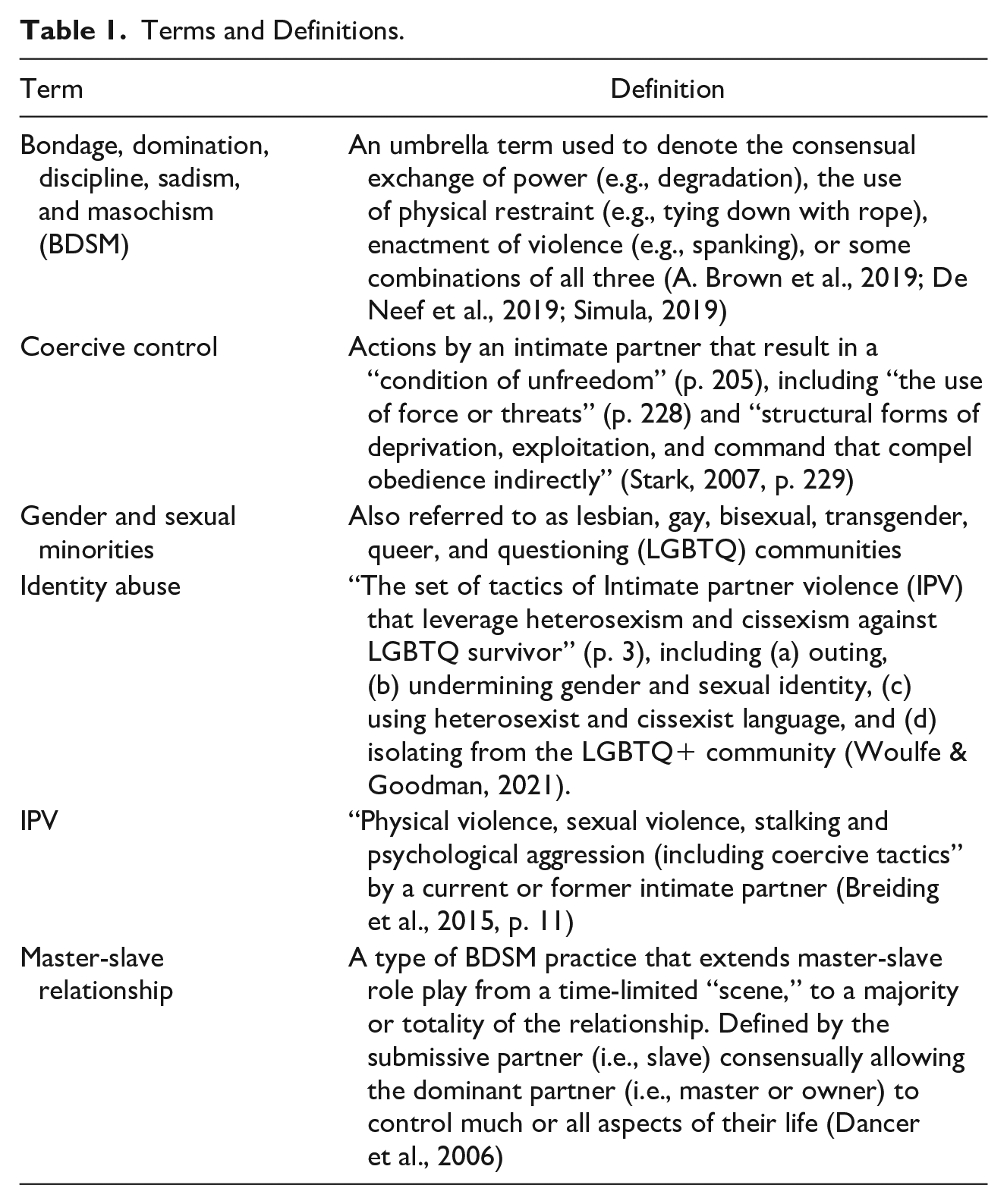
Research has found that GSM individuals generally experience IPV similarly to their cisgender heterosexual peers, including the presence of coercive control (Edwards, 2018; Walters et al., 2013). One type of abuse unique to GSM, however, is “identity abuse,” during which the perpetrator will weaponize gender and sexuality oppression against their partner (Guadalupe-Diaz, 2019; Woulfe & Goodman, 2020). In addition, multiple studies have found that GSM individuals have a disparity in IPV risk compared to their cisgender heterosexual peers (Dank et al., 2014; Martin-Storey, 2014; Martin-Storey & Fromme, 2016; Semprevivo, 2020). Dank et al. (2014) found that reports of physical, psychological, cyber, and sexual violence victimization were considerably higher among SM youth compared to heterosexual youth. Additionally, a higher percentage of GM youth reported these same types of violence compared to cisgender youth. Although research on GSM IPV is growing, studies often focus on minoritized sexual identities; minoritized gender identities, bisexuals, and pansexuals remain dramatically understudied populations.
BDSM
BDSM is an acronym used as an umbrella term to denote the consensual exchange of power, the use of physical restraint, enactment of violence, or some combination of all three (A. Brown et al., 2019; De Neef et al., 2019; Simula, 2019). BDSM can occur both within and outside the context of what would traditionally be called a romantic relationship. While not exhaustive, BDSM can include impact play, including spanking, caning, and whipping; bondage, including restraint with rope, handcuffs, or other devices; psychological play, including humiliation, degradation, and threats; service, including the requirement to do chores, such as cleaning or shopping; and power exchange including giving over control of aspects of one’s life (A. Brown et al., 2019; De Neef et al., 2019; Simula, 2019). For most people who practice BDSM (herein, “BDSM practitioners”), the activities mentioned above are time-limited to a short period or “scene” (Simula, 2019). A minority of people who practice BDSM extend the power differential indefinitely, living “24/7” (24 hr a day, 7 days a week), at times in the framework of a “master-slave” dynamic (Dancer et al., 2006).
Estimating the prevalence of BDSM interest and behaviors is difficult given the stigma attached to not only the practice of BDSM but also the research of it (Simula, 2019; Wright, 2006, 2018). Estimates of BDSM behavior range from 1.8% in a representative Australian sample (n = 1,440; (Richters et al., 2008) to 46.8% in a representative Belgian sample (n = 1.027; (Holvoet et al., 2017). Prevalence rates vary greatly by the methodology used, including whether the participant is surveyed about identity, behaviors, or fantasy. When asked about BDSM identity or labeling behaviors as “BDSM-themed activities,” participants endorsed at low rates. Conversely, asking behavior-based questions (e.g., Have you spanked a partner?) or regarding fantasies (e.g., Have you wished to be tied up?) yields greater endorsement (De Neef et al., 2019). For instance, in the Belgian study, 69% of the sample had BDSM fantasies, and nearly half the population reported BDSM behaviors, but only 7.6% reported identifying as a BDSM practitioner (Holvoet et al., 2017). These greater rates of interest comport with studies of U.S. samples (Herbenick et al., 2017; Kinsey et al., 1953; Renaud & Byers, 1999). In a representative sample of U.S. adults, Herbenick and colleagues (2017) found that greater than 30% of the sample had participated in spanking, greater than 20% participated in restraint, and greater than 13% had participated in playful whipping.
Although research on BDSM is nascent, sexual minorities report higher rates of BDSM interest and behaviors (Coppens et al., 2019; Richters et al., 2008). Additionally, the onset of BDSM fantasies and behaviors appears to peak in late adolescence and early adulthood (Coppens et al., 2019; Holvoet et al., 2017)—incidentally, this is also the most likely developmental period for the onset of IPV (Capaldi et al., 2012).
IPV and BDSM
The definitions of IPV and BDSM can appear to be quite similar, as they can be partially defined by violence, including blows to the body (e.g., hitting, slapping, punching), infliction of pain (e.g., biting, scratching), and restraint (e.g., holding down or tying down). Both are also framed as a differential in power, with one partner controlling the other partner (Johnson, 2008; Weinberg, 2006). However, an essential distinction separates IPV and BDSM: the absence or presence of consent (Ali & Naylor, 2013; Jozifkova, 2013; Pitagora, 2013). In BDSM relationships, the individuals communicate their interests and boundaries (Faccio et al., 2014; Jozifkova, 2013; Pitagora, 2013), and many in the BDSM community center consent, with frameworks developed to assist participants in negotiating and receiving permission for certain actions. These include Safe, Sane, and Consensual (SSC); Risk Aware Consensual Kink (RACK); and Caring, Communication, Consent, and Caution (4Cs) (Williams et al., 2014). In relationships with IPV, however, one individual takes power and control or enacts violence without request or permission (Johnson, 2008; Kelly & Johnson, 2008).
Research on whether and how IPV and BDSM co-occur is nearly nonexistent. Much of what has been theorized about IPV and BDSM comes from anecdotal experiences of individuals in the BDSM community or textual analysis of books and movies. Only two known studies have directly explored the intersection of IPV and BDSM. Pitagora (2016) interviewed three people—two cisgender women and one transgender woman—who reported being part of the BDSM community and experiencing IPV. She found that (a) inexperience with SM can create a susceptibility whereby the victim mistakenly believes abuse is SM, (b) IPV and the stigma of SM can isolate the victim, (c) minority stress, inclusive of oppression due to gender and sexuality, can further complicate a victim’s ability to differentiate IPV from SM, and (d) abusers might use SM relationship as a cover to perpetrate abuse. In the second study, Dancer et al. (2006) explored the experiences of those in master-slave relationships. They found that of the 48 participants who had ended such a relationship, 37% did so for feeling unsafe or fearing harm/death.
The potential to confuse and conflate these very different phenomena underscores how imperative it is that researchers and practitioners appropriately conceptualize and differentiate IPV from BDSM. Yet, research has not explored if the measurement of IPV is inadvertently capturing consensual BDSM behaviors. This is concerning as there are existing studies that point to the lack of precision in existing IPV measures. For instance, Lehrner and Allen (2014) explored women’s experience of completing the Conflict Tactic Scale (CTS), a commonly used measure of IPV. After completing the survey, participants were interviewed about their answers. These women reported that they endorsed items on the scale due to participating in wrestling, play fighting (“roughhousing”), and mock violence—something that was not intended in the instrument design. This raises questions about the conceptualization and operationalization of IPV in existing research, including if BDSM is creating false positives on IPV measures.
The Current Study
The aims of this qualitative study were to explore how GSM youth (a) describe experiences with IPV, including the types of abusive tactics used; (b) describe experiences with BDSM, including what types of behaviors they are interested in or have engaged in; (c) conceptualize consent, and if they apply the concept to differentiate IPV from BDSM; and (d) perceive standardized IPV measures among those who have practice or interest in BDSM.
Method
As others have stressed, it is critical for researchers to start by identifying the values and perspectives they bring to the research they conduct, especially when using qualitative methodology (see Merriam & Tisdell, 2016). The first author, who conducted the interviews, is a licensed clinical social worker. He has been involved in intimate partner and sexual violence social services for over 10 years, working in generalist and GSM-specific organizations, and across several contexts, including hotlines, shelters, and therapy clinics. As a clinician, he has worked with clients who report practicing BDSM, at times self-motivated to address their trauma symptoms. Others have experienced IPV in the context of consensual BDSM. He and the third author identify as a sexual minority, which partially reflects the population under study, and the second author has lived experience with IPV. The authors did not treat BDSM practice or interest as abnormal or pathological. All three of the authors have extensive research on the topic of IPV among GSM populations. Although there are benefits to aligning with the population under investigation, it cannot go unstated that this can also create a myopic impression of the participant responses. To counteract these effects, we used memoing, critical reflection, and peer debriefing.
Study Procedures
Participants were drawn from a GSM-serving organization in the Northeast U.S. using purposive and snowball sampling. The organization provides services to the youth, including education and referrals. It should be noted that the organization is aware of and promotes IPV and BDSM-specific resources, including readily available brochures with this information. Inclusion criteria for the study were being aged 16 to 24 at the time of the study, identifying as a minoritized gender or sexuality (or both), ability to consent and tolerate the interview process, and ability to speak and understand English.
Nine participants participated in the interviews. Although efforts were made to sample a wide range of ages between 16 and 24, all participants were at least 19 years old at participation, with a mean age of 21.2. Two participants identified their gender as male, one identified as female, and six identified as gender fluid or nonbinary. Five participants identified their primary sexuality as bisexual, one as pansexual and “poly,” one as demisexual, one as panromantic ace, 1 and one simply identified as “single.” Three participants identified as non-Hispanic White, one as “Hispanic non-White,” one as “White and Asian,” one as Asian, one as Cherokee, one identified as “African and Native American,” and one as “African American, West Indian.” Eight of the participants reported that their mothers had completed high school and had at least some college experience. One participant did not know their mother to provide the answer.
From late 2019 to early 2020, the first author interviewed each participant. Interviews averaged roughly 45 min, with no interviews lasting longer than 90 min. Interviews were audiotaped and professionally transcribed. At the end of the interview, participants were offered a $30 gift card to thank them for their time. Questions followed a semi-structured schedule covering several topics: IPV, BDSM, consent, and exposure to education about these topics. Questions included the following. Have you ever had experiences in your relationships where your romantic/sexual partner hurt you in some way? What were these experiences like? Have you ever wanted your partner to hurt or restrain you? What were these experiences like? What does consent mean to you?
Participants were also given the CTS and Modified Safe Dates Scale (MSDS) and asked follow-up questions about their experience with the surveys. One participant could not be given the surveys due to technological difficulties. Those who had not practiced BDSM were asked to imagine that they had practiced BDSM and consider if they would include those behaviors in their responses. Given the need for strict confidentiality, no contact information was collected, which precluded member checking.
[Institution withheld for blind review] Institutional Review Board approved the study. Given the vulnerability of the participants, great effort was taken to ensure safety and confidentiality. Participants consented to the study through both written and verbal explanations of the procedures and risks. All participants were given a list of resources, including national and local social service agencies, including IPV services, and a suicide hotline. Participants were interviewed in a social service setting in a private room, monitored for distress throughout the interview, and debriefed at interview termination. One participant chose to be interviewed via video chat due to the onset of COVID-19. Participants chose a pseudonym to be used when reporting the study’s findings, and their true names were left out of the audio recordings and transcripts. All data were kept in password-protected folders; only the research team had access.
Analysis
Transcripts were coded using thematic analysis to identify the informational content within the interviews (Braun & Clarke, 2023; Hsieh & Shannon, 2005). Each transcript was broken into small units. Units were named and then categorized into groups based on shared characteristics using the constant comparison technique. The authors produced in vivo codes using quotes taken from the transcripts. These codes were organized hierarchically to create categories that subsumed the in vivo codes. To increase trustworthiness, we followed Lincoln and Guba’s (1985) approach by completing contemporaneous memos during and after all participant interviews and during analysis and writing. In addition, attempts were made to bracket beliefs and thoughts to emphasize participants’ responses. As mentioned, peer debriefing was used throughout.
Results
Four themes emerged from the interview data: (a) GSM youth experience a spectrum of IPV victimization, often related to their gender and sexual identity; (b) interest in BDSM does not imply an acceptance of IPV; (c) GSM youth have a nuanced understanding of consent and strategies to communicate consent with their partners; and (d) consent is the organizing framework by which GSM youth distinguish IPV from BDSM.
GSM Youth Experience a Spectrum of IPV Victimization
Eight of the nine participants reported multiple types of violence in their intimate relationships. Tactics included psychological violence and threats (including threats of homicide), physical violence, and identity abuse. Participants viewed their partners’ tactics as attempts to control them. At times participants reported that the violence was bidirectional, with some noting use of violence to defend themselves. In most relationships, their partners identified as being GSM themselves or behaviorally were GSM by the nature of their current or past romantic and sexual relationships. Psychological and emotional abuse were common tactics reported by the participants.
Identity abuse targeting transgender participants often included attempts to undermine the participant’s sense of self and destabilize their gender identity—at times by misgendering them purposefully. Sexual identity was another target of identity abuse. Bisexual and pansexual participants seemed to be particularly targeted for identity abuse. For these participants, identity abuse appeared related to jealousy and the partners’ beliefs that bisexual and pansexual people are promiscuous and prone to infidelity. Lou—who identified as nonbinary, panromantic, and ace—explained that it was their asexual identity that their partner targeted: “He was unbelieving of the fact that asexual people could exist.” When asked if they thought their partner deliberately denied that their identity was valid, Lou responded affirmatively.
Interest in BDSM Is Not Acceptance of IPV
Participants had an interest in BDSM practice, which did not coincide with an acceptance of abuse. Six of the nine participants reported that they were either interested in or had engaged in consensual BDSM behaviors. Biting and restraints were two of the most common reported interests and behaviors. Participants described being both submissive (i.e., receiving pain or restrain) and dominant (i.e., doing the restraining or creation of pain). Some participants appeared to have a working knowledge of BDSM practice, including common components of consent (e.g., safewords) and tactics for avoiding unintended harm (e.g., using the dull backside of a knife). Others reported interest in BDSM but worried accidental harm could happen due to their lack of knowledge. Participants reported discussing sex and BDSM with their friends, often sharing information or warning each other of dangerous individuals. Some sought out information and community online or in-person through the BDSM community.
Some participants considered or fantasized about BDSM but had not manifested this into behaviors. When asked about their interest in BDSM, Felix—who identified as nonbinary, gender fluid, and single (as their sexuality)—reported: I mean, I’ve thought of it, I mean, like to an extent but not like purposely, you know like assaulting, you know what I mean. . .But like in a good way, not like, not in a bad way, point where it hurts mentally and emotionally both physically as well.
Even in describing their initial interest in BDSM, Felix distinguished between behaviors that are “good” and those that are “assaulting.” Felix later added, “I do know the difference between having it rough and then abuse.”
An interest in being dominated was a common theme for five participants. Hayden—who identified as nonbinary, pansexual, and poly—described an interest in being submissive to a more dominant partner. Specifically, they liked the roleplay of a “daddy-dom little girl situation,” but noted only with AFAB (assigned female at birth) transmen. Glass—a participant who identified as male and bisexual—described his interest in domination, “where people use whips and different things, maybe tie you to a wall, just sit there and punch you.” He named his past experience with trauma as a precursor to his interest in domination: “It’s ‘cause I like since I’ve been traumatized by the stuff I’ve been through, I’ve had habit of liking certain types of pain.” Glass also appeared to draw a distinction between what he considered acceptable and unacceptable violence in his relationships: I’m not talking about like weapons or like stabbing someone; I’m talking more just like if, if I can’t have your love, then I have to have your opposite.”
Participants explicitly distinguished between acceptable and unacceptable behaviors, with an awareness of their own boundaries and those of their partners. Lou described an interest in impact play (e.g., hitting, slapping, caning) but noted that they had not been able to try it with their partners yet due to being homeless and not having a private space. Leone—who identified as nonbinary and bisexual—reported interest in knife play, which they defined as “taking the tip of a knife and running it over your spouse’s body, hitting all the areas that are considered erogenous. And pretty much like teasing.” But noted concerns about the safety, which propelled them to seek out information and connection with other BDSM practitioners through an online community called FetLife and in-person informal gatherings. From this group, they learned to use the back of the blade and ensure the submissive is still to avoid harm.
Biting was a common interest for the participants. Felix named an interest that arose when drinking, specifically defining it as nonsexual. Leone described their experience biting partners: “Normally I’m, I’m the biter, but not like hard biting, you know. Like kittens, love nibbles. There are sometimes I’ve wanted somebody to do that towards me, but it always ends with them biting too hard or something.” Here, Leone is describing what is acceptable biting versus not. They report past experiences where the other person went further than they were comfortable with: “The times it was okay, it felt like a massage. I think there were only two times it wasn’t okay. But the other person did it anyway.” Hayden similarly named an interest in biting but also quickly noted a boundary because they did not like slapping.
Another common BDSM interest was restraint. Thorn—a participant who identified as nonbinary, transmasculine, and demisexual—reported negotiating verbally with their partner and ultimately using neckties for restraint. Leone reported interest in restraints and being open to tying down their partner when the partner requested it, but ultimately declined out of fear of not knowing how to do so safely: I felt severely irritated that I had to say no, to be honest. Because I knew that’s what they wanted and what I wanted to too, but because it was, you know, a safety risk, I didn’t think it was such a good idea. . .
Hayden reported similarly being interested in restraint but named some of their boundaries regarding restraints: And like I know some like really intense sub-dom relationships like they’re like putting people in cages and like putting like a whole plastic wrap around their head. I don’t want that. Just like the arms and the legs, that’s good enough for me.
Hayden also explained that the gender identity of their partner mattered when deciding if they would be okay with restraints: “With AFAB [assigned female at birth] people, I tend to like the restraints, but when it’s AMAB [assigned male at birth] people I don’t like it.”
GSM Youth Have a Nuanced Understanding of Consent
Participants reported nuanced understandings of consent, and most applied consent to BDSM. Many explained that consent could be both verbal and nonverbal through observing each other’s behaviors and reactions. Participants often talked about building trust in the relationship, achieving a “full yes,” the absence of a “no,” and the need for ongoing communication. Most participants reported a nuanced definition of consent that was both understood and communicated between all people involved. Thorn explained: [For] me, it’s like both people who are going into it understanding like what each piece of like what’s happening is, and like being okay with every aspect of it. Like consent is a complete yes. And nothing short of that. It’s like it’s built on trust. . .Consent isn’t an absent of a “no.”
Many participants used the word agree or agreement, such as Red—who identifies as female and bisexual—explaining that consent is when “you agree to something.” Lou described how consent should be both “affirmative and informed,” noting that “just because someone didn’t say no doesn’t mean it’s a yes.” Multiple participants also noted that consent can be given but then withdrawn. Felix explained: Consent is like you agree; both parties agree to what they’re about to do. They get permission, and they say, yeah, I allow this. And but if I don’t want to, we can stop at any time. That’s what consent is.
Nearly all participants reported verbal consent as being important. When asked what consent means to him, Glass reported, “I would tell [them]. I would just verbally have a conversation with them as I’m talking to you.” Lou echoed these sentiments: I think it’s really like being informed and being very clear about it. Like if you’re consenting to doing something or having action done, just being very clear like what are the parameters on the informed side. You know, what falls under, what doesn’t, which usually will come up in conversation, I think. And also just not relying on body language too much, but by actually verbally consenting.
Hayden noted the importance of direct questions: “Ask, asking or like asking before doing anything, but also being slow about it.” Ghost similarly reported conversations with explicit discussion of each act was important for all people being comfortable: So if we come to an agreement like okay, we’re both comfortable with this, but we’re not comfortable with that, we’re gonna do by all means to make each other comfortable. . . so I let people know, listen, I’m okay with X, Y, and Z, but C and D, I’m not okay with. If you’re okay with C and D, but you’re not okay with A to Z, like we have a conflict now.
In addition to verbal consent, many participants named nonverbal cues as being important. Many described the need to move slowly from one action to another, whereas others described the need to observe their partner’s reactions for signs they are not fully consenting to what is happening. Leone reported the importance of going slowly and moving from one sexual act to another sexual act, “There’s the whole, you know, oh, they said it’s okay, so it must be okay. But at the same time, you should always wait and be hesitant and ask them if they’re sure.”
Hayden explained that they are conscious of their partner’s mental health and possible reactions to sex and that these are why it is important to go slowly: “So not all the sudden kissing somebody on the head or hand or wherever you’re kissing somebody, but like doing slowly, so they know that you’re there and it’s not like a panic response or a PTSD situation.”
Many participants also talked about the importance of observing their partners: Just when they’re not sure, you can see it in their eyes. They’ll have that look about them. And it’s more like an uneasy feeling. . .. If I see even the hint of them being like I’m very unsure about this, or I’m just a little unsure, I will stop everything and wait. . . (Leone)
Ghost describes nonverbal consent as: “I tell by like the vibes. Like, like the action that they have because you can tell when someone doesn’t want to do something.”
GSM Youth Distinguish IPV from BDSM
Participants made clear that they distinguished BDSM from IPV by the presence of consent. Felix explained the need for consent during the use of restraints: “I mean, if someone’s gonna tie you down, you better agree to it, you know.” Similarly, these two quotes underscore the centering of consent: Yeah, I think like consent’s important for like everything, like new, and different [during sex]. Like anything that, like anything that someone might be uncomfortable with, where that needs to be like you need to trust your partner for, like needs consent. (Thorn) But the doms [dominants] aren't really the ones in charge in the BDSM setting. It’s the subs that are in charge. And a lot of people don’t recognize that. And the reason why the subs [submissives] are technically in charge is because it’s their consent that you have to wait for. (Leone)
Lou noted that perhaps it is the definition of consent to sex that was informed by definitions of consent drawn from the BDSM community, not the other way around. They noted that individuals practicing non-BDSM sex could learn from “the affirmative and informed part” of the BDSM definition. All of these examples demonstrate that participants use consent to delineate BDSM from IPV.
For some participants, verbal consent in BDSM also included agreement on a “safeword,” which can be used by either party to stop the sex or BDSM action. According to Leone, Definitely would have need of a safeword. But talk about before what they believe is okay in that scenario and what I believe is okay. Then we'd find the common ground that we both agree on, and that’d be the extent of what happens.
They define the safeword as: “Well, just any word that would be used outside of like a BDSM setting. Something that would definitely be known to not be like interpreted as anything else.” They explain that if someone says the safeword, all action stops. Lou similarly explains that safewords are important because people may be acting in the scene in ways that imply they are not giving consent when they really are: Like there are scenes where people want you to just go ahead, even if body language is essentially a big “No.” So in those cases, it’s just like if you communicate clearly about expectations beforehand, that’s fine to go off the verbal as long as you’re checking in. . .
Lou later gives their definition of safeword as “signals. . .that are never part of the scene, like body language can be part of the scene, verbal language can be part of the scene, but like safewords or safe signals are always outside of the scene.” These examples of participants using safewords demonstrate how someone can experience consensual violence but still retain control to stop the violence at any time—something that is not part of IPV.
The Co-occurrence of Consensual and Non-consensual Violence
Some participants noted the co-occurrence of consensual and non-consensual violence, with two participants avoiding BDSM when concerned for IPV. Ghost—who questioned their gender and identified as bisexual—made a direct connection in her current intimate relationship. She reported: I don’t like to be bit. And my current boyfriend likes to bite me. . . And then he starts to bite me, and I tell him, like don’t do that because that’s not something I like. But like, he tends to keep doing it. . .
Ghost also noted that her partner’s past abuse informed if she was willing to consent to some BDSM practices. She describes her male partner as wanting control and wanting to feel dominant. She reported being okay with some markers of dominance but not with some specific BDSM practices he was asking for due to his co-occurring abuse: Like he wanted to like choke me while we were being sexual. He wanted to like grab my hair, like fistfuls of my hair and stuff like that. He wanted to tie me up and stuff. And I’m just like, I don’t, I’m not into stuff like that. Don’t get me wrong; maybe if you weren't the way that you was, I would be okay with it because I would feel safe. Like, okay, he’s not gonna intentionally try to hurt you. No, you’re abusive, so it’s like if I let you tie me up, who's to say that you ain’t gonna try to kill me while you have me tied?. . . And it scared me, so I told him no, I don’t want to roleplay with you. I don’t feel safe with you.
Leone reported that their partner was abusive and requested doing restraints in their relationship. Leone declined to act on their partner’s request because they did not feel they had the knowledge of doing the restraints properly. However, Leone noted that if they had learned more about restraints before their abusive partner’s request, they would have participated with this partner. These two examples from Ghost and Leone demonstrate that while some GSM youth with abusive partners might avoid BDSM out of safety, others might agree.
IPV Measures Misidentify BDSM Among GSM Youth
When asked to review the two standardized IPV measures, participants either directly included BDSM behaviors in their responses or equivocated, providing caveats to situations where they would or would not include BDSM. However, even for those with more ambivalence about inclusion, all affirmed that in at least some cases, they would include BDSM behaviors in their responses to the IPV measures. Four participants made strong affirmative statements that they would include BDSM behaviors when answering items on the IPV surveys. For instance, participants said they would endorse items for biting, even if that biting was done consensually.
Four participants hedged in some way, saying things like “maybe” (e.g., Red) they would include BDSM behaviors or noted exceptions to their inclusion of them. For instance, Thorn suggested that given that some questions on the MSDS asked about behaviors while under the influence, they would be less likely to include BDSM behaviors. Lou made a distinction between the two surveys noting that they likely would include BDSM behaviors in the MSDS but not in the CTS. They explained, “The first part [MSDS] was different than the second part [CTS]. The first part was just like have you done this. The second part was have you done this as part of a disagreement.” For both Thorn and Lou, the survey provided context clues that made them more or less likely to include BDSM. Lou directly wondered about the mindset of the person giving the survey: “Yeah [I would include BDSM], but given that the person is aware of that people are practicing this consensually as well.” Here, Lou is describing how understanding the context of the research team or study might also inform their inclusion of BDSM behaviors when responding to IPV measures. When asked if he would include BDSM in his answers on the survey, Glass said, “Sometimes no, sometimes yes. It’s like a half-and-half thing” that would partially depend on the specific relationship or relationships the questions were asking about.
Discussion
The purpose of this study was to explore how GSM youth experience IPV and BDSM in their relationships, how they distinguish between the two constructs, and how they react to surveys intended to measure IPV. This is the only known study to explore IPV and BDSM conjointly with a GSM youth sample. This study is also one of few studies that focus on those who have been most marginalized due to their identities—including sexual minorities and those who practice BDSM. Importantly, a majority of the sample identified as gender minorities, bisexual or pansexual, and racial minorities. These populations—particularly those with these intersecting identities—are a particularly difficult group to identify and engage in research.
The GSM youth in this study experienced a spectrum of abusive tactics by their intimate partners, including psychological, physical, and identity abuse. These findings are consistent with the extant IPV literature (T. Brown & Herman, 2015; Peitzmeier et al., 2020). Reported types of IPV victimization were similar to those reported by Dank et al. (2014), including psychological and physical abuse. Additionally, the experience of identity abuse was common, which comports with a growing body of literature (Guadalupe-Diaz, 2019; Woulfe & Goodman, 2020).
We also found that there was considerable interest and engagement in BDSM among participants. They distinguished between consensual BDSM and IPV by noting their own boundaries and those of their partners. Some boundaries were due to their lack of interest, others due to lack of knowledge regarding safety, and others because they did not trust their abusive partner. These findings are consistent with the extant BDSM literature that shows youth—particularly GSM youth—are interested in BDSM and engage in these behaviors starting in late adolescence and early adulthood (Coppens et al., 2019; Richters et al., 2008). These youth were interested in a wide range of behaviors, including biting, restraint, and knife play. They also appeared to have been exposed to information about BDSM—some from partners, from their circle of friends, online communities, and social service organizations. As mentioned above, this sample was drawn from a GSM-serving organization, likely oversampling youth who have been exposed to health campaigns, sex-positive social service workers, and like-minded peers. Future exploration of those with a more tenuous connection to GSM organizations and communities—particularly those in more suburban or rural areas—might have differential exposure to BDSM practice or knowledge of consent.
The GSM youth in this study appeared to have a nuanced understanding of consent, which they applied not only to sex but also to BDSM practice. Many were able to describe components of consent mirroring recent public health messaging. This includes that consent is both verbal and nonverbal, ongoing, and can be withdrawn at any time (Muehlenhard et al., 2016; Williams et al., 2014). Given that GSM often already have identities that challenge heteronormativity, they might be more likely to seek information on sexuality, including education about BDSM practice. It is also possible that these GSM youth were well educated about consent due to the nature of the sample for this study and their exposure to services. Further research is needed to uncover the etiology of their conceptualization of consent. These findings regarding consent point to the importance of educating youth, particularly GSM youth, about sex from a sex-positive stance that is nonjudgmental and speaks to the varied behaviors they are practicing—including BDSM.
These findings demonstrate the importance of social service organizations and practitioners having a working knowledge of both IPV and BDSM. This knowledge is particularly important for organizations that endeavor to better serve GSM youth. This suggestion comports with more recent calls for clinicians to better understand BDSM practices (Dunkley & Brotto, 2018; Williams et al., 2017). Importantly, although there is a history of pathologizing BDSM—particularly within psychology (Weinberg, 2006)—more recent research has challenged this framework by demonstrating BDSM is not associated with psychological pathology (Richters et al., 2008; Rogak & Connor, 2018) but rather is associated with favorable psychological characteristics (Wismeijer & van Assen, 2013). This depathologized framework is likely to resonate with these GSM youth, given their interest and engagement in BDSM.
BDSM has also been framed by others as “therapy,” providing an important framework for these findings. Those who practice BDSM (Hammers, 2018; Thomas, 2020) frame their BDSM actions as therapeutic—particularly regarding past trauma. Some of the participants in this study appeared to note the interaction of BDSM and trauma, though how they understood this intersection was not clear from these brief interviews. Exploring the intersection of trauma exposure and BDSM is important to consider, given that some IPV victims might engage in BDSM behaviors during or after their victimization as a means of addressing the trauma that has arisen in their relationship. Further research is needed to explore if and how BDSM might be seen as therapeutic for some IPV victims and the effectiveness of its use.
Findings highlight the importance of fully conceptualizing and operationalizing consent when measuring IPV victimization. This clarity is important so as not to inadvertently conflate BDSM behaviors with IPV behaviors. Participants in the current study reported that they would either certainly or possibly include BDSM in their response to IPV items, suggesting that some people might be confused by the wording of the instructions or the lack of explicit exclusion of consensual violence. Taken together, findings suggest the need for explicit instructions in IPV measures that experiences of consensual violence should not be included when responding and that instructions and questions should be tested with GSM youth and BDSM practitioners to ensure validity and reliability.
Strengths and Limitations
GSM youth are a difficult population to study, given their vulnerability and apprehension to participate in research. Having high-quality interviews with nine racially diverse GSM participants—particularly those who have had experience with IPV and BDSM practice—provides a substantial contribution to the research literature. However, a limitation of this study is that the sample was drawn from a single social service agency. In addition, given that participants were drawn from a service organization, the sample is also likely to have had more exposure to sexual health education, including sex-positive conversations about consent, IPV, and BDSM. This research contributes to the literature by posing questions about how IPV, BDSM, and their distinction are conceptualized in the academic literature—as well as how GSM youth experience these phenomena. Having evidence that GSM are experiencing IPV, BDSM, and both simultaneously is a useful finding that demands further exploration using larger samples, deeper qualitative exploration, and quantitative measurement.
Future Research
Additional research is needed to explore how all GSM populations understand the constructs of IPV and BDSM, including if, how, and when IPV is co-occurring with BDSM. As Pitagora’s (2013, 2016) research has uncovered, abusers might use the cover of BDSM to enact violence on their victims surreptitiously. Particularly vulnerable might be those less connected to the wider BDSM community, including those just initially exploring their BDSM fantasies or identities.
Research is especially needed on the many overlapping and intersecting identities when studying IPV and BDSM among GSM youth. In particular, efforts should be taken to explore the individual subgroups that make up the GSM community and how those GSM identities intersect with other identities, including race. Current research already points to differential rates of BDSM interest (Coppens et al., 2019; Richters et al., 2008), suggesting this investigation might find other intragroup differences. Additionally, as some BDSM researchers have pointed out (Coppens et al., 2019), the BDSM community should not be seen as a monolith. Rather, it should be further explored to understand the nuances among subgroups that practice certain behaviors or BDSM-related identities. For instance, some consensual practices—such as 24/7 master–slave relationships—might create particular vulnerabilities (e.g., lack of access to bank accounts or employment) to IPV victimization or complicate help-seeking.
Findings from this study suggest that further testing of IPV measurement tools is needed to ensure false positives are not occurring for those who practice BDSM—particularly among GSM youth, who are more likely to be interested or practicing BDSM. These research methods could mirror the mixed methods design utilized by Lehrner and Allen (2014), who did a similar exploration of measures regarding IPV versus play-fighting/roughhousing.
Conclusion
This study is a valuable contribution to the nearly nonexistent literature on GSM youth’s experience and conceptualization of IPV and BDSM. Limitations notwithstanding, this study suggests that GSM youth experience a range of abusive tactics from intimate partners and that these behaviors are sometimes masked as BDSM. Findings raise important questions about how to best screen for IPV without creating false positives due to BDSM practice, and how to differentiate IPV from consensual violence when they co-occur. Additional research is needed to inform policies and clinical interventions that are sensitive to the unique needs of GSM youth.
Footnotes
Declaration of Conflicting Interests
The authors declared no potential conflicts of interest with respect to the authorship and/or publication of this article.
Funding
The authors disclosed receipt of the following financial support for the research and/or authorship of this article: Simmons University Fund for Research and Society for the Psychological Study of Social Issues.
