




Abstract
Institutional betrayal has been used to describe the experiences of sexual assault survivors who are harmed by institutions which they rely on for safety or survival. This concept has primarily been studied in the context of survivors’ direct relationships with institutions they are members of (e.g., universities, churches, military) and how the said institutions either failed to protect them or were unsupportive following their disclosure. Institutional betrayal can exacerbate negative mental and physical health outcomes for survivors, highlighting a need to hold institutions accountable for harm they cause. A limitation to this conceptualization is that many adults in the general public are not proximally connected to institutions (as they have historically been defined), and the majority of survivors do not formally report. Drawing on semi-structured interviews conducted with young women survivors (n = 12), the present study aims to address this gap by abstracting the conceptualization to a more macro level, proposing the term secondary institutional betrayal. Secondary institutional betrayal refers to survivors’ feelings of mistrust and disillusionment toward institutions they are distally connected to which are not directly involved in their own assault (e.g., the media, U.S. government, U.S. criminal legal system, their university), yet still have influence over their personal safety and survival. This sense of betrayal stems from secondhand observations, through the news media, of how other survivors are treated by these institutions. Many survivors in the present study reported their secondhand observations of institutional betrayal would likely deter them from reporting future assaults. Establishing research in this area is important to understand how survivors in the general public are impacted by news stories which highlight institutional betrayal, particularly in the context of ongoing social movements (e.g., #MeToo) which amplify public discourse about sexual assault.
Introduction
In October of 2017, a Twitter post sparked a sociocultural movement intended to highlight the prevalence of sexual violence: “If you’ve been sexually harassed or assaulted write ‘me too’ as a reply to this tweet” (Milano, 2017). This call constituted a modernized version of public “speak-outs,” used by the anti-rape movement in the 1970’s to raise awareness of sexual violence, debunk common myths, and highlight injustices (Fileborn & Loney-Howes, 2019). Indeed, this digital activism resulted in an influx of disclosures from survivors of sexual violence as well as high-profile news stories about survivors’ experiences, often in the context of institutions (e.g., the entertainment industry, judicial system) that normalized abuse, allowed it to continue, silenced victims when they came forward, and/or failed to hold abusers accountable. In this way, the #MeToo Movement has paradoxically encouraged survivors to speak out about their experiences while simultaneously amplifying examples of institutional betrayal other survivors have faced after coming forward. While it is crucial to point out when institutions fail and hold them accountable to bring about social change, it is also important to explore whether survivors in the general public are affected by secondhand exposure to instances of institutional betrayal via the news media.
Institutional Betrayal
Institutional betrayal was coined in 2008 to describe the pragmatic and psychological injuries people experience when they are harmed by institutions which they depend on for safety or survival (Freyd, 2008; Smith & Freyd, 2014). Betrayals perpetrated by institutions can stem from failures to protect their members from experiencing harm in the first place, or failures to respond supportively after members have already been harmed (Smith & Freyd, 2013). This concept is rooted in betrayal trauma theory, which explains the unique impact of experiencing trauma within relationships where safety and survival are contingent on continued attachment (e.g., a child experiencing sexual abuse from a parent; experiencing financial abuse at the hands of a spouse) (Freyd, 1994). Negative experiences within interpersonal relationships are processed differently (and often cause more distress) than trauma experienced outside of an attachment relationship (Sivers et al., 2002). Institutional betrayal abstracts this interpersonal form of betrayal trauma to larger institutions which individuals depend on for similar processes of trust or protection (e.g., schools, police).
Theoretical work and empirical research have applied this concept to a wide range of institutions and topics, including responses from the U.S. government, universities, and the healthcare industry regarding COVID-19 (Adams-Clark & Freyd, 2021; DePrince & Cook, 2020; Klest et al., 2020), experiences of police brutality (McAuliffe, 2018), racial discrimination in the workplace (Gómez, 2015), among others. The bulk of work, however, has examined the impact of institutional betrayal in the context of sexual trauma across multiple settings (e.g., universities, military service, the court system, churches) (e.g., Andresen et al., 2019; Cook & Freyd, 2019; Smith & Freyd, 2013; Smith et al., 2014).
Research in this context has identified unique harms that can be conferred on survivors of sexual trauma when they perceive they have not been protected by institutions and/or when they receive negative responses from said institutions upon disclosure. Indeed, institutional betrayal is associated with more severe symptoms of post-traumatic stress disorder (PTSD), depression, anxiety, and other trauma-related symptoms (Smith & Freyd, 2013). Moreover, institutional betrayal is associated with increased odds of suicide attempts among survivors of military sexual trauma (Monteith et al., 2016). Sexual trauma compounded by institutional betrayal can also contribute to negative physical health outcomes, including headaches, sleep issues, shortness of breath, and problematic sexual functioning (Smith & Freyd, 2013, 2017). Understandably, survivors may be reluctant to seek help from the institutions which betrayed them after an assault (Monteith et al., 2021). For example, women survivors of military sexual trauma reported waiting between 15 to 38 years after their assault to seek PTSD treatment from the Veterans’ Health Administration (Kelly, 2021). This is concerning given that avoiding or delaying treatment can negatively impact survivors’ mental and physical health outcomes (O’Callaghan et al., 2023).
Institutional betrayal, by design, has primarily been applied to survivors’ own assault experiences as they directly relate to a specific institution which they are members of. In example, assaults which happened and were not prevented within the context of a proximal institution (e.g., assaults while enrolled at a university or enlisted in military service), or assaults that were disclosed to an institution which then failed to meet the expectation of offering support or assistance (e.g., university, police, the court system). The #MeToo Movement has foregrounded the need to abstract this concept further to capture the macro impacts of national news stories which highlight institutional betrayal experienced by survivors who have come forward. In example, Dr. Christine Blasey Ford testifying about her assault to the U.S. Senate (which more than 20 million people watched on live television) and their subsequent confirmation of Brett Kavanaugh to the Supreme Court (Bauder, 2018; Holland & Barnes, 2019; Salter, 2019). The experiences of survivors who learn about institutional betrayal committed against other survivors via national news stories are underexplored in the literature. This is particularly important to consider given that many survivors in the general public: (a) are not directly linked to a proximal institution with clear membership (e.g., schools, military), and/or (b) choose not to disclose their experience to a formal institution (e.g., police, court system) (Morgan & Oudekerk, 2019). As such, the existing conceptualization of institutional betrayal would not fit the experiences of many survivors, despite negative feelings they may have toward institutions based on how they have treated other survivors.
Secondary Traumatic Stress
Exploring potential impacts of media coverage about institutional betrayal should also be considered through the lens of secondary traumatic stress. Secondary traumatic stress refers to someone experiencing emotional and psychological distress, even to the point of mimicking symptoms of PTSD, through learning about another person’s traumatic experiences (Figley, 1995). This concept has been developed and primarily studied in the context of helping professionals (e.g., therapists, advocates, first responders) working with clients who have experienced trauma (Ludick & Figley, 2017). Notably, professionals with personal trauma histories (particularly survivors of sexual assault, domestic violence, or child abuse helping clients with similar trauma histories) report higher levels of secondary traumatic stress (Dworkin et al., 2016; Hensel et al., 2015; Jenkins & Baird, 2002). This phenomenon has been attributed to the reactivation of personal traumatic memories and related symptoms upon secondhand exposure to another person’s trauma narrative (Ludick & Figley, 2017). This mechanism may apply to survivors consuming sexual assault narratives and examples of institutional betrayal being disseminated via mass media as well. Indeed, survivors of sexual assault report projecting themselves into the experiences of other survivors which they read about in the news media and being personally affected by how they were treated after coming forward (PettyJohn et al., 2022). Given what is known about the detrimental health impacts of institutional betrayal and secondary traumatic stress, it is crucial to understand if and how survivors are impacted by institutional betrayals experienced by other survivors which are highlighted via mass media and hashtag activism movements.
The present study proposes and describes a novel concept, secondary institutional betrayal, using data from semi-structured interviews (n = 12) with young women survivors of sexual assault. Drawing from survivors’ lived experiences, we define secondary institutional betrayal as feelings of betrayal, mistrust, and disillusionment survivors develop toward institutions based on their secondhand observations (through the news media) of how other survivors are treated by these institutions. After describing our methods and contextualizing this proposed concept with examples from survivors, we will expand on the application, relevance, and need for further research on secondary institutional betrayal in the discussion section.
Methods
Data for the current study were drawn from a broader study interviewing survivors about their experiences on social media since the inception of the #MeToo Movement (see PettyJohn, 2022). This study received full board IRB approval from the researchers’ academic institution. Recruitment occurred through flyers posted in local community therapy offices, printed flyers and listserv emails at a large Midwestern university, and via posts on social media (Facebook and Twitter). Inclusion criteria sought women (cisgender, transgender, or non-binary assigned female at birth), between age 18 and 34, who self-identified as survivors of sexual assault since age 14, and regularly used social media. Recruitment focused on these gender identities given that most sexual assault news stories related to #MeToo have involved women as victims. All potential participants were screened over the phone by the first author, a trained mental health clinician to assess for active suicidality, substance abuse, and/or psychoses for their own safety. No survivors were deemed ineligible for the study based on this screening. Consent procedures explicated that participation was voluntary, participants could decline to answer any question they did not want to answer, and they could end their participation at any time. Study participants were offered a $50 gift card as incentive and relevant resources for support (e.g., the National Sexual Assault Hotline).
Study Participants
Twelve survivors participated in interviews, an adequate sample size for in-depth, qualitative research exploring the lived experiences of people who have similar experiences of the phenomenon in question (Guest et al., 2006; Young & Casey, 2019). In the current context, this meant women of a similar age cohort who have experienced sexual violence and been exposed to national coverage of sexual assault stories since #MeToo began trending online in 2017. Participants had a median age of 23.5 years (ranging from 21 to 32). One-third of the sample (n = 4) were women of color (two identified as African American, one as Asian American, one as Hispanic American), with two-thirds (n = 8) identifying as White. One-third of survivors identified as bisexual (n = 3) or queer (n = 1), with two-thirds (n = 8) identifying as heterosexual. Half of the participants (n = 6) were undergraduate college students, while the other half fell equally across the following education levels: completed high school (n = 2), completed their bachelor’s degree (n = 2), or completed a graduate degree (n = 2). According to participant responses on the Sexual Experiences Survey-Short Form Version (SES-SFV;Koss et al., 2007), a majority (n = 10) of the sample reported experiencing completed rape since age 14, one participant reported sexual assault which did not include rape, and one participant stated they were unsure if their assault constituted rape. The timelines for participants’ most recent assault experiences ranged from 2007 to 2019.
Data Collection
The first author conducted semi-structured interviews with participants which lasted between 45 and 90 min. Eight interviews were conducted in a confidential therapy office, and four were conducted virtually via HIPAA-compliant Zoom after the onset of COVID-19. The interview script included questions about whether participants reported their assault to any authorities or institutions and asked about their exposure/response to news stories about sexual assault which have gone “viral” on news outlets and/or social media. Participants were debriefed at the end of each interview to ensure they were psychologically grounded and safe to leave. Interviews were audio recorded and subsequently transcribed, de-identified, and uploaded to Dedoose online coding software. A team of three researchers (PhD candidate, faculty member, and undergraduate assistant) reviewed and analyzed all data.
Analytic Approach
In the original study (PettyJohn, 2022), inductive thematic analysis was conducted following Braun and Clarke’s (2006) six-phase model: (a) becoming familiarized with the data (e.g., reading and memoing), (b) generating initial codes (e.g., noting interesting features across the data), (c) identifying themes (e.g., grouping codes across interviews into possible themes), (d) reviewing themes across the dataset (e.g., revisiting the data to determine fit of themes), (e) naming and defining themes, and (f) producing a report with key examples. Themes regarding survivor mental health, relationships, and clinical recommendations have been published elsewhere (see PettyJohn et al., 2022). The current paper focuses on the theme which our team came to define as “secondary institutional betrayal.” After identifying this concept (step 3), we revisited each interview to determine its prevalence, code the institutions which survivors referenced in this context and the resulting impacts of these perceived betrayals (step 4), finalized a definition (step 5), and extracted exemplary quotes to include in this report (step 6).
The research team attended to principles of trustworthiness as outlined by Lincoln and Guba (1985). Credibility of findings was bolstered by our use of systematic analyst triangulation, through extensive memo writing during the coding process, and member checking via adding questions to the interview script and gauging fit with subsequent participants. Confirmability was strengthened by the team’s collective expertise in violence and mental health research. A detailed audit trail of study processes was maintained to bolster dependability of findings. Team members also discussed and challenged each other on identities, beliefs, and biases they brought into the research process. This type of reflexivity and mutual accountability among team members helps strengthen confirmability of the research findings (Lincoln & Guba, 1985).
Findings
Most participants reported their assaults to at least one institution: seven reported to police, and two to their university (no one reported to both). Three survivors did not formally report. Using Smith and Freyd’s (2013, 2014) definition of institutional betrayal (i.e., pragmatic or psychological injuries people experience when harmed by institutions they depend on for safety or survival), we qualitatively identified that two-thirds of participants (n = 8) had experienced direct institutional betrayal: four from the police and two from their university based on how they responded to the report, one from the court system due to lenient sentencing, while three reported their university failed to prevent their assaults and subsequently chose not to report their assault to the university. These total numbers exceed eight because some participants reported multiple forms of direct institutional betrayal.
All but one participant (n = 11) referenced the idea of secondary institutional betrayal, characterized by feelings of hurt and mistrust toward institutions they are reliant upon in various ways based on how the institutions perpetrated harm against other survivors. Participants were exposed to these betrayals through national news stories about sexual assault; the most common stories referenced were assaults perpetrated by Brett Kavanaugh, Brock Turner, Larry Nassar, and Donald Trump. Instances of secondary institutional betrayal were thematically coded in affiliation with four primary institutions: the media (e.g., journalists, news outlets), the U.S. government (e.g., elected officials, the Supreme Court), the U.S. criminal legal system (e.g., police, the courts), and universities. Notably, for all participants who reported institutional betrayal, their reports of secondary institutional betrayal extended beyond the scope of their own direct assault experiences. In other words, survivors reported unique experiences of secondary institutional betrayal from institutions that differed from the institution(s) they experienced direct betrayal from. Each of the institutional categories, as well as reported impacts of secondary institutional betrayal, are discussed more in depth alongside exemplary quotes from survivors.
The Media
Participants discussed the power they perceived the media to have in shaping social discourse around sexual assault in a way that impacts them, even when they are not covering their own personal story. They referenced a sense of secondary institutional betrayal in how the media “sensationalizes” stories of sexual assault to garner “clicks” or views, without attending to potential consequences for the survivor in the story or larger social ramifications. One way participants felt the media achieved this was by covering assaults perpetrated by men in positions of fame or power (e.g., actors, athletes, politicians) which polarize social commentary as people tend to “choose sides” in defending the perpetrator’s reputation or defending the survivor.
“. . .sexual assault is real, like it’s not a story to be dramaticized for views or attention. These are real people’s lives and people are watching to see like what kind of message it sends and the way that something is framed, the way it can be positioned. . .like this also influences people who haven’t experienced it whether or not they’re gonna choose to believe someone.” (P2) “I think news outlets like through social media they care more about how many people visit the actual website, how many people are engaged with their website or whatever, and not actually caring about what people are saying.” (P5)
Another way participants felt the media amplified attention for their platforms was by focusing on stories where institutions failed survivors or injustices occurred (e.g., universities covering up assaults, perpetrators receiving little to no jail time). Survivors wished to see more stories where survivors felt justice or healing had actually been achieved.
“. . .there’s gotta be some sort of like, societal praise for judges and juries and cases that actually do end fairly. . .that needs to be broadcast as much as stories that promote outrage.” (P12)
Additionally, survivors were impacted by way the media presented sexual assault, noticing when they perpetuated rape culture narratives through things like biased language, stereotypes, or inserting their own commentary into victims’ stories: “[there’s a] nuanced way that the media can make the perpetrator look like anything other than a perpetrator of sexual assault.” (P3) “People report on and talk about sexual violence in a way that’s so dismissive of survivors in a way that any other crime isn’t really talked about. . .No one really talks about like alleged murders, or alleged robberies, and no one really dissects the facts of any other crime in that way.” (P11)
The U.S. Government
Feelings of secondary institutional betrayal by the U.S. government were referenced in relation to elected officials (e.g., the President, Senators, politicians), primarily men in high offices accused of sexual assault, and those who supported their power by discrediting survivors or dismissing the seriousness of sexual assault. The Senate hearing where Dr. Christine Blasey Ford shared her assault story, and the subsequent appointment of Brett Kavanaugh to the Supreme Court, were brought up most frequently: “I wanted to know if the government was as shitty as I thought it would be, like are they gonna do what I expect them to do or are we gonna like, stop this guy from becoming a judge?” (P1) “Listening to the senators ask completely asinine questions [to Dr. Christine Blasey Ford] [. . .] I’m upset with the Senators who are complete idiots.” (P3)
Alongside a sense of betrayal, participants reflected disenchantment with any survivor’s chance for fair treatment in a country whose government elevates and empowers men credibly accused of sexual assault to the highest offices.
“With Kavanaugh [and] like when Trump was elected, it was very clear my country doesn’t care about me [. . .] and now [Kavanaugh’s] gonna hear trials about sexual assault.” (P2) “I even had to mute Joe Biden [stories on social media] after the Tara thing because, I like can’t have Trump as president again, but it’s like, so much cognitive dissonance.” (P9)
The U.S. Criminal Legal System
Participants referenced major sexual assault cases where perpetrators were found not guilty, given light sentences for their crimes, or delayed prosecution meant they were able to continue harming others. This type of secondary institutional betrayal left some survivors questioning the overall integrity of the criminal legal system in the United States, and by extension, whether it was worth going through the process of reporting: “Brock Turner raped a girl behind a dumpster and it was like, filmed and witnessed, how is he getting 6 months sentence and then only serving 3 months of that sentence for being a “good boy” in jail? [. . .] it may not even be worth your time [to report] because the dude could suffer, or like receive justice, for a shorter amount of time than you could spend trying to get justice for yourself.” (P12) “I guess I just haven’t seen too many people actually get punished for [sexual assault], at least in a way that I feel like is adequate. Like with Turner the swimmer it was like, we all know him as this swimmer, we don’t know him as this rapist. Even though they do get prosecuted sometimes the only one that I can think of that actually received justice was maybe Nassar, who got away with it for so long that like, that still doesn’t feel like justice.” (P2)
Universities
Eight survivors in the current sample were affiliated (as current or former students) with Michigan State University, an institution that demonstrated catastrophic failure to protect students and the community from Larry Nassar’s decades of abuse. While five participants experienced direct institutional betrayal from the university related to their own assault (none associated with Nassar), seven participants’ responses epitomized secondary institutional betrayal linked to the Nassar cases: “When I first heard about it, I was so shocked. . .I think [the university] tried their best to say that they’re handling the situation, but I think it quickly died down by just trying to compensate people who have gotten that suffering [. . .] trying to save their school.” (P5) “. . .it was way more close to home than anything else, it was just ridiculous and I don’t know, it makes you lose trust in the systems that are supposed to be protecting us.” (P1) “. . .[the university] seems to be trying to cover up their tracks and not actually like own what they did or try to say like, this is how we’re helping.” (P2)
Impacts of Secondary Institutional Betrayal
While almost all participants reported a sense of secondary institutional betrayal tied to major news stories discussing sexual assault, their perceptions of how this impacted themselves and other survivors varied. Many survivors felt that, ultimately, the content of stories during the #MeToo era would paradoxically deter future reporting due to the way institutional betrayals were highlighted. The example quotes contain additional context on each survivor to demonstrate variability in how these impacts were perceived: “I think that if I had been assaulted, and especially after the Kavanaugh hearing probably, I mean the Me Too movement is great, but I don’t think that I would have come forward . . . or even after [Brock] Turner, you know, he did go to court but that sentence was so laughable and insulting that I don’t know if I would have gone to the police.” (Assaulted 10+ years before #MeToo, reported to police, perpetrator was sentenced to jail time, experienced institutional betrayal by the criminal legal system). “I think anytime the media shows somebody not getting their justice it ultimately sets back any victim that wants to seek justice because it almost makes them question is it worth it? Or anytime that a victim takes her perpetrator to court and he gets a year. . .6 months. . .what you go through in court, you ultimately question is it really worth it.” (Multiple assaults 5+ years before #MeToo, reported to police, experienced institutional betrayal by criminal legal system). “[I think] it would cause me more problems than it would help me to report. It would like, upend my life in a way that wasn’t worth it.” (Assaulted 1 year prior to #MeToo, did not report to any institution).
In contrast, some survivors felt that, regardless of secondary institutional betrayal, the #MeToo movement encouraged themselves or others to formally report or seek informal help: “I feel like the timing of when I was assaulted and the Me Too Movement, I don’t want to say I’m lucky that it was going on at the same time, but [. . .] if it wasn’t like the way it is now I feel like I might never have decided to speak up about it.” (Assaulted after #MeToo, reported to police, experienced institutional betrayal due to university failure to protect). “I think when that happened to me there, no one had ever talked to me about [sexual assault] before. . .I like to think [since #MeToo] I would’ve done something different.” (Assaulted 5+ years prior to #MeToo, did not report to any institution). “I think people are more willing to report it in a system where they’re not necessarily forced to go forward with it. . .I think like it wouldn’t necessarily impact a decision to report it to the police [. . .] but I think like hearing more people talk about it definitely makes it less difficult to say what happened.” (Assaulted 1 year prior to #MeToo, did not report to any institution).
Widening the Lens: Secondary Institutional Betrayal
Recent social movements (e.g., #MeToo, #NotOkay, #WhyIDidntReport) have intended to draw public attention to the prevalence and injustices of sexual assault (Guidry et al., 2020, 2021). One way of doing this has been highlighting, via national news stories, the ways survivors have been betrayed by institutions which they rely on for safety and support. A paradox exists in such movements by encouraging survivors to come forward for help while amplifying extreme examples of institutional betrayal. Indeed, participants in the present study were highly attuned to the harms other sexual assault survivors experienced as a result of reporting or seeking support from various institutions. They expressed sentiments of anger, mistrust, and disillusionment toward macro institutions which they are distant from, yet still ultimately reliant upon for safety and support (i.e., the media, the U.S. government, the U.S. criminal legal system), as well as more proximal institutions (i.e., their university) for their handling of sexual assault cases other than their own. We propose the use of secondary institutional betrayal to describe this phenomenon.
The CDC’s (2022) socio-ecological model can help visualize how betrayal trauma, institutional betrayal, and secondary institutional betrayal manifest in different spheres of survivors’ lives (see Figure 1). Betrayal trauma occurs within interpersonal relationships and institutional betrayal occurs at the community level as survivors interact with institutions they are directly connected to (Freyd, 1994; Smith & Freyd, 2013). As we identified in survivor narratives, secondary institutional betrayal can be experienced at either the community or societal level depending on the survivors’ relationship with the institution that committed a betrayal. It is important to identify secondary institutional betrayal as a distinct experience as only a fraction of survivors are proximally connected, or report their assaults, to formal institutions. Indeed, recent estimates suggest only 25% of survivors in the United States report to the police (Morgan & Oudekerk, 2019), 26.5% of college women and 8.4% of men report to their university (Cantor et al., 2020), and 30% of service members report to the military (U.S. Department of Defense, 2020). Yet, participants in our sample described the impacts of learning about how institutions betrayed other survivors; it hindered their own sense of safety and affected the trust they had in institutions’ willingness and abilities to prevent and respond to harm. Studies on secondary traumatic stress (a related but distinct concept) support our findings that individuals, especially survivors, may be affected by exposure to injustice or harm of others (Ludick & Figley, 2017).
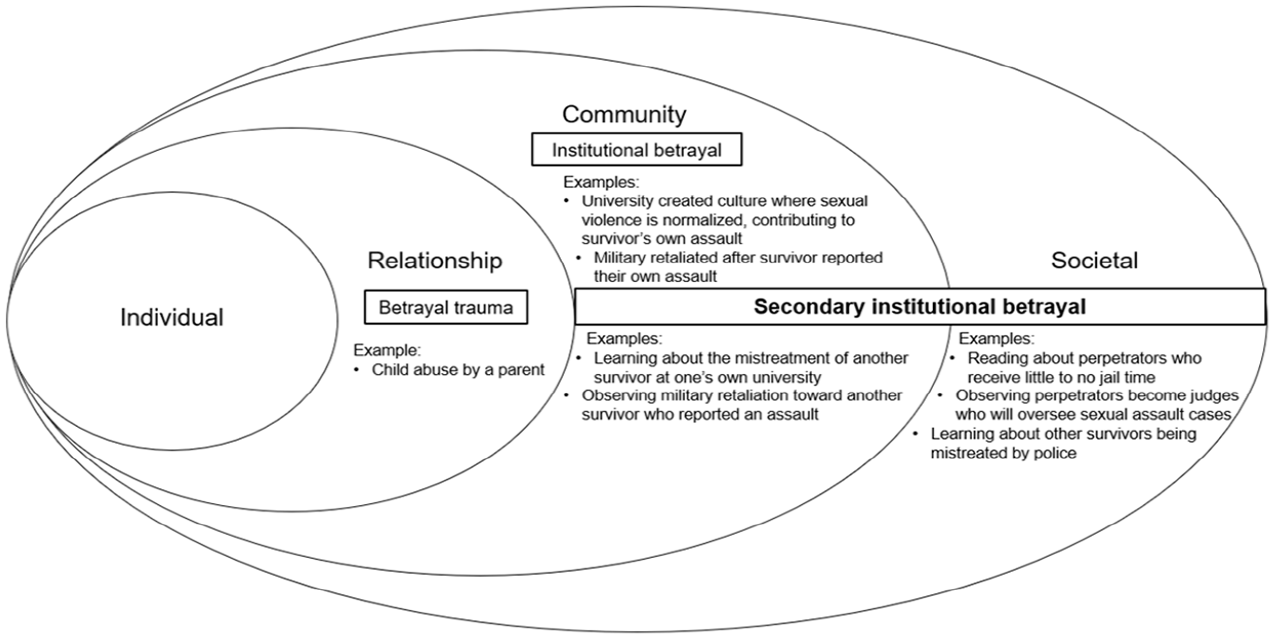
Betrayal trauma, institutional betrayal, and secondary institutional betrayal in a socio-ecological model.
Understanding and addressing secondary institutional betrayal is also an issue of equity, as rates of reporting to formal systems are even lower among survivors from marginalized groups, including people of color, the disability community, and the LGBTQIA+ community (Kirkner et al., 2022; McMahon & Seabrook, 2020; Slatton & Richard, 2020). Secondary institutional betrayal via news stories may exacerbate structural stress (i.e., having to navigate systems which systematically oppress certain identities and lived experiences) already experienced by minoritized communities (Burton & Guidry, 2021). Anticipation of discriminatory, demeaning, and unhelpful treatment contribute to lower rates of reporting among women of color (DeVylder et al., 2017). Coupling the lack of diverse representation within the #MeToo Movement (Onwuachi-Willig, 2018; Trott, 2021) and foregrounding examples of institutional betrayal may disproportionately affect survivors with multiply oppressed identities. Future research should address this possibility to minimize further disparities in survivor well-being.
While it is important that victims have agency over their decision to pursue formal justice or help-seeking processes, not reporting to these institutions may constitute missed opportunities for survivors to get connected with resources and support (Ullman, 2010). Several participants in the current study stated that feelings of secondary institutional betrayal would decrease the likelihood that they would formally report future assaults. Recent conceptual work suggests that an institution’s historical record on this issue can shape institutional climate, including attitudes and expectations regarding how an institution will respond to sexual assault (Moylan et al., 2021). Secondary institutional betrayal may be an important mechanism to explain the relationship between an institution’s history and survivors’ willingness to disclose. Hesitance to report sexual assault to certain institutions may constitute an unintended consequence of public activism campaigns about sexual assault, particularly the tendency to focus on examples of injustice and harm perpetrated by institutions. However, other participants felt that the positive impacts of recent social movements outweighed the secondary institutional betrayal they experienced, and either encouraged future reporting or had no effect. More work is needed to better understand how survivors’ willingness to seek help from institutions may be impacted by their feelings of secondary institutional betrayal via news stories.
In the present study, we conceptualized institutions at a more macro level than what is typically done in the foundational literature. Work on institutional betrayal specifies that, “clearly defined group identities with inflexible requirements for membership often precede institutional betrayal” (Smith & Freyd, 2014, p. 580). In these contexts, membership may be obvious and clearly defined when survivors have “opted-in” or rely on these bodies for daily necessities such as food and shelter (e.g., college students, military service members). Connections to other institutions which are less proximal may not be as apparent (e.g., police, the court system), but become necessary to survivors’ continued safety and well-being in the context of their assault experience. These conditions may fail to capture a large portion of survivors in the general population who do not belong to proximal institutions (e.g., post-college adults, non-military members), and/or those who do not formally report their assault (i.e., the majority of survivors).
While the media is often colloquially referred to as an “institution,” it does not carry some of the traditional features of an institution such as group membership, nor well-defined, direct impact over peoples’ lives. However, the media has incredible influence over all facets of the sociocultural landscape. Particularly in the era of #MeToo, many cases of sexual assault get “played out” in the media (e.g., Dr. Christine Blasey Ford’s Senate testimony, the Amber Heard v. Johnny Depp case), either alongside or in lieu of the criminal legal system (Pollino, 2020; Stelter, 2020). Participants in the present study were acutely aware that the way society perceives and responds to sexual assault survivors is often contingent on how the media chooses to present their stories, a phenomenon which has been supported in previous research (Li et al., 2017). Unfortunately, rape culture narratives in media coverage of sexual assault remain prevalent (Armstrong et al., 2016; Walters, 2021) with present data indicating survivors notice and, as a result, try to avoid the possibility of their own stories making it into the media.
The U.S. government and criminal legal system represent institutions which all Americans are subject to, regardless of their own assault situation. All of us are reliant upon politicians, legislators, police, and judges, from the local to the federal level, for protection of our rights and safety. Witnessing leaders in these positions denigrate survivors, defend perpetrators, and manifest injustice can foster secondary institutional betrayal and disillusionment with the entire system (Maas et al., 2018). The same can be said of institutions which survivors are more closely connected to at the community level (e.g., their own university, the military for active service members) based on how they are seen responding to other survivors’ experiences (Hannan & MacDonald, 2022).
Identifying secondary institutional betrayal as a unique construct, connected to but distinct from institutional betrayal, is a timely and necessary next step for the field. This concept will help us understand if/how the mental health and decision-making processes for survivors in the general population are impacted by news stories covering examples of institutional failures. Further, it helps place the responsibility for broadly harming survivors and discouraging reporting on the shoulders of macro-level institutions (e.g., the media, U.S. government, criminal legal system) which all Americans are subject to. The greater the structural power an institution holds, the broader their reach will be in the number of survivors they can harm or oppress through their actions. The examples of secondary institutional betrayal in this study are manifestations of rape culture (i.e., “an ideology that effectively supports or excuses sexual assault”) (Burt, 1980, p. 218; Johnson & Johnson, 2021). Due to its pervasiveness throughout all levels of society, rape culture is often seen as an amorphous, untouchable concept. Calling out secondary institutional betrayal caused by macro-level institutions can help identify specific examples of rape culture ideologies in practice and trace the impacts of their actions beyond the individual survivor(s) they harm.
Limitations
The current study utilized data from interviews asking survivors about their experiences on social media during the #MeToo era more broadly. Due to this, the questions were not specifically designed to probe this phenomenon of secondary institutional betrayal. This small sample also cannot be assumed to represent the diversity of perceptions among survivors regarding secondary institutional betrayal and news coverage of sexual assault. Given that two-thirds of the sample were affiliated with a university which recently had a major institutional crisis which included sustained national news coverage may also have resulted in higher levels of secondary institutional betrayal reported.
Future Research
More work is needed to understand the nuances of why some survivors felt secondary institutional betrayal would deter them from reporting future assaults, while others did not. A mixed methods approach collecting quantitative data on survivor assault experiences (e.g., timing of assault in relation to #MeToo, status of formal reporting, history of direct institutional betrayal, whether they would report in the future) followed by qualitative interviews with select participants, stratified by different experiences, could help illuminate these thought processes. This work should also examine differences in perceptions of secondary institutional betrayal and its impacts across identities to determine if survivors from marginalized groups are uniquely impacted. Further, adapting the Institutional Betrayal Questionnaire (Smith & Freyd, 2013) to measure secondary institutional betrayal could help identify how widespread the sense of betrayal in macro institutions is among survivors in the U.S. Validating this measure would allow us to track changes over time, as new waves of public activism or major news stories about sexual assault unfold.
Conclusion
Negative mental and physical health outcomes for survivors of sexual assault can be exacerbated by betrayals experienced at the level of interpersonal relationships (i.e., betrayal trauma) or the community level (i.e., institutional betrayal) (Smith & Freyd, 2013, 2017). Current qualitative data suggest that survivors may also experience secondary institutional betrayal at the societal level (via the media, U.S. government, and U.S. criminal legal system) and community level (via their own universities) based on how they observe institutions respond to other survivors, independent of their own personal assault situation. This phenomenon is particularly relevant in the context of ongoing activism campaigns (e.g., #MeToo) and related news coverage which highlights egregious institutional betrayals on a national stage. This concept also helps capture the experiences of survivors in the general public who may not be proximally connected to a well-defined institution (e.g., military, university) and/or those who choose not to formally report their own assault (i.e., the majority of survivors). Some survivors reported this sense of secondary institutional betrayal stemming from news media coverage would deter them from reporting their past or future assaults, which is concerning given already low levels of reporting for sexual violence. Additional research is needed to identify negative outcomes that may be associated with this phenomenon among survivors.
Footnotes
Declaration of Conflicting Interests
The author(s) declared no potential conflicts of interests with respect to the authorship and/or publication of this article.
Funding
The author(s) disclosed receipt of the following financial support for the research, authorship, and/or publication of this article: The first author received financial support for this research through the Human Development and Family Studies department at Michigan State University.
