




Abstract
Sext dissemination (i.e., the online sharing of sexually explicit images) has the potential to result in legal, social, and psychological harms. Recent research has shown that this behavior can be consensual or non-consensual in nature; yet little is known about how motivations or attitudes may differ between these forms, or with gender. This study is based on a cross-sectional online survey investigating consensual and non-consensual sext dissemination and associated demographic, behavioral, attitudinal, and psychological factors. Participants were 2,126 cisgendered adults aged 18 to 30 years (M = 22.97, SD = 3.21, 55% women, 45% men), resident in Western, English-speaking nations, particularly Australia. Around 10% of respondents reported disseminating texts, and of these, only 19.8% indicated they had permission for this, with no differences across gender. When sexts were disseminated “to gossip,” this was significantly more likely to be non-consensual. There were no significant differences between consensual and non-consensual dissemination in subjective attitudes or norms toward dissemination, nor levels of psychological distress. Women were more likely to non-consensually disseminate sexts that had been received as unwanted or unwelcome. Consensual dissemination was weakly associated with being sexually active and having given consent to having one’s own images disseminated. We discuss implications for future research regarding consent, and relationship and sexuality education.
Sexting, referring to the sending, receiving, or forwarding of sexually explicit messages, images, or photos to others via electronic means (Klettke et al., 2014), has received over a decade of interest from media and mental health professionals. Sexting behaviors are increasingly seen as part of sexual development in adolescence and emerging adulthood (Levine, 2013). A recent meta-analysis (Mori et al., 2020) estimated that among young adults, 38% had sent sexts, 42% had received sexts, 48% had engaged in reciprocal sending, and 15% had non-consensually forwarded sexts, with all rates increasing in recent years and figures likely underestimating current data. However, whilst sexting behaviors are not uncommon and are often endorsed by peers from an early age as normative (Wilson et al., 2021), they have been associated with a range of harms (e.g., Gassó et al., 2020; Mori et al., 2019).
In particular, sharing or dissemination of sexts has attracted specific attention regarding its prevalence (Walker & Sleath, 2017) and the potential for negative consequences (Clancy et al., 2019, 2020, 2021; Gassó, Agustina, et al., 2021; Gassó, Mueller-Johnson, et al., 2021; Walker & Sleath, 2017). In young adult samples across the United States, United Kingdom, and Australia, rates of sext dissemination range from 14%–18% (Clancy et al., 2019, 2020, 2021; Walker et al., 2021). Interest in sext dissemination behaviors is driven, in part, by potential significant negative impacts for those whose sexts have been shared or disseminated, including psychopathology, anxiety, and depression (Gassó, Mueller-Johnson, et al., 2021). However, there is relatively little investigation of factors associated with sext dissemination perpetration, potential motivations, and whichever other factors may be associated with this behavior. Potentially relevant factors may include whether the dissemination itself is consensual, how this may differ for different ascribed motivations, and whether this is associated with any forms of psychological distress.
Sext dissemination, when non-consensual, can be considered a form of interpersonal violence. Alternative terms in the literature include technology-facilitated or electronically mediated sexual violence, online sexual harassment, and image-based sexual abuse (Henry & Powell, 2015; Henry et al., 2019; Krieger, 2017; Powell et al., 2019), and this behavior is typically criminalized in jurisdictions across Australia, the United States and United Kingdom. For example, the Australian Enhancing Online Safety (Non-consensual sharing of Intimate Images) Bill 2018 introduced provisions for civil penalties for posting or threatening to post intimate images and requirements for hosting services to remove such images when notified. Consistent with such conceptualizations, the vast majority of current sext dissemination literature is based on the underlying assumption that all instances of sext dissemination are non-consensual (e.g., Boer et al., 2021; Walker et al., 2021). However, recent research has identified that a small, yet notable minority (~10%) of those who know that their images have been disseminated indicate that they had given permission for this; that is, dissemination was consensual (Clancy et al., 2020, 2021). Additionally, those who have given permission are 3 to 4 times more likely to be men than women (Clancy et al., 2020, 2021). These differences could provide insight into variation in motivations and rationales for dissemination where perpetrators have sought and been given permission to share the images.
Prior research in cisgendered samples has reported variation in rates of engagement in sext dissemination across genders and age within adult samples. An Australian study (Office of the eSafety Commissioner (OeSC), 2017) found that perpetrators of non-consensual sext dissemination were twice as likely to be men as compared to women, and that younger adults were more at risk than those aged over 45 years, with age-based differences based on cohort analyses and those aged 18 to 34 most likely to engage in perpetration. Other studies have found no difference by gender (Clancy et al., 2019, 2020, 2021; Walker et al., 2021), and either did not report on gender as a factor (Walker et al., 2021) or did not find age to be uniquely associated with dissemination (Clancy et al., 2019, 2020, 2021).
However, self-reported motivations for sext dissemination consistently seem to vary with gender. Common reasons for dissemination in young adult populations for men and women include being “for fun, as a joke,” or “because the person was hot” (Clancy et al., 2019, 2020, 2021; Walker et al., 2021). However, adult men have been found more likely to endorse motivations linked to attractiveness of the person depicted in the image/s, boasting or enhancing their social status, whereas women were more likely to endorse gossip or roasting/teasing (Clancy et al., 2019, 2020, 2021; Walker et al., 2021). Notably, for men and women, explicit motivations to cause harm or shame others are relatively infrequent (less than 10%; Clancy et al., 2019, 2020, 2021; Walker et al., 2021). As such, it appears that those who engage in sext dissemination seem to perceive this behavior largely as amusing, socially desirable, and/or relatively harmless. However, these prior studies have either explicitly examined non-consensual dissemination, or seem to implicitly assume that dissemination is non-consensual, hence nuances of motivation have perhaps been missed.
The role of consent has been found to be important in understanding harms associated with other sexting behaviors, and could be a critical factor in understanding or differentiating forms of sext dissemination. Previous investigations into the impact of coerced sending and unwanted receipt of images (e.g., Frankel et al., 2018; Gassó et al., 2019; Klettke et al., 2019) have identified that non-consensual, coerced or unwanted forms of sexting appear to be most likely associated with psychological distress for victims. Additionally, women tend to carry an increased risk of experiencing non-consensual sexting behaviors, including receiving unwanted sexts (Clancy et al., 2021; Klettke et al., 2019), and being coerced into sending sexts (Gassó, Mueller-Johnson, et al., 2021; Laird et al., 2021; Ross et al., 2019). Some studies also find that women are more likely to have their own sexts distributed without consent (Clancy et al., 2020, 2021), while others report no gendered difference in dissemination victimization (Gassó, Mueller-Johnson, et al., 2021).
However, no research to date has explored the role of consent as indicated by those who disseminate sexts and whether rates of consensual, as opposed to non-consensual, dissemination vary by gender. Investigations of the potential impact of gender on dissemination perpetration in general (i.e., not differentiated by consent) have resulted in conflicting findings. While some find no gender difference (Clancy et al., 2019, 2020, 2021; Walker & Sleath, 2017), others report that men are more likely than women to engage in dissemination (Gámez-Guadix et al., 2015; Garcia et al., 2016; Henry et al., 2017, 2019). Notably, as indicated above, prior research suggests that men are between three to four times more likely than women to have given permission for dissemination of their images (Clancy et al., 2020, 2021), which may reflect gendered sexual double standards internalized across adolescence and adulthood (Harvey et al., 2020; Ringrose et al., 2013, 2021), with greater opprobrium directed to women who are sexually assertive or active. Given that the majority (although not all) dissemination occurs between, rather than within, gendered groups, it is possible that rates of consensual dissemination may vary with gender, at least within cisgendered groups. Specifically, women may be more likely to be engaged in consensual dissemination, whereas men may be more likely to engage in non-consensual dissemination, if women are less likely to have given consent than men.
Additionally, the role of consent may help to contextualize expressed motivations toward sext dissemination. Some motivations may logically be more associated with non-consensual dissemination, such as revenge and spite. Additionally, in the absence of consent, views that sext dissemination is relatively harmless or amusing may indicate a lack of empathy for potential victims and the harms they may experience. In contrast, consensual dissemination motivated by attractiveness may reflect attempts to flatter the individual depicted, and motivations related to seeking sexual partners may be anticipated to be more likely consensual.
Prior investigations of sext dissemination have found that predictors of perpetration include positive attitudes and subjective norms toward sext dissemination that are consistent with the more common motivations, particularly seeing dissemination as harmless and normative (Clancy et al., 2019, 2020, 2021). As such, these norms and attitudes may minimise the perceived need to obtain consent from those depicted if it is seen as a common and harmless behavior, or “not a big deal.” Therefore, it is also important to understand whether motivations and attitudes vary for consensual versus non-consensual dissemination.
Whilst attitudes and motivations have been considered and found relevant, these may be driven by internal mood states, which are worthy of investigation. Specifically, in addition to motivations and subjective attitudes and norms, sext dissemination may arise from a desire to alleviate negative mood states such as anxiety and depression. Other forms of technology-facilitated abuse perpetration, such as cyberbullying, have been associated with internalizing symptoms of anxiety and depression and negative emotion regulation (Camerini et al., 2020), consistent with Allen et al.’s (2018) General Aggression Model (GAM). The GAM suggests that negative emotions and social anxiety lead to aggression in an attempt to relieve psychological distress. By extension, and given potential overlaps between non-consensual sext dissemination and cyberbullying (Ojeda et al., 2019), sext dissemination may be associated with attempts to seek social affirmation from peers. This is consistent with some motivations that relate to boasting, gossip, or seeking attention, status, and praise (Clancy et al., 2019, 2020, 2021), which may be driven by a desire to relieve personal distress through affiliation with others (Taylor, 2006). However, relationships between sext dissemination perpetration and indicators of psychological distress are yet to be investigated.
Prior studies have associated sending one’s own sexts with depression (Dake et al., 2012; Gámez-Guadix & de Santisteban, 2018), impulsivity and negative urgency in adolescence (Dir et al., 2013; Temple et al., 2014; Van Ouytsel et al., 2014), anxiety in interpersonal relationships (Drouin et al., 2015; Weisskirch & Delevi, 2011), and elevated stress (Hudson et al., 2014). Gámez-Guadix and de Santisteban (2018) argue that sexting may be a mechanism to gain positive attention from others, or it may relate to less resistance to external pressures to send sexts. Consistent with these explanations and the GAM, Branson and March (2021) found that cyber-dating abuse could be attributed to higher levels of reactive emotional aggression. Similar arguments of impaired decision-making processes and impulsivity may be relevant in decisions to disseminate sexts. Those with elevated anxiety may be more vulnerable to pressure to send not only their own sexts (Klettke et al., 2019; Weisskirch et al., 2016), but also to distribute the sexts of others, in an effort to alleviate distress and offset low self-esteem (Scholes-Balog et al., 2016). Individuals may also seek positive validation from others through social approval, pre-empting concerns of peer rejection (Brenick et al., 2017), which is consistent with reported dissemination motivations that seek to enhance social status (Clancy et al., 2019).
Lastly, it is possible that obtaining consent for dissemination may vary, depending on whether the initially received sext was wanted or unwanted. Prior research has suggested that, of those who engaged in sext dissemination, women were two and a half times more likely than men (64.6% vs. 26.3%) to report that the image they had disseminated was received as unwanted or unwelcome (Clancy et al., 2021). Other qualitative investigations (Clancy et al., 2020) suggest that in scenarios in which unwanted or unwelcome images were received, individuals forwarded images non-consensually, potentially as proof of harassment. It would be valuable to understand whether those who receive images as unwanted or unwelcome are more likely to disseminate without consent, and if so, whether this differs across gender.
Overall, the current study aimed to address significant gaps in the sexting literature regarding consensual and non-consensual sext dissemination behaviors and motivations in young adults. Specifically, our first research question was to explore consensual as opposed to non-consensual sext dissemination, determine if rates differed by gender, and identify any differences in self-attributed motivations, subjective attitudes, and norms and indicators of psychological distress based on whether dissemination was consensual or non-consensual. Secondly, we aimed to explore whether images being initially received as unwelcome or unwanted may impact on consent, and whether this varied with gender. Thirdly, we aimed to identify the unique and shared contributions of the identified demographic, behavioral, attitudinal, and psychological predictors to both sext dissemination overall, and in differentiating consensual from non-consensual dissemination. We did not include age in our research questions, as prior research has found no impact of age in adult samples.
While the above were largely exploratory research questions, we were able to form four specific hypotheses based on prior research. Firstly, it was hypothesized that: (a) while dissemination rates would be similar between genders, motivations for dissemination would vary with gender. Further, (b) rates of consensual sext dissemination were anticipated to differ by gender, with women more likely to engage in consensual dissemination than men, as men were more likely to give consent for dissemination. We further anticipated that (c) some motivations for non-consensual dissemination would differ from consensual dissemination, with more pernicious motivations (e.g., revenge, spite, and gossip) more likely to be non-consensual, whereas motivations related to seeking sexual partners were anticipated to be more likely to be consensual in nature. Lastly, we hypothesized that (d) women would be more likely to report non-consensual dissemination of images that were received as unwanted or unwelcome than men. No other hypotheses were proposed, given paucity of prior literature differentiating consensual from non-consensual dissemination.
Methods
Participants
Participants in this study were 2,126 young adults, ranging from 18 to 30 years (M = 22.97, SD = 3.21). Regarding gender identity, 55% identified as women, and 45% as men. A small number of responses (n = 9) were received from participants identifying outside the gender-binary, but as our research questions were investigating gender, these were removed as the group size was insufficient for analyses. The majority resided in Australia (79%), followed by the United Kingdom (9%), and the United States (6%). Most reported their ethnicity as Australian (50%), followed by British or European (20%), Asian (15%), or North American (3%), with small numbers of other ethnicities reported (12%). Most participants identified their sexual identity as heterosexual (75%), with 16% identifying as bisexual, 5% as lesbian or gay, 2% uncertain, and 2% either unwilling to disclose, asexual, or other. Over three quarters of respondents (77%) were sexually active, and the average age of becoming sexually active was 17.2 years (SD = 2.4). The most frequent level of educational attainment was a bachelor degree or equivalent (37%), followed by secondary school (32%), post-graduate degrees (13%), advanced or graduate diploma level (9%) and certificate qualifications (7%).
Measures
Sext dissemination behaviors
The current study drew on a previous sext dissemination questionnaire addressing specific aspects of sexting (Clancy et al., 2021). Within the survey, an initial definitional statement noted that all sexting-related questions regarding sexts included “sexually explicit images, sent, received, or shared via mobile phone messaging or apps.” Engagement in sexting behaviors was assessed through binary Yes/No questions regarding the respondent’s lifetime engagement in requesting, receiving, sending, and disseminating sexts. For full details of survey items, see Clancy et al. (2021).
To assess sext dissemination perpetration and receipt, participants were asked; “Has someone ever forwarded you an image-based sext via text or mobile app that was not originally intended for you?” (Yes/No) and “Have you ever received an image-based sext intended for yourself which you subsequently showed/sent to another person?” (Yes/No). As consent may vary on different occasions, those who had previously engaged in sext dissemination were then asked specifically to comment on whether consent had been obtained on the most recent occasion: “Did you have permission from the person depicted to distribute or share this image?” (Yes/No), and whether the image was received as unwanted and/or unwelcome (Yes/No). Participants were also asked whether they were aware of their own sexts having been shared with others; “Have you ever sent an image-based sext of yourself that was subsequently forwarded (to your knowledge?).” If they responded yes, they were asked; “Had you given permission for this image to be forwarded?” (Yes/No).
To determine reasons for sext dissemination, again specific to the most recent occasion of dissemination, participants were asked “What were the reasons why you decided to share the image with others?” A list of potential responses was provided, with participants able to select multiple motivations. These included: As a joke or to be funny; Because the person in the image was hot; To prove that I received the sext; Because another person asked you to; To improve your social status amongst peers; To initiate sexual contact; To roast or tease the person depicted; I did not think it was a big deal; To get attention/praise; To gossip; Out of spite; Because you felt pressured to do so; To get the recipient into trouble; To get back at the person / to get revenge; To brag. Additionally, participants could endorse “Other” with the option to specify their reason.
Psychological distress
Depression, anxiety, and stress, as indicators of psychological distress, were assessed via the short form of the Depression, Anxiety, and Stress Scale (DASS-21; Lovibond & Lovibond, 1995). This 21-item self-report instrument includes three 7-item subscales. Participants were asked how much each statement had applied to them in the previous week, and could using on a 4-point Likert scale ranging from 0 (did not apply to me at all) to 3 (applied to me very much, or most of the time). Answers for each subscale were added together, with higher scores suggesting greater levels of each indicator. The DASS-21 has previously shown good psychometric properties (Henry & Crawford, 2005) and demonstrated good internal reliability with this sample (Cronbach’s alphas for depression, anxiety, and stress subscales of .92, .86, and .87, respectively).
Subjective norms and attitudes
To assess subjective norms and attitudes regarding sext dissemination, a 7 item-item scale was used, drawing on prior sexting research (Clancy et al., 2021). A sample item is “Forwarding or sharing sexually explicit images via text or mobile app is no big deal.” Participants indicated their agreement with each statement on a 5-point Likert scale ranging from 1 (strongly disagree) to 5 (strongly agree). As the overall measure had low reliability (Cronbach’s α = .51) for this sample, indicating high heterogeneity, and based on concerns raised by Clancy et al. (2021), analyses were conducted at the item rather than scale level.
Procedure
After obtaining ethics approval from Deakin University’s Human Research Ethics Committee, participants were recruited via social media sites including Facebook, Instagram, and Reddit (n = 1,605), and survey aggregator site Prolific (n = 521), which was used to help achieve a more balanced gender sample. Unsurprisingly, given this targeted recruitment, planned contrasts between participants from social media and survey aggregator sites identified that respondents recruited via general social media sites were more likely to be women (χ2 (1) = 714.54, p < .001), and residing in Australia (χ2 (5) = 435.83, p < .001). Participants recruited via social media were also younger than those recruited from Prolific (t (2,124) = −10.32, p < .001), and more likely to have disseminated sexts (χ2 (1) = 19.80, p < .001).
Survey advertisements informed participants of the study aim (to explore factors influencing sexting behaviors), that it was intended for adults aged 18–30 years, whether they had sexted or not, and that responses would be anonymous and voluntary. Potential participants were provided with a brief online study description and indicated their consent by commencing the survey, which was completed in 15 to 20 min on average. No incentive was offered for general social media participants, whilst Prolific participants received a small £1 GBP payment (equivalent to approximately $1.37 USD) for survey completion. Survey responses were gathered from July 2020 to July 2021.
Design and Analyses
The study employed a cross-sectional design. After data cleaning to remove incomplete responses and checking of assumptions, descriptive statistical analyses enabled review of sample and variable means and standard deviations for variables of interest. Analyses of difference by gender and comparisons of consensual against non-consensual dissemination were conducted using chi-squared analyses, with all expected cell sizes at least 5, indicating sufficient power for analyses, whilst bivariate correlations assessed relationships between independent variables and sext dissemination. Where relationships were significant (p < .05), effect sizes were also estimated. Lastly, we conducted binomial multivariate logistical regressions to assess impacts of behavioral and personality variables on sext dissemination.
Results
Descriptive Statistics
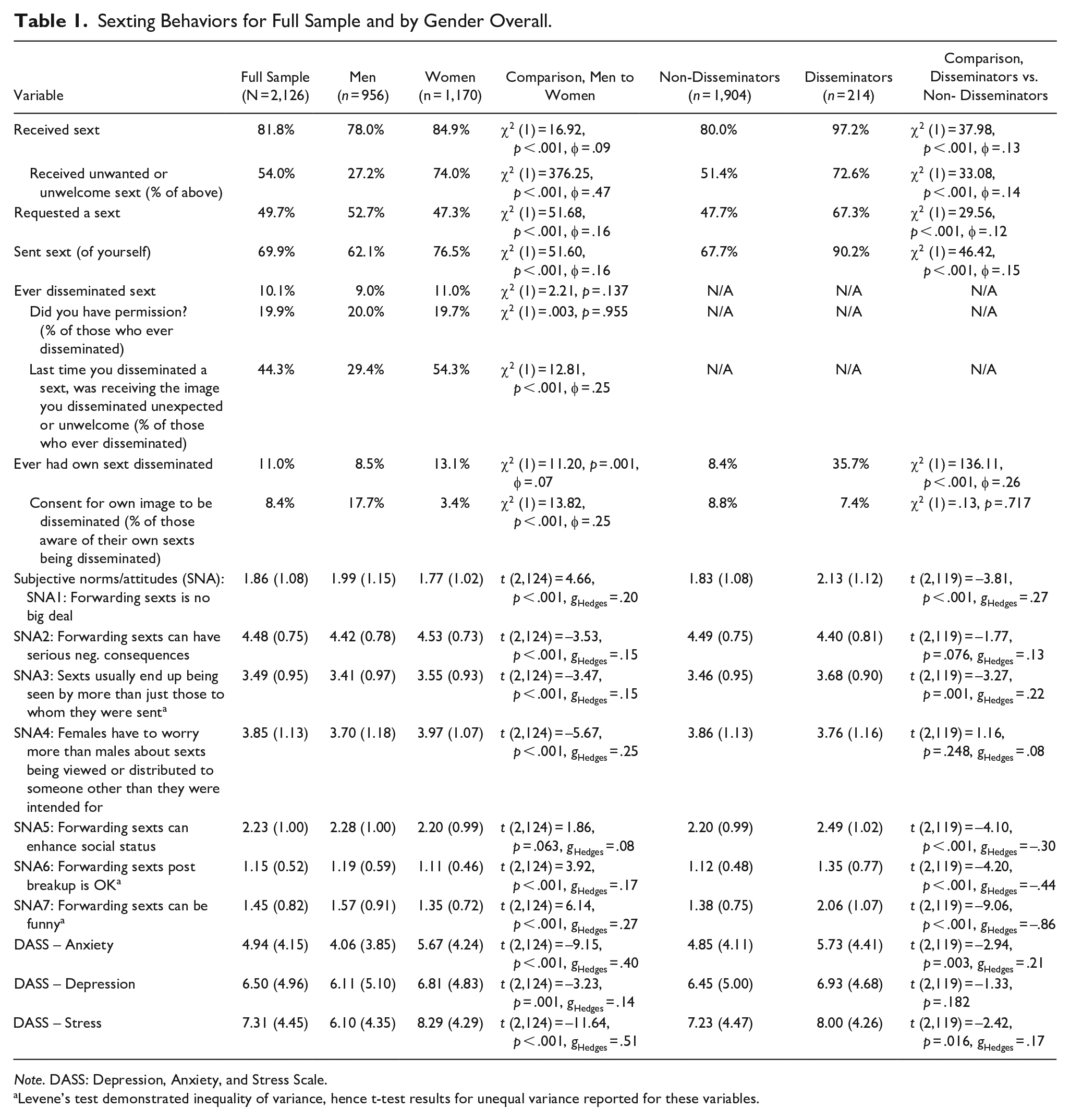
Key variables of interest are presented in Table 1. Over two-thirds of respondents had sent sexts of themselves, with women (76.5%) significantly more likely to have done so than men (62.1%). Rates of receiving sexts were 81.8% overall, with women significantly more likely to have received sexts (84.9%) than men (78.0%). Women were nearly three times more likely (74.0%) than men (27.2%) to have received unwanted or unwelcome sexts, a significant difference (χ2 (1) = 376.25, p < .001, φ = .47). Half of the sample indicated that they had requested sexts from others, with men (52.7%) significantly more likely to do so than women (47.3%). Overall, participants reported negative subjective norms and attitudes toward dissemination; however men were less negative than women in general, and women reported small to moderate elevations in psychological distress relative to men.
Sexting Behaviors for Full Sample and by Gender Overall.
Note. DASS: Depression, Anxiety, and Stress Scale.
Levene’s test demonstrated inequality of variance, hence t-test results for unequal variance reported for these variables.
Within our sample, 10.1% of respondents indicated that they had engaged in sext dissemination, with no difference by gender. Women were almost twice as likely (54.3%) as men (29.4%) to report that when they shared or disseminated a sext, this sext had been initially received as unwanted or unwelcome (χ2 (1) = 12.81, p < .001, φ = .25). We compared levels of behavioral and mental health variables between those who had or had not engaged in dissemination. Those who had engaged in dissemination were significantly more likely to have experienced or engaged in almost all sexting behaviors, including receiving (χ2 (1) = 37.98, p < .001, φ = .13), sending (χ2 (1) = 46.42, p < .001, φ = .15), requesting (χ2 (1) = 29.56, p < .001, φ = .12), and having their own sexts disseminated (χ2 (1) = 136.11, p < .001, φ = .26). Those who had disseminated also typically reported significantly more positive attitudes and norms toward sext dissemination across all items (refer to Table 1 for details). Lastly, those who had disseminated reported significantly higher levels of anxiety (t (2,119) = −2.94, p = .003, gHedges = .21) and stress (t (2,119) = −2.42, p = .016, gHedges = .17), although with similar levels of depression symptomatology (t (2,119) = −1.33, p = .182).
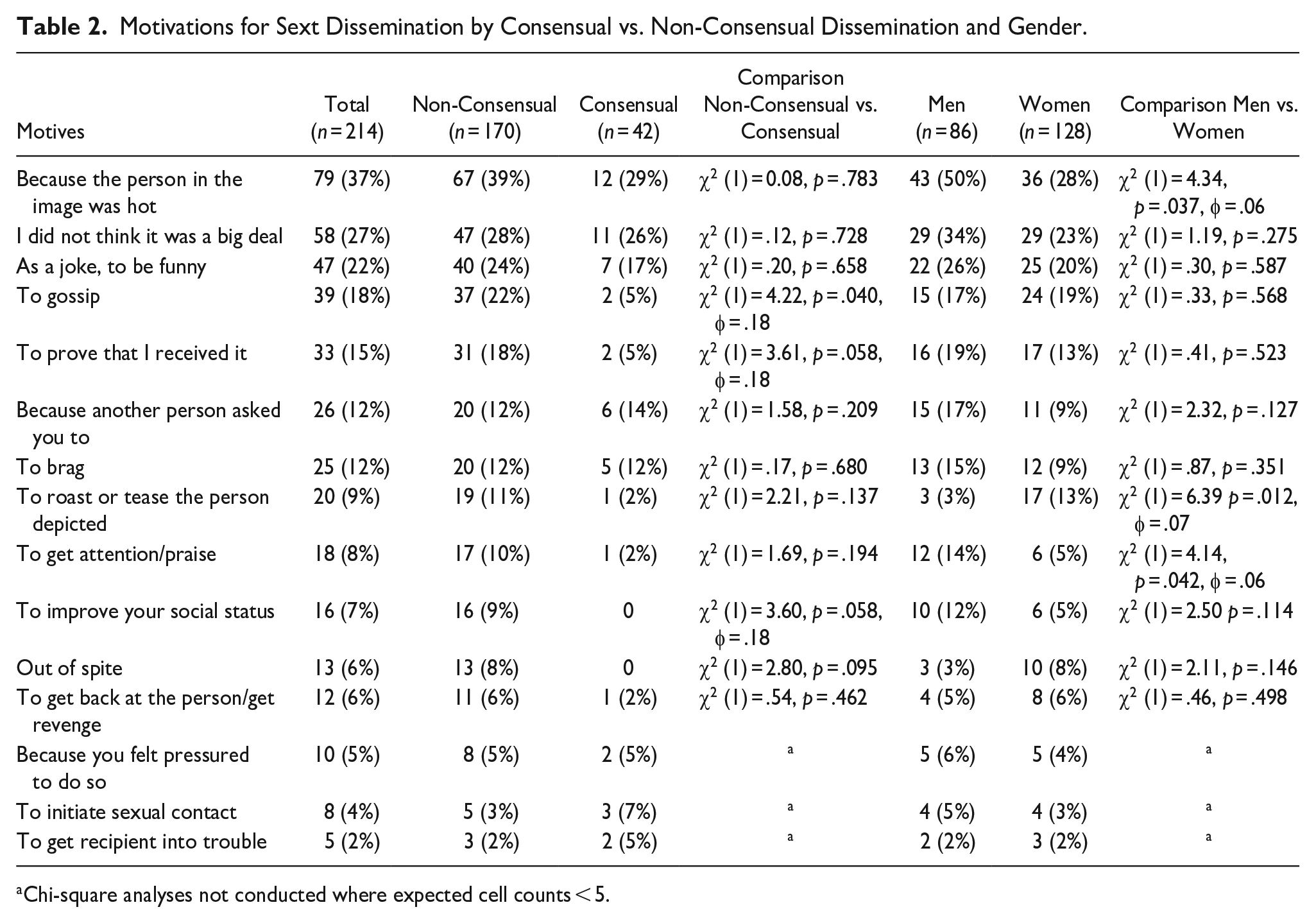
Consistent with Hypothesis 1, rates of dissemination overall were similar for men and women, but motivations for dissemination varied somewhat with gender. Men were more likely than women to endorse dissemination because “the person was hot,” or to get attention and praise, whilst women were more likely than men to disseminate to roast or tease the individual, as indicated in Table 2. No other differences in motivation by gender overall were noted. Addressing our first research question, of those engaged in dissemination, almost one in five respondents (19.8%) indicated they had permission from the person depicted in the image to share. In contrast to Hypothesis 2, there was no difference in rates of consensual dissemination on the basis of gender: χ2 (1) = .00, p = .988 (women 19.7%, men 19.8%).
Motivations for Sext Dissemination by Consensual vs. Non-Consensual Dissemination and Gender.
Chi-square analyses not conducted where expected cell counts < 5.
To explore Hypothesis 3, whether motivations for dissemination varied overall with consensual as opposed to non-consensual dissemination and gender, we performed chi-squared analyses as reported in Table 2. Those who disseminated sexts for reasons to gossip were significantly more likely to have disseminated non-consensually than consensually (χ2 (1) = 4.22, p = .040, φ = .18), while proving they had received them (χ2 (1) = 3.61, p = .058, φ = .18), or to improve social status (χ2 (1) = 3.60, p = .058, φ = .18) tended to be more likely non-consensual, but results were not statistically significant. No other differences in motivations for consensual versus non-consensual dissemination were statistically significant, thus Hypothesis 3 was only partially supported.
Further addressing our first research question, whilst sample sizes were small, explorations of consent and motivations within single-gender groups showed that when men disseminated to prove they had received images (N = 16), this was only ever non-consensual (100%), and never consensual (χ2 (1) = 5.62, p = .018, φ = .30), while for women (N = 17) this was largely but not exclusively non-consensual (88% of cases). In addition, men were more likely to report that dissemination to initiate sexual contact was consensual (27.3%) than non-consensual (4.7%), χ2 (1) = 5.34, p = .021, φ = .31. No other differences were significant for men, and there were no significant differences in motivation between consensual and non-consensual dissemination for women.
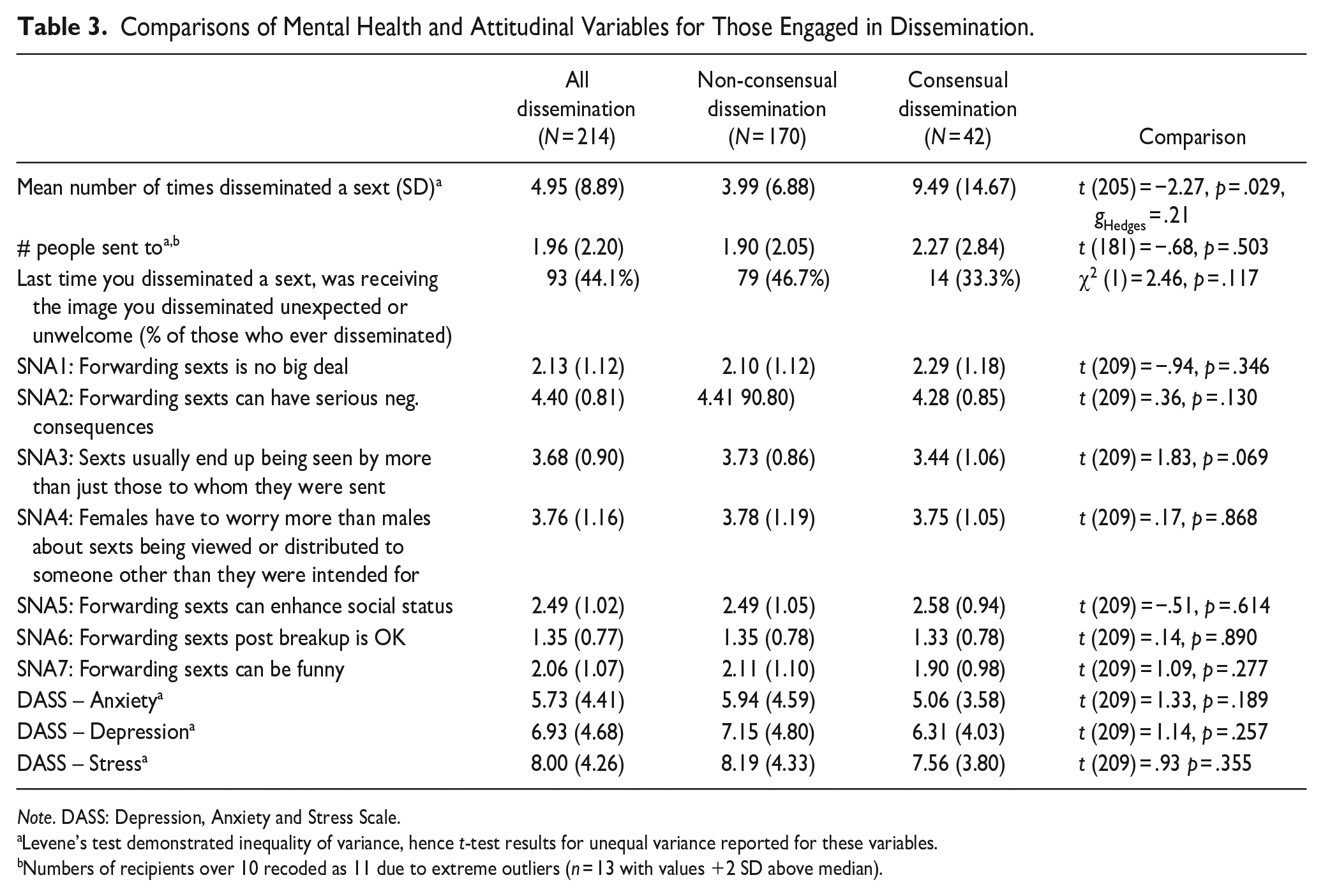
We also analyzed whether attitudes and norms, or levels of psychological distress, differed for those engaged in consensual than non-consensual dissemination, in keeping with our first research question. We compared the frequency of sext dissemination, the number of recipients, attitudes, and norms toward dissemination, and measures of psychological distress by consent, as presented in Table 3. Those engaged in consensual dissemination reported having shared sexts significantly more frequently than those engaged in non-consensual dissemination. However, there were no significant differences for those engaged in consensual as opposed to non-consensual dissemination in subjective attitudes and norms toward dissemination, nor levels of psychological distress.
Comparisons of Mental Health and Attitudinal Variables for Those Engaged in Dissemination.
Note. DASS: Depression, Anxiety and Stress Scale.
Levene’s test demonstrated inequality of variance, hence t-test results for unequal variance reported for these variables.
Numbers of recipients over 10 recoded as 11 due to extreme outliers (n = 13 with values +2 SD above median).
To further investigate our research questions regarding potential associations with psychological distress, factorial Analysis of Variances (ANOVAs) were used to identify potential interactions between gender, whether dissemination was consensual or non-consensual, and whether initial receipt of the disseminated image was wanted or unwanted on the three measures of psychological distress. There were no significant two- or three-way interactions between gender, having disseminated images that were received as unwanted and consensual dissemination, with only a main effect of gender for anxiety (F (1, 203) = 8.751, p = .003, Wilks’ Λ = .837), and stress F (1, 203) = 12.074, p < .001, Wilks’ Λ = .933, but no significant effect for depression. In exploring our second research question, we found partial support for our fourth hypothesis. Women were significantly more likely to report non-consensual dissemination of images received as unwanted or unwelcome (86.8% of dissemination was non-consensual when the image was unexpected or unwelcome, n = 59, whereas 72.4% was non-consensual when the image was expected and/or welcome n = 42; χ2 (1) = 4.05, p = .044, with φ = .18 indicating a small-medium effect size). However, there was no difference for men, with 80.0% of dissemination non-consensual, whether the image was wanted (n = 48) or unwanted (n = 20).
A logistic regression analysis was used to address our third research question, considering the unique and shared contribution of demographic, behavioral, attitudinal, and psychological predictors to sext dissemination overall. The model was significant: χ (14) = 245.54, p < .001, explaining 24% of variance, with regression results provided in Table 4. Unique predictors of dissemination included having received sexts (β = 2.75, p = .039), having sent sexts (β = 2.27, p = .009), having received disseminated sexts from others (β = 1.51, p = .016), having had one’s own images disseminated (β = 3.71, p < .001), and believing that forwarding sexts can be funny (β = 2.00, p < .001), whilst endorsing that “forwarding sexts after a relationship breakdown is acceptable” approached significance as a predictor (β = 1.27, p = .052). Supplementary analyses found that this attitude was only a significant predictor for non-consensual sext dissemination (β = 1.31, p = .043), and not consensual dissemination. Details of this regression are provided in Table 4.
Results for Logistic Regression Predicting Sext Dissemination.
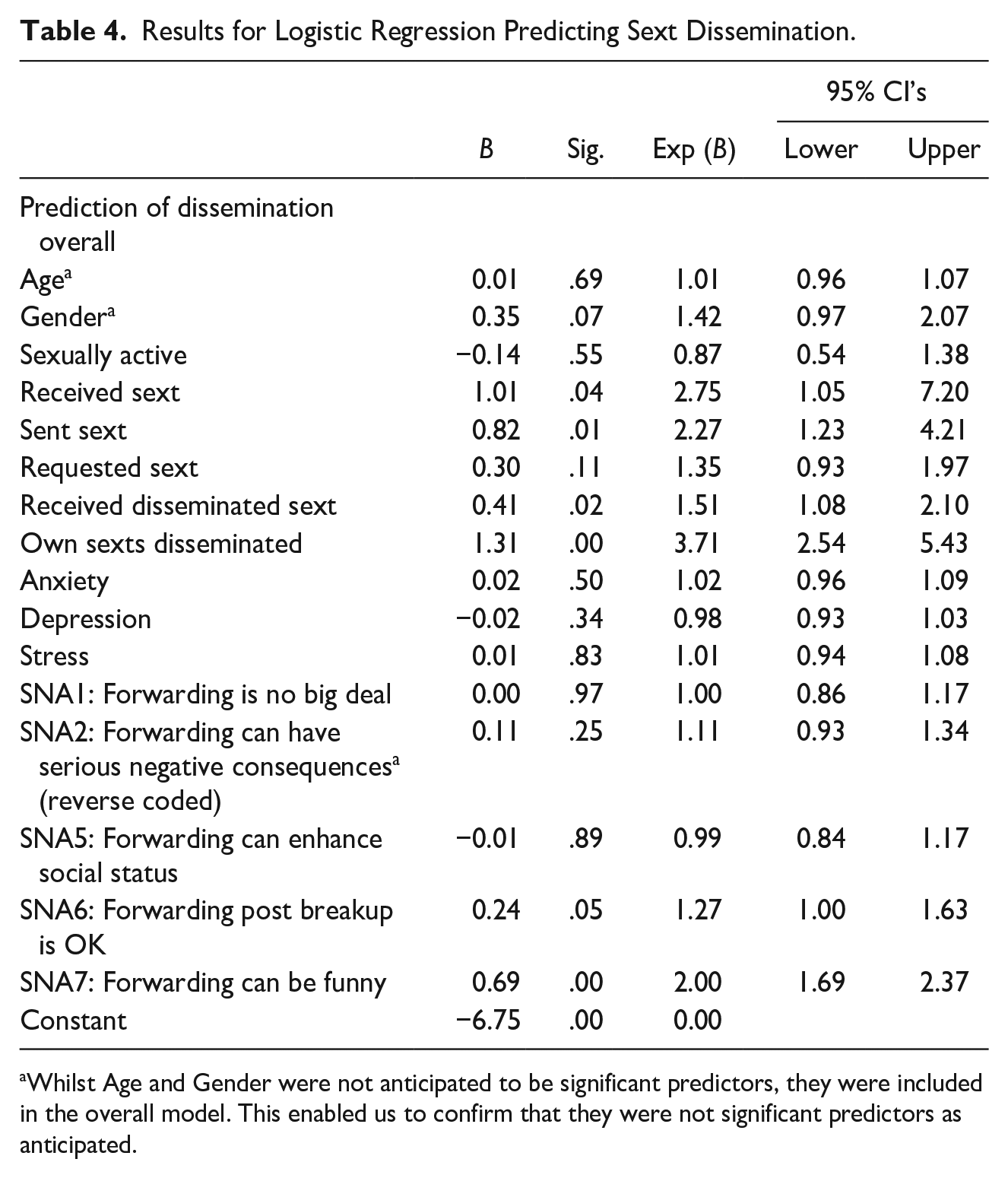
Whilst Age and Gender were not anticipated to be significant predictors, they were included in the overall model. This enabled us to confirm that they were not significant predictors as anticipated.
Lastly, to identify behavioral, attitudinal, and psychological variables that differentiated consensual from non-consensual dissemination, we ran bivariate correlations to identify relationships between consensual dissemination and individual variables. Consensual dissemination was positively but weakly associated with being sexually active (rs = .14 p = .04, explaining 2% of variance) and having given consent to having one’s own images disseminated (rs = .28 p = .023 indicating 8% shared variance). No other relationships with consensual dissemination were significant. A binomial logistic regression including all behavioral, attitudinal, and psychological variables was not significant: χ (17) = 26.31, p = .069, hence these predictors combined were no better than chance in predicting consensual or non-consensual dissemination.
Discussion
This study aimed to explore differences between consensual versus non-consensual sext dissemination with regard to gender, motivations, and attitudes toward dissemination. We also investigated potential relationships with psychological distress and predictors of consensual as opposed to non-consensual dissemination. Consistent with our first hypothesis and prior studies (Clancy et al., 2019, 202, 2021; Walker & Sleath, 2017), rates of dissemination overall were similar for men and women but motivations varied. Men were significantly more likely overall to endorse motivations related to the image being attractive and to get praise, whereas women were more likely to endorse motivations of teasing or roasting the individual. These findings may suggest that social rewards received for dissemination vary for men and women.
In contrast to our second hypothesis, we found similar rates of consensual and non-consensual dissemination for men and women. Only one in five women and men reported that they had permission to share images that they disseminated. This result is novel, as no prior studies, to the knowledge of the authors, have specifically asked whether respondent did or did not have consent for dissemination. However, the similarity in rates of consensual dissemination between men and women contrasts with our finding that men were significantly more likely to give permission when asked in prior studies (Clancy et al., 2021). Specifically, women (who are more likely to disseminate images of men as noted by Clancy et al. (2020)) were no more likely than men to engage in consensual dissemination.
However, it is noteworthy that whilst our sample was anonymous and we did not have access to links between those disseminating and those whose images were shared, less than one in ten of those who were aware of their own images being shared indicated that they had given consent for dissemination. Given that some individuals may be unaware of their images being disseminated, our data is likely to overestimate levels of consent. As such, the finding that one in five participants reported having consent for dissemination raises questions as to how this consent was established, and whether those depicted would agree their permission was sought and confirmed. Identifying how such consent is established, and whether forms of non-consent vary, is a key area for future research. In particular, seeking and having consent refused would perhaps be different from engaging in dissemination without asking for permission.
We found partial support for our third hypothesis, with some limited differences in motivation for consensual as opposed to non-consensual dissemination. Both consensual and non-consensual dissemination were most frequently and similarly motivated by attractiveness, joking, or humor, or indicating “it was not a big deal.” It is noteworthy that the latter could be classified not only as a motivation, but also a subjective judgement of its seriousness and these findings are consistent with prior literature (Clancy et al., 2019, 2020, 2021; Walker et al., 2021). Dissemination to gossip was more likely to be non-consensual, which seems intuitively logical. Whilst no other findings were statistically significant, motivations to improve social status or for spite were exclusively reported for non-consensual sext dissemination. In contrast, proving receipt of an unwanted image tended to be more likely to be non-consensual.
When split by gender, men who were disseminating to prove they had received images only did so non-consensually, and tended to be more likely to engage in non-consensual dissemination to seek praise. They also tended to be more likely to report that dissemination to initiate sexual contact was consensual than non-consensual. Women tended to be more likely to engage in non-consensual dissemination to gossip, but no differences were significant. There were no other significant differences between motivations for consensual and non-consensual dissemination when considered by gender. Given the small sample sizes for consideration of individual motivations, power was relatively small, and hence it is unsurprising that few differences were noted. However, it is perhaps not unexpected that non-consensual dissemination would be associated with peer-driven motivations, such as seeking praise, proving receipt of an image to others, or roasting/teasing someone. Similarly, motivations to initiate sexual contact would be more logically connected with consensual dissemination, especially for those wishing to engage in polyamorous activities. It does appear that motivations broadly associated with non-consensual dissemination appear to be more pernicious, but larger studies would be required to confirm this.
Lastly, and consistent with our fourth hypothesis, women were almost twice as likely as men to report that the images they had disseminated were initially received by them as unwanted or unwelcome. This was the case for more than half of the women who disseminated images, and unwanted receipt was associated with higher rates of non-consensual dissemination for women, but not for men. The experiences and motivations that underlie these behaviors seem to differ with gender. The decision to disseminate images initially received as unwanted or unwelcome may be justified by women with motivations of teasing and/or roasting; both of which were more common for women. In such scenarios, obtaining consent for dissemination may be considered irrelevant. If an individual did not want to receive or seek out the image, and it was sent as unsolicited, they may then feel justified in using this image in other ways, including sharing it with peers, without obtaining permission. However, this result seems to only apply to women, with men seemingly uninfluenced by whether the image was received as wanted or unwanted. This may reflect gendered double standards (Ringrose et al., 2021), where women are habituated into receiving unwanted images, and hence perhaps feel less responsibility to seek consent from those sending such images. By contrast, men, who receive unwanted images less often, may have engaged in less consideration as to whether dissemination of such images requires consent, and may see images as broadly available for dissemination regardless of the source.
Our exploratory research questions aimed to explore whether attitudes and norms, and levels of psychological distress would vary for those engaged in consensual versus non-consensual sext dissemination. Overall, we found that those engaged in dissemination reported higher levels of anxiety and stress and less negative attitudes and norms, although differences for anxiety and stress were small and unlikely to indicate clinically meaningful differences, especially as the measures of distress were general and not specific. In contrast to our hypotheses there were no differences in subjective attitudes and norms toward dissemination, or psychological distress between those engaged in consensual or non-consensual dissemination. This was contrary to what would be expected from Allen et al.’s (2018) GAM. However, given that most motivations for consensual and non-consensual dissemination were similar in nature, and that measures of psychological distress in particular were general, this is perhaps unsurprising. As such, our findings suggests that non-consensual and consensual dissemination are less different from each other, than in comparison to those who have not disseminated. Our further research aims regarding potential relationships between consensual and/or non-consensual sext dissemination, receiving disseminated images as unwanted, and psychological distress found no significant differences beyond the anticipated main effects of gender on psychological distress. This suggests that, at least in this sample, there is no support for the notion that consensual, as opposed to non-consensual, sext dissemination is an attempt to alleviate levels of psychological distress, even in scenarios of dissemination of unwanted images.
Lastly, and consistent with prior findings (Clancy et al., 2019, 2020, 2021), significant predictors of dissemination are other sexting behaviors, particularly having received or sent sexts, having received disseminated sexts from others, and most significantly, having one’s own images disseminated, as well as more positive subjective norms and attitudes toward dissemination. Bivariate analyses suggested that attitudes toward dissemination of images after a relationship breaks down appeared to be more impactful in decisions to disseminate non-consensually. However, behavioral and psychological predictors were unable to differentiate consensual from non-consensual sext dissemination. This suggests that other explanations are more impactful in determining whether consent is sought from an individual, particularly different motivations for dissemination. However, it is noted that the relevant sample size for this analysis was small, and further investigation is required to confirm this finding in larger samples.
Whilst this study details important findings regarding consensual and non-consensual sext dissemination, it is important to note key limitations. Firstly, this study was based on a convenience sample. Although Prolific recruitment was targeted to men in particular, given the typically lower response rate for men on such surveys generally, the sample was still not population representative for gender. In our study, participants were 55% women and 45% men, which is a higher proportion of women than the most recent Australian census data from 2021, which reported the population as 49.3% male, 50.7% female, and did not capture data on those identifying outside the gender binary (Australian Bureau of Statistics [ABS], 2022a, 2022b). Participants were also asked to self-report on their own behaviors. As our study was confidential and anonymous, we have no way of determining the accuracy of responses. Consensual versus non-consensual dissemination, motivations, and precursory factors were all based on the most recent incident, which may not be typical for all individuals. Additionally, we sought to apply a unidimensional measure of norms and attitudes toward dissemination; responses were heterogenous and hence we could not analyze at the scale level, and needed to instead consider individual items. Whilst this is not psychometrically ideal, it does enable identification of specific attitudes that seem to be more impactful. Given the relative infrequency of some behaviors, particularly consensual sext dissemination, statistical power was limited for some analyses, although we did confirm that all analyses had sufficient power to determine a medium effect size and used multiple methods to examine differences. Lastly, our analyses were exploratory and uncorrected for multiple comparisons, and our study was cross-sectional, limiting insight into the temporal ordering of associations.
Additionally, it is noted this sample is relatively homogenous. In particular, due to the nature of gendered analyses, this sample included only those identifying as men or women, and recruited from WEIRD (Western, Educated, Industrialized, Rich, and Democratic) nations. Experiences of individuals in more diverse cultural contexts, and those outside the gender binary, may differ. In particular, increased rates of digital sexual and gender-based harassment for those who identify as non-binary (Powell et al., 2020) and from culturally and linguistically diverse backgrounds (Leyton Zamora et al., 2022) suggests they are likely to experience more non-consensual dissemination victimization, and may be more reticent to perpetrate such actions themselves. Further investigation of these experiences would be important to determine how cultural and gender norms, as well as access to technology, impact on their behaviors. However, strengths of our study are the relatively large sample size, and it is noted that our sample comprised only 75% of respondents identifying as heterosexual; which is less than previous research in this area and does provide for consideration of sexual, as opposed to gender-based, differences.
Despite the above limitations, our study highlights that consensual dissemination can and does occur, and while less frequent than non-consensual dissemination, should not be ignored in operationalizing sext dissemination behaviors. More detailed and nuanced investigations of how consent for sext dissemination is obtained would be a valuable direction for future research. In particular, qualitative research could investigate how individuals negotiate and consider consent online, and whether such consent is active or passive. Additionally, it may be valuable to explore different forms of non-consent, for example whether individuals fail to seek consent at all, whether they ask for consent, which is declined, but still proceed to disseminate, or whether the image was initially shared with express limits on consent which are breached. All of these may reflect different nuances in understanding of consent.
Our findings are also of relevance in informing prevention and intervention programs that seek to address online behaviors. In particular, the disparity between consent given, and consent confirmed, are concerning. Many current programs rightly stress the key role of consent in relation to both online and offline behaviors. However, as argued by Marson (2021), relationship and sexuality education (RSE) needs to do more than focus reductively on consent as the issue, which risks creating a deficit model divorced from lessons around communication and relationships. Instead, Marson argues for consideration of comprehensive, positively framed RSE as a human right. Within this, engagement in consensual sexting could be posited as part of a suite of sexual activities. Given the relative ubiquity of engagement in sexting behaviors, positive RSE could then address the longer-term responsibilities incumbent on those who create, share, and hold digital images of others, both within and after relationships end. Additionally, and importantly, engagement in conversations around consent, that are ongoing, affirming, and nuanced, is a critical skill to focus on for young people negotiating online relationships, as well as in-person interactions. Our findings highlight that discussions and education focused on sexting, and sext dissemination, cannot simply focus on single concepts devoid of context, including negotiating how consent may perhaps change over time.
This study demonstrates that alongside the relative ubiquity of receiving sexts, and for women particularly receiving unwanted sexts, sext dissemination continues to occur within young adult interactions, both non-consensually and consensually. Opportunities to more fully understand the nuances of how permission is sought and confirmed for sext dissemination are clear directions for future research. However, regardless of the self-expressed motivations for dissemination, it is clear that this set of behaviors warrants further investigation, both to mitigate potential harms to victims of non-consensual dissemination, and continue to help youth and young adults develop healthy and respectful relationships which embrace digital technologies.
Footnotes
Authors’ Statements
All authors have agreed to the submission of this article which is not currently being considered for publication by any other print or electronic journal.
Author Contributions
Declaration of Conflicting Interests
The author(s) have no potential conflicts of interest with respect to the research, authorship, and/or publication of this article.
Funding
The author(s) received no financial support for the research, authorship, and/or publication of this article.
