




Abstract
Rape myth acceptance (RMA) is commonly targeted in anti-rape activism (e.g., the #MeToo Movement) and prevention work due to its association with perpetration, risk of victimization, survivor outcomes, and injustices in the criminal legal system. The 22-item updated Illinois Rape Myth Acceptance (uIRMA) scale is a widely used, reliable measure for assessing this construct; however, it has primarily been validated within samples of U.S. college students. To assess the factor structure and reliability of this measure for community samples of adult women, we analyzed uIRMA data from 356 U.S. women (age 25–35) collected via CloudResearch’s MTurk toolkit. Confirmatory factor analysis demonstrated high internal reliability for the overall scale (α = .92) and supported a five-factor structure (subscales: She Asked For It, He Didn’t Mean To, He Didn’t Mean To [Intoxication], It Wasn’t Really Rape, She Lied) with good model fit. The rape myth ‘‘He Didn’t Mean To’’ was most highly endorsed in the overall sample, while ‘‘It Wasn’t Really Rape’’ was endorsed the least. Analyses of RMA and participant characteristics demonstrated that women identifying as politically conservative, religious (predominantly Christian), or heterosexual endorsed rape myth constructs at significantly higher rates. Education level, social media use, and victimization history yielded mixed findings across RMA subscales, while age, race/ethnicity, income level, and regional location showed no associations with RMA. Findings suggest the uIRMA is an appropriate measure of RMA in community samples of adult women; however, the field would benefit from more consistent administration of the scale (i.e., 19-item vs. 22-item version; directionality of Likert-type scale) to allow for comparability across time and samples. Rape prevention work should target ideological adherence to patriarchal and other oppressive belief systems which may represent a common underlying factor across groups of women showing higher endorsement of RMA.
Introduction
Rape myths about women survivors are persistently held, false cultural messages which serve to minimize the gravity of sexual violence, blame women for their own victimization, and exonerate men who perpetrate this type of harm (Burt, 1980; Lonsway & Fitzgerald, 1994). Such myths include assertions like, only “certain types of women” are victimized, that women commonly lie about rape accusations, or that men are biologically driven to be sexually aggressive (Payne et al., 1999). These myths are socially constructed to maintain patriarchal power structures, framing men as dominant and worth protecting, and women as passive, untrustworthy, and dispensable. Eradicating these myths is difficult, as they exist at the individual (e.g., personal beliefs), relational (e.g., sexual scripts), and institution-level (e.g., policy, law enforcement, media portrayals) (Edwards et al., 2011), with each level functioning to reinforce the other and perpetuate these narratives. Nevertheless, targeting rape myths is central to feminist anti-rape activism and prevention work, as these beliefs are associated with increased likelihood of perpetration, survivor self-blame and reporting decisions, skewed media portrayals of sexual violence, and injustices within the criminal legal field (e.g., failed prosecutions, light jail sentences) (Edwards et al., 2011; Egan & Wilson, 2012; McMahon & Farmer, 2011; Reddy et al., 2022).
Recent social activism campaigns (e.g., #MeToo and others) have represented a resurgence of anti-rape work intended to challenge common rape myths (Fileborn & Loney-Howes, 2019). Paradoxically, however, these campaigns have also spurred a great deal of cultural backlash, resulting in rape myths being amplified alongside activism efforts (Anderson & Overby, 2021). Considering this, it is timely to assess the current state of rape myth acceptance (RMA) among the general public to inform next steps in activism and prevention work, particularly because the bulk of this research in the U.S. has been confined to college student samples. To address this gap, the current study assessed RMA and sought to validate the updated Illinois Rape Myth Acceptance (uIRMA) scale (McMahon & Farmer, 2011) with a community sample of 356 women (age 25–35) via Amazon’s MTurk platform.
Rape Myth Acceptance
RMA refers to the degree to which people believe in or endorse common rape myths. There is evidence that RMA has become less salient over the last several decades (Beshers & DiVita, 2021; Byrne et al., 2021), which may be credited to cultural change, legal reform, and prevention education efforts (Navarro & Tewksbury, 2017). However, actual changes in RMA are difficult to disentangle from changes due to social desirability bias (i.e., people simply knowing what they “should” say about sexual assault situations) (Edwards et al., 2011; Thelan & Meadows, 2021). Research has identified RMA as a risk factor for both perpetration of sexual violence by men (Yapp & Quayle, 2018) and possible victimization for women (Loiselle & Fuqua, 2007). Therefore, targeting RMA as a mechanism for attitudinal and behavioral change has become a primary focus for sexual violence prevention work, particularly on college campuses (McMahon et al., 2014; O’Connor & McMahon, 2022). Prevention work at the societal level, designed for the general public, is still in its infancy; however, preliminary intervention work using brief educational videos debunking common rape myths with an online community-based sample has shown some promise (Reddy et al., 2022). Further work validating RMA measures with community samples will help inform the development of wider reaching prevention work in nonstudent samples.
Trends in RMA
Decades of research have examined RMA in relation to demographic variables, people’s life experiences, and belief systems. Gender and sexual identity have strong effects on RMA, with men and heterosexual people reporting significantly higher rates of RMA than women and queer individuals (Navarro & Tewksbury, 2017; Wilson & Newins, 2019; Worthen, 2021). Subscribing to traditional gender roles, conservative political beliefs, and endorsement of other oppressive ideologies (e.g., racism, heterosexism, classism, and ageism) are correlated with greater RMA as well (Ortiz & Smith, 2022; Suarez & Gadalla, 2010). While meta-analytic work did not previously identify a significant relationship between religiosity and RMA (Suarez & Gadalla, 2010), more recent studies have found religiosity to be associated with greater RMA (Navarro & Tewksbury, 2017), even after controlling for political ideology (Barnett et al., 2018). Younger age has been associated with greater endorsement of RMA in studies of high school and college students (LaVerdiere, 2005; Navarro & Tewksbury, 2017); however, studies with mixed or community samples have found older age to be associated with less supportive attitudes toward survivors (Anderson et al., 1997; Nagel et al., 2005). This may be more reflective of education and cohort effects rather than age uniquely impacting RMA (Vonderhaar & Carmody, 2015). Associations between race/ethnicity and RMA have been mixed as well. While some studies have found that white-identifying participants endorsed RMA at significantly lower levels (note: lack of diverse study samples means this should be interpreted with caution; Powers et al., 2015; Suarez & Gadalla, 2010; Vonderhaar & Carmody, 2015), others have found no differences based on race (Navarro & Tewksbury, 2017). More nuanced work examining racial identity suggests that acculturation to Western cultural ideals may be a driver for greater RMA among immigrants (Devdas & Rubin, 2007; Fansher & Zedaker, 2022; Kennedy & Gorzalka, 2002). Similarly, while some research has identified lower education levels as a predictor of greater RMA endorsement (Page, 2008; Suarez & Gadalla, 2010; Vonderhaar & Carmody, 2015), other work has shown no relationship between these variables (Powers et al., 2015). Finally, having a history of sexual victimization or knowing a survivor has produced mixed results in relation to RMA as well. While some studies have identified these life experiences as associated with lower RMA (Anderson et al., 1997; Worthen, 2021), others have found no relationship (Carmody & Washington, 2001; Fansher & Zedaker, 2022), or even an increase in rape supportive attitudes (McQuiller Williams et al., 2016). Taken together, existing scholarship seems to point to gender, sexual identity, and ideological orientation as more consistently influential for RMA compared to other demographic variables or life experiences. Continued work examining trends in RMA endorsement is crucial to informing more effective, targeted sexual violence prevention work.
uIRMA Scale
Currently, the uIRMA (McMahon & Farmer, 2011) is widely considered the most reliable measure of RMA (Reddy et al., 2022; Skov et al., 2021). This scale was adapted to measure more subtle rape myths, acknowledging sociocultural changes in how people discuss sexual violence and the impact social desirability can have on their responses. The uIRMA was originally validated within a mixed gender college sample at a large university in the U.S. and demonstrated good internal reliability (α = .87; McMahon & Farmer, 2011). The scale consists of 22-items asking respondents to rate on a 5-point Likert-type scale how much they agree or disagree with common rape myth statements (e.g., “When girls go to parties wearing slutty clothes, they are asking for trouble” and “If both people are drunk, it can’t be rape”). Though only 19 of these items demonstrated significant factor loadings in the original study, the additional 3 items have been retained as optional and have proven to yield varying results in other cultures (Skov et al., 2021). A 5-factor model with the subscales: She Asked For It, He Didn’t Mean To, He Didn’t Mean To (Intoxication), It Wasn’t Really Rape, and She Lied, had superior fit in the original sample (comparative fit index [CFI] = .90, Tucker-Lewis index [TLI] = .97, root mean square error approximation [RMSEA] = .07) compared to the 4-factor model which combined the two subscales for He Didn’t Mean To (CFI = .87, TLI = .91, RMSEA = .09).
Other countries (e.g., Hungary, Denmark, Nigeria) have begun translating, culturally adapting, and validating the scale in various contexts (e.g., community samples, medical students, police officers, undergraduates; Fakunmoju et al., 2018; Nyúl & Kende, 2021; Skov et al., 2021). Differences have been identified across samples with regard to item significance and factor structure, supporting the notion that rape myths are socially constructed and culturally specific (Skov et al., 2021). Since the original validation study, researchers in the U.S. have primarily continued to study the uIRMA in the context of college students (e.g., Beshers & DiVita, 2021; Navarro & Tewksbury, 2017; Wilson & Newins, 2019), with limited applications in other sample populations (e.g., law enforcement, prisoners, Debowska et al., 2016; Venema, 2018).
While certain contexts confer unique risks for sexual assault and warrant specific research, RMA is not confined to specific institutions and should be examined within society more broadly given its wide-reaching impacts on perpetration, survivor well-being, and the criminal legal system. Limited work administering the uIRMA within community-based samples has included mixed gender samples without age limits (e.g., Belyea & Blais, 2021; Reddy et al., 2022; Thelan & Meadows, 2021), providing valuable information about societal trends, but making more targeted prevention strategies difficult to identify. To our knowledge, no work has validated the 22-item uIRMA using confirmatory factor analysis (CFA) in a community-based sample, limiting our understanding of the fit and relevance of the measure outside of college students and other narrowly defined sample populations.
Present Study
More work is needed to understand the current state of RMA among women older than traditional college age/emerging adulthood in the general public, particularly in the context of recent social activism campaigns (e.g., #MeToo) which have addressed sexual violence and spurred cultural backlash. Evaluating the validity of the uIRMA within this population is a crucial first step for assessing the significance of the scale in a broader context and tracking societal adherence to subtle rape myths over time. Furthermore, evaluating endorsement levels of the uIRMA subscales across participant variables will help identify key differences in how RMA is manifesting based on identity and/or life experiences. Both of these objectives will help inform the development of community-level prevention programming, a crucial next step in anti-rape work (Reddy et al., 2022). Therefore, the present study has two primary aims: (1) to conduct CFA with the uIRMA measure in a community sample of young adult women (age 25–35) and (2) to analyze potential differences in RMA across participant characteristics.
Methods
Secondary data analyses were performed using a subsample of participants from the first author’s dissertation research (see PettyJohn, 2022). The original study was designed to survey women (n = 483) about their experiences using social media in the aftermath of the #MeToo Movement. Data collection took place from January to April 2021. Young women (cisgender, transgender, and nonbinary individuals assigned female at birth) between ages 18 and 35 who live in the U.S. and use social media regularly were recruited to participate in an online Qualtrics survey (~30 minutes long). Survey recruitment took place via CloudResearch’s Amazon MTurk toolkit, which is designed to crowdsource research data from more representative community samples (compared to college or other internet-based samples) while using validation tools to improve data quality (Engle et al., 2020; Litman et al., 2021). In addition to CloudResearch validation checks (e.g., verifying location in U.S., blocking repeat IP addresses, identifying bots), the investigator reviewed all responses and removed participants who provided patterned responses, contradictory answers, took less than 5 minutes on the survey, or missed more than one attention check question (CloudResearch, 2020; Oppenheimer et al., 2009). All survey procedures received full-board approval by the investigator’s institution.
Sample
Data from a subsample of participants aged 25 to 35 (n = 356) were included in analyses for the present study. Participants 25 or older were chosen to capture RMA among women past traditional college age and emerging adulthood, an understudied population in this area of research; age 35 was the upper limit cutoff in the original dataset. Participants’ average age was 29.7 (SD = 2.83), with the largest racial/ethnic groups identifying as White/non-Hispanic (72%), African American/Black (11%), and Asian American/Asian (8%). Most women (75%) identified as heterosexual, with 25% identifying as either lesbian, bisexual, queer, or other. Participants primarily identified as either working or middle class (44% in each category). A plurality had a bachelor’s degree (37%), while 41% reported a level of education below college completion. The sample was slightly more liberal in their political affiliation (54%), while 23% were conservative, 14% were Independent/Third Party, and 8% reported no political affiliation. Most participants reported either being Christian (48%) or having no religious affiliation (42%). Two thirds (68%) of the sample reported experiencing sexual victimization since age 14.
Measures
Demographics
Participant age, location (state), income level (defined as lower, working, middle, or upper class), education level, and political affiliation were assessed using multiple choice questions. Race/ethnicity, sexual identity, and religious affiliation were also assessed via multiple choice questions, with the ability to write in responses not provided. Some variables were recoded prior to analysis to address highly uneven sample sizes across groups. Race/ethnicity, sexual identity, income level, and religious affiliation were recoded as dichotomous variables (White/non-White; heterosexual/queer; lower/working class, middle/upper class; religious/nonreligious). Participants were coded as religious if they indicated belonging to any organized religion (e.g., Christianity, Buddhism). Location information was recoded into four regions: Northeast, Midwest, South, and West, based on their state (U.S. Census Bureau, n.d.). Education level was assessed categorically with seven response options ranging from: “Less than high school” to “Graduated with PhD/Doctoral level degree”; these responses were recoded as a continuous variable for analyses.
Victimization History
Sexual victimization was assessed using the seven primary questions from the Sexual Experiences Survey–Short Form Version (Koss et al., 2007). These items ask about a variety of unwanted sexual experiences since age 14 (e.g., “Someone had oral sex with me or made me have oral sex with them without my consent”), which participants responded to with “Yes” or “No.” Women who responded with “Yes” to at least one of the items were coded as survivors.
Social Media Use
Participants were asked whether they use nine of the most popular social media platforms and how frequently they visit each platform selected. A total social media use score was calculated by summing Likert-type score responses (0 = less than once a week to 5 = 5 or more times a day) across the platforms.
Rape Myth Acceptance
RMA was measured using the uIRMA scale developed by McMahon and Farmer (2011). The full 22-item version was administered, with questions such as, “When girls are raped, it’s often because the way they said ‘no’ was unclear.” In line with other recent research (e.g., Łyś et al., 2021; Skov et al., 2021), we used a reverse Likert-type scale from the original measure for ease of interpretation, ranging from 1 = strongly disagree to 5 = strongly agree, with higher scores indicating greater acceptance of rape myths. Item responses were summed to provide a total RMA score as well as scores across subscales. Internal reliability for the overall scale was high (α = .92).
Analytic Approach
We aimed to test the validity and factor structure of the uIRMA within a community sample of adult women and explore potential differences in RMA between subgroups. We first conducted CFA using robust mean- and variance-adjusted weighted least squares estimation to account for the categorical nature of the Likert-type scale items (Kline, 2011). The CFA was conducted using Mplus version 8.5 (Muthén & Muthén, 2020). Then, we examined relationships between participant characteristics and RMA via correlational analyses and assessed potential differences via between-group comparisons. Scores for the total scale and subscales demonstrated significant positive skew (Kolmogorov-Smirnov < .001), ranging from .814 to 1.964. Thus, for between-group comparisons, we used nonparametric tests (Mann–Whitney U and Kruskal–Wallis H tests) which do not require the assumption of normality. Analyses of participant characteristics were conducted in SPSS 27 (IBM, 2020).
Results
Descriptive statistics of composite scores for the total uIRMA measure and subscales can be found in Table 1. Given differences in the number of items constituting each subscale, we also calculated average responses to items within each subscale, allowing us to compare levels of endorsement between rape myth constructs. The rape myth “He Didn’t Mean To” was most strongly endorsed by the overall sample (item M = 2.00, SD = .96), while the myth “It Wasn’t Really Rape” (M = 1.24, SD = .38) was endorsed the least (item mean scores for all subscales can be found in Table 1).
Means and Standard Deviations for uIRMA Scores.
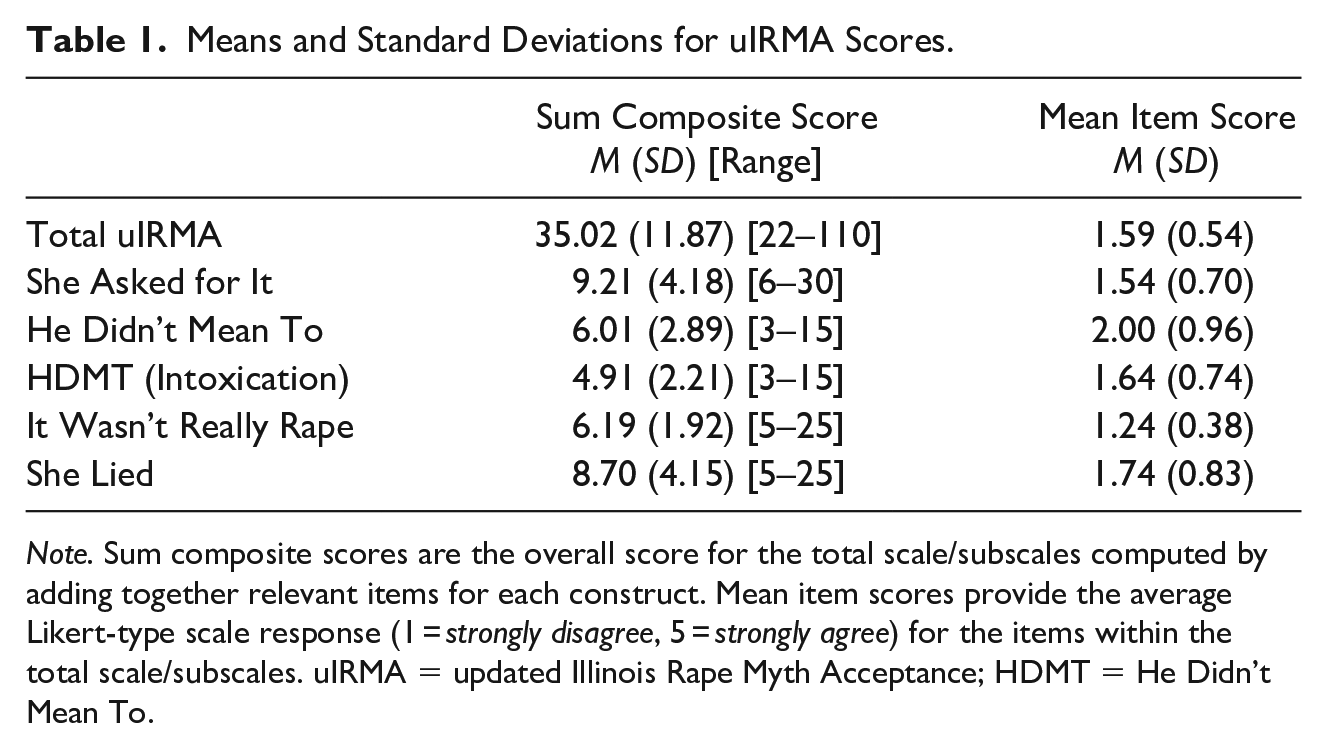
Note. Sum composite scores are the overall score for the total scale/subscales computed by adding together relevant items for each construct. Mean item scores provide the average Likert-type scale response (1 = strongly disagree, 5 = strongly agree) for the items within the total scale/subscales. uIRMA = updated Illinois Rape Myth Acceptance; HDMT = He Didn’t Mean To.
Confirmatory Factor Analysis
We used Hu and Bentler’s (1999) guidelines for assessing model fit, with good model fit indicated by CFI and TLI greater than 0.95, RMSEA below 0.06, and standardized root mean square residual (SRMR) below 0.08. Of note, RMSEA is considered a conservative indicator of fit within samples using categorical variables (Clark & Bowles, 2018; Garrido et al., 2016). Estimated fit statistics indicated good model fit for a four-factor model (χ2 = 498.85, df = 203, p < .001, CFI = .973, TLI = .970, RMSEA = .064, SRMR = .062) and a marginally better fit for a five-factor model (χ2 = 444.39, df = 199, p < .001, CFI = .977, TLI = .974, RMSEA = .059, SRMR = .055). All items loaded significantly onto their expected factor (p’s < .05), and all factor loadings were satisfactory within both the four-factor (.715–.985) and five-factor (.727–.984) models. To evaluate the model fit improvement between the four- and five-factor models, we conducted a chi-square difference test which was significant, Δχ2 = 54.45, df = 4, p < .001. This indicates the five-factor model is a significantly better fit to the data than the four-factor model; thus, the five-factor model was retained. Factor loadings, internal reliability estimates, and interfactor correlations of the five-factor model can be found in Figure 1.
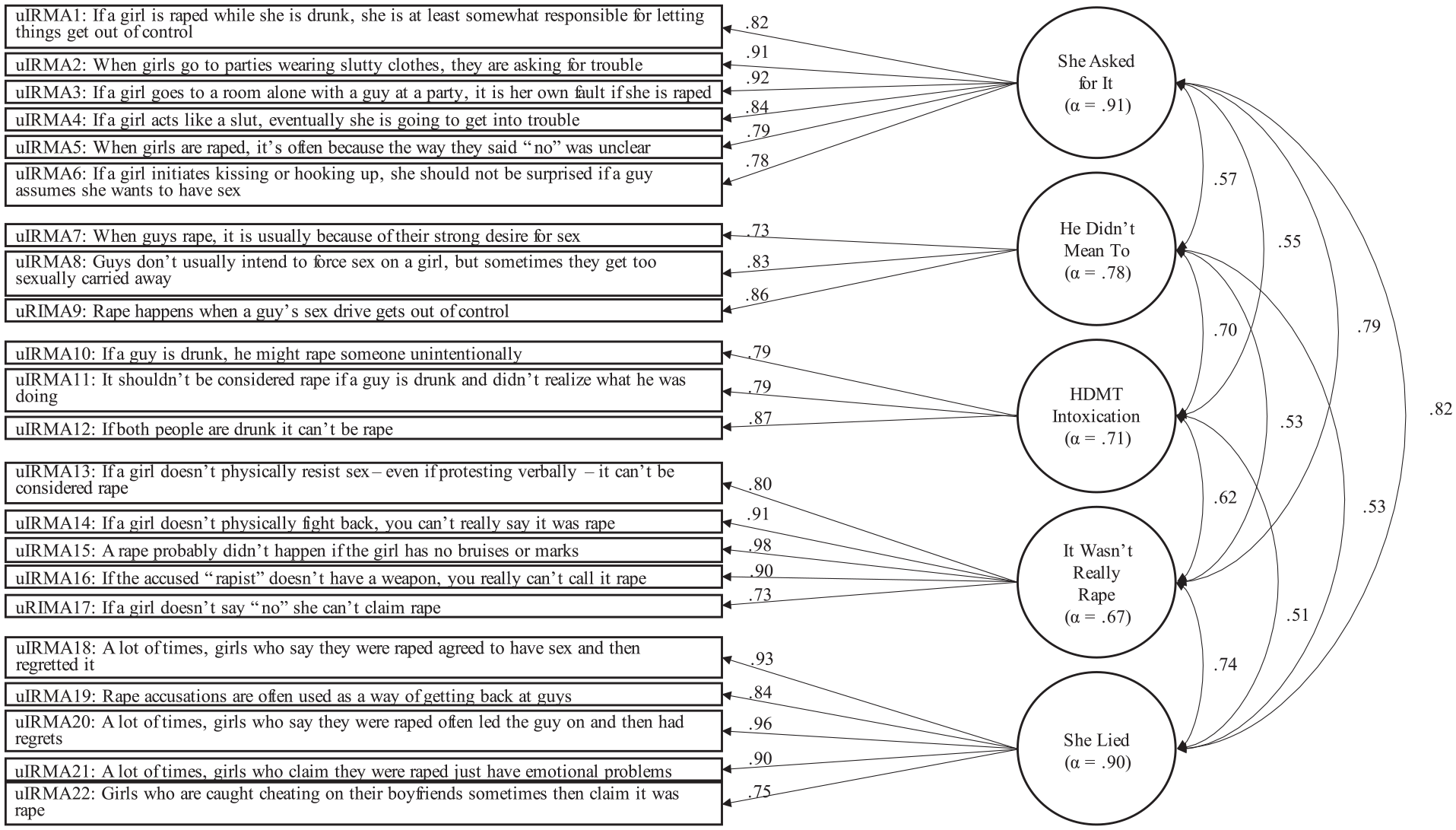
Estimates from confirmatory factor analysis of the final five-factor, 22 item uIRMA.
Internal reliability was acceptable to good with a total scale α of .92 and subscale α values ranging between .67 and .90. This range is similar to what was reported in the original uIRMA validation study (.64–.80; McMahon & Farmer, 2011) and more recent research utilizing the 22-item scale (.68–.85; Newins et al., 2018). Of note, “It Wasn’t Really Rape” (α = .67) was the only subscale with an α below .70. These previous studies did not clarify which alpha coefficients were associated with each individual subscale, making comparisons across the literature difficult. However, in a translated version of the scale, the “It Wasn’t Really Rape” subscale also demonstrated lower internal consistency (α = .52; Skov et al., 2021). In the present sample, removal of the item, “If a girl doesn’t say ‘no’, she can’t claim rape” improved internal consistency of the subscale to .78. However, given that this item loads strongly and significantly on its respective factor and the five-factor structure of the full 22 items was a good fit to the data, we decided to retain this item.
RMA by Participant Characteristics
We examined associations and group differences regarding RMA across variables relating to participant demographics, life experience, and ideology. Findings are organized by type of analyses conducted.
Correlational Analyses
Education
Education level was significantly associated with the subscale “She Lied” (r = −.18, p < .01), indicating women with higher levels of education were less likely to endorse the rape myth that women lie about being raped. No other subscales nor total uIRMA scores were associated with education level.
Social Media Use
Social media use was negatively associated with total uIRMA scores (r = −.11, p = .04) and “He Didn’t Mean To (Intoxication)” subscale scores (r = −.12, p = .02), suggesting more frequent social media use was associated with less acceptance of rape myths as a whole and specifically rape myths which excuse perpetrators who commit rape while intoxicated. No other subscales were associated with social media use.
Age
Age was not significantly associated with the uIRMA full scale or any subscale.
Mann–Whitney U Tests
Sexual Identity
Median scores by sexual identity group and results of Mann–Whitney U tests are reported in Table 2. Distributions of the total uIRMA and subscale scores were similar between heterosexual and queer women. Overall rape myths and all but one of the subscales were endorsed at significantly higher rates by heterosexual women compared to queer women. Endorsement of the subscale “He Didn’t Mean To (Intoxication)” did not differ between heterosexual and sexual minority women.
Group Medians and Results of Independent Samples Mann–Whitney U Tests.
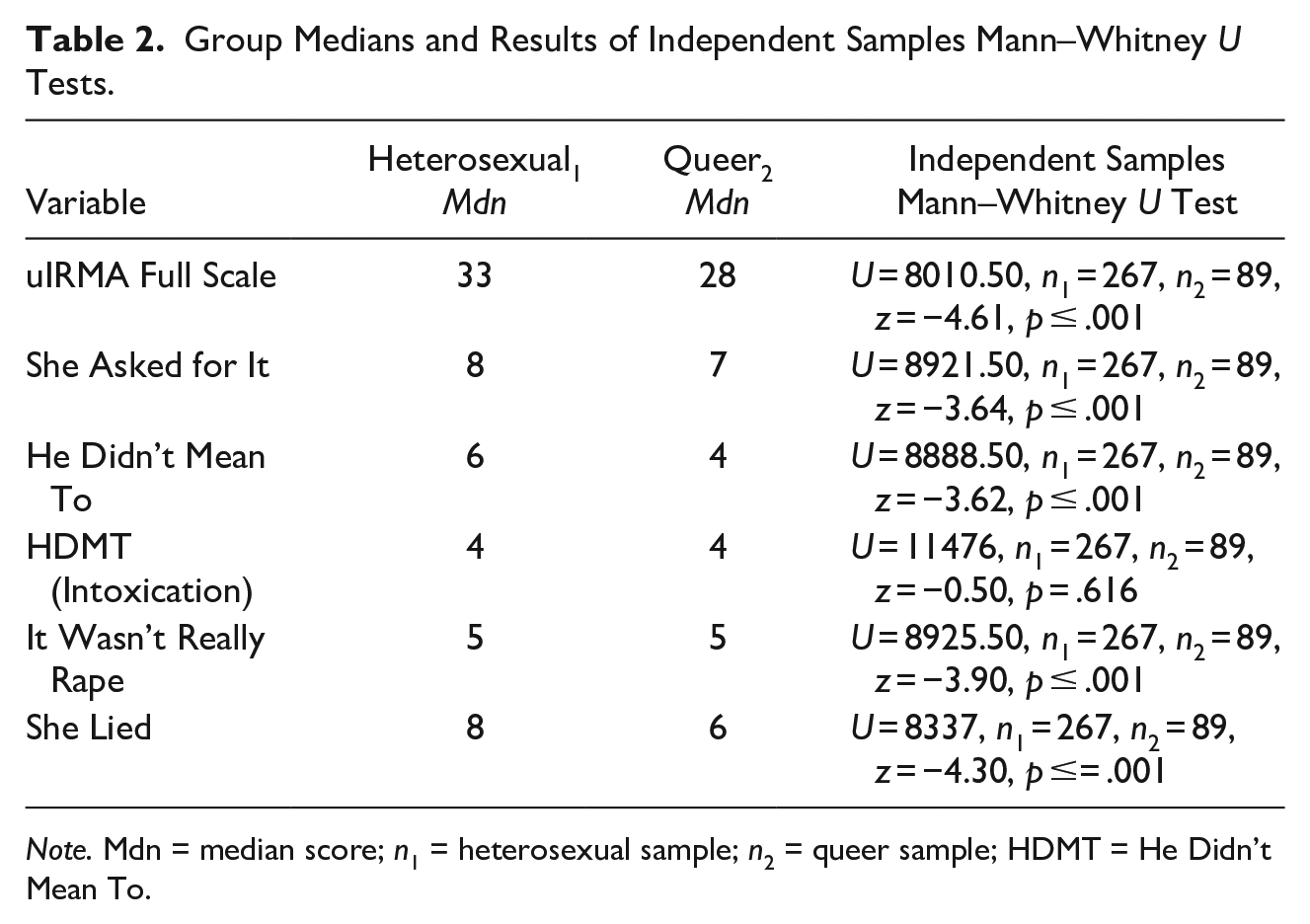
Note. Mdn = median score; n1 = heterosexual sample; n2 = queer sample; HDMT = He Didn’t Mean To.
Religious Affiliation
Distributions of the total uIRMA and subscale scores were similar between religious and nonreligious women. Total uIRMA scores varied by religious affiliation, with religious women (Mdn = 32) endorsing overall rape myths at significantly higher rates than nonreligious women (Mdn = 30), U(Nreligious = 191, Nnonreligious = 165) = 17,821.50, z = 2.13, p = .03. Religiously affiliated women also indicated greater endorsement of the subscales: “She Asked for It” (Mdn = 8; nonreligious women: Mdn = 7), U(Nreligious = 191, Nnonreligious = 165) = 17,662, z = 2.03, p = .04, and “She Lied” (Mdn = 8; nonreligious women: Mdn = 7), U(Nreligious = 191, Nnonreligious = 165) = 18,793.50, z = 3.20, p = .001. The subscales “He Didn’t Mean To,” “He Didn’t Mean To (Intoxication),” and “It Wasn’t Really Rape” did not significantly differ between religious and nonreligious women.
Race/Ethnicity
Distributions of the total uIRMA and subscale scores were similar between women of color and White women. Rape myth endorsement did not vary significantly based on race/ethnicity.
Victimization History
Distributions of the total uIRMA and subscale scores were similar between survivors and non-victims. Survivors of sexual violence endorsed the subscale “He Didn’t Mean To (Intoxication)” at significantly higher rates (Mdn = 5) compared to non-victims (Mdn = 3), U(Nsurvivor = 243, Nnon-victim = 113) = 16,005, z = 2.62, p < .01. No other subscales nor total uIRMA scores differed significantly by victimization history.
Income Level
Distributions of the total uIRMA and subscale scores were similar between income groups. Scores for total uIRMA and subscales scores did not differ significantly between the two income categories (lower/working class, middle/upper class).
Kruskal–Wallis H Tests
Political Affiliation
Distributions of the total uIRMA and subscale scores were determined to be similar between the four political groups assessed: liberal/democrat (n = 193), conservative/republican (n = 83), independent/third party (n = 51), and no affiliation (n = 28) based on boxplot inspection. Median scores, results of Kruskal–Wallis tests, and relevant post hoc tests are presented in Table 3. For scales that demonstrated significant median score differences, pairwise comparisons were performed using Dunn’s (1964) procedure with a Bonferroni correction for multiple groups. Significant differences were identified for overall RMA and the subscales “She Asked For It,” “It Wasn’t Really Rape,” and “She Lied.” Post hoc analyses revealed that conservative women and women with no political affiliation endorsed overall rape myths and these subscales at significantly higher rates than liberal women. Women identifying as independent/third party also endorsed the subscale “She Lied” at significantly higher levels than liberals. Endorsement of “He Didn’t Mean To” and “He Didn’t Mean To (Intoxication)” did not significantly differ between political groups.
Political Affiliation Medians, Results of Kruskal–Wallis H Tests, and Group Comparisons.
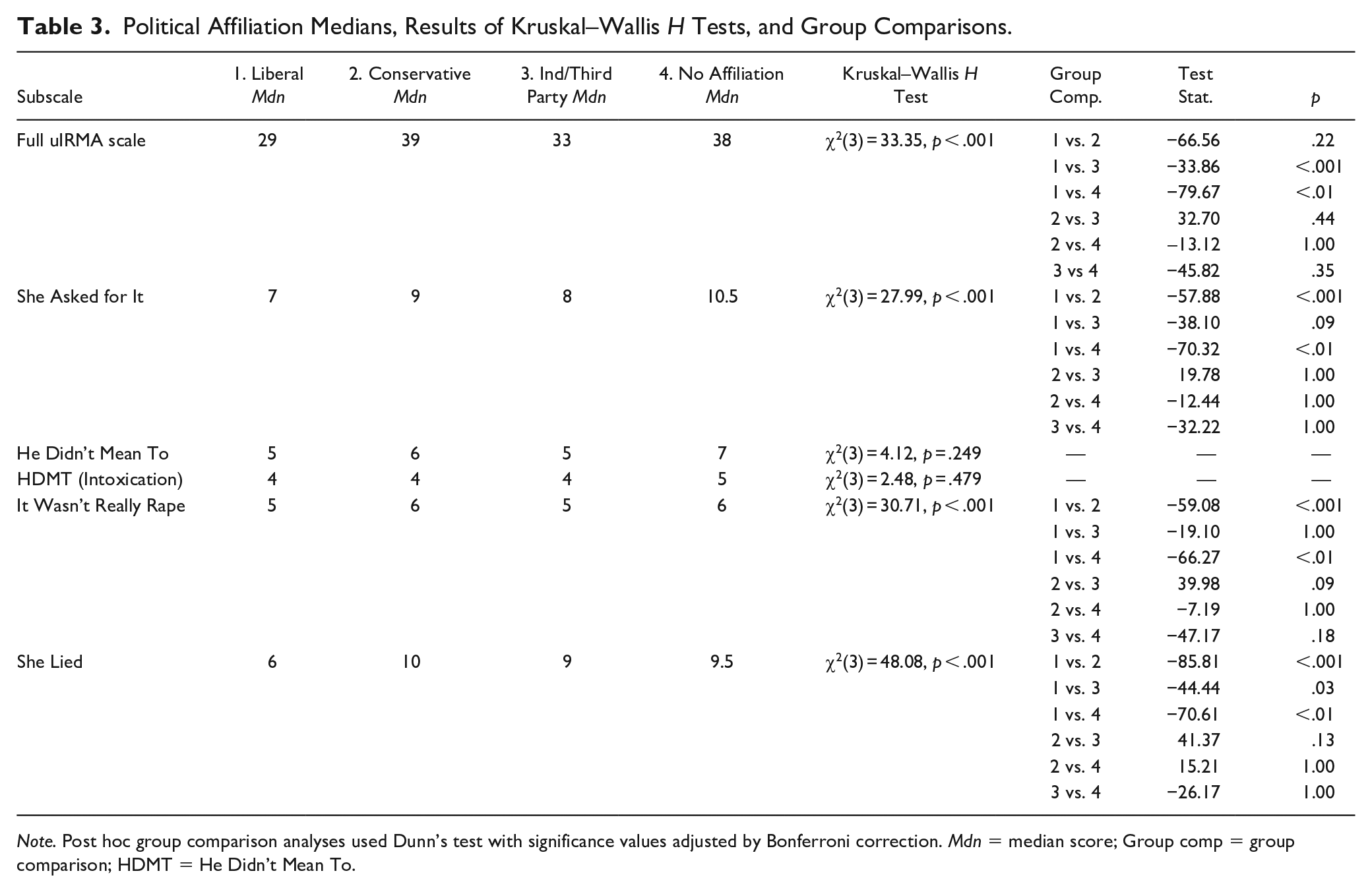
Note. Post hoc group comparison analyses used Dunn’s test with significance values adjusted by Bonferroni correction. Mdn = median score; Group comp = group comparison; HDMT = He Didn’t Mean To.
Region
Distributions of the total uIRMA and subscale scores were determined to be similar between regions: Northeast (n = 67), Midwest (n = 77), South (n = 155), and West (n = 57) based on boxplot inspection. Scores on the uIRMA full scale and subscales did not vary by regional location.
Discussion
The present study provides validity evidence and confirms the factor structure of the 22-item uIRMA scale (McMahon & Farmer, 2011) for measuring rape myths among adult women (ages 25–35) in a community sample. Results of a CFA yield a five-factor model with significant factor loadings on each subscale: She Asked For It, He Didn’t Mean To, He Didn’t Mean To (Intoxication), It Wasn’t Really Rape, and She Lied. This structure is in line with findings from the original validation study (McMahon & Farmer, 2011) and other research with college students (Navarro & Tewksbury, 2017) in asserting that the myth “men cannot be blamed for perpetration due to intoxication” is distinct from the myth that “men cannot be blamed for perpetration due to their strong desire for sex.” Of note, the original McMahon and Farmer (2011) study identified 3 uIRMA items which did not load significantly onto any subscale. In the present study, all items loaded strongly and significantly onto their respective subscale.
Participant item responses were positively skewed, meaning most participants endorsed RMA at relatively low levels. The subscale “He Didn’t Mean To” was endorsed most strongly in the overall sample and showed little variability between groups, suggesting the rape myth that men are unable to control their sex drive may be most predominant among adult women in the general public. In contrast, “It Wasn’t Really Rape” was endorsed at the lowest level in the overall sample, suggesting this cohort of women are able to reject the notion of “stereotypical rape” (e.g., women must physically fight back or say “no” to claim rape) more than other common rape myths. This may highlight successes with prevention work and social activism in providing education on what constitutes rape, with less success debunking gender essentialist notions which paint men as incapable of controlling sexual urges and therefore less culpable for harm they cause.
In line with existing literature, rates of RMA in the current sample were significantly associated with participants’ ideological beliefs and sexual identity, such that women identifying as religious, politically conservative, or heterosexual endorse rape myths at higher rates (Barnett et al., 2018; Ortiz & Smith, 2022; Wilson & Newins, 2019). While religious affiliation was coded dichotomously (i.e., religiously affiliated or not), it should be noted that nearly all the religious women in the sample (93%) identified as Christian. Religious doctrine confers great influence in shaping people’s beliefs regarding gender and sex, which often informs the social policies and political party they choose to support (Cassese & Holman, 2017; McMorris & Glass, 2018). Given as many as 89% of conservative women in the U.S. identify as Christian (Pew Research Center, 2014), it is unsurprising that beliefs about a gendered social issue like sexual violence would be aligned between these groups. A concrete example of how religious and political doctrine influence one another can be seen in Christian purity culture, which arose from conservative backlash to gains in women’s social and political empowerment (e.g., passage of Roe vs. Wade in 1973; Owens et al., 2021). Research indicates that people who subscribe to purity culture (e.g., emphasizing the importance of women’s virginity, denying women’s bodily autonomy) endorse rape myths at higher rates and were more likely to label rape scenarios as consensual sex (Owens et al., 2021). Similar social backlash has been seen in response to the #MeToo Movement in 2017, which aimed to draw attention to the prevalence and injustices of sexual violence against women. Indeed, research has found greater RMA and more negative perceptions of the #MeToo Movement among conservatives; moreover, opinions about sexual assault and #MeToo were more closely aligned with political affiliation than gender, a notable finding given that gender has historically been considered the most reliable predictor of RMA (Ortiz & Smith, 2022; Suarez & Gadalla, 2010).
Ideological support for upholding patriarchal power structures via promotion of traditional gender norms may explain the similar trends in higher RMA among Christian, conservative, and heterosexual women (Barnett et al., 2018; Schreiber, 2016). Traditional beliefs that women should submit to men’s social, moral, and political power are more common in Christian and conservative cultures (Whitehead & Perry, 2019) and mirror the constructs that underlie rape myths about women survivors (Edwards et al., 2011). Queer women, regardless of religious or political affiliation, may be less likely to support traditional notions of gender and sexuality given that their identity and lived experiences challenge the dominant discourse of heteronormativity in society, which may explain lower levels of RMA (Grollman, 2019).
In line with existing literature which found no relationship between victimization history and RMA (Carmody & Washington, 2001; Fansher & Zedaker, 2022), survivors in the present study did not differ from women without victimization histories, save for the “He Didn’t Mean To (Intoxication)” subscale, which survivors endorsed at higher rates. McQuiller Williams et al. (2016) also found survivors to be more likely to endorse potentially risky attitudes and behaviors relating to alcohol and sex, including the belief, “it is acceptable to pressure a date to drink alcohol to improve the chances of having sex,” and being more likely to have sex when they or their partner is intoxicated. Given the cross-sectional nature of these studies, it is impossible to determine whether adherence to alcohol-related rape myths preceded survivors’ victimization, or if those experiences shaped the way survivors think about alcohol use and sexual assault after the fact.
Social media use was associated with lower endorsement of RMA overall, and specifically of the “He Didn’t Mean To (Intoxication)” subscale. This may indicate some level of success in recent hashtag activism campaigns (e.g., #MeToo) in exposing social media users to psychoeducation about rape myths, or news stories/commentaries which appropriately place the responsibility for substance-facilitated sexual assault on perpetrators. However, the single item measure of social media use in the current study means interpretations should be made with caution. Education level also had limited associations with RMA, with greater education only being correlated with lower endorsement of the subscale “She Lied.” This may indicate that women who have the opportunity to pursue more education are less likely to perceive women as untrustworthy, but that general education is not related to adherence to other rape myths.
Implications for Rape Prevention
Women in our sample were most likely to endorse the “He Didn’t Mean To” subscale; items in this domain reflect items in validated assessments of gender-inequitable attitudes (Pulerwitz & Barker, 2008). Moreover, being heterosexual and holding ideological beliefs (i.e., religiosity, conservative political affiliation), which typically support patriarchal, heteronormative, white supremacist power structures, were associated with higher RMA as well. As rape myths are rooted in cultural attitudes about power and privilege, the current study underscores the continued importance of gender transformative, anti-oppressive programming that leverages the promotion of equity as a key prevention and intervention strategy (Casey et al., 2018). Gender transformative programs focus primarily on shaping men’s attitudes about gender equity, as men are most likely to perpetrate sexual violence. However, women with greater RMA have also demonstrated lower levels of risk detection for victimization (Loiselle & Fuqua, 2007). As Brush and Miller (2019) explain, “we are all inevitably enmeshed in social relations and dynamics of difference, power, and transformation” (p. 1649), highlighting the potential benefit of challenging inequitable gender norms and other oppressive beliefs in prevention efforts more broadly, including among women.
Recommendations for Future Research
Continued research on rape myths using the uIRMA would benefit from establishing more consistent administration of the scale. As discussed, the original validation study (McMahon & Farmer, 2011) administered 22 items, but found only 19 loaded significantly on factors in their undergraduate sample. Researchers have since varied in their use of the 19-item versus 22-item scale, making direct comparisons of RMA levels between studies and sample populations difficult. Additionally, while the original study used a Likert-type scale of 1 = strongly agree to 5 = strongly disagree (with a higher score indicating greater rejection of rape myths), several studies since (including the present study) have administered an inverted version of the scale (1 = strongly disagree to 5 = strongly agree), arguing that higher scores indicating greater acceptance of rape myths is easier for interpretation. This practice interferes with the ability to reliably compare findings between studies because, though the same measure is being used, the fundamental constructs being measured are different depending on the way the Likert-type scale is administered (i.e., level of rape myth rejection vs. level of RMA).
Limitations
Findings from the current study should be considered in the context of relevant limitations. Even with the implementation of best practices in validating data from internet research, it is impossible to know how much participants were paying attention and/or answering questions honestly through this forum. The present sample consisted of women from a limited age range (25–35 years old) with active accounts on CloudResearch. While this adds to the literature by assessing women older than traditional college age and can help inform more cohort specific prevention work, it should not be assumed that our findings regarding the validity of the uIRMA or trends in RMA based on participant characteristics would generalize to all women in the general public. The sample was also limited in racial/ethnic diversity, which may have biased validation of the uIRMA to a predominantly white perspective.
Conclusion
A five-factor model of the 22-item uIRMA scale (McMahon & Farmer, 2011) demonstrates good fit among young adult women (age 25–35) in a community sample, suggesting this scale is suitable for tracking RMA and informing prevention programming for this non-college population. Rape myths related to men being unable to control their strong desires for sex were most highly endorsed in the overall sample. Examination of participant characteristics revealed that ideological beliefs (i.e., religiosity and political affiliation) and sexual identity were related to level of rape myth endorsement, while other demographic variables (e.g., age, race/ethnicity) demonstrated no relationship. Sexual violence prevention work targeting RMA should be implemented at the community level and address traditional beliefs about gender and sexuality. These beliefs likely contribute to gender essentialist notions that men cannot control their sex drive and the commonality of higher rape myth endorsement among heterosexual, religious, and politically conservative women.
Footnotes
Acknowledgements
Special thanks to Dr. Leila Wood for her review and feedback on this manuscript.
Declaration of Conflicting Interests
The author(s) declared no potential conflicts of interest with respect to the research, authorship, and/or publication of this article.
Funding
The author(s) disclosed receipt of the following financial support for the research, authorship, and/or publication of this article: This study was funded by a 2020 Dissertation Grant awarded to the first author from Family Process Institute.
