




Abstract
Peer victimization and dating violence are highly prevalent among adolescents. Those two forms of victimization are notably associated with heightened levels of internalizing problems. The stress generation hypothesis stipulates that depressive cognitions and behaviors may generate interpersonal stressors for depressed individuals. It has thus been hypothesized that victims of peer victimization may experience higher levels of internalizing problems, which in turn, may render them more at risk of experiencing dating violence victimization. We used a longitudinal design with three waves from the Quebec Youth’s Romantic Relationships Survey (n = 4,923). Participants (59.6% girls, aged between 14 and 18 years old) reported their experiences of dating violence victimization, peer victimization and psychological distress. A cross-lagged panel analysis was performed to test the mediational effect of psychological distress between peer victimization and dating violence while controlling for age and gender. The interaction effect of gender in the model was also tested. The longitudinal relationship between peer victimization and dating violence victimization was significantly mediated by internalizing problems. This result thus supports the stress generation hypothesis. No interaction effect of gender was observed in the model, thus suggesting that this relationship does not change as a function of gender. This study offers to practitioners in the area of prevention and intervention for peer victimization and dating violence a different way of tackling the problem of revictimization. Indeed, our findings revealed that internalizing problems were longitudinally associated with subsequent relational problems, when occurring after being victimized. Therefore, addressing internalizing problems instead, or in addition to prevention or intervention efforts to stop victimization may help in reducing revictimization rates.
Introduction
During adolescence, peer relationships gain in importance and interest towards dating relationships increases (Curtis, 2015). However, a considerable number of adolescents encounter the dark side of these relationships in the form of victimization by peers and/or their dating partners (Jouriles et al., 2017; Plexousakis et al., 2019). Bowen et al. (2018) define peer victimization as “any type of undesired behavior considered hostile or harmful, which impairs the physical or psychological integrity of an individual, his or her rights or dignity” (p. 201). A meta-analysis of 165 studies found that between 10% and 35% of adolescents experience recurrent peer victimization (Moore et al., 2017). Peer victimization has been associated with a host of mental health problems, notably increased internalized symptoms, such as anxiety (social phobia and post-traumatic stress), psychotic symptoms and particularly depression (including suicidal ideations, self-destructive behaviors and suicidal attempts) (Moore et al., 2017). For its part, dating violence refers to “[…] any behavior within an intimate relationship that causes physical, psychological or sexual harm to those in the relationship” (Heise & Garcia-Moreno, 2002, p. 89). In their research review, Stonard et al. (2014) noted that between 10% and 30% of adolescents report having been physically victimized, between 35% and 55% were psychologically or emotionally victimized, and between 5% and 30% were sexually victimized in a dating relationship. Similarly to peer victimization, dating violence victimization has been associated with increased internalized symptoms, including feelings of sadness, negative perception of oneself, psychological distress, depression symptoms, suicidal ideations, and suicidal attempts (Hébert et al., 2018).
Sadly, victimization often cooccurs across different relational contexts (Hamby et al., 2012). Indeed, 50.4% of adolescents who reported experiencing peer victimization in the last year also reported having been victimized in the context of a dating relationship (Swahn et al., 2008). Furthermore, Cuevas et al. (2014) found that adolescents who experience peer victimization were 2.32 times more at risk of also experiencing dating violence victimization. Also, a recent meta-analysis based on 23 studies showed that adolescents who were victimized by their peers had a 2.5 times higher risk of also being victimized in their dating relationship (Zych et al., 2019). This association was found to be stronger for girls (OR = 2.44) than for boys (OR = 1.86). Moreover, peer victimization has been found to predict an elevated trajectory of dating violence victimization in adolescence (Brooks-Russell et al., 2013; Sabina et al., 2016). Given the substantial co-occurrence between peer victimization and dating victimization, the principal aim of the current study was to elucidate the underlying mechanism that may explain this association. Such an analysis can offer important cues for the design of efficient interventions in order to prevent revictimization in adolescence.
Depressive Symptoms as a Potential Mediating Mechanism
Research shows that both peer victimization and victimization in dating relationships not only predict internalized problems but are, in turn, themselves predicted by internalized problems (Foshee & Reyes, 2018; Reijntjes et al., 2010). In light of this bidirectional association between internalized problems and victimization in both relational contexts, one possible explanation for the co-occurrence between peer victimization and dating victimization may lie in the stress generation hypothesis (Hammen, 2006). This theoretical framework suggests that depressive symptomatology, as well as anxiety (Connolly et al., 2010)—which are characterized by negative behaviors such as negative inferential styles, ruminative tendencies, self-criticism, hopelessness, social disengagement and self-perceived interpersonal incompetence—may generate negative reactions in the social environment of depressed individuals (i.e., rejection, ridicule or aggression). These reactions then lead to further depression and anxiety (Connolly et al., 2010; Uliaszek et al., 2012). Thus, without attempting to put the blame on depressive or anxious individuals, Hammen’s theory highlights how they may be inadvertent actors in the stressful situations they experience, by being “congruen[t] with the needs, motives or reactivities of offenders” (Finkelhor & Asdigian, 1996; p. 6) who are always responsible for their violence.
The stress-generation hypothesis thus proposes a cyclical conception of interpersonal stress where internalizing symptoms and behaviors are mediating the relationship between previous and ulterior interpersonal stress. In support of this theoretical model, a literature review of 57 studies (Liu & Alloy, 2010) revealed that stressful life events indeed predict increased depression symptoms in adolescents, which in turn predict an increase in the number of stressful life events. The same conclusions were reached following a meta-analysis of 18 studies on the link between peer victimization and internalizing problems (Reijntjes et al., 2010). Specifically, the results showed a bidirectional association where peer victimization predicts internalizing problems (including depression symptoms) (average effect size r = .18), and—in turn—internalizing problems predict peer victimization (average effect size r = .08). What’s more, depression symptoms were found to mediate the temporal stability of peer victimization between fall and spring of the same school year in a sample of early adolescents (around 11 years of age) (Schacter et al., 2015). Importantly, empirical evidence suggests that the stress generation hypothesis can also explain the stability of victimization experiences across different social contexts. Specifically, controlling for a host of personal and familial confounders, depression symptoms assessed between ages 19 and 20 years have been shown to partially mediate the link between peer victimization at school (assessed between ages 12 and 17 years) and victimization at the workplace at age 22 years (Brendgen & Poulin, 2018). There is also a study (Cava et al., 2018) that tested the mediation effect of depressive mood on the association between peer victimization and dating violence victimization. However, in addition to being based on cross-sectional data, the model tested in that study included three consecutive and highly correlated mediators (depressive mood, loneliness and life satisfaction), with life satisfaction as an additional mediator in between depressive symptoms and dating violence victimization. Uniqueness problems in the tested mediators may have emerged from this analytical procedure, which may explain why no significant mediation effect of depressed mood was found. It is thus still unknown whether internalizing symptoms play a mediating role in the temporal stability of dating violence victimization and in the association between peer victimization and dating violence victimization among adolescents.
The Current Study
Guided by the stress generation hypothesis, the current study aimed to test whether internalizing problems may explain (i.e., mediate) —at least in part—the temporal stability of dating violence victimization over time as well as the longitudinal association between peer victimization and subsequent dating violence victimization in adolescence. It will also examine whether, in line with the cyclical model of the stress generation hypothesis, peer victimization and dating violence victimization mediate the stability of internalizing symptoms over time. An additional goal was to examine a potential moderating effect of gender in these associations. Based on the previously mentioned findings reported by Zych et al. (2019) as well as the higher levels of internalizing symptoms among girls (Essau et al., 2010), the association between peer victimization and dating violence (while using internalizing symptoms as a mediator) was expected to be stronger for girls than for boys. These hypotheses were tested in a sample of adolescents aged 14–18, because incidents of dating violence typically begin to occur during this developmental period (Bonomi et al., 2012).
Method
Participants
The study sample was drawn from the Quebec Youth Romantic Relationships Survey (QYRRS), a longitudinal study conducted in Quebec, Canada with five assessment times starting in fall 2011. Of the 131 randomly selected high schools contacted to participate in the study, 34 agreed to administer the survey to their consenting 10th to 12th graders. In 320 out of 329 classes, every student consented to participate, whereas the consent rate in the other nine classes ranged from 90 to 98%. Informed written consent was obtained from all participants. A research assistant explained the general aims of the survey, which were to examine the characteristics, correlates, antecedents, and outcomes of adolescents’ romantic relationships. A second research assistant was available to assist participants if needed. The study was approved by the research ethic board of Université du Québec à Montréal.
The current study only used data from the three first assessment times because peer victimization was only assessed at Times 1 and 2, thus precluding any test of the expected mediation effects beyond Wave 3. Respectively, 8,194, 6,779 and 1,833 students answered the survey at Time 1, Time 2, and Time 3, with 9,147 students participating in at least one of the first three time points. A large part of the sample (2,094 students; 22.9%) only participated at Time 1, 4,379 (47.9%) students participated at Time 1 and Time 2 but not Time 3, and 1,540 (16.8%) participated at all three assessment times. The large drop in participation after Times 1 and 2, which involved in-school assessments, may be explained by the fact that assessment at Time 3 was an online survey that participants completed at home. Some participants (0.8%) had missing values on almost every variable at all three time points and were thus considered “nonadmissible” for further analyses.
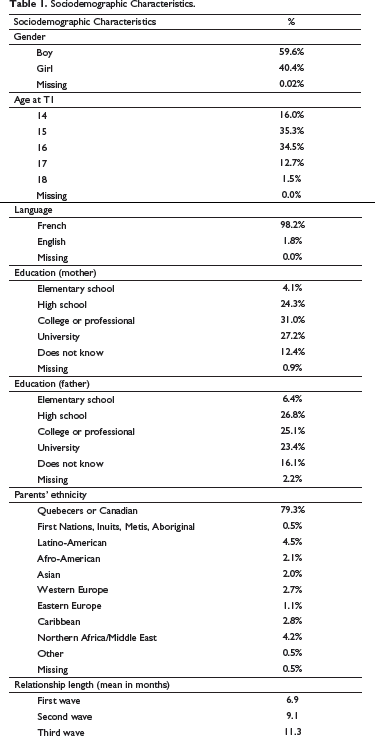
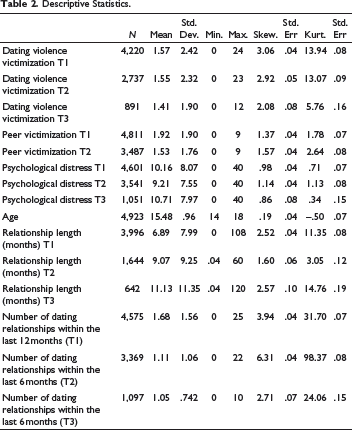
Participants selection from the overall sample. First, only participants between ages 14 and 18 years at Time 1 were included in further analyses in order to reduce bias due to age-related outliers (see Table 1 for sociodemographic information). This reduced the number of retained participants from 9,147 to 8,143. Next, because one of the key variables of interest concerned dating violence victimization, only participants that reported having been in a dating relationship were included in the analyses. Specifically, participants had to meet at least one of the three following conditions: (a) having been in a dating relationship in the year preceding the first wave, or (b) having been in a dating relationship within the 6 months preceding the second wave, or (c) having been in a dating relationship within the 6 months preceding the third wave. The difference in time lapses concords with the difference in time between measurements, each of them occurring in intervals of 6 months. This resulted in a decrease from 8,143 to 4,929 participants. Finally, Mahalanobis’ distances were examined to detect potential multivariate outliers. Using a conservative significance threshold of p < .0001 to avoid overidentification of multivariate outliers in this large sample, six cases were excluded. The final study sample was thus composed of 4,923 participants (59.6% girls) aged between 14 and 18 years (M = 15.48, SD = .955), with 26.4% of overall missing data points (see missing data analysis below). The sociodemographic characteristics of the sample are provided in Table 1 and descriptive statistics can be found in Table 2.
Sociodemographic Characteristics.
Descriptive Statistics.
Measures
Dating violence victimization. Victimization in dating relationships was measured at all three time points using a French adaptation of the Conflict in Adolescent Dating Relationships Inventory (CADRI) (Hébert et al., 2011; Wekerle et al., 2009; Wolfe et al., 2001). This scale measures both victimization and perpetration of dating violence, but only the victimization subscale was used in the present analyses. The eight items of this subscale refer to emotional and verbal violence (three items, such as: “He/She ridiculed or made fun of me in front of others”), physical violence (three items, such as: “He/She kicked hit or punched me”) and threatening behaviors (two items, such as: “He/She threatened to hurt me”) suffered at the hand of a dating partner. Participants reported how often they had experienced each behavior in the past 12 months (time 1) or the past 6 months (times 2 and 3) using a four-point Likert scale: 0 (“never”), 1 (“once to twice”), 2 (“three to five times”) to 3 (“six times or more”). Item scores were summed (range between 0 and 24; ordinal α = .90 at T1, .89 at Time 2 and .85 at Time 3).
Internalizing problems. A French version of the Kessler Psychological Distress Scale (K10) (Kessler et al., 2003) was used to assess internalizing symptoms at all three assessment waves. The scale is composed of 10 items treating the frequency with which various forms of internalizing symptoms have been experienced in the past week, such as “so depressed that nothing could make you smile,” “sad or depressed,” or “so nervous that nothing could calm you down.” Responses were given using a five-point Likert scale ranging from 0 (“never”) to 4 (“always”). Summed scores varied between 0 and 40, with a high score representing higher psychological distress. Internal consistency was excellent: ordinal α = .92 for the first measurement, .91 for the second, and .91 for the third.
Peer victimization. The scale assessing peer victimization consisted of three items. One of the items (“somebody made you feel excluded or left out”) comes from a survey conducted by Statistics Canada (2007). The second item (“somebody harassed you at school or somewhere else”) was derived from a study conducted by Chamberland et al. (2011). Finally, the third item is an adaptation of the second item made by the research team to assess cyberviolence (“somebody harassed you using electronic technologies”). All three items were measured using a four-point Likert scale: 0 (“never”), 1 (“once to twice”), 2 (“three to five times”) to 3 (“six times or more”). Summed scores varied between 0 and 9, with a higher score representing more frequent peer victimization. Internal consistency was acceptable: ordinal α = .74 for the first measurement, and .75 for the second.
Statistical Analyses
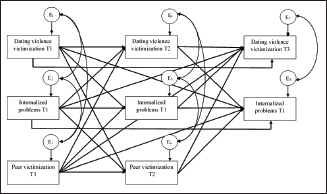
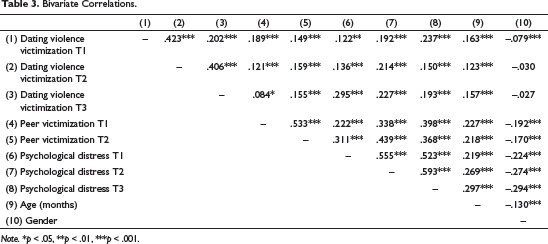
In preliminary analyses, performed with SPSS v.25, independent t-tests were computed to investigate potential mean differences between boys and girls for the study variables. Bivariate correlations between variables were also examined, both for the overall sample and separately for girls and boys. The main analysis consisted of a cross-lagged panel analysis (Figure 1) performed with the Lavaan (v. 0.6-6) package for structural equation modeling, with a full information maximum likelihood (FIML) estimation and bootstrapped standard errors (5,000 iterations). The FIML approach uses all available information without deleting cases in order to compute model fit and parameters. It is appropriate for moderate to large amounts of missing data, if predictors of missingness are included in the model (Lang & Little, 2018). Little’s MCAR test was significant (χ2(690) = 1054.298, p < .001), suggesting that missingness was not missing completely at random (MCAR). However, missingness was found to be significantly predicted by gender and age (with fewer missing values among girls and older participants), indicating that data were missing at random (MAR) (Mellenbergh, 2019). Gender and age were thus included as predictors (controls) of all the main variables in the panel model. In a simulation analysis, Newman (2003) demonstrated that in a three-wave panel analysis under the MAR assumption and with missingness of 25% and 50% in each wave, the use of FIML was associated with acceptable average parameter estimation errors (.033 for 25% and .059 for 50% of missingness, which fall under the “unacceptability” threshold of .1. In contrast, missingness of 75% in each wave was associated with unacceptable average parameter estimation errors (.138). The same results were obtained with respect to the increase in standard errors. However, FIML yielded results that were at least as good—if not better—as those obtained with multiple imputation for both the 25% and 50% missingness conditions (albeit but worse results in the 75% missingness condition), while performing almost twice as good as listwise deletion in all conditions. Although the present sample had 80.3% missingness in the third wave, variables in waves 1 (7.7% missingness) and 2 (33.9% missingness) had acceptable rates of missingness and they were also used as auxiliary variables to explain missingness in wave 3, which was not the case in Newman’s (2003) study. Thus, because missingness was only above 75% in one wave and auxiliary variables were used in the model, missingness was not expected to lead to biased results in the present study. Attrition from T1 to T2 and T3 (when combined) was found to be higher in boys (χ2(1) = 115.455, p < .001), older participants (t(1611.974) = 5.225, p < .001), and was associated with more dating violence victimization (t(1236.647) = 9.621, p < .001), less peer victimization (t(2467.653) = –4.225, p < .001) and lower psychological distress levels (t(2161.146) = –5.972, p < .001) at T1. Because normality assumptions were not met (Table 2), bootstrapping (5,000 iterations) was joined to the ML estimator, as this resampling technique can handle non-normal data (Awang et al., 2015). Finally, variance inflation factors (VIF) were evaluated on each linear regression model predicting all five dependent variables. No multicollinearity was observed in variables as all VIF were lower than 10 (Kline, 2015) (ranging from 1.014 to 1.379) (see Table 3 for the correlation matrix).
Note.
Bivariate Correlations.
Note. *p < .05, **p < .01, ***p < .001.
The tested model (Figure 1) was saturated and included all predictive paths from Time 1 variables (dating violence victimization, internalizing problems and peer victimization) to Time 2 variables (dating violence victimization, internalizing problems and peer victimization) and to Time 3 variables (dating violence victimization and internalizing problems). All predictive paths from Time 2 variables to Time 3 variables were also included. Furthermore, variables at Times 1, 2, and 3 were all controlled for gender and age effects. The hypothesized mediational effects as proposed by the cyclic Stress Generation Model were tested by assessing (a) the indirect effect of peer victimization (Time 1) on dating violence victimization (Time 3) through internalizing problems (Time 2), (b) the indirect effect of dating violence victimization (Time 1) on dating violence victimization (Time 3) through internalized problems (Time 2), (c) the indirect effect of internalizing problems (Time 1) on internalizing problems (Time 3) through dating violence victimization (Time 2), and (d) the indirect effect of internalizing problems (Time 1) on internalizing problems (Time 3) through peer victimization (Time 2).
To test potential moderation effects of gender, the model was rerun as a two-group model by gender group (and excluding gender as a predictor in the panel model). The fit of a nested model with equality constraints between genders for regressions, variances and covariances was compared with the fit of a model with all parameters estimated freely using the Satorra–Bentler chi-square difference test. A statistically significant difference between the two models would indicate a moderation effect of gender. However, because no moderation was found (χ2 difference (44) = 52.377, p = .181), the results of the more parsimonious model from the initial whole sample panel model are presented.
Results
Results from the whole sample cross-lagged panel model are shown in Table 4 and in Supplement Figure S1. Significant and mostly stable predictive effects were observed for the control variables. Being a boy was associated with lower levels of peer victimization at T1 (B = –.389, p < .001) and T2 (B = –.069, p = .022), as well as with fewer internalized problems at T1 (B = –.596, p < .001), T2 (B = –.195, p < .001) and T3 (B = –.122, p = .034). However, boys reported lower levels of dating violence victimization than girls only at T1 (B = –.167, p < .001). Age was not a significant predictor of internalized problems at all three assessment times. However, older participants reported lower levels of peer victimization at T1 (B = –.046, p = .001) and T2 (B = –.062, p < .001) but higher levels of dating violence victimization at T1 (B = .118, p < .001) and T2 (B = .036, p = .039).
Model Statistics.
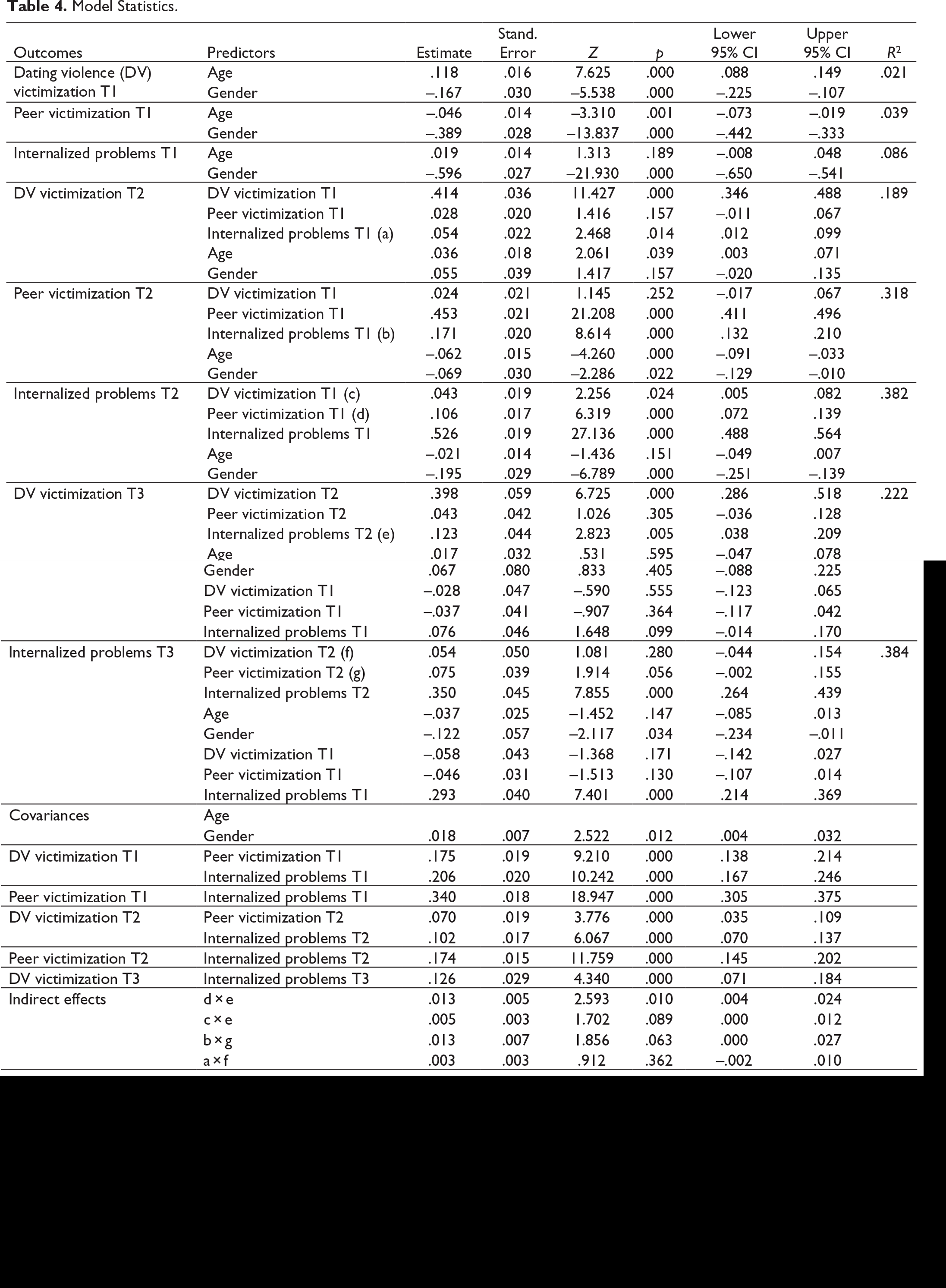
Stability in autoregressive paths was observed for all variables. Peer victimization at T2 was predicted by peer victimization at T1 (B = .453, p < .001). Similarly, dating violence victimization at T3 was predicted by dating violence victimization at T2 (B = .398, p < .001), while T2 was predicted by T1 (B = .414, p < .001). However, dating violence victimization at T3 was not significantly predicted by the same experiences at T1. Internalized problems at T3 were predicted by the same problems at T2 (B = .350, p < .001) and T1 (B = .293, p < .001), and T2 internalized problems were predicted by T1 (B = .526, p < .001). The residual concurrent correlations between the study variables were all statistically significant and in the expected direction. Specifically, higher levels of dating violence victimization were associated with higher levels of peer victimization and both were associated with higher levels of internalizing problems measured at the same time point.
Cross-lagged paths were also relatively stable through time. First, higher levels of dating violence victimization at T3 were predicted by higher levels of internalized problems (T2) (B = .123, p = .005), but not by peer victimization (T2). Similarly, higher levels of dating violence victimization at T2 were predicted by higher levels of internalized problems (T1) (B = .054, p = .014), but not by peer victimization (T1). Second, higher levels of internalizing problems at T3 were predicted (albeit only with a statistical trend) by higher levels of peer victimization (T2) (B = .075, p = .056), but not by dating violence victimization (T2). However, higher levels of internalizing problems at T2 were significantly predicted by higher levels of peer victimization (T1) (B = .106, p < .001), and by higher levels of dating violence victimization (T1) (B = .043, p = .024). Finally, higher levels of peer victimization at T2 were predicted by higher levels of internalizing problems (T1) (B = .171, p < .001), but not by dating violence victimization (T1). Results further showed a significant indirect effect of peer victimization at T1 on dating violence at T3 mediated by internalizing problems at T2 (B = .013, p = .010, CI = [.004, .024]). In contrast, the indirect association between dating violence at T1 and T3 using internalizing problems at T2 as a mediator only showed a statistical trend (B =.005, p = .089, CI = [.000, .012]). Moreover, the indirect association between internalizing problems (T1) and internalizing problems (T3) only showed a statistical when using peer victimization (T2) as a mediator (B = .013, p = .063, CI = [.000, .027]) and was not significant when using dating violence victimization (T2) (B = .003, p = .362, CI = [–.002, .010]) as a mediator.
Discussion
The stress generation hypothesis proposes that internalizing symptomatology may increase the risk of experiencing dependent interpersonal stressors, which in turn may lead to a further increase in internalizing symptoms (Hammen, 2006). This cyclic conception of relational stressors can thus be interpreted in two ways: (1) internalizing symptomatology mediates the association between previous and ulterior interpersonal stressors, and (2) interpersonal stressors mediate the association between previous and ulterior internalizing symptomatology. These mediational pathways were tested for peer victimization and dating violence victimization during adolescence. Equally for girls and boys, the results only partially supported the stress generation hypothesis. The longitudinal association between peer victimization and dating violence victimization was significantly mediated by internalizing problems. In addition, the longitudinal stability of internalizing problems was mediated by peer victimization, and the longitudinal stability of dating violence victimization was mediated by internalizing problems, albeit only with a statistical trend in both cases. However, dating violence victimization did not mediate the longitudinal stability of internalizing problems. Moreover, although a corresponding mediation effect has been found for the stability of peer victimization in previous research (Schacter et al., 2015) —and although peer victimization at T1 did predict increased internalizing problems at T2 in the present study—this mediational path could not be formally tested in the present study.
The significant indirect association between peer victimization and subsequent dating violence victimization, mediated via increased internalized problems, represents an important finding. Our study extends findings of a past study relying on a cross-sectional design (Cava et al., 2018) that examined the mediational effect of various variables such as loneliness, life satisfaction and depressive mood between peer victimization and dating violence victimization. As already mentioned, the sequential chain of mediators tested in that cross-sectional study may have precluded the detection of a mediation effect of depressed mood. The longitudinal design of the present study along with a focus on psychological distress offered a more direct test of the stress-generation hypothesis of depression. Together with previous findings showing that depressive symptoms mediate the link between peer victimization and later victimization at the workplace (Brendgen & Poulin, 2018), the present results suggest that the stress generation hypothesis may explain the transfer of victimization from one social context to another over time. The present results also support, albeit only tentatively, the bidirectional and cyclical nature of the association between internalizing problems and peer victimization found in previous studies (Mlawer et al., 2019). This bidirectional association was not unequivocally found for dating violence victimization. Indeed, dating violence victimization was significantly predicted by previous internalized problems at each wave, but the reverse association was not consistently observed across all time points. However, similar results were reported in a study by Jouriles et al. (2009) in a sample of adolescents. Of the measured psychological distress variables in that study (i.e., relationship anxiety, trauma symptoms and depressive symptoms), only relationship anxiety was significantly predicted by psychological dating violence victimization (as measured with the CADRI). Relationship anxiety was not significantly predicted by physical dating violence victimization (as measured with the CADRI), however, and trauma symptoms and depressive symptoms were not significantly predicted by either form of dating violence victimization. The authors suggested that most (80%) of the physical aggression reported was interpreted as “fooling around,” reducing its association with psychological distress. It is thus possible that the combination of psychological and physical violence victimization in the present study may have impeded a consistent predictive association with psychological distress. It should also be noted that, in contrast to the present study, most previous research reporting a significant association between dating violence and internalized problems (Callahan et al., 2003) did not control for previous levels of dating violence or internalized problems. Foshee and Reyes (2018) noted that the longitudinal body of literature on dating violence’s etiology was growing but that more research had to be done concerning its individual and social risk factors.
While the present results clearly indicate that adolescents victimized by their peers show higher levels of depression, anxiety, self-depreciation and tiredness, which in turn predict a higher frequency of dating violence victimization, the overall effect size was small. Although small effect sizes may be expected for indirect effects—especially when stability paths are controlled—it is possible that important moderating factors are at play. Unexpectedly, gender was not a moderating factor in the present study. This contrasts with the previously mentioned meta-analysis by Zych et al. (2019), which found the link between peer victimization and dating violence victimization to be stronger for girls. However, the authors noted that most studies examining the association between peer victimization and dating violence victimization were cross-sectional. It is thus possible that the use of a longitudinal design along with the control for age effects in the present study may explain this discrepancy with previous research. Still, other variables may moderate the observed indirect effect. For instance, a high level of support from friends has been found to mitigate the predictive effect of peer victimization on increased depression symptoms (Hodges et al., 1999). Therefore, high friendship support may also break the predictive chain linking peer victimization to later dating violence victimization. An individual’s level of tolerance of violent behavior in social relationships may be another important moderating factor. Further research is thus needed to examine which moderating circumstances may exacerbate or reduce the risk of continued victimization across different relationship contexts over time.
Strengths and Limitations
This study has several strengths, including a longitudinal panel design that controlled for the effect of previous levels of the key study variables, as well as a large sample with ample statistical power to test indirect effects and potential gender moderation. However, some limitations are to be considered. Most notably, peer victimization was only measured at the two first time points and was only assessed with a 3-item scale that included both offline and online peer victimization. As online victimization has specificities (e.g., possible anonymity of the perpetrator, rapid dissemination of the abuse or humiliation in front of a large audience, constant access to the victim), future studies may benefit from a more comprehensive measure of peer victimization as well as a specific measure of online victimization. Furthermore, although significant bidirectional longitudinal associations were found between peer victimization and internalizing problems measures at Times 1 and 2, it was impossible to formally test whether internalizing problems mediate the stability of peer victimization. Also, although stress generation hypothesis by Hammen (2006) mainly uses either depression or anxiety as the pivotal point in stress generation, the present study assessed psychological distress, which is a more general measure of internalizing symptoms. It would have been preferable to use a more specific measure of depression or anxiety that is closer to the original conceptualization. There was also considerable attrition between the first and the third waves. Indeed, external validity may be affected by the higher loss of boys over time, as well as the one of older participants, of adolescents that have been victimized in their dating relationships, as well as those who reported less peer victimization and internalized problems at Time 1. This may also affect internal validity, as variances are reduced with the attrition, the chances to obtain significant covariances between variables also decreases, thus affecting the ability to find associations between variables. Consequently, the observed predictive effects from other variables to variables at T3 may underestimate the true effect size. Furthermore, sexual dating violence victimization, which is mostly prevalent in girls (Hébert et al., 2017) was not included in this study. The inclusion of this form of dating violence could have influenced moderation analyses. As we used a representative sample, we assumed that diversity characteristics were proportionally distributed among the sample. The respective effects of ethnicity, sexual orientation, nationality, religion and culture, among others, are thus implied within the results we obtained, as should be within a populational study. However, even if the focus of our study was to obtain a general observation on how peer victimization and dating violence victimization would be related by using psychological distress as a mediator, we recommend that future studies examine more thoroughly this relationship among more specific populations, such as sexual minorities, as this population is more at risk of dating violence victimization than heterosexuals (Edwards et al., 2014). Also, despite the use of FIML and bootstrapping of parameter estimates and the inclusion of control variables that were associated with missingness in the model, the present results should be replicated in further studies using a more complete dataset. Finally, it should be acknowledged that all data were based on self-reports and shared rater variance may thus have influenced at least to some extent the observed associations. However, according to developmental theories of depression (Beck, 2002; Cole et al., 2010) as well as threat appraisal theory (Blascovich & Berry Mendez, 2013), it is how individuals perceive events that shapes their cognitive, emotional, and behavioral reactions, and hence also their future social outcomes such as the risk of revictimization. Still, information from additional sources such as parents or clinicians could be included in future replications.
Conclusion
The current study provides further support for the stress generation hypothesis by showing how peer victimization and internalizing problems may be inter-related in a vicious cycle that eventually leads to further victimization in other social contexts, notably dating relationships. As a consequence, the present findings help advance knowledge about the development of polyvictimization during adolescence. Still, further research is needed to understand why the stress generation hypothesis did not explain, at least in part, the stability of dating violence over time. The present study also has important implications for educators and clinicians working with adolescents. While the findings suggest that peer victimized youth are more at risk to also experience dating violence later on, this chain of events could be broken if internalizing problems resulting from peer victimization are addressed. Intervention efforts aimed at preventing or alleviating internalizing problems early on in adolescence may even reduce the risk of becoming the target of peer victimization in the first place, and thus avert the occurrence of revictimization in other social contexts. This thus suggests that the focus of interventions does not necessarily have to be directly on peer victimization or dating violence victimization, but on depression or anxiety symptoms among others, characteristics that can notably be worked on with individual therapy. Indeed, what this study shows is that there is an indirect relationship that goes from peer victimization to dating violence victimization through psychological distress, and thus, that intervention programs reducing peer victimization should also prevent dating violence victimization and psychological distress. However, this study also shows that psychological distress predicts peer victimization and dating violence victimization, indicating that individual or group intervention with students could provide an opportunity to reduce psychological distress and eventually prevent different forms of victimization.
Supplemental Material
The Mediating Role of Internalizing Problems Between Peer Victimization and Dating Violence Victimization: A Test of the Stress Generation Hypothesis
Supplemental Material for The Mediating Role of Internalizing Problems Between Peer Victimization and Dating Violence Victimization: A Test of the Stress Generation Hypothesis by Keith L. Kaufman, David S. Lee, Jeffrey J. Milroy, Anita Raj, Kevin Smith, Martine Hébert, Mara Brendgen and Martin Blais in Journal of Interpersonal Violence
Footnotes
Acknowledgments
The authors wish to thank the teenagers and the school personnel that participated in the Youth Romantic Relationship Project. Our thanks are also extended to Catherine Moreau for project coordination.
Declaration of Conflicting Interests
The author(s) declared no potential conflicts of interest with respect to the research, authorship, and/or publication of this article.
Funding
The author(s) disclosed receipt of the following financial support for the research, authorship, and/or publication of this article: This work was submitted in partial fulfillment of the requirements of a PhD in psychology by K.S.. This project was supported by the Canadian Institutes of Health Research (#103944) awarded to M.H..

Supplemental Material
Supplemental material for this article available online.
Author Biographies
References
Supplementary Material
Please find the following supplemental material available below.
For Open Access articles published under a Creative Commons License, all supplemental material carries the same license as the article it is associated with.
For non-Open Access articles published, all supplemental material carries a non-exclusive license, and permission requests for re-use of supplemental material or any part of supplemental material shall be sent directly to the copyright owner as specified in the copyright notice associated with the article.
