



Abstract
Many of the children reported to child protective services (CPS) exhibit signs and symptoms that allow others to recognize their abuse or neglect and intervene; others, especially adolescents, must disclose their experiences to be identified. Relatively little is known about young people’s disclosure experiences, but individual, interpersonal, and cultural factors appear to influence when and how young people disclose. Technology-facilitated approaches, such as text- or chat-based hotlines or crisis services, may be one way to help young people share their maltreatment experiences and seek help. The current study contributes to the small body of literature that includes nonsexual maltreatment disclosures and sheds some light on how to support young people during their disclosures. We conducted a qualitative content analysis of all conversations from a text-based crisis service that resulted in a report to CPS (n = 244). Many of the texters had previously sought support from their peers or parents, and some had engaged with more formal systems. Many young people were hesitant to reach out to formal systems in the future, in part because of negative experiences during past disclosure experiences. Young people may be more likely to seek support through their preferred communication medium, so providing text- and chat-based communication may be one way to encourage and facilitate disclosure. As these resources become increasingly available, determining best practices for receiving disclosures through technology-facilitated platforms will be critical.
Keywords
Introduction
Each year, there are approximately four million referrals to child protective services (CPS) in the United States (U.S. Department of Health & Human Services, 2020). Many of the children reported to CPS exhibit signs and symptoms that allow others to recognize their abuse or neglect and intervene; others, especially adolescents, must disclose their experiences to be identified (Child Welfare Information Gateway, 2019; Paine & Hansen, 2002; Raissian et al., 2014). Nondisclosure has deleterious consequences for victims, due, at least in part, to the associated delays in receiving support services (Arata, 1998; Palmer et al., 1999).
Much of the work on child maltreatment disclosure has focused on sexual abuse (Alaggia et al., 2019). Although there may be similarities between the disclosure of sexual abuse and other forms of maltreatment, the persons to whom victims disclose and the outcomes of their disclosure are quite different (Bottoms et al., 2007, 2016; Foynes et al., 2009). In one study, Foynes et al. (2009) found that approximately half of young people reported disclosing physical or sexual abuse within a year of the first abusive incident, while a third disclosed emotional abuse in this timeframe. Ultimately, more young people disclosed their sexual abuse experiences (87%) than physical (61%) or emotional (43%) abuse (Foynes et al., 2009). Conversely, Bottoms et al. (2016) found that emotional and sexual abuse were disclosed at similar rates and physical abuse comparatively less so. There were also differences across the types of abuse in the rates of disclosing to adults and peers, although the overarching patterns were similar. Across all forms of abuse, friends were the most common recipient with parents or other relatives a distant second (Bottoms et al., 2016). Less than 10% of young people reported they disclosed to an authority figure, such as teachers, clergy, or law enforcement (Bottoms et al., 2016). These patterns were similar to those found in other work in the United States (Bottoms et al., 2007; McGuire & London, 2020). Unfortunately, these disclosures resulted in relatively little change for young people. The abuse ended after the disclosure for one-third of sexual abuse victims, one-quarter of physical abuse victims, and one-eighth of emotional abuse victims (Bottoms et al., 2016).
Comparing young people’s disclosure experiences across several countries suggests that norms and values shape disclosures. In Israel, there were substantial differences in two studies between Arab and Jewish children in reluctance and urge to disclose maltreatment (Lev-Wiesel et al., 2014, 2019). In Canada, one study found that more than one-third of young people shared their experiences with professionals, and nearly 20% disclosed to law enforcement (Ungar et al., 2009). In another Canadian study, adults who were maltreated as children reported that they had disclosed to their parents more frequently than they disclosed to their friends or peers (Palmer et al., 1999). In Sweden and Finland, approximately 10% of young people disclosed to a professional (Jernbro et al., 2017; Lahtinen et al., 2020). In South Africa, only 20% of maltreated children shared their experiences with anyone, with caregivers and teachers receiving the most disclosures (Meinck et al., 2017).
Despite differences across studies in how and why young people chose to disclose, there is consensus that young people who decide to disclose need to receive an appropriate, supportive response (Collin-Vézina et al., 2015; Goodman-Brown et al., 2003; Jensen et al., 2005; Palmer et al., 1999). Positive reactions to disclosure may help young people reframe the maltreatment experience to avoid self-blame, which often reduces some of the poor health consequences associated with maltreatment (Briere & Jordan, 2004). However, many young people do not have positive disclosure experiences. Previous work has shown that young people commonly feel “undervalued,” “isolated,” and “disrespected” during maltreatment disclosures (Frank et al., 1999 as cited in Tucker, 2011). Beyond these feelings, young people who disclose maltreatment also risk further trauma associated with the social stigmatization of victimization and possible retribution by their family (Bottoms et al., 2016; Jernbro et al., 2017; Lev-Wiesel et al., 2019; Meinck et al., 2017; Ungar et al., 2009). Negative disclosure experiences may also have long-lasting consequences. Individuals who receive hurtful or unsupportive responses to their disclosures tend to have more significant post-traumatic stress disorder, anxiety, and physical symptoms (Palo & Gilbert, 2015).
Prior studies have found there are at least four primary issues that negatively affect the disclosure process (Tucker, 2011). First, many young victims of maltreatment have internalizing and externalizing behavior problems, resulting in academic and interpersonal challenges (Cossar et al., 2019; Moylan et al., 2010; Schneider, 2020). These challenges may influence adults’ perceptions of the truth of the disclosures (Tucker, 2011). Second, young people perceive that others are reluctant or refuse to become involved (Cossar et al., 2019; Tucker, 2011). Often, young people believe that the individuals receiving their disclosure are unwilling or unable to help beyond providing a referral to another professional (Tucker, 2011). These “failed” attempts discourage future help-seeking (Cossar et al., 2019). Third, young people perceive that their disclosures are not taken seriously because the perpetrator was known to the individual receiving the disclosure (Tucker, 2011). In their perspectives, adults are unable to believe that their friends, neighbors, or colleagues are capable of maltreatment. Finally, the maltreatment experiences shape the young victims’ perceptions of themselves, often resulting in feelings that they were less deserving of compassion or empathy (Tucker, 2011). This low self-regard may change the way young people present their narratives and respond to efforts to provide support.
Given the difficulty that many young people experience during the disclosure process, it is necessary and appropriate to provide disclosure opportunities tailored to the communication preferences of young people. For many young people, technology-facilitated communication (e.g., text, chat, social media) is the preferred method of communicating (Pew Research Center, 2018). Prior research has shown that young people report child maltreatment to general text-based crisis services (Schwab-Reese et al., 2019; Cash et al., 2020). In this work, we determined that many young people described prior offline disclosures and support-seeking efforts while seeking technology-facilitated support. Given the importance of the disclosure experience to future help-seeking efforts, the purpose of our analysis was to identify with whom young people seeking text-based support had previously shared their child maltreatment experiences and to describe their perspectives on possible future offline support seeking.
Methods
Data
We partnered with a national text-based hotline in the United States that provided general support and crisis response services. Individuals reached the service by sending a text message to the hotline, which was added to a queue to be answered by the next available crisis counselor. The hotline was staffed by volunteers who received training on crisis response with oversight by hotline employees.
As part of their normal operating processes, our partner noted when text conversations caused a crisis counselor to make a report to CPS or law enforcement. After removing all possibly identifiable information from the texts, they shared the verbatim messages from text conversations identified through this process with one member of the research team. The text messages we received were timestamped and contained a unique identifier that allowed the lead researcher to identify the beginning and end of each text conversation. Conversations began when a texter sent a message and ended after the texter actively stopped the conversation or failed to respond.
As part of this agreement, the lead researcher accessed the messages through a secure portal hosted by our partner for a period of nine months, beginning in early 2017. At the end of September 2017, our partner ended their 18-month long pilot data-sharing program because the costs of maintaining the program were higher than expected. As secondary data analysis, the study was exempt from review by the Colorado Multiple Institutional Review Board because we received a deidentified data set and had no contact with texters or crisis counselors.
Sample
Between October 2015 and July 2017, 244 text conversations with crisis counselors at our partner agency resulted in a report to the state CPS. Mandatory reporting is required in all states in the United States, so crisis counselors were required to report maltreatment to CPS when they had sufficient information to do so. However, the crisis service was anonymous, so texters had to disclose their names and state where they lived before a report could be made. As a result, our dataset did not include conversations where the texter decided against providing identifying information. Our prior work suggested that conversations resulting in a mandatory report were generally similar to maltreatment-related conversations that did not result in a mandatory report. Still, there are likely individual and contextual differences between texters who wanted and did not want to involve CPS (Schwab-Reese et al., 2019).
Sample Characteristics (n = 244).
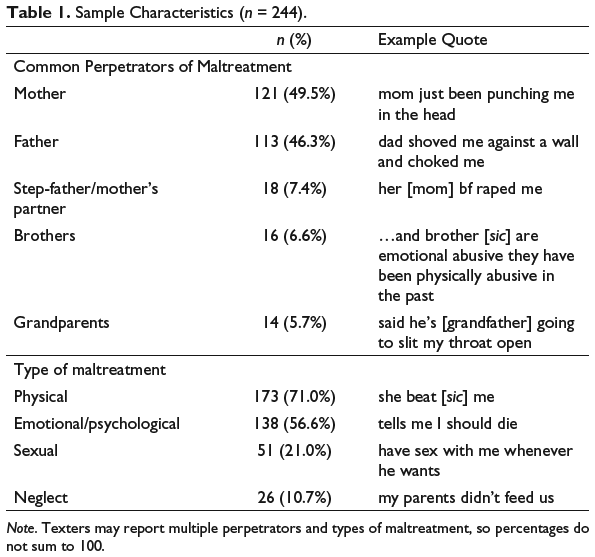
Note. Texters may report multiple perpetrators and types of maltreatment, so percentages do not sum to 100.
Qualitative Coding and Analysis
This analysis was part of a larger project examining how young people use technology to discuss child maltreatment and how crisis counselors respond to these disclosures (Schwab-Reese et al., 2019; Cash et al., 2020). For the overall analysis, we used a qualitative content analysis approach (Graneheim & Lundman, 2004; Hsieh & Shannon, 2005; Schreier, 2012). We used conventional content analysis, as defined by Hsieh and Shannon (2005), so the coding frame was directly derived from the text without preconceived categories. This approach is often used when there is insufficient existing literature to inform a codebook (Hsieh & Shannon, 2005).
We followed the adaptation of grounded theory described by Schreier (2012) during our codebook generation. We began with one member of the research team reviewing all messages in the dataset. During a second review of the messages, she took notes on patterns within the conversation, focusing on patterns that repeated across conversations and instances where conversations diverged. Based on these notes, we developed a draft codebook. As we refined the codebook, we discussed the code generation process and worked together to define and develop codes and categories. After the coding framework and definitions were complete, one team member applied the final coding framework to the full dataset. She recoded five conversations from early in the process at both the midpoint and at the end of coding to determine if the intrarater reliability was sufficient. Approximately 95% of the applied codes were the same when comparing across the three time points, which indicated strong intrarater reliability.
For some codes, the content of the message was categorized. For example, when texters said they were physically abused or described an experience consistent with physical abuse, the “physical abuse” code was applied to the message. The categorizations were developed as part of the code generation process and were based on two coauthors’ extensive experience with child maltreatment research. These codes were primarily used to describe the sample and their maltreatment-related experiences. For other codes, an open-response framework was used where the verbatim content of the message was recorded (e.g., the phrase used to disclose child maltreatment). This process most closely followed the segmentation process described by Schreier (2012), where units of coding are decontextualized, and segments are reviewed in relative isolation to identify patterns and themes. The analysis for this article is restricted to two open-response codes. The first captured the experiences texters had when they disclosed their experiences to others (past experiences). The second captured their responses to suggestions by the crisis counselor to seek support from formal support sources in their local area (possible future supports).
We report the verbatim content of the conversations, including spelling and grammar errors. Although the messages were reported verbatim, we intentionally selected messages that represented the overall experience without including unique circumstances. As such, no one, including texters, should be able to identify the texter from their message.
Results
Past Sources of Support
In 168 conversations (68.8% of conversations), the crisis counselor directly asked if the texter had previously reached out for help. Approximately 20% of texters (n = 28/168) had not sought support, often because they were scared to do so. The remaining texters (n = 140/168) had reached out to a range of informal and formal supports. Texters shared that they had reached out to peers, including friends and intimate partners, (n = 53), parents (n = 33), and other family members (n = 28). Some texters reported that they had actively sought support from more formal sources, such as mental health providers (n = 22), CPS (n = 10), the police (n = 16), and school personnel (n = 19).
Possible Sources of Future Support
In many conversations, crisis counselors asked texters if they could or would seek support from others in their local area. Most often, this question was framed around formal systems, such as school personnel, CPS, and law enforcement.
School personnel.
Common Perceptions of Formal Support Sources.
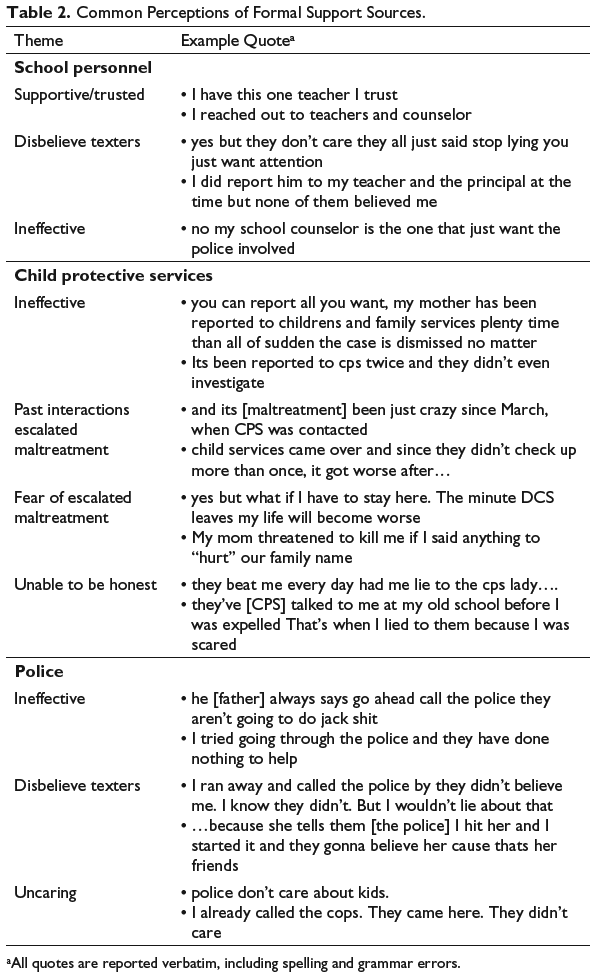
aAll quotes are reported verbatim, including spelling and grammar errors.
Generally, texters had more positive perceptions of school personnel than CPS or law enforcement as possible sources of support. Despite these positive perceptions, most texters were afraid to share their experiences or reported prior unpleasant experiences when they tried to seek support from school personnel. Many were afraid the adult thought/would think they were lying; others were concerned that the disclosure did not/would not stay confidential ([can’t share at school], mainly because my mom works at my school). Some were concerned about embarrassing themselves by crying or becoming upset (…I’m scared that I’m going to start crying in front of her and embarrass myself). For many texters, school personnel were perceived as unable to help the texter change their circumstances, even among texters who had generally positive perceptions of them. Texters perceived that these adults could listen and make a report to CPS and/or law enforcement but could not provide further support.
Child protective services.
All texters discussed CPS within the context of determining whether to share identifiable information to permit a report. During these conversations, many texters discussed prior experiences with CPS. None of these texters reported positive prior experiences with CPS. At best, CPS was discussed as an ineffective source of support. Texters’ perceptions about CPS as ineffective manifested in two primary ways inadequate investigation following a report and/or lack of change following CPS intervention.
About half of texters who perceived CPS to be ineffective knew reports had been made about them, but there was limited or no follow-up after the report. It was common to hear complaints, such as Its been reported to cps twice they didn’t even investigate and One of my counselors filed a CPS report for me, but it went no where. Others stated that they directly reached out to CPS but perceived that CPS did not respond (I think they [CPS] won’t help me because I have called them before and it didn’t help me at all). The other half of texters received a response by CPS but the maltreatment did not end. They often discussed contact without an adequate resolution, saying things like I just called today talking to a social worker and she pretty much told me there is nothing I can do or They left saying it needs to get worse in order for them to step in. Many reported that they had difficulty reaching or engaging their caseworker (I’ve tried reaching my social worker for the past month with no response). A few texters received extended services from CPS but reported that the maltreatment resumed as soon as the intervention ended (…I was actually removed out of the house for a few months. But then I ended up back here).
Some texters perceived an investigation by CPS to be a threat to their future well-being. Several reported that their maltreatment worsened after a prior CPS investigation or that they feared their parents’ response to the report and investigation. Some of texters’ perceptions about CPS may be due to the incomplete or inaccurate information provided to the caseworkers by the texters and families. Many texters who discussed prior interaction with CPS said that their parents had forced them to lie during the investigation. Some families threatened the texters (I told DHS and my brother threatened my life if I didn’t tell them it was all a lie, and My mom threatened to kill me if I said anything to “hurt” our family name). Other families told the texters that CPS workers were bad and that their goal was ripping families apart, which contributed to texters’ lack of trust in the system.
Law enforcement.
Texters and crisis counselors also discussed law enforcement as a possible source of support. In general, texters’ perceptions of law enforcement were similar to their perceptions of CPS. The majority thought law enforcement was unable or unwilling to prevent future maltreatment (nobody including the police will help). Others thought officers did not or would not believe them. Similar to texters’ perceptions of CPS, several thought their parents would respond poorly to additional law enforcement intervention (No Hell hurt me even more I think if he sees there lights then he will do something). While texters thought both CPS and law enforcement were unlikely to provide the desired support, there were other perceptions of law enforcement that were quite different from those about CPS. Texters believed law enforcement would always respond to calls, whereas CPS may not respond. However, several texters believed that the police are uncaring, suggesting that they would not act, even if it were within their power to prevent or respond to the maltreatment (Police don’t care about kids and I just don’t trust them they let the other guy Leave on Saturday). CPS, in contrast, was described as generally caring, but difficult to reach and ineffective.
Discussion
The purpose of our analysis was to identify with whom young people seeking text-based support had previously shared their child maltreatment experiences and to describe their perspectives on possible future offline support seeking. Many of the texters had previously sought support from their peers or parents, and some had engaged with more formal systems, such as mental health providers, school personnel, the police, and CPS. Many young people were hesitant to reach out to these types of formal systems in the future, in part because of negative experiences during past disclosure experiences. Our findings, which use data from young people’s efforts to seek help through a technology-facilitated platform, triangulate and support the results of prior survey and interview-based studies. Overall, the prior disclosure experiences described by our sample of texters were consistent with the experiences described in other samples. In our study, many young people also discussed unsatisfactory help-seeking attempts and described those experiences as a reason to avoid future help-seeking. Several of the findings of Tucker’s (2011) qualitative study of disclosure processes were echoed in our analysis, particularly the concerns about receiving limited help after the disclosure. Similarly, in a UK-based sample, Cossar et al. (2019) found that disclosing maltreatment resulted in mixed outcomes. Some young people received adequate support, such as having the abuser removed from the home or receiving further support services, while others did not receive adequate help, which discouraged further help-seeking (Cossar et al., 2019).
In addition, many of the fears young people reported about seeking formal services were similar to those described in other samples, although there were some differences. In a sample of undergraduate students in the United States, young people who experienced physical child maltreatment indicated that they did not report their experiences because they did not recognize it was abuse or they thought it was unimportant (McGuire & London, 2020). Other common reasons for not reporting included being embarrassed, being afraid to get in trouble or upset the abuser, or because they did not want the abuser to get in trouble. A study among Finnish young people found similar reasons for nondisclosure, including perceptions that their experiences were not serious, that disclosure would not result in help, or that others would not be interested in their experiences (Lahtinen et al., 2020). Studies in other locations across multiple decades have found similar perceptions among young people (Jensen et al., 2005; Jernbro et al., 2017; Palmer et al., 1999). Several of these issues were also discussed in our sample, including fear of retaliation by the family or the abuser. Of note, several texters described fears of being hurt by their abuser if CPS or law enforcement became involved or beliefs that adults would be unable to help them.
Implications
Although the importance of a supportive disclosure process that results in action taken to protect the young person is clear, less is known about the role of the communication method. Traditionally, child abuse hotlines, which receive and process reports of child maltreatment, have relied on verbal communication. Young people may be more likely to seek support through their preferred medium. Chat- and text-based child abuse hotlines, which use written communication, may be one way to encourage victims of maltreatment to seek support. However, additional research is necessary to determine how and why young people select their approach to disclosure (e.g., peers, local adults, hotline, text/chat line).
As technology-based resources become increasingly available, it will also be necessary to determine the best practices for receiving child maltreatment disclosures through technology-facilitated platforms (Crisis Text Line, 2020; National Domestic Violence Hotline, 2020; National Suicide Prevention Lifeline, 2020; Navarro et al., 2020; Nesmith, 2019; Sindahl et al., 2019; Szlyk et al., 2020; Thompson et al., 2018; Childhelp, 2020). Young people need to receive supportive, appropriate responses to their disclosures, so organizations must adequately train their personnel. Additionally, it is necessary to understand the types of services desired by young people. Hotlines, including those with text/chat capabilities, are generally focused on providing services during and immediately following a crisis. However, many hotlines, including our partner for this manuscript, have repeat users who treat the services as a type of regular counseling (Backe, 2018). Thus, young people may use these services to disclose their experience, then to seek regular support in coping. If this is the desired service, organizations may need to reflect on their ability to provide it, and if they cannot, determine how they will respond to repeat users.
Finally, our results suggest that a segment of young people who seek support from local adults do not receive supportive responses, nor does their situation change. Although our study is not able to evaluate the frequency at which this occurs, other studies suggest negative disclosure experiences are common (Jernbro et al., 2017; Lahtinen et al., 2020; McGuire & London, 2020). Thus, it may also be necessary for our systems that engage with young people, including the child protection system, to examine their current practices. “Nothing about me without me” is an ideal increasingly lauded in social work practice, including child protection (Merkel-Holguin et al., 2020). However, the experiences reported by the texters in our sample suggest that significant progress is necessary to allow young people’s voices to be heard. Some organizations have taken steps to include the voices of young people. In Ontario, Canada, Family and Children’s Services engaged young people to share their experiences with the system (Damiani-Taraba et al., 2018). Rather than interviews, the youth shared their perspectives through songs, poems, and other ways that were meaningful to them (Damiani-Taraba et al., 2018). Through this work, they learned that young people want to be believed, kept informed through honest conversations, involved in decisions, and supported (Damiani-Taraba et al., 2018). While these results are specific to the child protection system, this approach to soliciting information from young people and the resulting themes could inform efforts by other systems and organizations.
Limitations
Because our sample is limited to young people who sought support through a text-based crisis service and agreed to a report to CPS, the experiences of our participants may not reflect those of the overall population of maltreated youth. First, it is likely that young people who seek support through a text-based crisis service are different from those who do not. To use this service, they must have access to a cell phone and sufficient literacy to send text messages. Many victims of maltreatment, particularly those experiencing extreme maltreatment, lack those resources. Second, the disclosure experiences described in our sample may not be representative of the experiences of all people who seek support. That is, young people who receive adequate responses during and support services after disclosure may not need to reach out to a crisis service. Alternatively, others have terrible experiences during disclosure and may be less likely to seek any additional support. Nonetheless, our results suggest that at least some of the children who seek support from adults and formal systems receive responses that do not meet their needs, thus the reason to seek text-based support. Finally, the participants in our sample shared the necessary details to permit a report to CPS. Although many were scared to do so, they ultimately decided that the potential benefits of making a report outweighed the risks. While our prior work demonstrated that the conversations in our sample were similar to abuse-related conversations that did not result in a report, it is likely that the general circumstances differ, such as texters’ perceptions of the danger in their current environment and the likelihood of perpetrator retaliation to sharing (Schwab-Reese et al., 2019).
Conclusion
Young people who decide to disclose child maltreatment experiences need to receive an appropriate, supportive response. In addition, they need to see that adults are willing to act upon learning about the maltreatment. Despite negative prior experiences with formal systems, young people in our analysis were willing to try again through a technology-facilitated platform. As technology continues to be the preferred communication approach for young people, technology-facilitated services should be evaluated to ensure they are positively impacting the well-being of young people. If these interventions prove to be effective, they provide a novel opportunity to reach young victims of maltreatment with information and support. Further, systems that regularly engage with maltreated children, such as CPS and law enforcement, need to carefully consider how young people’s voices are included in their processes, so that young people are willing and able to receive services that prevent or interrupt their maltreatment experiences.
Footnotes
Declaration of Conflicting Interests
Funding
The author(s) received no financial support for the research, authorship, and/or publication of this article.
