




Abstract
The Family Violence Death Review Committee (FVDRC) is one of five Mortality Review Committees (MRCs) that sit within the Health Quality & Safety Commission, Aotearoa, New Zealand. A key goal of the work of these committees is the reduction of the unequal burden of disparities shouldered by Māori (Indigenous peoples). Guidance to the committees on interpreting and reporting Māori mortality comes from Te Pou (the pillar/post), a Māori responsiveness rubric published in 2019 by Ngā Pou Arawhenua (the caucus of Māori MRC members). This guidance was called upon by the FVDRC in the preparation of its sixth report, “Men who use violence,” published in 2020. In this article, the FVDRC reflects on how it strove to uphold responsibilities toward Te Titiriti o Waitangi 1 in its sixth report to get the story right (Tika—to be correct or true), be culturally and socially responsive (Manaakitanga—hospitability, kindness, support), advance equity, self-determination and social justice (Mana—prestige, authority, spiritual power), and establish relationship for positive change (Mahi Tahi—working together). Opportunities for improved responsiveness in FVDRC reporting are identified, alongside suggestions for extending the guidance in Te Pou. Reflective practice on responsiveness to Māori/Indigenous peoples is recommended more generally for MRCs.
Background
There are established disparities between Indigenous and non-Indigenous disease-specific mortality rates across countries whereby Indigenous peoples bear an unjust burden of avoidable mortality, including assault-related mortality (Bramley et al., 2004). While intimate partner violence has long been acknowledged as a public health issue, it has been a longer road to the acceptance of Indigenous views that issues of colonization, land loss, intergenerational trauma, and racism play a part in the intimate partner assault and mortality experiences of Indigenous peoples (Cormack et al., 2018). This is in spite of Indigenous peoples themselves calling for this analysis.
In Aotearoa, New Zealand, Manuka Henare described Māori (Indigenous peoples of Aotearoa, New Zealand) whānau2, 3 as having “suffered constitutional, legal and ethical abuse” (Henare, 1995, p. 16) with this needing to be considered as part of a wider context for understanding Māori experiences of whānau harm. 4 At the Māori Women’s Welfare League Indigenous Women's Conference in 1991, Parekotuku Moore, on behalf of the Family Violence Prevention Coordinating Committee, challenged Māori to “take a firm stance in eradicating family violence.” Roma Balzer and Hinematau McNeill recommended greater Māori participation in addressing domestic violence from a Māori cultural perspective. Their examination of the Te Tiriti o Waitangi and Māori history, led them to conclude the following:
“Family violence intervention involves male responsibility for their violence while ensuring the absolute safety and protection of the women and children victims of this violence. Any rehabilitation process for Māori men must be inclusive of positive Māori self-identity and must promote the family (whānau) as an institution which supports, as well as sanctions, behavior. (Balzer & McNeill, 1988, p. 10)”
Intimate partner violence and harm has therefore long been a major concern for Māori and has included calls for Māori men to take responsibility for male violence within their whanau (1991). Tackling the health and social problems that have for a long time been seen as key drivers of whānau harm and family violence in this country requires an understanding of the wider context within which individuals, family, and whānau live, and the unequal experiences Māori and non-Māori have had of the social and structural violence that manifests itself throughout our short history of colonization (Family Violence Death Review Committee, 2020). As Oberin (2001, p. 26) states, in relation to the historically poor treatment of Aboriginal and Torres Strait Island peoples in Australia, “the high rates of domestic and family violence in Indigenous communities must be seen in the context of colonization, disadvantage, oppression, and marginalization.”
It has been suggested that the adoption of policies and practices to eliminate inequities has the potential to do more to reduce mortality disparities than any technology or combination of technologies that could be introduced in the future (Victoria et al., 2003). Reviewing and learning from the deaths that occur because of whānau harm/family violence is one way to inform the responsiveness of policies and practices. Seeking out the opportunities to intervene throughout the life courses of perpetrators and victims of intimate violence can help ensure that signs and signals are seen by services and agencies and action is subsequently taken to respond to and protect the lives of those who are on pathways to possible mortality events. However, the information considered by mortality review committees (MRCs) does not often come from Indigenous sources or embody an Indigenous worldview. Rather, it is often from administrative databases where the classification of ethnicity and the assessment of risk is framed within colonial discourses, and from the views of non-Indigenous practitioners whose practice models come from the non-Indigenous governmental and nongovernmental agencies that employ them (Wilson & Cram, 2018). The short-comings of these sources shine through when intimate partner violence is examined through a Māori lens.
Even so, the lessons from morality review must be culturally responsive so that any policy or practice actions that they inform are culturally safe. This includes the reporting of mortality data and any accompanying descriptions of how this information, including Māori-non-Māori disparities, are interpreted (Reid & Robson, 2007). To support this, Ngā Pou Arawhenua, the Māori caucus of the five Aotearoa, New Zealand MRCs, developed Te Pou—a rubric to guide the work of the MRCs in their reporting of Māori mortality data. As described by Wilson et al. (2020), “variation existed between the MRCs’ understanding of equity, and its application to reduce avoidable mortality for Māori, which subsequently influenced their analysis, reporting and the recommendations generated.” The purpose of this article is to describe the use of Te Pou by the Family Violence Death Review Committee (FVDRC) in the production of its sixth report. To set the scene for this, we next describe mortality review within the Health Quality & Safety Commission of Aotearoa, New Zealand, with a particular focus on the FVDRC. We then provide an overview of the methods used for the review. Te Pou is then introduced and used to frame a discussion of its use within the FVDRC’s recent work.
Family Violence Death Review Committee (FVDRC)
Aotearoa, New Zealand has five statutory MRCs, housed within the Health Quality & Safety Commission, a government entity charged with the responsibility of advising the Minister of Health on how quality and safety in health and disability support services may be improved. The five committees are: Child and Youth, Family Violence, Suicide, Perinatal and Maternal, and Perioperative. Under Schedule 5 of the New Zealand Public Health and Disability Amendment Act (2010), the MRCs have the power to source any information relevant to their purpose, and they are charged with strict confidentiality conditions for the collection, storage, and use of information that they hold.
The FVDRC is an independent committee serviced by the secretariat within the Health Quality & Safety Commission. It has nine members drawn from health, psychiatry, social work, legal services, and a lived experience member. For the FVDRC, Schedule 5 enables the collection and collation of information relevant to contributing to the prevention of family violence and family violence deaths by
reviewing family violence deaths in Aotearoa, New Zealand, identifying systemic factors that shape practice and service provision within the family violence response system, making recommendations on how the system might be improved to prevent harm caused by family violence, and facilitating improvements to systems and services in the area of family violence (Health Quality & Safety Commission, 2018).
Between 2007 and 2017, the New Zealand police recorded 737 deaths by homicide, resulting in average of approximately 67 people killed by homicide in Aotearoa, New Zealand each year (
In April 2020, the FVDRC released its Sixth Annual Report: Men Who Use Violence (Family Violence Death Review Committee, 2020). Of the nine members at the time of writing the Sixth Report, five identified as Māori and were also members of Ngā Pou Arawhenua. One of the key concepts embedded in the report was Responsiveness to Māori, referencing Te Pou. In response to the recommendations of Wilson et al. (2020), this article is a reflection of how well Te Pou was embedded in developing the report, the impact on the findings and recommendations, and the reception to the report from stakeholders. Within the discussion, lessons learned are highlighted.
Methods
Development of the Sixth Report
Each MRC is expected to regularly report on family violence deaths to ensure that “relevant, evidence-based advice is provided to the [Health Quality & Safety] Commission as quickly as is practicable” (Health Quality & Safety Commission, 2020).
Prior to the development of the report, a proposed outline for the report, developed by the Secretariat, was presented to the FVDRC. The proposal was drawn from the Fifth Report (Family Violence Death Review Committee, 2016), which highlighted the whakapapa 5 of violence within whānau. This included the need to move away from asking what victims were doing to keep themselves safe and to begin work to understand men and their use of violence. It was the intention of the FVDRC to focus on male predominant aggressors (The Advocates for Human Rights, 2018) within an intimate partner relationship. Responses from FVDRC members focused on the need to avoid making intimate partner violence a Māori issue.
Report development was iterative, with Committee members recommending key texts and issues to highlight, as well as cautioning on the potential for data to be used to reinforce inequities. While there was an acknowledgment of the impact of colonization early, the FVDRC also challenged the secretariat to highlight the corollary of unchecked privilege and how this is used to uphold existing structures within society. Rather than simply present differences in life-course trajectories by ethnicity, there was encouragement to understand the historical underpinnings of these differences, including the overrepresentation of Māori tāne 6 in the justice system.
Committee members encouraged the secretariat to consider multiple forms of engagement with the Sixth Report following publication. As the report launch coincided with level four COVID-19 lockdowns in Aotearoa, New Zealand (stay-at-home orders with the exception of essential tasks or working in essential businesses), a decision was made to have a community-led webinar and seek reflections on the report content from community leaders.
Reflecting on the Process of the Sixth Report Using Te Pou
The Statement of Intent (SoI) for the Health Quality & Safety Commission was released in June 2020, following the publication of the Sixth Report. There are four strategic priorities set out within the SoI:
Improve the experiences of people using health and disability services Embed and enact Te Tiriti o Waitangi, and support mana motuhake
7
for Māori, Achieve greater health equity Support strong systems that enable safe, high-quality services
To support the movement toward improved health equity and the enactment of Te Tiriti o Waitangi, the FVDRC sought to draw on the Good Practice Expectations (Health Quality & Safety Commission, 2019) of Te Pou to develop an understanding of how the process of report writing and dissemination could be improved in the future.
The Good Practice Guidelines outline culturally appropriate components that should be embedded into the process of report writing and developing recommendations. The guidelines were drawn on by the Secretariat and the FVDRC to determine the strengths of the report writing process, and where improvements could be made.
Results
Te Pou—The Māori Responsiveness Rubric
In August 2019, Ngā Pou Arawhenua, the Māori caucus for the MRCs published Te Pou—the Māori Responsive Rubric (Wilson et al., 2020). Te Pou was developed to provide good practice expectations for the interpretation and reporting of Māori mortality, including disparities. The mortality review process results in the production of recommendations to improve government agency service delivery and prevention efforts. A particular focus of Te Pou was to facilitate the generation of recommendations by the MRCs to advance equity in service delivery and prevention efforts by government agencies. In parallel, guidelines for the implementation of Te Pou were published. In reflecting on the development and implementation of Te Pou, Wilson et al. (2020) suggested that a shared understanding of equity was required, in addition to commitment to positive working relationships and cultural humility.
A comprehensive description of Te Pou has been provided elsewhere (Wilson et al., 2020), and in the guidance provided by HQSC (Figure 1). In brief, the development of the rubric followed four principles:
It honored the articles of Te Tiriti o Waitangi (the Māori language version of the treaty signed in 1840 between Māori and the Crown that sets out Crown responsibilities, Māori rights and a relationship framework). MRC members varied in their understanding of equity, and this influenced the analysis and interpretation of mortality data. The rubric needed to be relatively simple to use, containing only essential information so MRCs could provide rigorous analyses, interpretation, and recommendations about Māori mortality. Achieving “good” practice would take time and support (Wilson et al., 2020).
Te Pou—Māori responsive rubric.
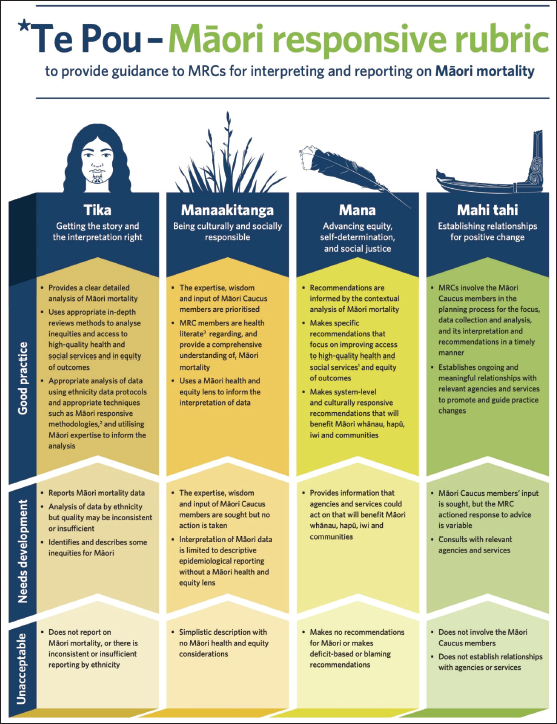
Following an iterative process, four pou (metaphorical posts or domains) were agreed:
Tika—do things right, getting the story and interpretation right. Manaakitanga—caring compassionately, being culturally, and socially responsive. Mana—status, authority, advancing equity, self-determination, and social justice. Mahi tahi—working collaboratively, establishing relationships for positive change.
8
Under each pou, three practice levels are described: unacceptable, needs development, and good practice. MRCs are expected to demonstrate good practice across the four pou, to support culturally response reporting of Māori mortality information. This article has been developed to reflect these four pou, as the FVDRC reflects on its practice in the production of its latest report. For each pou, the approach of the FVDRC is outlined, and opportunities for practice improvements highlighted.
FVDRC Sixth Report: Men Who Use Violence
Tika: Getting the story and the interpretation right.
This pou focuses on capturing Māori realities and perspectives. It requires that there is respect for the people being researched—both those who have passed and those who survive. It requires governance to be exercised in partnership with Māori and that agents evoke practice changes focused on preventing future deaths.
Prior to the development of the report, a proposed outline was presented to the FVDRC. The proposal was drawn from the Fifth Report (Family Violence Death Review Committee, 2016), which highlighted the whakapapa (genealogy) of violence within whānau.
While FVDRC members acknowledged an overrepresentation of Māori within intimate partner violence deaths (33% of deceased compared with 15% of the population), there was concern that the report could be used to further stigmatize rather than to identify solutions. Instead, members proposed that He Awa Whiria (a braided rivers methodology (Macfarlane et al., 2015) be adopted in the development of the sixth report.
Braided rivers flow as a network of multiple, intersecting channels, separated by alluvial islands. As well as being geologically unusual, braided rivers also support unique animal, bird, and plant life. For example, the upper Waitaki Basin and the adjoining wetlands in Aotearoa, New Zealand “are home to over 250 native plants, 27 mosses and liverworts and 35 lichens” along with “many invertebrates and several lizard and fish species.” They are also a stronghold for several [of our] most threatened birds (Department of Conservation, 2017). In He Awa Whiria—Braided Rivers, Angus Macfarlane and colleagues call upon this natural wonder to describe a methodology that draws upon both Western science and Te Ao Māori (the Māori world), for the purposes of cooperation, partnership, and integration (Hong et al., 2015). Braiding of western and Māori knowledge systems and the integration of knowledge is described as having the potential to “create new knowledge that can be used to advance understanding in two worlds” (A Better Start National Challenge, 2015). This knowledge is not static, as change and new understandings are inevitable as new tributaries/knowledge streams feed the braided river (Berman et al., 2015).
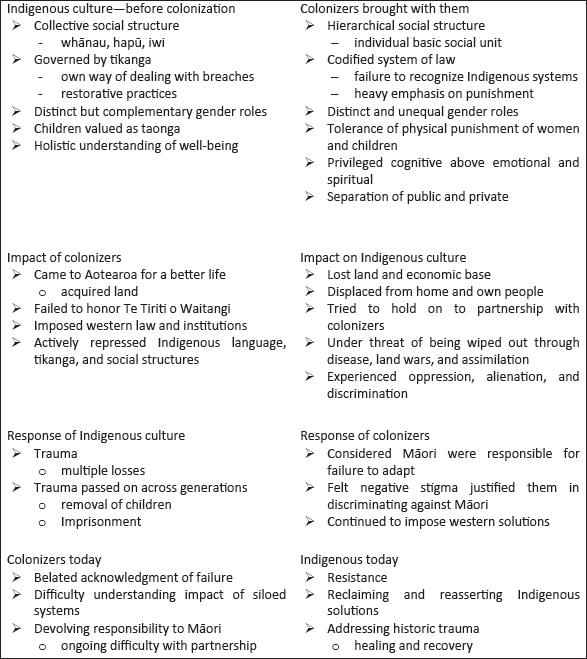
By taking this approach, the FVDRC was advocating for an acknowledgment of the historical and ongoing impact of colonization and described this through a network of awa or knowledge streams, including an understanding of traditional roles, the social structure imposed, the impact of colonization and subsequent responses of both Māori and Pākehā (European settlers, see Figure 2). Using He Awa Whiria as a central theme through the report necessitated drawing on kaupapa Māori 9 literature to clearly articulate the impact of trauma and acts of resistance, as well as highlighting the reclamation of Māori solutions. In addition, FVDRC members felt that is was important that the corollary of unchecked privilege be highlighted as it played out in the lives of Pākehā/White men and their interaction with their families and social structures.
A braided rivers understanding of the impact of colonization.

The Waitaki River.
By highlighting the impact of wider social structures on the lives of the men included in the report, the FVDRC was able to understand them as men who had the potential to live violence free, given appropriate responses to their help-seeking. This provided an opportunity to produce a strengths-based, aspirational report that highlighted potential areas for intervention, across the lifespans of the men, to reduce the likelihood of violence occurring. The FVDRC also drew on reviews that had been completed for justice (Safe and Effective Justice Advisory Group, 2019), welfare (Welfare Expert Advisory Group, 2019), and mental health and addiction (Government Inquiry into Mental Health and Addiction, 2018). Each of these reviews provided evidence that structural deficiencies had a disproportionate impact on the lives of Māori. Drawing on these reviews underscored the intersection between the criminal justice system and the increased likelihood of poor social outcomes, leading to a desire for alternate responses to violent behaviors.
The FVDRC also centered Māori solutions that were often whānau solutions, including iwi/tribally-based responses such as Te Puea Memorial Marae (Lee-Morgan et al., 2019) and He Waka Tapu for providing wrap-around support to families and whānau living in unsuitable, transient accommodation and for men using violence. By drawing on iwi-based responses, the potential for a more nuanced approach to trauma informed care was established. Further, structural violence was acknowledged as contributing to trauma experience (Atwool, 2019).
Manaakitanga: Being culturally and socially responsive.
Manaakitanga is the process of showing respect, generosity and care for others. This pou recognizes Māori own aspirations for health and is respectful of tikanga. 10 Within the limits of the mortality review process, this requires that the methods for collecting data are appropriate, and the limitations of government agency data are acknowledged. This pou further challenges the use of appropriate forum to ensure accessibility of the information produced, and drawing on Māori knowledge and expertise that is held within the MRCs. To effectively implement manaakitanga requires clear processes and systems to ensure MRC activities regarding Māori are culturally and socially responsible.
Upholding manaakitanga allowed the FVDRC to prioritize the expertise and wisdom of Māori members of the committee. Due consideration was given to ethically, legally, and culturally safe ways of reporting on data that had been collected for the report. To do so effectively required an acknowledgment that data is not value free (Elliott, 2017). In particular, being culturally and socially responsible required FVDRC members to consider the potential risks and benefits of publishing data, given the wider social context. For example, the FVDRC was concerned about the potential of producing a deficit focused report, concentrating on the overrepresentation of Māori in negative health and social statistics. Instead, there was a deliberate focus on the aspirational goals of recovery and restoration for Māori communities, and how this could be achieved. Specific focus was placed on the potential for decolonizing institutions and reclaiming matauranga Māori 11 to ensure culturally safe service delivery:
“Settler systems designed to address inequities have instead continued those inequities, compounding historical trauma and poverty, reducing employment” opportunities and making it more difficult to access the support people need. Family Violence Death Review Committee, 2020, p. 64, quoting Wilson, 2016
The FVDRC was also acutely aware of the use of information pertaining to gang membership, the unknown quality of this information, and the potential for the information to further marginalize communities (Roguski, 2019) as Aotearoa, New Zealand entered an election year. Identifying a person’s position in society as part of the “problem” results in labelling and stigmatizing individuals rather than considering the social circumstances that have resulted in the named “problem.” In addition, the labelling of someone as a gang member is too often done by someone other than the individual concerned, and often by the police. In the context of Aotearoa, New Zealand, the “problem” of gangs was brought about through delegitimizing te ao Māori, 12 language suppression and disconnection from biological whānau as a result of removal into state care. The well-worn path from state care into the youth justice system was evidenced among the men captured within the FVDRC data set and most strongly signaled a systemic failure rather than a personal deficit.
The approach taken by the FVDRC, considering the potential of individuals, whānau, and communities, allowed the committee to name behaviors used to resist structural violence (Pihama et al., 2019) without stigmatizing specific sectors of the community. Instead of placing an emphasis on individuals, an emphasis was placed on agency responses to individual help-seeking behavior and the opportunities presented if such responses were improved. Through this process, the impact of thresholds, whereby individuals have to reach a defined level of severity before they are considered a candidate and services become available (Dixon-Woods et al., 2006), on subsequent help-seeking behavior was evident. In other words, when men seeking help were turned away from services, their help-seeking behavior diminished.
However, central to the report was men’s use of violence to the extent that the violence resulted in a death event. The FVDRC were conscious that victims were considered to ensure the report did not further traumatize. As such, peer review from a victim advocate was sought to ensure a balanced approach.
Mana: Advancing equity, self-determination, and social justice.
Kaua e takahia te mana o te tangata.—Do not trample on the mana of people. The pou of mana is concerned with shifting the conversation from an individualistic, deficits approach to a collective, strengths-based approach. It is focused on improving outcomes for Māori, and reducing inequities so Māori enjoy the same optimal health as all other New Zealanders. This requires that recommendations are informed by the contextual analysis of Māori mortality, understanding the ongoing role of colonization and raising the profile of kaupapa Māori researchers and kaumātua 13 to advise and guide interpretation. It requires that Māori are involved in self-determining appropriate and acceptable recommendations
A social justice lens was applied to data analysis and interpretation, thereby posing the question “what are the key current and historical issues reducing the chances of optimal health and wellbeing for Māori?” (Cram et al., 2019). Such questions shift the focus away from an individual deficit model to understanding the inequitable and reinforcing factors evident within Aotearoa, New Zealand society. As highlighted above, this question brings colonization and structural violence to the fore, but also brings into focus the compounding impact of each of these factors to contribute to intergenerational trauma. Such a shift also results in an understanding of the impact of over-incarceration on Māori whānau (Gordon & MacGibbon, 2011; Rose & Clear, 1998), building on the review of the Justice system (Safe and Effective Justice Advisory Group, 2019), and leading to a desire to seek out alternative, nonpunitive approaches to addressing men’s use of violence. The FVDRC drew on Judy Atkinson’s Trauma Trails to understand the impact of historical events to increased rates of family violence, child sexual abuse, and family breakdown (Atkinson, 2002).
The FVDRC members also encouraged a focus outside the individual to consider whānau, hapū,
14
and iwi,
15
drawing on kaupapa Māori literature to describe the lives, challenges, needs, and aspirations of the Māori men included in the report. The shift in focus resulted in a consideration of traditional understandings of balance in relationships and the shared contributions of wāhine,
16
tāne, and the wider community in the growth, development, and well-being of tamariki
17
(Jenkins & Harte, 2011). This lead to the production of five underlying principles for addressing men’s use of violence:
Kaupapa Māori services provide opportunities for high-quality, culturally responsive health, and social services, improving the equity of outcomes. The safety and well-being of the child are inherently linked with the safety and well-being of the whānau or family. Men who use violence are not invisible. Responding to needs when they are help-seeking may enhance the likelihood of help-seeking in the future. Restoration, rehabilitation, and sustained change are the focus of engagement. Agencies have an in-depth understanding of a man’s culture, are able to respond in a culturally grounded manner, and have an in-depth understanding of family violence (Family Violence Death Review Committee, 2020).
Rather than providing discrete recommendations for change, reflective questions were posed to agencies to move them toward a focus on equity and social justice (Box 1).
Reflective Questions for Agencies.
Upholding Te Tiriti o Waitangi Whose world view am I prioritizing? How have we placed Te Tiriti at the center of this [policy/initiative]? In what ways will this [policy/initiative] contribute to reducing the ongoing impact of colonization? Does this [policy/initiative] include a focus on equity?
Decolonizing services
What is the evidence base that this is a safe, effective, and equitable service structure? Have we considered kaupapa Māori models of service delivery? In what ways do our systems promote mātauranga Māori?
Addressing racism
How is service development and delivery acknowledging and addressing historical injustices? What resources are we investing in developing culturally competent and aware staff? How do our senior leaders model cultural responsiveness? How does our organization understand and reflect our community?
Addressing structural inequities
How do commissioning structures reflect an understanding of the overlapping nature of structural inequities? In what ways are we encouraging creative and collaborative service delivery so agencies provide the right help at the right time? How is the functioning of the family or whānau at the center of the way we deliver services? In what ways have we considered how the proposed [policy/initiative] might unfairly impact on one sector of the population?
Mahi tahi: Establishing relationships for positive change.
Mahi tahi is the process of working together in true collaboration. This goes beyond consultation to requiring meaningful Māori representation and participation at every level. Mahi tahi requires an acknowledgment of Māori knowledge and expertise held within the MRC. It highlights that learnings from the data should lead to positive change that will benefit Māori, rather than reinforcing structural inequities.
While significant effort was placed into actively seeking input from Māori stakeholders and community level service providers, this was one pou that will require ongoing work from the FVDRC. Establishing relationships for positive change initially involved ensuring the content of the report was accessible for community groups. A community facing webinar was held, allowing the community voice to be the first heard in the response to the report. Because of the difficult nature of the information being discussed, effort was placed into ensuring that cultural guidance was available to hold the space safe for those who were presenting as well as those who were listening. However, this pou is a forward facing pou—one that provides an ongoing challenge for the FVDRC to advocate for positive, transformative change for Māori and to continue to seek active engagement.
Discussion
This article has presented a reflection of how well the FVDRC embedded Te Pou in developing its Sixth Report: Men Who Use Violence. Much like He Awa Whiria, the FVDRC is made up of members from differing world views, and the reports presents a weaving of those views. In the initial application of Te Pou, it is inevitable that there will be some lessons learnt for future analysis and report writing. It is likely that many of these lessons could be picked up on in follow-up work from the report.
Centring Indigenous Data Sovereignty
To fully uphold the four pou requires that data collection, analysis, and interpretation be more formally informed by Indigenous data protocols, such as the Principles of Māori Data Sovereignty developed by Te Mana Raraunga (2018):
“Implicit in Māori data sovereignty is the desire for data to be used in ways that support and enhance the collective well-being and self-determination of Indigenous peoples—a sentiment emphasized by Indigenous NGOs, communities and tribes (First Nations Information Governance Centre, 2016; Hudson et al., 2016). In practice Indigenous data sovereignty means that Indigenous peoples need to be the decision-makers around how data about them are used or deployed.” (Kukutai & Cormack, 2019, p. 204)
While the use of Te Pou as a framework for the Sixth Report helped to shift to an equity and human rights focus, this did not extend to an interrogation of the appropriateness of the data collection. Agency level indicators, such as diagnosis of a mental health disorder or being warned as opposed to being prosecuted, bring with them assumptions of equity in service access and being blinded to structural inequities. Future applications of a data sovereignty framework have the potential to move away from reinforcing negative stereotypes to reshape “human relationships and societal structures and institutions, and to hold those in power to account” (Kukutai & Cormack, 2019, p. 205).
Active Engagement
Māori communities include whānau, hapū, and iwi as sources of support and service delivery. Many nongovernmental service providers are whānau, hapū, or iwi based, and therefore are key stakeholders in the prevention of family violence. While there was the capacity to engage with Māori members of the FVDRC, peer reviewers and selected thought leaders in the development of the report, neither the structure of the report nor the timeframe for development allowed for engagement with the breadth of Māori communities—an important limitation given that Māori views are not necessarily homogenous. Significant resources are required to provide opportunities for engaging with communities, to listen and understand the feedback provided, building this feedback into the report where relevant. Ideally, such efforts should be led by Māori members of the FVDRC. However, by placing such expectations on Māori members creates differential expectations, requiring recognition.
In effect, such engagement could lead to FVDRC more fully embracing self-determination, and provide space for Māori voices in problem solving. However, the desire for such engagement also raises the question of how the FVDRC (and other MRCs) comprehensively build cultural advice into the development of reports and other outputs?
Māori Rights to Equity
By recommending upholding Te Tiriti o Waitangi, decolonizing services, addressing racism, and impacting on structural inequities, some commentators have interpreted the writing of the FVDRC as ignoring the corollary of unchecked privilege and sexism, and minimizing the use of violence (Tolmie, 2020). In fact, the first four recommendations in the Sixth Report provide a foundation from which effective strategies to address men’s use of violence can subsequently be developed, as outlined in the report’s recommendations (Family Violence Death Review Committee, 2020, p. 91). It does seem, however, that becoming more responsive to Māori holds a veiled risk of being seen as too pro-Māori to the detriment of other values or core tenets that people see as foundational to the work of the FVDRC. The lesson taken from this is that upholding Māori rights to equity and calling for structural change is a deeply political endeavor that will not sit well with everyone.
Finally, as with the methodology of He Awa Whiria that was used in the sixth report, the FVDRC is its own awa/river that continues to grow in its knowledge and understanding as it is fed by new tributaries as its membership changes. Over the past six or so years the FVDRC has embraced its need to understand the antecedents of Māori family violence deaths. From there, the Committee sought more nuanced understandings of Māori disparities and the system changes needed to help eliminate them. There has also been a shift to naming men’s use of intimate partner violence as a parenting decision and looking across men’s life courses for opportunities where agencies might have supported them to change their trajectories away from violence against women. Along the way, the FVDRC has come to understand the limitations of its knowledge about family violence deaths in Pākehā/White families. Perhaps most importantly in this journey, and relevant for our reflections on Māori responsiveness within the sixth report, is that a desire for a better understanding the lives of Māori whānau in the context of a family violence death was an important headwater for the awa/river the Committee now finds itself navigating.
Limitations and Lessons Learnt
The process outlined was one of self-review, conducted by the secretariat and the FVDRC, undertaken retrospectively. As such, the results of the review may be more favorable than had it been undertaken by an external party. Further, the guidelines developed by Ngā Pou Arawhenua in developing Te Pou are broad—there is no checklist of tasks to be undertaken to be considered “culturally appropriate.” Wilson et al. (2020, p. 517) have highlighted that “careful planning and ongoing education and support for staff and committee members [is required] at multiple levels. Follow-up support is needed to support its implementation into practice.” This moves beyond simple checklists and requires that report authors are open to critique and new ways of planning, developing, and launching a publication, as well as ongoing engagement after publication.
The implementation of Te Pou requires relational practice with Māori stakeholders and an upholding of kaupapa Māori knowledge. Resources must be made available at the start of report development to ensure a partnership approach to report writing that has the flexibility to attract additional expertise where it is needed. Currently, there is a tendency to require “Māori input into the interpretation of results” at a point where data has already been collected and analyses run. The implementation of Te Pou requires that the power balance is shifted, and that culturally safe spaces are created for all phases of report development—from conceptualization to publication and subsequent follow-up engagement with stakeholders. Culturally safe spaces can be created by intentionally considering the makeup of MRCs to embed Indigenous world-views. This has the potential to shift the power balance from one that favors a Western world-view to one that enables the implementation of cultural frameworks such as Te Pou, potentially shifting the conversation concerning who holds responsibility for inequities in mortality from the individual to the structures and system that uphold inequities in service provision and access.
Further, appending Māori processes onto a Western construct of knowledge production results in a mismatch between the intent and the outcome. Due consideration should be given to undertaking fully immersive knowledge translation exercises for the sharing of information. Should this be undertaken as the output is being developed, it is likely that a richer product will result, representing more diverse views.
While Te Pou calls on writers to develop cultural humility in their approach to the task, it is silent on the need to avoid cultural appropriation. For those grounded in a Western world view, adopting a culturally safe approach requires relinquishing control. The corollary of unchecked privilege continues to exist within Western approaches to knowledge generation.
Conclusion
The Sixth Report deviates from previous reports published by the FVDRC. As with much work undertaken on intimate partner violence, previous reports published by the FVDRC have been victim-focused. The intent of these reports was to elucidate agency responses to victim help-seeking, and how inadequate responses reinforced experiences of structural entrapment (Family Violence Death Review Committee, 2016). When embarking on the Sixth Report, knowing the focus was going to be on men who used violence, the FVDRC was intentional in their efforts to identify opportunities to alter men’s development and impact on ineffective responses to their help-seeking behavior. Centering on Te Pou required an understanding of the structures that reinforce violent patterns of behavior. The natural outcome of this process is an acknowledgment of the significant, and ongoing impact of colonization and western models of service delivery. We highly recommend this type of reflective practices to other MRCs; particularly those that are occupying the traditional lands of Indigenous peoples:
“Explicitly, Te Tiriti o Waitangi affirms Māori rights to equity.” (Wilson et al., 2020, p. 4)
The complete implementation of Te Pou is an unattainable goal. The framework asks for ongoing evolving space and continual reassessment and reflection on activities depending on the particular situation and need.
Footnotes
Acknowledgments
We would like to acknowledge the valuable contribution of past members of Ngā Pou Arawhenua for leading the development of Te Pou, as well as the contributions of the Family Violence Death Review Committee in supporting the development of this article.
Declaration of Conflicting Interests
Funding
The author(s) received no financial support for the research, authorship, and/or publication of this article.
