




Abstract
University-based sexual violence prevalence is worryingly high and leads to many serious consequences for health and academic achievement. Although previous work has documented greater risk for sexual violence among Indigenous Peoples, little is known about university-based sexual violence experienced by Indigenous students. Using a large-scale study of university-based sexual violence in Canada, the current study aims to (1) examine the risk of sexual violence against Indigenous students compared to non-Indigenous students, and (2) to document sexual violence experiences of Indigenous students. Undergraduate students from six universities (N = 5,627) completed online questionnaires regarding their experience and consequences of university-based sexual violence (e.g., forms of sexual violence experiences, gender, and status of the perpetrator, context of the violence, PTSD, disclosure). Findings indicated that compared with their non-Indigenous peers, Indigenous students experienced significantly higher levels of sexual harassment. However, no difference was found for unwanted sexual behaviors, nor for sexual violence contexts. Among Indigenous students, those having experienced sexual violence after age 18 (outside university) were more likely to report university-based sexual violence. Overall, findings highlight that Indigenous students, as well as non-Indigenous students, experience university-based sexual violence. Given their history, Indigenous students may have different needs, so sustainable policies that foster cultural safety on all campuses are clearly needed.
Although the terrible reality of sexual violence on campus is now acknowledged, its prevalence remains worryingly high. Previous research has revealed that up to 45% of women and 32% of men report some forms of university-based sexual violence, most often perpetrated by an individual they know (Andar, 2014; Burczycka, 2020; Fedina et al., 2018; Martin-Storey et al., 2018; Muehlenhard et al., 2017; Palmer et al., 2010). Considering the serious consequences of sexual violence for health and academic achievements, such as school dropout, depression, anxiety, and post-traumatic symptoms (Carey et al., 2018; Mengo & Black, 2016; Paquette et al., 2019), it is essential to better understand which students are at the greatest risk. In Canada, residential schooling and trauma related to colonization have been responsible for a long history of unresolved grief, marginalization, and oppression among Indigenous People (Fast & Collin-Vézina, 2010; Ross et al., 2016). This traumatic history and its interaction with current stressors have resulted in problematic outcomes, such as mental and physical health problems, and alcoholism (Brave Heart & DeBruyn, 1998; Fast & Collin-Vézina, 2010), and contribute to the magnitude and severity of current issues related to the rates of violence experienced by Indigenous People (Dion et al., 2018). However, little is known about the rates of sexual violence experienced by Indigenous students at universities. The current study examined data from a large-scale study of sexual violence among university students in Quebec, Canada (Bergeron et al., 2016), to better understand the heightened risk of sexual violence faced by Indigenous students, as well as to document the contexts of this violence experienced by Indigenous students. The current results can inform prevention and treatment programs to aid the development of more effective measures for reducing the risk of sexual victimization of Indigenous students on campus.
Several terms are used to describe Indigenous People in Canada, which include First Nations Peoples, Métis, and Inuit (Government of Canada, 2017). The term “Aboriginal” is often cited to refer to the first peoples of North America and their descendants. However, the word “Indigenous” is now preferred and is considered to be more uniting and less colonizing than the term “aboriginal” (Canadian Institutes of Health Research–Institute of Aboriginal Peoples’ Health, 2018). According to the 2016 Census of Population, 1,673,785 people in Canada identify as Indigenous, representing 5% of the Canadian population (Statistics Canada, 2017).
Indigenous people come from multiple nations and communities with distinct cultures, but share a common experience of marginalization and oppression. The contemporary difficulties encountered in Indigenous communities must be interpreted in light of historical trauma (e.g., Mitchell & Maracle, 2005; Wesley-Esquimaux & Smolewski, 2004). Over the course of their history, various laws and measures have promoted the assimilation of Indigenous People into Canadian society (Act for the gradual enfranchisement of Indians of 1869; e.g., British North America Acts of 1867; Indian Acts of 1876 and 1880; Indian Advancement Act of 1884). These assimilatory measures, which include the loss of land through the expropriation of Indigenous lands and relocation of Indigenous communities into reservations, and removal of children through the residential school system, as well as the “sixties scoop” (children were taken from their families and communities to be placed in foster homes or adoption), have been described by several authors as a cultural genocide (e.g., refer to Truth and Reconciliation Commission of Canada, 2015). This colonialist system still remains today (e.g., invasion of territories, mines, pipelines, underfunding of communities, missing and murdered Indigenous women and girls and gender diverse people), which continues to severely impact Indigenous culture, including family and community systems, with devastating consequences for the lives of individuals and their communities (Halseth, 2013). For example, Indigenous People who were sent to residential schools have been found to present high rates of mental health difficulties in adulthood, including post-traumatic stress disorder (PTSD), substance abuse disorder, gambling problems, and major depression (Corrado et al., 2003; Dion et al., 2016; Ross et al., 2015). While some communities gradually manage to rebuild, many problems persist, including distress, suicide, crime, poverty, infant mortality, discrimination, and dependency problems (Aguiar & Halseth, 2015; Ross et al., 2016).
Indigenous People carry a heavy burden of suffering which increases their vulnerability and is transmitted through physical, psychological, and sexual violence (Muckle & Dion, 2008; Ross et al., 2016). Indigenous People are three times more likely to experience violence compared with non-Indigenous people (Brennan, 2011). Moreover, a systematic review estimates that 25 to 50% of Indigenous People suffer childhood sexual abuse (Collin-Vézina et al., 2009), compared with 15–22% of women and 8–10% of men in the general population (Pereda et al., 2009; Stoltenborgh et al., 2011). A recent study of the characteristics of 948 adolescent girls and women using specialized violence treatment centers reported that 12% identified themselves as Indigenous, which is disproportionately high compared with the 4% of Indigenous women and girls in the general female population in Canada (Du Mont et al., 2017).
These difficulties may also be related to low school enrollment rates among Indigenous People: only 11% of the Indigenous population has a university degree, compared with 27% of the non-Indigenous population (Statistics Canada, 2011). Enrolling in higher education programs may demand considerable energy for Indigenous students who have been exposed to trauma, requiring them to conceal their post-traumatic situation while engaging in education, and being exposed to racism in their daily lives (Harper & Thompson, 2017). Indigenous students must also navigate a social context of oppression and lateral violence (that is, bullying, gossiping, feuding, shaming, and other in-group-directed behaviors) that can impinge their educational success (Lindstrom, 2018). A traumatic history embedded in a context of ongoing settler colonialism raises questions regarding the experiences of Indigenous People attending university. To the best of our knowledge, only two studies conducted have investigated university-based sexual violence in which the sample included Indigenous People in Canada (Burczycka, 2020; Wright et al., 2019). Among 544 participants who completed an online survey on a voluntary basis at the University of Toronto, seven identified as Indigenous. Among these students, four (57%) reported “yes” to having experienced sexual violence while at the University of Toronto (rate goes up to 71% if one participant who responded “not sure” was included), in contrast to 10% of all students reporting having experienced sexual violence (20% of those responding “not sure” were included) (Wright et al., 2019). Results of the study conducted among 14,882 participants attending a postsecondary school in Canada (Burczycka, 2020) revealed no differences in the rates of unwanted sexual behaviors and sexual assault experienced by Indigenous (39%) and non-Indigenous students (45%). However, other studies examining Canadian university campuses, but not specifically focused on sexual violence, reported that Indigenous students were overrepresented as victims of hate crimes (Perry, 2011) and faced higher rates of racial discrimination than other students (Currie et al., 2012).
A quasi-meta-analysis study conducted in the United States examined the utility of general campus climate surveys compared with sexual assault-specific surveys to measure student sexual assault experiences, including among Native American students (de Heer & Jones, 2017). The results revealed different rates of reports of nonconsensual sexual contact for Native Americans, depending on the type of survey used, with the lowest rates found in general surveys (1.4% [sexually touched or sexual penetration without contact] and 13.6% [being fondled, kissed, rubbed, or had their clothes removed without consent]), and the highest rate reported in a sexual assault-specific survey (23.4% [nonconsensual sexual contact involving physical force or incapacitation since entering college]) (Cantor et al., 2015; de Heer & Jones, 2017). In the general survey, non-native students reported experiencing unwanted touching in the last 12 months at a significantly higher rate than Native American students (5% vs 1%). In the specific survey, Native American students reported the highest rate of sexual assault compared with all other racial/ethnic groups (Cantor et al., 2015).
The Present Study
Previous studies of sexual violence experienced by Indigenous students on university campuses are scarce. However, it is known that Indigenous people experience alarming rates of sexual violence, suggesting that Indigenous students may be at an increased risk of sexual violence on campus (de Heer & Jones, 2017). The overarching goal of the current study is to better understand university-based violence experienced by Indigenous Peoples. University-based sexual violence was assessed specifically on campus or in university-based settings (that is, between two members of the university community off-campus). Specifically, this study aimed to:
examine whether Indigenous students are at increased risk of sexual harassment, unwanted sexual behaviors, and sexual coercion compared to non-Indigenous students and describe the contexts of sexual violence in a subsample of Indigenous university students and their characteristics.
Methods
Participants
In 2016, participants from six francophone Canadian universities located in diverse regions of the Quebec Province (urban, rural and metropolitan areas) were invited to complete an online self-report questionnaire regarding their experiences of university-based sexual violence via institutional email lists, online solicitation (e.g., social media), flyers, and posters (Bergeron et al., 2016). Overall, a total of 9,284 students, faculty, and staff members completed the survey. Participants provided information about their university status (e.g., undergraduate student, graduate student, professor, employee, etc.), their cultural status (visible minority student, Indigenous), their sexual orientation (heterosexual, homosexual, bisexual, and bispiritual), and their gender identity (cisgender man or woman, non-binary or transgender). The ethics review boards of the six participating universities approved this study.
For the first objective of this study, three inclusion criteria were used: being Canadian, being a student, and considering oneself as cisgender (N = 5,627); we excluded non-cisgender participants because they represented only 2% of the sample. The majority of participants were between the ages of 18–25 (65%) and enrolled in an undergraduate program (67%). For the second goal of this study, four inclusion criteria were used to compose the sample: considering oneself as Indigenous, being Canadian, being a student, and considering oneself as cisgender (n = 151, i.e., 2.7% of the entire subsample of Canadian students). It is to note that Indigenous students represent less than 1–1.5% of students in Quebec Canadian universities (Bonnin, 2019; Jean, 2020).
Measures
University-based sexual violence.
University-based sexual violence was measured using a French adaptation of the Sexual Experiences Questionnaire (Fitzgerald et al., 1999; SEQ-DoD). This scale includes 21 items that captures a wide range of sexual violence experiences with responses ranging from 0 (never) to 4 (more than 5 times), and included three subscales: Sexual harassment, sexual coercion, and unwanted sexual behavior (Fitzgerald et al., 1999). Sexual harassment was examined using eight items (e.g., “made crude and offensive sexual remarks”). Sexual coercion was examined using six items (e.g., “made you feel threatened with some sort of retaliation for not being sexually cooperative”). Unwanted sexual behavior was measured with seven items, four of which examined Unwanted sexual contact (e.g., “had sex with you without your consent or against your will”), and three of which evaluated Unwanted sexual behaviors without contact (e.g., displayed, used, or distributed sexist or suggestive materials (e.g., pictures, stories, or pornography) which you found offensive). When participants answered yes to one of these 21 questions, they reported whether the event happened in the last 12 months and/or since starting university. For each category of sexual violence and each time period, participants were considered having experienced sexual violence when they answered “yes” at least once. Higher scores reflected a higher number of sexual violence experiences. Cronbach Alphas (α = .821 to .855) indicated acceptable internal consistency for the six scales).
Contexts of sexual violence and disclosure.
Participants who reported university-based sexual violence experiences answered additional questions. Four factors were examined: Physical context of the sexual violence, gender of the perpetrator, status of the perpetrator, and disclosure. For the physical context, participants answered between nine choices (e.g., “While I was doing my tasks at work”, “During a sports initiation”, “Other”). Multiple answers were allowed. Choices were regrouped to form a variable with four types of physical context: Work, social activities, virtual context, other. For the gender of the perpetrator, the participants indicated if it was a man, woman, or a person from another gender/did not specify. For the status of the perpetrator, participants indicated the hierarchical status of the perpetrator in comparison to their own: inferior, equal, or superior status. Disclosure was measured with a single item: “Have you told anyone about these events other than the person who committed the acts?”.
Consequences of sexual violence.
The consequences of university-based sexual violence experiences refer to the presence of repercussions and the presence of a PTSD. Presence of repercussions was examined with 11 yes/no questions from various instruments (Banyard et al., 2007; Prins et al., 2004; University of Ottawa, 2015). Items measured functioning alteration (academic, professional, sportive), behavior modifications, and alteration of physical or mental health. If participants answered yes to at least one of those questions, they were considered to have experienced repercussions of university-based sexual violence (α = .868). Presence of a clinical PTSD was measured with the Primary Care PTSD Screen (Prins et al., 2004). In this study, participants were asked if, as a result of the sexual violence they experienced in a university context, they had experienced flashbacks, avoidance, dissociation, or hypervigilance. Total score was obtained by summing their yes or no responses to these four items, and a score higher than 2 reflected a clinical levels of PTSD symptomatology (α = .754).
Student’s characteristics.
Single items measured gender, Indigenous status, and disability status. For sexual orientation, eight choices were given, including heterosexual, homosexual, bisexual, and bispiritual. The variable was dichotomized: Heterosexual/other. For university status, participants had three choices (undergraduate/graduate (master level)/graduate (doctorate level), and this variable was dichotomized: undergraduate/graduate students. For sexual aggression before 18 and sexual aggression after 18 outside the university context, participants were asked two questions: “In your lifetime, has someone not affiliated with university … touched you sexually when you didn’t want to, or forced you to touch or touch another person sexually?” (yes/no after 18; yes/no before 18); “With the exception of the sexual touching mentioned above, forced you to have sex involving oral, anal or vaginal penetration when you didn’t want to?” (yes/no after 18; yes/no before 18). A score summing the two items was computed for the two periods of life.
Data Analysis Plan
UBSV Occurrence (Percentages) by Indigenous Status.
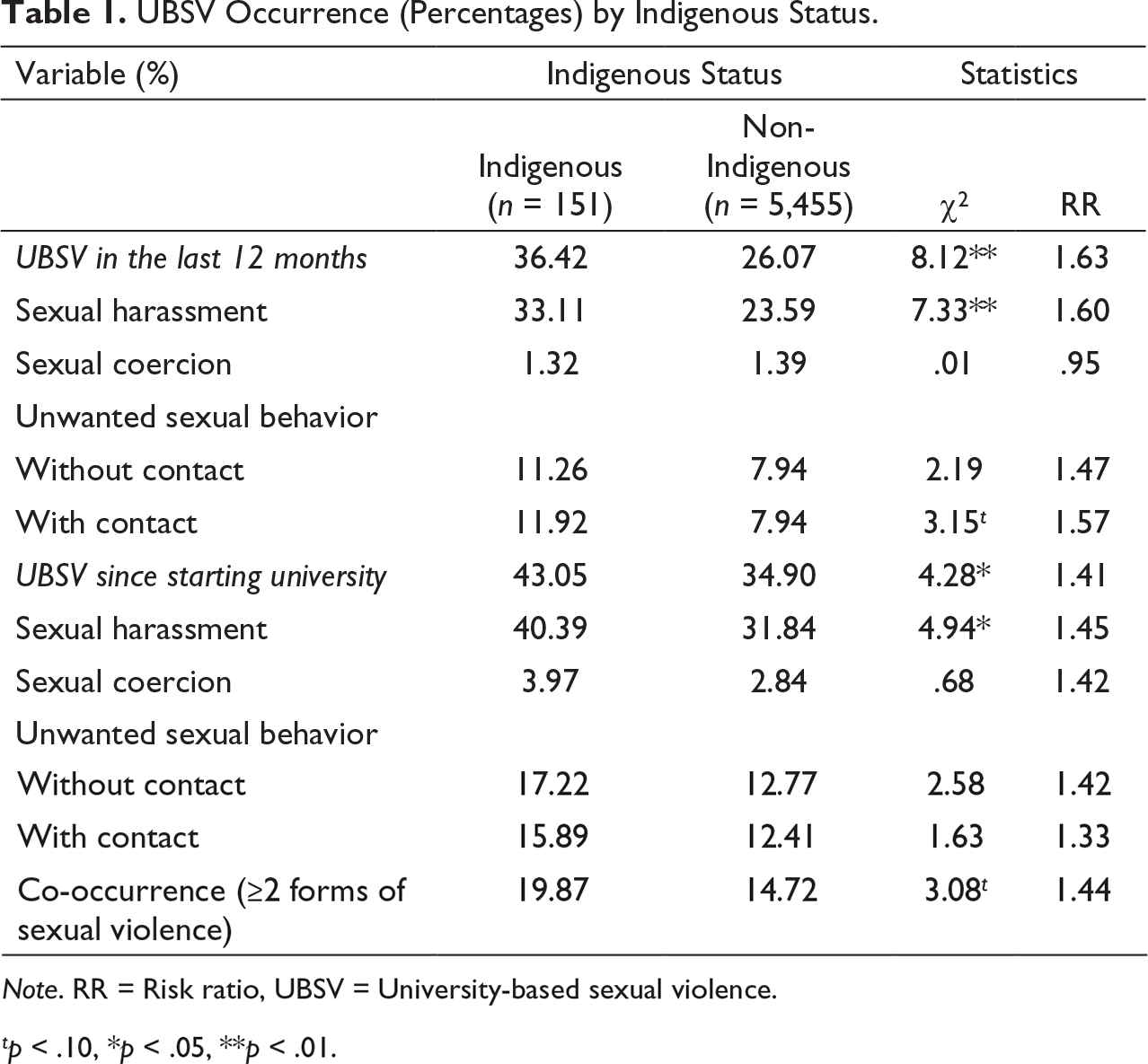
Note. RR = Risk ratio, UBSV = University-based sexual violence.
tp < .10, *p < .05, **p < .01.
UBSV Characteristics (Percentages) by Indigenous Status Among Victims.
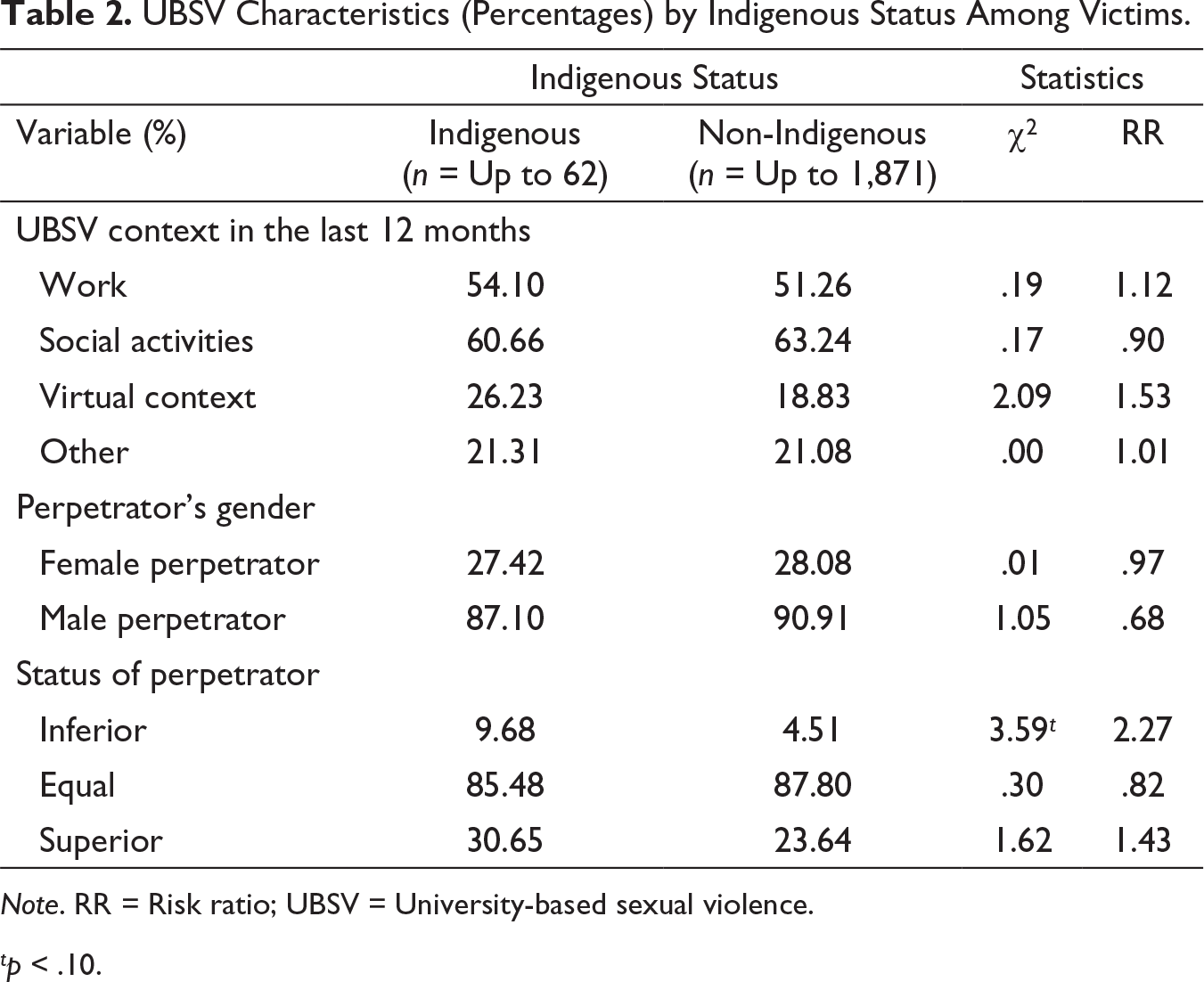
Note. RR = Risk ratio; UBSV = University-based sexual violence.
tp < .10.
Predictors of UBSV in the Last 12 Months and Since Starting University.
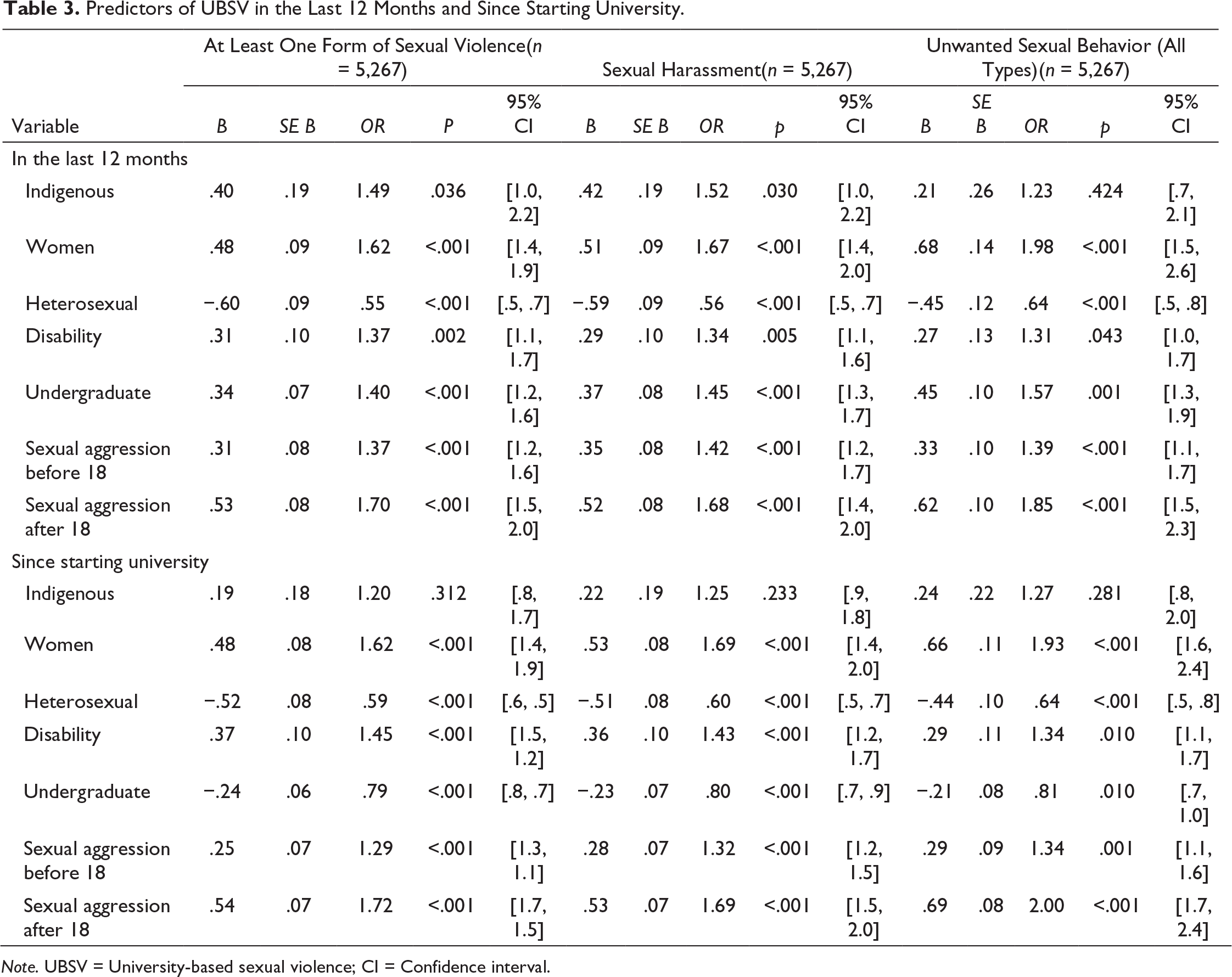
Note. UBSV = University-based sexual violence; CI = Confidence interval.
Results
Objective 1: Risk of Sexual Violence Among Indigenous Students Compared to Non-Indigenous Students
Tables 1 and 2 present the results of chi-squared analyses of the occurrence of sexual violence and contexts of sexual violence between Indigenous and non-Indigenous students. The results of binary logistic regression analyses for predictors of university-based sexual violence (at least one form of sexual violence, sexual harassment, and all types of unwanted sexual behavior) among all students are reported in Table 3. Because only six Indigenous students reported sexual coercion, no binary logistic regressions were conducted for that form of sexual violence. Hosmer-Lemeshow statistic indicated a good fit for all logistic regression models (significance indices were all higher than .05, i.e., > .25). Overall, the results of the regression analyses indicated that being Indigenous was significantly associated with experiencing at least one form of sexual violence in the last 12 months. Especially, being Indigenous was only significantly related to sexual harassment in the last 12 months, and not with unwanted sexual behavior. The Indigenous status was not related to any form of sexual violence since starting university. All of the other variables were associated with the different forms of sexual violence, sexual harassment, or unwanted sexual behavior in the last 12 months or since starting university.
Objective 2: Predicting Exposure to Sexual Violence in Indigenous Students
Binary logistic regression analyses were used with the sample of Indigenous students to examine variables associated with the different forms of university-based sexual violence in the last 12 months and since starting university. Variables used included gender, university status, disability, sexual orientation, sexual aggression before the age of 18, sexual aggression after the age of 18 (excluding sexual violence on campus). These results are reported in the text. Hosmer-Lemeshow statistic indicated a good fit for all logistic regression models (significance indices were all higher than .05, i.e., > .83). Overall, the results indicated that none of these variables predicted the various forms of sexual violence except having experienced sexual violence after age 18. This variable was associated with unwanted sexual behavior (with contact) since starting university, p < .001, odds ratio [OR] = 6.61, 95% confidence interval [CI] [2.13, 20.45], or in the last 12 months, p = .003, OR = 7.72, 95% CI [2.05, 29.16].
Discussion
Overall, the findings of this study extend the existing literature (Fedina et al., 2018; Muehlenhard et al., 2017) by confirming that rates of sexual violence at university campuses and sexual violence among both Indigenous and non-Indigenous peoples are severe, and need to be acknowledged. This large-scale study in a Canadian sample sought to further our understanding of university-based sexual violence among Indigenous students. Overall, being an Indigenous student was a predictor of university-based sexual violence in the last 12 months. Comparison of Indigenous and non-Indigenous students also revealed higher rates of sexual harassment for Indigenous students, but no significant difference in having experienced unwanted sexual behavior.
Despite the fact that the study did not focus on university-based sexual violence risk factors, our results indicated several other important risk factors to consider, including being a woman, having a disability and not being heterosexual, which are also risk factors largely studied (Basile et al., 2016; Hines et al., 2012). Being an undergraduate student was another risk factor identified in our study (Burczycka, 2020). Finally, our findings also indicated that students who have experienced sexual abuse before or after 18 years of age were more at risk of being sexually revictimized at university, compared with those who had not been sexually abused in the past. These results are consistent with previous research on the risk of revictimization (Daigneault et al., 2009; Hébert et al., 2017; Ports et al., 2016; Walker et al., 2019). According to the traumagenic dynamic model developed by Finkelhor and Browne (1985), the heightened vulnerability to revictimization may be explained by four processes: powerlessness, stigmatization, betrayal, and traumatic sexualization. For example, these processes may lead to believing in an inefficiency to manage future acts of aggression or to develop efficient self-protection strategies to recognize and respond to high risk (Hébert et al., 2020; Noll & Grych, 2011).
Sexual Violence: Indigenous Students Versus Non-Indigenous Students
Indigenous students showed higher rates of sexual harassment on university campuses than non-Indigenous students. Being an Indigenous student was a predictor of sexual harassment in the last 12 months even when many known risks factors were included in the analysis and examined as predictors. Although the high rates of sexual harassment in the current study are consistent with recent reports of high rates of sexual harassment among non-Indigenous university students (Oni et al., 2019; Sivertsen et al., 2019), they underscore a different reality for Indigenous students. This higher rate may be embedded in the racism and discrimination that Indigenous students face more frequently than non-Indigenous students at university. This may reflect a more “subtle” form of oppression, compared with other forms of sexual violence that were not found to be more frequent, used by the dominant culture to control or dominate Indigenous people.
In addition, no differences were found in the rate or contexts of sexual victimization between Indigenous and non-Indigenous students, which is also consistent with a previous study (Burczycka, 2020). These results may support the notion that Indigenous people are “self-determining peoples who have been and are actively resisting rape culture at multiple scales. Despite this violence, they are also cultural practitioners, land defenders, knowledge keepers, resisters, educators, and advocates” (Hunt, 2016, p. 8). However, the rates of sexual violence among Indigenous students obtained in this study raise questions regarding previous studies reporting higher rates of sexual violence among Indigenous Peoples (Dion et al., 2018; e.g., Collin-Vézina et al., 2009). It is important to note the significant historical trauma generated by the assimilative techniques of the Canadian and provincial governments and other institutions, which have fostered distrust (Bourassa et al., 2017) that may be present when responding to a survey on sexual violence. This could be linked to a distrust of the inappropriate societal response victims receive following acts of violence, often marked by racism or judgment (Bergeron & Boileau, 2015). For example, some media reports of murdered or missing women label victims as prostitutes, or present stereotypical images of broken Aboriginal people willingly placing themselves in bad situations or making bad decisions (Richardson & Dolan-Cake, 2016). It may also be linked to normalizing or trivializing violence, or even not realizing the severity of the situation (Bergeron & Boileau, 2015; Hoffart & Jones, 2018).
Finally, the current findings illustrate that the characteristics of the university-based sexual violence experiences are quite similar between Indigenous and non-Indigenous students and raise concerns regarding the magnitude of sexual violence for all students. For example, for Indigenous and non-Indigenous students, most perpetrators were individuals with equal hierarchical position (85%–88%), but a moderate proportion of sexual harassment was performed by individuals with superior hierarchical position (24%–31%). Recent studies also raised concerns about university-based sexual violence with a superior status perpetrator (e.g., Cantalupo & Kidder, 2018). Nonetheless, different realities might be present for the Indigenous students that were not explored in the current study.
Indigenous Students
When examining the subsample of Indigenous students, prior sexual abuse in adulthood was the only variable associated with experiencing sexual violence on campus. These results are in accord with previous studies among non-Indigenous people (Daigneault et al., 2009; Hébert et al., 2017; Ports et al., 2016), but also suggest that, among Indigenous students, other factors may be related to sexual violence on campus. Further studies will be required to better understand which Indigenous students are at increased risk.
Strengths and limitations.
To our knowledge, this is one of the first studies evaluating sexual violence on university campuses, and our sample includes more Indigenous people than the proportion usually found in Canadian higher education settings, which strengthens the external validity of the findings. Nonetheless, this research also involved limitations. When studying sexual violence on university campuses, researchers should study the impact of colonization, as well as the specific needs of Indigenous people (Hunt, 2016), which was not the case in the current study. Moreover, our measurement of sexual violence may have resulted in lower reporting rates, as Indigenous people may not report violence for various reasons, including language barriers and cultural differences (de Heer & Jones, 2017). Our research design and sampling may also have reinforced some of the biases and stereotypes against Indigenous people (de Heer & Jones, 2017). Further studies should be designed with Indigenous people to ensure culturally appropriate language, improved sampling methods, and research design, and, above all, to give Indigenous voices a chance to be heard (Coe et al., 2004; de Heer & Jones, 2017; Dion et al., 2015; Yuan et al., 2006).
Conclusion
Overall, the results of the current study revealed that Indigenous students, as well as non-Indigenous students, experience sexual violence on campus. A high proportion of Indigenous students may enter university with a past history of victimization, marginalization and oppression, and sexual violence may be another manifestation of the continuum of violence suffered related to ongoing settler colonialism (Hunt, 2016). Given their history, Indigenous students may have different needs compared with other students, so sustainable policies that do not render Indigenous students invisible are clearly needed (Bourassa et al., 2017). Moreover, there is a need to foster cultural safety on all campuses. Cultural safety involves moving beyond simple knowledge of Indigenous peoples to respecting and understanding Indigenous cultural values, and an acknowledgment that these may differ from the values of other cultures (Hunt, 2016). Cultural safety also requires competent and safe practices (Baba, 2013), which should be reflected in the social response to student victims of sexual violence.
Footnotes
Declaration of Conflicting Interests
Funding
The author(s) received no financial support for the research, authorship, and/or publication of this article.

Supplemental material
Author Biographies
References
Supplementary Material
Please find the following supplemental material available below.
For Open Access articles published under a Creative Commons License, all supplemental material carries the same license as the article it is associated with.
For non-Open Access articles published, all supplemental material carries a non-exclusive license, and permission requests for re-use of supplemental material or any part of supplemental material shall be sent directly to the copyright owner as specified in the copyright notice associated with the article.
