




Abstract
This study measured the prevalence of bullying behavior in 10-year-old children and investigated the effect of the socioeconomic context on the impact of household dysfunction on bullying. We studied 5,338 members of the Portuguese Generation XXI birth cohort. Information on involvement in bullying, socioeconomic characteristics, and household dysfunction was collected by trained interviewers using structured questionnaires. Being a victim of bullying was reported by 14.4% of participants, being a bully by 1.4%, and being a bully-victim by 3.9%. Being a victim or both bully-victim, simultaneously, was more frequent among children from medium-high income families. Also, children from low-income families who reported household substance abuse, witnessed parents’ intimate partner violence, and were victims of physical violence, were more frequently victims of bullying; and those who experienced family violence were more frequently involved as bully-victims. Among children from medium-high income families, all these household adversity experiences significantly increased the odds of being victim, bully, or bully-victim. Thus, although children from medium-high income families are less likely to experience adversity at home, when it happens, there is a greater effect on their behavior, suggesting that better socioeconomic circumstances do not seem to act as a protective factor.
Keywords
Introduction
Bullying behavior is a global phenomenon and highly prevalent in early adolescence (UNICEF, 2018), with devastating consequences and health implications. Several authors have provided definitions of bullying, with Farrington defining it as a “repeated oppression, psychological or physical, of a less powerful person by a more powerful one” (Farrington, 1993) and Coloroso defining bullying as “a conscious, deliberate hostile activity intended to terrorize and harm others through the threat of further aggression” (Coloroso, 2008). The most common and widely accepted definition of bullying was described by Olweus and states that “a person is bullied when he or she is exposed, repeatedly and over time, to negative actions on the part of one or more other persons” (Olweus, 1993). However, in all these definitions, authors agree that bullying is a form of aggression with serious long- and short-term implications on health and wellbeing of those who are involved.
A bulk of the literature have linked bullying victimization with a wide range of adverse health outcomes, mainly related to anxiety, depression, self-injury, and suicidal ideation (Lereya et al., 2015; Moore et al., 2017), and with engagement in unhealthy risk behaviors (Hertz et al., 2015; Moore et al., 2017; Waasdorp et al., 2018). Also, bullying others is predictive of poor academic achievement (Nansel et al., 2001, 2004), antisocial personality and other psychiatric disorders, substance abuse, and suicidal ideation in adulthood (Klomek et al., 2009; Sourander et al., 2007, 2009, 2011; Ttofi et al., 2011).
Bullying Forms
Bullying can take the form of verbal abuse, physical violence, or social rejection. Some authors also consider that these forms of bullying entail direct (verbal and physical) or indirect (relational) bullying (Björkqvist et al., 1992).
The direct or more overt aggression includes observable confrontations which involve physical and verbal attacks; while indirect bullying includes attacks that are carried out in a more covert and secretive manner, using spreading rumors, excluding people from groups, or persuading or daring a peer to harm another child or adolescent.
Gender seems to play an important role in bullying involvement (Steinfeldt et al., 2012). There is evidence showing that the rates of aggressive behavior and bullying behavior are higher among boys than girls (World Health Organization, 2017). However, some researchers argue that there is not a gender difference between boys and girls, but instead the two groups use different forms of aggression. Evidence suggests that boys are more likely to be involved as victims or as bullies, especially in its physical expression (Craig & Harel-Fisch, 2004; Silva-Rocha et al., 2020), while girls are more likely to engage in situations of indirect bullying, such as teasing or gossiping (Committee on the Biological and Psychosocial Effects of Peer Victimization, 2016; Finkelhor et al., 2015; Silva-Rocha et al., 2020). This difference in behavior might be attributed to biological reasons, or to gender differences in the socialization process, where boys are encouraged to be aggressive and competitive, but girls are expected to be nurturant and expressive. However, the consequences of bullying for the well-being and in health outcomes are not expected to be different among girls and boys.
Household Environment and Bullying Behavior
The social environment influences the nature and quality of social relationships which in turn affect child development and future achievements. Literature has shown that a warm, authoritative, and sensitive parenting style contributes to children’s positive social behavior and supportive peer relationship (Helsen et al., 2000). Also, students with higher “self-confidence” and “avoidance from bullying” scores, are more likely to report lower levels of family dysfunctions (Eşkisu, 2014).
On the other hand, a harsh family environment, with a low parental capacity to care for their kids, may affect children’s social skills and decrease their ability to cope with stress and difficult times (Álvarez-García et al., 2015; Hong & Espelage, 2012; Mazur et al., 2017; Yeager et al., 2015). Authoritarian parenting styles, such as use of physical discipline, and hostile and rejecting parenting influence engagement in bullying behavior through the development of poor self-image and emotional dysregulation (Christie-Mizell, 2003; Espelage & Swearer, 2003; Espelage et al., 2003; Shields & Cicchetti, 2001). Also, the exposure to household conflicts poses a significant threat to children’s ability to process and regulate emotions, and it may result in undercontrolled or overcontrolled emotional reactions contributing to both internalizing and externalizing behaviors (Zarling et al., 2013).
A dysfunctional family environment is associated with the onset of episodes of anxiety, aggressiveness, and impulsivity in the children, impairing their development tactics to solve a conflict with their peers (Kolk, 2017), and putting them at greater risk of displaying violent, aggressive, and bullying behaviors outside the home environment (Hong & Espelage, 2012). Children who bully others are more likely to come from family environments characterized by less cohesion, expressiveness, organization, control, and social orientation (Stevens et al., 2002). In addition, although parents’ aggressive punishment did not influence the child’s aggressive behavior directly, child’s aggressive behavior depends on the parents and child relationship. Parents of aggressive boys expressed higher approval of aggression in social life (Frączek & Kirwil, 1992) and children who are raised by dominant parents or with an over-control in their behavior tend to harass their classmates at school (Manning et al., 1978). At the same time, permissive parents legitimize combative activities and fail to provide opportunities for the child to control his or her aggressive urges (Schaffer, 1994).
Accordingly, growing up in a dysfunctional environment adversely impacts the children’s behavior. However, the specific nature of this link remains unclear. There are studies that find links to internalizing behaviors while other show links to externalizing behaviors (Kitzmann et al., 2003). Although we will not explore which mechanisms would explain these links, it would be relevant, therefore, to understand how this household dysfunction impact bullying behavior in children, in terms of frequency of aggression and victimization.
Socioeconomic Circumstances, Household Dysfunction, and Bullying
Studies suggested an inconsistent relationship between low socioeconomic circumstances and a higher likelihood of being victims and being involved as bully-victims simultaneously. While some authors state that family socioeconomic circumstances influence bullying involvement, and children from low socioeconomic backgrounds and living with a single parent are more likely to be involved in bullying behaviors (Nordhagen et al., 2005), a systematic review showed that the association of socioeconomic circumstances with bullying was weak, providing little guidance for targeted interventions (Tippett & Wolke, 2014).
However, a clear relationship between socioeconomic circumstances in childhood and neglect or maltreatment was reported in a systematic review, suggesting that low childhood socioeconomic circumstances is a determinant of such adversity (Walsh et al., 2019), and the longitudinal nature of many studies support a causal association. So, low socioeconomic circumstances seem to increase a child vulnerability to abuse and neglect at home (Ondersma, 2002). This can contribute to the development of low interpersonal skills, which in turn might increase the likelihood of involvement in bullying behaviors at school (Bowes et al., 2009; Glew et al., 2005; Jansen et al., 2011, 2012; Tippett & Wolke, 2014). It would be of relevance to investigate the impact of household dysfunction on bullying behavior considering the socioeconomic context in which children are living.
This Study
We hypothesize that the experience of household dysfunction by children from an advantaged socioeconomic group would less likely lead to engaging in peer violence. Studies have encouraged monitoring the different environments in which children are exposed, to provide a better understanding of the mechanisms and determinants of bullying involvement at early ages, and consequently to provide evidence to intervene and prevent its adverse consequences (Garmy et al., 2018; Henderson et al., 2018). Thus, we measured the prevalence of bullying involvement in 10-year-old children and examined how household dysfunction was associated with bullying behavior considering different family socioeconomic contexts.
Methods
Study Design and Participants
This study was conducted in the Generation XXI cohort, a prospective Portuguese population-based birth cohort. Briefly, the cohort was assembled between 2005 and 2006 and recruited a total of 8,647 newborn from the five public maternity units of Porto Metropolitan Area providing obstetrical and neonatal care covering, at the time. All maternities were level III units, with differentiated perinatal support, and in 2004, were responsible for 91.6% of the deliveries in the whole catchment population, with the remaining occurring in private hospitals/clinics (Alves et al., 2012; Larsen et al., 2013). The entire cohort was invited to participate in the following study waves, at children’s ages of 4, 7, and 10 years old (in 2009-2011, 2012-2014, and 2016-2017, respectively). Participants do not receive financial incentives for participation in the cohort evaluations, but the research team sends a report from the doctor comprising blood collection analysis and results from physical examination. In all study waves, information on demographic and socioeconomic characteristics, obstetric history, history of disease, and health-related behaviors were collected by trained interviewers using structured questionnaires. The present is a cross-sectional study that analyses data from 5,338 participants of the fourth study wave of Generation XXI, with complete information on bullying involvement collected at the age of 10 years.
Generation XXI was approved by the Portuguese Data Protection Authority and the Ethics Committee of the University of Porto Medical School/S. João Hospital Centre approved the study protocol (CES-01/2017). Informed consent was obtained for all participants, signed by their legal guardians at every study wave (Alves et al., 2012).
Bullying Behavior
Bullying behavior was self-reported and assessed through the Bully Scale Survey developed by the Centers for Disease Control and Prevention (CDC) (Hamburger et al., 2011). This scale collects information on the experience of bullying as a victim (11 items) and as a bully (11 items), as described in Supplementary Table 1. For each item, the child had to indicate the frequency of involvement, through five options: “never,” “rarely,” “sometimes,” “often,” and “always.” As bullying is a repeated behavior, we considered that it had happened when the child reported that at least one act occurs with the frequency “often” or “always.” Bullying involvement was categorized as “victim,” when the child answered “often” or “always” in the victimization scale, but answered “never,” “rarely,” or “sometimes” in the aggression scale; the child was classified as a “bully” when answered “often” or “always” in the aggression scale, but answered “never,” “rarely,” or “sometimes” in the victimization scale; or as “bully-victim” when was involved both as a victim and as bully simultaneously.
Household Dysfunction
Household dysfunction was assessed through a list of stressful events that were reported by the child at the age of 10 years and to which the child was asked to answer if it has ever occurred, with “yes” or “no” answers. Household dysfunction comprised: “household substance abuse” if the child reported living with a household member with problems with alcohol and/or drug abuse; “household criminality,” if the child reported the imprisonment of a relative, “witness parents intimate partner violence (IPV).” At the same wave, maternal history of victimization was reported by the mothers and defined as lifetime experience of emotional or physical abuse occurring during adulthood. Exposure to physical violence at the age of 10 years was assessed using a single item question: “Did someone in your house hit, kick, or punch you?”
Socioeconomic Circumstances
The household income included salaries and other sources of income, such as financial assistance, rent, monetary allowances, and alimony for the whole household. A low disposable household income was defined as €1,000 per month or less; intermediate if between €1,001 and €2,500, and high if more than €2,500. For analysis purposes, household income was dichotomized into “less or equal to 1,000 euros” corresponding to low income, and “more than 1,000 euros” per month corresponding to medium-high income.
Covariates
Data on family structure, parental education, and parental history of employment were reported by the parents at wave 4 when the child was 10 years old. Children were divided into the following two categories: “living with both parents” and “living with one parent/none of the parents.” Parents educational level was measured as the number of years of formal schooling completed and classified according to the International Standard Classification of Education 2011 classes (Unesco Institute for Statistics, 2012). The low educational level corresponded to 9 years or less of formal schooling; intermediate education to 12 years of formal education; and high education to more than 12 years of formal education. For analysis, parents’ educational level was dichotomized into low if “equal or lower than 9 years” and medium-high if “more than 9 years” of formal schooling. History of parental unemployment status was coded as “yes” if at least one of the parents reported having been unemployed at least for 12 months since 2009 and “no” for all other cases.
Statistical Analysis
All statistical analyses were performed using the software STATA version 15.1 (Stata Corp. 2017. Stata Statistical Software: Release 15. College Station, TX: StataCorp LLC). Pearson’s chi-squared test was used to compare proportions. To identify the association between household dysfunction and being bullied, logistic regression analyses were run. We calculated odds ratios, with 95% confidence intervals [OR, 95% CI]), sex-adjusted odds ratios (AOR), and 95% CI for the studied association. The primary outcome was involvement in bullying, as a victim, bully, or bully-victim. Children’s sex was considered as a confounder in the association between household dysfunction and type of involvement in bullying to account for some gender differences in the bullying tactics. Analyses were stratified by household income, as we previously found a significant interaction of household income *household dysfunction*bullying.
Results
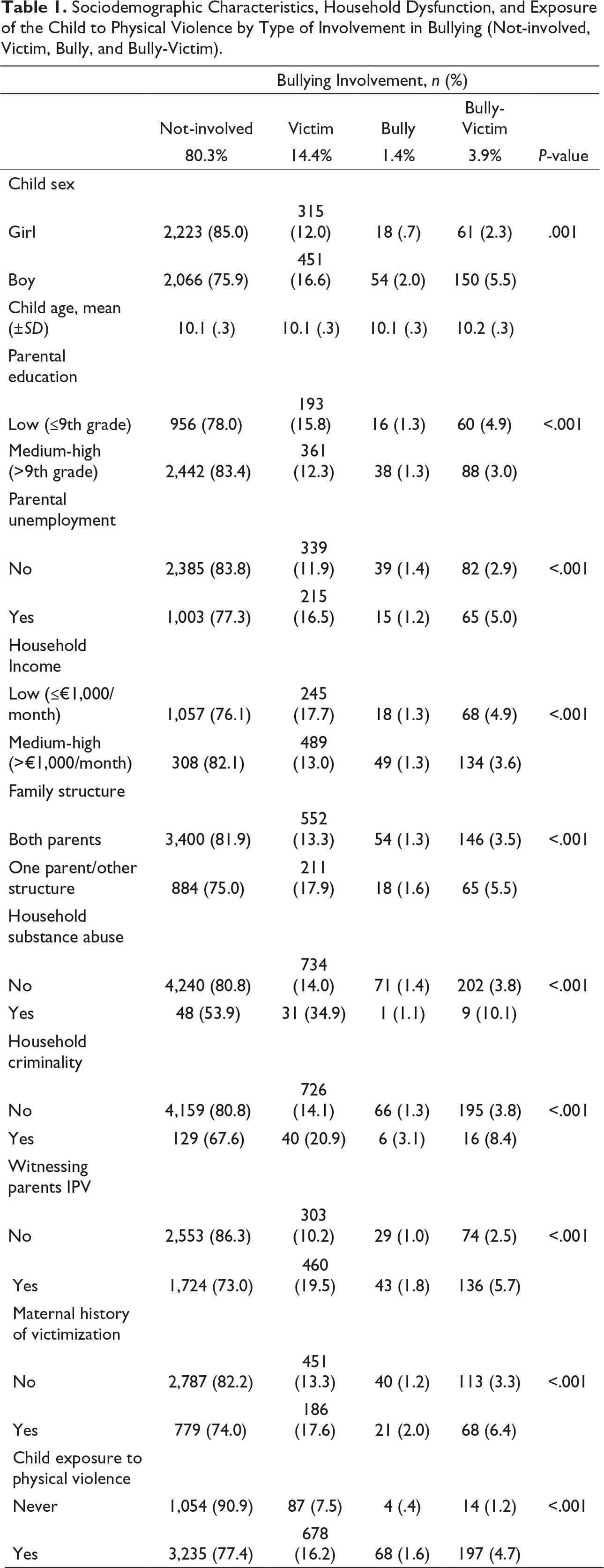
Overall, 19.7% of children reported to have been involved in bullying at the age of 10 years; involvement as a victim was reported by 14.4% of the Generation XXI participants, involvement as a bully by 1.4%, and involvement as bully-victim by 3.9%. Boys were more frequently involved in bullying behaviors than girls (16.6% versus 12.0% as victims; 2.0% versus .7% as bullies; and 5.5% versus 2.3% as bully-victims).
Sociodemographic Characteristics, Household Dysfunction, and Exposure of the Child to Physical Violence by Type of Involvement in Bullying (Not-involved, Victim, Bully, and Bully-Victim).
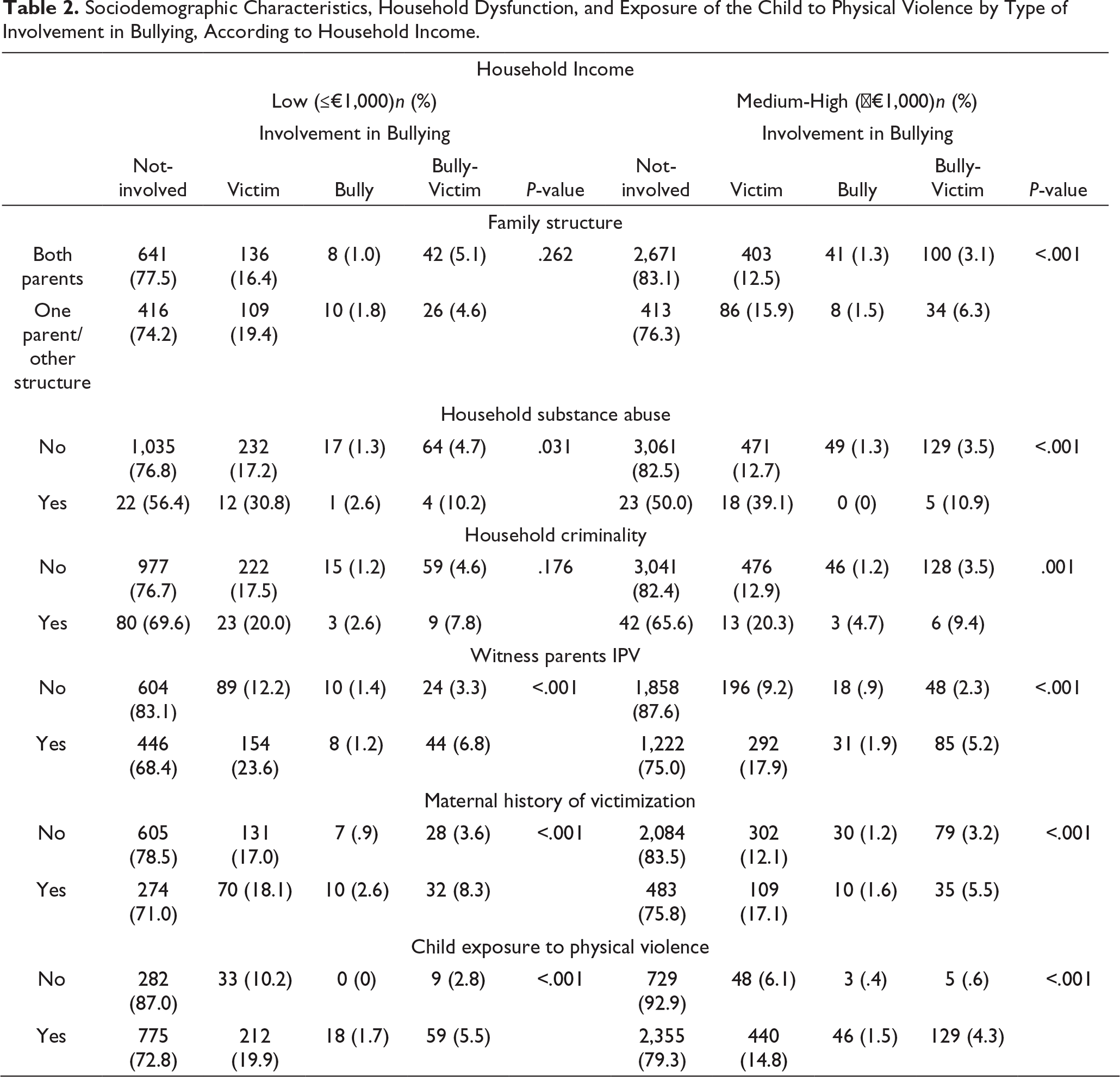
Sociodemographic Characteristics, Household Dysfunction, and Exposure of the Child to Physical Violence by Type of Involvement in Bullying, According to Household Income.
Sex-adjusted Odds Ratios (OR) and 95% Confidence Intervals (CI) for the Association of Household Dysfunction With the Type of Involvement in Bullying, According to Low and Medium–High Household Income.
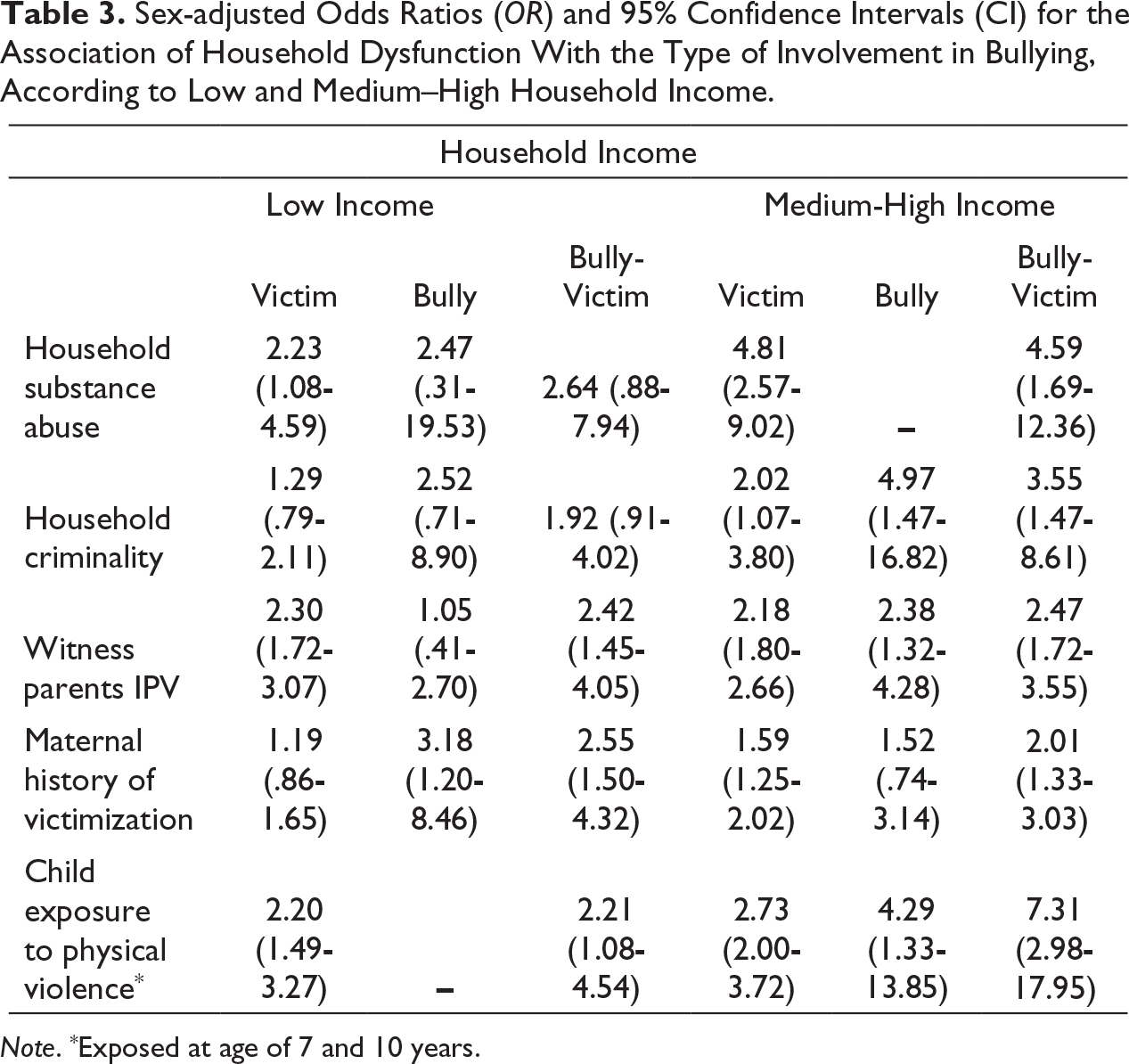
Note. *Exposed at age of 7 and 10 years.
Discussion
This study showed that although children from medium-high income families were less likely to experience adversity in their home and engage in violent behaviors, when stressful household events occur it substantially impacts the odds of being involved in bullying behaviors. Though we have to be careful when establishing comparisons between these groups of participants since their basal risk may be different, our results seem to support that the negative influence of household adversity in children’s behavior is not only limited to children in low socioeconomic families. As previously reported, being exposed or witnessing other forms of victimization at home might increase their susceptibility for being involved in bullying (Lereya et al., 2015), as children might see it as an acceptable way to manage interpersonal conflicts. When children from higher socioeconomic groups suffer an adverse experience in their home, the effect on their behavior is greater, suggesting that a more favorable socioeconomic environment may not act as a protective factor against the influence of household dysfunction. A similar finding was reported in a previous study (Halfon et al., 2017), in which authors showed that children in the highest income bracket who suffer from adverse childhood experiences were not protected against the effect of these adverse experiences on their health. Thus, a higher income does not always protect a family from the impact of a stressful event. On the other hand, if a child lives in a disadvantaged socioeconomic environment and is also exposed to material deprivation or financial strain, with the daily stress related to socioeconomic deprivation and its consequences, the impact of another traumatic psychosocial event may not have much meaning; but if a child belongs to a high socioeconomic household and experiences a traumatic event, this child will have increased levels of stress that may influence child’s reactions and behaviors, which may explain engagement in bullying. Moreover, we must acknowledge the intergenerational transmission of disadvantage that states that adverse family-related circumstances are associated with increased odds of experiencing disadvantaged social, economic, and health-related trajectories across adulthood. Thus, our results are in line with the theories of cumulative disadvantage, reflecting that an adverse situation in childhood may be a marker for accumulated and, to some extent, persistent problems later in life (Almquist & Brännström, 2018).
Previous studies showed that victims of bullying and bully-victims were more likely to come from low socioeconomic households (Alikasifoglu et al., 2007; Bowes et al., 2009; Jansen et al., 2011; Jansen et al., 2012; Tippett & Wolke, 2014). Our results also showed that household income was associated with bullying behavior, with those children from low socioeconomic conditions reporting more frequently being a victim or a bully-victim. Besides, we observed an increased likelihood of involvement as a bully in children from medium-high income when the history of household criminality, parents IPV, and exposure to physical violence is reported. These findings suggest that exposure to household dysfunction might impact children’s emotional and behavioral development, and as previously reported, with later increased risk of mental health consequences (Lereya et al., 2015) and disease conditions (Felitti et al., 1998).
In the study of Lereya et al., it was observed that children who were bullied were more likely to have mental health problems later in life, while children who were both maltreated and bullied were also at increased risk for mental health problems, but with lower risk than those of being bullied alone. Thus, being bullied had worse long-term adverse effects on young adults’ mental health than being maltreated by adults (Lereya et al., 2015). Taking these results into account, investments in the identification of children at risk of becoming a bully or victim could allow the intervention at younger ages and timely prevention of bullying and victimization, and consequently of its potential detrimental health outcomes. Identification is enhanced by knowledge on determinants and predictors of bullying behavior. Also, as involvement in bullying seems to be socially patterned, family, school, and neighborhood socioeconomic circumstances might also help to identify an increased risk of involvement and predict bullying behavior as these factors are likely to influence children’s behavior, and pose as a window of opportunity to intervene. Nevertheless, some controversy remains on the effectiveness of an intervention in school environments to prevent bullying. Even though several research teams have studied the effectiveness of various bullying prevention programs, a meta-analysis by Ttofi and Farrington is recognized as one of the most comprehensive and rigorous to date. They conclude that whole-school programs are effective in reducing bullying and victimization but also that there are great variations in the effects of different programs (Ttofi & Farrington, 2009).
Our study found that one in five children have been involved in repeated behaviors of bullying and that boys were more frequently involved in bullying than girls. This finding might mean that boys are more willing to report their bullying behaviors, or they are more willing to use bullying as a dominant strategy. Nevertheless, our results showed a higher prevalence of pure victims among boys when compared to girls. This is contrary to what most previous studies have shown, in which girls were more likely to report higher levels of victimization. Also, the prevalence of being a bully or being bully-victim is lower in our study. As they grow, children who were victims of bullying would be more prone to get involved in bullying others and, therefore, to be both victims and bullies simultaneously. Although our study is focused on a particular age, it is expected that the prevalence of pure victim’s decreases, and the prevalence of bully-victims and pure bullies increases with age (Craig et al., 2009).
One of the main strengths of this study is the use of a large study, such as Generation XXI. The use of several detailed questions about exposures to a household with dysfunctions, as well as data on bullying involvement, through a detailed scale, is likely to have given a higher catchment rate for those exposures than single screening questions. The information on adverse experiences was self-reported, so the children completed the questionnaire by themselves. It allowed us to assess self-reported involvement instead of the involvement reported by parents or professors as in other studies (Bowes et al., 2009; Foster & Brooks-Gunn, 2013). Also, the interviewer should only intervene when the child asked for help; therefore, the presence of the interviewer is not expected to influence children’s answers. However, self-report answers can add ambiguity due to undisclosed or socially desirable answers, especially expected when dealing with these private issues. Thus, it could contribute to underestimate the prevalence of bullying. Furthermore, we emphasize that while other studies are limited to investigate specific indicators such socioeconomic (Magklara et al., 2012) or other stressful or violent events (Bowes et al., 2009), our results exhibit a broader approach, once it takes into account the socioeconomic environment and the exposure to household dysfunctions simultaneously, which may be more useful to predict and prevent bullying involvement.
Our sample includes participants of Generation XXI, that were not selected by gender, ethnicity, or religion. Moreover, Generation XXI participants are almost exclusively Caucasian, and there is no ethnic variability to account for. In our cohort, less than 5% of mothers were born in another country. The lack of diversity at the recruitment time is explained by the small number of foreign citizens (329,898) who were living in Portugal in 2006, and by the fact that most of them were concentrated in the metropolitan area of Lisboa (Instituto Nacional de Estatística, 2007). As it is not expected that exposure to bullying varies for different ethnic or religious groups, these concepts are not to consider in the observed results, and the associations we found are mainly due to exposure to household adversity and socioeconomic circumstances differences.
However, some limitations must be acknowledged. Generation XXI aims at attaining novel and useful knowledge for understanding the Portuguese reality, by using data from children born in the metropolitan area of Porto, and by thus predominantly urban. However, it is not expected that the main results would be different if including children from rural areas. Also, within the cohort, we assessed bullying involvement and household adversity at the age of 10 years, and we used family socioeconomic circumstances reported at the same time, precluding any comparison or causality estimation due to cross-sectional nature of the study. Nevertheless, variables used as exposures, such as household dysfunction are considered as risk factors and cannot be consequences of bullying involvement. Even though exposure of the child to violence can be framed as either risk factor or consequence of bullying, we believe that family environment seems to play a substantial role in the likelihood of a child to become involved in bullying (Álvarez-García et al., 2015; Hong & Espelage, 2012; Mazur et al., 2017; Yeager et al., 2015) and thus explaining the association found. Therefore, it would be particularly informative for future studies to examine these exposures and bullying involvement by using longitudinal data. Additionally, although there is a potential bias through underestimation when asking for family income (Moore et al., 2000), the existence of bias would lead to an underestimation of the associations, therefore, not affecting our results. Moreover, we used data aggregated into classes instead of the format used for data collection, to easier comprehension and statistical efficiency. This way we can compare participants from low with medium-family incomes and also, identify different types of involvement in bullying, and classifying them according to the frequency of the involvement. Even though it is quite common to combine subjects with some score above a threshold into categories, as we did to the income and bullying variables, taking advantage of increasing the prevalence of participants in the different categories and improving the ease of comprehension and the statistical efficiency of the analysis, they may come at the price of misclassification of participants. We believe that this option does not affect our results, since we collapsed only adjacent categories with similar frequencies (in the case of bullying) and similar proportions (in the case of income). Thus, the impact of misclassification should be residual in the analyses. Also, as a common occurrence in prospective birth cohorts, there has been attrition over time, leading to a reduction in the sample size and a more socioeconomically advantaged group of participants throughout childhood and cohort evaluations. Nevertheless, we believe that the inclusion of the more-disadvantaged group would have widened the differences observed. The number of missing’s in the specific questions regarding bullying is insignificant and by thus, does not affect our findings.
We must also acknowledge that some dimensions might be important to take into account in future studies addressing this association. Perceived social support, meaning the knowledge and feeling that a person is cared for (Davidson & Demaray, 2007), ensure positive effects and may act as a “buffering effect” that can mitigate the negative impact of stress and exposure to a problematic situation (Holt & Espelage, 2007). Thus, social support can improve the coping ability and reduce the harmful consequences of bullying (Eşkisu, 2014), conducting toward a process of building resilience. Resilient individuals are those who manifest positive outcomes over time despite facing significant adversities (Luthar et al., 2000). Peer relationships may also play a role in promoting resilience to bullying. For example, bullied adolescents who report high levels of support from peers are more likely to maintain appropriate academic achievement for their age group compared to those with low peer support (Rothon et al., 2011; Wang et al., 2011).
Implication of Findings
Growing up and living in a dysfunctional context may contribute not only for learning negative relationship patterns but also to compromise the child’s healthy development by making them more vulnerable (Felitti et al., 1998; Lereya et al., 2015). Although children from medium-high income families are less likely to experience adversity in the home, when it happens, the effect on their behavior is greater, which suggests that better socioeconomic circumstances do not seem to act as a protective factor. However, we should focus on the high prevalence of bullying among 10-year-old children, those living and growing up in poverty, and on how psychosocial events may be managed by children. Bullying prevention and intervention strategies should target all the children, independently of their socioeconomic origin. Besides, children who have experienced a life stressful event should have the opportunity to receive psychological support.
Even though, in terms of implications, creating and sustaining safe, stable, nurturing relationships and environments for all children and families, independently of their socioeconomic background, may contribute not only to prevent adversity but also to provide children with the ability to cope with adversity. Furthermore, an investment in strategies for preventing and stopping bullying that entail a commitment of families, schools, and community would contribute to raising awareness of this phenomenon, and children should be more prepared to identify it as a problem and to manage to cope with their conflicts without engaging in violent behaviors. Particularly, reduction of bullying must aim multiple levels of the social-ecology and by extension, by contributions from individuals across a range of disciplines. At the family level, the implementation of programs that include a parent- or family-focused components, such as parent-child communication about violence and bullying behaviors; at school level promoting popular and political debates, rendering educational research on bullying among children and adolescents; and at the community level, media and mass communications, motivated by popular debate criticizing and condemning violence and bullying behaviors. Finally, special attention should be given to children from poor families who were likely to have an inferior quality of life.
To sum up, our findings raise awareness for a greater investment in bullying prevention involving not only schools, families, and children but also the entire community. Schools or community-based organizations should be able to provide a mechanism of support for those children who experienced life stressful events at home. Although our results show a high impact of household adversity on bullying involvement among those from favorable socioeconomic environments, it does not mean that children from lower socioeconomic groups do not need to receive psychological support. They also suffer when a stressful event occurs, but poverty has a higher impact on their lives for much longer. If children are already in a trajectory of adversity, caused by experiencing adverse circumstances in the family of origin that will relate to the child social, economic, and health-related disadvantages across the lifecourse, another negative event in early life will not have a multiplicative effect but an additive contribution to the suffering level. Finally, school environments should contribute to reducing inequalities and therefore children from poorer social backgrounds should not be left behind.
Footnotes
Acknowledgments
The authors gratefully acknowledge the families enrolled in Generation XXI for their kindness, all members of the research team for their enthusiasm and perseverance, and the participating hospitals and their staff for their help and support.
Declaration of Conflicting Interests
Funding
The author(s) disclosed receipt of the following financial support for the research, authorship, and/or publication of this article: This work was supported by the European Regional Development Fund (ERDF) through the Operational Programme Competitiveness and Internationalization and national funding from the Foundation for Science and Technology (FCT), Portuguese Ministry of Science, Technology and Higher Education under the projects “BioAdversity: How childhood social adversity shapes health: The biology of social adversity (POCI-01-0145-FEDER-016838; PTDC/DTP-EPI/1687/2014) and HIneC: When do health inequalities start? Understanding the impact of childhood social adversity on health trajectories from birth to early adolescence (POCI-01-0145-FEDER-029567; PTDC/SAU-PUB/29567/2017)”; Unidade de Investigação em Epidemiologia - Instituto de Saúde Pública da Universidade do Porto (EPIUnit) (UIDB/04750/2020); Administração Regional de Saúde Norte (Regional Department of Ministry of Health) and Fundação Calouste Gulbenkian; PhD Grant SFRH/BD/108742/2015 (to SS) co-funded by the FCT and Human Capital Operational Programme of the European Social Fund (POCH/FSE Program) and FCT Investigator contracts CEECIND/01516/2017 (to SF).

Supplemental Material
Supplemental material for this article is available online.