




Abstract
While exposure to violence and aggression is well known for its detrimental effects on employees’ health as well as organizational outcomes, certain high-risk work domains have scarcely been researched. Thus, this study set out to determine negative consequences of work-related exposure to four forms of harmful behaviors in private security. In a sample of 487 German-speaking security guards, 23% had experienced outsider-initiated violence, 56% aggressive acts, 30% vicarious violent acts, and 3% were sexually harassed over the past 12 months. Additionally, 19% reported substantial to extreme worries about violence. By presenting an integrated model of negative consequences to outsider-initiated violent, aggressive as well as sexual harassing acts, we strived to extend previous research by showing that turnover intention (as an ultimate negative behavioral outcome) is only indirectly related to these experiences via worries about violence and psychosomatic complaints. Structural equation modeling provided support for the model and plausibility for a sequential “two-step” prediction of turnover intention. Further, we provided support that worries about violence are not solely triggered by directly experiencing physical violence but also vicarious violence, aggressive acts, and sexual harassment. Consistent with previous studies, worries about violence were identified as a central mediator in the transmission process from exposure to harmful behaviors at work to negative consequences, that is, psychosomatic complaints and turnover intention. Our findings have implications for the detailed understanding of consequences emerging from exposure to workplace violence and aggression as well as the development of effective prevention strategies especially in high-risk occupations such as private security.
Keywords
Introduction
The exposure to various forms of violence or aggression has repeatedly been addressed as one of the principal occupational hazards (e.g., Gadegaard et al., 2018) causing numerous negative outcomes for victims and organizations. In the European average, the prevalence for physical violence (over a 12-month period) is estimated at 1.9%, threats of physical violence 5.0%, bullying and harassment 4.1%, and sexual harassment 2% (Eurofound, 2015). In Germany (and Austria) more than 15% [20%] of the workforce was found to be affected by facets of aggression or violence (verbal abuse, unwanted sexual attention, threats or humiliating behavior; Eurofound, 2015).
Generally, harmful behaviors, such as violence or aggression, can be mainly understood as attempts to (re-)gain or maintain control about other individuals, organizations, or situations that had caused a sense of, for example, powerlessness, frustration, or injustice. Building on the general theoretical knowledge about the nature of human aggression, which is mainly grounded in the frustration-aggression hypothesis (Dollard et al., 1939), cognitive-neoassociation theory of aggression (Berkowitz, 1993), and the general aggression model (Anderson & Bushman, 2002), work-related research has set out to establish an extensive set of personal and workplace predictors (and interactions thereof) in order to approach this detrimental phenomenon (Barling, 1996).
Due to its highly dynamical nature and composition, theoretical knowledge about the causes of workplace violence and aggression is not universally applicable. Composition of perpetrator-victim relationships (e.g., experiencing harm from supervisors, colleagues, or strangers), personal (e.g., coping strategies, mood, trait anger, intoxication), and workplace factors (e.g., time pressure, workplace insecurity) cause an abundance of constellations that affect underlying causes, motives, and intentions (Barling, 1996; Neuman & Baron, 1998). Consequently, psychological theories of explanation are as varied as causal factors.
High-risk Occupations
Occupations such as health care (66.9% non-physical violence, 36.4% physical violence, e.g., Spector et al., 2014), education (42.3% non-physical violence, 21.7% physical violence, e.g., Tiesman et al., 2013), public safety, retail and justice (Gadegaard et al., 2018; Hogh & Viitasara, 2005; Piquero et al., 2013) show much higher exposure rates than other work domains. While health care and law enforcement work appear well addressed by previous research, other high-risk occupations, such as private security (Leino, 2013; Rosen, 2001; Waddington et al., 2005), have not received similar attention. This is surprising, since, for example, the U.S. National Crime Victimization Survey (Harrell, 2011) rates private security work as the third-most violence exposed occupation after bartenders and law enforcement officers.
Private security work is characterized by frequent human interaction, often necessarily including the display of power and the exercise of control and prohibition, and has consequently been labeled a high-risk domain for violent exposure at work (e.g., Leino et al., 2011a). Moreover, many established risk factors are present there, such as night work (Leino et al., 2011b), holiday and weekend shifts, handling valuables, low levels of education or training (van den Bossche et al., 2013), having an increased (often confrontational) client contact, where a service or a request can be denied (Pizzino, 2000), work settings where clients consume alcohol or drugs (LeBlanc & Barling, 2005), being male, low work experience, and working alone (LeBlanc & Kelloway, 2002; 2006; Spector et al., 2007).
A Finnish study estimated monthly prevalence rates of security guards at 39% for verbal aggression, 19% for threats of assault, and 15% for physical acts (Leino et al., 2011b). Similarly, French security guards reported a 40% exposure rate for physical and verbal violence over the past 12 months (Dang et al., 2016).
In Germany and Austria, around 260.000 private sector employees increasingly perform tasks similar to those of the police, safeguard public events and transportation and even support health care professionals in handling aggressive and violent incidents. However, only few studies (e.g., Declercq et al., 2007; Leino et al., 2011a, 2011b; Vanheule et al., 2008) could be identified that target violent-related health issues for this particular workgroup. None of which has researched German-speaking personnel. The Security Report by the statutory accident insurance (Verwaltungs-Berufsgenossenschaft, 2018) in Germany showed that confrontations, as the source of an occupational accident (defined by this report as an event causing health impairments or death), had become 5-times more frequent in 2017 compared to 1988, soaring to be the future number one cause for workplace accidents. With 34.9%, confrontations are the second most prominent cause of accidents in general security work. Only accidents caused by falling or stumbling are more frequent (37.2%, others 21.8%, vehicles 4.6%, dogs 1.1%, guns 0.05%). In private policing of public transportation as well as shopping malls or migration homes, confrontations are by far the most frequent cause for workplace accidents (73.7%, 76.4%, 71.1%). Given that not all victims seek medical attendance, companies are only obliged to report accidents that result in a three-day absence from work and a high percentage of part-time work in the security sector, the presented figures might only display a fraction of the actual numbers. Interestingly, there were no similar data available for Austrian security personnel at the time of this study.
Violence and Aggression in the Workplace
Even though violence and aggression in a work setting have been a well-researched topic over the past 20 years (e.g., Hassard et al., 2018), a literature review on the established knowledge foremost revealed a highly heterogeneous and inconsistent body of research (e.g., Barling et al., 2009; Hershcovis, 2011; LeBlanc & Barling, 2005; Neuman & Baron, 1998). This is due to a great variety of concepts, operational terms, and definitions associated with phenomena of aggressive or violent exposure, which often limit comparable conclusions. Numerous terms, and their incongruent use across researchers (e.g., Neuman & Baron, 1998), seem to grasp similar and sometimes overlapping phenomenological aspects of the same problems varying along several dimensions and scopes such as actions, perpetrator-victim relationships, differentiations between violence, aggression, and other forms of harmful behavior (e.g., Barling et al., 2009). Acknowledging this, we would like to help raise awareness of this problem and consequently be as precise and transparent as possible with the concepts used in our study.
In general, we follow the definition of the International Labour Organization that workplace violence (workplace aggression) refers to “any action, incident or behaviour that departs from reasonable conduct in which a person is assaulted, threatened, harmed, injured in the course of, or as a direct result of, his or her work.” (International Labour Organization [ILO], 2004, p. 4). However, for further specification, we used the concept and definition by Neuman and Baron (1998) to differentiate between violent and aggressive acts. This distinction is fundamental yet not always carried out.
Whereas adverse effects can be equally dramatic (e.g., Walsh & Clarke, 2003), violent acts consist of a physical component, meaning physical contact (including e.g., being spat at), potentially causing direct physical harm (Neuman & Baron, 1998). Violent acts in work settings are well known to have substantial negative impacts on physical and psychological health, such as severe injuries or even death, substance abuse, suicidal behavior, depression (Krug et al., 2002), emotional trauma (Needham et al., 2005), posttraumatic stress disorder (PTSD; Ellrich & Baier, 2017), sleeping disorders or migraines (Barling, 1996) as well as organizational outcomes such as absenteeism, productivity and staff turnover (Leino et al., 2011a).
Aggressive acts do not involve physical acts and should therefore be limited to non-physical behavior such as verbal and non-verbal threatening, insulting, etc. (LeBlanc & Kelloway, 2002; Neuman & Baron, 1998). The exposure to aggression at work was found to positively impact employees’ emotional exhaustion, burnout, depression, and poorer health (Dormann & Zapf, 2004; Grandey et al., 2004; LeBlanc & Kelloway, 2002; Niven et al., 2013) as well as lower job satisfaction, organizational commitment and high turnover intentions (Acquino & Thau, 2009; Bowling & Beehr, 2006; Chang & Lyons, 2012).
Regrettably, research on aggressive or violent exposure at work still tends to focus on direct exposure rather than acknowledging that indirect exposure (witnessing or hearing) can have similar negative effects (Leather et al., 1998; Schat & Kelloway, 2003; Zhou et al., 2017). Based on social learning theory (observed actions also lead to specific enacted behaviors; Bandura, 1973) or Figley’s Trauma Transmission Model (observed actions are a reminder of the directly experienced incident; in Zhou et al., 2017) vicarious workplace violence, describing witnessed violent acts, was found to have similar negative impacts as direct exposure (Zhou et al., 2017). Since security guards often work in larger teams and in high-risk environments, we believe them to be especially exposed to this form of violence.
Additionally, the 2007 framework agreement of the European social partners as well as the 2000 Equal Treatment Directive (Eurofound, 2015) further acknowledge harassment as strictly belonging in the context of workplace violence. While both violence and harassment can take on physical, psychological, and/or sexual forms, harassment refers to phenomena also known as bullying or mobbing, with a more repetitive or persistent nature in comparison with violent or aggressive acts. Since our conceptualization of violent and aggressive acts covers physical and psychological forms without a “sexual or gender-based” component, we followed the ILO definition of sexual harassment in order to separately account for negative experiences at work that fall within this categorization:
Repeated unwelcome, unreciprocated and imposed action which may have a very severe effect on the person. Sexual harassment may include touching, remarks, looks, attitudes, jokes or the use of sexually-oriented language, allusions to a person’s private life, references to sexual orientation, innuendos with a sexual connotation, remarks about dress or figure, or the persistent leering at a person or a part of her/his body. (European Agency for Safety and Health at Work, 2010, p. 24)
Empirical findings also provide evidence that workplace aggression and sexual harassment are distinct but related constructs (Fendrich et al., 2002). Severe effects of sexual harassment were found to manifest in employees’ depersonalization, negative job attitudes (performance, commitment, satisfaction), negative psychological and physical well-being (Bowling & Beehr, 2006; Hershcovis & Barling, 2010; Willness et al., 2007), anxiety, irritation, depression and PTSD (McDonald, 2012). In male-dominated occupations (such as private security work), women are more likely to experience such mistreatment (De Haas & Timmerman, 2010).
Lastly, it is essential to establish a perpetrator-victim relationship as evident in the typologies of workplace violence (Braverman, 2000; Chang & Lyons 2012). Type I: As organizational outsider, the perpetrator has no legitimate relationship to the organization (e.g., criminal), Type II: As organizational outsider, the perpetrator has legitimate relationship to the organization (e.g., client, guest), Type III: As organizational insider, the perpetrator is a current or former employee, Type IV: As organizational outsider, the perpetrator has a personal relationship to the victim (e.g., partner, friend). As research found that most prevalent perpetrators are from outside the organization with no personal association with the victim (Zhou et al., 2017), we assume this would be even more the case for security staff.
Taken together, we believe to have reached an extensive and clear-cut approach in order to research the negative effects of violent and aggressive experiences by organizational outsiders (Types I & II) in private security work. By measuring the exposure to violent and aggressive acts, vicarious violence, and sexual harassment, we further resume all key facets of the ILO guidelines.
An Integrated Model of Violent, Aggressive and Sexual Harassing Experiences at Work
Exposure to different forms of harmful behaviors is relevant to organizations and individuals alike because they trigger a number of detrimental outcomes, such as diminished job attitudes, health, and the decision to leave the job (Chen et al., 2016; Krug et al., 2002; Wang et al., 2006), the latter of which can be considered the ultimate behavioral outcome. This behavior-focused view from experiencing violence or aggression to leaving the job constitutes a basic model in which psychological processes within the person form a “black box,” which is still scarcely touched by research (Mueller & Tschan, 2011).
So far, two studies, in particular, have attempted to shed light on the processes within this black box. In the established models for workplace violence (LeBlanc & Kelloway, 2002) as well as workplace aggression (Dupré et al., 2014) conceptual intersteps are introduced and evaluated. First, LeBlanc & Kelloway (2002) found evidence that exposure to public (or co-worker) aggression or violence increased the perceived likelihood of violence, which then increases the fear of future violence. However, contrary to their hypotheses as well as previous research, fear as an established mediator in this process (e.g., Mueller & Tschan, 2011; Rogers & Kelloway, 1997) did not predict any of the measured outcomes (psychosomatic well-being, turnover intentions). Second, Dupré et al. (2014) found perceived risk of aggression to fully mediate the association between witnessed or direct aggressive acts and proximal outcomes (mental health and affective commitment to a workplace) as well as ultimately negative outcomes (physical health and turnover intention).
As this research focused either on violent and aggressive (not witnessed; LeBlanc & Kelloway, 2002) or aggressive (not violent; Dupré et al., 2014) experiences, we integrated both models so that effects of all three key facets of violence and aggression (physical acts, verbal threats, vicarious violence) alongside sexual harassment could be analyzed simultaneously. By doing so, we also tested the idea that worries (or fear) about future violence might be differentially influenced by exposure to different forms of harmful behaviors. This idea refers to the claim that forms of aggression, vicarious violence, or sexual harassment are far more common than direct physical assaults but potentially still underestimated in their negative impact (Leather et al., 1998). Since the emotional appraisal (fear about future violence) seems to explain more variance in the prediction of adverse health outcomes than the cognitive appraisal (likelihood or perceived risk of future violence (e.g., LeBlanc & Kelloway, 2002), we are exclusively focusing on worries about future violence. Thus, we expect:
H1: Exposure to violent acts, aggressive acts, vicarious violence, or sexual harassment will each uniquely increase the probabilities to report worries about future violence.
Furthermore, both models tend to depict health (mental health: Dupré et al., 2014; psychosomatic well-being: LeBlanc & Kelloway, 2002) and behavioral outcomes (turnover intentions) as endpoints of separated processes emerging from an increased fear/risk perception of future violent experiences. However, from a theoretical standpoint, this approach seems unlikely. Exposure to forms of violence and aggression in workplace was traditionally understood within a stressor-stress-strain framework where the experience of harmful behavior constitutes the stressor resulting in individual fear of future violence, which causes stress. Stress, in turn, eventually triggers physical and psychological strain reactions, such as psychosomatic complaints (e.g., LeBlanc & Kelloway, 2002), which ultimately increases the need for avoidance strategies such as behavioral changes (leaving the job). Accordingly, the organizational stress theory perceives turnover as a “two-step” process, in which stressful work leads to psychological strain, which then causes several behavioral reactions such as turnover (De Croon et al., 2004; Kahn & Byosiere, 1992). Drawing from this, we introduce the idea that health and behavioral (organizational) outcomes could be perceived as different temporal stages of the same process. In the present study, we are going to test the paths of exposure to harmful behaviors at work to worries about violence (as an ultra-proximal stress indicator), psychosomatic complaints (as a proximal strain indicator), and turnover intention (as a distal behavioral indicator). In this approach, we understand turnover intention as the ultimate behavioral consequence to avoid future exposure to the stressors (violence, aggression, sexual harassment at work). Thus, we predict:
H2: Worries about violence (fully) mediate the relationship between exposure to violent acts, aggressive acts, vicarious violence or sexual harassment, and psychosomatic complaints (as proximal strain indicator).
Consequently, we assume psychosomatic complaints to finally foster the intention to leave the job. Thus, we predict:
H3: Psychosomatic complaints (fully) mediate the relationship between worries about violence and turnover intention (as distal behavioral indicator).
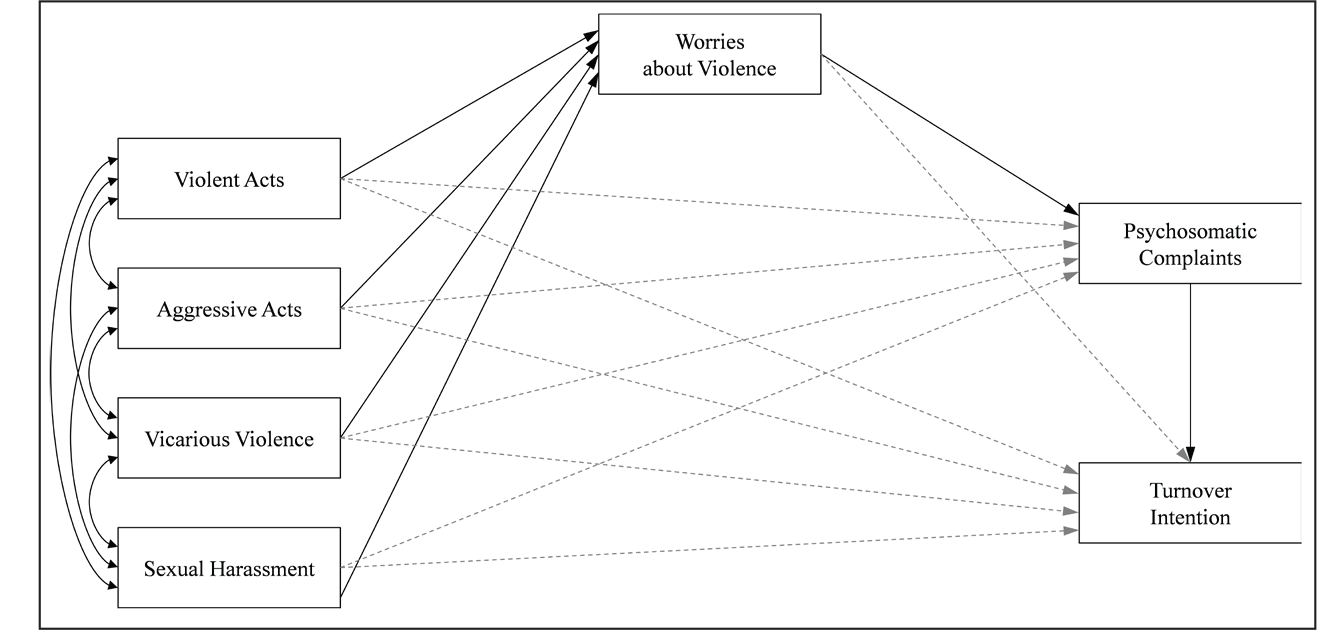
Proposed “two-step” model of consequences from exposure to violence, aggression, and sexual harassment.
The present study aims to extend previous research in four key domains: (a) We wish to expand the knowledge about exposure to harmful behaviors in an under-researched high-risk population of private security personnel, (b) We propose a more integrated and holistic examination of harmful experiences at work by testing a model, which includes multiple forms of violence, aggression, and sexual harassment, (c) We test the idea (e.g., LeBlanc & Kelloway, 2002) that worries about violence (as emotional appraisal) does not only mediate the relationship between violent acts and negative consequences but is also nurtured by vicarious violence, aggression, and sexual harassment, (d) We examine the negative process initiated by exposure to harmful behaviors at work by testing an integrated “two-step” prediction of turnover intention by worries about violence and psychosomatic complaints.
Method
As part of a funded project by the Austrian labor unions VIDA and Arbeiterkammer (AK), an online cross-sectional questionnaire was created and sent out to 500 mail addresses (union members concerned with the field). Additionally, we reached out to another 60 companies that were registered as private security companies in Austria and had no labor union affiliation. In Germany, the labor Union Verdi also distributed the questionnaire within their network. We also targeted Facebook groups that represented private security personnel to further distribute the questionnaire.
Sample
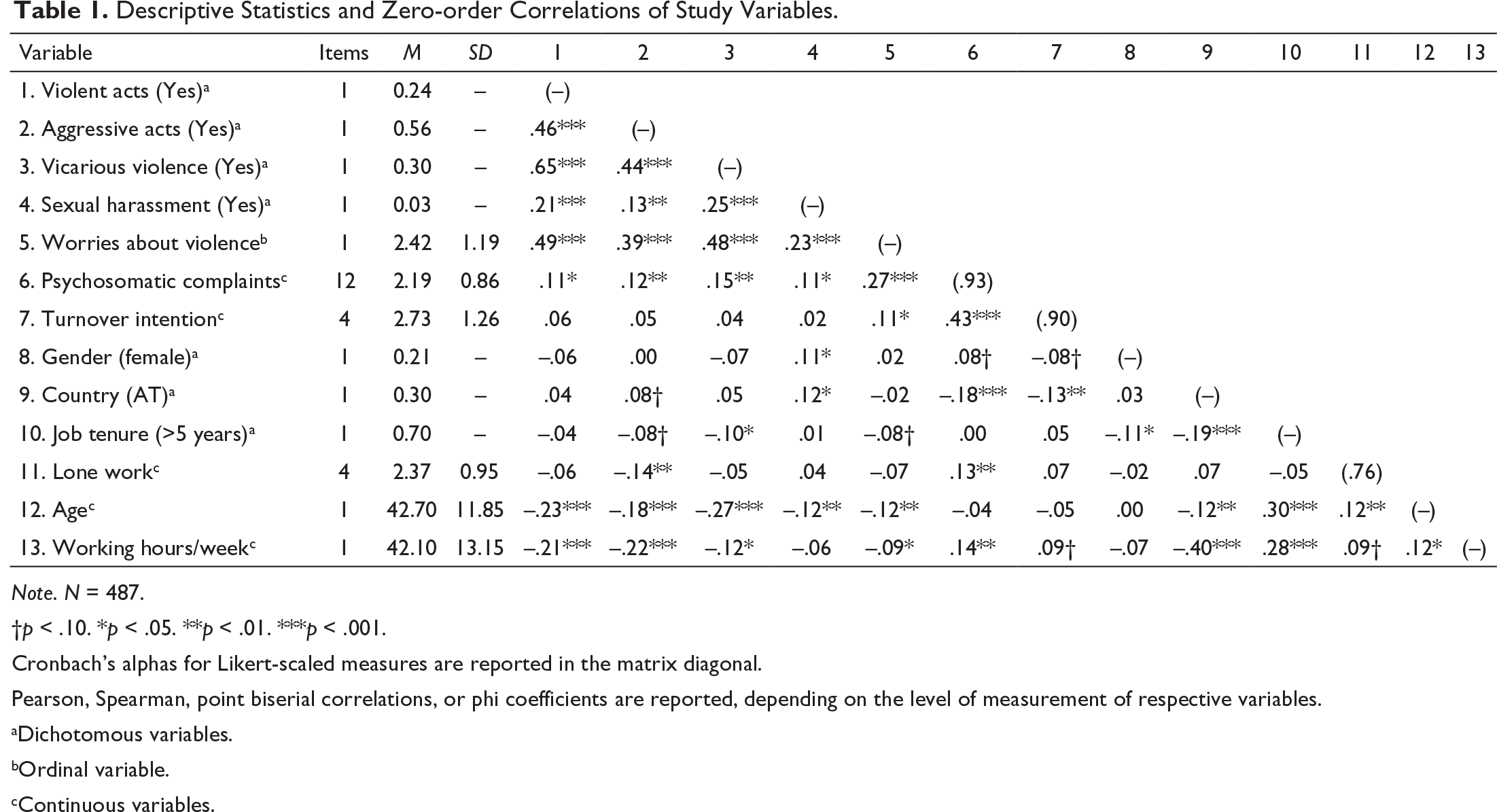
A total of 683 security guards filled in our questionnaire. After excluding sets that referred to insider (co-worker, supervisor), mixed (both insider and outsider), or unspecific (others, missing value) perpetrators on any of the measured experiences, and thus did not allow for an unambiguous allocation to organizational outsiders (Types I & II), 487 cases remained for statistical analysis. The majority of participants were male (n 386, 79.3%). The average age was 42.70 years (SD 11.9), ranging from 19 to 77 years. German security guards made up to 69.8% (n 340). A total of 70.2% of the participants (n 342) have been working for over 5 years in the field (2.6% less than 1 year, n 13) for an average of 42.10 hours per week (SD 13.15; refer to Table 1). Participants represented all common fields of operation (e.g., emergency response, money, and valuable transportation, traffic control services, bouncing) but the majority stemming from property protection & services (n 247; 50.7%), but also aviation security & others (n 110; 22.6%) and event security (n 70; 14.4%). In our sample, 23% had experienced outsider-initiated (Types I or II) violence (33 Type I; 120 Type II), 56% aggressive acts (73 Type I; 260 Type II), 30% vicarious violent acts, and 3% were sexually harassed (3 Type I; 13 Type II) over the past 12 months. A total of 19% of the respondents (n 94) reported substantial to extreme worries about violence (M 2.42, SD 1.19; 29% moderate [n 140], 22% little [n 108], 30% none [n 145]; refer to Table 1).
Descriptive Statistics and Zero-order Correlations of Study Variables.
Note. N = 487.
†p < .10. *p < .05. **p < .01. ***p < .001.
Cronbach’s alphas for Likert-scaled measures are reported in the matrix diagonal.
Pearson, Spearman, point biserial correlations, or phi coefficients are reported, depending on the level of measurement of respective variables.
aDichotomous variables.
bOrdinal variable.
cContinuous variables.
Measures
Exposure to violent or aggressive behavior and sexual harassment on duty was assessed by using respective items from the survey questionnaire of a Joint Program on Workplace Violence in the Health Sector (2003) conducted by the ILO, International Council of Nurses (ICN), the World Health Organization (WHO) and the Public Services International (PSI). Participants were asked to indicate if they had or had not been physically attacked (violent acts), verbally abused (aggressive acts), sexually harassed, or witnessed incidents of physical violence (vicarious violence) in the past 12 months, and who primarily perpetrated each behavior. It was possible to report several perpetrators (guest, co-worker, external worker, supervisor, general public, others). Worries about violence (“How worried are you about violence in your current workplace?”) were recorded on a 5-point scale (1 = “not worried at all” to 5 = “extremely worried”). We focused our attention solely on vicarious violent acts (not vicarious aggressive ones) for two reasons. Direct aggressive acts are the most prevalent in private security personnel so that witnessing aggressive acts might be so common in security guards (over a 12 months period) that little extra value would be added. Physical assaults in turn are, luckily so, less prominent in their occurrence (Greenberg & Barling, 1999; LeBlanc & Kelloway, 2002) and therefore might have a greater impact when witnessed. However, we do not postulate that witnessing, for example, aggressive acts has no adverse effects but they might be harder to detect. While the concept of vicarious violence could also include narratives about violent incidents, we solely focused on visually perceived cases since we believe them to be more emotionally troublesome as, in line with social learning theory, “hearing about—but not seeing—an event would provide the least powerful source for learning” (Dupré et al., 2014, p. 2360). This is even more so as seeing violence implies the presence of the witness, meaning that the security guard is nearby and the assault might even require him or her to react to the aggressor, which immediately heightens the risk of getting physically injured.
To assess psychological strain reactions, we measured the extent (1 = “none” to 5 = “strong”) of 12 psychosomatic complaints (e.g., “I suffer from the following complaints: dizziness, neck and back pain, etc.”) using a shortened version of the Giessen Complaint Questionnaire GBB-24 (Brähler et al., 2008) that comprised of 3 items from each of the four subscales (exhaustion, gastrointestinal complaints, head and limb aches, cardiovascular complaints). The internal reliability of the scale (α = .93) was satisfactory.
Intention to turnover was assessed by 4 items (e.g., “I am planning to leave my employer within the next 12 months”) that were adapted from Nadiri and Tanova (2010). Responses were recorded on a 5-point scale (1 = “no, not at all” to 5 = “yes, exactly”). The internal reliability of the scale (α = .90) was satisfactory.
Based on the knowledge of risk factors in association with violent or aggressive exposure or health, we also recorded the number of weekly working hours (Abedini et al., 2015), job tenure (<5 years, >5 years), age, gender, and lone work (e.g., van den Bossche et al., 2013; Leino, 2013) as potential controlling variables. The latter was measured with 4 self-developed items (e.g., “I often work alone, without other people in my immediate environment”) on a 5-point scale (1 = “not at all” to 5 = “yes, exactly”). The internal reliability of the scale (α = .76) was acceptable.
Data Analysis
We used path modeling to estimate the hypothesized model. To account for the ordinal nature of the mediating variable, we defined worries about violence as an ordered categorical variable. We estimated models in Mplus 8 by probit regressions using a mean- and variance-adjusted weighted least squares estimator (WLSMV) with theta parameterization. While the WLSMV is a robust estimator that does not assume normally distributed variables (Brown, 2006), theta parameterization is appropriate for models including a categorical variable that is both influenced by and influences another observed variable (Muthén & Muthén, 1998–2017, p. 675), as is the case with worries about violence. The threshold for statistical significance was set to .05. To evaluate model fit, we inspected various fit indices in combination with established rules of thumb for cut-offs (Di Stefano et al., 2018; Hu & Bentler, 1999). Besides the chi-square value (χ2) and its statistical significance, we used the root mean square error of approximation (RMSEA) with values below .06 indicating good fit. In addition, we inspected the 90% confidence interval of the RMSEA (CIRMSEA) and a p-value for the test of the null hypothesis that the RMSEA for the model in the overall population does not exceed .05. Furthermore, we used the weighted root mean square residual (WRMR) with values <.90 signifying good fit and the comparative fit index (CFI) and Tucker–Lewis index (TLI), where values of .95 or higher indicate good fit. Comparisons between nested models were conducted by means of chi-square difference tests. Because the analysis parameters did not allow for calculation of Akaike or Bayes information criteria, non-nested models were compared by their fit indices. Indirect effects were calculated as product indicators of respective direct paths and tested for statistical significance by means of bootstrap confidence intervals based on 100,000 bootstrap samples. Consistent with generally accepted practice (e.g., Pek & Hoyle, 2016), indirect effects were analyzed regardless of whether statistically significant total effects could be found.
Results
Correlations
Inspection of bivariate correlations of the study variables (refer to Table 1) revealed substantial positive relations between all forms of harmful behavior and worries about violence (.23 ≤ rpb ≤ .49, all p < .001). The same, albeit to a lesser magnitude, holds true for psychosomatic complaints (.11 ≤ rpb ≤ .15, .019 ≤ p ≤ .001), whereas no harmful behavior was significantly correlated with turnover intentions (.02 ≤ rpb ≤ .06, .636 ≤ p ≤ .168).
Examination of the control variables revealed that women reported sexual harassment more often (Φ = .11, p = .012). Working in Austria also had a positive association with sexual harassment (Φ = .12, p = .010) as well as negative associations with psychosomatic complaints (rpb = –.18, p < .001) and turnover intention (rpb = –.13, p = .006). Reported vicarious violence was higher with shorter job tenure (Φ = –.10, p = .027). Working alone was associated with not experiencing aggressive acts (rpb = –.14, p = .002) and more psychosomatic complaints (rpb = .13, p = .004). Age was negatively associated with all forms of harmful behavior (–.12 ≤ rpb ≤ –.27, .006 ≤ p ≤ .001) and worries about violence (rs = –.12, p = .007). The amount of weekly working hours was negatively correlated with all forms of harmful behavior except for sexual harassment (–.12 ≤ rpb ≤ –.22, .014 ≤ p ≤ .001), worries about violence (rs = –.09, p = .049) and positively correlated with psychosomatic complaints (rpb = .14, p = .003).
Direct Effects of Violence and Aggression
To test our hypotheses, we estimated two models. First, we estimated a partial mediation model that comprised all paths (solid and dashed) in Figure 1 plus the control variables. While the fit of this model could not be evaluated because it was just-identified with zero degrees of freedom (df), none of the effects indicated in dashed lines in Figure 1 reached statistical significance. Consequently, we estimated a second, full mediation model with all paths indicated by dashed lines in Figure 1 removed and only paths indicated by solid lines plus paths of controls on all dependent variables retained. This model fit the data very well, χ2(9) = 5.089, p = .826; RMSEA = .000, CIRMSEA = [.000, .031], p = .994; WRMR .142; CFI = 1.000; TLI = 1.000 (Figure 2). Since the full mediation model is nested within the partial mediation model, we computed a chi-square difference test to compare the fit between both models. The result was statistically non-significant, ∇χ2(9) = .234, p = .628, which suggests that the omitted parameters in the full mediation model (i.e., the paths indicated by dashed lines in Figure 1) did not worsen model fit compared to the partial mediation model. Comparing standardized effects and explained variances depicted in Figure 2 across both the partial and the full mediation model revealed that the former (refer to Supplementary Figure 1) showed a slightly stronger association between worries about violence and psychosomatic complaints (β = .302, p < .001), and slightly higher variance explained for turnover intention (20.9%). The remaining differences were no larger than .01 in magnitude.
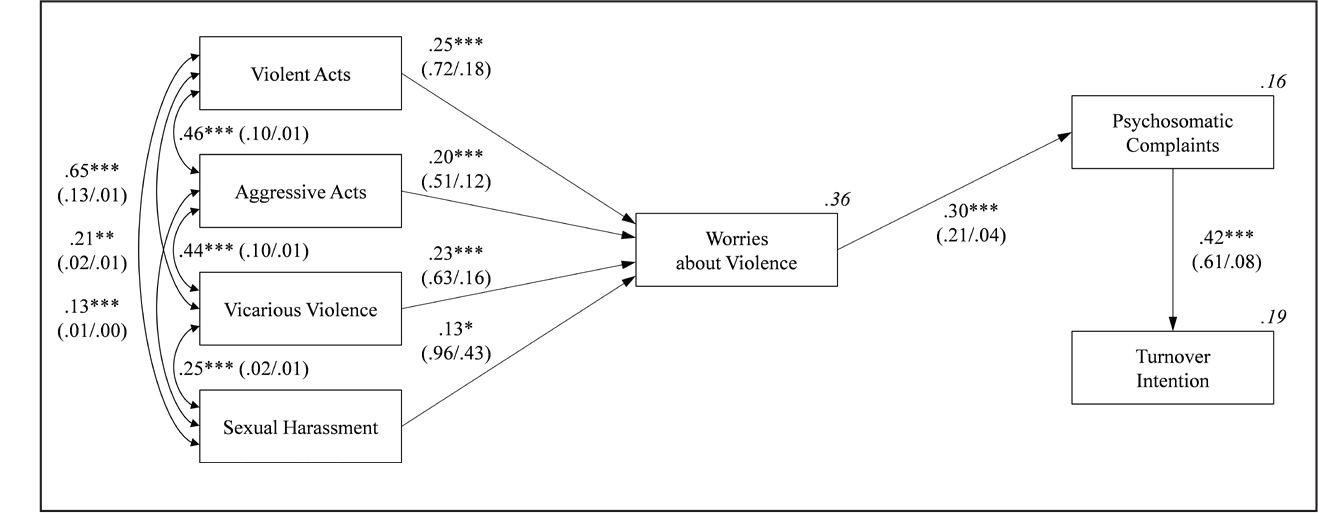
Empirical results of proposed full mediation model.
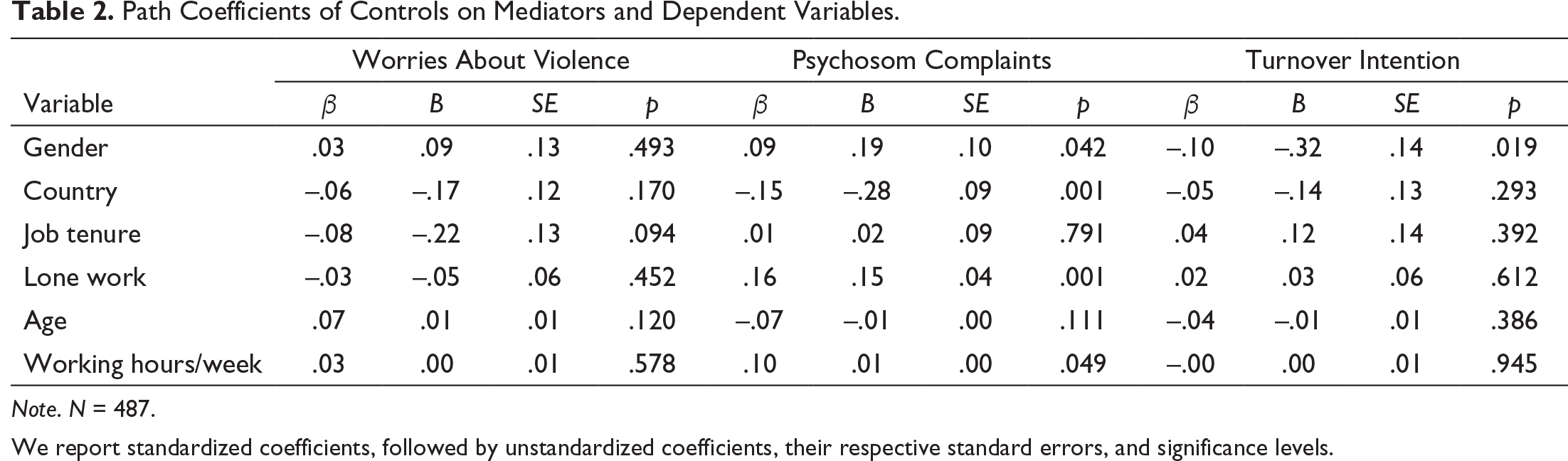
In the full mediation model (Figure 2), worries about violence were most strongly predicted by violent acts (β = .246, p < .001), followed by vicarious violence (β = .232, p < .001), aggressive acts (β = .204, p < .001), and sexual harassment (β = .134, p = .025). All effects suggested that the experience (versus non-experience) of any form of harmful behavior was uniquely associated with higher levels of worries about violence, thus confirming Hypothesis 1. Neither control variable predicted worries about violence (Table 2), albeit a small effect of less job tenure on higher levels of worries about violence approached statistical significance (β = –.081, p = .094). The four forms of harmful behavior showed substantial correlations among each other. All predictors explained 35.5% of the variance of worries about violence.
Path Coefficients of Controls on Mediators and Dependent Variables.
Note. N = 487.
We report standardized coefficients, followed by unstandardized coefficients, their respective standard errors, and significance levels.
Worries about violence were the strongest predictor of psychosomatic complaints (β = .302, p < .001), followed by lone work (β = .161, p = .001), country of work (β = –.147, p = .001), working hours (β = .103, p = .049), and gender (β = .091, p = .042; cp. Figure 2 and Table 2). These results suggest that more intense worries about violence, more frequent lone work, working in Germany (versus Austria), longer working hours, and female (versus male) gender were associated with higher levels of psychosomatic complaints, thus explaining 15.9% of its variance.
Turnover intention was strongly predicted by psychosomatic complaints (β = .416, p < .001) and also by gender (β = –.103, p = .019; cp. Figure 2 and Table 2). This means that higher levels of turnover intention were confirmed by individuals that reported more psychosomatic complaints and male participants. A total of 19.4% of the variance of turnover intention was explained by all predictors.
Indirect Effects of Violence and Aggression
We report indirect effects in Table 3. We found the effects of experiencing any form of harmful behavior on psychosomatic complaints to be fully mediated by worries about violence, which confirms Hypothesis 2. Likewise, we found that experiencing any form of harmful behavior was indirectly associated with higher levels of turnover intention through the serial mediators, worries about violence, and psychosomatic complaints, confirming Hypothesis 3. Notably, the latter indirect effects were confirmed in spite of the fact that no bivariate associations between independent variables and dependent variable could be found in the first place, a phenomenon known as indirect-only mediation (Zhao et al., 2010; cp. Table 1).
Indirect Effects of the Full Mediation Model.
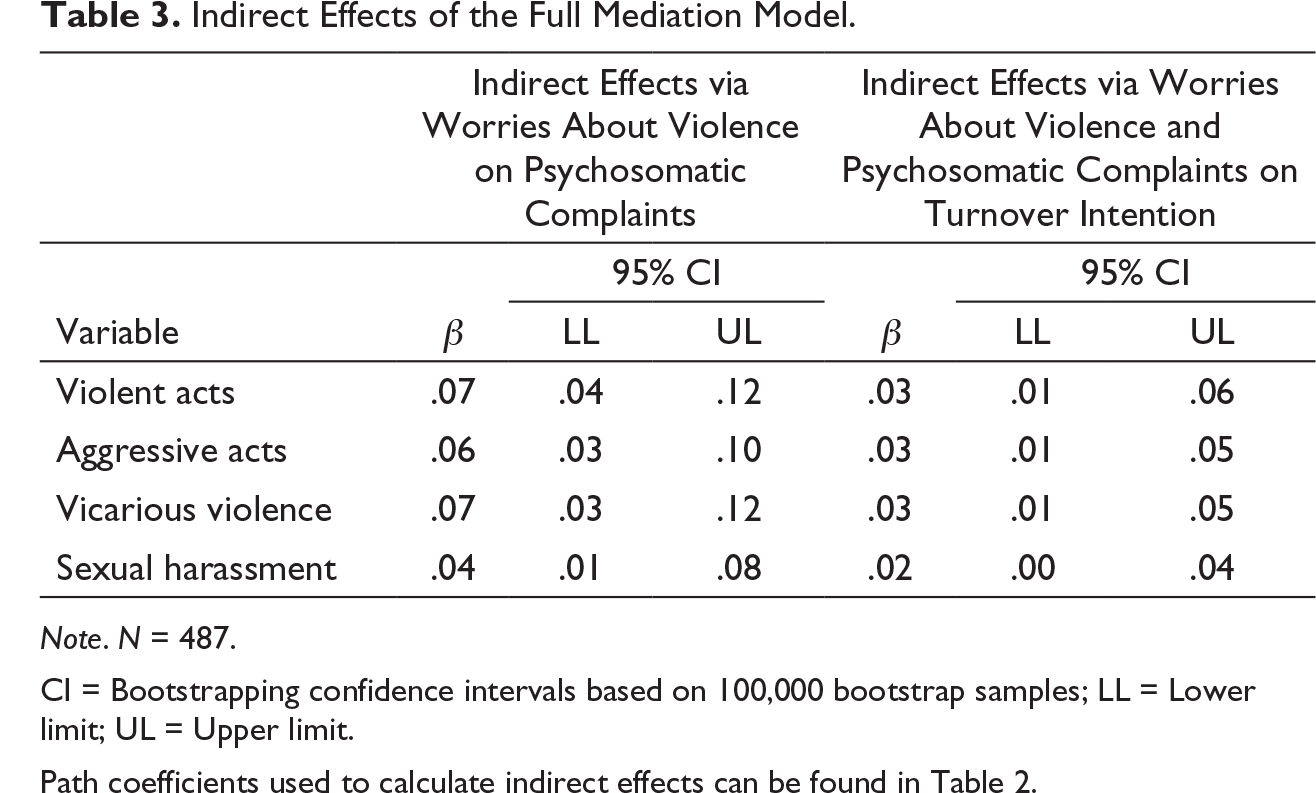
Note. N = 487.
CI = Bootstrapping confidence intervals based on 100,000 bootstrap samples; LL = Lower limit; UL = Upper limit.
Path coefficients used to calculate indirect effects can be found in Table 2.
Additional Analyses
In order to assess the performance of our hypothesized structural model against other conceivable pathways, we tested a number of alternative models. Since all of these models were not nested within our proposed full mediation model, we resorted to fit indices in order to perform model comparisons. First, we tested whether a ”single-step” model, in which worries about violence predicted both, psychosomatic complaints and turnover intention, while psychosomatic complaints did not predict turnover intention. Albeit fit indices of our proposed model were slightly better, this model also fit the data very well, χ2(9) = 4.857, p = .773; RMSEA = .000, CIRMSEA = [.000, .036], p = .988; WRMR .136; CFI = 1.000; TLI = 1.000. Furthermore, while indirect effects of all four forms of harmful behavior on psychosomatic complaints could be found in this model, indirect effects on turnover intention could not be confirmed. Second, we constructed a non-mediated model, in which the four forms of harmful behavior directly predicted worries about violence, psychosomatic complaints, and turnover intention. As was the case for the partial mediation model, this model was just-identified and could not be evaluated with model fit indices. An inspection of the effects revealed that all four forms of harmful behavior predicted worries about violence, only aggressive acts predicted psychosomatic complaints, and neither form predicted turnover intention. Third, we constructed a model in which we replaced the directional effect from psychosomatic complaints on turnover intention by a correlation. This model still exhibited good but worse fit compared to our proposed model, χ2(9) = 15.356, p = .082; RMSEA = .038, CIRMSEA = [.000, .070], p = .694; WRMR .301; CFI = .994; TLI = .950. Lastly, we tested a model in which the positions of psychosomatic complaints and turnover intention were swapped, turning the first into a mediator and the latter into a pure dependent variable. Fit of this model was unacceptable, χ2(9) = 55.546, p < .001; RMSEA = .103, CIRMSEA = [.078, .130], p < .001; WRMR .550; CFI = .958; TLI = .634. To conclude, although some alternative models also fit the data well, our proposed model exhibited the best overall fit compared to any other model tested.
Discussion
Researching different forms of outsider-initiated harmful behavior for the first time in a German-speaking sample of private security guards revealed prevalence rates substantially above the general European and National estimates (Eurofound, 2015) and might help to put those workers finally on the map of work-related health and safety initiatives. First, in our sample, exposure to violence was 12.6 times, aggression 11.2 times, and sexual harassment 1.5 times above the European average. A total of 60% of security guards experienced at least one of the harmful behaviors investigated here, which is four (three) times higher than the German (Austrian) national estimate. Congruent with established research, younger age positively predicted exposure to all forms of harmful behavior. Female gender predicted the experience of sexual harassment, as did being an Austrian guard. Additionally, the extent of weekly working hours was negatively associated with the experience of violent acts, aggressive acts, and vicarious violence. Surprisingly, less experienced security personnel recalled vicarious acts of violence more often. Newcomers might be less accustomed to perceiving harmful behavior and therefore recall it more prominently, while habituation causes more experienced guards to devote less attention to it. In addition, more experienced guards might be also more likely to hold “higher” positions where they in fact encounter less violence. Unsurprisingly, lone work was related to less frequent reports of aggressive acts. In our sample, German guards displayed higher levels of psychosomatic complaints and turnover intention when compared to Austrian guards. While the focus of the current study was not concerned with country differences, the nature of this finding could be interesting for closer investigation in future studies.
Second, regarding the central aim of this study, our proposed integrated mediated model on the consequences of exposure to violence, aggression, and sexual harassment in private security work revealed a number of interesting findings. As expected, our data were able to replicate findings by, for example, LeBlanc and Kelloway (2002) that worries about violence were influenced not only by experienced or vicarious violent acts but also by related non-physical phenomena, such as aggressive acts but also sexual harassment (Hypothesis 1). In line with previous findings of violence often being preceded by non-physical harmful behaviors (e.g., Barling, 1996; Neuman & Baron, 1998), the reported finding underlines that people also naturally acknowledge this, as harmful behaviors do not need to consist of a physical component in order to increase worries about physical harm in the future.
Additionally, we were able to replicate the findings of previous studies (e.g., Mueller & Tschan, 2011; Rogers & Kelloway, 1997) that identified fear about future violence as a central mediator in the transmission process from violent and aggressive exposure at work to negative consequences, that is, psychosomatic complaints and turnover intention (Hypothesis 2). Contrary to previous research, we used the term “worries” over “fear” as it generally connotes less serious reactions. Linguistically we understand worries as a preliminary stage to fear and thus applying to a wider range of emotional cognition. Based on the finding that stereotypical “male” occupations like law enforcement tend to trivialize violent experiences at work (Geoffrion et al., 2015) we aimed for a greater acceptance to report worries rather than fear, which some individuals may connote to admitting a personal weakness.
Third, our findings extend previous research (e.g., Dupré et al., 2014; LeBlanc & Kelloway, 2002) by showing, that turnover intention—while being unrelated to any form of harmful behavior via a direct path—may be predicted by all four forms indirectly via worries about violence and psychosomatic complaints (Hypothesis 3). Note that we could not confirm a mediation process on turnover intention via worries about violence alone in the first alternative model. This provides evidence for our hypothesized proximal and distal order of negative health and behavioral consequences of violent, aggressive, or sexual harassing experiences and therewith sheds some light into the behavioral black box between exposure to harmful behaviors at work and intentions to leave the field. Precisely, this supports the theoretical assumption that the exposure to various forms of harmful behavior at work does not necessarily imply (psychological) health impairments or intentions to leave the job. Rather, it seems that the emotional evaluation of negative experiences as threatening and/or harmful causes worries about future violence that over time manifest in strain reactions such as psychosomatic complaints, which in turn strengthen intentions to leave the job. This observation holds valuable implications for, but not limited to, private security organizations, as this field is also known to offer its staff little or no support (e.g., trainings, psychological support) on how to handle critical incidents (Leino, 2013). While the exposure to harmful behaviors appears inextricably interwoven with the livelihood of private and public security, law enforcement, as well as many other high-risk occupations, employers can create measures and offers (e.g., de-escalation trainings, staffing in high-risk situations) in order to avoid high-risk work situations and reduce their employees’ worries concerned with such experiences. From this point of view, we would like to encourage researchers to investigate other potentially important moderators at different levels, such as the safety climate (e.g., van den Bossche et al., 2013), or level of training (e.g., Leino et al., 2011; Zach et al., 2007).
Fourth, while the proposed model revealed an interesting and plausible path for the sequential “two-step” prediction of turnover intention by violence, aggression, and sexual harassment via worries about violence and psychosomatic complaints, at least one alternative model fit the data equally well. Across all fit parameters considered, the alternative ”single-step” model was hardly distinguishable from the proposed model and confirmed the nonexistence of a sequential “single-step” prediction of turnover intention by violence and aggression via worries about violence alone. This confirms the importance of considering the complete “two-step” pathway in any endeavor to understand the consequences of experiencing harmful behaviors in private security work. In this context, it must be noted that in order to fully understand this process, future studies should also investigate the role of personal (e.g., marital status, life satisfaction, employment type; Chen et al., 2016) or attitudinal consequences (e.g., Barling, Kelloway, & Frone, 2005), such as job satisfaction, organizational or affective commitment, on turnover intention (Wang et al., 2006). However, the present study focused on employees’ health impairment since it might be more severe and, thus, harder to reverse than worsened job attitudes, which are largely driven by human motivation and volition.
However, the presented results must be interpreted with caution, as there are several limitations to note. Most importantly, our data stem from a cross-sectional sample of private security guards. The causal claims made here must be regarded with caution and should be replicated by suitable study designs that allow for a more robust examination of longitudinal processes. This is important since we hypothesized and tested worries about violence, psychosomatic complaints, as well as turnover intention as symptoms at different (more proximal or distal) stages of a process initiated by exposure to harmful behaviors at work. A longitudinal design in future studies with at least four different measurement occasions would help to test the validity of our findings and more adequately account for the temporal order of constructs. The distribution of gender and fields of work in our sample seem to be approximately representative, as they correspond to representative distributions of the sector in Germany (Bundesverband der Sicherheitswirtschaft, 2019). In this context, it is important to note that the presented data illustrate an average of the diverse operational fields of private security work. Work fields potentially vary in their frequency of contact with organizational outsiders and consequently in their exposure to harmful behaviors. However, by incorporating lone work as covariate, we are confident to have limited possible bias at least statistically. However, the same security staff typically tends to be hired for diverse operations, which means that an individual working in the field tend to cover various operational fields during their weekly duties. Nevertheless, it seems very likely that bouncers or personnel mainly assigned to work at, for example, public events, especially those that take place at night (e.g., Leino, 2013; Vaez et al., 2014), include (young) intoxicated clientele (e.g., LeBlanc & Barling, 2005; van den Bossche et al., 2013), or loud music (Monaghan, 2003), will be much more frequently exposed to violence and aggression (and thus suffer from increased negative impacts) than colleagues mainly assigned to, e.g., property protection, where violent incidents might mainly occur in the presumably less frequent case of burglaries. This means that a more in-depth examination of security guards’ experiences of violence and aggression as a function of working in different operational fields over time—for example, by employing the method of experience sampling—remains to be conducted by future research.
We are aware that assessing the experience versus non-experience of harmful behaviors with a dichotomous response scale disregards potentially important aspects of intensity and frequency of experiences. Nevertheless, we contend the use of this instrument had two major advantages. First, the main global players in workplace safety and health agree on the underlying principles and definitions of the selected constructs. Second, the dichotomous structure of items possibly enhanced reliability of measurement because asking participants whether or not they experienced any of the harmful behaviors during a given period of time should be less prone to various forms of bias (e.g., recall, social desirability) than items targeting intensity and/or frequency. On the downside, however, this response format did not account for a more fine-grained examination of how frequencies or perceived severity influenced the extent of worries about violence. Recent research of van Reemst and Jongerling (2019) makes an interesting case that measuring external workplace aggression by a frequency index (rather than asking for frequency and severity) constitutes a promising approach in this regard. Due to what was mentioned above, we still believe single-items hold strong advantages when assessing harmful behaviors at work. However, we would encourage future researches to consider frequencies alongside more differentiated measures based on more systematic conceptual distinctions between aggression and violence (e.g., aggression and violence in sexual versus non-sexual contents). This could help to gain additional information from the data analyses and deepen the understanding of the impact relationships.
Furthermore, while the instrument allowed us to establish the perpetrator-victim relationship, the 12-months retrospective resulted in multiple answers from some of the test persons. Precisely, in some cases, participants reported both insiders as well as outsiders to be perpetrators of violence, aggression, or sexual harassment. In order to obtain clear findings with regard to the perpetrator category, as suggested by previous research (e.g., Barling et al., 2009; Chang & Lyons, 2012; LeBlanc & Kelloway, 2002; Neuman & Baron, 1998), we excluded those cases from statistical analyses. However, it must be noted that this conservative selection most certainly leads to an underestimation of actual prevalence rates for violence, aggression, and sexual harassment.
Simultaneously, asking about the exposure to different, but partly overlapping forms of violence and aggression in the current design might also bias results. Precisely, if participants categorized the same incident as being both aggressive and sexually harassing, they might have ticked both boxes while considering the same single incident. However, because prevalence rates in our study were only marginally higher compared to statistics of sexual harassment (Eurofound, 2015) and similar to previous studies on violence and aggression in this field (e.g., Dang et al., 2016; Leino et al., 2011b) or in other high-risk professions (e.g., Spector et al., 2014; Tiesman et al., 2013), we assume that multiple nominations of incident type is an unlikely source of bias. However, future research should try to overcome these issues by applying a design that allows for per-incident reporting (e.g., diary studies) with an unambiguous assignment of perpetrators as well as type of experience.
Finally, while we focused our attention only on witnessed violent acts, potential effects of vicarious aggression as well as narratives about harmful behaviors in the workplace remain to be investigated in future studies.
Conclusion
This study set out to determine negative consequences of work-related exposure to four forms of harmful behaviors in private security services as an under-researched high-risk occupation. A robust finding that emerged from our data is that worries about violence play a central role in predicting negative health outcomes such as psychosomatic complaints (over and above different harmful behaviors) and turnover intention. Generally, this holds valuable implications for further research on workplace violence and aggression, concerning especially the assessment of violent and aggressive events as well as the development of prevention programs. We suggest that high-risk occupations, in our case private security personnel, could benefit from continuous monitoring and supervision of violent and aggressive acts at work. Moreover, adequate training (e.g., by use of critical incident techniques) on handling difficult circumstances is needed to get more insight into specific situational and behavioral risk factors in order to prevent health impairments and to address high turnover rates as a central problem for organizations providing security services.
Supplemental Material
Supplemental Material - Consequences of Exposure to Violence, Aggression, and Sexual Harassment in Private Security Work: A Mediation Model
Supplemental Material for Consequences of Exposure to Violence, Aggression, and Sexual Harassment in Private Security Work: A Mediation Model by Alexander Herrmann, Christian Seubert, Jürgen Glaser, in Journal of Interpersonal Violence
Footnotes
Declaration of Conflicting Interests
The author(s) declared no potential conflicts of interest with respect to the research, authorship, and/or publication of this article.
Funding
The author(s) disclosed receipt of the following financial support for the research, authorship, and/or publication of this article: This work was supported by the doctoral scholarship at the University of Innsbruck.

Author Biographies
References
Supplementary Material
Please find the following supplemental material available below.
For Open Access articles published under a Creative Commons License, all supplemental material carries the same license as the article it is associated with.
For non-Open Access articles published, all supplemental material carries a non-exclusive license, and permission requests for re-use of supplemental material or any part of supplemental material shall be sent directly to the copyright owner as specified in the copyright notice associated with the article.
