




Abstract
Driven largely by the unequal distribution of power, female sex workers (FSW) globally bear a disproportionately high burden of HIV, sexually transmitted infections, and interpersonal violence. Prior literature has identified a number of multi-level factors that may serve to constrain FSWs’ agency, or their ability to define and take action to realize goals. Among these are work-based violence and substance use, which are potentiated by the criminalization of sex work and structural vulnerability. Quantitative research related to U.S.-based FSWs’ own sense of agency, as well as the barriers that may impede it, is sparse. We sought to identify patterns of various threats to agency and explore to what extent they were associated with perceived agency among a cohort of 381 FSW in Baltimore, Maryland, United States, using latent class analysis. Latent class indictors were past-six-month experience of client-perpetrated sexual violence, client-perpetrated physical violence, homelessness, food insecurity, arrest, daily crack-cocaine use, and daily heroin use. Perceived agency was measured using the short form of the Pearlin Mastery Scale. We identified three typologies of threatened agency among women in our sample: a “threatened by structural factors, drug use, and violence” class, a “threatened by structural factors and drug use” class, and a “less threatened” class. Mean perceived agency score was significantly lower for the class characterized by client-perpetrated violence than for either of the other classes. This suggests violence, in the context of deeper, structural power imbalances embedded in hunger, homelessness, and drug use, may dramatically reduce one’s sense of agency and operate as a critical barrier to empowerment. Our study adds important insights to the broader FSW community empowerment literature and supports the need for interventions to bolster both individual and collective agency among U.S.-based FSW, including interventions to prevent sex work-related violence.
Background
Globally, female sex workers (FSW) continue to bear a disproportionate burden of HIV and sexually transmitted infections (STI), with global estimates of 10.4% HIV prevalence among FSW and 13.5 times greater odds of HIV than women of reproductive age overall (Baral et al., 2012; Shannon et al., 2018). This disparity is largely attributable to macro-level systems and structures, in which “unequal power” shapes “unequal life chances,” rendering certain groups, like FSW, more vulnerable to a variety of harms (Galtung, 1990). The marginalization of FSW at the macrostructural level, through factors like the criminalization of sex work, is institutionalized in many aspects of the environments where they live and work, including workplace violence. It has been estimated that, globally, as many as 67% of FSW have ever experienced physical sex work-related violence, and as many as 54% have ever experienced sexual sex work-related violence (Deering et al., 2014). This, alongside other individual, interpersonal, and structural factors, constrains FSWs’ agency and inhibits their ability to make decisions that reflect physical and emotional autonomy, including engagement in protective health behaviors, such as consistent condom use (Rhodes et al., 2012; Shannon et al., 2014). Such constraint is understood to be key to the disparate adverse health outcomes observed among FSW (Rhodes et al., 2012; Shannon et al., 2014). We sought to identify patterns in the co-occurrence of violence and other constraining factors among a street-recruited cohort of FSW in Baltimore, Maryland, and examine their associations with perceived agency.
Agency is the ability to define one’s goals and take action to realize them (Kabeer, 1999). Practically, it is the ability to make choices and act in accordance with what one desires to do without impediment (Blanchard et al., 2013; Kabeer, 1999; Mosedale, 2005). Where sex work is illegal, FSWs’ agency, or lack thereof, has been central to discussions about FSW for decades, with perspectives that range from seeing FSW as powerless and exploited in the context of overwhelming structural forces (Farley & Barkan, 1998; Raymond, 1998) to their being portrayed as rational neoliberal agents whose engagement in sex work is based solely on a weighing of employment options against individual goals, free from external pressure, and choosing sex work (Kempadoo, 2003; Vanwesenbeeck, 2001). Others, however, have suggested this is a false dichotomy and that the presence of multi-level factors that constrain agency and influence behavior does not preclude the possibility of individual choice related to engagement in sex work and other contexts (Giddens, 1984; Rhodes et al., 2012; Shannon et al., 2014).
Prior work has highlighted the complex interplay between FSW agency and structure/environment and identified a number of such constraining factors that are present in the daily lives of many FSW at structural, interpersonal, and individual levels (Footer et al., 2017; Leddy et al., 2018; Rhodes et al., 2012). In the United States, the criminalization of sex work is a pervasive environmental feature that constrains agency through the violation of bodily self-determination, often at the hands of police, leaving little control over work environments and sexual exchanges and limiting legal employment, housing, and benefits (Decker et al., 2015; Vanwesenbeeck, 2017). Where sex work is criminalized, FSWs are subject to frequent police encounters, both “routine” (e.g., arrest) and abusive (e.g., verbal harassment, sexual assault, and exploitation). Both types of policing practices have been associated with adverse outcomes for FSW, including police and client violence and HIV and STI, via inconsistent condom use (Footer et al., 2019; Footer et al., 2016; Platt et al., 2018; Sherman et al., 2015).
Street-based FSWs are structurally vulnerable, meaning their social position—marked by structurally driven patterned socioeconomic power imbalances and discrimination—renders them more prone to experiencing a variety of harms (Quesada et al., 2011), and this amplifies both the occurrence and impact of violence. Structural vulnerability can manifest at the individual level as co-occurring economic and social disadvantages that constrain an individual’s choice and opportunity. For example, poverty, financial insecurity, housing instability, food insecurity, and history of arrest have all been directly associated with accepting more money for unprotected sex, inconsistent condom use with clients, and, subsequently, HIV/STI, as structural vulnerability constrains sexual agency (Lim et al., 2019; Reilly et al., 2015; Shannon et al., 2015; Sherman et al., 2019). Structural vulnerability also more broadly influences and frames one’s life choices and decision-making (Rhodes et al., 2012). The illegality of sex work both potentiates the impact of and amplifies these vulnerabilities.
As noted above, interpersonal violence is pervasive in the lives and work environments of many FSW. Client-perpetrated violence has been identified in settings around the globe as a major constraint on FSWs’ agency, including the ability to control the terms of sexual encounters (Choi & Holroyd, 2007; Decker et al., 2013; Rushing et al., 2005). Although such violence is immediately interpersonal, it is driven in large measure by structural factors such as criminalization, stigma, and structural vulnerability, and FSW may be hesitant to report abuse because of fear of adverse police response in environments where such violence is normalized (Decker et al., 2013; Dewey & Germain, 2014; Erausquin et al., 2015; Sherman et al., 2015). Experiences of work-based violence are highly prevalent among FSW, whether considered as a lifetime or recent exposure. A systematic review found that 19–44% of FSW globally had experienced sex work-related physical violence in the past year, and 15–31% had experienced work-related sexual violence (Deering et al., 2014), and FSW in various global settings have spoken about their inability to assert their own needs and desires in their interactions with clients given the pervasive threat and frequent experience of violence (Decker et al., 2013; Lim et al., 2015; Rushing et al., 2005). A recent study of street-based FSW in Baltimore found that 22% had experienced client-perpetrated violence in the past three months (Footer et al., 2019).
The high degree of overlap between sex work and drug use in the United States and other settings also plays a critical role related to agency at the individual level. Drug use has been reported both as common motivation for entry into sex work (Ditmore, 2013; Vanwesenbeeck, 2001) and as a coping mechanism among FSW (Romero-Daza et al., 2003). In a prior sample of street-based sex workers in Baltimore, 70% reported daily heroin use, 62% daily crack-cocaine use, and 12% daily use of prescription opioids or benzodiazepines (taken not as prescribed; Footer et al., 2019). A total of 86% of the same sample reported that they currently engaged in sex work in order to get drugs (Sherman et al., 2019). Intoxication and the need to access drugs to avoid withdrawal can interfere with one’s ability to make and act on choices and may alter willingness and ability to engage in protective sexual behaviors (Cusick, 2006; Ditmore, 2013; Rusakova et al., 2015; Shannon et al., 2008; Sherman et al., 2017). For example, participants in a qualitative study in Vancouver, Canada described experiencing a loss of control over their work in the face of “dopesickness” or withdrawal (Shannon et al., 2008), and a recent study in Baltimore found that FSW who reported being intoxicated during sex with clients were more likely to experience client condom refusal or removal, leading to inconsistent condom use with clients (Decker et al., 2019).
Yet, even in an environment where FSWs are constrained by a number of structural, interpersonal, and individual drivers that eclipse their agency, individual agency is never entirely absent, and individuals retain the potential to alter structure (Giddens, 1984; Rhodes et al., 2012). The transformation of that potential into actions and outcomes, however, may necessitate a process of empowerment. Empowerment is an ongoing multi-dimensional social process whereby those who have previously lacked power to make, act on, and achieve choices acquire the power and ability to do so (Alsop & Heinsohn, 2005; Carr, 2003; Kabeer, 1999). Multi-level community interventions that seek to empower FSW have shown great promise in addressing social, structural, and environmental determinants of HIV and have led to reductions in sexual risk, stigma, violence, and HIV incidence and prevalence among FSW in various global settings (Kerrigan et al., 2015; Kerrigan et al., 2013). They build upon theoretical and empirical literature that emphasizes the importance of social capital, social cohesion, and the formation of collective identity as central in the cultivation of agency for FSW and other marginalized populations, and on a recognition of mobilization and advocacy as positive coping strategies for FSW (Abel & Fitzgerald, 2010; Carr, 2003; Freire, 2000; Kerrigan et al., 2015). Community empowerment interventions operate at a collective level with the objective of increasing “individual and community control, political efficacy, improved quality of community life, and social justice (Wallerstein, 1992, p. 198).” Individual agency, then, remains foundational to community empowerment, linking individual-level empowerment to groups that can influence structural factors (Swendeman et al., 2009).
In the public health literature on FSW, discussions of agency often emphasize consistent condom use as a reflection of agency, but agency is defined by the ability to make less constrained self-defined choices, rather than specific externally predetermined behavioral or other outcomes (Kabeer, 1999); it cannot be measured in individual behaviors. In relation to one’s belief in their ability to define and act upon goals—or perceived agency—Mosedale argues, “In a sense, all power starts from here—such assets are necessary before anything else can be achieved” (Mosedale, 2005, p. 240). Therefore, in seeking to address health behaviors or outcomes, or to promote social and structural change, an understanding of what drives individual perceived agency is critical. Yet, little research exists related to U.S.-based FSWs’ own sense of agency and ability to control their lives, as well as the barriers that may impede it. In advance of a community-level empowerment intervention, we sought to identify typologies or subgroups of individuals with similar patterns of such hypothesized barriers, or threats, to agency and explore their associations with perceived agency among a cohort of FSW in Baltimore to help inform targeted intervention and policy.
Methods
Study Design and Recruitment
The current analysis utilizes baseline survey data from the ongoing Enabling Mobilization, Empowerment, Risk reduction and Lasting Dignity (EMERALD) study, which is a prospective two-group non-randomized trial to assess the efficacy of a structural community-level intervention on HIV and STI cumulative incidence among FSW in Baltimore, Maryland. The intervention includes a drop-in center in West Baltimore that offers clients who self-identify as women (regardless of sex assigned at birth) low-barrier health and social services, a safe space to relax and socialize, and laundry and shower facilities, among other services. Extensive outreach activities are also conducted in the surrounding areas. Detailed description of the EMERALD study and intervention is forthcoming (Silberzahn et al., under review).
The sample was recruited through targeted sampling, a method we have employed for the same population previously (Allen et al., 2019). Briefly, we identified hot spots of street-based sex work activity throughout Baltimore City by conducting geospatial analyses of sex work and drug arrest data as well as 911 calls for prostitution, in addition to primary data collection through windshield tours and stakeholder discussions. This resulted in 10 recruitment zones—6 from the geographic area around the drop-in center (intervention group) and 4 from other parts of Baltimore City (control group)—from which participants were recruited during randomly selected times, locations, and days.
Study eligibility criteria included: (a) aged 18 or older, (b) cisgender woman, (c) sold or traded oral, vaginal, or anal sex “for money or things such as food, drugs, or favors” three or more times in the past three months, and (d) willing to provide contact information for follow up visits. Between September 2017 and January 2019, study staff approached women in designated locations at various times of the day and night using a mobile van and screened those who were interested in participating in the van. Eligible respondents received additional information about study procedures, and staff obtained written informed consent. Baseline study visits included a 50-minute ACASI survey, including items about demographics, sex work history, drug use, and psychosocial measures, a staff-administered oral HIV test, and self-administered vaginal swabs for gonorrhea and chlamydia. Pre- and post-HIV test counseling, as well as test results and referrals, as needed, were given during the study visit. Participants received $75 USD for the baseline visit. Study procedures were approved by the Johns Hopkins Bloomberg School of Public Health Institutional Review Board.
The full study sample included 385 women, with data from 381 included in analyses described here because n = 4 were missing data on at least one item comprising the dependent variable scale (see below).
Measures
Dependent variable/distal outcome.
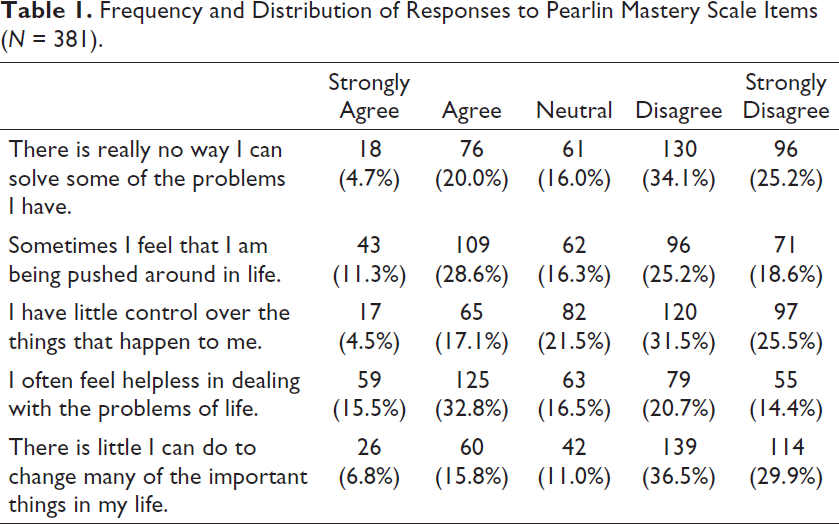
The outcome of interest, perceived agency, was measured by a modified version of the Pearlin Mastery Scale, which assesses how much an individual perceives their life as being under their own control or controlled by some external force (Pearlin & Schooler, 1978), with higher scores indicating greater perceived agency. This scale has been used globally in studies of people living with HIV and people who use drugs (Gibson et al., 2011; Kendler & Myers, 2015), as well as a U.S. study of FSW (Buttram et al., 2014). In an exploratory factor analysis of the original 7-item scale in our study data, two factors emerged, one of which contained the same 5 items (all negatively worded) that have been used as a short form of the scale in a number of other studies and surveys (Clench-Aas et al., 2017; Gallo et al., 2007; Korkeila et al., 2007). The other factor contained only two positively worded items, and, because we found no precedent for using those two items as a separate scale, we excluded them. In this analysis, based on typical and recommended use of the scale (Clench-Aas et al., 2017; Pearlin & Schooler, 1978), we used a continuous scale score, which was also supported by results of a Shapiro–Wilk test of normality. The resulting scale had satisfactory internal reliability (Cronbach’s alpha = .80) and a possible score range of 5–25. The items used for scoring and response frequencies are listed in Table 1.
Frequency and Distribution of Responses to Pearlin Mastery Scale Items (N = 381).
Barriers to agency.
We examined clusters of seven frequently reported individual, interpersonal, and structural experiences and behaviors in the lives of U.S.-based FSW that prior literature has suggested are indicators of threatened agency and that are known to frequently co-occur (Brantley, Kerrigan, et al., 2017; Footer et al., 2019; Lim et al., 2019; Shannon et al., 2008). Each indicator was a binary (yes/no) variable, indicating whether a participant reported having experienced each of the following in the past six months: homelessness and food insecurity (defined as being hungry one or more times per week), which are manifestations of structural vulnerability; arrest for any reason; client-perpetrated physical violence (defined as being physically hurt or threatened or hurt with a weapon) and sexual violence (defined as use of physical force to make respondent have unwanted vaginal or anal sex; Decker et al., 2014; Straus & Douglas, 2004); daily heroin use; and daily crack-cocaine use. We separated heroin and crack because prior literature has found different risk profiles associated with use of each substance and we, therefore, wanted to allow for the possibility of clustering differently with other indicators (Lejuez et al., 2005).
Covariates.
Based on agency’s complex intersections with identity, personal history, race, socioeconomic status, and sexuality (Logie & Daniel, 2016), we controlled for a number of variables in our model: race/ethnicity (White vs Black, indigenous, or person of color [BIPOC] 1 ), age (continuous), educational attainment (less than high school diploma vs high school diploma or equivalent [GED]), sexual orientation (heterosexual vs sexual minority, for example, lesbian, gay, bisexual, queer), relationship status (single vs in a relationship/married), and age at sex work entry (18 years or older vs under 18 years).
Analysis
We first conducted descriptive analyses to assess the prevalence or mean of each indicator of threatened agency and covariate, as well as perceived agency. Bivariate linear regression analyses were then used to estimate unadjusted associations between each of the covariates and perceived agency outside the latent class model in which they were used as control variables.
We conducted a latent class analysis (LCA) with the indicators (N = 7) detailed above in order to identify subgroups of participants based upon which barriers to agency they reported and patterns in how those factors clustered or co-occurred (Goodman, 1974; Lazarsfeld & Henry, 1968). LCA is a person-centric method to latent variable modeling that focuses on understanding people more holistically than is possible with single variables or scores; through this approach, we seek to identify typologies that describe real people and their experiences. First, we estimated and compared fit statistics for a series of models with 1 to 5 classes. To select a preferred model, we assessed Akaike Information Criteria (AIC), Bayesian Information Criteria (BIC), and sample size-adjusted BIC (aBIC), for which smaller values indicate better fit, as well as log likelihood, for which larger values indicate better fit. Vuong–Lo–Mendell–Rubin Likelihood Ratio Tests (VLRT) and Bootstrapped Likelihood Ratio Tests (BLRT) were used to test each model against a model with one fewer class. Significant p-values for the VLRT and BLRT indicate that the larger model is preferred (Nylund et al., 2007). Although not explicitly considered for model selection, we also assessed the classification quality of each model using average latent class posterior probabilities, which measure the overall likelihood that individuals assigned to a particular class were correctly assigned, and model entropy, which is an overall measure of classification precision (values >.8 indicate good classification quality; Clark & Muthén, 2009). We selected the final number of classes based on fit statistics, as well as interpretation of the meaning of the classes.
Only participants who responded to all five perceived agency items were included in regression analyses, resulting in a sample size of 381 (N = 4 removed because of missing data). We tested associations between latent class membership and perceived agency, adjusting for covariates, using the BCH method of weighted multiple group analysis (Asparouhov & Muthén, 2014; Bakk & Vermunt, 2016). Associations between latent classes and agency were adjusted for age, race/ethnicity, sexual identity, educational attainment, relationship status, and being a minor at sex work entry, as described above, as well as study arm (intervention vs control). We estimated change in odds of membership in each latent class versus each other latent class per one-unit increase, or presence versus absence, of each covariate. A Wald Test was used to identify overall differences in perceived agency scores between latent classes, and we conducted pairwise tests to identify any significant differences between each pair of latent classes. Figure 1 presents the adjusted latent class regression distal outcome analysis model. Analyses were conducted using Mplus8 (Muthen & Muthen, 1998–2017).
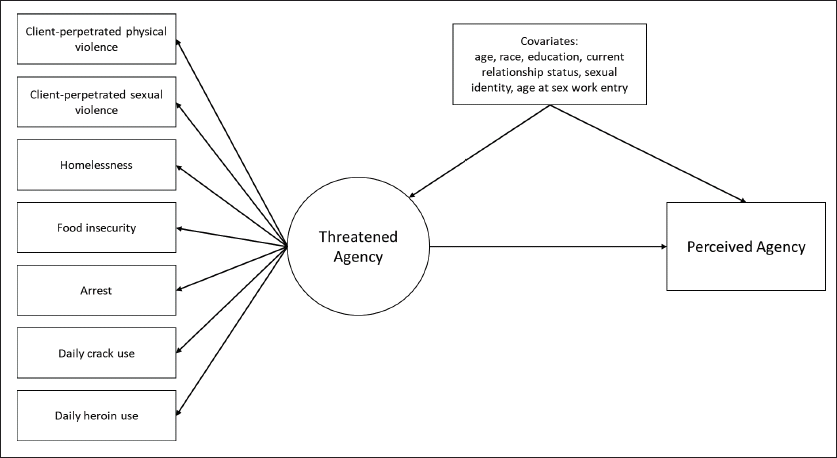
Latent class analysis with distal outcome model.
Results
Sample Description and Bivariate Associations
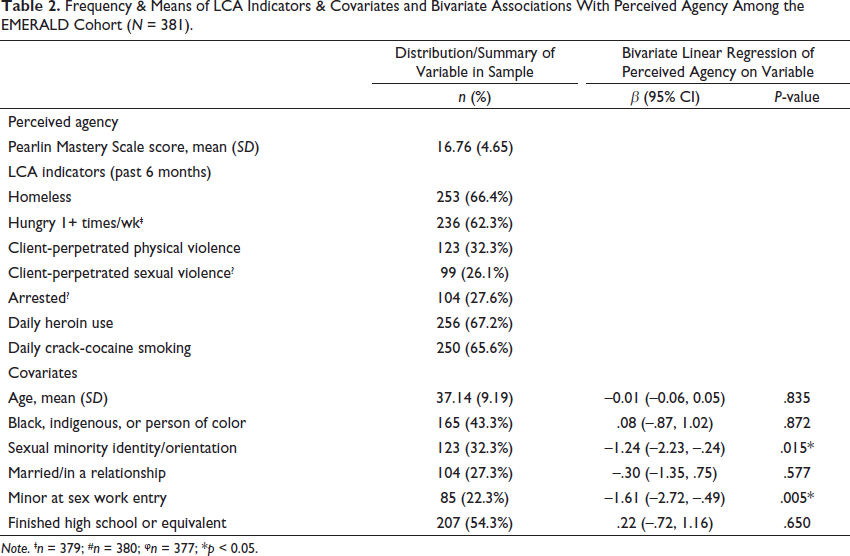
The mean (SD) age in the sample was 37.14 (9.19) years (Table 2). Nearly half (43%) identified as being BIPOC (36% Black only and 7% multiracial or any other non-White race/ethnicity), 32% identified as a sexual minority, more than a half (54%) had finished high school or a GED, and 27% were married or in a relationship. Nearly a quarter (22%) had initiated sex work when they were minors. Among the full sample, the mean (SD) perceived agency score was 16.76 (4.65), with scores ranging from 5 to 25.
Frequency & Means of LCA Indicators & Covariates and Bivariate Associations With Perceived Agency Among the EMERALD Cohort (N = 381).
Note. $n = 379; #n = 380; φn = 377; *p < 0.05.
Participants had high rates of structural vulnerability, with two-thirds (66%) reporting homelessness and 62% reporting food insecurity in the past 6 months. More than one-quarter of women (28%) reported recent arrest; 32% and 26% reported recent client-perpetrated physical violence and sexual violence, respectively. Daily heroin use and daily crack use were reported by 67% and 66% of the sample, respectively. Among the examined covariates, two were significantly and negatively associated with agency in bivariate linear regression models (Table 2): sexual minority identity (
Latent Class Analysis
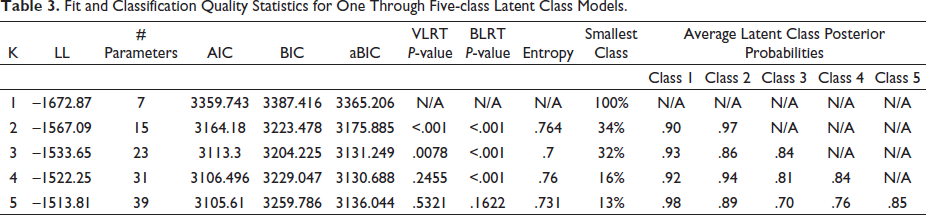
Table 3 summarizes the fit and classification quality statistics for each model estimated during the class enumeration procedure. Based on fit statistics alone, either a three-class or four-class solution could have been justified, with BIC and VLRT favoring three classes and aBIC and BLRT favoring four classes; entropy and average posterior probabilities were also acceptable/good for both models. Taking substantive interpretation into account, we selected and proceeded with three classes of threatened agency: less threatened, threatened by structural factors and drug use, and threatened by structural factors, drug use, and violence. Conditional probabilities of the different indicators, defined as the probability of an individual member of a given class experiencing each indicator, are displayed in Figure 2. The less threatened (LT) class (35% of sample, based on most likely class assignment) was characterized by comparatively lower likelihoods of structural vulnerability, drug use, client-perpetrated violence, and arrest. The threatened by structural factors and drug use (SD) class (32%) was also characterized by low conditional probabilities of client-perpetrated violence, but high probabilities of daily drug use and structural vulnerability and moderate probability of arrest. The threatened by structural factors, drug use, and violence (SDV) class (33%) was characterized by high conditional probabilities of structural vulnerability, client-perpetrated violence, daily drug use, and heterogeneity regarding recent arrest (43% conditional probability of recent arrest vs 57% not).
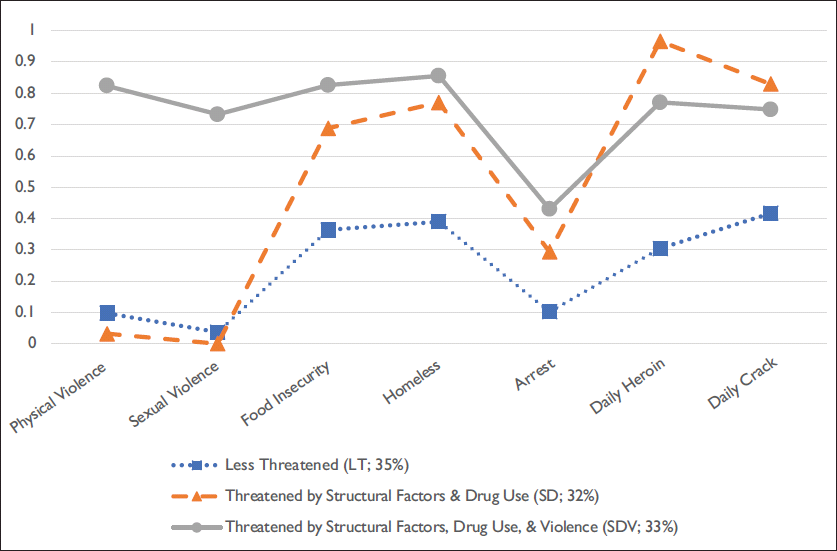
Conditional probabilities of each vulnerability indicator by class in the three-class solution.
Fit and Classification Quality Statistics for One Through Five-class Latent Class Models.
Perceived Agency by Latent Class
Mean perceived agency scores by class are presented in Figure 3. Wald test results suggested an overall significant difference in agency by class (χ2 = 7.65; p = .022). Mean scores were similar for the LT class (17.47) and SD class (17.23), with the SDV class reporting considerably lower mean perceived agency (15.58). Looking at pairwise comparisons, mean perceived agency score was significantly lower for the SDV class than for either the LT class (
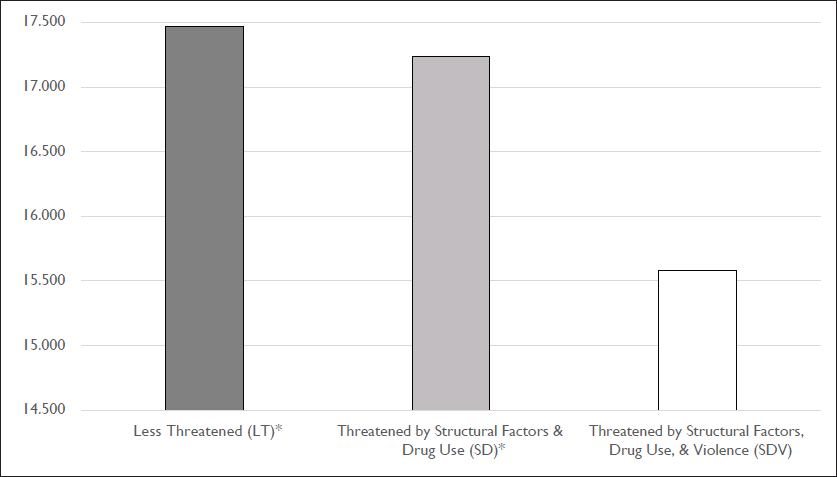
Estimated mean perceived agency (Pearlin Mastery Scale) score for each latent class.
Correlates of Latent Class Membership
Figure 4 presents a graph and table of the estimated prevalence/mean of each covariate in each latent class based on the LCA distal outcome model. Statistically significant differences in the odds of membership in one latent class versus each other latent class are also noted. The SDV class was significantly younger (OR = .96; 95% CI: .92, .99; p = .01) and less likely to identify as BIPOC (OR = .40; 95% CI: .21, .77; p = .01) compared to the LT class. The SD class was significantly more likely to be in a relationship (OR = 2.75; 95% CI: 1.15, 6.60; p = .02) and significantly less likely to identify as BIPOC (OR = .36; 95% CI: .17, .78; p = .01) compared to the LT class. The SDV class was significantly more likely to have been less than 18 years of age at sex work initiation compared to the SD class (OR = 4.69; 95% CI: 1.82, 12.07; p = .001).
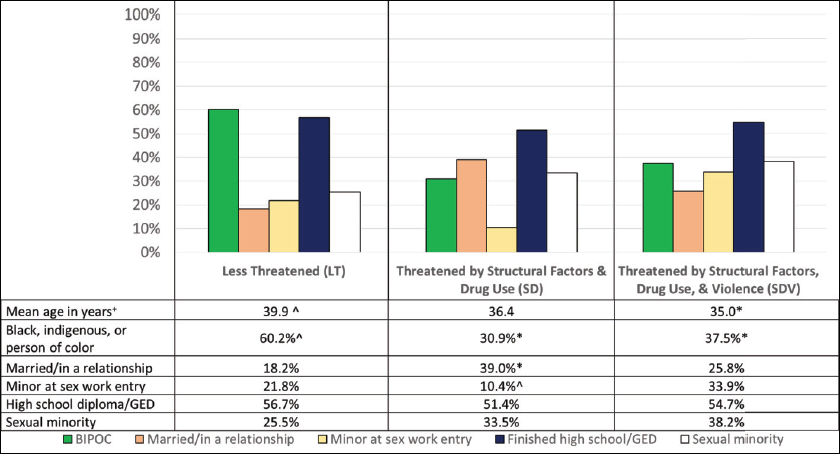
Mean/prevalence of covariates by latent class membership.#
Discussion
This study examines the complex patterns of co-occurring factors that reflect threatened agency among a sample of urban street-recruited FSW. We found that the sub-group of women who had experienced the interpersonal factors of recent client-perpetrated physical and sexual violence, alongside structural vulnerability and drug use, had a more constrained personal perception of agency. Even as understandings of empowerment among FSW cohorts have evolved to capture multiple levels and domains, individual sense of power and agency remains a cornerstone of community empowerment (Mosedale, 2005) and has not been commonly articulated or explored in the FSW literature. Our findings contextualize how FSWs’ perception of the amount of control they have over their own lives may be shaped by their daily lived experiences of structural vulnerability, policing, violence, and drug use. These findings are the first to examine perceived agency among the largest U.S.-based cohort of FSW, whose structural vulnerabilities serve as a threat to both individual and collective agency and empowerment.
Few published studies that utilized the modified Pearlin Mastery Scale report scores that allow for comparison to our sample, none among FSW. A small study of pregnant women in California (Rini et al., 1999) and a large nationally representative Norwegian all-gender sample (Clench-Aas et al., 2017) both reported substantially higher mean mastery scores than we found in our sample. We also found agency varied significantly based on latent class membership. Our latent classes were patterned manifestations of a construct we conceptualized as “threatened agency.” Thus, we hypothesized that class membership would be associated with a measure of perceived individual agency. Contrary to what might be expected, however, perceived agency was similar between the less threatened (LT) class and the threatened by structural factors and drug use (SD) class despite evidence that structural vulnerability, policing, and substance misuse—all of which are much more probable in the SD class—constrain sexual agency and the practice of protective health behaviors. However, mean perceived agency score was significantly lower for the threatened by structural factors, drug use, and violence (SDV) class, a class distinguished by exposure to interpersonal threats. This suggests that, for our sample, threats to agency are not simply additive, supporting our use of LCA.
Our finding that the presence of violence in the constellation of factors operating in these women’s lives is a particularly important influence on individual sense of agency aligns with conceptualizations of agency that see it as inextricably linked to social and structural contexts (Kabeer, 1999; Wallerstein, 1992). Women in our sample, who are subjected to daily manifestations of structural inequities, exhibit lowered sense of agency compared to other populations that are positioned further from the margins of society (Clench-Aas et al., 2017; Rini et al., 1999). Kippax et al. (2013) have argued that behavior is never truly individual but rather inherently social, therefore drawing our attention to social processes and practices as a space where structural factors are enacted to influence individual agency (Kippax et al., 2013). Client-FSW interactions, including violence, are social and interpersonal processes but are also driven from above and below by structural forces and the individual agency of both FSW and client. Violence is a critical issue in the lives of FSW the world over (Deering et al., 2014), and our findings suggest that, as in other settings, violence plays a central role in relation to agency and empowerment among U.S.-based FSW (Kerrigan et al., 2015).
The criminalization of sex work, as measured by recent arrests, did not meaningfully distinguish classes as we anticipated. This may have been due, at least in part, to the lack of specificity regarding the reason for arrest. Criminalization and associated policing practices have been described in qualitative research as critical constraints on agency (Decker et al., 2013; Sherman et al., 2015) and have been quantitatively associated with a host of adverse outcomes among U.S.-based FSW (Footer et al., 2019; Footer et al., 2016; Platt et al., 2018), but this low variability in arrest between classes makes it difficult to draw direct conclusions about its role, among other co-occurring factors, in perceived individual agency.
Client-perpetrated violence emerged only as part of a typology also characterized by structural vulnerability and drug use, reflecting deep power imbalances in FSWs’ interactions with clients. Many of our study participants are likely engaged in sex work because they are unstably housed and fed, and because of their need to avoid drug withdrawal. They rely on paying clients for access to income, food, housing, and/or drugs, and they may feel powerless to escape or report violence (Shannon et al., 2008). Women in the class distinguished by recent experience of client-perpetrated violence were significantly more likely to have entered sex work as a minor than the other two classes, which has also been associated with diminished power and higher structural vulnerabilities (Footer et al., 2020; Goldenberg et al., 2014). These findings echo Kabeer’s discussion of the potential for power and agency to be exercised over others in order to override their agency (Kabeer, 1999). Clients, the vast majority of whom are men, wield structural power, bolstered by the stigma and criminalization of sex work, which operates at the interpersonal level to limit FSW choice and control. Criminalization also fosters an environment where work-related violence and other human rights violations are normalized, and FSW may be hesitant to report abuse because of fear of adverse police response and other barriers to seeking justice, allowing abusers to act with impunity (Decker et al., 2015; Decker et al., 2013; Dewey & Germain, 2014; Erausquin et al., 2015; Sherman et al., 2015). Violence, as a more proximal, immediate, and interpersonal reflection of one person’s power over another, in the context of the deeper, structural power imbalances embedded in hunger, homelessness, and drug use, may have a more immediate effect on dramatically reducing one’s own sense of agency, ultimately limiting the ability to define and act on choices, including those, such as condom use, that directly influence one’s health. This interpretation of our quantitative findings is supported by prior qualitative research with Baltimore-based FSW. Women described clients’ use of direct and threatened violence to force or coerce condomless sex or particular sex acts women did not want to perform and how experiences of client-perpetrated violence restricted their agency and made them feel they could not assert their own desires in future sex work encounters (Decker et al., 2013). It is also aligned with global research that has identified violence against FSW by clients and other non-state actors as widespread violations of human rights, including the rights to security of person and life, which are closely tied to agency, and as major structural barriers to implementation of empowerment interventions (Decker et al., 2015; Kerrigan et al., 2015). In this U.S.-based cohort of FSW, as well, vulnerability to violence, particularly that perpetuated by clients, is a barrier to empowerment, given its role in diminishing agency, suggesting the necessity of addressing this as part of any community empowerment process.
The results should be viewed in light of several limitations. Although the sample size was sufficient for LCA, it is possible that with a larger sample size we might have been able to identify rare classes that were too small to emerge in this sample. Because all variables were self-reported by participants and include highly stigmatized experiences such as drug use and violence, social desirability, or response, bias is possible. Additionally, the use of cross-sectional data does not allow us to draw conclusions about temporality or directionality, including in relation to drug use, which may both contribute to and be an outcome of constrained agency or oppression (Rhodes et al., 2012). However, our positioning of perceived agency as driven by co-occurrence of structural vulnerability, violence, and drug use is supported by prior literature and frameworks (Shannon et al., 2014). Our sample only includes FSW recruited from the street, limiting generalizability to FSW who do not work on the street. We unexpectedly found that BIPOC women were significantly more likely to be in the less threatened class compared to White women. It is possible that the most vulnerable FSW of color, who are more susceptible to egregious policing and who may have fears of participating in research studies because of our institution’s complex history with the surrounding, primarily Black, community, were less likely to be selling sex on the street or to be interested in enrolling in the study (Brantley, Footer, et al., 2017; Hendrix, 2017; U.S. Department of Justice, 2016).
The present study measures and examines individual sense of agency, and it is critical to note that sense of agency is not the same as truly having the ability to attain one’s choices, with empowerment necessitating an actual shift in power (Cattaneo & Chapman, 2010; Kabeer, 1999; Riger, 1993; Wallerstein, 1992). Individual agency is essential, but, alone, it is insufficient to change structural forces. Our study’s findings should be viewed in the context of the broader literature on FSW community empowerment. Social and structural change depends on collective agency and action, and collective agency is a characteristic of a community, not simply an aggregation of individual agency among individuals who happen to be in a group (Kippax et al., 2013). Decades of work have shown that the development of social cohesion and sense of collective identity among FSW, which is fostered in sex worker-led spaces and programs that understand FSW to be the greatest experts with regards to their needs, is fundamental (Kerrigan et al., 2013). This coming together then leads to recognition of common struggles and their structural sources, and development of collective agency, leading to action, and social/structural change (Kerrigan et al., 2015). Our study fills an important gap in knowledge about individual perceived agency among U.S.-based FSW, and interventions intended to empower or build agency among this population must also attend to collective agency as a basis for social change.
Our study is also characterized by key strengths that make it an important contribution to the limited literature on FSW in the United States. Through explicit interrogation of the relationship between patterns in the structural, interpersonal, and individual behaviors and experiences thought to reflect threatened agency, and a measure of individual sense of agency, our study illuminates both the complicated co-occurrence of these experiences in FSWs’ lives at any given time and the way that particular patterns impact individual agency. While robust research on structural interventions that strengthen individual and collective agency exists in international settings, it remains underdeveloped in the United States. Our findings support the need for such empowerment interventions in the United States and particularly highlight the need to address interpersonal violence as a major impediment to agency. While ultimately structural interventions will have the most significant and lasting effects on violence, other trauma-informed interventions that target FSW may offer some more immediate improvements (Decker et al., 2018). Future research should explore programs, services, and resources that might bolster both individual and collective agency among FSW, including measures of collective agency, and qualitative studies that might elucidate more of the complexities and nuances underlying our findings on threats to agency.
Footnotes
Declaration of Conflicting Interests
The author(s) declared no potential conflicts of interest with respect to the research, authorship, and/or publication of this article.
Funding
The author(s) declared the following financial support for the research, authorship, and/or publication of this article: This work was supported by the National Institute on Drug Abuse under Grant R01DA041243; National Institute of Mental Health under Grant F31MH118817; and Johns Hopkins University Center for AIDS Research, a National Institutes of Health-funded program under Grant P30AI094189.
