




Abstract
Childhood animal cruelty (CAC) is a risk for later interpersonal violence and a red flag for other forms of violence in the household, yet very few studies have spoken to children directly about their cruelty to animals. Animal Guardians (AG) is a humane education program run by the Scottish SPCA for children of age 5 to 12 years who have been cruel to animals or deemed at-risk. This research investigated how children referred to AG spoke about their experiences of animal cruelty and factors surrounding it. Research consent was obtained for 10 children (average age = 8.8 years, n = 9 males), referred concerning cruel/at-risk behavior toward their pets. The interview schedule combined techniques such as crafts, vignettes, open questions, and standardized measures. Interviews were qualitatively analyzed using content analysis and interpretative phenomenological analysis (IPA). Content analysis suggested that referred children (a) tended to have small attachment networks which often included pets, (b) tended to interpret ambiguous situations predominately negatively, (c) tended to like animals and see them as sentient, and (d) struggled admitting to cruelty. Three main superordinate themes emerged from the IPA: (a) Bonding to animals, (b) Exposure to/normalization of violence, and (c) Signs of emotional issues/trauma. Children who were referred for animal cruelty toward their pets were from vulnerable backgrounds, often had complex backdrops to their at-risk or cruel behavior, and sometimes had trouble regulating their emotions and behaviors. Programs hoping to address CAC should be aware of these complex emotional, psychological, and behavioral factors, tailoring interventions accordingly.
Introduction
Animal cruelty in children has been very sparsely researched: Few studies have worked with children directly (Hawkins et al., 2017; Longobardi & Badenes-Ribera, 2019) and even fewer have taken a qualitative approach (McDonald et al., 2018). As a result of this overreliance on mostly adult and quantitative data, little is known about how children experience cruelty, how to approach this sensitive topic with them, and even whether there are distinct “types” of childhood animal cruelty. Gaining insight into children’s own accounts of cruelty is a crucial step in developing early intervention, understanding risk factors, and developing an empathetic child-centered approach. Given the frequently documented comorbidity of animal cruelty with a range of issues, including aggressive behaviors, delinquency, family issues, and trauma, this research aims to shed more light on this “red flag” using a range of qualitative techniques.
Ascione (1993) defines animal cruelty as “nonaccidental, socially unacceptable behavior that causes pain, suffering or distress to and/or the death of an animal” (p. 228). Hawkins et al. (2017) systematically reviewed research on psychological risk factors for childhood animal cruelty (CAC). Their findings can be conceptually divided into two dimensions. First, experiences which increased the risk of CAC including abuse, neglect, witnessing animal cruelty, bullying, and victimization. Second, psychological issues observed to co-occur with CAC including: behavioral disorders, conduct disorder (CD) and its modifier callous–unemotional (CU) traits, and low empathy. The two are not entirely separate: It is likely the environmental risk factor such as abuse result in emotional detachment and poor emotional control (Gullone, 2012).
Most research on CAC comes from retrospective self-report studies, often with incarcerated adults (Kellert & Felthouse, 1985; Merz-Perez et al., 2001), which has led to CAC being viewed as a predictor of future violence. However, evidence for associated constructs such as the MacDonald triad (Parfitt & Alleyne, 2020) or the graduation hypothesis (Walters, 2013) is inconsistent. Occurrence of CAC can correlate with family violence and domestic abuse, child maltreatment, and neglect (Becker & French, 2004; Bright et al., 2018). K. D. Becker et al. (2004) found that CAC was predicted by domestic violence and harsh parenting. Currie (2006) showed that children exposed to domestic violence were more likely to be cruel to pets. The emerging pattern is that CAC is not only a predictor of future violent behavior but is predicted by a history of family violence.
Psychological models of animal cruelty have attempted to bring some of these strands of evidence together, usually adapting human aggression models to understanding animal abuse. Parfitt and Alleyne (2018) adapt a process model of aggression formulated by Gross (1998) which argues that issues with emotional regulation and impulsivity, potentially arising from exposure to violence, are central to the development of aggression. Several authors propose that social information processing (SIP) theory could be used to explain animal cruelty (Henry, 2018; McDonald et al., 2018). SIP breaks down the process by which people choose actions using their learned experience through feedback loops, emphasizing that the interpretation of social cues as hostile can lead to aggression, with newer models also allowing for the role of emotions in choosing behavior (Lemerise & Arsenio, 2000). Henry (2018) also makes a distinction between reactive aggression, which is emotionally driven and often in response to provocation, and proactive aggression, which is “instrumental in nature” and often more premeditated (i.e., in pursuit of a goal, also known as predatory aggression). This is potentially important as different sociocognitive processes and/or developmental pathways may underlie the two different forms of aggression (see Hoffer et al., 2018).
Although this focus on the link between CAC and violence is justified, other important developmental factors may be often overlooked. One study reviewed by Hawkins et al. (2017) mentioned the link between emotional attachment, animal cruelty, and empathy (Thompson & Gullone, 2008). From a practitioner’s point of view, “attachment theory … is most helpful in formulating cases involving animal abuse” (Shapiro et al., 2013, p. 7), and the link between attachment and empathy is well known (Stern & Cassidy, 2018).
To capture other relevant developmental factors, it is important to carry out research directly with children involved in cruelty. However, only two studies have interviewed children about their cruelty to animals. Ascione et al. (1997) focused on examining the specifics of cruelty incidents to create a standardized set of questions, which became the basis for the Children and Animal Inventory (CAI; Dadds et al., 2004). McDonald et al. (2018) adopted a more qualitative approach, examining the narratives of mothers and children from homes with intimate partner violence (IPV) to understand the context of children’s cruelty, their motivations for cruelty, and their belief in animal minds. They found that children came from families where normalizing harm or neglect of animals was common, that children anthropomorphized animal sentience, and that the main motivations for cruelty were punishment and curiosity. However, the study used interview notes rather than transcriptions of audio data, and interviewed a sample of children from households with IPV, potentially conflating issues around the context of violence.
Current Study
This study aims to close some of the gap in the literature regarding children’s own accounts of their cruelty. A variety of techniques were used to triangulate results. These included a creative task based on hierarchical mapping techniques, a projective image interpretation task (to probe SIP theory), open questions and vignettes (to explore children’s accounts of cruelty), and the CAI. Using the narratives of participating children, this research had two guiding questions:
Method
Participants
Recruitment for the study was done alongside the referral process for Animal Guardians (AG) a humane education intervention program run by the Scottish SPCA. The AG program is aimed at children aged 5 to 12 years old in the Edinburgh area, and recruitment occurred from May to end October 2018. Referrals to the AG program came from a variety of sources, including teachers, social workers, children’s charities (e.g., Barnardo’s), and Scottish SPCA incidents. Parents could refer their children, but referrals were always processed using the child’s school or other learning facilities, as interviews and interventions were not performed in their homes. Ethical approval was obtained from the University of Edinburgh Department of Clinical and Health Psychology.
Between May and October, AG received 30 referrals, of which 20 were appropriate for the program and within the inclusion criteria (mean age = 8.5 years, n = 17 males). Of these children, 16 were eligible to have research consent information sent to their parent/carer. We received parent/carer consent for 10 of these referrals (63% of eligible referrals). All children consented to participate in the research (Mage = 8.8 years, SD = 2.1, n = 9 males), but two children declined to have their interviews audio-recorded, so verbatim notes were taken. Two children were referred for severe cruelty (animal death), four children were referred for moderate cruelty (rough handling or hitting), and four children were identified as “at-risk,” usually due to violent behavior toward peers and difficult home situations (see Supplemental Table 1). Basic demographic information on the child’s family composition was also collected, using questions like “Who do you live with at home?” and “What pets do you have?.” Children mostly reported living with their mothers (n = 9; one child lived in residential care), and most children had siblings (n = 7) although some did not live with them (older siblings, or when in residential care). Only two children reported living with their fathers, although some seemed to visit them, based on children’s reports. Almost all children reported living with one or more pets (n = 8). The most common pets they lived with were cats (n = 5) and dogs (n = 5), followed by small mammals (n = 3), but also with other pets such as birds, a turtle, and even a snail.
Theme Structure Derived From IPA.
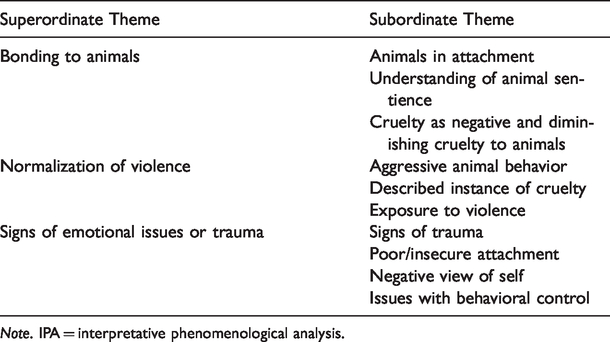
Note. IPA = interpretative phenomenological analysis.
Interview Schedule and Measures
The interview schedule was designed using a variety of techniques, both to allow children to engage in a variety of ways, but also so that the research questions could be addressed using appropriate tasks. The first two tasks used (attachment mapping and the Thematic Apperception Test; TAT) were chosen to answer the first research question, on the environmental and psychological contexts of animal cruelty. Specifically, the attachment mapping task aimed to get some insight into the child’s view of pets in a family context, while the “Animal-at-risk” TAT was chosen to investigate SIP, through the child’s interpretation of ambiguous social scenes. The second set of tasks (vignettes and open questions, CAI) were used to more specifically answer the second research question, on children’s understanding of animal cruelty behavior. These tasks focused on the treatment of animals, asking about animal cruelty, how children understood motivations for harm, and whether they understood how this contrasted to showing empathy and kindness to animals.
The interview was designed to be appropriate for children (Kortesluoma et al., 2003) and was piloted with four typically developing children spanning the expected age range of participants (5, 6, 10, and 15 years old). Following the pilots, the interview schedule was revised to make it easier to complete: The interview schedule was shortened, activities were “chunked” to allow for breaks, and pictures were added (especially, the consent procedure) to make it easier for younger children to follow. The pilot and research interviews were carried out by the first author.
Creative arts to map attachment
The first section allowed children to choose among a selection of crafts (drawing, play-doh, or fuzzy-felts; Irwin & Johnson, 2005), and had a dual purpose: building rapport with the child (Keller-Hamela, 2016) and enabling them to discuss their family relationships. Children were asked to draw/make themselves in a central circle and then draw/make “anyone who is really important to you, like family, or friends, or pets” in an outer circle. This specific procedure is novel, although with strong similarities to existing procedures, including a hierarchical mapping technique used to probe attachment in adults (Rowe & Carnelley, 2005) and a task for mapping children’s naïve understanding of family relatedness (J. M. Williams & Smith, 2010). While children created each element, they were asked to talk a little bit about it (e.g., “what do you like about your [mum]?”). If children tired, they could tell the researcher who else they wanted to include, and the researcher wrote down verbatim.
“Animals-at-risk” Thematic Apperception Test (AAR-TAT)
Children’s tendency to potentially interpret ambiguous situations negatively was probed using a subsection of the AAR-TAT, a set of images designed for an unpublished part of a study by Deviney et al. (1983), and as part of broader research on whether the presence of animals changed how social scenes were interpreted (Friedmann et al., 1993). This set of images was described as a way to elicit discussion “of events that might transpire within the family surrounding common situations that might create tension in the human-animal relationship” (p. 92, Shapiro et al., 2013). Children were presented with a subset of five AAR-TAT images (see Figure 1). For each image, children were asked: “Who do you think the people are?,” “What do you think has happened?,” “What is going to happen?” (Lockwood, personal communication, 2018), and an additional question, “How do you think they are feeling?,” which was added to investigate how children understood emotion in social situations.
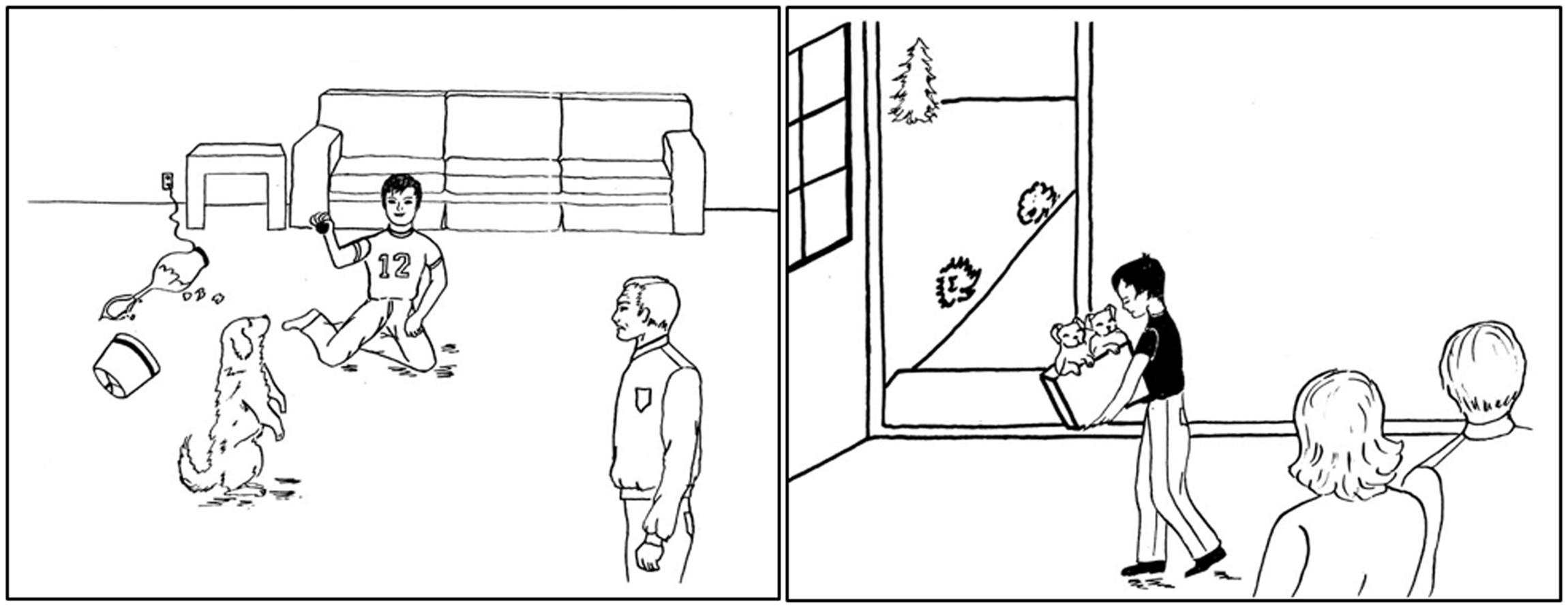
Two of the five images used as part of the Animals-at-risk Thematic Apperception Test (AAR-TAT).
Open questions and vignettes
The open questions aimed to probe children’s understanding and experience of cruelty. Questions were phrased so as to be short, not to suggest a right or wrong answer, or to seem accusatory (Keller-Hamela, 2016). Children were asked six questions about their understanding of harm and how this related to animals, including the following: (a) whether human and animal harm was different, (b) whether they had seen an animal being hurt, (c) how they felt when this happened, (d) what might make someone want to hurt an animal, (e) how they would be nice to animals, and (f) if they liked animals (certain topics were suggested by MacDonald, personal communication, 2018).
The vignettes were designed to probe the child’s own animal cruelty incident, allowing sensitive topics to be explored in a less personal way (Barter & Renold, 2000; Palaiologou, 2017). The vignette presented the child with a moderate animal cruelty scenario in four to five sentences. The child’s cruelty incident(s) was the basis of the vignette (where information was available), but was written to reflect this in a moderate form (e.g., no specific mention was made of an animal dying). Where we had no details of a child’s cruelty behavior, a standard “rough handling” vignette was used. The vignette was then followed with questions asking the child what they thought about what happened, how the child and animal in the story felt, and whether they had ever been in a similar situation.
Cruelty to Animals Inventory
The Cruelty to Animals Inventory (CAI) is a measure developed be Dadds et al. (2004) to investigate incidents of animal cruelty in children, with the child version being suitable for children as young as six. It was based on previous work by Ascione et al. (1997), which used a semi-structured interview technique with nine main dimensions. In the original study, the child version of the CAI was reported to have good reliability: An index of person separation of .90, which is a test statistic conceptually similar to Cronbach’s alpha, but run as part of a Rasch scaling analysis because the CAI violated assumptions of normality (Dadds et al., 2004). The CAI was also shown to have good predictive validity, having an association with behavioral difficulties (as measured through the Strengths and Difficulties Questionnaire), and correlating significantly with observations of behavior toward mice in the classroom, with higher CAI scores predicting more cruelty behavior and less nurturing behavior (Dadds et al., 2004). For this study, the CAI was read aloud to children, along with the possible answers, and children were asked to choose the answer which was closest to their experience. This was done to control for literacy, allow for discussion, and maintain higher response rates. However, nothing is known about how this impacts children’s responses, and it is possible that either it introduced a social desirability bias or children became disengaged rather than admitting to behaviors they thought would be viewed as “bad.” Given the often incomplete and inconsistent responses children gave, the questions in the CAI were analyzed as additional prompts within the qualitative analysis rather than being analyzed quantitatively.
Procedure
The interviews were carried out on a one-to-one basis in a quiet room (in two cases the child was accompanied by a teacher). Interviews lasted between 25 min and 1 hr. Children were given the option to take breaks during the interview, generally a break was offered every 20 min. Interviews were audio-recorded using a DS-30 Olympus audio recorder and transcribed into Microsoft Word using an Olympus transcription kit. Transcriptions were imported into nVivo 12 for coding and analysis. Interviews were read through multiple times and open-coded, before specific coding techniques were used.
Qualitative Analysis
Content analysis
Content analysis straddles the boundary between qualitative and quantitative methods (Elo & Kyngäs, 2008) by chunking participant’s answers into categories. For each question, children’s answers were summarized, and categories were inductively created. Where a child did not answer the question, an “uncodeable/no answer” category was included. In some cases, a child’s lack of answer can be seen to carry meaning, such as suggesting the question is uncomfortable or the child has conflicting answers. Once all the interviews were coded by the first author, three interviews (30%) were randomly selected to be coded by the third author. Any major disagreements or points that lacked clarity were discussed to refine the coding throughout the interviews. Inter-rater agreement scores were calculated for each section and for the whole interview (95%). Further statistics were analyzed using IBM SPSS v24 including mean values, standard deviations, and Welch’s t-tests (which assume unequal variance, given the very small sample size). Before running t-test, assumptions of normality were verified by visually inspecting histograms of data.
IPA
IPA bridges the gap between the quantitative methods used in social and clinical psychology, and qualitative discourse analysis (Smith, 1996). IPA is an idiographic approach, allowing for a degree of interpretation of cognitive and emotional processes underlying the account of each participant. IPA has a well-defined set of analysis steps, which ensure that researchers take a consistent approach (Smith & Osborn, 2004; Willig, 2008). Following standard IPA procedure, after transcription and familiarization, the interviews were analyzed individually. For each interview, themes were identified, and these were combined and structured into superordinate themes, before moving on and repeating the process for each interview. Finally, themes from individual interviews were combined into a list of master themes. For this research, coding and structuring into themes was performed by the first author, using a process which was entirely separate from the content analysis. An interim audit report was produced by the first author to be reviewed by the third author. This report contained descriptions of all superordinate themes, subordinate themes, and at least three coded examples of each subordinate theme. Concerns around theme structure, content, or clarity were discussed, and the IPA was revised accordingly.
Results
Content Analysis
Creative arts to map attachment
Children’s responses were classified to show which individuals they tended to include in their networks, and the size of children’s networks. Nine children made/drew themselves, and one child refused. The most common attachment figure included by children was their mothers (n = 7), followed by an animal or pet (n = 5) and siblings (n = 3). Interestingly, fathers were seldom included (n = 2). Children’s attachment networks tended to be fairly small (M = 1.9, SD = 1.2), with one child not including anyone and three children only including one person. Although there was an overlap between who children reported they lived with and who they included in their attachment circles, there were some discrepancies. Generally, children included fewer categories of people in their attachment circles (M = 1.9, SD = 1.2) than categories of people who they reported to live with (M = 2.6, SD = 1.3), although this difference was not significant, t(18) = –1.27, p = .22; see also Supplementary Table 2.
“Animals-at-risk” TAT
Children’s responses were categorized along the following dimensions: (a) overall outcome and interpretation of events in the scene, (b) the emotions attributed to the humans in the scene, and (c) the emotions (if any) attributed to the animals in the scene. Answers were summed across the pictures for each child.
Outcomes were predominately interpreted as negative by children, with children interpreting 60% of scenes as having a negative outcome (such as punishment, danger, violence, and abandonment). The next most common answer was a neutral or mixed outcome (16%; such as scenes where children could see both positive or negative outcomes unfolding, or very neutral descriptors like “she will keep sleeping”) followed by positive outcomes (12%) and no answer (12%). Human emotion attribution followed a similar pattern although slightly less skewed, with 50% of attributed emotions being negative (this included emotions like sadness, anger and fear), followed by 20% neutral/mixed (including responses like sleeping, both sad and happy), 16% positive (this included happy, playing), and 14% no answer. Interestingly, attributions of animal emotions did not follow this strong bias, with 36% of emotion attributed being negative, 30% positive, 32% giving no answer, and interestingly only 2% attributing neutral or mixed emotions. Some children had consistent patterns of interpretation: two children consistently struggled to interpret scenes and three children consistently interpreted scenes negatively (see Supplemental Table 3).
When adding each child’s answers across categories (i.e., outcomes, human emotion attribution, and animal emotion attribution), children gave significantly more negative answers (M = 7.3, SD = 3.65) than positive answers (M = 2.9, SD = 2.91), t(14) = 3.37, p = .004. However, it is difficult to interpret these results conclusively without a noncruelty control group, as the images may be inherently interpreted more negatively even by the general population. Still, when dividing the children into either a “cruelty” category (children referred for severe or moderate cruelty, n = 6) as opposed to an “at-risk” category (n = 4), some interesting trends were observed. Children in the cruelty group tended to give more negative answers (M = 7.67, SD = 4.55) than children in the at-risk group (M = 6.75, SD = 2.21), although unsurprisingly this was not significant, t(8) = 0.42, p = .68. Although the very small sample size makes the lack of significance unsurprising, what is interesting is that the difference in mean values go in the directions we would expect from SIP theory: Children with more pronounced aggression issues (those referred for cruelty) interpreted things more negatively than those identified as at-risk.
Open-ended cruelty questions and vignettes
Children generally responded empathetically to questions, saying that animal harm was as bad or worse than harm to a human (n = 9), and almost all children saying they liked all animals (n = 7), with some specifying they liked most animals but not insects (n = 2). Children showed some good understanding of how to demonstrate kindness to an animal (n = 9; responses included saying they would cuddle/stroke n = 5, “help” the animal, give treats to, or play with animals), and most felt negative in some way when an animal was harmed (n = 6; either sad n = 3, angry n = 2, or bad n = 1; with the rest not giving an answer, or saying “I don’t know” n = 4). Many children admitted to witnessing animal harm in some capacity (n = 6), although this was mostly not admitting to their own cruelty directly and relaying a story instead (n = 5). Regarding motivations for animal cruelty, the main two reasons were “punishment” (n = 3) and “emotional lashing out” (n = 3), while four children did not provide an answer. During the vignettes, there were additional questions on how the animal might have felt after the cruelty incident, and almost all children realized the animal might feel bad in some way (n = 9; either scared n = 3, sad n = 3, angry n = 2, or pain n = 1).
CAI
For two children, there was insufficient time to complete the CAI, and results summarize the answers of the remaining eight. Many children seemed to struggle, giving inconsistent answers so that calculating a score as was done in Dadds et al. (2004) was not likely to produce meaningful results. For example, for “Have you ever hurt an animal on purpose?,” five children said “Never” and three said “Hardly ever,” but then for “How many times have you hurt an animal on purpose?,” three said “Never,” while five said “Once or twice.” In terms of the categories of animals harmed, most animals were “Pets” (n = 4), followed by “None” (n = 2), “Wild animals” (n = 1), and “Don’t know” (n = 1). Within this, the types of animals that were harmed were “Worms or insects” (n = 4), “Birds or mammals” (n = 4), “Fish, lizards, frogs” (n = 1), “None” (n = 1), and “No answer” (n = 1) (children could choose more than one answer). Children’s responses suggested some empathy for animals, with five children saying they felt “Very bad for any animal they had hurt” (and the remaining three either saying they had never been cruel, or did not give an answer) and seven children saying they felt “Very sad and upset” about people hurting animals.
IPA
The IPA aimed to go beyond the content analysis to explore how children understood the context of their cruelty. Three superordinate themes emerged: (a) emotional bonding to animals, (b) normalization of violence, and (c) signs of emotional issues or trauma. Table 1 summarizes these superordinate themes and their subordinate themes.
Bonding to animals
This theme captures children’s discussions of animals as positive figures and sources of comfort/friendship. The first subtheme, animals in attachment, captures children’s explicit descriptions of attachment to animals, or by describing positive behavior toward animals. The second subtheme captures instances where children took the perspective of the animal, viewing them as sentient and empathizing with them. The third subtheme captured children’s discourse about cruelty often viewing animal harm as something that made the perpetrator, even themselves, bad. Overall, the sense for this superordinate theme was that children had positive relationships with animals, although this ranged from strong attachment to discussing them as pleasant and friendly.
Animals in attachment
Children described many ways of relating positively to animals, even describing animals as friends and attachment figures. This was most explicit in the hierarchical mapping creative task, where children placed animals in relation to themselves (Supplemental Figure 1 shows the mapping task for four children who included animals in their attachment circles).
For Harry, his relationship with his cat was nearly as important as his relationship with his mum. As the interview continued, it became clear that Harry saw his cat as allied with him against his mum and his mum’s cat “I brought my kitten up to be on my side, so the war is on!” This conflicted attachment to the mum is explored more in later subthemes. In fact, Harry was one of the children who described one of the most intense relationships with his pet cat, spontaneously expressing sorrow at the idea of his cat’s death: “I shouldn’t have gotten one as well, because when they die you get really really sad.”
For George, his description of interactions with his dog (who incidentally was the only family member he put in his relationship circles) seemed similar to descriptions of interaction with a friend or sibling. He gave his dog a nickname “Dumb Dog” and told stories of various interactions, such as teaching his dog things and bringing the dog into his bed: When it was a puppy I had to teach it how to go up and down the stairs and then I went up to get my covers (mm-hmm) and want to go, and then I fell asleep, and the dog hit me with its tail [. . .] and I had to sleep uhmmm, besides my bed.
Understanding of animal sentience
An extension of how children relate to animals was their ability to talk about animals as sentient beings with intention. This was explored directly in the AAR-TAT, but also came through at other times during the interview. Children did not see animals as unfeeling or as objects, acknowledging their feelings and intentions. In fact, sometimes it seemed that children saw animal intention as less threatening than human intention, as something which was easier to explore, and a less dangerous conversation topic. For example, Charlie (who struggled to complete that TAT) wanted to discuss the animal emotions and intentions rather than the people’s. For Frank, who could be violent toward his peers, he spoke very differently about being violent toward animals. He described violence as a way to retaliate against people who would hurt or offend him, and he said that he wouldn’t want to hurt an animal because animals would not have a desire (intention) to harm him.
During the image interpretation, children saw animals as having simpler emotions, and sometimes while people were angry and deceitful, animals remained quite happy. Beyond believing animals were sentient, the sense that animals had less hostility and were not a threat for some children seemed to facilitate their interactions with animals.
Cruelty as negative and diminishing cruelty to animals
An extension of children’s relationship with animals was that they struggled to acknowledge their harm to animals. This was expressed in a variety of ways, from children using very negative language to describe instances of cruelty, to denying the occurrence of any cruelty incident, or minimizing the extent of the cruelty. Many of the children seemed to be in conflict, having difficulty acknowledging their actions of harm, while maintaining that animals were important to them.
For example, Charlie, while looking at the pictures in the AAR-TAT, interpreted one of the pictures as two boys teasing a dog. He struggled to talk through his interpretation of the picture, but said, “It makes me feel angry cause they’re bitches.” Later, when asked about the rough handling incident in the vignette and why the child had hurt the cat, he answered, “Because he’s evil.” For some children, it seemed that when animal cruelty occurred, it was not simply the act which was cruel, but the person perpetrating the act. For Harry, this meant his own act of cruelty resulted in him viewing himself as evil. When asked why he slapped his cats to get them to fight, he responded, “Because I am evil” and “I’m a thug.”
Particularly striking was Alex, who was involved in serious cases of cruelty, having killed kittens. During the CAI, Alex very briefly mentioned his own instances of cruelty. His language suggests that he saw cruelty as bad and that part of his difficulty in discussing the cruelty was because he saw himself as bad for having done it: Alex: uh sometimes I hurt animals, but I don’t actually hurt them very … I don’t hurt them in badness, I just, sometimes I just hurt them by trying to help them Interviewer: oh really, is that what happens? So it’s like an accident? Alex: yeah I’ve, I’m being good and bad (mm-hmm) yeah so I’m trying to help it because a needle’s stuck in it but I pulled it out very fast into and hurt this kitten
Normalization of violence
This theme brings together children’s description of violent behavior in their daily lives in a way where it seemed normalized because of its intensity or implied frequency. The first subtheme describes incidents where children recalled violent animal behavior, suggesting they had not been supervised or taught to see animal aggression as abnormal. The second subtheme revolves around children’s description of cruelty events, including other people’s cruelty to animals. The last subtheme brings together other instances of violence children described, including domestic violence, incidents with the police, exposure to particularly graphic or violent video/game content, and violent or aggressive play themes during the interview itself.
Aggressive animal behavior
At least three children described being bitten by animals. Ben described being bitten by both his cat and a hamster. The bite was what triggered him to squeeze the hamster and kill it. Eddie described being bitten by a dog, as did George, who gave a vivid description: George: when I was younger, this dog bit my leg Interviewer: Oh, really? Did that hurt? George: Yes Interviewer: And, what happened? George: X came down and the dog wouldn’t let me go, so they had to keep on hitting it Interviewer: Really … And, how did you feel? [. . .] George: Mad Interviewer: Mad, yeah? At the dog? George: Yes (mm-hmm) and then my dad came out and had to stop- hitting the dog as well . . . Katie: My cat’s kind of vicious to dogs, she thinks they’re funny but then she doesn’t like them at the same time … she likes to roll around and try to attack them Interviewer: And do you … does she do that with your dog as well at home? Katie: Yeah she does it all the time Interviewer: And what do you do, do you stop it or are you just like, that’s what she does Katie: Yeah she always does it, it doesn’t work if you stop her
Described instance of cruelty
Almost all children described an instance of cruelty in their interviews. Occasionally, this was their own instance of cruelty, but fairly often, it was an instance of witnessed cruelty, usually in the household. For example, following the vignette story, Daniel described an instance of cruelty to a cat which he had witnessed at home, which caused him to retaliate: Daniel: Actually, I saw someone do that . . . Interview: You saw someone do that? Aha, can you tell me a bit about what happened? Daniel: He picked up the cat with the tail, and swinged it like that and chucked it Interviewer: Ahhhh … really? And how did you feel when you saw this happen? Daniel: Sad … and I went mental on him for picking it up and chucking it in the house Interviewer: But do you do it [smack the cat] anyways? Harry: But I have to do it because he’s being bad. I wish I had brought my cat up like even worse Interviewer: Why? Interviewer: Because I mean like even when we’re sleeping, I never slap him actually, it’s my mum who slaps him Interviewer: Oh your mum slaps that cat? And … both cats? Harry: I just slap him when he’s being like, too good to her and like fight her, fight her, charge at her
Exposure to violence
Violence seemed pervasive for most of the children: of the 10 children interviewed, only one did not have themes of violence (Ian). Some of the violence was explicit, while other violence was “secondary” such as using graphic language or expressing violent play themes. Explicit violence often involved violence in the family. For example, Ben described an instance where his grandmother threw a bottle at him, hitting him in the eye. Interestingly, he also played quite “violently” with the puppets, pretending they were attacking him: “look the cat’s pretending like he’s dead. Look, he poked me in the eye, he smashed right in my eye like that.” Charlie described an incident where he ran away from home and was apprehended by the police and proceeded to show the bruises on his arm. Harry described being hit by his mother, which seemed to create an internal struggle where he did not want to cry. Hitting his cat was potentially a way to play out his anger: Harry: I am used to the slaps, I don’t care, I’m just like … really? Interviewer: Is that your mum that slaps you? (yeah) when you’re bad? Harry: I don’t care, I’m just like, when I was little I couldn’t even stand slaps, and now I can, like, by I mean like standing them I can I can just say … Aaaa Interviewer: Did it make you sad before? Or does it still make you sad when you get slapped? Harry: No Interviewer: Did it before? Harry: Yeah, I’m going to stop crying
Signs of emotional issues or trauma
This theme brought together psychological constructs: unresolved trauma, attachment issues, negative view of self, and issues with emotional reactivity and behavioral control. This superordinate theme suggests that the normalization of difficult and sometimes violent experience, combined with children’s often insecure attachment frameworks, led to situations where animals could be harmed.
Signs of trauma
This subtheme included being preoccupied with an event, describing a particularly negative or violent event, or displaying signs of “stuck play.” This analysis of trauma loosely follows the description of unresolved trauma in Crittenden’s Dynamic Maturation Model (DMM; Crittenden et al., 2010). Of the 10 children interviewed, four children (Alex, Ben, Frank, and Harry) had discourse markers suggestive of trauma. In addition, two children (Frank and Eddie) refused to be recorded, and interestingly, both of these children had been interviewed by the police, which for a young child in a violent situation could be a traumatic experience.
For Alex, most of the trauma markers related to his cruelty incidents. In one of these incidents, he killed a kitten by poking its eye. Eyes became a motif in the interview, and when he created a play-doh tiger, he asked whether the interviewer could “make a dot” on its eye with their pen. Furthermore, Alex had some preoccupation around the events of the kittens’ deaths and in wanting to make things better, which was clear in the way he recounted the story of what had happened. The other kitten Alex killed had been swung against a wall and died. Although Alex never admitted to this in his story, he vividly described a kitten getting a broken leg and this being fixed: Alex: It lived still … It’s body … it’s leg, they gave it some medicine … to make it go to sleep (mm-hmm) and then they cut it’s leg open because it’s bone was broken, and then they took it’s little bone out, and they took a bone off a bird, and gave it all the right size, and then put in the leg, and they tied it up, so then it was . . . Interviewer: It was better? Alex: And then it could be able to walk again
Poor/insecure attachment
Many children displayed signs of insecure attachment. For some children, this was around their parents, but for others, the tension came from siblings (Ian, who was adopted, explicitly stated not liking his sister). Some children did not include many people in their attachment circles, which can be indicative of poor attachment; from an IPA perspective, this is difficult to code as it is an absence of discussion. This is particularly the case for Eddie, George, and Katie, who all did not include any people in their attachment circle and did not discuss them much throughout the interview. For two of these children, their attachment needs may have been partially fulfilled by their relationship with their pets.
For some children, there was a nearly explicit link between an issue with attachment and their cruelty incident. This was particularly the case for Alex, Frank, and Harry. For Alex, there was a conflict around seeing his other brothers rough handling pets, but still feeling like he had to like them even though they were “really bad.” For Frank, his poor relationship with his father explicitly led to some incidents of cruelty, where he would be cruel to a cat as a form of retaliation: [paraphrased from notes] “He hated his father and father’s girlfriend and was purposefully cruel to her cat as a result. Pulled his dad’s girlfriend’s cat’s tail, because he hated her and wanted to get back at her and his dad.”
Harry gave the most complete picture of how his troubled attachment with his mother led to him being cruel toward the two pet cats. His description of his attachment with his mum while drawing her was quite vivid: Harry: OK … she loves red so I’m going to draw her evil! Interviewer: and do you get on with your mummy? Harry: sort of, I kind of hate her but please don’t tell her
Negative view of self
For some children, there was striking use of negative language to describe the self. Interestingly, this was most obvious for the children with poor attachment described above. For Alex, this negative view of self became self-effacement, refusing twice to make himself in the attachment mapping task. Later, he mentioned that he did not want to be bad or hurt animals “in badness.” This might imply he had difficulty coming to terms with the implication of a bad self if he admitted to cruelty. Frank was more explicit in his negative view of self, mentioning “my brother is not messed up like me,” and further explaining that he has been diagnosed with attention deficit hyperactivity disorder (ADHD) and autism spectrum disorder (ASD) and has trouble controlling his behavior. Later on, Frank also explained he did not want to be bad anymore and that his harm behavior toward animals had not stemmed from lack of knowledge: Frank: I felt bad for [the cat], but will never do it again. Interviewer: What made you realise you shouldn’t do it? Frank: I knew it was bad before, and that it’s just a stupid thing to do and I wouldn’t do it again because I don’t want to be a bitch
Issues with behavioral control
This subtheme was created to code some of the children’s behaviors, rather than only the content of their interviews. Four of the interviewed children had difficulties concentrating and regulating their behavior during the interview (Ben, Eddie, Frank, and Harry). For example, some children got very distracted by the camera, even after being repeatedly told to ignore it. Other children needed to always have something in their hands, hitting objects in their play, or even biting themselves. Some children seemed to have a degree of awareness around this lack of control. When Frank was asked why the boy in the vignette story hurt the cat, he answered, “Because he was upset about something or about themselves, sometimes that can make people lash out.” Even though just under half of the children seemed to have issues with behavioral control, this theme suggested that for some children their ability to emotionally regulate and inhibit behavior was atypical and potentially linked to their cruelty incident. There was an overlap between the children who expressed some issues around self and attachment and those who had difficulty regulating their behavior.
Discussion
This study aimed to explore (a) the environmental and psychological context of children’s cruelty to animals, and (b) how children understood acts of animal harm, with a goal of informing interventions for CAC. The use of several interview techniques helped triangulate the results of the study, and the results of the content analysis broadly supported the results from the IPA.
In answer to the first question, the content analysis provides tentative support for the idea that both attachment style (specifically insecure attachment) and SIP theory (through the negative interpretation of social scenes) might be important psychological factors in understanding CAC. The IPA further emphasizes these points and places them in context. The theme on bonding to animals suggests how animals integrate themselves into children’s attachment, while the theme on the normalization of violence partially suggests children may be consistently interpreting scenes negatively because this reflects their own experience. Finally, the theme on emotional issues and trauma underlines the repercussions of many of these negative experiences in creating further psychosocial difficulties, including poor behavioral and emotional regulation.
In answer to the second question, the content analysis suggests children did not generally lack a conceptual understanding of animal emotion, harm, or how to show kindness to animals. The few children who managed to articulate an answer around motivations suggested it was an issue that might be classified as reactive aggression, either in the form a lack of behavioral/emotional control, or as a punishment for bad (animal) behavior. The IPA suggests that although children knew their behavior was “bad,” they lacked the control to regulate their behavior, used cruelty to retaliate against others, and/or were modeling behavior which they were regularly exposed to.
Content Analysis
Mapping attachment
The hierarchical mapping technique revealed that children tended to have small attachment networks (just under two relationships on average) and that many children readily included pets in these networks. Although there is no direct research on using the total number of relationships placed in hierarchical mapping tasks to assess attachment, Rowe and Carnelley (2005) demonstrate that insecure relationships are less likely to be placed in attachment maps (in adults and teenagers). As children have a lesser capacity to form relationships outside the home, it is possible that children cannot compensate for insecure attachment to family members by including other people, and that for these children, insecure attachment simply results in smaller networks. This is somewhat supported by the observation in this study that children did not usually include all the people they lived with in their attachment map, so that their maps had fewer people in them. It is interesting to speculate whether some children with poor attachment to parents (potentially George and Katie in this case) partially compensated for the lack of closeness to their parents with a relationship to a pet.
The second point ties in to existing literature on children’s attachment to pets (Marsa-Sambola et al., 2016; Muldoon et al., 2019), which shows that children do include pets in their attachment networks, that pets can provide important social support, and that attachment to pets can be predictive of emotional wellbeing. These findings suggest that children who have harmed animals can, perhaps counterintuitively, be attached to the very pets they are harming. Understanding how children relate to their pets may be crucial to understanding their cruelty.
Interpreting social scenes
The “Animals-at-Risk” TAT revealed some interesting patterns in children’s interpretation of social scenes with pets. Children tended to interpret the scenes negatively and attributed negative emotions to people more readily than to the animals. Children struggled more with attributing emotions to animals and did not attribute mixed feelings to them as often. This might suggest that although children could struggle with animal emotional attribution, animals were perhaps seen as less hostile or threatening. Some children had interpretation biases, consistently interpreting images either negatively (three children) or struggling to interpret scenes at all (two children). Furthermore, when children were separated into “cruelty” and “at-risk” groups, there was an interesting trend that suggested children in the cruelty group interpreted images more negatively than the at-risk group, although the sample size was far too small to yield significant results, especially without a control group. These observations lend some support to SIP theories of childhood aggression and its relevance to animal cruelty (Henry, 2018). Thus, for some of the children interviewed here, there seems to be a bias toward negative interpretation of social signals, and the suggestion is that difficulty in interpreting signals, or automatically interpreting ambiguous signals very negatively, could lead to aggressive or defensive behavior.
Understanding of animals and animal cruelty
The open questions revealed that children did not generally see harm to animals as different to humans, that they saw animals positively, and that they often did not have a desire to cause harm. Rather, motivations around cruelty were usually as punishment for bad behavior or due to lashing out or anger, which supports findings in previous research (McDonald et al., 2018). The CAI demonstrated just how difficult it was for children to admit to their cruelty, with inconsistent answers across questions making numeric or statistical analysis difficult. This suggests that in some cases, children may struggle to discuss their cruelty when asked directly.
IPA
Bonding to animals highlighted that animals were seen positively, that children usually did not express a direct desire to harm, and that some children were attached to their animals. This theme speaks to the literature on children’s understanding of animals and their attachment to pets (Marsa-Sambola et al., 2016), and suggests that children who have abused animals do not necessarily have an inherently different relationship with their pets. This theme also develops McDonald et al.’s (2018) study, which found children anthropomorphized animal sentience. This suggests anthropomorphizing is perhaps a double-edged sword: Although it can foster attachment relationships and consequently empathy toward animals (Hawkins & Williams, 2017), it may also (as suggest by McDonald) be the reason for hostile attribution biases and the rationalization for harsh punishment. Finally, this suggests that attachment theories are relevant for understanding relationships to animals even in the context of cruelty, where the concurrent presence of cruelty and attachment to a pet might indicate broader attachment problems.
The second theme, Normalization of violence, captured children’s frequent descriptions of violence both interpersonally and toward animals, which suggested that this was commonplace for them, and possibly had become part of their schemas for relationships. This recapitulates the literature on the effects of exposure to violence on children’s emotional and behavior development, and to “the link” where animal cruelty has been observed to occur alongside other forms of interpersonal violence in the household (Ascione & Arkow, 1999). It also lends support to the idea that children who abuse animals are displaying learned behaviors, including the relevance of SIP models to understanding animal abuse (Henry, 2018; McDonald et al., 2018), but adds an additional dimension: not only was human aggression normalized for these children, but so was animal aggression. This suggests that demonstrating positive animal interactions and good animal behavior may be important in helping these children reduce their instances of harm. It is interesting to note that aggression was also apparent in children’s language, with some boys frequently using the derogatory word “bitch” to refer to both themselves and others, perhaps suggesting that were accustomed to adopting an aggressive stance in their daily language patterns.
Finally, Signs of trauma and emotional issues, attempted to capture the complex psychological backdrop to children’s relationship patterns, including signs of unresolved trauma, insecure attachment, and the related issues of poor self-image and difficulty in regulating emotions and behavior. This points to two related literatures on trauma and attachment, and their effects on behavioral and emotional control (Dvir et al., 2014; Mikulincer et al., 2003). It also emphasizes the importance of not simply viewing animal cruelty as a developmental marker for issues around aggression and CD, but potentially as an indicator of other psychological issues, which need to be carefully assessed. The AniCare child approach highlights the importance of assessing not only for ADHD and CD, but for attachment issues (Shapiro et al., 2013, p. 23). These results suggest that trauma and problems with emotional regulation and behavioral control are also important factors to consider. Finally, this theme also suggests that low self-esteem may also be a factor for animal cruelty. Although the idea of a negative self-esteem being a factor for CAC is mentioned by certain animal welfare agencies (Los Angeles SPCA, 2020), few published research papers mention this. Alleyne and Parfitt (2018) found that low self-esteem was one of two predictors which reliably differentiated animal-directed aggression from other antisocial behaviors. Bringing all this together, Harry was probably the most obvious case of how trauma, insecure attachment, and poor self-esteem unfortunately translated into animal cruelty, despite also being attached to his pet.
This highlights the often overlooked importance of attachment in cases of animal cruelty, despite its relevance being known in the broader literature on aggression: insecurely attached partners are more likely to be aggressive (Babcock et al., 2000), insecure attached teenagers are more likely to bully (K. Williams, 2011), and abused and neglected children are more likely to have insecure attachment and be violent or socially withdrawn (Finzi et al., 2001).
Framework for the Psychological Context of Animal Cruelty
Tying in the superordinate themes from the IPA with existing models of animal abuse and aggression could help place them in a long-term developmental context using theories such as emotional regulation (Parfitt & Alleyne, 2018), SIP (Henry, 2018), and the role of attachment (Thompson & Gullone, 2008). Bringing these themes together to consider how they create a distorted internal model for the child could help clarify how problems like emotional dysregulation, poor social information processing, and lower empathy often arise in tandem in children who abuse animals. Figure 2 illustrates how these concepts might come together. It is centered on the child’s attachment-based Internal Working Model (IWM; Dykas & Cassidy, 2011), which interfaces with observable constructs (rectangles) through the child’s emotional processing system. The rectangles are partially based on the extracted themes in the analysis (in italics). The idea of the IWM interfacing with other constructs through emotional processes is based on Crick and Dodge’s (2000) model of SIP which has a central “database” surrounded by emotional processes, and on the relationship between attachment systems and emotional regulation (Zimmermann, 1999).
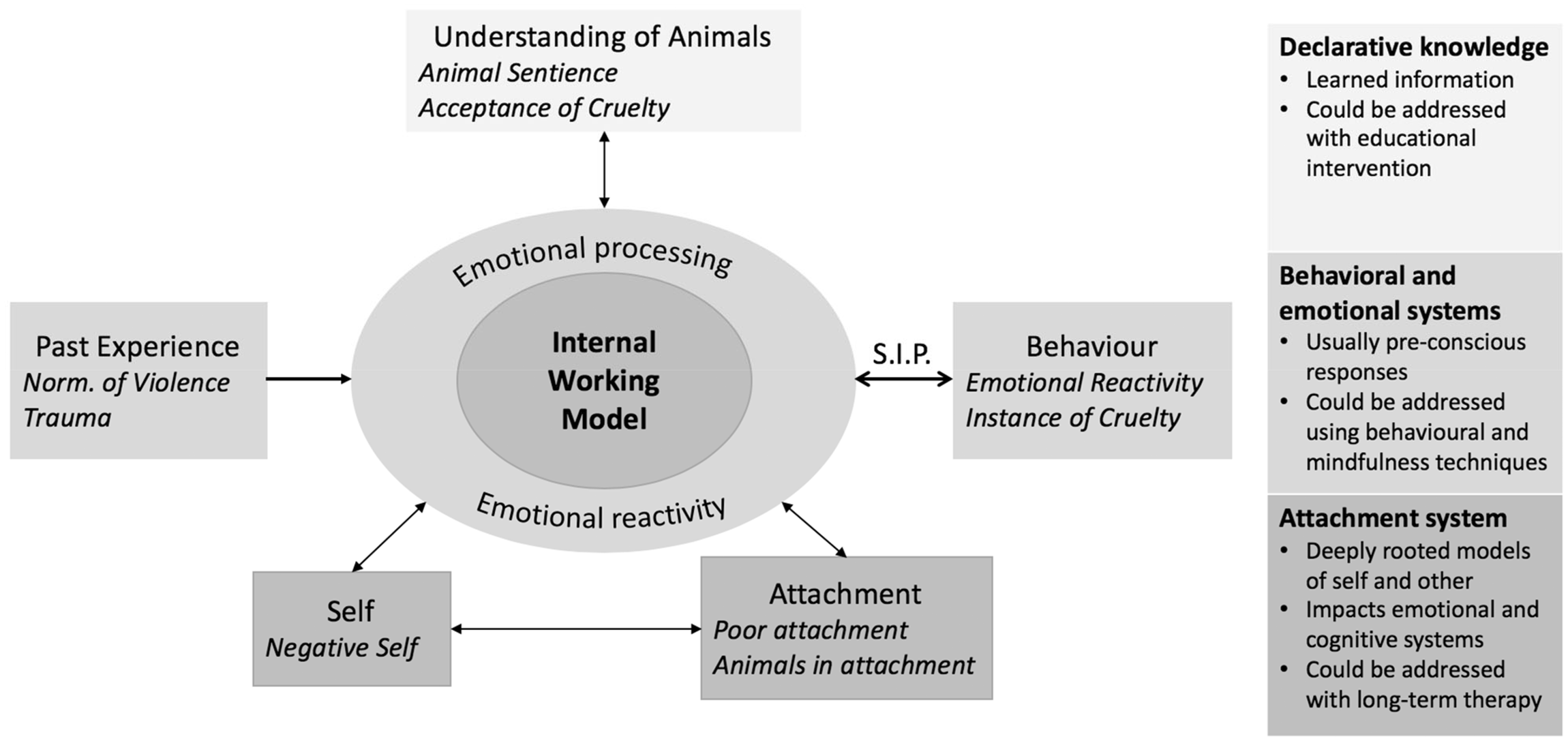
Hypothetical model showing how constructs described in the qualitative analysis (rectangles) might relate to the child’s internal models and internal processes (ovals).
The implication is that animals are integrated into the child’s psychological framework, and that animal abuse is likely not separable from other behavioral or psychological issues. This framework further suggests that risk factors for cruelty might build upon each other: the more risk dimensions a child has (e.g., poor attachment, poor view of self, experience of violence, and low understanding of animals) the more at-risk the child might be for animal abuse, and possibly the worse and earlier the abuse will start. This “cumulative” negative effect has been demonstrated for adverse childhood experiences (ACEs) by Bright et al. (2018), who showed that juvenile offenders who had committed acts of animal cruelty were more likely to have four or more ACEs. This model is also somewhat aligned with Parfitt and Alleyne’s (2018) conceptualization of animal abuse, which is suited to models of reactive aggression. Specifically, the model in Figure 2 implies that longer term factors such as trauma, violence and poor attachment may give rise to poor emotional and behavioral regulation processes, which Parfitt and Alleyne argue are responsible for reactive aggression toward animals.
Limitations and Further Research
The main weaknesses of this study related to generalizability, and included having a small, fairly uniform sample, and not having a control group. As part of the homogeneous sampling required for IPA, participants were from a specific region, age range, and participating in the AG program. This sample of ten participants is in line with recommendations for IPA techniques, which focus on small, specific populations and in-depth analysis (Pietkiewicz & Smith, 2014), but limits the generalizability of the results. Furthermore, the results of the image interpretation and the attachment mapping tasks are tentatively interesting, but it is impossible to conclude whether the referred children would have exhibited differences if compared with controls. Finally, the fact children struggled to answer the CAI may be due to a weakness in methodology, as it is a validated measure which children should not struggle to complete. This may be because children struggled discussing their instance of cruelty in person, while the CAI was originally tested as a written measure to be completed individually.
Another limitation was the lack of basic demographic data collected, especially social economic status (SES) and ethnicity. This information was not collected because of the young age of participants, and the fact we did not use parent report. However, this makes the results more difficult to place in context. For example, Hartman et al. (2019), found that controlling for income impacted which factors came out as predictive of CAC: higher affective empathy, lower cognitive empathy and callous-unemotional traits predicted animal cruelty, but when controlling for income, the effect of affective empathy disappeared. Their sample also had more ethnic diversity than this study (about half of respondents identified as Latino), and they note that cultural influences on empathy expression are important to consider. In fact, the significant impact of ethnicity on animal cruelty has been reported in a U.S. sample of adults, where Latinos were found to be less likely to perpetuate animal cruelty on average (Vaughn et al., 2009). Thus, without relevant data on the SES or ethnicity of participants, it is difficult to comment on the study’s generalizability to other populations.
Finally, due to the recruitment procedure for this study, it is possible that our sample of CAC is biased toward harm resulting from reactive aggression. The relevance of reactive and proactive aggression to CAC is an ongoing discussion (Henry, 2018; Hoffer et al., 2018), but given that these forms of aggression may correlate with specific disorders, such as CD and broader externalizing problems with reactive aggression, and psychopathy with proactive aggression (Kempes et al., 2005), it may be important to distinguish between them. If these two forms of aggression apply to CAC, it is possible that the sampling procedure, which relied on caregiver referral, may favor the identification of more reactive types of animal harm. This is because reactive aggression tends to be unplanned and in response to provocation, so the child has less chance to conceal their behavior. However, proactive forms of aggression tend to be planned out or at least purposeful, and so have more scope to be secretive or concealed. In their development of the CAI, Dadds et al. (2004) give covertness a higher score, suggesting a link between secrecy and more severe cruelty, and found that it was fairly common for parents to underreport their children’s acts of cruelty. Although this research did capture some forms of proactive aggression, especially where children harmed animals to indirectly harm people (Frank, Harry), we did not interview any children who reported sadistic intent in their animal harm. As this is still a relevant area of research, especially as a predictor of psychopathy (Stupperich & Strack, 2016), it is important to note that our results do not necessarily reflect the absence of such cruelty and may instead be an artifact of sampling.
Suggestions for Intervention
Given the wide range of factors discussed in this study, we thought it would be useful to translate these findings into suggestions for intervention. This list is not exhaustive nor entirely novel (see Shapiro et al., 2013 for guidelines on treating animal cruelty), but rather offers suggestions based directly on the results. These suggestions should apply to a variety of interventions, from animal welfare education programs to therapy:
The child’s assessment should consider a variety of risk factors (e.g., family violence, attachment issues, trauma) which will inform the need for additional therapy or intervention.
Be aware that many children may still be currently living with pets, and may be attached to them.
Do not approach the cruelty in an accusatory fashion, but in a neutral and matter-of-fact way. Some children may need a few sessions to open up.
Involve parents where possible, to educate them on animal welfare as well, and to help change the child’s home environment.
It is necessary to understand the context and motivations for harm, as these can be varied—from intentional to unintentional, proactive to reactive—and different intervention components may be necessary for different contexts.
Help the child practice both “basic” emotion recognition and the interpretation of more complex scenes containing both humans and animals.
Help the child understand their own context for the harm, as many children may struggle to analyze the events that lead to and triggered their behavior.
Help the child practice safe behavior and handling around animals to minimize the risk of aggressive responses from animals. If safe and possible, model positive human–animal interaction.
Incorporate strategies and exercises to help the child practice regulating their behavior that they can easily recall if caught in the “heat of the moment.”
Conclusion
These results are broadly consistent with previous research and suggest that CAC is a red flag not just for development of aggression, but for a range of psychological stressors, including poor attachment, exposure to violence, poor behavioral and emotional regulation, and trauma. Animals were embedded in children’s broader psychological frameworks so that children’s interactions with animals were informed by their learned experiences and often reflective of their broader environment. Even when cruelty had occurred, children could be attached to animals and seldom expressed desire to cause harm as a motive. In fact, children potentially interpreted animals as less threatening, and possibly as “safer” targets on which to rehearse behaviors they would otherwise inhibit. Exploring some of the concepts uncovered in this qualitative analysis with larger groups of children with matched controls will help establish the generalizability of results and could help inform a comprehensive model of the development of animal cruelty for better intervention.
Supplemental Material
sj-pdf-1-jiv-10.1177_0886260520928640 - Supplemental material for A Qualitative Study of Children’s Accounts of Cruelty to Animals: Uncovering the Roles of Trauma, Exposure to Violence, and Attachment
Supplemental material, sj-pdf-1-jiv-10.1177_0886260520928640 for A Qualitative Study of Children’s Accounts of Cruelty to Animals: Uncovering the Roles of Trauma, Exposure to Violence, and Attachment by Laura Wauthier, Scottish Society for the Prevention of Cruelty to Animals (Scottish SPCA) Joanne M. Williams in Journal of Interpersonal Violence
Footnotes
Acknowledgments
The authors thank all the children who gave their time to take part in the interviews, as well as the schools who helped to organize the interviews and make the project successful.
Declaration of Conflicting Interests
The author(s) declared no potential conflicts of interest with respect to the research, authorship, and/or publication of this article.
Funding
The author(s) disclosed receipt of the following financial support for the research, authorship, and/or publication of this article: This work was partially supported by the RS Macdonald Charitable Trust.
Author Biographies

Supplemental Material
Supplemental material for this article is available online.
References
Supplementary Material
Please find the following supplemental material available below.
For Open Access articles published under a Creative Commons License, all supplemental material carries the same license as the article it is associated with.
For non-Open Access articles published, all supplemental material carries a non-exclusive license, and permission requests for re-use of supplemental material or any part of supplemental material shall be sent directly to the copyright owner as specified in the copyright notice associated with the article.
