




Abstract
Male and female victims of sexual violence frequently experience secondary victimization in the form of victim blame and other negative reactions by their social surroundings. However, it remains unclear whether these negative reactions differ from each other, and what mechanisms underlie negative reactions toward victims. In one laboratory study (N = 132) and one online study (N = 421), the authors assessed participants’ reactions to male and female victims, and whether different (moral) concerns underlay these reactions. The reactions addressed included positive and negative emotions, behavioral and characterological blame, explicit and implicit derogation, and two measures of distancing. It was hypothesized that male victimization would evoke different types of (negative) reactions compared with female victimization, and that normative concerns would predict a greater proportion of the variance of reactions to male victims than female victims. Multivariate analyses of variance (MANOVAs) were conducted to test whether reactions to male and female (non-)victims differed. Multiple regression analyses were conducted to test the influence of gender traditionality, homonegativity, as well as binding and individualizing moral values on participants’ reactions. Results revealed that participants consistently reacted more negatively to victims than to nonvictims, and more so to male than to female targets. Binding values were a regular predictor of negative reactions to victims, whereas they predicted positive reactions to nonvictims. The hypothesis that different mechanisms underlie reactions to male versus female victims was not supported. The discussion addresses implications of this research for interventions targeting secondary victimization and for future research investigating social reactions to victims of sexual violence. It also addresses limitations of the current research and considerations of diversity.
Victims of crime are often met with sympathy and receive help and compensation (Gray & Wegner, 2011). However, supportive reactions by a victim’s social environment are not guaranteed. Instead, victims also frequently experience secondary victimization (Williams, 1984), which includes victim blaming, derogation, distancing, and disbelief (Lerner, 1980). The archetypal crime in which such reactions occur is that of sexual violence.
The current article focuses on observer reactions to male and female victims of rape. Despite inconsistent findings, scholars have suggested that such reactions are gendered (Reitz-Krueger et al., 2017). We investigate whether male and female victims of rape prompt different negative reactions from observers. We also illuminate potentially different underlying mechanisms of reactions to male and female victims by considering related moral concerns. Although academic attention to male rape has increased along with concerns about diversity, scholars press for more research on “the nature and triggers” of negative reactions to male victims (Lowe & Rogers, 2017, p. 41). We speculate that moral concerns about loyalty, obedience to authority, and maintaining purity (which have been termed “binding values”; Graham et al., 2009) underlie negative reactions to rape victims, especially male victims. In two experiments, we use both explicit survey questions and more indirect measures to investigate the relationship between (non-)normative victimization and observers’ reactions.
Observer Reactions to Male and Female Victims of Rape
Experimental studies on victim blaming have sometimes shown that female victims of rape are blamed and dismissed more than (heterosexual) male victims (e.g., Schneider et al., 1994). Other studies, in contrast, have reported more blame and less sympathy assigned to male than female rape victims (e.g., Ayala et al., 2018). Finally, a few studies found that participants assigned more characterological blame to female victims and more behavioral blame to male victims (e.g., B. H. White & Kurpius, 2002).
These mixed findings indicate the importance of targeting two consistent oversights when comparing social reactions to male and female victims of sexual violence. First, it is important to examine reactions beyond blatant victim blame. Indeed, some of the findings suggest that certain (negative) reactions may generally be more common in response to male victims and others more common in response to female victims. In the current research, we hence include a variety of observer reactions, encompassing explicit and implicit character derogation, distancing, and emotional responses.
Accordingly, Reitz-Krueger and colleagues (2017) speak of “gendered nuances” in the framing of male and female rape myths (p. 315). Whereas female rape myths emphasize the notion of “asking for it,” many male rape myths maintain that “real” men cannot be raped (Javaid, 2015). The former set implies attributions of deservingness and blame, whereas the latter conveys denial and derogation. Hence, a second common oversight is the lack of (empirical) attention paid to the possibility that reactions to male and female victims of rape are characterized by qualitatively different underlying mechanisms. The mechanisms we investigate in the current study are moral concerns underlying reactions to (non-)normative victimization.
(Non-)Normative Victimization
People are generally concerned with (in)justice and preventing or redressing harm done to victims (Lerner, 1980). However, people are also concerned with maintaining a sense of control, of a “normal” world order where things happen as expected (Proulx et al., 2012). Hence, victims of serious crimes may trigger conflicting feelings and motivations in an observer: On one hand, an observer wishes to help the sufferer; on the other hand, the observer is tempted to pretend the injustice never happened. This is the type of conflict an observer might experience when confronted with a woman who reports she has been raped. However, when an observer is confronted with a man who claims to have been raped, additional concerns may come into play. Male rape is not only evidence of an injustice, but it also constitutes an upsetting of familiar societal structures (Cohen, 2014; Sivakumaran, 2005). Social reactions may in this case also demonstrate an observer’s need to reestablish familiar gender and victim stereotypes (Mulder et al., 2020).
Rape as a crime is, of course, inherently nonnormative. First, it is against the law. Second, it occurs in the sexual realm, riddled with taboos and stigmatization (Nussbaum, 2004). However, male sexual victimization may generally be described as more nonnormative than female sexual victimization (Kiss et al., 2020). Thus, female sexual victimization by an acquaintance is a more “normative” injustice because, while being unjust, it is also recognized as something unfortunately in line with the expected. This notion appears to be confirmed by statistics, considering that the prevalence rate of (attempted) rape of women in the United States (21.3%) is about 8 times higher than that of men (2.6%; Smith et al., 2018), but it also relates to societal (gender) norms. As stated by MacKinnon (1991), “women occupy a disadvantaged status as the appropriate victims and targets of sexual aggression” (p. 1302, our emphasis). Male sexual victimization is unjust and defies additional normative expectations of what the world should be like. First, male sexual victimization taps into prevalent homophobic attitudes that fear and derogate male–male intimate relationships (Kiss et al., 2020). Second, it defies heterosexual norms that portray the male body as physically impenetrable (Graham, 2006). Third, it defies the stereotypical cultural portrayal of a (real) man as someone who cannot be a victim (Cohen, 2014).
Importantly, although many male victims of sexual assault identify as heterosexual, male sexual victimization is quickly framed as related to homosexuality (Sivakumaran, 2005). Whereas both perpetrator and victim are involved in male-on-male rape, only the victim transgresses the ideal of a man as active rather than passive. Hence, although observers with homophobic attitudes tend to engage in more male victim blaming (S. White & Yamawaki, 2009), reactions to male victims may additionally be explained by broader moral or normative concerns uncaptured in current scales measuring homonegativity.
Moral Foundations and Reactions to Rape Victims
Different moral concerns thought to underlie people’s engagements with others and the world have been formulated in Moral Foundations Theory (MFT; Graham et al., 2009). As Milesi et al. (2020) describe, MFT may be considered “a descriptive framework of the different standards people may rely upon intuitively when they consider whether something is morally right or wrong” (p. 121, emphasis in original). The MFT features five moral foundations: care, fairness, loyalty, authority, and purity. The first two foundations have been summarized as “individualizing values” and the latter three as “binding values” (Graham et al., 2009). While individualizing values are concerned with (preventing or redressing) harm and suffering, binding values “focus on prohibiting behavior that destabilizes groups and relational ties: disloyalty, disobedience to authority, and behavior reflecting spiritual and sexual impurity” (Niemi & Young, 2016, p. 13, our emphasis). Individualizing values, then, seem positively associated with empathic concerns for victims of violence. Binding values, on the contrary, tap into people’s need for the world to consist of structured, predictable events and relations, and thus resemble normative concerns. Binding values are positively associated with rape myth acceptance (RMA), whereas individualizing values are negatively associated with RMA (Barnett & Hilz, 2018; Milesi et al., 2020). Recent studies have also indicated that binding values predict victim blame and negative judgments of victims (Milesi et al., 2020; Niemi & Young, 2016). According to and colleagues (2020), “this raises the possibility that rape cases are judged with reference to a range of intuitive criteria of moral approval or disapproval that go beyond those of care and justice” (p. 113).
Because male sexual victimization is more nonnormative than female sexual victimization, we expect binding values to explain a greater proportion of variance in reactions to male victims. Negative reactions to male victimization may result from group loyalty and hierarchy concerns because male victimization upsets the traditional gender hierarchy. Previous research has demonstrated, for instance, that endorsement of traditional gender role attitudes correlates with RMA and rape minimization in acquaintance rape (e.g., S. White & Yamawaki, 2009). Male victimization may also more strongly trigger purity concerns because this type of victimization involves the sexual taboo of homosexual contact, even if it is nonconsensual (Sivakumaran, 2005).
The Current Research
Our research addresses a wider array of possible reactions toward victims of sexual violence, including blaming, derogation, distancing, and emotional responses to the target person. We mostly expect the perceived nonnormativity of male sexual victimization to evoke more negative observer reactions, although the normative framework available for female victimization may in contrast facilitate reactions of blame toward female targets. In studies examining the sensitive topic of social reactions to victims, it is especially important to include measures that are less susceptible to socially desirable responses. In Study 1, we used a Single Target Implicit Association Test (ST-IAT; Bluemke & Friese, 2008) to measure implicit victim derogation, and in Study 2, we used a pictorial measure (van Bakel et al., 2013) to assess psychological distancing from the victim. The current research also builds on recent studies that have demonstrated causal relations between moral concerns and (negative) reactions toward victims (Milesi et al., 2020; Niemi & Young, 2016) by exploring whether moral concerns differentially influence reactions toward male versus female victims of sexual violence. We hypothesized that
Study 1
Method
Participants and design
An a priori power analysis (using G*Power; Faul et al., 2007) for a repeated-measures multivariate analysis of variance (MANOVA) with four levels in the between-subjects factor and two within-subjects levels yielded a required sample size of N = 126 to detect a medium-sized effect (f = 0.30) with a power of .80 at an alpha level of .05. Participants were recruited in the main hall of a German university and had various educational backgrounds. They received a chocolate bar for their participation and had a chance to win a voucher of EUR 20.00. After excluding data from 10 participants who either failed to answer the manipulation check correctly (five cases) or had problems understanding the material (five cases), the final sample consisted of 132 participants (50 male, 82 female) with a mean age of 22.55 years (SD = 7.01; range = 18–69). A total of 12.0% indicated they had been a victim of sexual violence at some point in their life, and 30.1% said they knew someone close to them who had been a victim of sexual violence. Male and female participants were randomly assigned to either a female-target condition (n = 66) or a male-target condition (n = 66), with number of participants per cell ranging from 20 to 46. An additional, within-subjects factor was created by having participants complete the dependent measures twice, once before (T1) and once after (T2) learning about the target’s victimization.
Procedure and materials
The experiment took approximately 30 min and was run by the software Inquisit 5 (https://www.millisecond.com/). Participants were seated in front of a computer, where they completed several questionnaires and then read a short description of a student (the target) who was either female or male. The description was accompanied by a picture of the target and contained information about the target’s major and hobbies. The target had a girlfriend or boyfriend, respectively, which was included to imply that she or he identified as heterosexual. After reading the description, participants completed an ST-IAT measuring implicit positive versus negative associations of the target. Participants then rated the target on a variety of traits and indicated what emotions they felt toward her (him). The study continued by presenting a vignette in which the target was raped by a man whom she or he had met at a party. Following the vignette, participants completed the ST-IAT a second time, rated the target once more on the same traits, indicated again what emotions they felt toward the target, and answered items pertaining to victim blame. Participants also indicated what type of violence they had read about, which served as a manipulation check. Last, they answered several demographic questions. The materials used in this study were either originally generated by the authors in German (vignettes, ST-IAT, and most dependent variables) or taken from available German-language instruments (SABA-G and TAGRAS) or translated versions (MFQ; see below for details).
Dependent variables
The explicit reactions assessed related to expressed emotion, blame, and derogation. Two emotion items (disgust and contempt) were combined to form an index of negative emotions (Pearson’s r at T1 = .73), and two items (solidarity and empathy) were combined into positive emotions (Pearson’s r at T1 = .60). The response scale for the emotion items went from 0 (not at all) to 100 (completely). Six items were combined to form a scale of behavioral blame (Cronbach’s α = .77), and six items were combined to form a scale of characterological blame (α = .87). Behavioral blame focused on the behavior of the victim, such as “Lukas/Lena could have avoided the situation if (s)he had drunk less alcohol,” whereas characterological blame was more generally related to the character of the victim, for instance, “A person less naïve than Lukas/Lena would have been more in control over the situation.” The response scale for the blame items went from 1 (do not agree at all) to 7 (completely agree). Explicit derogation was measured by the ascription of nine traits largely based on the research of Prentice and Carranza (2002). Items were translated by one bilingual person and double-checked by another. Examples of these traits were incompetent, gullible, weak, and untrustworthy (α T1 = .79; response scale from 1 (not at all) to 7 (completely).
As a measure of implicit derogation, participants completed two ST-IATs during which they were requested to quickly and accurately press the correct key in response to a number of evaluative phrases and words referring to the target (“Lena” or “Lukas”). Examples of positive evaluative phrases were “admire,” “attractive,” and “pure.” Examples of negative evaluative phrases were “nasty,” “avoid,” and “weird.” Words referring to the target included “Lena [Lukas],” “Student,” and “Ms. S. [Mr. S.].” The ST-IAT consisted of five blocks. After a practice block that involved allocating only evaluative phrases, all ST-IATs continued with an inconsistent block that required responding to negative phrases and target person stimuli by pressing the same (right-hand) key of the keyboard and responding to positive phrases by pressing another (left-hand) key. The inconsistent block was followed by a consistent block in which participants responded to positive phrases and target person stimuli by pressing the same key (and to negative phrases by pressing the other key). This was followed by one more inconsistent block and one more consistent block. Participants were required to correct any mistakes they made during the ST-IAT. Final d scores were calculated by Inquisit, following the algorithm suggested by Greenwald et al. (2003), with higher scores representing more positive implicit associations of the target. The d scores have a theoretical range from −2 (most negative) to +2 (most positive).
Continuous predictor variables
Moral concerns
A German version of the Moral Foundations Questionnaire (MFQ; Bowman, 2010; Graham et al., 2009) was used to measure participants’ scores on the domains of care, authority, and sanctity. Items of the MFQ include “compassion for those who are suffering is the most crucial virtue” (care), “respect for authority is something all children must learn” (authority), and “I would call some acts wrong on the grounds that they are unnatural” (sanctity). The response scale ranged from 1 to 7, indicating not at all relevant to extremely relevant, or strongly disagree to strongly agree, respectively. A principal component analysis indicated support for a two-component scale. All items that mapped at least .5 unto one of the two components were retained, meaning that four items were dropped. This resulted in a six-item scale of care items, congruent with that originally formulated in the MFQ30 (α = .67), and an eight-item scale representing binding values (α = .76).
Attitudes toward homosexuality
Participants’ attitudes toward male homosexuality were measured with the SABA-G scale (Preuss et al., 2020). This scale consists of five scenarios that ask the participant to imagine, for instance, seeing a homosexual couple kissing in public. For each scenario, participants indicated how comfortable they would feel in the situation (1, very uncomfortable, to 7, very comfortable), and how likely they would be to avoid that situation (1, very unlikely, to 7, very likely). All items were combined into one scale (α = .91) and coded so that higher scores indicate more negative attitudes toward gay men.
Gender role attitudes
The Traditional-Antitraditional Gender Role Attitudes Scale (TAGRAS; Klocke & Lamberty, 2015) was used to measure participants’ attitudes toward gender roles. Participants indicated what they thought of a range of behaviors, such as playing soccer or becoming a hairdresser, when performed by a man versus a woman; response scale from −2, very bad, to +2, very good. Difference scores were calculated as suggested by Klocke and Lamberty (2015), yielding a variable that ranged from −1.27 to 2.73. Negative scores indicated antitraditional attitudes, positive scores indicated traditional attitudes, and (near) zero scores indicated egalitarian attitudes (α = .91).
Results and Discussion
Reactions to victims and nonvictims
To test H1 and H2, a repeated-measures MANOVA was conducted with target gender and participant gender as between-subjects variables and victim status as the within-subjects variable. Positive emotions, negative emotions, explicit derogation, and implicit derogation were included as dependent variables. A second MANOVA included target gender and participant gender as independent variables and behavioral and characterological blame as dependent variables. Because participants’ age and their own or close others’ experience of sexual victimization were unrelated to the combined dependent variables, they were not included as covariates. Correlations and descriptive statistics are presented in Table 1. There were no missing data points.
Descriptive Statistics and Correlations of Outcome Variables, Study 1.
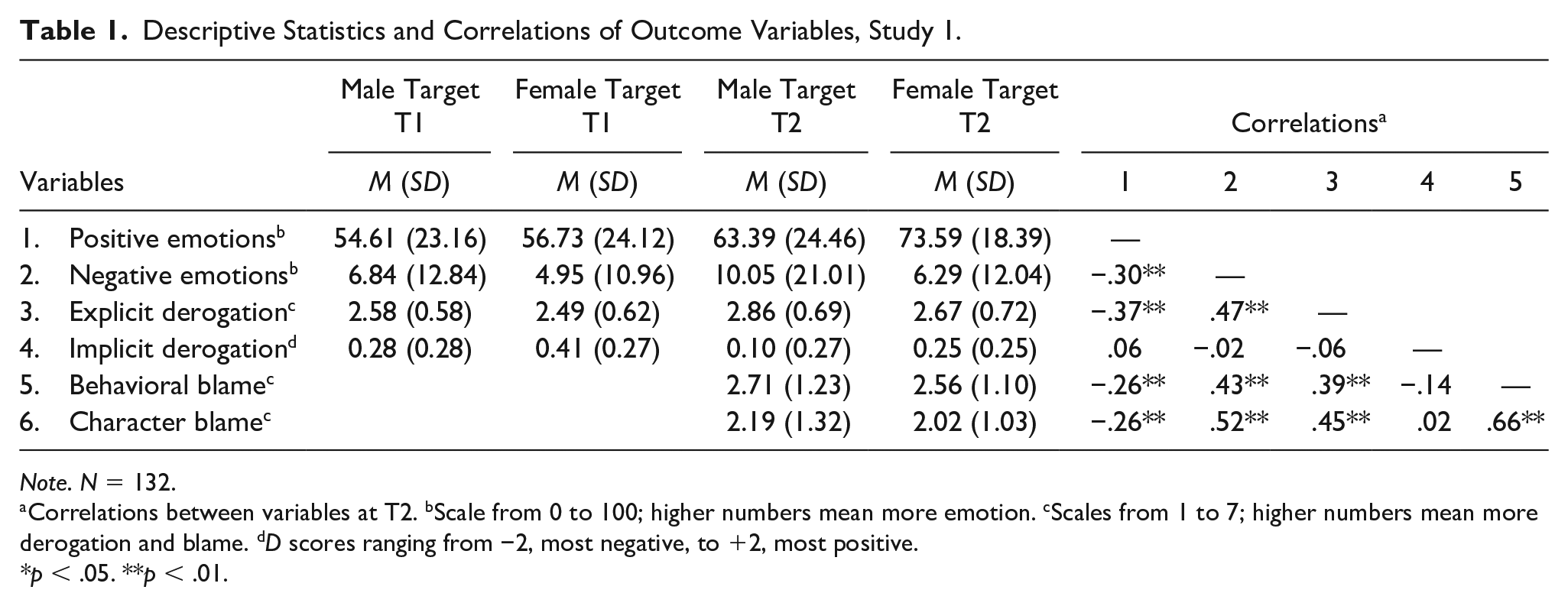
Note. N = 132.
Correlations between variables at T2. bScale from 0 to 100; higher numbers mean more emotion. cScales from 1 to 7; higher numbers mean more derogation and blame. dD scores ranging from −2, most negative, to +2, most positive.
*p < .05. **p < .01.
The first MANOVA indicated significant overall multivariate effects across the dependent variables for victim status, F(4, 125) = 27.75, p < .001, Wilks’s Λ = .53,
Emotions
Follow-up univariate analyses of variance (ANOVAs) showed that victim status had a significant effect on both positive emotions, F(1, 128) = 28.40, p < .001,
Derogation
Univariate ANOVAs also showed that victim status had a significant effect on both explicit derogation, F(1, 128) = 26.47, p < .001,
Blame
Participant gender had an effect on attributions of behavioral blame, F(1, 128) = 4.91, p = .028,
To summarize, support was found for H1. Although participants understandably expressed more sympathy for victims, they also reported more negative emotions and were more likely to derogate victims. No substantial support was found for H2, as no interactions were found between victim status and target gender. Thus, although male targets were generally met with more negative reactions than female targets, this was not something particular to victimization. The only difference between male and female victims was found in the attribution of characterological blame. Contrary to our hypothesis, the character of male victims was blamed more than that of female victims, though only by male participants.
The influence of moral concerns, homonegativity, and gender role attitudes
Hierarchical multiple regression analyses were used to test H3 and H4, assessing how binding values and individualizing values influenced reactions to victims. The influence of traditional gender role attitudes, homonegativity (both centered around the mean), target gender, and participant gender were entered at Step 1 as control variables. Binding values and care values (each centered around the mean) were entered at Step 2 (see Table 2). To protect against capitalizing on chance (analogously to the MANOVAs above), we first tested the effect of these variables on a single dependent variable in which all the standardized dependent variables were aggregated. Both the model at Step 1, R2 = .19, F = 8.47, p < .001, and the model at Step 2, R2 = .41, F change (2, 125) = 6.27, p = .003, explained considerable proportions of variance. We then proceeded with univariate multiple regression analyses per dependent variable. For variables measured twice, difference scores that subtracted measurement at T1 from measurement at T2 served as dependent variables. 2
Hierarchical Regression of (Difference Scores in) Observer Reactions on Moral Concerns and Control Variables, Study 1.
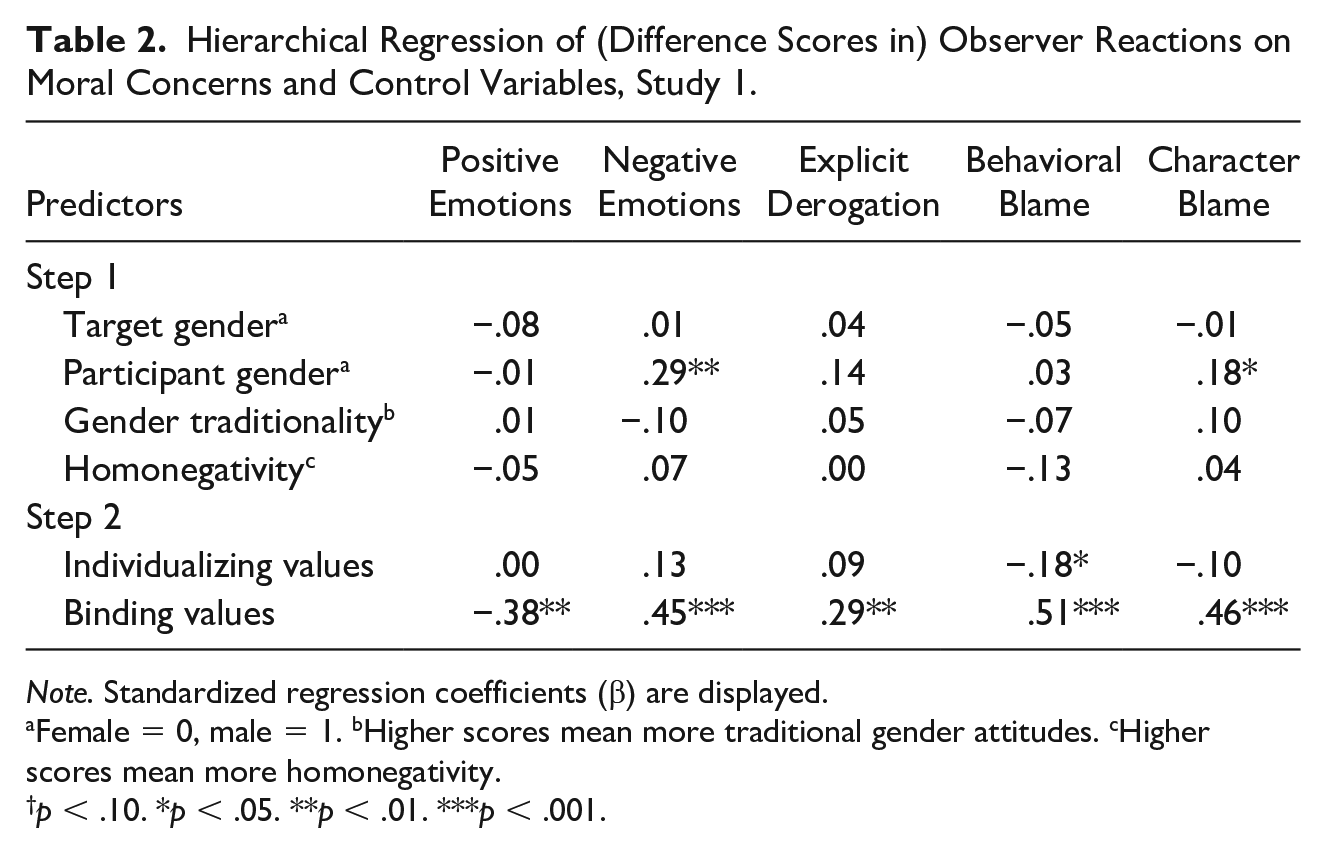
Note. Standardized regression coefficients (β) are displayed.
Female = 0, male = 1. bHigher scores mean more traditional gender attitudes. cHigher scores mean more homonegativity.
p < .10. *p < .05. **p < .01. ***p < .001.
Positive emotions
Whereas the model at Step 1 did not explain a significant proportion of variance in expressed positive emotions toward the victim, F = 1.91, p = .113, the model at Step 2 did, F change (2, 125) = 6.27, p = .003. Binding values served as the only significant predictor (β = −.38, p = .001), with higher endorsement of binding values predicting less positive emotions toward victims.
Negative emotions
The model at Step 1 explained 4.8% of the variance in negative emotions toward the victim, F = 2.67, p = .035. The model at Step 2 explained 14.7% more variance, F change (2, 125) = 11.86, p < .001. In the final model, male participant gender (β = .29, p = .002) and endorsement of binding values (β = .45, p < .001) significantly predicted more negative emotions toward the victim.
Behavioral blame
The model at Step 1 explained 14.1% of the variance in behavioral blame, F = 6.28, p < .001, whereas the model at Step 2 explained 29.8%, F change (2, 125) = 15.16, p < .001. In the final model, care values negatively predicted (β = −.18, p = .036) and binding values positively predicted (β = .51, p < .001) behavioral blame of victims.
Characterological blame
The model at Step 1 explained 18.3% of the variance in characterological blame, F = 8.31, p < .001, whereas the model at Step 2 explained 30.4%, F change (2, 125) = 12.07, p < .001. In this model, male participant gender (β =.18, p = .039) and binding values (β = .46, p < .001) significantly predicted characterological blame.
Explicit derogation
The model at Step 1 explained 4.2% of the variance in the attribution of negative traits to victims, F = 2.45, p = .050. The variance explained at Step 2 was 9.2%, F change (2, 125) = 4.45, p = .014. Binding values were the only significant predictor of negative traits assigned to victims (β = .29, p = .009). Although the model at Step 3 did not explain a significantly larger proportion of the variance (p = .10), it is notable that in this model the only significant predictor was the interaction between binding values and target gender (β = .26, p = .033). The endorsement of binding values was hence likely a stronger predictor of the derogation of male victims than the derogation of female victims.
Implicit derogation
None of the models significantly predicted the differences in ST-IAT scores toward targets pre- and postvictimization, all p > .114.
Hence, support was found for H3. Binding values were frequently the strongest predictor of reactions toward victims, whereas gender traditionality and homonegativity explained little variance in the dependent variables. However, no substantial support was found for H4, which stated that binding values would be a stronger predictor of reactions toward male victims than toward female victims.
Study 2
In Study 2, we again tested whether male and female rape victims received qualitatively different reactions from participants and the extent to which concerns for normativity (differentially) influenced those reactions. This time, data were collected from a larger and more varied sample of British participants. In addition, all moral foundations were included in the prediction of reactions to targets.
Method
Participants and design
A power analysis for a MANOVA with four levels and nine dependent variables was conducted using G*Power (Faul et al., 2007). This yielded a required sample size of N = 356 to detect a small to medium-sized effect (f = 0.15) with a power of .80 at an alpha level of .05. Data were collected on the U.K.-based online platform Prolific Academic, which is geared toward (academic) research and includes elaborate data quality checks (https://www.prolific.co/). This platform provides a relatively naïve and diverse sample of participants (see Peer et al., 2017). After excluding data from six participants because they answered the manipulation check incorrectly (three) or because the questionnaire ended prematurely due to malfunctioning (three), the final sample consisted of 421 participants (206 male, 212 female, three nonbinary) with a mean age of 36.90 years (SD = 13.04; range = 18–81). Of the sample, 18.9% indicated they had been a victim of sexual violence at some point in their life (6.6% preferred not to answer), and 33.5% said someone close to them had been victimized by sexual violence (3.2% preferred not to answer). Participants took approximately 12 to 14 min to complete the study and received GBP 1.50 for their participation.
Procedure and materials
Study 2 resembled Study 1, but victim status was now varied between participants. In addition, after preliminary tests, participant age and participants’ experience of sexual victimization (either own experience or that of close other) were included as (control) variables. This yielded a 2 (target victim status: victimization vs. no victimization) × 2 (target gender: male vs. female) × 2 (participant gender: male vs. female) × 2 (experience of victimization: yes vs. no) between-subjects design. The number of participants per cell ranged from 14 to 35. All participants read the target description, but only participants in the victimization conditions read the rape scenario. (For an example of the vignettes, see the supplementary material.) Verbal and pictorial distancing items replaced the explicit and implicit victim derogation items. Different questionnaires were used to measure homonegativity and traditional gender role attitudes, and the complete 30-item MFQ was included.
Dependent variables
The explicit reactions assessed included expressed emotion, blame, and distancing. Sympathy and pity were combined as positive emotions toward the target (Pearson’s r = .73), whereas contempt and disgust were combined as negative emotions (Pearson’s r = .44). The response scale for the emotion items went from 0 (not at all) to 100 (completely). Attributions of blame were measured only in the victim conditions, with five items each assessing behavioral blame (α = .80) and characterological blame (α = .90). The response scale for the blame items went from 1 (completely disagree) to 7 (completely agree). Distancing was measured verbally by seven items (α = .93); five items were taken from Martin et al. (2000), and two were added that referred to the description participants had read about the target, for example, “How willing would you be to employ Lucas [Lisa] as your babysitter.” The response scale ranged from 1 (definitely unwilling) to 7 (definitely willing). Distancing was also measured by an adaptation of the Pictorial Representation of Illness and Self Measure (van Bakel et al., 2013): Participants indicated how close they felt to the target by dragging a disk resembling Lisa/Lucas closer to or further away from disks representing the participant himself or herself and their life. Closeness was measured by the relative distance between the centers of the disks resembling the participant and the target.
Continuous predictor variables
Moral concerns
The MFQ30 (Graham et al., 2009) was used to measure participants’ scores on care, fairness, loyalty, authority, and sanctity. Care and fairness items were grouped as individualizing values (α = .79) and all loyalty, authority, and sanctity items were combined as binding values (α = .90). The response scale ranged from 1 to 7, indicating not at all relevant to extremely relevant and strongly disagree to strongly agree, respectively.
Attitudes toward homosexuality
To measure attitudes toward male homosexuality, the Modern Homonegativity Scale–Gay men (MHS-G; Morrison & Morrison, 2002) was used. The scale consisted of 12 items (α = .93); response scale from 1 (strongly disagree) to 7 (strongly agree). Item examples are “Gay men should stop shoving their lifestyle down other people’s throats” and “Gay men still need to protest for equal rights” (reversed). Higher scores indicated more negative attitudes toward gay men.
Gender role attitudes
The Social Roles Questionnaire (SRQ; Baber & Tucker, 2006) was used to measure participants’ gender role attitudes. The scale consisted of 13 items (α = .86); response scale from 1 (strongly disagree) to 7 (strongly agree). Examples are “Men are more sexual than women” and “Tasks around the house should not be assigned by sex” (reversed). Higher scores indicated more traditional gender role attitudes.
Results and Discussion
Treatment of missing values
Nineteen participants chose not to indicate whether they had any experience of victimization; these cases were thus not included in analyses that featured victimization experiences as an independent variable (see below). 3 Replies to both disgust and contempt were missing for two participants; hence, these cases were excluded from data analyses including negative emotions. One participant did not reply to one of the positive emotion items, so the other item response served as the positive emotion score.
Reactions to victims and nonvictims
To test H1 and H2, a four-way multivariate analysis of covariance (MANCOVA) was conducted that included victim status, target gender, and participant gender, and experience of victimization as independent variables, and positive emotion, negative emotion, verbal distancing, and pictorial distancing as dependent variables. A three-way MANCOVA was also conducted including target gender, participant gender, and experience of victimization as independent variables, and behavioral and characterological blame as dependent variables. Participant age was included in both analyses as covariate; hence, in the remainder of this section, covariate-adjusted means and standard errors will be reported. Correlations and descriptive statistics by condition are presented in Table 3.
Descriptive Statistics and Correlations of Outcome Variables, Study 2.
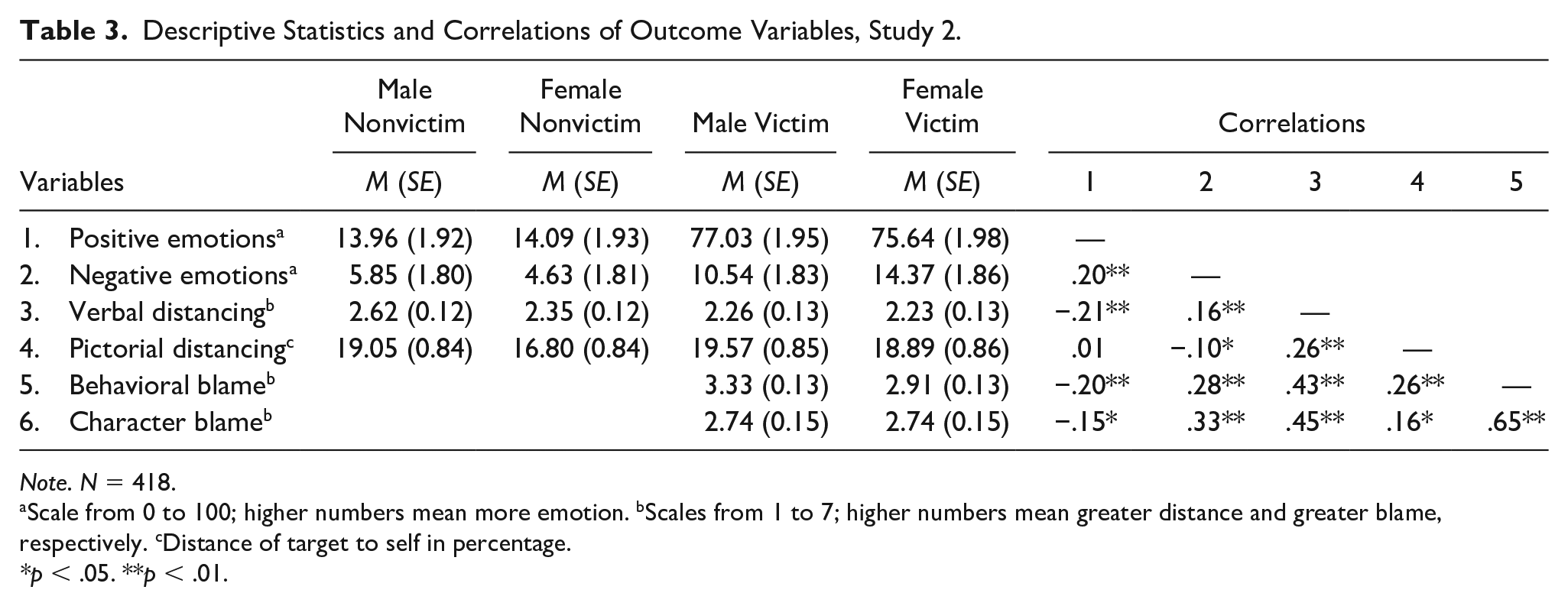
Note. N = 418.
Scale from 0 to 100; higher numbers mean more emotion. bScales from 1 to 7; higher numbers mean greater distance and greater blame, respectively. cDistance of target to self in percentage.
*p < .05. **p < .01.
The four-way MANCOVA indicated significant overall multivariate effects across the dependent variables for victim status, F(4, 378) = 266.61, p < .001, Wilks’s Λ = .26,
Emotions
Follow-up univariate ANOVAs yielded significant main effects of victim status on positive emotions, F(1, 381) = 1,026.18, p < .001,
Distancing
No significant univariate effects were found for victim status on verbal distancing, p = .052, or pictorial distancing, p = .124, nor were significant effects found for experience of victimization on verbal distancing, p = .061, or pictorial distancing, p = .853. However, a significant interaction between victim status and experience of victimization on pictorial distancing, F(1, 381) = 11.17, p = .001,
Blame
Target gender had a significant univariate effect on behavioral blame, F(1, 190) = 5.12, p < .001,
Hence, partial support was found for H1. While participants expressed more positive emotions, they also expressed more negative emotions toward victims. Participants with no victimization experiences also distanced themselves more from victims, though not verbally. However, H2 was not supported. First, target gender did not have a significant influence on emotional and distancing reactions. Second, where blame was expected to be a more prominent reaction to female victims, the opposite pattern was found with participants blaming the behavior of male victims more. An interesting and unexpected finding was the influence of experience of victimization, with participants who had had such experiences generally displaying more positive reactions to targets than those who did not.
The influence of moral concerns, homonegativity, and gender role attitudes
To test H3 and H4, regression analyses were used as in Study 1 (see Table 4). To test the overall effect of the independent variables on the combined dependent variables, we again aggregated all dependent variables into one variable. Victim status, target gender, participant gender, participant age, experience of victimization, gender traditionality, and homonegativity were entered in the model at Step 1 as control variables. Binding values and individualizing values were included in Step 2, and the interactions between victim status and binding values, as well as between victim status and individualizing values, were included in Step 3. Both the model at Step 1, R2 = .33, F (1, 390) = 28.87, p < .001, and the model at Step 3, R2 = .38, F change (2, 386) = 16.25, p < .001, explained a significant proportion of variance. In a second analysis, data were split by victim status, and interactions between moral concerns and target gender were entered at Step 3. The interactions between moral concerns and target gender were not significant for either group, p > .534, and will not be further discussed.
Hierarchical Regression of Observer Reactions on Moral Concerns and Control Variables, Study 2.
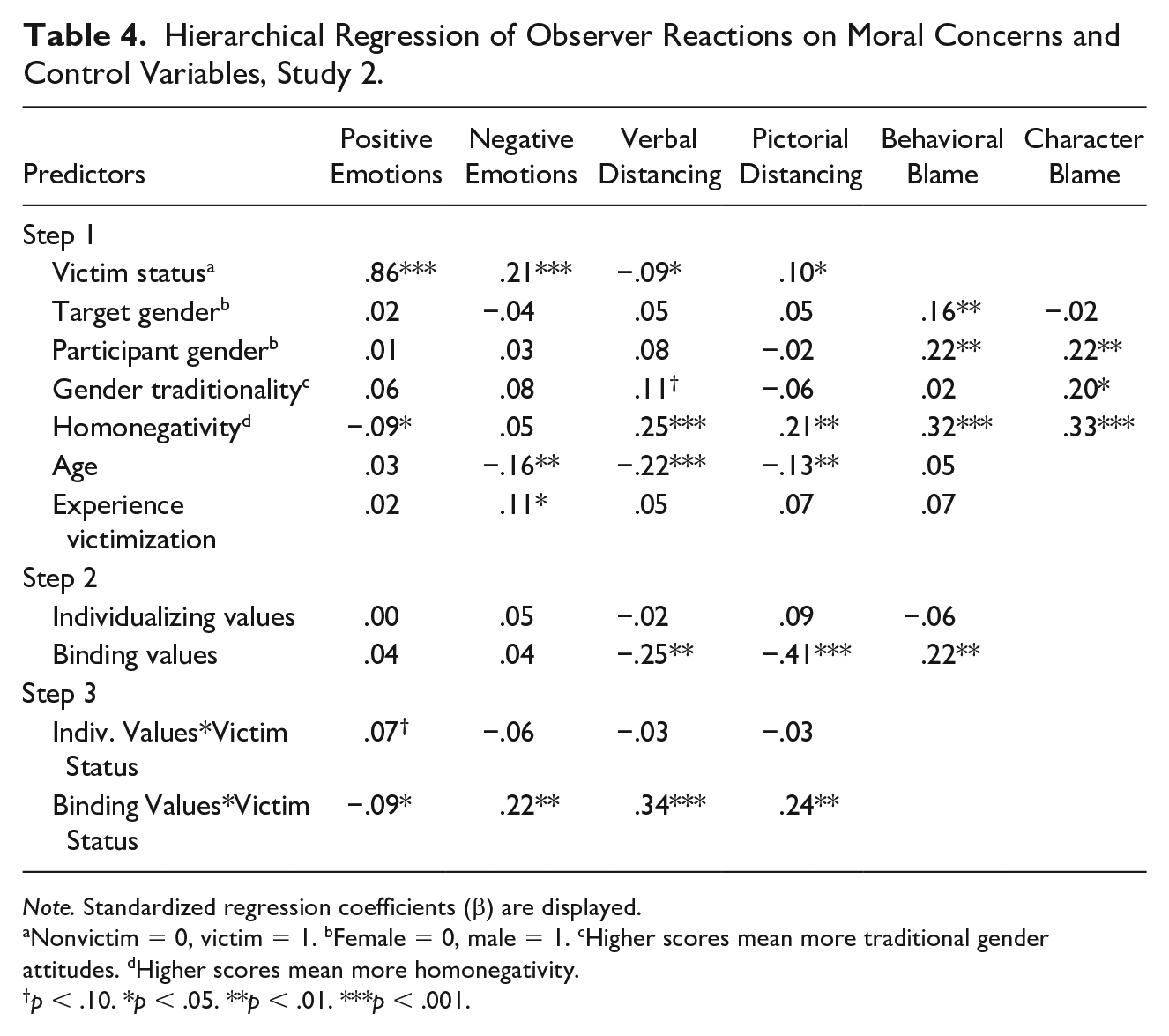
Note. Standardized regression coefficients (β) are displayed.
Nonvictim = 0, victim = 1. bFemale = 0, male = 1. cHigher scores mean more traditional gender attitudes. dHigher scores mean more homonegativity.
p < .10. *p < .05. **p < .01. ***p < .001.
Positive emotions
Repeating the regression model for individual dependent variables, we found that the model at Step 1 explained 73.5% of the variance in positive emotions toward targets, F = 158.84, p < .001. The model at Step 2 did not explain additional variance, p = .243, but the model at Step 3 did, F change (2, 388) = 3.74, p = .025. In the final model, victim status positively predicted and homonegativity negatively predicted positive emotions (see Table 4). A significant interaction between binding values and victim status (β = −.09, p = .020) indicated that the influence of binding values on positive emotions was significantly more negative in response to victims compared with nonvictims (β = .04, p = .339). Although the interaction between individualizing values and victim status was not significant (β = .07, p = .082), it pointed to an opposite trend.
Negative emotions
The model at Step 1 explained 10.4% of the variance in negative emotions toward targets, F = 7.61, p < .001. The models at Step 2 and at Step 3 explained significantly more variance, F change (2, 388) = 5.43, p = .005 and F change (2, 386) = 5.32, p = .005. In the final model, younger participants and those who had not experienced victimization reported more negative emotions toward targets (see Table 4). In addition, victim status (β = .21, p < .001) and the interaction between binding values and victim status (β = .22, p = .001) significantly predicted negative emotions toward targets. Binding values more strongly predicted the expression of negative emotions toward victims than toward nonvictims (β = .04, p = .598).
Behavioral blame
The model at Step 1 explained 34.2% of the variance in behavioral blame, F = 18.14, p < .001, whereas the total variance explained by the model at Step 2 was 38.6%, F change (2, 190) = 3.72, p = .026. In the final model, male participant gender (β = .22, p = .001), male target gender (β = .16, p = .006), homonegativity (β = .32, p < .001), and binding values (β = .22, p = .007) positively predicted behavioral blame of victims.
Characterological blame
Whereas the model at Step 1 explained a significant proportion of variance (28.4%) in characterological blame, F (6, 192) = 14.07, p < .001, the model at Step 2 was no better at predicting variance in characterological blame, p = .262. In the final model, male participant gender (β = .22, p = .001), gender traditionality (β = .20, p = .017), and homonegativity (β = .33, p < .001) positively predicted characterological blame.
Verbal distancing
The model at Step 1 explained 15.1% of the variance in verbal distancing, F = 11.18, p < .001. Whereas the model at Step 2 did not explain more variance, p = .539, the model at Step 3 did, F change (2, 388) = 13.35, p < .001. In this model, victim status (β = −.09, p = .043), participant age (β = −.22, p < .001), and binding values (β = −.25, p = .001) negatively predicted verbal distancing, whereas homonegativity (β = .25, p < .001) positively predicted distancing. An interaction between binding values and victim status (β = .34, p < .001) indicated that whereas binding values predicted closeness to nonvictims, they predicted distancing from victims.
Pictorial distancing
The model at Step 1 explained 2.7% of the variance in negative emotions toward targets, F = 2.60, p = .013. The models at Steps 2 and 3 explained significantly more variance, F change (2, 390) = 7.10, p = .001 and F change (2, 388) = 5.76, p = .003. In the final model, victim status (β = .10, p = .050) and homonegativity (β = .21, p = .002) positively predicted, and participant age (β = −.13, p = .009) and binding values negatively predicted distancing (β = −.41, p < .001). An interaction between binding values and victim status (β = .24, p = .001) again indicated that whereas binding values predicted closeness to nonvictims, they in contrast predicted distancing from victims.
Hence, in support of H3, binding values predicted distancing from and negative emotions toward victims compared with nonvictims, as well as predicting behavioral blame. However, failing to support H4, binding values did not serve as a stronger predictor of reactions toward male victims than toward female victims.
General Discussion
Summary of Findings
In both studies, results largely indicated that people reacted more negatively to victims than to nonvictims. These negative reactions extended beyond blaming, to include derogation, distancing, and the expression of negative emotions. In contrast to our hypotheses, hardly any differentiation was found in negative responses to male compared with female victims. In fact, target gender was much less influential in reactions to victims than participant gender (Study 1) or participants’ own experience of sexual victimization (Study 2).
With respect to moral concerns, results demonstrated that binding values regularly influenced reactions toward targets, whereas individualizing values rarely did. Binding values had differential effects on reactions toward victims compared with nonvictims. Whereas binding values generally had a positive (or no) influence on participants’ reactions to nonvictims, they mostly had a negative influence on participants’ reactions to victims. For instance, binding values predicted closeness to nonvictims, but predicted distance from victims. However, moral concerns did not have a differential effect on the reactions toward male versus female victims. Notably, neither homonegativity nor gender traditionality explained variance in the outcome variables of Study 1, whereas homonegativity frequently served as significant predictor in Study 2 (in accordance with S. White & Yamawaki, 2009). Possibly, the more diverse sample in Study 2 included more participants with negative attitudes toward persons who do not conform to gender stereotypes. Students generally report low levels of homonegativity and gender traditionality, and hence these variables may explain less variance in a student sample. Moral concerns may thus at times be preferred over more direct predictors such as homophobia and rape myths to explain reactions to victims.
Implications
Reactions to victims
Previous research has made few attempts to examine whether reactions such as blame, derogation, and distancing reflect different types of underlying meaning-making processes, and/or are elicited by different stimuli (for a review regarding the latter, see Hafer & Rubel, 2015). Based on research relating to (gendered) rape myths (Javaid, 2015; Reitz-Krueger et al., 2017), we hypothesized that nonnormative instances of victimization, in this case the rape of a male victim, would elicit different reactions from more stereotypical cases of victimization. Assuming that people are most likely to engage in “strategies that are less effortful or more available” (Hafer & Rubel, 2015, p. 76), we expected that a more elaborate sense-making framework for female victimization would promote reactions of blame, whereas the absence of such a framework would foster reactions of avoidance and derogation. However, we found neither clear differentiation between negative reactions nor in response to victim gender. One tentative explanation is that reactions to male compared with female victims may not differ substantially. This is in contrast to a number of previous studies (e.g., Schneider et al., 1994 or, contrastingly, Ayala et al., 2018), although in line with the accumulative inconsistencies of these previous findings. Perhaps different reactions found toward male and female victims sometimes indicate different reactions to male and female targets in general. What is more, perceived gender differences may largely be subordinate to an overarching conception of victimhood. In line with this argument, Mulder et al. (2020) found that sexual victimization led observers to perceive victims as more feminine. In the current study, target gender and respondent gender only became significant predictors when victim status was excluded from the analysis. McKimmie et al. (2014) have made a similar suggestion. In their study, observers evaluated allegations of sexual assault according to a hierarchy of prototypicality, where gender stereotypes only played a significant role in judgment forming when the crime and the victim’s behavior did not correspond to respondents’ normative expectations.
Alternatively, our findings may suggest there are no significant qualitative differences between the various (negative) observer reactions to victims, but that they are all expressions of one particular sentiment (e.g., Lerner, 1980). Yet we need to entertain the methodological concern that the current design failed to properly allow for distinctions in response strategies. In other words, whereas our hypothesis was based on the idea that no ready-made framework is available to participants when trying to make sense of male rape, the subsequent questions we posed them may have created such a framework for them. In a design where participants receive open questions or give spontaneous responses, we might discover greater differentiation or subtleties in (negative) reactions. To illustrate, using interview methods, Anderson and Doherty (2008) did find that participants employed different metaphors to describe female versus male victimization.
Moral concerns
Milesi and colleagues (2020) concluded that moral concerns other than that for justice influence people’s reactions to victims. The current studies extend this claim by showing that binding values consistently predicted negative reactions to victims of sexual violence more strongly than individualizing values did. In fact, concerns for harm only once served as a significant predictor. The predictive value of moral concerns elucidates the way in which people react and connect to others who have suffered severe misfortunes. Potentially, people do not need to score particularly high on fairness and care concerns to understand rape as an unjust experience. However, people’s concerns about what binds them in society may complicate reactions to victims (Niemi & Young, 2016). Taking this into account, sexual violence awareness campaigns that target secondary victimization may wish not (only) to highlight the suffering and unjustness caused to victims, but also emphasize how these people are valued members of society.
Limitations
Studies 1 and 2 differed in several important aspects. Alongside several advantages, the differences in design may also have impeded generalizability because at times it was unclear to what element inconsistencies should be attributed. Notably, the studies included very different samples. In addition, different questionnaires were used to measure attitudes toward homosexuality and gender roles. It is possible that these did not entirely measure the same constructs. In the second study, for instance, homonegativity predicted much of the variance of reactions toward targets, not just in response to male victims. It is possible that this questionnaire to a certain extent measured negative reactions toward “attention-seeking” minority groups, not limited to gay men. Furthermore, Study 1 partly included a within-subjects variation, whereas Study 2 used a fully between-subjects design. We can only speculate about the possibility of such designs having different effects on observer reactions. In Study 1, for instance, participants may have felt that they already knew the target fairly well, before discovering that this person had been victimized. This change of image may have produced different effects than when a person is immediately introduced as a victim.
Considerations of Diversity
Although it was not the focus of our research, our findings and the body of knowledge we draw upon have implications for issues of diversity. This applies quite explicitly to the diversity of targets; thus, a person’s gender may determine not only his or her risk of being sexually assaulted, but also the risk of being subjected to (different types of) secondary victimization. Furthermore, (perceived) sexual orientation, another facet of diversity, strongly comes into play in cases of male-on-male sexual aggression. Finally, we found that especially binding moral foundations, which are shaped by a person’s social identity, affect the perception of victims. This suggests that future research on observers’ socioeconomic status, ethnic or national background (cf. Milesi et al., 2020), religion, and culture may enrich our understanding of victim perceptions and their applied implications.
Conclusion
The current research demonstrates that concerns over normativity may at times have a stronger impact on reactions to victims than may concerns over harm and justice. Indeed, whereas normativity concerns may bind us to others in many instances, this clearly depends on who that other is, or what she or he has suffered. Other types of (experimental) designs may be necessary to further explore whether and how normativity concerns differentially affect reactions to male and female victims of sexual victimization.
Supplemental Material
sj-pdf-1-jiv-10.1177_0886260520914565 – Supplemental material for Negative Third-Party Reactions to Male and Female Victims of Rape: The Influence of Harm and Normativity Concerns
Supplemental material, sj-pdf-1-jiv-10.1177_0886260520914565 for Negative Third-Party Reactions to Male and Female Victims of Rape: The Influence of Harm and Normativity Concerns by Eva Mulder and Gerd Bohner in Journal of Interpersonal Violence
Footnotes
Declaration of Conflicting Interests
The author(s) declared no potential conflicts of interest with respect to the research, authorship, and/or publication of this article.
Funding
The author(s) disclosed receipt of the following financial support for the research, authorship, and/or publication of this article: This research was supported by grants from the Nederlandse Organisatie voor Wetenschappelijk Onderzoek to Eva Mulder (grant 406-15-157) and from the Land Nordrhein-Westfalen, Programm “Geschlechterforschung an Universitäten,” to Gerd Bohner.

Supplemental Material
Supplemental material for this article is available online.
Notes
Author Biographies
References
Supplementary Material
Please find the following supplemental material available below.
For Open Access articles published under a Creative Commons License, all supplemental material carries the same license as the article it is associated with.
For non-Open Access articles published, all supplemental material carries a non-exclusive license, and permission requests for re-use of supplemental material or any part of supplemental material shall be sent directly to the copyright owner as specified in the copyright notice associated with the article.
