




Abstract
The term “apostate” describes the term used by the religious to describe individuals raised within religious families who once identified as religious, but who have ceased to believe in the existence of God, gods or follow their religious belief, and now identify as non-religious. Given the strong feelings families can have about the rejection of their shared faith, and the difficulty that police forces may have in identifying and understanding the complexities of violence toward the apostate, this study sought to examine the possibility that apostates represent a hidden population of abuse victims within religious households. We recruited 228 persons (102 males, 119 females) from an online survey with the support of “Faith to Faithless”—a service within Humanists UK, which supports people that leave their religious faith. Individuals were screened using a modified version of the Conflict Tactics Scale to quantify their experience of assault and negotiation. It was found that persons who identified as apostates experienced more assault (i.e., harmful violence) than non-religious persons. Within this sample, Muslim apostates were significantly more likely to be victimized than Christian apostates. Disclosure of being abused for identifying as an apostate within a religious household to law enforcement was extremely uncommon, thereby preventing detection or prosecution of abusive acts committed by family members and limiting public awareness of this issue. These results are discussed in the context of the broader culture of honor-based (izzat) violence, which occurs across the Eastern Mediterranean, Middle East, and North Africa, and is also seen in some Protestant Christian subcultures, and common to all Abrahamic religions, rather than Islam alone. This study highlights that within a multicultural society, there remain hidden populations of abuse victims who are vulnerable due to religious, cultural, and traditional constraints made by abusive family members.
Introduction
People typically follow the religious faith observed by their family (Herzbrun, 1999). The term “apostate” is given by the religious to describe individuals raised within religious families who cease to believe in the existence of God, gods or follow the religious belief when they choose to identify as non-religious (Hadaway, 1989; Hunsberger & Brown, 1984; Hunsberger, 1983). The onset of apostasy varies: an individual may leave the religious identity of their family due to non-belief from childhood, discarding childhood beliefs in adolescence (when belief in religious traditions as a child becomes untenable in adolescence), or when actively choosing non-belief in young adulthood (Herzbrun, 1999). Dissatisfaction with the notion of an all-powerful interventionist God, dissatisfaction with organized religion, the development of a scientific outlook and morality, free of supernatural foundations, all provide reasons for some people to identify as an apostate (Fazzino, 2014; Wright et al., 2011). The transition from adherence to apostasy can be a difficult decision for people to make, as the process of leaving one’s religious faith can cause the individual to re-evaluate their sense of identity. This process has the propensity to cause an individual to question their identity, initially formed by the convergence of religion, tradition, and culture, necessitating a new version of this identity (King, 2003; Oppong, 2013; Zuckerman, 2015).
Disagreement about personal values between individuals is often problematic, and can particularly cause conflict in families. Arguments about religion can be volatile, as faith often encapsulates shared social values and identities (Tajfel, 1982). Although all Abrahamic (Jewish, Christian, and Muslim) scriptures censure apostates (see Appendix A), whether this rejection is regarded as a metaphor or physically enforced depends upon how literally one considers the injunction within the belief system. The literal interpretation of injunctions within a belief system begs the question of what safeguarding mechanisms are in place for people if a literal interpretation is taken as axiomatic (Anthony, 2015; Cooper, 2013; The Guardian, 2015; Shams, 2016).
The assertion by offenders that they are protecting the honor of their family and community is regularly used as a rationale for committing a crime (Gilbert et al., 2004). From a religious perspective, the apostate can be victimized for dishonoring the collective beliefs of the community and household, and as such, crimes against the apostate can be classified under the umbrella of being “honor-based.” Honor-based violence (HBV) can be described as follows: A collection of practices used predominantly to control the behaviour of [specifically] women and girls within families or other social groups to protect [or defend] perceived cultural and religious beliefs, values or social norms in the name of “honour” . . . By its nature, hidden. It is mainly (although not exclusively) perpetrated by the victim’s family or community, and may include collusion, acceptance, support, silence or denial [when perpetrators perceive that a relative has shamed the family and/or community by breaking their honour code]. This includes such behaviour on the parts of some community leaders. (Her Majesty’s Inspectorate of Constabulary [HMIC], 2015a, p. 29)
Her Majesty’s Inspectorate of Constabulary (HMIC) is independently responsible for assessing the effectiveness and efficiency of police forces in England and Wales. This organization inspected HBV, forced marriage (FM), and female genital mutilation (FGM) in the United Kingdom, following the progression of a victim’s journey from initial contact with the police to the closure of police involvement (HMIC, 2015a). They found a lack of understanding, training, and resources for police forces, causing inconsistent processing of victim reports of crimes, so increasing the level of risk to the victim (HMIC, 2015a). The HMIC (2015a) report highlights that even if crimes are reported to the police, the Crown Prosecution Service (CPS), the principle public prosecution agency for conducting criminal proceedings in England and Wales, lacks lawyers experienced or specialized in HBV. HMIC (2015a) asserts that police forces have limited knowledge of legal measures that are available for victims of HBV. Furthermore, police forces may also be unaware that a prosecution can be brought against the perpetrator, even without the co-operation of the victim to ensure victims are safeguarded, safe, and supported (HMIC, 2015a). There is a clear need for police forces and the CPS to be more aware of HBV and how a lack of action can harm the victim.
Statistics reported about HBV are reliant on formal reports by victims to the police. As such, responsibility lies with the understanding police officers have of HBV to identify it as such, otherwise, crimes are not identified and flagged as HBV, which may result in further harm to the victim (HMIC, 2015a). There was an increase of 32.13% of victims reporting incidents of HBV from 2011-2012 (n = 1,024) to 2014-2015 (n = 1,353; HMIC, 2015b). Even though these statistics suggest that victims are reporting more incidents of supposed HBV, they do not meet the threshold to be categorized as actual crimes. In 2014-2015 for example, 2,617 incidents were reported under the categories of HBV, FM, and FGM. Out of these 2,617 incidents, only 32% (n = 833) were categorized as criminal, which leaves 68% (n = 1,784) reported incidents not being categorized as crimes (HMIC, 2015b). In the same year, there were 1,353 reported incidents of HBV. Of these 1,353 incidents, just under half (48%, n = 649) were categorized as HBV crimes. Gender breakdowns indicated that in 86.8% of offenses the offender was male, and in 76.4% of cases, the victim was female (Crown Prosecution Service, 2016). The differential effects of gender for victims and assailants are not dissimilar to those seen in survivors of intimate partner violence (IPV), or lesbian, gay, bisexual, or transgender (LGBT) hate crimes (Fassinger, 1991; Muehlenhard & Kimes, 1999; Roberts et al., 1999). The umbrella of “honor” remains pertinent to the apostate, as the decision to identify as being non-religious within the religious household is reliant on how strongly honor, as a notion, is valued within the household and the external community.
The statistics for victims of HBV are likely to underestimate the number of victims that may exist. The cultural, religious, and traditional norms of the family and community against apostates increases the level of risk, rejection, and possible abuse toward the victim as a result of the individual identifying as being non-religious (Haidrani, 2016; The Telegraph, 2007; Waters, 2010). The academic literature on persons who leave their birth religion is slight. There is, however, an abundance of documented and expressed fear of religious, social, and cultural pressures on internet blogs (Carlisle, 2013; “Is it Normal?” 2015; Quora, 2014; Tarico, 2015; Wright, n. d.). Some people who identify as apostates claim to live in states of fear and apprehension for “coming out” as non-religious to their religious family. Apostates may fear further violence being committed due to their home and family having been dishonored. This is reportedly similar to the experience of persons identifying as LGBT whom “come out” by expressing their sexual orientation within a socially conservative environment (Breshears & Braithwaite, 2014; Faith to Faithless, 2019; Fruhauf et al., 2009; Goodrich, 2009; Rossi, 2010; Trussell et al., 2015; Wisniewski et al., 2009). Official statistics underrepresent non-religious populations (Zuckerman, 2007). Realistic fears of abandonment, threats of physical and psychological abuse, and ostracism by the community are good reasons why people are less likely to publicly identify as non-religious within a household or their community. As a result, the fears of the potentially victimized are not irrational (Russell, 2004).
The willingness to impose more severe punishments increases with social distance and social inferiority (Cooney, 2014), and through apostasy a person may acquire both of these qualities, placing them at risk (Johnson et al., 2012). Given some families’ concerns about honor, one would expect people labeled as apostates or non-religious (e.g., atheist, humanist, secular, or non-theist) to be at risk of discrimination, maltreatment, and abuse within religiously inclined households (Blanchard, 1991; Bottoms et al., 2015; Hammer et al., 2012; Harper, 2007; Novšak et al., 2012; Regnerus & Burdette, 2006; Simonič et al., 2013; Stewart, 2013; Stokes & Regnerus, 2009; Weber et al., 2012). The current study examines the type of abuse that people identifying as apostates may face within religious households, and the help-seeking behavior it elicits.
Persons who remain in a state of threat, with a heightened awareness for potential risks and danger, show deterioration in their mental well-being (Gilbert, 2009). Methods of coercive control within a household are psychologically abusive and anxiety-provoking, and may progress to violence if coercive control appears to fail in reaching the abuser’s desired outcome (Tanha et al., 2010). Many victims do not report their victimization or do not wish to press charges; as with IPV survivors, non-reporting among people identifying as apostates may reflect the fear of further psychological and physical abuse. As was once the case for IPV, the family may rationalize what are unlawful actions through the ideology of religion, culture, or tradition (Babu & Kar, 2009; Koenig et al., 2006). Whatever the ideology, the abuse encountered when people decide to leave a milieu they consider to be mentally oppressive is detrimental to their psychological and physical health. The choice made by the abused may also cause them to feel guilt at the possible thought of causing grief to their families (Cline, 2015; Cooper, 2013; Gewirtz & Edleson, 2007; Herrenkohl et al., 2008; Holt et al., 2008).
Izzat (honor) is a broad term used in Pakistan, northern India, and Bangladesh which crosses all the local faith communities in the region (Cheesman, 1997). The term izzat encompasses the honor of the household under categories of caste and class status to public reputation within the community. This is further evaluated through the generosity that households show to guests and inferiors, which in turn further aims to maintain control over sexuality, reproduction, and formed alliances within communities (Werbner, 2007). Families sometimes fear their izzat within the community is under scrutiny if a family member declares to not follow the same religious ideology. For the parental migrant generation, izzat remains a significant mechanism used to maintain the reputation that a household may have within their community. To enforce conformity, family members may use shame, stigma, and violence as drivers to subordinate cultural challenges, and so maintain traditional standards, regardless of the mental health or welfare of the individual who seeks to deviate from tradition (Gilbert et al., 2004; Werbner, 2007). The consequences of being responsible for bringing shame and dishonor to the family may further increase the threat response by family members to the apostate.
The number of people in the United Kingdom identifying as religious is falling (Office for National Statistics [ONS], 2013). Representative data from the U.K. census (ONS, 2012) suggested the largest faith community was Christian (59.3%, 33.2 million people), the second largest Muslim (4.8%, 2.7 million people). In 2011, 25.1% (14.1 million people) of the population reported being non-religious: This is an increase from 14.8% of the population in 2001 (ONS, 2012). Of the individuals reporting as non-religious, 40% are aged below 25 years, and more than 80% are aged below 50 years (ONS, 2013). Compared with the previous census, there was a further rise of 637,000 people aged 20 to 24 years identifying as non-religious (ONS, 2013). The rise of people reporting as non-religious furthers the need to investigate tensions this may cause within religious households.
Moreover, 93% (13 million people) of the U.K. population who identify as non-religious are from a White ethnic background (ONS, 2013). These statistics do not include the number of people living in religious families privately identifying as non-religious, nor acknowledge the number of people identifying as non-religious within Black, Asian, and Minority Ethnic (BAME) communities. The underreporting of people identifying as apostates in BAME communities and religious households means these persons are not recognized (Anthony, 2015), and so their concerns become marginalized; a person who has no visibility may not experience the advocacy of other individuals (Campbell et al., 2004). Whether due to fear of breaching social sanctions or community rejection, underreporting of abuse relating to apostates may consequently lead to an increase in hidden populations of victims (Heckathorn, 1997; Ogland et al., 2014). Conventional values and social norms projected by a strong community fail to protect if they disfranchise and invalidate those who think differently (Devers & Bacon, 2010).
Victims of abuse in hidden populations may be less inclined to report their abuse to the police. Classically, victims of rape are less likely to report their abuse by people they know at home or within a social setting, which may cause the survivor to imagine their complicity in the abuse experienced (Campbell et al., 2015). Research on IPV highlights the issues surrounding the difficulties of detecting victims, due to the complicated nature of social, cultural, and relationship factors involved in abuse, which contribute to the victim’s inability to make themselves known as a victim of crime (Schackner et al., 2017). There remain limits to the current knowledge, comprehension, and discourse regarding the victims of HBV, and how these victims can be protected by the criminal justice system (Biggs, 2010). This is particularly the case if it is believed that disagreements about apostasy should be resolved within their communities, as IPV and child abuse once was (Gangoli & Rew, 2011).
The present study examined the range and magnitude of the levels of familial abuse experienced by people identifying as apostates. A modified version of the Revised Conflict Tactics Scale (CTS) was used to formally measure the abuse participants may have experienced (Straus et al., 1996). It was hypothesized that persons identifying as apostates within religious families would report increased levels of assault. Moreover, it was hypothesized that victims of such abuse would be less likely to report their abuse to the relevant authorities, as this would enable family members to maintain coercive control over the victim, and place their human rights at risk. In addition, it was hypothesized that religious-ideological texts which justify abuse and death of apostates, would increase the chances for people identifying as apostates to be victimized in their familial home and within their community. Results are examined concerning birth-faith and care-seeking within their family. Care-seeking can be informal or formal; informal is support from friends and family networks to seek help for the concern whereas formal may involve engagement with medical, social, or criminal justice systems (Calton et al., 2016).
Method
Participants and Procedures
In the present study 228 persons were recruited from a questionnaire that was opportunistically sampled from a worldwide population. All procedures were reviewed and approved by the Research Ethics Committee at the authors’ university. Participants were recruited with the support of the following organizations: “Faith to Faithless,” the “Peter Tatchell Foundation,” and the “Council of Ex-Muslims of Britain,” with the questionnaire being posted on their respective social media platforms. These organizations work to promote and protect the human rights of people under threat from victimization due to their identity, sexuality, religious or lack of religious belief within the United Kingdom and internationally.
Participants ranged in age from 17 to 67 years (M = 29.95 years, SD = 10.69 years), with 52% self-identified as female (n = 119), 45% as male (n = 102), and 3% as other (n = 7). The ethnicity and birth religion of participants were categorized using the United Kingdom’s 2011 census categories (ONS; National Records of Scotland; Northern Ireland Statistics and Research Agency, 2016). For ethnicity, 59% (n = 135) people self-identified as White, 29% as Asian/Asian British (n = 65), 6% as mixed or multiple ethnic groups (n = 13), 4% as Black/African/Caribbean/Black British (n = 10), and 2% as other ethnic groups (n = 5). For birth religion, 57% (n = 130) people identified as Christians, 30% as Muslims (n = 68), 4% as Hindus (n = 9), and 1% as Jewish (n = 3). 1 There were also 8% (n = 18) people identifying as non-religious from birth.
The completion of the survey required participants to confirm they had read and understood the information from the information sheet, that their participation was voluntary, and that their answers were anonymous—but if they wished to withdraw their data, they could do so by contacting the authors by quoting their identification answers provided at the start of the survey. The debriefing provided details of how participants could withdraw their data and contact information of charities working to support victims.
Measures
The extent that people in relationships engage in psychological, sexual, and physical attacks on each other, and the methods used to manage conflict and negotiation was measured using the Revised CTS (Straus et al., 1996). The CTS was modified (mCTS) in the current study to assess the extent that people within families engage in psychological and physical assaults on each other, following the individual declaring they do not believe in the shared religion, God, or gods. The CTS uses the term “my partner” to highlight IPV committed by the partner to the victim and in response (Straus et al., 1996, pp. 311–312). This study replaced “my partner” with the term “my family” and omitted sexual violence items from this study. Participants were instructed to state how many times they may have experienced conflict in the past year and whether such conflict has occurred outside of the parameter of a year. Responses were rated on a scale from 0 (this has never happened) to 6 (more than 20 times in the past year), with ratings of 7 if there had been incidents in the past. Higher scores on any of the dimensions indicate a greater magnitude of abuse being inflicted.
All participants provided age, gender, sexuality, and ethnicity information. Participants also provided their religious or non-religious affiliation from birth, their current religious or non-religious affiliation, whether they had fully rejected religion, and whether their family was aware of their decision.
Data Analysis
The mCTS was tested for validity using exploratory factor analysis (EFA) and confirmatory factor analysis (CFA) using AMOS. Statistical relationships were calculated based on the mCTS scores and questions within the survey. The reliability of these measures was calculated using Cronbach’s alpha. Differences between groups were calculated using univariate analysis, and testing if people were victimized due to their lack of religious belief within religious households. A higher score on any of the mCTS dimensions indicates a greater magnitude of abuse being inflicted.
Results
Abuse of Participants
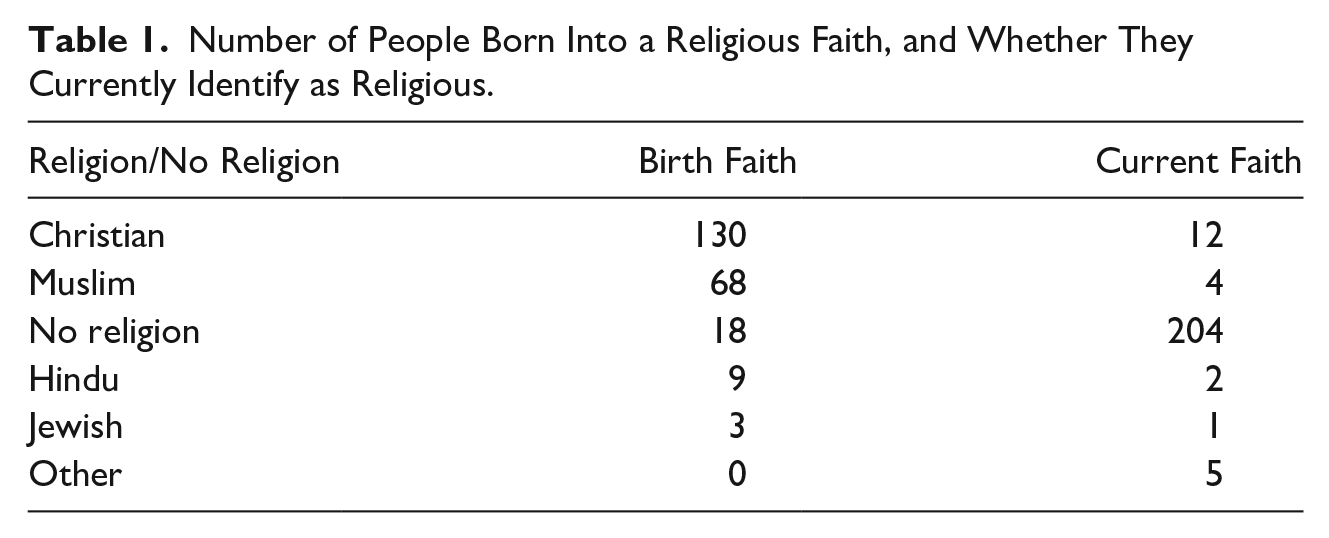
Table 1 presents the number of people who were religious or non-religious from birth and the number of people who are religious or non-religious currently. Of the 228 participants raised in a religious faith, just 19 were now observant. Most persons had been raised in Christian, Muslim, or non-religious households; as only 12 participants identified Hindu, Jewish, and Sikh family households, the analysis focused on persons who were Christian, Muslim, or had no reported faith.
Number of People Born Into a Religious Faith, and Whether They Currently Identify as Religious.
To test if abuse was differentially distributed across groups, two one-way analyses of variance (ANOVAs) were calculated and presented in Table 2. There was a highly significant difference across groups for assault, with post hoc comparisons using the Bonferroni test. We found people raised within Muslim households were more likely to identify as victims of assault for not identifying as Muslim anymore, in comparison to people identifying as Christian or non-religious from birth. There was no difference between people who identified as non-religious and those who identified as Christian. These results further indicate that being an apostate within some Muslim households may increase the likelihood of experiencing assault.
mCTS Subscale F-Ratios (One-Way ANOVA) Between Apostate Participants, Broken Down by Birth Faith.
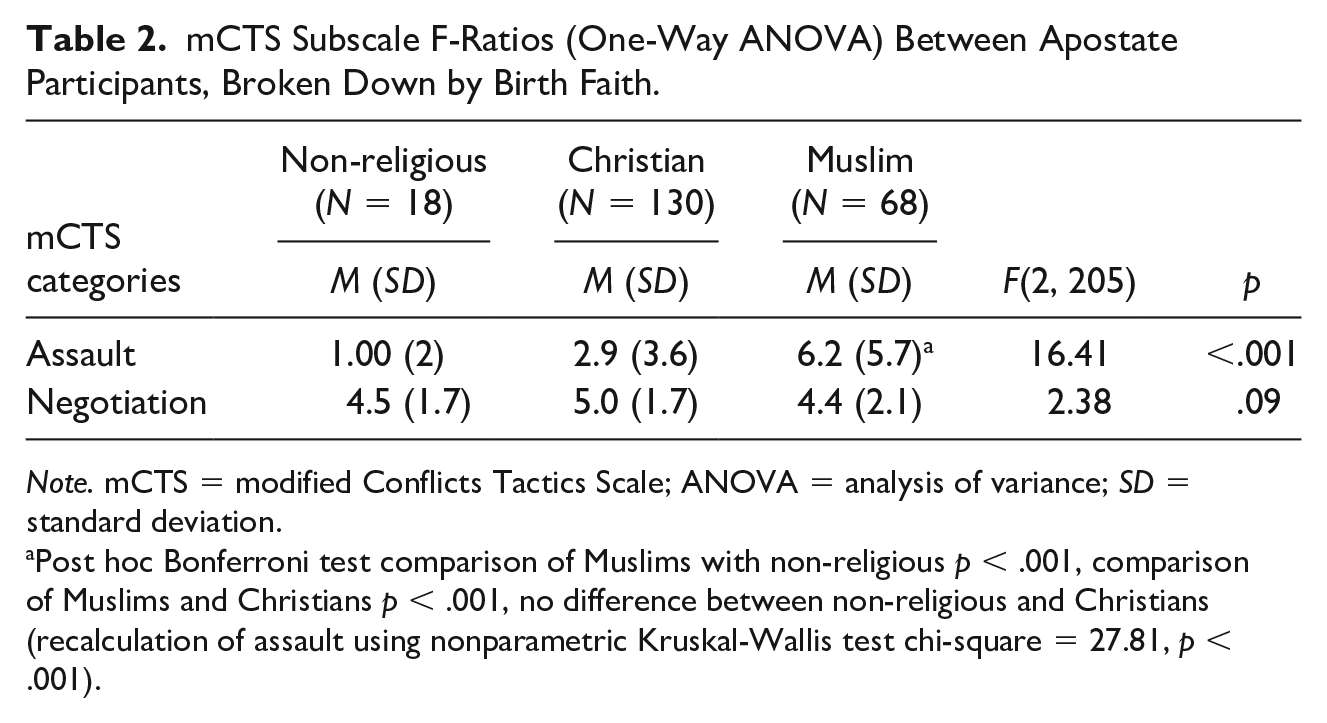
Note. mCTS = modified Conflicts Tactics Scale; ANOVA = analysis of variance; SD = standard deviation.
Post hoc Bonferroni test comparison of Muslims with non-religious p < .001, comparison of Muslims and Christians p < .001, no difference between non-religious and Christians (recalculation of assault using nonparametric Kruskal-Wallis test chi-square = 27.81, p < .001).
Negotiation in Participants
A final ANOVA was conducted to examine the way people manage conflicts in relation to not identifying with the religion of the household. There was no significant difference in attitudes of the family negotiating differences of opinion and conflict in relation to the religion of the family.
CFA of mCTS
To test the validity of the mCTS for assessing within family violence and conflict, the scale was assessed initially with EFA to identify the a priori loadings, as highlighted in Table 3. These were then tested with CFA. With 20 mCTS items and an N of 228, an eigenvalue of 1.0 would potentially produce spurious factors, so parallel analysis (O’Connor, 2000) was used to estimate the criterion above which eigenvalues could be trusted. This revealed a value of 1.74. The data had a KMO sampling adequacy of 0.874. The EFA (with oblique rotation of the factors to accommodate covariation of the factors) produced three oblique factors that rotated in 22 iterations, explaining a total of 50.21% of the variance. The three factors were assault, negotiation, and, negatively loaded, serious assault. A series of CFAs were conducted to test the validity of this structure (additional downloadable content for output of CFA described). The a priori EFA structure comprising three factors had a CMIN of 2.449 with 121 df. The confirmatory fit index (CFI) for this was 0.898; the root mean square estimate of approximation (RMSEA) was 0.80. This fit is acceptable but inspection of modification indices indicated that many items with very high critical ratios in the assault and serious factors should be associated, and regarding these as separate meant that they could not be added for a better fit. For this reason, we combined the assault and serious assault items into an assault scale. This had a CMIN of 4.408 with 79 df, a CFI of 0.918, RMSEA = 0.112 (90% confidence interval [CI] = [0.109, 0.136]). There is a discrepancy between the acceptable fit of the CFI fit index compared with the RMSEA, which is less than ideal. This difficulty of inconsistency of fit indices has been discussed by Lai and Green (2016), who note that increasing numbers of fit indices can sometimes increase the confusion of the validity of a model and focused on the reliability. The negotiation items were examined separately and fitted very well; CMIN = 1.355, with 6 df, a CFI of 0.99, and an RMSEA of 0.039. We, therefore, took general indices of assault (α reliability = 0.92) and negotiation (0.68) as our key indicators from the mCTS. The complete final CFA output and a figure are available in the supplemental materials.
Pattern Matrix of EFA of mCTS Scale (N = 228).
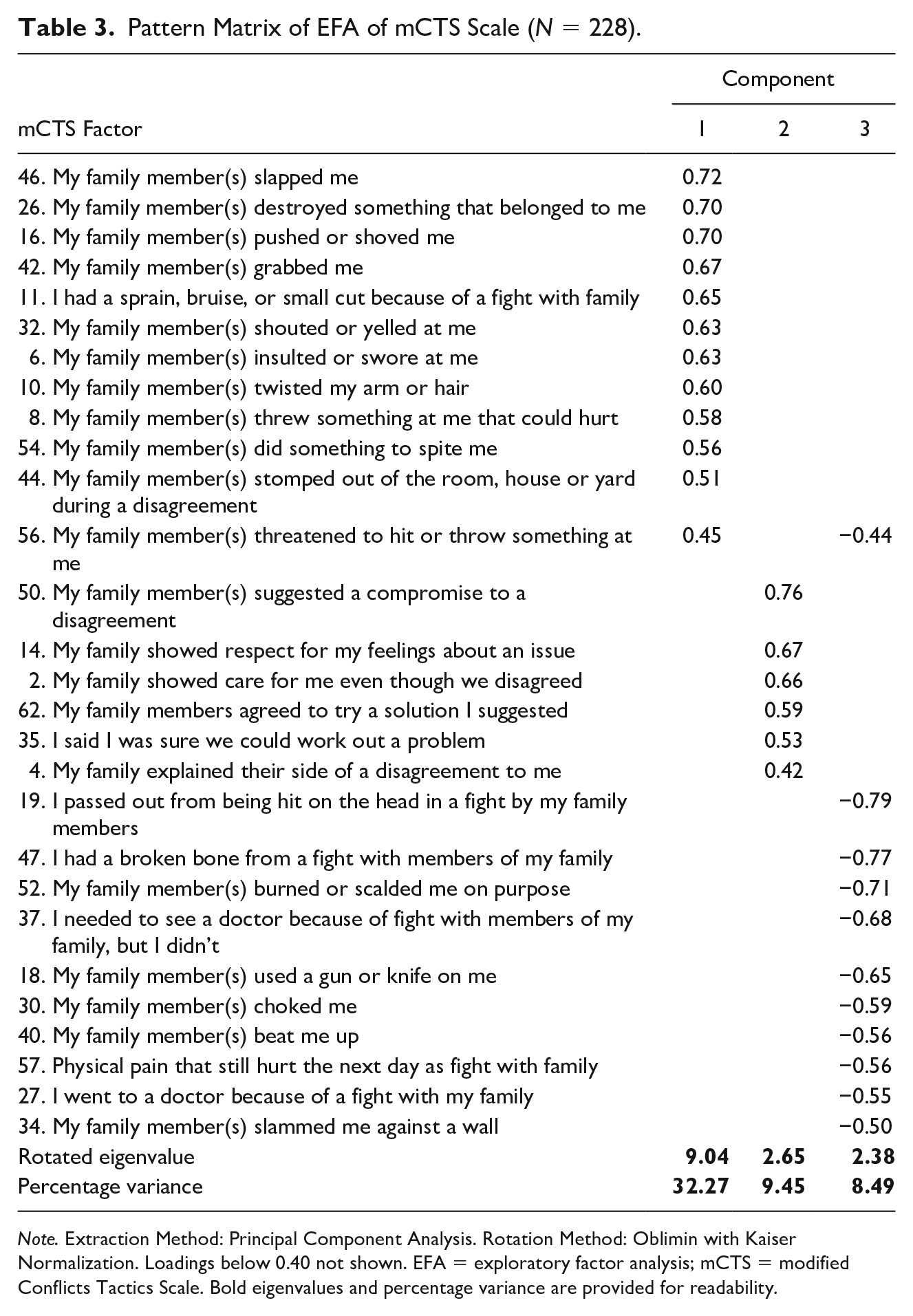
Note. Extraction Method: Principal Component Analysis. Rotation Method: Oblimin with Kaiser Normalization. Loadings below 0.40 not shown. EFA = exploratory factor analysis; mCTS = modified Conflicts Tactics Scale. Bold eigenvalues and percentage variance are provided for readability.
Disclosure of Assault and Abuse to the Police
Out of 154 persons assaulted in the cohort, only nine respondents (5.8%) reported their assault to the police. In terms of consequences for committing an assault, five assailants were given a warning and one was charged. Of the 71 participants who reported reasons as to why they did not report their abuse, 44% (n = 31) believed reporting would be disrespectful to their family dynamics and would be perceived as a betrayal of their family and community. A participant said, . . . I was not aware I could; I was too scared to do so; I did not think I would be believed; I knew people who would defend my assailant at all costs; and I knew I would be a pariah in my community.
Furthermore, 27% (n = 19) believed the police would be unable to support them appropriately. For example, another participant said, . . .“This is something that culturally I couldn’t cross; It was taught that getting the ‛western’ system involved with family affairs was wrong, and I cared enough about my family members not to put them in jail.”
Another 10% (n = 7) further highlighted that victims remain threatened to inform their family of not identifying with their religious faith due to perceived repercussions of violence by family members, and the lack of support they might receive from police forces as a result. A participant stated that “. . . they threatened to kill me; They have beaten me and wanted to kill me; and because I don’t practice Islam anymore . . . they’ll kill me for it if they found out.”
Victims remain vulnerable by their lack of trust in the ability of police forces to manage the threat to their lives and provide them with a sense of security and safety from familial abuse.
Discussion
The current study examined the level of abuse experienced by self-declared apostates, hypothesizing they represent a hidden population of abuse victims. We enquired whether abuse would be reported to the authorities and whether the abuse and its seriousness differed according to birth faith. We recruited a predominantly Christian and Muslim sample, of whom more than 90% had left their religion of birth. We found persons who disclosed being from a Muslim background had a higher likelihood of assault. Negotiation of conflicts was equivalent across communities. Disclosure to the authorities was rare and highlights the complexities found policing cultural issues.
The cultural complexities within any society with a “culture of honor” may be salient for understanding differential effects of violence across differing interpretations of scripture (Ellison et al., 2003). The patriarchal, hierarchical, and traditionalistic need to maintain izzat within the household is essential to earning respect from the community—this is the foundation of many Asian families across Hindu, Muslim, and Sikh communities (Ballard, 1982). Cultural rules and values, under the guise of “honor,” are systematically embedded by communities to prevent individualization and the demise of traditional cultural norms held by the parental migrant generation. In practice, izzat is often a social mechanism for families to counter secularization and used to protect and maintain the religio-cultural social norms held by the community against the threat of impending westernization (Ballard, 1982; Hayes et al., 2016).
The United Kingdom’s Human Rights Act (1998) specifically aims to protect all members of society under the state of law. A conflict emerges when two kinds of law—secular and religious—seek to legislate the same human conduct rather than cover different magesteria. Offenders may engage or exploit inconsistencies in either system as proves expedient. In practice, the justifications provided by ideological scriptures may justify and excuse the abuse of people identifying as non-religious within a religious household. Neither law then protects the victim. Although the law is improving in relation to the needs and plight of IPV survivors, enforcement of law remains tentative to some cultural complexities (Goldfarb, 2007; Turner et al., 2017).
It is only by disclosing an offense that due legal process can occur. Our study (comprising a sample size greater than the number of reported honor crimes in the United Kingdom for 2015-2016) found that of 154 persons who self-reported experiences of assault, only one assailant was charged. Most survivors resisted making a complaint due to their belief that disclosure would harm their relationship with their family and that the police would not comprehend their issues because they were fearful of the social repercussions of openly identifying as non-religious. A victim’s internalization of powerlessness enables abusers to perpetuate their transgressions, as does an unnuanced or literal interpretation of scripture used to commit this abuse by seeming to encourage the reader’s moral disengagement (Egan, Hughes, & Palmer, 2015). The most significant concern for a victim when deciding to disclose their abuse is often the feared response of the perpetrator (Gill, 2004). Collins and Miller (1994) found victims are more likely to disclose their abuse to people whom are receptive and approachable (Brown & Reed Benedict, 2002). Police caution about community relations is understandable, but public scandals that follow from their not taking offenses seriously undermine public confidence in the agency (Jay, 2014).
Limitations
First, the current study gathered data from the community and special interest groups; we are mindful it may provide skewed data given the sampling. However, given the lack of disclosure to police in our sample, basing such research on official data may have revealed little, and suggests that far more offenses are occurring than are being reported. The abuse of apostates exists within the broader concept of (so-called) “honor” crime, which encompasses murder, violence, abduction, and genital mutilation. Another limitation is being unable to decompose Christian and Muslim denominations into their various sects, so testing, for example, whether persons from more evangelical Protestant, traditional Catholic, Sunni, or Shia birth families are more likely to be abused if they wish to break away from their religion of birth. We used the information acquired, and the study did not seek to disparage any particular faith. Future studies will seek a larger, broader, and more fine-grained analysis of differing faith and belief communities to redress this need. We suspect that any culture with izzat values or their local equivalent may potentially commit “honor”-related crimes (Kulczycki & Windle, 2011). Third, the use of the mCTS in the survey strongly operationalized violently abusive experiences but did not deconstruct psychological abuse into its underlying components, and there may be a more effective screening tool for victimization experiences than the CTS. A final limitation is the low number of people sampled from Hindu, Jewish, Buddhist, and Sikh backgrounds. Other studies could redress this need.
Directions for Future Research
Future research on apostasy needs to continue gathering data creatively, using both social media and indirect official data sources such as medical settings, where injured or psychologically abused persons may disclose victimization, to unravel the true incidence of this kind of abuse. Another task is to increase awareness of the existence of apostate-abuse among the general public, by having such persons perceived as survivors, like those affected by IPV now are (Beeble et al., 2008). Further research is needed to support police officers so they have better cultural knowledge and understanding of apostates disclosing abuse, and the context in which this operates.
Our study found people identifying as non-religious within a religious household are at risk of abuse. This was rarely reported to the authorities. The ideological justification for carrying-out such abuse breaches individual human rights, but without prosecution, increases the likelihood of apostates being victimized within their community. Persons who get away with violence, or express it with self-righteousness are more likely to be violent again. A multicultural society seeks to respect, validate, and protect all its members: It must also be mindful of the intimidation which conceals abuse in hidden—and not so hidden—communities.
Supplemental Material
CFA_of_aggression_items_in_CTS – Supplemental material for Apostates as a Hidden Population of Abuse Victims
Supplemental material, CFA_of_aggression_items_in_CTS for Apostates as a Hidden Population of Abuse Victims by Hari Parekh and Vincent Egan in Journal of Interpersonal Violence
Footnotes
Appendix A
Declaration of Conflicting Interests
The author(s) declared no potential conflicts of interest with respect to the research, authorship, and/or publication of this article.
Funding
The author(s) received no financial support for the research, authorship, and/or publication of this article.

Supplemental Material
Supplemental material for this article is available online.
Note
Author Biographies
References
Supplementary Material
Please find the following supplemental material available below.
For Open Access articles published under a Creative Commons License, all supplemental material carries the same license as the article it is associated with.
For non-Open Access articles published, all supplemental material carries a non-exclusive license, and permission requests for re-use of supplemental material or any part of supplemental material shall be sent directly to the copyright owner as specified in the copyright notice associated with the article.
