




Abstract
The Teacher Reporting Attitude Scale (TRAS) is a newly developed tool to assess teachers’ attitudes toward reporting child abuse and neglect. This article reports on an investigation of the factor structure and psychometric properties of the short form Malay version of the TRAS. A self-report cross-sectional survey was conducted with 667 teachers in 14 randomly selected schools in Selangor state, Malaysia. Analyses were conducted in a 3-stage process using both confirmatory (stages 1 and 3) and exploratory factor analyses (stage 2) to test, modify, and confirm the underlying factor structure of the TRAS in a non-Western teacher sample. Confirmatory factor analysis did not support a 3-factor model previously reported in the original TRAS study. Exploratory factor analysis revealed an 8-item, 4-factor structure. Further confirmatory factor analysis demonstrated appropriateness of the 4-factor structure. Reliability estimates for the four factors—commitment, value, concern, and confidence—were moderate. The modified short form TRAS (Malay version) has potential to be used as a simple tool for relatively quick assessment of teachers’ attitudes toward reporting child abuse and neglect. Cross-cultural differences in attitudes toward reporting may exist and the transferability of newly developed instruments to other populations should be evaluated.
Background to the Study
Child maltreatment 1 is recognized as a significant public health problem in many nations. There is well established empirical evidence to show that children exposed to different types of child maltreatment and multitype maltreatment suffer considerably poorer outcomes than their nonmaltreated counterparts (Gilbert, Kemp et al., 2009; Gilbert, Widom et al., 2009). Adverse effects of maltreatment extend into adulthood resulting in poorer quality of life and significant social and economic consequences for whole societies (World Health Organisation, 2002). To protect abused and neglected children, Federal and State jurisdictions in many nations have enacted laws requiring teachers and other professionals to report known or suspected maltreatment to statutory authorities (Mathews & Kenny, 2008). These laws, commonly referred to as mandatory reporting laws, are designed to ensure that professionals having most contact with children can intervene to stop maltreatment and prevent further harm. As well, child protection reports act as a catalyst for provision of interventions in the form of physical treatment, psychological counseling, and justice services.
Malaysia is a developing nation with a population of more than 28 million with approximately one-third aged below 15 years (Department of Statistics Malaysia, 2010). Despite recent prevalence studies revealing the extent of all forms of maltreatment for children in Malaysia both within their homes and at school (see for example Choo, Dunne, Marret, Fleming, & Wong, 2011), no mandatory reporting laws exist for teachers in Malaysia 2 . Medical doctors, family members, and child care providers however, are subject to provisions in the Child Act 2001 (Act 611, Part V, Chapter 2, Section 27-29) requiring them to report a child who is physically or emotionally injured as a result of being ill-treated, neglected, abandoned or exposed, or who is sexually abused, to the social welfare officers or police (Lembaga Penyelidikan Undang-Undang, 2005). Extending these provisions to include teachers, arguably the professional group having most contact with children, has been publically discussed by interest groups in Malaysia (Alavi, Amin, Subhi, Mohamad, & Sarnon, 2012; Jal Zabdi, 2008, 2010). This context makes the current study important, timely, and relevant. In addition, data from Malaysia’s official child protection agency reveal that school personnel are the least common reporters contributing only approximately two percent of the annual official CAN cases reported nation-wide (Department of Social Welfare Malaysia, 2008). This figure represents a vast discrepancy when compared with reporting rates in countries having mandatory reporting for teachers such as United States and Australia. In these countries school personnel are the second most common reporters contributing approximately one quarter of their CAN reports in these countries (Australian Institute of Health and Welfare, 2008; U.S. Department of Health and Human Services, 2010). Well-functioning child protection systems require teachers who are well-equipped for their roles as reporters, including holding positive attitudes toward reporting. Understanding Malaysian teachers’ current attitudes toward reporting child abuse and neglect is a crucial step toward undertaking broader strategies such as awareness raising, advocacy for legislative change, and the adoption of teacher training for child protection.
Previous research suggests that professionals’ child maltreatment reporting behavior is influenced by attitudes toward reporting. In particular, negative attitudes acting as barriers to reporting include notions that the benefits of reporting are outweighed by its costs (O’Toole, Webster, O’Toole, & Lucal, 1999; Zellman, 1990; Zellman & Bell, 1990); fears of making an inaccurate report (Bunting, Lazenbatt, & Wallace, 2010); fears associated with retaliation for reports (Alvarez, Kenny, Donohue, & Carpin, 2004; Kenny, 2004; Vulliamy & Sullivan, 2000); fears of damage to reputation (Webster, O’Toole, O’Toole, & Lucal, 2005); lack of faith in child protection authorities (Kenny & McEachern, 2002); support for physical discipline of children (Abrahams, Casey, & Daro, 1992; Briggs & Potter, 2004; Feng, Huang, & Wang, 2010; Kenny, 2004; Kenny & McEachern, 2002; Tite, 1993); and beliefs regarding the privacy of the family (Abrahams et al., 1992; Crenshaw, Crenshaw, & Lichtenberg, 1995). Positive attitudes toward reporting have been associated with greater willingness to report (Hawkins & McCallum, 2001a, 2001b) and with reporting consistency (Goebbels, Nicholson, Walsh, & De Vries, 2008). Specifically, positive attitudes acting as facilitators to reporting include beliefs that child abuse reporting is necessary (Beck, Ogloff, & Corbishley, 1994) and conviction that reporting is the teacher’s responsibility (Haj-Yahia & Attar-Schwartz, 2008).
Teachers’ attitudes toward reporting child maltreatment in non-Western countries remain relatively unexplored. Furthermore, studies have not explored the underlying latent drivers of attitudes for teachers other than for those in Western industrialized nations. On the one hand, theorists have claimed that cultural, behavioral, and perceptual differences abound between individuals in the West and East (see for example Nisbett, 2003). On the other hand, research in the related field of school violence suggests that commonalities exist across cultures (see for example, Benbenishty & Astor, 2005; Chen & Astor, 2009). Importantly for this study, differing sociocultural and sociopolitical beliefs about reporting of suspected cases of child maltreatment have been found in non-Western samples of Palestinian preschool teachers from Israel (Haj-Yahia & Attar-Schwartz, 2008), early childhood educators from Singapore (Briggs & Potter, 2004), and school teachers from South Africa (Phasha, 2008) and Taiwan (Feng et al., 2010). In particular, in non-Western societies there are differences in adults’ views about what constitutes acceptable and unacceptable behavior toward children. This is particularly so in Asian societies (Dunne, Chen, & Choo, 2008). For example, although violent and severe discipline in schools is generally illegal in many Asian societies, the use of discipline and force to control or punish children can be common and socially sanctioned (Chen & Luster, 2002; Shek, 2000; Tang, 2006). This may in turn result higher levels of tolerance for these acts by parents and other adults (Dunne et al., 2008). In this vein, Feng et al. (2010) reported that the majority of teachers in their sample from Taiwan felt physical discipline was acceptable, and perceived it as an effective and legitimate feature of child rearing in Taiwan. Hence, Taiwanese teachers’ acceptance of physical punishment was found to be negatively related to intention to report child abuse (Feng et al., 2010). The authors attributed this finding to traditional Chinese culture, which emphasizes filial piety requiring children’s absolute loyalty and obedience to parental authority and demands (Chen & Luster, 2002; Tang, 1998).
Clearly, studies are needed in different cultures to obtain important perspectives on the similarities and differences within and between different societies with respect to child maltreatment reporting attitudes and behaviors. The aim of this study, therefore, was to adapt and test an English-language instrument for assessing teachers’ attitudes toward reporting child abuse for use with a sample of Malaysian teachers, and to investigate the instrument’s factor structure and psychometric properties.
Method
The Instrument
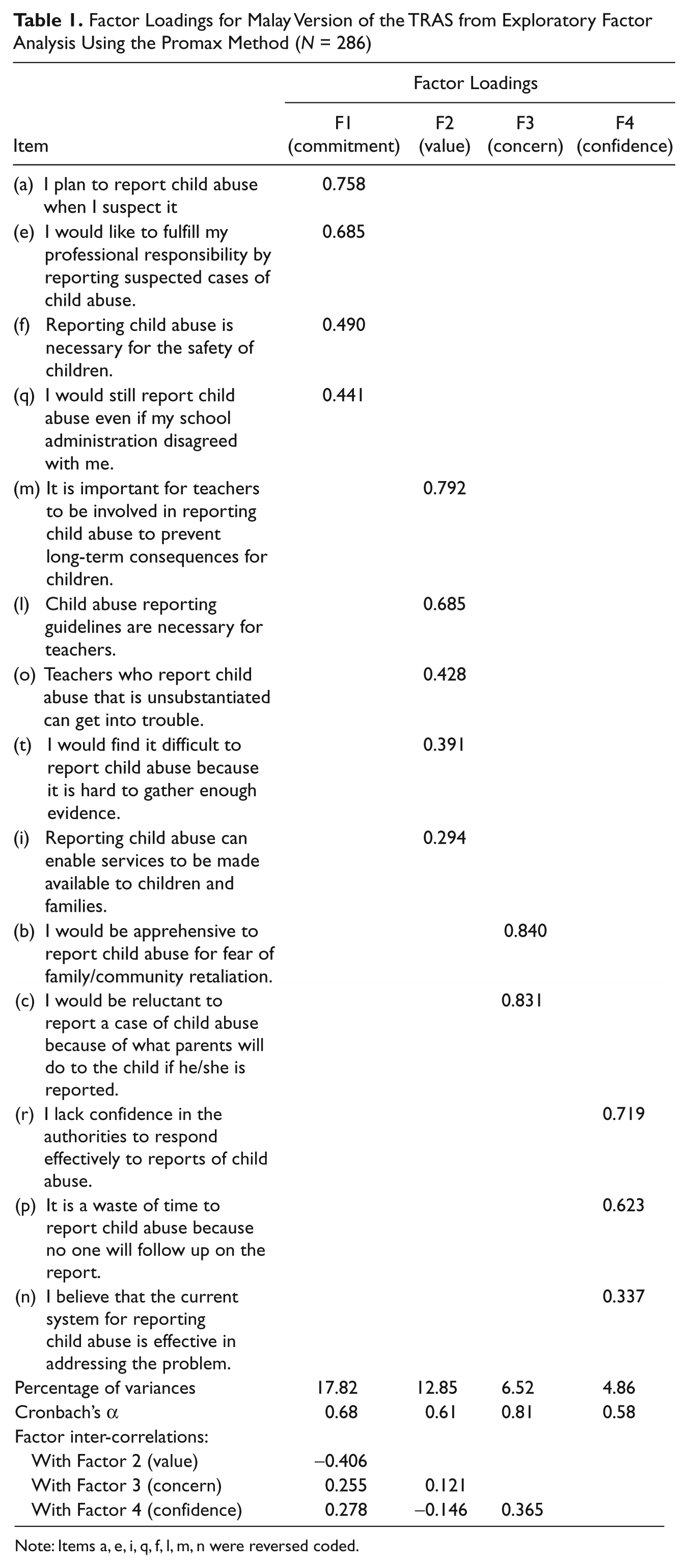
The Teachers’ Reporting Attitude Scale for Child Sexual Abuse (TRAS-CSA) is an English-language attitude measure first developed by Australian researchers using a comprehensive systematic review, 5-phase validation, and preliminary testing process (Walsh, Rassafiani, Mathews, Farrell, & Butler, 2010). The 3-factor structure of the measure was reported in a subsequent study (Walsh, Rassafiani, Mathews, Farrell, & Butler, in press) wherein the scale was reduced to 14 items. Self-administered response choices consist of 5-point Likert-type scales ranging from 1 (strongly agree) to 5 (strongly disagree). Items that are positively worded (e.g., “I plan to report child abuse when I suspect it”) are reverse-coded for scoring purposes so that higher scores represent more positive attitudes (reverse-coded items are listed in the note at the bottom of Table 1). Three attitude subscales have been identified from the TRAS-CSA: Commitment to the reporting role; confidence in the system’s response to reports; and concerns about reporting. These are described as underlying attitude dimensions. The original scale displayed good internal consistency, and construct validity, and can be completed in approximately 5 to 10 min (Walsh et al., in press).
Factor Loadings for Malay Version of the TRAS from Exploratory Factor Analysis Using the Promax Method (N = 286)
Note: Items a, e, i, q, f, l, m, n were reversed coded.
Modification Procedure
Modification of the original TRAS-CSA scale was undertaken to adapt the instrument for use with teachers in Malaysia. The main modification was definitional, expanding the measure to be inclusive of all forms of child maltreatment (labeled child abuse for the purpose of this study) rather than focusing exclusively on child sexual abuse as in the original measure (Walsh et al., 2010). It was considered that Malaysian teachers may not be sufficiently familiar with the specific issues associated with child sexual abuse. Child maltreatment, generally, was considered a more relevant focus.
Validation of the TRAS (Malay version) was undertaken in four steps: Forward translation; backward translation; preliminary testing; and field testing. First, the original English version of the TRAS scale was translated into Bahasa Melayu, the official language of Malaysia (hereafter referred to as Malay), by a graduate school teacher and a public health specialist working independently; both were bilingual. Two drafted scales were subsequently reviewed in a multidisciplinary team meeting, which included 2 paediatricians, 1 general practitioner, and a public health specialist. Second, backward translation from the Malay version into English was undertaken by two bilingual public health specialists. These translators were blinded to the original English version. The translated versions were compared with the original English version. Discrepancies were discussed by the team and resolved to ensure the Malay version retained the meanings inherent in the original TRAS. Third, a small-scale preliminary test was conducted with 20 teachers via face-to-face interview to further refine the measure and to check question wording, order, and time taken to complete the questionnaire to minimize respondent burden and maximize item clarity. Finally, the Malay version was revised and field-tested in the current study.
Research Ethics
Ethical clearance was granted by the University of Malaya Medical Institutional Review Board. Permission to conduct the research was obtained from Selangor Department of Education and Malaysian Ministry of Education. Questionnaires were completed anonymously (i.e., no name, identification number or address was required on the document).
Data Collection
Data were collected in 14 randomly selected urban and rural primary national public schools 3 in the state of Selangor, Malaysia from July to October 2010. The first-named author visited the randomly selected schools and explained the purpose, content and nature of the survey. All teachers who participated in the survey did so voluntarily and completion and return of the self-administered questionnaire constituted their consent to participate in the research. They were provided a list of researchers’ contacts to allow them to ask for additional information about the survey if they wished. Those who completed the questionnaire were given a small souvenir as a token of appreciation for their participation. The survey was completed without any reported complaints or adverse events.
Statistical Analysis
The instrument validation process was conducted in three stages using both confirmatory (stages 1 and 3) and exploratory (stage 2) factor analyses to test, modify, and confirm the underlying factor structure of the Malay version of the TRAS. Data were analyzed using Statistical Package of Social Sciences (SPSS) Version 15.0 (SPSS Inc., 2006) and SPSS AMOS (Arbuckle, 2006). Descriptive analyses were undertaken to obtain frequency, proportions, means and standard deviations. A Mahalanobis Distance (MD) for each case, based on the standard method with robust estimation of the parameters, was computed to check for multivariate outliers (Hair, Tatham, Anderson, & Black, 2005).
The factor structure analysis took the following approach. First, a confirmatory factor analysis (CFA) procedure was used to test the fit of the Malay data to the original 3-factor TRAS-CSA model. A combination of several fit indices were used to assess the model as no agreed on single standard exists (Hair et al., 2005). These included Chi-square/df ratio; comparative fit index (CFI); Joreskog’s goodness-of-fit index (GFI); adjusted goodness-of-fit index (AGFI); Tucker-Lewis Index (TLI); and the root-mean-square error of approximation (RMSEA). It is generally accepted that Chi-square/df ratio value less than 3; CFI, GFI, AGFI, and TLI values greater than .90; and RMSEA ≤.07 indicate adequate model fit (Hair et al., 2005; Tabachnick & Fidell, 2007). Modification index coefficients were used to check any cross-loadings between statements (i.e., items). Model modifications were based on the values of the Consistent Akaike’s Information Criterion (CAIC) for comparing different models (Hu & Bentler, 1999). Although empirical statistics are significant in developing a theory and modifying models, the contents of the theory are of equal importance when making decisions on whether to retain or include a statement (item) (Bollen, 1989). In a good structure, therefore, the individual factor loadings must be at least 0.5, and average variance extracted (AVE) must be higher than 0.5 (Hair et al, 2005). If the AVEs for any two factors are greater than their squared correlation estimate, they provide evidence of convergent and discriminant validity (Hair et al., 2005).
Second, an exploratory factory analysis (EFA) was conducted using the principal axis factoring (PFA) extraction method with iterated oblique rotation (Promax). Several indicators were used in combination to decide the number of factors and items to be retained. The determination of the number of factors to extract must be guided by theory and that yields the most interpretable results. Hence, only items with factor loadings of more than 0.40 were included in the components (Munro, 2005). In the extraction, only factors with eigenvalues of more than one were considered. The scree plot was used as graphical summary to check on the relative importance of each factor (Cattell, 1966). Items that did not meet these criteria were removed from the analysis. The internal consistency reliability of the items was also calculated (DeVellis, 2003). Separate analyses were performed for all subscales of the TRAS scale. For large sample sizes, a coefficient alpha of >0.60 is an indicator of minimally acceptable internal consistency (DeVellis, 2003). A coefficient alpha of 0.70 to 0.79 is considered fair, 0.80 to 0.89 is good; and above 0.90 is excellent (Hair et al., 2005; Nunnally, 1978).
Third, once the number of factors was determined from the EFA, a further CFA was conducted to test if the data supported the structural model of the attitudes scale measurement using a hold dataset for verification. In estimation, the Maximum Likelihood Estimation (MLE) method was used (Byrne, 2008; Hair et al., 2005).
Results
A total of 1081 questionnaires were distributed to the 14 randomly selected schools. A total of 668 teachers returned the questionnaires. Fifteen cases were excluded from analysis because of missing and outlying data, leaving 653 cases. This constitutes an average response rate of 60.4%.
The respondents in this survey were aged between 19 to 60 years (M = 35.3, SD = 9.04). Females (81.4%) were overrepresented in this study when compared with the primary school teaching workforce generally (69%; Ministry of Education Malaysia, 2010). Ethnic backgrounds of the respondents were reported as Malay (46.6%), Chinese (29.8%), and Indian (23.6%). Participant qualifications spanned degree holders (43.0%), diploma holders (39.8%) and those with secondary school education only (17.2%). The respondents, on average had 11.2 years of teaching experience (SD = 9.08). Slightly more than a quarter of the teachers (26.7%) had been teaching for less than 5 years. As few as 7.7% had received any type of training about child abuse during their preservice teacher education, and only 4.2% had received training on child abuse during their service as teachers. Results of the factor structure analyses are outlined below.
First, based on the original conceptualization of the TRAS-CSA (Walsh et al., 2010), a 3-factor model was tested using CFA. To reiterate, the original model had 3 unique attitude dimensions (commitment, concerns, and confidence). However, for this Malay sample, a 3-factor model as was found to be inappropriate: None of the fit statistics were satisfactory (CFI = 0.742, TLI = 0.682, GFI = 0.869, RMSEA = 0.100, AIC = 390.38) indicating the need for considerable improvement in the fit between the model and the data to establish a feasible theoretical structure. Therefore, a decision was made to investigate the underlying structure in the data using EFA. To do this, the data were split, randomly, into test data and hold data. There were 286 cases in the test data file used in the EFA. A further 367 cases remained in the hold data set for use in the CFA to verify the factor structure arising from the newly generated EFA.
Second, an EFA was performed with the results showing clear evidence of a 4-factor structure with eigen values over Kaiser’s criterion of 1.00. The newly generated 4-factor model collectively explained 42.1% of the variance. The Kaiser-Meyer-Olkin (KMO) value was 0.70 and this measure verified the sampling adequacy for the analysis. Bartlett’s test of sphericity indicated that the correlations between items were sufficiently large for the EFA analysis (p < 0.001). Except for two items (“I would be apprehensive to report child abuse for fear of family/community retaliation” and “I would be reluctant to report a case of child abuse because of what parents will do to the child if he/she is reported,” which had an anti-image correlation matrix of 0.63, all other individual variables had correlations of less than 0.6, indicating sampling adequacy. The scree plot test was used to determine the number of factors to retain and rotate with the test results confirming the appropriateness of a 4-factor solution. Table 1 shows the factor loadings after rotation using the Promax method. The correlation values between the four factors were weak to moderate (0.12-0.41). Three items were dropped, as their factor loadings were less than 0.4: “I would find it difficult to report child abuse because it is hard to gather enough evidence”; “Reporting child abuse can enable services to be made available to children and families”; and “I believe that the current system for reporting child abuse is effective in addressing the problem.” The EFA yielded an 11-item measure with a 4-factor structure. The 4 factors were labeled as commitment, value, concern, and confidence. Reliability of the items in each of the four TRAS subscales was tested using reliability analysis. The Cronbach’s α value for the items were commitment (0.68), value (0.61), concern (0.81), and confidence (0.58).
Third, the hold data in the second file, with 367 cases, were used in CFA to test the fit of the 4-factor model. The fit indices showed that this model had a better fit (CFI = 0.913, TLI = 0.874, GFI = 0.945, RMSEA = 0.075, AIC = 168.78) compared to the CFA undertaken in the first stage analysis. However, some modifications could be made to further improve the fit statistics. Based on the largest modification indices and lowest factor loadings (< than 0.5), the model was reduced by removing three items, one at a time. These included the following statements: “Teachers who report child abuse that is unsubstantiated can get into trouble”; “Reporting child abuse is necessary for the safety of children”; and “I would still report child abuse even if my school administration disagreed with me.” The decision to delete these three items was made by considering whether these items were consistent with the underlying constructs, whether the combination of items in each factor was interpretable, and whether any items cross-loaded to other factors (Byrne, 2008). The fit indices showed that the final model, with eight items, was acceptable (Chi square/df = 2.151, CFI = 0.991, TLI = 0.983, GFI = 0.986, RMSEA = 0.034, AIC = 63.496). Figure 1 displays these results. The model was cross-validated with 1000 bootstrap resample and the Bollen-stine p-value was calculated as 0.194. The factor loadings for the items ranged from 0.51 to 0.95 as displayed in Figure 1. The average variance extracted (AVE) for the 4 factors ranged from 57.5% to 82.5% and the AVE values were more than the R-squared values between the respective constructs, indicating sufficient discriminant validity. This information is summarized in Table 2.
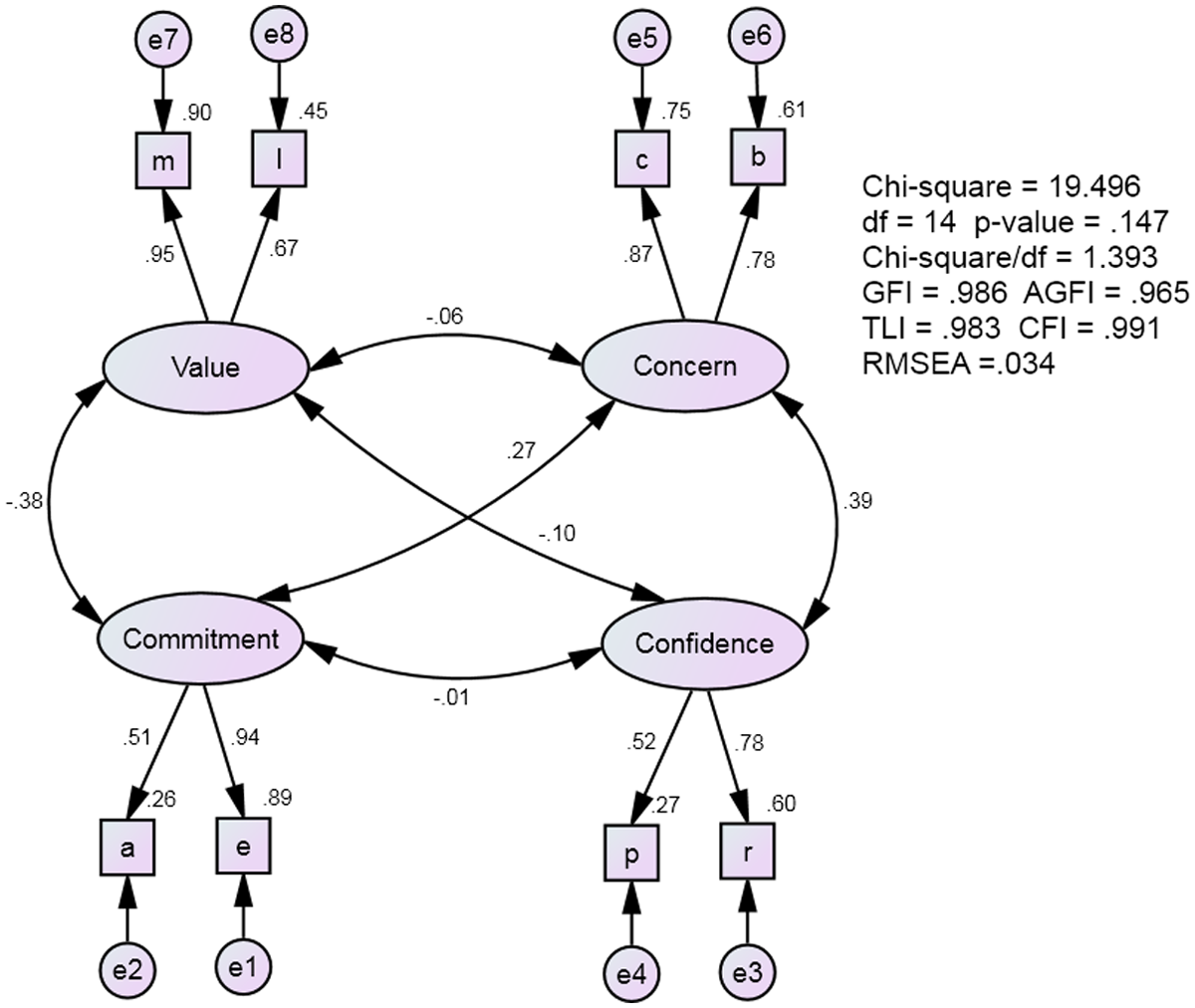
Factor structure of the Malay version of the TRAS using confirmatory factor analysis
Average Variance Extracted (AVE) and R-Squared for the 4-Factor Short-Form Malay Version of the TRAS
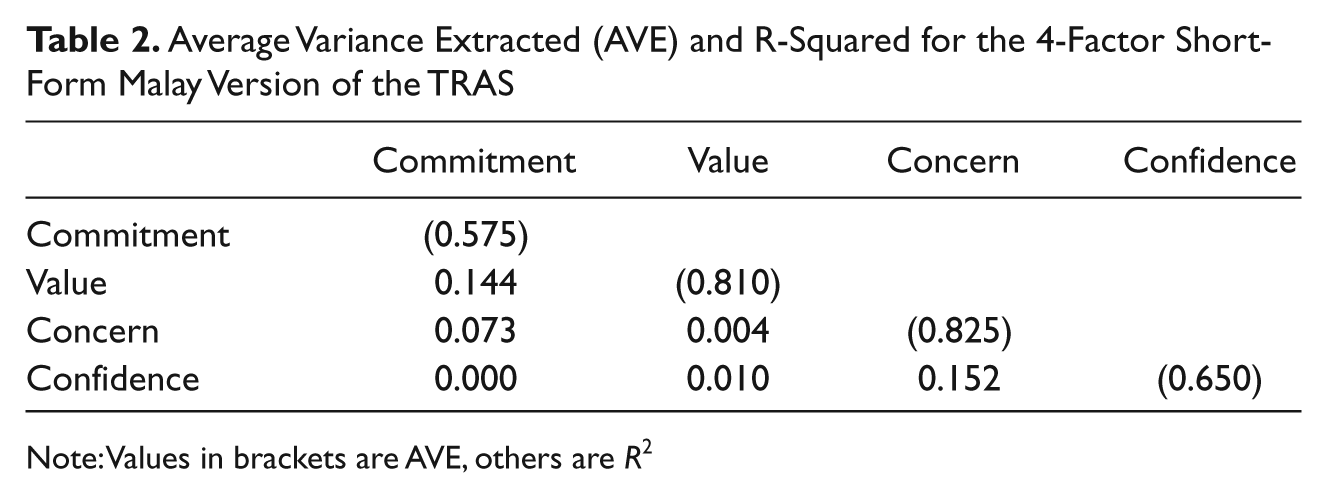
Note: Values in brackets are AVE, others are R 2
Finally, each of the 4 factors identified in this 3-step analysis was described with a data provided by a sample of Malaysian teachers. The analysis revealed that three of the four factors describe the same constructs as were identified in the original TRAS-CSA study (Walsh et al., in press). However, for this Malaysian sample, an additional factor, value, was identified. The first factor, commitment, relates to teachers’ commitment to their professional responsibility to report child abuse. The second factor, value relates to teachers’ acceptance of the underlying social value of reporting. The third factor concern, relates to teachers’ personal concerns about reporting. The fourth factor, confidence relates to teachers’ confidence in the system’s effective response to their reporting.
Attitudes Toward Reporting Child Abuse
Teachers’ (N = 653) mean scores on each of the 4 subscales are presented in Table 3. Generally, teachers have positive attitudes toward reporting child abuse (M = 8.02, SD = 1.29). Overall, their attitudes were most positive on the attitude dimension relating to factor 1 (commitment to professional reporting) (M = 8.02, SD 1.92). Attitudes were not quite as positive for attitude dimensions relating to factor 4 (confidence in the system’s effective response to reports) (M = 6.66, SD = 1.76), and factor 3 (concerns about reporting consequences) (M = 6.31, SD = 1.89). Attitudes were least positive for the newly generated factor 2, value of reporting (M = 3.32, SD = 1.76). Scores for each factor ranged from a minimum value of 2 to a maximum value of 10.
Participant Characteristics and Summary Scores across the 4-Factor Short-Form Malay Version of the TRAS
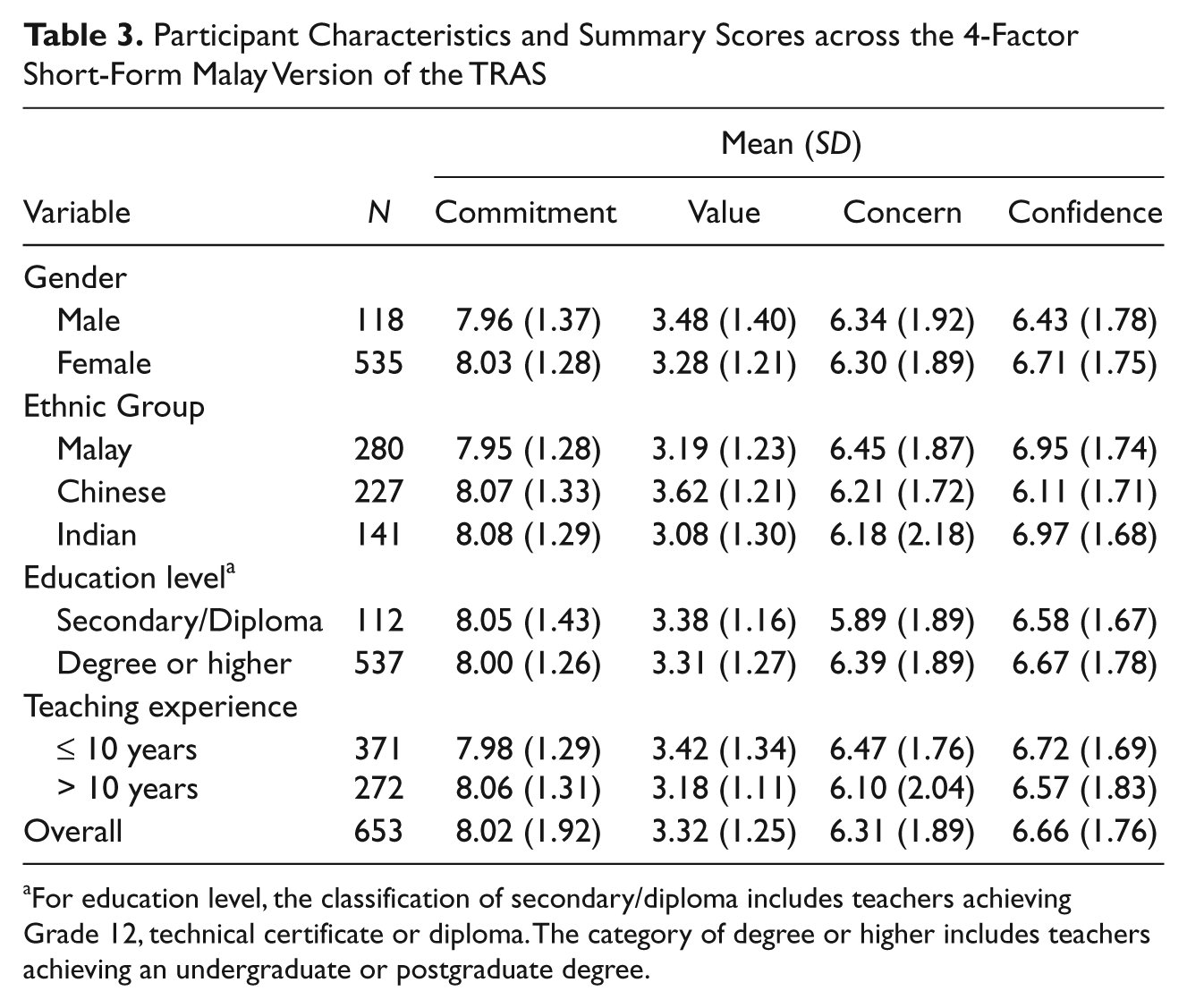
For education level, the classification of secondary/diploma includes teachers achieving Grade 12, technical certificate or diploma. The category of degree or higher includes teachers achieving an undergraduate or postgraduate degree.
There were no significant differences between male and female teachers’ mean scores on any of the four attitudinal subscales. However, significant differences were found between ethnic groups on the value subscale (p < 0.001) and confidence subscale (p < 0.001). Post hoc analysis (Bonferroni) revealed that teachers from Chinese backgrounds had higher value scores (M = 3.62, SD = 1.21) than teachers from Indian backgrounds (M = 3.08, SD = 1.30). Teachers from Chinese backgrounds had lower confidence scores (M = 6.11, SD = 1.71) than teachers from both Malay (M = 6.95, SD = 1.74) and Indian (M = 6.97, SD = 1.68) backgrounds. Significant effects were also found for teachers’ level of education. Teachers who had only a secondary school certificate scored significantly lower on the concern subscale (M = 5.89, SD = 1.89) than teachers who had a diploma (M = 6.26, SD = 1.92) or a bachelor’s degree (M = 6.39, SD = 1.89; p = 0.014). Teachers’ exposure to child abuse training had no influence on their attitudes toward reporting in any of the TRAS subscales. However, significant differences were found for teachers’ length of work experience. Teachers with less than 10 years of service had significantly higher scores on both the concern subscale (M = 6.47, SD = 1.76) and value subscale (M = 3.42, SD = 1.34) than teachers with 10 or more years of service (M = 6.10, SD = 2.04, p = 0.016; M = 3.18, SD = 1.11, p = 0.015 for concern and value respectively).
Discussion
This is the first study to examine the factor structure of the TRAS using a large non-Western sample of Malaysian teachers. The findings make a significant contribution to the existing literature on professionals’ attitudes toward reporting child abuse by highlighting cross-cultural differences and similarities. While we stop short of suggesting that there are universal dimensions in teachers’ attitudes toward reporting child abuse and neglect, there is some evidence, from this and previous research (see for example, Haj-Yahia & Attar-Schwartz, 2008; Zellman, 1990) that is suggestive of the presence of some unifying features around the three of the four underlying factors identified in the studies. In particular, this study has shown that the original commitment subscale identified in the study with an Australian sample (Walsh et al., in press), loaded onto two separate factors for this Malaysian sample. Closer examination of the nature of the items suggests that these items were perceived by Malaysian teachers to capture two slightly different concepts: one relating to the professional commitment to carry out a reporting duty (labeled commitment in this study) and another relating to acceptance of the social value of a reporting duty (labeled value in this study). It is possible that in a non-Western nation such as Malaysia, teachers’ attitudes toward reporting are formed in different ways and expressed differently in research.
Attitude theorists have stated that attitudes are multidimensional: They can be formed in many ways, and are subject to change according to individuals’ context, education, time, and experience (Albarracin, Zanna, Johnson, & Kumkale, 2005; Alzen, 2005). Results of this study appear to reflect this theoretical premise. It is reasonable to suggest that the differences in the TRAS factor structures in samples from two different countries may be explained through the lens of these influential dimensions: context, education, time, and experience.
First we discuss context and education. One important difference between the current teacher sample in Malaysia and the previous teacher sample from Australia is that, at the time of the study, Malaysian teachers were not required, by law, to report suspected child abuse or neglect, whereas in the Australian study, some, but not all, teachers were legally obliged to do so. Teachers in some Australian states, like those in many other parts of the world, have been subject to mandatory reporting laws and/or government policies progressively introduced since the 1980s (Mathews & Kenny, 2008) 4 . Furthermore, the introduction of legislative obligations to report child maltreatment is often accompanied by the initiation of training (see for example, Lamond, 1989; Mathews, Cronan, Walsh, Farrell, & Butler, 2008) wherein teachers receive instruction about the aetiology and sequealae of child maltreatment as well as induction into their specific roles and responsibilities as reporters. Clearly, Malaysian teachers had little access to this type of training with less than 1 in 10 teachers having received preparation during their teacher education courses, and even fewer, approximately 1 in 25, having received any training at all during their service as teachers.
Another important contextual issue relates to the ethnic composition of Malaysian society. Malaysia is a multiracial and multilingual society with approximately 67.0% Malay, 24.3% Chinese, 7.4% Indian and 0.35% from other ethnic backgrounds (Loke & Hoon, 2011). Importantly, despite the lack of legislative or policy directives for reporting child maltreatment, and the paucity of training available to Malaysian teachers, they held generally positive attitudes toward reporting. However, this study also identified a significant contextual influence on teachers’ attitudes; that of ethnicity. Specifically, this study found teachers from Chinese backgrounds (composing between one quarter and one third of the teaching workforce) felt more strongly about the underlying social value of reporting, but were less confident that the authorities would respond effectively. This principled stance, coupled with a lack of faith in authorities may stem from the historical legacy of hostility and perceived inequity between Chinese and Malays in the country, particularly in relation to educational opportunities (Tong, 2010). These findings will require further qualitative study to fully understand the mechanisms by which cultural differences are manifest in attitudes toward the reporting of child abuse and neglect. Future studies should further explore sociocultural and sociopolitical influences on attitudes (via characteristics such as views on adherence to family roles, conformity to norms, perceptions of punishment, and conceptions of shame, self-reliance, and spirituality). Qualitative studies of this type have potential to yield important information that can be used to guide the design of future teacher training efforts for Malaysia’s diverse teaching workforce.
Cultural differences in attitudes toward child maltreatment reporting have been previously identified by Haj-Yahia and Attar-Schwartz (2008) in their study of Palestinian preschool teachers from Israel. They found significant ethnic variation in attitudes toward reporting suspected cases of child abuse and neglect to child protection services and to the police. This was because of the fact that social welfare services in Israel were segregated for Arabs and Jews, and there was a strong mistrust of the police among Palestinian teachers (Haj-Yahia & Attar-Schwartz, 2008). However, findings from Lowe, Pavkov, Casanova, and Wetchler (2005), in a study conducted in the United States of America, introduce the notion of a temporal or decay effect on ethnic differences in attitudes. They found no significant differences in willingness to report child sexual abuse among present day White Americans, African Americans, and Hispanic Americans. The authors attributed the findings to the homogenization of cultural values over generations with the passing of time (Lowe et al., 2005).
We turn briefly, now, to education, time and experience as influences on attitudes. This study of Malaysian teachers has uncovered relationships between qualifications and experience and attitude dimensions. Teachers with higher qualifications (as represented by possessing a diploma or bachelor’s degree) and less experience (as represented by having fewer than 10 years of teaching service) had higher levels of concern about reporting in terms of outcomes for children. This is congruent with previous studies, which have found teachers’ attitudes and decisions to report are influenced by perceptions about whether reporting is likely to benefit the child or family (Bryant & Baldwin, 2010; Crenshaw et al., 1995; Kenny, 2004; O’Toole et al., 1999). Previous research from the United States has yielded mixed findings on the predictive strength of teachers’ qualification levels. For example, in some studies, higher teacher qualifications have not predicted child abuse detection or reporting (O’Toole et al., 1999). Yet in others, teachers with less education were found to be more likely to fail to report when a report should have been made (Webster et al., 2005). This is consistent with a study among teachers in Australian schools (Goebbels et al., 2008). Compared to their colleagues who had suspected child abuse, teachers who had never suspected child abuse were more likely to have lower academic qualifications and fewer years of teaching experience. This suggests that education, experience, and exposure are important proximal influences on report decision making. But the role of these variables in attitude formation, is yet to be fully understood. Importantly, this present study also found teachers with less experience, had higher levels of acceptance of the underlying social value of reporting compared to their more experienced colleagues. This suggests a degree of malleability in attitudes toward reporting child maltreatment over teachers’ career paths. At a practical level, training initiatives could capitalize on the aspirational qualities of less experienced teachers to provide greater reinforcement of the potential positive outcomes of reporting for children including educational outcomes.
The short form Malay version of TRAS represents an efficient measure with four subscales to reliably assess teachers’ attitudes toward reporting child abuse. It is short and easy to administer to teachers. The low intercorrelations among the factors suggest that each factor may be considered independently when scoring TRAS instead of summing the total scores. This finding is consistent with the original version of the scale (Walsh et al., 2011).
Several caveats must be considered when interpreting the results of this study and applying the findings. First, the samples were recruited from randomly selected schools from one state, which may not be representative of those found throughout the country. This study, therefore, cannot claim to provide insight into the attitudes of Malaysian teachers as a whole. Second, mandatory reporting laws are not extended to teachers, at present, in Malaysia. Hence this study could not examine the extent to which prevailing attitudes are predictive of actual reporting behavior. Social desirability bias may also exist; but as the survey was anonymous, it is not likely to have substantially affected the data. Nevertheless, future research should consider including a social desirability measure to neutralize the potential confounding effects of such biases. On a positive note, a major advantage of this study was the high rate of participation among the teachers. The response rate of this study was much higher (60.5%) than comparable studies, which have yielded relatively lower response rates (Bryant, 2009; Feng et al., 2010).
Conclusion
The results of this study provided much needed insights into the nature and complexity of teachers’ attitudes to reporting child abuse. This study illuminates some important findings. The short version of the TRAS with eight items is suitable and appropriate as a quick assessment to be used to measure attitudes toward reporting child abuse. Cross-cultural differences in attitudes toward reporting exist and this should be taken into consideration when applied other instruments to other populations. Further study with teachers in other countries is still necessary to assess the extent of which these four factors are generalizable to other populations.
Footnotes
Acknowledgements
The authors express their gratitude to Malaysian Ministry of Education, Selangor state Department of Education, and various schools for approving the study, as well as the teachers’ for their valuable contribution.
Declaration of Conflicting Interests
The author(s) declared no potential conflicts of interest with respect to the research, authorship, and/or publication of this article.
Funding
The author(s) disclosed receipt of the following financial support for the research, authorship, and/or publication of this article: The University of Malaya (Grant no: RG017/09HTM) provides funding support for the conduct of this study. Dr Kerryann Walsh was supported by a Queensland University of Technology Vice Chancellor’s Research Fellowship (2010-2012).
Notes
Bios