




Abstract
Drawing upon embodied and feminist knowledge, arts-based research (ABR) is a methodological approach aimed at advancing work that is liberatory both in its findings and its processes. To examine this phenomenon, three social work scholars engaged in a reflective research process to study the meaning of arts-based research through a methodology blending arts, collaborative autoethnography (CAE) and phenomenology. The team explored our own experiences of using art in research, and the implications for feminist social work. This article begins with a brief overview of ABR before introducing the strategic use of art creation and discourse within our CAE. We present the findings uncovered through analysis of our qualitative data - including our own artwork - and the experiences they represent. Thematic findings include: power dynamics in research and academia as revealed through ABR, and the liberatory components of ABR. Lastly, we discuss the implications of the findings, strengths, and limitations, and suggest future research. Implications for social work practice and research include: opportunities for integrating humanistic and engaged praxis as tools of liberatory knowledge production; the promotion of feminist-based inquiry as resistance to social pressures; and the use of ABR as an anti-oppressive research approach.
Keywords
“Research…can be figured as a kind of art, or even a dance… There is craft in research, and artistry.
To be a researcher is to trace a new and narrow path. To find something new, one must be willing to encounter the unknown.” - Ben Spatz
Introduction
The use of art in research can challenge hegemonic and positivist ways of understanding truth. It can disrupt and reconfigure power dynamics between researchers and research “subjects,” and be a catalyst for liberatory empowerment. Having experienced these dynamics firsthand, our research team members came together to explore the impact of art-based approaches in social work research. Our previous endeavors with the arts in research contexts revealed relational and intrapersonal insights and enjoyment. Incorporating color, movement, emotion, and poetry into research were profound intellectual and embodied experiences, especially in contrast to what it is like to conduct mainstream positivist research methodologies. Echoing those observations, scholars such as Clover (2011) suggest that arts-based research (ABR) can be conceptualized as a feminist research methodology. The arts have a history in women's production of knowledge and problem-solving approaches (Clover, 2011) while Western societal conditioning suggests that creative or embodied epistemologies are associated with characteristics that have been socially constructed as feminine. This is particularly pronounced when dichotomously contrasted with the socially constructed notions of “rigor,” logic and rationality as masculine. As noted by Collins (1993), “Thought and feeling are not seen as two different and interconnected ways of approaching truth that can coexist in scholarship and teaching. Instead, feeling is defined as antithetical to reason, as its opposite” (p.27). ABR has long been a tool for free, creative expression of self and social structure by women and other scholars with minoritized identities.
The methodology also aligns strongly with critical feminist principles of social work research, including but not limited to the importance of positionality and perspective, honoring relationships and connection, centering traditionally subjugated voices, questioning traditional ways of knowing and of producing knowledge, and commitment to liberation and social justice (see Goodkind et al., 2021). Notable examples of scholars using the arts to challenge and resist traditional paths to academic knowledge production include exploring race in academia through autoethnographic story-telling (Boylorn, 2006), using poetry to express self-reflexivity (Beltrán, 2019; Furman et al., 2008), and expressing experiences of disability through poetry and song (Shemer & Shahar, 2023). As these examples demonstrate, utilization of arts-based methods within the context of critical feminist research has a rich history of centering voices and stories typically not represented and challenging and resisting casually assumed objectivity in research (see Beltrán, 2019). Like other critical methodologies, ABR provides research alternatives that critique the status quo and do not “conform to the increasing view in the academy that ‘evidence-based’ research is exclusively limited to post-positivist epistemologies and quantitative paradigms” (Mayor, 2020, p. 1057).
Arts-based knowledge production can elevate unique perspectives and obscured voices and explore new social possibilities (Fraser & Al Sayah, 2011; Van Lith et al., 2013). Specifically, Chilton and Leavy (2014) assert that, “Free from academic jargon and other prohibitive barriers, the arts have the potential to reach a broad range of people and to be emotionally and/or politically evocative for diverse audiences” (p. 403). As a tool for data collection, a way to disseminate knowledge, or a blend of both, art can offer an opportunity for empathetic connection between the creator and viewer (Potash & Ho, 2011), a relational dynamic that is often associated with traditionally feminine characteristics in Western society (Hodges et al., 2011). Of course, there are gaps between human experiences grounded in differing social positionalities. Our shared societal context and social factors (e.g., racism and the legacy of slavery, and the dominance of neoliberal policies and economic structures) compound those differences. In this landscape of separation, art can serve as an invitation to connect, through sharing (as the artist) and witnessing (as the audience) a moment, feeling, thought, or observation from another's unique perspective.
Recognizing the possibilities offered through the creative arts, ABR has gained popularity in social work. In this relationally-centered field, ABR can be a key element in several forms of participatory action research and other feminist-based approaches. As such, ABR has been utilized in work that seeks to center the emic knowledge of marginalized and oppressed people and communities (see for example, Malka & Huss, 2022; Manovski, 2014; Mikkonen et al., 2020). Despite growing attention and interest in ABR among social work scholars, there has been limited attention paid to when and how to use art in research (Mayor, 2022). Further, ABR's advantages are not yet fully understood or discussed within social work academia (Huss & Bos, 2023). Should social work scholarship move towards increased use of such approaches, not only must we better understand ABR's utility and impact on those we work with, but we must also further develop an understanding of the impact the research process has on the researchers as reciprocally affected agents in the process. While such awareness is important across theoretical traditions, it is of utmost importance for those drawing upon critical feminist theory, where use of self and one's social positionality are inextricably linked to each phase of the research process.
An Emergent Inquiry
Our research team was initially formed in 2021 to prepare a conference presentation focused on our individual use of ABR and its role in social work research. We each came to the team with prior experiences of art being deeply impactful, even transformative, for ourselves and our clients, students and research participants. Some of these individuals suggested that creative arts felt freeing. As a group, we had no experience creating art as research participants. We were curious about the experiential process and impact of participating in ABR, and whether an applied inquiry could offer insight into the lived experience of ABR. We decided to study the methodology further.
To prepare for our conference presentation, we each began reviewing ABR-focused social work literature, and engaged in a reflective dialogue with the literature and each other. During this time, we explored in conversation the ways our individual and collective experiences aligned with or diverged from those being reported. We were compelled by our shared observations of the embodied nature of our previous experiences with ABR, particularly around our self-awareness, emotional self-attunement, and conscious embodiment. These themes resonated with our collective knowledge and experience with critical feminisms in research and education, especially as discussed in the works of bell hooks (e.g., 1994) as well as with scholars identifying embodiment as a critical part of scholarship (e.g., Pelias, 2004). Amid our initial conversations around the current body of knowledge of ABR, socio-political trends, and our own lived experiences, we realized we had organically begun to embark on a collaborative autoethnography (CAE) (Chang et al., 2013).
This article presents findings from our CAE in which our team explored our own experiential use of ABR to better understand the methodology's impact on the researchers who use it, and the liberatory potential it holds for our work. Following an overview of ABR in social work, we present a brief description of our intentional blending of ABR with other research traditions as we examined the benefits and challenges to the use of arts-based methods in social work research. A detailed description of our pilot methodology is the subject of a forthcoming article. This piece concludes with considerations of these findings for future arts-based research.
Background
Social research involving human participants often purports to seek participant perspective and feedback, though traditional positivist research practices are rife with power differentials in which the researcher is positioned as the expert and participants may be, at worst, exploited, or more commonly, treated as mere data points (Foster, 2012; Lynch, 2000; Wertheimer, 2008). Within the context of socio-political pressures in life and academia, ABR is an alternative approach to research, which offers a reprieve and opportunity for rejecting those influences. The methodology, often used to explore questions of participants’ lived experiences, utilizes various tools for data collection, analysis, and dissemination that may include visual art, photography, writing and ethnodrama, among other creative media. Like feminist and participatory methods more broadly, ABR can interrupt the power (im)balances between researcher and participant (Foster, 2012) that emerge through research, inviting less restricted contributions from participants in the knowledge-creation process. ABR has been found to interrupt oppressive narratives (Dominelli, 2006), such as those tied to imperialism and colonization, by “centering subjugated knowledges” (Osei-Kofi et al., 2010, p. 334), and to empower participants who have been systematically stripped of power (Huss, 2018; Keidan, 2008; Keifer-Boyd, 2011; Osei-Kofi, 2013). ABR has potential to provide a unique platform for unheard voices and stories (Finley, 2008; Fonseka et al., 2021) and help people to imagine new stories and futures (Montgomery, 2019). There is room within the literature to further examine if (and how) these understandings and benefits of ABR extend to the researchers themselves.
Social Work, Liberation, and Art
Social work, often regarded as a “helping profession,” is a field that, according to its Code of Ethics (NASW, 2021), cares for vulnerable individuals, upholds the dignity of every individual, and meets clients where and how they are, as the experts in their own lived experience. Yet, the field has not been immune to the socio-political pressures in which it developed. As part of industrialization efforts in the US, the field underwent a movement of “professionalization” which led in part to a divide in the field (Kramer et al., 2023). Over the past several decades, the influences of neoliberalism and capitalism on the field and its practitioners have placed increased importance on market outcomes, efficacy, and policing (see Kramer et al., 2021). These influences, affecting social work practice, teaching, and research, are evident in academia, furthering a focus on positivist, fundable, and publishable research adjudicated within a system of privilege, hierarchy, and white supremacy in which “power shapes what counts as legitimate knowledge” (Osei-Kofi, 2013, p. 138). As an academic field, social work, like other social sciences, faces pressure to pursue legitimacy through positivist research practices, steeped in privilege and white supremacy (Bisman, 2004; Kim, 2017). Critical feminist approaches like ABR present an opportunity to challenge such practices for the mutual benefit of participants and researchers and the field at large.
One potential benefit is an experience of liberation through ABR. At its core, liberation is understood as freedom from oppressive or constricting forces (Harro, 2000) and centers ideas such as critical consciousness (Abe, 2020; Bussey et al., 2021) and understanding one's reality (Doyal & Gough, 1991) or one's oppression (Boal, 1979). Others discuss liberation as freedom from repetition and a consideration or imagining of what can be (Wallin, 2011) as well as freedom from a need for efficacy and action (Bussey et al., 2021). Central to notions of liberation, and a pillar in liberatory knowledge production, is Freire's (1970) idea of conscientization. Freire (1970) suggests that oppression can be examined and understood beyond the isolated experience of an individual, and rather, be seen more clearly as a socio-political force. He suggests this heightened awareness, or reflexive seeing, itself can be the impetus for liberation for oppressed people.
In social work, core values shape policies and practices aimed at optimizing human thriving. This often requires healing or disentangling from harmful circumstances. Such liberation may be associated with anti-oppressive practice and freeing oneself – practitioners and consumers – from hegemonic structures and narratives that shape modern society. As such, liberation in social work can be conceptualized as freedom from dominant influences (e.g., of white supremacy, patriarchy, positivism, and paternalism), which often contribute to experiences of social control among social work consumers (Bussey et al., 2021). By extension, freedom from the demands and expectations to engage in traditionally valued and funded research – that is often steeped in racism and white supremacy (Pewewardy & Almeida, 2014) – is also possible, where researchers can make space for other, often silenced, participant voices and ways of knowing to emerge (Osei-Kofi, 2013; Simons & McCormack, 2007).
The field tends to draw artificial boundaries between “science” as factual and objective, and “art” as mysterious and subjective (Leavy, 2009). The connection between social work and the arts trace back to the settlement house movement of the early 1900's (Kelly & Doherty, 2017). Currently, several social work programs in North America have begun to include courses about socially engaged art in their curricula (see Kim, 2017.) In social work research, many scholars have utilized ABR methods to answer various research questions and explore and better understand an array of experiences of the human condition. For example, Huss (2018) used the visual arts to explore the concerns of Bedouin women in Israel; Colacchio (2023) used art to study the experience of well-being among youth in foster care; and others have used the ABR method, photovoice (introduced by Wang & Burris, 1997 and utilized more recently, for example, by Cosgrove et al., 2021), to engage LGBTQ + young people in participatory action research across varying issues (e.g., Cosgrove et al., 2023; Kinney & Cosgrove, 2022; and Capous-Desyllas & Mountz, 2019). To explore elements of the research process itself, Gerstenblatt (2013) used collage portraiture to analyze qualitative research, and Trevelyan et al. (2014) used the arts to explore critical reflexivity in social work, a key element of the researcher's experience.
Studies utilizing ABR have broadened the perspectives represented in social work literature, and they have been reported to facilitate transformative and empowering experiences among participants (Cosgrove et al., 2023). However, there is limited literature exploring ABR's influence upon the researchers themselves. Building upon the theoretical exploration of the freeing nature of social work (e.g., Hyslop, 2012) and the ways in which ABR can be experienced as transformative by the participants it engages, there is room for additional inquiry into liberatory experiences for the academic researchers utilizing such methods. Scholars have explored how the research process impacts the researcher (Leavy, 2009), including impacts on researcher reflexivity (Macbeth, 2001). Because reflexivity plays a vital role within feminist research and practice (Gill, 2021), feminist scholars are called to explore critical methodologies and the ways in which, (particularly, in the context of Indigenist story-telling methodologies), the researchers are in “relationship” with the stories being told (Beltrán et al., 2024, p. 8). Beltrán (2019) offers that intentional reflexivity using creative engagement in personal and collaborative poetry is an act of resistance against colonial erasure and epistemological delegitimization. Consequently, conducting a reflexive study of ABR, and the relational and experiential processes it offers, provides a unique perspective that can support further engagement of such methods.
For scholars, who seek to center the lived experiences of marginalized people, ABR is a promising approach. Moreover, for critical feminists who are concerned not only with “what” is known, but also “how” it becomes known, insight into the first-hand experiences exploring ABR as a tool of liberatory praxis invites the field to consider the implications, opportunities and challenges of such methodologies.
Methodology
As a team of three social work scholars who had all engaged with art-based methods in our teaching, practice and research, we sought to explore the role and meaning ABR has played in our own experiences with participants, students and clients. Since our work has been guided by critical feminist and queer theories and pedagogies, we were curious to further explore the liberatory potential of ABR and the ways in which it promotes conscientization (Freire, 1970), or the emergence of critical awareness of self and others. We were motivated to examine the possibilities and challenges ABR methods could hold for social work research broadly and for researchers themselves. Thus, we explored the meaning and impact of the ABR methodology as the subject of an arts-based, collaborative autoethnographic (CAE) inquiry.
Three Contributing Methodologies
Arts-based research (ABR) was the focal subject of this inquiry. As a methodological process, ABR lends itself to exploring multiple perspectives, truths, and realities. One philosophy of ABR (cited in Leavy, 2009) recognizes that: art has always been able to convey truth(s); use of arts is critical in achieving awareness and knowledge of self and others; and art values unconventional epistemologies, including preverbal, sensory, kinesthetic, and imaginary. By using art directly, ABR excels in allowing participants to describe, explore and discover multiple meanings. Like art, ABR can take many forms, including the use of art creation and interpretation during any or all phases of data collection, analysis, reporting, and post-research actions (Norris, 2000).
To explore our collective experiences of ABR in a self-contained, reflective process, we utilized collaborative autoethnography. Grounded in autoethnography, collaborative autoethnography (CAE) positions the researchers as the subjects of inquiry, seeking to use methodical reflective processes (such as discussion and journaling about ourselves and our experiences) to learn about a lived experience or phenomenon of interest (Kramer et al., 2023). While autoethnography is conducted by an individual researcher studying themselves and their relationship to a subject, CAE engages many of the same reflexive steps but occurs among and between a team of researchers (Chang et al., 2013; Kramer et al., 2023). For our project, this reflexive process included a series of open discussions, shared journal reflections, creating and sharing artwork, and collective interpretations of our art. These activities (described further below) aligned with our intentions to follow a collaborative and non-linear method.
We chose a third methodological tradition, phenomenology, to incorporate into the project to guide our formal analysis process because our research question (articulated below) sought the essential meaning of ABR as a liberatory tool in neoliberal academia. Phenomenology centers on the reality of objects - including experiences or phenomena - asserting that an object has an essence or true meaning, which can be perceived by the perceiver(s) (Husserl, 1931). Further, phenomenology seeks to uncover the meaning and essence of an experience from the subjective perspectives of people close to that experience (Finlay, 2014; Groenewald, 2004; Husserl, 1931; Hycner, 1999). Led by Bridget Colacchio as first author, we adapted a contemporary guide to phenomenological analysis methods (Groenewald, 2004; Hycner, 1999) to suit our CAE process investigating the central phenomenon, ABR. These adapted guidelines included the following steps: (1) identifying a priori impressions and experiences of the phenomenon; (2) deeply immersing oneself in the data to delineate units of meaning; (3) organizing units of meaning to form thematic clusters; (4) revisiting the data to validate and modify clusters where necessary; and (5) articulating a composite summary of findings. Collectively, we followed these steps to arrive at the present interpretations.
In Table 1, we illustrate how each methodology informed components of the study. For example, our data collection reflects ABR in our creation of artwork, CAE in the data generated from our discussions and journals, and phenomenology in the open, thorough expression of our perspectives, experiences and meaning-making around ABR.
Methods Informing key Research Components.
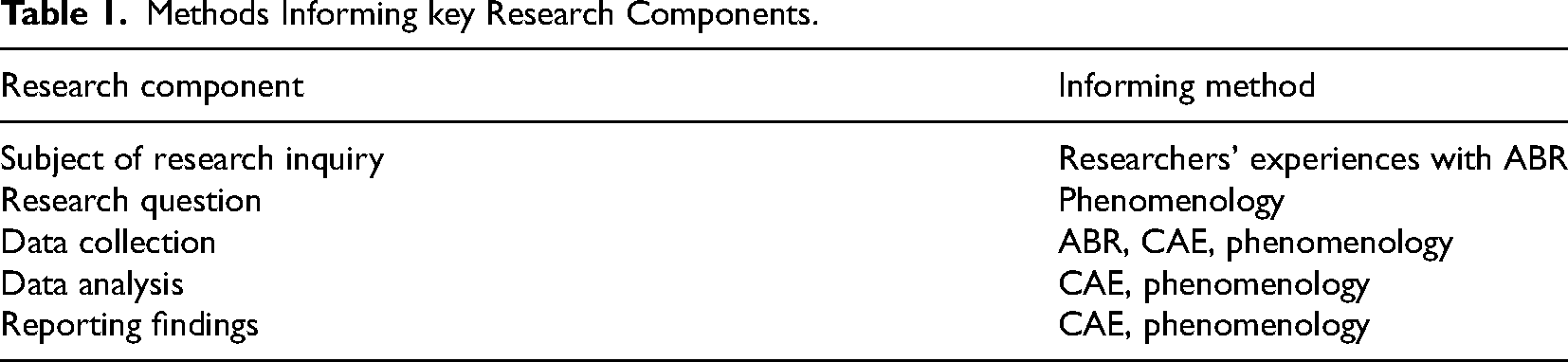
In drawing from three different methods – ABR, CAE, and phenomenology – the team adapted each method so as to complement one another in a combined approach. The constellation of decisions that comprised the development of this three-pronged methodology are described below, followed by the findings derived from it. The blended methodology is described in even greater detail in a forthcoming publication focused on the methodological approach.
Research Team and Research Questions
Our CAE team consists of three social work scholars from different academic institutions. Bridget Colacchio, clinical assistant professor, is a white, cis-hetero woman. She has 20 years of social work practice, teaching, and research experience using anti-oppressive and art-based qualitative methods to explore the lived experiences of youths’ relationships and well-being. Darren Cosgrove is an assistant professor of social work and a white gender-queer man who has social work practice and research experience with LGBTQ + young adults and families and engages in arts-based participatory action research. Dana Levin is an associate professor of social work. She is a white, cis-hetero woman with a background in social work, developmental psychology, and theatre, as well as many years of practice experience with children and families. Dana utilizes quantitative, qualitative, and art-based research methodologies to engage youth about their experiences with gender and sexual socialization and sex education, as well as art-based teaching methods. Early in the project, our team had a fourth member (white, genderqueer, queer associate professor). Due to time constraints, this member excused themself after the initial meetings for the project; we considered their comments and reflective insight as we interpreted data. As a team, we were aware of our shared whiteness and positionality as highly educated, middle-income professionals, as well as of our differences in terms of religious, ethnic, and gender identities. Our individual and collective positions of power, privilege, and marginalization (discussed further below) influenced our conversations, research decisions and interpretations.
As noted, our team originally formed to prepare a conference presentation but quickly found ourselves engaging in the reflective group-inquiry common in CAE. As such, we paused our reflective conversations to study CAE methodology and develop a data collection and analysis plan that both complemented our naturally emergent process while also offering structure and guidance to our inquiry. Shortly after we determined to conduct the CAE, we reached consensus on two central research questions: What meaning do we assign our experiences with arts-based social work research? In our experiences, what does ABR have to do with liberation? As feminist, arts-based researchers, we were eager to invite our positionalities into all phases of the inquiry, and we wanted to incorporate the creation and discussion of our own artwork into the methodology. Drawing from critical feminist theory and utilizing the CAE methodological framework offered by Chang et al. (2013), we engaged in multiple cycles of generating data and iteratively analyzing it, both individually and collectively. This process, explained below, was aimed at exploring our chosen subject: our experiences of ABR and liberation. Because we were all the researchers, participants and artists during the project, those labels are used interchangeably throughout the article. Because we served as both the inquirers and the subjects of inquiry, our respective institutional boards indicated they did not require approval or oversight of the project.
Data Collection and Exploration
Our data collection included both free-form and structured activities. In alignment with CAE, data collection began with our first conversations, conducted via Zoom. These early discussions did not follow an agenda or scripted set of discussion questions; instead, the open-ended conversations included a broad exploration of ABR and the ways it seemed to relate to liberation. We shared our perspectives on using ABR in our previous research projects, teaching, and social work practice. We listened to one another, offered reflective commentary on what we heard, and collectively introduced additional experiences, examples and questions to the group to iterate on together. Given our attunement to issues of identity, we often remarked on our intersectionality and positionality as they bore on our previous experiences. All reflective conversations were captured in writing with a collaborative memo to which we all contributed, and with Zoom's audio/visual recordings of team meetings, which were later transcribed. With our agreed upon research questions, we decided that our first structured data collection activity for each researcher would be to write a reflective journal entry about the liberatory nature of ABR. We read one another's entries, individually noted comments and questions for each other, and gathered again to discuss similarities, differences, and emerging ideas for further exploration. We also discussed how our racial, gender, religious, and other identities and backgrounds shaped our reflections on liberation. Shortly after, we chose to have each team member create an initial piece of art that expressed our experiences conducting ABR. These works included three visual pieces (a series of photographs, one collage, and one painting) from the three authors, and a written piece by our fourth team member before their departure. After we created the works and shared them electronically, we held a series of team meetings, during which each artist-researcher presented their work, describing both the piece and their creative process. After each person shared, the other team members asked questions of them and offered reflective comments, reactions and interpretations. At this time, the fourth team member departed the project. Like our initial meetings, these discussions were recorded and transcribed.
After many months, we arrived at new insights regarding the essence of ABR and liberation and decided to further explore this emergent knowledge through the creation of a second body of creative works. We each created a new piece of art (a drawing, painting and a collage) and again shared the works with one another, repeating the prior reflective process. The team continued to meet to discuss regularly over many more months. Our discussions continued through multiple rounds until we determined that our conversations were no longer generating new ideas, akin to a saturation point in qualitative analysis (Glaser, 1965).
To summarize, these conversations represent the crux of the art-based CAE: a cyclical, iterative and inter-related data creation and analysis process. We expressed and described our individual experiences of and reflections on ABR through our journals and artwork (i.e., data collection); we explored collective interpretations of the pieces (i.e., initial data analysis) and included our memos and transcriptions of all meeting sessions in the complete data set for later analysis, which was conducted with phenomenology. Thus, the lines between data collection and data exploration, or analysis, were intentionally blurred. Our experience of ABR and our newly created artwork was continually, iteratively interpreted through a process of constant comparative analysis (Glaser, 1965; Fram, 2013), looking to support, expand upon, or contradict the emergent themes of our evolving analysis.
The complete dataset for the project included all reflective writing, transcriptions of each team meeting, pieces of artwork, and ongoing memos. All data, including digital copies of our artwork, was stored in a password protected shared folder that only each team member had access to. To maintain methodological integrity and rigor, once we reached saturation, we chose to cease the on-going discussions and conduct a formal phenomenological thematic analysis of all data. Utilizing the five-step analysis process (above), we individually reviewed sections of the data to first immerse ourselves in the data and then assign to them distinct units of meaning, with each team member working with a collection of items from across all data types. We repeated this phase until all data had been reviewed, and units of meaning assigned. Next, we reviewed our units of meaning as a team and thoroughly discussed definitions, alignment, and disagreements until consensus was reached. The units of meaning were then organized into larger, thematic clusters of meaning, which we collaboratively interpreted.
Interpretations
Grounded in a desire to better understand our respective and collective experiences with ABR, we sought to uncover phenomenological themes that were salient across our unique and shared experiences. Through the blended method described above, first documenting our collective experience, then analyzing and applying it to the state of social work research, then the core meaning of ABR as a liberatory praxis – or a freeing combination of theory and practical application—emerged. These interpretations deeply reflect our positionality and experiences of both marginalization and underrepresentation within the academy (as women, religious minorities, and a queer person), as well as the privileges we hold as employed academics broadly, and white scholars more specifically. As we explored what it meant to exist at a nuanced intersection of privilege and marginalization, our findings began to give voice to the joys and challenges of using ABR within the academy.
As described in the methods, we organized our interpretive meaning-making into two clusters, the first of which illuminates elements of ABR through contradictory comparison: that is, what ABR is not. Here, the study exposed the constricting influence of power dynamics within social work academia and praxis. These may cause pressure, fear, and judgment that constitute barriers to ABR. The second cluster points to the experience and conceptualization of ABR more directly. In this cluster, the study revealed how ABR offers an alternative to (or freedom from) the limiting, dominant narratives around power, in that ABR methods were experienced as radical, humanizing, humbling, and anchored in presence. Below, we illustrate these interpretations using quotations and examples of artwork from the dataset. Some exemplative quotes are an individual researcher's direct statements while others are summative comments that were captured through our collaborative memoing documentation. The latter are attributed to “(research team memo)” alongside the relevant quote.
Power Dynamics in Academia
The first cluster of meaning exposed multiple levels of power dynamics in “traditional” research, academia, and beyond. These power structures illuminated neoliberal effects on research and education, characterized by these themes: objectivity, pressure to produce, and fear of being judged for straying from the research status quo. Overall, we found that the use of ABR stands in contrast to the power differentials implicit in “traditional” research. The idea that researchers ought to be rigidly detached from and objective regarding, their research is a common assumption, yet also a limiting one. This idea emerged numerous times as we discussed our previous experiences and our artwork.
For example, our creative works contained elements of rigid boundaries (e.g stratified colors in paint, hard edges within photographed images, etc.). In interpreting these shared elements spanning our artistic mediums and styles, we found resonance in the visual representations of the strictness and rigidity within academic environments. These contrasted with more optimal educational settings that are flexible, curious and creative. Such sentiments were articulated by Dana, Quantitative research is [considered] somehow value neutral and somehow completely objective, as if that exists which, in my opinion… doesn't exist if humans are doing it. [Like] we're supposed to take emotion out of it and I'm like, why are we trying to not be human? Are we trying to be robots? Why is that the highest, most valued kind of research is the kind that we pretend is emotionless and valueless and “objective”? Whereas something like this [ABR], for me, is much more meaningful.
In sharing our art and the embodied emotions we experienced in the creative process, two dimensions of what we commonly experienced in academia (and subsequently, the freeing experience of creative and artistic work) were noted: the pressure to produce “acceptable” forms of scholarship and the fear of consequences for not conforming to traditional methods. First, we noted implicit and explicit expectations to always “climb the ladder,” and “publish or perish” in academia, no matter the costs. Often couched as the “American dream,” people with less power in academia – and society - feel pressure to constantly produce and prove their worth, an idea captured by this exchange: [People in society think], ‘if I perform well enough, if I produce enough, if I work hard enough, then I will be able to join the privileged class.’ So, I think there can also be a fear in transforming systems and structures, because [for some] there's a desire to join the ‘ruling class.’ (Darren)

Excerpt from Dana's art piece, mixed paper collage.
In this collage, expectations for continual production were represented by various phrases, such as, “get ahead,” “protect your hard work,” “finish strong” and “roll up those sleeves.” This pressure to produce in ways that are acceptable to the academy was experienced negatively, as it functioned as a disincentive to engage in alternate methods like ABR.
These themes were strongly represented in our reflections as we considered what it was like to create art and engage in artistic research. We discussed how such pressures and professional expectations drive researchers to maintain the status quo, even while critiquing it. For example, as we created and discussed our artwork, we found a fearful, “pestering” voice in the back of our heads wondering if this study would get published or accepted by the kind of academic journals and conferences where we are expected to represent our institutions. Moreover, we wondered if a project such as this would invite from our colleagues or peer reviewers accusations of lack of rigor or seriousness as scholars. Our collective experience illustrated that the power dynamics we rejected are partially propped up by an implicit or unnamed collective fear that truly shifting or leveling power dynamics would disrupt the myth of joining the ranks of the powerful. As our positionalities showed up in our discussions, we were aware that our relative racial, educational and socio-economic privileges protected us from more dire consequences of the power dynamics in our midst. Together we explored how, perhaps, our willingness to engage in a creative project in the first place stemmed from a sense of security or trust in the privileged protections our whiteness might provide in the academy. What would it look like for those facing greater marginalization within the academy to invest their time and energy into a project that could easily face rejection and disapproval within academic structures? Our fears of anticipated judgment were partially mitigated by our positions of privilege.
Although the common fear- and shame-inducing power structures are likely to only benefit some, everyone is conditioned to them, leading many to lean into the familiarity of the status quo. In a previous study, Darren and their co-researchers found that: [F]aculty who were closer to tenure felt safer doing [alternate methodologies, like PAR]. Everybody [in the study] who was doing PAR early in their career was having a dual research agenda like, ‘I'm doing PAR but I'm doing this other stuff to get publications, to get funding, to prove my worth.” And then as people got closer to tenure, there seemed like there was more opportunity to just exclusively do PAR. For me, it also seems like there's an element of survival in that” (see Cosgrove et al., 2021).
Throughout the process, our time spent creating art allowed us to note the internalized judgment we felt from within academia and consider how it created a barrier to utilizing ABR. Judgmental pressures were experienced as draining and demoralizing. Because it is perceived as an alternative methodology that stands in opposition to mainstream research, it may feel unorthodox, or even unsafe, for researchers and participants. As Dana said: [T]there's no right answer [in ABR], and that should be freeing. But that's often fear-inducing for people who are like, ‘but what do you mean there's no right answer? There's no parameters? What if I look ridiculous?’… [And] for people who have power…. ..is that threatening to come in [with ABR]? …[Would that] mean that they have to relinquish some of their power and share some of it? (Dana).
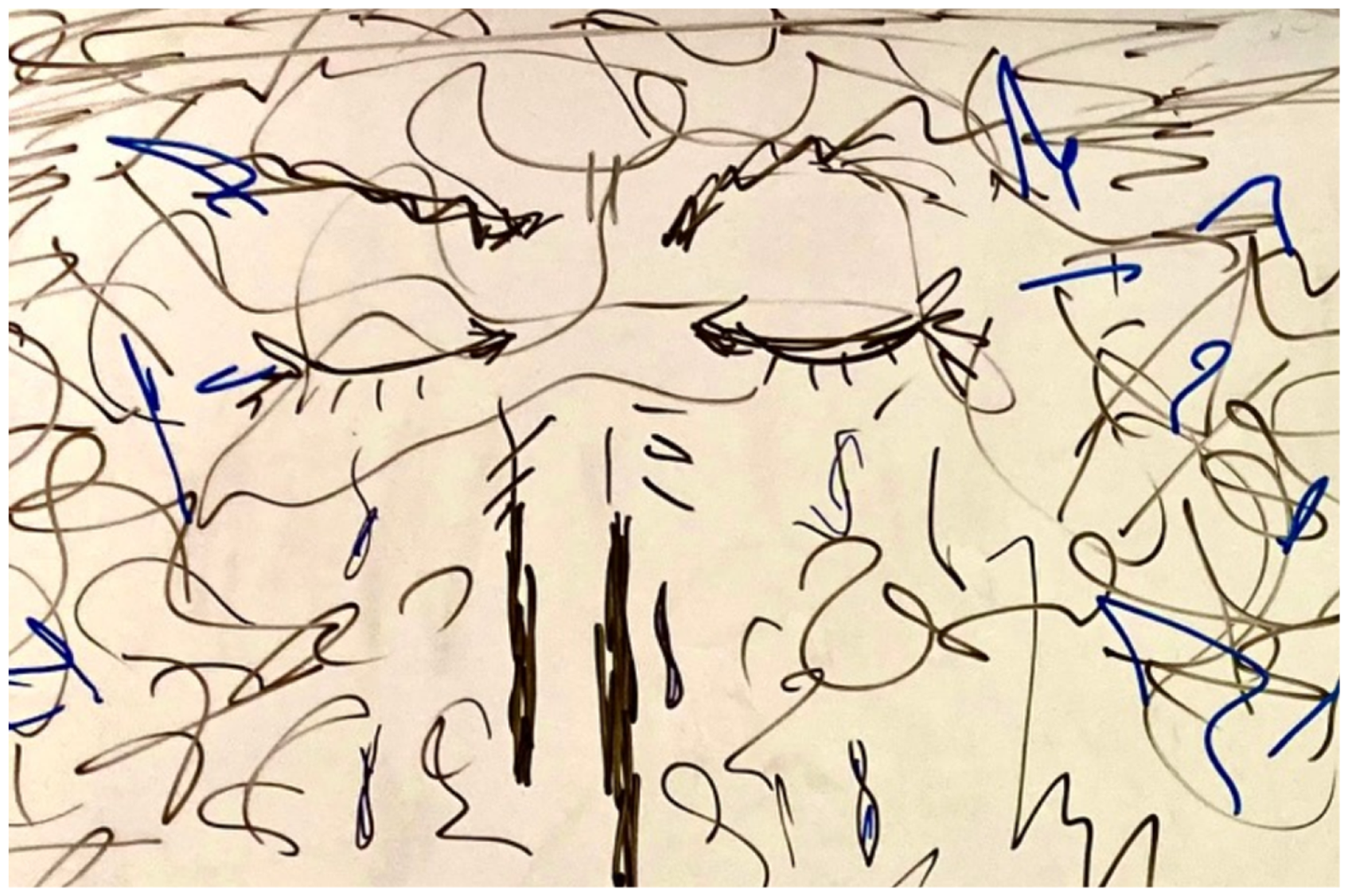
Excerpt of Bridget's art piece, ink on whiteboard.
A figure's pained facial features are barely visible within the dark, chaotic markings that represent the pressures of existing within oppressive structures. The artist and the group interpreted this part of the art piece to represent pressure, criticism and judgment that is common in oppressive spaces.
This theme of judgment also pointed to how pursuing ABR might be additionally impeded within a field like social work, which itself is often striving for legitimacy when compared to other social and hard sciences. “Is it harder to do or ‘sell’ this type of work in a field that is striving to be perceived as credible? Is this a case of double stigma for ABR within social work?” (Darren). Indeed, this study further found that social work professionals, institutions and organizations suffer from imposter syndrome, or a sense of not being worthy of the same respect as other disciplines. “Social work tries to prove its worth and therefore assimilates or performs what is expected in order to be valued” (Dana). From within this context of social work striving for validation as a valuable contributor to knowledge generation, ABR was experienced as freeing.
The observations within this cluster of meaning around power dynamics and dominant narratives led the team to a summative curiosity: In social work research, why are “thriving, freedom, creativity, and simply being (as opposed to doing, toiling, and producing) considered luxuries rather than necessities?” (research team memo). This points to the second cluster related to what ABR is, as opposed to what it is not.
Liberation Through ABR
Throughout the study, the liberatory nature of ABR was described and experienced. These insights contributed to the second cluster of meaning, noting how ABR can function as an alternative to the power dynamics described above. For example, ABR is “deconstructing notions of expertise” and, in our CAE exploration specifically, ABR helped “blur the lines between subject and object” and between researcher and participant (research team memos). In such a deconstructed and uninhibited space, we felt the opportunity to be creatively alive and thus more authentically present as ourselves. Such presence invited deep relational connection within the team and a friendly affection that we had rarely experienced in the patriarchal rationality and rigidity of the academy. This leveling and unifying experience of ABR between us as participant-researchers was deeply moving and freeing. Within this relational context of the project, the collectively defined meaning of ABR was characterized by a freedom from; a radical, humanizing and humbling nature; and being anchored in presence.
First and foremost, ABR provided freedom from the typical constraints that have often defined Western, positivistic, scientific inquiry. Despite the process of creating and discussing our art shining light onto the internalized pressures of academia culture and the manifest pressures we personally experienced within it, we quickly found the process to be both freeing and exciting. ABR was not reductionist but expansive and exploratory. In fact, ABR was experienced as a radical approach to research in that it is intuitive, subjective, and contextual. In this study, ABR stood out as an ‘abnormal’ research experience compared to positivist, scientific norms that suggest knowledge creation should be objective, controlled, contrived and hypothesized. Thus, “ABR feels liberatory in the face of these stifling pressures that we feel we need to be liberated from” (research team memo). The data pointed to a shared understanding that liberation does not exist by itself. It is relative and therefore can be understood best in relation to the positionally and contextually relevant confines of those experiencing it. Darren's artwork (Figure 3) conveyed this meaning via collage.
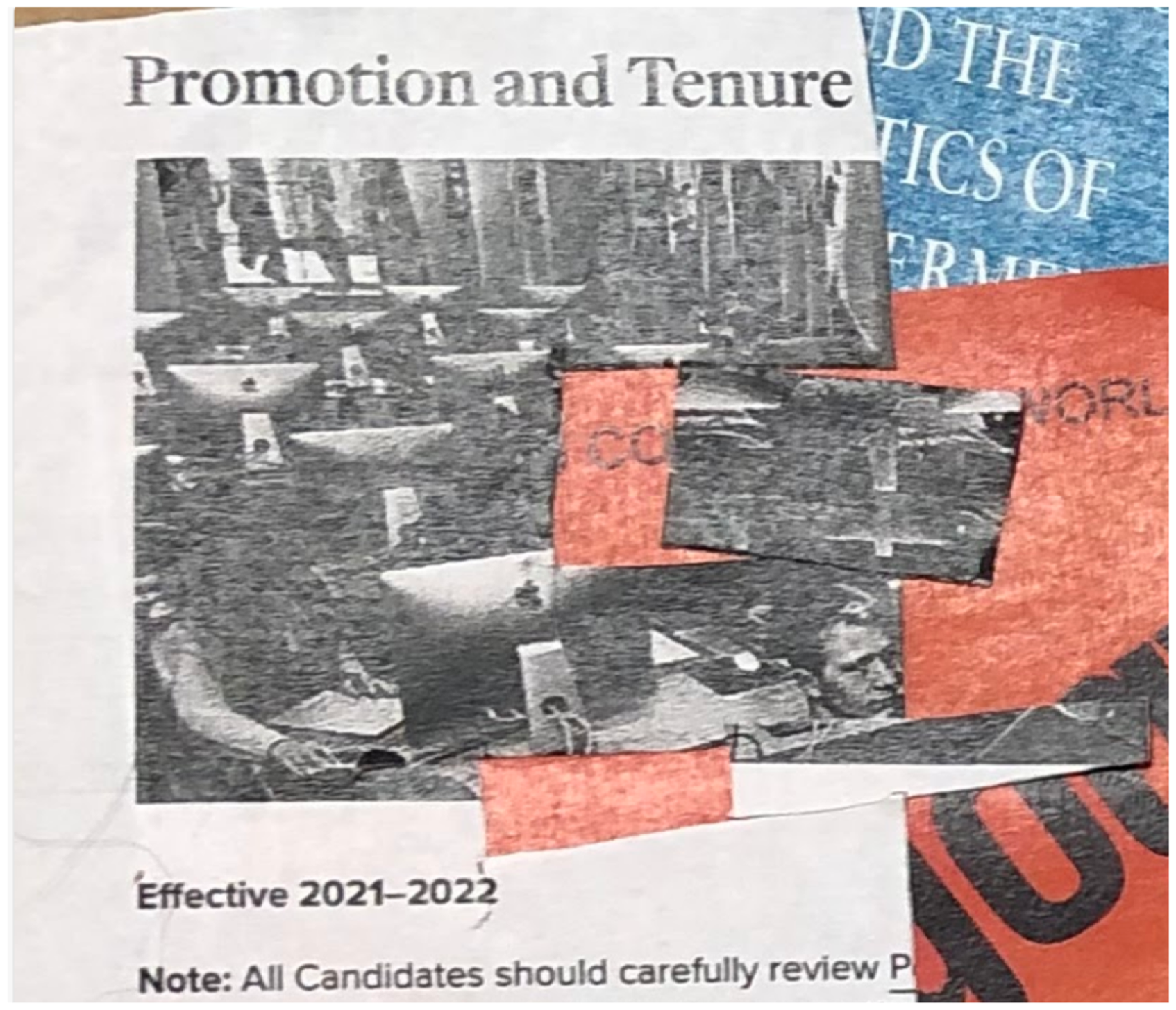
Excerpt of Darren's art Piece, Multi-Paper Collage.
In making this piece, which included tearing up academic manuals, books and journal articles, the artist-researcher expressed how freeing it was to engage in the subversive act of destroying academic artefacts and repurposing them into an expressive critique.
The theme of ‘freedom from’ was also connected to the duality of surviving vs. thriving. Through the grounding and freeing experiences of ABR, instead of simply focusing on overcoming the limiting expectations of academic pursuits (i.e., pressures to efficiently arrive at a product and fear of being perceived as unserious scholars), we felt that we could learn, grow, freely have fun and find a more actualized state of existence as a function of the research process: “The prison of survival has to be cracked open in order to achieve freedom and realness” (research team memo). This freedom from positivist research expectations allowed for a nonrestrictive space with opportunities to be and express oneself authentically. In this space, “I can let go of…the urgency and drive to have to do things to survive. I can put that down and then, I show up. And I create and I express and I can say and do and be what's real for me” (Bridget). The freeing authenticity and clarity in this type of knowledge generation was also apparent in our artwork, as in this excerpt from Bridget's photo series (Figure 4).
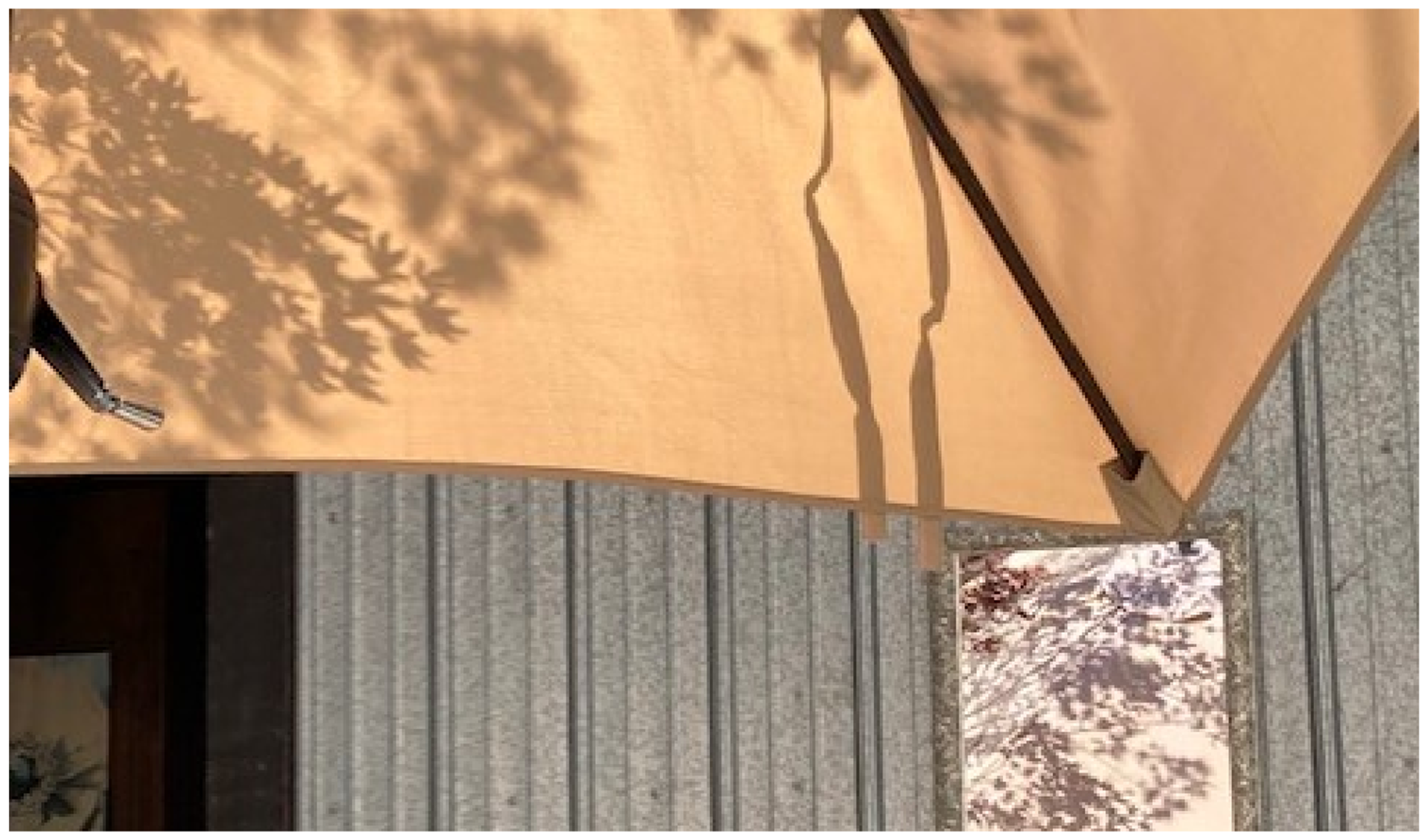
Excerpt from Bridget's art piece, photo series.
Here, the umbrella is a metaphor for ABR, through which you can perceive the quality and texture of the leaves more distinctly than they can be seen ‘objectively’ in the mirror. This interruption of the conventional way we tend to see most clearly - i.e., with the naked eye or in a mirror - illustrates the surprisingly clear manner through which ABR's processes can more accurately reveal the truth of our experience. Being free from confines also left room for the imperfect, which “represents the beautiful possibility of mistakes, that this type of methodology … allows for, that isn't allowed for in more rigid structures and systems” (Darren). Breaking free was also discussed regarding Darren's painting (Figure 5): “[It's] like it can't be contained by these traditional ideas of rigor” (Dana).

Excerpt of Darren's art piece, paint on canvas.
ABR was also shown to be subversive or radical compared to the dominant narratives of traditional academic activities. The team felt a liberating sense of shirking the expectations of positivist processes: “I mean, we're still researchers, but we started out as researchers in this top-down way. And now we're becoming both participants and the makers of data, [which] is also very liberatory. It's nonlinear and interrupts power” (Dana). In ABR, interrupting power included making time in the research process for relationships and creativity itself, which were also experienced as an act of resistance: “It feels healthy to rebel against unhealthy demands. Subversion is a form of self-care within toxic institutional or social expectations” (Darren). There was a sense of “excitement to create and do something rebellious against unsustainable or toxic expectations” (Bridget).
For this and other reasons, ABR was experienced as a deeply humanizing process. Through transparency, eschewing nagging calls for productivity, and making genuine personal connections, “this methodology both collects data and also celebrates and affirms people” (Dana). ABR also invited us to bring our authentic selves into the creative process. Through ABR, “creativity and authenticity can emerge,” which in our shared experience, provided insight into the truest “examples of the human condition” (research team memo). The research team also described how the creating and sharing of our art allowed us to feel “engaged, seen, excited, hopeful, alive and more human,” (research team memo), all of which felt to us like freedom and a relief from the typical pressures of academics and adult life in a neoliberal society. Art invited us to be “present to the full range of human experiences, like joy, pain, etc.” (Dana), which included experiences of “life and death. It's peaceful” (Bridget).
ABR was also experienced as deeply humanizing in that it was messy and humbling. By intentionally moving away from the confining structure and predictability of other methodologies, openness and unpredictability - or “messiness” - emerged. This required a level of humility in not knowing where the process would lead, and acceptance of surprises and unexpected outcomes. An excerpt from Darren's painting on canvas (Figure 5), illustrates this theme of openness and messiness, which showed up as color, movement, and vibrancy toward the top of the piece, emerging from static darkness at the bottom.
According to Bridget's explanation and our shared meaning-making of the piece, the order and relatively calm predictability of the dark indigo and maroon represented traditional research methods. Though objectively “messier” in the upper portion, the red, white, yellow, and blue brush strokes represented the free, exciting, and joyfully unpredictable dimensions of ABR. “ABR is a different approach to people and communities. It leads to expansiveness by embracing complexity and messiness. It's humbling not having the ‘answer’” (research team memos). Ultimately, “exploration of [multiple] knowledges and experiences, as opposed to coming to definitive answers or objective truth” (Dana) was part of the messy freedom of ABR. The creation of this study itself was the result of an ABR process that was unattached to a particular result or conclusion. “We couldn't have planned to get here, even if we tried” (Dana. This element of surprise and the organic, iterative creative process were part of ABR's freeing nature.
Lastly, the freeing quality of ABR was understood to invite people - both researchers and participants - to release expectations for constant production, allowing us to simply be. Freely being in the moment felt like an opening into uninhibited expansiveness. This sense of space was also seen in the artwork itself. While not consciously intentional, we consistently found moments of stillness represented within our works, usually as blank spaces amid busier or more chaotic imagery. For example, in Dana's ink drawing (Figure 6), the kaleidoscope of innumerable, demanding pressures of everyday existence swirled around an empty center, representing the opportunity afforded by the arts, a moment where spaciousness and quiet are the only things present.

Excerpt from Dana's art piece, marker on paper.
The open spaces and stillness were understood most clearly only after fully seeing and acknowledging the challenges or limiting dynamics against which they were contrasted. The space did not have to perform, produce or meet expectations. It simply existed. By extension, ABR offered us as researchers and participants the space to “take a break from doing and drop into being. Within that space, access to different knowledge is gained” (Darren). This connection between a quiet yet expansive state of being and the opportunity to see, know and understand more deeply was clear: Art allows us to lose ourselves into being… ABR asks us to pause and consider some important questions, such as, ‘What is true to you and how would you like to express that?’ And, “Does ABR allow participants (us, in this case) to access knowledge, truth, or reflective insights that are otherwise inaccessible to our “doing” mind?” (Bridget) “Far more aligned with… the spirit of being a human being… All of these tropes of how you're supposed to be and how you will be accepted and how you will get to the dream that you think is supposed to be; it's all about doing. It's doing doing doing doing. So, there's no time, no space, no capacity to just be. And this methodology is inviting people, even though there's a product in the art, it is inviting us, I think, to put down the striving, put down the doing, and breathe for a second (Bridget).
Discussion
Feminist inquiry invites us to claim our authentic and embodied engagement in our studies, contextually and positionally. Within this unique opportunity as researcher-participant-artists, our team encountered a transformational individual and collective experience with relevance to our personal, professional and academic lives. Early in the period of defining feminist research, Bernhard (1984) suggested that feminist methodology includes: researcher-subject interaction, non-hierarchical research relationships, expressions of feelings, concern for values, and the potential for the research to help its subjects. Harding (1987) also highlighted that feminist research must be founded on a balance of power between the researcher and subjects. Today, the focus on power and inequities continues as a central aim of feminist research (Jenkins et al., 2019). These dynamics of inviting personal, subjective experience into the scientific process while both confronting and being freed from the confines of traditionally hierarchical power dynamics echo this study's findings. The emancipatory value of feminist research also resonates with our findings on ABR's promise of liberatory impact (Webb, 1993).
Previous literature has noted the ways in which social work scholars’ social positionalities, and the identity-based experiences of those facing marginalization, can inform and motivate methodological decisions that are creative, engaged and participatory (Cosgrove et al., 2020). As such, our findings not only developed through the lens of our personal experiences, but through our identity-based motivations to pursue ABR. In particular, our whiteness felt protective as we sought to engage a methodological process that existed outside of, and overtly critiqued, the academy's near exclusive emphasis on positivist research. Yet our racial identities necessarily precluded our lived experience of some of the confining dynamics in academics. Moreover, the ways in which social work doctoral students and pre-tenure faculty face barriers when pursuing non-traditional research methodologies (Kramer, et al., 2021), have manifested themselves in our interest in power, voice and agency in knowledge production.
Liberation for Scholars
In our experience, ABR invites opportunities for the development of new knowledge and methodological approaches that embody transformative epistemologies. While, of course, art could be used as a tool of manipulation or oppressive ideologies (Staal, 2018), the invitation to creative expression was found here to be an avenue to freedom in inquiry, in relationship building, and in greater authentic connection to ourselves and one another. Through CAE, we explored the ways ABR can serve as a liberatory social work praxis and identified that explorations of ABR reveal deeply ingrained power dynamics and dominant narratives in academia. Those structures have implications for individuals at multiple levels of the research process. Further, ABR itself can be characterized by a set of values and concepts that point toward an experience of liberation from structures of power for researchers and participants. Here, we used creative processes to document and analyze our personal and professional experiences as scholars within traditional academic institutions. We found these experiences liberatory as they afforded us the opportunity to explore and share parts of ourselves, we would not usually reveal in our research. We also experienced liberation through the very nature of turning the microscopes upon ourselves, thus interrupting the idea of researcher as expert (while simultaneously recognizing the importance of participant as expert of their own experiences.) Indeed, the act of blending the role of researcher and participant interrupted the dominant narrative of researcher as separate from participant (Dominelli, 2006; Foster, 2012). It also felt liberating to respond organically, and to engage in a way more akin to the ways we usually would in social work practice, bridging the gap between research and practice.
We found that liberation is relative, in that people's experiences of freedom may differ depending upon the structures or situations that constrain them. The confines of one's oppression, impacted by their identity and circumstances, may shift what is considered liberatory and how that is experienced. As white-identified, highly educated individuals, we cannot suggest that our experience of liberation from academic processes and institutions will necessarily resemble those of another person in another situation. We know people with marginalized gender, racial and sexual orientation identities face additional barriers and structural oppression in academia (Domingo et al., 2022; Eliason, 2024; Eslen-Ziya & Yildirim, 2022), with added barriers for those with intersectionally marginalized identities, such as queer women of color. Still, we suggest that ABR offers a powerful tool to achieve liberation for both participants and researchers, regardless of one's identities. These findings contribute to the literature on ABR by centering on the potential of the research methodology to foster experiences of liberation from systemic power structures while embracing the importance of the research practitioners’ own needs for and experiences of liberation, alongside that of their participants.
Returning to Social Work's Roots
Although social work has a history that is “…embedded in colonization, class struggle, patriarchal religious traditions, and white supremacy” (Cosgrove & Pyles, 2023; citing Del-Villar, 2021; Plummer et al., 2021), early social work practice was more relational. Yet, with ongoing professionalization through the 19th and 20th centuries, the relational nature of social workers’ engagement with individuals, families and communities was slowly replaced by technical, skill-driven positivist approaches to service (Adams, 1993; Kramer et al., 2021). This is true in both social work practice and research, where the field has strived for legitimacy in a milieu marked by neoliberal, positivist standards and emphasis on fundability and generalizable outcomes steeped in privilege and white supremacy (Bisman, 2004; Foster, 2012; Kramer et al., 2021; Kim, 2017; Lynch, 2000; Osei-Kofi, 2013; Wertheimer, 2008). ABR has emerged as one response to counter neoliberal and white supremacist structures and ideals in social work and society at large, as ABR broadens what has traditionally been considered knowledge (Simons & McCormack, 2007), widening the epistemological tent to not only include but center subjugated knowledge (Osei-Kofi et al., 2010). ABR also invites space for authentic self-expression and connection, consistent with social work's priority of meeting people with authenticity of self and of relationships. In discussing our experiences through this study, we collectively felt that by reprioritizing goals and changing discourse and process around knowledge creation, power can be shifted. Thus, ABR's potential as a humanizing methodology aligns well with calls for social work to return to a more engaged and transformative practice (Kramer, et al., 2021).
ABR's messiness and flexibility is responsive to the ever-changing nature of the complex social problems social work scholars explore. In doing so, ABR facilitates data collection and analysis that enact the profession's espoused values of self-determination, centrality of human relationships, social justice, and an emphasis on the authentic human experience within a biopsychosocial context (Bronfenbrenner, 1979; National Association of Social Workers [NASW], 2021). As a methodology that “honors multiple ways of knowing” and “reject[s] the idea of knowledge creation as value-free” Osei-Kofi (2013, p. 137), ABR's anti-oppressive stance and creative processes foster adaptive flexibility to uplift diverse epistemologies. As social work scholars, ABR provided both a respite from and a tool of resistance to the dominance of seemingly narrow views of productivity and positivism within the academy. Other participants engaging in ABR may encounter similar respite and resistance through the vulnerability, reflexive engagement, and complex knowledge ABR invites. Specifically, we found that creating and iteratively interpreting our art prioritized a creative and relational knowledge that is often overlooked.
Finding Connection and Joy in Research
In addition to “the resistive potential of art” (Leavy, 2009, p. 256) and the impact of socially engaged art as an act of resistance against structures of neoliberalism and capitalism (Kester, 2011), art also brings people together. As the field of social work itself, ABR tends to be relational, evocative, and emotionally engaging. Artistic engagement in general engages people on a visceral, multi-sensory level (O'Neill et al., 2019) and improves connection both among people and within oneself, often integrating one's cognitive and emotional experiences to increase a sense of embodiment (see Huss & Sela-Amit, 2019.) For individuals who cannot or choose not to express themselves in words, these creative media offer alternative formats through which to express oneself (Gullion & Schäfer, 2018) and contribute to the generation of knowledge around their unique experiences. This study supports a constellation of research drawing connections from art to freedom, mediated by relationships and well-being. First, through experiences like ABR, art engages our emotions (Mastandrea et al., 2019) and promotes relationships directly through mechanisms such as social capital, intergroup social cohesion (Lee, 2013) and enhanced sense of belonging, safety, and trust (Versfeld et al., 2023). By inviting participants to engage in creative expression, ABR has the potential to facilitate new ways of communicating, and to help develop empathy and understanding (e.g., Foster, 2012; Mayor, 2022; Potash & Ho, 2011). Research involving ABR also illustrates strong ties between relationships and well-being (Mastandrea et al., 2019); for example, ‘balanced authenticity’ in relationships (Wang, 2016) and relational safety (Colacchio, 2023) are associated with high relational satisfaction and greater psychological and subjective well-being. We experienced this link as the most fulfilling and joy-filled aspect of this study, as the setting we co-created prompted relationships where we felt deep satisfaction and a source well-being.
While engaged in data collection and exploration, our team stepped away from typical pressures and expectations of academia and into profound, authentic connections. Born out of an innate, shared desire to see and know one another, we began every meeting with a thorough check-in, sharing the events of our personal and professional lives. We collectively invited the realness of our lives – divorce, illness, death of loved ones – into the study's setting. Through this organic practice, our connection became foundational to our CAE experience. Authentically bringing our full selves into the research space enhanced the veracity of the truths we uncovered together. Our experience bolsters the findings around the humanizing and liberatory nature of ABR as a methodology. When research often leaves researchers and participants feeling dehumanized (Weaver & Mollet, 2023), the prospect of a more connected and liberating method is compelling for social work and beyond.
The interpretations of this study illustrate how incorporating artwork into learning and knowledge generation could offer direct benefits to participants and researchers alike. Thus, the ethos of ABR is consistent with social work values on many fronts. Both prioritize empowerment and resistance to oppressive structures, alongside flexibility and imagination, relationality, and empathy. Both prioritize the important connection between theory and practice (Huss & Bos, 2023). As Freire (1970) suggests, joy is a political act, particularly for those who are being oppressed. The fact that a research process could conjure such authentic connection and contentment was revelatory. Knowing that suffering is intrinsic to human existence, revealing opportunities for creativity and connection as a wellspring of joy is critical. Where ABR can be fully embraced by social work researchers and practitioners, this methodology presents an opportunity to distinguish the field, leaning into what we know about what is good for humanity.
Limitations
Defining limitations and their significance largely depends on the readers’ epistemological orientation. To be sure, our findings lack generalizability and objectivity. However, such characteristics were never intended for our study. As we were more interested in nuanced and rich interpretations of lived experience from a feminist perspective, the findings are intentionally subjective in nature. Nonetheless, our experiences may not be reflective of other social work scholars and practitioners. Further research would be necessary to explore how our positionality impacted our findings and how participant-researchers with other backgrounds might arrive at distinct conclusions.
This limitation is particularly relevant for work examining concepts like oppression. While we offer a critique of academia, we are all actively a part of academic institutions. Despite our critiques, we quite enjoy our roles and the relative creative freedoms they offer. Thus, this work does not intend to suggest that being an academic is to be in a marginalized role, particularly in that our entire team is white. Rather, we seek to understand how knowledge production disrupts or perpetuates the systems and structures that produce ongoing social hierarchies. Towards this end, having a team of racially diverse scholars would have improved this work and is a suggestion for future inquiry.
Further complicating our work's relationship with notions of “rigor” and “validity” is that we were heavily influenced by one another's experiences in our co-created research parameters and analyses. We experienced developing meaning in a relational manner to be a process that deepened understanding and facilitated insight. In our experience, this seemed to be a “rigor-enhancing” process. Nonetheless, to others this might suggest problematic “bias” or “influence.”
Implications and Areas for Future Research
This study revealed the multi-faceted opportunities for ABR in social work research and practice. Where the traditional, positivist research process can be linear, constrictive and at times dehumanizing, this study amplified practices that are iterative, connected, and truly joy-filled. As social work scholars, our professional values compel us to move beyond the standard that our research minimizes harm, and towards an ethos of research engagement that is deliberately and explicitly beneficial to those engaged (Cosgrove et al., 2023). As a research process that yields rich and complex data reflecting the nuanced experiences of participants, ABR can help researchers embrace and represent the messiness of the human experience, subvert the politics of positivist knowledge production, and invite inspiring and vulnerable engagement. Further, such approaches can facilitate meaningful relationships between researchers and participants. Critical scholars may find ABR well-aligned with personal or professional values and commitments to social justice. Future research can explore the themes of power, relationships, and freedom within ABR with various populations and investigate the inter- and intra-personal mechanisms at play in ABR's impact.
Artistic engagement tends to integrate one's experiences – cognitive, emotional, sensory – and to encourage embodiment, meaning that the participant is interpreting their own here-and-now experience (Huss, 2018), also a key concept within feminist traditions of research and education (Hooks, 1994). Considering the embodied and experiential processes used in ABR, such methods can “bypass” the need for verbal articulation of feelings or experiences and draw upon the “embodied encounter” with a given topic (Greenwood, 2019, p. 3). Implications from this study include the invitation to explore mindful engagement and non-verbal encounters for researchers and participants. Social work can benefit from engagement in praxis using ABR, blurring the artificial boundaries between research, theory and practice, bringing together disparate components often found within social work (e.g., emotion and cognition, theory and practice, worker and client) (Huss, 2018). This would allow for moving beyond the positivistic idea of knowledge creation for its own sake to the idea of honoring multiple ways of knowing in service of liberation, social justice, and well-being. Where social work practitioners support and empower the most vulnerable members of our society, researchers are often expected to stay close to the ivory tower and publish findings from big data in top journals. It is ironic that in liberating ourselves from these pressures during this project and engaging in a process bordering on “subversive,” we felt we moved closer to the values of social work. We experienced the freedom, connections, and dignity that project what social work research could, or should, be.
In addition to other methods, we have discussed how both ABR and CAE may generate affective responses, and how knowledge and experience may be co-created by researchers and participants. While these components may be present using either approach, we argue that with the method we engaged, a unified CAE-ABR, researcher engagement and research-participant co-creation are not just potential by-products, but that they are a necessary, integral, and uniquely defining part of the process. Thus, we believe that CAE-ABR makes a unique contribution to the field. Through methods like ABR and CAE, and specifically, CAE-ABR, social work research has potential to disrupt power dynamics, re-envision metrics of success, and uniquely contribute to the social sciences invested in improving the human condition. This could bring social work research and practice into greater alignment.
Footnotes
Declaration of Conflicting Interests
The authors declared no potential conflicts of interest with respect to the research, authorship, and/or publication of this article.
Funding
The authors received no financial support for the research, authorship, and/or publication of this article.

Correction (July 2025):
There was a problem with figures 4-6: These final three images were in the wrong places. The captions are correct, but the images are not. Figures have now been placed at correct places since original publication of the article.