




Abstract
Through interviews with 16 social workers, drawing on the concept of “willful subjects”, the aim of this paper is to analyze how social workers working in Swedish municipal social services make sense of, adapt, and/or challenge routine questions about intimate partner violence, and how such routines affect their professional role and agency. We found that participants renegotiated standardized ways of asking by stressing the need to use such questionnaires with care, and stating that the individual judgement and agency of the social worker is paramount. The participants also renegotiated the purpose of asking; while their routine questions about IPV seldom led to a disclosure of ongoing exposure to violence, social workers considered it important to ask because it “opens the door” and signals the possibility of receiving help in the future. We argue that social workers are not necessarily stripped of agency when following standardized protocols and routines, despite increasing efforts to include controlling mechanisms in their everyday practice. However, our results also show that social workers’ legal obligation to report to child protection services, if there are children in the household, limits their room for discretion and how the routine questions about violence are asked and perceived by clients.
Keywords
Identifying intimate partner violence (IPV) through direct questions posed by welfare professionals to their clients has become an important and widely promoted strategy in healthcare and social services, in Sweden as well as internationally (García-Moreno et al., 2015; Goicolea et al., 2023; Lundberg & Bergmark, 2021; Sweet, 2014). In Sweden, the responsibility of social services to actively try to detect violence has been emphasized for the last decade and, since 2022, all local social services must have routines both for asking about exposure to violence and for identifying those perpetrating violence in close relationships (National Board of Health and Welfare [NBHW], 2022). 1 Each municipal social service agency determines, by delegation from the elected local social committee, what these routines should be. The focus and implementation of the routines, for example the level of standardization, therefore vary between municipalities. The general intention is however to increase the detection of ongoing violence through more direct inquiries (NBHW, 2023).
As routines for asking about violence become implemented, questions arise as to how they are being experienced, understood, and used by social workers in practice. In their quantitative study of self-perceived competence among Swedish social workers to ask about and deal with IPV, Lundberg and Bergmark (2021) found that many felt ill-equipped in this area. While administrative routines for screening for exposure to violence were in place in most municipalities, only 43 per cent of the respondents—working in all areas of personal social services—said that they followed these in practice. This suggests that implementing these routines is difficult. The authors did find, however, that social workers who regularly asked about violence were more likely, according to their own estimates, to identify such cases, particularly those who met clients seeking cash assistance. Lundberg and Bergmark's study is based on data from 2014, which is the same year as the NBHW published national guidelines for improving detection of violence within healthcare and social services and launched a standardized assessment tool, designed for detecting, describing and risk assessing cases of intimate partner violence (NBHW, 2014).
To learn more about what has happened since, and how and why (not) social workers ask the recommended routine questions about violence, this paper aims to analyze how professionals working in Swedish municipal social services make sense of, adapt, and/or challenge routine questions about IPV, and how such routines affect their professional role and agency. The study is based on individual and group interviews with 16 social workers, working in different divisions of the social services, in 11 different municipalities.
Social Services’ Responsibility and Organization in Relation to IPV in Sweden
Social services in Sweden are formally governed through the legal framework of the Social Services Act (SFS 2001:453), while each municipal political majority decides its annual budget, how to organize its work, and, by delegation, the regulations for individual cases. Social services have the main formal responsibility to provide support for victims of violence in close relationships, women in particular, and to provide treatment for perpetrators of violence. Besides the provision of support, social services are also responsible for setting up their own routines for when and how it is appropriate to ask clients about their experience/use of violence (NBHW, 2022). In its guidelines on IPV, the NBHW recommends routinely asking, which is described as asking independently of any signs or indications of IPV, and following written instructions established by the responsible organization and decided on at management level (NBHW, 2018, 2023). For this purpose, the NBHW (2014) has developed a tripartite assessment tool called FREDA (a Swedish verb meaning “to guard” or “to protect”), which includes a short questionnaire for detecting violence, a risk assessment tool, and an extended questionnaire that can be used to elicit a closer description of the violence to which a client has been exposed. Standardized questionnaires used for other areas, such as addiction or financial aid, may also include questions that can be used to address experiences of violence.
Standardization and Mandatory Reporting: Social Workers as Willful Subjects
The increasing use of standardized instruments and protocols is a widely acknowledged development within various areas of social work, both internationally and in Sweden (Ponnert & Svensson, 2015), and should be understood as part of a general development towards and discourse on evidence-based social work (Lauri, 2016). Within the area of IPV, standardization focuses on routines for when, who, and how to ask about violence, and how to make risk assessments. Some scholars have argued that standardization reflects mistrust in professionals and that the turn towards standardization may lead to alienation and de-professionalization (Ahlbäck Öberg et al., 2016; Lauri, 2016), as well as eroding ethical aspects of social work (Cellini & Scavarda, 2020). Others have found that increased standardization contributes to professionalization, because it can strengthen social workers’ ability to conduct their tasks, such as assessing risks in relation to IPV (Skillmark et al., 2019), although professionals’ support for standardization can wane over time (Skillmark & Oscarsson, 2020). This could arguably be related to the fact that the tension between individualized support measures and standardization is delegated to street-level social workers (Nordesjö et al., 2022). Further studies have emphasized that there is an implicit flexibility in standardized social work and have shown that social workers’ local adaptation of standards plays an important role in the quality of social work practice (Bakkeli & Breit, 2022; Skillmark et al., 2019). Social workers’ adaptations and perceptions of standardized methods are also dependent upon the available resources, such as time and room for reflection (Ryding, 2020).
In the US, social workers’ capacity to address domestic violence has been described as shaped by a “braid” of neoliberal management routines and priorities, as well as increased professionalization and criminalization (Mehrotra et al., 2016). These have affected how social workers think about the problem, and what solutions and responses can be imagined. While the political and social contexts differ, we argue that a similar development can be seen in the Nordic region, not least in Sweden. Comparative studies have concluded that among advanced capitalist nations, Sweden ranks in the top in both the speed and reach with which neoliberal management reforms have been deployed (Pollitt & Bouckaert, 2011; see Lauri, 2016, regarding social services). Over the last 30 years, public support structures for vulnerable groups and individuals have weakened, and the allocated resources are diminishing (Kamali & Jönsson, 2018). IPV support in Sweden has been professionalized by formalizing the social services’ role to provide support, whereas women's shelters have become more like social services (Helmersson, 2017). Consequently, the “solidary role” of social workers has partially transformed into a more controlling one, giving them less room to promote the “welfare of the people” (Jönsson, 2019, p. 5).
The solidary role of Swedish social workers is further challenged by increasing expectations that social services will collaborate with the police authorities (see e.g., Finch et al., 2019) and by mandatory reporting regulations. As described by Mehrotra and colleagues (2016), trends towards the criminalization of IPV affect how social services in the US work with violence. In Sweden, we have witnessed a similar development, where punitive policies are increasingly being framed as a central solution to the problem (Lauri et al., 2020). For example, since 2021, a child who witnesses violence against a family member is considered a victim of crime (NBHW, 2021). While intended to strengthen the rights of the child, this legislation also implies that social services should report such suspicions to the police. All Swedish welfare professionals are also obliged to immediately report to child welfare services if they suspect that a child is being neglected or abused, which includes the child being a witness to violence against a family member (SFS 2001:453). Consequently, if a social worker receives information about violence in a family, social services must initiate a parallel child welfare investigation and are advised to file a police report (NBHW, 2022).
In the international literature, there is a growing critique of this type of mandatory reporting of child abuse or maltreatment, because it can activate multiple policies that disproportionately affect racialized and marginalized communities (Harrell & Wahab, 2022) and increase the well-documented tensions between IPV support systems and child protection services (see e.g., DeVoe & Smith, 2003; Goodman et al., 2020; Kjellberg, 2024). Mandatory reporting rules may have unintended negative consequences for both children and direct victims of IPV, possibly exacerbating their vulnerability to violence, damaging trust and thereby fracturing important relationships with supporting professionals, effects that pose challenges to social work practice (cf. Goodman et al., 2020).
While commonly understood as a regulation to protect children from parental abuse or neglect, the obligation to report is very much present in cases of IPV, and increasingly so due to recent legal changes in Sweden. At the same time, the needs of children and abused parents are increasingly treated in parallel and by different actors (e.g., since April 2024, children's need for protected shelter is to be assessed separately from that of a parent, (NBHW, 2024)). In a Swedish interview study with 16 mothers surviving IPV, Kjellberg (2024) showed that, while the women felt supported by the parts of social services that dealt with IPV, several participants described that they felt betrayed and revictimized by the professionals in child protection services and family law, who frequently questioned their stories (see also Waller Skoog, 2022). Such structures, which can lead to fragmented and contradictory support, arguably exacerbate the ethical dilemmas introduced by mandatory reporting, further complicating the multiple processes activated by the obligation to report (cf. Harrell & Wahab, 2022).
Given social workers’ societal positioning as both agents of liberation and discipline, practitioners will always be caught in a nexus of ambiguity (Roose et al., 2012). But, while social workers’ ability to work with IPV is shaped by the structures and regulations described above, we can also assume that they have some degree of discretion and room for agency. Weinberg and Banks (2019) argue that social workers can respond to the challenges of neoliberalism and managerialism through engagement and compliance, resignation, or quitting, but can also enact passive resistance through bending rules, or active resistance through challenging institutions or joining campaigns. Jönsson (2019) further emphasizes that social workers are not to be seen as passive enactors of neoliberal transformation, but rather as agents who can take a stance, despite unease with their role as controllers. Inspired by Sinai-Glazer and Krumer-Nevo's (2023) investigations into how social workers enact agency under the many constraints they face in their work, we tentatively understand them as “willful subjects” (Ahmed, 2014), in the sense that they express agency, in various and sometimes subtle ways, in relation to bureaucratic rules and standardized tools. Sinai-Glazer and Krumer-Nevo found that one important aspect of social workers’ agency was to “challenge bureaucracy and regulations” (2023, p. 761). While these forms of agency could be disregarded as failing to challenge wider structures, the authors argue for the recognition of such “mundane willfulness” as a reaction against the structural constraints they have to navigate in their everyday practice (Sinai-Glazer & Krumer-Nevo, 2023, p. 774). In the following, we use the term “negotiate” in order to explore how the participants enact such mundane willfulness; making sense of, adapting (to), and challenging the standardized approach to IPV detection and support, and navigating their different roles and duties.
Methodology
From March 2023 to February 2024, we conducted semi-structured interviews with 16 social workers, including one group interview with four participants (referred to as participants 5a–d). Participants were recruited through ads distributed to municipal social service managers via four regional IPV coordinators, that in turn shared the information to their employees. Ads were also distributed directly to social service offices in selected municipalities to achieve a broad geographical representation, as well as in one Facebook group for Swedish social workers. Those interested contacted the researchers directly. The participants worked in different areas, including economic support, children and youth, family support, addiction, social emergencies, units specialized in violence (n = 3), and management, in 11 different municipalities located in seven different regions. It was two men and 14 women, their ages ranged from 29 to 72, and they had between 5.5 and 21 years of experience of social services. The interviews were conducted via Zoom or phone, in Swedish or English, recorded, and lasted between 38 and 92 min. There was no financial compensation for participation. Before one interview (no. 5), the respondent that initially agreed to participate asked to include three of her colleagues, in order to “provide as much information as possible”. We accepted this and regarded this interview in a similar way as the others, i.e., not as a focus group interview because our interest and structure of the interview was not to study reflections and interactions between participants. Consequently, in the analysis, the statements from each interviewee are treated the same way as in the individual interviews. It is likely, however, that the collective interview format affected the discussion and led to more homogenous narratives from this group of participants. All authors conducted at least on interview each and all were conducted individually, except for the group interview, conducted by Lauri and Carbin. The interview guides included questions about the participants’ work with violence, with a particular focus on detecting and asking about violence. When interviewing, we used the terms “exposed to violence” (våldsutsatta) and “violence in close relationships” (våld i nära relation), because, in our experience, these are the terms most frequently used in social services.
The analysis builds on Braun and Clarke's (2022) reflexive thematic analysis. We transcribed the interviews verbatim and each of us read all the interviews several times, taking notes of relevant aspects and subsequently coding parts of the interviews that corresponded to the aim. Codes were both close to the empirical material and more interpretative. The team met to share and discuss our codings and impressions, and to develop a preliminary set of themes. With this preliminary set of themes, we went back to the transcripts to revise whether they captured the empirical material, which led to refinements of the themes’ labels and content. Through continuous writing and discussions within the team, the structure was modified into three final themes, and the team took turns to revise and discuss these until the final structure of the results was agreed upon.
Each participant consented to participate after receiving and reading an informed consent form sent by email, in which the objectives of the study, principles regarding confidentiality and termination of their participation, and the reason for the interview were explained. The project was approved by the Swedish Ethical Review Authority (2021-06011-01).
Findings
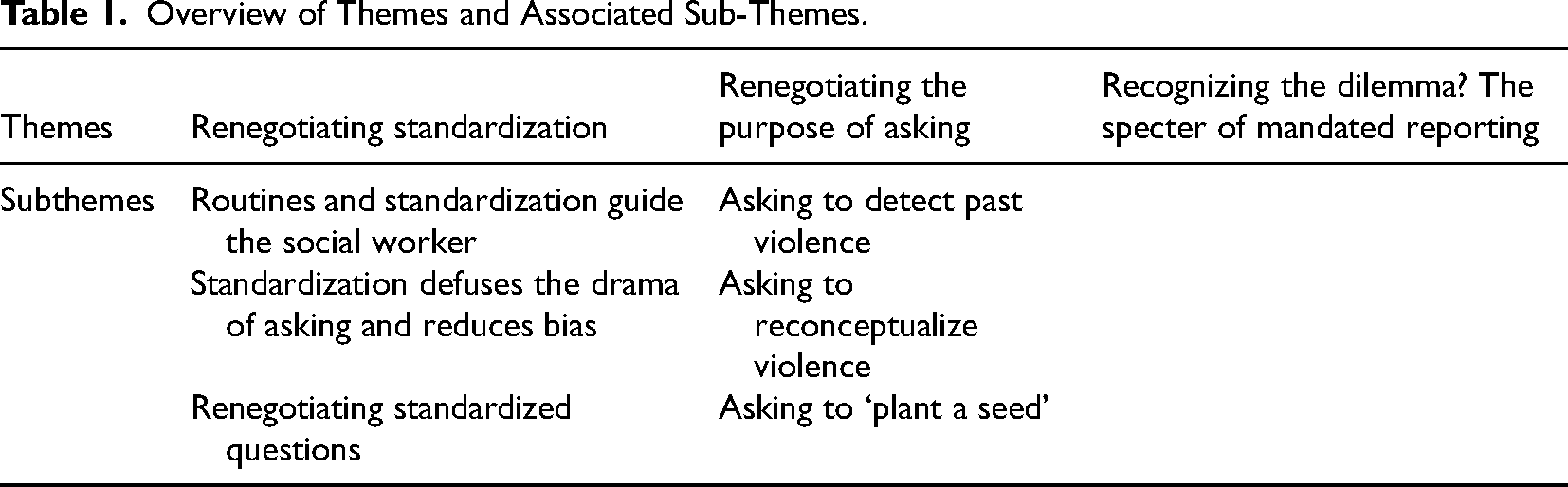
We begin this section by exploring how the participants practiced routinely asking and the use of standardized protocols. In the second theme, we analyze how the social workers described what (if anything) they detected when asking about violence, and how they negotiated the approach of detection. In the third theme, we examine how the social workers’ experiences of asking about violence had been affected by the mandatory reporting regulations (see also Table 1).
Overview of Themes and Associated Sub-Themes.
Renegotiating Standardization
Standardization has been described as both potentially alienating and as a way of professionalizing social work (see e.g., Lauri, 2016; Skillmark et al., 2019). This theme explores how the participants in this study perceived the implementation and use of routines and standardized questionnaires relating to IPV.
Routines and standardization guide the social worker
The participants stressed several advantages of having a special routine for asking about violence, and of doing so in a standardized way, similar to the policies in this area (cf. Goicolea et al., 2023). A recurring justification was illustrated by participant 3, who said that when questions about violence “are introduced into a routine […] it kind of becomes natural after a while.” Similarly, participant 6 said that having a routine is advantageous, “because then you know you’re not missing anything, which is easy when you’re in a [normal] conversation.” In a similar manner, two of the social workers said: I believe that having these questions has provided a relief, that we have a foundation for… what we have to think about prior to the meeting, during and after the meeting. You have the answer already in front of you, how to proceed, you don’t have to think about it yourself before every meeting. (Participant 5c) If you’re used to asking, then you’re also always prepared, if you know how to handle the answers. Compared to not asking regularly, then you have to think, “okay, what if she says yes, what do I do?” Then you have to dig up some routine for how to do it, because you don’t have it in your bones. So yes, I think it's better to ask anyway, to always ask. (Participant 7)
When asking becomes routinized, it is said to become less dependent on the memory, willingness, knowledge, or previous experience of the social worker, and this ensures that asking will take place. The responses above suggest that routines for regular asking, often using standardized instruments, make the practice less dependent upon the context or the capacity of each social worker. In this sense, the participants were seemingly portraying themselves as “scripted agents,” following the “body of regulations and procedures social workers are expected to abide by” (Sinai-Glazer & Krumer-Nevo, 2023, p. 763). At the same time, as participant 7 argued above, routinization can be a way to keep social workers more attentive to the matter of violence in each individual case. Furthermore, the routine was described as helpful in relation to handling affirmative responses. Phrased differently, asking regularly does not only ensure the asking itself, but can also contribute to making the issue a natural part of social work practice, ideally “in the bones” of social workers.
Standardization defuses the drama of asking and reduces bias
While the respondents talked about routines and standardized instruments as helpful for remembering to ask and for providing guidance, we also encountered the opinion that such instruments offer advantages in the client interaction. Participant 1 said for example: “Standardization is helpful, like ‘Oh, we ask everyone here, you know. ‘We have to ask everyone’. You try to defuse it like that”, and participant 6 noted that “having the standardized ones can be quite disarming, you pull out a piece of paper and it's very clear that this isn’t something I’m just making up, but we have this paper, and we have this routine”.
As argued by the participants above, asking all clients the same questions can be used to defuse the drama of the encounter with the client. For participant 6, the “physicality” of the paper that the questions are printed on illustrates that they are used for everyone, which makes the questions less personal. Participant 7 argued that, in the units that do not ask everyone, it is “more common to ask when there's substance abuse or mental illness. But when everything seems fine on the surface, at first glance, then I don’t think you ask.” Hence, the participants argued that, when everyone is asked the question, it excludes space for social worker discretion and therefore possible prejudices about who constitutes a possible victim.
Picking up on the aspect of prejudice, participant 1 described standardized instruments, such as FREDA, as having a broad scope in terms of covering many different forms of violence, addressing both men and women, and that clients are asked about both perpetration and victimization. Such inclusiveness was described as important by another participant: We try to highlight that, no matter who we meet, we should ask the question, because we notice that it's so easy to fall into the trap that we often ask women because there we think it's a high probability. While we may not ask men the question at all, because there we assume that, if anything, they expose others to violence. (Participant 11)
This participant argued that both men and women can be either victims or perpetrators, and both should be asked. Hence, for some participants, routines and standardization are related to an effort to degender conceptualizations of violence and practices of asking because, like participant 11, they understand the assumption that women are more likely to be exposed as a “trap.” Participant 13, who worked in financial support, explained that their clients often come together as a couple. Since their routine is to ask everyone during their first encounter, they pose the question to both partners while they are both present, which was not further problematized. However, similar gender-neutral practices were described by another participant as posing challenges: If it's a couple, then you have one [meeting] together and one separate with each client, to be able to address this [ask about violence]. But that can also be sensitive, because if I go in and ask him, he understands that I’m also asking her. So, it's very much like that, whether it's right or wrong, whether to ask jointly… (Participant 1)
Renegotiating standardized questions
While many participants argued in favor of routinized and standardized asking, they could simultaneously question or modify these routines. One participant (7) said: “of course, you have to choose your opportunity, you can’t ask just for the sake of asking, you also have to feel that it's appropriate.” Participant 11 explained that standard questions do not suit everyone; for example, those who have an addiction and lack “the ability to sit down like that for a long time and answer all these questions.” Interestingly, participant 4, who educates other social workers about domestic violence, indicated that she wouldn’t recommend FREDA short questions if anyone suspects a case of violence. Instead, she emphasized the importance of noting the signs and following up on such suspicions: Maybe you don’t ask based on FREDA, [but] at least based on what you hear, that you dare to ask follow-up questions […]. I believe that getting better at detecting, better at seeing, better at asking follow-up questions and daring to poke, not accepting the first response [would improve detection].
We thus conclude that, while the participants generally argued in favor of standardized asking, making the topic a “natural” part of the client encounter, they also said that it is not suitable for all situations. The FREDA short questions are simple and straightforward, such as “have you ever been exposed to some form of physical abuse (e.g., being pushed, beaten, kicked, or otherwise)?” Some of the informants recognized room for development, arguing that these questions are “a bit thin and hollow” (Participant 4), or that the instrument needs “to be developed” in order to include issues such as sexual vulnerability and honor-related violence (Participant 7). The interviewees thus argued that standardized asking should be integrated into working routines, but in a way that considers each client's individual circumstances, opening up the professional role of the social worker as not just following a formula, but (also) drawing upon experience and professional ideals.
Renegotiating the Purpose of Asking
Asking as a routine is intended to improve the detection of ongoing violence and individuals in need of immediate support (see e.g., NBHW, 2014). While Lundberg and Bergmark (2021) found that social workers who regularly asked about violence estimated that they discovered more cases of violence than those who did not, our results indicate that the assumption that direct questions lead to immediate disclosures needs to be nuanced.
Asking to detect past violence
Most of the participants said that posing routine questions about violence when the client is seeking support for a different primary reason hardly ever receives an affirmative response. Participant 9, for example, said that they always ask, but “very seldom” get an affirmative response, and participant 1 stated that “it [exposure to violence] doesn’t come up in the screening.” Participant 11 could not “recall any instances” of detecting ongoing violence with a routine question. These quotes illustrate the most common reply: when asking routine questions, the participants rarely detected ongoing violence. What may be detected, however, is, as participant 2 phrased it, “past violence.” Participant 3 said that “not that many are exposed to violence here and now,” and continued: “We mostly deal with problems happening here and now and not problems that were relevant three years ago.”
While participant 3 explained that past experiences of violence are not dealt with in their municipality, others emphasized the need to process and sometimes treat such experiences. Participant 12, who works in an IPV team, said that many people who have been exposed to violence “suffer from PTSD”, and therefore may also need support afterwards. Participant 2 stated: “Sometimes they can ask for support due to violence in the past, and a need to process that […] that's the most common, I’d say.” According to both participants 2 and 11, who described a similar impression, this concerns clients who turn to social services with an openly stated desire to process past violence, i.e., not those detected through routine asking.
Sweet (2014) argues that biomedical responses to IPV have moved from a logic of physical injury to a logic of health, with a focus on approaching IPV as a risk factor for future health ailments. When past experiences of violence are conceptualized, as in the quotes above, as something that negatively affects women even (long) after the violence ceases, then identifying clients’ previous experiences may be highly relevant in order for social services to meet the requirement to offer adequate support to victims of violence. As the policy in this area (NBHW, 2022) focuses on needs in acute and ongoing situations, however, not all municipalities offer support when the violence is considered a “past” experience. This implies that, by asking about violence, one might open up space for clients to share experiences that the organization does not have resources to follow up on.
Asking to reconceptualize violence
The initial negative response about whether violence is detected was further nuanced when probing deeper into what is identified and talked about. Consider this statement from participant 9: “Very seldom do you hear ‘he hits me’. The physical violence isn’t what comes first, it's more like control or sex or… Control, I’d say.” Participant 13 similarly explained that, in a first meeting, “what you tend to hear about” is the psychological violence. According to participant 6, who shared this perception, this is because “identifying psychological violence is the easiest, because that's what people dare to talk about. They probably don’t even realize it is psychological violence.”
Participant 1, who stated that violence “never comes up in the screening,” also distinguished between different forms of violence when discussing what is disclosed. She explained that, during the process of applying for financial support, a client may explain that “he has all the money,” indicating a controlling behavior. According to participant 7, talking about economic violence is easier than physical violence: It's quite easy to conceptualize, that one of the people in the household has all the bank accounts and credit cards and that you get a weekly allowance from your partner […] and then you can take that further and talk about “what's the reason for that, what's that based on?”
It thus seems that, while ongoing physical violence is rarely detected by asking as routine, these routine questions may start a conversation about other forms of violence. Thus, asking about violence needs to be understood in a context where not all expressions of violence are equally acknowledged or disclosed by clients: physical violence is easier to be aware of, but harder to acknowledge publicly, according to participant 6, because it is surrounded by “a culture of silence.” However, when it comes to actions that can be considered psychological violence, coercive control, sexual violence, or economic violence, it seems to be the other way around. Participants 4 and 5a expanded on the role of instruments like FREDA and routine asking in relation to this matter: The [FREDA questionnaire for] description is [useful for] those who find it difficult to put it into words, or something like this: “I don’t really know what's happened.” Then going through FREDA can be helpful as a basis for conversation. But most of the time we get all that and even more from our normal conversations. (Participant 4) But I think we detect more people [with experience of violence] by asking the question routinely, precisely because [then] we also explain the violence. We talk about different types of violence during the conversation, that the people we meet might not think of as violence otherwise. (Participant 5a)
According to these claims, routines and standardized questions not only help clients to remember, but also offer them language for talking about their experiences as violence. However, as participant 4 said above, they can get “even more from [their] normal conversations,” indicating that the FREDA instruments are not necessarily better at detecting or describing clients’ experiences.
Asking to “plant a seed”
While routines and standardized questions rarely seem to lead to the direct detection of ongoing physical violence, the interviewees were not negative towards such practices. On the contrary, they argued for the importance of asking routinely and provided other arguments for doing so, renegotiating the purpose of routine questions. For example, participant 2 said: It's great that you ask everyone, because many who’ve been exposed to violence before, like way back, can tell us today that “nobody asked.” “I showed signals in different ways, but nobody asked” […] So it [the question] may plant something, and you’re ready to tell in a month or a year.
Participant 12 argued that asking is “really great” even if the client says no, because it demonstrates that social services are a place she can turn to “sometime in the future.” Similarly, participant 4 said that, even if someone doesn’t dare to tell today, having been asked will ensure that “you can come back later.” Participant 9 contended that a routine question may not make any difference, but it can make violence “more discussable” and said that “I think it's important that you open up that door.”
Arguing in favor of asking, several participants used phrases like “planting a seed” or “opening a door.” This can entail making something (more) “speakable” and contributing to reconfiguring past or current experiences as violence. But planting a seed also relates to the future: the social workers hope they are signaling that they (or others in the organization) can help, if the client wants or needs support later on. The practice of asking is thus described as positive because it sends the message that social workers are knowledgeable, that they care, and can be trusted.
Recognizing the Dilemma? The Specter of Mandated Reporting
We have previously analyzed how the policies governing social work in the field of IPV primarily explain clients’ reluctance to disclose exposure to violence with reference to the topic being “sensitive,” or that one has “normalized” the situation, whereas other potential reasons for not disclosing, such as mistrust of social services’ ability to help, are given little attention (Goicolea et al., 2023). The interviewed social workers partially confirmed this narrative, but they also provided insights into the effects and intertwinement of the mandatory reporting regulations on these encounters. Several participants explained that their questions about violence are normally accompanied by information about their obligation to report, if they think that a child may be at risk of harm. As participants 5a and 5b explained, “if there are minors involved, we need to make a report of concern (orosanmälan), obviously” (5b), “which is something we inform them of when we explain that we’re about to ask these questions” (5a). Participant 12 elaborated further: In a first contact with our client, we always inform them about our obligation to report to the Children and Youth Unit. And that's something we really take very seriously, so that, regardless of whether our client says “no, but my children haven’t seen or heard anything!” we all play the safe card there and always make a report of concern.
Participant 3 explained that, in severe cases, a report to the child protection unit may lead to the child being taken into compulsory care: If it's a mother who, for example, has small children, then we become a bit more engaged, since no child should ever grow up in a home where there's violence. So that can, possibly, if the violence is serious, lead to the child being placed outside of the home.
Asking parents about violence thus often comes with an implicit “threat” of reporting the matter further, and even placing a child in the custody of social services. When we asked how this obligation to report affects the conversation, several participants stated that it is likely to reduce the client's willingness to tell. While the obligation to pursue a child protection investigation is intended to ensure the child's wellbeing, there is thus a risk that this regulation discourages clients from seeking support and hence hampers social workers’ ability to help. As phrased by Goodman and colleagues (2020, p. 226), it seems likely that the “specter of mandated reporting prevents many survivor-mothers from seeking help to begin with.” For this reason, the participants in the group interview concluded that how you phrase the obligation to report is important, and you must stress the responsibility of the parent to protect their children and, therefore, the parent's “duty to tell [if their partner is violent]” (5d).
Previous research has further demonstrated that poorly functioning cooperation between units within social services that are required to protect children, support parents to cooperate, and support victims of violence, can have severe negative effects. This implies that, even when a client chooses to disclose violence from a partner to one social worker, social workers in child protection services or family court may not trust her story (DeVoe & Smith, 2003; Kjellberg, 2023, 2024). In addition, social services have only limited influence if a custody dispute is taken to the district court where, as a recent governmental report shows, indications of violence are often ignored, and violent fathers may be given sole custody (Swedish Gender Equality Agency, 2022). Such potentially negative consequences of disclosing violence to social services—all related to the mandatory reporting regulations and child welfare—were not further discussed by the participants, however. While the participants quoted above described their obligation to report as a possible barrier to clients’ disclosure of violence, they did not problematize this duty or its potential effects per se, nor did they clearly describe it as a dilemma. The social workers’ obligation to file a report of concern to child protection services thus appears to be something of a limit on their individual discretion, reflecting that this report and investigation is a legal requirement.
Concluding Discussion
This paper set out to analyze how Swedish social workers understand, adapt to, and/or challenge routines and standardized ways of asking clients about exposure to intimate partner violence. As summarized in the discussion below, the interview participants displayed both room for maneuver and professional adaptation of the routines, especially in framing their purpose and practical use, whereas other dimensions of the governing regulations were less subjected to critical reflection, such as gender neutrality and mandatory reporting.
In general, the participants perceived routine and standardized questions about violence as helpful and important and, in contrast to studies of standardization in other areas of social work in Sweden, we did not find any strong criticisms of this way of asking about violence (cf. Ahlbäck Öberg et al., 2016; Cellini & Scavarda, 2020; Lauri, 2016). Referring to Greenhalgh and colleagues (2004), Skillmark and colleagues (2019, p. 459) argue that “standardization is not carried out by its own power, but in organizational contexts by actors with intentions and expectations who diffuse, adopt, and adapt to standardization reforms for various reasons.” The participants in our study showed signs of such agency in adapting routines, instead of merely “ticking off” the issue. They displayed professional agency in relation to the standardized instruments, stressing the importance of taking individual circumstances into account or refraining from using the manuals when it seemed counterproductive. In this sense, the social workers were negotiating the use of standardized questions and using them to benefit their professional practice. By so doing, we argue that the social workers expressed what Sinai-Glazer and Krumer-Nevo (2023, p. 774) describe as a “mundane willfulness,” a form of resistance that focuses on the adaptation of routines.
While the study's qualitative design limits what conclusions we can draw about the efficiency of routine questions about violence, the results indicate that such questions rarely lead to a direct disclosure of ongoing physical violence. This is notable in comparison to Lundberg and Bergmark's (2021) findings, and suggests that the current needs of clients should be included in future studies of the effectiveness of routine questions about IPV. If physical violence is identified through screening procedures, in the experience of our respondents, this almost exclusively concerns previous exposure. Seeking to understand why social workers still view the practice as highly important despite this apparent “failure”, we have identified two other key arguments in favor of routine questions: Firstly, the purpose of asking is not primarily to detect violence, but to build trust and “plant a seed,” by demonstrating that they care and are willing to help. Secondly, routine questions about violence are perceived as making the topic more “speakable”, for example by also initiating a conversation about non-physical violence, to possibly broaden the client's perspectives. We suggest that this renegotiation of the purpose of asking can also be seen as a form of resistance towards instrumental social work practices of detection and problem definition. The participants were in general positive towards the routines, not because of their immediate and countable results, but because the routines and questionnaires can be used in a personalized way, as “tools” to build rapport. This approach aligns with a conceptualization of social work as solidarity work, rather than bureaucratic “form filling” (Jönsson, 2019). This also indicates a certain willfulness (Sinai-Glazer & Krumer-Nevo, 2023) and a renegotiation of the goal of asking. Although the social workers were not straightforwardly challenging bureaucracy and standardization, they did seem to bend it in subtle ways to fit their practice of meeting and helping clients.
The routinization and standardization of questions about IPV appears, however, to contribute to a de-gendering of the understanding of IPV as a social problem. Some participants recognized challenges with a gender-neutral approach; for example, the practical implications of asking both parties in a couple. However, most did not challenge or problematize the idea that standardization removes a suggested “gender bias.” While some did problematize the gender-neutral terminology, for example when explaining their own use of the term “women” when speaking about (possible) victims, we found an overall understanding of gender neutrality as a positive development in this field. In our view, however, this reflects a worrisome trend in Swedish welfare policies, that may lead to a practice less attuned to power asymmetries. The practical implications of gender-neutral routines in this field need further exploration.
Finally, while the participants argued that their obligation to report any suspicion of children being witnesses to or victims of violence may negatively affect the clients’ willingness to disclose exposure to IPV, they did not question this routine or its potential effects. This reflects Harrell and Wahab's (2022) observation that mandatory reporting is often treated in social work discourse as a taken-for-granted good and as a simple moral duty. Following Harrell and Wahab, however, we argue that the welfare professionals’ obligation to report should be considered an ethical dilemma—rather than a duty—because, arguably, it induces a conflict between “two or more competing ethical commitments” of social work professionals (2022, p. 833). It should be recognized that the obligation to report may reduce trust and clients’ willingness to disclose, and, arguably, social workers’ ability to provide adequate support to both (female) victims of violence and their children.
In conclusion, our analysis reveals the duality of structure versus agency; that social workers are constrained by structures and logics such as routinization and standardization that are de-gendering IPV as a social problem, and by their role as mandatory reporters, which appears to limit their opportunities to identify violence and provide support. However, these social workers are also using their agency to renegotiate the aim and practice of standardized ways of asking about IPV and are using their professional experience and knowledge to adapt routines and standardization in order to meet the specific needs of clients exposed to IPV. Sinai-Glazer and Krumer-Nevo (2023) argue that social workers’ agency needs to be nurtured. Such nurturing can encompass creating a supportive environment and providing resources that empower social workers, together with colleagues, to make informed, autonomous decisions in their professional roles. For this, we conclude that adequate resources in terms of time and support measures that match clients’ needs are paramount, as well as an organizational climate that encourages cross-sectorial cooperation and a more nuanced and critical discussion of standardized, gender-neutral problem definitions and obligatory forms of case processing and reporting.
There are both strengths and limitations to the study that should be taken into consideration. All five researchers were involved in conducting interviews and analyzing the material. We have diverse disciplinary backgrounds and different experiences of social work research, however, none of us is a social worker. Our diverse experiences have been useful for making visible, and questioning, each other's preunderstandings in the research team. Different interpretations were managed through reflexive discussions, involving a continuous exchange between interpretations and the empirical material. We aimed to maintain a critical analysis without adopting a blaming approach towards the social workers’ narratives or practices, but instead approaching participants as active and reflexive agents.
The results provide insight into individual experiences of asking routine questions about violence, that are situated in different local contexts. Given the large variation of organizational structures, local routines and preconditions, and varying roles of social workers, the number of participants and the represented sub-divisions of social services in this study likely do not cover all relevant dimensions or types of experiences of screening for IPV in Swedish social services. There is a need for more focused qualitative studies of experiences from specific areas of social work, such as addiction, family support, and financial aid, that further explore how and to what extent matters like gender-neutrality in screening routines and standardization are dealt with in practice. However, with our detailed descriptions of the study context and the methodology, we hope that the reader will be able to assess the transferability to their given context. We also see a need for quantitative research with more nuanced approaches to detection, taking into consideration, for example, if the violence identified is ongoing and if a disclosure leads to any support measures.
The study points to the importance of continued critical reflection among practitioners and policy makers about both opportunities and downsides of standardized ways of asking about violence, staying attuned to power dynamics and effects beyond the questions’ efficiency in terms of immediate detection. To facilitate adequate support provision, there is also a pressing need to learn more about when, how, and why (not) those exposed to IPV decide to turn to social services for help. While the everyday work and experiences of social workers is highly dependent on local context, these are questions of relevance not only in Sweden, but in every setting where norms of standardization and gender-neutrality affect the agency of social workers and their possibilities to support victims of violence.
Footnotes
Declaration of Conflicting Interests
The authors declared no potential conflicts of interest with respect to the research, authorship, and/or publication of this article.
Funding
The authors disclosed receipt of the following financial support for the research, authorship, and/or publication of this article: This work was supported by the Forte - Swedish Research Council for Health, Working Life and Welfare, (grant number Dnr 2021-01373).
