




Abstract
This article originates from two research projects: “Violencias de género en un contexto de cambios: retos y desafíos para un análisis desde la perspectiva de género” and “Políticas feministas: análisis de prácticas no punitivas y modelos alternativos en el contexto de las violencias de género”. Drawing on fieldwork conducted in Granada, Spain, we challenge the unidirectional approach to addressing victims of gender-based violence. Our aim is to transcend the singular notion of “violence” to discuss “gender-based violence(s)” in plural, and to advocate for approaches that extend beyond punitive measures in the formulation of public policies. To this end, we critically review the punitive turn in public policy, specifically in policies designed to protect women, incorporating perspectives from peripheral and community-based experiences. This issue has only recently gained attention in Spain, where scholars have underscored the importance of documenting informal, decentralized, and unofficial responses.
Introduction
The issue of gender-based violence in Spain began to attract attention in the 1980s, largely spurred by the activism of the feminist movement. However, it did not become a priority on the public agenda until the 1990s, particularly after the murder of Ana Orantes by her husband in Granada. This case drew widespread media coverage because Ana had appeared on a television program where she openly described how, despite filing complaints, she was forced to continue living with her husband. Tragically, this public revelation ultimately cost her life.
Following this case, as well as earlier activism and the wave of protests after her murder, Spain introduced various legal reforms, such as amending the Criminal Code in 1995, and implemented action plans to address this social problem—most notably, the approval in Andalusia of the First Action Plan in 1998 aimed at advancing the eradication of violence against women. These efforts culminated in the passage of Organic Law 1/2004, of 28 December, on Comprehensive Protection Measures against Gender-based Violence (hereinafter Law 1/2004), which received unanimous support in the Congress of Deputies and marked a major victory for the feminist movement in Spain (as examined by Bustelo, 2004; Carballido González, 2007; De Miguel, 2003). This law, with a scope that was intended to be comprehensive, strengthened in effect the criminal/punitive approach, which, as we will discuss further, required a formal complaint in order to access the protection system.
Social work is also deeply intertwined with punitive approaches to social issues, which dominate public policy frameworks by perpetuating programs of individualized treatment rooted in punitive logic (Jacobs et al., 2021; Leotti, 2021; Richie & Martensen, 2019; Sandbeck, 2012). Whether through collaboration with, funding from, or functioning as an extension of the state's punitive apparatus, social work often becomes entangled in processes of “replicat[ing] control, surveillance, and punishment,” rendering the two systems “indistinguishable” from one another (Richie & Martensen, 2019, p. 14). However, it is essential to highlight—especially as noted in the U.S. context—the emergence of an alternative strand within social work that actively supports non-punitive responses to social issues (Jacobs et al., 2021; Leotti, 2021; Richie & Martensen, 2019). This shift includes reviving community-led initiatives that both accompany and condemn violence against women, whether inflicted by individuals or by the state (Davis, 2016; hooks, 2004; INCITE & Critical Resistance, 2006; Jacobs et al., 2021; Leotti, 2021; Richie & Martensen, 2019). These efforts emphasize tackling the structural roots of such violence and advancing alternatives through education, political advocacy, mutual aid, and activism (Davis, 2016; INCITE & Critical Resistance, 2006; Kaba, 2021; Kim, 2018; Law, 2014). Such initiatives are paramount to social work and to the more activist nature that is at the very basis of the discipline. It is also crucial for feminism, as it compels us to put into practice issues that we have been only questioning from a theoretical standpoint. To the best of our knowledge, this kind of work is not yet established in Spain.
This is the challenge, to collect non-punitive approaches to social issues, that we seek to address in this article, which originates from the research project “Violencias de género en un contexto de cambios: retos y desafíos para un análisis desde la perspectiva de género” and builds upon the subsequent project “Políticas feministas: análisis de prácticas no punitivas y modelos alternativos en el contexto de las violencias de género”. Both studies explore alternative, non-state responses to gender-based violence, particularly in situations that fall outside the scope of Law 1/2004—such as violence occurring within universities or in the domestic service sector—or that impact marginalized populations, including elderly women. It is important to note that in Spain, there is a strong consensus regarding the centrality of reporting mechanisms and the legal definition of gender-based violence, as well as the pivotal role of state intervention. This consensus is evident in the numerous awareness-raising campaigns carried out by public authorities (such as those led by the Ministry of Equality 1 ) and in the documents and guides they publish 2 . It is also reflected in the fact that the majority of information available on the websites of various organizations that support women affected by gender-based violence relates primarily to institutional resources (as analyzed by Núñez Puente, Vázquez Cupeiro & Fernández Romero, 2016).
Our research question asks whether it is possible to broaden the concept of gender-based violence(s) 3 —formulating it in the plural form—and whether alternative approaches exist to accompany and support women beyond punitivism and state-driven responses. We define punitivism as the tendency whereby the response to social problems (i.e., those of the dispossessed) involves punishment, meaning an increase in the number of crimes and penalties associated with them. When discussing the punitive turn in public policies, we follow the definition proposed by Loïc Wacquant (2010), who argues that there is a link between criminal policies and welfare policies that creates what he calls the “liberal-paternalistic state”. This framework illustrates how criminal policies facilitate the systematic mass incarceration of marginalized populations, while welfare policies are reorganized into mechanisms of surveillance and control, targeting those who deviate from the prevailing economic and moral norms. Together, these dynamics undermine the welfare state, bolstering the criminal-legal system, which ultimately imposes its own operational logic.
It is essential to highlight the challenge of how punishment is the default response mechanism in the social and cultural imaginary, and almost the only possible option to respond to social problems (Ahmed, 2021). Therefore, non-punitive alternatives are within what we could name as an “imaginary of the impossible”, which destabilizes and questions the social order. Punitive practices have been so present in the way we conceive reality that many of us find profound difficulties in imagining the reparation and prevention of violence. As a result of this epistemic occupation, it may even seem incorrect to consider non-carceral responses to violence because the dominant neoliberal logic outlines only an intelligible way of accountability. Thus, alternative forms of justice, reparation, or abolition that break with state-centric prison systems seem perplexing, irresponsible, and even monstrous. The choice seems limited to capturing an individual with the punitive tools of the state (Heiner & Tyson, 2017).
This is why we wanted to map possible non-punitive responses to situations in which women and other sexual dissidents experience different types of violence. These responses often emerge from social movements, particularly from those more distant from the state, offering valuable insights for rethinking social interventions. This seems particularly relevant in Spain, where the professional integration of social workers is closely linked with the welfare state and public social services. In this context, we align with the critique established by Antolínez-Domínguez and Jorge Barbuzano (2023, p. 434) of policies that categorize women as either “expellable” or “expendable,” through mechanisms of control, or “receivable,” within a framework that reduces women to the role of “victims.” While this critique was initially directed at social interventions with women on the border, we found similar patterns in our analysis of gender-based violence, underscoring the need to challenge these categorizations in social policies and practices.
To address our primary research question in this article, we critically examine the concept of gender-based violence as it is commonly understood in the singular—a term widely used in the Spanish context. We also define, from a feminist perspective, what we mean by the terms “punitive” and “non-punitive,” which will be explored in greater depth below. Finally, we document and critically reflect on the contributions of various associations and informal groups we have engaged with, which confront multiple forms of gender-based violence. Additionally, we draw insights from other experiences to broaden the discussion.
Background: Gender-Based Violence(s) and Punitivism
Gender-based violence has been defined across various public policy documents approved by both nation-states and supra-national bodies, such as the United Nations. State-driven discourse on gender-based violence is predominantly legal-protectionist, as reflected in numerous legal and policy frameworks.
Examining national legislation and international treaties on gender-based violence or violence against women reveals a continuum of definitions, ranging from restrictive to more inclusive. For instance, a restrictive definition can be found in Spain's Law 1/2004, which defines such violence as acts perpetrated against women by “their present or former spouses or by men with whom they maintain or have maintained analogous affective relations, with or without cohabitation, as an expression of discrimination, the situation of inequality, and the power relations prevailing between the sexes” (Preliminary Title). In contrast, a broader definition is provided by the Council of Europe's Convention on Preventing and Combating Violence against Women and Domestic Violence, commonly known as the Istanbul Convention (2011). Ratified by Spain in 2011 and enforced in 2014, this convention defines violence against women as “all acts of violence that result in, or are likely to result in, physical, sexual, psychological, or economic harm or suffering to women, including threats, coercion, or arbitrary deprivation of liberty, whether occurring in public or private spaces” (Article 3).
These definitions share a structural approach. The preambles of both texts assert that the root cause of gender-based violence is simply being a woman. This perspective consciously distances itself from explanations that either attribute violence to certain behaviors of women—thereby shifting blame onto them—or reduce it to the individual dysfunctions of men who commit violence (see Osborne, 2000, for a discussion on these approaches). However, in an era of fluid gender identities and gender discrimination that also affects other sexual dissidents and feminized bodies beyond women, this framework becomes increasingly complex, as it risks, for instance, excluding LGTBIQ + communities from its scope (Bonet i Martí, 2007). Additionally, both laws adopt a legal-protectionist approach, which often overshadows alternative responses that focus on educational interventions and fostering self-awareness around the issue (as highlighted by Larrauri, 2007; Maqueda Abreu, 2006; Osborne, 2008).
The key difference between the two laws lies in their scope of what constitutes gender-based violence. To expand on the narrow definition set forth in Law 1/2004, and in alignment with the Istanbul Convention, the Spanish National Pact against Gender-Based Violence was approved in 2017 by both the Senate and Congress. This document outlines 234 measures grouped into 10 axes, incorporating broader forms of violence, including sexual violence, human trafficking, and workplace violence. All these modifications occur within a context of resurgence of the far-right in Spain (Cabezas & Vega, 2022), aligning with similar trends in Europe (Farris, 2021). Anti-feminist rhetoric has gained traction, particularly through the far-right party Vox, which is linked to both rising right-wing movements in Latin America and the radical right in Europe. Vox, now holding power at local and regional levels, has amplified anti-gender discourse through social and mainstream media. A notable example is a statement by Vox spokesperson Jorge Buxadé, who dismissed gender as an “ideological” construct and announced the party's intention to repeal Law 1/2004, advocating instead for a “comprehensive law for the protection of women and families” 4 . This political climate has posed significant challenges to public policies promoting gender equality. It has also heightened polarization, making it increasingly difficult to critique these policies without being perceived as directly attacking them. While it is crucial to remain aware of the threat posed by the far-right's institutional presence, we believe it is equally important to maintain a critical perspective on public policies addressing gender-based violence, in the singular form.
The use of the term “violence” in its singular form raises critical questions that we aim to address. In our view, the use of the singular form establishes a problematic homogenization. While it is undeniable that the causes of gender-based violence are structural, can we truly identify the same dynamics in violence within a heterosexual couple as in violence occurring in the workplace? Is the experience of violence identical for someone in a rural setting versus an urban environment? Clearly, the answer is no. The singular form also leads us to think that the situations of violence are particular and autonomous, something that seems to be implied in the documents and that does not make explicit the intersectional approach. Intersectionality makes us think, following the French feminist François Vergès (2022), about the link between gender-based violence and the systemic violence that capitalism, racism and patriarchy unleash on women and racialized people into our analysis. As stated by Rachel Sieder (2017) when she analyzes gender-based violence with Indigenous women in Guatemala, we need to identify the links between structural violence (economic, political, institutional, historical, etc.) and the interpersonal violence that women and gender-diverse people face in the domestic, labor, political and social spheres.
As an example of how intersectionality has to be included in our analysis, it is important to bear in mind that women, with other marginalized populations, like racialized people and migrants, have historically had to show their innocence and legitimacy in order to access protection (Vergès, 2022). Adopting an intersectional approach allows us to better understand how these violences are experienced and interconnected, revealing their multifaceted nature. Moreover, the singular framing of “violence” imposes a specific construction of the “victim” that is deeply problematic (Casado-Neira & Martínez, 2016; Núñez Rebolledo, 2019).
There appears to be a singular type of victim deemed worthy of assistance: the victim who aligns with the expectations defined by the state, embodying the notion of the “ideal victim” (a concept developed by scholars such as Gámez Fuentes & Núñez Puente, 2013; Laurenzo Copello et al., 2008; Maqueda Abreu, 2006; Núñez Rebolledo, 2019; Núñez Puente & Fernández Romero, 2018; Núñez Puente, Rubira García & Fernández Romero, 2013; Tamarit Sumalla, 2010; Van Dijk, 2009). In this context, the category of victim becomes a form of benevolent sexism —a seemingly well-intentioned form of protection from violence that, in reality, undermines empowerment and restricts access to rights. This conception portrays a passive victim, who goes from being dependent on her husband to being dependent on the state, a mother with children, poor, national or migrant and perpetually suffering (Alcázar-Campos & Valenzuela-Vela, 2022; Valenzuela-Vela & Alcázar-Campos, 2020). As Forringer-Beal (2022) argues in the context of anti-trafficking legislation, we can similarly observe that gender-based violence legislation and the emergence of the “ideal victim” are co-constructed phenomena. The “ideal victim” thus becomes a legal construct—a subject that exists only within the framework of these laws.
Punitivism and how This is Expressed in Responses to Gender-Based Violence
When we talk about punitivism, we must necessarily consider the different translations 5 of this term, taking into account how the concepts travel and are applied to different contexts, mainly because of globalization. Following our Argentinean colleagues, who edited the volume Otrxs dicen (2021), we use translation as an excuse, since “it is not about influencing or bringing ideas that resonate or generate local echoes (…) translating is an excuse, whose productive and disruptive (and why not, also destructive) dimension particularly interests us” (p. 8). It is with this spirit in mind that we approach the intellectual production on punitivism, whose origins date back to the prison abolition movement. Spearheaded by Angela Davis in the United States, the prison abolition movement denounced the over-representation of the African-American population in American prisons. Punitivism refers to the discourse on punishment and prisons as the primary arenas where societies penalize those who transgress the social order. However, we are interested in the theoretical production that, from a prison abolitionist perspective, challenges social policies as a whole (an approach already proposed by Wacquant, 2010). Anti-punitive ideas originated in the United States, gaining momentum in the 1970s and spreading worldwide by the late 1990s (Wacquant, 2010). However, as we already mentioned regarding concepts, we need to take into account the socio-historical contexts influenced by these notions. If we talk about Europe, the presence of the welfare system, the importance of the common good, which to some extent hinders the influence of individualism, along with the lower level of significant ethnic-racial differences, initially slowed the expansion of punitive strategies (Wacquant, 2010, p. 23).
The decentralized presence of social services in neighborhoods across major cities—where there is a diverse ethno-racial composition, coupled with universal access to healthcare and education—has helped to curb the expansion of punitive measures. This impact is evident, for example, in Europe's comparatively lower incarceration rates relative to other continents
6
. Nevertheless, in the current context, with the increasing migration to Europe of racialized populations from impoverished countries and the electoral growth of far-right parties, we must closely examine the expansion of ideas labeled as “penal populism” and how they impact the current punitive shift. In this article, we adopt a broad understanding of penal populism, encompassing not only its political dimensions—such as the use of criminality as an electoral strategy—but also its cultural aspects, as articulated by Cigüela Sola (2020). According to Cigüela, penal populism is both a consolidated and widespread approach to criminal policy and a means of shaping societal culture. It leverages underlying social currents prevalent in digital-age democracies and operates in parallel with populist movements in other social and political domains (p. 3).
He also highlights the symbolic and communicative power of criminal law, which “can be used to shape social perceptions and meanings, particularly through the tool of criminalization” (Cigüela Sola, 2020, p. 9). This tool amplifies social control over impoverished populations, operating within a context of neoliberal economic and social governance. Under this paradigm, social policy is replaced by a “managerialist approach centered on cost-driven administration of carceral stocks and flows”, leading to the proliferation of “correctional services” (Wacquant, 2010, pp. 2-3). Simultaneously, a particular conception of welfare emerges, wherein access is contingent upon hard work, pushing social welfare into the private sphere and compartmentalizing social problems.
Thus, the neoliberal logic of the social sphere (Ávila Cantos & Malo de Molina Bodelón, 2010) advocates for a punitive policy where the “mistakes” of the free market can be addressed through law and punishment, facilitated by the state. Trust is placed in the state and the law to grant recognition of damages and victim status, reaffirming their power to perpetuate norms about who can seek recognition and how it should be sought, solidifying existing social relationships rather than transforming them (Brown, 1995). This leaves us with a state composed of legal, medical, and psychological institutions that become spaces that both restrict and enable the articulation of testimonies and the construction of “truth” (Smart, 1989).
Social problems are individualized, relating them directly to the immorality of a few actors, rather than to the structural causes of social inequalities. These narratives criminalize “the (dark-skinned) figure of the street delinquent, the ‘welfare queens’, the homeless, the unemployed, the drug addicts, the street sex workers and the (postcolonial) immigrants” (Wacquant, 2010, p. 2).
The punitive approach to gender-based violence has produced several notable effects. Firstly, by framing violence as the individual actions of a few “evil” actors, neoliberal governments avoid accounting for their role in perpetuating structural violence. This framing homogenizes the experience of violence, constructs an “ideal victim” (as previously discussed), and defines a stereotypical perpetrator. Structural factors influencing individual behavior are ignored, favoring narratives of individual guilt and promoting the idea that “bad individuals” can be removed from society like a tumor (Gruber, 2020, p. 66). Additionally, the emphasis on punitivism—and the mandatory reporting that triggers the judicial and expert systems—categorizes violence into rigid forms. Physical violence within a couple's context, which aligns with the ideal victim narrative, is often deemed the most credible. This framework marginalizes other forms of violence, such as psychological or sexual abuse, making their recognition more challenging.
Furthermore, the proliferation of criminal laws contributes to the establishment of a security state rooted in citizen insecurity (García et al., 2021). Penal populism and moral panic reinforce a narrative that portrays the social situation as untenable, thereby justifying calls for more punitive measures. When connected to the fight against gender inequalities, including gender-based violence, this phenomenon reflects what Cinzia Arruzza et al. (2019, p. X) describe as the mistaken idea that “laws, police, and courts maintain sufficient autonomy from the capitalist power structure to counter its deep-seated tendency to generate gender violence”. Such assumptions lead to demands for increasingly punitive measures, particularly in the aftermath of highly publicized, sensationalized cases. This dynamic often results in unexpected alliances between right-wing and left-wing parties in a unified “war against gender-based violence” (Farris, 2021, among others).
Lastly, punitivism equates punitive actions with ostensibly protective measures directed at victims of gender-based violence, as discussed in previous studies (Alcázar-Campos & Valenzuela-Vela, 2022; Valenzuela-Vela & Alcázar-Campos, 2020). This raises concerns highlighted by feminist criminologists, who critique the restriction of women's agency and their increased vulnerability to criminalization when engaging with the legal system. Measures such as the immediate arrest of the alleged aggressor and the imposition of restraining orders prohibiting contact between victim and aggressor—without taking the woman's opinion into account—undermine women's autonomy. Moreover, women who choose not to pursue criminal proceedings may face legal consequences for “lack of cooperation” or “false testimony” (Laurenzo Copello et al., 2008; Valenzuela-Vela & Alcázar-Campos, 2020). In Spain these issues have been further denounced in the field of social work by researchers studying female victims of trafficking (Antolínez-Domínguez & Jorge-Barbuzano, 2023) and migrant women (Monteros & Retamozo, 2022; Martínez Virto et al., 2021). Such women are often seen as “others” in need of protection, yet their agency is systematically denied. By stripping victims of the ability to make decisions for themselves and prioritizing state protection, these measures perpetuate a victimizing narrative characterized by passivity and dependence. As a result, these laws function as mechanisms of social control that reproduce gender norms and stereotypes rather than serving as tools for empowerment or self-determination (Laurenzo Copello et al., 2008). Recognizing this is essential to reframing interventions so they respect and enhance the autonomy of the affected women.
Considering all of the above, we decided to approach those non-punitive experiences that accompany processes that individuals identify as gender-based violence(s). We use the word violence(s) in the plural to exceed the narrow scope of Law 1/2004 and challenge the singular path prescribed for escaping “gender-based violence”. In this article we examine the initiatives we engaged with—those that do not activate the state's criminal apparatus—and explore how they question the legal definition of gender-based violence.
Methods: Approaching Informal Experiences, the Importance of how
Taking into account all of the above, we turned our attention to how best to approach these critical reflections within informal spaces. We recognized that our engagement would inevitably be shaped by our feminist perspectives. While in other contexts this positioning might be seen as a limitation, we view our awareness of the partial and contextual nature of our approach (Haraway, 1995) as a strength. Rooted in what Scheper-Hughes (2000, p. 132) describes as “highly disciplined subjectivity,” we understood that we could not—and did not want to—engage with any space in any random way. To this end, we prioritized the methodological construction of collaboration, aiming to avoid extractive knowledge dynamics and instead build relationships based on shared interests and genuine collective effort. Central to this approach was the principle of care (Gregorio Gil et al., 2020). This meant valuing the research process and data collection equally with the interests of participants. Practical manifestations of this care included fostering meaningful relationships that extended beyond the research context, actively supporting the groups’ initiatives, respecting their schedules by adapting to their availability, honoring agreements to exclude information they preferred not to share, and shifting the focus of interviews when certain topics caused distress.
Initially, we mapped all the informal groups we could find in Andalusia that were committed to developing non-punitive processes to address various forms of violence(s). We believe that understanding violence as an intersectional issue is necessary to implement a deeper analysis. Accordingly, when it comes to selecting the collaborative spaces, we contacted social movements and activists that work to expand the concept of gender-based violence. We believe that understanding both violence and its responses from different spaces, where intersection is present, is essential to explore new approaches and reflect further.
Specifically, we reached out to 27 groups, of which only 8 responded and ultimately participated. To determine which groups aligned with the expanded concept of gender-based violence and an anti-punitive approach, we analyzed their social media presence or attended some of their training sessions or assemblies. This approach allowed us to include a broader range of movements beyond those we were previously familiar with and to connect with those that are often less visible.
Following this initial mapping, and after some preliminary contacts, we realized the need to engage in an ethical-political debate. The responses—or rather, the lack of responses—from many of these groups highlighted that our approach needed greater care and deeper consideration of the context in which we were operating. The lack of responses pointed to an underlying reality marked by distrust, shaped by factors such as state surveillance or scrutiny faced by these groups. Ultimately, we chose to focus on understanding the circumstances of the groups we approached and accepted the limitation that we could not cover all of Andalusia. Instead, we concentrated on spaces where we already had established relationships, specifically in Granada. This decision also allowed us to move beyond the marginalization often ascribed to southern regions like Andalusia in studies of underground social movements, which tend to spotlight regions such as Madrid, Catalonia, or the Basque Country. As a matter of fact, this lack of visibility has been criticized by other Andalusian feminists (Gallego, 2020).
A total of 13 interviews were conducted, involving 16 participants: 2 semi-structured group interviews and 11 individual interviews. The format of each interview was determined by the preferences of the respective spaces. Participants represented a diverse range of genders, ages, races, sexual orientations, education levels, and social classes. Their participation was facilitated by our prior relationships with the collectives, which helped build trust. The selection of participants was the result of internal discussions within the collectives. These debates concluded that participants should be those most active in the groups, founders of the spaces, or individuals who met both criteria. The interviews were carried out between March and May 2023. Each collective also selected the locations, dates, and times for the interviews.
We obtained explicit permission from all the collectives and participants to use their real names. This decision reflects our commitment to amplifying their voices and ideas, ensuring their visibility (See Table 1).
Description of the Interviewees’ Profile.
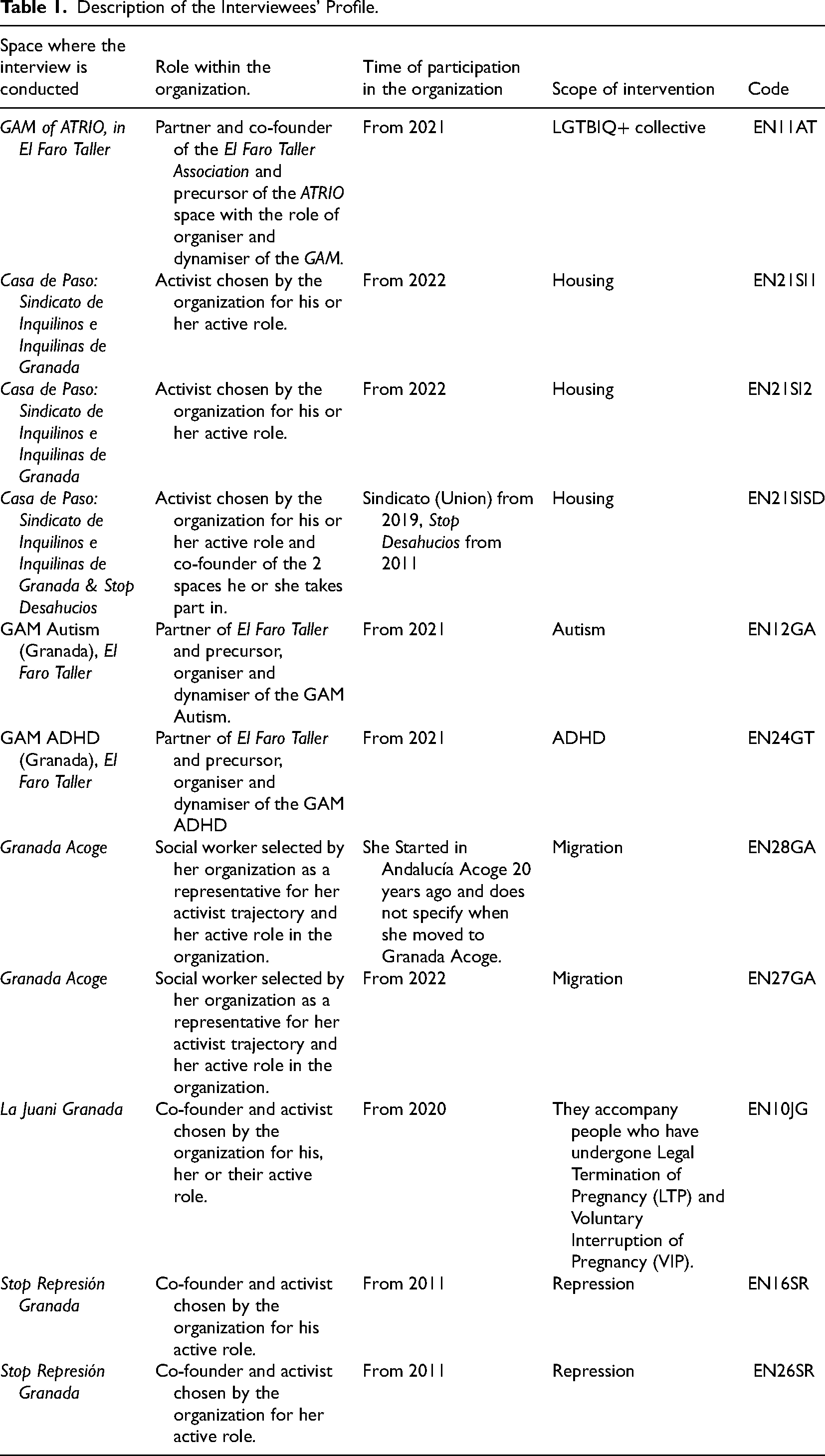
The interviews were transcribed and analyzed, with the content organized thematically into the following categories: perspectives on the concept of gender, views on violences (with particular attention paid to gender-based violences), experiences of gender-based violences identified within the collective, experiences of gender-based violences identified outside the collective and directed toward its members, perspectives on anti-punitivism, and non-punitive alternatives for conflict resolution.
Additionally, we engaged in participant observation in spaces where the researchers' presence was agreed to be meaningful and non-disruptive to the dynamics of the assemblies. This participation arose from requests by two collectives, which proposed that we contribute to their organizations in exchange for the knowledge and interviews we sought to gather, as a form of reciprocity. We attended the assemblies of Sindicato de Inquilinas and Stop Desahucios on a regular basis. However, it was ultimately decided that these observations would not be included in the analysis, as they were not directly relevant to addressing our research questions. Nevertheless, the experience proved invaluable for strengthening networks and building trust with the collectives.
Our ethical commitment allowed us to foster collaborations between the university and certain associations while actively engaging in some of the participating spaces. This ethical approach guided the implementation of several measures to ensure the research was conducted responsibly. We obtained informed consent from all participants, either in writing or orally (with recordings made during the interviews). Participants were provided with a detailed explanation of the research, including its purposes, objectives, how the information would be used, and the intended outcomes. They were informed of their right to withdraw from the research at any time. Together with the participants, we reviewed an informed consent document where they could agree or decline to take part in the research. Additionally, we negotiated with participants regarding how they wished to be represented in the outcomes (e.g., papers), among other ethical considerations. Ultimately, our prior relationship with these collectives enabled their participation in the research, as these are spaces located on the margins and, in some ways, challenge the mainstream discourse on gender violences and the responses to it, as we will analyze more in detail in the following section.
Findings: Gender-Based Violence(s) in the Plural Form and Non-Punitive Practices
In this section, we analyze, from an intersectional feminist perspective, how the collectives understand gender-based violence(s) (in plural) and non-punitive approaches to address them. These approaches are based on various initiatives launched by feminist activists and autonomous social groups, and we intend to initiate a dialogue between these different measures. Our goal is to highlight the unique characteristics of these groups while recognizing that other collectives may also be employing non-punitive approaches that we were unable to include—either because we were unaware of them or because their practices diverged from our initial assumptions. In this sense, what could be seen as a limitation is not one for us. Given the access challenges outlined in the methodology section and our deliberate choice not to generalize or be exhaustive, we view the testimonies collected as intrinsically valuable and meaningful.
Two key issues emerged during our conversations. First, these collectives conceived of gender-based violence —and gender itself—from a more pluralistic perspective than the law defines them. This pluralism could be found in their reflections on whether gender was a significant factor in the violence they experienced, or whether intersecting factors generated specific forms of violence. Second, this pluralistic perspective led collectives to consider non-punitive alternatives that avoided reliance on state mechanisms, either due to ethical concerns or because those mechanisms were ineffective. This approach was particularly relevant given the shared commitment of these groups to non-punitive and nuanced approaches to addressing gender inequalities.
The challenges of engaging with these groups were shaped by recent events, such as revelations of police infiltrations into social movements in Barcelona (Olmo Sánchez, 2023) and Madrid (Elorduy, 2023). These incidents increased distrust, making field access more complex and limiting our interactions to a few trusted individuals. For example, the Stop Desahucios and Stop Represión collectives frequently denounced state violence and described feeling under constant surveillance. Similarly, although for different reasons, groups advocating for the rights of sexual-affective dissidents (e.g. LGTBIQ+ communities) expressed hesitation in openly critiquing the current conceptualization of gender-based violence.
Gender-Based Violence(s) in the Plural Form
One of the particularities of these collectives, which was what led us to approach them in the first place, is their approach to the concept of gender and, consequently, what is or is not gender-based violence. This approach involves elements such as class, racialization, corporeality, or sexual orientation, among others.
For example, in spaces like ATRIO, gender is closely related to sexuality, as it is a space designed for LGTBIQ + individuals. Similarly, in the GAM (mutual support group) of ATRIO, where Edith (EN11AT) emphasizes the presence of trans or non-binary individuals, the identified and discussed violences have been conditioned by the particular vulnerability of these individuals.
Focusing on housing-related spaces, both Stop Desahucios 15 M Granada y Casa de Paso: Sindicato de inquilinas e inquilinos de Granada agree that gender fundamentally intersects with housing issues. Women are both the most involved in these movements and the most affected by specific forms of violence within this context. As Juanma observes, “that [housing issues] is what gives rise to the possibility of more differentiated and more blatant violence, more direct extortion, more direct blackmail, more threats” (EN21SI1). In turn, Perla adds, “we are even talking about physical violence” (EN21SI2). The participants highlight how structural factors underlying inequalities intersect—in this case, housing precarity and sexism—creating unique forms of exclusion. These situations not only lead to specific experiences but also foster distrust towards the state and its agents, which, in turn, strengthens mutual support and solidarity. For this reason, these two social movements in particular hold open advisory assemblies, where those in need can receive guidance from expert volunteers or from others who have faced similar challenges. The goal is to reinforce dynamics of mutual support and accompaniment and to build a sustaining network that addresses the structural and bureaucratic obstacles these movements encounter.
In the case of the GAM for AHD and the GAM for autism, we also find coincidences highlighted by the interviewees, bringing both spaces into dialogue. The diagnosis or, rather, the lack of it, is completely influenced by gender issues. There are diagnostic models, as Samantha tells us, “designed from a masculine perspective, and specifically for boys” (EN12GA). This bias leads to a low rate of correct diagnoses for women on the autism spectrum, as well as for adults in general. Due to these circumstances, both factors (gender and mental health issues) come together, causing specific forms of violence that lead women or other non-masculinized identities to adulthood without adequate resources and supports related to autism.
A similar situation can be found with ADHD diagnoses. Tabi recounts how, beyond medical and administrative criteria, there is clear social violence or bias they consider to impact all aspects of life: Many individuals assigned female at birth have learned to externally control their hyperactivity. (…) People not identified as men are socialized, on the one hand, to suppress certain things, and on the other hand, to have social behavior dynamics that do not quite fit with the character superficially associated with ADHD. This does not mean though that people don't have it (EN24GT).
In this way, women and girls feel and experience that they are different, but, unable to articulate what is happening to them, they perceive it as a personal anomaly—something that happens only to them, for which they find no explanation.
La Juani Granada has an undeniable relationship with gender due to its origins and primary role in providing support for Voluntary Interruption of Pregnancy (VIP) or Legal Interruption of Pregnancy (LIP). The collective also to address obstetric violence in all its forms. Considering this context, Ali tells us that the interpretation of gender sometimes limits the approach they want to give to the space: “we mainly accompany women and non-binary individuals, but also individuals with a vulva or other identities. The medical system has a clear gender focus, influencing who they believe are the individuals who either become pregnant or undergo abortion” (EN10JG). The binary construction of our societies not only marginalizes other sex-gender identities, particularly in the field of healthcare, but also conceptualizes pathologies in a gender-exclusive manner.
Lastly, Stop Represión has had to accompany cases of repression and violence against all genders. When we asked about which gender receives more or less repression, Javi mentions that “I could not tell clearly. I mean, I can’t tell whether there is a clear police bias more on one side than the other. I think the difference is clearer with other issues like racialization” (EN16SR). Ari, however, offers a different perspective, noting that while there may not be a direct difference in repression by gender, its consequences and context vary significantly. This observation underscores the importance of intersectionality in understanding the broader implications of repression and its differential impact. I think it (gender inequality) does harm us. For example, it's not trivial to be arrested by men. How they treat you, how you feel with two men with so much power at that moment… And that is your appearance, your body… most of the insults are directed there (EN26SR).
When discussing repression and gender, the representation of who the subjects of violence are is also crucial because it has a lot to do with the, according to Ari, “underrepresentation of women as political subjects, also for direct actions, for example” (EN26SR). With this in mind, it may be less important to determine who might be more or less repressed by the state and more helpful to think about what repression is visible and may take on a specific form depending on the bodies of both those who enact it and those who receive it.
When broadening our understanding of gender-based violence, the experiences shared by the different collectives allowed us to reflect on the importance of recognizing how this violence is both enacted upon and perpetrated by gendered bodies. All these experiences underscore the need to adopt an intersectional perspective that links mental health, racialization, housing precarity, or public space advocacy with gender. Such connections enable us to view gender-based violence beyond that which occurs in intimate relationships, emphasizing institutional violence and even expanding beyond a binary understanding of gender itself. Drawing on the insights from these collectives—who challenge the dominant definition of gender-based violence in Spain—we decided to explore further the non-punitive responses they are actively implementing.
Non-Punitive Responses to Gender-Based Violence(s)
Among all the non-punitive proposals that the collectives have shared with us, we would like to highlight, first of all, the effort being made in spaces like La Juani or Stop Represión to problematize concepts such as “victim” or “survivor” as the only way to relate to or to deal with violences. This effort challenges the social construction of a single type of victim deserving help, a type that fits into what the state outlines for her in a unique path (Alcázar-Campos & Valenzuela-Vela, 2022). Recognizing the diverse positions we occupy within the social structure and challenging labels that standardize, homogenize, and fix realities is, in our view, a critical first step toward advancing non-punitive responses. In times of fluid genders and gender-based discriminations that also affect other sexual dissidents and feminized bodies, not just women, this static and singular construction of the victim is problematic, as it leaves out LGBTQ + people.
A second approach adopted by these collectives relates to how they define violence and identify the elements that produce it. As Ari points out, “the punitive responses of the institutions are related not to what we do but to who we are and what we intend to change” (EN26SR).
As stated in a document drawn up by the group, the question who we are is, in this case, linked to identity processes of self-ascription to the LGTBIQ + community. This identity is linked to proposals that transcend the mere conquest of rights, aiming instead for broader social transformation. As the group outlines on its website: The fundamental goal of Stop Represión is to combat the instruments employed by the state to silence social protests, serving as a defense tool for individuals and collectives affected by repression. Additionally, we aim to publicly denounce all repressive strategies of the state, raising awareness in this area and attempting to break the isolation that the criminalization of social protest seeks to achieve.
7
It is precisely their opposition to the criminalization of social protest that has led them to question whether other criminal responses, such as those to gender-based violence, make sense. As a result, they have articulated alternative responses within their collective when this issue has arisen, emphasizing the central role of, in the words of Ari, “having our own protocols for action and conflict management to avoid reproducing normative punishment dynamics, but also avoiding a laissez-faire approach and lack of care or recognition of harm” (EN26SR). These protocols are designed to resolve situations of violence, whether gender-related or not, within the collective. An example of this occurred when an activist heterosexual couple went through a separation process in which gender-based violence was identified. Initially, it was decided to expel the person who had been reported from the movement he was part of. Later, however, the collective paused to reflect on the different approaches they could take to address the situation. Ari explained it this way: After this happened to us, (…) you start to consider what stance to take, what kind of debate to create, or how to engage with anti-punitivism—aiming not to reproduce the state, but also ensuring it doesn’t mean ‘anything goes here’ and that there aren’t things that, well, I’m not sure how to put it, but things that don’t have any sort of consequences, or at least that don’t get discussed for potential repair. It's about figuring out how to position oneself in that space (EN26SR).
This example reflects how these groups strive to implement alternative ways of addressing potential dynamics of violence or power relations without resorting to a single, rigid notion of victim and perpetrator or a one-size-fits-all solution. In this sense, most of the participating social movements are developing support and response protocols that emphasize the acceptance of all identities, but not all behaviors. In doing so, they seek to move away from simplifying violence as connected to specific identities or particular sexualities.
Regarding the creation of a single victim archetype, most of these collectives (the three mutual support groups and Granada Acoge) reject the idea of requiring “legitimacy” to participate in their spaces by adhering to state-imposed tools and norms. For instance, they embrace flexibility by not requiring official medical diagnoses for participation in support groups or by extending the duration of assistance and accompaniment beyond the time limits typically mandated by state guidelines, as they recognize that such rigid requirements fail to address the diversity of cases they encounter. In spaces tied to identity issues, such as those supporting LGBTQ + individuals, autism, or ADHD, this approach is particularly significant. Samantha highlights the importance of “not asking for anyone's condition ‘ID’ or just relying on a certain diagnosis to allow access to a space” (EN12GA). Instead, these support groups encourage participation not only from individuals with formal diagnoses but also from those who feel affected by similar issues or seek to better understand experiences they identify with.
Similarly, these collectives aim to avoid paternalistic dynamics that undermine autonomy and respect for people's self-determination. Kris points out one of the anti-punitive strategies adopted to address the methodological tensions between paternalism, assistance, and the power dynamics inherent in punitive practices. At Granada Acoge, they “aim to position ourselves in a pro-rights stance where the autonomy of the person is fundamental, where we ask what they need from us, and where the goal is to serve as a tool” (EN27GA).
From our perspective, this “serving as a tool” offers an alternative to victimization by emphasizing recognition of autonomy and self-determination. This contrasts with the passive framing of victimhood, which reduces the issue to an individual level and neglects broader axes of inequality that diverge from the constructed ideal victim (Alcázar-Campos & Valenzuela-Vela, 2022; Casado-Neira & Martínez, 2016). When the collectives work with populations whose experiences embody intersectionality—such as those undergoing processes of racialization or impoverishment—their responses for cases of gender-based violence need to “go beyond the norm”. This demands rethinking collectively about how to accompany those processes.
In this context, these groups try to avoid punitive practices by identifying certain elements they consider intrinsic to such approaches. One key aspect is respecting the diverse feelings of each individual. For example, La Juani emphasizes respecting a person's decision to have an abortion while simultaneously acknowledging the need to support them in constructing a grieving process, if that is part of their experience. This approach challenges stereotypes and barriers surrounding VIP and LIP, as presented by self-proclaimed pro-life associations. Participants at La Juani recognize the existence of a moral-ethical and medical mandate on how one should act and feel when approaching these situations, which they describe as punitive. They challenge this punitive framing by respecting each person's unique process and emotions, avoiding the construction of a single narrative about how someone should feel about having an abortion.
Similarly, Stop Desahucios understands that anti-punitive practices involve not making attendance to meetings compulsory, and ensuring this is not a factor when supporting others. As Clara explains, they promote “understanding that collaboration can take many forms and that one does not always have the energy or the time for it, and that this should not imply excluding those people from collective support” (EN21SISD).
Another aspect of non-punitive approaches involves acknowledging the potential for mistakes or discomfort when expressing certain ideas, referring to others, or inhabiting certain spaces. In other words, according to Edith: “understanding that we are all learning and that we can have different approaches and knowledge without implying that we won't try to create spaces as careful as possible or point out those attitudes” (EN11AT). This perspective challenges the dominance of expert discourse, which is often another barrier that those individuals who “go through the institutions” encounter in their search for answers to their demands 8 .
Finally, regarding restorative and transformative justice in response to demands for punishment, Stop Represión explained that it will always depend on the severity of the case discussed, and they do not feel qualified to dictate a “sentence on what can be claimed and what cannot be claimed as reparation (…) We have the right to seek justice and still complain that punitive dynamics don't work, because our claim for justice does not necessarily have to involve the idea of prison, but rather the recognition of harm” (EN26SR).
From our perspective, and despite the lack of direct communication between the collectives, this aim connects directly with proposals emerging from social work that start from critical stances on punitivism (Kim, 2018, 2020), whilst aligning with experiences like those undertaken in the United States (INCITE!, Critical Resistance, 2006). As Julia Downes (2020, p. 209) argues, “the key idea here is to prefigure a world capable of responding to violence and harm with the support, care and compassion necessary to end it, so that dominant punitive state solutions become obsolete”.
Although the participants in the research are aware of the risks of punitive responses, especially for more vulnerable individuals such as migrants, sex workers, LGBTQ + community (Feminist Justice Seminar, 2019), they understand that the approach will depend on each case. To them, transformative justice holds an important place as a community process that addresses not only the needs of the harmed person but also the structural conditions that allowed that harm to occur. There are no right or wrong patterns, and no fixed models to follow, as each process depends on the individuals and the circumstances concerned by it.
In essence, through this reflection on the non-punitive strategies used by marginalized collectives to address situations of gender-based violence(s), our aim is not to propose the definitive answer but rather to offer one possible answer—one among many that should exist—challenging both the singular path often prescribed to women seeking to escape violence (Casado-Neira & Martínez, 2016) and the conventional definition of gender-based violence itself.
Key Implications & Contributions
This article advocates for transcending the barriers of legal definitions, adopting a broader view of gender-based violence(s)— defined as violent actions, or the threat of them, that are directed at feminized bodies. We also put into question the necessity of a previous model that constructs victims of gender-based violence through a narrative co-constructed with legal frameworks. This narrative validates a certain experience, ultimately creating the archetype of the “good victim” (Alcázar-Campos & Valenzuela-Vela, 2022). These legal provisions have a punitive nature and, under the intention of protecting victims, disregard the victim's wishes and build societies of control instead of creating radical programs to challenge injustice (Favaro & Gill, 2020). Our proposal argues that these radical programs would necessarily have to question punitivism.
We engaged with various collectives addressing forms of violence not recognized as gender-based violence under Law 1/2004, yet where gender plays a central role in connection with other intersecting factors. These groups provide support to LGBTQ + individuals, people facing housing exclusion, individuals with autism or ADHD, migrants, and activists targeted by state repression, incorporating gender into their analyses. Women and other feminized bodies are more likely to suffer the various exclusions addressed by each of these collectives, entering spirals of rights violations and violence that need differentiated approaches. Echoing examples from other contexts, such as U.S.-based organizations like INCITE! and Critical Resistance, these collectives highlight the role of state violence as a facilitator of these injustices (Jacobs et al., 2021; Kim, 2020).
Consequently, they advocate for approaches that use non-punitive responses, similarly to the collectives we have interviewed. This includes respecting the processes of the people they work with (as conveyed by people interviewed from Granada Acoge and Stop Desahucios), not generating exclusions based on diagnostic labels (as articulated by people interviewed from the three mutual support groups), building caring spaces (like people interviewed from GAM TDHA, GAM Autismo, La Juani o ATRIO), and denouncing state punitive actions (as highlighted by Stop Represión). These practices signal the beginning of a shift in Spain toward exploring solutions to violence that were previously unthinkable. In essence, what we aimed to capture in this article is how critiques of current punitive solutions compel us to think in the long term. It's not merely about contemplating immediate responses to the situations of gender-based violence(s) that we encounter but also envisioning the kind of societies we want to inhabit and construct, steering towards transformation. This challenge places non-punitive feminism at the forefront because it is up to us “(to) imagine a different horizon and are not limited by a discussion of what is possible at present” (Ben-Moshe, 2020, p. 16). Quoting Maddie Brockbank & Saara Greene (2022): We can reimagine community involvement in violence prevention, such as efforts to solicit men's active engagement as one example, as redressing longstanding carceral histories that have failed survivors and other marginalized persons, while also seeking to move towards a future where community accountability and transformation are not peripheral, new, or taboo topics. Accountability can then be reframed as something that is not equated to punishment; rather, it is a shared responsibility to contribute to a better world (p. 5041).
Finally, we firmly believe that research, particularly university-based research, carries the responsibility to support these processes and assist in their visibility. In times when rights are under threat, the role of knowledge transfer between academia and professionals on the field is crucial for social work (as previously addressed by Agrela-Romero & Morales Villena, 2017; Martínez Rubio et al., 2023). In our opinion, this article is a step in the right direction towards achieving this goal.
Footnotes
Declaration of Conflicting Interests
The authors declared no potential conflicts of interest with respect to the research, authorship, and/or publication of this article.
Funding
The authors disclosed receipt of the following financial support for the research, authorship, and/or publication of this article: This work was supported by: Research project “Violencias de género en un contexto de cambios: retos y desafíos para un análisis desde la perspectiva de género (VIDEGRA)”. Funded by FEDER/Regional Government of Andalusia-Regional Department of Economic Transformation, Industry, Knowledge and Universities (Spain). Call for FEDER Programs (2021). B-SEJ-220-UGR20. And Research project “Políticas feministas: análisis de prácticas no punitivas y modelos alternativos en el contexto de las violencias de género”. Funded by the Ministry of Science, Innovation and Universities of Spain. Call for ‘Research Projects of the State Plan' (2023). PID2023-148552OB-I00.
