




Abstract
This study intervenes in a growing scholarly dialogue about neoliberalism in social work and social welfare by addressing the undertheorized concept of resistance. We conduct a scoping review of 54 articles published from 2008–2023 to answer two questions: how is resistance discussed in relation to neoliberalism, and what are the practice elements of resistance? Findings highlight resistance as a diverse phenomenon enacted in relation to context-specific manifestations of neoliberalism. A range of actors engage in resistance, including individual practitioners, social service organizations and collective action entities, among others. Resistance occurs across all scales of practice and takes many forms, from subtle, individual acts to publicly organized, confrontational acts. The findings also reveal a paradox: in resisting neoliberal norms, practitioners may inadvertently reinforce them through self-exploitative practices or resilience strategies that function more as adaptation than opposition. Overall, we find the concept of resistance to be complex and broad when discussed in relation to neoliberalism; this is further muddied by its frequent interchangeable use with terms like social justice, anti-oppressive practice, advocacy, subversion, and so forth. Additional inquiry is warranted to clarify the conceptual and practical boundaries of resistance for critical social work.
Keywords
Introduction
Social work's professional history is saturated with variation, disagreement, and evolution of beliefs about the meaning and pursuit of social justice (Lundy & Jennissen, 2022; Pease, 2013; Reisch, 2019; Thyer, 2010). A range of forces shape the contours of this history, such as repressive shifts in political climate (Andrews & Reisch, 1997; Noble & Ottmann, 2018), intellectual advances in theorizing power and oppression (Chambon, 1999; Fook, 2002; Mehrotra, 2010; Richie & Martensen, 2020), and transformations in the global economy (Abramovitz, 2021; Spolander et al., 2014), among many others. The temporal nature of societal conditions thus requires constant awareness and revision of how we conceptualize and enact our “critical and justice aspirations” (Wilson, 2023, p. 54). One part of this process is the interrogation of key orienting concepts or frameworks to assess their continued relevance. In this paper we focus on the relationship between two important concepts for critical social work: neoliberalism and resistance.
Critical social work literature of the Global North recognizes neoliberalism as the dominant form of governance since the 1970s (Abramovitz, 2012; Gray & Webb, 2013; Gray et al., 2015; Reisch, 2013; Spolander et al., 2014; Toft et al., 2023). At its core, neoliberalism is a set of ideological and political practices that apply free market economics to all spheres of modern life both public and private (Brown, 2015; Soss et al., 2011; Toft et al., 2023). Neoliberalism is characterized by an emphasis on economic efficiency, privatization, deregulation and hyper-individualism, as well as the discipline and control of those who fail to thrive in such an environment.
The distribution of life chances through a volatile and inequitable market economy is one of many ways neoliberalism affects those served by social work. Literature also illuminates how neoliberalism has transformed the function and delivery of social services (Hasenfeld & Garrow, 2012; Marthinsen et al., 2019; Soss et al., 2011; Toft et al., 2023). As responsibility for services is devolved and privatized to nonprofits, those organizations focus their advocacy less on social rights for marginalized populations and more on securing and maintaining government funding (Hasenfeld & Garrow, 2012). Others have found that in the context of austerity, workers are expected to meet greater and more complex client needs despite having fewer resources at their disposal (Brockmann & Garrett, 2022; Hyde, 2024; Hyslop, 2018). Furthermore, Zelnick and Abramovitz (2020) found that the intensified focus on productivity supplanted workers ability to spend quality time with clients, assess client needs, and build trust. The impact of these trends on worker well-being and longevity are alarming; for instance, Hyde (2024) found that workers see their jobs as financially and emotionally unsustainable due to unreasonable expectations, low pay, and stress. Neoliberalism not only redefines the landscape of service delivery but also challenges the foundational values of social work—values that emphasize social justice, equity, and the collective provision of care (Brockmann & Garrett, 2022; Morley & Macfarlane, 2014; Pollack & Rossiter, 2010).
At the same time, neoliberalism has been critiqued as a “rascal concept” (Brenner et al., 2010) with overblown explanatory power. Several critical social work scholars recently noted this concern. Toft et al. (2023) observed that neoliberalism is used ambiguously in social work literature, partly due to its operation on multiple levels of practice, from ideological currents to individual service interactions. Webb (2023) cautioned that neoliberalism is used ubiquitously “as a denunciatory category for just about anything we disagree with” (p. 15). Our own experiences teaching and conducting research in social work also support these observations.
While a robust body of social work literature has directly engaged the topic of neoliberalism, it is our observation that literature on resistance is less common and somewhat disjointed (key exceptions include: Calhoun et al., 2014; Carey & Fosher, 2011; Ferguson & Lavalette, 2006; Garrett, 2021; Smith, 2007; Strier & Bershtling, 2016). Strier and Bershtling (2016) provide the most focused analysis of resistance within social work, finding the concept “is scarce and inconsistent and reveals contrasting theoretical perspectives” (p. 112). In response, they suggest an integrated view that accounts for a diversity of strategies used across all scales of practice, from individuals opposing directives in their workplace to the professional challenging of dominant discourse on societal levels. Elsewhere, when resistance is discussed, it is often interchangeable with related terms like anti-oppressive, critical, social justice, radical and subversive, among others, rather than treated as a distinct concept. Furthermore, discussions of resistance are not always put into direct conversation with neoliberalism.
It is from within this knot of observations that we explore one way to conceptualize critical engagement with neoliberalism: as resistance. Our specific objectives are twofold: first, to ascertain how resistance to neoliberalism is conceptualized; and second, to delineate the key characteristics of resistance. To anchor this study, we draw on the framework proposed by Baaz et al. (2016) for the field of “resistance studies.” They articulate three approaches to the study of resistance: empirical (describing and understanding resistance practices), normative (determining the most effective or preferable practices and outcomes), and constructive (envisioning the future social order and the role of resistance in achieving it). Our study is situated in the empirical approach, as we seek to systematically map and understand how resistance to neoliberalism is discussed in existing social work and social welfare literature. While this scoping review does not directly engage in normative and constructive tasks of determining the most effective strategies or envisioning alternative futures, we believe that a thorough empirical accounting of resistance can lay the groundwork for future scholarship and praxis in this area.
Locating Ourselves in the Study
Our collaboration is tied together by theoretical and axiological commitments to critical social work and social justice. We both have a longstanding interest in how neoliberalism shapes the landscape of social work practice, research and education, and have examined the topic from multiple angles. For instance, we have considered the question of resistance to neoliberalism in social work education (Cherry et al., 2023), knowledge production as a site of political and ethical contestation in social work (Leotti, 2020), the profession's role in perpetuating and/or resisting the carceral state (Leotti, 2021), the paradoxes of professionalization and politicization for critical social work (Cherry, 2018a), and the neoliberalization of social welfare funding (Cherry, 2018b, 2019). In these inquiries we have grappled with the importance of understanding context as a necessary component of formulating generative questions about social justice and social change (Goodkind et al., 2021). As social work scholars and educators based in the United States, our curiosities and perspectives are inevitably shaped by our location in this particular sociopolitical environment.
Additionally, as educators we have struggled to offer social work students a coherent explanation of neoliberalism that is broad enough to capture its hegemony but narrow enough so that it's contestable through thought and action. We have witnessed our students’ difficulty in holding onto hope while engaging in critique, and have seen how the insidiousness of neoliberal logic can limit their understanding of what is possible and desirable. These experiences fuel our wish to engage and nurture the political imaginations of students by pushing them to envision a world beyond the confines of neoliberal orthodoxy. We are committed to critical feminist principles that challenge us to destabilize assumptions and embrace complexity in critical praxis (Goodkind et al., 2021). These principles inform our approach to this project, as we seek to provide a necessary critique of neoliberalism and to explore possibilities for resistance.
Methods
We performed a scoping review for the purpose of exploring how resistance to neoliberalism is addressed in social work and social welfare literature. Scoping reviews provide a reconnaissance of the literature (Levac et al., 2010) in order to map and clarify key concepts, including identification of working definitions and the conceptual boundaries of a topic (Anderson et al., 2008; Arksey & O’Malley, 2005; Peters et al., 2020). We followed a five-stage process as outlined by Arksey and O’Malley (2005): identify a research question; identify relevant studies; study selection; chart the data; collate, summarize and report the results.
Research Questions
Our research questions are: How is resistance discussed in relation to neoliberalism, and what are the practice elements of resistance?
Eligibility Criteria
Articles from peer reviewed journals published in the English language between 2008–2023 were the primary source of data for this review. 2008 was selected as a starting point due to increased global attention to modern political economy as a result of the Great Recession. Inclusion criteria were established a priori, and included English-language articles that (a) were published in peer-reviewed journals, (b) were either empirical or conceptual in nature, (c) included a primary focus on social work and/or an aspect of social welfare (d) substantively addressed neoliberalism and resistance. Articles were excluded if they were (a) not articles (e.g., books reviews, commentary, teaching notes, etc.), (b) gray literature, (c) books and book chapters, (d) theses or (e) editorials or introductions to special issues.
Search Strategy
On May 19, 2022 we searched Social Service Abstracts, Social Science Citation Index, Social Work Abstracts, and PsycINFO using the search terms “resist* AND neoliberal.*” The terms were searched as keywords and subject headings. In the case of Social Work Abstracts where a keyword search was unavailable and the search by subject headings netted zero results, we searched by abstracts. This search strategy produced 218 publications. Following removal of 31 duplicate items, 187 publications were available for assessment. Two reviewers independently assessed the titles and abstracts of these publications to ensure consistency in applying inclusion and exclusion criteria. First, we reviewed article titles to eliminate those that clearly did not fit within the inclusion criteria. Such eliminations included articles focused on issues such as urban planning, environmental issues, and other less directly related topics. Next, we reviewed abstracts to further eliminate articles that did not meet the inclusion criteria. Only articles dealing explicitly with social work and/or social welfare that included a significant focus on resistance to neoliberalism were selected. If it was unclear from the abstract review whether or not an article met the inclusion criteria, we reviewed the full text. A total of 53 publications met the inclusion criteria, and we retrieved the full text for each. During our initial read through of all the articles, two additional articles were removed from the sample because the focus was not on social work/social welfare or resistance to neoliberalism, resulting in 51 articles.
On August 10, 2023, we conducted a second search using the same strategy outlined above in order to capture literature published after May 19, 2022. This search produced 41 additional articles. Following removal of 11 duplicate items, 30 publications were available for assessment. Following the same review process outlined above resulted in 7 publications that met the inclusion criteria; we retrieved the full text for each. During our initial read through of all the articles, one additional article was removed from the sample because the focus was not on resistance to neoliberalism. In the course of data charting, we identified two more articles that met eligibility criteria but were not captured in the databases searches; these were added to the sample. Our final sample included 59 articles. Of these, 46% (n = 27) were conceptual, and 54% (n = 32) were empirical. See Figure 1 for a diagram of the search strategy.
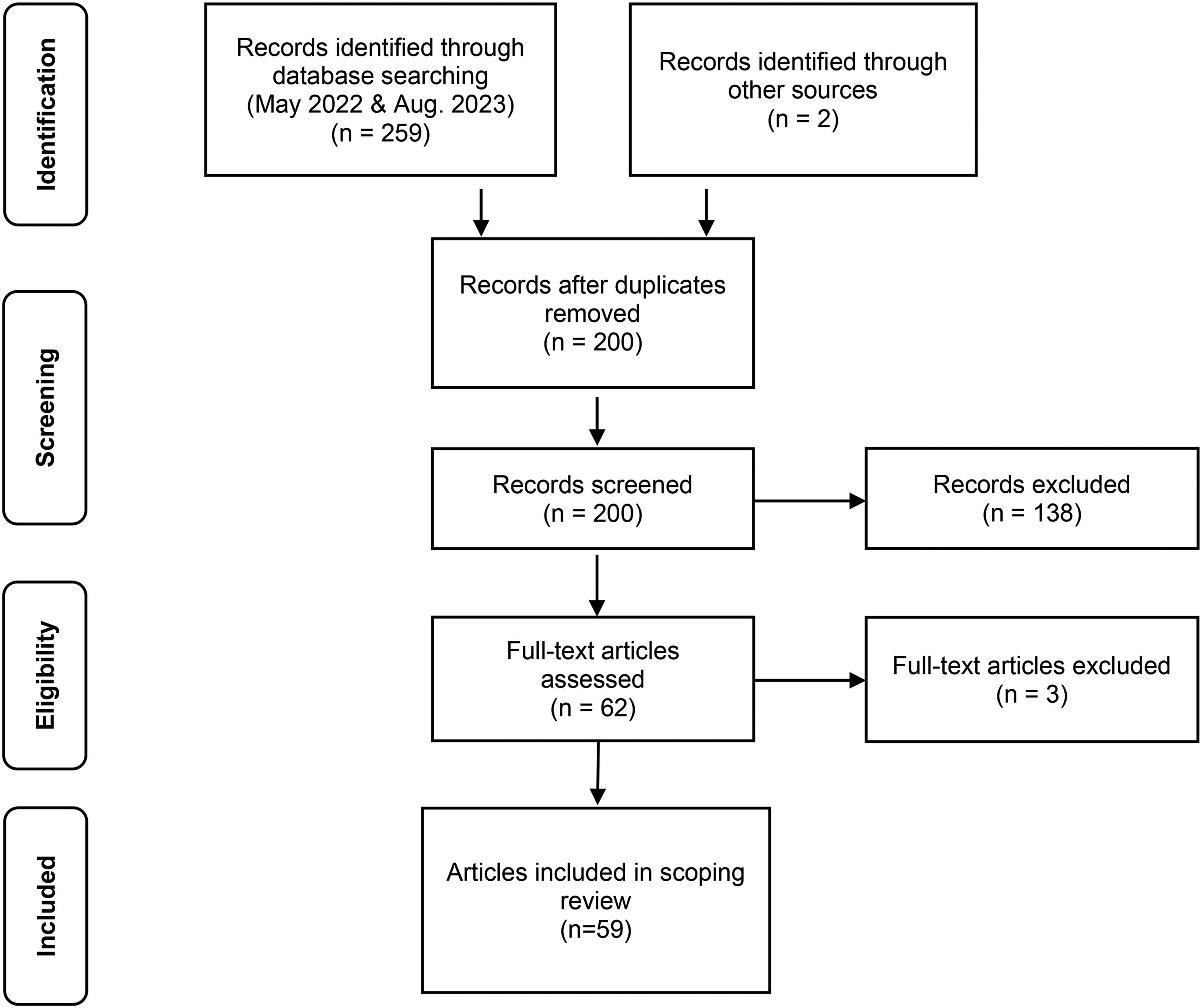
PRISMA search strategy.
Data Charting and Analysis
Using a data table developed in Google Sheets, we charted key information from each article related to the research questions. We utilized a “descriptive-analytical” (Arksey & O’Malley, 2005, p. 26) method of applying a common analytical framework for collecting standard information from all articles. The charting protocol was developed through an iterative team approach. We collectively determined which categories of information to extract in order to answer the research questions. After creating preliminary charting categories, we piloted the protocol by collaboratively charting the first five articles and adjusted the protocol accordingly. After reaching consensus on the protocol, we independently read and charted all articles, meeting after every five to discuss the process and resolve discrepancies. During this process, we recorded information related to: publication details, manuscript type, geographic region, substantive issue area, definitions of neoliberalism, definitions of resistance, targets and actors of resistance (what is being resisted and who is doing the resisting), and activities of resistance.
After charting the data, we engaged in descriptive numerical summary and thematic analysis (Levac et al., 2010). The analysis began with extended immersion in the charted data and identification of preliminary patterns and observations within each charting category. We then synthesized initial themes and supporting evidence to map the key concepts and definitions related to resistance and neoliberalism. Next, we grouped the data into broader categories based on their relevance to the research questions and emerging insights. This process was iterative and involved constant comparison and refinement of categories to ensure their relevance and consistency. Once the categories were established, we identified overarching themes that best represented the data and addressed the research questions. These themes were refined for clarity, distinctness, and thoughtful representation of the data. What follows is a presentation of the primary results followed by a discussion that delves into the implications for the field.
Limitations
There are several limitations to this study. While a scoping review provides a description of the breadth of the peer-reviewed literature, it evaluates neither the depth or quality of the scholarship, as would a systematic review or more in-depth qualitative analysis. Also, limiting our search to academic journal articles meant that other relevant pieces published in books, research reports or the grey literature were not included. Another key limitation is that the term “resistance” is often used interchangeably with other words and phrases such as dissenting, anti-oppressive, ethical practice, critical, social justice, subversive and radical, among others. While we acknowledge resistance is one of many related concepts that could be productively explored, placing parameters around the single concept was the most appropriate and feasible option for a scoping review with descriptive/empirical aims. Therefore, this review does not capture the full scope of actions taken to oppose neoliberalism as described in social work and social welfare literature. We see our study as an entry point into further research and conceptual development, and we hope future scholarship will take up the challenge of clarifying and distinguishing resistance and its neighboring terms.
Findings
Geographic Region
We began by identifying the geographical region represented in each article. Together, the United Kingdom (n = 15) and Canada (n = 13) made up 47% of the dataset. Other countries include Australia (n = 8), the United States (n = 6), Chile (n = 5), South Africa (n = 4), New Zealand (n = 4), Spain (n = 2), Israel (n = 2), India (n = 1), Sweden (n = 1), Japan (n = 1), and Portugal (n = 1). Among the remaining articles, geographic region was either not specified (n = 4) or implicitly associated with ‘Western Liberal Democracies’ (n = 3). Of note, there is overlap in the regional representations, as some articles discussed more than one. The overarching observation from this regional analysis is that there is strong representation from regions often identified as Western liberal democracies. While this distribution could highlight a bias in the literature, we believe it's more plausible that these regions act as active centers of academic discourse on neoliberalism and its resistance.
Substantive Issue Area
We categorized articles by the issue area addressed. Issue area primarily refers to fields of practice (e.g., mental health), though some issue areas spanned multiple fields of practice (e.g., management and administration) or were more conceptual in nature (e.g., the welfare state).
The three most common issue areas were generalist social work practice, the profession of social work, and the welfare state. Those categorized as Generalist Social Work Practice (n = 8) focused on practitioners’ employment-based interactions with service users but were not limited to specific practice settings or populations served. These articles addressed things like desirable skills and characteristics in workers as well as their experiences navigating difficult ethical and political circumstances. Articles categorized as the Profession of Social Work (n = 8) were less practice-oriented in their implications; instead, these analyzed the profession through historical, contemporary, and future lenses, primarily focusing on challenges posed by neoliberalism to the profession's mission and values. Articles categorized as Welfare State (n = 7) were not exclusively focused on social work; however, similar to the profession of social work category, these articles examined neoliberalism's impact on the structuring and implementation of human services from societal, policy, organizational and practice perspectives.
Social Work Education (n = 6) was a noteworthy issue area with its intended audience of educators. Similar to other issue areas, these articles identified neoliberalism as a key contextual presence in universities and schools of social work, and set out to identify organizational and pedagogical strategies for resistance. Surprisingly, few articles focused on single-issue practice areas: Poverty and Inequality (n = 5) was the most common among these, followed by Health and Healthcare (n = 4), Management and Administration (n = 4), Disability (n = 2), Food and Hunger (n = 2), Mental Health (n = 2), Housing and Homelessness (n = 2), Aging and Older Adults (n = 1), Criminal Justice (n = 1), Domestic Violence (n = 1), and Death and Dying (n = 1). The remaining articles were categorized as Ethics (n = 3) and Activism and Social Movements (n = 2).
Definitions of Neoliberalism
Our analysis revealed varied definitions of neoliberalism. A majority of the articles (66%) provided an explicit definition, directly characterizing neoliberalism in clear terms. In contrast, 34% articles ambiguously or implicitly defined the term. These articles alluded to or described the concept without overtly labeling it as a definition, frequently referencing its manifestations or consequences as indicators of neoliberalism.
We discerned several thematic categories for definitions of neoliberalism based on authors’ primary emphases. It is noteworthy that there is considerable overlap across categories, especially when discussing neoliberalism as a “political economy.” Such overlap is indicative of the slippery discourse around neoliberalism; as others have observed, it is often ill-defined and conceptualized in a variety of ways depending on context and discipline (Calhoun et al., 2014).
To begin, a prominent theme was a description of neoliberalism in terms of Market Centered Rationality (n = 31), highlighting the fluid and symbiotic relationship between markets and the state. Articles in this category highlight a paradigm shift toward market-centered governance where all aspects of the state and civil society align with and defer to the logic of the market. Neoliberalism was often described as a Governing Philosophy (n = 25) that emphasizes minimal state intervention and market primacy. This state-centric lens focuses on neoliberalism as a policy, political discourse, or governing approach with a penchant for market-oriented solutions. A significant portion of the articles portrayed neoliberalism as an Economic Ideology and Structure (n = 20) characterized by austerity, privatization and inequality. These articles shed light on the social and economic implications of contemporary free market capitalism.
In another set of articles, neoliberalism was discussed in terms of its Manifestations and Consequences (n = 15). Rather than providing a coherent definition of neoliberalism itself, these articles defined neoliberalism by virtue of its tangible impacts in the real world. A subset of these articles focused specifically on the manifestation of Managerialism (n = 11) within public services and social welfare as evidenced by an emphasis on cost reduction, efficiency and performance metrics. Personal Responsibility and Individualism (n = 14) was another theme identified as central to neoliberalism. This theme underscores the neoliberal emphasis on private individuals as opposed to social structures. Finally, in a small number of articles neoliberalism was defined with a Temporal Definition or as the “Neoliberal Era” (n = 5), which characterizes neoliberalism a discrete historical period with clear economic and political trends.
Definitions of Resistance
As part of analyzing resistance, we examined how articles defined the concept, beginning with identification of explicit versus implicit definitions. Similar to how definitions of neoliberalism were categorized, explicit definitions described resistance in clear terms; 42% of the articles met this criteria. Explicit definitions ranged from one sentence to entire sections and from vague to very specific. Some explicit definitions drew on existing literature, which is described below, though others did not. In contrast, 58% ambiguously or implicitly defined the concept, often alluding to or describing resistance without explicitly labeling it as such. Many articles only identified how to enact resistance through specific activities rather than how resistance as a concept is understood. It was also common for authors to use the word resistance interchangeably with related terms or phrases like subversion, challenge, opposition, activism, counter-hegemonic, social movements, and radical social work.
Several themes were identified across implicit and explicit definitions of resistance; it should be noted that these themes are not mutually exclusive. One noteworthy theme in definitions of resistance was a Modernist Conception of Power (n = 28). Articles in this category assume power is relatively fixed and possessed by particular individuals, groups and institutions that wield power in top-down, oppressive ways. Resistance, then, is a reaction to this power imbalance and is positioned as the binary opposite of oppression. A small number of articles take pains to disrupt this binary in the conceptualization of resistance by drawing on Post-Structuralist Understandings of Power (n = 6). These articles understand power as diffuse, fluid, productive as well as repressive, and exercised rather than possessed; resistance in this formulation is always present alongside power rather than being external and/or exceptional to it. Aronson and Smith (2011) embody this perspective by acknowledging the “scant possibility of the self standing apart from the managerialist or corporate surround” (p. 435), thus undermining characterizations of resistance “as heroic and unambiguous acts of opposition” (p. 435).
Resistance was defined in some cases as a phenomenon occurring on particular scales and of a particular nature. Some articles defined resistance as a form of Ideologically Driven Political Activism (n = 6) that takes shape through mass protests and social movements. Other articles defined resistance as inherently Individualistic, Modest, and Often Hidden (n = 6); in this formulation, resistance is pragmatic and concerned with everyday matters rather than “some fantasized future” (Power & Bergan, 2019). Notably, another category of definition focused on resistance as a Spectrum or Umbrella Phenomenon (n = 10) that encompasses minor, covert actions to major, overt actions and everything in-between. These definitions repeatedly drew on Strier and Bershtling (2016), who advocate for “a more integrated view of resistance” (p. 115) that acknowledges a range of targets, including both material and discursive elements of oppression, and a range of forms from visible to hidden, collective to individual, local to global, and practical to symbolic. Finally, some articles defined resistance as primarily about the Creation of New Alternatives (n = 8) rather than the disruption or destruction of existing conditions. These definitions prioritized counter-hegemonic values and practices like solidarity, collectivity and mutual aid as a means to solidify alternative models of social relations outside of neoliberalism.
Actors of Resistance
In our review of the literature, various actors of resistance within the realm of social work and social welfare emerged. Importantly, many articles identified multiple actors, highlighting the often-collaborative nature of resistance. The actors that emerged most frequently were Individual Workers and Practitioners (n = 46). This broad category captures a diverse array of professional roles including frontline and community social workers, healthcare workers, domestic violence advocates, union members and those in faith-based roles; it also includes specific aspects of social identity such as racialized practitioners and gendered non-profit care workers (predominantly women), domestic violence advocates, and union members. Also of great significance was the category of Affected Community/Stakeholder Populations (n = 20). These are individuals and groups who directly experience the effects of neoliberal policies, services, or societal structures. They encompass service users, the general community, and marginalized populations such as the elderly, disabled, oppressed, and racialized groups, among others. Social Work Academics (n = 20) surfaced as another actor of resistance. This group, consisting of researchers, scholars, educators, and students, was identified as playing a crucial role in shaping the discourse and future direction of the profession. They were named for their significance in producing knowledge, imparting education, and influencing practice.
The need for collective efforts in resistance was evident in the Collective Action Entities (n = 17) category. This category highlighted group formations including activists, unions, coalitions and social movements. Another distinct category comprised Organizations (n = 8). These include but are not limited to, NGOs, faith-based groups, community organizations, health clinics, and entities catering to specific cultural demographics. While fewer in number, Social Work Managers (n = 4) and “The Profession” & Professional Associations (n = 4) were also identified as having a role in resistance, be it through leadership or broader institutional structures and bodies that guide, represent, and often advocate for the social work field.
Targets of Resistance
In addition to actors and their activities, we also charted targets of resistance. In the broadest sense, targets are manifestations of neoliberalism and refer to who or what the actors direct their resistance activities toward. Targets include entities such as individuals, groups and organizations that are implicated in neoliberalism. Targets also include qualities of these entities, such as values, beliefs, policies and practices. A majority of articles identified multiple targets, and therefore the categories presented below are not mutually exclusive.
The Professional Field of Social Welfare
Most articles (72%) focused on resistance directed towards social welfare itself, primarily targeting Social Work Practice (n = 24). Such articles critiqued specific fields and forms of practice by identifying how neoliberal discourses and values have taken hold, including the individualistic nature of services, worker practices of surveillance and punishment, and workers’ own internalization of values like competition and self-sufficiency. The second most common target of resistance related to social welfare was Social Service Organizations (n = 13). Values and processes of managerialism were the primary target, including pressures for productivity, reporting and compliance requirements, and restrictive fiscal environments. Managers, training curriculum, and organizational policies were identified as targets in this category.
A smaller group of articles focused on Social Work Education (n = 6) as a target. In this category, curriculum and teaching that centers depoliticized, individualistic methods of practice were specified as targets, as well as managerialism in university administration, the devaluing of field education, and scholarship that perpetuates harmful, dominant discourses. Funders of Social Welfare Services (n = 4) were also discussed as targets, specifically highlighting how funders can pressure providers in ways that contradict their values. The Profession of Social Work (n = 3) was identified as a target, drawing particular attention to competency-based approaches to practice and licensing as well as the profession's uncritical embrace of professionalism, criminalization, and free market economics. The final target was Service Users’ Internalization of Neoliberal Values (n = 2), such as undeservingness and individualism.
Government
Over half (54%) of the articles focused on government as a target of resistance. Within these, the primary target was Policy (n = 30), ranging from specific laws to general trends. Numerous articles identified austerity-related policy as a target, as well as the historical trend of reductions in the social safety net. Similarly, government policies and practices of managerialism were repeatedly discussed as targets. Several articles focused on particular aspects of a policy issue, such as meager benefit levels, profit motives in healthcare, and paternalistic implementation of policy in indigenous communities. Values and Norms Underlying Policy (n = 15) were the second most common government-related target of resistance. These articles specifically named neoliberal ideology and discourse as targets, including efficiency as a core governing value, belief in the supremacy of free market economics, and understandings of social problems as inherently individualistic rather than structural.
Governmental targets of resistance also included specific groups of individuals and agencies. Elected Officials (n = 6), especially those with the ability to advance or oppose specific laws, were identified as targets, as were the Administrative Agencies and Personnel (n = 3) with responsibility for implementing policy and regulating practice. Specific levels of government, such as City (n = 1) and Regional (n = 1) government, were the final targets in this category.
Society, Global Institutions, and Corporations
The remaining broad categories of targets include society at large, global institutions, and the private sector. Articles discussing Society (n = 8) as a target focused on similar qualities identified in social welfare and government but weren’t as narrow in conceptualizing how these qualities manifest. Specifically, neoliberal values and discourses were repeatedly classified as targets in relation to what authors named as civil society, the social imaginary, and society at large. Global Institutions (n = 2) responsible for spreading neoliberal values and policies were also identified as targets, including the United Nations, the World Bank, the European Central Bank and the European Union. Finally, two articles identified Private Industry (n = 2) as targets for resistance, including oil and gas companies and large corporations involved in agriculture.
Activities of Resistance
In examining activities of resistance, we found evidence of strategies across micro, mezzo, and macro scales. Among articles with a singular scalar focus, Micro (n = 11) was dominant compared to Mezzo (n = 3) and Macro (n = 3). In articles focusing on two scales of practice, Micro and Mezzo (n = 14) was most common compared to Mezzo and Macro (n = 10) and Micro and Macro (n = 3). The remainder of articles (n = 14) focused on all three scales. Although the following activities are presented in discrete categories of micro, mezzo and macro, we acknowledge most articles highlighted a range of resistance strategies that operate across scales.
Micro-Level Activities
This category refers to actions taken at the individual or small-group level, often in personal or localized contexts. While varying in visibility and scope, micro activities are named throughout the data as integral to the profession's response to neoliberalism. In analyzing these activities, a spectrum of strategies unfold, illustrating how various actors center social justice values by embedding acts of opposition within the fabric of routine practice and interaction.
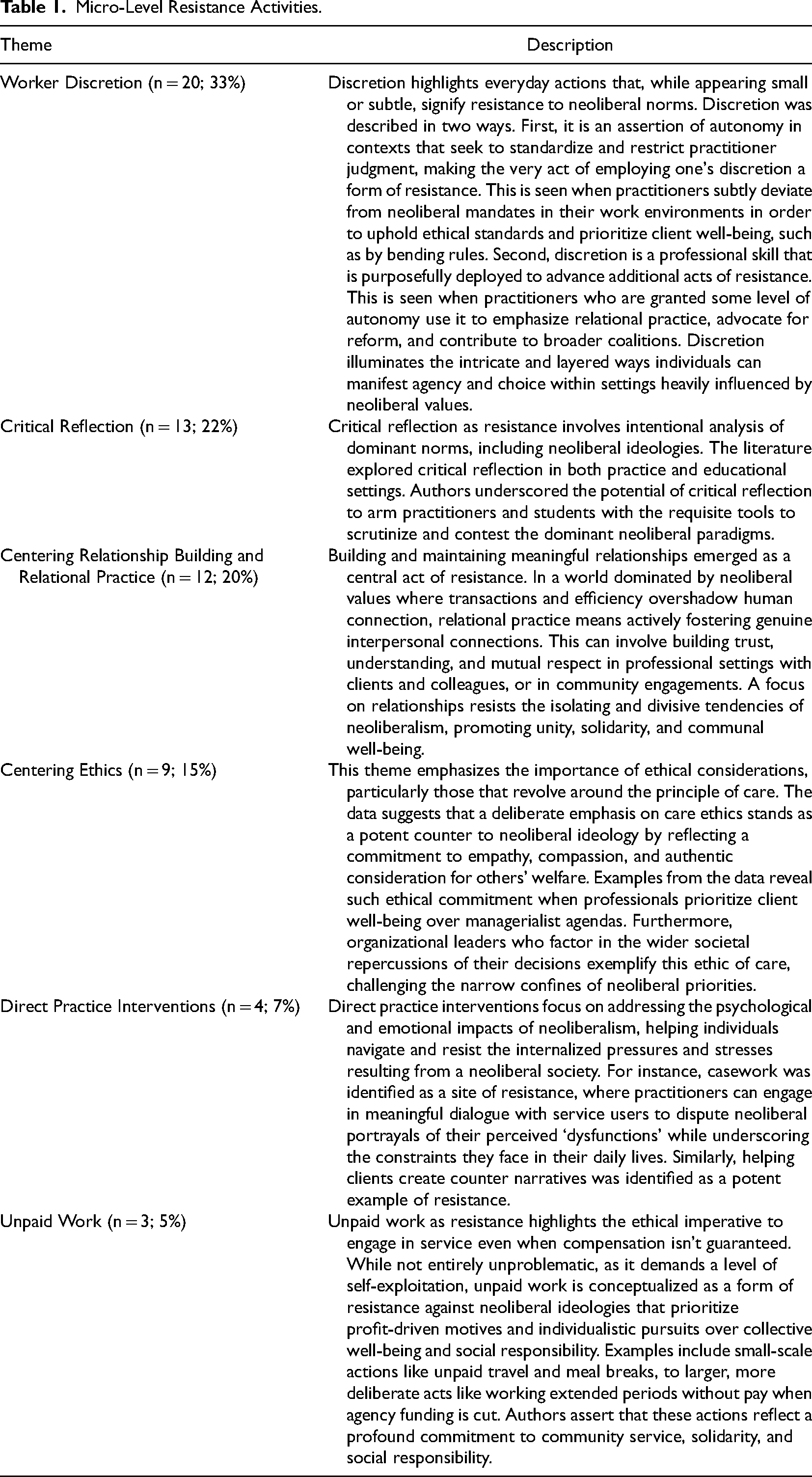
Table 1 details micro-level resistance activities, which we briefly summarize here. The most prevalent form of micro resistance was Worker Discretion (n = 20), highlighting the use of professional judgment as an act of defiance against the standardization imposed by neoliberal policies. Critical Reflection (n = 13) was also significant, with practitioners and educators employing it as a tool to question and dismantle dominant norms. Centering Ethics (n = 9) in decision-making processes stood as a counterforce to market-centric values, emphasizing the importance of care and compassion. In addition, Centering Relationship Building and Relational Practice (n = 12) emerged as a vital strategy, prioritizing meaningful human connections amidst a backdrop of transactional relationships encouraged by neoliberalism. Finally, although less frequently cited, Direct Practice Interventions (n = 4) and Unpaid Work (n = 3) were noted for their roles in addressing the individual impacts of neoliberalism and reinforcing the commitment to community service and social responsibility, respectively.
Micro-Level Resistance Activities.
Mezzo-Level Activities
Activities in this category fall between the micro (individual) and macro (larger societal) levels, often focusing on actions taken within organizations, institutions, or communities. Addressing this intermediate level captures the collective activities of groups that might be more impactful than individual actions yet more localized than broad societal movements.
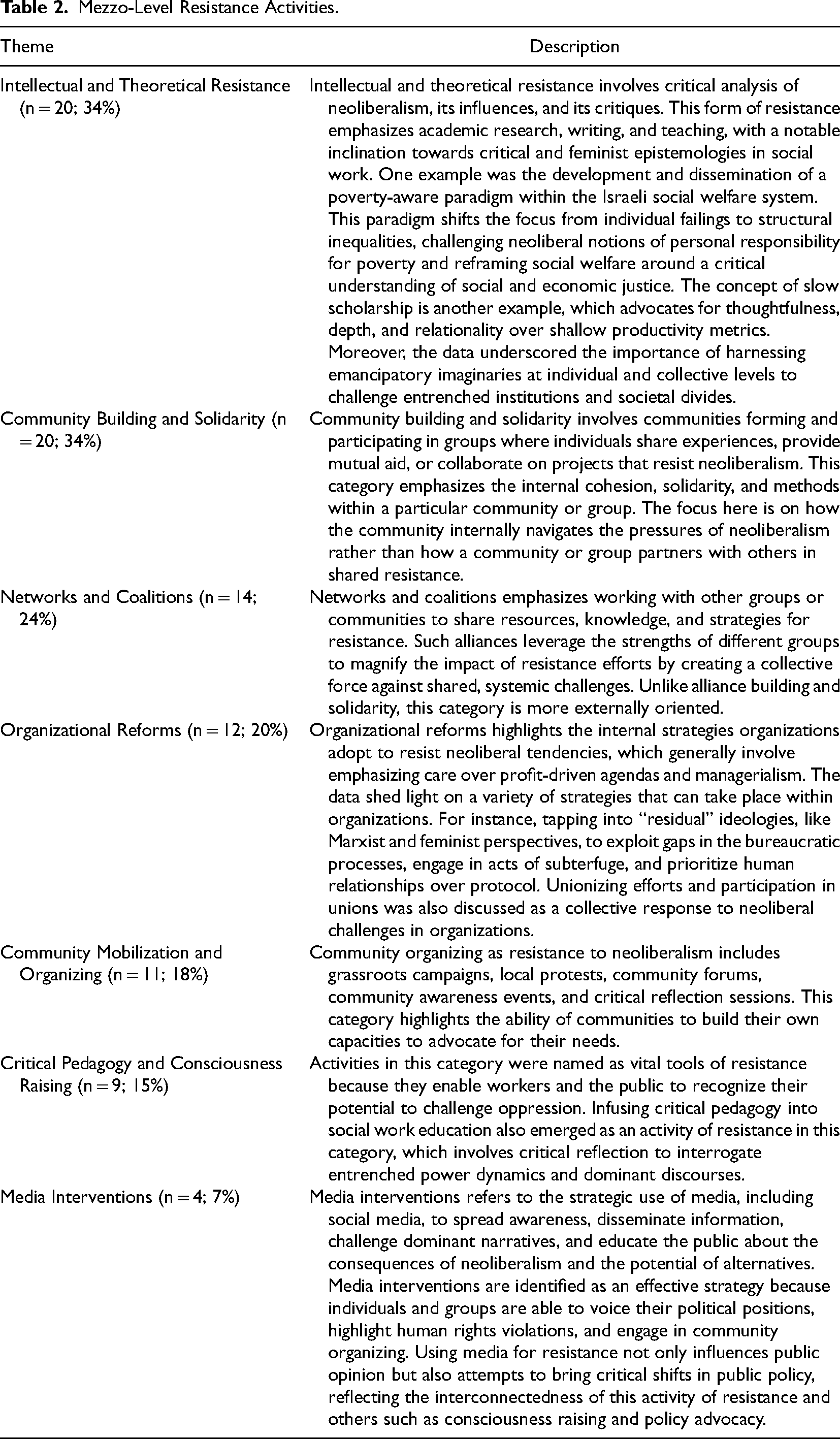
Table 2 details mezzo-level resistance activities, which we briefly summarize here. The most prevalent activity on the mezzo level was Intellectual and Theoretical Resistance (n = 20), which emphasizes academic critique and the promotion of research that examines and unsettles neoliberalism, and Community Building and Solidarity (n = 20), which focuses on internal cohesion and shared practices within a community. Networks and Coalitions (n = 14) speaks to collaboration between multiple groups or communities on shared resistance efforts, while Organizational Reforms (n = 12) highlights internal strategies organizations adopt to counter neoliberal norms. Community Mobilization & Organizing (n = 11) encompasses local advocacy and grassroots movements, while Critical Pedagogy and Consciousness Raising (n = 9) is focused on educating and empowering communities to recognize and resist oppressive structures. Finally, Media Interventions (n = 4) involves utilizing various platforms for information dissemination and public engagement to challenge and reshape dominant neoliberal narratives.
Mezzo-Level Resistance Activities.
Macro-Level Activities
Activities in this category refer to actions and interventions that occur at the broadest societal, national, or even international levels. They are characterized by their large scale and potential to bring about systemic change.
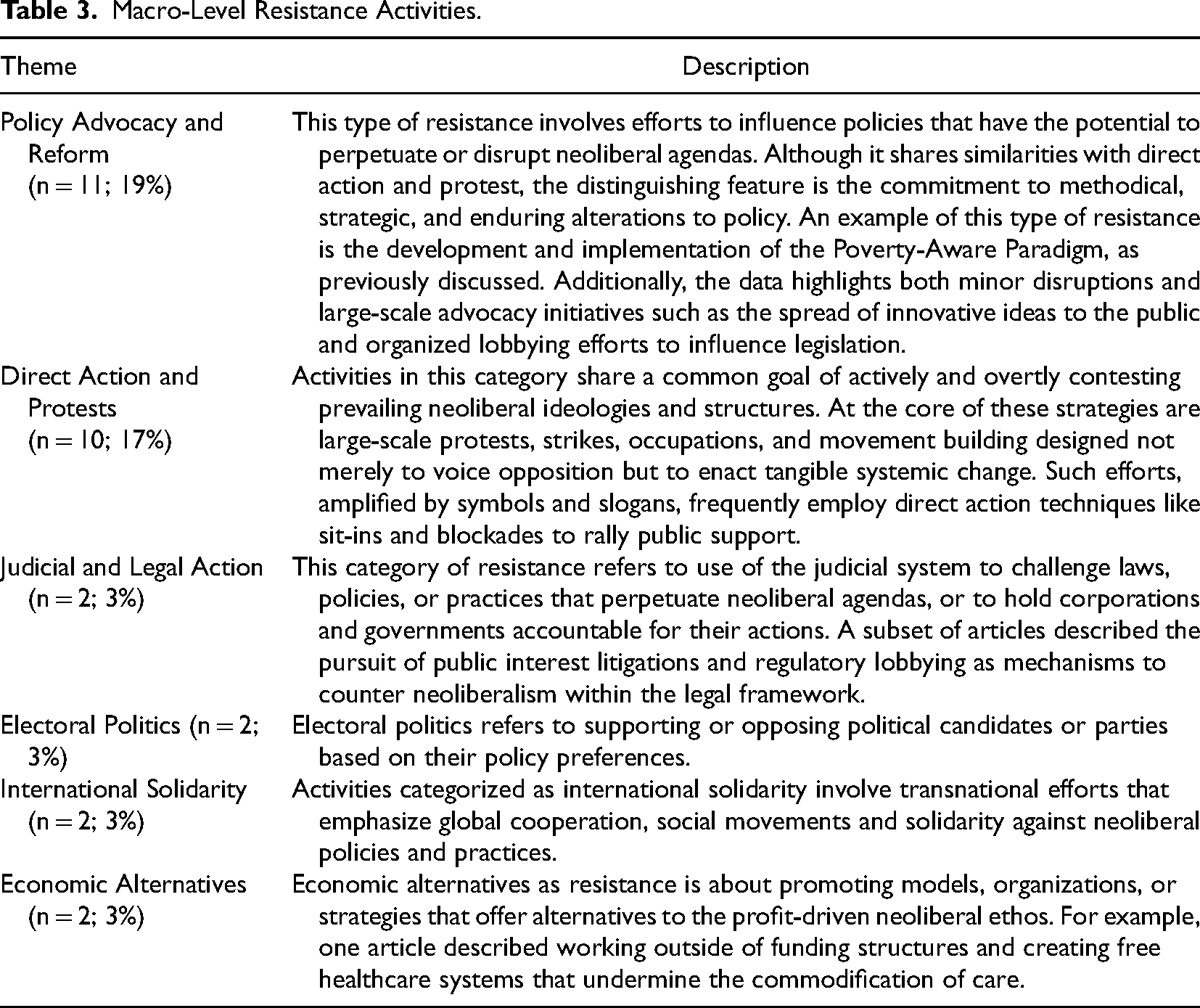
Table 3 details macro-level resistance activities, which we briefly summarize here. Macro-level resistance activities are defined by their expansive reach and the potential to instigate systemic change. The most frequently noted activity was Policy Advocacy and Reforms (n = 11), where efforts are channeled towards influencing policies that have the potential to perpetuate or disrupt neoliberal agendas. Following closely is Direct Action and Protests (n = 10), which involves large-scale public demonstrations, strikes and social movement activities. While less prominent, Electoral Politics (n = 2) and Legal and Judicial Action (n = 2) were also named as paths to resisting neoliberal policies and practices by influencing electoral contests and pursuing public interest litigation. International Solidarity (n = 2) and Economic Alternatives (n = 2) were the final macro-level activities, with the former focused on transnational endeavors that emphasize global unity against neoliberalism, and the latter emphasizing the development and support of cooperative models or strategies that center anti-capitalist values.
Macro-Level Resistance Activities.
Discussion
Across the literature under examination, neoliberalism is understood as actively destructive to, and incompatible with, social justice. From the micro to the macro level, whether through individual acts of discretion or mass political movements, a variety of actors work to disrupt neoliberalism wherever and however it manifests. Resistance to neoliberalism in social work and social welfare confronts existing conditions and dominant norms while simultaneously nurturing practices of relationality and collective care. While the purpose of resistance to neoliberalism seems clear, questions linger about the specific characteristics and practical implementation of resistive actions. Here we synthesize key themes that we believe shed light on the complex nature of resistance to neoliberalism.
Resistance is Diverse and Contextual
A central finding from this review is the critical role of context in understanding and enacting resistance to neoliberalism. The operation of neoliberalism is not monolithic (Peck & Tickell, 2002; Spolander et al., 2014); it manifests differently across settings, and thus takes on diverse forms. Understanding how neoliberalism manifests in a particular setting is fundamental to developing resistance strategies in that setting. Resistance practices are therefore multifaceted, occurring at all scales of practice, from individual client interactions to organizational and policy levels. Resistance encompasses a spectrum of activities ranging from subtle, everyday acts of discretion to mass protests. Moreover, it is directed towards an array of targets and is enacted by a myriad of actors, each offering unique perspectives on counteracting neoliberalism's reach and impact. This finding aligns with previous scholarly observations on the diverse nature of resistance (Hollander & Einwohner, 2004; Strier & Bershtling, 2016).
Consequently, resistance is inherently contextual: what is resistance in one setting may not be in another. The variability may correlate with the extent to which neoliberalism has penetrated a particular setting. For example, in contexts where neoliberal policies have made welfare benefits harder to access through rule complexity and administrative burden, the very existence of services to assist eligible individuals obtain benefits can be seen as a form of resistance (Baker & Davis, 2018). The use of discretion also illustrates the contextual nature of resistance; for example, prioritizing relationship building with service users may be resistance in highly prescribed and managerial settings, whereas in other settings it may be expected as part of routine practice. The contextuality of resistance thus requires practitioners’ keen awareness of surroundings and flexibility in choosing appropriate strategies.
Contextuality must also be considered in relation to the motivations and consequences faced by different resistance actors. What is resistance for some may be exploitation for others; for instance, actions like extending workdays without additional pay in order to meet service user needs can paradoxically become forms of self-exploitation. In efforts to resist neoliberal pressures, practitioners and clients alike may inadvertently engage in practices that demand excessive individual responsibility. This highlights how resistance is not only about challenging external structures but also involves critical introspection about the personal costs of such actions and how the internalization of neoliberalism shapes the expectations for resistance we place on ourselves.
The divergent conceptualizations of power identified in our findings have further implications for understanding the diversity and contextuality of resistance. The modernist conception, which frames power as fixed, possessed, and wielded in top-down ways, may lead to a focus on overt, oppositional acts of resistance against clearly defined targets such as government officials. This overlooks more subtle and everyday forms of resistance, thus offering a limited path for educators, scholars, and practitioners to walk. Although only represented in a small portion of our sample, poststructuralist conceptions of power reflected a different level of complexity in analyzing resistance. This approach characterizes power as diffuse, exercised rather than possessed, and productive as well as repressive; it operates through normalization and ancillary techniques of surveillance and discipline. This understanding reflects Foucault's concept of biopolitics, which Webb (2023) suggests is “the primary framework of analysis for critical social work” (p. 11).
As Foucault argues, power relations should be seen as agonistic struggles, where subjects are entangled in conflicts that seek to transform the power relations that shape them (Webb, 2023). Importantly, these struggles do not arise from a subject's ability to stand outside of power, but are instead immanent to power. Where power operates, so too does negotiation, contestation and resistance. For social work, this suggests that resistance is not simply a matter of recognizing and then opposing harmful exercises of power by others, but of navigating and transforming the power relations that constitute the field itself. Resistance, from this perspective, is an ongoing, situated process that is always entangled with power, rather than a singular, oppositional act. Understanding power from a biopolitical lens allows us to reflexively examine how social work is implicated in the very power relations it seeks to transform, and how our own practices may inadvertently reproduce domination even as we aim to resist it. This approach not only assists with engaging the tension between resistance and self-exploitation, but also foregrounds our analysis of self-focused resistance strategies and targets discussed in the following section.
Emphasis on Self-Focused Strategies and Self-Focused Targets
A second primary theme across the data is an emphasis on self-focused resistance strategies and the self as a target of resistance. The data suggests that most resistance does not take the form of exceptional acts or mass movements. Instead, it manifests in smaller, everyday decisions that challenge internalized neoliberal norms. Such micro-level work may include critical self-reflection, self-care, and developing strategies to navigate, survive, and potentially transcend neoliberal influences. This focus on the self, as both the locus and target of resistance, reveals an intimate aspect of the struggle against the pervading ideology of neoliberalism.
The emphasis on self-focused resistance strategies also reflects a broader trend within social work toward personal empowerment and resilience—understood as the ability to adapt and cope within the constraints of market-drive practices—resulting in the marginalization of macro practice in favor of individual-focused interventions (Cruikshank, 1993; Garrett, 2016; Leotti, 2020). This focus is, in part, a pragmatic response to the perceived agency (or lack thereof) that individuals possess within their immediate contexts. It also reflects the hegemony of neoliberalism in organizational and societal settings, where confrontational, public actions may pose substantial risks, including jeopardizing resources and relationships that are crucial for the functioning of social work and human service organizations (Hasenfeld & Garrow, 2012; Mosley, 2020).
In an environment where the logic of neoliberalism has been internalized to the extent that it becomes the automatic backdrop for thought and action (Brown, 2015; O’Malley, 1996), resistance may indeed necessitate an inward gaze, requiring a recognition and critique of the values and rationalities of neoliberalism that have been absorbed. This notion is further substantiated by Fenton's (2019) research which observes that social work students have deeply internalized the neoliberal narrative, suggesting that the influence of neoliberalism extends into the educational foundations of the profession itself. Such internalization presents a profound challenge: it is not just the external structures that need to be resisted, but also the neoliberal ideologies that have become embedded within the psyche of current and emerging professionals.
An inward focus is framed throughout the data as a form of critical reflection and reflexivity that empowers practitioners to reimagine their identities and responsibilities in a way that is cognizant of, and actively resists, internalized neoliberal influences. Much of the data asserts that by recognizing and challenging internalized neoliberal values, practitioners can cultivate strategies that not only foster resilience but also embody active resistance. In this sense, disrupting the ways in which we absorb the logic of neoliberalism through self-focused strategies can perhaps foster a space of hope and possibility; seeing, naming, and questioning neoliberalism (including the ways in which it operates in and through us as individuals) disrupts the perceived inevitability of neoliberalism and may therefore open new avenues for direct action.
However, it is important to consider the distinction between resistance and resilience in the context of neoliberalism. Resilience, as mentioned previously, refers to the ability to adapt and cope within the constraints of market-driven practices. In contrast, resistance represents a more proactive stance of seeking to overturn existing neoliberal norms and structures. While conceptually clear as a binary, our analysis indicates that the distinction between resilience and resistance may not adequately capture the nuanced spectrum of responses to neoliberalism's varied manifestations. For instance, our findings reveal that social workers often engage in acts of discretion (see Table 1). Practitioners use their professional judgment to subtly deviate from neoliberal mandates in their work environments, such as bending rules or undertaking unpaid care work, in order to uphold ethical standards and prioritize client well-being. These acts of discretion can be seen as a form of resilience, as they help practitioners navigate the constraints of neoliberal policies while remaining committed to their work. At the same time, these acts also contain elements of resistance, as they contest organizational norms imposed by neoliberalism and signal the importance of prioritizing human values and relationships. Perhaps this points to a dual necessity of adapting to immediate neoliberal environments while maintaining a broader vision for systemic change.
By using their professional judgment to prioritize client needs over organizational demands might social workers be adapting to the system while also actively resisting its logic? The question arises: does labeling actions simply as resilience or resistance oversimplify the dynamics at play? And, under conditions of neoliberalism, can actions be easily categorized as one or the other? In other words, is neoliberalism so insidious and adaptable (Peck & Tickell, 2002) that everyday, accessible acts of resistance might both disrupt and reproduce its ideological manifestations? The problematic of distinguishing between resistance and resilience is further complicated by scholarly critiques of the concept of resilience itself. Park et al. (2020) raise concerns about resilience becoming a “technology of the neoliberal self,” where adaptability ultimately serves the interests of a neoliberal agenda (p. 152). Similarly, Garrett (2016) identifies resilience as a concept that is inherently compatible with neoliberal rationality and warns against the potential co-option of resilience as a term that dilutes opposition to neoliberalism, suggesting that resilience, without critical examination, might ultimately lead to acquiescence rather than resistance.
At a minimum, a binary of resilience and resistance discounts consideration of actions that embody aspects of both. Our findings demonstrate how acts of resilience can harbor elements of resistance, subtly challenging the status quo even within the act of adaptation. As we unpack these distinctions, we confront vital questions. In the shadow of neoliberalism's pervasive influence, how do professionals navigate the tension between adapting to and actively opposing neoliberalism? How do we distinguish resistance to neoliberalism from accommodation to it? How will the distinctions between resistance and resilience evolve as neoliberalism evolves?
Conclusion and Future Directions for Research
This study intervenes in a growing scholarly dialogue about neoliberalism in social work and social welfare. There is robust recognition that neoliberalism is counter to the pursuit of social justice and well-being for those the profession of social work purports to serve. Existing literature explores the forms and impacts of neoliberalism in a variety of settings including policy, practice, organizations, higher education and scholarship. Existing literature also illuminates how different actors seek to challenge neoliberalism in these settings. The present study systematically maps one way this pushback is conceptualized: as resistance.
We find significant complexity in how resistance to neoliberalism is understood and enacted. This complexity is an outgrowth of the pervasive yet elusive, constantly evolving nature of neoliberalism. As neoliberalism evolves and manifests in new, unpredictable ways, so too must resistance. The dynamism of the resistance-neoliberalism nexus creates unique challenges for the practice, teaching, and study of resistance in social work and social welfare.
This study raises questions about the utility of “resistance to neoliberalism” as a conceptual and practical framework. Our findings largely reflect scholarly conceptualization of various activities as resistance to neoliberalism. It's unclear to what extent actors conceive of their own actions as resistance as opposed to activism, ethical practice, critical social work, advocacy, social justice, etc. It is also unclear to what extent actors conceive of the targets of their actions as neoliberalism as opposed to injustice, oppression, inequality, and the like. This ambiguity is compounded by a diverse body of scholarship that critically engages the topic of neoliberalism and what to do about it under many banners, including radical social work, critical social work, anti-oppressive practice, dissenting social work, a new left politics of social work, and structural social work, to name a few. We wonder in what ways there is utility—practical, conceptual, political—in a broad-based understanding of resistance to neoliberalism, and how such utility accounts for the diverse and contextual nature of resistance. The conceptual slippage among resistance and related terms is pervasive in the social work literature, and we believe addressing this in future research could be a useful contribution to disciplinary discourse and rhetorical habits. We also wonder about the importance students and practitioners place on conceptualizing their actions as resistance and/or the targets of their actions as neoliberalism. As discussed previously, the distinction between resistance and resilience may not always be clear cut, and social workers might have different understandings of what constitutes resistance in the context of their work. Future research could explore how actors themselves understand resistance, label their activities, and navigate the tensions between adaptation and opposition in their practice.
Future research could also explore the theoretical orientations of resistance literature to better understand the conceptual foundations that shape understandings and practices of resistance. Additionally, a critical discourse analysis could provide insights into how neoliberal discourses shape the ways resistance is understood, practiced, and constrained within social work. Discourse analysis would be particularly helpful for examining how different conceptualizations of power inform the strategies and outcomes of resistance efforts within social work. The theoretical tools offered by post structural discourse analysis could also help to deconstruct how acts of resistance might be complicated by their entanglement with dominant power structures and the potential for unintended consequences, such as the self-exploitation of workers.
Footnotes
Declaration of Conflicting Interests
The authors declared no potential conflicts of interest with respect to the research, authorship, and/or publication of this article.
Funding
The authors received no financial support for the research, authorship, and/or publication of this article.
