




Abstract
Jessica Blanche Peixotto was the first woman to become a full professor at the University of California in 1918 and yet her role in establishing social welfare studies at Berkeley is mostly untold. A social economist and foremost a scientist, she led efforts to infuse evidence-informed practice in professional social work education in the early 1900s, laying a foundation at Berkeley that is still felt today. Of her many efforts, she established a certificate in social welfare at Berkeley in 1917, the first such training on the West Coast. This article describes her personal and professional life and seeks to establish the importance of her role in establishing social work education at Berkeley and in furthering an evidence-informed approach to our professional work.
Social work education began at the University of California in 1904 when President Benjamin Ide Wheeler appointed Dr. Jessica Blanche Peixotto as a lecturer in sociology. Despite being an alumnus of the School of Social Welfare at Berkeley and spending my entire career in social work higher education, I was not aware of the historical importance of Jessica Blanche Peixotto (See Figure 1) to our profession until 2012 when I was appointed dean of Berkeley Social Welfare. I was trained at Berkeley to develop evidence to inform practice and so my interest was piqued about this predecessor of mine and how she shaped our field.
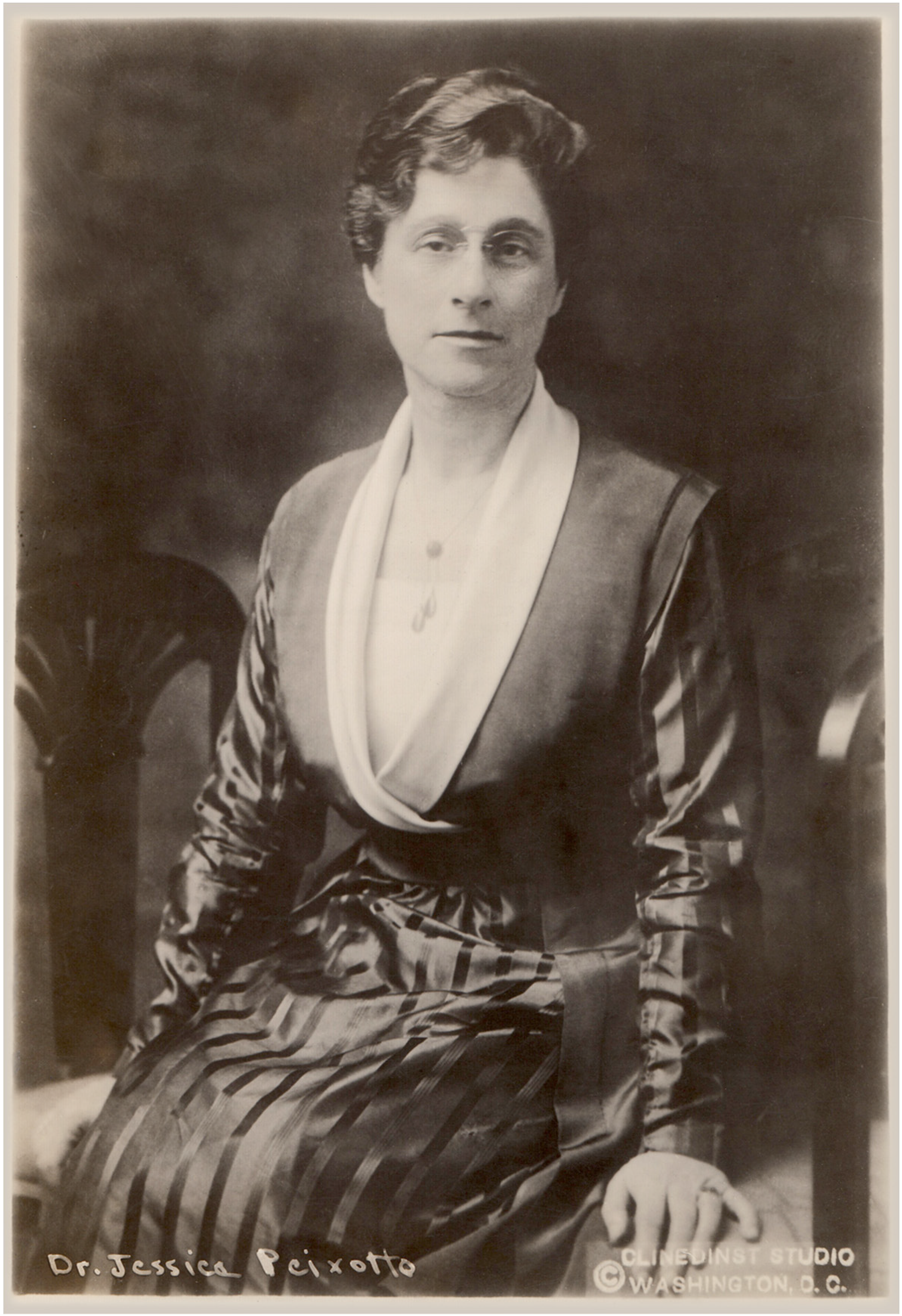
Jessica Blanche Peixotto in 1918. University Archives, University of California, Berkeley.
This article draws on a wide variety of sources published by Peixotto and others about her life, family, and academic career. It seeks to establish the previously untold importance of her role in leading the formation of social work education at Berkeley, her mentoring of women students and faculty, her efforts at social reform in California and nationally, and perhaps most importantly, in developing an evidence-informed approach to our professional work that lives on today.
Family History of Migration
This story starts long before Peixotto was born on October 9, 1864, in New York City. The Peixotto family migrations can be traced back to the late 1400s when Christopher Columbus was setting off for the New World and the Spanish Inquisition against non-Christians was in full swing on the Iberian Peninsula. Peixotto's Jewish ancestors fled Portugal for Amsterdam where they resided until the early 1800s (Dzuback, 1995; Peixotto, 2010; Voorsanger, 1905). Her ancestors’ decision to escape the Inquisition in the late 1400s set in motion cascading migrations to The Netherlands, the Caribbean island of Curaçao, and then to New York. These migrations continued almost four hundred years later when, in 1870, a six- year-old American-born descendent, Jessica Blanche Peixotto, traveled with her mother, Myrtilla, and two younger brothers, Sidney and Edgar, by ship from New York to Panama, by train over the Isthmus of Panama, and then by steamer up the West Coast to San Francisco. The family was reunited with her father, Raphael Levy Maduro Peixotto, who had traveled earlier to the San Francisco Bay Area where Peixotto would spend most of the rest of her life. Two younger brothers, Ernest and Eustace, were later born in San Francisco (Peixotto, 2010).
Her large Portuguese Jewish family was related to many well-known figures. Cousins included: Annie Nathan Meyer, a founder of Barnard College; Emma Lazarus whose poem appears at the base of the Statue of Liberty; and Associate Supreme Court Justice Benjamin Nathan Cardozo. Her father, Raphael, was an early employee of Levi Strauss and eventually became an executive in his in-laws’ successful retail business, The Emporium department store, which later merged into Macy's. He also served in the late 1890s as the President of Temple Emanu-El, the oldest synagogue west of the Mississippi that still thrives today in San Francisco. Raphael's eulogy in 1905, delivered by Rabbi Jacob Voorsanger, noted that despite having only an elementary education, Raphael strived to educate himself by inviting college professors and other intellectuals into their home and likely influenced his daughter's own yearning for education (Voorsanger, 1905).
Hard-Fought Berkeley Education
Upon graduation from San Francisco's Girls’ High School in 1880, Jessica Peixotto sought to extend her education by enrolling at Berkeley. Unfortunately, her father did not think it was appropriate for women to attend college but did encourage his daughter's continued studying with private tutors (Dzuback, 1995; Hatfield, 1935). Finally, in 1891, her father was convinced to allow Peixotto to enroll in classes at Berkeley but not pursue a degree. Perhaps, her father's mind was changed by the fact that women's enrollment at Berkeley was expanding rapidly. In 1890, there were only 105 female students enrolled, but by 1900 there were 10 times that number, representing almost half of the student body and giving Berkeley the highest female enrollment in the country (Nerad, 1999). ii
Peixotto excelled at Berkeley. In a seminar taught by the renowned historian and political scientist, Bernard Moses, she was one of only two students, the other being David P. Barrows, who later became a president of the university. She also befriended her brother's close friend, Frank Norris, who was later a well-known California writer. Norris thought Peixotto was wasting her time by not working toward a degree and helped convince her father to allow her to formally enroll in a degree program. She completed all the requirements in only three years and was awarded a Bachelor's degree in 1894 at the age of 30. This was only a start, however, for Peixotto then enrolled in graduate studies in 1895 under the mentorship of her teacher, Professor Moses, who encouraged her to study social political economies (Dzuback, 1995; Hatfield, 1935). Her dissertation focused on French socialism, and she was encouraged to develop her dissertation in France where her brother, Ernest, was already studying art.
Peixotto headed to Paris in the Spring of 1896 to spend a year at the Sorbonne. A single woman in her 30s, Peixotto traveled and roomed with another American student in France. Her companion was a 24-year-old childhood friend and architecture student named Julia Morgan who traveled with her by train to New York, across the Atlantic to France, and then shared lodging with her in Paris.
Julia Morgan was a pioneering woman in her own right. Morgan was encouraged by the well-known architect, Bernard Maybeck, to enroll in the l’Ecole des Beaux-Arts in Paris where she became the first woman admitted to the school's architecture program. When Morgan returned to California from France, she became the first woman to be a licensed architect in the state and designed over 700 buildings, including the famed Hearst Castle in San Simeon, California (Kastner, 2009).
Peixotto's dissertation, titled The French Revolution and Modern French Socialism: A comparative study of the principles of the French Revolution and the doctrines of modern French socialism, was completed in 1900 and published as a book in 1901 (Peixotto, 1900, 1901). At the age of 36, she became only the second woman, after the psychologist Milicent Shinn, to receive a doctorate at the University of California.
Phoebe Apperson Hearst and the Hiring of Peixotto at Berkeley
Peixotto never intended to become an academic. After graduation, she worked in a settlement house in San Francisco (Peixotto, 1919). But the university was under growing pressure to give attention to women students and faculty. Phoebe Apperson Hearst, the widow of a mining magnate, suffragist, and mother of William Randolf Hearst, was appointed in 1897 as the first woman regent of the University of California and served on the Board of Regents until her death in 1919.
Hearst was perhaps an early example of affidamento, the 1980s Italian feminist concept of entrustment. As Shpall (2021) stated “affidamento is more intimate than most apprenticeships or mentor relationships, and less egalitarian than most friendships” (p. 686). It is a controversial Italian feminist belief—developed by the Libreria delle donne di Milano (Milan Women’s Bookstore Collective, 1990)—that younger, less experienced women need to entrust themselves to more experienced women in a mentoring-type relationship (Shpall, 2021).
Hearst practiced affidamento in her own way as a strong advocate for women students and faculty at Berkeley and funded the campus master plan as well as many early scholarships for women, campus buildings, and new academic programs. Nerad (1999) points out that in 1891 when Peixotto became an undergraduate, “women had no social or extracurricular life, no athletic programs, no facilities for social and cultural events, and no rooms for club meetings” (p. 19) in comparison to a full array of opportunities for male students. Hearst championed the cause of women on campus and would likely have seen hiring of women faculty as important to the institution and part of an “entering wedge” strategy “to make university women visible and bring them gradually into the mainstream of campus and American life” (Nickliss, 2018).
Peixotto's opportunity for a teaching position at Berkeley came during Hearst's era when she was approached by the University's president, Benjamin Ide Wheeler. Wheeler, who became president in 1899, was evidently alarmed at the growing number of women on campus and feared they would displace men in the sciences. He is quoted as having said that women's education “should tend to make you more serviceable as wives and mothers” (Nerad, 1999, pp. 28–29).
Despite his views on women in academia, Wheeler approached Peixotto in 1903 to ask her what she intended to do with her recently earned doctorate. Her response is reported to have been one of surprise as “she had no intention of doing anything” with it (Hatfield, 1935). Even so, Wheeler hired her in January 1904 as a lecturer in sociology to teach a course in Contemporary Socialism, the topic of her dissertation. Dzuback (2006) argues that Regent Hearst played a key role in Peixotto's hiring. She writes, “Hearst knew Peixotto from their civic work in San Francisco, and that she had a close friendship and advising relationship with Wheeler, likely contributed to his willingness to consider Peixotto” (p. 157) for a position.
Peixotto and Lucy Sprague, who was appointed the first dean of women and promoted to the faculty in 1906, were the first two women hired as full-time faculty members at the University of California, Berkeley being the only campus at the time. The first part-time female faculty member was Dr. Mary B. Ritter, hired in August 1899 to serve as the university's medical examiner for women and a part-time lecturer in hygiene, a position fully paid for by Hearst (Nickliss, 2018).
Peixotto was later appointed as an assistant professor of sociology in 1907, but she did not like being labeled a sociologist. In her oral history, Helen Valeska Bary, one of the first employees of the Social Security Administration, stated that “Dr. Peixotto was very much opposed to the current thinking in sociology, which was much more sentimental and religious” (1974, p. 172). In their history of sociology at Berkeley, Burawoy and VanAntwerpen (2001) confirm Peixotto's antipathy toward sociology, writing she was “an uncompromising foe of sociology, regarding it, in the words of Robert Nisbet, as a ‘mixture of social uplift and metaphysical nonsense’” (pp. 6–7). Perhaps this reflected the fact that at the turn of the century, “many of the major figures in sociology, especially at Chicago had been theologians” (M. Burawoy, personal communication, May 28, 2020). It also reflected wider opposition to sociology at Berkeley in the first half of the last century (see VanAntwerpen, 2005).
At Peixotto's urging, her appointment was changed by 1909 to an assistant professor of social economics. She was later promoted to associate professor of social economy in 1912 and finally to professor of social economy in 1918 (Dzuback, 1995; Hatfield, 1935). With this final promotion, Peixotto became the first woman at the University of California to achieve full professor status.
Women's Struggle for Acceptance in Academia
When Peixoto arrived back on campus in 1904, there was clearly a continuing bias against women as students, and even more so as faculty members. She and Sprague were the only two women faculty members on campus in those early years. Their appointments were not without resistance. As Sprague (Sprague Mitchell, 1953) wrote in her autobiography, “The older men were solidly opposed to having any women on the faculty” (p. 193). The chair of the Economics Department in 1904, Adolph Miller, was clearly one of these men. Sprague Mitchell (1953) quoted Miller as saying “the finest flower of any culture was a ‘lady’—and a lady never worked except in her own household” (p. 143). But Peixotto, as Dzuback (2006) suggests, had demonstrated her intellectual abilities as a doctoral student, came from a prominent family and, perhaps most importantly, at age 40 was unmarried. Sprague Mitchell (1953), writing about her own poor treatment by male faculty, stated, “Jessica Peixotto was their equal in training and in intelligence, and they acted the same way toward her appointment because she was a woman” (p. 193).
President Wheeler may only have hired Peixotto to expand opportunities for educating women to satisfy domestic roles, but Peixotto and her female colleagues had other ideas and sought to train women for careers in the sciences (Dzuback, 2006). Peixotto continued to argue for women's right to a college education throughout her career, clearly arguing so in The Case for Coeducation (1923a).
In the early years there is evidence that Peixotto and Sprague avoided attending faculty meetings in the economics department. As Dzuback (1995) writes, “they did not attend faculty meetings, not because they were barred from them, but because they feared they would alienate their male colleagues with their ‘conspicuous’ presence” (p. 4). Sprague commented “Certainly we could have come, but I know that it would have prejudiced the men against us, and we already had enough prejudices to live down” (Nerad, 1999, p. 40).
Peixotto leveraged her growing influence to further the education of women on campus. For example, President Wheeler appointed Peixotto in 1909 to head the Domestic Science Committee studying the establishment of a home economics department at Berkeley. While Wheeler may have seen this as another opportunity to divert women from the sciences into a “women's department,” Peixotto and her female colleagues saw it as a path to establishing more opportunities for women to engage in rigorous social science training that would have direct impacts in communities (Nerad, 1999).
Women's exclusion from Berkeley's Faculty Club was another continuing marker of their second-class treatment. In the early 1900s, women were only allowed into certain areas of the Faculty Club, often only at the invitation of the male faculty. In the Fall of 1919, an invitation was issued to all women faculty to meet to discuss establishing a separate space for themselves on campus. Again, Peixotto was at the center of this effort and held this first organizing meeting in her small apartment in Cloyne Court, now a student dormitory. The meeting set in motion larger meetings of women faculty and staff, culminating in the funding and building of the Women's Faculty Club in 1923 (Women's Faculty Club, n.d.). The Club later became the center of women faculty's social lives (Dzuback, 1995) and a century later, the Berkeley Women's Faculty Club “is the only faculty club in the nation, founded originally for women, that still has its own building” (Women's Faculty Club, n.d.).
Peixotto's Advocacy for Herself and Other Women
Throughout her career, like Hearst, Peixotto exemplified affidamento in her relationships with women students and faculty. A former student of hers, Emily Huntington spoke extensively about Peixotto's ability to inspire students. She stated that “Professor Peixotto had a real interest in her students. If a student at an informal conference expressed an interest in some special aspect of the course, she frequently gave us assistance in developing a small project. I was one of those students, and in working closely with her I came to know her well” (Huntington, 1971, p. 8). Huntington, who would later be hired by Peixotto as a colleague in social economics, recalled that “Peixotto brought to her teaching an enthusiasm for her subject, a very wide knowledge of the literature in her fields. (We sometimes smiled a little when she would name three or four books she had read very recently. We were suspicious that she couldn’t have read each book through, but her comments usually stopped our smiles.)” (p. 8). For Huntington, it was a very important connection: “My longest and closest association was with Jessica Peixotto. She was the person most responsible for stimulating my interest in economics during my undergraduate years. She encouraged me and gave me confidence not only in finding interesting jobs after graduation but later in returning to Radcliffe to complete the work for a Ph.D. degree” (p. 7).
When asked if Peixotto was charismatic, Ella Barrows Hagar, the daughter of a university president and wife of a regent, answered “very, very…She was slight and small, beautifully garbed, very precise and brilliant, and very human. Yet, it was never a chummy relationship at all. It was one of great respect and affection” (Hagar, 1974, p. 67). When asked if she was a role model like Jane Addams, Hagar responded “Well, no and yes. Certainly not like Jane Addams who must have been a very earthy person, dealing directly with the slums and areas of poverty and administering actually to people. Dr. Peixotto, always elegant and crisp and theoretical and academic, was another kind of model.” Hagar continued, “We all respected Dr. Peixotto and had great affection for her” (p. 67).
Peixotto not only supported women students and faculty hiring but was unafraid to voice her displeasure with her own treatment as a faculty member. Several authors have pointed to her ongoing correspondence with President Wheeler. In one exchange in 1914, she stated “I hope I may be of such service to (the university), that someday it will be ready to confer upon me a less elementary title than that of ‘Assistant Professor,’ a title I have held for six years” (Dzuback, 1995, p. 5). She was promoted to Associate Professor the next year. Several years later, she wrote again to Wheeler after several male colleagues hired after her had passed her in rank. She wrote that it had been “mortifying enough these past weeks to feel that when it is a question of promotions in our department, I am invariably the latest to get any evidence of merit. Late comers get first place” (Dzuback, 1995, p. 5). She was promoted to full professor the next year.
Focus on Economics and Structural Sources of Poverty
Economics during Berkeley's early history was mostly the domain of a single faculty member, Bernard Moses, who was Peixotto's mentor. The content was taught as “political economy” until a separate Department of Economics was formed in 1903. So when President Wheeler hired Peixotto in January of 1904, she entered a brand-new academic unit. As her role at the University became more permanent, she and the first Dean of Women, Lucy Sprague, worked hard to bring more women faculty onboard to expand relevant teaching and research. In social economics, Peixotto hired Lucy Ward Stebbins in 1911, Barbara Armstrong in 1919, and later, Emily Noble, Martha Chickering, and Emily Huntington. These women faculty made economics at Berkeley unique for having so many women faculty members and influenced the department to focus on more progressive social reform efforts in teaching and scholarship (Dzuback, 2006).
Peixotto's home department was economics throughout her career, and she clearly aligned with the view that rigorous data on the economics of home life could inform improved social policy and charitable practices. As stated earlier, she objected to the label of sociologist and instead developed, along with other women colleagues, an area of study she termed “social economics” but that male colleagues derogatorily labeled the “feminine branch” of economics (Dzuback, 2006, p. 157). Social economics—the study of poverty, labor, and social reform programs—grew into one of the four areas of study in the economics department and was led by Peixotto. To this day, Peixotto's early leadership role in the study of economics at Berkeley is widely recognized. The department's student lounge is the Peixotto Room.
Over the years, Peixotto taught a number of courses—including many relevant to future social workers—such as the Control of Poverty, the Child and the State, the History of Social Reform Movements, the Household as an Economic Agent, Contemporary Theories of Social Reform, Crime as a Social Problem, and, at the end of her career, the History of Economic Thought (Berkeley Baptist Divinity School, 1915, 1919; Hatfield, 1935).
Peixotto's course syllabi often included both a course outline and an annotated outline of each of her lectures. For example, her syllabus for Econ 180: The Control of Poverty course syllabus was published by the University of California Press in 1923 and is over 100 pages in length (Peixotto, 1923b). The syllabus shows that in this course, she went into detail defining poverty, its prevalence, its socioeconomic sources, a variety of theoretical conceptualizations of poverty, and actions to end it. She also discussed how social services could intervene to reduce poverty's effects.
This course reflects her career-long interests in poverty, its structural sources, and the sources and expenditure of family incomes. Her focus on structural sources of poverty appears throughout her courses, as it does, for example, in her syllabus for Econ 42: Contemporary Theories of Social Reform (Peixotto, 1906). Her former student and colleague, Emily Huntington, remarked “Although Jessica Peixotto had been brought up in a family where I understand there were no economic strains, she had real concern for the problems of the lower income groups. For some reason which I could never fathom, her interest seemed to be in the history of the treatment of the poor and the reasons for the existence of poverty in the early decades of the twentieth century” (Huntington, 1971, p. 8).
Both students and colleagues commented on Peixotto's scholarly approach to her work. Her publications were significant and influenced public policies and programs of her era. Her dissertation was published as a book in 1901 (Peixotto, 1901). She next participated in a major study of the impact on families of the 1906 earthquake (O’Connor et al., 1913). Peixotto later surveyed almost 100 faculty to establish family incomes and estimate a living wage, publishing the results in Getting and Spending at the Professional Standard of Living: A study of the costs of living on academic life (Peixotto, 1927) and Family Budgets of University Faculty Members (Peixotto, 1928). She continued this line of research with a community survey of 82 typographers and their families resulting in the Cost of Living Studies, II: How workers spend a living wage (Peixotto, 1929). The foci of Peixotto's scholarship still resonate in our society today as scholars continue to estimate a living wage and laborers and professionals fight for it.
Peixotto also worked to support her own research and that of her female colleagues by securing funding to establish the Heller Committee on Social Economic Research in 1923, an important source of research funding for the University of California. She secured financial support for the Heller Committee from her close friend, Clara Hellman Heller. Heller was a member of a banking family that owned Wells Fargo Bank among other financial institutions. Peixotto served as founding chair of the Committee and held that post until her retirement. She used the Committee's funds to support research into social economic issues mostly conducted by herself and fellow female colleagues and to support women student assistants who were not being hired by the male faculty at the time. The Committee added greatly to Peixotto's standing and that of her colleagues as well as creating an intellectual center for social economic scholarship (Dzuback, 2006; Hatfield, 1935).
Peixotto's research and teaching at the University coincided with her extensive engagement in public affairs. The evolution of the social service curriculum coincided with Peixotto's appointment in 1910 as a founding member of the Berkeley Commission on Public Charities. Hatfield (1935), who served on the Commission with Peixotto, wrote that Peixotto was the only member of the Commission with knowledge of charities and other members relied on her expertise to develop policies and programs. She would serve on this Commission until 1913 and later served as the chair of the San Francisco Federation of Women's Clubs’ Child Welfare Department. In this later role, she arranged a speaker series on contemporary child welfare issues. She was also one of the founders of Oakland's Baby Hospital in 1912, the first Western hospital to admit infants and children regardless of their family's economic status, now named the UCSF Benioff Children's Hospital Oakland (Oakland Wiki, n.d.).
Peixotto's skills were also recognized at the state level. California Governor Hiram Johnson appointed her to the State Board of Charities and Corrections that coincided with the election of 1911 when a progressive government came into power in California. Soon after the federal Children's Bureau was established under the leadership of Julia Lathrop, the State Board was given the authority to investigate and license all private charities and publicly supported institutions (Gutman, 2014) and by 1922 had oversight for 2200 California institutions and homes caring for over 12,000 children (Hatfield, 1935). Peixotto served as both a member and chair of the State Board's Committee on Children and as chair of the Board's Committee on Research (Hatfield, 1935).
During this same decade, as World War I broke out, President Woodrow Wilson created a Council of National Defense to coordinate national resources in support of the country's war effort. Peixotto was appointed to the U.S. Council of National Defense in 1917 and eventually moved to Washington D.C. for a short period to serve in several leadership roles. She served on the Women in Industry and Child Welfare Committees. Her work on the Council included a much larger survey of child wellbeing than her later family income studies. This survey included the distribution of six million questionnaires nationally (Hatfield, 1935). Peixotto was promoted to chair of the Committee on Child Welfare in December 1917 and worked closely with Lathrop and the Children's Bureau staff to advocate for and win approval from President Wilson for a national “Children's Year.” She was quickly promoted to the Chief of the Child Conservation Section of the Council. Peixotto's group acted as the liaison with state- and territory-level committees to implement the policies and programs of the Children's Bureau.
She returned to California soon after the war ended and resumed her work on living wages. A 1921 San Francisco Chronicle story details her talk to the meeting of the California Conference of Social Work that generated so much interest that the venue had to be moved to a larger space. As reported, her talk focused on the need for social workers to advocate for a living wage for all workers (San Francisco Chronicle, 1921).
Peixotto made many state and national appearances over her career, at sociology, economics, and social welfare conferences. As Chief of the Child Conservation Section of the National Defense Council, she delivered an extensive report on the Children's Year accomplishments at the 1918 New York State Conference on Charities (Peixotto, 1918) and published a similar report in the Annals of the American Academy of Political and Social Science that same year (Peixotto, 1918). The Chicago Daily Tribune described a speech by her encouraging women to become “home health volunteers” as part of the Children's Year effort to reduce infant and child mortality by 100,000 (1918, March 14, p. 11). The National Conference on Social Work, held in Milwaukee in 1921, lists Peixotto participating on the Committee on Time and Place led by Harry Hopkins, on the Committee on Expression Concerning Standards alongside Mary Richmond, and the Children's Division alongside Grace Abbott among others, all early leaders of the social work profession. Clearly, she was connected to social reform efforts at a national level and among the leaders of an emerging social work profession. Peixotto's work as an economist also resulted in her appointment as Vice President of the American Economic Association in 1928 (May & Dimand, 2016).
Emergence and Growth of Social Welfare Studies
Historians have written about Jessica Blanche Peixotto, the social economist, but there is scant mention of her leading role in social welfare education and scholarship. Peixotto was a contemporary of Jane Addams, who was four years her senior. As indicated in oral histories, Peixotto's approach to social welfare was quite different from that of Jane Addams and other settlement house leaders (e.g., Hagar, 1974). She was perhaps more similar to Alice Salomon, eight years her junior, who at the same time founded social work education in Germany. Both Salomon and Peixotto came from assimilated Jewish families, were strong advocates for women, and spent most of their careers in academic settings. Neither were activists who spent their lives on the street or in neighborhoods (see Salomon, 2004). iii Peixotto was a scholar who used the methods of social science to bring about social reform and was described as one who used “science in the service of humanity” (Dzuback, 2006, p.158).
It is clear from people who knew Peixotto that she was somewhat reserved, and so the life of an academic may have been more fitting for her. But her reserved nature did not stop her from leading major changes at Berkeley. As mentioned earlier, she almost singlehandedly developed an array of courses relevant to future social workers and used her formal and informal power to push the university to hire more women with interests in social economics, reform, and intervention.
Historical documents indicate the economics faculty concluded in the early 1910s that “widespread interest in the control of poverty has given rise, in recent years, to a demand for the services of the trained social worker.” The demand was seen as the result of four trends: (1) growth in the number of charities; (2) growing agitation for social reform; (3) the development of social science methods; and (4) the establishment of similar training programs at other universities, such as Columbia and the University of Chicago (University of California, n.d.).
Berkeley's official history of social welfare education points to 1912 as the establishment of the first formal Curriculum in Social Economics that included both a year of study in social economics and field work with the Associated Charities of San Francisco (University of California, n.d.). Peixotto and Lucy Ward Stebbins would have taught most of the required courses at that time, and Peixotto's connections to charitable organizations likely paved the way for these first internships.
Hatfield wrote that the first formal training for social workers occurred during World War I in the summer of 1917 when Peixotto and her colleagues established a program for Red Cross and home service workers. He suggests this led to the establishment of a formal graduate Certificate of Social Service in the following 1917–1918 academic year (Hatfield, 1935) just before the so-called “Spanish Flu” pandemic arrived in the San Francisco Bay Area. Correspondence from Peixotto to President Wheeler shows that by this time there were 230 students enrolled in the social economics curriculum (Nerad, 1999).
There is some discrepancy in historical records about the establishment of a certificate of social work at Berkeley. The university's own website lists a different chronology with the Certificate being established ten years later, in 1927 (University of California, n.d.). This suggests first there was a curriculum in social economics followed by a more specific one in social services. Regardless, this social service curriculum was then accredited in 1928 by the American Association of Schools of Social Work. One of the first graduates of the accredited program was Martha Chickering who was hired by Peixotto, became the program director of the certificate program in 1932, an Assistant Professor in 1936, and went on in 1939 to become Director of the California State Department of Social Welfare for the next six years (Martha Chickering Fellowship, n.d.).
It would be 10 years after accreditation and a few years after Peixotto's retirement that a Department of Social Welfare was established under the leadership of Harry Cassidy in 1939. The department emerged as an independent School of Social Welfare, under the leadership of Dean Milton Chernin, in 1944 during World War II. Sadly, Peixotto did not live to see this last achievement.
The Influence of Economics on Berkeley Social Welfare
The influence of economics on social work training today is not as robust as it was in Peixotto's era. Page (1977) wrote of this history and pointed out that in the 1920s and 1930s a majority (15 of 28) of social work programs required economics courses. By the 1970s, however, very few programs required such courses or even mentioned economists in the profession's textbooks. At Berkeley, the last economist to hold a position in social welfare was Leonard Miller who retired in 2005 after 34 years on the faculty. There are a few economists who are still prominent in social welfare, for example, Sheldon Danziger who now leads the Russell Sage Foundation and previously taught in social work programs at the Universities of Michigan and Wisconsin.
Peixotto's research and teaching exemplified social work practice and policy shaped by the best available evidence. Her work and that of her colleagues in social economics laid the groundwork for evidence-informed social work and provided fertile ground for scholars like Joel Fischer, a Berkeley doctoral graduate, to ask decades later if casework was effective (Fischer, 1973). It has also been the academic home for Eileen Gambrill (2019, see Burnette, 2016), a member of the Berkeley faculty for over four decades and a leader in bringing evidence-informed practices to our field.
Retirement
Peixotto started her academic career at age 40 and then spent three decades as a faculty member at Berkeley. The sociologist Robert Nisbet recalled that “undoubtedly the most brilliant of the six was Jessica Peixotto” (Nisbet, 1992, p. 69). A special volume—a festschrift—was published in honor of her retirement (Grether et al., 1935). Many authors, obituary writers, and myself have relied heavily on a biographical chapter in that volume by her friend and colleague, Henry Hatfield. The volume was much more than a biographical sketch. It included a wide variety of chapters by her colleagues and former students. Interestingly, one chapter was authored by then economics doctoral student, Clark Kerr, who later became the first Chancellor of the Berkeley campus and then President of the entire University of California system.
Peixotto never married and perhaps choose a professional career over family.
She responded “opportunities missed” on a form asking for her marital status and number of children (Nerad, 1999). Peixotto lived for many years in what is today a student housing cooperative, Cloyne Court, but in her time was the first housing devoted solely to faculty. She had contemporary roommates at times, from Julia Morgan in Paris to Lucy Sprague for a year early in her time at Berkeley.
Peixotto's mother, Mrytilla, lived with her in Berkeley after Jessica's father died in 1905. There is no mention of Peixotto having an intimate partner, male or female, in the record. She was the older sister to four brothers, three of whom died before her. Her nephew, Ernest D. Peixotto, recalled—in a telephone interview and subsequent letter—her being seen as a mother-figure to his own father, Eustace, who was 23 years younger than her. She was called “Doc” by her family (E.D. Peixotto, personal communication, July 5, 2016).
Her death came on October 19, 1941, at age 77 after a long illness. Obituaries appeared in many regional papers as well as The Los Angeles Times, The New York Herald, and The New York Times. The census of 1940 and obituaries show that she was living with her brother Sidney's widow, Jean, and her teenage nephew, also named Sidney, in the Elmwood neighborhood of Berkeley at the time of her death. Shortly after her death and the end of World War II, the University constructed the first student housing complex on campus, including one building for 77 male students named Peixotto Hall (University of California, n.d.)
Peixotto's Legacy to Social Welfare and Berkeley
Like so many women in our society, Jessica Blanche Peixotto's leading role at Berkeley is mostly untold. While she would likely have been identified as an economist and not a social worker, her important role in the early development of social welfare education and scholarship is less well known.
Peixotto was a strong advocate for herself and other women students and faculty at Berkeley, exemplifying the Italian feminist concept of affidamento. She founded social welfare scholarship using rigorous social science methods of her day to establish evidence that would inform policies to support living wages. She was the key faculty member who led a systematic effort to give birth to and expand social economics and social service training programs at Berkeley. Finally, she was an engaged scholar who held many influential positions in key local, state, and national organizations aimed at promoting child and family wellbeing.
In a review of the festschrift published at her retirement, Carr-Saunders (1936) of the University of Liverpool wrote, “Miss Peixotto has not only made valuable contributions to knowledge; she has also exerted widespread influence upon students, and more than that upon the trend of social research and upon the course of social legislation…her work has been in the important, and until lately neglected, field of scientific social investigation, followed by the formulation of practical policies; and she has won her place among that group of remarkable women who have done so much for their country” (p. 328).
Peixotto's legacy can still be felt today at Berkeley Social Welfare. The faculty are leading scholars who focus on developing evidence to inform both social welfare policy and social work practice. Current faculty and graduates include leaders in comparative family policy, evidence-informed practice, and in services to support children and families. Peixotto's early work to bring scientific knowledge to inform policy and practice is present every day in the life of Berkeley Social Welfare and throughout the social work profession.
Footnotes
Declaration of Conflicting Interests
The author declared no potential conflicts of interest with respect to the research, authorship, and/or publication of this article.
Funding
The author received no financial support for the research, authorship, and/or publication of this article.
