




Abstract
Like other forms of problem-solving justice, prostitution diversion programs (PDPs) are designed to (re)shape thinking and behaviors. The authority to surveil and punish stems from criminalization of sex work, itself an act of control over women and their bodies. The court cues normative behaviors through rewards and punishments based on information gleaned through ongoing surveillance in and out of court. Using a critical feminist lens, we draw on ethnographic and interview data from studies of two court-affiliated PDPs to examine the regulation of women's bodies and intimate relationships. We found that criminal justice professionals explicitly viewed constant discussion and surveillance of all facets of PDP participants’ lives as a tool to cause participants to internalize particular understandings of normative relationships. Such normative understandings involve assumptions about which men are “creepy” that do not always reflect women's lived experiences and decontextualize relationships in ways that are incompatible with women's own assessments of these relationships. This analysis contributes to feminist social work by revealing the social control functions of such programs, which employ “creepy” intrusion to police the boundaries between unacceptable and normative behavior while simultaneously disregarding the systemic forces that shape women's choices and constructions of normativity.
The exchange of sex for money is a criminal offense throughout the United States with the exception of Nevada, where legality is determined by county governments (Weitzer, 2010). In practice, enforcement of transactional sex prohibitions tends to focus on those who sell sex, the majority of whom are women, rather than consumers. Within this group, trans women and women of color are disproportionately targeted (James et al., 2016; Strangio, 2017). Criminalization of the exchange of sex for money has many negative repercussions including stigma, compromised safety and well-being, and symbiotic harms of criminal conviction (Capous-Desyllas et al., 2021; Condry & Minson, 2021). Structural barriers coalesce to make sex work a viable source of income in the United States and elsewhere despite the threat of legal consequences and stigma (Fisher et al., 2021; Karandikar et al., 2022; Shdaimah & Wiechelt, 2017). This may be especially true for those who struggle to find legal employment to sustain themselves and their loved ones due to substance use or other mental health conditions, a criminal record, a dearth of living wage opportunities, or social marginalization (Fisher et al., 2021).
Some jurisdictions have de facto decriminalized sex work through changes in arrest and prosecution policies (Schuppe, 2021; Steele & Carruso, 2021). For example, Baltimore City declared an initial moratorium on enforcement of low-level crime, including sex work, during coronavirus disease 2019 (COVID-19), which the mayor then continued due to no demonstrated rise in crime rates. It remains to be seen whether such forms of decriminalization are indicative of more fundamental changes in cultural mores, as some Baltimore citizens decried a perceived influx of sex workers from adjacent counties and elected a city prosecutor who ran on a crackdown-on-crime agenda that included resuming prosecution of sex work (Gessler, 2023; Schwartzman, 2021).
Even in jurisdictions where criminal statutes that prohibit sex work are not enforced, people could still be arrested for sex work or proximate offenses, such as loitering or obstructing traffic (Mogulescu, 2020). As a result, people who sell sex in public spaces find themselves in a precarious legal landscape that is subject to changing ideas about public health, safety, and law enforcement. Although the United States is often singled out as particularly punitive toward sex work in the Global North, a recent scoping review revealed that criminalization or other restrictive regulations that prohibit and punish many types of sex worker activities are prevalent globally (Karlsson, 2022). Furthermore, even in places where sex work is legal, stigma persists and sex workers may still be subject to intrusive oversight and interventions that target their dress, behaviors, and intimate relationships (Armstrong, 2019; Wahab & Abel, 2016). This literature underscores the broad relevance of an analysis that employs a feminist lens that “probes absences, silences, omissions and distortions in order to challenge common-sense understandings” (Hawkesworth, 2006, p. 3). We do this by analyzing the heteronormative, paternalistic, and gendered surveillance and regulation targeting the behaviors and attitudes of people who sell sex.
From the outset, we would like to acknowledge the debates on terminology. Here, we refer to “sex trade” when speaking generally, reserving the term “prostitution” for when it is used in the name of programs or to specifically refer to forms of sex work that are criminalized. Debates about sex work, trafficking, and prostitution—including among feminists—often deny sex worker perspectives. They also tend to polarize into “abolitionist” and “pro-sex” camps and although a growing number of contemporary feminist researchers (e.g., Showden, 2011) provide a more nuanced and grounded perspective, polarization persists in current policy and advocacy debates around sex work. The framing of people charged with prostitution as victims is also influenced by narratives of sex trafficking, which pervade U.S. and global discussion about all forms of sexual labor (e.g., O’Brien, 2021; Parmanand, 2022). Sex workers navigate a continuum of consent or agency and coercion in their daily interactions, often making choices within a changing landscape of legal, financial, and relational constraints (Dewey & St. Germain, 2016; Shdaimah et al., 2023; Showden, 2011). Although beyond the scope of this article, it is also important to note that some jurisdictions use the term “human trafficking” in their programming, which simultaneously and problematically conflates trafficking and sex work as coerced, but also—and with internal inconsistency—uses punishment and coercion to responsibilize those people who are caught in their web (see also Global Health Partnership, 2018; Gruber et al., 2016; Kendis, 2019).
Literature Review
Court-affiliated prostitution diversion programs (PDPs) were developed as a specific form of problem-solving justice focused on individuals arrested for the illegal sale of sex (Shdaimah, 2020). A report documenting the first wave of PDPs traces their beginnings to the early 2000s (Mueller, 2012), although Quinn (2006) and Cohen (2017) have traced their connection to earlier reform movements as far back as the early twentieth century. PDPs, which include prostitution courts, emerged as a response to traditionally punitive criminal justice approaches to criminalized sex work. These traditional approaches were widely criticized for being ineffective (Wolf, 2001) and for unfairly punishing people in street-based sex trade, which was often viewed as an inherently coerced choice (Leon & Shdaimah, 2019). Understandings of people who sell sex as both unfortunate and unruly actors shaped the development of programs centered around rescue for purposes of behavioral reform that rely on often contradictory narratives of agency and victimhood (Baylson, 2017; Franke & Shdaimah, 2022). Similarly, professional stakeholders rely on what Musto (2016) refers to as “carceral protectionism,” which is the use of criminal legal system coercion to foist their imagined idea of rescue on unwilling “victims.” These complex and problematic impulses of rescue, empathy, and aversion advanced a desire to develop more effective and collaborative programs for those arrested for prostitution (Blakey & Gunn, 2018; Leon & Shdaimah, 2021).
Problem-solving justice is grounded in the basic premise that addressing the perceived underlying causes of offending is more effective than solely punishing individuals for prohibited behaviors, such as theft or street-based sex work (Wolf, 2007). In the context of street-based sex work, victimization, often intertwined with drug addiction and other untreated mental health concerns, are presumed as dominant, underlying causes. However, disjunctures between premise and practice (i.e., how these goals were operationalized) reveal challenges that have been criticized by scholars and practitioners (Franke & Shdaimah, 2022). One such concern is the deeply intrusive and gendered practices of court-affiliated PDPs, such as requirements to engage with trauma therapy, strictures around dress, and heightened surveillance (Corrigan & Shdaimah, 2016; Global Health Justice Studies, 2018; Singh, 2018). These premises reveal assumptions about the causes of prostitution and victimhood as a totalizing identity that coalesce to support the deployment of such intrusive practices (Shdaimah et al., 2023). Although PDPs may meet some needs, they may harm defendants in ways that are counterproductive to the very processes they are ostensibly designed to disrupt, such as heightened stigma, self-doubt, and deep enmeshment with the legal system. This raises doubts about the efficacy of court-affiliated PDPs vis-à-vis their stated goals, as well as how system professionals and program participants experience PDPs. Efforts to maintain PDPs in the face of such doubts raises questions as to how the “problem” of “prostitution” is constructed and, in turn, addressed.
Governmentality scholars emphasize that a problem's construction shapes the resources or solutions that will be mobilized for its resolution (Valverde & Mopas, 2004). Building on Foucauldian concepts of biopower, critical feminist scholarship has exposed skewed perceptions of sex work in policy, practice, and programming with little understanding of how and why women make the choice to engage in sex work (Claggett, 2021). Countering this skewed narrative, scholars have argued the need to move away from what Tuck (2009) described as a “damage-centered focus” to show more calculated ethical and rational decision-making in the face of structural limitations, particularly in capitalist patriarchal societies (Baylson, 2017). For example, Karandikar et al. (2022) described how sex workers in India provide for their families, acting as “good” mothers and partners. They are often proud of their sex work and benefit from relative independence, despite societal stigma that may discourage them from openly sharing their source of income. Regardless, society continues a stigmatizing and prurient gaze toward women in sex work.
The Current Study
In this article, we adopt a critical feminist conceptual, epistemological, and political research stance (Goodkind et al., 2021). Conceptually, we provide context for the work of PDPs and the lives and relationships of those who participate in them to reveal a mismatch between PDP goals and their actual impact. This mismatch often stems from PDPs’ gendered and classist beliefs about families and relationships that they force upon PDP participants, backed by carceral power that allows them to ask about and regulate participants’ relationships. Epistemologically, we replace the dominant framing by which PDPs are assessed (do they result in desistance?) with the question,“how do they replicate and police gendered norms regarding women's behaviors and attitudes?” Politically, we reject intimate interventions that undermine women's lived experiences, knowledges of self, and basic humanity and call for sex worker-led dialogs about what policies would help them thrive. Our own prior work has found a strikingly similar heightened focus on bodies, sex, emotions, and presentation in legal system scrutiny of women who file sexual assault claims and women arrested for street-based sex work (Corrigan & Shdaimah, 2016). Despite very different bases for women's involvement with the criminal legal system, these shared, gendered discourses reveal the common denominator of the exertion of state power and control over women and their bodies.
Specifically, we examine features of regulation, surveillance, and criminalization of sex work using a feminist analysis that centers on gender as a lens (Hawkesworth, 2006). Such an analysis exposes a narrative around the regulation of women who are disproportionately targeted for arrest and focuses on the forms of surveillance and social control that we describe as “intimate interventions.” We use this term to characterize the highly gendered regulation of bodies, activities, and relationships faced by women engaged in selling sex, in addition to legislatively mandated fines and incarceration. These narratives of victimization and rescue are imbued with paternalism, which both justifies and requires heightened surveillance and control that will produce normative gendered behavior and comportment (Anasti, 2020a; Cohen, 2017). That they are also imbued with maternalism expressed (primarily by women) using an ethos of compassion and care, particularly for other women, highlights the problematic nature of these interventions from critical feminist and social work perspectives characterized by attention to relations of power and oppression (Abrams & Curran, 2004; Wahab, 2002).
Method
In this article, we draw on data from two study waves to examine intimate intervention as part of the PDPs’ efforts to make women into normative subjects who did not make commercial use of sex. The study was designed to examine two court-affiliated PDPs, Philadelphia's Project Dawn Court (PDC) and Baltimore's Specialized Prostitution Diversion Program (SPD). This study was designed to explore how the criminal legal system stakeholders understood and sought to prevent women from engaging in criminalized sex work and how the participants in these programs understood the role of the criminal legal system in responding to their offending.
Here, we applied a critical feminist lens to better understand one of the key themes that emerged from our analysis of our interview data to reveal how PDPs:
understand participants’ ability to form what they see as normative relationships, present such normative relationships as a goal for participants, surveil and control participants’ relationships during PDP involvement, and assess participants’ ability to maintain normative relationships, once inculcated.
It is important to acknowledge our own positionality as White cisgender academics who do not identify as sex workers or criminal legal system personnel. We represent a diversity of sexual orientations, ages, and abilities and share a commitment to praxis and social justice inquiry (Charmaz, 2011). We also share deep skepticism about U.S. carceral systems, which we believe to be harmful and unjust. These beliefs and long-standing commitment to critical feminist inquiry shaped the study and the current analysis.
Study Design
Data are from two waves of a longitudinal study of the aforementioned PDPs. 1 The first wave was an ethnographic study conducted between 2011 and 2014 by Shdaimah that included observations and interviews with program staff and participants. Shdaimah conducted one-time interviews with criminal legal system and related programming personnel (lawyers, judges, therapists, forensics, and administrators; n = 13). She also conducted a series of interviews with PDP participants as they moved through the programs and in the year following completion, as long as she was able to maintain communication, resulting in up to seven interviews with 18 program participants. Finally, she also conducted observations in settings where participants interacted with program staff or services, including monthly court meetings, and occasional observations in the probation offices, a correctional facility, and a central location for prostitution arrests that fed into the PDPs. A summary of key features of the study design can be found in Table 1 below and more detailed information on the study design of Wave 1 can be found in the Qualitative Data Repository (Shdaimah, 2020).
Design Components by Study Wave (N = 47).
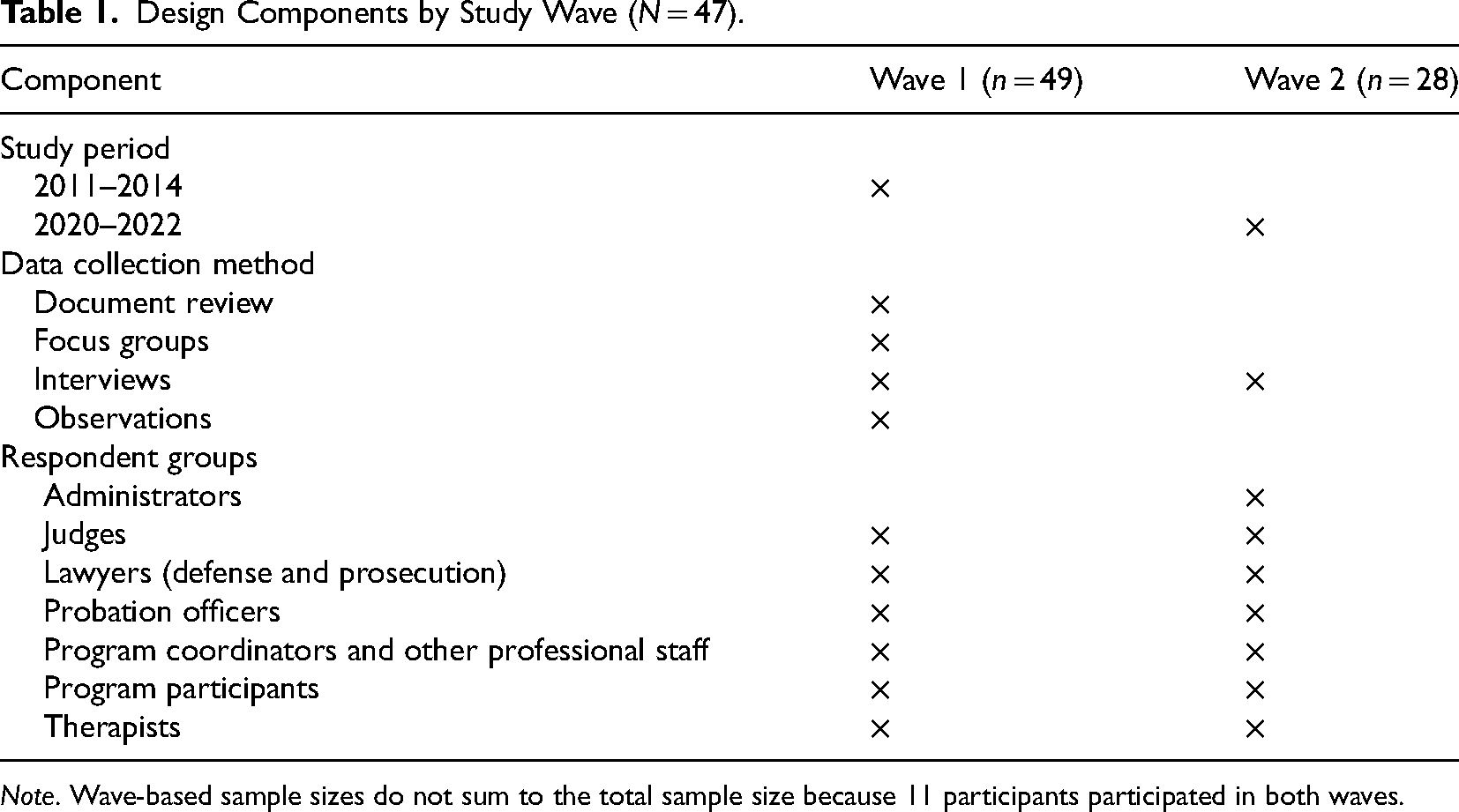
Note. Wave-based sample sizes do not sum to the total sample size because 11 participants participated in both waves.
The second study wave comprised one-time interviews with professional staff (n = 22) and program participants (n = 3) who were currently or formerly involved with either of the two PDPs. Eleven of the second wave study participants (professionals: n = 10, program participants: n = 1) also participated in the first study wave. The second wave investigated whether and how program participants and staff perceived criminalized sex work and the PDPs designed to address it through a combined punitive–rehabilitative approach had changed over time, in light of a decade of experience and growing trends toward de facto decriminalization (Steele & Carruso, 2021). In both waves, we employed maximum variation sampling, which was designed to include people from all stakeholder groups with a variety of perspectives on the program, as well as snowball sampling. For example, we purposively recruited criminal legal system professionals who remained committed to the program and those who had severed their involvement due to critical views and conflict, as well as program participants who succeeded and were enthusiastic about their experience and those who were critical of, or terminated from the program.
Shdaimah conducted all first-wave interviews and observations in person, and Shdaimah and Franke conducted second-wave interviews virtually. Interviews lasted from about 45 to 90 min and were recorded and transcribed verbatim. We used semistructured interview and observation guides to focus exploration on evolving experiences with the PDPs. We also asked more individualized questions pertaining to current and ongoing topics that emerged over the course of Shdaimah's ethnographic work, which also allowed for member checking. Although we did not provide compensation to professional program staff, we provided $20 incentives to program participants for each interview. Both study waves were approved by the University of Maryland Baltimore Institutional Review Board.
Sample Description
We interviewed a total of 27 criminal legal system professionals with a variety of roles. These included three judges, two court coordinators, six public defenders, three probation officers, three prosecutors, six therapists, and four people who held an administrative or agency service coordination role. Program professionals largely volunteered to work with their respective PDP as part of, and sometimes augmenting, their regular professional duties, with the exception of the court coordinators, who were the only professionals with a PDC-designated funding stream. We also draw on data from interviews with a total of 20 program participants.
All PDC program participants were cisgender women, which is the only gender identity group that PDC accepts and who make up a large majority (88%) of all SPD participants. They ranged in age from 30 to 53 years. Those who provided ethnoracial demographic information identified as White (n = 10); African American (n = 5); Hispanic (n = 1); and African American, White, and Indian (n = 1). All of them, as required by program eligibility criteria, entered PDC with three or more arrests or convictions for prostitution. All were actively struggling with severe, long-term drug addiction at the time they entered PDC, except for one who was in active recovery. As a result, drug use and recovery were a central feature of PDC participants’ experiences and often shaped their residential and service milieu mandated by the court.
Analytic Strategy
In order to protect respondents’ confidentiality, we use pseudonyms that they provided. We also created pseudonyms for their agencies. Data were analyzed using a multistep process of thematic analysis (Nowell et al., 2017). We first read all of the transcripts to get a general sense of the interviews and to review the transcriptions for accuracy. The next step was to read sample transcripts for the purposes of creating an initial coding list. In each case, another member of the research team reviewed the same transcript and met to discuss. In keeping with tenets of feminist analysis, we took an emic, or insider, perspective that privileged our respondents’ understandings and draw heavily from their words in our presentation of findings. Author discussions led to further clarification and specification of the meanings and use of the codes, which were subsequently resolved through consensus. The agreed-upon coding scheme was then applied to all subsequent transcripts. Codes were descriptive (e.g., age), conceptual (e.g., stigma) and, when appropriate, in vivo (e.g., “creepy men”). We supplemented our emergent coding with sensitizing concepts derived from the literature (e.g., desistance). One of the primary themes generated from this analysis included the PDPs policing of women's intimate relationships, which has also been noted by feminist criminologists of the criminal legal system more broadly (Lilley et al., 2020).
For the current article, we conducted a focused, secondary data analysis within this specific theme (Ruggiano & Perry, 2019). To this end, Shdaimah and Becker read through all of the material coded under relationships, creepy men, and surveillance, and formulated an initial coding scheme through regular discussion and consensus. Becker and Franke then applied this coding scheme to all of the data, meeting with Shdaimah and Leon for debriefing and clarification of concepts and emerging ideas. Any discrepancies and overlaps were resolved through discussion and consensus. Additional steps to enhance study rigor were employed triangulation of respondent perspectives, member checking, peer debriefing, and audit trails (Padgett, 2017).
Findings
Through our analysis, we conceptualized the court's interventions as a chronology. The court begins with an inquiry into participants’ paths into criminalized sex work against the context of their past. Courts then work to engage participants in the PDP with the goal of transformation, so that they emerge from the PDP as people who participate in (only) “normative” relationships. This chronology simultaneously justifies and upholds the court's own invasive practices as necessary. That is, the court's interpretation of participants’ past informed its interpretation of not only their present but also their future and, therefore, supported the court's intimate intervention. Highlighting the biased and judgmental framing that was prevalent in our data, our themes included: Tragic pasts, problematic presents, and uncertain futures.
Tragic Pasts and Dysfunctional Families: “Their Parents Were Damaged Goods” 2
Continuing a long-standing practice of state systems’ pathologizing of poor families (Dettlaff et al., 2020; Hansen et al., 2014), interventions into women's lives made sense in response to perceptions of neglectful, abusive, and otherwise failed role models. Program participants and program staff alike acknowledged that the PDPs justified their intervention in women's intimate relationships by attributing their precipitating charge of prostitution to a dysfunctional family environment. In this way, professionals viewed their involvement in the more intimate aspects of participants’ lives as instrumental in transforming participants from victimized offenders to the court's vision of normative functioning members of society. Such a framing also undercuts a systemic view of women's plight that might call for advocacy in favor of individual intervention, with very few exceptions.
Public defender Kacey explained how unfair it is that criminalized women are judged without any regard for the kind of behavior that might have been modeled while they were growing up. Importantly, Kacey also attributed what might seem like poor decision-making not only to a lack of modeling, but also to systemic factors that leave many PDC participants without legal options: The client came out of jail and made a decision about … [not] spending time with [her] child. And the prosecutor was like, “why wouldn’t you do that?” and “that's what you should do. That's what good mothers do.” And I was like, “this is such a narrow view.” That's what you know good mothers do but maybe no one ever taught her that, or maybe she just got out of jail with a shirt on her back and needs money to get a ride home, so she's gonna turn a trick right now because it's survival. So, really, just not knowing what their life experience was like can lead to judgments or statements that are not based in reality or understanding.
In some instances, participants described home environments in which parental engagement in sex work was normalized as a means to fund substance use. For instance, connecting participants’ childhood traumas with ongoing traumatic experiences throughout adulthood, therapist Belle noted that this context was ingrained and maintained within extended families: A lot of this is also intergenerationally developed. I’ve worked with a lot of women who, like their mothers or their aunts or even their grandmothers, were also sex workers, too, or had addiction challenges. So, there's also a normative culture there.
Mentioned more commonly was the history of childhood victimization at the hands of parents or other guardians. Most often, this abuse was noted as being sexual in nature, ranging from rape by family members to “being sold” to family members’ acquaintances, such as drug dealers, for sex. Oftentimes, program staff described the trauma resulting from this abuse as an impetus for participants’ own substance use as a way to cope, the financial pressures of which, in turn, prompted engagement in sex work. As therapist Diane explained: The big revelation [that] … took people way too long [to understand], in my mind, was that there's no choice involved. This is not being a prostitute or a nurse; this is the result of a very bad trauma history or domestic violence or a whole array of things. But choice isn’t one of them. Once you understand and see firsthand the concept [of] what happened to this person as a child … The trauma of the childhood is marking their adult life, and their ability to make decisions is so limited compared to a person who has not had that trauma that it seems almost pointless to blame them, especially when you have a behavior that is turned against themselves, such as drug use, prostitution, and so forth. And once you see that, I think you can’t unsee it.
Because PDPs conceptualized trauma as the antecedent for participants’ current engagement in selling sex, program staff—even those employed outside of a therapeutic role—viewed it as within their professional bounds to inquire about intimate trauma histories. Parole supervisor John recounted how attending a PTSD-focused educational seminar inspired this view: This lady blew me away. She was arrested 88 times and she said, “not one person ever asked me until the 88th time ‘do I have sexual trauma in my background?’” It took 88 arrests and she's like, “that's talking to social workers, public defenders, district attorneys, judges. No one.” Until one time, this lady in the prison said to her, “do you have sexual trauma?” … So, from that point on, I knew it. I would go into booths. So, it's a hard question to ask. And I would straight up ask them. And [by] their reaction, you knew right away.
But the bottom line, [Interviewer], is that probation [staff] only had one thing in mind, and that was to help the ladies deal with their trauma because we knew if we can get them to talk about the trauma, we can start getting them off the drugs, because these ladies are doing heroin to forget their grandfather.
John's perspective of dysfunctional families as a backdrop for substance use disorder and sex work guides his interactions with participants and reinforces the PDC team ethos.
Problematic Presents: “What Led [You] to Starting to Date Shithead Guys That Led to Him Being a Pimp and Taking You Out on the Street?” 3
As stated, the trauma inflicted through abuse during childhood and adolescence was seen as contributing to engagement in substance use and sex work during adulthood. These high-risk behaviors were roundly noted as setting the stage for compounding traumatic events, including what the professionals deemed to be non-normative intimate relationships (e.g., those with much older men or violent and/or drug-using partners) or from participants’ interactions with clients or facilitators. For instance, therapist Belle stated, “I don’t know the percentages, but I would say a majority of them have trauma that stems from childhood through adolescence through adulthood.” Outreach worker Adam expanded on the plurality of factors that give rise to abuse and compounding trauma: Part of what's connected to some of that severe complex trauma is kind of the overlap that people involved in commercial sex work can have with some degree of human trafficking, of their relationships with people that are quote pimps end quote. You know, they feel like that sort of perpetual threat of physical violence, emotional abuse, insecure or unstable housing, no control over their financial resources. I air quoted “pimps.” I think there's some different nomenclature that might be associated with that and it's not always like how the person necessarily views that person. The person can have a view of a person that an outsider might call a “pimp” that they might say is their romantic partner.
As we discuss at length in other work (Authors, 2023), Lily shared her understanding of demands that she had made of participant Christina to leave a “man who she lived with part time.” When Lily took Christina to retrieve her belongings, the man and his interaction with Christina did not match the image of the problematic relationship that Lily had assumed, which was that “either he was a john or a pimp and there was nothing in between”: I remember thinking about how I was sort of dragging her away from the only safe place she had. … This was like her safe haven. It was clean. It was where she could shower. She could keep her clothes there. This guy wasn’t gonna beat her up or charge her or steal from her, you know? He just liked the companionship and, because I didn’t see things as gray so early on, I really think I hurt [pause]—I hope sometimes that she went back there. I can’t tell you how many times I was raped out there. [Shakes head] All those things. How many times you got beaten up, how many guns got put on you, how many times your face got busted open, how many beatdowns did you take?
PDP staff saw their role in disrupting these patterns to be part of a legal and moral obligation to women who they felt were ill-equipped to do so without court involvement. These sentiments were echoed, to varying degrees, by staff who lamented the deaths—and the contexts surrounding them—of program participants following graduation. As parole officer Catherine Heathcliff said, “she got married and I’m almost sure that [her husband] was pimping her out on the street. And she had really bad diabetes and she wasn’t … The combination of her on the street, using drugs, and her diabetes … She just passed.”
These sentiments held by the court prompted several initiatives. Many program staff noted the glaring optics of the PDPs’ focus. For example, therapist Caroline stated: I felt like there should have been more of an emphasis on the offenders, like on the johns. What about them? Why are we focusing so much on the women and not on, like, “why wasn’t there a Johns’ Court?” Why just don’t … What about these men who were using and victimizing our women? It felt like it was pretty sexist. Anecdotally, we developed a “johns’ school,” right? The way we developed that was we went with key stakeholders to a johns’ school in Brooklyn. We looked at it and said, “uh, it looks good. Let's do this in Philly.” And we set one up. We didn’t consult with anyone. It's a 4-h workshop where we tell people, like, “it's really bad to do this behavior. You get your car taken by the police. You can get STDs, STIs, whatever. Don’t do it.” And then we give them a certificate. We charge them $250 for it.”
Conversely, public defender Jan explained how more attention was afforded to the intimate interventions in PDPs: Project Dawn actually had heightened scrutiny much greater than that of treatment court. I don’t know if you’re aware of that. So, for instance, the probation officer would take their phones and look and see who's the men listed in their phones and who they were talking to and who they were texting, which is what they would do for sex offenders. But these were hardly sex offenders, you know what I mean?
In a few U.S. jurisdictions, such as New York and Pennsylvania, policy efforts to address sex trafficking have combined with broadly written sex crime policies such that conviction for a prostitution charge may itself be categorized as a sex offense (Mogulescu & Goodmark, 2020). Yet, in most jurisdictions, the criminal legal system views these as distinct groups, though at times with overlapping experiences and barriers to re-entry (Leon et al., 2023).
Uncertain Futures: Moving Away From “Creepy Men” and Into “Icky Environments”
PDPs saw themselves as a corrective model to help participants move away from their past relationships through a combination of exhortations and modeling. Sometimes, this was explicit, as when Judge Kahan pointed to the one male team member in the court as an example of the type of man that participants should aspire to partner with instead of the “creepy men” with whom they were involved. The court used the word “creepy” to signal vague undesirability and inappropriateness either of the person themself or the relationship. This included people whom program participants met at their treatment facilities, men without steady employment or with criminal records, or people with whom they associated in the past with whom the court deemed likely to entice them into drug use or sex work.
The court also saw itself as a corrective model family that showed the right balance of accountability and love in contrast to participants' dysfunctional relationships. PDP professionals clearly interpreted the court's intervention as a way to ameliorate some of the impact that trauma, “reject families,” and “shithead guys” had on participants. The assumption appeared to be that PDP participants lacked family or friends to encourage behavioral change related to substance use and sex work, so the courts must act as proxy. As therapist Gerrie explained, I think the court system, a lot of times, can potentially play a very good role in that interruption of having the person stop and have the opportunity to do something different. … But, for a lot of the people we dealt with in SPD, their families were unavailable or had abandoned them. They didn’t have that opportunity because maybe too many bridges were burned by them, or there was, what's that called? Estrangement. So, sometimes, the court steps in almost in a paternal [way] to say, “we’re going to be the ones. Society, through us, is going to be the pressure.”
The carceral protectionism embedded in PDPs relied on and furthered gendered and classist stereotypes that often went unscrutinized. As a prosecutor Jack said, “here's the way I feel about prostitution: If some college-educated woman wants to use her body to make money and her skill set to make money with men, women, whoever—go for it.” Jack drew a distinction between what he sees as privileged sex workers who do not warrant state intervention and street-based sex workers whose very same violation of the law is the primary target of prosecution. The court dialog centered on trauma and poor judgment, often in regard to relationships, as the rationale for intervention. In comparing PDPs to other courtrooms, public defender Alice confirmed that PDC participants were “patronized and seen as manipulative and seen as obnoxious and babies a lot more than men.”
Professionals and participants repeatedly described how the court prioritized control over care for individual needs. Therapist Dolores explained, “it just seemed like [the PDP] didn’t really care what was best for the client. They just cared [about] what they needed to do, what was their agenda. It was not consumer-based at all; it was more their agenda.” For some, sustained recruitment efforts in the face of inadequate support for current participants contributed to a sentiment of exploitation that saw participants as cogs supporting a programmatic agenda. PDC participant Toni described her frustration with the court's lack of holistic services, inability to support long-term change for participants, and seeming more invested in doing things “for appearances”: “Where is Dawn's Court [later]? In the jail, suckering somebody else into the program, forgetting all about the person that they suckered into it last year.” Through misdirected attempts to correct women's behavior without the ability to address more systemic concerns, such as housing and living-wage employment, PDPs became yet another harmful relationship in participants’ chronology.
Many PDP-affiliated professionals understood the court as a protective entity without considering the problematic nature of constant surveillance, or what parole supervisor John described as “lifetime probation.” PDP participants were often enrolled in the court for multiple years. For many professional stakeholders, there seemed to be no limits to surveillance. While surveillance was often justified by genuine worry over participants, it was also seen by some as unwarranted and improperly intrusive. For instance, through a cell phone text chain, stakeholders shared photos of a participant at a bus stop and collectively concluded that she was selling sex. Similarly, professionals often accompanied participants or visited them during difficult times or celebratory times, such as when someone gave birth or was ill, especially when the participants were without support systems or if they were afraid. However, such well-meaning support could have a voyeuristic or intrusive edge, such as when professionals shared photos of another participant in a hospital bed.
This invasive conduct of the PDC team resulted in what agency service coordinator Sofia described as an “icky environment.” PDP ickiness was reinforced by an organizational structure that offered individual staff members wide flexibility to determine the scope and type of their interventions into participants’ lives. Thus, the lack of explicit parameters outlining appropriate versus inappropriate engagement with participants fostered a lack of individual boundaries, with professional stakeholders investigating and making largely unfettered determinations about respondents’ bodies, sexual activity, and intimate relationships.
To this end, interviews revealed several incidents by professional stakeholders that seemed especially “creepy.” Some relationships between professionals and participants lacked boundaries, including text messages that said “I love you” and long phone calls in which “we’d just bullshit for hours.” Other PDP professionals acted in ways that risked retraumatization (see also Shdaimah, Leon, & Wiechelt, 2023). Parole supervisor John described how he and Catherine Heathcliff would work as a team during intake. Using a good cop/bad cop routine, John would shout at new participants who were confined in an interview booth at probation and parole, and pressure them into admitting their trauma histories. His reasoning was that this would set up Catherine as a trusted probation officer, who would assuage participants’ anxiety and allow them to open up about their past. Both John and Catherine Heathcliff were unwavering that the ends justified the means.
Additionally, when asked, prosecutor Jack noted that it would be “creepy” if he kept track of PDC participants once they completed the program. However, he laughed while recounting the time he was stopped by a police officer while looking for a PDC participant in a neighborhood known for sex work: “He thought I was cruisin’. I pulled out my badge. I was like, ‘no, I’m actually on the job right now.’” Jack saw such actions as acceptable and not “creepy,” despite, as prosecutor Erin noted, “the National Johns Suppression Initiative statistics tells us that the highest percentage of people who are purchasing sex are White, middle-aged, married, educated, employed people.” Although Jack was motivated by care and concern, literature also shows that women trading sex at the street level often have negative experiences with law enforcement (Mueller, 2023). This means that women engaging in street-based sex work, like the police officer who stopped him, may question John's intent.
Discussion
Using a feminist lens to examine how professional stakeholders understand their role reveals that these PDPs have constructed themselves as a kind of substitute family for women arrested for sex work. PDPs act through a paternalistic substitute judgment model that can take a heavy hand while offering maternalistic love and guidance that is also designed to model and encourage socially accepted behaviors and attitudes, especially as they relate to intimate relationships. This blend of exhortation and empathy exposes internal tensions within PDPs. On the one hand, we have provided examples of professional stakeholders invoking tropes of “there but for the grace of God go I,” whereby they express similarities with program participants, with the only difference being the difficult life circumstances that precipitated women's poor choices. Such projected empathy joins a long line of social workers and other would-be saviors acting on behalf of a group and silencing them in the process (Quinn, 2006; Wahab, 2002). Moreover, they do so often without evidence and in ways that are counter to evidence-based interventions that are fed by and reinforce already existing prejudices (Shdaimah 2020a, 2020b; Shdaimah et al., 2023). This particular form of saviorism is also undergirded by and reinforces the conflation and seepage of trafficking narrative in popular culture that justify dubious tactics of vigilantism (Lemoon, 2023; Shih, 2016).
On the other hand, PDP professionals simultaneously engage in othering discourse and practices that highlight differences and maintain dividing lines between acceptable, normative behaviors to which participants are accountable, enforced, for example, through approval or rejection of living arrangements. This echoes Kerrison's (2018) finding from a participant observation study conducted while working in a women's re-entry home that required participants to have a home plan approved by the staff. The women and femmes experienced “heteronormative surveillance” (Kerrison, 2018, p. 134) that often excluded queer partners and enforced norms misaligned with their own perceptions of self and their lived experiences, in favor of what the program professionals deemed to be in their best interests. In our study, for example, heteronormative surveillance was reinforced by PDC's exclusion of transwoman, cisgender men, and nonbinary sex workers, which could be interpreted as a denial or rejection of these populations. Although our study respondents did not share exclusions based on sexual orientation or gender identity, we did see that similarly “narrow conception[s] … hinged upon finding a breadwinning male partner” (Kerrison, 2018, p. 146).
Here, we call for a reconceptualization of creepiness, in at least two ways. The first is that the professional stakeholders’ ideas of who or what is creepy are often at odds with participants’ assessments (see also Kerrison, 2018). The most prominent example of this is that the professional stakeholders largely describe men who are unemployed, who may themselves have substance use disorders, experience housing instability, and engage in illegal behaviors, as creepy. However, these are the potential male partners—in both intimacy and survival—that participants are most likely to meet in their all-consuming rounds of required treatment and programming. They are also among participants’ family members and social networks. Therefore, the court's characterization of creepiness ascribes a blanket stigma that limits participants’ opportunities for social support and intimate relationships.
Another way that participants’ and professionals’ assessment of creepiness may be at odds is that PDPs use the same logic of shorthand assessments that rely on superficial criteria with classist and racist (among other forms of oppression) assumptions that may be incorrect, which Kerrison (2018) describes as state governance of criminalized women by “White, middle-class, heteronormative norms of domesticity” (p. 148). In our data, we have examples, such as the age difference criteria that prompted Lily to require Christina to sever ties with the man she was living with, despite his provision of material and emotional support. These biases may also be incorrect with regard to assessments of appropriate (i.e., not creepy) behaviors. For example, the irony of Judge Kahan's exhortation that participants seek out men who look like the White male prosecutor in court wearing a suit and tie is not lost on a court audience aware that some street-based sex workers provide services to similarly dressed professionals on their way to jobs in the commercial and government areas of the city. Such a juxtaposition turns creepiness back onto the PDP itself, raising questions about the value of well-meaning but intrusive public and private surveillance that border on the prurient. Our findings invite further exploration of the particular salience of boundaries around gendered behavior, especially as they relate to bodies and sex, and the purpose of this boundary maintenance and its accompanying surveillance and control. Our claim that PDPs function as a form of boundary maintenance is supported by our findings that these intrusive interventions into intimate lives—carried out primarily by other women—focus on marginalized women whose survival activities have been criminalized. Recent calls from sex worker organizations and researchers warn of the dangers of digital surveillance (e.g., Albert et al., 2022; Scoular et al., 2019). That said, it remains to be seen how increasing digital intrusion will impact sex worker's safety, financial precarity, and stigma management, especially within legal regimes that criminalize sex work.
PDPs join an established history of social workers acting in a social control role toward sex workers that is in tension with social work ethics of solidarity and social change (Anasti, 2020b; Reisch, 2019; Wahab, 2002; Wahab & Panichelli, 2013). Instead of calling out and heeding these tensions, many of those who are charged with the obligation to protect people and groups with whom they work (e.g., public defenders, therapists, social workers) often join their criminal legal system counterparts (e.g., prosecutors, judges, probation officers) in seeking to surveil and change women's individual behaviors under threat of punishment. Social workers and other professional actors who embrace these tensions to challenge PDP norms of surveillance and control often find themselves sidelined or leave (Franke & Shdaimah, 2020).
Implications
We call for social workers to lead the charge in addressing and critiquing this social control orientation in PDPs and other problem-solving justice interventions in favor of social reform approaches that are more in line with social work and feminist ethics. Social workers and other advocates should be joining forces with people who are engaging in sex work by choice or lack of choice and with peer-led advocacy groups to help bring about the kind of future that people imagine for themselves. To do so requires that we consistently challenge the carceral, punitive logics that sweep all forms of aid within the ambit of the criminal legal system. Our recommendations extend to social work education, where we can model and encourage critical perspectives through going outside of typical academic sources to actively seeking perspectives and experiences of those who will be impacted by programming and policy that we design and implement (Berg et al., 2022; D’Adamo, 2017), and challenging ourselves to identify and reflect our own biases and impulses even (or especially) when we believe that our intentions are just (Leon & Shdaimah, 2020).
Our findings apply even to programming that ostensibly mitigates gendered power relations and disparities (Sydney, 2005). Acknowledgment and concerns about difficult environments and traumatic pasts that give rise to empathy do not fundamentally change the regulation of women and their intimate relationships under a helping mandate. While these changes may provide some much-needed programming, they also create a pathway for heightened surveillance and othering, which may (inadvertently) be voyeuristic and stigmatizing.
Footnotes
Author note
Todd D. Becker is currently affiliated with School of Medicine, Washington University, St. Louis, MO, USA. Nancy D. Franke is currently affiliated with LaSalle University.
Declaration of Conflicting Interests
The author(s) declared no potential conflicts of interest with respect to the research, authorship, and/or publication of this article.
Funding
The author(s) disclosed receipt of the following financial support for the research, authorship, and/or publication of this article: The third author was supported by the Daniel Thursz Social Justice Endowment as a Community Justice and Equity (CJaE) Initiative Fellow.
