




Abstract
Social 1 work was reintroduced to Hungary during the third wave of democratization in Europe. As an academic discipline, it is in a disadvantaged position: the domestic academic traditions prefer strict disciplinary boundaries to inter- or transdisciplinary integration. Ongoing reforms in the country highlight the economic gains and the societal mission of higher education, with a strong focus on internationalization and direct connections to professional practice. Unfortunately, in this new framework, social work is understood as an auxiliary profession. This, in combination with female academics’ unfavorable position in Hungary, establishes a situation in which gender-based and disciplinary disadvantages result in a negative synergy. To explore the potential impacts, we maintain a dual focus throughout the paper and analyze academic women's position and the position of academics in social work.
Background
Problem Definition
The neoliberal turn, with its enhanced focus on economy, is a worldwide challenge to social work values and practices (Chi, 2005; Wallace & Pease, 2011). This turn has had its impact on higher education as well: globalization and competition have become the key determinants of academia. Blell et al. (2022, p. 1822), examining international examples, have commented on this change as follows: “the interlinked conditions of precarity, neoliberalization, internationalization, digitization, and state-encouraged intervention” may lead to “increased surveillance, (self-) censorship, and cultures of silencing.” These factors are more of a threat to those whose positions are relatively weak in the system of higher education.
In this study, we explore the position of female academics in social work. Though the focus of this study is mainly Hungary, a Central and Eastern European country, embedding our analysis into a global environment yields insightful comparisons. We propose that the academic discipline itself can be a factor that determines female lecturers’ disadvantaged position, strengthening the negative impact of gender-based disadvantages.
In the subsequent analysis, we explore the overlapping problems that come from the traditions concerning women's position in general and in academic life specifically, aggravated by the low prestige of social work as a professional area and as an academic discipline (Erdos et al., 2020).
Our goal is to explore the interconnections of the above problems. The method, critical discourse analysis (CDA), requires exploration into the social context of the theme: the position of female academics and academics in social work in Hungary. Therefore, we first give an overview on the domestic traditions concerning women's position and then analyze academic women's situation, identifying recent challenges in social work as an academic discipline. We analyze Shifting of Gears in Higher Education Mid-Term Policy Strategy 2016. Action Plan 2016–2020 (SGHE) (Ministry of Innovation and Technology, n. d.) and a recent document on “pink education” (Németh et al., 2022) for a more elaborate view on the current processes and future implications on the position of female academics in social work in Hungary (the phrase “pink education” refers to women's presumed predominance in academic life in Hungary). Both documents are meant to substantiate policies in HEIs. SGHE is a comprehensive national-level strategy, and “pink education” was published by the State Audit Office, a body responsible for controlling all public spendings (including the spendings of state HEIs and the Hungarian Academy of Sciences (HAS)) and conducting analyses to ensure good governance and the introduction of adequate policies.
Feminist Traditions in Hungary
Women's active role-taking in professional and political life had their early roots in Hungary, as in the other European countries. After WWII, feminist ideas were eclipsed by communist ideologies. In this perspective, feminism meant an invitation toward “masculine” positions. A female tractor driver was celebrated as an iconic figure of the new “freedoms” and “autonomy,” depicted as an undebatable proof for gender equality. This new “freedom” was not extended to more prestigious areas, and the woman was invariably held responsible for all the household chores, often without any help from her husband: housework was not seen as a shared responsibility. The system firmly established a dual earner–single carer model. In the 1950s, women were looked upon as the main means of reproducing the workforce, as captured in the contemporary slogan: “For a woman, bearing children is a duty; for a maiden, it is a glory” (quoted and commented by Vértesy, 2016, p. 39). Ironically, women's exploitation was widespread in a system that regarded exploitation as the root of all social ills. Women were considered ideologically weak creatures to be educated by their cultivated husbands while they were ironing or mending the clothes (Fodor, 2002). Importantly, communist ideology was seen as the ultimate science, so this presumed “weakness” was generalized to other areas. Perversely, women in the communist system were expected to demonstrate the same physical skills and strength, while they were deemed intellectually weaker than men. Although a quota system was introduced into political life, women did not hold any key positions, which indicates that socialization issues shaping the discriminatory traditions were not addressed effectively (Fodor, 2002). Since the elimination of the quota system after the change of the social system in 1989, the 30% peak of female representatives in the parliament has quickly flattened (see Table 1).
Proportion of Seats Held by Women in the Hungarian Parliament, 1945–2021.
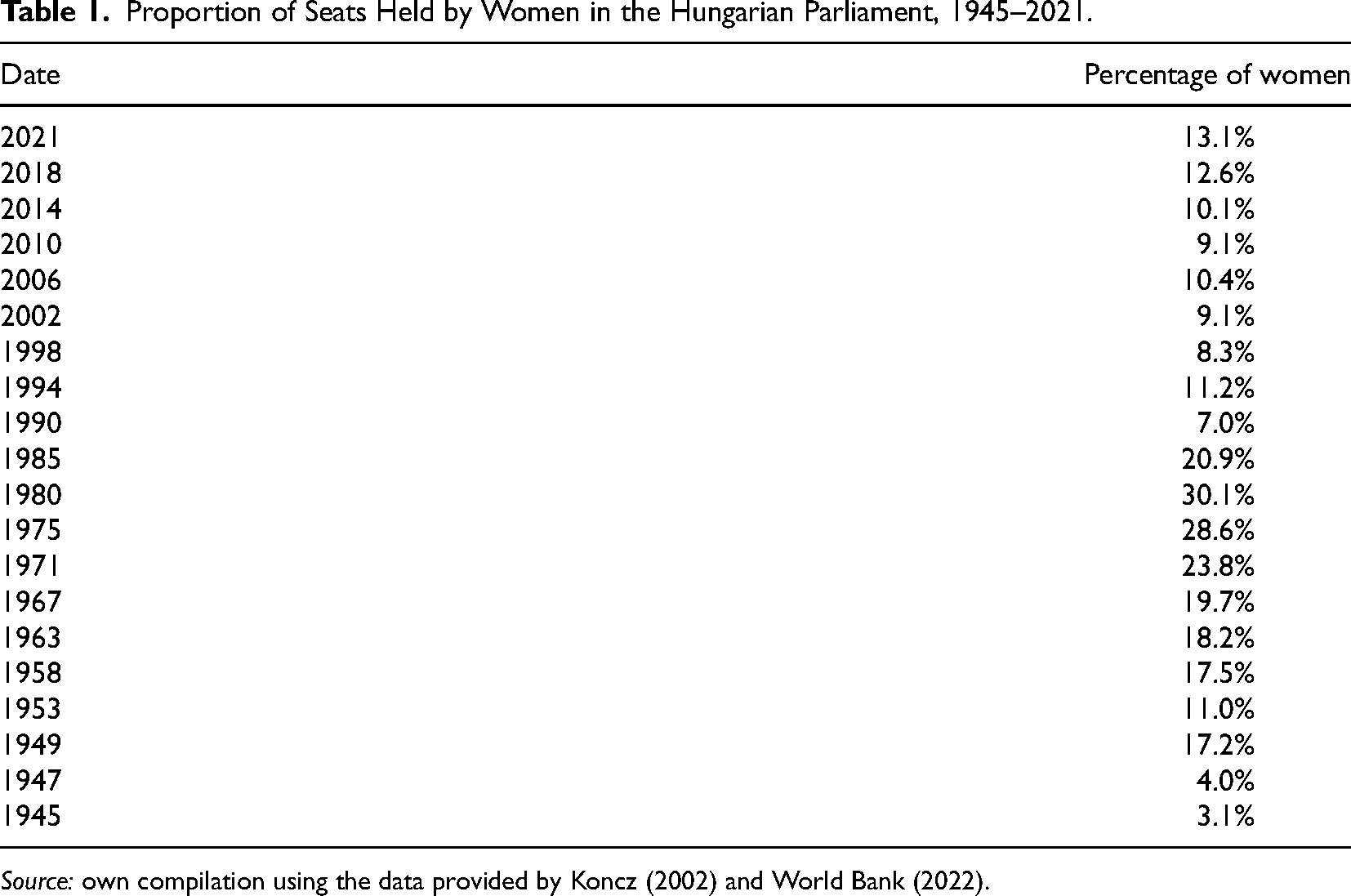
Source: own compilation using the data provided by Koncz (2002) and World Bank (2022).
Currently, Hungary's Gender Equality Index is the third poorest (54.2/100) in the European Union. Two dimensions, segregation and quality of work (56.4/100) and economic power (21.4/100), are among the most problematic areas. The weakest dimension is political power (21.8/100) (European Institute for Gender Equality, 2022). Recently, there has been some progress: Katalin Novák became the first female President in Hungary in 2022.
Not only in Hungary but also in the European Union, women spend considerably more time on caring activities and household chores than men do (European Institute for Gender Equality, 2022). This tradition contributes to female academics’ difficulties in pursuing a career and establishing a work–life balance (Keczer, 2014).
Women in Academia
Women's underrepresentation in academic life is a global phenomenon. A summary by the Catalyst (2020) has identified similar problems in Asia-Pacific, Canada, Europe, and the United States, including women's overall underrepresentation, underrepresentation in senior posts, and a gender-based pay gap. Women of color may face additional discrimination. Further, a work–family balance is much more difficult to reach for women who feel the pressures of both the biological and the academic clock (Sakamoto et al., 2008). However, taking women's family-related responsibilities as a potential explanation for their overall lower positions in higher education is often overemphasized and may mask other global-level contextual factors and discriminatory practices (Aiston & Jung, 2015). Walker et al. (2020, p. 11), in their exploration of female researchers’ positions in New Zealand, have claimed that women's higher research performance does not necessarily result in achieving senior positions. Women's chances to assume leadership positions in academic life are still low; as Butler-Henderson et al. (2022) have concluded: “Whilst shifts are occurring, they are painfully slow.”
In the Hungarian system, the highest academic ranks are granted by the HAS. The number of academic doctors (Sc.D.) is about 2700, with approximately 400 women. Inequality is now seen as a major problem within the academic community (Lannert & Nagy, 2019; Magyar Tudományos Akadémia, 2019). However, female professors’ lived experiences still reflect the patronizing traditions: a female Sc.D. noted that at her workplace, she is usually addressed as “Gabika” (a pseudonym is used to maintain the professor's anonymity), a version of her first name to express kindness and familiarity. In a formal context, this is inappropriate. Male professors are addressed by their job title (“professor”). Academic women pursuing a prosperous career must detach themselves from cultural expectations (e.g. their genderlect), risking that colleagues will judge them as aggressive, masculine, or thinking high of themselves—a double bind that is hard to resolve.
Most research grants and scholarships are for the faculty members under 45 years of age. “Late” beginners suffer a disadvantage. Faculty members in social work often spend some time in practice before the commencement of their academic career. In addition, women may spend several years on childcare leave (a maximum of 3 years per child in Hungary) as they would not be able to access or pay for the necessary services if they went back to work. The Hungarian family and child protection system is one of the most generous in Europe if we consider the state spendings (around 2% of the GDP) (Vértesy, 2016). At the same time, salaries are rather low. The domestic system differentiates between instructors (a practitioner not pursuing a PhD), assistant lecturers (part-time PhD students/early PhDs), assistant professors (for them, a PhD and some teaching experiences are a usual requirement), associate professors, and professors. An assistant lecturer's salary is comparable to that of an assistant in a shopping mall (in 2019, EUR 682) (Eurydice, 2022). Professionals were considered “non-productive” and a politically unreliable workforce in the communist era, and their salaries were defined accordingly. This dubious legacy has not been eliminated from academic life yet. Academics’ relative autonomy and flexible working hours—exceptional in the domestic context (Vértesy, 2016)—are considered a privilege, a compensation for low salaries. Such flexibility allows academic women to assume traditional care responsibilities, often at the expense of their career.
Social Work Practice, Research, and Education
Devaluation of social work as a profession and an academic discipline is an experience for practitioners and academics in several countries, leading to “a devaluation of their skills, confusion over their role, a deteriorating image of social work and the hiring of staff not effectively trained to meet the demands of the job” (Greenslade, 2013, p. 105). Weiss-Gal and Welbourne (2008) have listed several indicators of professionalization, such as public recognition, professional monopoly and autonomy, a distinctive knowledge base in practice, education, research, the presence of renowned professional organization(s), ethical requirements, and fair remuneration. Social work's somewhat fragile positions in some countries are often manifested in low prestige and remuneration. These positions and the traditional assumptions on feminine and masculine professional areas have made social work as women's work. In the US, the gender ratio among social workers is around 4:1 (female–male) (Salsberg et al., 2017). In South Africa, 85% of social workers are women (Khunou et al., 2012); in the Seychelles, the female–male ratio is 22:1 (Nicette, 2019), and in Hungary, 5:1 (Pilinszki et al., 2004). Though social work is considered women's work, prestigious positions are more often occupied by men (Schaub, 2022). As Sakamoto et al. (2008, p. 38) have concluded: “Women have historically occupied a second-class status within social work, ironically in a profession they are said to “dominate.” One dimension of this domination in social work education is professional advancement, with men benefitting from a glass escalator advancing them to tenure. Academic women in social work are rarely employed in prestigious research institutions but are often responsible for the service work as “organizational housework” (Sakamoto et al., 2008, p. 39) or “taking care of the academic family” (Guarino & Borden, 2016, p. 1), e.g. helping first year students transition to tertiary education (Konjarski et al., 2022). Gender-based pay inequities are a common finding both among social worker practitioners and lecturers in social work (Guarino & Borden, 2016). Di Palma (2005) has noted that the position of female social work faculty is better than female academics’ position in other disciplines, but she attributed this seeming advantage to social work's low prestige, in addition to the positive impact of social work values and conscious efforts to promote equity. Women may assume positions that men are less willing to accept.
In most countries experiencing an era of communist dictatorship, the early introduction of social work in the first decades of the 20th century was followed by its abolishment and then its reinstatement around the 1980s (Budai et al., 2006; Chi, 2005). For example, social work as a profession was recognized in China in 2005. Still, it is often identified as “the traditional civil work which can be regarded as a kind of indigenous non-professional social work or administrative work, which may hinder the professionalization of social work” (Wang, n.d.).
In Hungary, initial successes in reinstatement were followed by a decline, indicated by a strong and continuous decrease in the number of students applying/admitted to graduate programs (Balogh et al., 2015). In 2022, the number of bachelor students entering the program in the country was only 311, in sharp contrast with a peak of 1331 students in 2008. The number of students in the two main master-level programs (social work and social policy) has been more stable, with about 150 students/year admitted to the programs (Oktatási Hivatal, n.d.). Low and decreasing numbers are an indicator of the low prestige of social work in Hungary (Erdos et al., 2020).
The area has a career system of limited progressivity, a euphemism expressing that salaries are lower than elsewhere in the public sector (Meleg, 2020). The low reputation of the profession is transferred to academic contexts. While committed insiders identify social work as an academic discipline, others do not recognize it as such.
The domestic epistemological and methodological traditions are mainly rooted in classical German philosophy characterized by a strong theoretical direction and abstractions. American pragmatism, with its focus on the social self, experience, reflexivity, and relational ethics, a robust “orienting framework for social work research and practice” (Berringer, 2019, p. 614) is not a well-established tradition in the domestic HEIs. Dahle, when discussing the interconnectedness of gender, class, and social work's position in Norway, claims that abstract, theoretical thinking is associated with masculinity and practical work with femininity (Dahle, 2012). Social work remains identified as women's work by the public and is not considered a genuine, autonomous field of study: “their work is not classified as scientific, and their occupations are not part of a truth system that constitutes ‘true’ professions. The knowledge forms are ranked, and women's work is regarded as inferior” (Dahle, 2012, p. 311). Possibly, there is one more underlying reason for not acknowledging social work and its practice-oriented research projects as genuine scientific endeavors. Social programs and interventions “emerged from the rough and tumble of political support, opposition, and bargaining” (Weiss, 1993, p. 95), and as Weiss argues, their political nature renders these pragmatic investigations somewhat risky. From this perspective, studying abstractions and theoretical issues seems a safe and more rewarding option.
Even the Hungarian translation of The Global Definition of Social Work (International Federation of Social Workers, 2014) fails to mention social work theories, referring only to theories of the humanities and social sciences. It labels social work as a gyakorlati alapú szakma (this term is usually a reference to a blue-collar worker's job; for example, no one would define medical doctors this way) and not as a hivatás (a profession, requiring a degree) (IFSW 2014—Hungarian translation, p. 96).
Research Questions
How is social work as an academic discipline positioned in a strategic document defining the developmental path of higher education in Hungary? How are women's academic positions established in the domestic discourse of policy makers? How are these positions naturalized in the discourse? What are the possible implications for female academics in social work?
Method
In the subsequent part of this article, we analyze publicly available data on social work education and provide a critical analysis on two key documents that have major implications for social work education and for female academics’ position in Hungary. The first one, SGHE (Ministry for Innovation and Technology (Ministry for Innovation and Technology, n.d.), defines the developmental strategies for the Hungarian system of higher education. The second one is the “pink education” phenomenon in Hungary. Factors and economic–societal impact of the overrepresentation of female graduates (Németh et al., 2022) is an analysis by a team of the State Audit Office (Állami Számvevőszék) that has elicited not only indignation from many since on its publication but also a well-established refutation (Hungarian Academy of Sciences (HAS) Presidential Committee on Women in Scientific Careers, 2022; Nagy, 2022). The Committee claimed that “pink education” uses research questions and conclusions that are unsubstantiated and violate the principles of equity by presenting mere stereotypes as scientific facts. Therefore, they cannot serve as a basis for responsible policy making. These two documents represent a sample that has adequate information power to respond to our research questions, considering the aim of the study (explorative), the high specificity of the sample, and the context-sensitive method (Malterud et al., 2016).
The authors employed CDA as the research methodology. CDA, taking a historical or an ethnographic perspective, focuses on the relationship between discourse and social practices, and one of its main aims is to reveal how the public representation of certain social groups defines the social positions of these groups. Exploring manipulation and discrimination is a frequent research goal for CDA (Fairclough, 1995; Van Dijk, 2014). CDA, as a specific approach within discourse analysis, is defined as a systematic exploration of “naturalized implicit propositions of an ideological character” that “are pervasive in discourse, contributing to the positioning of people as social subjects” (Fairclough, 1995, p. 23). In this social constructionist tradition, discourse is not a mere representation of social facts. Rather, it is seen as a means to establish the subjects’ social positions and is inseparable from social action. Therefore, discourse is not only situated in the social context but also constructive of the context. Fairclough (1995) has claimed that dominant ideological–discursive formations have the power to “naturalize” ideologies, depicting these distortions as valid, non-ideological commonsense knowledge. Denaturalization makes the underlying causal chains and speakers’ motives visible. CDA also focuses on potentially relevant but missing themes and alternative perspectives: “one way of describing something will always be countering—either explicitly or indirectly—alternative ways of describing the same thing” (Wiggins & Potter, 2013, p. 77).
CDA is a flexible framework that utilizes the traditional methods of content analysis (Braun & Clarke, 2006) governed mainly by the research questions. It focuses on the strong interconnectedness between the discourse and the social context—most importantly, how subjects’ social positions are established and naturalized by the discourse. The researcher is to decide about the relevance of a theme and about the potential interpretations. Therefore, CDA is often carried out by at least two researchers (known as researcher triangulation to ensure validity) who read and discuss the material to avoid under-analysis (Antaki et al., 2003). Relevance may be defined by frequencies, evaluating the occurrences of certain key expressions in their context, or by the information power of even a single but significant occurrence. This requires close reading and re-reading the documents and involvement in joint discussions to identify the key points as potential responses to our research questions. We have followed the above procedure, and CDA was conducted by the first and second authors. Data triangulation involved the inclusion of relevant data sources informative about the social context and the two documents. We aimed to identify the discursive tools applied in the documents to naturalize female academics’ and social work's disadvantaged positions. A statement was deemed relevant if it (a) referred to academic women's or social work's positions and (b) naturalized a potentially discriminatory measure/policy. To establish connections with the social context, we used available external evidence, including the professional literature and some descriptive statistical data on women's position in academia and particularly in social work education. We focused on inconsistencies, missing data, and poor argumentation as the main sources for distortions in the documents. The discursive tools of SGHE and pink education are used to determine and naturalize women's social position in higher education and, in the case of SGHE, social work's role as an academic area.
Defining the Context
The system of Hungarian higher education has been the subject of continual reforms since the transition of the social system in 1989. Hungary's accession to the European Union necessitated major improvements. Hungary became a member of the European Higher Education Area in 1999 and introduced a three-level tertiary education, following the Bologna model with its bachelor, master, and doctoral levels in 2006 (Erdos et al., 2018). These substantial reforms modernized the system of education but left other areas—such as research and higher education institutions’ (HEI's) organizational background—relatively unchanged. The recent strategy, SGHE (Ministry for Innovation and Technology, n.d.), has addressed HEIs’ core problems by introducing new key performance indicators. Major results, including economic gains, are expected by 2030. Essentially, this is a neoliberal turn in the domestic HEIs, the “new managerialism” with its three E's: economy, efficiency, and effectiveness (Saunderson, 2002).
Most recently, there has been a reform in the Hungarian system of higher education, transforming many previous state universities into foundation institutions. Currently, undergraduate programs in social work are available at five HEIs run by public trust foundations, at five Christian colleges, at a private institution, and only one state institution. Master-level programs are provided by one state and four public foundation universities, with another foundation university to join them in 2023. International study programs (baccalaureate and master) are available only at one foundation university, though the diversity accompanying internationalization is a major resource for social work education.
There is no specific social work doctoral school or program in Hungary: students may choose a program in a related area (such as sociology, psychology, and political studies). This usually means a double workload in (at least) the first 2 years of their studies, as they are expected to focus on that discipline and not on their own area. After obtaining a PhD degree, an assistant professor is to wait 5 years before habilitation, a proof of advanced research, and lecturing skills. Habilitation, conducting and publishing high-level research in a given area and delivering a public lecture in Hungarian and a foreign language, is a minimum requirement either for associate professors or full professors (“leading lecturers”), depending on the HEI's own regulations.
Academic requirements for HAS professorship (ScD) were changed in 2020, comprising some new indicators while also retaining the previous ones. By such steps, academic decision-makers have brought about inconsistencies in several areas and hardened the requirements for would-be professors, pulling the ladder up after themselves. Faculty members were busy looking at Scimago's journal ranks, classifying the journals based on academic metrics (H-index, number of citable publications, independent citations etc., https://www.scimagojr.com/journalrank.php) to adapt themselves to the abrupt changes with no transitional period. The reforms, however, did not alter the strict disciplinary boundaries—a marked disadvantage for faculty members in social work. For example, each carefully circumscribed discipline has its own domestic list of acceptable journals (Sasvári & Ludányi, 2021). Social workers do not have such a list, as the area is still classified as a sub-discipline of sociology. What if academics in social work would like to publish in any other related areas (e.g. psychology)? They are free to do so; but they are evaluated against the criteria of the area and are expected to compete with the professionals who enjoy the advantages of the home field.
Searching for a ScD in social work in the HAS database (https://mta.hu/mta_doktorai; Magyar Tudományos Akadémia, n.d.) results in no hits.
Gender Distribution of Faculty Members in Social Work in Hungary
We have collected and analyzed publicly available data from the websites of the academic departments providing social work education to count the number of male and female social work faculty members and compare the gender distribution in the different positions. Currently, there are 115 faculty members (permanent staff) at the institutions, with 58.3% female academics (“college professors” are equal to associate professors at a university).
If we compare the gender distribution in the group of senior or “leading” academics (N = 48; 47.9% women) and assistant professors/assistant lecturers (“non-leading” academics) (N = 67; 65.7% women) (see Figure 1), then we can conclude that there are more women in the lower rungs of the academic ladder, though the result is not significant (χ2= 3.625; p = .06). In a similar pilot study in Canada with higher numbers (N = 312), authors have identified a significant difference, showing male academics’ advantage (Sakamoto et al., 2008).
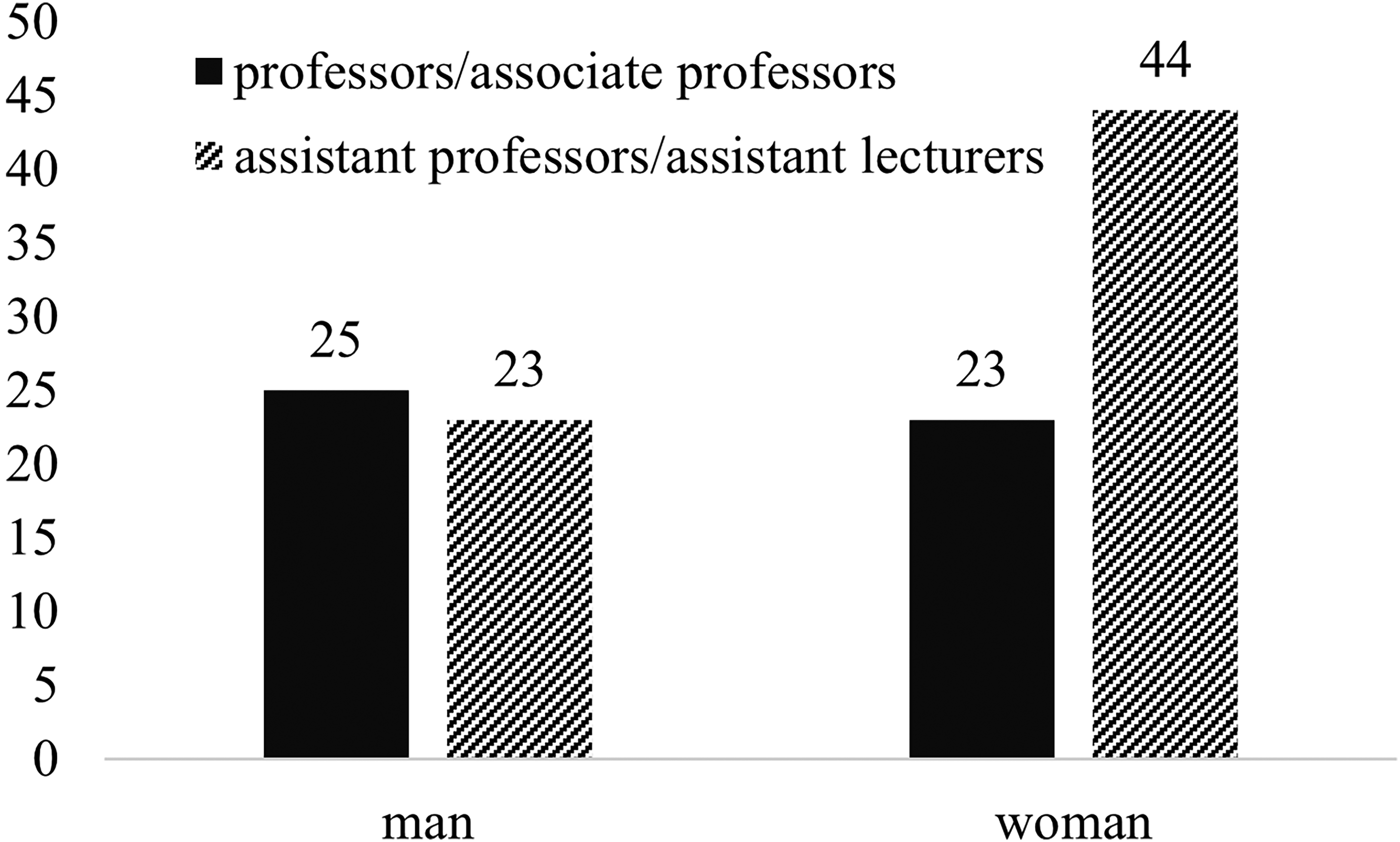
Gender distribution among leading and non-leading lecturers.
Shifting Gears
Hungary had been the 32nd in Scimago's country ranks in 2006, succeeded by a marked decline (50th in 2020). This rank is determined by the quality of research mirrored by the number and quality of publications and citations. Recent improvements (46th in 2022) (Scimago, 2022) followed the introduction of new key performance indicators focusing more on international academic metrics, set by SGHE. But HEIs could not expect further state investments: “…the necessary financial conditions are available so that by using the available resources efficiently, with unchanged state participation, while attracting external additional funding, the domestic system of higher education can stand on its own feet” (Ministry for Innovation and Technology, n.d., p. 2). As regards the resources and cost-effectiveness, investments into HEIs have been moderate: Hungary's expenditure to the GDP ratio was 30% less than that in the OECD countries and 25% less than the EU average (Polónyi, 2022). The Hungarian government has recently announced a substantial investment of 2% GDP in higher education (Magyar Hírlap/Magyar Távirati Iroda, 2022).
SGHE's proposed solution to financing gaps was not an increase in financing but concentration, both physically (focusing on the capital, Budapest), and in terms of disciplinary areas: “…the sectoral approach that has proven itself in economic policy will have to be adapted to higher education, too” (Ministry for Innovation and Technology, n.d., p. 2). This argumentation echoes the strong economic focus of the neoliberal turn. The same principle applies to the for-profit sector and academia. The detailed explanation is as follows: In the future, every university and college will need to focus on its own, clearly defined field of study, i.e., institutions will need to have a solid programme profile and will need to provide world-class education in the fields they represent. Contributing to this fact is the cession of unnecessary rivalry among institutions, replaced by a healthy competition between training programmes and therefore the higher education institutions of the country will be able to cover any and every field of study” (Ministry for Innovation and Technology, n.d., p. 2).
Another solution to increase effectiveness is the introduction of “dual programs,” understood as apprenticeship degrees, with the involvement of “economic entities” (Ministry for Innovation and Technology, n.d., p. 16). This practical orientation, a major step forward to leave HEI's traditional ivory tower, but also a measure to strengthen external economic influence leading to diminishing autonomy, is reflected in the 2.2.4 objective: “In the field of education innovation, the teaching methodology used in higher education should be centred on practice and student work” (Ministry for Innovation and Technology, n.d., p. 29).
SGHE prioritizes the traditional STEM areas, which are not women's traditional areas (Chan & Torgler, 2020). The term “social science” is mentioned altogether five times, and only one of these mentions is positive: “Traditionally, the most popular fields of study in Hungarian higher education are related to the disciplines of humanities and social sciences…” (Ministry for Innovation and Technology, n.d., p. 15). Social sciences are represented as popular in the domestic context, but in the next excerpt, they are described as unfit for international competition: “In humanities and social science disciplines, the differing social science topics and problems make it more difficult to measure scientific performance in an international comparison” (Ministry for Innovation and Technology, n.d., p. 49). This statement is not grounded. In today's globalized context, we share some remarkably similar problems, though the surface representations might be different. Social scientists have the chance to study these problems and compare and discuss their results.
“Social” (108 mentions, mostly related to care) is interpreted as a health-related, auxiliary-level discipline, as in the subtitle “6.1. Medical, health science and social training” (Ministry for Innovation and Technology, n.d., p. 66) and “Social care and auxiliary professions” (Ministry for Innovation and Technology, n.d., p. 69). Other mentions are related to social problems and HEI's third mission, community service. Social work's academic strengths and its substantial contributions to sustainable development are not recognized. Contrastingly, “Medical/medicine”/“health,” a category related to a helping profession and a leading industry, occurs 109 times in an overall positive context, indicating great expectations. “Restructuring should be performed based on and in response to the labor market and innovational demands of key strategic fields of study (medical and teacher training, engineering, economic and agricultural fields)” (Ministry for Innovation and Technology, n.d., p. 6). The strategy mentions some challenges to be solved: “While medical training is a success story within the Hungarian higher education, graduate and postgraduate medical training that embodies the triad of healing–education–research is faced with several challenges simultaneously” (Ministry for Innovation and Technology, n.d., p. 66). The first and most important challenge mentioned in the document is the unmet demand for medical professionals. Though the demand for social professionals is also very high (Gyarmati, n.d.), this fact is not raised.
SGHE's economical solution, concentration, will probably decrease the number of women working in HEIs, due to the fact that traditional caring roles are incompatible with changing the place of residence or spending long hours commuting to work. Concentration as a strategy for all the academic areas seems questionable in an era when knowledge building in the virtual space is easier than ever—and an eco-friendly solution as well. In addition, concentration may not be an effective strategy when facing the complexity of today's human problems. Nicely cut dividing lines between the disciplines and physical concentration delimits the HEIs’ ability to respond to these problems. For example, ensuring accessibility for persons living with disabilities or for the elderly demands a close collaboration between architects and mechanical engineers, as well as medical, legal, and social professionals—and we could raise many similar examples.
Due to concentration, SGHE as a strategy may not be promising for female academics in HEIs, nor for the academics in the broader area of social sciences and social work specifically, but it does not contain any overt argumentation against women's participation in scientific life. On the contrary, women's position is discussed in a balanced and fair manner: Although there has been a significant majority of women among those with tertiary qualification for decades, in the higher degrees of scientific hierarchy women fell behind men. There has been a widening employment gap in the university hierarchy, and while we can see women being the majority among full-time students, their proportion is one-third among associate professors, and merely one-fifth among professors (Ministry for Innovation and Technology, n. d., p. 11).
“Pink Education”
This recent publication (Németh et al., 2022) is an easy target for CDA. The document is identified as a scientific analysis. The authors’ basic argument is that education should promote social mobility and talent development; therefore, “women's overrepresentation in tertiary education” (p. 6) is problematic. According to Németh et al. (2022), the “imbalance” may lead to societal and economic harms, such as the lack of talented men in tertiary education and a population decline. The principle that men should enjoy equal rights and chances in the system of tertiary education as women is hardly debatable, but Németh and associates’ research strategy and argumentation are rather questionable. They simply neglect the immense role of underpayment in many professional areas in Hungary, requiring high investments and resulting low returns. In most sectors, skills-based careers are much more profitable. Here, Németh et al. (2022) follow a controversial logic when they argue that high-level “masculine” competencies are not only needed in the country's economy but in everyday life as well, as there will not be any skilled workforce to fix a computer crash, or a leaking tap, or assemble newly purchased furniture (p.19). How are these handyman jobs related to men's chances in tertiary education?
Németh et al. (2022) have based their main conclusions on a survey conducted among teachers (N = 300) and parents (N = 400), an aggregate sample described as representative in their study. The survey is aimed at identifying the above-mentioned “feminine” and “masculine” competencies, arguing that such opinions will have real-life social consequences. This may be true. Indeed, stereotypes and prejudices build in our identity, delimiting one's opportunities. However, in their subsequent argumentation, authors readily identify respondents’ polarized opinions with scientific facts and use this as a basis for their conclusions. Bateson (1972) commented on such fallacies as eating the menu, not the meal, that is, mixing the thing itself with its social representation. Nagy (2014) in her review article has concluded that “the actual differences between women and men are significantly fewer than the differences within the group of women or men” (p. 96). There are no such salient differences as Németh et al. (2022) have identified, disguising their flawed logic by a statistical analysis, and trusting only the magic of numbers.
In-text references are often missing from this study, and some of the resources they use are rather outdated, but the main problem is that they misuse the resources to underpin their claims. One of the cited authors, Beáta Nagy, whose original argumentation was subject to such distortions, commented on these in an online newspaper (Nagy, 2022). Nagy pointed out that women are not at all “overrepresented” in the system of the domestic tertiary education: rather, the current 54.55% female participation is balanced (between 40 and 60%).
Further, Németh et al. (2022) argue that favoring the competencies that are identified as feminine will delimit men's chances in higher education. “Developing masculine characteristics and competencies on a lower level and to a lesser degree causes economic damage and is a disadvantage for the country in international competition” (p. 11). Authors wrongly equate talent with intelligence quotient. As they claim, IQ is less evenly distributed among men than women; therefore, “there are more exceptional talents and geniuses” (p. 11) among men. This serves as a “natural” explanation for men's higher participation in doctoral studies and lecturing, neither of them identified as a problem in this study. First, uneven distribution is debated (Bosson et al., 2020); second, IQ is only one factor in career success. Motivation, emotional intelligence, self-concept, and self-discipline are among the determining factors (Coleman & Argue, 2015; Goleman, 2009; Spinath et al., 2014). In the light of recent research results, measuring IQ only to predict one's true talents is an outdated strategy: The IQ-based talent identification was questioned when it turned out that in 1921, two ten-year-old boys, Luis Alvarez and William Shockley had filled in the American version of the Binet–Simon-Q-test, the Stanford–Binet-test. Neither of them had reached the expected score of 135 (identifying gifted children for a study) but both of them were awarded the Nobel Prize in Physics: Alvarez in 1968 and Shockley in 1956 (Jávor et al., 2021, p. 263). generally, partners marry someone with the same level of education (…) when there is a difference between the partners, then the brides are more educated than their bridegrooms. If this tendency continues, then the inversion of gender inequality in higher education will decrease fertility as women will be less likely to get married and bear children (p. 19).
Discussion
This study has explored the interconnectedness between women's position in academic life and the position of social work as professional practice and as an academic discipline. In Hungary, a Soviet-type “emancipation” was present before the system change in 1989, strengthening women's positions in the labor market and inviting them into new areas of work but devaluing them as potential leaders and members of the intelligentsia as “ideologically weak creatures.”
Academic women face specific problems in Hungary such as the glass-ceiling phenomenon, negative discrimination, and women's underrepresentation in decision-making bodies and senior positions in academic life (Keczer, 2014; Lannert & Nagy, 2019). The new problem definition, “pink education” referring to women's “overrepresentation” in higher education, is a step backward and is incompatible with SGHE's main message to encourage women's participation in scientific research. The publisher, the State Audit Office, is a body controlling the spendings of the HAS and conducting analyses to substantiate policies. HAS, as the most competent domestic organization in scientific research, formulated a strong critique on “pink education.” This has established a strange loop in the system with its confused hierarchies and roles.
Hopefully, the distortions in this recent “pink” document are due to the authors’ (individual, not group-based) shortcomings in research competencies and are not motivated by a new policy to discourage women from pursuing an academic career. SGHE has taken a fair and appropriate gender perspective, though concentration, as a strategy, would put women at a disadvantage, unless specific steps are taken to help them find a viable work–life balance. The predictable success and sustainability of SGHE reforms are another question. Moon (2022) has pointed out that top–down organizational changes are hardly sustainable, whereas “change that is brought about through collaboration and empowerment tends to be more readily accepted and lead to more lasting change” (Moon, 2022, p. 3). This idea is missing from SGHE: the reforms are top–down and centralized, both for their contents and for the processes.
While the three E’s might be important, Saunderson (2002), when commenting on the introduction of the “new management” in the United Kingdom, pointed out the stressful impacts on academic women. She called for the introduction of special policies to protect employees’ wellbeing. For female faculty members in social work, women's general problems in HEIs are aggravated by the weak professional monopoly power of social work as an academic discipline. CDA results as well as the statistical data imply that their positions in this “female majority, male dominated profession” (Sakamoto et al., 2008, p. 38) are weaker than academics’ positions in other disciplines.
Limitations of the Study
This study has several limitations. First, relatively few data are available on female faculty members in social work globally and in the domestic context. Second, we have used the publicly available data and analyzed the documents that are indicative of future trends in Hungary but have not explored academics’ lived experiences. As the “personal is political,” such studies could contribute to a more elaborate view on the theme. However, the system of higher education is undergoing major reforms, substantially changing faculty members’ perceptions on their current positions, roles, and prospective careers. In the moments of deep transformations, data from interviews or focus groups might inform us about perceptions of these changes (presumably, understood as threats by the potential participants) but do not respond to our research questions. Blell et al. (2022) have raised further problems concerning the impact of non-disclosure agreements, casualization, and fixed-term contracts, conducive to self-censorship in a similar context. In a more stable period of the transition, such studies, preferably involving cross-country comparisons, could add a lot to our understanding of on the position of female academics in social work.
Conclusion and Implications
Flying fish are a family of fish that can actually “fly” if they must escape a threat, but their optimal environment is the water. Female faculty members in social work could achieve better results in an academic environment acknowledging the values of a care-oriented, practice-based academic discipline, 2 a context in which envisioning female academics in social work in senior and leadership positions is a genuine possibility. Building such contexts requires further, global-level research, additional steps in professionalization, and the elimination of the “false debate” of separating practice and academia, a discourse weakening social work's professional positions (Berringer, 2019; Dahle, 2012; Martinez, January 3, 2018). Practitioners, as well as academics, must work hard to improve the reputation of the area. SGHE does not acknowledge the importance of social sciences in responding to today's challenges, but social workers can embrace the strong practical orientation of this strategic document (Ministry for Innovation and Technology, n.d.). Pragmatism as a solid knowledge base for social work would suit well this recent, practical focus in higher education. Practice-oriented thinking, together with a holistic view on human problems, relational ethics, and reflexivity are common to pragmatism and feminism (Berringer, 2019).
The disadvantages experienced in practice and in academic life do not affect social workers only but also the societies they serve. Social work's integrative and systemic approach could be used to develop workable solutions to global-level risks and sustainability problems. The university of the future is expected to respond to these challenges (Moon, 2019). In this respect, women's lower-level participation and the suppression of women's voices in academic life is a feminist issue, a social justice issue, and a factor deeply influencing human welfare and wellbeing. Not only women lose positions, but also the entire societies that marginalize their perspectives lose important values. Martinez (January 3, 2018) in her recent contribution reflected on today's urgent problems: “The reinvention of social work worldwide also implies having the maturity to criticize our own governments, when these governments only respond to interests of large transnational corporations. These corporations have neither homeland nor nation and take political decisions that harm millions of people” (Martinez, January 3, 2018). Women's care-oriented, relational, and holistic orientation, a result of their socialization (Webteam, 2011), is a potential and precious resource that has not been fully appreciated in scientific life. In the shadow of global-level repeated crises, human development and our mere survival on this planet now seem to be more a question of care than fight and competition.
Footnotes
Acknowledgments
We would like to thank the editor and the reviewers for their thoughtful comments and help to improve our manuscript.
Declaration of Conflicting Interests
The first author is a female faculty member in social work in Hungary. The authors declared no potential conflicts of interest with respect to the research, authorship, and/or publication of this article.
Funding
The authors received no financial support for the research, authorship, and/or publication of this article.
