




Abstract
Feminism and social work alike are complicit in historic colonial projects and further this agenda into the present day through the perpetuation of white supremacy. As social work moves to reckon with historic harms and decolonial feminist discourse proliferates, it remains to be seen how feminist social work will acknowledge or account for the legacy of systemic violence against Indigenous peoples and make meaningful changes going forward. The combination of close reading of the literature and the embodiment of experiential and cultural knowledge informs the development of the Indigenous decolonial feminist framework. Decolonial feminism in social work offers a pathway for Indigenous sovereignty – a collective liberation created and defined by Indigenous peoples for Indigenous peoples. Indigenous decolonial feminism requires a commitment to achieve social justice that is in direct alignment with the overall aim of social work. The present work will delineate an Indigenous decolonial feminism, situate this work within the current feminist social work landscape, and call for the field to engage in critical strategizing for social change and embodied decolonization.
As social work moves to reckon with its past and begin to plan for a better future, decolonization in all aspects of the profession is needed. Feminist social work is no exception, as critical feminism is only just beginning to be brought to the forefront of the conversation. Decolonial feminism can be seen as an embodiment of critical approaches while also extending this work from an Indigenous perspective. Ultimately, Indigenous decolonial feminism is a pathway to achieving tribal sovereignty and advancing efforts of collective liberation. This paper will discuss problems with the current landscape of feminism and social work in the United States, such as white supremacy and whitestream feminism, delineate the nine principles of the Indigenous decolonial feminist framework, provide a case example through the perspective of decolonizing the academy, and conclude with a call to action for feminist social workers to engage in this work and imagine decolonial futures for the betterment of the profession and the communities we serve.
We are all called to pay attention to and be accountable to how these colonial processes play out on Indigenous bodies, especially in the places where we live (Aikau et al., 2015). Qwo-Li Driskill, a queer Indigenous studies scholar, calls us to re-evaluate the land we live on, at bare minimum whose land it is (Aikau et al., 2015). Ultimately, place matters. As such, the present work is grounded within the settler colony of the United States, traditional homeland of more than 574 Native Nations. Literatures reviewed herein are limited to decolonial, Indigenous feminists within Turtle Island, as well as a particular focus on the history of social work practice in the United States. As decolonial Indigenous feminist scholars have stated elsewhere, the United States is centered on white supremacy and heteropatriarchy, and as such, everyone in the country has a relationship to settler colonialism (Arvin et al., 2013). Beyond hollow land acknowledgments that most often further marginalize Indigenous communities by situating us as historical relics, truly decolonial scholars call us to recognize and honor the sovereignty that remains on the land and the presence of the ancestors, challenging the very legitimacy of the United States and related settler nations (Aikau et al., 2015). Throughout, this work calls readers to interrogate the history of the land from which this work emanates, asks readers to consider emerging perspectives from an Indigenous scholar of this nation, and concludes with action for critical solidarity in social work to support tribal sovereignty going forward.
As a queer Indigenous woman, I approach this work from an intersecting Indigiqueer perspective, holding both my queerness and Indigeneity as critical to understanding my individual experience and collective worldview. Tsistsistas is Cheyenne for “The People,” it is our way of saying I am Cheyenne. I am a sovereign member of the mighty Cheyenne and Arapaho Nation. I was raised by my mother and grandmother, both strong Cheyenne women from the Little Calf bloodline. Holding traditional knowledge and generational wisdom in conjunction with a western higher education, I seek to decolonize the academy. I further position myself as a decolonial scholar, in the way that I approach navigating the academy and Ivory Tower altogether. It is important to state this as the majority of decolonial calls and work on Indigenous folx has largely not been by us.
Social Work and Settler Colonialism
Social work continues to be complicit in the social construction of whiteness (Gregory, 2020) and the perpetuation of settler colonialism and white supremacy (Asher BlackDeer & Gandarilla Ocampo, 2022). Previous work has detailed how social work has historically carried out colonial agendas on behalf of the federal government (Asher BlackDeer & Gandarilla Ocampo, 2022; Tang Yan et al., 2021; Brady et al., 2019). This work has explicitly named structures of settler colonialism and white supremacy as a first step to begin the process of disrupting these forces.
Social work is guilty of mainstreaming social justice through virtue signals and hashtags (Asher BlackDeer & Gandarilla Ocampo, 2022), but our profession's supposed commitment to true social change has yet to be realized. Both the National Association of Social Workers (NASW, 2021) and the Council on Social Work Education (CSWE, 2021) have released apology statements to move toward accountability and reconciliation; however, it remains to be seen how social work as a profession will move forward in addressing colonialism and white supremacy (Asher BlackDeer & Gandarilla Ocampo, 2022).
Before presenting the Indigenous decolonial feminist framework for social work, I first provide an overview of key critiques established within Indigenous feminist scholarship and activism. As others have pointed out, settler colonialism is not a historical event but an ongoing structural project (Bardwell-Jones & McLaren, 2020). The general population mistakenly understands colonialism as a historical point in time from which society has since progressed; however, the problem with this historical notion is how its disregard for the past leads to settler colonialism not being confronted in the present (Mack & Na’puti, 2019). Settler colonialism is an ongoing system of power that perpetuates the genocide and repression of Indigenous people and cultures, seen throughout culture, labor, and knowledge production.
As I and others have shown, mainstream feminism has largely failed to address both the historic and ongoing aspects of settler colonialism. “whitestream feminism” has been put forth by Indígena scholar Sandy Grande (Quechua) to characterize the predominant mainstream feminist discourse that is both dominated by white women and structured around the white, middle-class experience, but also as a discourse that caters to the political interests and investments of white women (Grande, 2003, p. 330). Whitestream feminism has centered on patriarchy as the over-arching concern but fails to consider the influence of settler colonialism upon the patriarchy. We know from Indigenous feminist scholars and activists that colonialism intersects with the heteropatriarchy at the colonial stratification of gender and leads to damaging consequences for Native women (Bardwell-Jones & McLaren, 2020; Pictou, 2020). This can be seen in the heightened prevalence of violence against Native women, hyper-sexualization of Indigenous women and girls, and the ongoing epidemic of missing and murdered Indigenous peoples (Weaver, 2009). Further, the patriarchy is largely undertheorized as a universal oppressor of all women (Grande, 2003). Indigenous communities often interpret white patriarchy much differently than other cultural groups (Williams Jr., 1989). For Indigenous peoples, our experiences of colonialism under patriarchal capitalism have been described as silenced by white society (Poupart, 2003). The present work expands this critique to social work, positing that whitestream feminism in social work fails Indigenous peoples by focusing on patriarchy in lieu of considering settler colonialism. Ultimately, settler-state colonialism is embedded in patriarchal power (Pictou, 2020) and must be addressed in feminist social work.
Native women continue to rightfully side-eye white women as the beneficiaries of whitestream feminism as they are the first constituents of the same white supremacy and colonization that continues to oppress Indigenous communities (Grande, 2003). Feminism has historically been a vehicle for colonial and imperial projects (Aikau et al., 2015). Several scholars have written extensively about the role of white women in the long history of violence against communities of color within the United States, particularly how white feminism universalizes the experiences of white women to mobilize the ideal of white womanhood to support racism and colonialism (Bonds, 2020; Wells, 1997; Lorde, 2007; Carby, 1997; hooks, 1981; Hill Collins, 2000). Colonialism as a project has flourished because of the complicity of white women (Grande, 2003). Examples include how white women were involved with the removal of Indigenous children (Jacobs, 2005), how white women's allegations of rape led to the murder of Black and Brown folx, and more recently, how white women's tears have been weaponized to legitimize state-sanctioned violence and dehumanization of marginalized communities (Phipps, 2021). White women perpetuating colonialism can be seen throughout feminist movements, most recently in the virtue signaling pink pussyhat era of Trump's presidency (Shenton, 2019) or the invoking of imagery from the fictional work of The Handmaid's Tale in recent discussions of disproportionate abortion access (Fustich, 2022).
Social Work and Feminism
While critical feminists in social work have framed feminism as an intellectual movement fueled by critical analyses and focused on social justice (Goodkind et al., 2021), the reality of feminism in social work and broader US society leaves much to be desired. Social work is a predominantly woman-dominated profession, yet the influence of patriarchy and white supremacy remain intact (Almeida et al., 2019). Feminism in social work education has likewise been sidelined throughout social work curriculum (Phillips & Cree, 2014) as scholars report that conversations of gendered oppression are lost in broad sweeping feminist frameworks which privilege individual empowerment rather than addressing structural issues (Almeida et al., 2019). Ultimately, despite social work's commitment to social justice, gender and gender inequalities remain tangential to mainstream social work (Lauve-Moon et al., 2020). Nearly three decades after Freeman's (1990) initial call, integration of feminist content is still yet to be realized.
In addition to perpetuating white supremacy and settler colonialism, feminism in social work has largely reflected the field's demographics. Social work is and always has been a women's profession (Phillips & Cree, 2014), specifically a white women's profession. Even feminist social work has paid little attention to the history and systemic violence against Indigenous peoples, especially Indigenous women (Johnstone & Lee, 2021).
Critical Feminist Social Work
Feminism at large is not a “we” due to the longstanding legacy of white supremacy carried out largely by white women. Historically, whitestream feminism has been critiqued as reasserting white colonial logic and centering US experiences (Mack & Na’puti, 2019). Uncritical feminism has been termed whitestream feminism by Indigenous feminists in order to draw attention to the whiteness embedded within mainstream discourses that purport to be universally applicable but most often ignore and further marginalize Indigenous and people of color concerns (Aikau et al., 2015, pg. 89). Whitestream feminism centers binaries, biological determinism, and catered to moral panics and civility as political engagement (Deer et al., 2021). For example, whitestream feminism reflected colonial power relations by centering the experiences of white women in the #MeToo movement while erasing Black and Brown LGBTQ + folx and reaffirming colonial dichotomies (Mack & Na’puti, 2019). Ultimately, this whitestream feminism centers white women and marginalizes women of color (Grande, 2003).
Previous scholars have commented on the lack of sensibility of white feminism to be able to see the vastness of the world (Mack & Na’puti, 2019). As such, whitestream feminists continue to miss the larger structural issues facing women. White women, self-proclaimed feminists and social workers, center individual level issues and completely miss the entire structural violence surrounding them. These narrow perceptions are then generalized as universal experiences (Mack & Na’puti, 2019).
Overall, whitestream feminism largely reflects the values and scholarship of white middle-class women (Grande, 2003). Whitestream feminism privileges the academic performance of feminism, avoiding political projects (Grande, 2003) or engagement beyond the hollow encouragements to vote. The distance between whitestream feminist academics and real-world women is staggering (Grande, 2003). Whitestream feminists write from the cushy comfort of their Ivory Towers, treating issues of colonialism as problems of the distant past, meanwhile women in the real-world struggle with everyday manifestations of coloniality including racism, poverty, and trauma. Will whitestream feminists come down from their towers and build critical allyship with those with their boots on the ground? Further, it is also hugely problematic to build lucrative careers by theorizing “other” women (Grande, 2003). Whitestream feminists must move from their privileged perches and put their scholarship into action. Cumulatively, these problems of white feminism undermine solidarity efforts between Indigenous women and mainstream feminism (Bardwell-Jones & McLaren, 2020). Whitestream feminist academics must move away from distanced theoretical appraisals and work toward leveraging their privilege for critical action. The present work seeks to weave together a framework for how to reclaim feminism from the clutches of a whiteness through an Indigenous decolonial perspective. Feminism begins with women's oppression in the patriarchy whereas decolonization begins with the collective oppression of Indigenous women from colonialism (Grande, 2003). This work puts forth an Indigenous decolonial feminist framework as a means both to decolonize and reclaim feminism, offering a pathway forward for both Native and non-Native feminists alike.
Unsettling Feminism
In order to unsettle feminism, it is important to distinguish the fundamental differences between whitestream and Indigenous feminism as previous attempts have only extracted from Indigenous scholarship under the guise of inclusion (Arvin et al., 2013). The overall goal of whitestream feminism is equality and freedom while the overall goal for Indigenous feminism is reclamation and decolonization (Mouchref, 2016). Native feminists have delineated how Indigenous inclusion into whitestream feminism cannot be an end goal as it works to reify the colonial hierarchy (Arvin et al., 2013). Essentially, inclusion of Indigenous ideas into a settler system only supports the perpetuation of the system rather than radically transforming it. Whitestream feminism reproduces these racial hierarchies and settler privileges that work against the capacity of Indigenous communities to thrive (Bardwell-Jones & McLaren, 2020). Indigenous feminism is a home for interrogating how colonialism intersects with other forms of systemic social injustice (Deer et al., 2021). We must understand these important differences in order to embrace how Indigenous feminism can inform a decolonial feminist future for social work.
Decolonization
Decolonization is the ongoing process of undoing colonialism through the reclamation of Indigenous ways of knowing and being (Asher BlackDeer, in press b). While decolonization has become a buzzword in recent years, Indigenous feminists have delineated what true decolonial work is nearly a decade ago already (Tuck & Yang, 2012). Decolonization requires imagining and enacting a future for Indigenous communities based on our own terms (Arvin et al., 2013). Decolonization is not merely another way to reform, diversify, include, or recognize; it is focused on the goals of sovereignty, abolition, and liberation. Tribal sovereignty is the inherent right of Native Nations to govern ourselves. Decolonization shifts focus from Indigenous assimilation into the US federal government's way of being and reinforces our power as Indigenous peoples to honor and preserve our traditional ways of knowing and being. Similarly, the goal of abolition is intimately related to decolonization; both abolition and decolonization are continuous processes that imagine life beyond structures of settler colonialism and white supremacy (Burns et al., 2020; Paramaditha, 2022). Whether abolishing prisons and policing or returning tribal lands, both abolition and decolonization are imagining ways to end settler colonialism and White supremacy rather than diversifying these institutions (Gortler, 2022).
Finally, liberation is the goal of collective freedom. Decolonization returns to traditional ways of knowing and being for all Indigenous peoples, from Turtle Island and beyond. Achieving decolonization requires collective liberation of all communities that have been impacted by settler colonialism and White supremacy. Ultimately, decolonization is an expansive, liberatory framework that is a complementary process to abolition with the shared goals of tribal sovereignty and collective liberation.
A commitment to decolonization is necessary to address the violence within settler nation states (Mack & Na’puti, 2019). The concept of decolonization for Indigenous scholars and activists alike has become a way to articulate strategies to expose the myriad of ways settler colonialism continues to impact Indigenous folx in settler states (Pictou, 2020). Unfortunately, decolonization is often confused with historic notions of colonization, so folx typically conceptualize decolonization as reconciling the past while failing to address contemporary colonization (Pictou, 2020).
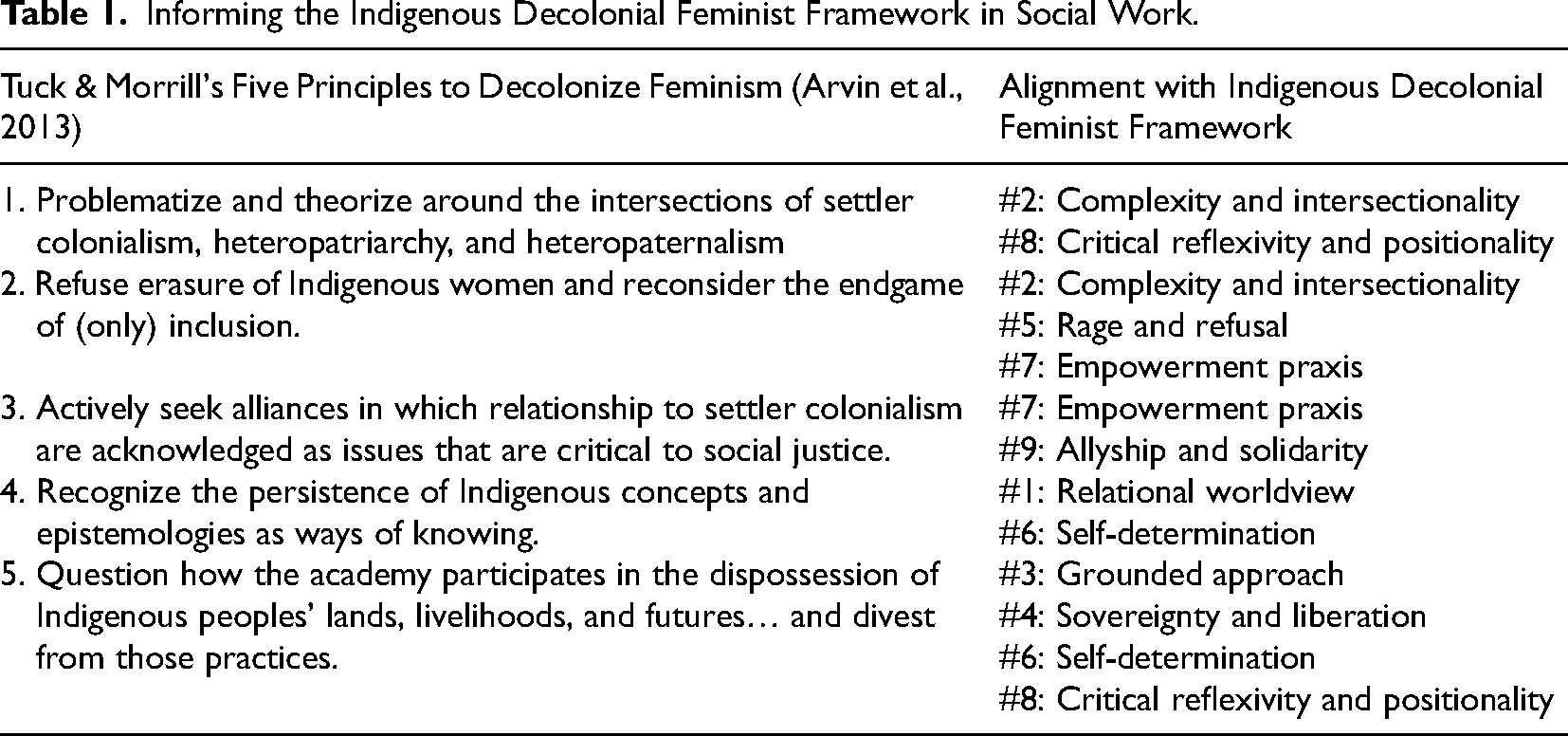
Decolonial feminism is not merely adding more Indigenous perspectives; it goes beyond ideas of inclusion. Too often Indigenous knowledge is expected to be collapsed or crushed to fit into western frameworks and ways of knowing. Decolonizing the canon makes space for Indigenous worldviews, to be defined on our own terms and in our own words. The following section delineates an Indigenous decolonial feminist framework as informed by Arvin et al. (2013) five principles to decolonize feminism. Table 1 delineates how these principles were mapped onto the subsequent framework, further explained below.
Informing the Indigenous Decolonial Feminist Framework in Social Work.
Decolonial Indigenous Feminism
The Indigenous decolonial feminist framework can be seen in Figure 1 below. The framework is split into three main sections: ideas, values, and actions. Ideas describe guiding ideological perspectives from which decolonial feminism in social work can start. The second section delineates decolonial feminist values that can be applied in any forum going forward. The third and final section recommends actions to embody decolonial feminism. This framework is not meant to be a specified or finite set of decolonial practices, but a space in for decolonization to be practiced with in various contexts (Arvin et al., 2013).
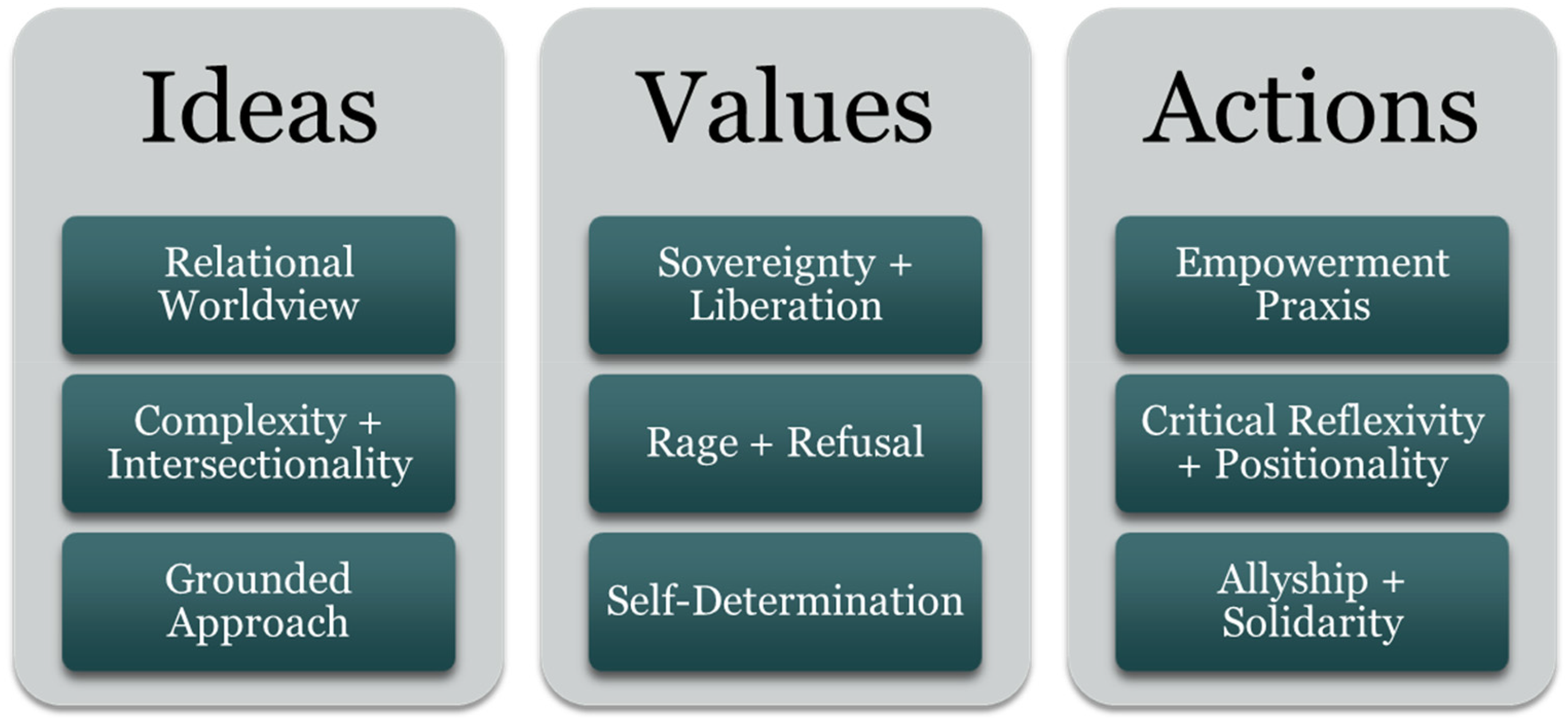
Indigenous decolonial feminist framework.
Ideas
Relational Worldview
To inform a decolonial feminist framework, one must begin with an understanding of Indigenous worldviews, particularly the concept of relationality. A worldview is defined as a set of beliefs and values that are held and honored by a community or group of people (Little Bear, 2000). This worldview informs how individuals and the group interact with the world around them (Little Bear, 2000). Indigenous worldviews center on the concept of relationality, the idea that everything and everyone are all related and connected. Our laws, kinship, and spirituality all reinforce this interconnectedness (Little Bear, 2000), this interdependence.
In applying a relational worldview to decolonizing feminism, we can take a holistic approach to achieving social justice. This relational worldview would account for settler colonialism across communities as we have all been impacted by colonialism and subsequent White supremacy. One such way to embody this relational worldview is to value connections between one another and our communities, centering our interdependence rather than western notions of independence. A relational worldview is complementary with Goodkind et al.’s (2021) critical feminist principles of a holistic worldview, relationships, trust, authenticity, and connection. We must begin any decolonial feminist effort by centering relationality, to begin our endeavors in a good way.
Complexity and Intersectionality
Similar to understanding relationality, decolonial feminism in social work must value both complexity and intersectionality. As previously mentioned, whitestream feminism in social work has separated Indigenous feminism from the overall movement or made hollow attempts to include Indigenous ways of knowing into the larger settler system. By valuing both complexity and intersectionality, decolonial Indigenous feminism can be embraced as part of the whole of feminism.
Within social work, it is vital to hold space for a multitude of complexities as we know systems of oppression are entangled and nearly impossible to address separately. Indigenous decolonial feminism encourages us to hold multiple truths, advocate for myriad of causes, and address overlapping systems of oppression simultaneously. An intersectional approach is paramount to understanding complexities of both Indigenous communities as they intersect with issues of gender, white supremacy, and social justice. Feminism can no longer see Indigenous women as just women; it is vital to account for both Indigeneity and gender, thus the need for intersectionality.
Grounded Approach
Indigenous feminism grounds programs, pedagogy, and practice in place-based Indigenous politics to deepen the overall discussion (Aikau et al., 2015). Moving beyond micro level context allows for a structural view that takes historical context into account, namely, settler colonialism past and present, and embracing a localized approach. Before scaling up and out, Indigenous feminism localizes the struggle first. Scholars call us to resist the “Free Tibet syndrome” in which progressive individuals are eager to demonstrate solidarity by “freeing” whatever country currently in the media, but largely miss the decolonial struggles in the areas that they work and live (Aikau et al., 2015).
Similar to the mindset of the “Free Tibet syndrome” is the parachuting nature of white saviorism where white outsiders to the community parachute in to save the individuals or communities they deem in need of saving. As a remedy to this, it is important to ground the work where you currently are, considering how multiple intersecting forces of race, class, gender, and sovereignty are operating in our own backyards (Aikau et al., 2015). From this grounded understanding, only from there can we then begin to establish strategies of resistance than can then be scaled up to the regional or global level (Aikau et al., 2015).
Values
Sovereignty and Liberation
As critical feminism in social work commits to liberation and seeking strategies to dismantle (Goodkind et al., 2021), Indigenous decolonial feminism also seeks to dismantle and disrupt all systems of oppression and advocate for tribal sovereignty and self-determination. In thinking of Indigenous decolonial feminism, the invitation is to imagine what does a truly decolonial future look like? How can we achieve collective liberation? We want actual structural change through meaningful concerted action and coalitions of solidarity more than commercialized taglines on campaign buttons or social media hashtags (Deer et al., 2021). Centering goals of sovereignty and liberation aligns with Goodkind et al.'s (2021) critical feminism principle of reimagining justice and care. Too often, frameworks jump right into action but fail to pause and direct movement toward a concerted goal. By up-fronting tribal sovereignty and liberation, decolonial feminism embodies social work's mission of social justice. Scholars can simply ask, how is what I’m doing today moving us closer to sovereignty and liberation? and adjust their behavior accordingly.
Rage and Refusal
Contemporary Indigenous feminism centers both refusal and rage in response to the settler-state's attempts to reconcile how they maintain control over unceded and stolen lands (Deer et al., 2021). Decolonization calls us to undo settler colonialism and white supremacy, which is no easy feat. Whitestream feminism has stereotypical connotations with positivity and the color pink, garnering a reputation as “Girl Boss” feminism (Clifford, 2022). This reputation brings with it the idea that feminists must be kind and mild mannered to be taken seriously; however, decolonial feminism disrupts this notion entirely. Indigenous feminist legends like Sarah Deer and Jodi Byrd invite us to consider the role of rage in our collective feminist struggle, and how rage can beget solidarity (Deer et al., 2021). Rather than policing anger or silencing disruptors of the status quo, how can mainstream feminists stand in solidarity with the collective rage of their marginalized peers? How can social work honor the right of refusal in communities without categorizing them as non-compliant?
Self-Determination
Extending upon the values of rage and refusal, decolonial feminism values self-determination. As one of social work's ethical responsibilities to clients, self-determination is defined as enhancing client's capacity to address their own needs. Within Indigenous communities, self-determination can best be understood by the phrase: Nothing about us without us – meaning that Native Nations have the right to determine what is best for us and what we need. This also includes highlighting our resilience and resistance to colonialism throughout time, again resisting notions of ahistorical social problems. Therefore, self-determination as a value of decolonial feminism honors the capacity to change while also holding firm that communities know what's best for them. An example of this in practice is best encapsulated by the quote from Pawnee scholar and activist Abigail Echo-Hawk speaking about working with Indigenous communities, “Come to us because we have the answers, not because you think we have the most problems” (UIHI, 2020).
Actions
Empowerment
Centering praxis in both critical and decolonial feminisms embodies the idea that knowing is not the same as doing, valuing embodied approaches and community action to address these wicked problems of our time. To move Indigenous decolonial feminist work forward, we must go beyond critiquing structures of power, such as settler colonialism, from the classroom and actively engage with the community (Aikau et al., 2015). Through praxis, we are called to go beyond the why of colonization and patriarchy and shift our focus to the how of decolonization (Aikau et al., 2015). A vital activity in praxis is envisioning alternative preferred futures for the next generation and uplifting work that contributes to Indigenous resurgence (Aikau et al., 2015). Kanaka Maoli (Native Hawaiian) scholars have put forth Indigenous resurgence as a model of praxis, planting seeds of liberation (Aikau et al., 2015). Active engagement and genuine inclusion are required to transform feminism (Bardwell-Jones & McLaren, 2020).
An empowerment praxis calls us to recognize both individual and structural challenges through a both/and approach, noting that the personal is still very much political (Goodkind et al., 2021). Decolonial feminism centers structural violence resulting from settler colonialism and ongoing historical oppression that have created, enforced, and sustained these disparities within Indigenous communities. Taking such a stance allows decolonial work to address both micro level issues facing Native women while simultaneously advocating for structural change for the betterment of all Indigenous and marginalized communities overall.
Critical Reflexivity and Positionality
Decolonial feminism challenges positivism through both critical reflexivity and positionality, beyond upfront statements of privilege but true critical reflection and application to the work. Kanaka Indigenous feminist scholars demonstrate the power of bringing people together for critical learning and strategizing for social change and decolonization (Aikau et al., 2015). One such way of doing this is through the Hawaiian concept of kuleana, which extends positionality through critical reflexivity (Aikau et al., 2015). Kuleana is described as the fluid understanding oneself in relation to the place where you are, living your responsibilities, authorities, and obligations (Aikau et al., 2015). It is also important to locate oneself in relation to the overall collective, considering human and non-human relations, living or dead, past and future generations (Aikau et al., 2015).
Decolonial feminism embraces critical reflexivity and positionality throughout the entirety of the work, not just upfront parking lot approaches to privilege. White feminism has largely embraced the idea of checking one's privilege, but often uses this as a benchmark or check box to show that they are doing the work without any true critical application to the work. Rather than leaving their privilege at the door or out in the parking lot, critical reflexivity and positionality require an ongoing conversation on the myriad ways that our individual and collective identities interact throughout the work. It is an iterative process of embodied decolonial scholarship and accountability.
Decolonial feminism continues to embody critical feminist principles in questioning assumptions by interrogating the lasting legacy of settler colonialism carried out through western ways of knowing (Tuhiwai Smith, 2012). Indigenous scholars have described this phenomenon as research through imperial eyes – the approach that assumes western ideas about our fundamental reality are the only ideas possible to hold (Tuhiwai Smith, 2012). Decolonial feminism refuses this notion of reality, holding that our traditional knowledge and ways of being are just as valid as western science purports.
Allyship and Solidarity
Similarly in taking a stand in critical feminism (Goodkind et al., 2021), decolonial feminism requires explicit allyship and prioritizing of Indigenous voices to the front. Decolonial feminism puts forth allyship and solidarity as an invitation to learn about one another as resisters to the coloniality of gender (Mack & Na’puti, 2019). To build critical allyship and solidarity, scholars have recommended the decolonial feminist strategy of witnessing in order to build coalitions by decentering one's voice in favor of centering Indigenous voices (Mack & Na’puti, 2019). It is important for settler allies to know when and where to step up, step back, or step out (Aikau et al., 2015) in addition to engaging in radical self-examination of settler bias and hidden gendered or colonial logics (Bardwell-Jones & McLaren, 2020). Will whitestream feminists identify as settlers? Can whitestream feminists at least commit to the idea that decolonization is not a metaphor? (Aikau et al., 2015; Tuck & Yang, 2012). Native feminists are awaiting your response.
Who is making the call to decolonize and Indigenize feminism? The majority of calls for decolonial scholarship have been led by self-identified settlers (Bardwell-Jones & McLaren, 2020). Even in Johnstone & Lee's (2021) call to center Indigeneity in social work, they self-identify as “settlers who align with feminist social work scholars” (p. 377). The present author is a decolonial Indigenous scholar, weaving both empirical knowledge and my own embodied life experiences through generational wisdom, tradition, and culture.
Acknowledging complicity is an essential action for building allyship and solidarity. Addressing these power differentials begins with naming social work's complicity in whitestream feminism and the legacies of harm from both social work and feminism as movements (Goodkind et al., 2021). Decolonization is the undoing of colonialism, which must begin with acknowledging the harm, complicity, and failure to act since the acknowledgment itself. In 2021, the Council on Social Work Education (CSWE) released the Statement of Accountability and Reconciliation for Harms Done to Indigenous Peoples (Weaver et al., 2021). This is a first step toward acknowledging harm and complicity on behalf of social work, particularly against Indigenous communities. However, it remains to be seen how social work education will respond to this acknowledgment, and ultimately what structural changes or actions will be taken.
Case Example: Indigenous Feminists Decolonizing the Academy
The following section demonstrates how the framework can be applied to practice through the lens of decolonizing the academy. Decolonial feminism ensures both Indigenous culture and presence become prominent features of the feminist canon (Bardwell-Jones & McLaren, 2020). Colonial practices of distance and unknowing permeate whitestream feminism (Mack & Na’puti, 2019). Distance is a hallmark feature of colonial education; this can be seen in how outsider perspectives are privileged throughout research under the guise of objectivity (Smith, 2012). Those who are outside of the community being studied are seen as experts; however, those seeking to do work within their own communities have historically been criticized as being too close. This practice of outsider objectivity ultimately leads to work that encourages White savior perspectives rather than insider accounts. Whitestream feminism perpetuates this practice of distance when it fails to account for social location, identity, and critical reflexive positionality.
Similarly, western concepts of distance are complementary to practices of unknowing in the academy. Unknowing is described as an epistemology of ignorance (Adams et al., 2015, pg. 215). Unknowing is the tendency to imagine and study social phenomena abstracted from their historical and social contexts (Adams et al., 2015). The academy encourages scholars to practice unknowing as it continues to treat colonial violence as an artifact of the distant past, having no bearing on scientific work in the present (Smith, 2012; Adams et al., 2015). Whitestream feminism practices unknowing by failing to recognize and upfront the importance of history, particularly complicity with settler colonialism and resulting White supremacy throughout the field. Decolonial Indigenous feminism addresses both distance and unknowing through the practices of both critical reflexivity and positionality and place-based politics, grounding the work in both historical and current physical landscapes.
Indigenous decolonial feminism interrogates traditional academic knowledge production by repositioning ourselves from seeing ourselves as consumers of knowledge and shifting our focus to being in right relation with knowledge. This fundamental shift in focus is the embodiment of a relational worldview, focusing on the interdependence between the knowers and the knowledge. Further, allies working with Indigenous knowledge are called to see themselves as knowledge keepers, a sacred and lifelong responsibility that extends beyond a research project (Asher BlackDeer, in press a; Alderson, 2020). Finally, Indigenous decolonial feminism embodies this through prioritizing traditional knowledge and generational wisdom just as highly as peer-reviewed journal articles.
Decolonial Indigenous feminists have done this in multiple ways, from inviting elders into the classroom, sharing recordings or podcasts of traditional storytellers and elders, and even creating entirely new additions to the curriculum which center Indigenous ways of knowing and knowledge transmission. Through the combination of being in relationship with knowledge and scholarship as well as uplifting other ways of knowing and being, particularly from our communities, we contribute to the collective and ongoing effort to decolonize the academy and shift the feminist canon toward our embodied praxis.
Where Do We Go From Here?
To move this work forward, feminism must take seriously how land and sovereignty play a role in perpetuating colonialism (Bardwell-Jones & McLaren, 2020). Learning about divergences in Indigenous feminisms and mainstream feminisms is a great place to start, but why further interrogation is warranted. Additionally, feminism and social work must identify what relationships exist and do not exist between Indigenous and all non-Indigenous feminisms in social work to determine what relationships we hope to create in the future (Aikau et al., 2015). It is the hope of the present author that this work may serve as a catalyst to reignite this conversation in order to encourage coalition-building and solidarity across our movements.
Finally, white feminism has failed to reckon or engage with decentering whiteness and colonial epistemologies (Mack & Na’puti, 2019). Indigenous decolonial feminism makes the call for social work to interrogate their role in perpetuating whiteness and western ways of knowing. While this framework is just the beginning, future work should continue to address and interrupt whiteness in social work feminism.
These principles of Indigenous decolonial feminism can guide us in the overall mission of unsettling feminism in social work to address the enduring legacies of settler colonialism and white supremacy. Feminist scholars should engage in decolonization (Mack & Na’puti, 2019). Decolonial feminism is an expansive liberatory framework that invites a paradigm shift in feminism overall. Through the combination of decolonization and the work of unsettling feminism, Indigenous communities can come to the forefront of feminist struggle and movements for social justice. Social work is at a pivotal moment in reckoning with its past and planning for a better future, and Indigenous decolonial feminism can be part of this reconciliation. The time is now to unsettle your feminism and begin imagining a decolonial future.
Footnotes
Declaration of Conflicting Interests
The author declared no potential conflicts of interest with respect to the research, authorship, and/or publication of this article.
Funding
The author received no financial support for the research, authorship, and/or publication of this article.
