




Abstract
Despite serious health and mental health problems associated with weight stigma and dieting, many health providers consider intentional weight loss to be a positive pro-health intervention. Alternatively, the fat activist movement challenges weight prejudice and advocates for the equitable treatment of individuals with diverse body types. Inspired by the work of fat activists, this article encourages social work educators and practitioners to critically deconstruct anti-fat social norms and to integrate body-positive interventions within micro, mezzo, and macro practice. Fat activism complements critical feminist, queer, and disability justice frameworks that are relevant to this special issue on critical feminist inquiry.
In the United States, cultural and social norms idealize Westernized beauty standards and consider weight to be a measure of health, worth, morality, and personal character (Akbar & Panichelli, 2019; Felkins, 2019; Gordon, 2020). Although fatness is typically interpreted as a moral failing that must be ‘cured’ (Afful & Ricciardelli, 2015; Fathi, 2011), weight is primarily a reflection of factors outside of one's control including social determinants of health like poverty, environmental health, discrimination, lack of access to quality health care, and sociocultural identity (Institute of Medicine, 2004). Fat individuals can experience intolerance in the form of microaggressions from friends, family, peers, and healthcare professionals (Parker & Pausé, 2018) and verbal and physical harassment (Gordon, 2020; Rice, 2007). The stigmatization of fatness and fat people contributes to a litany of issues including low self-esteem (Crocker et al., 1993); depression, anxiety, and eating disorders (Vogel, 2019); peer rejection, victimization, and teasing (Musher-Eizenman et al., 2004); and employment, health care, and education discrimination (Jackson et al., 2015). Despite serious consequences, weight stigma and anti-fat beliefs are so hegemonic in the United States that they tend to go unquestioned or, worse, are favorably interpreted as a motivation to help people lose weight.
Because anti-fat beliefs and practices are deeply ingrained within the United States and its health care systems, social workers and their professional associations risk embedding harmful and discriminatory anti-fat beliefs and practices in their work. In this article, we argue that social workers and their professional organizations must critically examine and disrupt engagement with anti-fat interventions instead of perpetuating weight stigma and anti-fat discrimination. To this end, we will begin by deconstructing cultural understandings of fatness. We will then provide a brief history of the fat activism movement and discuss how social work risks contributing to anti-fat bias. Finally, we will provide tangible examples of how to embed fat activism in micro, mezzo, and macro practice, as well as social work education.
Shifting Cultural Understandings of Fatness
Fat activism draws upon critical feminist theory, fat studies, critical weight science, and disability studies to emphasize a new understanding of fatness (Mollow, 2017). It reevaluates and critiques post-positivist research regarding the relationship between weight and health, criticizing biomedical interpretations of fatness (Conrad & Barker, 2010). Fat activists explicate how health is socially constructed and promote critical analysis that emphasizes how political, economic, and cultural structures influence interpretations of fatness (Chrisler & Barney, 2017, Hussain et al., 2022). Fat activists, and we as authors, do not use the terms ‘obese’ 1 or ‘overweight’ because they suggest that there is a standard desirable weight, ignoring naturally occurring body diversity (Meadows & Daníelsdóttir, 2016, as cited in Ellis-Ordway & Ramseyer Winter, 2022). Instead, we use the word ‘fatness,’ reclaiming it in a way that rejects the medicalization and pathologization of fat people and normalizes it as a term without negative bias.
Fatness has not always been interpreted as an epidemic or a measure of people's—especially women's and trans femmes’—worth (Akbar & Panichelli, 2019, Fraser, 2009). Before 1890, medical providers believed that fatness was healthy, a sign of fertility and advantageous in fighting infectious diseases (Fraser, 2009). However, after the 1890s, European standards of beauty shifted toward slender aesthetics, and a small body size was used as ‘evidence’ of white racial superiority (Strings, 2019). Larger Black women's bodies were sexualized for their ‘robust’ shape and concurrently viewed as ‘slothful’ (Strings, 2019, p. 88). At the same time, as technical advances increased the production of cheap food, fat was no longer associated with wealth (Fraser, 2009).
Despite professional and scholarly criticisms that body weight is a poor indicator of health (Fletcher, 2014; Gordon, 2020; Stoll, 2019), medical professionals, researchers, and public health officials use the body mass index (BMI) as a measure of health. However, BMI does not account for muscle mass (Mahadevan & Ali, 2016) nor body changes like increased body fat, decreased muscle mass, and decreased bone density that occur naturally due to aging (Rothman, 2008). Contemporarily, BMI is problematically utilized in the Diagnostic and Statistical Manual of Mental Disorders, 5th edition (DSM-5) to assess and diagnose eating disorders. This results in barriers to treatment as fat individuals with a higher BMI are frequently seen as not sick or thin enough to receive treatment, particularly in U.S. health care systems (Harrop, 2019; Obesity: Facts, Figures, Guidelines, n.d.).
A Brief Overview of the Fat Activist Movement
The National Association to Advance Fat Acceptance (NAAFA) was founded in 1969 to challenge anti-fat bias and discrimination while promoting the civil rights of fat individuals. Its tactics included letter-writing campaigns and community building (https://naafa.org/aboutus). Although it has done positive work in creating community, some have recently critiqued its organizational leadership hierarchies, membership dues, Western notions of activism, and predominantly white leadership and membership (Cooper, 2016).
The radical feminist activist group the Fat Underground was founded in 1979. It published the Fat Liberation Manifesto as the first call to action and unification of its kind in the United States. Its authors argued that respect and recognition must be an entitlement for fat people: We are angry at mistreatment by commercial and sexist interests. These have exploited our bodies as objects of ridicule, thereby creating an immensely profitable market selling the false promise of avoidance of, or relief from, that ridicule. We see our struggle as allied with the struggles of other oppressed groups, against classism, racism, sexism, ageism, capitalism, imperialism, and the like (Freespirit & Aldebaran, 1979, p. 18).
The Health at Every Size (HAES) movement evolved from NAAFA and the Fat Underground in 1995. This initiative takes a weight-neutral approach to wellness and acknowledges the normalcy of body diversity (Wotasik, 2013). Contemporarily, HAES is working to shift the ways in which social workers, registered dietitians, and other eating disorder providers approach care for fat people, for example, by integrating community building as part of treatment. One example of this shift includes the development of solidarity-based and peer-led groups composed of people with eating disorders, clinicians who implement and champion HAES, and clinicians with eating disorders (Hicks, 2022). Although organizations like NAAFA, the Fat Underground, and HAES deserve recognition for their work to shift consciousness about the rights of fat people and the connections between capitalism and anti-fat bias, historical accounts of fat activism tend to center around these white-dominated organizations, neglecting the Black activists of the movement. Consequently, Black fat activists like Johnnie Tillmon and Margaret Bass, who pushed for fat liberation beginning in the 1960s, are nearly invisible (“The Black, Femme History,” 2022). Additional research is needed to their stories, as well as those of organizations such as the Association for Size Diversity and Health, which was developed by and for Black women and femmes, and NOLOSE which focuses on the queer community and its intersecting identities.
The contemporary fat activist movement fights for fat liberation in at least three ways (Cooper, 2016). First, it centers the voices of fat people, using an intersectional approach that prioritizes the most marginalized fat people and works to grow sufficient social power for fat people to be participants in their liberation. Second, it organizes to promote policy changes that prioritize equitable treatment and access to care. Third, it supports cultural changes including the disruption of weight prejudice and the internalization of fat stigma. Fat activists integrate many social change practices including consciousness raising and community building; their tactics include street protests, political demonstrations, and artistic work like zines, political theater, and photography (Matacin & Simone, 2019).
Social Work and the Danger of Anti-Fat Bias
Although some social workers integrate principles of fat activism within their practice—perhaps without naming it as such—there is a danger that, without critical analysis, they can act as ‘norm enforcers,’ who interpret intentional weight loss as a positive pro-health behavior. For example, although most bodies cannot maintain intentional weight loss, some social workers incorporate it into their practice as an achievable goal. Our recent search in the commonly used directory Psychology Today yielded results from thousands of social workers whose profiles advertise support for weight loss and the ‘o-word’ epidemic. This suggests that many social work clinicians’ profit from the body dissatisfaction of their clients (Taylor, 2018). Additionally, social workers who claim to support weight loss may be practicing outside of their scope unless they have dietetic training.
Social workers who prioritize weight loss risk causing harm to clients. By assessing, diagnosing, and treating fat individuals as at risk, they can contribute to a diet culture that leads individuals to believe that weight gain is a personal failing caused by a lack of willpower rather than a complex set of biological, physiological, psychological, and social determinants. Because bodies cannot tell the difference between a diet and starvation, weight gain can be a protective biological response, and 95 percent of individuals who diet will regain lost weight and more despite maintaining their diet and exercise program (Gordon, 2020; Mann et al., 2007; Miller, 1999). Studies of fat adolescents and adults find that concerns about weight and experiences of weight discrimination are associated with developing eating disorders and bulimic behaviors (Field et al., 1999). Social workers will provide better care if there was more examination of dominant messages from diet culture like my body is unacceptable and I must take personal responsibility to shrink it rather than uncritically supporting weight loss.
Conclusion: A Call to Incorporate Fat Activism in Social Work
When social workers fail to challenge belief systems relating to weight stigma and anti-fat bias, they risk causing harm or perpetuating dangerous social norms. Alternatively, by incorporating fat activism into their practice—micro, mezzo, macro, or the intersections therein—social workers can promote social justice, shift social norms, and support people who are working to accept, nourish, and care for their bodies regardless of their size.
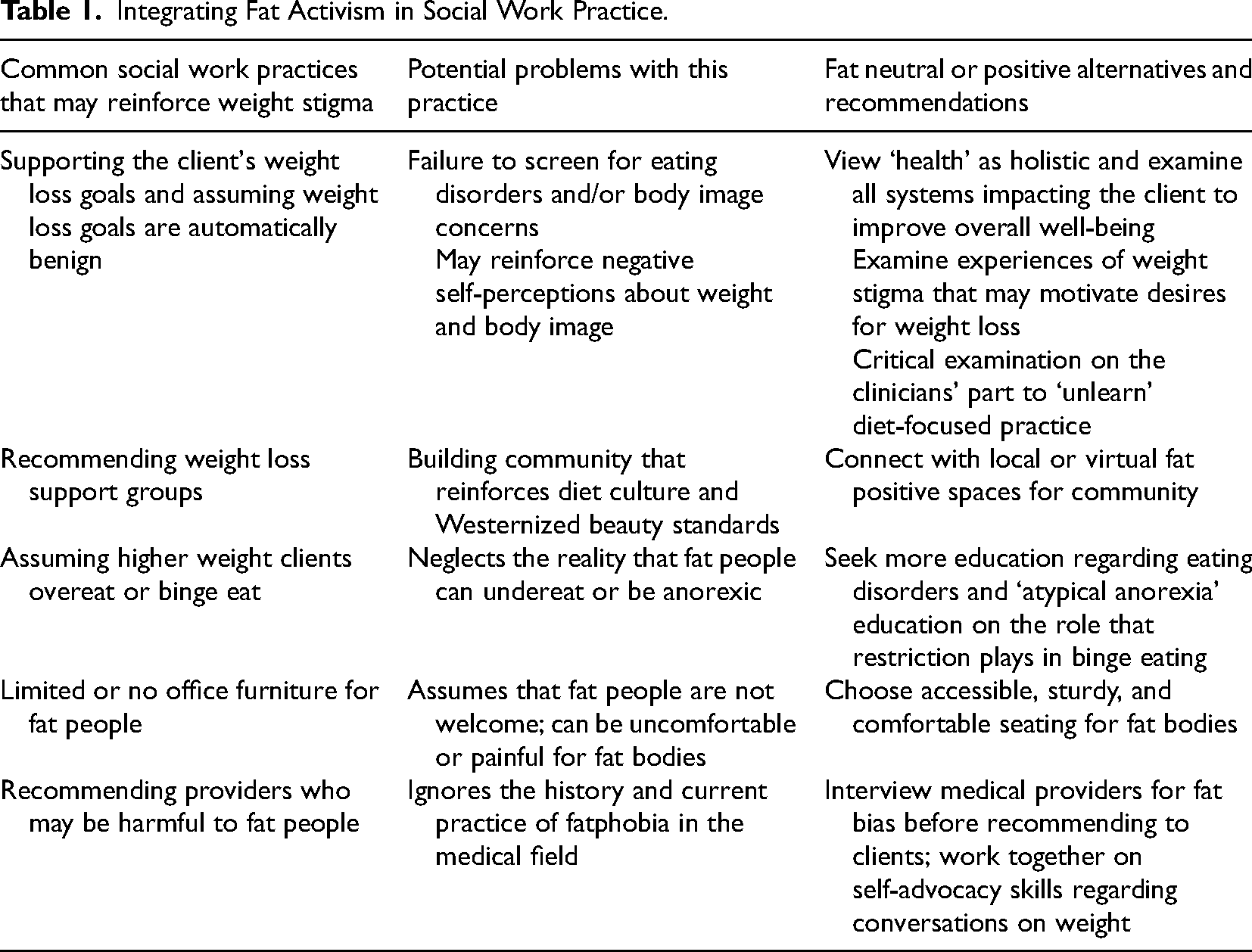
On a micro level, social workers can incorporate fat activism into therapeutic processes through the integration of body sovereignty and radical self-acceptance of one's body (Taylor, 2018). The process of shifting one's understanding of fatness and anti-fat bias—with the help of a social worker or mental health provider—can be transformative. For example, after years of weight loss treatments, therapy modalities, and ‘lifestyle changes,’ [Author A] found a therapist who introduced her to fat activism. Before this work, it never occurred to her that perhaps her body was never the problem and she did not need to fix, cure, or apologize for its existence. (Table 1).
Integrating Fat Activism in Social Work Practice.
On a mezzo level, fat activism can be a framework used to create community and critical consciousness through shared experiences. These communities can cultivate camaraderie and joy. Fat-centered community events include fat clothing swaps, fat pool parties, fat hiking, and other joyful movement tailored to fat bodies. They can also provide support and tangible resources, including advice about advocating for oneself with family, peers, and health care professionals. In some cases, conscious communities can lead to collective action toward common goals and social change (Sturmer et al., 2003).
At a macro level, fat activism provides a framework to challenge the anti-fat bias and discrimination embedded in health care policies, medical industry practices, and employment. It shifts the focus from individualized to structural approaches that include challenging cultural norms and addressing social determinants of health such as inequitable access to food, mental health care, safe and affordable housing, and reliable income (Ellis-Ordway & Ramseyer Winter, 2022; Gerend et al., 2021). Its intersectional approach centers on the well-being of individuals with multiple marginalized identities including people of color; women and femmes; and people who are poor, disabled, queer, transgender, and nonbinary.
Fat activism needs to be incorporated within social work education. A recent study analyzed the curriculum and syllabi of 100 U.S. social work graduate programs accredited by the Council of Social Work Education. Its authors could not identify a single program that included the size or weight as a dimension of diversity or a determinant for oppression and socioeconomic injustice (Wood et al., 2020). Instead, 37 programs examined fatness as a health issue using a medicalized deficit-based approach (p. 66). Integrating fat activism within social work education can encourage body sovereignty as opposed to body surveillance.
In conclusion, due to its promotion of body sovereignty, social action, and institutionalization of cultural norms and social policies that support vulnerable and exploited people and communities, fat activism aligns with principles embedded in feminist social work practice (Ellis-Ordway & Ramseyer Winter, 2022) as well as the National Association of Social Workers’ Code of Ethics (NASW, n.d.). Social workers have an ethical responsibility to challenge weight stigma, dismantle oppressive structures that harm fat individuals, and promote care and justice through this paradigm shift.
Footnotes
Declaration of Conflicting Interests
The author(s) declared no potential conflicts of interest with respect to the research, authorship, and/or publication of this article.
Funding
The author(s) received no financial support for the research, authorship, and/or publication of this article.

Note
In the remainder of the paper, we replace the use of these terms with ‘o-word’ because some fat activists consider them to be anti-fat slurs.