




Abstract
Bereaved fathers dealing with political loss provide an under-examined experience of living with unbearable pain. Drawing on an anti-colonial feminist framework, this article analyzes the written and visualized pain of bereaved Palestinian fathers posted on Facebook. This study approaches cyberspace as a meaningful site for theorizing the suffering of a people living under state violence. I focus on three portraits shared by fathers, which include texts, photos, e-comments, and e-interpretations. By considering the narratives and reactions evoked by these portraits, this study reveals complex transformations of individual and collective pain, loss, and grief. The study further suggests that visualizing fathers’ pain on social media provides a space for fathers to navigate trauma. They achieve this by traversing traumatic confusion into a state of survival and agency while challenging structures of dehumanization, dispossession, and death.
Introduction
Cyber platforms are meaningful spaces for people who live under oppression to express pain and resist domination (Giaxoglou, 2014; Keller et al., 2018; Otman, In press; Shalhoub-Kevorkian, 2011; Spears-Rico, 2019; Zia, 2020). When mainstream news and social media outlets are surveilled and censored by the state (Aouragh, 2008; Bonilla & Rosa, 2015; Shalhoub-Kevorkian, 2012; Tawil-Souri & Aouragh, 2014; Tufekci & Wilson, 2012; Zia, 2020), cyber platforms are often used as counter spaces of speech, defiance, and solidarity. Utilizing cyberspace to express feelings of loss and suffering, therefore, represents a form of meaning-making (Getty et al., 2011; Giaxoglou, 2014) where images of pain become part of the narrative stabilization process that seeks to produce stories from fragmented events into a matrix of meanings and culture (Duaphinee, 2007). Misri (2019) indicates how visualizing the pain of the wounded allows us to bear witness to the wounding inflicted by a dominating power. This witnessing gives rise to modes of exhibiting truths of pain (Lloyd, 2000; Sontag, 2003).
This article analyzes the written and visible pain of bereaved Palestinian fathers posted on Facebook. It specifically examines portraits shared by fathers (texts, photos, e-comments, and e-interpretations offered), and considers the narratives and reactions evoked by the portraits. When pain finds a voice, it begins to tell a story (Scarry, 1985). Fanon (1963) argues that pure and spiral violence is inherent in dominating the colonized life. He shows how the colonial government speaks the language of oppression and puts it into practice. The state brings it into the home of the colonized,, inscribing it on the body and the mind of the native (Fanon, 1963). Accordingly, the article presents a feminist analysis of fathers’ pain, loss, and suffering amidst ongoing dispossession and violent structures of the settler-colonial regime in Occupied East Jerusalem (OEJ) and the West Bank. To challenge hegemonic understandings of fathering and fatherhood, I situate the praxis of understanding Palestinian fathers’ resistance to colonial oppressive structures within feminisms, specifically anti-colonial feminism (Hall, 2016; Shalhoub-Kevorkian, 2010). In doing so, this study explicates the complexities of fatherhood amidst death and dispossession in Palestine, and reveals new forms of survival and refusal.
The article begins by mapping the scholarly landscape on fatherhood within the context of political violence, psychological pain and trauma, and its portrayal on social media. The next section presents the study’s methodology. The third section presents an analysis of pain from three portraits of bereaved fathers. By examining the way fathers narrate their pain, I examine the process of meaning-making that comes from unbearable loss. Specifically, I analyze modes of “e-fathering;” electronic modes of fathering in cyberspace (Otman, In Press), generated, performed, and maintained under militarized surveillance and loss. The paper concludes by critically examining the role of fatherhood when responding to agonizing loss under the conditions of settler colonialism, leading social workers and therapists to utilize anti-colonial analysis of fatherhood in their practice.
Fatherhood in the Context of Colonial Violence
In order to situate my analysis within the existing literature on fatherhood within the context of colonial violence, I offer a brief overview of how scholars have analyzed fatherhood across Indigenous and settler-colonial contexts. Violent colonial policies produce fissures in the sociocultural transmission of fathers’ roles across generations and create challenges for Indigenous fathers’ sustained involvement with their children (Hunter, 2006; Manahan & Ball, 2007; Richter & Morrell, 2006). Duran and Duran (1995) argue that colonialism dismantled traditional male roles within Indigenous communities in Canada by destroying their traditions, as men were often the protectors of families and communities. Manahan and Ball (2007) further claim that practices such as removing children from family homes to place them in residential schools, and the stripping of land from communities, disrupted fathers’ roles within the family. The suppression of men’s ability to father coupled with the fragmentation of traditional community systems has lasting intergenerational traumatic effects on Indigenous fathers (Manahan & Ball, 2007). Similarly, in South Africa's Cape Town, fathers had been considered the home protectors, providers, and role models until the early 20th century when colonial seizure of lands, imposition of extraordinary taxes, and the tremendous need for labor in the diamond and gold mines resulted in many being forced into the colonial market (Ramphele & Richter, 2006).
The continuous military occupation of Palestine since 1948 manifests through daily, punitive policies and actions against the Indigenous Palestinian people. These policies and practices include but are not limited to displacement, restrictions on movement, demolition of homesteads, arrest, and killing. The continued experience of oppression and political violence undermines gender hierarchies (Giacaman & Johnson, 2013; Johnson & Kuttab, 2001; Peteet, 1994; Shalhoub-Kevorkian, 2003), and challenges parenting practices (Barber, 1999; Qouta et al., 2008; Shalhoub-Kevorkian, 2019). As such, punitive policies particularly affect the role of fatherhood (Gokani et al., 2015; Otman, 2020; Rabaia et al., 2018).
Under military occupation, Palestinian fathers face daily oppression, poverty, unemployment, lack of mobility, decreased access to social and health services, and violence. These phenomena impede fathers’ abilities to safeguard their children (Gokani et al., 2015). The protection hierarchy typified by the parent–child relationship where parents protect their children is disrupted by the occupation (Gokani et al., 2015, p. 212). Shalhoub-Kevorkian (2015a) notes that the Israeli authorities incapacitate parents by making it impossible for them to help and protect their children. In addition, children witness their parents cry, plead, and beg in front of the Israeli military, particularly when the military invade Palestinian homes to arrest fathers and\or their children. A recent report by human rights organizations shows how violent home invasions may rupture the image of the father as the head and protector of the family, both in his own eyes, and those of family members (Wijler & Stahl, 2020). I’ve noted elsewhere (Otman, 2020) how colonial penetration of the family disrupts a father’s ability to maintain family cohesion, prevent threats against one’s family, and secure a smooth day-to-day functioning home environment. I’ve defined such an effect of colonial trespassing of fatherhood as “handcuffing” (Otman, 2020). Shalhoub-Kevorkian (2019) defines settler colonialism’s brutal penetration of fathers’ roles as “unfathering.” To counter colonial handcuffing and unfathering, I have discussed elsewhere (Otman, 2020) how Palestinian fathers insist on offering creative and flexible modes of protection that subvert the violence of settler colonialism. I continue to focus on this creativity and flexibility exhibited by fathers in this study but within experiences of bereavement and loss.
Trauma, Pain, and Loss Amid Colonial Violence
The effects of unfathering add to the trauma and pain Palestinians already experience as a people under occupation. Furthermore, these experiences create cascading effects on their internal and social structures. Martin-Baro (1989) argues that people under oppression experience a “psychosocial” trauma due to the colonial power’s mission to dehumanize and alienate them in order to dominate. The psychosocial trauma implies that every person will be affected according to their particular social context (Martin-Baro, 1989). Those who survive traumatic events often feel an overwhelming obligation to bear witness to the shattering of their fundamental assumption of their daily existence (Janoff-Bulman, 1992). The pain of trauma can be so deep that it becomes un-sharable through language (De Mel, 2007). When settled assumptions are shattered, so is language, as language is part of the social order, “What we can say no longer makes sense; what we want to say, we can’t. There are no words for it” (Edkins, 2003, p. 8).
How can we share the indescribable and the unbearable asks Jelin (2003, 2007)? Philipose (2007) argues that pain can be communicated through language via metaphor and analogy since emotional pain does not require complete articulation to be expressed. Philipose also proposes that certain kinds of pain are embodied and become core components of a person’s everyday lived experience, as pain remains with the individual long after the trauma is healed. Scholars have explored the ways coping with suffering is influenced by religious beliefs (Abu-Raiya & Pargament, 2015; McMartin & Hall, 2021; Pargament & Lomax, 2013), culture (Eggerman & Panter-Brick, 2010; Sharma, 2020) and spirituality (Nabolsi & Carson, 2011; Schnitker et al., 2017). Sayigh (2015) argues that silencing is itself a cause of suffering and deepens pain and loss.
In this study, I have chosen to focus on coping with suffering within the context of settler colonialism. This context requires us to not only consider the suffering that is seen, witnessed, and heard, but also the suffering that is hidden within and silenced. How should one inhabit such a world that has been made strange through the desolating experience of pain, violence, and loss (Das, 1997)? Assuming that mourning is a transaction between the language and the body, Das (1997) suggests that we inhabit this world by mourning it, as mourning is a transaction between the language and the body. Laments are an anguished cry that stands between language and silence, between expression and annihilation, an expression of crippling pain in the face of an almost unspeakable reality (Batnitzky, 2014). For example, within certain cases in India, mourning laments are women’s work as they draw with their bodies, bearing witness in public to death (Das, 2003). Laments are an anguished cry that stands between language and silence, between expression and annihilation, an expression of crippling pain in the face of an almost unspeakable reality (Batnitzky, 2014).
In analyzing fathers’ accounts, I listened for specific elements cited in previous research, such as moments of silence, lamentation, and attempts to build collective memory to understand their coping strategies. Das (2003) asks how life after such cruel loss and violence can be redeemed? To answer this question, she engages with Mbembe’s (2002) argument of creating a collective identity by finding meaning and recovery in the memory, which is done through self-creation and self-presentation that is conceptualized as a form of self-writing. Halbertal (2014) emphasizes that lamentation language operates in full gear: “reality doesn’t make sense anymore, but language has stayed intact; it is the only weapon left.” When the lamenter writes his pain, he declares that “here I am, not in shock, not at all mute. I will call upon all available linguistic resources to declare my truth. Since everything was destroyed there is nothing to lose but what is left of my integrity.” (2014, p. 5).
Recognizing victims’ narratives is crucial because recognition forms the basis for transnational solidarity (Dalley, 2015). Colonial encounters connect disparate experiences of pain and create sociopolitical ties across cultures (Dalley, 2015; Zia, 2020). Such experiences contribute to collective politics, suggesting that mourning fuels people’s resistance, and viscerally connects people’s struggles, giving rise to “affective solidarity” (Zia, 2020). Martin-Baro’s work encourages us to consider the psychology of the whole; to study the individual and collective effect of political violence, and the damage caused to the social structures (Martin-Baro, 1994). He claims that political violence undermines trust among individuals in a community, crushes their ability to be in solidarity, and damages social relations, and consequently the collective capacity to cope with their circumstances (Martin-Baro, 1994). This study will show how continuous colonial trauma creates everlasting pain for Palestinian fathers, but they use those experiences to fuel their psychosocial resistance and refusal.
Visual Representation of Pain and Grief on Social Media
Feminist scholars demonstrate how visual production can serve as a marker of pain silenced by the state (De Mel, 2007). Such visual productions produce political spaces to speak back and express outrage (Duaphinee, 2007; Misri, 2019; Saramifar, 2019). By centering the overlooked and neutralized, visual productions reveal the dire need to “make sense” of pain. As Misri (2019) argues, visual productions of the wounded in Kashmir seek the recognition of their wounded humanity, an act that is political in nature. In the same manner, Scott (2014) argues that martyrdom death imagery captures the public trauma moving from mere testimony into symbolism that contains a distinct moralizing force, providing an ever-increasing power with which to mobilize solidarity.
Saramifar (2019) argues that photos of pain and loss are used to serve the master narrative of the state’s political agenda, and alternatively, can be used to convey a counternarrative that disturbs the state. Rather than images of the dead heroes on the battlefield, photos can also provide a platform to document people’s suffering, “bitterness,” and victimhood. These “disrupting” photos let the pain of the people remain apparent via a frame captioned, authored to garner sympathy and attention. The varied reactions to these photos demonstrate the politicization of suffering, fluid notions of pain, and the challenging terrain of framing the pain of others. Thus, images are not displayed for the sake of imagery itself, but they assist in the meaning of the narratives that come to be associated with the imagery (Duaphinee, 2007). Therefore, images have the capacity to animate important forms of political resistance (Duaphinee, 2007), and forcefully call attention to the unequal terms on which the human is constructed. These types of visual narratives decolonize what it means to be human, gesturing toward new ways of envisioning humanity in occupied zones (Misri, 2019).
Feminist Investment in Speaking the Unspeakable
Previous studies indicate that the internet is a major site for channeling and expanding a therapeutic space that encourages the sharing of stories and builds support networks (Giaxoglou, 2014). Feminist scholars argue that sharing and making visible “unspeakable experiences” on digital media fosters a supportive sense of community that challenges the status quo (Gajjala, 2002; Keller et al., 2018; Shalhoub-Kevorkian, 2011). Affective solidarities built through social media influenced women off-screen and in daily life, giving them strength and power to cope with, and challenge atrocities (Keller et al., 2018; Zia, 2020). Feelings and emotions can reverberate in and out of cyberspace, change and take on new meanings (Kunstman, 2012). This in turn creates digital structures of feelings that work together and produce a tapestry of affects related to the wider context of culture and politics (Kunstman, 2012). In addition, Getty et al. (2011) suggest that bereavement posts seek collective support, suggesting that web mourning offers increased opportunities for visibility of the mourners and the deceased (Getty et al., 2011).
Under oppressive regimes, attesting to injustice in a public sphere is censored and highly manipulated by the state, such that mourning expressed on social media plays a crucial role in challenging authoritarian political rule (Direk, 2020). Perera (2016) argues that “survival media” is used by refugees to make their suffering traceable, and enables them to haunt their oppressors and demand justice (p. 22). “Survival media” includes bodies, space, and cultural forms that refugees engender to witness and break the silence of their suffering by drawing attention to their hopes and inspirations. Spears-Rico (2019) argues that Indigenous communities resist their disposability by engaging with technology as a means of building network sovereignty for the purpose of bearing witness to atrocities and rehumanizing themselves. Otman (In Press) suggests that bereaved fathers’ psychosocial cyber practices of posting on Facebook are acts of resistance, enabling them to create new modes of fathering after the ordinary modes have been stripped by colonial power. Hence, “E-fathering” is a strategy Palestinian fathers invented to navigate loss recreating their own anti-colonial psychosocial practices (Otman, In Press). This current study expands on this strategy by incorporating community interactions with the fathers’ posts and further analyzes pain as a space of resistance.
Methodology
Responding to Jelin’s (2003, 2007) question “How can we tell the indescribable and the unbearable?,” this study analyzes the pain of Palestinian bereaved fathers through their own narrations on Facebook. Largely overlooked in the past, visual materials are now being used more frequently to undertake narrative and biographical research (Roberts, 2011). I will utilize a feminist methodology because it allows for a complex understanding of settler-colonial oppression that not only includes the experiences of said oppression, but also responses of refusal and livability.
Palestinian feminists have studied the effects of militarization and endless violence (Hammami, 2010; Kuttab, 2009; Shalhoub-Kevorkian, 2015a, 2015b). At the same time, they have acknowledged how women’s issues are not separated but linked organically to issues of the nation, men alongside women, especially when the whole nation is under attack (Kuttab, 2009; Shalhoub-Kevorkian et al., 2022). Anti-colonial and Indigenous feminisms criticize western-oriented feminism as being narrow and binary because it ignores the realities of imperialism and colonialism (Kuttab, 2009; Mekgwe, 2008; Shalhoub-Kevorkian, 2015a, 2015b; Shalhoub-Kevorkian et al., 2022). Furthermore, they insist on the liberation of all people and not just women. Elia (2017) discusses the ways U.S. feminist organizations acknowledge Indigenous sovereignty, Palestinians’ right to self-determination, and she argues that the Palestinian struggle is a feminist issue (Elia, 2017). In the same manner, this paper suggests that understanding Palestinian fatherhood and fathering under ongoing settler colonialism, against colonial dehumanization and dispossession, is a Palestinian feminist concern. Thereby, this research employs a critical feminist approach to recognize the importance of the lived experience of everyday life, with the goal of unearthing subjected knowledge (Hesse-Biber, 2007).
This research is part of a larger study that focused on Palestinian fathers’ facing Israeli occupation forces in OEJ. The larger study aimed to understand the experiences of fathers whose children were arrested or killed by occupation forces, as well as those whose homes were demolished, and/or were engaged in family unification processes. The larger study included 40 interviews and three focus group discussions between the period of 2017–2020 with Palestinian fathers in OEJ. Because fathers referenced Facebook, and the use of social media during the qualitative interviews and focus groups, I modified my study design to also collect and compile over 200 Facebook posts (writings, photos, interactions, and videos) created by the fathers. While in my previous article (Otman, In press) I presented various fathers’ cyber activities to show how fathers use cyberspace as a platform to e-father against politics of unfathering and unchilding (Shalhoub-Kevorkian, 2019), This manuscript I dig deeper into cyberspace and e-fathering modes to reveal three cyber portraits of fatherhood indicated by the fathers themselves during their interviews to explain their experiences of coping with loss and living with continuous unbearable pain. The ethical committee at Hebrew University approved the study design, and the fathers gave verbal and written consent to participate, including consent for me to analyze and share their posts.
After interviewing the fathers, I asked for their permission to send a friend request to them on Facebook in order to collect the specific post they referenced during their interview. This article discusses the data collected specifically from Facebook posts, and it includes some of the data from interviews as a means of providing additional and necessary context for the Facebook posts. Additional methodological details of this research will be published elsewhere. The data I collected from Facebook included a photo with the fathers’ written interpretation of the photo, as well as the comments on the post.
To understand bereaved fathers’ intimate experiences and feelings of pain and loss, this study invokes a local anti-colonial feminist qualitative approach that also involves the epistemology of details (Shalhoub-Kevorkian, 2015b). Because portraits never tell a single story (Lawrence-Lightfoot, 2005), it was important to also weave the fathers’ interpretations and responses to posts, as a means of broadening and deepening the significance of the posts. This process is similar to arts-based research engaged with images (Capous-Desyllas & Bromfield, 2018). Accordingly, I analyzed the posts through a visual analysis (Pauwels, 2010) of the photo, and implied textual analysis (Mayring, 2000) to analyze the father’s writing and accompanying comments.
Ethics
Feminist researchers studying conflict zones have raised ethical concerns about the effects of hypervisibilizing and invisibilizing those suffering from mundane violence (Shalhoub-Kevorkian, 2010). Given the aim of the research to make visible the suffering of fathers whose sons had been martyred, my research contributes to the hypervisibilizing of Palestinian suffering under military occupation. As I navigated my moral compass, alongside the University’s requirements for ethical research, particularly around the anonymity of study participants, I leaned on feminist and decolonizing epistemologies that frame knowledge production through research as resistance against epistemic violence. As a feminist and Indigenous community social worker and researcher, working and living in OEJ for almost 20 years, I have been navigating ethical dilemmas associated with practice and research within the context of secrecy and state violence for decades. While the University’s human subjects review board required I maintain the anonymity of study participants, I had my own reasons to do so, that is, a feminist ethics of care to carefully anonymize data collected (Luka & Millette, 2018). Although some may argue that participants’ consent coupled with the fact that these portraits had been publicly shared by the study participants themselves is sufficient reason to forgo anonymity, my ethical commitment to care facilitated a more nuanced consideration and approach. Specifically, I felt a moral responsibility to maintain the anonymity of the research participants throughout the various phases of the research process given that I knew the analysis of the portraits would reveal more about their intimate experiences than what they had originally included in their posts. As such, I attempted to offer some protection using pseudonyms and deleting some identifying details that could more explicitly reveal their identities. In accordance with feminist methodologies, I shared my findings with the three fathers to ensure that my analytical interpretation was aligned with their understanding of their words and actions (Birt et al., 2016; Lincoln & Guba, 1985).
Fatherhood in and Against Pain
In what follows, I offer three cyber portraits of fathers in, with, and against pain. The portraits individually and collectively delve into the complexities of fathering under a matrix of domination and loss to map fathering within a settler-colonial context. The Israeli settler-colonial state has complete control over the lives of Palestinians. They kill and arrest with impunity and families are left to process these experiences on their own within their community. This study shows how fathers of martyrs cope with unbearable pain and loss.
Longing
Abu
1
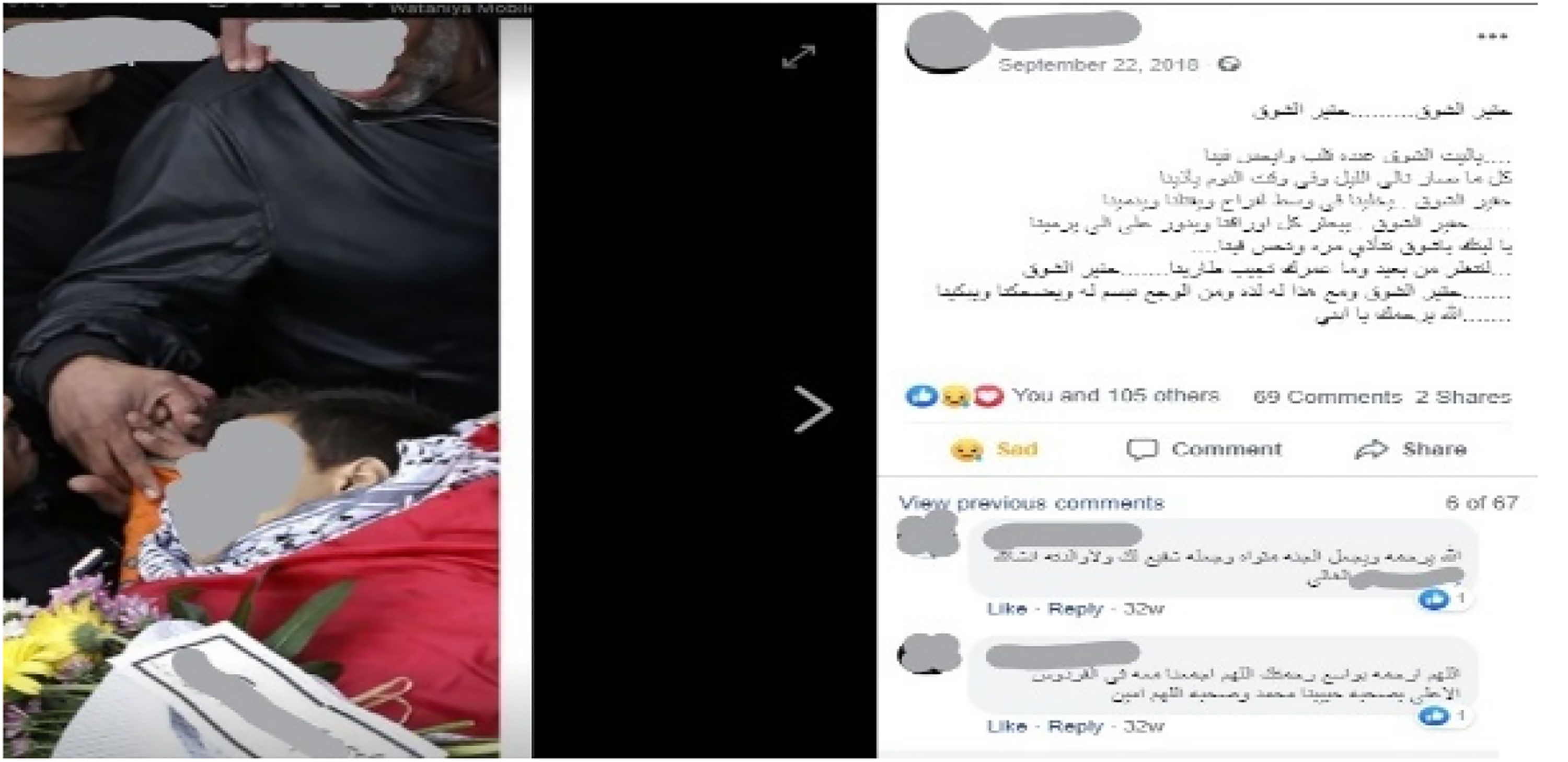
Ahmad, a Palestinian father, experienced the loss of his 15-year-old son 4 years ago when his son was shot and killed only meters away by Israeli soldiers. Abu Ahmad had no option but to physically carry his bleeding son, place him in his car, and drive him to the hospital. He had to navigate traffic while frantically trying to keep his son alive. He states in the interview, “My son died in my arms before reaching the hospital.” Abu Ahmad used his Facebook account to share his pain and thoughts. After continuous posting on his traumatic experience, Abu Ahmad was approached by an Israeli intelligence officer who informed him that he must cease writing about his son on his Facebook page. Abu Ahmad was told that he must stop sharing his posts, as they were posing a challenge for the Israeli intelligence unit to control Palestinians via cyberspace. Abu Ahmad refused to be silenced and informed the officer that the page is a personal space for him to express himself. This led to his arrest by Israeli forces. Three years prior to his arrest, Abu Ahmad shared the post below with a photo from the funeral, showing him weeping over his son’s body, and the following text (Figure 1)
2
: The longing is despicable… the longing is despicable I wish that longing has a heart so it can feel us every night, when we are about to sleep it hurts us. The despicable longing kills us and make us bleed in joyful times… The despicable longing scatters our cards…I wish that the longing gets hurt and feels (pain) with us… so it can leave, go away and never come back to us … The despicable longing although it is despicable, but it causes pleasure too, because it is so painful, (sometimes) it makes us laugh and (sometimes) it makes us cry… rest in peace my son.
Abu Ahmad’s portrait.
The post revealed the agonizing ramifications of the loss of a son, a sudden and violent loss of severe trauma, continuous wounding, and irrecoverable grief. The expressed sorrow contained what he defined as an unending, mundane, “longing pain” and a sense of loneliness that infiltrates every aspect of life. He talked about his sense of being trapped, blocked from moving on, and revealed how his loss shattered him, his present and future, his routines, and his life. He indicated the impossibility of enduring such pain while at the same time demanding to know how to endure it, and how to father in such a context?
His narrations reflect feelings of pain, anger, loneliness, feeling trapped, and longing for his son. Together, these are reflected and reverberate—sometimes in tears and at times in laughter—revealing the complexity and the fluctuation of his feelings. Trauma gives rise to complicated and uncanny alterations of consciousness (Herman, 1992), suggesting that it is not the longing that is despicable, but the traumatic wound, the sudden loss, and the sense of helplessness. In the moment of trauma, the victim is rendered helpless by overwhelming force engulfing the ordinary systems of care that give people a sense of control, connection, and meaning (Edkins, 2003; Herman, 1992; Janoff-Bulman, 1992, 1999). The ability to express and process memories is highly compromised when one is afflicted with post-traumatic stress disorder (PTSD). The act of reposting enabled Abu Ahmad to reorganize, recalibrate, and reflect on his trauma and inner wounds, implying that posting such memories on social media channels and expands his therapeutic space (Giaxoglou, 2014).
The surveillance around Abu Ahmad’s Facebook posting reveals how the sovereign state seeks to silence the pain of people living under oppression (Lloyd, 2000) where the expression of pain becomes a “threat” to its sovereignty and machinery of control (Lloyd, 2000; Sayigh, 2015). The Israeli intelligence agency wants Abu Ahmad to stop posting on Facebook, demanding that he smother his voice and muffle his moaning. Abu Ahmad resists the dehumanization of the colonized by the machinery of the settler colonial state (Martin-Baro, 1989) by insisting on his right as a father to post his excruciatingly intimate feelings of grief. Posting and reposting about the atrocity and the unimaginable pain it bequeathed him becomes a political act against this colonial silencing (Duaphinee, 2007). Anti-colonial feminism examines and engages with the agency of people under oppression amidst pain (Coddington, 2017). While focusing on Abu Ahmad’s pain and agony, his power to resist the state’s politics of silencing is made evident. In addition, the written and visual productions of loss seek the recognition of wounded humanity (Misri, 2019). This constitutes a political act that bears witness to his pain and wounding (Misri, 2019), and further conveys a counternarrative that disrupts the regime (Saramifar, 2019).
Moreover, in Palestine, martyrdom is valorized because it contains historical layers of practice and mythology, and sedimentations of both nationalist and religious ideologies (Khalili, 2007). Thus, visualization of martyrdom facilitates national and religious pride (Allen, 2006). Accordingly, the status of martyr holds deep respect, and socially and politically elevates the families of those who were killed by the Israeli occupation, (Allen, 2006). Indeed, most of the comments made by his family and friends convey wishes for the martyr’s soul to rest in peace, and for Abu Ahmad to experience patience and solace. These comments reflect public recognition of Abu Ahmad, which he reiterated, helped to ease his psychological pain. Feminist analysis of political mourning suggests that grief and its public expression has social and political implications for the individual and for the marginalized group (Cheng, 2000). Abu Ahmad replies to these comments by thanking them for their solidarity, which led me to indicate that embracing his wound and acknowledging his pain nurtures his psyche and creates digital structures of support and solidarity (Zia, 2020).
Abu Ahmad’s portrait illustrates the duality of control and resistance. Sharing this portrait reveals how the longing for a lost child is beyond painful—in the words of Abu Ahmad, “it is despicable.” But we can also read it as a scream, a call for justice in a space where such a call can be criminalized and silenced. Abu Ahmad’s posting and reposting on Facebook itself is part of this ongoing struggle, a visual act that carries the capacity to animate important forms of resistance.
The Salute
Abu Hasan is a Palestinian father who experienced the loss of his martyred son, a well-known activist in the Palestinian community. Prior to the death of his son, Abu Hasan was unaware of his son’s physical whereabouts for months, due to his son’s active Israeli military pursuit
3
and surveillance. He learned of his son’s death through social media. The body of Abu Hasan’s son was confiscated by Israeli military forces, and the family
4
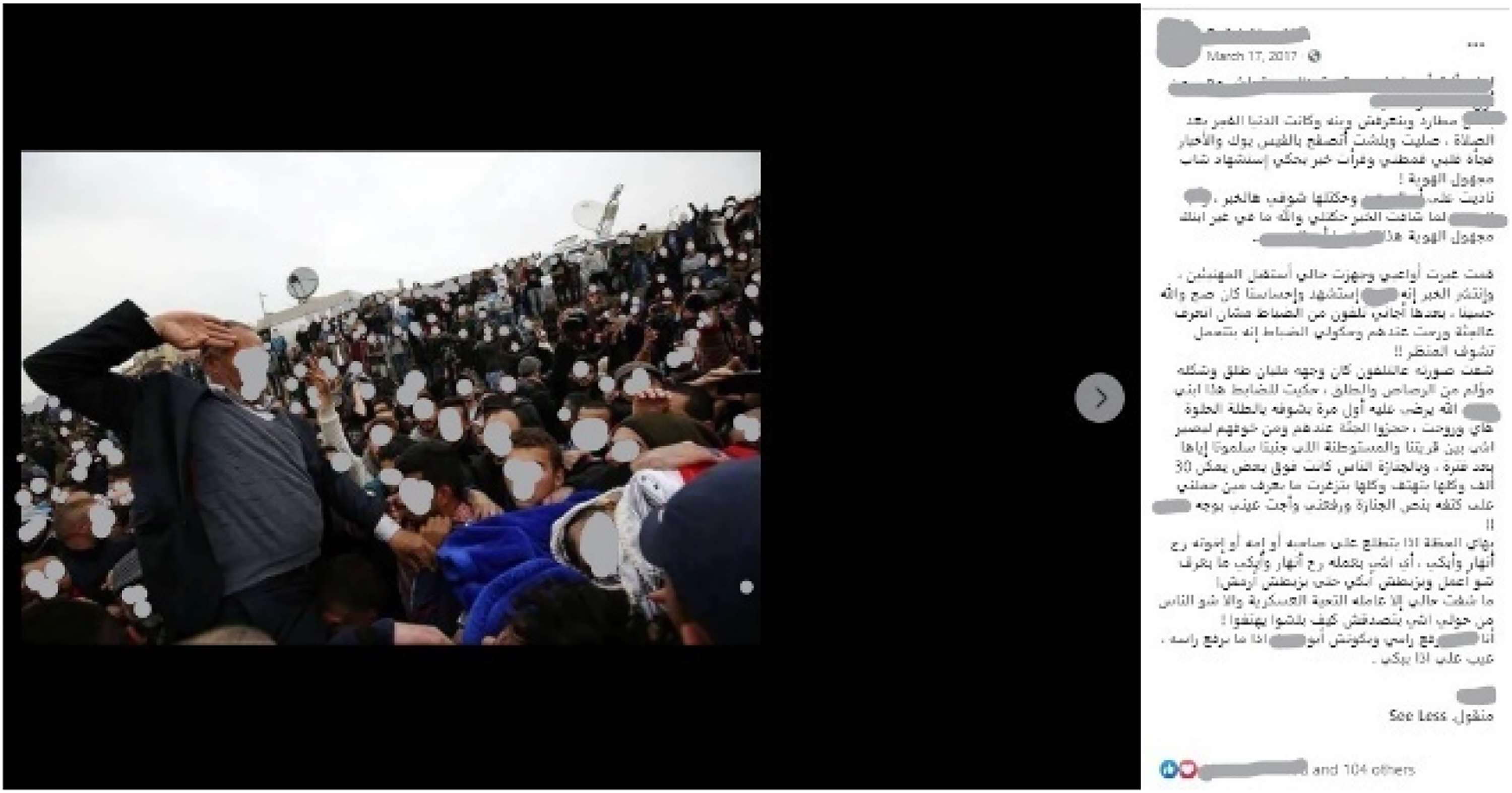
was prevented from retrieving his body. After the body was eventually returned to the family, thousands came to partake in the funeral to provide solidarity, support, and pay respects to the father and his family. Verbal support could be heard among the crowds throughout the funeral, vocalizing slogans of collective solidarity and glorification for the soul of the martyred. When it came time for Abu Hasan to bid farewell to his son’s body, he was lifted on the shoulders of a funeral attendee to have a look at his son one last time. Upon his last look, he lifted his right hand and offered a military salute to the corpse, in honor and recognition of his son’s steadfast resistance to oppression and continuous aggression posed by the Israeli military. A photo was then taken of this profound moment that went viral and was widely circulated on social media. The description next to the iconic photo states (Figure 2): … An Israeli officer called me to go identify the body. When I arrived, the Israeli officer asked if I could handle the scene (as the officer made it clear that it will be a harsh scene). When I looked at my son’s photo on the officer’s telephone, I saw many bullets in his face, a painful view of many bullets in his body, I then said to the officer, “Yes this is my son, may God be kind with him, but I have never seen him as beautiful as today” and then I left. They (the Israelis) refused to give us the body, they wanted to withhold it, but they were afraid that something will happen between our village and the settlement nearby, so they delivered it to us after a while (days after). More than 30,000 participated in the funeral, and all of them were cheering and shouting. Then I didn’t know who carried me on his shoulders and then I looked onto my son’s face, and I thought if I look at his friends or his mother or his brother I will collapse and I will cry and I cannot cry… so what should I do? But suddenly I did the military salute and people started incredibly cheering more and more. I am his father, he made me proud, I cannot fail him and cry.
Abu Hasan’s portrait.
The above portrait was taken at just this moment, when a father is psychologically torn between his agonizing loss and the reaction expected of a father, amidst the public’s solidarity. It captured that confusing moment of pain and pride, loss and gain that found expression in the unexpected salute. His unthought-out psycho-physical act was his automatic response to the immense sorrow he felt when seeing the wounded face of his dead son, being raised up, and dignified by a large public.
Abu Hasan twice confronted the view of his son’s maimed face and injured body. The first time was with the Israeli officer when he identified the body, and the second was during the funeral. These two harsh confrontations are also about staring down the power of colonial dispossession and comprehending the shock of his martyred son. In both confrontations, Abu Hasan created “unexpected” reactions that reflect the complexity of those confrontations, creating a new meaning for his loss and countering his son’s death with a salute of fatherly love and national pride. Abu Hasan’s meaning-making helped him regain control of fatherhood over the death of his son, producing new meanings. Reconstructing meanings not only can assist in processing grief, but also contributes to a sense of self-efficacy. As such, this leads to a transformation in one’s self-narrative, while also instigating the processes of reaffirmation, repair, or replacement of the basic plot and theme of one’s story (Neimeyer, 2011). Accordingly, Abu Hasan’s salute is about the re-narration of his loss which contains unbearable extreme pain coupled with psychological agency and repair.
The scene of a wounded son and dispossessed father is a spectacle that was imposed by the colonial context. Abu Hasan resisted the violence of wounding by creating a different scene. He enacted a “counter spectacle” (Couldry, 2008) by creating a new aesthetic symbol—the salute. This salute, with its performative and psycho-political meanings, caught the attention of the viewers, portraying a refusal to be dispossessed and resistance against the grammar of power. This counter spectacle elucidates the circular dynamics of the “game” of struggle and survival between the colonized and the colonizer within the martyr’s funeral—“the field”—where all spectacle and counter spectacle are produced (Mahbub & Shoily, 2016). Hence, the father resisted pain by recreating a spectacle of life against the spectacle of death. Abu Hasan recreated his fatherhood as a space of power, an authoritative state against the “unrecognition and orphanhood” caused by the state, using his term. It is in that moment of interaction between those in power (the colonizer) and dignified powerlessness (of the colonized) that we see fatherhood’s power to recode the dynamics and meanings of the interaction, and reclaim a sense of control and—most importantly—one’s dignity (Hammami, 2006, p. 24). By constructing a counter spectacle, Abu Hasan reproduced a cultural form (Mahbub & Shoily, 2016) of resistance and fathering under the context of colonialism.
Emotions are building blocks that ensure that a sense of humanity and subjectivity remains within the colonized. Consequently, these emotions challenge the colonial structures of power, whose intent is to dehumanize the colonized by eradicating any signs of emotion (Philipose, 2007). The embodiment of emotional pain becomes a source of strength for the colonized, solidifying their humanity (Philipose, 2007). Abu Hasan tells us in his narration that he thought about his reaction, but he refused to collapse or cry. He wanted his son to be proud of him as a father. His self-reflection tells us that he is politically present and has a sense of agency reflected in his militarized salute (Philipose, 2007).
Abu Hasan’s salute was endorsed by the crowds, suggesting that Abu Hasan’s emotions and pain fueled not only his agency, but also the activism of the crowds against the conditions that caused the loss of his son. The crowd’s endorsement of the salute indicated that his pain is collective, and is recognized collectively (Ahmed, 2014; Philipose, 2007). Ahmed (2014) argues that emotions are contagious in the sense that they pass from one to another, from the individual to the collective. I suggest that Abu Hasan’s pain, agency, resistance, and interrupting was transformed into a collective mode of pain, agency, and resistance. Abu Hasan’s pain is a mode of interrupting the disposability attempted by the settler colony.
Reactions to grief are varied because they are influenced by personal, interpersonal, and collective constraints in addition to the intersecting dimensions of gender and race/ethnicity (Rodgers & DuBois, 2018). Using these studies, my analysis of Abu Hasan’s portrait shows how bereaved fathers in Palestine reflect on their loss and grief in complex ways. In so doing, their portraits facilitated different reactions that not only reproduced new spectacles, but also produced new authorities and sovereignties against the orphanhood imposed by the colonial state and the Palestinian non-state.
The Victory
Abu Jamal lost his son when his child was shot and killed by Israeli security forces. His loss was followed by Israel’s refusal to release the body, withholding it in the morgue for months. The state’s incarceration of Palestinian dead bodies motivated Abu Jamal to launch a community-based Palestinian parents’ movement to protest this cruel form of collective punishment and support bereaved families in their struggle to have the bodies of their loved ones returned to them. 5 Abu Jamal used Facebook to constantly post about his experience as a father, protesting the holding of the martyrs’ bodies in Israeli freezers. In one post, Abu Jamal describes the moment his son’s body was released and the immense apprehension he felt knowing that his son’s body now needed to be buried swiftly while it was delayed and access denied several times due to restrictions set by Israel. He explained how the Israeli security administration dictated that the funeral could only be attended by immediate family members. Although Abu Jamal tried to fulfill the state’s requirements, many youths and community members were appalled by such traumatic restrictions, and decided to attend the funeral, turning it into a peaceful protest to support the family, dignify the dead, and resist the killing of Palestinian youth.
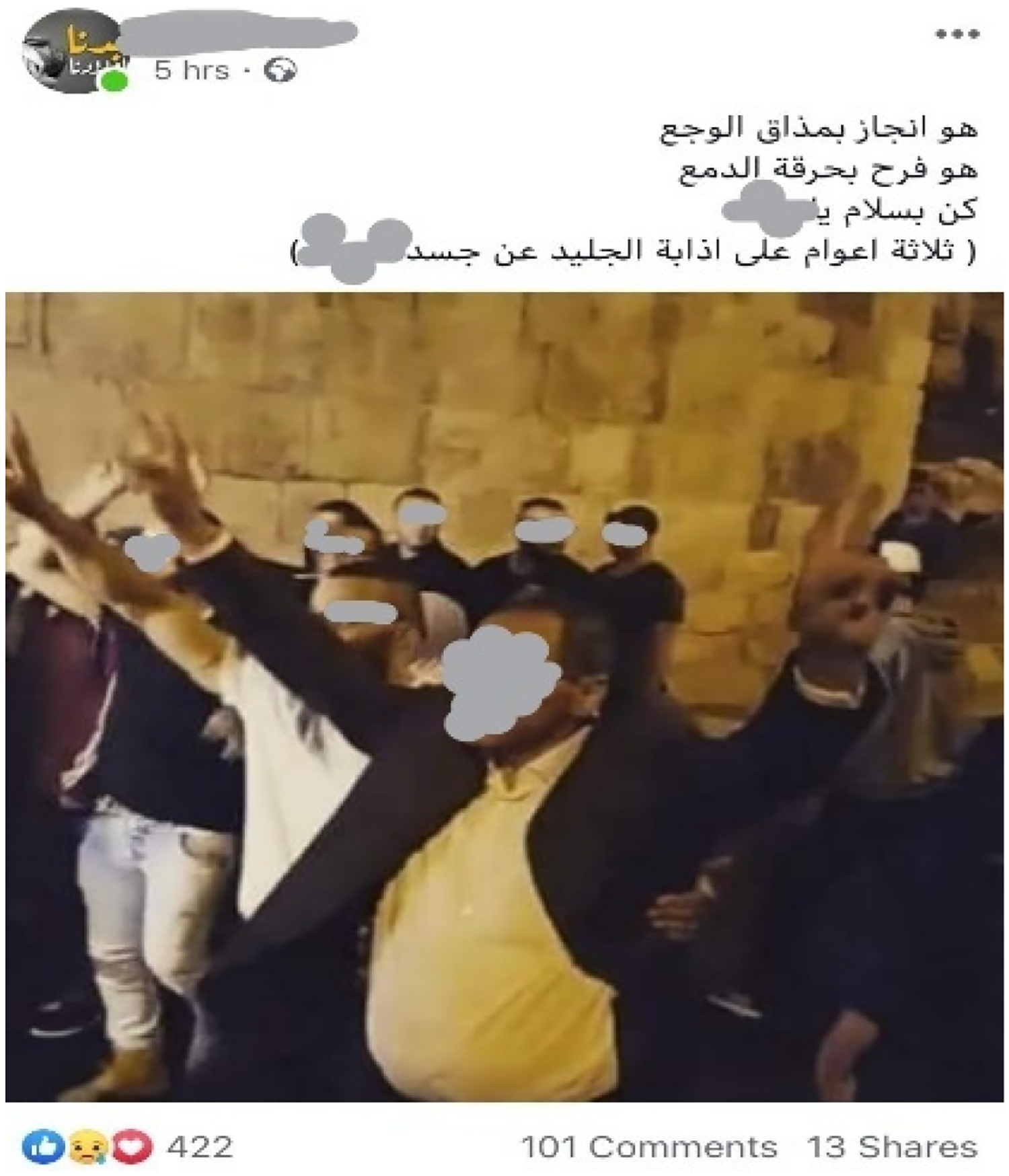
Abu Jamal created a post describing this moment on his Facebook page 3 years after the incident. The post shows Abu Jamal marching together with other Palestinians as they are raising their hands, cheering, and holding up victory signs. Abu Jamal provided the following narrative next to the photo (Figure 3): It is an achievement with the taste of pain It is happiness with the burns of tears Rest in peace my son (after three years of melting the ice on my son’s body)
Abu Jamal’s portrait.
Abu Jamal stated in an interview that he confronted his son’s death twice, the first time during the moment he received the news about the killing of his son, and the second when he received the body of his son. Prior to receiving his son’s body, Abu Jamal was going through the unbearable process of fighting for the release of his son’s body, held captive by a cruel bureaucratic entity. Abu Jamal was juggling between the demands of both the Israeli and Palestinian administrations, while also working with the lawyer, the court system, and the press. These accumulated pressures had interrupted his mourning. His inner pain of loss remained in a frozen state.
Abu Jamal’s story is an example of how colonialism invaded bereaved fathers’ intimate spaces of morning. The effect was a manipulation of fathers’ emotions through the inhumane restrictions of releasing their loved one’s dead body: a process that continues to psychologically affect families (Shalhoub-Kevorkian, 2020). The constant state of waiting, feeling frozen by the state’s abusive restrictions and demands was made by a mother who has yet to receive the body of her dead son, she commented the following on Abu Jamal’s post: And you still digging the rocks to melt the ice… Despite some warmth, you still feel the ice…May your son rest in peace and the idea never die
The mother is pointing out that, despite the harsh months of waiting, their loved ones will never be forgotten. The family is kept in a state of uncertainty, making their days and months timeless, as the passing of time becomes heavier psychologically (Shalhoub-Kevorkian 2015b, 2020).
The battle with authorities to retrieve his son’s body intensified Abu Jamal’s pain and deepened his wound. This was due to the demands he faced concerning the details of the death, the body, the freezer, the release, the funeral, and many other procedures that required him to be focused, to negotiate, and to make decisions, all when and while suffering. Shalhoub-Kevorkian (2020) defined this ordeal as necropenology. Necropenology is a form of forced confinement of the living family that moves from punishing the dead to punishing members of the family and eventually the entire community.
Abu Jamal’s portrait points to his sense of responsibility, as the father, to win the battle to take back his son’s body. During his interview, he explained that he felt obliged to win by being steadfast in his determination to release his son’s body from freezing captivity and to bury him with dignity. At the same time, he had to fulfill his responsibility to protect his wife and other children and provide them the space to mourn their beloved son and brother. The portrait shows how his victorious moment is burdened with pain. His performance of “victory” came to signal the winning of a battle against the necropolitical colonial machinery, against uncertainty, daily atrocity, and the prolonged waiting. By burying his own son, he reclaimed his sense of fatherhood. Trauma survivors who choose to “fight” (rather than give flight) establish a degree of control over their emotional state that reaffirms a sense of power (Herman, 1992). Ghnadre-Naser & Somer (2016) argue that Palestinians implement various coping strategies when forced to cope with the conditions of an ongoing Nakba. The settler colonial context places constraints on the ability to mourn, in addition to the prevailing cultural and social norms that discourage displays of emotion (Ghnadre-Naser & Somer, 2016). Palestinians decided to participate in the funeral while challenging the attendance restrictions as part of a collective act of defiance and ultimately national resistance (Hammami, 2006) demonstrating what Shalhoub-Kevorkian (2014) defines as structures of support that maintain hope in times of death and dying.
By circulating these memories, Abu Jamal represents the past and the present of a bereaved father who faced necropolitical powers, and yet continued to help other bereaved parents. Personal archives on social media enable memory practices for individuals (Acker & Brubaker, 2014). Furthermore, documenting the cultural memory of society in private and in individualized ways allows other users to access and add layers of context to individual posts (Acker & Brubaker, 2014). Abu Jamal’s portrait of victory suggests that he created a new space of re-narration to control his own history and story against hegemonic narration. Feminist analysis of political mourning demonstrates how, in the case of African-American mothers, grief can transform the marginalized, racialized, and oppressed person “from an object bearing grief to being a subject speaking grievance” (Cheng, 2000, p. 174). Moving grief to the public sphere to be shared by others allows for the agency to emerge amidst suffering. He spoke against a portrayal of himself and his community as the passive object of invasions, and instead redefined his identity as a subject of struggle and resistance. His victory was a victory of those loving fathers and their communal solidarity.
Conclusion: Recognizing and Learning From New Cyberspaces of Narrations
In response to Dass’s (1997) question: How should one inhabit such a world that has been made strange through the desolating experience of violence and loss? I propose we engage with the wound, confronting loss and pain while also re-narrating it as survival amid loss and community building in the face of the wounding and the deathly logic of colonialism.
Through Abu Jamal’s, Abu Hasan’s, and Abu Ahmad’s portraits, we learn about the hidden meanings of pain and agony under settler-colonial context. Paying attention to their communications, we map a means to cross from traumatic confusions into a state of survival and agency. Such a proposed analysis subverts simplistic representations of mourning and bereavement, and valorizes the power of life and continuity in death to challenge the violence of historical and present dispossession (Shalhoub-Kevorkian, 2014). Through their use of social media to visualize their pain they have opened up spaces to work with, rather than be overwhelmed by, the trauma. Fathers spoke from the wound. Using cyberspace they displayed their agonies, re-narrated moments of confusion and paralyzing pain, for themselves and the public. By showing their extreme pain, they hope to transform their wounds into collective wounds, moving from a state of coping alone to collective resistance. Martin-Baro (1994) argues that political violence is experienced individually and collectively. Likewise, the portraits in this study show us how presenting and circulating pain photos, narrations, and meaning-making can shift the grammar of wounding from the individual to the collective. Fathers transform themselves and their communities, from objects of colonial oppression to subjects of survival.
Freire’s (2000) well-known “critical consciousness” theory suggests that when the oppressed develop a critical reflection on their sociopolitical existence, they understand their social and political conditions and develop more nuanced thinking about how their context is structured to move toward action against oppression. This analysis has indicated that cyber platforms provided fathers with a space to think, reflect, and process their trauma, exposing the dehumanizing and criminal logic of oppression and voicing their demand for justice (Perera, 2016). Feminist scholars suggest that political and public mourning enables the bereaved to develop agency amidst pain suggesting that activism can be used as a coping tool for grieving (Al’Uqdah & Adomako, 2018). Fathers spoke back while interrupting colonial dehumanization and criminalization in public. Within certain emotional circumstances, colonial violence escalates liberating actions collectively, giving rise to progression in the national consciousness and fueling collective responsibility (Fanon, 1963). These fathers demonstrate the feminist liberation fundamentals of the personal are political.
Fathers’ cyber portraits open up new psycho-political spaces to speak back, express pain, and make sense of both individual and collective/national wounding. Fathers’ portraits assert the importance of recognizing contemporary cyberspaces as additional spaces to process loss and engage with new modes of meaning-making and resistance. These portraits suggest that we take seriously Facebook posts in the context of political violence. As counterhegemonic voices and photos, they open up additional theoretical and methodological approaches to understanding and dealing with the pain of loss.
If bereaved fathers, under an ongoing settler colonial regime, manage to create new zones to cope with pain, critical social workers will need to consider more seriously how and where settler-colonial pain is embodied and expressed. To understand fathers’ experiences of loss and pain, social workers must understand colonial history and collective trauma. In doing so, social workers might gain new understandings of settler-colonial unfathering politics (Shalhoub-Kevorkian, 2019), as well as how these politics dispossess fathers of their fathering, even in death. Centering fathers’ counter modes of fathering, survivability, and agency, will allow multiple modes of psychosocial and collective fathering to be recognized as fathers’ refusal of settler-colonial violence. Acknowledging fathers’ counter meanings and spaces can inspire social workers to consider anti-colonial interventions. Specifically, social workers should insist on constructing new modes of anti-colonial social work that interrupt unfathering, and allow fathers to maintain their sense of authority as fathers, in relationship to their children and to their fatherhood.
Footnotes
Declaration of Conflicting Interests
The author declared no potential conflicts of interest with respect to the research, authorship, and/or publication of this article.
Funding
The author received no financial support for the research, authorship, and/or publication of this article.
