




Abstract
Through an epistemological stance of post-structural feminism, this conceptual paper explores the use of language within eating disorders (ED) intervention articles, and the problematic narratives and power dynamics that are reinforced through this discourse. The paper begins with a vignette coupled with reflexive analysis of the authors’ experiences within a hospital-based ED unit. The authors then engage in a post-structural feminist analysis to discuss how language within ED intervention research relay problematic narratives of: (1) the individual with an ED as passively, not actively, engaged in care; (2) that their experiences can be captured and categorized; and (3) that measurement based scientific knowledge is more valuable than the lived experiences of clients. Overall, the authors argue that these narratives not only shape how social work researchers think of EDs, but also what we think of those with EDs. These themes also signal a larger power dynamic that continuously favours the epistemic value of researchers’ knowledge over that of the client’s, which runs contrary to the guiding principles of client-centered care in social work. To address these critiques, the authors recommend that social work researchers adopt an eco-social phenomenological approach informed by post-structural feminism when conducting ED intervention research.
This paper begins with a vignette based on the first author’s experiences practicing within a hospital based eating disorders (EDs) unit.
Vignette
“A few years ago, I began a new role as a hospital social worker in an eating disorder treatment program for adolescents. Within the first week all new staff, including myself, were encouraged to read a list of articles on “evidence-based” treatment for eating disorders. As a social worker and part-time researcher, I was critically reflective of this literature being shared to train unit staff. The intervention research shared on the unit (see supplementary materials) was heavily focused on the prevalence, diagnosis, and treatment of eating disorders. All of the articles shared were positivist in their epistemological orientation, and written through the lens of researchers and service providers. Moreover, this material was referenced by service providers on the interdisciplinary team and often used as a means to relay information for new staff on questions around eating disorders. In my position as both a practitioner and researcher, I wondered how language within the articles oriented not only how we thought of eating disorders, but also how we thought about those with eating disorders. I noticed that the positivist language in the literature permeated many of the dialogues I observed between staff and clients on the unit. I recall one time where a client was told that they were “tiptoeing between anorexic with subclinical bulimia or a bulimic generally” and the client later saying these words verbatim to other adolescents on the unit, as though it had become her identity. This interaction stuck with me for weeks. I wondered how the lens of this service provider may have been informed by the material they read. I also wondered how the intervention material I was expected to read could orient my perceptions of those with EDs in damaging ways. I wondered what I could do differently.
I spoke with colleagues about my concerns and the importance of sharing material that was varied in epistemological and ontological viewpoints. However, given my social location and position as a new team member, I realized that trust would need to be established before my concerns were addressed. I channeled my questions into independent critical exploration of the intervention literature. This process and my position as a social worker and researcher led to the development of this conceptual paper.
Introduction
As social workers engaged in ED intervention research and advocacy work, the authors are aware of how often an individual’s ED diagnosis can become their identity. In their clinical and advocacy work, the authors noticed that individuals with EDs would often assume the role of a “helpless, sick person”, which sometimes became so enmeshed with their identity that it impacted their ability to focus on recovery, resulting in them leaving treatment. During her experiences, outlined in the vignette, the first author was simulatenously conducting research guided by feminist thought and thus was curious and critically reflective of the literature shared on the ED unit. The author was curious about which voices were being heard and valued in this literature, which identities were contributing to the construction of this research knowledge, and the underlying epistemologies guiding this. This led the author to engage in further reading of the critical feminist literature on EDs, and an iterative process of reflexive analysis emerged.
Feminist scholars have extensively criticized the biomedical approaches used to understand EDs, instead preferring to see EDs as resulting from socio-political problems (Woolhouse et al., 2012). Wolf (1991) argued that EDs are representative of women’s attempts to broaden their careers and position of power in society. Through this lens, the female body is a site of resistance to the ascribed career paths, status, and roles that are traditionally afforded to women. Bordo (2003), a post-structural feminist scholar, argued that EDs are a by-product of gender discourses in society and the unrealistic messages transmitted to women about their bodies. She argues that women who suffer from EDs and pursue the “thin ideal” are unconsciously protesting against the “curvy figure of a maternal, domestic woman” and the expectations accompanying this role (Myers, 2015). Other feminist scholars have also criticized the ED literature for narrowly focusing on the experiences of white, middle class women (Bordo, 1990; Thompson, 1994). There is limited attention on the interplay of societal gender discourses and the intersectionality of race, sexuality, socioeconomic class, able-bodiedness and EDs (Thompson, 1994; Moulding, 2016, p. 71; Murray et al., 2017a; Nagata et al., 2020a; Nagata et al., 2020b; Nagata et al., 202°c; Udo & Grilo, 2018).
Psychologists have also proposed feminist theories that explore factors influencing the higher rates of EDs among women, in comparison to men. One well-researched example of this is Objectification Theory which argues that women are often seen by society, and by men in particular, as sexual objects (Fredrickson & Roberts, 1997). When internalized, this sexual objectification often becomes self-objectification and can lead to feelings of helplessness, anxiety, shame, or despair (Fredrickson & Roberts, 1997). Research also supports the connection between self-objectification and patterns of disordered eating (Calogero et al., 2005; Muehlenkamp & Saris-Baglama, 2002). Embodiment Theory (Piran & Cormier, 2005) is another feminist explanation for EDs that builds on the work of Wolf (1991), Fredrickson and Roberts (1997), as well as Bordo’s (2003) post-structural feminist literature. It argues that “internalized gender-based social discourses” (Piran & Cormier, 2005, p. 556) can cause women to feel a “disembodiment” that goes beyond a dissatisfaction with one’s body to a detachment (Piran & Teall, 2012). In a society fixated on the physical appearance of women, the messaging received by girls and women is that taking care of your physical appearance grants social power, making gender a risk factor for developing EDs (Piran & Teall, 2012). These scholars advocate for a feminist approach to understanding EDs that is rooted in exploring women’s lived experiences within the context of these dynamic and interacting societal forces and gender discourses (Bordo, 2003; Fredrickson & Roberts, 1997; Piran & Teall, 2012; Wolf, 1991).
Building on this work, post-structural feminist scholars (Malson, 1995; Malson, 1998; Myers, 2015) further argue how an ED diagnosis can impact identity formation, and critique how diagnostic labels arose out of a pathologization of femininity that fails to recognize the significant role sociocultural factors play in the development and maintenance of EDs. Post-structural feminist theory (Table 1) emerged after liberal and radical feminism, and became recognized as third wave feminism (Randall, 2010). This theoretical approach posits the importance of deconstructing our understanding of reality through examining how gendered binaries, and gender hierarchies constitute one’s identity and impact one’s interactions in the world (Randall, 2010). The production of knowledge in the ED field has historically been dominated by the Euro-centric male view (Woodside et al., 2001). A post-structural feminist approach argues that the socially constructed nature of reality is informed by language that supports a patriarchal worldview, in which holding masculine traits and identity provides power, autonomy, and control (Tickner, 2004).
Overview of Models and Frameworks Discussed
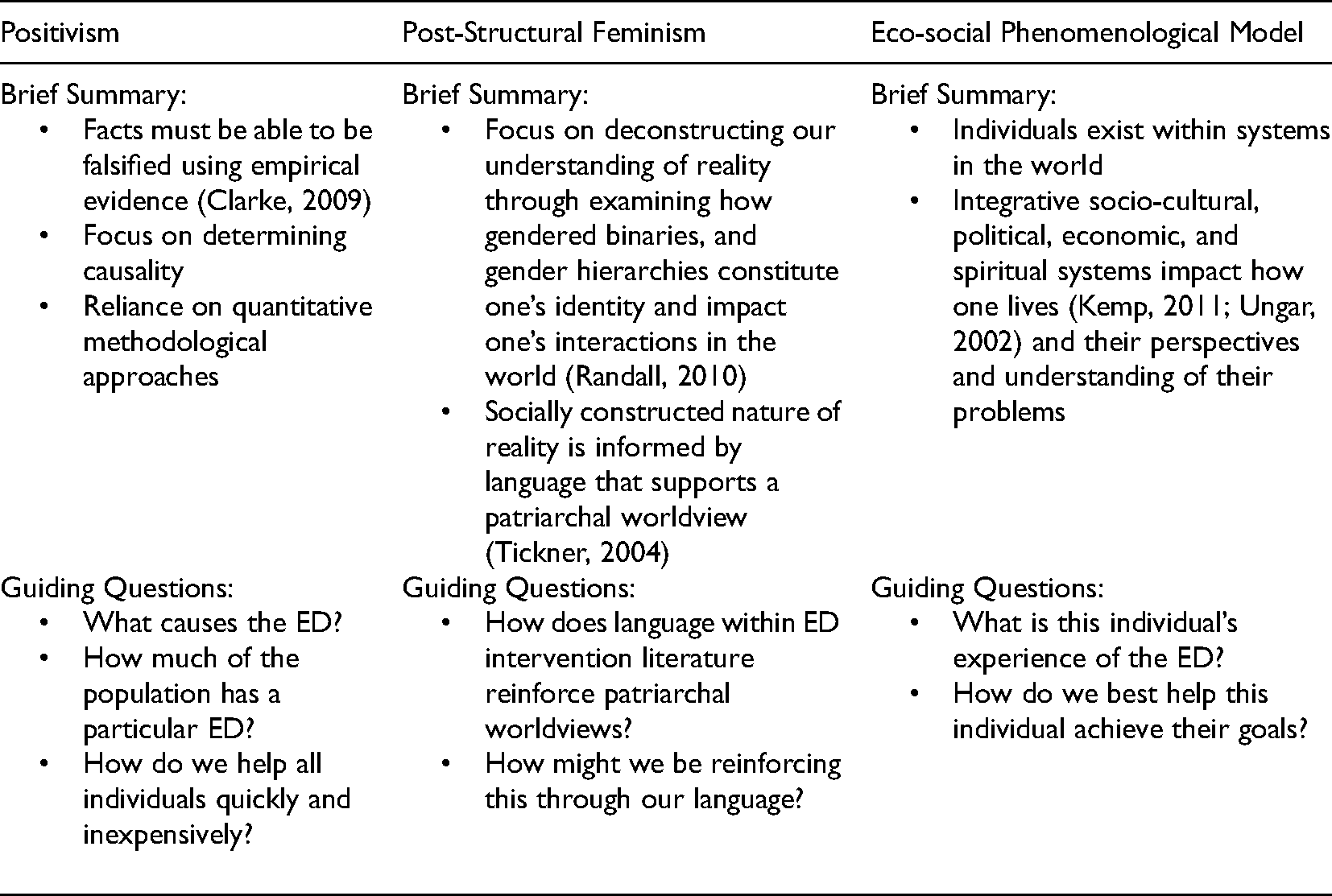
Informed by these critiques and in discussion with feminist scholars within ED research, the following questions emerged. These research questions guided our analysis of the literature shared on the ED unit:
Which knowledge systems guide the current intervention research in EDs? How does language within these articles structure how we think of those with EDs? Whose voices are being heard, supported, and empowered in these articles? What are the power dynamics being reinforced through language, and how does this guide how we, as social work researchers, view those with EDs?
Through an epistemological stance of post-structural feminism (Randall, 2010), in this paper we critically explore the ED intervention literature shared on the unit, and how masculinity, power, and authority shape knowledge production within this material. Prompted by the vignette outlined above, the authors will engage in reflexive analysis to discuss how the language within the ED intervention research can fuel problematic narratives of “helpless, sick” individual (Finlayson, 1999; Foucault, 1982; Tickner, 2004; Randall, 2010). Using examples from this literature, we discuss how discourses within this research relay the narratives of: (1) the individual with an ED as a passive object of their disorder, (2) that their experiences can be captured and categorized, and (3) that measurement based scientific knowledge is more valuable than clients lived experiences. We argue that these themes also signal a larger problematic power dynamic present in research and practice that continuously supports the epistemic value of researchers’ knowledge over participant/clients’ knowledge. In order to address these critiques, we offer eco-social phenomenological approaches to shift towards a more holistic, person-centred, ecological approach for ED intervention research (see Table 1).
Reflexive Analysis: Positionality and Epistemology
ED intervention research often involves perspectives from interdisciplinary service providers, including social workers, physicians, nurses, occupational therapists, and dietitians, to name a few (Gurney & Halmi, 2001). The social work role within ED intervention is unique as these service providers bridge medical models of care with systems-level, trauma informed, and recovery-oriented approaches when supporting clients (Berg-Weger & Schneider, 1998; Bronstein, 2003). Through the first author’s practice and research experiences in the ED field, and the second author’s experience leading ED support groups at a University campus, both noticed the dominant positivist medical models guiding ED intervention research. This is evident in current research trends towards genetic, neuroimaging, and machine learning approaches to understanding the causes of EDs that inform subsequent interventions or treatments (Booij & Steiger, 2020; Bracher-Smith et al., 2020; Stern & Bulik, 2020). What also became apparent was the underlying Euro-centric male positivist views that have historically guided knowledge production in this field. These views became so ingrained as the dominant discourse in the first author’s practice setting that identifying and critiquing them required extensive reflection. The authors are critically aware that different aspects of their positionality resulted in their previous alignment with scientific positivist epistemology. For instance, their positionality of being young, racialized women, and relatively novice social workers in the field of EDs embodied them with certain needs. These included a constant need to demonstrate their intellectual competence, a need to showcase that their contributions were at the same level as their male colleagues, and a need to display their worth to those in more privileged positions (due to their professional roles, socioeconomic status, age, whiteness, and educational achievements). These needs were fueled by the core thought that because of aspects of their identity, they were inherently less able to perform such a role. Also, the first author noticed that her clinical social work role was situated within a bureaucratic system that is economically and politically focused on diagnosis, assessment, and treatment. Thus, to challenge and formulate her own epistemological stance would situate her in the vulnerable position of being judged, dismissed as less valuable, or fired based on her indigeneity of thought. The authors imagine that this is how clients often feel, surrounded by those in power in the medical system.
The authors are also aware that this positivist epistemology was guided by their North American education, where most of their learning aligned with the neo-liberal, positivist, Euro-centric ideologies of the institutions they attended and worked in. They are aware that this often resulted in the privileging of diagnostic, outcome-based measurements as more representative of “truth” rather than acknowledging the client’s truth. The authors are also cognizant of the systemic structures in place that have profound meso and macro level impact on intervention research. For instance, ED research is embedded within a neoliberal governance model in which the type, nature, and focus of this research is heavily influenced by funding opportunities. The decision to provide funding and allocate resources is often based on quantifiable and outcome-based research. Moreover, the focus to develop “evidence-based practice” in this field is inherently rooted within these neoliberal systems, and the authors recognize how this permeates into the ED intervention research.
Through our lens of post-structural feminist epistemology, we now realise that in order to explore this narrative of the “helpless, sick individual” within the selected literature, we must explore both this narrative itself, and the systems of knowledge and discourses that have produced it (Agger, 1991; Ahmed, 2006).
Through this lens of post-structural feminism, it is important to analyze how the language embedded within this literature permeates one’s understanding of EDs, as well as one’s understanding of those with EDs.
Positivist Epistemologies Through the Discourse of Language
In alignment with post-structural feminism, we begin by analyzing the positivist epistemologies embedded within the language of articles shared on the ED unit. The language used in these articles relayed the notion that measurable, quantifiable data is superior to other forms of knowing. Recurring terminology within the intervention literature included: understanding the “etiology” of the ED, as well as the “symptomology”, “prevalence rates”, “vulnerability factors”, and “the burden/impact of the disorder”, to name a few (Bardick et al., 2004; Barth, 2014; Golan, 2013; Horney et al., 2015; Ioakimidis et al., 2009; Rikani et al., 2013; Robin et al.,1998). This language was presented early on, often within the introduction paragraph. The use of such language is problematic as it reinforces the ideology that phenomena, EDs in this case, must be measured and quantified in order for them to receive adequate attention.
What Knowledge Is Valued?
To elaborate, the inclusion of specific terms such as “prevalence rates” or “impact of the disorder”, is guided by dominant discourses of which type of knowledge is valuable in research. This focus on measurable values is rooted in intervention medicine, in which there is often a necessity to focus on numerical data to determine the widespread impact of disorders and secure appropriate resources (Rikani et al., 2013; Murray et al., 2017b). Though this quantitative language is valuable for the reasons stated above and more, language such as “prevalence’ or “risk factors” can be problematic. This language emphasizes the role of individualistic “risk factors” and minimizes the importance of larger systemic factors (such as family dynamics, sociocultural identity, poverty, discrimination) and the role these play in the development of ED interventions (Thompson, 1994). As such, the quantification of experiences can be reductionist in nature because it does not allow space for diverse experiences of those with EDs.
Within the socio-political context of the North American health care system, there is often a need to quantify the impact of the disorder in order to obtain funding within many organizations. This language of quantifying disorders allows individuals and systems to assert some control over an issue (such as pandemics, or the spread of chronic health conditions). This ideology informs our research in mental health, where quantifying the “impact” of such disorders is guided by a need to substantiate the importance of this topic, particularly in different domains of society (e.g., governance, economic systems, medicine, public health; Rikani et al., 2013; Robin et al., 1998). However, this discourse endorses the belief that: (1) the impact of a phenomenon must be at a substantial numerical value, and (2) the problematic belief that one can determine what this number should be at, in order for something to be deemed worthy of attention. Through describing prevalence rates and impact of the disorder, the articles also categorize individuals with unique identities and lived experiences into a homogenous sample, represented as a statistic (Doucet et al., 2010; Finlayson, 1999).
Causality and Underlying Assumptions
Furthermore, the use of measurable, quantifiable language is also problematic because it relays an underlying focus on the causality of EDs and doing so is reductionist and categorical in nature. The terminology previously mentioned within these articles (Bardick et al., 2004; Barth, 2014; Golan, 2013; Horney et al., 2015; Ioakimidis et al., 2009; Rienecke, 2017; Robin et al., 1998) aligns with most medical and quantitative research and relays that we must look at the causal nature of disorders in order to manage them (such as the etiology of diabetes, or schizophrenia, etc.). For instance, the term “etiology” is defined as the (a) cause or origin of a disease or disorder as determined by medical diagnosis (b) assignment of a cause, an origin, or a reason for something (The American Heritage Medical Dictionary, n. d.). The use of positivist terms, such as etiology, in these articles suggests that there are one or more causal entities related to the development of an ED, and that if we can capture or understand these we can reduce or manage symptoms of the disorder (cause and effect). This preoccupation with the root “causes” of disorders is a prominent Western scientific thought in which our understanding of a certain phenomenon as a whole requires focus on the historical exploration and timeline of how this phenomenon may have developed (Doucet et al., 2010). To understand something as it exists in the present day without a causal exploration would be an innovative approach in Western scientific research. Terminology, such as “etiology”, reduces the nature of the disorder to causal phenomena, rather than looking at the complex, varying, and heterogeneous systems within one’s present environment that may be sustaining the ED. Also, the underlying assumptions embedded within this positivist language (etiology and causality) relay that individuals are a site of causal interactions: passive objects of their environment and their condition.
The Problematic Nature of Operational Definitions
Moreover, through the use of operational definitions, it is clear that the articles align with Euro-centric positivist notions around not only what form of knowledge, but also whose knowledge, is deemed more valuable. This is clear through every stage of the intervention research, including the initial process of describing EDs through an operational definition or diagnosis. The articles define EDs through reference to the Diagnostics and Statistical Manual (DSM), a manual for the assessment and diagnosis of all mental health disorders (American Psychiatric Association, 2013). Feminist mental health professionals have a long history of protesting specific DSM diagnostic labels, starting with strong opposition in the 1980s to labels such as masochistic personality disorder, premenstrual dysphoric disorder, and paraphilic rapism (Marecek & Gavey, 2013). The DSM has often been the battleground for social justice work with feminists passionately debating what is considered pathological and what is rooted in larger societal and systemic challenges (Dodd, 2015). The DSM has also been criticized for its lack of racial, cultural, and ethnic inclusivity (Malik & Beutler, 2002). Though the criticisms of the DSM-5 could warrant a paper of its own, for the scope of this paper we will focus on the intentional use of DSM based diagnostic labels within the ED intervention literature, and the underlying epistemologies guiding this.
Historically, EDs were first documented in 1873 by a male English physician, and later by a male French physician (Rikani et al., 2013). These European positivist researchers mainly focussed on identifying cases of anorexia among Caucasian European women (Rienecke, 2017; Rikani et al., 2013). These descriptions continued to inform the scientific literature on what EDs should look like, a presentation that was clearly informed by a Euro-centric male lens. Though there continues to be revisions, the current DSM-5 criteria for EDs is founded on this existing research with Caucasian women (Malik & Beutler, 2002). The ontology underpinning these DSM categories is that there is a true reality of how these disorders exist in the world and defining them brings this reality into existence. Though receiving a diagnosis is a subjective experience that can be validating for some and disempowering for others, the use of DSM-5 based criteria in the shared intervention articles leads readers to categorize and interpret how EDs should present. This is evidenced in the vignette where the first author witnessed a patient with ED refer to herself as her ED diagnosis. Such approaches orient readers to classify, monitor, and reduce the experience of those with EDs into one that prescribes to the Euro-centric description of the disorder. This use of operational definitions also gives service providers an “illusion of understanding”, and the belief that they can “capture” the experiences and unique histories of those with EDs by referencing these diagnostic criteria. We believe this strips the nature of one’s experience from subjective and internal, to one that is objective and controlled.
Furthermore, defining EDs through the use of such operational definitions in these articles ultimately ascribes a binary between those that are “sick” and those that are healthy (Finlayson, 1999). It dictates that there is a “way of being ill” or “sick” and a way that is not. The use of the DSM allows the service provider to not only label and categorize the individual with the ED, but also monitor their access to different health and mental health services. This assumes that through this definition, we possess the knowledge to not only identify those who have an ED, but also who is and should be accessing services based on this. The client’s experience can thus become dictated by the voices of service providers, instead of their own. This highlights the problematic narrative within these articles of individuals as being passively, rather than actively, engaged in their care. For racialized and/or LGBTQ individuals, these discourses of those with EDs as passive receivers of care confounds the institutional, sociocultural, economic, and political barriers these populations continue to face in receiving equitable care (Bhuyan et al., 2017). When service providers and researchers hold these narratives of individuals as passively, rather than actively, engaged in care they fail to help clients gain agency, voice, and power within their treatment. This can result in individuals turning to their ED and the pursuit of an ideal body as a means to gain “masculinized autonomy, power, and control” (Moulding, 2016, p. 71; Murray et al., 2017a; Nagata et al., 2020a; Nagata et al., 2020b; Nagata et al., 202°c; Udo & Grilo, 2018).
Shifting Towards an Eco-Social Phenomenological Framework
It is clear that the Euro-centric positivist ideologies embedded within these articles perpetuates not only how we think of EDs, but also what we think of those with EDs. The assumptions analyzed in the selected articles do not align with social work values of maintaining the inherent worth of persons, respect for autonomy, and engaging in the pursuit of social justice to support the needs of clients (CASW, 2008). The goal of social work research is to focus on empowering individuals to manage their challenges within the context of their lives (Brekke, 2012), advocating for their needs with them, not for them, promoting their sense of agency, and generating hope in their ability to do so (CASW, 2008). This involves hearing one’s experience of their ED through their own lens, acknowledging that we do not hold professional expertise of their ED, and that this process is a shared collaboration towards an individual’s identified goals. Supporting individual rights in this manner is central to social work research. Thus, the assumptions outlined in this literature beg the question: How can future social work researchers view those with ED’s as autonomous, active, agents in their recovery when the ED intervention discourse continues to reinforce the epistemic value of researchers’ knowledge over the participants’ knowledge?
We believe that continuing to produce knowledge in this light fuels a utilitarian approach to care, rather than one that is client centred (Agger, 1991). The current research situated within quantifiable, diagnostic knowledge is reflective of supporting our needs as service providers and researchers rather than the needs of our clients. It promotes our ability to assess, diagnose, treat, and refer efficiently, favouring organizational efficiency over quality of care. These approaches continue to privilege service providers and researchers as expert knowers of their clients/participants experiences.
Thus, it is imperative that social work researchers collaboratively engage with individuals in a manner that inherently challenges this perspective. To support this, we propose the use of an integrative eco-social phenomenological approach informed by post-structural feminism.
Shifting Towards an Eco-Social Phenomenological Framework
An eco-social phenomenological approach (Table 1) informed by post-structural feminism not only shifts the underlying assumptions embedded within this positivist literature, but it also aligns with core social work values of pursuit of social justice, maintaining autonomy and integrity, and respecting the inherent dignity and worth of persons (CASW, 2008). In alignment with recommendations from feminist scholars, examining the interplay of gender discourses in society and how these perpetuate the development and maintenance of EDs is also essential. Integrating a post-structural feminist lens within EDs intervention research would involve reducing power differentials between the researcher and researched, with specific attention to challenging pathologizing discourses, centering women’s voices, and addressing gender-based power dynamics. As outlined below, this approach could involve reflexive analysis from the researchers and research team before conducting research. This reflexive analysis would unearth biases, positionality, and assumptions that need to be recognized in order to conduct effective social work research. Community Based Participatory Action Research (CBPAR; Strand et al., 2003) is then outlined as one possible research approach that aligns with both an eco-social phenomenological and post-structural feminist lens. Specific recommendations for how to apply CBPAR within the EDs population are included below.
Eco-Social Phenomenological Approaches
One way of integrating an eco-social phenomenological approach is for researchers to engage in critical reflexivity to deconstruct their individual judgements and biases of EDs prior to engaging in this research (Denzin & Lincoln, 2008). As researchers, our ontological and epistemological beliefs continuously guide our research, whether we are conscious of this or not. Though some element of researcher bias will always exist, consistent reflexivity of one’s judgments and ontological assumptions is critical in order to support the co-construction of knowledge with those that have lived experiences of ED (Cunliffe, 2004). Thus, researchers must recognize and prioritize engaging in critical reflexivity throughout the research process. This would allow one to focus on the intersubjective dynamics between the researchers and their relationship with individuals with EDs. This should be a process engaged not only by the primary researcher but the research team as a whole, in order to foster collaboration and shift dominant hierarchies in research (Cunliffe, 2004). In order for the whole research team to embrace the practice of reflexivity throughout the research process it is essential to have recurring team meetings that allocate training, time, and space for all team members to engage in reflexive practice. Such approaches may involve dialogue and discussion amongst the team on reflective questions prior to beginning the research, including through journaling what knowledge they hold of EDs, where and through which mediums they attained this knowledge, which identities are represented in the ED research they have been exposed to, which aspects of ED literature they are familiar with, and identifying areas that they feel less familiar with. In addition to this, researchers should be reflexive of their own internalized gender discourses within the context of their social location. Specific questions to guide this process may include, “what is my current understanding of EDs?”, “where does this knowledge come from?”, “what am I willing to question?”, “how am I reinforcing common gender norms in my daily life?”, “how do mainstream societal views of the body impact my relationship with my body?”, “how do I resist common gender stereotypes, norms, or behaviour in my life?” and “what material on EDs am I likely to accept as reality or truth?” (Cunliffe, 2004). As outlined in the vignette, such reflection was beneficial for the first author in deconstructing the material shared on the EDs unit and the impact this had on her work.
Furthermore, a fundamental component of this reflexive practice would be to acknowledge that all individuals exist within systems in the world, and these experiences contribute to their own unique insight and experience of their ED. This approach aligns more succinctly with theoretical explanations for the development and maintenance of EDs that consider the individual’s interactions within a social environment (e.g., Objectification Theory; Fredrickson and Roberts, 1997; Embodiment Theory; Piran and Cormier, 2005; Sociocultural Theories; Smolak and Levine, 2015). Such an approach would acknowledge that the place where people live and the integrative systems in their lives (from socio-cultural, religious, political, economic, spiritual) impact how they live (Kemp, 2011; Ungar, 2002). The impact of these dynamic forces and how they interact to shape the many experiences and perspectives of an individual cannot be captured by others, such as researchers. Thus, social work researchers must acknowledge that there is strong value in attending to the lived experiences of our clients, for their “experience of reality” is more accurate than our interpretation of their reality. This fosters our ability as social work researchers to privilege other forms of knowing over our professional knowledge (Ungar, 2002).
During research engagement with those that have lived experience, some practical eco-social phenomenological approaches informed by post-structural feminism include: (1) using individuals’ words verbatim when engaging in dialogue with these participants, as well as in all documentation, rather than interpreting and labelling this experience in the researchers terms, (2) being aware of limiting the use of operational definitions in written and oral communication, (3) supporting alternative forms of communication for individuals to relay their experiences (such as drawing, music, or an interactive activity), and (4) conducting research that is gender-aware and acknowledges that one’s experience of their ED is informed by an interplay of gender-based expectations in society, alongside intersecting identities of sex, culture, race, ability, socioeconomic status, age, and sexual orientation. For instance, a phenomenological exploration in ED research would include exploring the meaning of food and starvation for individuals, and have them draw or use an art form to express their experience (Ma & Chan, 2004). This could also involve a research focus on how different relationships influence one’s experience of their ED and how there should be a paradigm shift away from symptom-focused research towards identifying the purpose of starvation. Employing this approach supports a co-constructed understanding of EDs, in which those with EDs are active agents in guiding these narratives. This would also move from a utilitarian approach to care towards a more client centred one.
Community-Based Participatory Action Research
In addition, adopting a CBPAR approach guided by an eco-social phenomenological framework enables collaborative approaches to understanding the lived experiences of those with EDs. The use of CBPAR approaches can foster systemic shifts that challenge the problematic narratives present within the ED intervention research. Through active collaboration with individuals with EDs in all stages of research including: developing research questions, meaning-making, report writing, and knowledge dissemination, we promote the co-construction of knowledge and also shift the power dynamic of “researcher and the researched” (Ungar, 2002). This epistemological shift values the participant’s knowledge as equal, if not more valuable, than that of the researcher. It allows for the reality that multiple truths can exist, instead of a dichotomy of illness experiences. A core tenant of CBPAR is to facilitate collaborative, equitable, and representative partnerships between researchers and participants (Creswell, 1998). A key goal of CBPAR is also to build on the strengths and resources of the community being studied and to integrate and prioritize this in all stages of the research (Ozanne & Anderson, 2010). Additionally, researchers should attempt to engage in collaboration with those with EDs in a way that centers on discovery and knowledge sharing rather than to confirm their own ideas around what EDs are and may look like. One approach to do so is through the formation of advisory boards consisting of individuals with EDs, who are actively involved in each element of the research process (Creswell, 1998). This is the goal of collaboration and a phenomenological post-structural approach to ED research.
When engaging in CBPAR research, the researcher should adopt a “curious, learner stance” that seeks to discover individuals’ understanding and meaning of their ED, rather than an “expert stance” (Denzin & Lincoln, 2008). The researcher must also be mindful that it is their role to pay attention to the realities shared by individuals with EDs, and share these realities in a way that is not confounded by their own interests. This includes awareness of their own gender biases and expectations, and acknowledges how women, men, and transgender individuals may have different experiences of their ED based on the complex gender roles ascribed to them in society. Moreover, a key part of collaborative research that promotes systemic shifts lies in the dissemination stage of CBPAR. In disseminating this research, it is important to have members of the advisory board taking a lead in presenting and sharing this knowledge. Having individuals present findings on community platforms, online content, conferences, and other mediums can shift the existing hegemonic power dynamics often present in research (Creswell, 1998).
When writing and presenting research findings, through a phenomenological approach it would be important for the researcher to introduce the topic of EDs using direct quotes or outlined accounts from those with EDs, rather than through the use of definitions and medical terminology. Such an approach would provide space for diverse knowledge to exist, and challenge the dominant Euro-centric positivist discourses that may influence the reader’s perspective. This also moves away from discourse of researchers as “expert” knowers in written material. Centering this research from beginning to end in collaboration with those that have lived experience is essential in order to shift away from the narrative of these individuals as passive, rather than actively involved in their care. This collaborative research also fosters a sense of unity and shifts the dynamic of those with EDs as “ researched on” to “researched with.”
Social workers need to provide a greater voice within the interdisciplinary field of ED intervention research. EDs and related behaviors are widely prevalent among the general public (Lipson & Sonneville, 2017; Nagata et al., 2020a; Neumark-Sztainer et al., 2011; Udo & Grilo, 2018). Thus, social work researchers, who work with clients with EDs in diverse settings, are in a unique position to engage these individuals. Social workers provide a unique lens that acknowledges the interplay of multiple systems and how these may affect an individual’s experience of their ED. This includes opportunities to integrate a critical post-structural feminist lens by examining how gendered binaries, and gender hierarchies constitute one’s identity and impact one’s interactions in the world (Randall, 2010). Additionally, they often work with family members, and thus have a unique insight into what family members and clients find to be supportive in their recovery process.
As social workers, we believe that adopting an eco-social phenomenological and post-structural feminist informed lens through the outlined approaches is necessary for critically informed research in this field, along with greater engagement with CBPAR research. Through our clinical and research experiences supporting those with EDs, we are aware that these individuals have navigated multiple systems of care. They often become very familiar with the scientific discourse on the prevalence, etiology, and outcomes-based treatment available for their “diagnosis.” Individuals with ED are not seeking a repetition of this knowledge, in which their ED is a topic spoken to them, rather than with them. They are seeking a voice to share what it means to have an ED, a relational approach involving collaboration and care. Through the use of an eco-social phenomenological approach to social work research, we can move towards this.
Limitations
This conceptual paper engaged in an analysis of ED intervention literature shared in a hospital based ED unit. As such, the authors recognize that the intervention articles shared on the unit are not representative of all existing ED intervention research. We also acknowledge that there may be social work researchers that are currently operating through an eco-social phenomenological approach, without specifically identifying it as such. We applaud these researchers, and hope this conceptual paper provides a useful framework for their continued work. We also recognize that the eco-social phenomenological approaches outlined are one framework for conducting research, and that this is based on the authors’ epistemological orientations. An overview of eco-social phenomenology has been presented in this paper, and an in-depth understanding of these approaches requires further reading. Moreover, CBPAR is not the only research approach for understanding the experiences of those with EDs. The CBPAR approach is offered as one potential recommendation, and the authors encourage further discourse around additional techniques that may be better suited to the needs of those with EDs. It is essential to note that these approaches are not “one-size-fits-all” and should be used in conjunction with other approaches that are deemed most suitable to the needs of the population. Future directions for research include engaging in a comprehensive review of the ED intervention research in order to conduct a more thorough analysis of this literature. Also, it would be important to look beyond the scope of social work research and identify how these discourses permeate and impact social work practice within ED intervention.
Conclusion
The authors outline a vignette and engage in a post-structural feminist analysis to discuss how language within ED intervention research shared on an ED unit relay the key narratives of: (1) the individual with an ED as passively, not actively, engaged in care; (2) that their experiences can be captured and categorized; and (3) that measurement based scientific knowledge is more valuable than the lived experiences of clients. Overall, the authors argue that these narratives not only shape how social work researchers think of EDs, but also what we think of those with EDs. These narratives also signal a larger problematic power dynamic that continuously favours the epistemic value of the social workers’ knowledge over that of the clients. To address these critiques, the authors suggest an eco-social phenomenological approach for future social work research within this field. This aligns with values of social work and acknowledges that all individuals exist within systems in the world, and that these experiences contribute to their own unique insight and experience of their ED.
As more treatment approaches shift towards integrating family and relationship-based therapy for ED, the number of social workers within ED intervention settings will continue to rise (Gurney & Halmi, 2001; Kosmerly et al., 2015). Though social workers play a key role within ED intervention, the voices of social work researchers in this area remains limited. Through the recommended suggestions in this paper, we aim to provide social work researchers with a framework for conducting ED research, while also encouraging unique perspectives from social workers in this interdisciplinary field.
Footnotes
Declaration of Conflicting Interests
The author(s) declared no potential conflicts of interest with respect to the research, authorship, and/or publication of this article.
Funding
The author(s) received no financial support for the research, authorship and/or publication of this article.
