




Abstract
While societal and structural factors often constrain women’s agency in patriarchal settings, women nevertheless find creative ways to manifest and develop agency. Female sex workers (FSWs), in particular, are regularly assumed to have little or no agency, but an important body of literature suggests otherwise. To add to this knowledge, this study sought to answer the question: How do FSWs in Mumbai, India, exert agency in personal and professional contexts? In-depth interviews were conducted with 12 FSWs in the Kamathipura red-light area. Four themes emerged: (a) sex work as a rational and empowering choice, (b) resources and assets, (c) sex work as a means of achievement, and (d) managing violence, retribution, and fear. These themes reveal expressions of agency that illustrate how sex workers are intentional, rational, goal-oriented, and resilient. The findings of this study can contribute to the removal of stigma surrounding sex work and inform service providers working with this population in their efforts to treat sex workers with dignity and respect. Further research is needed in this area, especially which centers on the voices of the agentic sex workers themselves.
Sex work in India has been studied primarily from a public health and social welfare perspective. Much of sex work research in India has focused on the aspects of sex workers’ lives that reflect narratives of poverty, gender oppression, disease, and lack of agency (McClarty et al., 2014; McCloskey et al., 2020). While awareness of these inequities is important, there remains an equally critical need to recognize the diverse sociocultural and political contexts surrounding sex work in India. Sex work is illegal in India, yet widely practiced in a variety of settings, including brothels, homes, streets, online sex work, and transitional sex work. Experiences of sex workers are firmly based on their individual lived realities. Sex workers make individual choices to engage in sex work, even in the context of limited economic options (Azhar et al., 2020). It is in this spirit that this study examines how female sex workers (FSWs) in Mumbai, India, exert agency in personal and professional contexts. While prior research in India has focused on agency among sex workers, this study focuses specifically on lived experiences of FSW’s of the Kamathipura red-light area of Mumbai.
Agency
Agency has been studied and conceptualized in many ways (Ahmed & Hyndman-Rizk, 2020; Hewson, 2010; Kabeer, 2002). However, to consider how agency is manifested among sex workers, it is important to clearly define agency as a construct. Agency was defined by Kabeer (2002) as one aspect of the multidimensional ability to exercise choice; the other two aspects being resources and achievements. When discussing the ability to exercise choice, Kabeer argued that the possibility of alternatives is necessarily implied in truly having choice. She suggested that agency is the “ability to define one’s goals and act upon them” (Kabeer, 2002, p. 438). However, Kabeer also maintained that agency is more than just the straightforward processes of decision making; it also encompasses less obvious forms of “bargaining and negotiation, deception and manipulation, subversion and resistance” (Kabeer, 2002, p. 438). Furthermore, Kabeer also suggested that an individual’s sense of agency, her personal feeling of “the power within,” should be included when defining agency (p. 438).
Hewson (2010) put forth that three key elements give rise to agency in human beings: (a) intentionality, (b) power, and (c) rationality. If any of these are lacking, Hewson argued, then agency is not present. Ahmed and Hyndman-Rizk (2020) emphasized that agency has to involve the freedom to act on goals without violence, retribution, or fear.
Agency Among Sex Workers
Considering the conceptualizations of agency given above, the ability to recognize the agency expressed by sex workers is contingent on the understanding that sex work is not inherently exploitative and that women have the right to their own sexuality, sexual experiences, and choice to engage in sexual labor. This is true even in the context of patriarchy. In India, gendered power relationships favoring heterosexual men pervade numerous domains of society including family structure and educational, employment, and commercial opportunities. Historically, there has been a strong divide when it comes to this question of agency in sex work. As Kotiswaran (2019) explained, “radical feminists view sex work as patriarchal violence and any claim to sexual agency as false consciousness” (p. 10). This clearly stands in opposition to the position of sex workers, as outlined below.
Several recent studies on sex work in India highlight the agency of sex workers and challenge the assumptions that reduce all sex work to a form of oppression and victimization (Azhar et al., 2020; Dalla et al., 2019; Kotiswaran, 2019; McCloskey et al., 2020). For instance, Devine et al. (2010) found that women choose to enter sex work judiciously for economic independence, freedom from reliance on a male partner, and the ability to own property. Azhar et al. (2020) noted that sex workers actively choose sex work for the higher pay and increased autonomy over their work and bodies in comparison to other options. Many sex workers, for example, operate independently in nonbrothel-based settings without having to give any part of their earnings to pimps, madams, or brokers. Swendeman et al. (2015) found that participants often highlighted how they explicitly chose sex work over other occupational opportunities due to the higher levels of financial independence, autonomy to make decisions, and flexibility it afforded them. Several studies on sex work in India also found that sex workers made their choices to engage in sex work and manage the social challenges involved for the sake of using their earnings to give their children a better future (Dalla et al., 2019; McCloskey et al., 2020). Furthermore, Kotiswaran’s (2019) recent review of the politics of sex work in India over the past few decades highlighted how sex workers’ groups have demonstrated agency in their response to various pieces of legislation and the mainstream anti-trafficking discourse that dominates narratives surrounding sex work.
Similarly, for sex workers outside of India, agency rather than victimhood is often fundamental to how these individuals view their labor. This has been shown in studies of sex work in the United States (Desyllas, 2014; Kelser, 2002), Cambodia (Sandy, 2007), Indonesia (Sano, 2012), China (Choi & Holroyd, 2007), Tanzania (Van Bavel, 2017), Nepal (Basnyat, 2014), and Singapore (Praimkumura & Goh, 2016). For instance, Sandy (2007) found in her ethnographic study that sex workers in a port city in Cambodia viewed their choice to enter sex work as a practical response to their situations that enabled survival. Similarly, participants in Basnyat’s (2014) study of street-based sex workers in Nepal did not identify as “powerless, agency-less and victimized” but viewed themselves as women who had made a rational choice to engage in sex work to provide for their children (p. 1045).
It is critical to acknowledge the intersection between choice and constraint, so that sex work can be set firmly within the larger context of women navigating patriarchy that influences numerous domains of life, including social roles, social capital, income options, and access to education. Indeed, as Kesler (2002) argues, while sometimes women’s agency may be constrained, that does not mean it is fully negated. Studies on sex workers’ agency commonly noted that choice, while being the result of women’s power, intentionality, and rationality, was also shaped by structural limitations such as gender inequality (e.g., Choi & Holroyd, 2007). Sex work in many cases involves individuals who do not have the freedom to fully shape their social world but yet are not fully determined by structural constraints (Sandy, 2007; Sano, 2012; Van Bavel, 2017).
Powerful displays of agency amid constraints are evident in the choices that sex workers make to promote personal safety (Choi & Holroyd, 2007; Dasgupta, 2019; Scorgie et al., 2013; Sinha, 2017). For instance, studies of sex workers in India reveal how they exercise agency in order to achieve profit and safety, after the initial choice to engage in sex work (Dasgupta, 2019; Sinha, 2017). Scorgie et al.’s (2013) study involving interviews and focus groups with sex workers in Kenya, South Africa, Uganda, and Zimbabwe discussed specific strategies that participants utilized to survive and resist human rights violations. These practical expressions of agency included scrutinizing clients carefully, tricking military police by pretending to be sick to avoid rape, going to the police when clients refused to pay the agreed upon amount, remaining undercover, and “using innovative approaches to confront their would-be abusers, by actively taking control of the situation and demanding respect” (Scorgie et al., 2013, pp. 8, 9).
The findings from these studies bring a more nuanced exploration of what it means to make choices that goes beyond the dichotomy of victim/agency. In short, findings from the current corpus of studies on sex workers’ agency strongly indicate that sex workers do employ agency with regard to their sexual labor. They make intentional choices to engage in sex work as a means of creating opportunities for survival or for a better future for themselves or loved ones. They understand the social and physical risks inherent to sex work within their current environment and make the appropriate “patriarchal bargains” that create a viable space for themselves, employing a range of strategies that promote personal safety and continued profitable labor. Kandiyoti (1988) described the need for these strategies: Women strategize within a set of concrete constraints which I identify as patriarchal bargains. Different forms of patriarchy present women with distinct “rules of the game” and call for different strategies to maximize security and optimize life options with varying potential for active or passive resistance in the face of oppression. (p. 274)
Feminist and Strengths-Based Perspectives
While the aforementioned research studies involve the perceptions of agency and strengths of FSWs, this is not the norm. It is not uncommon for research with FSWs to focus on substance use, violence, sexually transmitted diseases, and misuse of contraceptives, which can reinforce stigma (Jani & Felke, 2017; Karandikar & Frost, 2013; Karandikar & Gezinski, 2013; Swendeman et al., 2015). Even though prior research highlights significant challenges experienced by sex workers, it is critical to shift this lens to observe sex workers’ experiences from a strengths-based perspective in order to increase empowerment and encourage community and individual growth to promote social justice (Burnes et al., 2012; Turner & Maschi, 2015). For this reason, this study uses a feminist and strengths-based perspective to examine the agency of FSWs.
The strengths-based perspective, traditionally used in social work, focuses on the positive individual attributes that inform the dignity and worth of all individuals. Focusing on and supporting strengths allows for a shift in personal and community stigma of those who are often unappreciated for their personal strengths and contributions to communities (Turner & Maschi, 2015). The strengths perspective allows not only for the identification of strengths but for the ability to use those strengths as building blocks for positive change (Segal et al., 2019).
With this, a feminist research perspective builds on individual strengths by allowing for the observation of women in their environment and the impacting structures, such as social, political, and economic factors that shape individual experiences (Carr, 2003). Through this lens, women have the ability to build self-confidence and self-efficacy of their place in society in order to reclaim power and create positive social change. Empowerment and consciousness raising in the feminist perspective demonstrates that all women have the ability to shape their environment to improve their situations (Black, 2003; Boes & van Wormer, 1997; Turner & Maschi, 2015).
This study applied feminist and strengths-based perspectives throughout the design, data collection, and data analysis. When designing this study, the researchers sought to understand the financial planning strategies and autonomy of FSWs, in order to comprehend the decisions they make about their income in a patriarchal society. Additionally, the interviewer approached FSWs as the experts in narrating experiences from their own lives and emphasized their rights to express their opinions freely and independently. Lastly, the researchers used a feminist and strengths-based lens when reading and analyzing the data. Together, this combined feminist and strengths-based perspective provided a framework that magnifies the strengths of FSWs, their striving for power over their lives, and their ability to make decisions for themselves and their children. This lens not only supports the notion that FSWs have the ability to choose their work but that they can exert personal growth and build self-efficacy through agency.
Study Objectives and Methods
Design
This qualitative study was exploratory in nature. This study answered the following research question: How do FSWs in Mumbai, India, exert agency in personal and professional contexts? A narrative-inquiry approach was used to collect data (Creswell, 2013). This approach helped us focus on understanding lived experiences of sex workers and explore their life stories of living and working as sex workers in Kamathipura.
Sampling and Data Collection
This research study was conducted in the Kamathipura red-light area of Mumbai, India, which is considered to be one of the oldest red-light areas of Mumbai. This area has both brothel-based and street-based sex workers. The majority of sex workers in the area are economic migrants either from other states of India or from neighboring countries such as Nepal and Bangladesh (Karandikar & Gezinski, 2017; Menen, 2007). The population of Kamathipura was estimated at 50,000 sex workers in 1992, but only 1,600 in 2009, and most recent estimates are at 500 (Kamath, 2018).
The first author of the study, who has over 15 years of research and practice experience with FSWs in India, conducted 2 weeks of daily field visits to the red-light area of Kamathipura to interact with FSWs, build rapport, describe the study, and recruit respondents. Women interested in participating were asked to contact the first author. Additionally, a snowball sampling strategy was used to recruit respondents. Adult cisgender FSWs currently soliciting in the Kamathipura red-light area were eligible for participating in the study. After verbally consenting to participate, respondents were engaged in in-depth interviews. All the interviews were conducted by the first author of this article. A total of 12 cisgender FSWs were interviewed for this research. When it was determined that no new information was emerging from the interviews and saturation was reached, the recruitment process was stopped. All the interviews were completed in November 2019.
Interviews lasted from 1 to 1.5 hr and took place in brothels where the women worked. Questions focused on experiences of living and working in Kamathipura and talking about daily challenges and financial planning strategies. Some of the questions were as follows: Can you tell me about your entry into sex work? Can you tell me about your daily routine as a FSW living in Kamathipura? and How do you make decisions about spending your own money? The respondents narrated their experiences of beginning sex work and talked about their daily life as well as challenges of living as sex workers. Each respondent received 500 rupees (approximately US$8) for participation. Interviews were conducted in Hindi by the first author of this article and were translated and transcribed into English. Strategies for rigor included journal writing during data collection, peer debriefing, and analyses for reflexivity throughout data collection and analysis. The first author of this article has prior practice and research-based relationships with sex workers in Kamathipura. This relationship helped with engaging in trusting conversations. The first author took active efforts to acknowledge and bracket her feelings of frustration, sadness, or excitement through journal writing and peer debriefing to address reflexivity during the data collection phase.
Additionally, each author of this article has one or more graduate degrees in social work and experience working in public health or studying topics relevant to the discipline. The authors’ positionality as academics in a western country writing about sex workers in India was acknowledged during research meetings. Biases and knowledge gaps related to sociocultural nuances and lived experiences of the authors were identified and noted throughout data analysis in ongoing zoom and phone conversations. All of these strategies helped build rigor in this qualitative study. All research activities were approved by the institutional review board at the first author’s university. Given the vulnerability of the population, measures were implemented to protect respondents’ privacy and ensure the research was conducted ethically. For example, given varying levels of literacy, respondents were verbally informed of the purpose of the study and their rights related to participation, and they were asked to provide verbal consent to participate. Respondents also self-selected the pseudonym that was used across all study materials and were not asked to provide any identifiable data.
Data Analysis
Transcriptions of the interviews were read line-by-line then coded using NVivo12 software. In alignment with the research question and the need to explore participants’ lived experiences of agency with as little bias as possible, analysis of participants’ responses followed the first and second cycle coding method described by Saldaña (2015). Data were coded with inductive codes derived from the literature review on women’s agency in a patriarchal setting: agency, resources, achievements, rationality, sense of power, alternatives, choices, and constraints. Deductive preliminary codes were also assigned to segments of data that described perspectives and routines, rituals, rules, roles and relationships (Saldaña, 2015) pertaining to the respondents’ personal and professional lives as sex workers. Code mapping into categories was attempted on the first cycle codes. This was followed by axial coding, clarifying how categories and subcategories might relate to each other. Theoretical coding was done next in order to identify the primary themes emerging from the data. It was noted that data saturation was reached by the ninth interview, as further interviews brought no new codes or themes. It has been noted in studies of data saturation in qualitative work that data saturation may be attained within 10 interviews (Guest et al., 2006; Hennink et al., 2016). Throughout the analysis process, analytic memos and reflexive journal entries were kept.
Results
The respondents varied in age from 22 to 40 years old, with the mean age being 30.5. All the respondents had been married at least once; four respondents reported that their husbands had left them, and of those four, two had since remarried. Five respondents reported that their husbands were former customers of theirs, and one respondent shared that her husband had sold her into sex work against her will. Five respondents indicated that their husbands were aware of their current involvement in sex work, and two respondents explained that their husbands did not know about their profession. All but one respondent had children; with the vast majority having two or more children. Seven respondents were originally from Kolkata, one was from Pune, another was from the state of Jharkhand, one was from Nepal, and two did not specify where they were from before coming to Kamathipura. Of the respondents who shared how long they had been engaged in sex work, the range of experience was 8–20 years, with an average length of 15.6 years. All the respondents reported being from low-caste families and the majority of the respondents were Hindu, followed by Muslims. The majority of the respondents were either illiterate or were only able to write their names.
The following four themes emerged from the data: (a) sex work as a rational and empowering choice; (b) managing violence, retribution, and fear; (c) sex work as a means to achievement; and (d) resources and assets. Figure 1 displays the four themes and the codes for each theme, respectively.
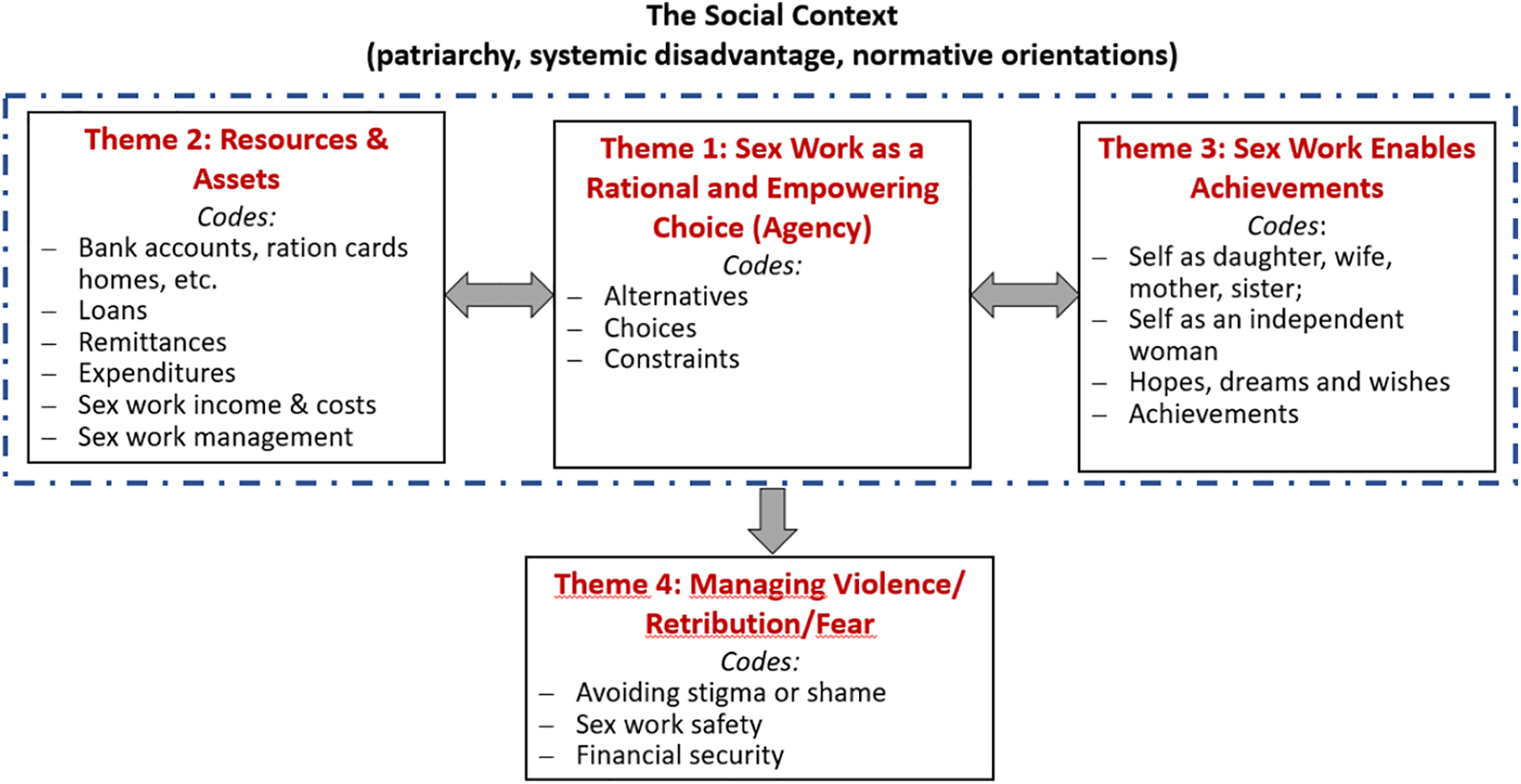
Summary of themes and codes.
Theme 1: Sex Work as a Rational and Empowering Choice
The first and most fundamental theme that emerged was the description of sex work as a rational and empowering choice. Several respondents acknowledged that the work was not easy nor respected by society, desired a different life for their children, and noted they would engage in a different job if it were available to them. However, none of the respondents framed sex work as a form of oppression or violence. Rather, sex work was framed as an empowering means of income and asset generator and was thus an opportunity for gaining independence, meeting needs, and giving the next generation a better future. Essentially, the respondents described sex work in terms of a goal-oriented choice. The ability to define goals and create pathways toward these goals is a fundamental expression of agency (Kabeer, 2002). For instance, Seema chose sex work in order to gain independence: “Through a known person from my village I came into this line. He told me about this work and the money. I was a little scared but there are many girls who do this and become independent.”
Similarly, Rasika, who continued to engage in sex work without her husband’s knowledge in order to earn money of her own, stated: I will just entertain one or two customers a day so that I can pay the rent and everyday expenses from his [husband’s] income and I can send what I earn to my family in the village and save a little…. It gives me freedom to have my own money.
Several respondents emphasized the rationality of sex work as a choice by contrasting the outcomes of sex work against the outcomes of not being engaged in sex work. In the face of systematic disadvantage, respondents made the choice that would provide the most advantages. Ratna described sex work as the preferred alternative to insufficient income: “I went to the village but the situation there was the same…. Poverty, hunger, no pucca (concrete) house. I decided to come back to Mumbai and join sex work.”
Notably, respondents also revealed their agency in relation to sex work when they described refusing interference from human service providers working in nongovernmental organizations (NGOs). For example, Shanu explained: “The NGO workers want us to work for them, like community work and go door to door and talk to other women. I don’t want to do that either. I just work when I can and try my best.”
Theme 2: Resources and Assets
The second theme involved respondents manifesting agency through accessing resources and controlling assets needed to achieve goals. Notably, respondents were in charge of key decisions involving income and asset deployment to fulfill goals of being good wives, mothers, and/or daughters. All respondents indicated a significant degree of choice regarding how they spent their profits. For instance, respondents shared that they wanted to support their families and described themselves as having the authority to prioritize needs of children rather than extended family and to spend their money accordingly. Ratna shared: No one forces me to send money but I myself send money to my home…. It’s difficult to send money every month as my savings are not there. Expenses are also high but I try my best. Without sending money I don’t feel good. I keep money with me and spend on my child. I do not give money to my husband…we both share the rent expenses but most time I have to pay…after all the expenses, it’s difficult to send money back to my village. My husband does not demand the money (for daughter’s education) on the contrary he gets angry with me for sending this money to the village. He says its dirty money earned from bad job but I have to look after my daughter.
Respondents were not reliant on others to remit money back to their families, and all but one respondent had kept control over her income and did not have to hand it over to a spouse. Shital uses online banking: “Online transfer is better and cheaper than bank transfer…. I did not find any difficulty in sending money through online.” Ratna operates through her local bank: When I need to transfer money, I go to the nearby bank and just tell them the bank account number…. I have a cell phone so I call and ask my mother-in-law and husband if they got the money. I work on the street and rent a cot when I get a customer. There is no pimp working for me. I don’t have to worry about anyone helping me find customers…. I solicit at night when my son sleeps, so it’s never been an issue. Most of my customers come to me at Kamathipura. Sometimes, they call me at different places and I try to go there.
Theme 3: Sex Work as a Means of Achievement
Sex work as a means of achievement was another theme in the data. For instance, Shital shared: “Through earnings from the sex trade I have purchased land in my village. I will build a home and I can stay there.” Achievement is one aspect of agency (Kabeer, 2002), and all but one respondent related how sex work enabled them to achieve goals related to the culturally salient social roles of wife, mother, and daughter/sister. Through sex work, several respondents were able to be “good” wives, mothers, and daughters/sisters who provided for the current needs and secured the future needs of their families as their sex work was the primary source of income for themselves or their families.
Surekha explained: “Whenever any relatives or anyone’s in-laws visit our home even now, I am the person to send money and do the needful. I am almost like breadwinner for my family.” Like Surekha, Shanu also took pride in providing for her family: “I keep money with me and spend on my child…. We (husband and speaker) both share rent expense but most times I have to pay…. I send money for my mother.” Suman also takes on the responsibility of being a breadwinner for her children: “I have two children in my village to be looked after so I decided to come here…. I pay for their expenses.”
Respondents were also explicit about how they were taking on roles of being a provider that were traditionally the domain of the males in the family. Shanu shared: “With my health, I just want to work for as many years as I can and keep supporting my son. I don’t think my husband will take care.” Unlike Shanu, Seema’s husband does not like her work, but she still decides to work in order to obtain an income: “My husband knows all this. He does not like it, but I have to do it for the money…He is a cook in a hotel and does not get much money.” For many in a patriarchal society, men are the main breadwinners, but for Shital, when her husband left, she did what she needed in order to care for herself: “My husband left me so I had to leave the village to find some work.”
Theme 4: Managing Violence, Retribution, and Fear
Agency involves the ability to make decisions about one’s own life and achieve goals, free from violence, retribution, or fear (Ahmed & Hyndman-Rizk, 2020). Sex work, particularly in a patriarchal context, poses the risk of social and physical violence, retribution, and fear for workers (Crawford, 2017). The capability of preventing violence, retribution, and fear was the fourth theme that displayed respondents’ agency. Risks were managed through numerous strategies such as controlling disclosure to family and neighbors, careful negotiations with clients, and judicious choices of when and where to work.
Several respondents described strategies for managing the social risks, such as stigma or family disapproval, by careful control of disclosure. One strategy involved “legitimizing” income by telling family members that they work for a “company” in the city, which Seema utilized: “I have father, step mother, and two elder sisters in my family. Sisters work somewhere in village. No one among them knows about my profession. All know that I work in a company.” Amina also shared a similar experience: “When they call me for money, I never ever tell them about my current business. I give them reasons like there is shortage of work or the company owner is not paying salary.” The two respondents interviewed who were married to men who wanted them to stop sex work refrained from disclosure altogether. One was Kavita: “If my husband inquires then it will be trouble. He has denied me to do this work. He knew I was in the sex trade. But he does not know that I am still in the trade.”
Other strategies involved geographical distancing, such as Shital’s approach: “I do not stay in this area. I live a little bit away from here, so no one in my area knows where I go to work.” A few of the respondents also protected their children from stigma by using these strategies of geographical distancing, including Kesar: “When my child was 7 months old, my husband left me. He is 16 years old now. He stays with my parents in Nepal. It is good that he is away from this dirty place.” Seema also made the choice for her child to not remain in Kamathipura: “I do not want my child to know about my work so I have kept him at Dadar with my husband.”
The strategies used by the respondents to exert control over how they or their children were viewed by family and neighbors showed that respondents were agentive individuals capable of managing their interactions with larger social structures in order to protect themselves and their families. Similarly, respondents were intentional in reducing the risk of violence from clients, other sex workers, moneylenders, and other individuals who may pose harm. For example, Shanu stated: “Sometimes I borrow money from my friends but I also return it promptly. I do not borrow from an unknown person. It’s very dangerous, they are always behind you to pay back and it’s a lot of tension.” Rosie was also aware of the dangers in Kamathipura: I do not stay at night. At the night time customers are bit risky to handle…. Very few people come to Kamathipura but I can’t go to another area. I have heard that other women who work there will fight with me. Here all bad things take place like theft and murder. If a lady has fixed the rate before talking customer to sex room she has to stick to her rate after reaching. If she increases the amount, a dangerous customer may kill her…. It’s always advisable to take our own money from customer. If we try to rob him he can kill us. Sometimes I feel like leaving this place and going away from here. Sometimes I feel like I let my life come to an end…. I work for my daughter. Things should be better in her life. Her life should be secured…. One should not take tension and live happily. They [her children] are mine alone to worry about and I live for them. There is no future in the sex trade…. My life is hell but I will always let my child grow in a good environment. Tomorrow he should not say that his mother left him alone to face problems of life and went away.
Discussion
These four themes—(a) sex work as a rational and empowering choice, (b) resources and assets, (c) sex work as a means of achievement, and (d) managing violence, retribution, and fear—encapsulate expressions of agency. In their expressions of agency, respondents revealed how sex workers are intentional, rational, goal-oriented, and resilient in the use of their bodies and time, their mindsets about their work, their domestic roles, degree of self-disclosure, and key business decisions. Sex workers in this study clearly spoke of themselves as independent business owners who were capably achieving goals rather than as victims of the patriarchy. Indeed, results from the respondents revealed that sex workers in Kamathipura adopted strategies to navigate the “rules of the game” in their specific social context—that is, the gendered social norms and expectations that one needs to comply with to “win” a valued or at least normative status with its attendant benefits (Kandiyoti, 1988). These strategies included limiting self-disclosure, being their own boss and managing generated income, limiting involvement with NGOs, using income to generate further assets and capacities for choice (such as purchasing land), choosing when or where to work, deciding how to engage clients, geographical distancing, and asserting parental authority as mothers. Respondents likewise reported feeling agentic: Their sense of “power within” was an important part of their agency (Kabeer, 2002).
The themes also reveal how respondents complied with and subverted norms as needed in order to navigate the social boundaries they encountered as women engaged in the sex trade and in the larger patriarchal context. Similar to what Praimkumara and Goh (2016) described, respondents in this study transformed the meaning of certain schemas to appeal to masculine ideals while maintaining their role as sex workers with the benefits it offered them. Specifically, respondents emphasized how their participation in sex work allowed them to properly carry out their roles as mothers primarily, as well as responsible daughters and sisters. Moreover, they were able to be the provider for family members due to their income from sex work. Several respondents bluntly stated that they were providing for their families because their husbands were unable to or had abandoned the family. Instead of remaining helpless, victimized and (further) impoverished by the male provider’s lack of fulfillment of his social duties, the respondents employed a marketable asset they had and chose to engage or to continue to engage in sex work to achieve desired outcomes.
In India, sex work is stigmatized as a trade for immoral women (Cornish, 2006). However, the narratives cast by the respondents suggest a noble (rather than immoral) cause of providing for the family. Rather than being indicative of the women’s failure to fulfill traditional expectations of virtuous womanhood or motherhood; for many of the respondents, their narratives called attention to the men who were not contributing sufficiently, if at all, for the family’s needs. In particular, sex workers who were mothers evoked cultural narratives of good mothering. They referred to sex work as their only means of providing better lives for their children, often in the context of the children’s fathers being incapable or unwilling to do so (McCloskey et al., 2020). Sex worker mothers were willing to prioritize earning money for their children’s needs over their own health concerns or access to medical care and used their income to finance their children’s education, so that their children would eventually have access to a wider range of employment options (Ali et al., 2021; Basu & Dutta, 2011; Dalla et al., 2019, Praimkumura & Goh, 2016). While still unacknowledged as a whole by the wider society (McCloskey et al., 2020; Ryan et al., 2019), the honorable intentions and self-sacrificial practices of these mothers reflected normative themes of motherhood.
Our interviews with respondents also supported the perception established in previous research that agency is a nuanced concept: It can both manifest and be constrained at the same time. As we showed, respondents clearly described these constraining factors throughout their interviews, describing their strategies to circumvent them and acknowledging the limits posed by these factors that they did not have the resources to overcome, including the limited earning power of sex work. Notably, respondents’ investments in their children’s future were aimed at preventing their children from being limited by the same factors, clearly illustrating respondents’ ability to impact their social context even while being constrained by it.
Respondents’ descriptions of their intrinsic agency amid structural and cultural constraints clearly support feminist and the strengths-based perspectives. The women themselves were resilient and were cognizant of their strengths and capabilities. They focused on their ability to contribute to their families, particularly to create positive change for their children through sex work. At the same time, respondents described the social constraints, risks, injustices, and lack of access to needed resources that were part of their environments. They deliberately created opportunities for themselves to make choices that enabled them to improve their situations while personally resisting stigma and protecting control over their assets. Not only did respondents protect their assets, families, and reputations to the best of their abilities, they also intentionally protected their mental or emotional health; for instance, Naznin’s comment, “One should not take tension and live happily.” They also protected their self-image; for instance, Surekha’s poignant comment, “I am almost like breadwinner for my family.” Essentially, with little social or familial support or help from service or governmental agencies, respondents empowered themselves.
Overall, findings from this study are in line with prior research that illustrates how participation in sex work is both an act of agency in itself and a pathway through which women gain agency (Swendeman et al., 2015). The findings of this study on sex workers in Mumbai highlight women’s ability to navigate the challenges presented by their social contexts in order to achieve goals, supporting previous research that has examined women’s, and particularly sex workers’, agency amid patriarchal institutions (e.g., Basnyat, 2014; Sinha, 2017). The robustness of these finding across different studies in different cultural sites over the past few decades affirms the resilience, immutability, and universality of women’s agency in difficult circumstances. The findings of this study also bring a more detailed view of what this agency looks like in relation to the different goals women have and their strengths, the specific types of choices that they make to protect their agency, and what they consider as they make choices for themselves and their families.
Strengths and Limitations
This study has a number of strengths. First, rigorous qualitative practices were employed to reduce researcher bias and reactivity, including maintaining a journal, detailed audit trail, and peer debriefing throughout data collection and analysis. The study also has ecological validity given the focus on the social context and the location of interviews in the brothels. Respondents reported a wide range of experiences related to their personal and professional lives as sex workers in Kamathipura.
Regarding limitations, the interviews were conducted in Hindi and were translated and transcribed into English. It is likely that there was some data loss due to this, and some cultural or linguistic meanings may be skewed or missing from the data. Second, respondents self-selected into the study, so results could be biased based on the subset of women who felt comfortable participating in the study. Given that the focus of this study was to highlight the narratives and lived experiences of a small group of cisgender FSWs in Kamathipura, we understand that the study findings cannot be applicable to the diverse population of sex workers in general.
Conclusion
The findings in this research have several implications for future research and practice with sex workers. For micropractice interventions, it is imperative that those who work with sex workers provide dignity and respect to individual choice and agency. This is critical as this study has shown that the strengths-based perspective is congruent with sex workers’ own empowering approach to their goals and challenges. Micropractice service priorities should be set by sex workers themselves in order that services rendered would be relevant to them. Micropractice could focus on the goals that sex workers themselves have identified as important, such as safety, physical health needs, viable financial alternatives, access to affordable housing, and school for their children. Services should also address emotional well-being, self-confidence, and self-efficacy, as sex workers have been explicit about the importance of these issues to their overall well-being and ability to continue earning. Addressing mental health issues may have a positive impact on sex workers’ physical health; for instance, previous research with sex workers demonstrates a correlation between low self-esteem and high depression with higher rates of HIV infection (Alegria et al., 1994). Overall, micropractice should aim at covering all areas of need and support the various goals described by sex workers for their social, familial, financial, physical, and mental well-being.
In addition to micropractice, macrowork with communities and societies is essential to remove the stigma from sex work. The stigma of sex work contributes to oppression, maltreatment, and criminalization of sex workers (Lutnick & Cohan, 2009). That the sole way respondents were able to navigate the stigma associated with sex work was to hide it from unknowing family, friends, and neighbors clearly indicates that community-level structural interventions are needed. As stigma prevents many sex workers from taking full control over their lives and situations, especially in patriarchal societies, it is critical for feminist declarations to allow women to make decisions without fear of societal pushback or mistreatment. Currently, local and national sex workers’ collectives such as the National Network of Sex Workers, the All-India Network of Sex Workers, and the Durbar Mahila Samanwaya Committee (Kolkata) exert effort toward destigmatizing sex work as labor with the attendant rights to social services, health care, and protection from discrimination and violence. Social work researchers could partner with these collectives to evaluate the impact of these collectives, to collaboratively design structural interventions, and to secure funding for further advocacy and intervention work.
These findings also have important implications for research. Respondents’ indications that local social services had been mostly unhelpful in providing for their needs or unwanted by them strongly suggest that research evaluating social services for sex workers is necessary and that this research must include the voices of sex workers themselves. Additional research pertaining to the autonomy and agency of sex workers is necessary in order to develop tools that can further assist with obtaining independence and personal achievement in a patriarchal society. This work is not only necessary in Kamathipura, but around the globe to allow sex workers everywhere to live without discrimination or stigma, feel empowered to make decisions, and exert agency in their personal and professional lives.
Footnotes
Declaration of Conflicting Interests
The author(s) declared no potential conflicts of interest with respect to the research, authorship, and/or publication of this article.
Funding
The author(s) received no financial support for the research, authorship, and/or publication of this article.
