




Abstract
The purpose of this study is to conduct a feminist-based policy analysis to examine the role of power in campus sexual assault policies. This research investigated the role of power in campus policies that are in response to addressing sexual assault using a feminist policy analysis framework. McPhail’s (2003) Feminist-Based Policy Analysis Framework was used to study the policy-setting documents authored by the United States (U.S.) Department of Education’s Office of Civil Rights and White House Task Force to Protect Students from Sexual Assault that was established in 2014. Together, these documents encompass the federal guidelines for college campuses’ compliance, rights, and responsibility under Title IX. The Framework provides four questions to consider when analyzing the role of power within a policy. Several strengths of the policies are identified as well as tension between the power of institutions versus the power of student survivors, specifically in mandatory reporting policies. Implications for social work research, practice, and policy are explored along with identifying the study’s limitations and future research suggestions.
The U.S. Department of Education (USDOE; 2011a) defines sexual violence as, “physical sexual acts perpetrated against a person’s will or where a person is incapable of giving consent due to the victim’s use of drugs or alcohol” (p. 1). Research has shown that 1 in 5 female and 1 in 16 male students will be a victim of sexual violence while at college (Black et al., 2011). Researchers have studied the impact and reporting of sexual violence on college campuses. The majority of survivors will not report to formal resources, such as legal or mental health services, but are more likely to report to informal resources such as friends (Sabina & Ho, 2014). After surviving sexual violence, a student may experience a wide array of mental health symptoms including posttraumatic stress disorder and internalization of rape myths, shame, or blame (Orchowski & Gidycz, 2015). This article will present a feminist-based analysis with a focus on female students, given the higher prevalence of female sexual assault.
In response to the prevalence of sexual violence and efforts by survivors and advocates, key pieces of federal legislation have been passed to include Title IX (1972), the Clery Act of 1990, the Violence Against Women Act of 1994, and the 2013 Campus SaVE Act. These federal policies, specifically Title IX, have significantly informed college institutions’ response to sexual violence. It is critical to examine the relationship between the current policies and their influence on shaping responses to campus sexual assault, especially in political climates that may threaten progress. Applying a feminist-based framework makes gender explicit and calls for the empowerment of female student survivors. This article uses a feminist-based framework to analyze policy-setting documents regarding sexual violence on college campuses in the United States.
Literature Review
Federal Policies
Title IX (1972) remains one of the most significant policies that has impacted college campuses and sexual violence. Title IX was passed as part of the Educational Amendments of 1972 to address sexual discrimination in educational settings. Title IX (1972) explicitly states, “No person in the United States shall, on the basis of sex, be excluded from participation in, be denied benefits of, or be subjected to discrimination under any education program” (p. 371). Sexual violence became an officially recognized form of sexual discrimination as a result of Title IX.
In response to the prevalence of sexual violence, institutions of higher education have relied on other key federal policies. In 1990, The Jeanne Clery Disclosure of Campus Security and Campus Crime Statistics Act (Clery Act of 1990) was passed as an amendment to the Higher Education Act of 1965, to increase academic transparency and accountability of reporting crime statistics, preventing violence, and providing processes to increase safety. Crimes included in these reports are sexual assault, rape, dating violence, and stalking. Another key piece of legislation that shaped responses to sexual violence was the Violence Against Women Act (VAWA) that was passed in 1994. In the 2013 reauthorization of VAWA, the Campus SaVE Act was added to the reporting requirements of the Clery Act including reporting domestic violence, dating violence, and stalking. Other revisions include informing students about their rights in reporting to law enforcement, creating a standard of evidence in discipline proceedings, and providing education prevention.
Federal Guidelines
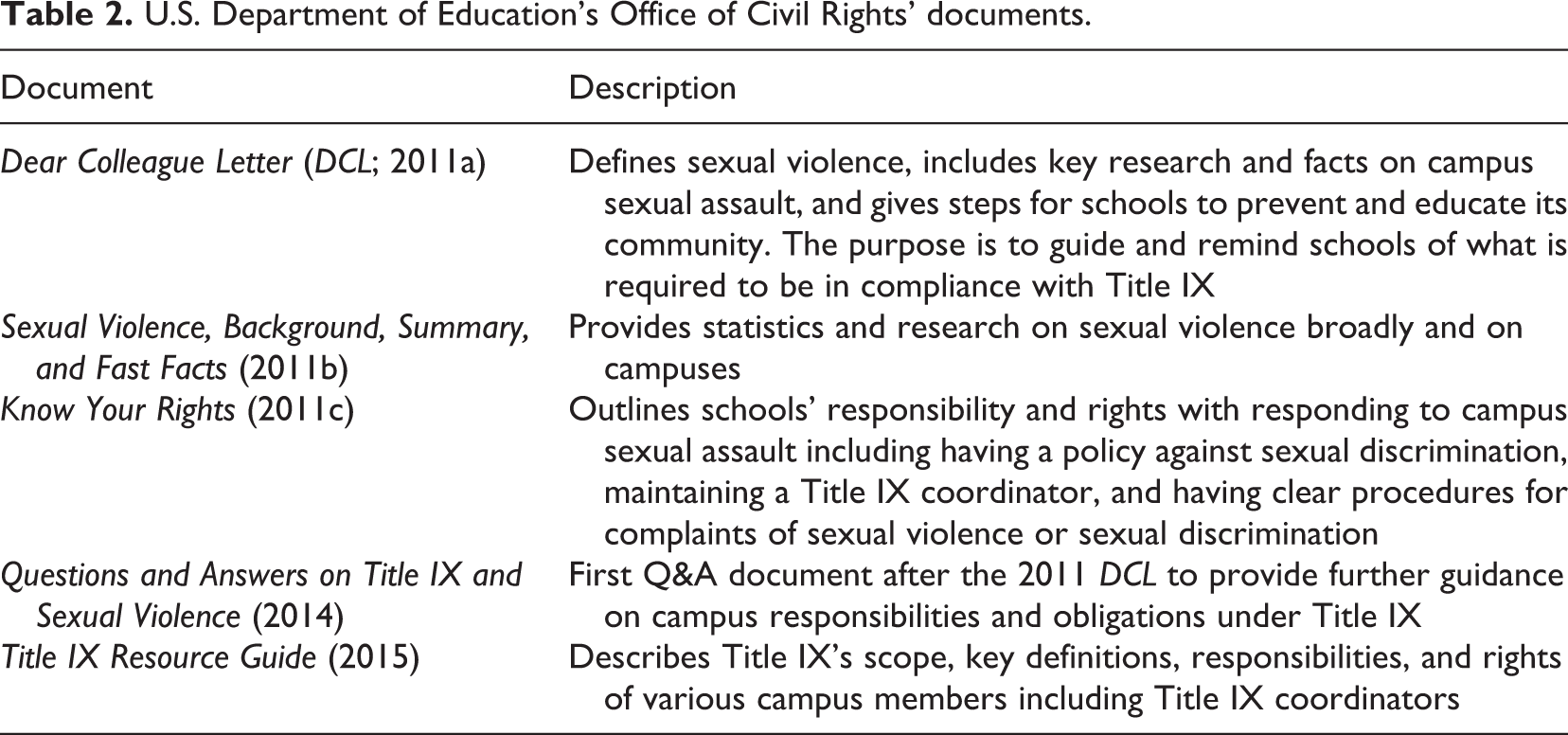
Due to fervent student advocacy calling on the USDOE to hold institutions of higher education accountable, the USDOE’s Office of Civil Rights (OCR) released a Dear Colleague Letter (DCL; 2011a) along with other guides outlining the requirements to be in compliance with Title IX (USDOE, 2011b, 2011c, 2014, 2015, 2018). The OCR cited the DCL as a “significant guidance document” under the Office of Management and Budget’s Final Bulletin for Agency Good Guidance Practices. The OCR is the federal office that provides oversight and management of Title IX. A DCL is a document that provides explicit guidance on the implementation and obligations of how to be in compliance with policies. This DCL and resulting reports reflect the OCR’s authority to outline such requirements as having a Title IX campus coordinator, creating mandatory reporting and consent policies, and recommendations on investigations and standards of evidence.
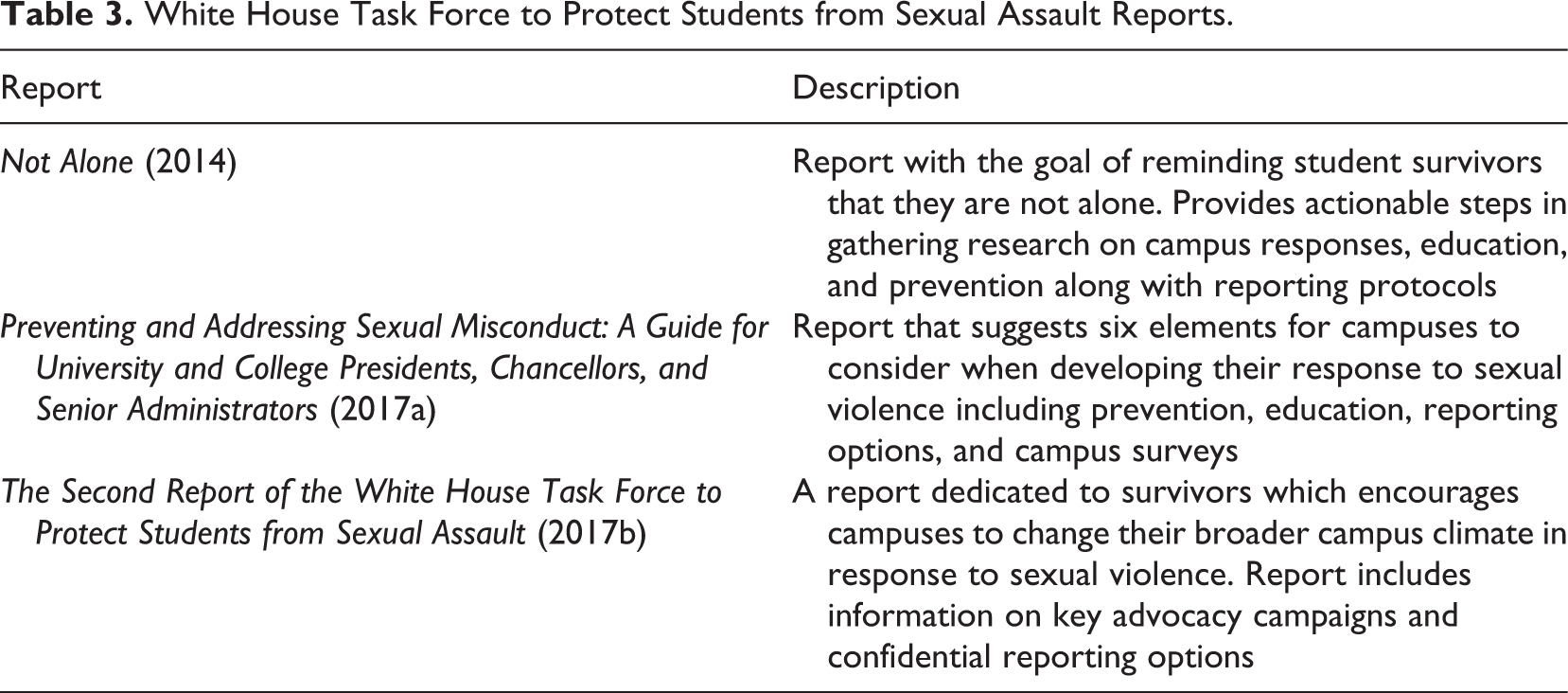
The Obama Administration also established the White House Task Force to Protect Students from Sexual Assault in 2014 that was chaired by Vice President Joe Biden and cochaired by Valerie Jarrett, who served as chair on the White House Council on Women and Girls. This Task Force was created to support campuses in their compliance with federal policies, inform prevention efforts, and increase federal response. The Task Force released similar reports to OCR in response to campus sexual assault and Title IX (2014, 2017a, 2017b). These reports have significantly impacted how institutions respond to sexual violence and develop policies on mandatory reporting, consent, and education.
As Betsy DeVos became Secretary of Education under the Trump Administration, she published a proposed rule to amend Title IX in November 2018 (OCR, 2018). Several key changes would include that institutions may establish the “clear and convincing” standard of evidence instead of the “preponderance of evidence” that was recommended during the Obama administration and that institutions are not required to investigate off-campus incidences (OCR, 2018). The period for the public to submit comments to the proposed rule ended in January 2019. The USDOE has yet to reach a final outcome or ruling, and institutions of higher education are expected to adhere to the current standards and policies previously set forth until further notice.
Title IX
While the intention behind Title IX is to protect students, researchers, activists, and students have become increasingly wary of its impact and unintended effects such as the tension between feminist values and the criminal justice focus (Brubaker, 2018; Busch, 2018; Richards, Branch, Fleury-Steiner, & Kafonek, 2017). In a study on mandatory reporting, campus advocates expressed feeling conflicted in trying to adhere to campus policies while wanting to support feminist values of survivor empowerment (Brubaker, 2018). Busch (2018) writes that Title IX has exceeded its scope and “the process by which Title IX’s jurisdiction has expanded reveals the unchecked nature of what I term the ‘discretionary bureaucracy’” (p. 105).
Researchers have argued that, as campuses interpret the Title IX requirements, survivors increasingly experience a lack of power in reporting, seeking help, and making choices in the adjudication processes (Brubaker & Mancini, 2017; DeMatteo, Galloway, Arnold, & Patel, 2015; Holland, Cortina, & Freyd, 2018; Holland & Cortina, 2017; Mancini, Pickett, Call, & Roche, 2016). Brubaker (2018) writes, “mandatory reporting takes control away from survivors who may not want to pursue a formal investigation and prevents them from being able to seek support and services” (p. 14). Weiss and Lasky (2018) argue that college students are adults with the ability to report independently without having adults on campus make those reports for them. Cantalupo (2016) argues that mandatory reporting violates Title IX in being discriminatory with respect to gender by not treating college students as adults with legal independence to report to law enforcement. Cantalupo (2016) writes, “Differential treatment without a reasonable justification falls under the definition of discrimination” (p. 292). Researchers caution universities that are quick to create policies despite the lack of research on perceptions and outcomes (DeLong et al., 2018; Dowler, Cuomo, & Laliberte, 2014; Mancini et al., 2016, 2017; Newins, Bernstein, Peterson, Waldron, & White, 2018; Richards, 2019).
Feminist-Based Analyses of Title IX
Researchers have incorporated feminist analyses to study the impact of campus policies resulting from Title IX. Brubaker (2018) used a feminist standpoint approach to identify the conflicts that campus advocates expressed with respect to the campus versus feminist values of empowerment, agency, and autonomy for survivors. Similarly, Busch (2018) incorporated a feminist standpoint analysis when reviewing Title IX, noting the feminist criticisms of the policy’s implementation that fails to protect and support students. In using a feminist ethics of care approach, Dowler, Cuomo, and Laliberte (2014) identified the ways in which campus policies do not address the broader culture of violence that permeates across campuses. Streng and Kamimura (2017) similarly noted the disconnect between policies and the broader campus perceptions of sexual assault that are needed to address rape myths, which shape the culture, implementation, and perception of policies.
Other studies have identified feminist values that are in opposition to campus policies, such as mandatory reporting policies that appear to disempower survivors (Holland et al., 2018) or barriers that prevent the voices of advocates, students, and survivors from being heard (Perkins & Warner, 2017). Researchers also have included intersectional feminist frameworks (Worthen & Wallace, 2017) and feminist-based models of advocacy (Richards et al., 2017). Richard et al. (2017) write that a feminist approach, “recognizes that sexual violence removes control from survivors and consciously seeks to return that control, enabling victims to decide whether to seek medical treatment or make a police report, or even whether to speak with an advocate at all” (p. 106).
Social Work’s Role and Campus Sexual Assault
Researchers have critiqued social work’s lack of participation in studying sexual violence, specifically in the lack of explicit feminist-based analyses within policy (Kanenberg, 2013; McMahon & Schwartz, 2011; McPhail, 2003; Schwartz, McMahon, & Broadnax, 2015). Social workers have currently and historically worked with diverse populations of women who experience the repercussions of various types of violence including violence against women on campuses (Voth Schrag, 2017). In referencing Dietz (2003), Swigonski and Raheim (2011) write, “Both feminisms and social work are historically constituted and embody both emancipatory purpose and normative content…[and] are multifaceted, nuanced, complex, and often contentious” (p. 11).
Social workers inevitably encounter sexual violence across multiple settings (e.g., hospitals, schools, mental health agencies), from diverse positions in micro, mezzo, and macro systems (McMahon & Schwartz, 2011), and acknowledge the person-in-environment, an element critical to the context of campus sexual assault (Schwartz et al., 2015). Social work has explicit values and ethics that reflect the importance of protecting and supporting survivors of sexual violence including social justice, the dignity and worth of the person, the importance of relationships, and self-determination (National Association of Social Workers, 2017). A gap in the social work literature exists in conducting feminist policy analyses and campus sexual assault research.
Given the tension identified by researchers between an institution’s power to direct the response to sexual assault and female students’ power to direct the response to sexual assault, this article will use a specific feminist-based policy framework to analyze campus sexual assault policies. A feminist analysis that recognizes the role of power is critical to analyze this tension between institutions and their students.
Method
Study Design and Analysis
The research question is, “How is power expressed in the campus policies that are in response to sexual assault using a feminist policy analysis framework”? This study will use McPhail’s (2003) Feminist-Based Policy Analysis Framework to answer this research question. The Framework is comprised of different topics that McPhail maintains are critical to study in a feminist-based policy analysis. Some of the topic categories include values, context, equality/rights and care/responsibility, and power analysis. Each of these categories includes certain questions ranging from one to seven subquestions for the analyst to consider when evaluating a policy. McPhail encourages the researcher to identify what topic area may be the most appropriate to conduct the specific policy analysis. This article’s focus is on the examination of the role of power between institutions and female survivors as it relates to campus sexual assault policies. The topic area selected is what McPhail refers to as a, “Power Analysis,” which includes four questions that examine who has the power to define the problem and solutions that a policy attempts to address. The four questions that will be analyzed with respect to the text selection are included in Table 1.
McPhail’s (2003) Feminist-Based Policy Analysis Framework.
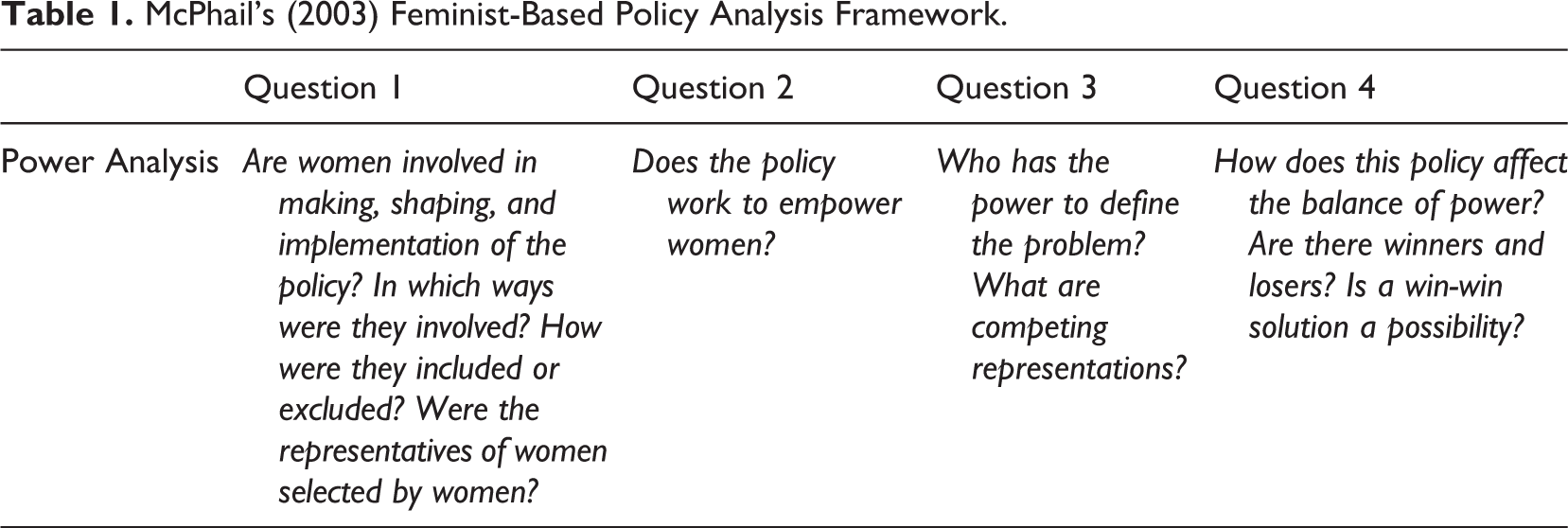
In response to the need of a social work feminist analytic lens, McPhail developed this Framework to analyze policies through a set of critical questions related to the expression of power. Key values of this Framework that aligns with social work values include the reconceptualization of power that the personal is political, the importance of holistic views of the person, nonhierarchical relationships, and the significance of relationships. In acknowledging that no set of questions can address all the underlying issues in a feminist analysis, McPhail reminds policy analysts that questioning policies is the initial step and that these questions need to lead to reshaping, responding to, and addressing the broader issues.
Text Selection
The primary data for this study are federal documents and reports that have been written by both the USDOE’s OCR and the Task Force to inform institutions’ Title IX compliance. While other pieces of U.S. legislation have impacted campus sexual assault policies, this study focuses on Title IX given its frequent mention in the policy-setting documents along with key studies identified in the literature (Brubaker, 2018; Busch, 2018; Newins et al., 2018; Perkins & Warner, 2017) as well as its broad civil rights context to higher education (Cantalupo, 2016). Together, these policy-setting documents create the textual data for this analysis. The description of the documents from the USDOE is included in Table 2. The list of key reports along with their descriptions from the White House Task Force to Protect Students from Sexual Assault is included in Table 3.
As noted, each of the reports is the USDOE’s OCR’s or Task Force’s rule enforcement, information sharing, and federal guideline for campus sexual assault policies and implementation of Title IX. The OCR is the primary responsible department that oversees the implementation and enforcement of Title IX. The resulting reports are rule extensions of Title IX. These documents will be analyzed with respect to McPhail’s four questions to consider when analyzing the role of power (Table 1).
Results
Feminist-Based Policy Analysis Framework
The four power analysis questions from McPhail’s Framework were applied to the entire set of documents presented in Tables 2 and 3. Each question, along with its set of subquestions, is reintroduced with key findings from the USDOE’s OCR and Task Force’s documents.
U.S. Department of Education’s Office of Civil Rights’ documents.
White House Task Force to Protect Students from Sexual Assault Reports.
USDOE’s OCR
Arne Duncan was the U.S. Secretary of Education during the creation of the above documents. During this time period, the Assistant Secretary of OCR was filled by two female Presidential appointees, whom the USDOE listed as the official author on several of the documents. For instance, OCR’s Assistant Secretary for Civil Rights, Russlynn Ali, is the official author listed on the 2011 DCL. Catherine Lhamon, the following Assistant Secretary for Civil Rights, is the official author listed for Questions and Answers on Title IX and Sexual Violence in 2014 and the Title IX Resource Guide in 2015. The other documents did not list specific authors in their text. The documents do not provide information on how they were created, what the specific roles of Assistant Secretary for Civil Rights were in creating these documents or the impact of these roles as women. It is not known to what extent other women may have been involved in selecting these women for their positions. Besides official staff employees, female student advocates also played significant roles in leading to the release of these documents (Dick & Ziering, 2015). As a result of female student survivors filing complaints with USDOE of their campuses being in violation of Title IX, the USDOE responded with the initial 2011 DCL.
The documents contain language that references student survivors who have guided the shaping of the policy for campuses. This language is reflected when statistics pertaining to female student survivors are included. For instance, in the Sexual Violence, Background, Summary, and Fast Facts (2011b), one of the first statistics includes, “When young women get to college, nearly 20% of them will be victims of attempted or actual sexual assault, as will about 6% of undergraduate men” (p. 1). However, language throughout these documents references both female and male students, likely reflecting that the basis of Title IX is that no campus may discriminate against a student because of their sex. For instance, the Title IX Resource Guide (2015) begins with “Title IX protects students, employees, applicants from admission and employment, and other persons from all forms of sex discrimination including discrimination based on gender identity or failure to conform to stereotypical notions of masculinity or femininity” (p. 1).
White House Task Force to Protect Students from Sexual Assault
The Task Force was chaired by the Vice President Joe Biden and cochaired by Valerie Jarrett, who served as a Senior Advisor to the President and the Chair of the White House Council on Women and Girls during the distribution of these documents. The documents do not contain specific information pertaining to Jarrett’s or other female staff members’ involvement in the creation of these documents. However, parts of these policy guidelines are written at times with a female lens such as the Not Alone (2014) report that uses the language of “she.” For instance, in the Not Alone (2014) report, the Task Force writes, “it happens her freshman or sophomore year…she knows her attacker” (p. 6). The first statistic in the Not Alone (2014) report writes, “One in five women is sexually assaulted in college” (p. 2). The documents, Preventing and Addressing Sexual Misconduct: A Guide for University and College Presidents, Chancellors, and Senior Administrators (2017a) and The Second Report of the White House Task Force to Protect Students from Sexual Assault (2017b), are also explicit in language to include survivors and female-based groups, such as campus women’s centers, in the implementation and response to campus sexual assault. The Second Report of the White House Task Force to Protect Students from Sexual Assault (2017b) begins by writing, “A huge debt of gratitude is owed to the numerous survivors of campus sexual assault who have made it their mission to become agents of change…this report is dedicated to those survivors” (p. 1). While not explicitly naming females, the high prevalence of female student survivors may indicate that the quote appears to be written in a way that is both dedicated to and inclusive of female student survivors.
USDOE’s OCR
McPhail describes empowerment in response to the tendency for policies to historically maintain the powerlessness of women instead of women gaining and taking up power. One of the key highlights across USDOE’s documents, with respect to empowering women, includes the importance of clearly outlining rights, responsibilities, definitions, options, and processes for students under Title IX. By providing transparent information, survivors become empowered in knowing their rights, making informed decisions about their next steps, and knowing the responsibility of the institution. For instance, the DCL (USDOE, 2011a) reminds schools, “Title IX protects students from sexual harassment in a school’s education programs and activities” (p. 3). The other documents continue to explicitly reference Title IX’s definition of sex discrimination that includes sexual assault (USDOE, 2011b, 2011c). Empowerment-based language also appeared as the reports highlighted that, in response to protecting students, campuses need to be explicit and communicate often about who is a mandatory reporter and what confidential reporting options are available (USDOE, 2014). Similar to the findings for Question 1, these documents are explicit in including all students, not just women. The document, Questions and Answers on Title IX and Sexual Violence (2014), writes, “Title IX protects all students…any student can experience sexual violence…male and female students” (p. 5). While these documents support all students and provide some language that may focus on women’s empowerment, the textual data are unable to indicate to what extent the documents may empower women.
White House Task Force to Protect Students from Sexual Assault
While the Task Force includes language that may reference “she” or mentions statistics of female student survivors, there are no other explicit references to females. Given the prevalence of female victims and the reports’ dedication to survivors, the documents may infer a female focus when discussing the theme of empowerment among student survivors. For instance, the reports acknowledge that the primary reason identified by research for why students choose not to report is fear of their disclosure not being kept confidential. The Second Report of the White House Task Force to Protect Students from Sexual Assault (2017b) writes, “These statistics emphasize the importance of connecting survivors with the support they need. Providing initial, confidential support encourages victims to come forward, helps them regain a sense of control” (pp. 19–20). The Not Alone (2014) report also writes, “Sexual assault can leave victims feeling powerless—and they need support from the beginning to regain a sense of control” (p. 11).
The reports recognize that campus policies must target and empower all members of the campus community to influence the broader campus culture that needs to change in response to gender, sex, relationships, and violence as well as involve surrounding community partners such as rape crisis centers (Task Force, 2017a). Likewise, the Preventing and Addressing Sexual Misconduct: A Guide for University and College Presidents, Chancellors, and Senior Administrators (2017a) document includes suggestions for campuses when supporting survivors, such as, “Provide resources and accommodations to support a survivor after an assault, including access and referrals” (p. 12). This resource list includes victim advocates to law enforcement to transportation. The documents explicitly remind campuses to clearly communicate and educate the community on resources for all students impacted by sexual violence.
USDOE’s OCR
The USDOE’s OCR holds the primary power for creating the policy implementation of Title IX for campuses. The documents remind campuses that they too have power, given that the details of their local policies may vary. In Questions and Answers on Title IX and Sexual Violence (2014), USDOE writes: A school’s procedures and practices will vary in detail, specificity, and components, reflecting differences in the age of its students, school size and administrative structure, state, or local legal requirements (e.g., mandatory reporting requirements for schools working with minors), and what it has learned from past experiences. (p. 14) Schools should inform and obtain consent from the complainant…before beginning an investigation. If the complainant requests confidentiality or asks that the complaint not be pursued, the school should take all reasonable steps to investigate and respond to the complaint consistent with the request for confidentiality or request not to pursue an investigation. (p. 5)
White House Task Force to Protect Students from Sexual Assault
The Task Force documents reflect another entity within the federal government to provide guidance and suggestions on institutional responses. The Task Force explicitly calls for both institution officials’ and students’ involvement in defining how campuses respond. The competing representations of power with respect to campus sexual assault may be seen in the guidelines of mandated reporting and confidentiality. In order to respect students’ power, institutions are strongly encouraged to communicate clearly and often about who is a mandatory reporter and what confidential resources are available. The Not Alone (2014) report reads: Today, we are providing schools with a model reporting and confidentiality protocol—which, at its heart, aims to give survivors more control over the process. Victims who want their school to fully investigate an incident must be taken seriously—and know where to report. But for those who aren’t quite ready, they need to have—and know about—places to go for confidential advice and support. (p. 3) It cautions institutions to consider the recommendations contained in this guide only after determining the unique needs and characteristics of the institutions, its student body, and its surrounding community…Schools should consult their legal counsel to ensure they are meeting all elements required by law. (p. 3)
In highlighting the importance of students’ power in reporting, The Second Report of the White House Task Force to Protect Students from Sexual Assault (2017b) says, “Providing initial confidential support encourages victims to come forward, helps them regain a sense of control, and makes it more likely that they will proceed with a formal complaint or participate in an investigation” (p. 20). Depending on if the entity includes the federal government, institutions, or students, responses to mandated reporting and confidentiality may vary.
USDOE’s OCR
The USDOE’s documents make efforts to emphasize that campus policies should be equitable for all students from diverse backgrounds and prevent sexual assault from impacting any student. In doing so, USDOE upholds that no student should be discriminated against based on sex. The documents, Title IX Resource Guide (2015), Sexual Violence, Background, Summary, and Fast Facts (2011b), and DCL (2011a), begin with reminding campuses that Title IX “prohibits discrimination based on sex in education programs and activities in federally funded schools at all levels” (p. 1). With respect to the student perspective, a balance of power should exist between the potential perpetrator and victim in reporting options and policies. Reflecting this in Know Your Rights (2011c), USDOE writes, “all procedures must provide prompt and equitable resolution of sex discrimination” (p. 2). In the DCL, the USDOE (2011a) writes, “providing all students with an educational environment free from discrimination is extremely important” (p. 1). Protecting all students may pose a “win-win” solution, whereby protecting students from sexual assault also keeps the entire community safer.
Similar to the above questions, the text poses potential “winners and losers” if an imbalance of power exists between campus authorities and student survivors, particularly those who may not want to report or disclose to a campus employee who may be a mandated reporter. It may not be clear for students or institutions, when institutions may overrule a student’s desire to keep their report confidential or make an official report to campus authorities. As previously noted, the USDOE (2014) writes, “There are situations in which a school must override a student’s request for confidentiality in order to meet its Title IX obligations” (p. 19). In the same report the USDOE (2014) writes, “A school should be aware that disregarding requests for confidentiality can have a chilling effect and discourage other students from reporting sexual violence” (p. 19). Finally, as noted previously, the DCL (2011a) informs campuses that, “a school that knows, or reasonably should know, about possible harassment must promptly investigate” (p. 4). Tension in the balance of power may exist between campuses attempting to be in compliance with Title IX through investigation while respecting a student’s wishes.
White House Task Force to Protect Students from Sexual Assault
In quoting President Obama, the Not Alone (2014) report begins with: And that’s why we’re here today—because we have the power to do something about it as a government, as a nation. We have the capacity to stop sexual assault, support those who have survived it, and bring perpetrators to justice. (p. ii)
The intention of the Task Force’s documents appears to support the win-win scenario that includes both power of institutions and students. The Not Alone (2014) writes, “we are here to tell sexual assault survivors that they are not alone. And we’re also here to help schools live up to their obligation to protect students from sexual violence” (p. 2). The Task Force reinforces that all campus members have power to respond to sexual assault, leading to “win-win solutions” for the entire community. The Preventing and Addressing Sexual Misconduct: A Guide for University and College Presidents, Chancellors, and Senior Administrators (2017a) document reminds campuses “the importance of university leadership sending a strong public message of support for these responses—the faculty, staff, and students who are behind the—championing a culture shift that promotes safe campuses that are free from sexual misconduct” (pp. 2–3). Furthermore, The Second Report of the White House Task Force to Protect Students from Sexual Assault (2017b) writes, “The procedures schools use to resolve complaints of sexual assault must be fair so that everyone—complaints, respondents, and the entire school community—is granted their right to nondiscrimination and can have confidence in the resolution” (p. 16). While the prior quote emphasizes the role of all campus members in impacting the broader culture, this quote reinforces that the adjudication process also should respect all campus members’ rights to no discrimination and fair treatment.
Similar to the USDOE documents, the Task Force draws attention to the potential “win-lose” situations that may arise if an institution goes against the student’s wishes with respect to their report. The Second Report of the White House Task Force to Protect Students from Sexual Assault (2017b) writes, “Making students aware of the various reporting and confidential disclosure options available helps them make informed choices about where to turn for help should they experience sexual violence” (p. 20). Again, tension may arise in institutions’ competing allegiance to be in compliance with Title IX but protect a student’s desire for confidential disclosure.
Discussion
This feminist analysis reveals how power is explicitly expressed within Title IX and its resulting guidelines. Table 4 represents a summary of the key findings from the data using McPhail’s Feminist-Based Analysis Framework.
Summary of Key Findings from the Power Analysis.
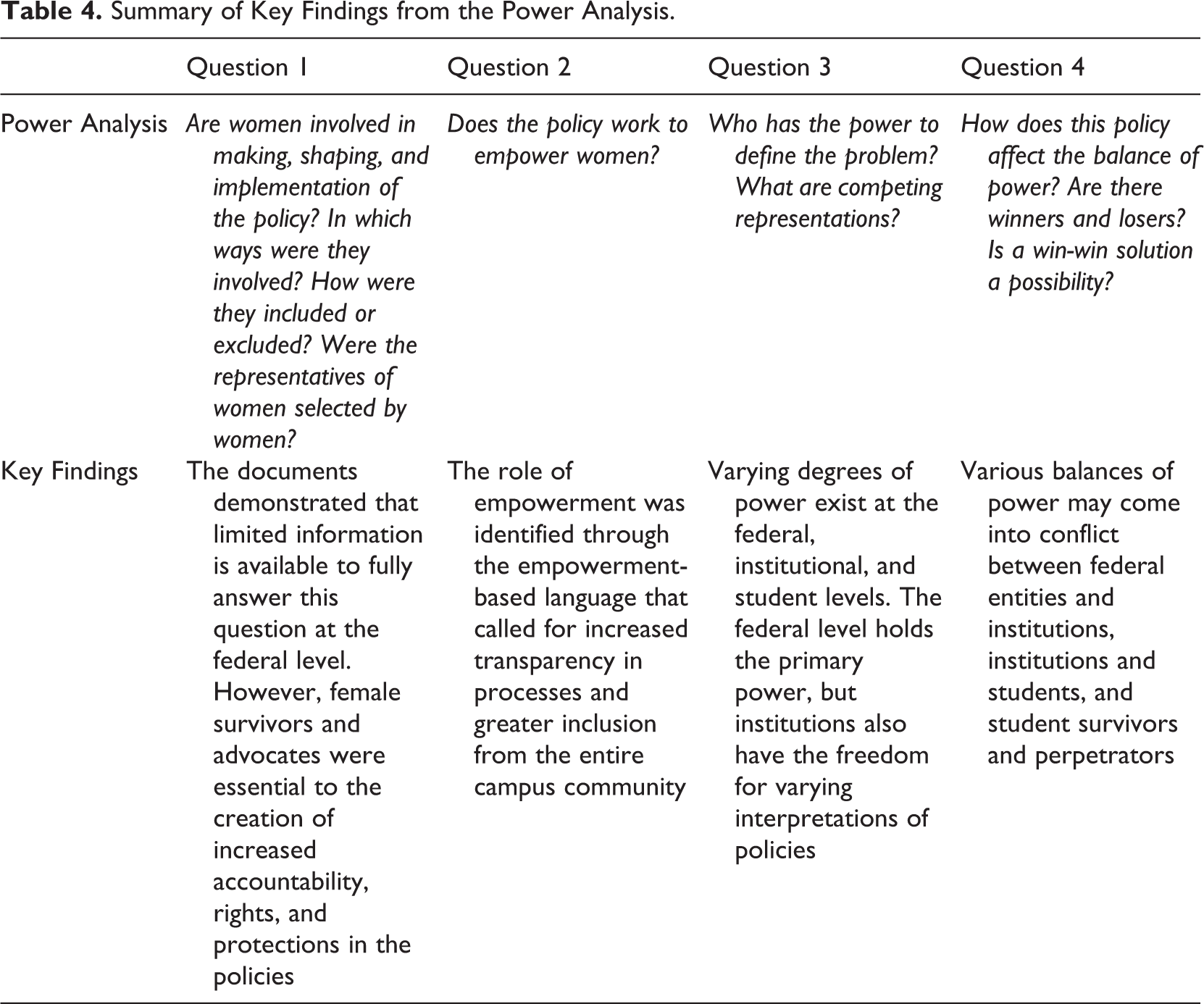
The findings demonstrate the data’s focus on creating policies that protect the entire campus community regardless of sex. The documents are explicit in the requirements and accountability of institutions as they work to be in compliance with Title IX. These points of clarity include defining sexual assault, including its prevalence on campuses, outlining the role and responsibility of the Title IX coordinator, and explaining the adjudication process. Both the OCR and the Task Force acknowledge the responsibility of the federal government and institutions along with students, especially survivors, to be part of the process of developing policies. Similarly, the theme of institutions needing to be explicitly clear on communication to all students pertaining to rights, responsibilities, and resources was apparent throughout the documents.
The analysis of power identified tension that remains with the competing power of the institution versus the power of the student in mandatory reporting. The documents outline that institutions must clearly designate who is a mandatory reporter or confidential person. The documents state that institutions need to obtain consent from survivors and respect the survivor’s desire to not open an investigation. While the documents reflect language that supports a survivor’s request, students may face ambiguity and a lack of power in navigating reporting. This tension of power confirms previous findings that question the evidence for the role of mandatory reporting, especially given its limitation on the autonomy of survivors (Brubaker, 2018; Brubaker & Mancini, 2017; Cantalupo, 2016; Holland et al., 2018; Moylan & Hammock, 2019).
When Secretary DeVos released the proposed rule to amend Title IX, activists and students diligently wrote responses and argued that the proposed changes would back track from the progress made during the Obama administration (Kreighbaum, 2019). According to the Federal Register (2019), over 120,000 comments were submitted. While OCR’s proposed rule has not yet amended Title IX, it is important to consider some of the implications using McPhail’s Framework. For instance, with Question 1, Secretary DeVos is a female official providing extensive oversight and guidance but not necessarily in the support of other female survivors or advocates. In response to Question 2, activists have argued that the proposed changes work to increase the empowerment of alleged perpetrators more than victims (Kreighbaum, 2019). For the role of power in Questions 3 and 4, the proposed changes may intensify the conflict between the balance of power across the rights and responsibilities at the federal, institutional, and student levels. The proposed regulations would make the power of institutions and their interpretation of processes explicit over survivors’ power.
Implications, Limitations, and Future Research
This policy analysis provides significant implications across practice, research, and policy and supports previous findings that question the extent to which certain policies may support survivors’ power. Given the prevalence of sexual assault and current political climate, researchers must evaluate the policies that guide institutional responses to protect students and consider alternative options. With regard to mandatory reporting, the USDOE and institutions of higher education may consider the restricted reporting option offered in the U.S. military by U.S. Department of Defense (2012). For instance, students may choose to make an unrestricted report that launches an official investigation or a restricted report, where students can make an initial report, provide evidence, and receive services while remaining confidential.
The results indicate strengths of Title IX along with the tension between the power of institutions versus the power of survivors; a tension that may increase if Title IX becomes amended. This tension reflects social work’s difficult position at times of protecting both the individual and the community. The Code of Ethics reads, “Social workers are cognizant of their dual responsibility to clients and to the broader society. They seek to resolve conflicts between clients’ interests and the broader society’s interests” (National Association of Social Workers, 2017). Social workers responding to sexual assault need to understand their many potential roles in relation to these policies. Future qualitative work may explore how social workers respond to competing directives, which may arise from adhering to campus policies while supporting the values and ethics of the profession. Sexual assault on campuses should be a social justice concern for the social work profession, and the social work profession has significant strengths in its ability to respond.
Besides the implications of needing more social work research on campus sexual assault and exploring alternatives to the current mandatory reporting policies, this feminist analysis brings forth certain power struggles that need to be considered by institutions and the federal government when considering policy changes. Sexual violence is a crime that impacts the broader campus community and culture. Consequently, multiple community stakeholders must be included in the response and prevention of sexual violence. The policy-setting documents reflect the complexity in potentially competing voices between different levels of power. Within each campus community other competing entities of power may exist depending on jurisdiction, religious affiliation, funding, geographic location, or student body. Each campus includes a diverse array of voices among students, staff, faculty, and community partners. Extending these efforts and research to the broader campus community may lead to greater possibilities in sharing the responsibility to create change, alleviate sexual violence, and inform stronger policy efforts. Before amending Title IX or making other policy recommendations, the federal government should consider the diversity in voices and power within each campus community that both shape and are shaped by sexual violence. Conducting feminist analyses of policies recognizes the importance and inclusion of critical values, such as empowerment, equality, shared responsibility, and diversity of voices, especially among student survivors, which policy makers should incorporate. Bringing together, these values of feminist analyses along with increased campus inclusion will have a stronger impact on future policy efforts addressing sexual assault.
While this study provides significant implications, several limitations need to be noted. For instance, the previous literature was limited in informing the incorporation of McPhail’s Framework. This study was unable to address each of the topic categories and corresponding questions. If other topic categories were included, the analysis may have yielded different results. Similarly, some of the questions within the power analysis are more relevant than others. Since Title IX responds to discrimination based on sex, it may be problematic if the data had more female driven language. Likewise, the data itself were unable to provide extensive findings on the extent to which women were involved in shaping the policy and the role of this in empowering students. Researchers who have reflected on this framework have cited some of these limitations as inevitable challenges (Kanenberg, 2013).
Future research needs to evaluate the effectiveness, implementation, and perceptions of campus policies pertaining to sexual assault. While the rules and guidelines from the USDOE’s OCR and Task Force inform the implementation of Title IX, institutions may vary in their interpretations and, increasingly so, if the 2018 proposed ruling becomes official. Future research may incorporate increased opportunities to include diverse student survivors and community partners to inform how institutions respond to, prevent, and support the whole campus community (Krause, Miedema, Woofter, & Yount, 2017). Social work researchers and policy analysts should conduct future studies using McPhail’s Framework and identify ways to strengthen it.
Footnotes
Declaration of Conflicting Interests
The author(s) declared no potential conflicts of interest with respect to the research, authorship, and/or publication of this article.
Funding
The author(s) received no financial support for the research, authorship, and/or publication of this article.
