




Abstract
As anti-trafficking social service providers (SSPs) facilitate the process of victim recovery and empowerment, they also participate in the dissemination of trafficking-related knowledge to the general public. Drawing on a feminist postcolonial framework, this study sought to examine how anti-trafficking SSPs represent trafficking victims in written narratives published on their organizational websites. Thirty-three narratives were drawn from the websites of 10 New York–based anti-trafficking SSPs. Despite the widespread adoption of a strength-based term, “survivor,” the narratives were found to reinforce a gendered and racialized representation of trafficking victims as sex trafficked women from the “global South” and to (re)produce many “ideal” trafficking victim stereotypes that have been dominating the current discourses of trafficking. A “life transformation” discourse was pervasive, discursively foregrounding the positive impact of the SSPs on trafficking survivors. The findings suggested a need for anti-trafficking SSPs to engage with critical reflection on their positionality and intentionality in representing trafficking victims/survivors and to adopt a survivor-led storytelling paradigm. This study also provided a timely reminder for social work practitioners and researchers to continue to challenge the dominant narratives embedded in their fields of practice, to exercise critical self-reflexivity, and to provide a discursive space for those who have been deprived of voices.
Keywords
According to the United Nations (UN), human trafficking is a “global crime” yielding enormous financial profits “at the expense of millions of victims” who are “dehumanized and enslaved” (United Nations Office on Drugs and Crime [UNODC], 2007, p. 2). To ensure that victims of human trafficking receive sufficient support, both international organizations (e.g., the UN) and regional governments have been committed to securing policies and funding for victim protection (Limoncelli, 2016). Anti-trafficking social service providers (SSPs) have been taking on the critical task of providing victim support and services, such as victim identification, mental health counseling, case management, and housing (Heffernan & Blythe, 2014; Limoncelli, 2016; Schwarz et al., 2019; Steiner, Kynn, Stylianou, & Postmus, 2018). Mainstream media such as press and television have been playing a key role in disseminating trafficking-related news, reports, and victim stories, all of which can contribute to the public and stakeholders’ perception of human trafficking (Rodríguez-López, 2018). Meanwhile, given their direct contact and professional engagement with the victims, anti-trafficking SSPs are often considered as having great expertise in understanding trafficking victims and their lived realities, and they have also been participating in the knowledge dissemination of trafficking through numerous ways such as delivering educational workshops (e.g., Coalition To Abolish Slavery & Trafficking, n.d.) and offering expertise through interviews with journalists (e.g., Kulish, Robles, & Mazzei, 2019). Sharing trafficking victim stories through organizational websites has also been practiced by many anti-trafficking SSPs. For instance, International Justice Mission is an international organization spearheading anti-slavery work across the globe, and “stories of rescue” are a collection of victim stories shared on their organizational website, depicting different victim characters and their life journeys from being trafficked to being rescued (International Justice Mission, n.d.).
The issue of victim representation has drawn increasing attention from critical scholars, and previous studies have examined how trafficking victims are represented in mainstream sources of information, such as press media, films and television, public awareness campaigns, and international reports (Andrijasevic, 2007; Jahic & Finckenauer, 2005; Johnston, Friedman, & Shafer, 2012; Wilson & O’Brien, 2016). However, little research has explored how SSPs represent trafficking victims through their knowledge dissemination efforts. Therefore, this study sought to fulfill this gap. Specifically, I adopted a feminist postcolonial framework to examine how trafficking victims are represented in written narratives published on anti-trafficking SSPs’ organizational websites.
Challenging the Representations of Trafficking and Trafficking Victims
Critical scholars argue that the legacies of colonial power and White supremacy have been dominating the knowledge production of human trafficking, such as framing the “problem” of trafficking, establishing globalized “best practices” of policy and social programing, and constructing master profiles of trafficking victims (Cheng, 2008; Kapur, 2000; Kaye, 2017; Kempadoo, 2015; Kotiswaran, 2014; McGrath & Watson, 2018). For instance, Hua and Nigorizawa (2010) pointed out that human trafficking is predominately framed as a problem resulting from “‘bad’ morals” associated with “cultural backwardness” and “sexual deviancy” in the “Third World” which lead to the “‘bad’ practices” of human trafficking (p. 415). According to Todres (2009), this dominant “problem framing” of trafficking is operated on the premise of a “dichotomous view” through which “the problem lies with the Other and its culture” and that the global North is “the virtuous Self” that bears the ultimate responsibility to solve a problem caused by “the Barbarous Other” in the global South (pp. 622–623). What have not been given adequate attention, however, are the many forms of structural inequality that have contributed to the vulnerabilities for trafficking among particular groups (Cheng, 2008; Mai, 2013). For instance, historically, practices of colonialism have contributed to the extremely unequal distribution of global resources and capital, pushing many migrants from the global South to leave poverty and seek alternative economic solutions overseas (Hua & Nigorizawa, 2010).
In the dominant policy discourse on trafficking, migration, or illegalized migration, from the global South to the North is often flagged as a prominent risk factor for trafficking in persons, and therefore restrictive immigration policies and border control and inspections have been justified and widely implemented as important measures to address trafficking (Andrijasevic & Mai, 2016; Doonan, 2016; Nieuwenhuys & Pécoud, 2007; Sharapov, 2017; M. Smith & Mac, 2018). Of all migrant groups, migrant women from developing regions who seek economic opportunities overseas are seen as highly vulnerable to trafficking, especially those who migrate and enter into the sex industry (Berman, 2003; Doezema, 1999; Goodey, 2003; Weitzer, 2011). In a qualitative study with Australian border control officials, for instance, Pickering and Ham (2013) demonstrated how a gendered and racialized understanding of human trafficking is used as evidence to flag potential victims and impose additional security screenings on women travelers who appear to fit certain “gendered and racial profiles,” such as Asian women perceived by the border control officers as “not being knowledgeable about their travel destination” (p. 10). In a recent work responding to the current anti-trafficking movement in Canada, Kaye (2017) challenged the dichotomy in the current debate concerning transnational trafficking versus domestic trafficking and argued that the dominant anti-trafficking measures are grounded in a settler-colonial framework that primarily serves a national-building agenda and brings harms to the racialized and marginalized individuals, including both women who are migrants and of indigenous origin.
Additionally, various forms of media coverage of trafficking have contributed to constructing certain stereotypes about human trafficking and trafficking victims; these dominant narratives are often oversimplified and not grounded in the complex realities of trafficking and lived experience of trafficking victims (Baker, 2014). For instance, studies found that, compared with labor and other forms of trafficking, trafficking for sexual exploitation in women or children has been disproportionately overrepresented in many mainstream sources of knowledge such as press media, films and television, international reports, and material used in anti-trafficking campaigns (Andrijasevic, 2007; Cheng, 2008; Pajnik, 2010; Rodríguez-López, 2018; Uy, 2011; Wilson & O’Brien, 2016). Victims of trafficking have been overwhelmingly portrayed as ignorant, weak, incompetent, and in need of a heroic rescue (Baker, 2014; Leon, Shdaimah, & Baboolal, 2017; Rodríguez-López, 2018; Sanford, Martínez, & Weitzer, 2016; Wilson & O’Brien, 2016).
A Feminist Postcolonial Lens
This study is guided by postcolonial and feminist postcolonial theories of representation. The concept of “postcolonialism” should not be simply taken as the literal time frame after the colonial period; instead, it should be understood more broadly as “the contestation of colonial domination and the legacies of colonialism” (Loomba, 2005, p. 16). Postcolonial theorists recognize that the legacies of colonialism have continued to influence and shape the dominant political ideologies and socioeconomic structures within the current world-system (Loomba, 2005). Part of the colonial legacy is the Eurocentric-oriented production of knowledge about non-Western people and their cultures (Bhambra, 2014), and therefore, one central task of postcolonial scholarship is to challenge such knowledge production. As one of the earliest founding intellectuals of postcolonial thought, Said (1978) stated that what has been pervasively constructed as historical “truthful text” through language is merely representation, and the “value, efficacy, strength, [and] apparent veracity of a written statement” about a non-Western group, which in his work is “the Orient” (people in the Middle East), rarely relies on the real lived experience of the non-Western group (p. 29). Following Said, other postcolonial theorists further stressed that it is the asymmetrical power relations between the colonizer and the colonized that have enabled the colonizer to dominate the production of knowledge—a form of knowledge which constructs and represents non-Western people and cultures as singular, monolithic, and inferior to the dominant western culture (McEwan, 2001).
Aligning with the postcolonial vision, feminist postcolonial theorists give their analytical attention to the issues of sexualization and racialization and how these social processes interact and work together in shaping the discursive production of knowledge about non-Western women (Kerner, 2016; Lewis & Mills, 2003; Mohanty, 1991). In a critique, Mohanty (1988) stated that in many Western writings such as feminist scholarly works, “Third World women” are constantly depicted as “ignorant, poor, uneducated, tradition-bound, religious, domesticated, family-oriented, [and] victimized” (p. 65). This patterned discursive practice, according to Mohanty (1991), is “normed on a white, Western (read progressive/modern)/non-Western (read backward/traditional) hierarchy” (p. 6), a hierarchy that assumes and perpetuates the inferior status of non-Western women. Such practice of representation can come at the price of silencing. According to Spivak (1988), in a postcolonial context, the group that is silenced has neither access to power nor opportunities to challenge the oppressors, and therefore, their experiences, voices, and viewpoints are represented by other groups that possess more power, such as the colonial governing authority and their local community representatives. Spivak (1988) referred to this silenced group as the subaltern. It is not that the subaltern does not speak but merely that their voices and their ways of communication are ignored by those in positions of relative power (Maggio, 2007). In the anti-trafficking movement, trafficking victims, as the subaltern group, are represented by multiple stakeholders (e.g., media, policy makers) who can influence the dominant discourses of trafficking. Among these stakeholders, anti-trafficking SSPs are positioned with unique power, as their direct contact with the victims and professionalism in service provision gives great legitimacy to their representative role of being the “voice” of the trafficked; therefore, the victim stories they share with the public can arguably be easily accepted as “truth.” The SSPs, however, are also positioned in relation to other influential stakeholders who may have authority and power in shaping the framework under which the anti-trafficking movement operates or in determining the funding that goes to the SSPs. As anti-trafficking SSPs tell trafficking victim stories, it is of paramount importance to understand how the SSPs are positioned in relation to other stakeholders and to trafficking victims, as their position can greatly contribute to their intentionality in representing victims.
The Study Context
Adopted in 2000, the UN Trafficking Protocol is a significant tool that has universalized a legal framework for states and nonstate actors to combat human trafficking on a global scale (UNODC, n.d.). Since the ratification of the UN Trafficking Protocol, the United States has been spearheading a series of anti-trafficking initiatives globally and domestically. In 2001, for instance, the U.S. Department of State (USDOS, 2018) established the Office to Monitor and Combat Trafficking in Persons to monitor the progress made by all countries across the globe in combating trafficking and publish annual Trafficking in Persons reports (TIP reports) since then (para.1). As a global enforcement mechanism for the UN Trafficking Protocol and a policy document, the TIP report has great impact on constructing the public knowledge of human trafficking, such as trafficking patterns and victim characteristics (Wilson & O’Brien, 2016). In addition to the global leadership, the United States has launched policy and social initiatives supporting trafficking survivors within, and trafficked to, the United States. For example, the U.S. Department of Defense (USDOD, n.d.) and Department of Homeland Security each established special offices and units dedicated to combating human trafficking; their tasks range from public awareness raising to victim rescuing and to trafficker prosecuting (e.g., para 1). The U.S. Government also passed the Victims of Trafficking and Violence Protection Act (TVPA; USDOS, 2018, para 1). The TVPA is significant because it secures a legal environment under which a series of subsequent social programs for trafficking victims are made possible. The TVPA does not provide a distinct definition of trafficking; instead, it only defines “severe forms” of trafficking which include trafficking for both sexual exploitation and labor exploitation. While the former is defined as “the recruitment, harboring, transportation, provision, or obtaining of a person for the purpose of a commercial sex act,” the latter refers to “the recruitment, harboring, transportation, provision, or obtaining of a person for labor or services, through the use of force, fraud, or coercion for the purpose of subjection to involuntary servitude, peonage, debt bondage, or slavery”(TVPA, 2000, p. 1470). It is worth noting that the TVPA has also been used in the TIP reports as the criteria to construct a tier system based on which countries across the globe are ranked by anti-trafficking efforts. The effectiveness and impartiality of the tier system have been questioned, and the United States was critiqued for being a “global sheriff” (Chuang, 2006).
With the legal support of the TVPA, the State of New York has been actively engaging with local stakeholders in anti-trafficking work as well as providing funding support to anti-trafficking SSPs (Office of Temporary and Disability Assistance, n.d.). The SSPs function not only as an aftercare service provider but a bridge between victims and other stakeholders. For instance, some local criminal courts in New York have converted their former prostitution diversion programs into the Human Trafficking Intervention Courts (HTICs); the HTICs connect individuals arrested for the crime of prostitution with anti-trafficking SSPs, with the hope that those forced or coerced into the sex industry can receive help (Cohen, 2017).
While the aforementioned paragraphs orient readers to the geopolitical context of the current study, it is also crucial, in feminist work, to incorporate reflexivity through which the author’s positionality and intentionality is made visible (Naples & Sachs, 2000; Ozkazanc-Pan, 2012). Informed by feminist postcolonial theories of representation, I also acknowledge that, as I offered my interpretation of the data, I engaged in a process of representing anti-trafficking SSPs, a process that was shaped by not only my theoretical framework but my social location and research intention. Between 2012 and 2017, I worked as a social worker in an anti-trafficking SSP based in New York. As an immigrant woman of Chinese descent, I was assigned many clients who were also women migrating from Asian countries, particularly from mainland China. Given my direct practice with trafficking victims of Chinese origin as well as my “expertise” in “Chinese culture,” I was often asked to share my knowledge about foreign-born Chinese women who are victimized by trafficking. It is through my constant practice of “synthesizing” stories to “best represent” this particular group that I found my ongoing struggle with staying authentic to the diversity and complexity of their lived experience as well as to the Chinese culture that I am familiar with. This struggle has led to both my desire to explore what it was that compromised my authentic representation of client lived experience and my interest in examining how SSPs, as organizations, represent trafficking victims.
The website-based narrative data I retrieved for this study, by nature, are dynamic and ever-changing, and so are SSPs’ storytelling practices. Therefore, instead of naming the SSPs in the article, I assigned each organization a code (see Table 1). This decision aligns with my intention not to lock the SSPs in my static text representation, running the risk of stigmatization. My hope is that this research, rather than being taken as an “outsider’s” criticism of anti-trafficking SSPs’ representation, may serve as a critical reflection from an “insider” and may open up more opportunities to work alongside anti-trafficking organizations in promoting the type of storytelling that best serves the interests of those whose voices have been structurally silenced.
Information of the SSPs That Used Narratives and Survivor Narrative Distribution.
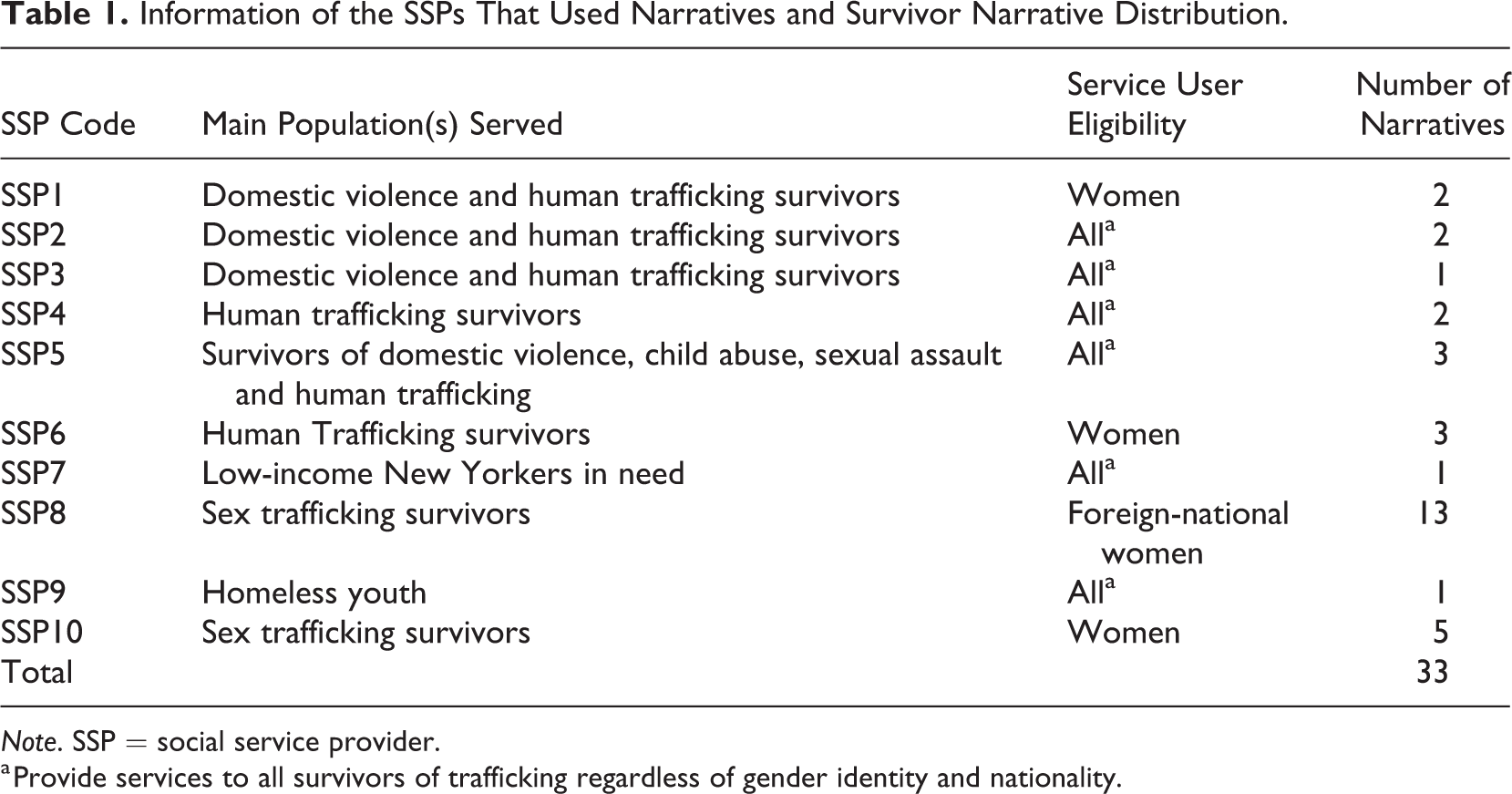
Note. SSP = social service provider.
a Provide services to all survivors of trafficking regardless of gender identity and nationality.
Method
Analytical Framework
To define narrative, I draw on Bal’s (1997) analytical approach of narrative that emphasizes the distinction among fabula, story, and narrative. A fabula refers to “a series of logically and chronologically related events” that take place in certain locations and involve certain social actors (Bal, 1997, p. 5); it serves as “the raw material” for a story to be constructed (Walsh, 2001, p. 601). A story represents a particular way through which events, actors, and spaces from a fabula are selected and arranged (Bal, 1997; Fairclough, 2003). A narrative is a form of text that conveys the story “in a particular medium,” such as a conversation through oral communication, television news, or a written social media report (Bal, 1997, p. 7). In the present study, the “medium” that I focus on is the written narrative of victim stories published on anti-trafficking SSPs’ organizational websites such as webpage texts, online reports, and blog posts. Therefore, a qualified narrative for this study is operationalized as a written text that encompasses one or a series of events, locations, and social actors, which involve trafficking victims as the main character in the story. A character depicted in a narrative text, according to Bal’s (1997) framework, “is not a human being” but “resembles one” (p. 115). Specifically, a character constructed in a narrative “is always strongly colored by the ideology of the critics,” and therefore, “what is presented as a description is an implicit value judgement” (p. 118), suggesting that the intentionality and positionality of the narrative constructor, which in the present study is the SSP, can greatly direct what victim characteristics and events should or should not be made present, as well as the way these selected discursive elements are arranged in a narrative. These selected elements that are made into a narrative are no longer in the context of the original fabula but are recontextualized. According to Fairclough’s (2003) principles of recontextualization, four analytical foci—presence, abstraction, arrangement, and additions—should be given analytical attention. Therefore, I proposed the following questions to guide my discursive thematic analysis. Presence: What events and social actors related to trafficking victims are made present? Abstraction: How general or concrete are the discursive elements? Arrangement: How are the elements arranged in a victim narrative? Additions: What other information and texts are also present in and surround a narrative?
Sampling
To draw a sample of narratives, multiple online data sources were consulted. The first step was to consolidate a list of New York–based SSPs. Specifically, I checked (1) the website of the New York State Anti-Trafficking Coalition (n.d.) which lists 143 member organizations, (2) a Human Trafficking Services Resource Directory complied by the New York City Mayor’s Office of Criminal Justice (NYC Mayor’s Office, 2014), and (3) an online resource directory provided by the National Human Trafficking Hotline (n.d.). I then generated a list of anti-trafficking SSPs by looking at mission statements, programs and services provided, and organizations’ physical locations. I operationalized a New York–based anti-trafficking SSP as an organization that (1) has a physical working site in the state of New York and (2) explicitly states that trafficking victims are the population or one of the populations served by the organization through direct services (e.g., shelter, crisis intervention, and counseling). Through this screening process, a total of 19 service providers met the criteria. The second step was to retrieve narratives. I looked at the official websites of the 19 SSPs, including all accessible web pages, their website-embedded blogs (if any), and annual reports published on the websites. For SSPs with multilinguistic websites, I only searched those written in English. Data collection took place throughout June 2018.
Results
A total of 33 narratives met the criteria. There is a variation in the frequency of the use of written trafficking victim narratives on organizational websites across the anti-trafficking SSPs. Of the 19 SSPs, 9 did not use trafficking victim narratives on their webpages. Of the 10 SSPs that used at least one trafficking narrative, 4 of them provided services exclusively to trafficking victims, whereas 6 also provided services to other populations such as domestic violence and sexual assault survivors. While some SSPs provided services to women only, SSP8 was the only provider that also made foreign nationality a requirement. It is worth noting that, compared with other SSPs, SSP8 also demonstrated a more intensive practice of using written victim narratives on the website. Across all SSPs, there appeared to be a consensus with regard to the use of survivor instead of victim, when referring to their clients. In comparison with the term victim, survivor aligns with a strength-based approach that recognizes the resilience and ability of an individual in overcoming an adversity. This form of strength-based language was also adopted in other parts of the webpages of many SSPs, such as in mission statements and program introductions. The average word count of the narratives was 319.5, ranging between 45 and 674. Table 1 summarizes the basic characteristics of the 10 SSPs and the distribution of the narratives by organization.
A Prominent Presence of Women and Trafficking for Sexual Exploitation
The majority of the narratives depicted a woman victim character, whereas men as survivors only appeared in two narratives. In addition to men and women, no other gender identities were represented. Trafficking types were explicitly referenced in 19 narratives, with the majority being trafficking for sexual exploitation. Of the 14 narratives that did not specify the type of trafficking experienced by the victim character, 9 were retrieved from SSP8 and SSP10, the two SSPs that provide services exclusively to victims of trafficking for sexual exploitation. These findings show that the narratives contain a prominent presence of women who are victims of trafficking for sexual exploitation. Table 2 summarizes the trafficking types and victim genders represented in the sample.
Types of Trafficking and Gender Represented.
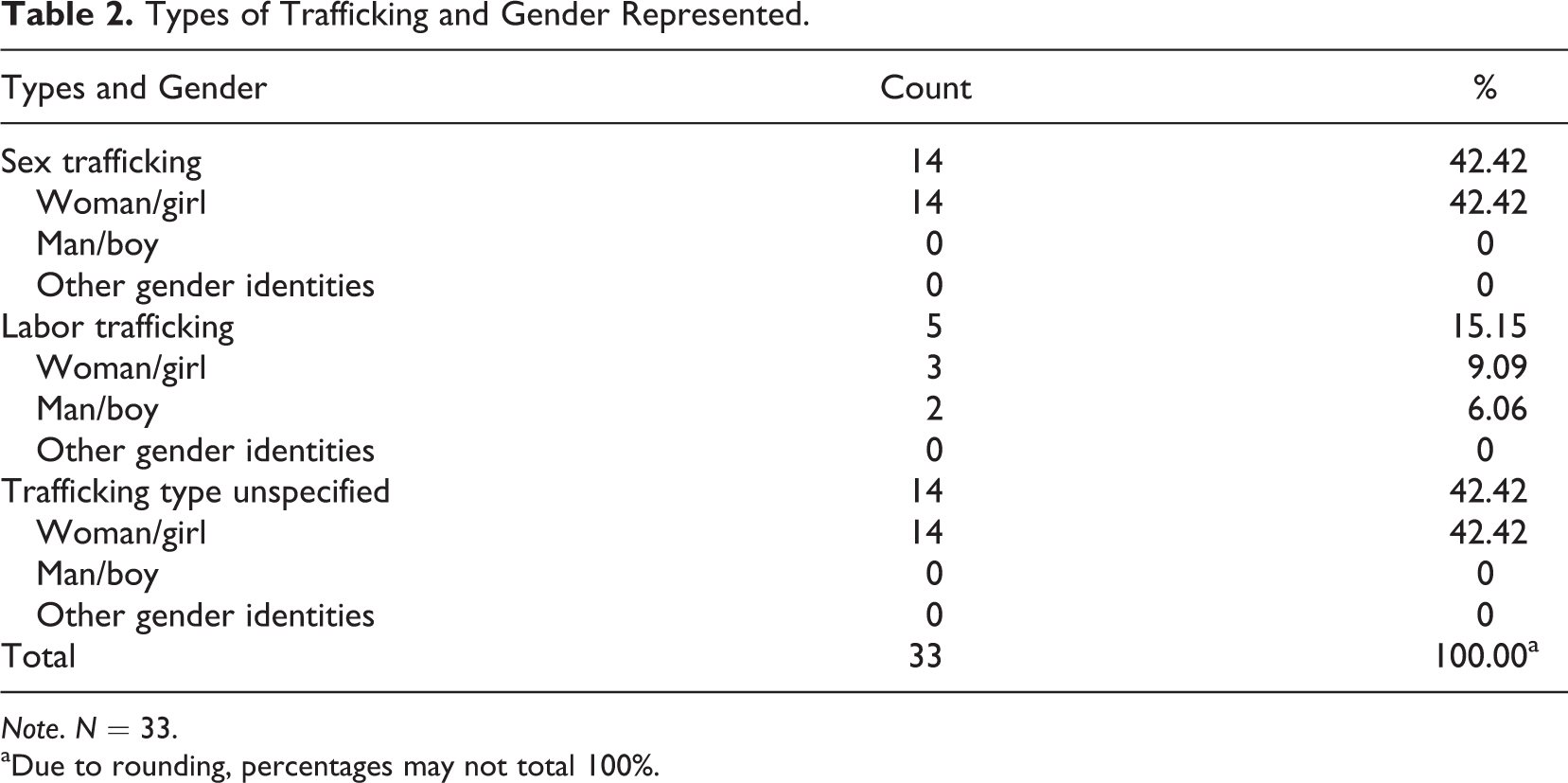
Note. N = 33.
aDue to rounding, percentages may not total 100%.
Third-Person Versus First-Person Voice
The majority of the narratives (n = 24) used a third-person pronoun, whereas nine were written in first-person voice. Five of the first-person narratives were drawn from one service provider, SSP10. They were presented as a collection of five direct quotes on a page titled “testimonials.” The use of direct quotes signals that these were the original words from SSP10’s actual clients. At the end of each quote, initials were used to identify different clients. These testimonies share a fairly uniform discursive theme—expressing gratitude to a staff member. For example, in Excerpt 1, a client initialed “A.C.” expressed her thankfulness to a staff member who had provided her with tremendous emotional and instrumental support, a type of support that had impacted her life in a transformative way. Rather than describing what “problems” that had challenged this client, the focus of the narrative was on the impact of staff support and encouragement. Excerpt 1: I’ve had days in my life when I felt like I couldn’t go on and wanted to give up. [Staff name] would talk to me and make me realize my worth, and that I’m a strong, independent woman that can do whatever I put my mind to. She always had my back every time I went to her and helped me solve my problems. There was never a time she let me down. She was always that person who was there for me when no one else was, and I truly thank her and love her for everything she’s done for me. (A.C.)
Home-Country Adversities: Abuse and Hardships in the Global South
One prominent discursive theme was trafficking survivors’ early life experience. Specifically, family-related adversities and hardships in home countries, such as domestic violence and extreme financial burden, constituted the main focus. While some narratives did not specify the names of the home country, those that did always referred to a country located in the global South, such as Africa, Colombia, and Mexico. Excerpts 2 through 4 were examples of this discursive theme.
Excerpt 2 was drawn from a survivor story published on SSP1’s website. The webpage was entitled “Story of Mei.” A large picture profiling an East Asian-looking woman was also present. A direct link to this story was embedded in a different page which mainly shared educational information on human trafficking and help-seeking procedures. On the educational information page, there was a note indicating that survivor stories were based on real client cases, and pseudonyms were used to honor confidentiality. Excerpt 2: Mei was abandoned and abused by her family and husband in China. She came to the US after she divorced. An agent made all travel arrangement for Mei and offered to let her pay off his fee after she earned enough money in the US. Excerpt 3: Aurelia was from a small village in Africa. She lived with a large family that her parents struggled to support. She had been searching for ways to earn extra money when she heard about a man who was recruiting women to become dancers in the U.S. When they spoke, he personally assured Aurelia that she would make enough money to help her family. Excerpt 4: I live in a small village in Mexico. I am 19 years old, the eldest of three. For as long as I can remember, my parents have traveled 2 hr to our closest city to find work. Sometimes my father is gone for weeks, while my mother usually comes home every other day. I spend my time caring for my grandmother and younger siblings…I love my family, but I wonder what could be if I leave this desert life.
Family Members and Friends as “Trafficking Facilitators”
The majority of the narratives included information about how the survivor character was trafficked. In these narratives, survivors’ family members and their home-country friends were often directly or indirectly facilitating the trafficking process. Both Excerpts 5 and 6 are examples of friends or family members being the trafficker. In Excerpt 5, “Gabriella” was trafficked by a “childhood friend” from Colombia to the United States; the narrative contained detailed information about the survivor’s childhood life and the process of being trafficked. This excerpt was drawn from a blog post of SSP4, under the category of “survivor stories.” The title of this post was “Survivor Story: Tricked by a Man She Trusted.” Excerpt 5: Several years ago, Gabriella lived in Colombia with her family and worked at a grocery store. As the eldest child, she had to provide for her mother and sisters after her father committed suicide. A childhood friend of Gabriella’s moved to the United States some years before, and he offered to help her move to America every time he visited Colombia. He promised he would help her to find work in a restaurant so she could better support her family. After a year, she agreed. The next thing she knew, Gabriella was taken to the U.S. and forced into prostitution. Excerpt 6: Tragically trafficked by her own family, she was also a victim of bullying in several shelters before arriving at [SSP8]’s safehouse. Excerpt 7: One of Liu’s friends told her of a woman who had moved to New York City and found well-paying, short-term work right away. Liu—desperate to solve her situation—decided to leave China and come to America, hopeful for a good job. But this job was part of a scam that would force Liu into sexual slavery.
In-Trafficking Experience
Survivors’ in-trafficking experience was also a prominent theme in the sample. The depiction of trafficking experiences was predominantly centered on mental and physical abuse, extremely unbearable living conditions, and survivors’ lack of awareness of the surroundings and not knowing what to do. Excerpt 8 was from SSP1’s website, under a page entitled “Story of Nancy,” along with “Story of Mei” from which Excerpt 2 was drawn. Excerpt 9 was from the same narrative from which Excerpt 5 was extracted. In the two excerpts, “Gabriella” and “Nancy” discursively appeared to have neither knowledge nor capacity to comprehend their surroundings. Excerpt 8: Sometimes [Nancy] would need to get up from sleep to serve customers who decided to visit the massage parlor in the middle of the night. She did not know better or may have forgotten throughout the years in how to live a normal life. She was shocked when the police showed up to shut the business down. Excerpt 9: For 5 long years, Gabriella lived as the property of her traffickers. She was moved to a different brothel almost every week, never knew where she was, and wasn’t able to seek outside help. Excerpt 10: In Casper, he lived in the hotel’s maintenance room and shared it with ten other people. The room had no air conditioning or heat. The bathroom they shared was small and didn’t have hot running water…During his working hours, he was routinely exposed to toxic paint fumes. He developed insomnia, severe stress and high blood pressure. Excerpt 11: Jose promptly locked Maria up and forced her to service men—sometimes as many as 30 a day. When she resisted, Jose beat her so severely that she later needed reconstructive surgery. Excerpt 12: Maria’s story is not unique. Throughout New York City, countless adults and children are trafficked for sex every day. Like Maria, many are young, vulnerable and far away from home.
Life Transformation
Trafficking survivors’ experience with the SSPs was included in all narratives. Two themes were captured: (1) the significant impact made by the SSPs on survivors’ mental health, work and life skills, and cultural adaptability and (2) gratitude expressed by survivors. The two themes were interwoven and constructed a life-transformative experience for trafficking survivors. Discursively, this life-transformation narrative was often realized and amplified through a pileup of concrete “first-time in life” moments. Excerpts 13–18 are examples.
Both Excerpts 13 and 14 were extracted from “Mei’s story.” This narrative began with a direct quote from “Mei” in first-person voice (Excerpt 13), followed by one paragraph explaining how “Mei” was trafficked from China to the United States and then referred by a HTIC to SSP1. The remaining three paragraphs described a series of services “Mei” received from SSP1, such as counseling, medical and legal referrals, and job training. The narrative ended with Excerpt 14, elaborating on “Mei’s” transformation after receiving services and staff support. Her “first-time experience” of receiving emotional support was highlighted at both the beginning and the end of the narrative text. Excerpt 13: This was the first time I can talk openly about my situation and felt listened to. Excerpt 14: At the end of her last session, Mei became more confident and was able to find work in a restaurant through the encouragement of her counselor. She also told the counselor that this was the first time she was given a safe space to talk openly about her situation and felt listened to. Excerpt 15: Natalie was in such extreme fear that her traffickers were hunting her, as they had before, that she suffered major panic and anxiety attacks and she adamantly believed that she would be killed if she went to the police. [SSP2’s] staff helped her process her experiences and validated her for the first time in her life.…Natalie secured public benefits and was able to address her medical, mental health, and dental needs for the first time in 19 years. Excerpt 16: We’re thankful we could give her a Thanksgiving like none she’s ever had, and that she was able to purchase her first Christmas tree in December. Excerpt 17: One of the great privileges of our safe house communities is being able to welcome human trafficking survivors into these traditions and celebrations. Many of the women in our safe houses have not celebrated holidays of any kind for years, much less been surrounded with love and a sense of security. Their appreciation is eye-opening and renews our own thankfulness every year. Excerpt 18: He tells us that no amount of money could ever replace what [SSP5] has done for his life and that he is now pursuing his true American dream.
Discussion
Informed by both a feminist postcolonial lens (Mohanty, 1988; 1991; Spivak, 1988) and theories of narrative and discourse (Bal, 1997; Fairclough, 2003), I sought to examine how SSPs represent trafficking victims through written narrative texts on their organizational websites. Consistent with previous studies (e.g., Denton, 2010; Pajnik, 2010; Sanford et al., 2016; Wilson & O’Brien, 2016), the victim narratives were predominantly focused on women and trafficking for sexual exploitation. There was also a prominent discursive presence of non-Western racialized migrant women portrayed as trafficking victims through both textual depiction and use of visual images, a finding that coincides with the master victim profile represented in the TIP reports (Wilson & O’Brien, 2016). Most narratives were present along with one or some of the following textual elements: (1) educational information about human trafficking, (2) donation requests, and (3) description of the SSP’s programs and/or presentation of program outcomes, suggesting that the use of victim narratives was mainly for public education, fund-raising, or both.
Migration as one of the prominent discursive themes was constructed as either an equivalent of trafficking or a risky process that leads a migrant woman to a trafficking situation in the United States. Furthermore, poverty was depicted as a critical “push factor” or cause for migration. Across the narratives, however, the discursive focus of poverty was placed on depicting personal or familial shortcomings, such as family members who were violent or abusive, and on parents who were financially incapable of raising children. Like in other mainstream representations of trafficking (Baker, 2014), macro-level factors that have greatly contributed to micro-level financial instability and sufferings were not given discursive attention. Furthermore, family members, acquaintances (e.g., a friend), and strangers in the home country were often constructed as abusers or trafficking facilitators, suggesting that home countries in the global South are a place of “risky” people who are primarily responsible for the victimization of non-Western women in trafficking situations. Although I by no means dismiss the role of individual abusers and traffickers in causing harm, such as physical and psychological trauma, to migrant women or trafficking victims, the narrative of trafficking remains incomplete if we do not give equal attention to many structural inequalities and oppressions that migrants, especially migrant women, are facing (Cheng, 2008; Mai, 2013) as well as to how these structural inequalities have been greatly shaped by the colonial domination and the lingering effects of colonialism (Hua & Nigorizawa, 2010). According to a recent study with service providers, many factors, such as financial and housing instability, education inequality, and language barriers and social isolation experienced during migration, can cumulatively contribute to one’s vulnerability for labor and sex exploitation, potentially leading to a trafficking situation (Schwarz et al., 2019).
Previous studies have documented the pervasiveness of certain “ideal victim” stereotypes constructed and reinforced through multiple mainstream sources of knowledge (Rodríguez-López, 2018; Sanford et al., 2016; Wilson and O’Brien, 2016). Specifically, in addition to being a woman trafficked for sexual exploitation, an “ideal” trafficking victim is characterized as someone constantly victimized by multiple other forms of abuse and violence, as being weak and lacking agency, and in need of a rescue to break the cycle of victimization (Baker, 2014; Pajnik, 2010). In the present study, despite the extensive use of the strength-based term, survivor, the narratives were found to (re)produce the stereotypical ideal trafficking victim. For instance, the discursive emphasis across the narratives was often placed on survivors’ experience of emotional suffering, physical violence, and a mental state of being extremely “disoriented” both in the home country and during trafficking. These discursive elements functioned as a system in constructing a victimized individual who was locked in multiple circles of violence and exploitation before being “saved” by a social service organization.
A unique contribution of the present study to the victim representation literature lies in the revelation of how a life-transformation discourse was employed by the SSPs to further legitimize and reinforce the significant impact and value of their work. Three main discursive strategies were used to achieve this goal. First, when depicting survivors’ life transformation, the textual content was overwhelmingly centered around numerous ways through which the SSPs served and supported trafficking survivors. Second, while much text was devoted to telling what the SSPs had done for survivors, the efforts made by trafficking survivors toward their journeys of restoration were greatly elided. Meanwhile, the place where survivors’ agency was made discursively present was when they expressed gratitude toward the SSPs or staff members. Last, the patterned discursive practice of emphasizing survivors’ “first-time” experiences, such as the “first-time feeling safe” and the “first-time celebrating holidays,” further amplified the significance of the SSPs’ work in giving trafficking victims unprecedented opportunities to be back to a “normal” life. These discursive strategies, as a result, jointly contributed to the (re)production of “a rescue narrative” (Baker, 2014, p. 214) in which the anti-trafficking SSPs were positioned as a critical “rescuer” for their clients.
While the narrative of SSPs rescuing the “ideal victim” provides some clear benefits for service providers, such as legitimizing their donation requests, it simultaneously runs the risk of diminishing the agency of trafficking survivors in making their own efforts and decisions toward healing and restoration. As many SSPs strive to support and empower trafficking survivors, whether and how survivors should be represented through written and other forms of text must be taken into consideration as an essential part of the empowerment work. Drawing on Spivak’s (1988) critique of the representation of the subaltern, anti-trafficking SSPs may disempower and silence the trafficking victims they serve by being the representative and the “voice” of them, particularly when the SSPs position themselves as an “expert” in the field to educate the public about trafficking or to fundraise for helping trafficking survivors. Therefore, it is of paramount importance for service providers to revisit the practice of telling client/survivor stories in either internal or external communication and to engage with a genuine and ongoing reflection on their own positionality and intentionality. I by no means suggest that survivor stories should not be shared; instead, I advocate for a leadership shift in storytelling from SSP-led to survivor-led. In a survivor-led storytelling paradigm, trafficking survivors have the ultimate ownership of (1) how, when, where, and which part of their lived experience can and cannot be shared and (2) for what purposes their stories are shared. Anti-trafficking SSPs can be of a great support to the survivor-led storytelling. As advocated by Maggio (2007), to make the subaltern’s voice heard, we not only need to acknowledge their “language of communication as a valid mode” but “must try hard to listen to people in all of their forms of communication” (p. 437). To listen, anti-trafficking SSPs must first distinguish their own intentions to use survivor narratives and survivors’ motivations to tell their stories and then feel comfortable with letting the storytelling initiative be inspired by the goals that the survivors aim to achieve and the communicative formats that the survivors feel the most meaningful.
While survivors’ leadership in storytelling is encouraged, we must be cautious that survivor-led efforts are not immune to (re)producing the dominant discourses and stereotypical victim narratives and that a survivor leader may also be in a “community representative” role to voice for the subaltern (Spivak, 1988) or “positioned in the role of potential savior” (Leon et al., 2017; p. 131). Therefore, a critical reflection of one’s intentionality is crucial for anyone who is positioned in a leading role. Ultimately, anti-trafficking SSPs and survivor leaders are in a unique position in the knowledge dissemination of human trafficking in that their professional and personal journeys as well as direct contact and close collaboration with trafficking survivors can potentially complement the knowledge production of trafficking with more elements of diversity, complexity, and therefore authenticity. An authentic representation of trafficking survivors and their lived experience, however, cannot be accomplished without anti-trafficking leaders and peer advocates making tremendous efforts to make space for diverse experiences, intersecting identities, complex feelings and emotions, and various ways of communication in survivors’ storytelling.
Implications for [Feminist] Social Work
A social justice vision lies at the heart of the social work profession and has inspired many of us to become social work practitioners and researchers. Our commitment to social justice, however, remains limited if we hesitate to confront the structurally reproduced inequalities (Gringeri & Roche, 2010). Feminist postcolonial theory offers us a critical lens through which we may challenge structural injustice with a reflexive mind (Deepak, 2014). As we engage with the multifaceted complexity of human trafficking, critically examining the dominant narratives of trafficking offers us an entry point to further discovering the asymmetric distribution of power in the current global postcolonial context and how nowadays the power of neocolonialism continues to manifest and circulate in a rather subtle but pervasive way. Dominant narratives never stand alone but rather are infused with political and ideological rhetoric. For instance, one of the contested debates in the global anti-trafficking movement has been over the legitimacy of women’s choice in commercial sex, a debate that has greatly shaped the dichotomy of “oppressed victims” (an abolitionist ideology) versus “self-determined sex workers” (liberal feminism, Baker, 2015; Miriam, 2005; O’Brien, 2015). Neither of the two narratives, however, fully captures the complex and ever-changing realities of those who are resilient, motivated, and actively making choices in circumstances where their daily lives and opportunities are deeply constrained and materially impacted by many structural inequalities such as poverty, sexism, classism, racism, homo/transphobia, xenophobia, and stigmatization (Acker, 2004; Corado, 2017; Ferrell-Schweppenstedde, Hunt, & Matekaire, 2019; Shannon et al., 2008; N. J. Smith, 2012).
Dominant narratives not only exist in the field of anti-trafficking but are embedded in many other aspects of social work practice and research. A feminist postcolonial lens allows us to critically examine how certain narratives and stories are more pervasive than others and how power plays a role in giving rise to the visibility of these dominant narratives. As we are inspired to use narratives in our own work, such as writing a community report or a grant proposal, it is imperative that we reflect on our own positions of power: How have our social locations, knowledge systems, and ideological beliefs contributed to the power we each possess and the view that we each subscribe to? How would our storytelling practices silence alternative voices and hence (re)produce certain dominant narratives and perpetuate structural injustice? How can we acknowledge our own biases and limitations in representing other individuals and then open up space for those who have been deprived of voices?
As we commit our work to social and structural justice, we bear the responsibility to disrupt the singularity, (mis)representativeness, and othering in the dominant construction of knowledge. This task is neither easy nor comfortable but worthwhile.
Footnotes
Acknowledgments
The author would like to thank Professor Rupaleem Bhuyan for her advice and encouragement throughout the development of this work; her comments on several early drafts have been invaluable. The author also wishes to thank the three anonymous reviewers for their expertise and insights which have greatly improved the article.
Declaration of Conflicting Interests
The author(s) declared no potential conflicts of interest with respect to the research, authorship, and/or publication of this article.
Funding
The author(s) received no financial support for the research, authorship, and/or publication of this article.
