




Abstract
This study explores the experiences of domestic violence victims with their Temporary Assistance for Needy Families (TANF) applications and the subsequent assessment processes in the state of Georgia, focusing on the conditions related to their disclosure of abuse and their postdisclosure experiences. This study interviewed five victims of domestic violence, four local victim advocates, and three nationally recognized experts regarding domestic violence screening in TANF programs using semistructured interviews. Data were analyzed using grounded theory techniques. The findings showed that the participants perceived TANF application and assessment processes as (i) inaccessible and (ii) unhelpful, lacking special considerations for domestic violence victims. Conditions related to victims’ disclosure of abuse included (i) safety concerns, (ii) working relationships between local victim support agencies and TANF offices, (iii) a safe environment to disclose abuse, and (iv) advocacy. After disclosing their domestic violence history to their TANF caseworkers, the victims reported experiencing (i) a lack of continued assessment and support related to domestic violence and (ii) a compulsion to make final decisions regarding continuing or discontinuing their TANF applications. The current study contributes to the field of social work by providing a better understanding of how and to what extent victims of domestic violence are actually supported within the TANF system and by yielding practice and policy implications for effectively assisting the victims of domestic violence within the TANF system.
This study explores how domestic violence screening within the Temporary Assistance for Needy Families (TANF) program is implemented and how it is experienced by victims of domestic violence who had applied for or were receiving TANF as well as the key informants who assisted them at the community, research, and policy levels. Under the so-called welfare reform—the Personal Responsibility and Work Opportunity Reconciliation Act (PRWORA) of 1996—TANF was transformed from an entitlement program to a conditional benefit that imposes a maximum of six TANF program requirements upon its recipients including work, lifetime limits, residency, child support enforcement, and immigration/citizenship (Allard, 2007). At the same time, states had the option to implement the Family Violence Option (FVO) under TANF. In consideration of the fact that the majority of TANF recipients were the victims of domestic violence and also out of concern for the victims’ safety and well-being when attempting to comply with the new TANF requirements, the FVO mandated routine screening for domestic violence in nationwide TANF programs (Legal Momentum, 2004).
When the FVO was initially enacted, it was based on research findings suggesting that between 15% and 51% of welfare recipients were victims of domestic violence (Government Accountability Office [GAO], 2005). More recently, Cheng (2012) reported that approximately 75% of TANF recipients were current victims of domestic violence, a far higher proportion than that found in the general population (31%). Research suggests domestic violence victims often struggle to comply with TANF requirements, which affects their capacity to regain self-sufficiency, as demonstrated by Davies (1998, 2010). For example, victims of domestic violence experience special hardships that hamper their ability to comply with TANF requirements and in turn stymied their ability to subsequently receive such benefits (Davies, 1998, 2010; Kogan, 2006; Spatz, Katz, & Rees, 2005). An identified challenge in complying with the TANF requirements was that victims may face harassment by their abusers in their new residency or workplace when this information is revealed to their abusers, most often the biological fathers of their children, for the purpose of receiving child support (Fontana, 2000; Meisel, Chandler, & Rienzi, 2003). Another challenge facing victims may be a lack of preparedness for work due to injuries, post-traumatic stress disorder, or lack of work experience resulting from domestic violence (Coulter, 2004).
The FVO establishes TANF as a venue for identifying victims of domestic violence by routinely screening TANF applicants (Administration for Children and Families [ACF], 2014) and providing relevant support for identified victims of domestic violence to ensure their safety. According to the FVO, local TANF offices shall (1) screen and identify recipients of TANF with a history of being victims of domestic violence, while protecting the confidentiality of any such recipients; (2) refer such recipients to counseling and supportive services; and (3) waive, pursuant to a determination of good cause and for so long as necessary, other program requirements for any such recipients of TANF assistance…in cases where compliance with such requirements would make it more difficult for individuals receiving TANF assistance to escape domestic violence or unfairly penalize such recipients who are or have been victimized by such violence, or individuals who are at risk of further domestic violence. (GAO, 2005)
However, the reality of implementing domestic violence screening in TANF turned out to be quite different from the policy ideals of FVO (Holcomb et al., 2017). Published data have consistently revealed that local TANF offices rarely screen for domestic violence or provide relevant support (An, 2015). Most pressingly, TANF offices often fail to ask applicants about domestic violence at all. According to the data collected during the early welfare reform era, TANF offices in Michigan, New York, and Texas asked fewer than 1 in the 10 TANF applicants about their domestic violence experience (Lindhorst, Meyers, & Casey, 2008). Texas and Georgia offices, for example, identified only 2 of the 100 TANF applicants as the victims of domestic violence (Lindhorst et al., 2008). In addition, local TANF offices in two California counties only informed between 30% and 50% of TANF recipients about good cause waivers (An, 2014).
Because TANF minimally implements domestic violence screening, it is hard to understand what portion of TANF applicants have experienced domestic violence and need waivers from TANF requirements or other supportive services. In one study, despite the fact that 20% of welfare recipients were identified as potential victims of domestic violence, only one in the five of this 20% disclosed their experiences to TANF caseworkers (Hetling, Saunders, & Born, 2006). The disclosure rate of abuse in another study was only about 30% (Postmus, 2004). Women who disclosed abuse tended to be less educated, younger, and white (Hetling & Born, 2006; Hetling et al., 2006).
Victims of domestic violence reported several factors that influenced their decision to not disclose their abuse experience to their TANF caseworkers. The women were concerned about judgmental responses from their caseworkers, the possibility of losing their children, or potentially becoming involved in additional TANF application procedures because of the disclosed abuse (Postmus, 2004). They also reported that it would be hard to talk about domestic violence with TANF caseworkers and they feared their disclosure would incur negative consequences (Saunders, Holter, Pahl, Tolman, & Kenna, 2005). Structural barriers embedded in the routine screening were also revealed. More than 50% of TANF applicants did not disclose abuse simply because they were not asked about it (Saunders et al., 2005). Victims of domestic violence perceived the TANF caseworkers trained in domestic violence as more comfortable and helpful than those not trained in domestic violence when discussing their domestic violence experiences (Saunders et al., 2005). However, the sporadic domestic violence training that TANF caseworkers receive has shown to be ineffective because serving the victims of domestic violence is not the central focus of TANF (Lindhorst, Casey, & Meyers, 2010).
Additionally, the current domestic violence screening implemented by TANF appears to erect barriers to victims of domestic violence who consider applying for and receiving good cause waivers. Although approximately half of the victims of domestic violence who disclosed abuse considered applying for waivers in 2013 (An, 2014), only 2.4% of the recipients in California’s TANF (i.e., CalWorks) received a waiver (California Department of Social Services, 2013). Victims of domestic violence most frequently received a waiver from work (60.9%), followed by a waiver from the lifetime limitation (28.0%) and child support enforcement (24.5%; Hetling, 2011).
Available evidence on domestic violence screening within the TANF system heavily relies on quantitative indicators, including rates of domestic violence screening, identification of domestic violence victims, victims’ disclosure of abuse, service referrals, and TANF waivers (An, 2015). However, such evidence barely explains what factors guide the victims’ behaviors or decisions. Building on the existing research, further investigation is needed to better understand what prompts, motivates, and enables a woman’s decision whether to pursue services related to the FVO. Quality indicators of domestic violence screening in TANF may include ensuring safety, confidentiality, and privacy-ensured screenings for domestic violence; providing sufficient information about relevant services including local domestic violence services or good cause waivers; and conducting individual need-based assessment (Hetling & Born, 2006). In an attempt to fill in the gap in the existing body of knowledge, this study explores TANF application and assessment processes from the perspectives of different stakeholders including TANF applicants who experienced domestic violence, community-based domestic violence advocates, and national FVO experts at the research and policy levels. The following research questions guided this study: (1) How are the TANF application and assessment processes understood by victims of domestic violence and key informants? (2) What are the conditions surrounding the disclosure or nondisclosure of domestic violence? and (3) What are the experiences of victims of domestic violence who do choose to disclose?
The study site was Georgia. Therefore, to provide a contextual background before discussing the current study, we first review the FVO as practiced in Georgia, followed by the two main frameworks of intersectionality and procedural justice, so as to better understand the complexity of domestic violence in relation to poverty and victims’ access to TANF.
Context of Domestic Violence Screening in Georgia
The Georgia Division of Families and Children’s Services (DFCS) in the state of Georgia adopted the PRWORA of 1996 into state TANF programs that same year and adopted the FVO in 1998 (S. 104, 2013; Lindhorst et al., 2010). By adopting the FVO, TANF caseworkers are expected to conduct domestic violence screenings including (1) identification of victims of domestic violence among TANF applicants; (2) referral of identified domestic violence victims to domestic violence assessors, who would in turn make recommendations to the DFCS on the family violence assessment report regarding potential waivers from TANF requirements, or to a local domestic violence agency for victim support services; and (3) grant a waiver of TANF requirements (Online Directives Information System of the Georgia Department of Health Services [ODIS], 2016). Overtime, the implementation of domestic violence screenings in TANF has been debilitated through changes in funding for domestic violence assessors and decreased caseloads.
When FVO implementation in Georgia began, state-certified domestic violence agencies funded by the Georgia Department of Health Services hired a full-time TANF Assessor, tasked with conducting domestic violence assessments, at each local TANF office. TANF assessors had on-site office spaces in local DFCS offices. Hence, TANF offices could conduct domestic violence screenings and domestic violence assessments with their own TANF Assessors, in the lieu of calling upon TANF caseworkers. In 2008, the position of TANF Assessors disappeared as the result of a budget cut when TANF implemented a new business model prioritizing “healthy marriage promotion and responsible fatherhood” (S. 104, 2013, p. v). Currently, the TANF program in Georgia relies on domestic violence advocates, namely, domestic violence assessors, who are employees of state-certified domestic violence agencies and who perform the roles of former TANF Assessors (ODIS, 2016).
For the last two decades, TANF caseloads have also significantly dropped. Between the fiscal years of 2005 and 2018, TANF caseloads dropped by 73.5%, and only 11,137 cases received TANF in 2018 in Georgia (ACF, 2019). Almost 80% of the total caseloads consisted of child-only cases in 2014 (Cagle, Ballard, & Christopher, 2014). No case received a waiver from the lifetime limit in 2013 (S. 104, 2013). About one third (33%) of the domestic violence advocates working in 36 state-certified domestic violence shelters reported difficulty obtaining work waivers for their clients (Georgia Coalition Against Domestic Violence [GCADV], 2006, as cited in Senterfitt, 2006, p. 7). The evidence of domestic violence screening by TANF in Georgia remains quite scarce (An, 2015).
Domestic violence screening procedures in regional/local TANF offices in Georgia vary across the state. A common practice, reported in about 80% of 36 surveyed state domestic violence shelters, involves local TANF offices conducting group or individual orientations regarding domestic violence screenings and assessment (GCADV, 2006, as cited in Senterfitt, 2006, p. 7). Based on the first author’ observation of a TANF orientation held at 1 of the 15 regional TANF offices in Georgia during the year 2014, work eligible TANF applicants were invited to attend a group-based TANF orientation meeting, which also carried out domestic violence screenings, by a TANF caseworker. In the orientation and/or any in-person interaction context, TANF caseworkers may provide a brochure entitled, “What Every Women Needs to Know,” which explains certain waivers TANF applicants may be eligible for under the circumstances that the FVO delineates. A TANF applicant who discloses abuse may be referred to a domestic violence assessor. Then, the assessor makes a recommendation to the TANF caseworker after completing a domestic violence assessment form regarding good cause waivers.
Intersectionality and Procedural Justice in Conceptualizing Domestic Violence Screening in TANF
Crenshaw (1991) argues that intersectionality is a useful tool to better understand the experiences and lives of victims of domestic violence who are at the intersection of poverty, race, gender, and so forth. Poor women are more likely to be victimized by their intimate partners (Cheng, 2012) and their ability to escape from the impact of abuse is more limited than those who possess “more resources and more affluent social networks” (Josephson, 2002, p. 10). Feminists argue that female victims of domestic violence experience greater difficulties in gaining access to the resources necessary for their survival in a male-dominated social structure (Jasinski, 2001). Inevitably, victims of domestic violence who lack resources and supportive social networks turn to TANF. The framework of intersectionality implies that victims of domestic violence in the welfare system may have unique circumstances, and their domestic violence experiences should be assessed with appropriate considerations of the unique situations each victim faces.
Ironically, victims of domestic violence are not only at the intersection of their own personal demographics and experiences with abuse but also face oppression by TANF, ostensibly an element enabling their self-sufficiency goals. The feminization of poverty in general and in the welfare system in particular has fostered stereotypes targeting TANF recipients, most notoriously that of the “welfare queen” a black mother who irresponsibly depends on welfare (Rich, 2016; Robert, 2014). As such, in pursuit of the presumably beneficial aim of reducing out-of-wedlock births and welfare dependency, welfare reform implemented the aforementioned requirements that aimed to emphasize personal responsibility. However, these reforms have proved oppressive to poor women, especially those whose hardships conflict with their methods of resolving their problems. Domestic violence victims who desperately need financial assistance through TANF might be forced to give up their government assistance or the safety of their children and themselves in order to comply with the TANF requirements. Moreover, TANF highlighting personal responsibility by enforcing these requirements conflicts with the FVO, which aims to protect the safety of victims of domestic violence and allows them to avoid sanctions by waiving certain TANF requirements. Hence, the mismatch between the focus of mainstream TANF policies and “the experiences and needs of vulnerable abused women at the intersection of race, class, and/or ethnicity” exacerbates the vulnerability of victims of domestic violence (Purvin, 2007, p. 190).
To dismantle potential oppression toward victims of domestic violence, the domestic violence screening process in TANF should uphold victims’ self-determination in choosing service options and procedural justice in screening for domestic violence. According to the National Association of Social Workers (NASW, 2018): social workers pursue social change, particularly with and on behalf of vulnerable and oppressed individuals and groups of people. Social workers’ social change efforts are focused primarily on issues of poverty, unemployment, discrimination, and other forms of social injustice. […] Social workers strive to ensure access to needed information, services, and resources; equality of opportunity; and meaningful participation in decision making for all people.
This study conceptualizes “just procedures” as a means to enhancing social and economic justice that ensures the self-determination of victims of domestic violence. If domestic violence screening in TANF forces victims of domestic violence to disclose abuse in an unsafe screening environment, this creates another form of oppression. However, assuming that every TANF applicant is screened for domestic violence and informed about good cause waivers, it may be possible to deliver just procedures through assisting TANF applicants in disclosing their domestic violence experiences, enabling them to make self-determined, informed decisions (An et al., 2015). Hence, the present study illuminates the experiences of abused women who went through the TANF application and assessment processes. The study focuses on challenges related to their vulnerability as well as promoting informed decision-making processes and outcomes as a just procedure.
Method
Study Design
The current study utilized a constructivist grounded theory approach, which renders an interpretive definition of theory that reflects multiple realities and “depends on the researcher’s view” (Charmaz, 2006, p. 239). This study did not utilize theoretical sampling, so instead of developing a theory grounded in the data, findings will be displayed using thematic analysis (Attride-Stirling, 2001; Braun & Clarke, 2006). Thematic analyses can be incorporated into various theoretical frameworks and tied to “a particular theoretical or epistemological position such as grounded theory” (Braun & Clarke, 2006, p. 78).
Procedures
In order to provide a holistic understanding of the perspectives and experiences of domestic violence victims in their TANF application and assessment processes, this study purposively sampled and interviewed participants from three different groups and then triangulated the interviews. The three groups that participated in this study include (1) current and former TANF applicants/recipients who were victims of domestic violence at the time of their TANF application and who were currently receiving services from victim support agencies in Georgia, (2) domestic violence advocates who currently conduct family violence assessments for TANF programs at the time of interviews, and (3) nationally recognized experts noted in peer-reviewed journal articles and/or for activism in the fields of TANF and FVO.
Through 46 member agencies of the GCADV, consisting of certified family violence shelters and outreach programs, this study recruited victims of domestic violence who were TANF applicants and/or recipients, along with domestic violence advocates in 2014. Twenty-six agencies agreed to provide an interview invitation letter to clients who had applied for and/or received TANF during the past 2 years and to domestic violence advocates in their agency. The first author recruited nationally recognized experts regarding FVO with a study invitation letter sent via e-mail.
Participants
Participants of the study included five TANF applicants and recipients, four domestic violence advocates, and three nationally recognized experts. The interviewer did not collect any personal information other than the information related to sampling criteria. Pseudonyms are used in the current study, except in the case of the nationally recognized experts. The experts’ names were identified based on their verbal consent agreement.
Four of the TANF applicants disclosed their intimate partner abuse history to their TANF caseworkers. Among them, Passion was the only TANF applicant considered for a good cause waiver related to her experience with abuse. Jane would have been in danger due to her past abuse experience if she complied with child support enforcement. Without any exemptions or waivers, Jane, Mariel, Kelly, and Jessica withdrew from the TANF application process. Table 1 describes the characteristics of TANF applicants related to their experience of disclosing domestic violence in the TANF application.
Characteristics of TANF Applicants.
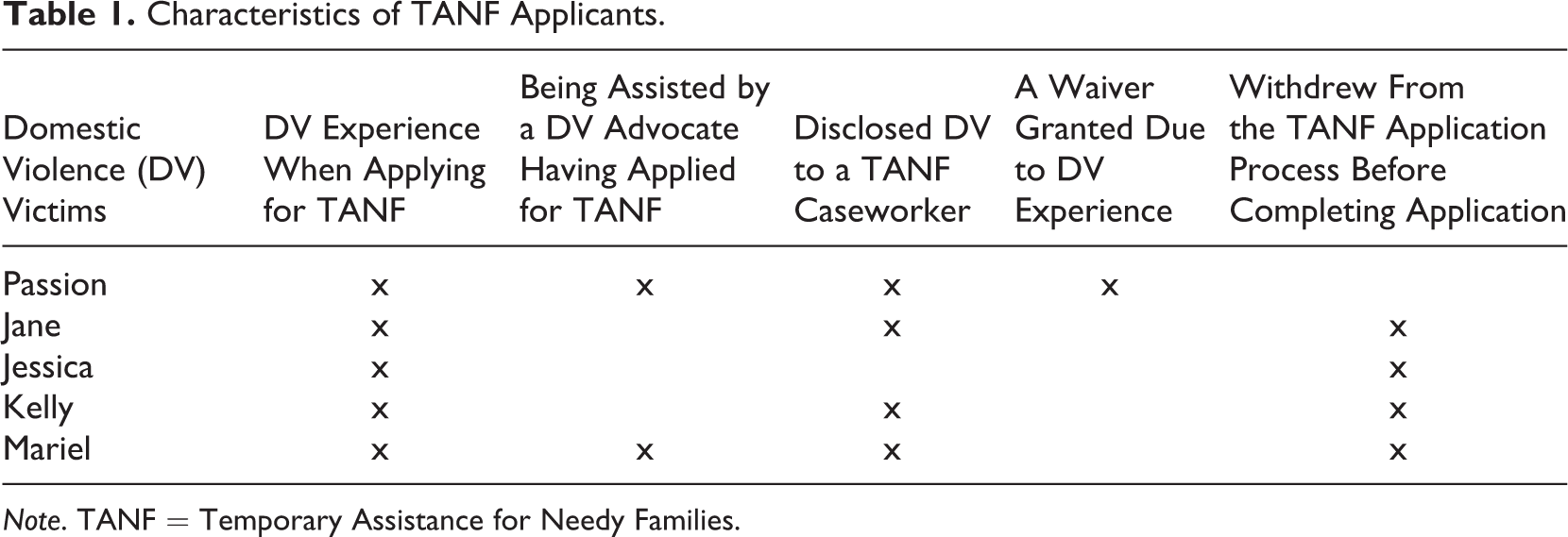
Note. TANF = Temporary Assistance for Needy Families.
All domestic violence advocates represented worked, at the time of the study, at state-certified family violence shelters, or outreach offices. They routinely assisted their clients in applying for TANF or received referrals from local TANF office(s) to conduct family violence assessments. Two advocates (Debra and Emily) were former TANF assessors who assisted victims of domestic violence in local TANF offices for family violence assessments until 2008. The other two (Devours and Kim) began employment as domestic violence advocates after 2008 and had conducted family violence assessments for their own clients or referred clients from their local TANF office. As a domestic violence advocate, Devours had previously attended TANF orientations that provided general information about TANF and domestic violence to TANF recipients. Kim, on the other hand, was still attending TANF orientations at the time of data collection. The nationally recognized experts included Dr. Hetling and Dr. Lindhorst, university professors, and Ms. Menard, Chief Executive Officer at the National Resource Center on Domestic Violence.
Data Collection
Interviews were conducted between September 2014 and February 2015 via phone, Skype, or in-person meetings by the first author. This study employed semistructured, flexible interview protocols. Participants received an information letter prior to the interview. Written consent was waived. The study was approved by the first author’s affiliated institutional review board.
Interview questions included (1) How have the victims of domestic violence experienced TANF application and assessment processes? (2) How were they asked about domestic violence and informed about good cause waivers? (3) What was difficult and easy about TANF application and assessment processes? and (4) How were they particularly benefited by both domestic violence screenings and good cause waivers? The data collection continued until “the point at which gathering more data about theoretical category revealed no new properties nor yielded any further theoretical insights” (Charmaz, 2006, p. 345). Each interview was audio-recorded and transcribed verbatim. The audio-recordings were permanently deleted after the interviews were transcribed. The interviews ranged in length from 38 to 76 min. The researcher recorded field notes after each interview and also obtained Georgia TANF application and assessment forms via the state of Georgia’s DFCS homepage.
Data Analysis
This study used the constant comparative approach, wherein the researcher constantly compares initial coding and categories so as to “establish analytic distinctions and thus make comparisons at each level of analytic work” (Charmaz, 2006, p. 132). First, interviews were analyzed through an initial open, line-by-line coding process including the “‘In Vivo Code” and then, more focused coding was conducted based on the research questions (Charmaz, 2006, p. 150). At each level of coding, the first author wrote a theoretical memo, and codes were interpreted at a more abstract level and categories and/or themes were developed based on this process. To enhance the credibility of the findings, the second author independently coded the data. The two researchers then discussed the consistency and inconsistency of the findings at each stage of the initial and focused coding. Themes and subthemes that interraters agreed upon are presented in Table 2.
Iteration of Analysis and Emerged Themes and Subthemes.
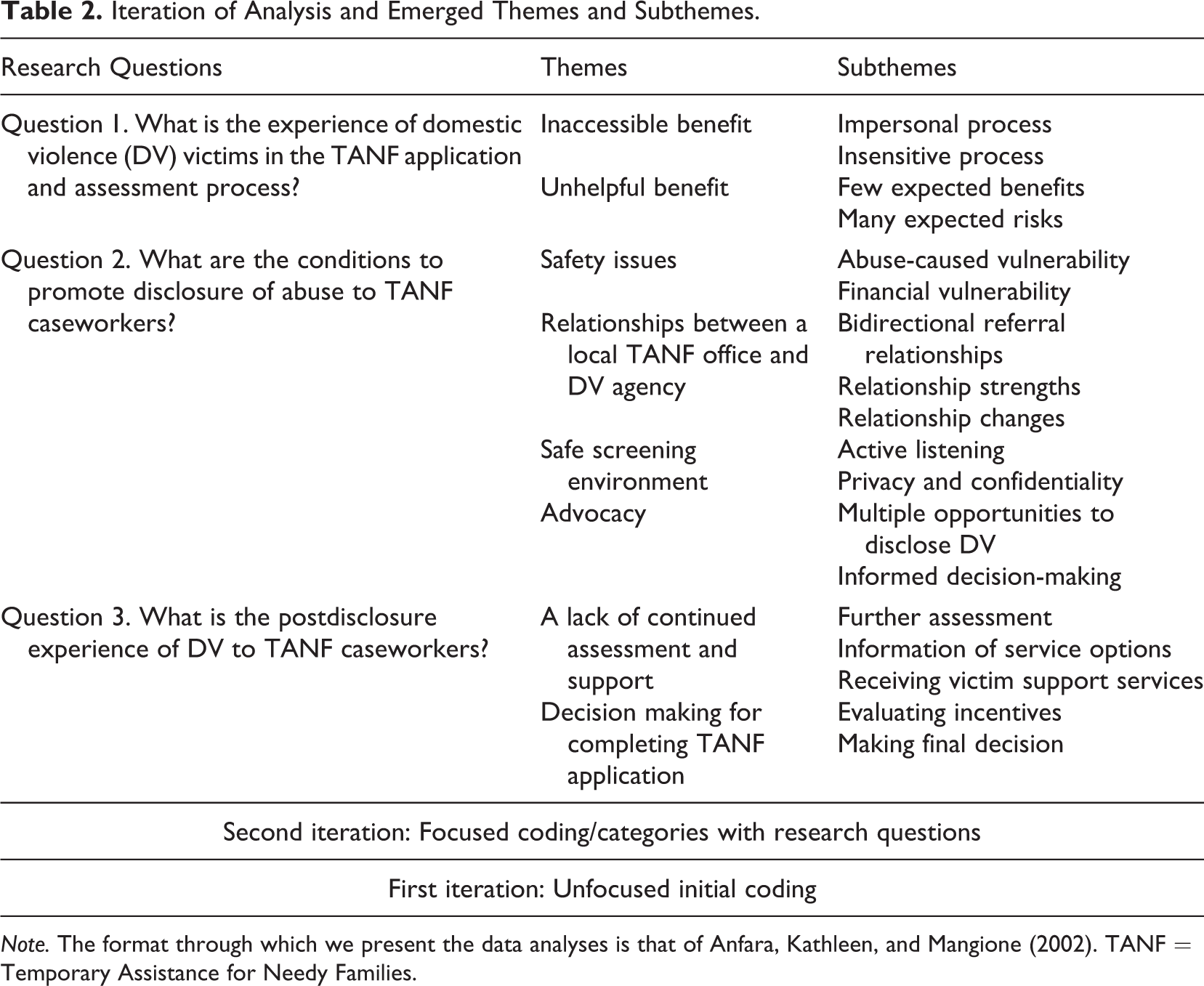
Note. The format through which we present the data analyses is that of Anfara, Kathleen, and Mangione (2002). TANF = Temporary Assistance for Needy Families.
Findings
TANF Application and Assessment Processes
An inaccessible benefit
Interview participants perceived the TANF process as an inaccessible benefit because its application and assessment processes (hereafter the TANF process) were (i) impersonal and (ii) insensitive to the needs of domestic violence victims regarding benefit access. Interviewees, victims in particular, perceived the TANF process as impersonal. TANF applicants perceived the process as highly authoritarian, uncomfortable, and/or rushed. They were informed about TANF requirements but discouraged from applying for benefits when they asked TANF caseworkers about these requirements. Some of them felt uncomfortable with the group environment, which limited individual communications with the caseworker. They also expressed discomfort with the unilateral, caseworker-led communication process, which hampered further discussion of their capacity to comply with TANF requirements. They perceived that there was no room for their voices to be heard, as the TANF process seemed like that of a drive-through, where speed and efficiency are the most important factors. The following quote is a response from Mariel who disclosed her abuse by showing a residency letter verifying her residence at a domestic violence shelter. However, she did not receive any response from her TANF caseworker while attending a TANF orientation, as she explains: …So, I was like whatever. I felt like I already wasted my time…her [TANF caseworker] attitude wasn’t good enough, and I’m just like I don’t want to deal with anything. So I just left. (Mariel, TANF applicant) These [case]workers have so many things to do already. It is really difficult to meet the very unique needs of these women. From a policy perspective, sometimes having very strict guidelines is easier, but from social work perspectives, it doesn’t work well. (Dr. Hetling, national expert)
An unhelpful benefit
By engaging in the TANF process, the domestic violence victims were convinced that TANF was a possibly irrelevant option for them, although they desperately needed such benefits. This realization derived from their assessment of (i) the few expected benefits and (ii) the many expected risks of receiving TANF due to the seemingly impossible program requirements. The survivors’ experiences with the TANF process reinforced their perception of few expected benefits, because while receiving TANF only granted the applicants a small amount of money, the program simultaneously imposed heavy burdens upon them. The maximum monthly TANF cash assistance benefit in Georgia in 2016 was US$280 for a single parent caring for two children (Falk, 2019). The applicants seriously questioned how they could follow the requirements, such as volunteering for 40 hr in a designated workplace without childcare or transportation, while currently experiencing and striving to recover from trauma. The money was still valuable to them but the required responsibilities far exceeded their capacity to comply: The first time I was like, I am a single mom. I have a 3-month old. There’s no way I can look for a job 40 hr a week. It has to be like 30 hr of walking around looking for a job and actually job searching and then 10 hr on the computer.…You have to put in so many applications and you have to be referred to a job practically. Add to the mix that you have to find a job. It got me discouraged…(Kelly, TANF applicant) …if we received food stamps or anything like that. That’s another thing, our food stamps could be lowered. Yeah, that shocked me because I was thinking, I was like, “I don’t think that this has anything to do with our children eating.” It doesn’t make any sense. (Kelly, TANF applicant)
Conditions Surrounding Disclosure of Domestic Violence
Safety concerns
Two subthemes that emerged in discussions of safety issues are (i) abuse-caused vulnerability and (ii) financial vulnerability. Abuse-caused vulnerability is related to ongoing safety issues, especially in complying with TANF requirements. TANF applicants disclosed intimate partner abuse to TANF caseworkers when they were experiencing ongoing safety issues or perceived the risk that claiming child support was likely to reveal their locations to their former abusers through paternity establishment. Such claims were consistent with the literature, which highlights child welfare enforcement may put a victim in further danger by revealing their current address to their abusers (Fontana, 2000). The work mandates embedded in TANF could also cause the victim to encounter her abuser at her workplace or face workplace harassment or other abusive situations (Meisel et al., 2003), as the following statement illustrates: They [two TANF officers] said they would do a DNA test. They said that when I take the TANF, the father of my child has to pay back through child support.…They said there is a way that we didn’t have to go, like we will be harmed or something like that, but I wasn’t eligible for that. They said that I am not eligible to not have him [the father of my child] involved. I try not to do that because it [was] gonna cause some problem[s]. But they told me I have to.…He is angry and violent. I didn’t want to deal with it because he would be mad and violent; he hit me long enough and I don’t want to be hit by him anymore…she told me that if I did, there is a way to protect me, but if I didn’t, then I cannot receive TANF…they kept pushing me to go after my abuser. (Jane, TANF applicant) I think it would help me with my son—like diapers and wipes, and I wanted to pay for daycare. I couldn’t get daycare assistance, I don’t have child support. I’m a real single mom, I don’t have child support. I don’t get any income. I’m trying to find a job, I apply to jobs, and I was a current victim of domestic violence. I couldn’t work at the time, I was really, really depressed. I was in bed all day crying. So I needed the money to take care of my son, put him in school—get him out of the house, get him in school so he could be active during the day and not see me like that, feed him—stuff like that. Just life stuff. (Mariel, TANF applicant)
Working relationships between a local victim support agency and a TANF office
An established and sustainable working relationship between a local victim support agency and the local TANF office was a strong factor that affected the victims’ decision to disclose abuse. Three subthemes of working relationships common to the two systems included (i) bidirectional referral relationships, (ii) relationship strengths, and (iii) relationship changes.
In the absence of formally recognized TANF assessors qualified to conduct domestic violence assessments in local TANF offices in Georgia, in a few regions, TANF caseworkers maintained referral relationships with advocates in local domestic violence shelters. Those advocates received referrals for conducting domestic violence assessments if women were identified as the victims of domestic violence. At the same time, the advocates also referred their clients to a local TANF office, so that the clients could receive cash assistance. In this referral process, the advocates verified the clients’ residency in the shelter and completed a domestic violence assessment form with a direct recommendation for a certain good cause waiver. The following interview excerpt demonstrates a model referral relationship between the two important systems to identify domestic violence and the victims’ needs: As far as the TANF application processes in […] County, that is one of the two ways. Sometimes victims come to our agency and they ask other services maybe asking for shelter or transitional housing and they disclose they are abused during the assessment, she has no income and does have children. At that point, domestic violence assessment questions. We will actually inform her TANF already waivers in hands. The other way is that she goes to DFCS. She answers a question if there is any domestic violence and she answered yes and DFCS will refer her to our center for the assessment get done. (Debra, domestic violence advocate) If it weren’t for Miss Kim [her victim advocate] arranging transportation for me I wouldn’t have ever been able to get back and forth up there in the time frame that they [her TANF caseworker] wanted me to get everything done. I wouldn’t have been able to do it, but she helped me get everything turned in…[my TANF caseworker] told me that I need to meet with Miss Kim. She knew her from the first time. She has a relationship with my shelter.…Miss Kim was there on the [TANF] orientation…. (Passion, TANF applicant) One, that the state budgets were really tough and so key people were leaving because the positions were cut or departments were cut. The resources and support were not in place. The other thing that happened is that just people retired with a lot of institutional knowledge so that all those folks that were involved at a state level.…Many of the folks that were part of these early conversations of figuring this stuff out and the policies, and the practices disappeared. I feel like now we don’t have as much institutional knowledge as we did even 10, 15 years ago and that’s a problem that has to be built up. (Menard, national expert)
Safe environment to disclose domestic violence
Promoting a safe environment for the disclosure of abuse entails the subthemes of (i) upholding the value of taking time to listen to victims of domestic violence and (ii) ensuring privacy and confidentiality in domestic violence screenings in TANF. Active listening to DV victims takes time. However, the accelerated nature of the TANF process and nonempathetic responses from TANF caseworkers were formidable barriers to abuse disclosure by the applicants. Conversely, simple steps, such as TANF caseworkers engaging in active listening, could help the victims of domestic violence open up to their TANF caseworkers and ask for help, as suggested by Emily, one of the domestic violence advocates in this study. In other words, TANF caseworkers taking an empathetic approach helps build a positive rapport with the victim and establish trust in their relationship (Lindhorst et al., 2008). The following quote addresses a domestic violence advocate’s empathetic screening practice: I usually will have them [referred clients from a local TANF office] fill out a very short preliminary document.…Then, I meet them in person and talk to them about their needs as far as complying with the TANF program. “So do you understand what it is they ask you to do?” and “do you feel like you have any barriers?” So I try to make it very…empathetic in the safety-planning piece, which is a next step. I usually talk to them in more details of any safety risks to participate in any part of TANF program. Then, they usually prompt me to ask them, “Do you feel like that’s going to keep you from being able to do this in TANF?” So really it’s a conversation about this is what DFCS expects and do you feel like that you can do all of that given what’s going on as far as domestic violence is concerned. (Emily, domestic violence advocate) What supports disclosure?…. There’s knowledge of, okay, so if this is a barrier, how can you put that and have that be a support? The support there would be privacy and confidentiality assurances that anything that you’re sharing about domestic violence will be confidential, that your privacy is going to be respected, and that you’re going to get information. (Menard, national expert)
Advocacy
Advocacy can address the unique service needs of victims of domestic violence in TANF. Two subthemes emerged under the theme of advocacy; advocates can (i) provide multiple opportunities to disclose abuse and (ii) facilitate information-based decisions to disclose abuse. Such advocacy from a TANF caseworker or domestic violence advocate is expected to ensure quality work in domestic violence screenings in TANF (An, 2014).
In this study, domestic violence advocates and national experts have emphasized that TANF could conduct domestic violence screenings at every stage in the program in order to offer multiple chances for victims to disclose abuse. Such stages would include the initial intake, orientations, ongoing monitoring, and the time of sanction. Researchers also suggest that TANF applicants’ ability to fulfill the program requirements should be assessed at the time of program sanction because domestic violence and its impact on women’s lives increase the risk of being sanctioned by TANF (Casey, 2010; Fontana, 2000). Debra, a domestic violence advocate, shared a case of a domestic violence victim who benefited from ongoing assessments of her changing situation: We had a woman who was working. While she was working, she decided to apply for child support because she hadn’t seen her abuser for a while…. Somehow, when applying for child support, he was able to find out where she was working and he actually came to her work place and started harassing her…so she came here and it was decided that she should leave the job at that time and take a period until she applies for TANF and works on a TPO [Temporary Protective Order] and try to overcome those barriers and get him accountable for his behavior. So she did apply for TANF. At that time we helped her to apply for TANF, we did not send her a waiver. But DFCS sent her with a waiver form back to us and we did the assessment and filled out that with a waiver. She actually received TANF for a period of time while she was able to file a TPO. (Debra, domestic violence advocate) …unless they [victims of domestic violence] have been coached in why it would be helpful to them to disclose this, the vast majority don’t. And it’s a strategic, thoughtful, smart decision on their part. It’s because you can’t necessarily know if you’re going to get a worker that’s going to help you with that or is going to make a whole lot of things more difficult for you because you’ve told this stuff. (Dr. Lindhorst, national expert)
Postdisclosure Experience
A lack of continued assessment and support
Practically, the victims of domestic violence who disclosed abuse experienced the following subthemes of responses at various levels: (i) undergoing procedures for further assessment, (ii) accessing information about service options, and (iii) receiving support for domestic violence-related issues.
Victims who disclosed domestic violence went through additional assessment procedures, while the other three victims were not asked to further explain their situation or to meet with a domestic violence advocate to complete a domestic violence assessment form.
According to the victims of domestic violence who disclosed their abuse, the TANF process did not inform them about their service options, including good cause waivers from TANF requirements. Except for Passion, none of the victims said that they heard about good cause waivers during the TANF process. However, as explained earlier, the TANF program in Georgia has implemented a routine notification policy of good cause waivers by disseminating the brochure, “What All Women Need to Know” (ODIS, 2016). The following quote is Passion’s story. She was told to complete a relevant form to receive exemptions from her child support enforcement and work responsibilities: She [TANF caseworker] said that if I can get this paperwork filled out I won’t have to worry about going to do job searches.…[She said child support enforcement] was different for different people.…I don’t have to do this because I have been in a domestic violence situation, but if you aren’t in a domestic violence situation you have to do your absent parent form, and the child support, if you don’t follow the child support rules then they will cut your TANF off that way too, so you have to comply with child support enforcement. (Passion, TANF applicant) If you are now working and you don’t have a vehicle how you gonna get places? If you have children and now you are working, and you have no vehicle, and then you have no money to pay for baby sitter, how you gonna go and do these things if you can work. You might not have Internet and you cannot apply for jobs. It just creates whole lists of difficulties because every parent knows that they can’t leave their kids at home and go to do what DFCS wants to do. You have to have a vehicle, you have to have bus passes or you have to have an Internet to fill them out online, and the baby sitter, if you can’t do those things, then you can’t comply with the work responsibility. (Jane, TANF applicant)
Making final decisions
Two subthemes were identified regarding subjects’ postdisclosure phase experiences: (i) evaluating the helpfulness of TANF with or without its requirements and (ii) continuing or discontinuing the TANF application. Victims of domestic violence in the current study believed that TANF could be very helpful as a source of essential resources for the support of their children. However, complying with the TANF requirements, especially the work responsibility, without relevant support was not deemed a viable option.
Passion was the only applicant who was in the process of applying for good cause waivers from both child support enforcement and work. The remaining study participants discontinued their TANF applications. Many reasons motivated the women’s decisions to discontinue their TANF applications, including feeling shamed by the TANF process. Yet it appears that all of the women identified their most burdensome challenge as the 40-hr work responsibility requirement, which they were expected to fulfill without any support or assistance for accessing necessary resources such as transportation. Mariel, who alone disclosed her abuse by showing proof of her residency in a shelter to her TANF caseworker, nevertheless did not receive appropriate accommodations for her domestic violence situation and had to comply with the work requirement. As Mariel shared in the statement below, her application was denied due to lack of completion: …the email saying “You have been denied TANF due to incompletion of the process, do you want to argue your case?,” and gave you a number, things like that. But I just left it alone. I was like, “No, I am okay.” I didn’t want to call them back and let them know that I was in shelter and that’s the reason why I didn’t go through with it, because it’s supposed to exempt [the work responsibility]…. I haven’t done it. I should have. But they are supposed to exempt you from doing work activity if you’re in a shelter, or if you have mental illness or whatever, but I didn’t want to tell them because I was embarrassed at the place, and she would act like whatever. (Mariel, TANF applicant)
Discussion
The current study stems from the assumption that victims who apply for TANF will benefit from receiving TANF with special considerations, such good cause waivers and victim support services, because of the unique hardships they encounter arising from their intersectional status as poor women who are also the victims of domestic violence. The findings of the current study reveal that victims in this study could access TANF benefits only when the service system considers their special hardships; otherwise, they will experience difficulties in accessing TANF benefits as the program emphasizes enforcing its requirements. This study’s findings yield a better understanding of how to best support such women’s needs.
The study participants hope to see TANF become a valuable resource and/or a last resort that could empower victims of domestic violence who lack the resources to become self-sufficient. Victims of domestic violence with resources sufficient to allow them to escape or improve their situation will not be attracted to TANF (Josephson, 2002). All three categories of interviewees in this study accentuated that TANF intends to help victims temporarily, until they recover from abuse-caused vulnerability or are ready to transition to financial self-sufficiency. Three of the five victims in this study had to move to a new county after suffering abuse by their intimate partners and experienced housing insecurity with their newborns and children. Consistent with previous research, the victims in this study faced multiple barriers, including safety issues stemming from abuse, housing insecurity, and/or a shortage of basic necessities (Bowie & West, 2010).
The study findings underscore that TANF implements a one-size-fits-all assessment process for applicants and that such an approach penalizes victims of domestic violence for their inability to comply with the program’s many requirements. The findings of this study support the idea that TANF application and assessment processes heavily focus on verifying program eligibility (Levin, 2001) and overlook potentially eligible recipients of good cause waivers or other supportive services provisioned by the FVO. Such application and assessment processes prevent TANF from assisting victims of domestic violence in complying with these requirements (Gallagher, 2011). Ideally, TANF recipients should demonstrate their commitment to personal responsibility through meeting the program’s requirements, but those in desperate need often do not possess the resources necessary to do this by themselves. It appears that TANF attracts financially vulnerable domestic violence victims, but it then excludes them due to its inadequate understanding of their unique needs. Insensitive domestic violence screening procedures systemically deprive one of society’s neediest populations of their eligibility for one of its purported benefits. The victims of domestic violence in this study perceived TANF processes as unhelpful, and they consequently reached self-defeating conclusions such as, “I can’t work.” TANF caseworkers may interpret such attitudes as disinterest in receiving benefits on the women’s part, a lack of motivation to change their circumstances, or simple irresponsibility. Unfortunately, it is possible that such interpretations in part arise from and ultimately confirm caseworkers’ already-held stereotypes of TANF recipients.
The findings of the current study also highlight the importance of removing barriers and enhancing the capacity of the system, including TANF caseworkers and domestic violence advocates, to ensure self-determination of abuse disclosure and access to knowledge of the service options available to victims of domestic violence. The current study revealed that victims of domestic violence are unaware of why they need to disclose abuse and that they could qualify for a good cause waiver from the work requirements in TANF. Effective working relationships between local TANF and victim advocacy agencies were identified as a source of strength in service systems that better equips them to support victims’ self-determination of disclosure through domestic violence screening within TANF. Having support from domestic violence advocates could help victims of domestic violence undergo the TANF application process and subsequently become eligible for TANF. The women who were assisted by a domestic violence advocate now know that they need to advocate for themselves when TANF requirements are discussed. Conversely, self-filing applicants who did not have the advocates’ support did not understand the significance of domestic violence screening in the TANF process.
Assisting victims of domestic violence in TANF is seemingly an overwhelming job for TANF caseworkers. A substantial amount of literature has discussed interpersonal and organizational barriers that limit TANF caseworkers’ ability to identify and support victims of domestic violence (Hagen & Owens-Manley, 2002; Lindhorst & Padgett, 2005). For example, TANF caseworkers are overworked and underpaid, and their services are seldom appreciated by either the recipients or the public (Varghese, 2016). Furthermore, TANF caseworkers may not have had training in empathic engagement with their clients and or in domestic violence per se, as social workers and domestic violence advocates would have, which further impedes their ability to intervene effectively. Such work challenges are likely to affect the caseworkers’ abilities to assist domestic violence victims during the TANF process. Our findings are consonant with those of Lindhorst, Meyers, and Casey (2008) who found that for TANF applicants to disclose their abuse experiences to TANF caseworkers, the following conditions must be met: provision of physically and emotionally safe environments that ensure confidentiality and privacy, and the creation of multiple opportunities to discuss applicants’ needs and service options. The current study indicates that to guarantee that just procedures are embedded into domestic violence screenings in TANF, local victim support advocates should work with their local TANF offices to develop such procedures and ensure they place. It seems that the relationship between a victim advocate and a TANF caseworker in the same community could make a tremendous positive impact on the victims.
Implications for Social Work Practice
The current study’s findings yield several important implications for social work practice. To advocate for the unique service needs of TANF applicants in situations of domestic violence and to support self-determination in choosing services, it is crucial to develop and strengthen partnerships between victim advocacy services and local TANF offices. Domestic violence advocates can be proactive in initiating such relationships by networking with the TANF caseworkers in the region and engaging in victim outreach efforts rather than merely waiting for referrals from TANF officers. A recently hired victim advocate in the current study reported that she rebuilt the previously floundering working relationships with the local TANF office. Such actions can be impactful because, in her case, she was serving 1 of the 15 counties that had only two TANF caseworkers, who were alone responsible for all TANF cases in the region at the time of this study’s data collection.
From another perspective, a more fundamental solution could be to hire social workers as domestic violence advocates and TANF caseworkers. Social workers bring their values on social justice and advocacy into their work setting. An (2014) identified six potential roles that social workers can play to advocate for domestic violence victims in TANF: (i) a TANF caseworker and a client advocate, to equally identify and assess the risks resulting from domestic violence; (ii) a trainer and a facilitator who enhances professional knowledge and skills, to identify the victims of domestic violence, assess their needs, and provide relevant services; and (iii) an administrator and a policy maker, to eradicate structural barriers at the organizational levels and ensure evidence-based practice. The feminist perspective would argue that gender, class, and race are constituent parts of a U.S. matrix of domination, and women need to resist mainstream oppression in part by telling their stories (Alinia, 2015). The study participants, particularly the victims of domestic violence, offered powerful and self-empowering testimonials. Passion was exemplary in voicing her needs, and Mariel was impressive in identifying her needs while postponing her opportunity to receive TANF until the future. Social workers should encourage women to persist in empowering themselves and work to remove roadblocks to TANF access.
It is also important for local advocates and TANF officers to inform their clients of the various services offered by victim service agencies and TANF programs even before the victims inquire about such information or disclose their experience with abuse. Such practices would align with the concept of procedural justice. Previous studies underscore that victims often hesitate or decide not to disclose abuse whether they are unsure of why they should (Lindhorst & Padgett, 2005; Postmus, 2004). This simple practice could help the victims of domestic violence weigh the benefits and limitations of good cause waiver options in their unique circumstances and eventually promote or enhance their capacity for self-determination. Moreover, through such mutual working relationships, victims’ safety and their opportunities for self-sufficiency can be more assured.
Conclusion
The study considered the voices of victims of domestic violence who had applied for TANF and illuminated the key roles of victim advocates in tackling systematic barriers to advocate for the sensitive assessment of the needs of victims of domestic violence in TANF. While sensitive screening and assessment of domestic violence is no longer a high priority in TANF, this study calls for a commitment to eradicating barriers to access for victims and a coordinated action plan from frontline victim advocates as plausible options for systemic change, especially on the state level. Future studies should evaluate the effectiveness of such efforts. The current study could not generate a model or theory grounded on data without theoretical sampling; therefore, further research is necessary. Future research can utilize more rigorous and specific purposive sampling that reflects the experiences of victims of domestic violence in TANF who have not only disclosed abuse to TANF caseworkers but who have also made informed service decisions. It is also important to include the perspectives of frontline TANF workers. Finally, the participants of the current study were all from Georgia, and thus, the findings may not be applicable to the experience of victims of domestic violence applying for TANF in other states. Practitioners should consider how local TANF programs are operated when transferring the current study findings into their practice context.
Footnotes
Acknowledgment
The authors would like to thank the study participants and the New York Trust Fund for funding this study.
Declaration of Conflicting Interests
The author(s) declared no potential conflicts of interest with respect to the research, authorship, and/or publication of this article.
Funding
The author(s) disclosed receipt of the following financial support for the research, authorship, and/or publication of this article: The first author received a doctoral dissertation grant through the Fahs-Beck Fund for Research and Experimentation in the New York Community Trust (#146602).
