




Abstract
The connection between intimate partner violence (IPV) and abuse against animals is becoming well-documented. Women consistently report that their pets have been threatened or harmed by their abuser, and many women delay leaving abusive relationships out of concern for their pets. Shelters are often faced with limited resources, and it can be difficult to see how their mandate to assist women fleeing IPV also includes assistance to their companion animals. Through surveys with staff from 17 IPV shelters in Canada, the current study captures a snapshot of the shelter policies and practices regarding companion animals. The study explores staff’s own relationships with pets and exposure to animal abuse, as well as how these experiences relate to support for pet safekeeping programs, perceived barriers, and perceived benefits for the programs. Policy implications for IPV service agencies include asking clients about concerns about pet safety, clear communication of agency policies regarding services available for pet safekeeping, and starting a conversation at the agency level on how to establish a pet safekeeping program in order to better meet the needs of women seeking refuge from IPV.
Decades of research on intimate partner violence (IPV) has documented the perpetration of several forms of abuse including physical, psychological, sexual, and financial abuse. Many scholars, practitioners, and service providers view this violence through the lens of patriarchy and understand it as part of a system of male dominance over women (Dobash & Dobash, 1979; Faver & Strand, 2003; M. P. Johnson, 2011; Stark, 2007; Walton-Moss, Manganello, Frye, & Campbell, 2005). In the myriad behaviors listed on their power and control wheel, Pence and Paymar (1993) include pet abuse as a component of psychological abuse. That there is a connection between animal abuse and IPV is likely not news to many practitioners who work with abused women, as survivors often share stories of their experiences with shelter staff (Ascione et al., 2007; Krienert, Walsh, Matthews, & McConkey, 2012; Wuerch, Giesbrecht, Price, Knutson, & Wach, 2017). However, there is little information available, particularly in the Canadian context, about how shelter staff are addressing the multifaceted issues posed by the frequent co-occurrence of these forms of abuse.
The current study explores Canadian shelter staff’s awareness of animal abuse in the context of IPV as well as any services in place to assist survivors with pets who are seeking safe shelter. This is the first study to access shelter staff across Canada, and as such, it aims to create a snapshot of pet safekeeping programs across the country, to identify important avenues for more detailed study, and to offer evidence-based suggestions for policy and practice.
The majority of homes in Canada have pets (Oliveira, 2014). Although we do not know for certain what proportion of abused women also have pets, it is likely in line with the general population. A fairly large body of empirical research has demonstrated that pets in homes where IPV is perpetrated are also at significant risk of abuse: The rates of co-occurrence reported by samples of women in shelters in the United States have ranged from 25% to 86% (Ascione et al., 2007; Carlisle-Frank, Frank, & Nielsen, 2004; Faver & Strand, 2003; Simmons & Lehmann, 2007; Strand & Faver, 2005) and from 42% to 89% in Canada (Barrett, Fitzgerald, Stevenson, & Chung, 2017; Daniell, 2001; Fitzgerald, 2005; McIntosh, 2004). While methodological variations among studies (i.e., operationalization of animal maltreatment, sampling) contribute to the wide range in estimates of pets who are also subject to abuse, the research indicates that at a minimum the pets of one in four abused women in the United States and of nearly one in two abused women in Canada have also experienced abuse. The co-occurrence of these forms of abuse has been conceptualized by some scholars as being grounded in the interrelated oppression of women, children, and animals within patriarchy (e.g., Adams, 1995; Flynn, 2012).
Survivors’ Relationships With Pets in the Context of IPV
Although the majority of pet owners report feeling close to their pets, women are more likely than men to endorse the belief that pets are family members (Taylor, Funk, & Craghill, 2006). This suggests that animal companionship plays a particularly salient role in the lives of females with pets, a role that may be heightened for women in abusive relationships. Research indicates that it is common among samples of abused women for pets to be described as family members, as are reports of experiencing stress and grief when pets are left with abusers (Faver & Strand, 2007; Flynn, 2000a, 2000b). For some women who experience abuse, the relationship with their companion animals can represent the only positive relationship left in their lives, as documented in samples studied by Fitzgerald (2007), Flynn (2000b), and Loring and Bolden-Hines (2004).
In light of the strength of the human–pet relationship, it is not surprising that women will delay leaving an abusive relationship out of concern for their pets. In samples of survivors in the United States, 20–88% report they delayed leaving their partner due to concern for their pet(s) (e.g., Ascione et al., 2007; Faver & Cavazos, 2007; Flynn, 2000b); and in Canada, the proportion has ranged from 43% to 56% (Barrett, Fitzgerald, Peirone, Stevenson, & Chung, in press; Daniell, 2001; Fitzgerald, 2005; McIntosh, 2004). Along with the variations in operationalization and sampling which contribute to the variability in estimates, a limitation of this research is that it has relied on samples of women who are already in shelters; it is therefore unknown how many women may never leave an abusive partner due to concern for their pet. This presents a challenge for shelters for survivors of abuse: Their focus is on serving their human clients, and dealing with pets is not something that generally falls within their mandates. However, when women will not leave, or delay leaving, their abusers because of their pets it can be argued that ensuring safety for pets ought to be part of this mandate.
It should be noted that not all men who abuse their partners also mistreat or abuse the companion animals in the home. In fact, some men have very positive relationships with animals in their life (Stevenson, 2012). With that said, research has consistently documented large gender differences in the perpetration of animal abuse, with males more likely than females to engage in all forms of violence against animals, with the exception of animal hoarding (Herzog, 2007). Men are also more likely than women to perpetrate animal abuse specifically within the context of IPV (Febres, 2015). These gender differences indicate that animal abuse in the context of IPV is disproportionately likely to impact female victims who are particularly likely to have concerns for the safety and well-being of their pets. As such, shelters serving female victims of IPV are likely to encounter family configurations seeking shelter including pets and are increasingly confronted with addressing the safety need of not only women and children but also the nonhuman companions within their family.
Some shelters have begun implementing pet safekeeping programs to address the needs of their pet-owning clients. These programs can include sheltering pets at a local animal shelter or veterinary clinic, foster care through private organizations and individuals, and less commonly, sheltering the pets on-site at the shelter for abuse survivors. In Krienert, Walsh, Matthews, and McConkey’s (2012) survey of 767 domestic violence shelters in the United States, 57% did offer some form of assistance to women to find shelter for their pets, though only 6% allowed the pets to stay on-site at the shelter. The most noted barriers to implementing a safe pet program were lack of space and lack of resources (Krienert et al., 2012). Stevenson (2009), focusing on Western Canada, found that approximately half of the domestic violence shelters offered some form of safe pet program, even when there was not an official policy. Ad hoc solutions (e.g., pooling resources to access a local kennel, contacting a local animal care agency, or a staff member fostering the animal) were the norm and represented creative solutions to ensure the woman’s and the animal’s safety. More recently, Wuerch, Giesbrecht, Price, Knutson, and Wach (2017) explored challenges surrounding the provision of services to women with pets, including obstacles to pet safekeeping and agency needs to provide services. In interviews with nine domestic violence service providers and animal welfare agency staff in Saskatchewan, Canada, all respondents noted that they knew of women who had refused to go to a shelter because they could not bring their pets. The participants noted that even when programs to shelter pets are in place, there can be barriers to accessing them, including the requirement to provide veterinary records and/or payment for services in some cases, and a limited length of stay for the animal in others.
Pet safety is one aspect of the day-to-day challenges that domestic violence shelter staff face in having to be responsive to a variety of situations with limited resources. Community resources can be a way to manage some of these challenges, although Vinton and Wilke (2016) found that domestic violence service provider knowledge about additional services in the community can be fragmented and incomplete, likely owing to lack of time to search out and catalogue available services and programs. Burnett, Ford-Gilboe, Berman, Wathen, and Ward-Griffin (2016) note that domestic violence service providers are constantly trying to manage varying needs of their clients, which include managing poverty, precarious housing, and physical safety. Burnett et al. (2016) also note that all this is done by “creatively making something out of nothing by stretching their resources beyond what was intended” (p. 522). It is in this context that some shelter staff are attempting to address the concerns of women with pets.
As several cities in Canada continue to face unprecedented housing crises (Fletcher, 2017), lack of affordable housing constitutes a significant barrier for women exiting abusive relationships. IPV has consistently been documented as a pathway to homelessness for women (Baker, Billhart, Warren, Rollins, & Glass, 2010), and the shelter system plays a vital role in ensuring that women leaving abusive relationships have accessible and safe housing. There are numerous barriers for maintaining enduring connections to one’s pet upon becoming homeless, including the inability to take pets on public transportation or into homeless shelters, as well as the need to leave pets unattended while searching for employment or housing (Slatter, Lloyd, & King, 2012). As research has established the salience of pets as a source of resilience not only for those in abusive relationships but also for women facing the disruption of housing instability and homelessness (Labrecque & Walsh, 2011), ensuring that domestic violence shelters are equipped to preserve families with their pets during these points of transition is critical.
The current study seeks to contribute to the literature in three primary ways. First, this study provides a snapshot of the shelter policies and practices, and staff knowledge thereof, vis-à-vis companion animals in a number of provinces across Canada. Second, the study makes a novel contribution by exploring staff members own relationships with pets and exposure to animal abuse, including how these experiences relate to support for pet safekeeping programs as well as perceived barriers and benefits for the programs. Finally, we use these data to make recommendations for policy and practice.
Method
This study reports findings from a broader research project that included both a survey of clients, assessing their experiences with IPV and pet maltreatment (see Barrett et al., in press, and Barrett et al., 2017 for findings from the client component of the research), and a survey of staff exploring their experiences both in a personal and agency context (the focus of the present paper). Utilizing a comprehensive list of Canadian shelters (Public Health Agency of Canada, 2008), 40 shelters were contacted with the aim of maximizing representation across Canada, including rural and urban shelters. Of the shelters contacted, 23 agreed to participate in at least one aspect of the broader study. The research was comprised of two parts. First, the survey instruments were discussed, assessed, and refined via qualitative focus groups with eight shelters (representing seven agencies). Recommendations were made in these focus groups regarding additional questions to include and clarifying question wording. Second, the surveys were revised accordingly and distributed to 17 shelters in nine provinces. 1 The current paper reports on staff responses to the revised surveys. Research ethics board approval was obtained from the researchers’ home institution.
Data Collection
Shelter staff were briefed on the research protocol, including ethics (e.g., informed consent, confidentiality). Hard copies of the surveys were mailed to the participating shelters with a self-addressed stamped package for the surveys to be returned, along with a US$25 gift card for a local coffee shop to thank the shelters for participating in the research. The key staff contact distributed the surveys to interested staff members who self-administered the surveys in a private location and sealed the completed survey in an envelope to ensure confidentiality. The completed surveys were returned to the research team once all interested staff had participated. Of the 216 staff surveys sent to participating shelters, 116 completed surveys were returned, representing a response rate of 53.7%.
Variables
Demographic variables
We collected sociodemographic information from participants, including gender, racial identity, and level of education (all categorical variables), as well as age, years of service, and lifetime number of pets owned (continuous variables).
Experiences with IPV and animal abuse
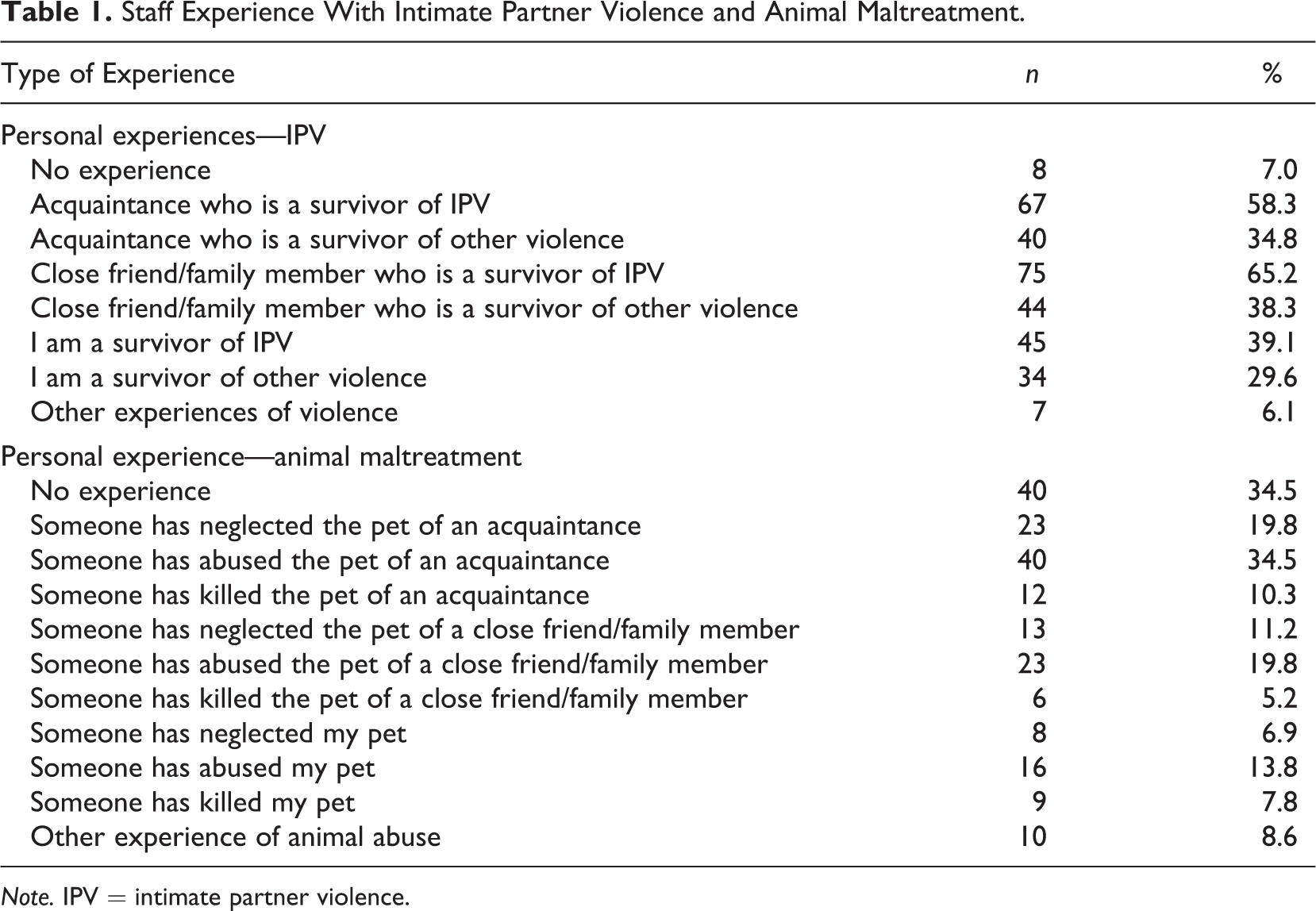
We asked participants about their own personal experiences with IPV and animal abuse. Participants could select all forms of experience that applied to them to capture the potential breadth of experiences (response options were not mutually exclusive). The response options are detailed in Table 1.
Staff Experience With Intimate Partner Violence and Animal Maltreatment.
Note. IPV = intimate partner violence.
Awareness of animal abuse at organizational level
To gauge the degree of awareness of animal abuse at an organizational level, respondents were asked to provide information about how much of the training content they received in their current position focused on animal abuse in the context of IPV. The possible responses were no content at all, a brief mention or comment, a short discussion, a unit or class, an entire course or workshop, and more than one course or workshop. Staff members were also asked about their individual awareness of women in the community who did not use the shelter services because they could not bring their pets. Additional questions assessed the number of clients over the previous 5-year period who reported animal abuse or threats while at the shelter, left the shelter to care for pets temporarily, returned to abusive relationship to care for pets, delayed leaving out of concern for the pets, and for whom abuse of the pets was a factor in leaving the abuser.
Agency services and policies
Respondents were asked “does your transition house have an official policy of offering services to care for pets of abused women” (response options: Yes, there was an official policy; no official policy and no services provided; no official policy but informal partnerships with other agencies; no official policy but assist on case-by-case basis; and do not know). A follow-up question for respondents who replied “no services provided” asked about the reasons why the shelter did not have an official policy to assist the pets of abused women who resided in the shelter. Respondents who noted that services were available to women with pets were asked about the style of program (referral to community program, arrangements made to board pet at animal shelter, veterinarian, or foster home, or pet allowed to accompany woman to the shelter). Details about communication to the clients about the availability of the pet safekeeping options, including questions on intake to the shelter, were also gathered.
Support for pet safekeeping programs
Likert-type scale questions assessed the support for a policy allowing pets of women at other shelters (1 would not recommend to 5 strongly recommend), the level of support for allowing pets to accompany women to the respondent’s own shelter, as well as the level of support for the designation of emotional support service animals (1 not supportive at all to 5 extremely supportive). Individual potential barriers to pet safekeeping programs as well as benefits were assessed using a Likert-type scale (1 not significant at all to 5 extremely significant). Qualitative responses were gathered through the following open-ended question: “If you could design a shelter that would meet all of the needs of women leaving intimate partner abuse, what would that ideal shelter be like?” These data were subjected to a thematic analysis (Braun & Clarke, 2006). The responses were coded and analyzed and are used to provide additional context around the quantitative results.
Descriptive analyses were conducted on the demographic variables, the variables measuring awareness of animal abuse, and the agency services and policies. A series of bivariate analyses were conducted on demographic variables and support for pet safekeeping program variables, including Pearson’s correlations, t tests, and χ2 test of group differences.
Results
Demographics
The majority (99%) of the 116 respondents were female, with one respondent identifying as transgender. The ages of respondents ranged from 22 to 67, with an average age of 42.5 years (SD = 13.08). White respondents made up 75.8% (n = 88) of the sample, with 12.1% (n = 14) Aboriginal, identifying as either First Nations, Métis, Inuit, or self-identifying a portion of their racial heritage as Aboriginal. Additional ethnic groups represented were Black (n = 5), South Asian (n = 4), with five respondents reporting as Filipino, Latin American, mixed heritage, or other. Most of the sample held some postsecondary education, with 73.2% holding a college or university degree (n = 85), 5.2% holding a master’s degree (n = 6), and 13.8% currently pursuing a diploma or degree, including graduate studies (n = 16). Lifetime ownership of pets ranged from 0 pets (n = 2) to 32 pets, with the average number of pets owned being 9.13 (SD = 6.05). Overall, 88.7% of staff reported owning at least one pet during their lifetime.
The average years of service to the particular agency was 9.2 years (SD = 8.82). While the official titles varied somewhat (e.g., crisis intervention worker, case management, youth advocate, and social worker), 95% of the respondents held advocacy and support positions at their agencies, with the remaining respondents holding administrative and management positions. Eleven respondents reported that they held multiple positions at the shelter, which is not surprising because pervasive scarcity of resources means employees often fill multiple roles.
Personal Experience With IPV and Animal Abuse
As detailed in Table 1, participants were asked to select all forms of violence or maltreatment with which they had personal experience, and thus could indicate more than one type of victimization. Overall, 93% reported some experience of IPV or other personal violence, and 65.5% indicated experience with some form of animal abuse. The most commonly experienced form of animal abuse was abuse of the pet of an acquaintance, reported by 34.5% of respondents. Staff members also revealed that their own pet had been neglected (4.0%), abused (8.0%), and killed (4.5%). While the category of acquaintance could possibly be conflated with shelter clients in this context, in the focus group discussions about specific survey questions, the participants clearly understood that questions asking about their personal experiences referred to their experiences outside of their agency role.
Awareness of Pet Abuse in Context of Abusive Relationships
The majority of participants reported that they had heard at least mention of animal abuse in trainings they had received: 37.7% reported that their training contained no content related to animal abuse, whereas 36.0% cited a brief mention or comment regarding animal abuse, and 19.3% reporting that their training contained a short discussion of animal abuse.
The majority of shelter staff (74.8%) stated that they were aware of abused women in the community who did not access the shelter because they could not bring their pets with them. This question was aimed at assessing the subjective awareness of staff members of the issue in the community broadly rather than attempting to assess the actual number of women in the community who may need services. Many staff members were also aware of survivors being concerned about their pet(s) while in shelter. Forty-seven percent of staff reported that they were aware of between 1 and 10 women who left the shelter temporarily to return home to care for their pets, and 42.6% of staff were aware of between 1 and 10 women who learned their abuser was threatening or harming their pet while she was residing at the shelter. Seventy percent of staff responded they were aware of women who delayed leaving their abuser out of concern for their pets, while 47.8% of staff were aware of women for whom the threats or abuse to their pets were part of the motivation to leave the abusive relationship.
Agency Services and Policies
When questioned about whether the shelter had an official policy of offering services to care for the pets of abused women, 25.9% stated that there was no policy and no services provided. Staff were also asked why there was no official policy to assist women with pets. The top reasons given were staff and resident allergies (42.9%), lack of money (40.3%), and lack of space at the shelter (36.4%). Concerns over hygiene and property maintenance (28.6%), a lack of community partnerships (28.6%), and safety concerns (18.2%) were also commonly selected reasons for the lack of an official policy. Interestingly, only six respondents stated that staff resistance was a factor in the absence of a pet policy, while 13 stated that there was no need for an official policy. The details provided by the staff for “other reasons” generally fell into two categories: There used to be service provided for clients with pets (used to have agreement with vet but clients couldn’t pay) and limited need for program (residents have been homeless and unable to have pets prior to coming here).
The most commonly reported pet-related service offered was referral to a community agency or a program in the community that could help (46.6%), followed by making arrangements to board at the local animal shelter (43.1%). Boarding with a veterinarian (8.6%) and foster care for the animals (12.9%) were less frequently noted. Only three staff (2.6%) reported that women were able to bring their pets to the shelter, representing the single agency that allowed on-site sheltering of pets. Of the four staff members responding that other services were offered, two mentioned that “on occasion woman can bring pet until other options are explored,” and two stated that the women were encouraged to make arrangements with friends or family to keep the pets.
Staff were questioned about if or when they asked clients about pet-related concerns in three contexts: when clients call the shelter, on intake to the shelter, and as part of a risk assessment. Thirty respondents (25.9%) stated that women were never asked about pets when calling the shelter, 40.5% said women were queried “a few times” or “sometimes,” with 10.3% responding that questions about pets were “frequently” or “always” asked of callers, and 23.3% responded “do not know/not part of my position.” A more equal distribution was seen in the inclusion of pets on risk assessments: 31.9% of staff said pet abuse was never included, 22.5% responded “a few times” or “sometimes,” and 28.4% stating that pet abuse was “frequently” or “always” incorporated in evaluations of women’s risk.
Although 12.9% stated that they “did not know” or it was not part of their position, 71.6% of staff revealed that there was no question about pets on intake to the shelter. Of those who did have intake questions about pets, they were framed in three ways: if the pet had been the victim of abuse and/or threats, if the client had a pet that needed care, and instructions to the staff member to begin a dialogue about options for the safety of the pet. Safety planning that included pets was reported by 38.8% of staff, whereas 40.5% stated that pets were not included; the remainder were unaware whether pets were incorporated in safety plans.
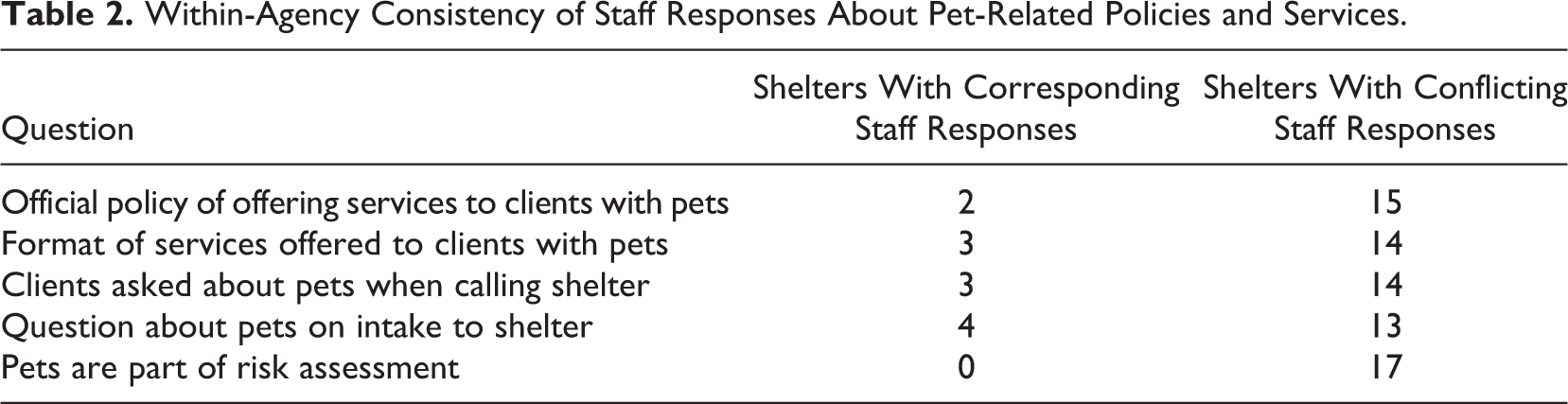
Staff responses to questions about agency policies and services for clients with pets illustrated a high degree of within-agency inconsistency (Table 2). The conflicting answers to questions about agency policies and services vis-à-vis pets far outweighed consistent responses from staff members at the same shelter.
Within-Agency Consistency of Staff Responses About Pet-Related Policies and Services.
Support for Pet Safekeeping Programs Allowing Pets to Stay With Clients at Shelter
Staff members were asked about their support for programs allowing pets to stay with women at the shelters (frequently referred to as cosheltering). Respondents were significantly less supportive of allowing pets to stay with the clients at their own shelter than they were of doing so at other domestic violence shelters (t = 4.353, p < .001).
Staff were questioned about their level of support for some pets being designated as service animals to support an abused woman with emotional and/or psychological difficulties. Respondents were very supportive of emotional support animals with a mean score of 4.59 (SD = 1.37).
Separate correlations were run between level of educational attainment and lifetime ownership of pets with the program support variables. The number of pets a staff member has owned in her lifetime was positively associated with increased support for animals being designated as emotional support service animals (r = .320, p < .01) as well as support for allowing pets at the respondent’s own shelter (r = .242, p < .05). Conversely, the number of pets was not significantly related to support for programs at other shelters, while the level of educational attainment was positively associated with support for pet programs at other shelters (r = .189, p < .05).
A χ2 analysis was conducted to assess the significance of previous experience of animal abuse with support for safe pet programs. A positive response to awareness of women who have not come to the shelter because of their pets was significantly related to increased support for programs both at their own shelter (χ2 = 13.351, p < .02) and at other shelters (χ2 = 19.791, p < .001). Personal experience with animal abuse was recoded into two groups: no animal abuse and any animal abuse. Personal experience with animal abuse was not significantly related to support for safe pet programs at the respondent’s own shelter, but support for programs at other shelters did approach significance (χ2 = 10.524, p = .062).
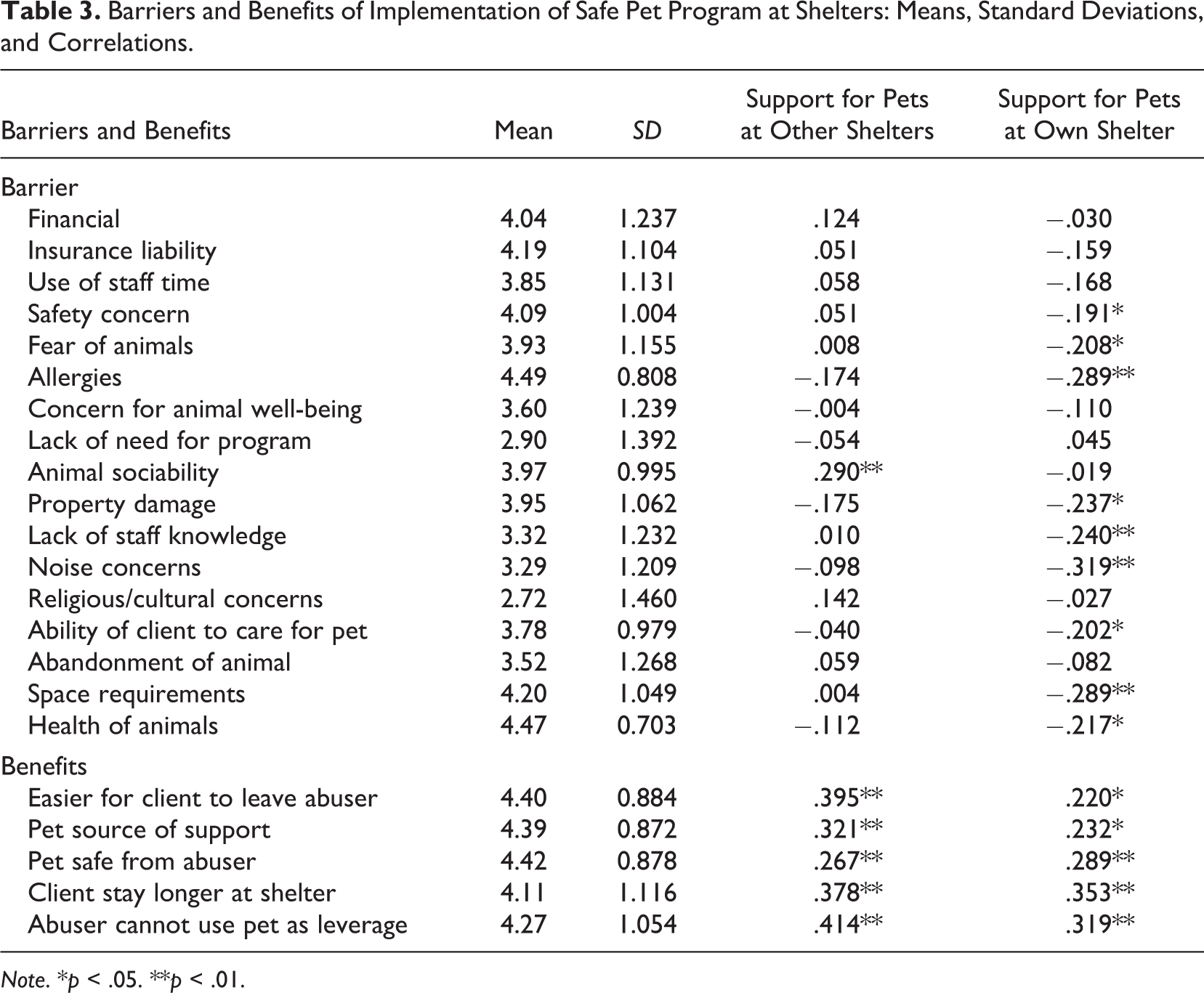
Staff were asked about possible benefits and potential barriers to programs allowing women’s pets to accompany them to the shelter. Most of the barriers were rated as extremely or very significant by the respondents, as indicated by 11 of the 17 variables having a mean greater than 3.75 (overall range of 2.72–4.49; Table 3). Correlation coefficients were computed to assess the relationship between the importance of the perceived barriers with support for programs at other shelters and at the respondents’ own shelters (Table 3). The relationships between support for programs at the staff members’ own shelters and barriers tended to be negative, meaning the higher the perceived significance of the barriers, the lower the support for allowing pets at the shelter, with the effects being small to medium in size. The strongest relationships were with concerns about noise (r = −.319, p < .01), animal-related allergies (r = −.289, p < .01), and space required to house the animals (r = −.289, p < .01). Notably, the only significant correlation with support for programs at other shelters was animal sociability (r = .290, p < .01); a higher score on support for pet programs at other shelters was significantly related to a higher rating of importance for concerns about animal sociability with other residents, including children. Separate correlations were also run between the barriers and lifetime ownership of pets and education level of the staff members. As the number of pets owned over the respondent’s lifetime increased, the perceived significance of the barriers lack of need for a program (r = −.252, p < .05) and noise concerns (r = −.232, p < .05) decreased. On the other hand, the only barrier that showed a positive association with education was religious or cultural concerns of having animals share space with residents (r = 0.221, p < .05), indicating that as education level increased, the perceived religious or cultural barrier increased in importance.
Barriers and Benefits of Implementation of Safe Pet Program at Shelters: Means, Standard Deviations, and Correlations.
Note. *p < .05. **p < .01.
Respondents rated the perceived benefits of allowing pets to accompany women to the shelter as extremely or very significant (means ranging from 4.11 to 4.42; Table 3). Correlation coefficients were computed to assess the relationship between the perceived importance of benefits with support for programs at other shelters and the respondents’ own shelters (Table 3). The relationships between support for programs at the staff members’ own shelters and at other shelters were all positive, meaning the higher the perceived significance of the benefits, the stronger the support for allowing pets to accompany women to shelters, with the effects being small to medium in size. For programs allowing pets at other shelters, the strongest relationships were with the benefits of not allowing the abuser to use the pet at leverage (r = .414, p < .01) and making it easier for the client to leave the abusive relationship (r = .395, p < .01). The benefits of the client staying longer at the shelter (r = .353, p < .01) and not allowing the abuser to use the pet as leverage (r = .319, p < .01) were the strongest correlations with support for a pet program at one’s own shelter. Correlations were also run between the perceived benefits and lifetime ownership of pets, with no significant association found between the variables.
The “Ideal Shelter”
Respondents were asked to describe their ideal shelter that met all the needs of women leaving intimate partner abuse in an open-ended question. Overall, 54 staff conveyed that their ideal shelter would include a space for the pets of their clients, with an additional five advocating for “some sort of service to help people with their pets.” In the descriptions of the ideal shelters, 11 respondents noted an indoor space allocated for clients with pets, whether it was specific rooms set aside for women with pets within the shelter, such as “separate areas within the shelter designated for “pet friendly families” or “one big room to bring their pets and toys.” Eighteen staff specifically mentioned an attached outdoor space separate from the shelter building, such as a kennel or additional building exclusively for the animals. One respondent described her ideal as “heated sheds for dogs/cats” where the women have “easy access to their pets.” In only seven responses were offsite facilities or external agencies (e.g., Society for the Prevention of Cruelty to Animals, boarding kennel) mentioned as an option. Three of the seven responses were qualified, however, with one noting the inability of on-site pet sheltering to meet the needs of larger animals, and two others suggesting that they be housed nearby, such as in “a kennel in the neighborhood of the shelter, accessible to the women for visits” and “close enough to allow for frequent daily visits.”
Pets or pet services were not mentioned at all in 12 responses. Instead, the comments from these staff members were centered on enhanced services for women and children exclusively, with comments like “have more programs available to help women through their issue and to empower them” and “programs of support with professionals.” While additional resources arose in other staff visions of their ideal shelter, resources were the dominant theme in respondents that made no mention of pets, despite being primed through the completion of the survey. This indicates that at least for some staff members, providing services for pet safety is fully eclipsed by concerns related to the limited resources of the shelters.
The connection between a woman and her pet arose as part of the rationale for having on-site sheltering of pets in the ideal shelter. Ten of the respondents specifically mentioned the therapeutic and support aspects of the human–animal relationship. Comments like “animals are great therapy!” and “having animals around would be therapeutic” speak to the staff members’ belief in the benefits of companion animals. Two staff members offered a more detailed rationale, with one respondent stating that “it is emotional and psychological strain on clients when they leave a pet behind,” and another respondent stating that her ideal shelter would “have counsellors [that] understand the importance of the people and animals [sic] relationship.” These staff members acknowledge the deep bond that some women have with their companion animals, and the benefits that maintaining the relationship with the pet can have for the woman’s healing process, as well as the possible setbacks to healing that can occur when a pet is left behind.
Barriers to on-site pet sheltering at an ideal shelter were raised by 10 staff members, and often in conjunction with a solution. For example, one respondent made note of having an “allergy-free area with no pets,” while another was more specific in describing how to manage risk to other residents through having a “separate wing for residents with pets away from main part of shelter (to accommodate small children, ppl with allergies, ppl with religious conflicts) [sic].” That pets might bother other residents was a key concern, evidenced through comments like needing outside space for the animals because they “were not allowed in communal areas” and in having separate spaces for women and pets where they “would not impact other residents.” The lack of pet-friendly housing also arose as a unique issue, with two staff members citing the need for their ideal shelter to either “advocate for more pet friendly housing in the community” or implement “pet friendly transitional housing” to which women can go with their companion animals after the shelter.
Discussion
The oppression of women and animals are intertwined in patriarchal systems, and nowhere is this interconnection more apparent than in the co-occurrence of animal abuse and women abuse. Therefore, supporting the safety of pets of survivors of IPV is an important social justice endeavor, not just for the protection of the animals but also for the women who care for them.
The first goal of this study was to capture the shelter policies and practices regarding companion animals. Like other studies (Hardesty, Khaw, Ridgway, Weber, & Miles, 2013; Krienert et al., 2012), the current study shows that Canadian IPV service providers have a clear awareness of the intersection of companion animal maltreatment and IPV in the community. The majority of respondents were aware of survivors who did not come to shelter because they could not bring their pet. This is in line with the findings in the study by Wuerch and colleagues (2017), where all staff members reported being aware of women who refused to go to a shelter because their pet was not allowed to accompany them. A limitation of most of the research on the co-occurrence of animal abuse and IPV (with Wuerch et al., 2017, as a recent exception) is the reliance on samples of women who are already in shelters; it is therefore unknown how many women may never leave an abusive partner due to concern for their pet. Although we do not yet have an estimate of the proportion of people in the community who remain in abusive relationships due to concern for their pets, the fact that such large proportions of staff members in these studies are aware of women who need support for both themselves and their companion animals provides further evidence of the need to establish pet safekeeping programs.
There is also an organizational level of awareness evidenced through mention of pets in over half of agency training, but there are still very few questions about pets on intake to the shelter or when women call for service. The paucity of questions may lead women to believe that there is no support for their pets’ safety, and therefore they may not ask staff for assistance for their pets. Starting the conversation about pets with the clients means that staff will be aware of any concerns and risks on intake which can be managed on a case-by-case basis.
Through asking women who contact the agencies about companion animals, including threats or harm to the pets, and compiling statistics on the responses, a better understanding of the needs of survivors and their community can be gained. In the absence of questions and data, Randour (2007) argues that “responders are operating in the dark, without the necessary knowledge they would need to plan effective prevention and intervention strategies” (p. 102). Echoing the policy recommendations of Krienert et al. (2012), Hardesty et al. (2013), and Wuerch et al. (2017), clearly communicating the options available for pet safety and including pets in risk assessments and safety planning are avenues to build a knowledge base to better meet the needs of shelter clients with pets.
In the absence of knowledge about pet safekeeping programs, or confusion about the availability of services for clients with pets, staff members may be reluctant to open a conversation for which they see no solution. This then represents a point of impasse: the clients may not mention they need services for pets as well as themselves or their children for fear of being refused shelter or being criticized for taking their pets into consideration when their own safety and that of their children is at risk, and the staff may be apprehensive about calling attention to a need that the agency is unable to meet. It is in the midst of this impasse that the benefits to pet safekeeping programs come into stark relief.
Not having to worry about a pet’s safety can make it easier to leave an abuser. Reducing the leverage that an abuser has by removing the animal target of threats or harm also reduces the risk that the woman will return to a dangerous situation. Anderson and Saunders (2003) call attention to the “process-of-leaving” perspective on exiting violent relationships (p. 172). Leaving an abusive relationship is conceptualized as a process of decisions and shifts in thinking over time, rather than a single discrete decision (Anderson & Saunders, 2003). The process is not time bound, nor is it linear. Leaving can take place over an extended period of time, sometimes years, and temporary separations and reunions are common in this process before the final break with the abuser is made (Anderson & Saunders, 2003). Yet, each time a woman returns to an abuser, her risk increases for intimate partner homicide (H. Johnson & Dawson, 2011). Ensuring the safety of her pets means one less reason to return to an abusive relationship, which increases the safety of the woman, her children, and her companion animals. This increase in safety warrants making pet safekeeping services available to clients who need them a priority for domestic violence service agencies.
The seeming confusion within shelters about the availability of services for clients with pets, such as the format of pet service offered (i.e., boarding at veterinarian, foster home) at each shelter, is difficult to assess due to the inconsistency in responses about whether the shelter had an official pet policy. The myriad responses about what formats the pet services take may be due to the differences at the individual, rather than shelter, level. Individual shelter staff may be taking the initiative in assisting women to find safety for their pets rather than adhering to a shelter-wide policy or practice. This is in line with the ad hoc solutions commonly implemented by the shelters noted by Stevenson (2009), where the goal stated by the respondents was to do what they needed to do to get the woman safe. The inconsistencies in responses may simply be a reflection of creative problem-solving on the part of staff and lack of communication among staff members about available options for pet safety. However, this represents an avenue for future research, including how staff access community resources, and how the ideas can be translated into official shelter policy for caring for pets of survivors and communication to those needing services.
The idea of creative problem-solving is connected to the survivor-defined advocacy model suggested by Davies and Lyon (2013) and Kulkarni, Herman-Smith, and Ross (2015). Survivor-defined advocacy emphasizes the voice of the survivor, focuses on providing individualized solutions to the challenges that women face, and attempts to address systemic barriers that inhibit women’s ability to move into a safe and secure life (Davies & Lyon, 2013; Kulkarni, Herman-Smith, & Ross, 2015). However, there are also barriers to implementing this style of IPV service provision, the primary ones being time and resources. When asked about why their shelter did not have an official policy to assist women with pets, many of the staff noted that there was simply not enough time to collaborate with other agencies, and not enough time or money to implement an established program to assist victimized companion animals. Given that space is often at a premium and funding is limited, when coupled with staff often filling multiple roles, these answers are not surprising.
The second goal of this study was to explore IPV shelter staff experiences with animal abuse and how these experiences are related to support for pet safekeeping programs. This is the first study to our knowledge to ask shelter staff about personal experience with pet maltreatment, and the results show that nearly two thirds of shelter workers have some level of personal experience with animal abuse. A particularly curious result was that personal experience with animal abuse had no significant association with support for a pet safekeeping program at other shelters or the staff member’s own shelter. This runs contrary to the expectation that staff who had been touched by animal abuse in their personal lives would be more empathetic and supportive of women with pets who also needed haven. However, it may be that the relatively high degree of exposure in among our sample to abuse survivors who refused going to a shelter because they could not bring their pets (74.8%), who had delayed leaving due to concern for their pet (70%), and who had left the shelter to return home to care for their pet (47%) has educated those who have not had personal experience with animal abuse about the significant toll that it can take. A key area for future research is examining the differences in personal experience and the nuanced ways that this may affect how staff members respond to women whose pets also need safety.
Staff showed less support for allowing cosheltering pets with women at their own shelter than at other domestic violence shelters. This may be due to a perception of fewer barriers at other shelters, an intimate awareness of barriers at one’s own shelter, or the perception that the need for a program may be greater elsewhere. On-site pet sheltering is only one option of several that are available to domestic violence shelters. The key policy recommendation is that shelter staff need to begin to ask questions of their clients to determine the need for a pet safekeeping program, which in part, will direct the format that the program takes. The different program formats have their own pros and cons. For example, some women may not want to share their temporary home with animals (perhaps due to fear of animals or concerns about hygiene), whereas other women may experience stress due to separation from their companion animal who is staying in a kennel or boarding location. However, the descriptions of the ideal shelters reveal that on-site pet sheltering is desired by staff members, despite acknowledging barriers like allergies and impact on other residents. Overall, most barriers to allowing pets to accompany women to the shelter were rated as important, although the most significant barriers were noise concerns, allergies, space within the shelter for the animals, and animal sociability. These are common concerns raised in the literature (Krienert et al., 2012; Stevenson, 2009) and are a good place to start a conversation within shelters about creative ways to manage these challenges in order to meet the needs of clients.
Based on the findings of this study, the most supportive staff are those who have had companion animals in their lives, who also place less importance on barriers to pet safekeeping programs and more importance on the benefits. This has important implications for how to garner support for programs at agencies, in that staff who are pet owners, regardless if their own pets have been abused, are more supportive of such programs. Benefits to allowing women to stay at the shelter with their pets were all related to the safety of the woman in limiting the abuser’s power and easing the way out of a harmful relationship. These represent key aspects of the mandates of IPV service providers and make a strong argument for shelters having a policy in place to support all family members in seeking safety from abuse.
As with all studies, this one has associated limitations. The reliance on self-report data is one such limitation. For instance, it could be that a particular event, or client experience, was current in the minds of the respondents and this shaped their responses, including support or lack thereof for pet safekeeping programs. In addition, there is the possibility of self-selection bias in that those who agreed to participate were unique in some way, perhaps in their high level of lifetime pet ownership and experience with animal abuse. There is also the possibility that the respondents at the six shelters who participated in both the focus groups and the survey distribution phases of the research were primed by the focus group discussions. Given that the surveys were discussed in detail in the focus groups, staff members who participated in the groups had the opportunity prior to receipt of the survey to reflect on the issue as well as the agency policies in a way that was not available to other respondents, and which may have shaped some of their responses.
A limitation of the qualitative data collected via the open-ended question is the potential of a priming effect. The open-ended question about what the participant’s ideal shelter would look like was the final question in the survey, and as such, the answers may have been shaped by the concerted thinking about pets and women escaping violence. Questions about their own experience, or the barriers and benefits to a safe pet program, may have sensitized the respondents to issues that were perhaps hard to address in their own shelter but more easily managed in an ideal situation with funding, services, and space.
A final limitation worth mentioning is our modest sample size, which resulted in insufficient statistical power to analyze agency-level characteristics and make those comparisons here. This was an exploratory study that sampled only a small proportion of Canadian domestic violence shelters, which impacts the ability to generalize our results to a larger Canadian context. Future phases of this project aim to capture a more comprehensive sample of domestic violence shelters.
Conclusion
One of the aims of the study was to generate evidence-based policy and practice suggestions. As noted throughout the discussion above, there are three specific policy recommendations arising from this research. First, asking questions about pet safety when women call the shelter for service, as well as on intake, in risk assessments, and in safety planning would provide staff with more information about the needs of their clients. Importantly, asking a question about pet safety addresses a potential barrier to the woman’s safety, thus helping to fulfill the mandate of IPV service agencies. The second recommendation is to make the policies and options available regarding pet safekeeping programs clear for staff. The degree of inconsistent staff responses means uncertainty about services for survivors, which can negatively impact meeting their needs. Finally, it is time to begin conversations at the agency level about how to implement a pet safekeeping program. The barriers noted in this study, such as allergies, space, and money, can be managed through creative solutions and designing a safe pet program that fits the needs of the clients, the shelter, and the community (see http://alliephillips.com/saf-tprogram/).
Many women see their pets as family members, and when survivors will not leave abusive relationships out of fear for their pets, it is critical to have services in place to assist pets in finding safety as well. This research shows that IPV shelter staff are aware of the co-occurrence of pet maltreatment and IPV in the community and are largely supportive of establishing pet safekeeping programs. Together, we need to ask the questions about pets and make the safety of all family members a priority.
Footnotes
Declaration of Conflicting Interests
The author(s) declared no potential conflicts of interest with respect to the research, authorship, and/or publication of this article.
Funding
The author(s) disclosed receipt of the following financial support for the research, authorship, and/or publication of this article: This study was funded by the Social Sciences and Humanities Council of Canada, #430-2012-0101, and a University of Windsor Faculty of Arts, Humanities, and Social Sciences Collaboration Grant.
