




Abstract
As the number of women incarcerated in the United States continues to rise and their complex needs become more apparent, social workers must fortify their historical commitment to criminal justice reform. However, crafting more effective and compassionate responses to the needs of justice-involved women may very well require a more nuanced understanding of the holistic impact of incarceration on women’s well-being than the current literature offers. Utilizing the framework of feminist standpoint epistemology, the researcher engaged in qualitative content analysis to examine published personal accounts from 43 women to better understand their experiences in prisons and jails in the United States. Two overarching themes emerged from the analysis. First, the personal accounts illustrated that women experience prisons and jails as environments of denial insofar as these carceral environments deny women’s basic needs, their sense of humanity, and their personal power. The second overarching theme pertains to the holistic impact of the carceral environment upon women’s lives, meaning it has expansive effects on women’s biopsychosocial–spiritual functioning. Social workers should dedicate efforts to dramatically reducing the number of women behind bars and engaging in holistic intervention approaches that might counteract the negative effects of incarceration across domains of well-being.
Feminist scholars implicate the U.S. criminal justice system in the perpetuation of patriarchal oppression, pointing to the routine dehumanization and disempowerment of women that occurs in prisons and jails (Brans & Lesko, 1999; Chesney-Lind, 2006; Fruchter, 2001). Amid staggering increases in female incarceration over the last half century (Cahalan, 1986; Carson, 2015), correctional facilities and services fail to meet the needs of justice-involved women (G. Fedock, Fries, & Kubiak, 2013), often functioning to traumatize rather than rehabilitate (Aday, Dye, & Kaiser, 2014; Harner & Riley, 2013). By advocating for transformation of the criminal justice system, social workers can begin to address the myriad injustices women experience during incarceration (Willison & O’Brien, 2017). Realization of those ends, however, will require comprehensive knowledge of women’s lived experiences of incarceration, including a nuanced understanding of how the carceral environment impacts women’s physical, emotional, social, and spiritual well-being. My own experience as a correctional social worker suggests those working directly with women in criminal justice contexts too often demonstrate myopic attention to mental health needs while lacking a full appreciation of the holistic impact of incarceration on all aspects of women’s lives. Utilizing the framework of feminist standpoint epistemology, this qualitative content analysis sought to give greater voice to incarcerated women with the hope of providing social work practitioners with a richer understanding of women’s experiences.
Women in the Criminal Justice System
Women represent almost one fifth of adults under correctional supervision in the United States, with over 1 million women currently on probation, incarcerated, or on parole (Kaeble, Glaze, Tsoutis, & Minson, 2015). Although women currently account for only 7% of incarcerated adults, the number of incarcerated women has increased by an alarming 1,534% since 1950 (Carson, 2015), thus contributing significantly to the current state of mass incarceration. In fact, the rate of female incarceration has been outpacing increases in male incarceration since 2000 (Glaze & Kaeble, 2014). The marked increase in female incarceration has been largely attributed to policies stemming from the so-called War on Drugs and the development of mandatory minimum sentencing (Javdani, Sadeh, & Verona, 2011; Wright, Van Voorhis, Salisbury, & Bauman, 2012). Indeed, women are more likely than men to become incarcerated as the result of a drug-related offense and less likely to be convicted of violent or property offenses (Carson, 2015). Importantly, the disproportionate incarceration of poor women and women of color has also contributed significantly to female mass incarceration (Richie, 2012). Rather than addressing the structural inequalities that contribute to female crime, the criminal justice system has perpetuated the criminalization of women’s “survival behaviors” and increasingly relied upon incarceration as a mechanism for responding to and compounding women’s marginalization (Willison & O’Brien, 2017, p. 38).
In addition to the structural oppressions of sexism, racism, and poverty, many incarcerated women contend with trauma, mental illness, substance abuse, and strained familial connections. Multiple studies show disproportionate rates of lifetime trauma and victimization among incarcerated women (Cook, Smith, Tusher, & Raiford, 2005; McDaniels-Wilson & Belknap, 2008), the majority of whom experience polyvictimization (Scott, Coleman-Cowger, & Funk, 2014), domestic violence, and sexual assault. Incarcerated women also experience disproportionate rates of mental and emotional distress, with the most recent Bureau of Justice Statistics data showing that over 70% of female inmates in prisons and jails meet the criteria for some form of mental illness (James & Glaze, 2006). Conservative estimates indicate that 60% of women in state institutions struggle with substance abuse as well (Mumola & Karberg, 2007).
Given the complexity of women’s lived experiences prior to incarceration, their experiences during incarceration can have potentially deleterious effects. For women with trauma histories or prior mental health diagnoses, aspects of the carceral environment may retraumatize or promote suicidal ideation and behavior, ultimately worsening preexisting mental health conditions (Dye & Aday, 2013; Harner & Riley, 2013; Marzano, Hawton, Rivlin, & Fazel, 2011). Limited access to medical care and inadequate nutrition may contribute to poor physical health outcomes (Douglas, Plugge, & Fitzpatrick, 2009). Incarceration also has considerable social costs insofar as it isolates women from their families and creates legal difficulties for mothers hoping to reunite with their children upon release (Allen, Flaherty, & Ely, 2010). In his classic sociological study, Sykes (1958) characterized correctional institutions as environments of deprivation, citing how the “pains of imprisonment” wielded a negative impact on inmate health and behavior. Although Sykes’ original study involved male inmates, his deprivation theory has since been applied to understanding the experiences of incarcerated women as well (Dye & Aday, 2013; G. L. Fedock, 2017). The present study adds to this growing body of literature by examining the holistic impact of incarceration across multiple domains of women’s lives, including the biological, psychological, social, and spiritual dimensions.
Feminist Standpoint Epistemology
To most cogently give greater voice to justice-involved women themselves, the present study utilized feminist standpoint theory as its guiding epistemological framework. The central tenet of feminist standpoint epistemology is its recognition of women’s experiences as a legitimate and valuable source of knowledge (Harding, 2004). As members of an oppressed group, women offer unique and important perspectives on social issues in particular. As Brooks (2007) explains, “women’s experiences, and the knowledge garnered from these experiences, can be used as a means to draw attention to the inequalities and injustices in society as a whole” (p. 60). Since countless scholars have characterized the U.S. criminal justice system as a proponent of devastating social injustice (Alexander, 2012; Davis, 2011), women’s experiences may provide a means for identifying the precise mechanisms through which injustices occur, thus illuminating specific points for social and political action aimed at criminal justice reform.
Method
The present study employed qualitative content analysis to examine published personal accounts of currently and formerly incarcerated women in order to deepen our understanding of their experiences in the criminal justice system. Content analysis has been used previously to examine issues related to women and criminal justice, including sexual assault during incarceration (Alarid, 2000), risk and resilience factors among incarcerated mothers (Schlager & Moore, 2014), gender differences in the experience of military imprisonment (Treacy, 1996), and civilian interest in criminal proceedings for entertainment purposes (Dirks, Heldman, & Zack, 2015). However, no empirical studies were found which examined women’s experiences of incarceration while also emphasizing the implications for social work practice and criminal justice reform.
Sampling
Personal account literature offers a form of readily accessible, authentic data through minimally invasive means. The use of published memoirs can be considered “feminist” insofar as it is nonintrusive and nonexploitative; rather than collecting data from new, additional human subjects, the research uses data that women have already chosen to put forth for mass consumption (Leavy, 2007). Published memoirs may provide more authentic data than that collected for the express purposes of research or gathered from other forms of popular culture such as television and film. Whereas researcher bias might influence interview participants via questioning protocols, for example, published memoirs presumably contain genuine accounts of women’s experiences since they preexisted the research efforts (Leavy, 2007). Additionally, memoirs may be more likely to present a woman’s experience in her own words, unlike the scripts of films or television programs, which filter women’s experiences through the schemas of scriptwriters, producers, and actors. Based on the above rationale, published memoirs were deemed an appropriate source of data for the present investigation.
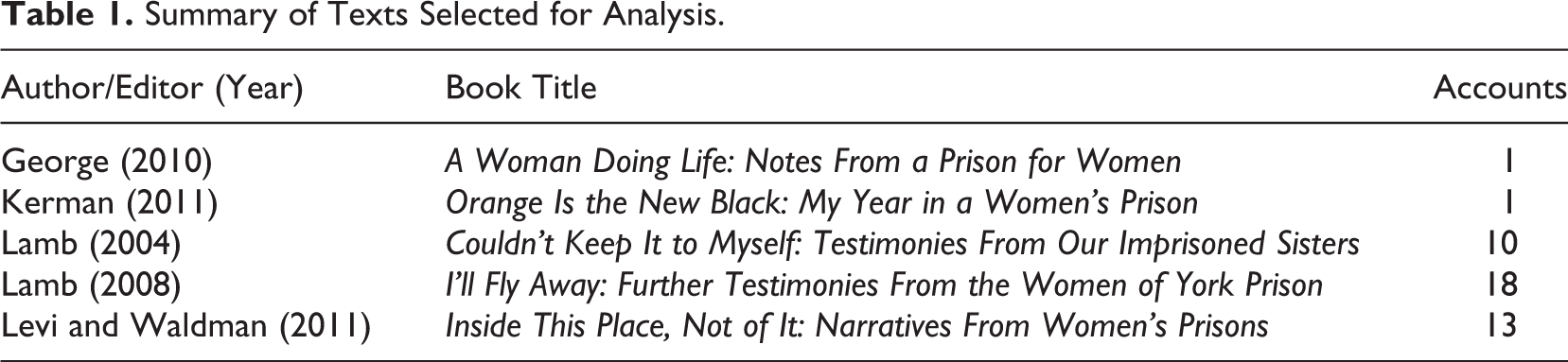
Memoirs included in the present study were identified through multiple key word searches on the website of a popular book retailer. Following the example of Charles (2013) who conducted a content analysis of personal account literature regarding serious mental illness, texts were located through www.amazon.com. Limiting search results to “biographies and memoirs” through the application of a search filter, six searches were completed using six relevant key words: prison, jail, incarceration, incarcerated, correction, and reformatory. From over 2,500 total search results, five texts were identified which met the following inclusion criteria: (a) the text must offer an autobiographical account of incarceration in the United States related to a criminal conviction, (b) the author must have been detained within a correctional institution for women, (c) the author must identify with the female gender whether implicitly or explicitly, and (d) the text must have been written within the last 20 years. Table 1 provides detailed descriptions of the five selected texts, which include three anthologies containing accounts from multiple women. Altogether, the present study analyzed the writings of 43 women who experienced incarceration in local jails and state and federal correctional institutions throughout the United States.
Summary of Texts Selected for Analysis.
Analysis
The sampled personal accounts were subjected to qualitative content analysis, a data analysis strategy appropriate for the examination of “cultural products” such as mass marketed books (Leavy, 2007, p. 224). According to Drisko and Maschi (2015), qualitative content analysis focuses on themes and latent content within a data source rather than solely examining word counts or phrasing as in other approaches to content analysis (i.e., Neuendorf, 2001). The consideration given to latent content within qualitative content analysis makes it well suited to exploratory research that seeks to describe less tangible aspects of a phenomenon. Because the present investigation attempted to uncover the impact of incarceration upon multiple facets of women’s lives and well-being, qualitative content analysis was deemed suitable.
Following the method of qualitative content analysis prescribed by Drisko and Maschi (2015), codes were generated inductively based on both manifest and latent content in the texts. Included in initial coding was all content judged to be relevant to the primary research question: How do women experience incarceration in the United States? Initial codes were primarily descriptive (Saldaña, 2015). Once the initial coding process was complete, codes were grouped into categories through constant comparison of the coded text segments. Finally, the categories were grouped into themes and assigned labels. Throughout the coding process, the author simultaneously engaged in reflexive journaling, a practice which allowed for active acknowledgment of how personal biases and values may have shaped interpretation of the text. Reflexive journaling was especially useful for bracketing the authors’ perspectives, experiences, and questions encountered while interrogating the data. In keeping with feminist standpoint epistemology, the author sought to preserve the standpoint of the incarcerated women and separate them from the standpoint of the researcher, also a former correctional social worker.
Results
Two overarching themes emerged from the analysis. First, the personal accounts offered insight into how women experience jails and prisons as environments of denial insofar as they deny women’s basic needs, humanity, and personal power. That is, women’s personal accounts highlighted their experiences of deprivation amid unsuitable living conditions, dehumanization through institutional protocols, and powerlessness in interactions with staff. The second overarching theme pertains to the holistic impact of the carceral environment upon women’s lives. Specifically, women described biological, psychological, social, and spiritual impacts of their experiences in jail and prison. In bringing a social work perspective to the analysis, the researcher organized the themes in terms of the biopsychosocial–spiritual framework that guides clinical social work practice. The themes are visually represented in Figure 1 and described in detail below with supporting quotations from the personal accounts.
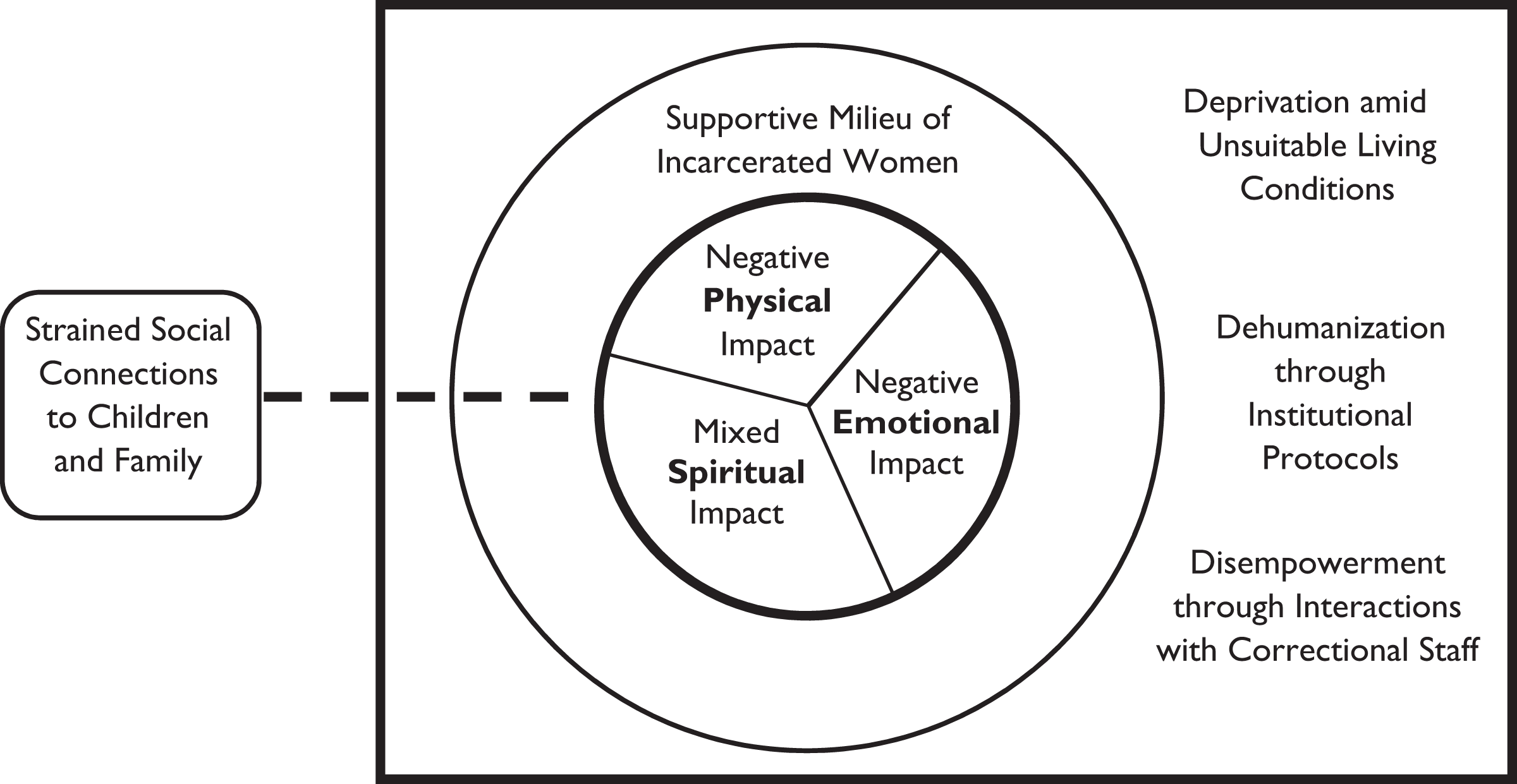
Impact of correctional environment upon individual women.
Jails and Prisons as Environments of Denial
Deprivation amid unsuitable living conditions
Women described the physical conditions of the institutions in which they lived as uninhabitable in terms of unsanitary conditions, overcrowding, or insufficient heating, resulting in a denial of some of their basic needs. For example, Kerman (2011) described a prison facility plighted with infestations, where “little black maggots would periodically appear in the shower area, squirming on the tiles” (p. 82). Other women described cells in which “sewage would rise up on the floor” (Levi & Waldman, 2011, p. 79) or which were “bitterly cold” (George, 2010, p. 95). Additionally, George (2010) recounted overcrowding in the facility in which she was housed: in cells designed for one inmate, they would house three: two in bunks and a third on the floor…I couldn’t even use the toilet in the cell without having to put my feet on someone’s mattress. (p. 23)
Making the experience of incarceration even more difficult was the deprivation of virtually all physical items that might provide a modicum of comfort or pleasure. For example, in a diary entry, Nancy Birkla expressed, “I feel crazier than ever tonight, because getting a fucking piece of paper took me over an hour” (Lamb, 2004, p. 134). Although some items are available for inmates to purchase through the institutional commissary system, the high prices of such items make them inaccessible for some women. Kerman (2011) explains: I desperately wanted to buy a cheap little portable headset radio for $42.90. The radio would have cost about $7 on the street. At the base pay for federal prisoners, which is $0.14 an hour, that radio could represent more than three hundred hours of labor. (p. 78)
Dehumanization through institutional protocols
The personal accounts highlighted myriad examples of institutional protocols and regulations which—while ostensibly designed to promote the safety of inmates and staff—functioned to strip women of their sense of personhood. Anna Jacobs lamented, “I don’t think anybody knows how demoralizing and how humiliating it can be to be in prison” (Levi & Waldman, 2011, p. 134). For example, Tabatha Rowley experienced a hygienic protocol as demeaning: “New ‘admits’ at York must scour their scalps with bug shampoo. That humiliated me. Do I look like I’m carrying cooties in here? I wanted to ask the officer” (Lamb, 2004, p. 98). To maintain safety within correctional facilities, security staff engage in constant surveillance of inmates. Understandably, some women experienced this lack of privacy as unnerving and disruptive: “the threat of a shakedown [a thorough cell inspection] is always there, waiting to shatter any fragile illusion we have of privacy and place” (George, 2010, p. 63). Maria Taylor highlighted the sense of dehumanization she felt in response to surveillance protocols: Your life, your every move, is controlled by these people. When you eat, when you sleep, everything is known. At the beginning of my prison term, I didn’t feel like I was a human being. I didn’t feel like I had any rights. I didn’t feel like anyone cared. (Levi & Waldman, 2011, p. 66) Remove shoes and socks, shirt, pants, T-shirt. Pull up your sports bra and display your breasts. Show the soles of your feet. Then turn your back to the female prison guard, pull down your underpants and squat, exposing yourself. Finally, force a cough, which would theoretically cause any hidden contraband to clatter to the floor. (p. 60) There I stood, a woman who had been too inhibited to appear naked before her husband unless it was in the dark, now facing this hostile stranger under the glare of fluorescent lights. Ashamed, I obeyed her because I had no choice. (Lamb, 2004, p. 71)
Disempowerment through interactions with correctional staff
Overwhelmingly, the most glaring experiences of disempowerment involved women’s interactions with correctional staff. This is somewhat unsurprising since a stark power differential exists between inmates and correctional staff. Also unsurprising is that some correctional officers seem to take advantage of this favorable power differential: Certain prison guards relish the power and control that they wield over other human beings. It oozes from their pores. They believe it is their privilege, their right, and their duty to make prison as miserable as possible by threatening, withholding, or abusing at every opportunity. (Kerman, 2011, p. 240)
Women also experienced profound powerlessness when correctional staff subjected them to verbal and sexual abuse. Women reported myriad instances of correctional staff demonstrating inappropriate behavior ranging from racist harassment to sexual assault. For example, correctional officers ridiculed Tabatha Rowley because of her traditionally African American hairstyle: “Sometimes when I passed by the officers with my new look [an afro], they’d mock me by singing those old Jackson Five tunes” (Lamb, 2004, p. 109). Most appalling are the sexual assaults which several women endured. Teri Hancock describes the physical and emotional impact of sexual assault: Seventeen times he’d assaulted me that day. I had bruises and marks…I think that’s one of the reasons why I have a hard time with men touching me now. Because he damaged me. I feel damaged. (Levi & Waldman, 2011, p. 97)
Biopsychosocial-Spiritual Impact of Incarceration
Physical impact
Women reported experiencing a deterioration of physical health during incarceration, especially while serving long sentences. George (2010) explains, “prison time is hard time for lifers—poor diet, inferior medical care, lack of restful sleep, and an abundance of grief age most of us far more rapidly than would be normal outside” (p. 75). Many women reported substandard—almost negligent—medical care during their incarceration. For example, Anna Jacob’s health was in such peril that she experienced cardiac arrest during her brief jail term, yet she never received medication or counseling to treat her diabetes: “I’m on insulin now, but I never got any while I was in there, and no one ever told me what I should or shouldn’t eat” (Levi & Waldman, 2011, p. 129). Prenatal care for pregnant women was also found to be lacking; Olivia Hamilton reported, “I was there for about a month before I actually saw a doctor. I didn’t have vitamins there, and I had no prenatal care” (Levi & Waldman, 2011, p. 30). Additionally, women bemoaned their limited access to nutritional foods such as fruits and vegetables; according to George (2010), “Vegetables are scarce and frequently range from merely aged to the obviously moldy. The same goes for the fruit” (p. 89). Finally, Marilyn Sanderson noted the noise level in correctional institutions can make sleep difficult, which takes a negative toll on physical health as well: “So many of us are sleep deprived, because it’s hard to get a deep sleep when you’re in this environment” (Levi & Waldman, 2011, p. 157).
Emotional impact
Incarceration seems to represent an intense emotional experience for many women. In fact, some women exhibited personality changes or developed mental health conditions during their imprisonment. For example, Barbara Lane reflected, “I am more suspicious now—untrusting, disillusioned, and bitter” (Lamb, 2004, p. 238). George (2010) recounted the mental health difficulties she experienced in response to the constant surveillance in prison: “I just found the whole thing depressing…Who can bear constant observation and not be reduced to quivering paranoia?” (p. 42). For some women with histories of substance abuse, incarceration forced them to experience sobriety and confront uncomfortable emotions. Lynda Gardner recounted: “This has been the first time in forty years that I haven’t been high on drugs, alcohol, or gambling. And I’m scared shitless, because I feel. I feel hurt, sadness, and sorrow” (Lamb, 2008, p. 88). For some, the experience of incarceration intensified the desire to abuse substances. Nancy Birkla described her harrowing experience with anxiety symptoms: I had the freakiest anxiety attack yet. They’re wearing me down, these bouts of panic. They’d be bad enough to deal with outside of prison, but they’re unbearable in here. I want drugs. I really do. I need something to help me feel less trapped and confined all the time, even when I’m not in a confining situation. (Lamb, 2004, p. 130) An overwhelming majority of incarcerated women have suffered profoundly damaging sexual abuse, so for many of them these violations are all too vivid echoes of the past. For them, every body search is a reenactment of the rape they suffered at 14, or their father’s nocturnal visits. And they must endure it again and again. (p. 65).
Social impact
Incarceration has drastic implications for the social well-being of women. At the forefront of many narratives was discussion of the devastating impact of separation from their family, especially their children. For example, Barbara Lane wrote, “My greatest punishment is…the separation from my children’s lives—the lost opportunity to watch my grandchildren grow, the inability to make sure my family is safe” (Lamb, 2004, p. 216). This separation often caused strain on their relationships, sometimes producing a traumatic response in children, which then became a source of guilt for women. As Olivia Hamilton explains, “The first time [my children] came was really hard. They were beating on the glass, trying to come through it. I was so mad at myself for putting them through this” (Levi & Waldman, 2011, p. 31). Institutional location and the prohibitively high cost of phone calls can further complicate the separation of women from their families: “The problem is that these phone calls are so expensive that in many cases families have to regretfully limit these vital contacts because they simply can’t afford to pay the phone bills” (George, 2010, p. 90). Separation from family can make tragedies more difficult to bear, compounding the experience of grief when a loved one passes away: I had seen many other prisoners suffer through the illnesses of their loved ones and had felt helpless watching them when the worst would come—when they had to confront not only their grief, but also the personal failure of being in prison and not with their families. (Kerman, 2011, p. 226)
Spiritual impact
Women noted that religious worship and pastoral services were some of the most readily available outlets for promoting well-being, more so than mental health services or educational programming. As such, incarceration did seem to strengthen the spiritual well-being of many women insofar as they often utilized their spiritual practices as positive coping skills. For example, Bonnie Foreshaw acknowledged the fortitude she gained from her faith during incarceration: “I made it through on the strength of my Rastafarian beliefs” (Lamb, 2004, p. 193). Similarly, George (2010) explained, “My faith gives me order in chaos, and purpose in aimlessness” (p. 162). For other women, faith was a source of redemption for past misdeeds: “Jesus loves me, even if I’m a bad person, even if no one else does” (Kerman, 2011, p. 230). On the other hand, a couple of women experienced a loss of faith during their incarceration; Brendalis Medina stated simply, “As far as I’m concerned, God evacuated my life long ago” (Lamb, 2008, p. 210).
Discussion
The present research adds to existing knowledge about women’s experiences of incarceration in several ways. The present findings also inform our knowledge of the daily lives of female inmates, since so little is available in the academically published literature (Foster, 2012; Zaitzow & Thomas, 2003). The findings corroborate numerous reports from empirical studies identifying the detrimental effects of incarceration upon women’s well-being. Previous research has also documented deterioration in the physical health (Colbert, Sekula, Zoucha, & Cohen, 2013; Douglas et al., 2009), mental health (Aday et al., 2014; Harner & Riley, 2013; Marzano et al., 2011; Suto & Arnaut, 2010), and social health (Allen et al., 2010; Few-Demo & Arditti, 2014) of women during periods of incarceration. Unlike previous studies focused on only one aspect well-being, the present research provides a more comprehensive, nuanced understanding of women’s experiences of incarceration, indicating that women seem to confront multiple, simultaneous assaults to several dimensions of their well-being throughout their time in jail or prison. For women with multiple disadvantaged identities, these assaults overlay a preexisting web of intersectional oppressions and result in further marginalization (Crenshaw, 2013). Social workers should also consider how the impact of incarceration across domains of well-being may intensify as the length of incarceration increases, thus demonstrating a more severe impact upon women serving longer sentences in prisons versus shorter stints in jails.
In highlighting how aspects of the carceral environment can hinder women’s well-being, the findings of the present study also provide further empirical support for deprivation theory (Sykes, 1958), suggesting that environmental factors do contribute significantly to inmate health and adjustment in many cases. The “pains of imprisonment” that women experience constitute gross social injustices, indicating the need for system-level changes that will substantially improve conditions in jails and prisons while also dramatically reducing the number of incarcerated women. Social workers in health care, social welfare, and policy contexts should engage in prevention efforts to preempt women’s entrance into the criminal justice system, implementing programs and policies that disrupt women’s pathways to crime via victimization and poverty (Daly, 1992). Existing laws should be critically interrogated vis-à-vis the potentiality of a disproportionate impact on poor women and women of color. Social workers must also advocate for the increased implementation of alternative sanctions that connect women to services and supports in lieu of incarceration.
To ensure the humane treatment of women for whom incarceration represents an appropriate measure, criminal justice reform efforts should also aim to improve conditions within correctional settings. Because institutional protocols have been shown to dehumanize and retraumatize, social workers should investigate best practices for achieving the security imperatives of correctional institutions while ensuring humane treatment of inmates. The adoption of feminist, empowerment, and antioppressive treatment approaches might also help correctional social workers attend to the role of power in practice. Social workers should also dedicate efforts to the development and implementation of holistic intervention approaches that might counteract the negative effects of incarceration across domains of well-being rather than focusing exclusively on mental health or substance abuse issues.
Strengths and Limitations
The use of feminist research methods represents a considerable strength of the present study insofar as these methods promoted increased knowledge of women’s lived experiences while also upholding the social work values of social justice and dignity and worth of the person. Importantly, the research serves as a bridge between the personal account literature and the scholarly literature on female incarceration, cementing the legitimacy of personal accounts as valuable sources of knowledge. The use of personal account literature as a data source also provided an opportunity to examine narratives from women incarcerated in a variety of correctional settings across numerous geographic locations, perhaps increasing the transferability of the findings (Guba, 1981).
However, the use of personal account literature also presents a few limitations. The selected texts did not provide demographic information about contributors, thus we cannot know the extent to which the data are representative of a diverse population of women. Additionally, editors and publishers may have interfered with the data during the publication process, potentially conflating their standpoints with those of the authors. For example, both the Kerman (2011) and Levi and Waldman (2011) texts demonstrated a clear political orientation toward criminal justice reform; Kerman (2011) included an index of justice reform resources, and Levi and Waldman (2011) proclaimed their affiliation with a human rights organization. Admittedly, their goal of criminal justice reform might have been best served by showcasing those narratives and anecdotes that demonstrate appalling injustices within jails and prisons.
Footnotes
Acknowledgment
I would like to gratefully acknowledge Dr. Kia J. Bentley for advising and supporting me throughout the course of this research study.
Declaration of Conflicting Interests
The author(s) declared no potential conflicts of interest with respect to the research, authorship, and/or publication of this article.
Funding
The author(s) received no financial support for the research, authorship, and/or publication of this article.