




Abstract
This article addresses the role of money in power relations among mining and nonmining couples. The research performed in the region of Antofagasta, Chile, is based on an interpretive paradigm, with discursive analysis. Twenty-eight people were interviewed based on the category of conflicts and tensions in money negotiations. Findings include that among older women and men, money appears to be masculinized and associated with an illusion of empowerment of women, exacerbating the androcentric sex/gender model. In their discourses, some women express their progress toward relationships of greater equity. Couples must deal with gender conflicts when negotiating money. Even though women manage the family’s money, it’s not considered their money; therefore, they don’t feel free to use it and must account to the man. In this power game and in negotiating, the model of romantic love prevails, the couple’s public and private position, and a neoliberal culture that promotes high levels of consumption.
Introduction
Chile’s neoliberal sociocultural model of the 21st century places a high value on money and attendant displays of consumption and wealth (Garretón, 2007; Moulian, 1999). One field with particularly high purchasing power is mining: Its workers enjoy power, prestige, and control over large amounts of resources compared to other sectors, such as the domestic work of caring for families.
In the region studied, the workers’ sectors differ in their access to quality education, goods and services, and health and housing. This is tied to differences in remuneration among various sectors, as well as to the benefits provided by mining companies, which significantly exceed those of other sectors.
This culture is sustained by copper production, permeating affective relationships that tend to be commercialized: Mining companies offer high economic and social rewards in exchange for intensely productive shifts at the mines. During these shifts, men are absent from family life and women are left with significant power, both in managing day-to-day relations with the children and in controlling the family’s resources. When men return from their shifts at the mines, this empowerment of women is retracted, modifying their position in the gender hierarchy. This system has been called the “family accordion.” Even though these practices generate a lot of tension, the family holds a predominant place for the workers’ emotional stability. It is their reference for security, social support, and identity as a “family man” (Gissi, 2004).
This system can produce familial conflicts, one of which centers on handling and controlling money (Montecino, Rebolledo, & Sunkel, 1999; Silva, 2014; Silva & Barrientos, 2008; Valdés & Rebolledo, 2014). There has been relatively little attention to this conflict in mining families, resulting in a knowledge gap regarding money as a significant source of power and conflict among couples, families, and societies (Dema, 2006; Krenz, Gilbert, & Mandayam, 2014; Vogler & Pahl, 1994).
Therefore, we are interested in contributing to a better understanding among social psychology and social work professionals of the role of money in power relations within couples in a mining context in the region of Antofagasta, Chile. In approaching this topic, we have organized this document in six section: Introduction; Power, Couples, and Money; Models of Analysis for Gender, Couples’ Relations, and Money management; Methodological Models; Findings; and Conclusion.
Power, Couples, and Money
Northern Chile is known globally for its copper mining, which occurs mainly in the region of Antofagasta. Chile ranks third in copper production among 68 countries recently evaluated. Clearly in Chile, as in other parts of the world, mining is a male-dominated profession (Pini & Mayes, 2012; Pini, Mayes, & Boyle, 2013). Workers must adapt to irregular work schedules, normally 45 hr per week distributed over 5 or 6 days. There may also be shifts of up to 2 consecutive weeks and—in unusual cases—a schedule of 2 consecutive days of work followed by 2 days off.
As the mines operate 24 hr per day, miners have many different schedules in terms of their work days, days off, day shifts, and night shifts. Consequently, they are frequently absent from their families: They miss significant events in their children’s development; discussions with their partners about raising and educating their children; and aspects of an intimate, affective, and sexual life with their partners.
In return for the heavy physical and psychological demands of their jobs, miners enjoy higher status and better remuneration than workers in other trades (Valdés & Rebolledo, 2014). This has been observed in the mining industry on a global scale, where research by Pini and Mayes (2012), and Hubbard (2008), among others, has been particularly influential.
Myths have developed about the abundant resources in mining areas. It is not uncommon to hear of this region, “it is like another Chile, the other side of mining prosperity.” The Chilean mining sector includes 48,318 people. Based on miners’ salaries, 1 the average monthly income of a mining family in the Antofagasta region is US$1,314, while for nonmining families, the average monthly household income in Antofagasta is approximately US$852. Because of high mining salaries, the cost of living in the mining region is high compared to other regions of the country. For example, the average cost of a family basket (a month’s food supply) in Chile is US$61.59, but in Antofagasta, the cost is about US$78, a premium of 40%. The minimum monthly salary in Chile is only US$319.
For women who are married to or in partnerships with mining workers, tensions are caused in the couple’s intimate lives due to the miners’ prolonged absences and irregular schedules. Family life must adapt to the men’s trips to and from the mine (fly-in–fly-out) as well as to their sporadic days off. This can provoke conflict that in many cases ends in divorce (Guzmán & Contreras, 2012; Pini & Mayes, 2012). Conflicts are also related to gender violence, 2 alcohol consumption, and commercial sex (Salinas, Reyes, Romani, & Ziede, 2010).
Socioculturally influenced gender roles are neither homogenous nor permanent but rather are in a constant state of flux depending on relational styles and scenarios, the economic resources in play, and the couple’s affections (Dema, 2006). Thus, there is no guarantee that managing the family’s money actually empowers women (Dema, 2006; Pahl, 2007; Tapia & Gonzálvez, 2013; Vogler & Paul, 1994). Unless equality is consolidated through negotiation, this money management is only an illusion or mirage power. For example, women continuously make decisions regarding household expenses, as opposed to the big economic decisions in the family, such as bank investments, which are made by the “head of the family.”
In mining couples, women assume the responsibility of adequately managing the family’s resources and spending. On other occasions, women exercise control but have to render accounts to the male providers who do not actually handle their own money. Thus, control depends on who is positioned as the head of the family. At the end of the month, the women must provide details of the administration of household expenses: school, supermarket, clothing, and medical among other family expenses. There is also suspicion that women might poorly manage or excessively control the family’s money. This creates a power conflict because money is not seen as belonging to women and they are not permitted to use it freely (Pahl, 2007; Vogler & Pahl, 1994). There are conflicts in the couple regarding money not rendered by the women, such as that invested in personal care: hair salon, cosmetic, leisure, and culture. When the money is produced and controlled by the man, it is seen that tensions and conflicts increase when the woman destines it for her personal use and not for the family, for example, clothes, cosmetics, leisure, and recreation.
Given these tensions, money management in a couple can be a source of conflict and can provoke feelings of guilt or shame when it has not been used as directed by the family provider. Guilt and shame, according to Osborne (2014), are interrelated and mutually porous emotions. Feeling guilty about the poor use of money could result in tension and power struggles for a couple. Such feelings and conflicts may be more powerful in an androcentric model, such as a mining culture, than in more equitable societal models (Ashenden & Brown, 2014; Silva, 2012). This occurs when the man questions the woman suspecting the poor use of “his money.”
In contexts where there are cultural distinctions in gender roles and gender models are structured in androcentric hierarchies, the model of romantic love prevails (De Singly, 2002; Giddens, 1992) and is articulated with the circulation of power in handling money and who makes the decisions regarding the distribution of the family’s “goods,” despite gender transformations in the last 40 years in Chile. In Westernized and neoliberal societies, money as a “valued good” possesses an eroticized meaning, and according to Coria (2012) continues to be symbolized as virile power.
Models of Analysis: Gender, Couple Relations, and Money Management
Coelho (2014), Vogler and Pahl (1994), and Pahl (2007) propose five types of money management within couples: (1) joint management, (2) management by the man, (3) management by the woman, (4) management of an assigned quantity by the woman, and (5) independent management by the man and the woman.
Dema (2006) indicates that inequality does not depend as much on the type of management model adopted as it does on its functioning. She provides three dimensions for interpreting the internal dynamics of a couple’s relations, based on the ways inequality is generated and power is exercised: (1) couples formed on the basis of inequality of power legitimatized by the traditional socialization of gender, (2) couples with an egalitarian ideal, in which despite the ideal, there are power disparities, and (3) couples that establish ways of negotiating that tend toward equality.
In more egalitarian couples, diverse obstacles emerge that make it difficult for an egalitarian relationship to function successfully. Even when these couples are able to establish equality, they still face daily conflicts and tensions that hinder their success at maintaining it.
Fundamentally, money is considered one of the most significant factors when analyzing power relationships and negotiations within a couple. It is important to consider who manages and handles the money, who possesses the money, and who provides it. Additionally, the gender model of masculine dominance in Western cultures (Coria, 2012) further complicates negotiations within couples. Such a model is a manifestation of power relationships, both those that are more explicit or visible and those that are more hidden or concealed.
As stated above, there are voids of knowledge in the social sciences regarding understanding tensions in negotiations, administration, and management of money in a couple from a mining culture. This research contributes with experiences from its protagonists who reveal different strategies and forms of power regarding the place that money occupies. This way, social workers and psychologists can analyze the results and include them as part of the problems in which intervention is required and in the training for supervisors and leaders in mining companies.
Methodological Model
This research analyzes how couples in a Chilean mining context manage and handle money. We study the subjects in their field of action (Canales, 2006; Strauss & Corbin, 2002), from a phenomenological perspective, and provide an interpretative analysis of the results. Following a single tradition somewhat contradicts the recommendation of Denzin and Lincoln (1994) that considers qualitative methodologies as a do-it-yourself, admitting that multiple tools can be used and any method can be drawn upon as long as rigor is maintained in the analysis and the object being studied is not lost sight of (Creswell, 1998).
Techniques
We used open interviews organized in a script that inquired into the dynamics of the couple in three categories: (a) conflicts and tensions, (b) gender positions, and (c) money control and management. Each participant signed an informed consent guaranteeing anonymity and authorized the use of the information for research purposes. Additionally, each person completed a questionnaire with basic sociodemographic information.
To analyze and interpret the data from the interviews (Table 1), we applied discourse analysis strategies (Alonso, 1998; Silva, 2012) including successive readings of the interviews and field notebooks; preparation of interpretive matrices; and determinations of where the categories, meanings, and topics intersected with the research questions.
Example of Analysis and Interpretation Matrix.
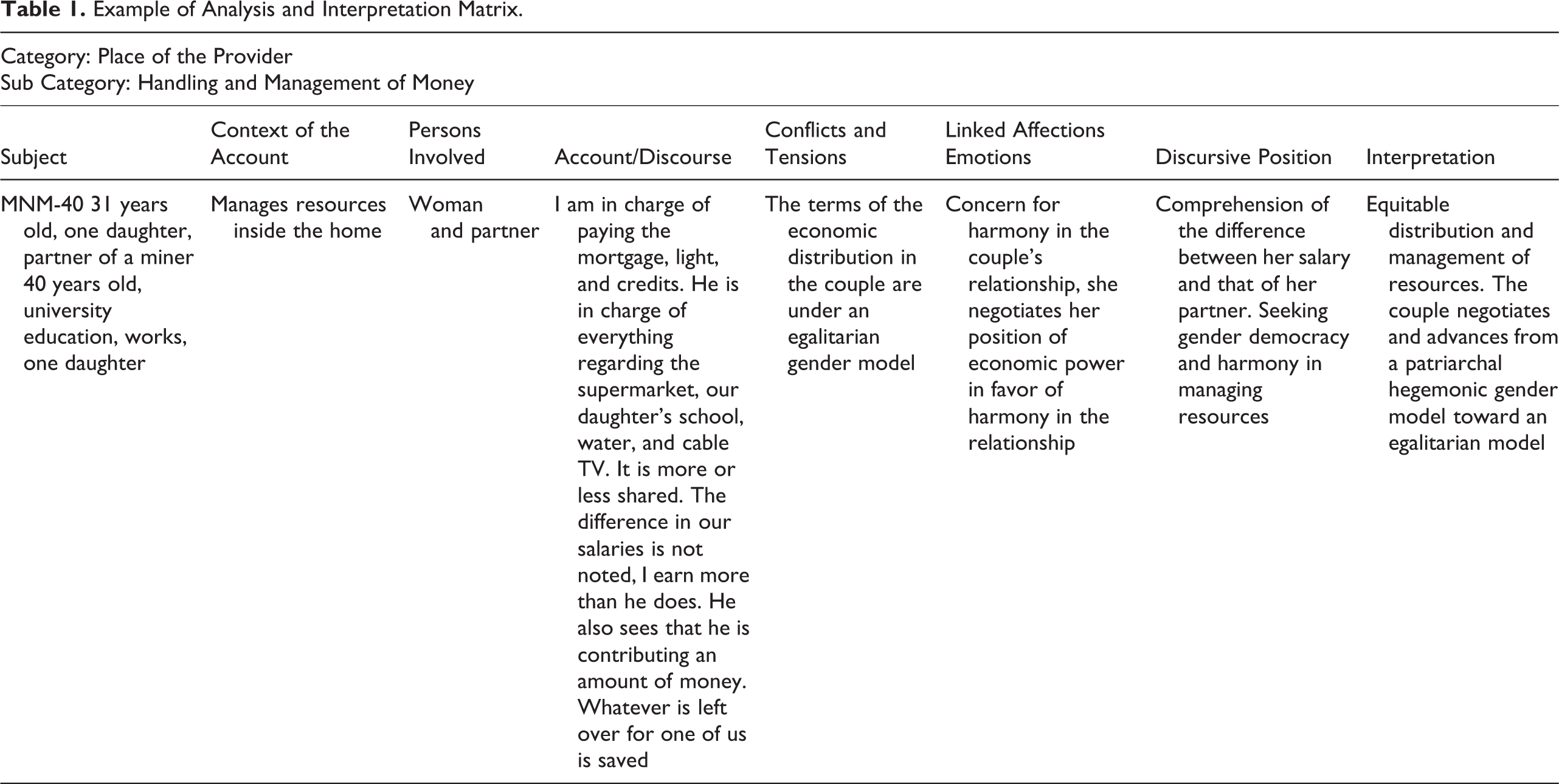
Microtexts (fragments of accounts) were selected (Van Dijk, 2003) according to the model established by Heidegger (2003) to capture the meaning of the discourses, taking into account their individual and social contexts. During the process, we worked as follows: (a) discussion among the researchers; (b) interdisciplinary analysis at a theoretical level regarding the articulation of material from different social science disciplines on mining, gender, and couples; and (c) interpretation of open interviews, field notebooks, and sociodemographic questionnaires.
Participants
Twenty-two workers participated, 11 from copper mining companies and another 11 workers from other nonmining sectors, all from the Antofagasta region. The experience of workers was analyzed based on their occupational positions.
The ages of participants were between 21 and 65. The limit of 65 enabled us to hear longer histories of couples, with greater articulation of the traditions of the “pampinas” (habitants of de desert). We also interviewed six women partners of workers who discussed their experiences of conflicts and tensions, gender positions, and handling and managing money.
The inclusion criteria were based on the objectives of the project, seeking to understand the experience of a mining couple in the family bond. For women, they were being a mother and maintaining a relationship with a male who worked in mining, on a shift system, or in other sectors of the Antofagasta region. Men were required to work in mining or in other sectors for at least 1 year, to be in a relationship for at least 1 year with a partner and to have their own or their partner’s children.
Of the six women interviewed, five did not have their own income. Family incomes, in the majority of cases, came only from the men and in all cases approximated US$3,500 per month. In one couple where both partners worked in mining, their total income amounted to US$8,500.
Procedure
We used institutional mining company and union networks to contact workers and their partners and then applied the snowball system among the participants. This population is difficult to access not only because of restrictions imposed by companies but also because of subjects’ typical resistance to openly discussing sensitive and intimate matters. We organized the interviews in pairs of male and female researchers to offset sexualization 3 in the process.
Findings
We organized our results according to the central category (conflicts and tensions in negotiating money) and according to two subcategories: (1) gender position, handling and managing money in a mining family couple; and (2) gender position, handling and managing couple. Below we propose a comprehensive analysis model that articulates this theory and characterizes the context, categories of analysis, types of negotiation, and modes of handling and managing money in the couple (Figure 1).
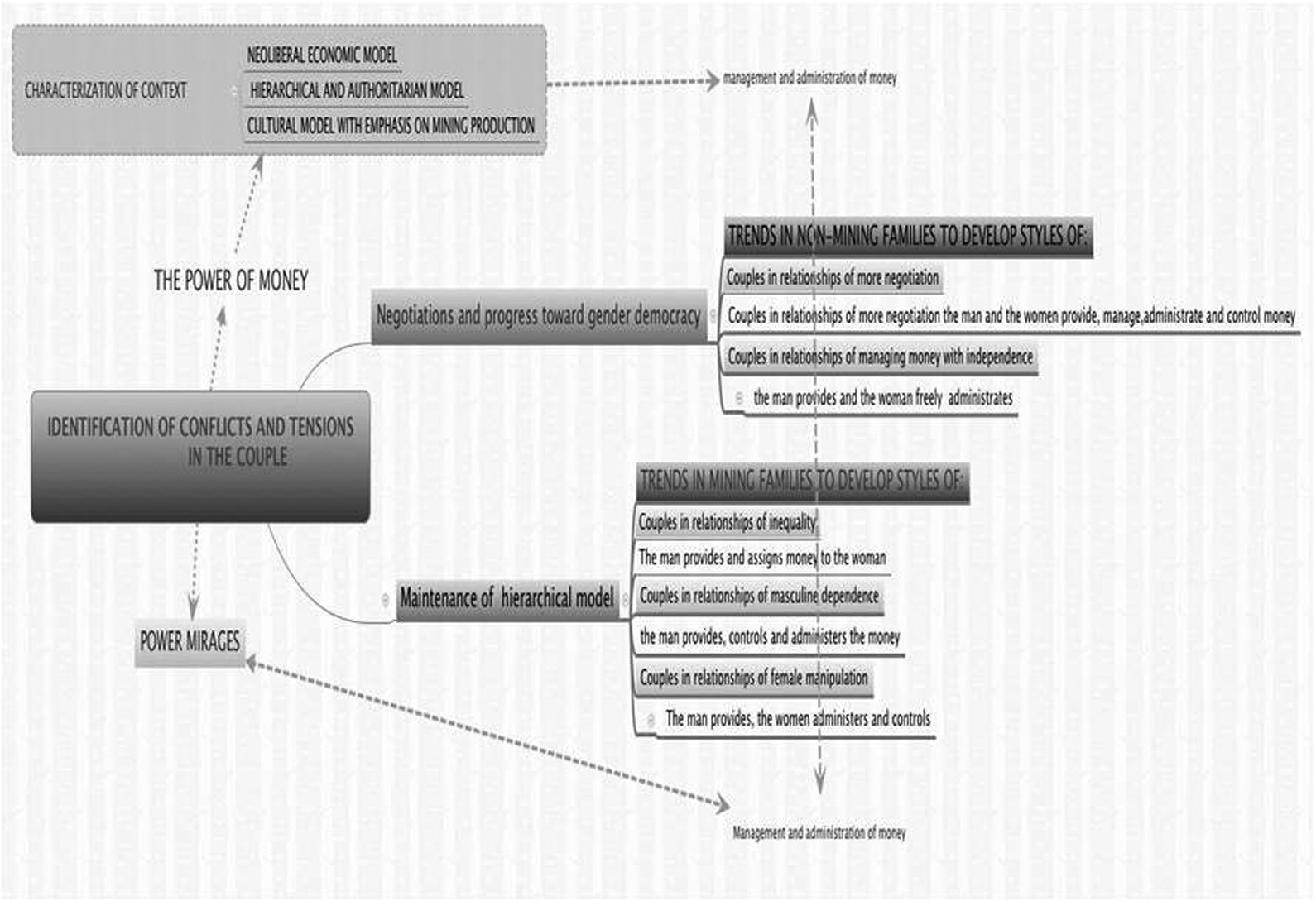
Emerging analysis model.
Gender Position, Handling and Managing Money in a Mining Family Couple
Woman 5, Mining Family, 38 years old, 2 daughters. After years of me managing the money while he was at the mine, suddenly he started with “Where is the money! But if I haven’t ‘farreado’ (expression to denote squandering money) it, what is happening!” We had problems because he said, “but we can’t spend so much money, we have to save.” So I said to him, do I buy less food, what do I do? We argued, because I am not a woman who wastes money and he knows that, so it bothers me. I have felt his change of attitude; now he pays the bills and I am very much at peace; I don’t spend anything, I don’t pay anything. He handles the subject of how much comes in, how much goes out, and how much is spent; he is taking care of it.
She attempts to describe her effective management of the family money, but her feelings of guilt emerge. She says “I am very much at peace” despite being newly subordinated (Osborne, 2014). Her attitude can actually be an antidote to her experience of shame; she can overcome her husband’s suspicion of wasting his resources. Yet, by focusing solely on household labors, she will not be seen as a good woman–wife who deserves the power to manage the family’s money. Woman 6, Mining Family, 60 years old, 2 sons. We manage the money together. On paydays, my husband and I see what we need to pay. But he administers the money; he keeps it in his bank account and during the week he gives me money, or in emergency cases. We have arguments because he spends a lot of money going out or on clothes, but he doesn’t like to invest in furniture or in construction (fixing up the house), which are things that seem more necessary to me. Arguments have come up because my husband lends money to his brothers and does it behind my back. Since I don’t have access to his bank account, if he tells me a number and I realize the numbers don’t coincide, I ask him and he says “I sent money for a brother” and then he doesn’t pay him back.
The man’s type of consumption is eminently “masculinized” and “of class,” tied to the exhibition of resources in the public sphere, in consonance with the need to project an image linked to the mining ideal of a man who is “successful, well dressed and who eats well”. Also, disinterest is denoted in making lasting investments of interest for the family. Woman 6, Mining Family, 60 years old, 2 sons. Miners consume everything there is in places with women, alcohol, and food. So my strategy was that if they paid him 50 pesos, I applied for a credit for 80. I arranged to pay for it with the extra bonuses; I always consumed more. If he wanted to replace the car, fine! We’ll replace it. If we want to replace things in the house, so what if we are indebted! What was important was that there was no money left in the pocket because I saw that those who had money left were the ones who went out to spend it on “those other” women.
She handles the couple’s time and activities authoritatively, her great fear being extramarital relations. Fear/morals (Pini et al., 2013) are in the power of seduction attributed to the “other women” with whom the man could “invest” part of the resources that she (the wife) wants to manage. In this power game, the mining man is symbolized as highly attractive to all women, based on a hierarchical gender and heteronormative model. Woman 4, Mining Family, 32 years old, 1 son. I have the same profession as him and I work in the mine. When we started to divide up the household tasks we agreed that we would divide the bills half and half. The bills that were up to him he forgot about and they piled up. I said that I don’t forget that type of thing. So I pay all the bills and you give me your part of the money. We don’t fight for sport; if we fight it’s to solve a problem and reach a conclusion. I take charge, give me your money, I pay the bills, and you take care of other things. He took it well because there haven’t been any more conflicts. Man 9, Mining Family, 41 years old, 2 sons. Now we give them the card so they can buy what they need because they are independent. Before their mother bought for them but now they choose what they want. They are responsible in that sense and we trust they can handle it. Man 8, Mining Family, 38 years old, 2 sons. I manage; I try not to cause my partner to worry. Even though I earn good “lucas” (money) I try for her not to worry about what has to be paid, take the burden away from her. She also has her cards; she has the right to have money. I go more for the big bills, the mortgage loans there always are, so on that side I’m the one who handles the money. Man 4, Mining Family, 35 years old, 3 sons She spends maybe around 140, 150 “lucas” (thousand pesos) she didn’t have to spend that maybe was intended for other things and she spent it on clothes. There is nothing that makes her happier than to buy herself clothes. But she knows she mustn’t, if she is going to buy something she has to ask me. I don’t know; also, she has to use the money for something necessary. I give her the cards so she can go to the teller machine for some emergency when she travels or if the children get sick and I am on shift, and she spent it.
Gender Position and Management of Money in Nonmining Family Couples (Other Sectors)
Man 5, Nonmining Family, 59 years old, 2 sons. Still there is trust between us, but mostly I handle the money. I pay the bills and handle the money. Now she has her own money. Since both children are working now, they give her money. Now she handles more money than I do; well, after several years she is handling more money.
In this particular case, the woman does not manage or use the money generated by the male provider. Even though she now obtains and uses more money than he does, this is equivalent to jointly managing common money. Woman 3, Nonmining Family, 40 years old, 1 daughter. At first I thought that the topic of money was harder for him than for me. I completed my higher education and had a good salary, then he still competed with me, but over time we talked it over and have to try not to make it so important. But I believe what we did well was when we said, “okay, you take charge of this and I’ll do this other.” Woman 2, Nonmining Family, 40 years old, 1 daughter. I am in charge of paying the mortgage and the light bill. And he is in charge of paying at the supermarket, our daughter’s school, water, and cable. It’s more or less shared, because we contribute almost the same amount, so we don’t notice the difference, we negotiated it from the beginning. Because he sees that he is contributing a good amount of money and so am I. If one of us has something left after paying their part, whether more or less, we save it.
This testimony shows traits of the new masculinities and femininities. Compared to managing money, there are more options for achieving equality in other aspects of family life, such as raising children. Man 11, Nonmining Family, 32 years old, 2 children. She is the one who imposes punishments and discipline, and my daughter always comes to me to defend her, even though I know that is wrong, since it undermines my wife. Regarding the money provided for the home, I earn it but she manages it; she do it, she manages it because I spend it all. It’s not that I spend it on things for me, but on things for my daughter, anything; if I go somewhere, I see something for my daughter.
The management and use of resources in the masculine hierarchical gender relationship are inverted in this family’s division of children/money. In this case, the exchange of goods or property is in conflict because although the woman continues to be the “queen of the home,” who manages and sets the rules, it is the man who indicates that “the daughter is mine and the money is yours.”
Conclusion
This research provides information for family mediation actions carried out by duos of mental health professionals, where the social worker plays a fundamental role in interventions in mining and nonmining communities. In Chile, the success of the “neoliberal global system” lies in that society and its union-based organizations have been largely depoliticized and now they negotiate based on economic claims, leaving subordinated the workers’ quality of life, expansion of their civil rights, and taking care of their emotional well-being. In this sense, the Chilean neoliberal model is focused on its depoliticizing effects, which is evidenced in the narrative of the participants in these studies, which reflect the different relational expressions with their partners and children regarding consumption and the effects in terms of security and empowerment that money gives them. One way of challenging the model is to promote the recovery of the sense of the union organization in pursuit of strengthening social relations and the recovery of the political conscience and civil rights of mining workers, as a resistance to the dominant socioeconomic and cultural model.
In these contexts, occurrences such as conflicts over money, debts, or the threat of unemployment can cause separations or situations of domestic violence that are difficult to resolve (Wendt, Buchanan, & Moldeo, 2015). In those contexts, the results contribute knowledge for the proposals that social workers carry out in companies and state organisms regarding labor policies and work–family reconciliation and the handling of money faced with economic changes and this type of crisis situations, which could involve the development of new forms of gender relations in the families of mining and nonmining workers. Among younger couples, negotiation experiences may indicate changes that have to do more with new attitudes toward gender hierarchy and social participation than with age. We also observed that among mining couples, money has a more masculinized symbolic role than in nonmining couples. This is due to mining workers’ access to high salaries and good benefits.
Couples in which both partners contribute to the family financially are able to maintain a relationship tending toward equality in gender relations. They see money as a shared asset, symbolizing the building of mutual trust in the couple, particularly among young couples with a professional working woman. In couples with higher economic incomes, where both work, conflicts over money decrease because they achieve gender relationships of greater equality and negotiation is more democratic, as opposed to couples with lower incomes, where the woman does not work and depends on the man’s money. In these cases, there are conflicts of power and less control by the woman during negotiation. It should be taken into account that Antofagasta does not have an indigenous population in poverty status in mining jobs and the levels of unemployment in the region are low.
To older women and men from mining families, money as a symbolic element of power appears to be sexualized and associated with empowerment of either the woman or man, thus exacerbating the sex/gender model of the current authoritarian hierarchy. Even when the women studied could manage the money assigned by the men and reach significant levels of independence, this did not assure them true autonomy but rather created a “mirage or illusion of power.”
In older women, this fiction means managing the money without making use of it as their own because they must render accounts to the male provider. This is linked to the prevailing androcentric gender model: These women continue perceiving it as “natural” that money is symbolized as masculine power and that men persist in holding on to that power. Public displays of mining money show masculine prestige, granting social status, and symbolizing virile strength (Coria, 2012).
Among some women, unease is linked to feelings of guilt (Osborne, 2014) when their male partner doubts their capacity for “proper” handling of the money he provides. This is observed more in mining couples than in nonmining couples. In families where the man works on a shift system, it is difficult for the woman to work a traditional schedule because she is in charge of raising the children and/or taking care of the home. She cannot earn her own income or purchase goods, which places her in a subordinate position to her working husband.
In the Chilean context, mining companies favor neoliberal economic ideologies, as observed in the style of management with inequality of power legitimized by the gender models that predominate among the families in this study (Dema, 2006). These models can create tensions and conflicts regarding the use of the family’s resources, whether for investments or on superfluous consumption (food, clothing, parties, travel, etc.), with each partner seeking to satisfy his or her own interests, needs, and desires.
In this high-consuming culture, there are public displays of wealth that grant social prestige but cause debt among mining families. The same occurs with loans to family members, which also contribute to the image of the sustaining, wealthy miner who provides resources to those in need. Because the woman does not participate in decisions regarding money management, conflicts emerge, and persist in the family.
This model of a consuming family is sustained by the mining company, which reproduces social and gender inequalities that contribute to perpetuating public/private distinctions. The entire family is organized according to mining production rhythms, and the family depends on its benefits for making decisions (scholarships, payment of services, housing loans, etc.). Additionally, the family’s rhythm adapts to the shift system and to the father’s presence and absence at family and school events and in private life.
This changes when there is joint management, where resources are used in an egalitarian manner because the couple’s financial contributions go directly into a common purse. In these families where both partners work, regardless of whether the incomes are equal, the possibility of both partners participating in decisions and sharing power is enriched by gender equity.
One mirage or illusion of power occurs when women are isolated from decision-making based on androcentric gender hierarchies. There is a tendency to characterize the woman as a child by “not complicating her life, and protecting her from unnecessary worries.” This is a common control mechanism in mining contexts. Additionally, the romantic love model (Ashenden & Brown, 2014; Giddens, 1992) makes the woman potentially culpable for any emotional instability of the man who is responsible for the couple as the provider.
In this model, the couple is idealized as “a whole,” with each partner merging into the other. As with the romantic dimensions of a relationship, there is a need to balance individual interests and desires. In mining and nonmining families, the man breaks away from this merger in daily life and the woman must take charge of multiple tasks and responsibilities in the sphere of the children and the functioning of the home. Here, her many roles are greatly valued.
We believe that to improve couples’ relationships regarding money management and to promote equality, it is important to involve mining companies in a broad commitment to changing cultural and gender roles among their workers. This commitment would entail incorporating families’ quality of life as a factor in union negotiations, along with educational programs about money management. This would raise the psychosocial well-being of workers and their families by reducing levels of debt and excessive spending.
Resolving conflicts between work and family requires transcending the borders of the mine, as the mining context shelters and reproduces typical neoliberal models in a paroxysmal manner. However, this article does not intend to attribute family financial conflicts exclusively to mining companies; to do so would overlook the multiple sociopolitical and ideological facets of these conflicts.
One of the limitations of this study, undoubtedly, is the sensitive subject matter. Whether in the mining or nonmining population, we address intimate subjects that are seldom discussed outside domestic and family boundaries. We required not only access to women and men from mining and nonmining families but also information on whether the couple’s partners have comparable salaries.
Nevertheless, our interviews show that women who have jobs increase their autonomy and independence. Although, as indicated by Jiménez Figueroa and Moyano Díaz (2008), similar incomes between a man and a woman would not, in themselves, generate more symmetrical or egalitarian relations in the couple. It has not been possible to fully evaluate this in Chilean mining contexts strongly influenced by neoliberal culture, where access to the world of work and salaries is different for men and women.
Footnotes
Declaration of Conflicting Interests
The author(s) declared no potential conflicts of interest with respect to the research, authorship, and/or publication of this article.
Funding
The author(s) received no financial support for the research, authorship, and/or publication of this article.